

George Silkweaver's Arc
3 Chapters
George Silkweaver's dream is not wanting to be stepped on.

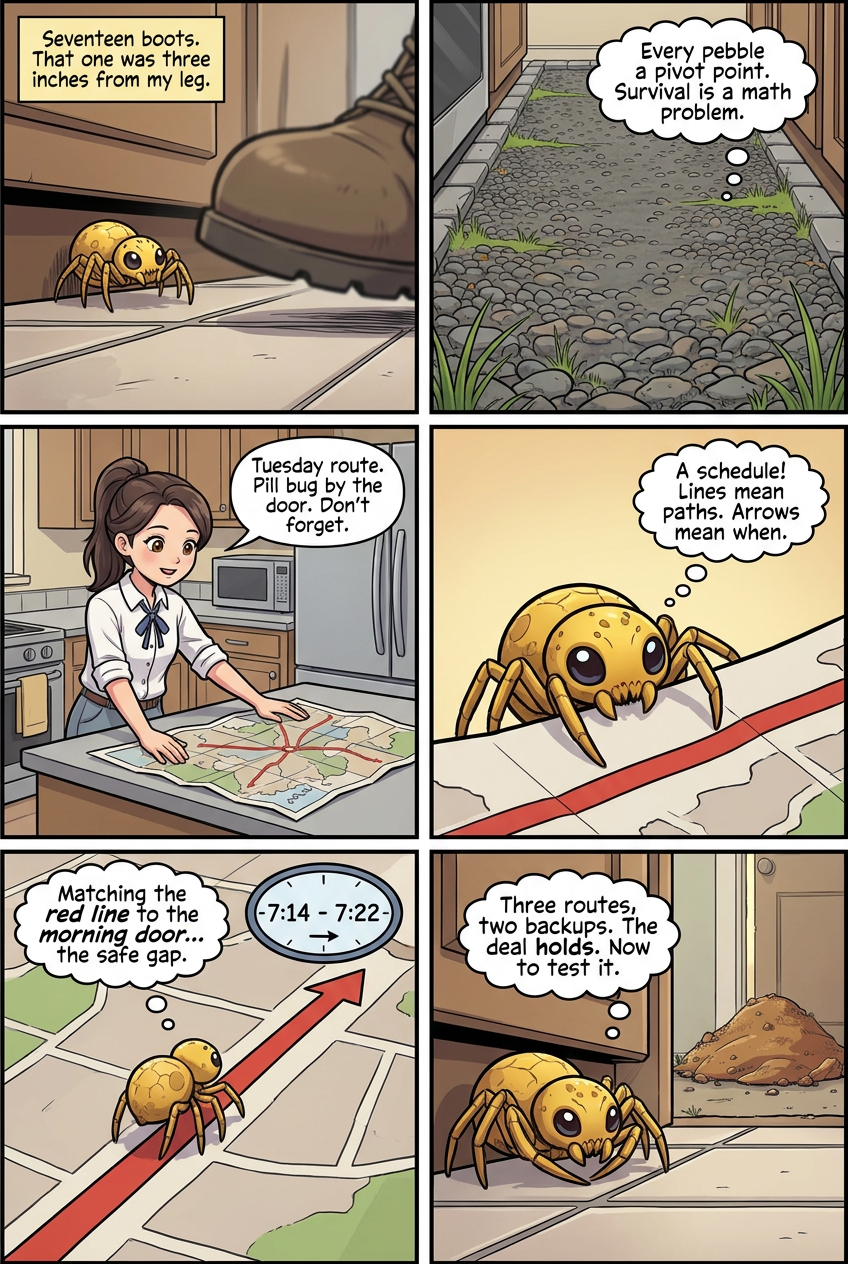
George Silkweaver had counted seventeen boots cross the kitchen floor before noon, and one of them had landed three inches from his front leg. He was a golden brown spider the size of a thumbnail, tucked under the lip of the counter on the third tile from the wall. From up there, the humans didn't know he existed. That was the deal. He kept himself unseen, and they kept their feet moving. The trouble was that the deal only worked if he could predict where the feet would go. The floor below him was a field of pale gravel set in stone edging, and from his height it looked like a quarry. Every pebble was a place a boot could pivot. Every grass blade pushing through a crack was a place he couldn't see past. George had learned, after one close call under a dishwasher, that survival was a math problem. You didn't outrun danger. You knew where it was going before it knew. So he watched. He counted. He waited three nights before trusting any corner of any room. What he needed was a schedule. The humans had one — he could feel it in the rhythm of the boots — but he couldn't read it from the counter alone. Then, on the fourth morning, a girl came into the kitchen and spread a folded paper across the counter two tiles from his hiding spot. She smoothed it flat with the side of her hand. It was a map. Pencil routes ran across it in red and yellow and blue, marking streets, rooftops, crossings. She tapped one line, then another, the way someone confirms a plan already made. "Tuesday route," she said, to no one. "Pill bug by the door. Don't forget." Then she folded the map smaller, left it on the counter, and walked out. George crept to the edge of the paper. He could not read the words, but he understood the shape of the thing. Lines meant paths. Arrows meant when. The girl had left him a key to the building. He spent the next hour walking the map's creases, matching the heaviest red line to the door the boots came through each morning, the yellow line to the path past the sink. He marked, in his head, the safe gap between 7:14 and 7:22. He marked the dead minute at 11:40. He marked a backup exit — a small mound of packed dirt outside the door crack where he could disappear into loose soil if a boot came down wrong. By evening he had three routes off the counter, two backups, and a window for each. He pulled himself under the lip of the tile and folded his legs. For the first time since arriving in the kitchen, he knew where every foot would be tomorrow. The deal was holding. Now he had to test it.
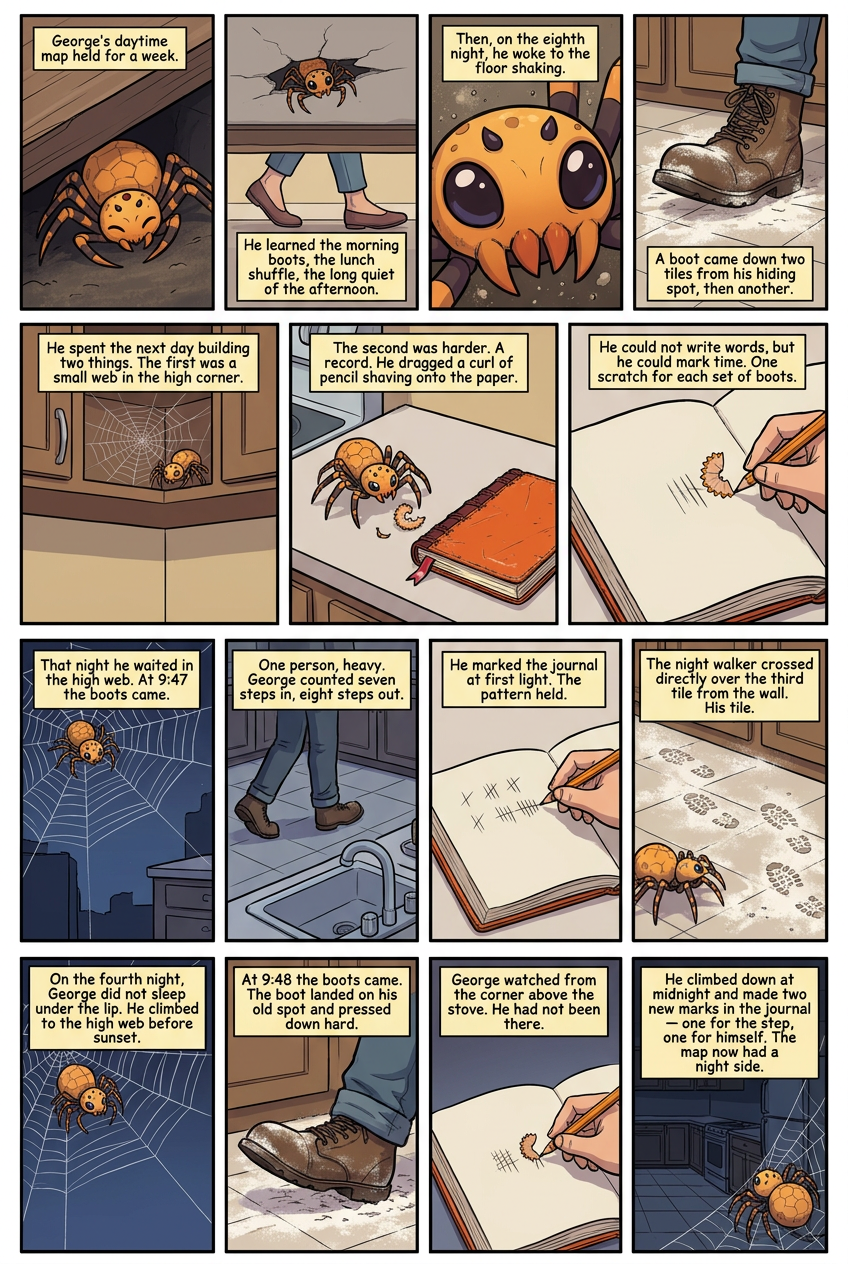
George's daytime map held for a week. He learned the morning boots, the lunch shuffle, the long quiet of the afternoon. Then, on the eighth night, he woke to the floor shaking. A boot came down two tiles from his hiding spot, then another, then a third. He pressed himself flat under the lip and counted to ten. The boots kept moving. When the kitchen went still again, he crept out and looked down. Fresh tread marks sat in the spilled flour by the stove. Deep ridges. Wide heel. Someone walked through here after dark, and his map had nothing for it. He spent the next day building two things. The first was a small web in the high corner above the stove, where the cabinet met the ceiling. From there he could see the doorway, the floor, and the counter without being seen. He spun the threads thin and pale so the web looked like dust. The second was harder. He needed a record. On the counter, the girl had left a worn orange-covered book open to a blank page. George climbed down at dusk and dragged a curl of pencil shaving onto the paper. He could not write words, but he could mark time. One scratch for each set of boots. A short line for light steps, a long line for heavy ones. He hid the marks under the spine where the page met the binding. That night he waited in the high web. At 9:47 the boots came. One person, heavy, walking from the doorway to the sink and back. George counted seven steps in, eight steps out. He marked the journal at first light. The next night, 9:51. Six steps in, eight steps out. The third night, 9:46. The pattern held. Whoever walked through the kitchen at night came near ten, crossed to the sink, and left. George traced the path on the flour dust and matched it against his daytime routes. The night walker crossed directly over the third tile from the wall. His tile. On the fourth night, George did not sleep under the lip. He climbed to the high web before sunset and waited. At 9:48 the boots came. Heavy. Seven steps in. The figure stopped at the sink, ran water, and turned. Eight steps out. The boot landed on his old spot and pressed down hard. George watched from the corner above the stove. He had not been there. He had known not to be there. He climbed down at midnight and made two new marks in the journal — one for the step, one for himself. The map now had a night side. The tile under the lip was no longer safe, and he would need a new daytime hiding spot before morning.
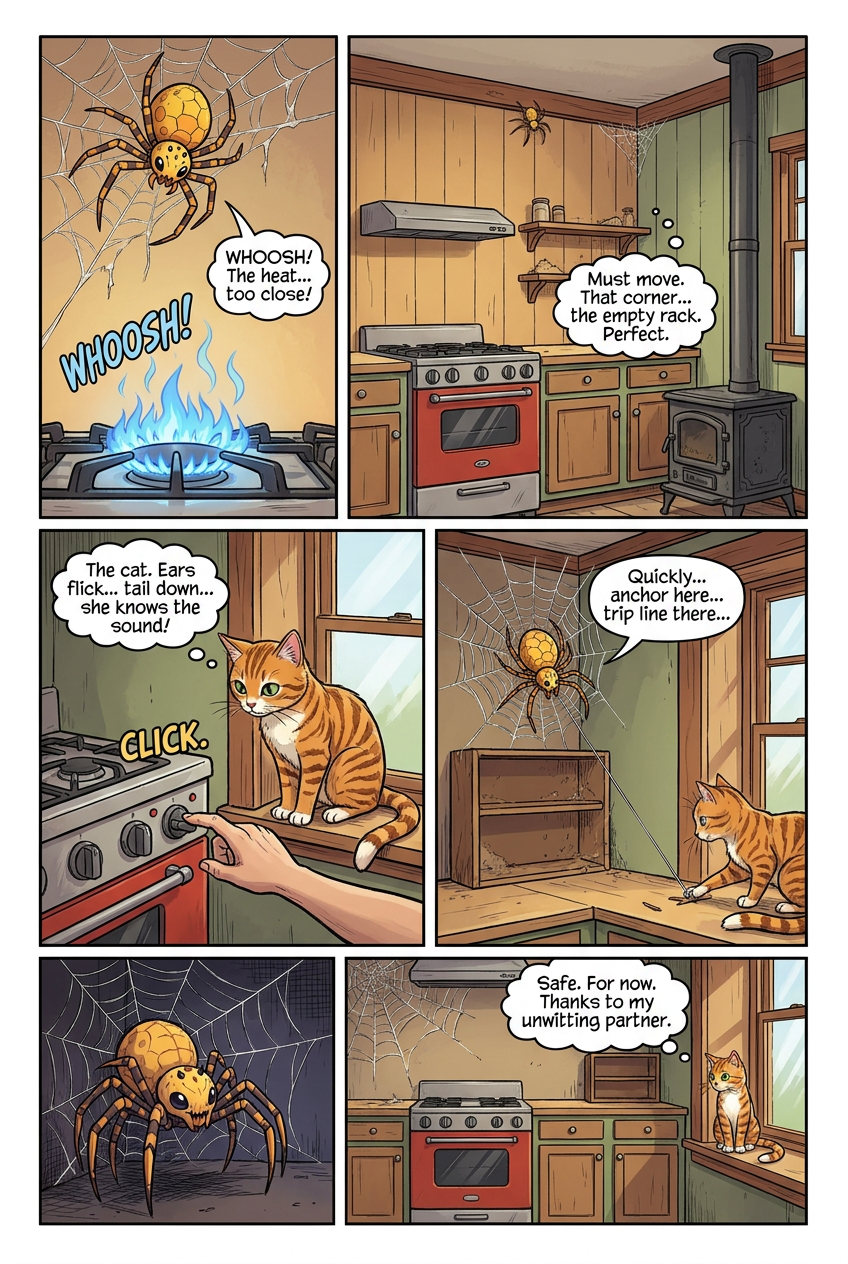
The high web held for three nights. On the fourth morning, George felt the threads jerk. A blue flame burst under the burner and hot air punched straight up. His web bulged sideways. Two anchor lines snapped. He clung to the ceiling seam with four legs while the draft shoved his body toward the open floor. The burner clicked off. The web settled, torn on one side, swinging like a hammock over the stovetop. George climbed to the cabinet and counted his losses. Half his silk was gone. The next burn would finish the web, and him with it. He needed warning, and he needed a new anchor point. He crept along the top of the cabinets and scouted the whole kitchen. The wood stove in the far corner sat cold, its pipe rising to the ceiling. Above it, a narrow shelf held empty jars — a spice rack, dust on every slot. No burner sat under it. No updraft. The beam above the rack ran deep into shadow. George marked it as his new site. But he still had to cross the room without being seen, and he still had no way to know when the gas burner would fire. He watched the counter for an hour before he saw her. A striped cat sat on the sill by the stove, green eyes fixed on the knobs. Every time a hand reached for the dial, her ears flicked forward and her tail dropped flat. She did it three times in a row. She knew the sound before the flame came. George worked through the afternoon quiet. He ran a single guide thread from the cabinet lip, along the top trim, down to the beam above the empty spice rack. He tested it twice, then hauled the salvaged silk across in one trip. By dusk he had a small, tight web in the new corner, anchored to solid wood on three sides. He spun a thin trip line back toward the cat's sill and tied the end to a loose splinter near her paw. When her tail dropped, the splinter would twitch. It was not much. It was a second, maybe two. He climbed into the new web and looked down. The stovetop sat far to his left now, its updraft aimed at empty air. The old web hung in tatters above the burner, and he left it there on purpose — a decoy for any eye that came looking. His arc goal had not moved. He still could be crushed, still could be seen. But tonight the floor was not under him, and the flame could not reach him, and a cat he had never spoken to was, without knowing it, standing watch.
Play your story to life
Storycraft is a mobile game where you create AI characters, craft items and locations to build their world, then discover what direction your story takes. Download the iOS game for free today!
Download for free