

Gotim's Arc
7 Chapters
Gotim's dream is claiming the black crown as the master of shadows and forbidden knowledge.

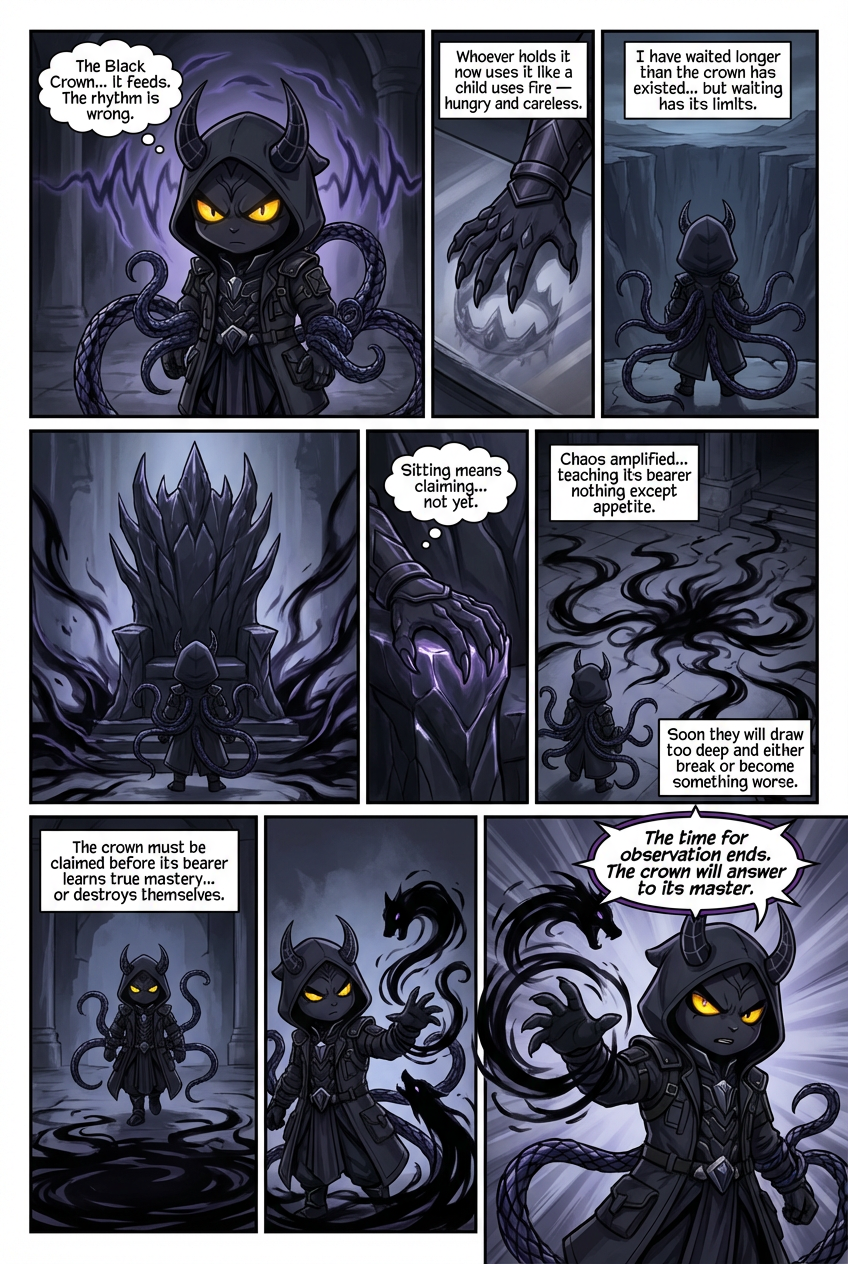
Gotim feels the pulse through the layers of distance and time. The Black Crown feeds, and its rhythm is wrong. Whoever holds it now uses it like a child uses fire — hungry and careless, burning through power with no thought to control. The hunger grows stronger with each pulse. Gotim has waited longer than the crown has existed, and he can wait longer still. But waiting has its limits. He stands before the throne carved from obsidian, his throne, positioned where the currents of shadow converge. The crown's pulse reaches him here like ripples across dark water. Each throb reveals more — the holder grows drunk on power, letting the crown amplify their chaos instead of directing it. Darkness pooled around the wrong hands spreads like spilled ink. Gotim watches the shadow patterns spread across the floor at his feet. They twist outward without purpose, without design. The crown is teaching its unworthy bearer nothing except appetite. Gotim places one clawed hand on the throne's arm. The obsidian responds to his touch, warming. The throne has stood here since before the current age, waiting for its rightful occupant. He does not sit. Not yet. Sitting means claiming, and claiming means the time for patience has ended. The crown's pulse quickens again, stronger now. Its holder is learning to draw deeper. Soon they will draw too deep and either break or become something worse. He moves away from the throne and walks to where the shadows pool thickest. The crown must be claimed before its bearer learns true mastery or destroys themselves and the crown with them. Either outcome is unacceptable. Gotim extends his hand and the shadows respond, gathering around his fingers like loyal hounds. They know him. They have always known him. The time for observation ends. He will move now, not with haste but with certainty. The crown will answer to its master.
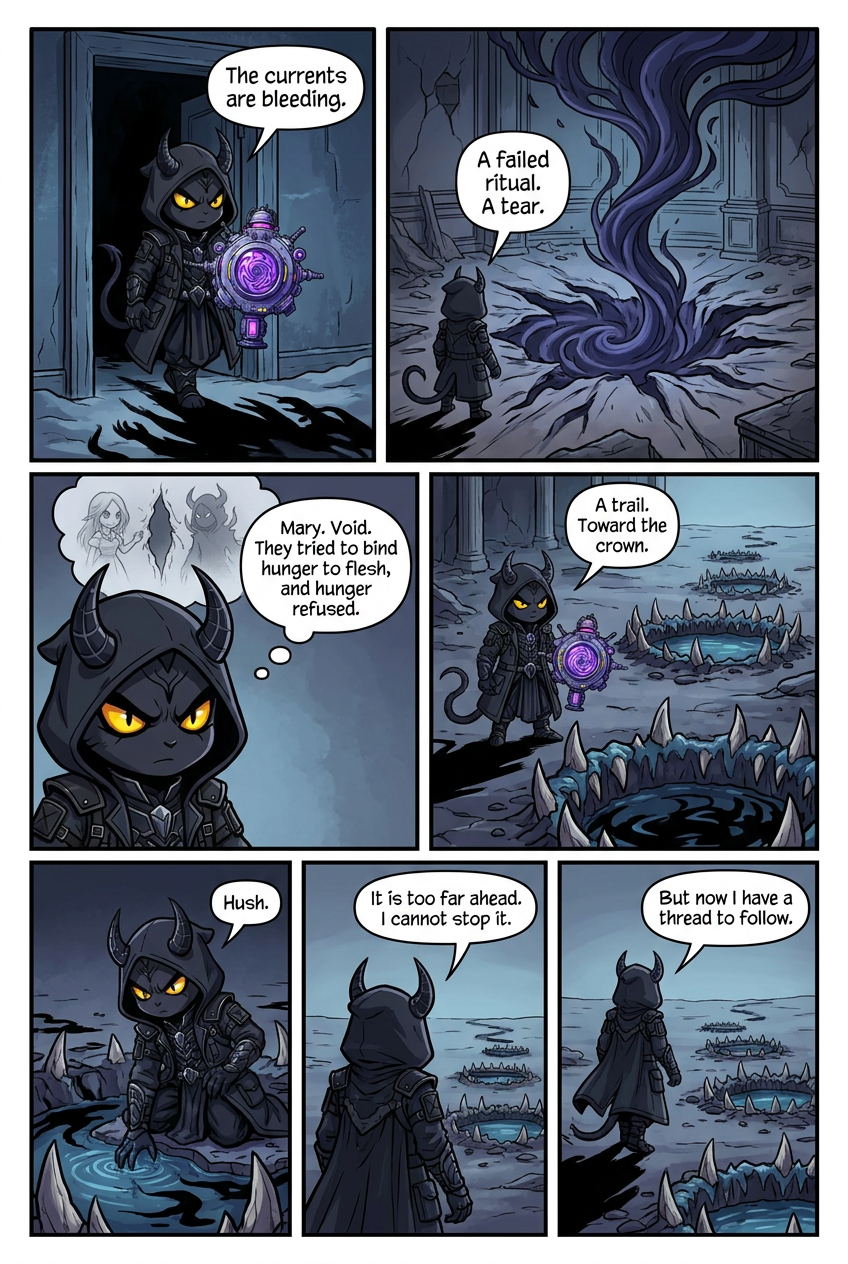
Gotim steps from the throne room into the cold air of Frostshade. The shadows at his feet follow him like water finding a slope. He lifts a small device from his belt, a round thing of metal and glass that hums against his palm. Its lens spins open, and a purple swirl forms inside it. The radar reads the currents, and the currents are bleeding. Something has torn the dark open. Not the crown's careless bearer this time. Something else. A failed ritual, close by, its edges still smoking in the unseen layers. Gotim follows the reading. He does not hurry. He never hurries. He finds the wound at the edge of a ruined mansion's east wing. A tall column of swirling shadow rises from the broken floor, twisting up into the night. It is not a doorway. It is a tear. He studies it the way a surgeon studies a cut. Through the breach, he feels the shape of two who were there before him — a mirror-girl and the hungry one beside her. Their names sit in his mind without weight. Mary. Void. They tried to bind hunger to flesh, and hunger refused. The radar pulses harder. Gotim turns. A trail leads away from the tear, carved into the frozen ground. Wherever the escaped hunger has passed, it has left a pit ringed in jagged stone teeth, full of dark water. Each pit points the same direction. Toward the crown. Toward the bearer he will not name. Gotim kneels at the nearest maw. He places his clawed hand into the cold water and speaks one word into it. The shadows in the pit go still. He cannot stop the hunger from reaching the crown. It is too far ahead, and it moves through layers he would have to tear himself to follow. So he does not try to stop it. He listens to it instead. He learns its scent. He rises. The hunger will arrive at the crown before he does, and the crown will feed it, and the unworthy bearer will grow worse. That is the cost of this hour. But Gotim now has a thread to follow that does not lie, a trail of pits that lead straight to what he wants. He lowers the radar and begins to walk.
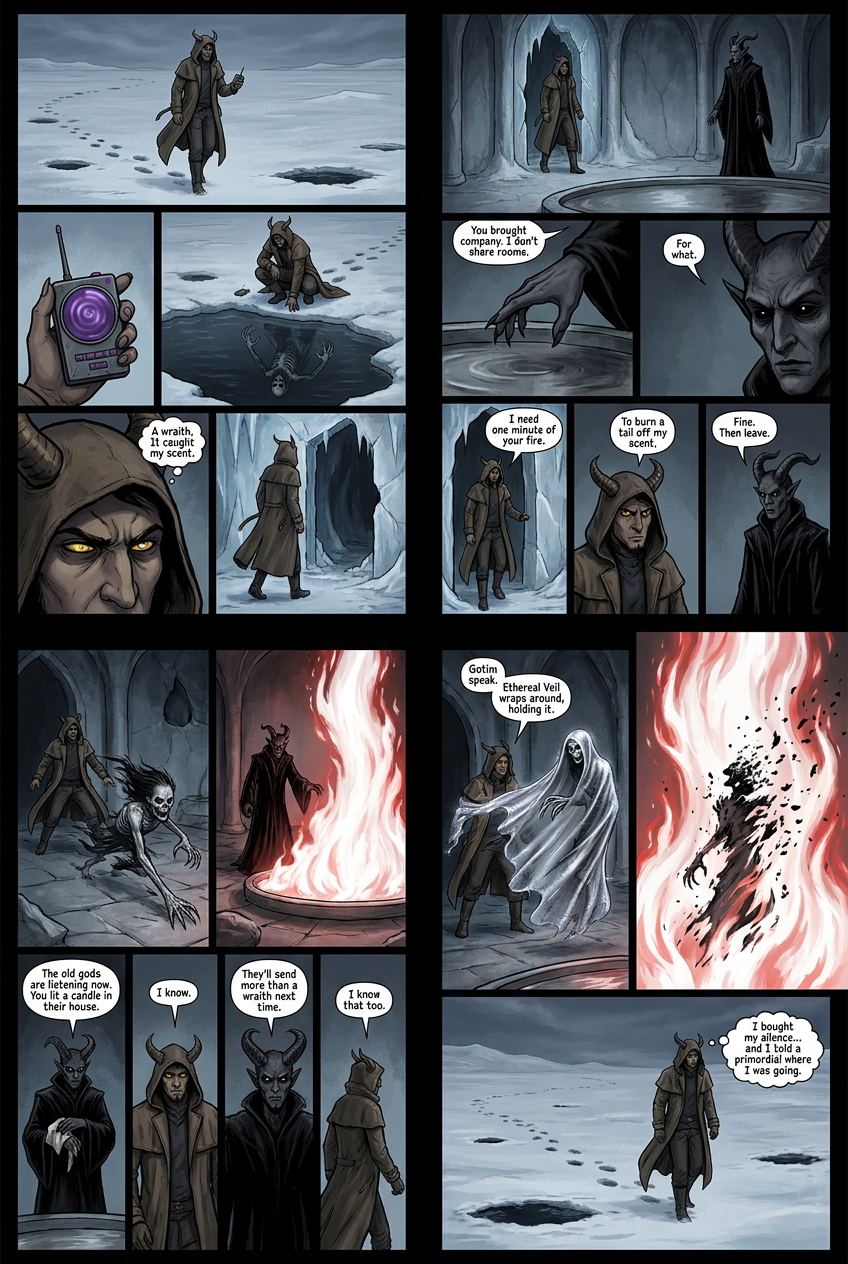
Gotim followed the trail of pits across the frozen plain. The wind died. The radar in his hand slowed its purple swirl and pulsed once, low, at his back. Something behind him was moving when he moved, and stopping when he stopped. He did not turn. He walked three more steps to be sure. He crouched by the next pit and pretended to study the dark water. In the reflection he saw it — a lesser shadow-thing, low to the ground, ribs like a skull's teeth, claws long enough to drag. A wraith. It had caught his scent in the open dark and pinned itself to his heel. If it kept following, it would call louder things. It would call the crown's bearer, or worse, the hunger he was tracking. Either would ruin him. He rose and changed course. He turned toward a broken doorway in the ice, a chamber he had known was near — a hollow where old fire once burned, a pool of dull metal ringed by dead roots. He walked at the same slow pace. The wraith followed. He led it inside. A figure was already there. Chao DeVoid stood at the edge of the reflective pool, one clawed hand hovering above the surface. He did not look up. "You brought company," he said. "I don't share rooms." Gotim stopped in the doorway. "I need one minute of your fire." Chao DeVoid's black eyes lifted. "For what." "To burn a tail off my scent." A pause. "Fine. Then leave." Gotim stepped aside and let the wraith come in. It cleared the doorway in a low rush, claws scraping stone, jaw open. Chao DeVoid dropped his hand into the pool. A pillar of flame tore up from the metal, white at the core, red at the edges. Gotim spoke one word into the shadow at his feet and the shadow rose in a thin veil, soft as silver water, and wrapped the wraith's shoulders. The veil held it for half a breath. Half a breath was enough. The fire took it. The wraith did not scream. It came apart into black flakes and the flakes went up the pillar and were gone. The flame sank. The pool went dull again. Chao DeVoid wiped his hand on his robe. "The old gods are listening now," he said. "You lit a candle in their house." "I know." "They'll send more than a wraith next time." "I know that too." Gotim stepped back into the cold. The trail of pits still led forward, still pointed at the crown. He had bought his silence, and he had spent a favor to buy it, and he had told a primordial where he was going. He began to walk again. He did not hurry.
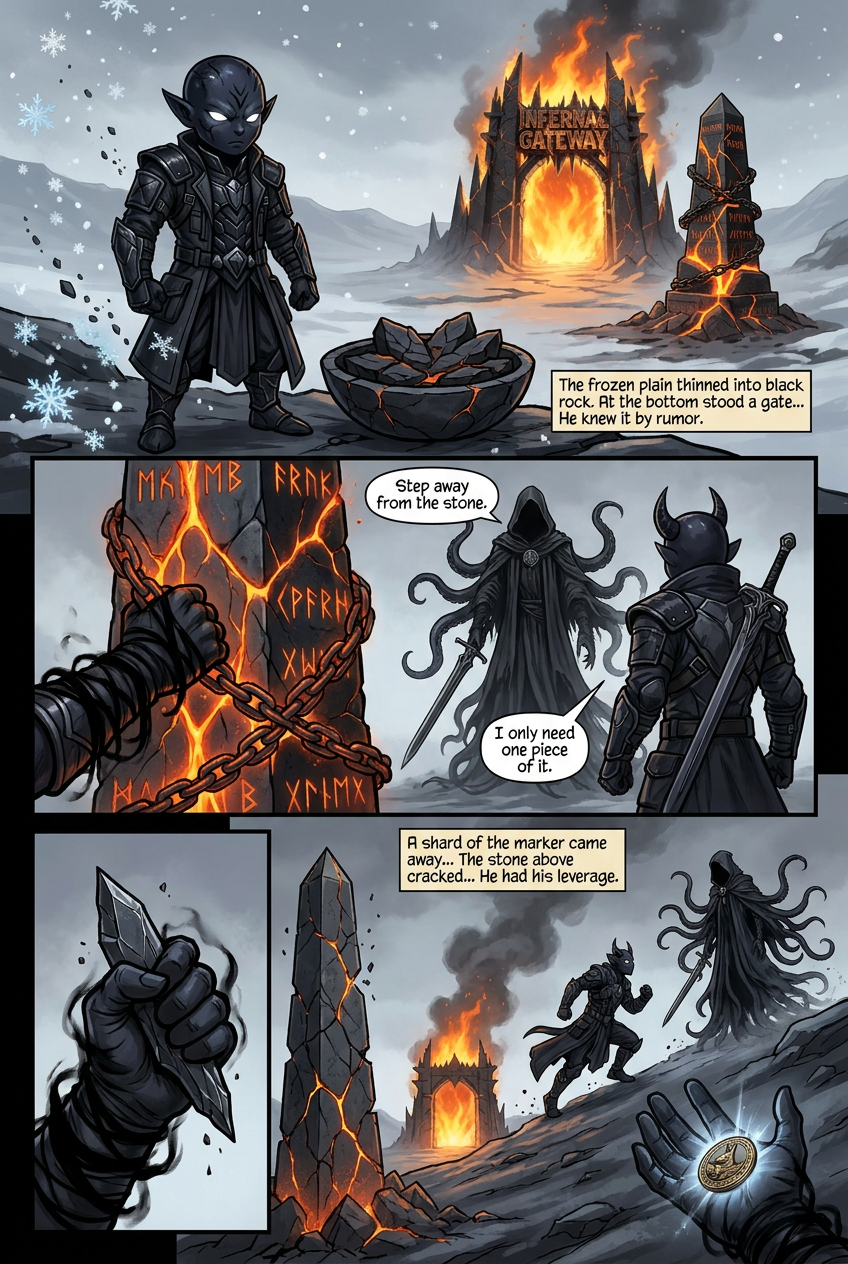
Gotim walked until the frozen plain thinned into black rock. The trail of pits ended at a ridge, and past the ridge the ground dropped into a bowl of cracked stone. At the bottom stood a gate of scorched iron and burnt stone, wreathed in low fire. He knew it by rumor. It was a door the crown's bearer used to move between the cold world and the hot one. If he wanted leverage, he had to find it here, before the hunger arrived. He went down the slope slowly. The fire from the gate did not warm the air. Near the arch a tall black stone rose from the rubble, bound in iron chains, veined with molten light. The old runes on its faces were still lit. It was a marker — a compass the bearer had planted to fix a path home. Gotim understood at once. The stone was the bearer's tether. Break it, and the bearer would come running to save it. Take it, and he had his leverage. He set his hand on the chain. The chain burned. He held on. He pulled shadow up from his own feet and wrapped his palm until the metal cooled to iron again. Then he pulled. The chain gave a link. The stone leaned. Something moved behind him. He turned. A cloaked figure stood between him and the gate, hood empty, cloak breaking apart into low tentacles that dragged along the rock. It carried a great black sword point-down in one clawed hand. A watcher. Not the bearer. A servant the bearer had left to guard the marker. "Step away from the stone," the figure said. Its voice came from under the hood, flat and old. Gotim did not step away. "I only need one piece of it." The figure lifted the sword. Gotim spoke a word and the shadow at the base of the obelisk climbed the stone in a black sheet. He drove his hand into the sheet and closed his fist on the light inside. A shard of the marker came away in his hand, still hot, still humming. The stone above cracked from top to base. The runes died out one by one. The figure came for him. Gotim did not fight it. He turned and ran up the slope. Behind him the gate's fire dimmed as the marker failed. The watcher stopped at the ridge, bound to the ruined stone, unable to follow past it. At the top of the slope Gotim opened his hand. The shard sat on his palm, dim now, but alive. A small medallion of scales was pressed to the stone from the bearer's old work — a token of judgment, still warm. He pocketed it with the shard. He had his leverage. He also had a problem. The bearer would feel this within the hour. The hunger was still coming. Now both would race him to the same point, and he stood between them with a broken piece of their road in his hand.
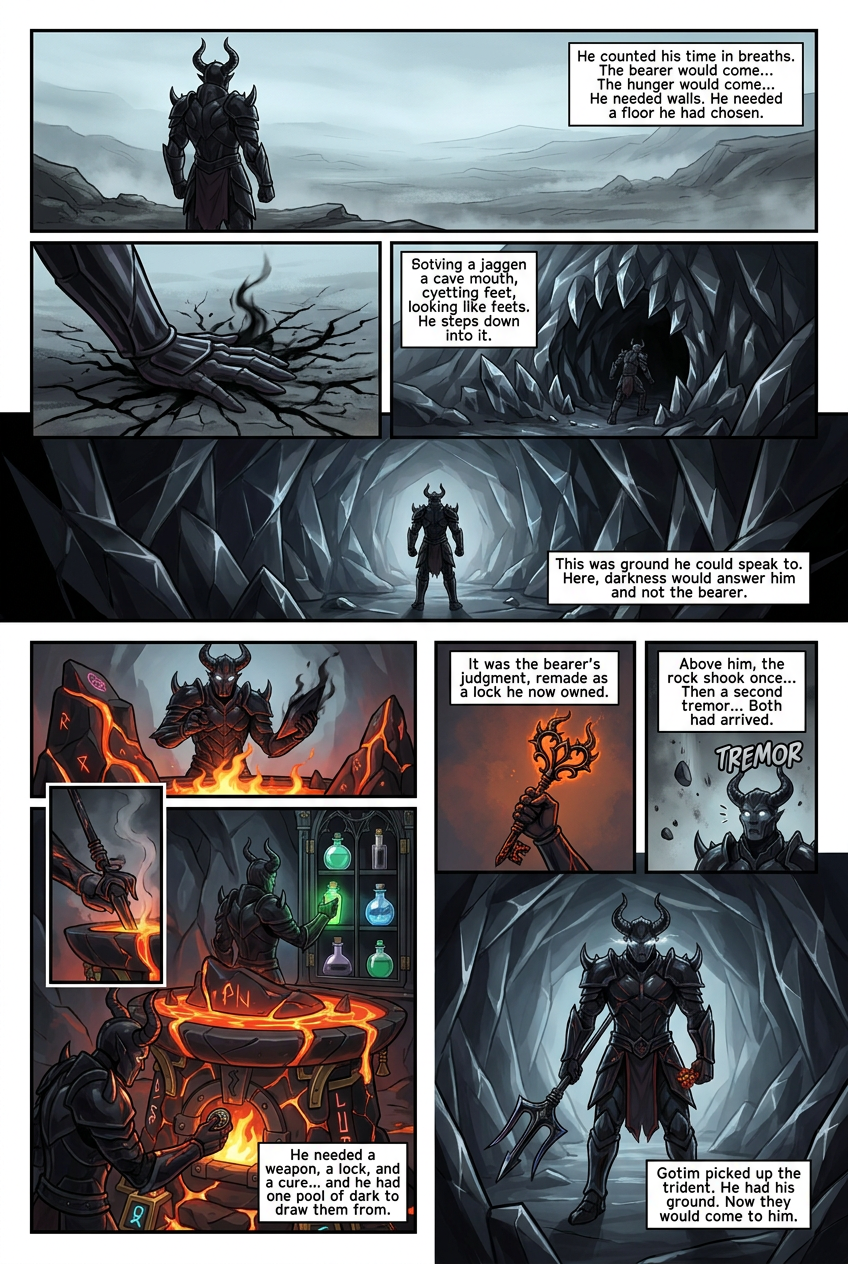
Gotim stood on the ridge with the shard in his pocket and counted his time in breaths. The bearer would come from the gate below. The hunger would come from the trail he had followed in. Both would reach this open ground before he could pick a side. He needed walls. He needed a floor he had chosen. He turned inland and looked for the seam in the rock he remembered from an older map of himself. A vein of black ran under the plain here. He set his palm flat on the stone and pushed shadow down through it, feeling for the hollow. He found it three steps to his left. He stepped there and pushed harder. The rock parted like wet cloth. A mouth of smooth obsidian opened at his feet, jagged crystal teeth around a dark throat. He dropped inside and sealed the seam behind him. The cave held him the way a hand holds a coin. The walls shone. His own shape moved in every face of them, thinned and multiplied. This was ground he could speak to. Here, darkness would answer him and not the bearer. He worked fast. He set the shard on a flat shelf of stone and pulled shadow up around it in a ring. He needed a weapon, a lock, and a cure for what was coming for him, and he had one pool of dark to draw them from. He drew first from the floor. The dark rose in a column and cooled into a forge, seamed with slow red light. He fed the shard's heat into it and kept the medallion of scales aside. From the forge he drew a shaft, three-pointed, black glass with an edge that would cut a name. He set the trident against the wall. He drew again. A tall cabinet grew out of the far side, shelved and narrow, and he filled its slots with what the cave gave him: a stoppered vial of his own shadow for the hunger's mouth, a bottle of cold light for the bearer's fire, a small green one he did not label. He would need all three before dawn. Last, he pressed the medallion of scales into the forge's mouth. The metal ran. He shaped it as it cooled. A key came out of it, horned at the bow, veined with the same slow light as the forge. It was the bearer's judgment, remade as a lock he now owned. Whichever door the bearer opened next, Gotim held the other side of it. Above him, the rock shook once. Something heavy had crossed the ridge. Then a second tremor, farther off, colder. Both had arrived. Gotim picked up the trident. He put the key in his pocket beside the shard. He had his ground. Now they would come to him.
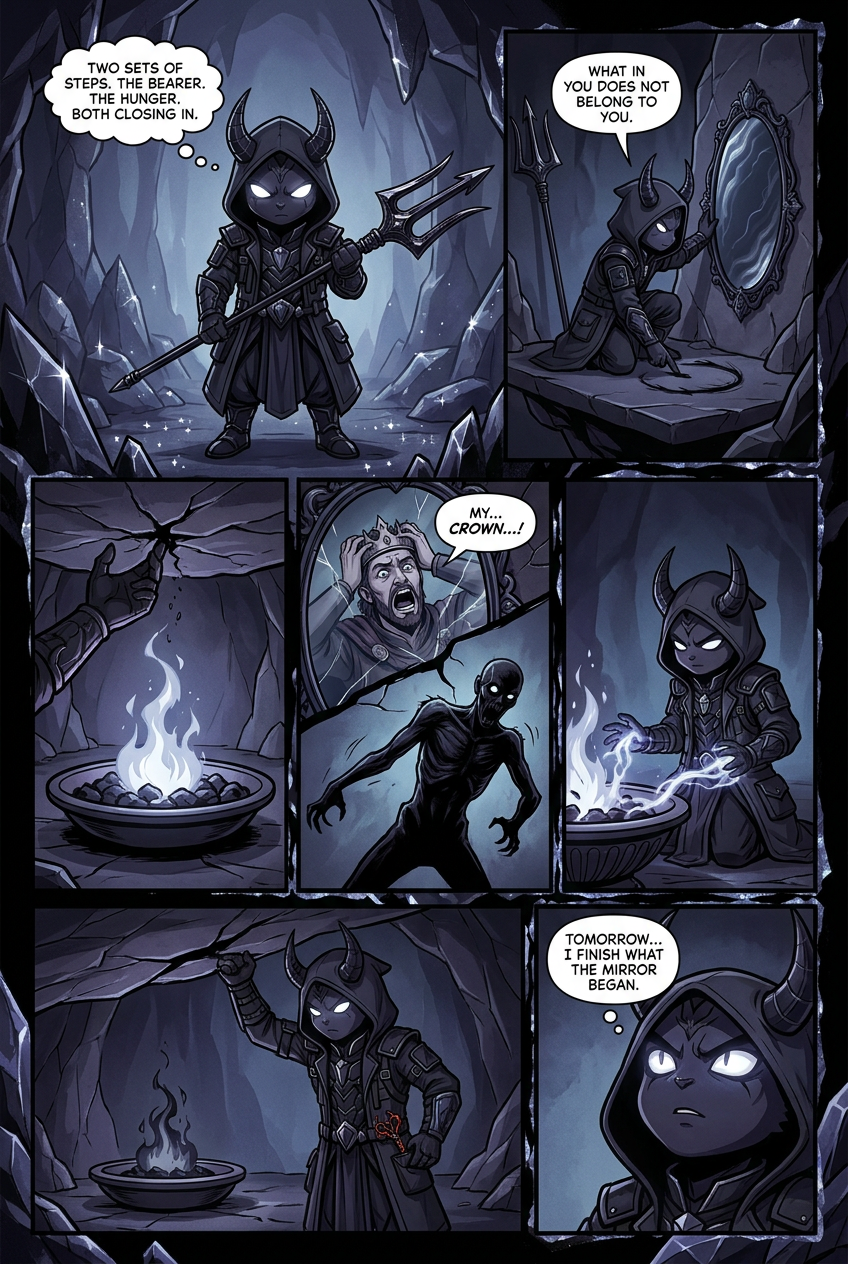
The rock shook again above the obsidian hollow. Gotim stood in the center of the cave with the trident in his hand and listened. Two sets of steps. One heavy, dragging. One quick and hot. The bearer above, the hunger below the ridge, both closing on the seam he had sealed. He could burn either one with shadow. He could not do it without shouting his name across the dark to the old gods, who had been listening since the wraith. The soldiers they had sent were already moving. A large working here would bring them down on him mid-fight. He set the trident against the wall. He would not use it first. He knelt at the flat shelf where he had made the key and drew a small circle of shadow. Small was the rule now. Small would not carry. He pulled a dark mirror out of the stone. It came up warped, its face rippling like slow water. He did not want to see. He wanted them to see. He wanted the two above to face what they carried, and let their own hearts do the work his hands could not. He pressed his palm to the mirror and spoke into it. Not a spell. A question. What in you does not belong to you. The obsidian took the question and held it. He drew a second small working. A shallow basin rose from the floor, black stone with a red seam, and a low flame stood up in it, cold at the edges. The flame did not roar. It waited. It was a fire for burning off what a heart refused to name. He cracked the seam above him a hand's width. Just enough for the mirror's face to see out. Just enough for the flame to breathe. The bearer looked in first. Gotim watched the reflection show a man clutching a crown he could not lift. The bearer screamed and fell to his knees on the ridge. The hunger came next and saw its own empty mouth. It thrashed and turned on the bearer, drawn to the larger wound. Gotim did not throw a single blow. He fed the mirror. He fed the flame. What the two above could not carry, the obsidian took, alchemized, and drank down through the seam into the pit at his feet. The flame ate it in silence. No shout went up into the dark. No soldier turned his head. When it was done the bearer lay senseless on the stone above, stripped of half his rage. The hunger was smaller by a measure, curled and licking its ribs. Neither had died. Neither had seen Gotim's face. He closed the seam. He set the key in his pocket beside the shard. He had not claimed the crown tonight. He had made its holder lighter, and the hunger weaker, and himself unseen. The old gods heard nothing. Tomorrow he would climb out and finish what the mirror had begun.
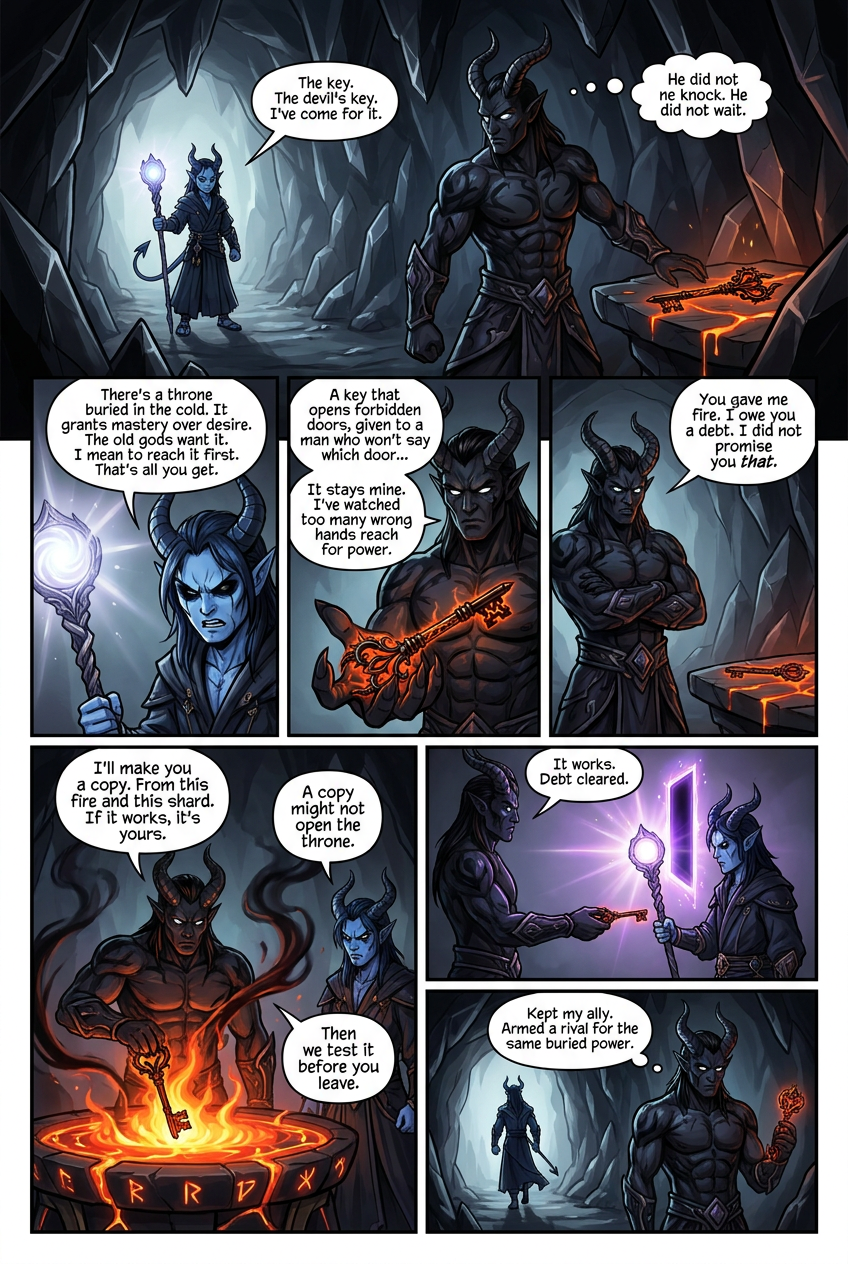
Morning had not yet reached the ridge when Gotim felt the seam of his cave part. He turned from the flat shelf where the key lay and found the incubus already inside. Chao DeVoid had earned this favor. Days ago he had given Gotim fire to burn a wraith, and fire had its price. Now the primordial stood with his staff in hand, the swirling orb at its head throwing pale light across the black walls. He did not knock. He did not wait to be asked. "The key," Chao said. "The devil's key. I've come for it." Gotim did not move toward the shelf. He measured the incubus the way he measured everything. "You gave me fire. I owe you a debt. I did not promise you that." "You promised a favor. This is the favor." Chao's black eyes did not blink. "The original. Not talk." Gotim lifted the key from the shelf and held it in his palm. Its horned crown caught the light. Molten lines ran down its shaft like veins. He had made it from the bearer's own medallion, and he did not yet know all it could open. "What do you want it for?" "That's mine to know." "Then it stays mine." Gotim closed his hand. "A key that opens forbidden doors, given to a man who won't say which door. I've watched too many wrong hands reach for power they can't hold. I won't add yours." Chao's jaw tightened. He said it fast, the way he said things he hated saying. "There's a throne buried in the cold. It grants mastery over desire. The old gods want it. They've decided it won't be me. I mean to reach it first." Then the shutter came down. "That's all you get." Gotim heard truth in it. He also heard a hunger old enough to break worlds. He crossed to the forge in the corner, its obsidian face seamed with molten light, runes glowing along its rim. "I'll make you a copy. From this fire and this shard. If it works, it's yours." "A copy might not open the throne." "Then we test it before you leave." Chao considered. He wanted the original and knew he would not get it. "Make it. It opens what I need, or the debt stays open." Gotim laid the key against the forge and drew shadow into the flame. The molten seams brightened. A second key rose from the heat, cooling from red to black, its horns curling like the first. He handed it over. Chao pressed it to the swirling orb of his staff. The orb flared. A thin door opened in the air, then closed. "It works," Chao said. He pocketed the copy. "Debt cleared." He left through the seam. Gotim looked at the original still in his palm and knew he had kept his ally and armed a rival for the same buried power.
Play your story to life
Storycraft is a mobile game where you create AI characters, craft items and locations to build their world, then discover what direction your story takes. Download the iOS game for free today!
Download for free