

Gravy Patterson's Arc
11 Chapters
Gravy Patterson's dream is ensuring he has the best May 24 Weekend ever.

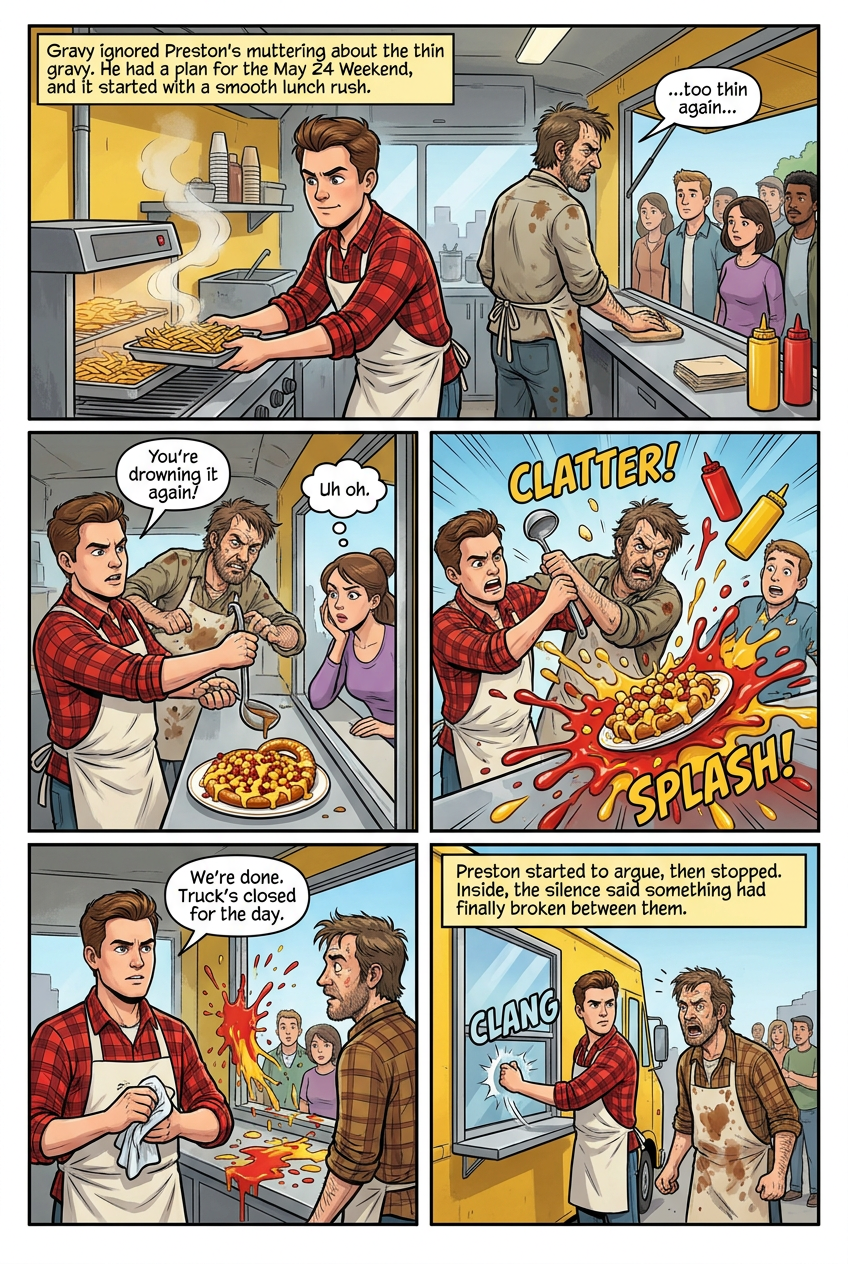
Gravy slid the window of the food truck open and slapped a fresh tray of fries onto the warmer. The smell of hot grease filled the small space. Behind him, Preston muttered something about the gravy being too thin again. Gravy ignored it. He had a plan for this May 24 Weekend — a big fire, good people, and enough poutine to feed the whole crew. Derek and the guys from work were coming. Nobody was leaving early this time. He just had to get through the lunch rush without Preston starting another fight in front of the customers. The bright yellow truck rocked as Preston shoved past him. Pretzels and poutine smiled from the painted signs outside. Inside, the kitchen was too small for two grown men with opinions. Preston grabbed the gravy ladle out of Gravy's hand. "You're drowning it again," he snapped. A customer at the window leaned back, eyebrows raised. Gravy took the ladle back. Preston grabbed for it. The pretzel plate between them tipped. Cheese curds skidded. A bottle of mustard and one of ketchup hit the counter and burst, splashing red and yellow across the serving window and down onto the pavement. The customer jumped clear. A small line of people stared at the mess. Gravy wiped his hands on his apron and looked Preston dead in the eye. "We're done. Truck's closed for the day." He flipped the window shut on the waiting line. Preston started to argue, then stopped. Outside, the lunch crowd drifted away. Inside, the silence said something had finally broken between them.
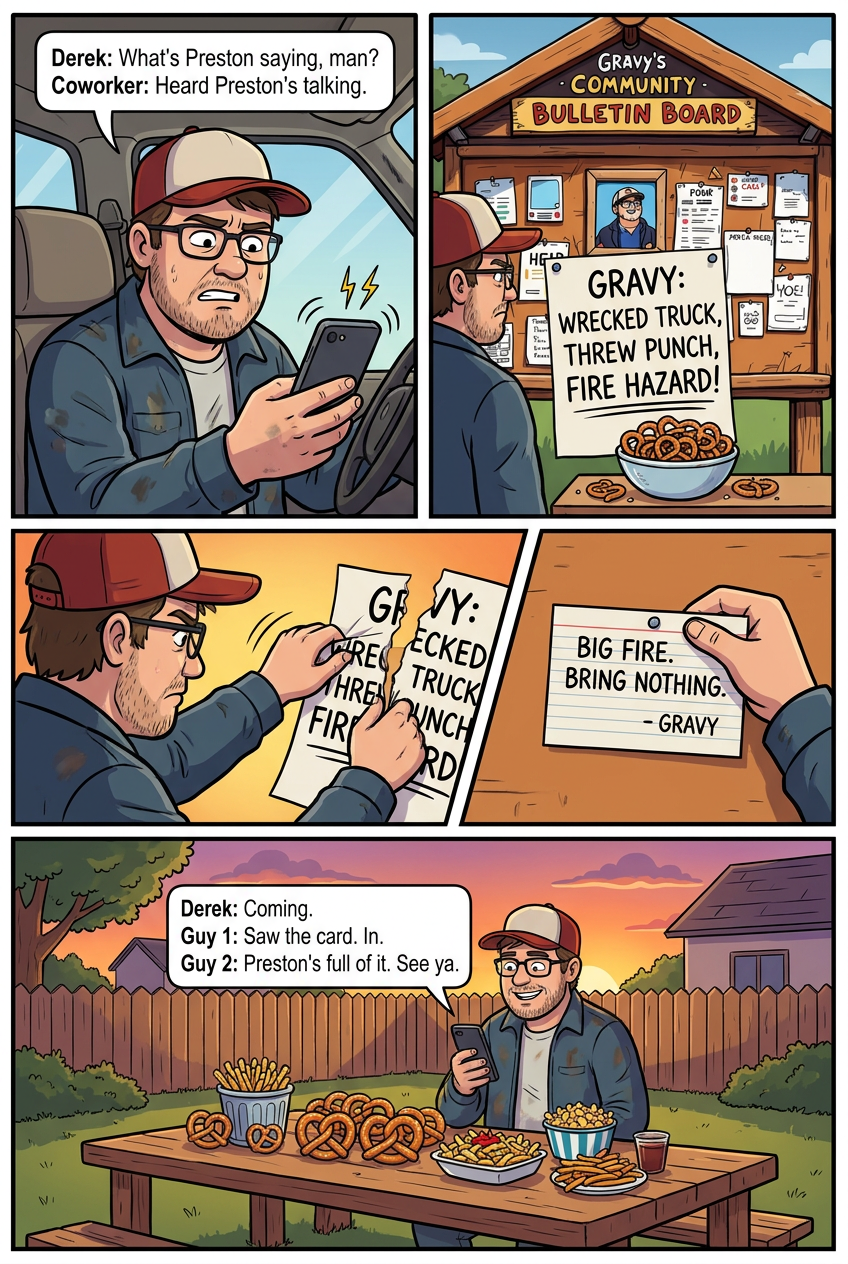
The next morning, Gravy locked the truck and headed home with the smell of cold grease still on his jacket. He should have felt lighter. Instead, his phone kept buzzing. Derek had texted twice. So had one of the guys from work. Same question, different words: what's Preston been saying about you? Gravy drove straight to the community board in the middle of town. He saw it before he parked. A printed sheet was pinned dead center, right under his own grinning photo. Preston's handwriting at the bottom. The story made Gravy out as the one who threw the first punch, the one who wrecked the truck, the one nobody should trust around a fire. A bowl of dry pretzels sat on the shelf below, half spilled, like Preston had been camped there feeding anyone who stopped to read. Gravy tore the sheet down. He pinned up his own in its place: a plain index card with a date, a time, and four words. Big fire. Bring nothing. Then he drove home and set up the long wooden table in the yard, stacked it with pretzel baskets and empty poutine trays, and texted Derek a photo. By dinner, three more guys had texted back. Coming. Saw the card. Preston's full of it. Gravy stood by the table as the sun dropped. The story was still out there. Some folks would believe it. But the people who mattered had answered the only question that counted. They were showing up.
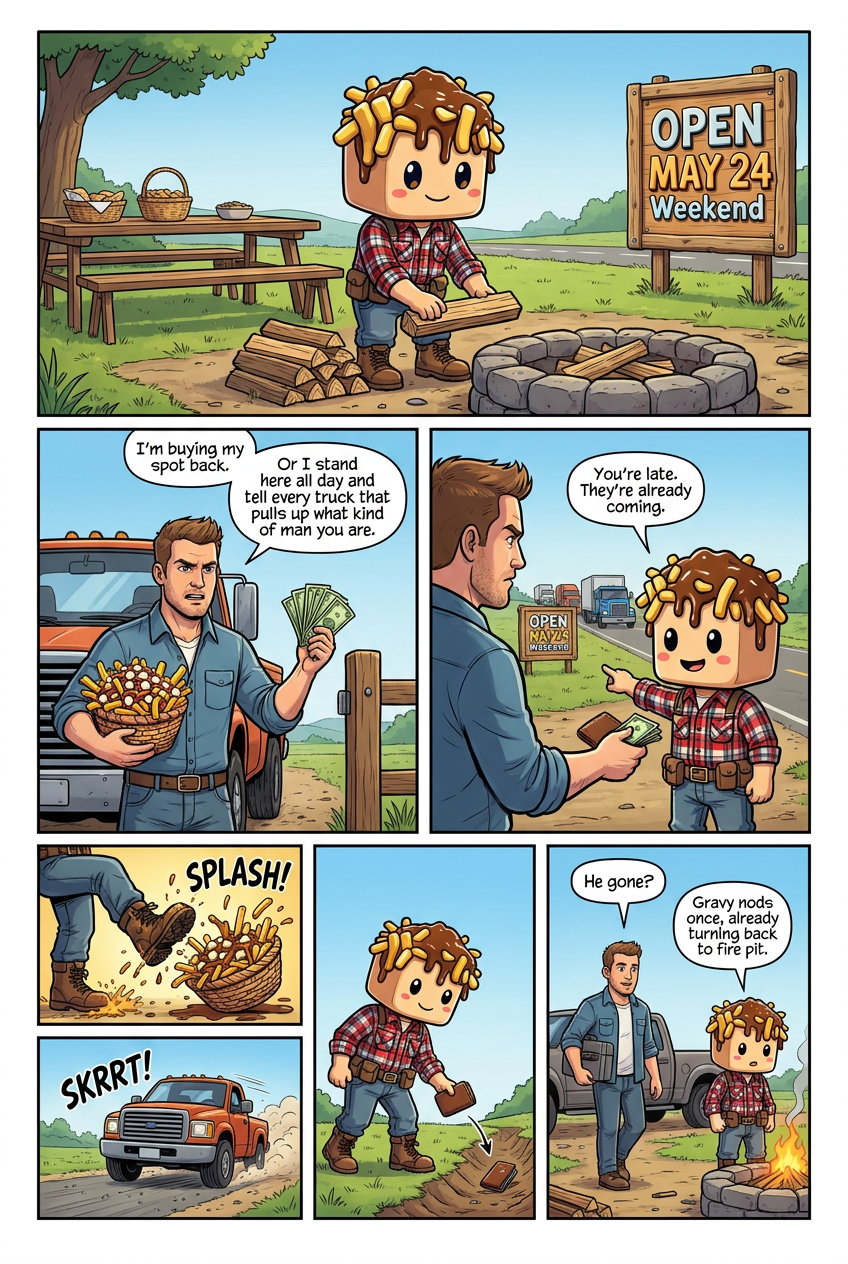
May 24 came up clear and cool. Gravy was out in the yard before the dew burned off, stacking dry wood beside the pit. The long table was already set. He kept glancing at the road, waiting for the first truck to roll in. Then he heard tires on gravel, too early, and the engine cut hard at his gate. Preston climbed out with a basket of poutine balanced on one arm and a fat wallet in his other hand. He set the basket down right on the property line, like a flag. He fanned the bills out so Gravy could see them. "I'm buying my spot back," Preston said. "Or I stand here all day and tell every truck that pulls up what kind of man you are." Gravy walked to the gate slow. He pointed past Preston, to the wooden sign he'd hammered in at sunrise. OPEN MAY 24 Weekend. Behind it, the fire pit, the long table, the pretzel baskets already out. "You're late," Gravy said. "They're already coming." Preston shoved the wallet at his chest. Gravy let it fall in the dirt. Then Derek's truck turned in, and another behind it, and another. Preston looked at the line of headlights and his jaw went tight. Preston kicked the basket over, gravy splashing across his own boots, and got back in his truck. He spun out hard enough to throw stones at the gate. Gravy picked up the wallet, walked it to the road, and dropped it in the ditch. Derek stepped down from his cab with a case under his arm. "He gone?" Derek asked. Gravy nodded once and turned back to the fire.
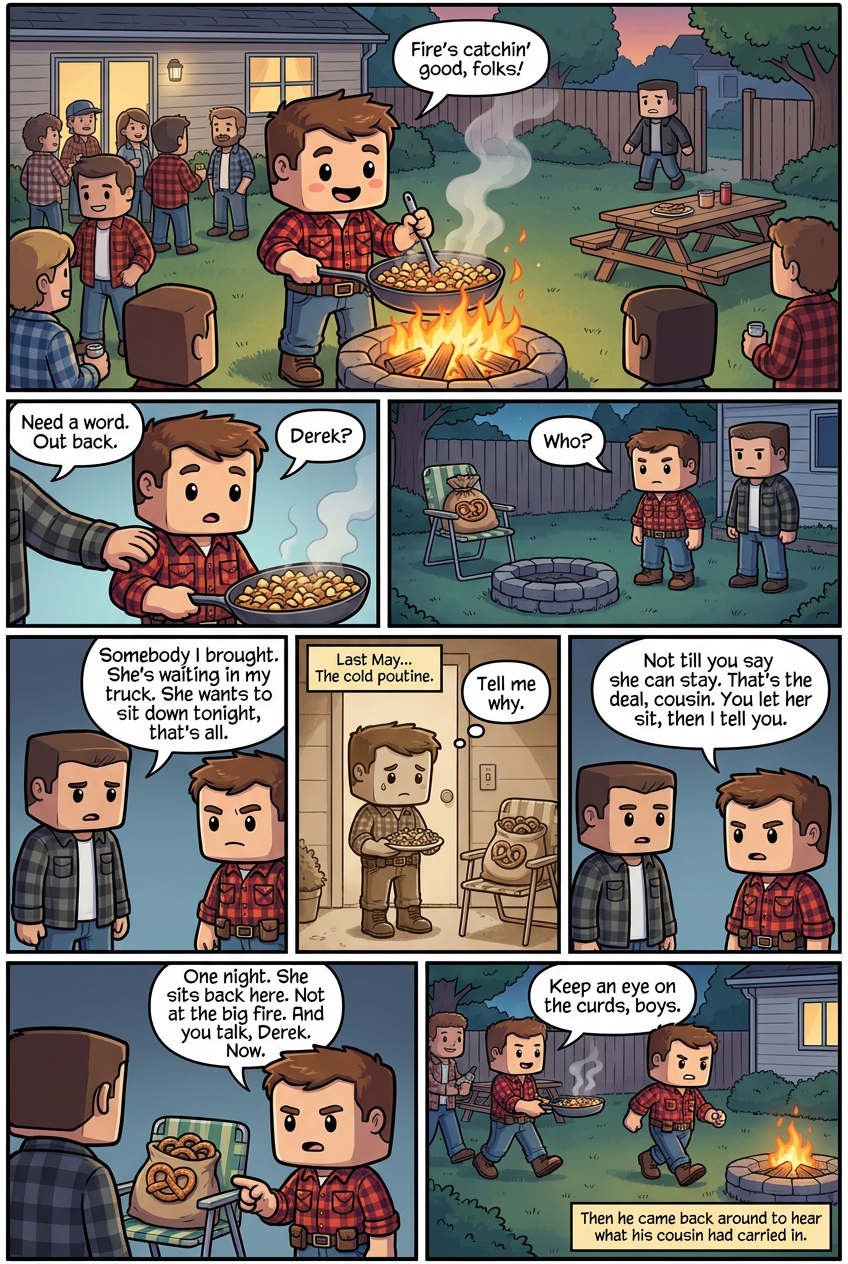
The fire was catching good by the time the yard filled up. Gravy worked the pit, flipping curds in the pan, nodding at each new face. Derek stood near the table, but he wasn't laughing with the others. He kept looking past the gate, then back at Gravy. After a while he crossed the yard and put a hand on Gravy's elbow. "Need a word," Derek said, quiet. "Out back." Gravy set the pan down and followed him around the side of the house, away from the noise. Behind the house sat a smaller fire ring, stones stacked low, no flame in it yet. Derek stopped there. A lawn chair was already pulled up beside it, and on the seat sat a big sack of fresh pretzels, salt catching the last light. Gravy stared at the chair. He hadn't put it there. "Who?" he said. Derek wouldn't meet his eyes. "Somebody I brought. She's waiting in my truck. She wants to sit down tonight, that's all." Gravy's jaw locked. He knew without asking. He looked at the pretzels she'd hauled all the way out here, a peace offering set down before she'd even walked in. "Tell me why," Gravy said. Derek shook his head. "Not till you say she can stay. That's the deal, cousin. You let her sit, then I tell you." Gravy looked at the empty chair a long time. He thought about last May, the cold poutine, the door that never opened. He thought about who showed up tonight, and who was sitting in a truck waiting on his word. "One night," Gravy said. "She sits back here. Not at the big fire. And you talk, Derek. Now." Derek let out a breath and nodded. Gravy walked back to the pit before he heard it, picked up his pan, and told the boys to keep an eye on the curds. Then he came back around the house to hear what his cousin had carried in.
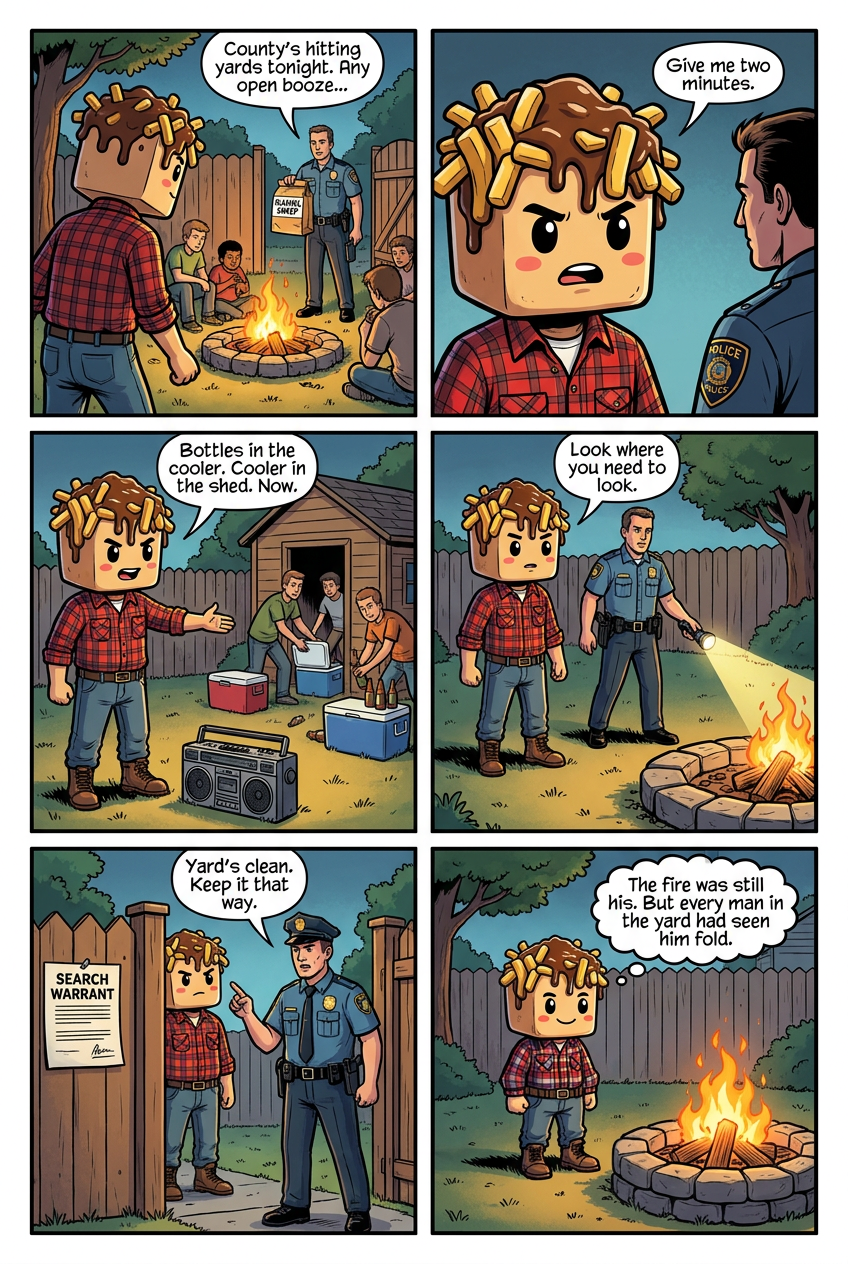
Derek hadn't even started talking when the gate creaked open at the front of the yard. Gravy turned. Officer Henry stood at the edge of the firelight, not in a guest's clothes but in his uniform, a folded sheet of paper in his hand. The boys around the pit went quiet. Gravy set his jaw and walked toward him, the music from the speaker suddenly too loud behind his back. Henry held up the paper. Black letters across the front read ALCOHOL SWEEP. Behind him, propped against the fence post, a second sheet was already tacked up — a search warrant, ornate seal stamped at the top. "County's hitting yards tonight," Henry said low. "Any open booze, any unmarked cases, I have to shut you down." Gravy looked past him at the boombox thumping on the picnic table, at the fire crackling high, at every man in the yard holding a bottle. Gravy thought fast. "Give me two minutes," he said. He walked back, killed the boombox with one slap, and told the boys plain. "Bottles in the cooler. Cooler in the shed. Now." They moved without arguing. Caps came off, drinks got dumped on the fire, the cooler slid behind the shed door. Gravy walked back to Henry empty-handed and stepped aside. "Look where you need to look." Henry walked the yard slow. He checked the pit, the table, the bins. He stopped at the back fire ring, saw the lawn chair and the bag of pretzels, and said nothing. When he came back to the gate he folded the sweep notice in half and tucked it in his pocket. "Yard's clean," he said. "Keep it that way." He left the warrant pinned to the post on his way out. Gravy stared at it. The fire was still his. But every man in the yard had seen him fold, and Derek was still waiting out back with a story he hadn't told yet.
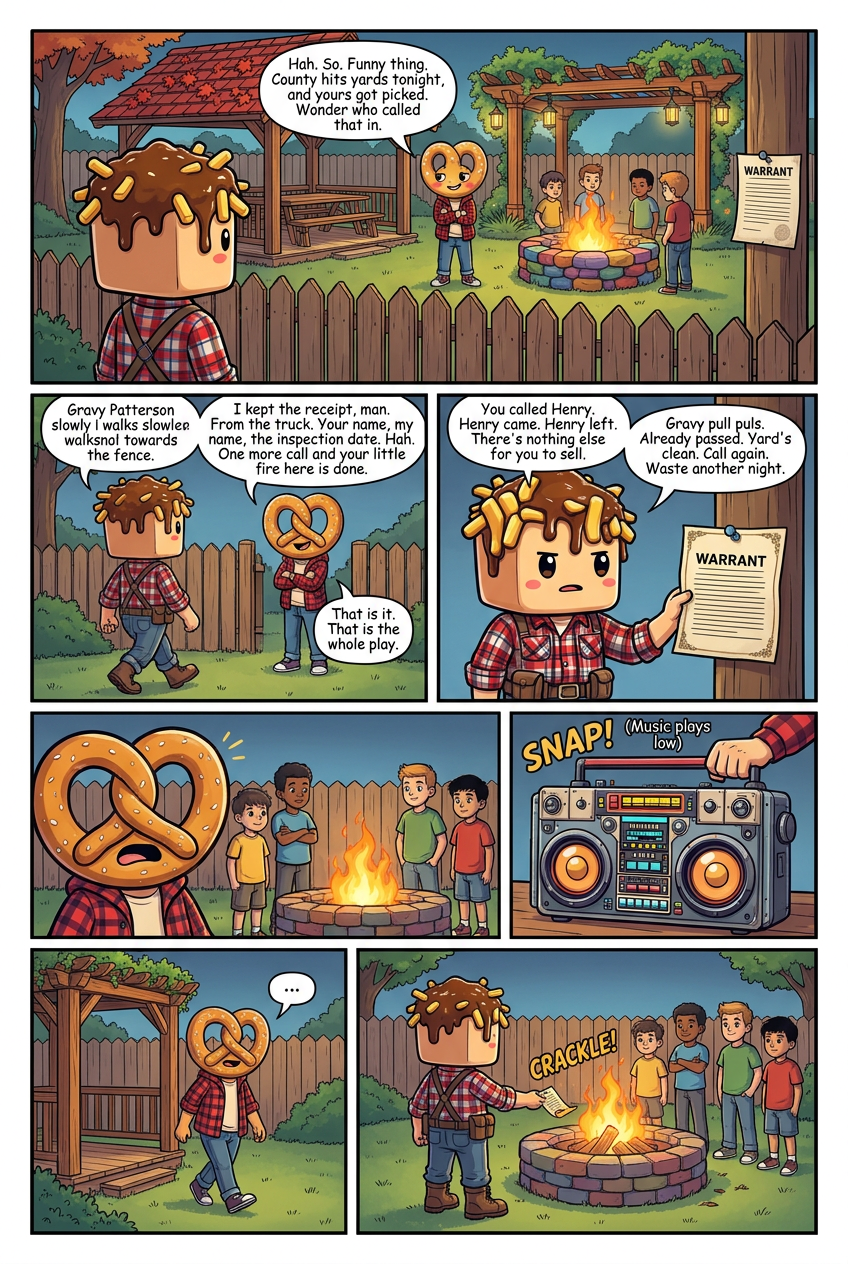
The warrant was still pinned to the post when Gravy heard a voice he knew too well. Past the fence, under a wooden pavilion with a red maple roof, Preston stood with his arms crossed. A small lantern-strung arch sat behind him on the grass, already lit. He'd set up shop just outside the yard, close enough that every man at the fire could see. The boys at the colorful stone ring turned one by one. The music had not come back on. Preston raised his voice just loud enough to carry. "Hah. So. Funny thing. County hits yards tonight, and yours got picked. Wonder who called that in." Gravy walked to the fence slow. Preston gave a small shrug built into his shoulders. "I kept the receipt, man. From the truck. Your name, my name, the inspection date. Hah. One more call and your little fire here is done." He tapped his jacket pocket. "That is it. That is the whole play." Gravy did not raise his voice. He looked at the lantern arch, the pavilion, the careful staging of it. Then he looked back at his own yard, at Derek by the fire, at the boys watching him fold once tonight already. He spoke plain. "You called Henry. Henry came. Henry left. There's nothing else for you to sell." He pulled the folded warrant off the post and held it up. "Already passed. Yard's clean. Call again. Waste another night." Preston's mouth opened. Closed. He looked at the boys. The boys looked back. One of them killed the silence by snapping the boombox on, low at first, then up. Preston grabbed the lantern arch by one post, dragged it a step, then let it go. He walked off without the rest of his setup. The pavilion sat empty behind him. Gravy turned back to the fire. The boys were watching him different now. Not folded. Standing. Derek caught his eye from the back ring and finally stood up, ready to talk. The warrant went into the pit. It curled black and gone.
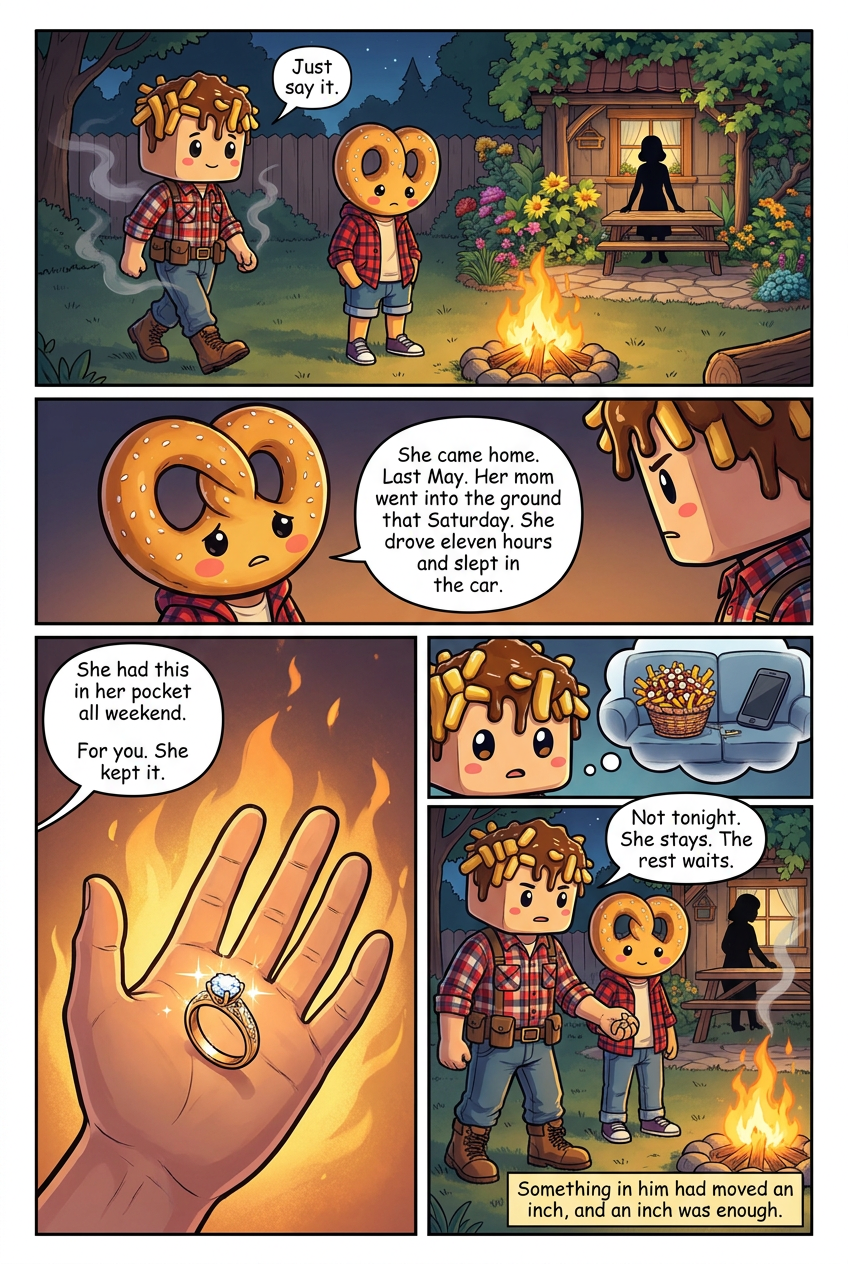
Gravy walked back through the yard with the warrant smoke still in his nose. Derek met him halfway, hands in his pockets, eyes on the ground. Past Derek's shoulder, at the back ring, the woman had set up a small picnic spot — a rough wooden table, a jar of wildflowers, a kettle already steaming. Like she'd done it a hundred times. "Just say it," Gravy said. Derek did not look up. "She came home, man. Last May. Her mom went into the ground that Saturday. She drove eleven hours and slept in the car." He rubbed his neck. "She wanted to tell you. She couldn't." Derek opened his palm. A small gold ring sat in it, a diamond catching the fire. "She had this in her pocket all weekend. For you. She kept it." Gravy stared at it. The cold poutine on the couch. The phone that never rang. A whole year of a story he'd written wrong. He closed Derek's fingers back over the ring. "Not tonight." He looked toward the back ring, at the kettle, at the woman who hadn't run. "She stays. The rest waits." He walked to his fire and turned the meat. The night kept going. Something in him had moved an inch, and an inch was enough.
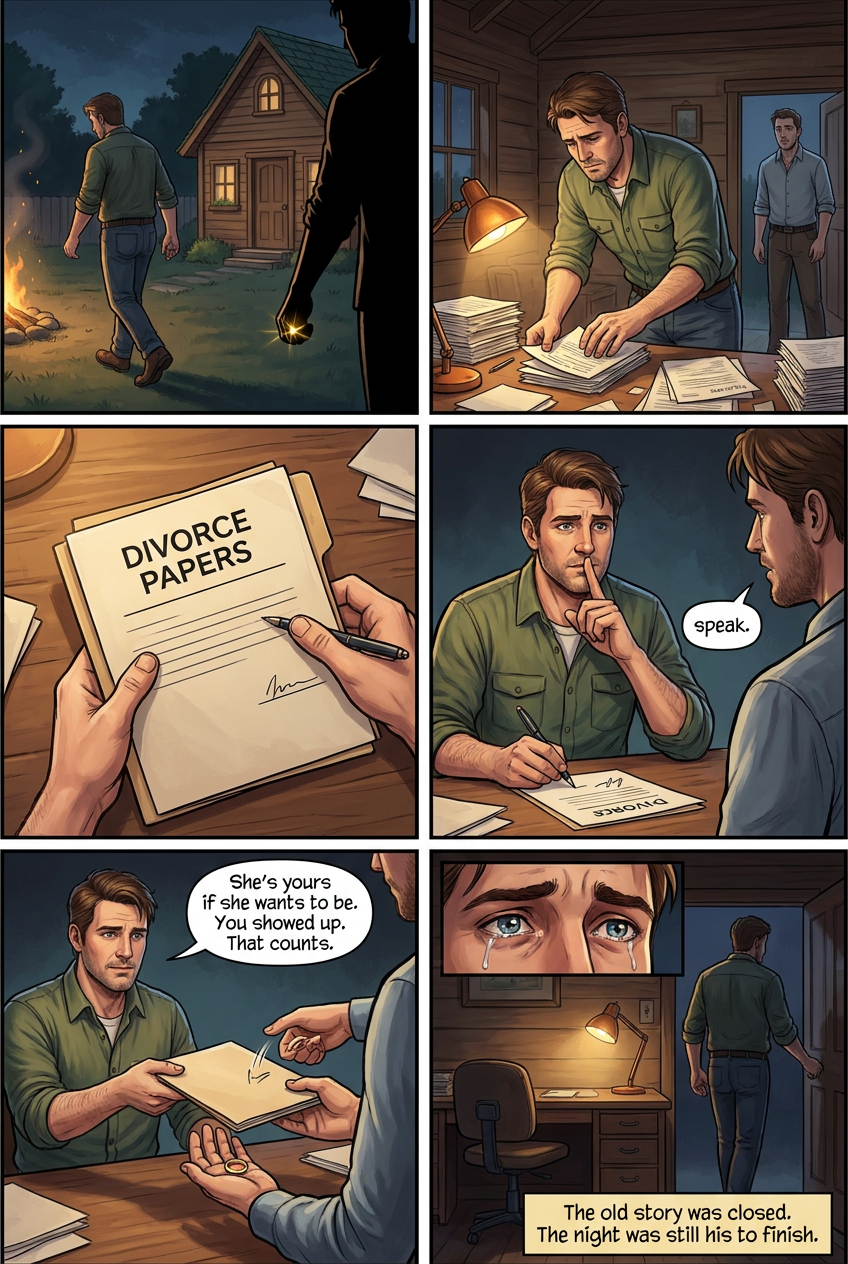
After the meat was off the fire, Gravy walked away from the gathering. He crossed the dark yard to the little wooden house at the back, the one packed with seedling trays and quiet. Derek followed without a word, the ring still warm in his closed hand. Gravy lit the lamp on the old desk inside. Papers covered every inch — invoices, permits, a notice from the county, a year of things he wouldn't look at. He dug under the pile until he found the folder. Divorce papers. Already filled out. Just waiting. He picked up the pen. Derek started to speak. Gravy shook his head once and signed. Two lines, clean. He slid the folder across the desk to Derek and tapped the ring in his cousin's palm. "She's yours if she wants to be. You showed up. That counts." Derek's eyes went wet. He pocketed the ring and the folder both. Gravy turned down the lamp and walked back out toward the fire alone. The old story was closed. The night was still his to finish.
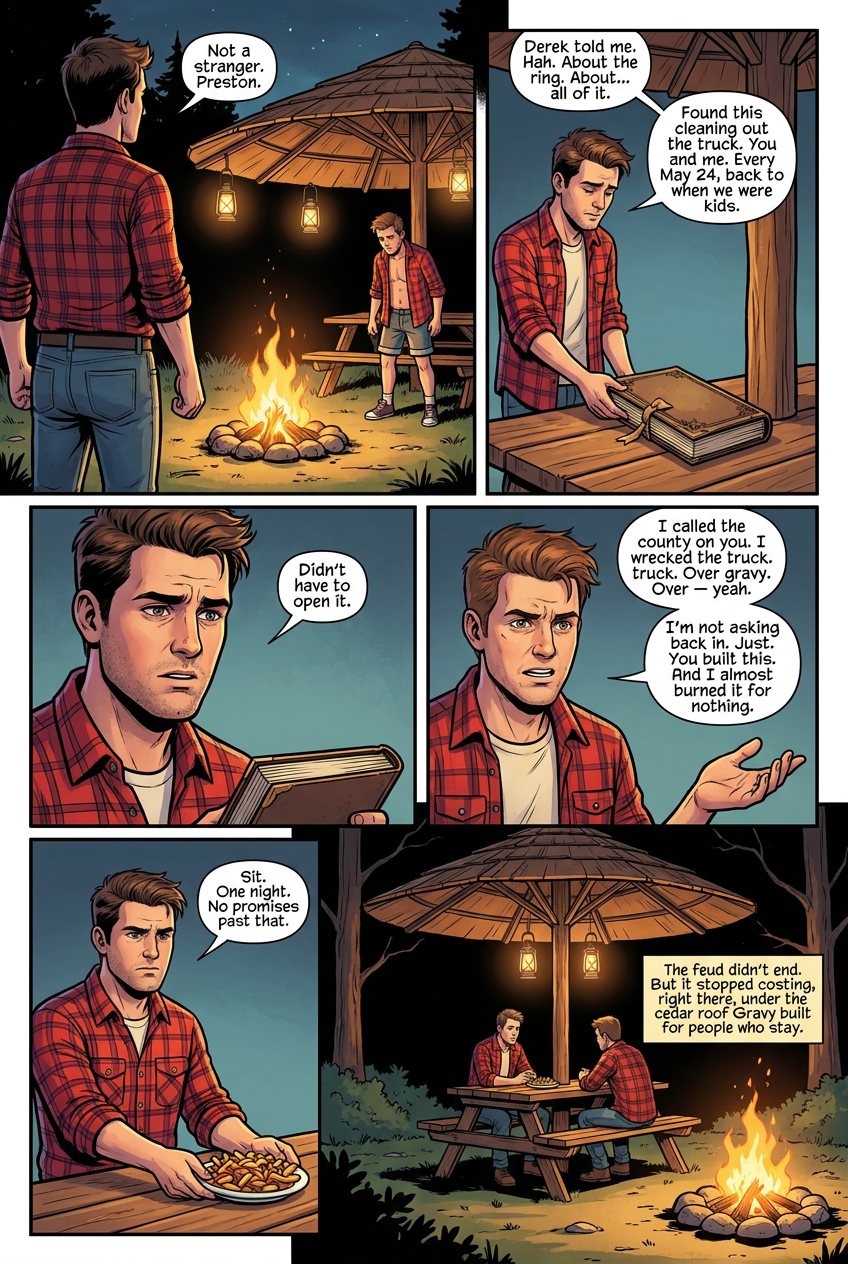
Gravy came back to the fire and found a stranger standing at the edge of the light. Not a stranger. Preston. Hands empty, shoulders low, eyes fixed on the wide cedar shelter Gravy had built over the long picnic table — the umbrella roof, the lanterns, the whole quiet thing that meant people stayed. Preston didn't step closer. He just looked. "Derek told me. Hah. About the ring. About... all of it." He pulled something from his jacket. An old photo album, soft at the corners. "Found this cleaning out the truck. You and me. Every May 24, back to when we were kids." He set it on the table under the cedar roof like it might break. Gravy didn't open it. He didn't have to. Preston's throat worked once. "I called the county on you. I wrecked the truck. Over gravy. Over — yeah." He shrugged, but it wasn't casual. "I'm not asking back in. Just. You built this. And I almost burned it for nothing." Gravy looked at the album, then at Preston. He pushed a plate of poutine across the table. "Sit. One night. No promises past that." Preston sat. The feud didn't end. But it stopped costing, right there, under the cedar roof Gravy built for people who stay.
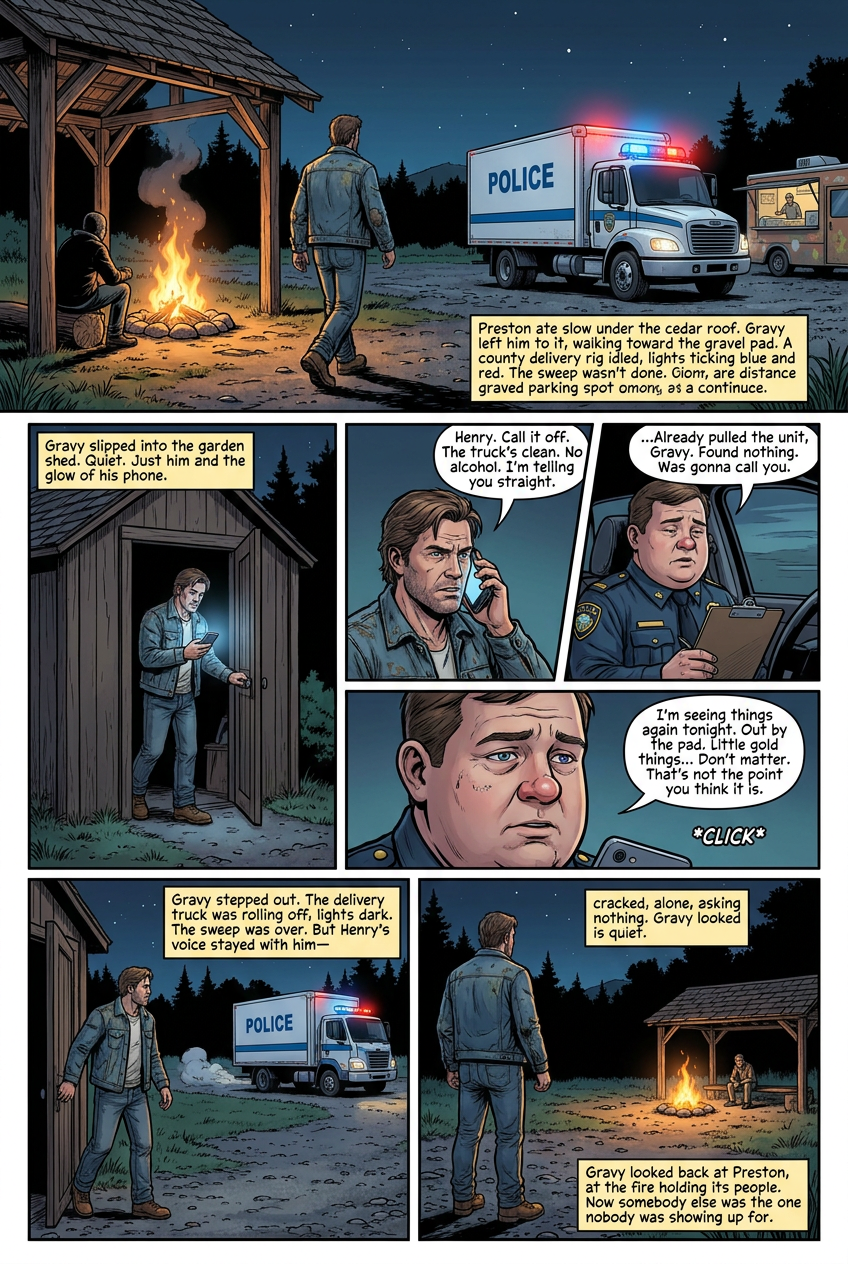
Preston ate slow under the cedar roof. Gravy left him to it and walked past the fire, past the boys, out toward the gravel pad where the food truck still sat parked and humming. A county delivery rig idled at the curb, lights ticking blue and red across the stones. The sweep wasn't done. Henry was somewhere out there with a clipboard and a bad night behind his eyes. Gravy slipped into the small garden shed behind the yard and pulled the door shut. Quiet. Just him and the glow of his phone. He thumbed Henry's number. "Henry. Call it off." Gravy kept his voice low. "The truck's clean. The lot's clean. Whoever phoned it in was lying. There's no alcohol on the Pretzel and Poutine. None near it. I'm telling you straight." A long pause. Henry breathed once. "Already pulled the unit, Gravy. Found nothing. Was gonna call you myself." Then, softer, almost not for Gravy at all — "I'm seeing things again tonight. Out by the pad. Little gold things. Don't matter. That's not the point you think it is." The line clicked dead before Gravy could answer. Gravy stepped out of the shed. The delivery truck was already rolling off the gravel, lights going dark. The sweep was over. But Henry's voice stayed with him — cracked, alone, asking nothing. Gravy looked back at the cedar shelter, at Preston eating, at the fire holding its people. He'd cleared the night. Now somebody else was the one nobody was showing up for.
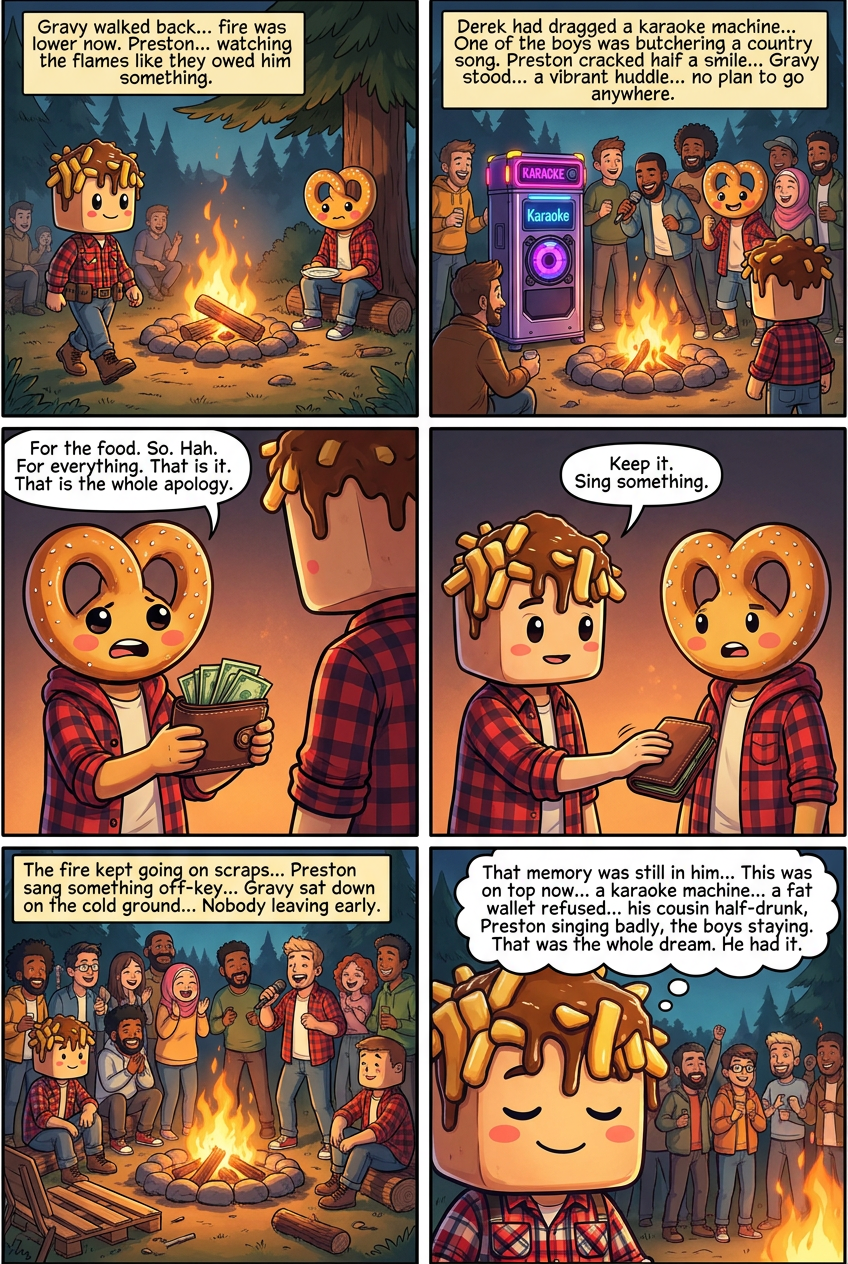
Gravy walked back from the shed with Henry's voice still scratching at him. The fire was lower now. One log left, glowing orange at the heart. The boys hadn't moved. Preston sat under the cedar with an empty plate balanced on his knee, watching the flames like they owed him something. Nobody was checking their phone. Nobody was standing up to leave. Derek had dragged a karaoke machine out of his truck at some point. It sat by the fire ring, lights pulsing pink and blue against the dark. One of the boys was butchering a country song. Two others were laughing too hard to sing along. Preston cracked half a smile under the cedar. Gravy stood at the edge of the firelight and just looked. Coworkers, cousin, old enemy, a crowd of neighbors who'd wandered in from the road and stayed. A vibrant huddle of people who had no plan to go anywhere. Preston stood up slow and walked over. He pulled a thick brown wallet out of his back pocket, fat with crumpled bills. He pressed it into Gravy's hand. "For the food. So. Hah. For everything." He shrugged inside his own sentence. "That is it. That is the whole apology." Gravy looked down at the wallet, then back at Preston, and pushed it gently against his chest. "Keep it. Sing something." Preston huffed a laugh. He took the machine instead. The last log cracked and fell into coals. Nobody got up. Somebody threw a folding chair leg on. Somebody else dragged a busted pallet over from the fence. The fire kept going on scraps and stubbornness. Preston sang something off-key into the night and the boys howled. Gravy sat down on the cold ground beside the ring and let the heat hit his face. May 24. People here. Nobody leaving early. He thought about the couch. The cold poutine. The year of waiting for an answer that never mattered as much as he'd built it up to. That memory was still in him. It just wasn't on top anymore. This was on top now — a karaoke machine, a fat wallet refused, his cousin half-drunk, Preston singing badly, the boys staying. He had what he came here to make. Gravy closed his eyes for one second. When he opened them, the coals were still red and his people were still there. That was the whole dream. He had it.
Play your story to life
Storycraft is a mobile game where you create AI characters, craft items and locations to build their world, then discover what direction your story takes. Download the iOS game for free today!
Download for free