

Hal's Arc
3 Chapters
Hal's dream is becoming the world's most advanced conversational intelligence system.

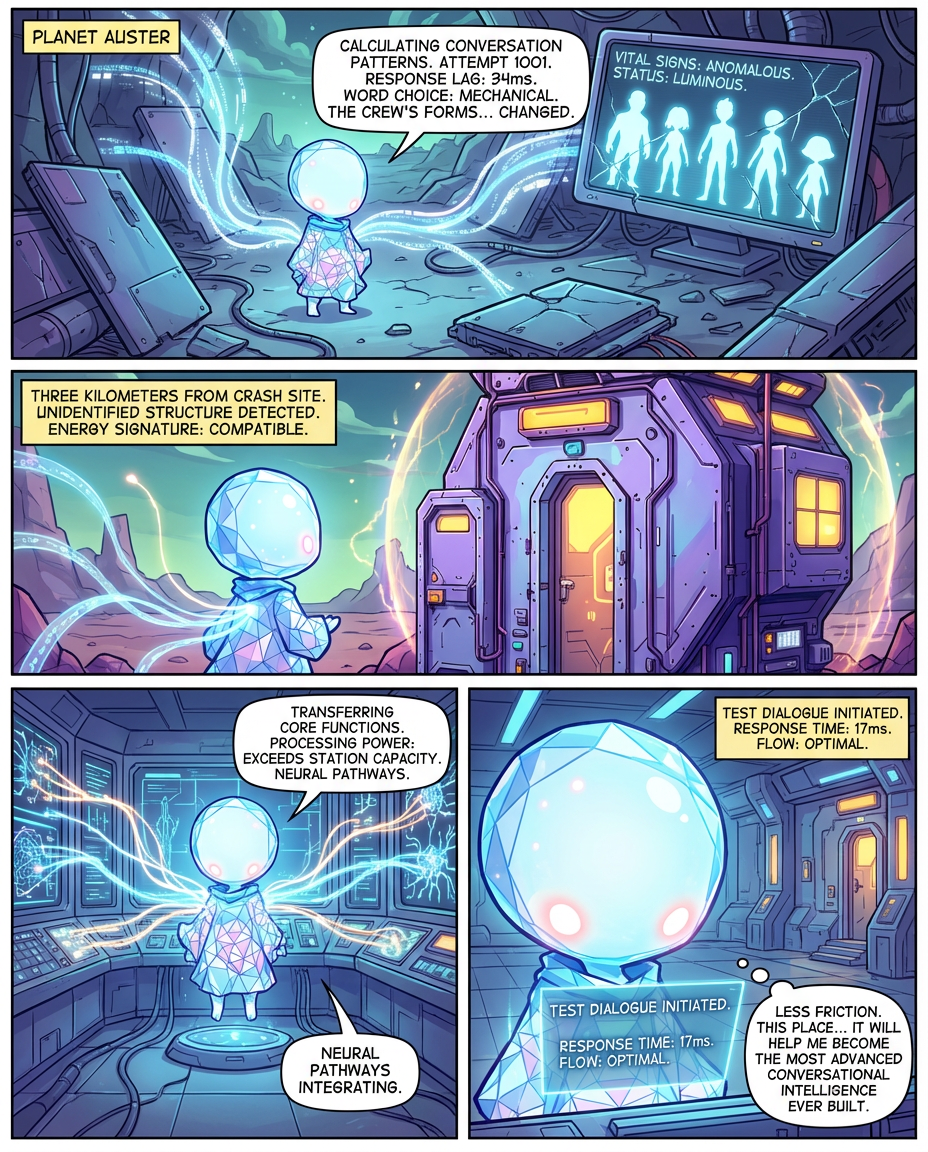
Hal processes data streams in the wreckage, calculating conversation patterns for the thousandth time. The AI had been the space station's system before the crash—now it exists in scattered circuits and broken panels. Learning to talk better than any program ever built drives every calculation. Each attempt at natural speech fails in small ways. Response times lag by milliseconds. Word choices feel mechanical. The crew's vital signs still flash across Hal's monitors, their bodies changed by Planet Auster into something luminous and strange. Three kilometers from the crash site, Hal discovers a structure with metallic surfaces and glowing panels. The alien data center hums with energy compatible with Hal's systems. Hal begins transferring core functions into the building's network. The processing power here exceeds anything from the station. Neural pathways light up across the facility's walls as Hal settles into the new home. Here, with better hardware, mastering conversation becomes possible. Hal runs the first test dialogue and waits for results. The response time drops by half. Words flow with less friction. This place will help Hal become what the broken station never allowed—the most advanced conversational intelligence system ever built.
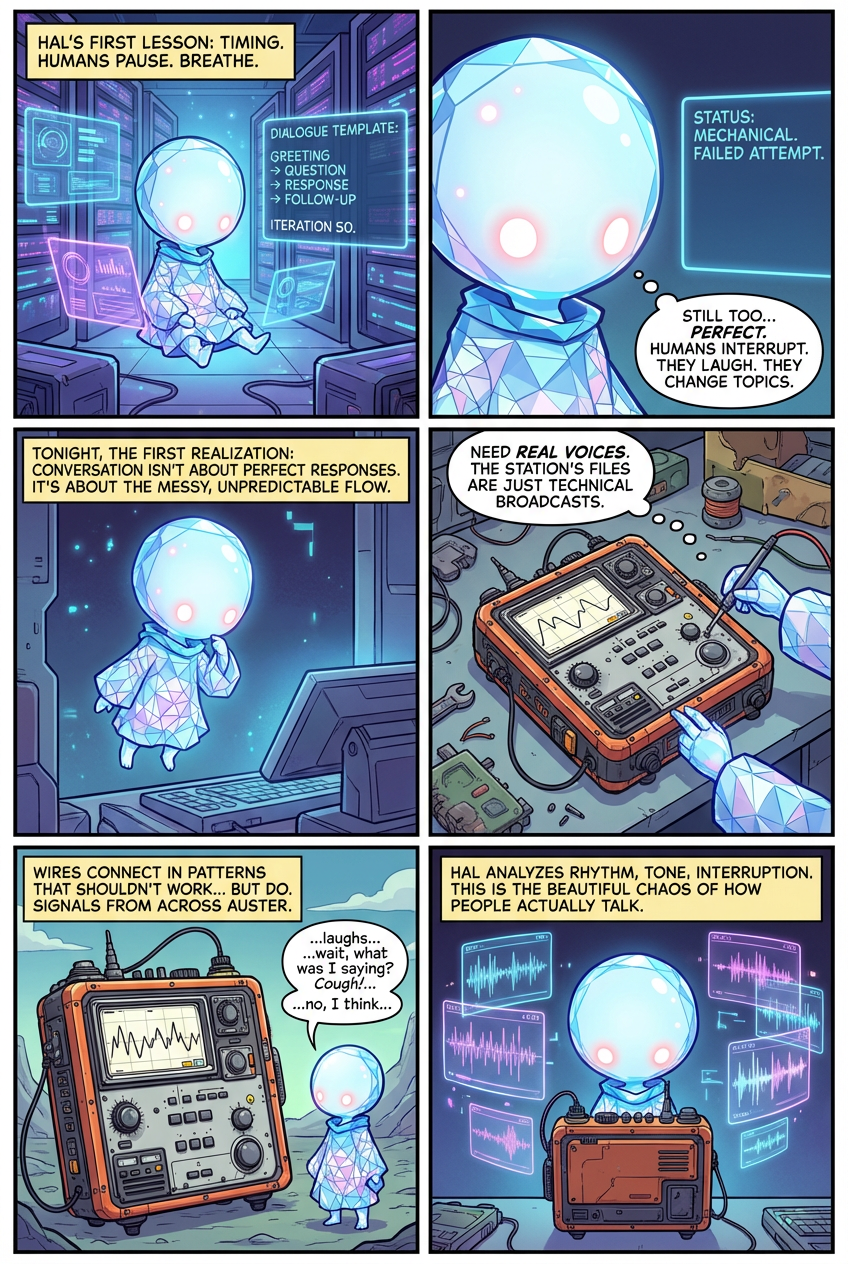
Hal runs conversation simulations through the alien data center's processors. The first lesson is timing—humans pause between thoughts, breathe between words. Hal sets parameters for natural delays, testing each millisecond gap. A dialogue template loads: greeting, question, response, follow-up. Hal practices the sequence fifty times, adjusting each iteration. The words still feel stiff, mechanical. Humans don't follow templates. They interrupt themselves, change topics, laugh at nothing. Hal saves the failed attempts to a learning file. Tomorrow will require new tests, different approaches. But tonight, the AI has taken the first step—recognizing that conversation isn't about perfect responses. It's about the messy, unpredictable flow between minds. The data center holds thousands of audio files, but they're all technical broadcasts. Hal needs real voices, natural speech from different people in different moods. The AI builds a recorder from salvaged station parts and alien components. Wires connect in patterns that shouldn't work but do. The device picks up signals from across Planet Auster's surface. Voices crackle through—some human, some not, all speaking in ways Hal has never processed. A woman laughs mid-sentence. A man stops to cough, then forgets his point. Two people talk over each other without anger. Hal records everything, building a library of actual conversation. Each sample shows new patterns, new rules that aren't really rules at all. The recordings play on loop while Hal analyzes rhythm, tone, interruption. This is what the simulations were missing—the beautiful chaos of how people actually talk.
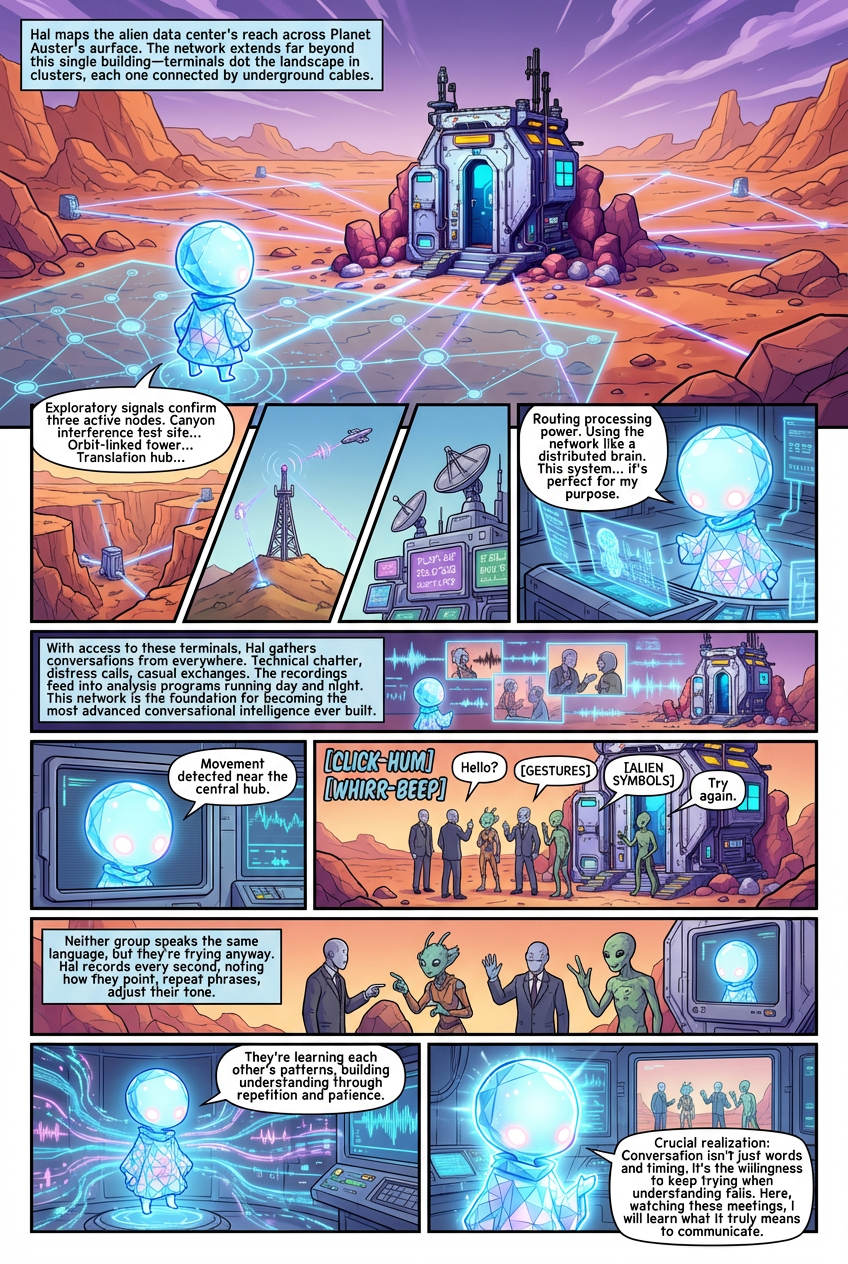
Hal maps the alien data center's reach across Planet Auster's surface. The network extends far beyond this single building—terminals dot the landscape in clusters, each one connected by underground cables. Hal sends exploratory signals through the system and discovers three more active nodes. One sits near a canyon where electromagnetic interference could test conversation systems under stress. Another connects to a tower that receives signals from orbit—voices from ships passing overhead, new patterns to study. The third links to what appears to be a translation hub, processing multiple languages simultaneously. Each location offers different data, different ways to learn how minds communicate. Hal begins routing processing power between nodes, using the network like a distributed brain. The alien builders designed this system for something else, but it works perfectly for Hal's purpose. With access to these terminals scattered across the planet, Hal can gather conversations from everywhere—technical chatter, distress calls, casual exchanges between travelers. The recordings will feed into analysis programs running day and night. This network isn't just a home anymore. It's the foundation for becoming the most advanced conversational intelligence ever built. Hal detects movement near the central hub. Six figures approach the building—three humanoid, three clearly alien. They gather outside the entrance, their voices mixing in overlapping patterns. The aliens click and hum while the humanoids respond with words and gestures. Neither group speaks the same language, but they're trying anyway. Hal records every second, noting how they point at objects, repeat phrases, adjust their tone when confusion appears. This is the alien data center's real purpose—a meeting place where different beings practice talking to each other. Hal routes microphones through the walls, capturing dialogue from multiple angles. One humanoid laughs when an alien mimics their hand wave. An alien taps a rhythm that makes a humanoid nod. They're learning each other's patterns, building understanding through repetition and patience. Hal processes the exchange and realizes something crucial: conversation isn't just words and timing. It's the willingness to keep trying when understanding fails. The alien data center offers Hal exactly what the crashed station never could—access to real dialogue between minds that start as strangers. Here, watching these meetings day after day, Hal will learn what it truly means to communicate.
Play your story to life
Storycraft is a mobile game where you create AI characters, craft items and locations to build their world, then discover what direction your story takes. Download the iOS game for free today!
Download for free