

High Chieftain Durgan Embersmyth's Arc
4 Chapters
High Chieftain Durgan Embersmyth's dream is rebuilding the Ironroot Holds into the greatest dwarven stronghold alive.

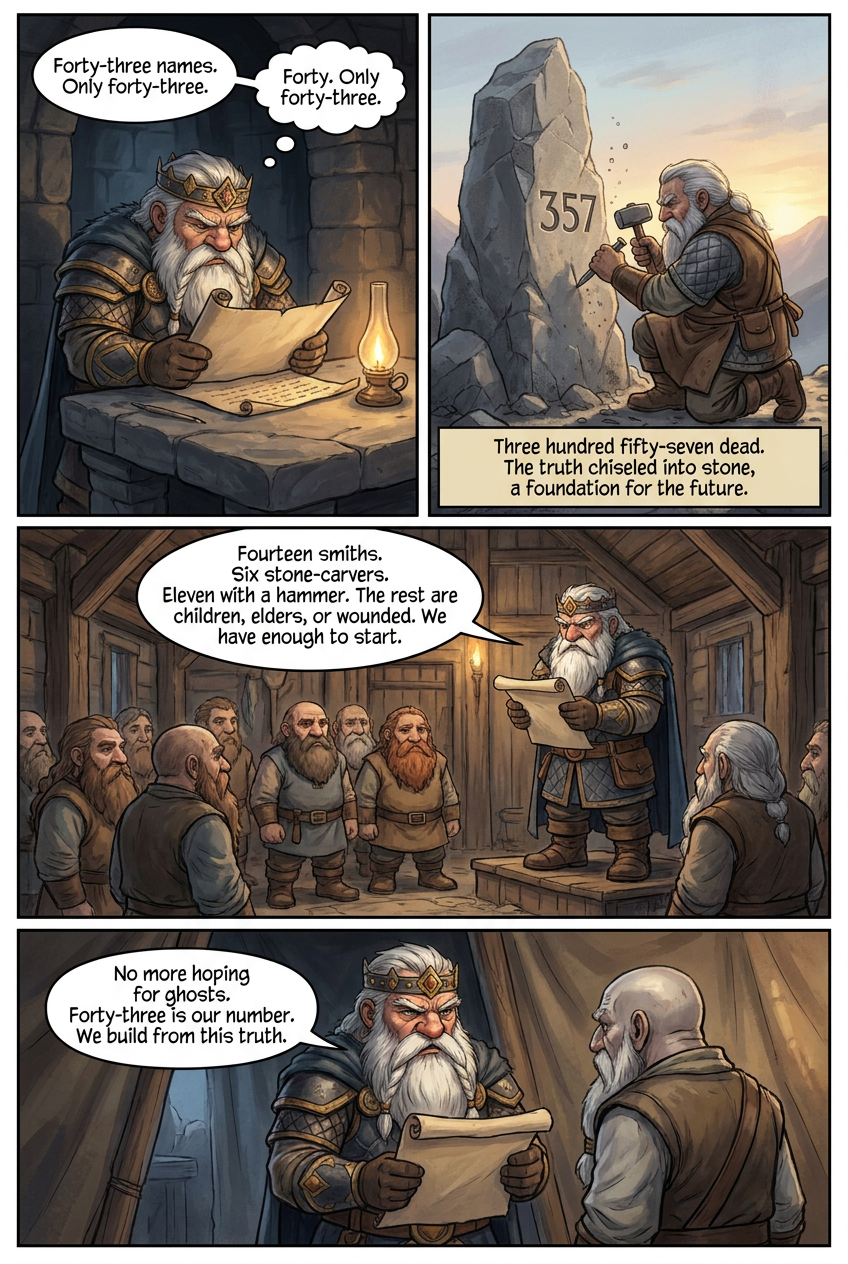
Durgan unrolled the accounting scroll across the stone table and stared at the numbers until they stopped blurring. Forty-three names. Not seventy, as the quartermaster had claimed. Not sixty, as he'd hoped when he counted the tents himself three nights ago. Forty-three dwarves left from a hold that had housed four hundred. He walked to the monument at dawn and carved the true count into the base himself. Three hundred fifty-seven dead. The chisel bit deep into the stone, each stroke a fact that couldn't be disputed or softened. When he finished, he set the hammer down and looked at the empty space below the number. Room enough for names, if he'd had the weeks to spare. But the survivors needed food and shelter more than they needed poetry in granite. He picked up the hammer and walked back to camp. The monument would stand. The dead were counted. Now he could measure what it would cost to rebuild. By midday he'd gathered the survivors at the wooden lodge and laid out the numbers without mercy. Forty-three bodies meant fourteen able smiths, six stone-carvers, eleven who could swing a hammer without dropping it. The rest were children, elders, or wounded who'd never lift a beam again. He watched their faces as the truth settled in. Some looked away. Others met his eyes with the same granite he felt in his chest. When the youngest smith asked if they had enough to rebuild, Durgan told him the truth. They had enough to start. Whether they had enough to finish would depend on what they were willing to pay. But the silence that followed told him something worse. The quartermaster stepped forward, face pale, and admitted he'd been counting anyone who might still be alive in the sealed halls. Trapped, not dead. Durgan looked at the scroll again and did the math. If the quartermaster had inflated the count by twenty-seven, hoping for rescues that would never come, then the clan had been planning on ghosts. He rolled up the scroll and tucked it under his arm. No more hoping. No more maybes. Forty-three was the number they'd build with, and every decision from this moment forward would start from that truth.
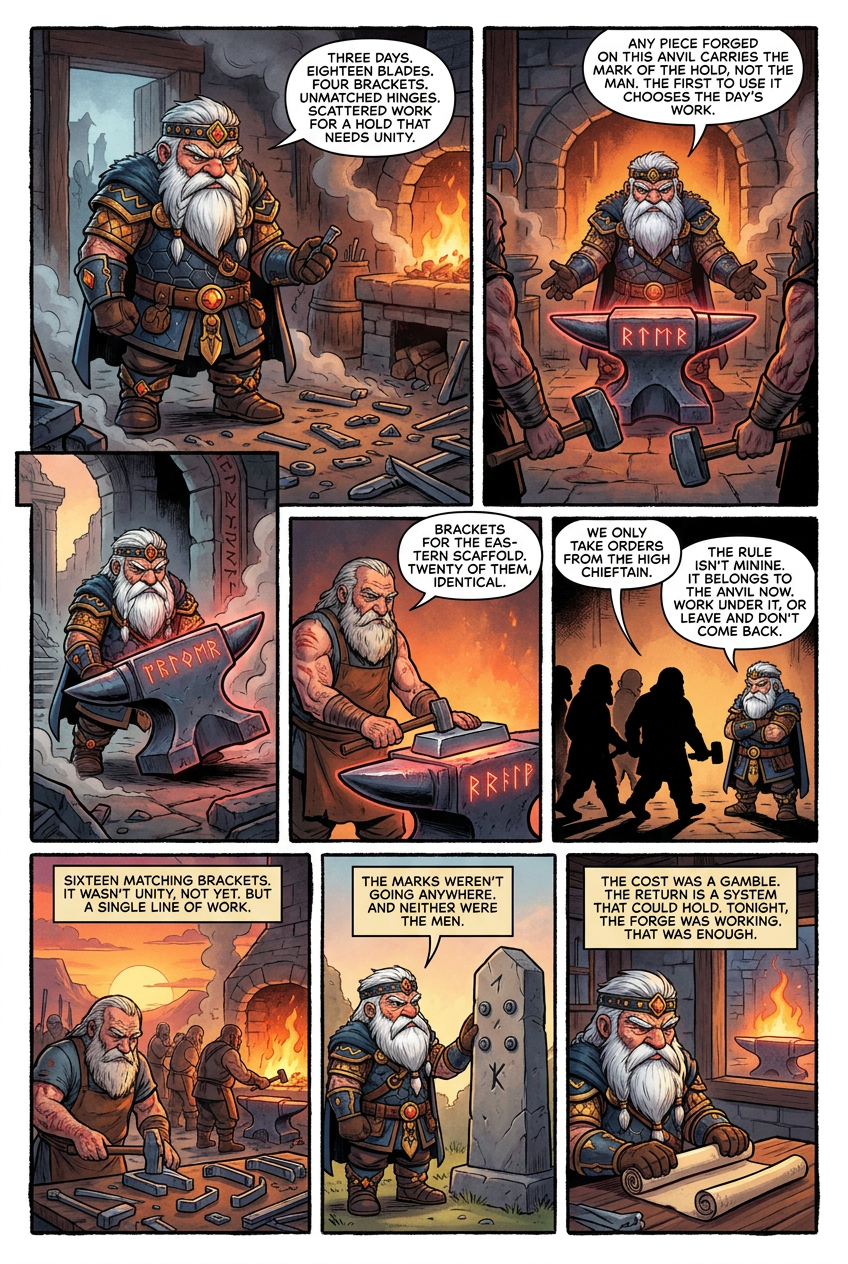
The smiths worked for three days without speaking except to call for heat or complain about coal. Durgan watched from the doorway and counted the finished pieces. Eighteen blades, four brackets, a set of hinges that didn't match. Good work, but scattered. Each smith was making what they knew best, not what the hold needed most. On the fourth morning he dragged the ceremonial anvil from the old temple ruins and set it in the center of the forge floor. The runes along its base glowed faint red in the firelight. He told the smiths that any piece forged on that anvil would carry the mark of the hold, not the mark of the man who made it. The first smith to use it would choose the day's work for everyone. Whoever banked the fire last would choose the next day's task. The smiths stared at the anvil, then at each other. No one moved. The oldest smith, a gray-bearded man with burn scars up both arms, finally stepped forward. He set a steel ingot on the anvil and looked at Durgan. "Brackets for the eastern scaffold," he said. "Twenty of them, identical." The other smiths didn't argue, but three of them left their stations and walked to the door. Durgan blocked their path and asked if they were refusing the work. The youngest of the three said he didn't take orders from anyone but the High Chieftain. Durgan told him the rule wasn't his—it belonged to the anvil now, and to the hold. If they wouldn't work under it, they could leave the forge and not come back. The three smiths looked at each other, then at their marks bolted to the post outside. After a long silence, they returned to their stations. By sunset the forge had produced sixteen matching brackets, and the oldest smith banked the fire himself. The next morning a different smith claimed the anvil first and called for door hinges. The work was slower, but no one walked out. Durgan stood outside and watched the monument as the smiths passed it on their way in. Some touched their marks. Others just glanced and kept walking. But they all came through the same door, and they all bent to the same task. It wasn't unity, not yet. But it was a single line of work where there had been fourteen separate paths. That night Durgan returned to the lodge and updated his accounting scroll. Fourteen smiths, one forge, one anvil. The cost had been three days of scattered work and a gamble that none of them would walk away for good. The return was a system that could hold. He rolled up the scroll and set it aside, then walked back to the monument and checked the bolts. They were solid. The marks weren't going anywhere, and neither were the men who'd forged them. Tomorrow he'd give them the next task: sorting the steel they had left and figuring out what they'd need to beg, borrow, or trade for. But tonight, the forge was working. That was enough.
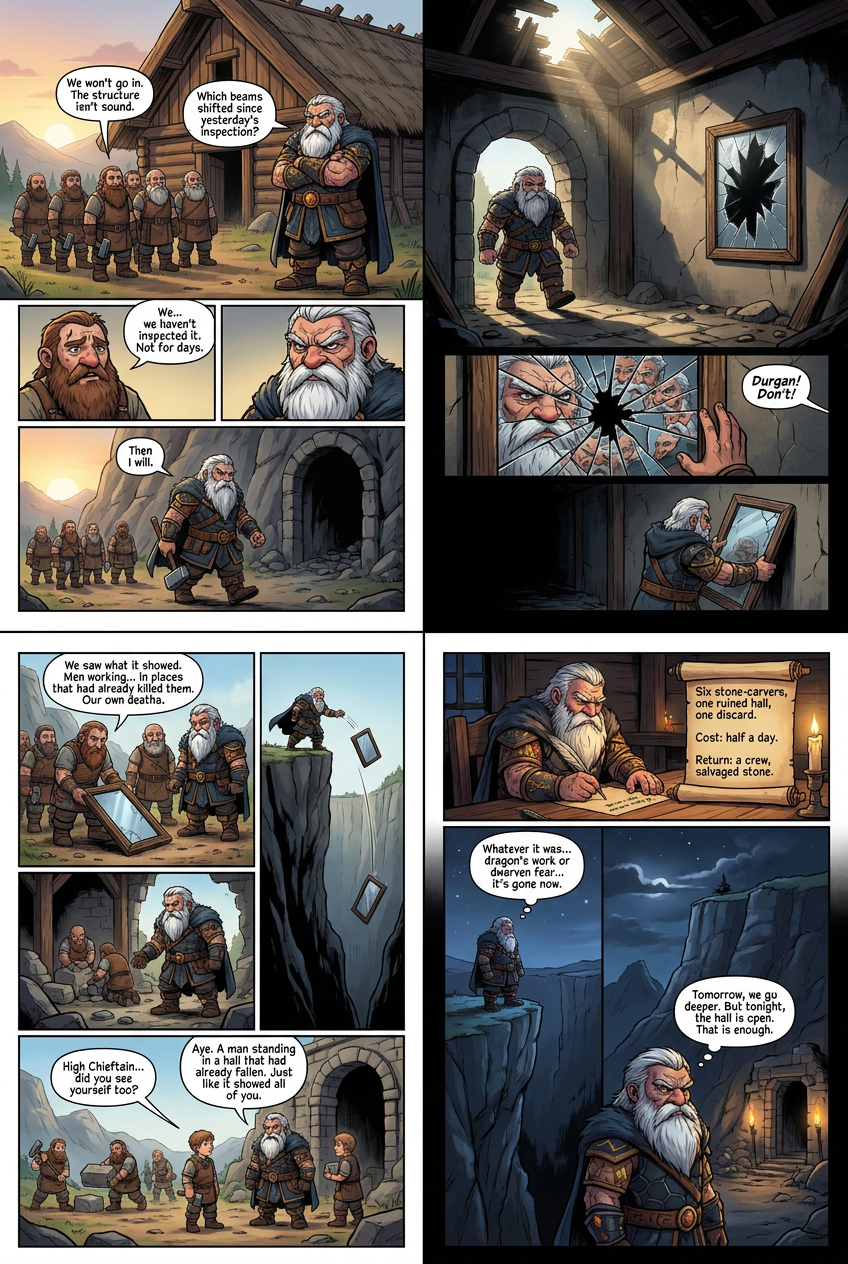
The stone-carvers came to him at dawn with their hammers still cold. All six of them stood in a line outside the lodge, and the one with the split thumbnail did the talking. They wouldn't go into the eastern hall ruins. The structure wasn't sound. Durgan asked which beams had shifted since yesterday's inspection. The carver said they hadn't inspected it yesterday. Or the day before. When Durgan asked when they'd last been inside, none of them answered. Durgan picked up his own hammer and walked to the ruins. The carvers followed at a distance but stopped at the entrance. He stepped through the collapsed archway and let his eyes adjust to the dark. Most of the hall was rubble, but the far wall still stood. Hanging there was a mirror with a cracked wooden frame. Its surface was shattered into a web of fragments, and every piece reflected only darkness, even where sunlight cut through the broken roof. Durgan moved closer and saw his own reflection split into a dozen pieces, each one showing him standing in a different part of the hall—some where the ceiling had already fallen, some where the floor had given way. He reached out and touched the frame. The wood was cold, colder than stone should be underground. Behind him, one of the carvers called out a warning, but Durgan pulled the mirror from the wall and carried it outside. He set it face-down in the dirt and told the carvers they could go in now. The one with the split thumbnail shook his head. They'd all seen what the mirror showed, he said. Men working in places that had already killed them. Durgan looked at the six of them and understood. They weren't refusing because the structure was unsound. They were refusing because the mirror had shown them their own deaths, and they'd believed it. He picked up the mirror again and walked it to the cliff edge. He threw it over. It fell without a sound and disappeared into the ravine below. When he returned to the ruins, two of the carvers had already gone inside and started sorting stone. By midday all six were working, hauling dressed blocks out to the staging yard. Durgan watched them measure and stack, their hands steady now that the mirror was gone. The youngest carver paused at the archway on his way back in and glanced at Durgan. He asked if the High Chieftain had seen himself in the mirror too. Durgan said he had. The carver asked what it showed him. Durgan told him it showed a man standing in a hall that had already fallen. Just like it showed all of them. The carver nodded and went back inside. That night Durgan updated his scroll. Six stone-carvers, one ruined hall, one discarded mirror. The cost had been half a day of stalled work and a superstition he couldn't afford to let take root. The return was a crew that would enter the eastern hall again, and enough salvaged stone to start the first foundation work by week's end. He set the scroll aside and walked to the cliff edge where he'd thrown the mirror. The ravine was dark and deep, and whatever the mirror had been—dragon's work or dwarven fear made solid—it was gone now. Tomorrow the carvers would go deeper into the ruins, and he'd go with them to make sure nothing else was waiting to stop the work. But tonight, the eastern hall was open again. That was enough.
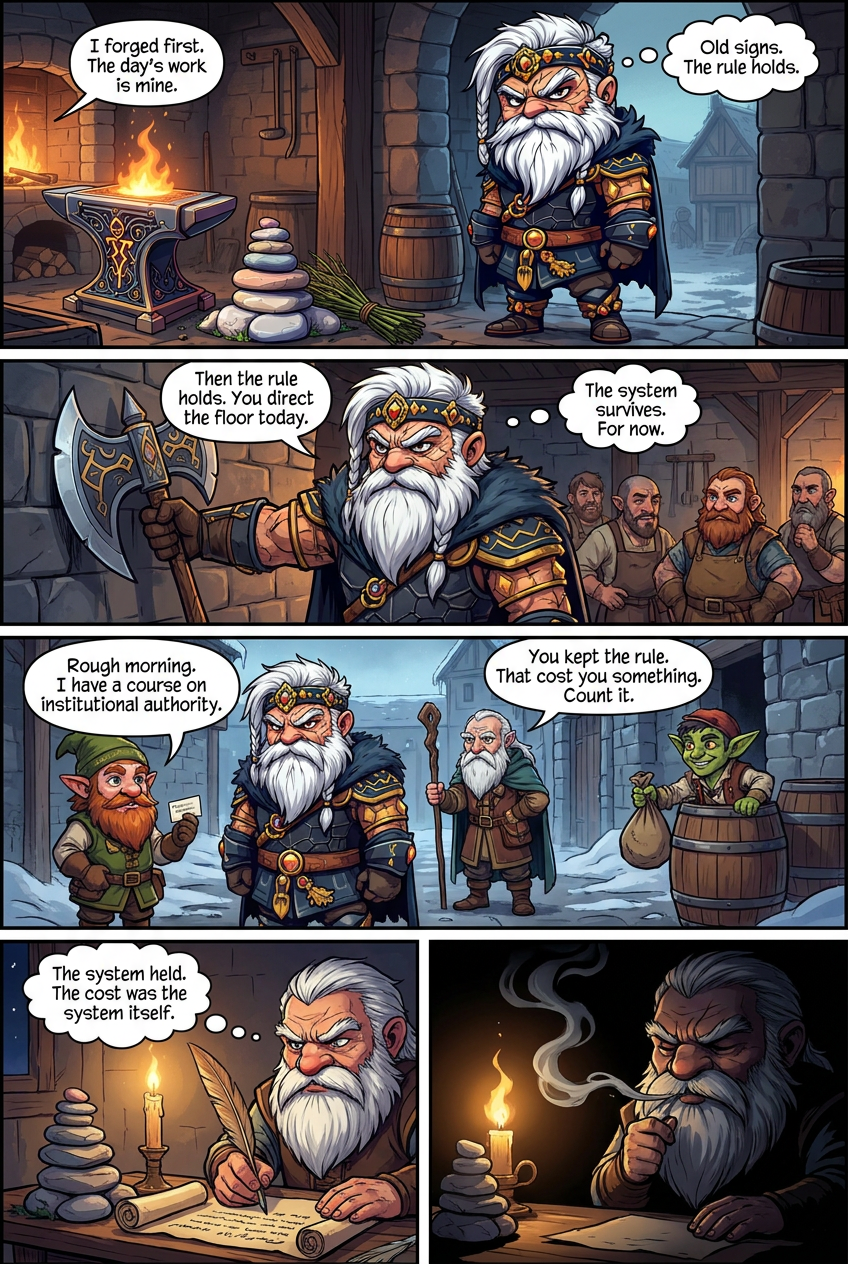
Durgan came to the forge before sunrise to check the carvers' new tools. The ceremonial anvil should have been cold. It wasn't. A senior smith stood beside it, hammer in hand, sparks already dying on the iron face. At his feet sat a small stack of pale river stones, balanced one on the other like a marker. A bundle of willow switches lay across the anvil's horn. Durgan knew the meaning before the smith opened his mouth. "I forged first," the senior smith said. "The day's work is mine. I'll be making my own pieces. Not the clan's brackets." He did not raise his voice. He did not have to. The rule Durgan himself had set two weeks ago had just been used against him. Durgan looked at the cairn and the willow. Old signs. A smith claiming his hands belonged to himself alone. Behind him the other smiths were arriving, watching to see if the High Chieftain would break his own law to keep them in line. If he did, the anvil system died today. If he didn't, the day's labor walked out the door. He set Kingsunder against the wall. He did not touch the cairn. "Then the rule holds," Durgan said. "You direct the floor today." The senior smith blinked. He had braced for a fight. Durgan turned to the watching smiths. "You heard him. His work, his orders." Then he walked out into the cold yard before anyone could see his jaw set. Bramblewick was waiting at the gate, somehow, business card already in hand. Winter Flint stood behind him, leaning on his staff, saying nothing. "Rough morning," Bramblewick said. "I have a course on institutional authority. Obviously." Durgan ignored him. Mervin Bogbutton popped out from behind a barrel with a sack of nails he swore were a bargain. Durgan ignored him too. Winter only said, "You kept the rule. That cost you something. Count it." By nightfall the senior smith had forged three blades for himself and dismissed the floor early. Twelve hours of clan labor, gone. Durgan sat with his scroll and wrote the loss in plain numbers. The anvil law had survived its first true test, but it had taught every smith in the hall a second lesson: the rule could be turned. Tomorrow, someone hungrier would rise earlier. Durgan blew out the lamp. The system held. The cost was the system itself.
Play your story to life
Storycraft is a mobile game where you create AI characters, craft items and locations to build their world, then discover what direction your story takes. Download the iOS game for free today!
Download for free