

Horacio Ashmont's Arc
12 Chapters
Horacio Ashmont's dream is saving enough coin to rent a permanent room above a tavern.

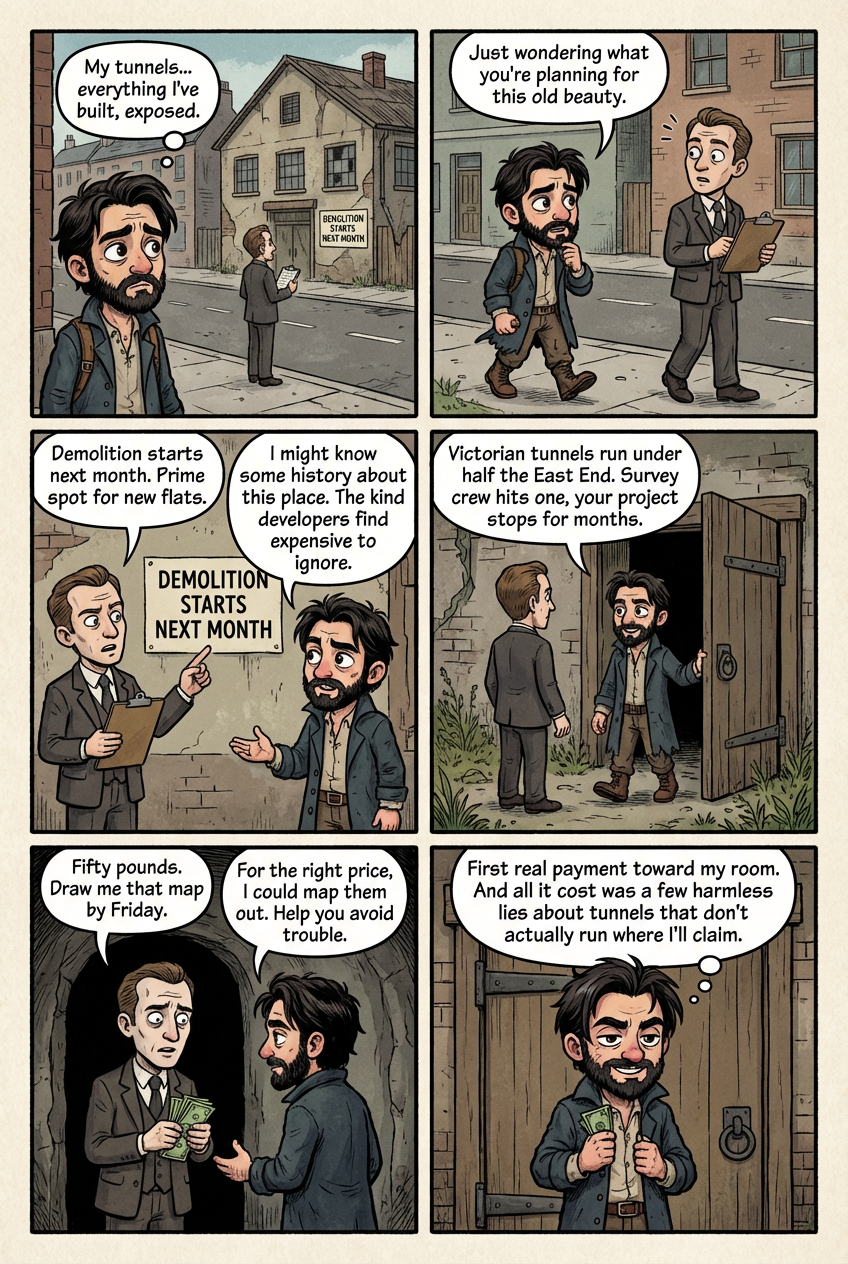
Horacio stood across the street from the old warehouse, watching a man in a pressed suit measure the building's facade with his eyes. The warehouse looked ready to collapse, but that didn't matter to Horacio. Behind those rotting boards lay the main entrance to his tunnels, the secret routes he guarded like a dragon hoards gold. The suited man pulled out a clipboard and started writing notes. Horacio's chest tightened. If they tore down this building, his whole network would be exposed. Worse, the street folk who depended on those tunnels for shelter would have nowhere safe to sleep when winter came. He needed money for a room of his own, true, but not like this. Not by losing everything he'd built below ground. Horacio crossed the street and cleared his throat. The man looked up, startled. "Help you?" he asked. Horacio forced a smile. "Just wondering what you're planning for this old beauty." The developer gestured at a freshly hammered sign beside the entrance. Bold red letters warned the building was condemned. "Demolition starts next month," he said. "Prime spot for new flats. You live around here?" Horacio's mind raced. A month to find new routes, move supplies, relocate people who trusted him. Or a month to scrape together enough coin to buy time. He'd spent years protecting these tunnels for free. Maybe it was time to make them pay. "I might know some history about this place," Horacio said carefully. "The kind developers find expensive to ignore." The man's eyes narrowed with interest. The developer offered twenty pounds for a tour. Horacio led him around back to where weeds swallowed the old storm cellar doors. The heavy wood groaned as Horacio pulled them open, revealing stone steps disappearing into darkness. "Victorian tunnels run under half the East End," he said. "Survey crew hits one of those, your whole project stops for months. Archaeological assessments. Council inspections." He watched the developer's face go pale. "But I know every tunnel under this block. For the right price, I could map them out. Help you avoid trouble." The developer pulled out his wallet and counted out fifty pounds. "Draw me that map by Friday." Horacio pocketed the money. First real payment toward his room, and all it cost was a few harmless lies about tunnels that didn't actually run where he'd claim.
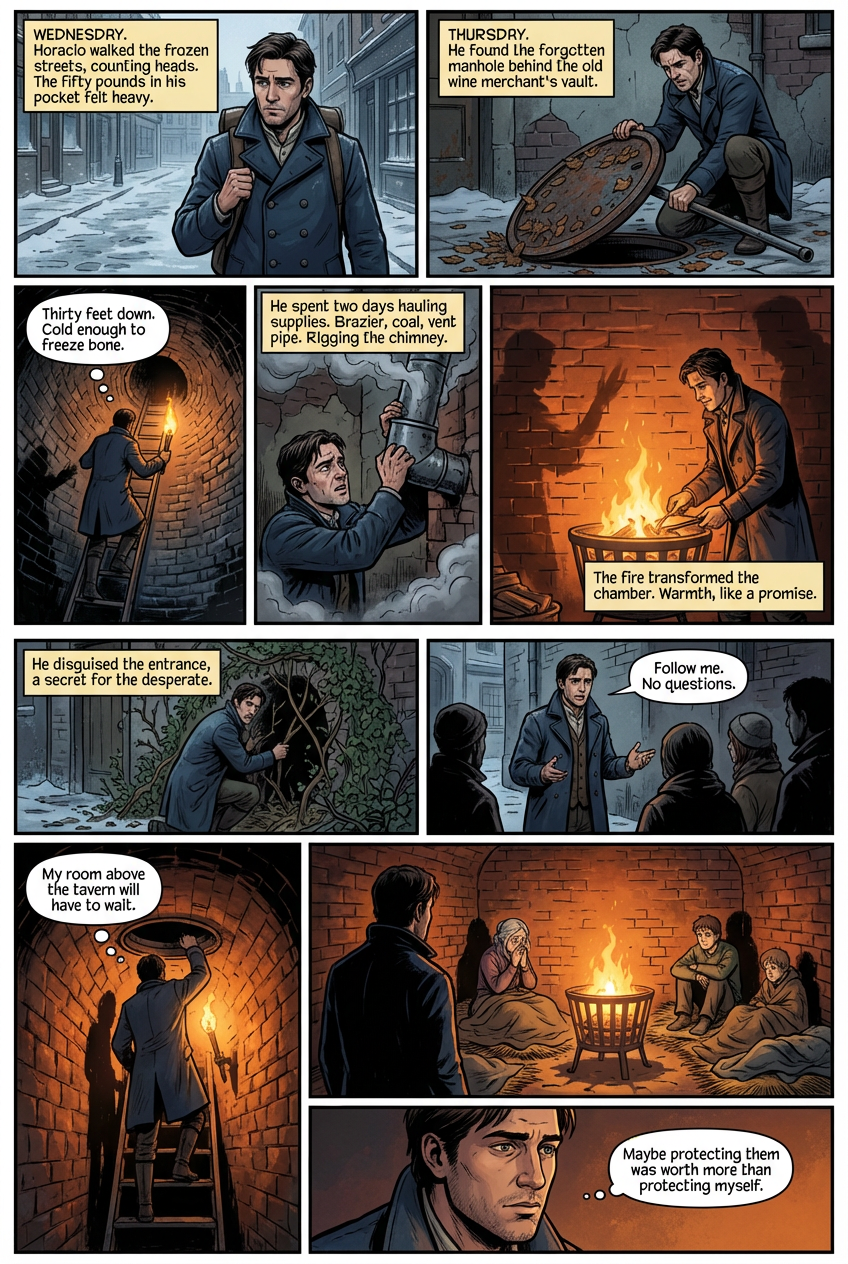
Horacio spent Wednesday walking the frozen streets, counting heads. Twelve regulars slept in the warehouse most nights, plus whoever stumbled in desperate when the temperature dropped. The fifty pounds sat heavy in his pocket, but it wouldn't solve this problem. He needed to prepare the deep tunnel, the one he'd kept secret even from most of the street folk. Thursday morning, he found the manhole cover behind the old wine merchant's vault. The ornate metal was half-buried under dead leaves and rubbish, which meant nobody had bothered it in months. Good. He pried it up with a length of pipe, muscles screaming, and lowered himself into darkness. The tunnel below ran thirty feet before opening into a brick chamber large enough for two dozen people to sleep without touching. But the air down here bit worse than the streets above. No ventilation meant no fire, and the cold would kill them just as dead as exposure. He spent two days hauling supplies. A brazier from the scrap yard cost him three pounds. Coal and kindling, another two. He rigged a vent pipe through an old chimney shaft, testing it with wet rags until the smoke drew properly. The fire he built in the brazier transformed the chamber, casting dancing shadows on the brick walls. Warmth spread through the space like a promise. He dragged down blankets and straw pallets, working until his back seized up. At the entrance, he wedged a salvaged wooden door frame tight against the opening, then wove ivy and dead branches through it until it looked like nothing but overgrowth. Friday evening, he gathered the warehouse regulars in the alley. They followed him without questions, trusting him like they always had. One by one, he lowered them through the manhole, watching their faces change when they felt the heat rising from below. Old Martha wept. Young Tom just stared at the fire like he'd forgotten what warmth felt like. Horacio climbed down last and sealed the cover above them. His room above a tavern would have to wait—he'd spent eighteen pounds of his fifty on this instead. But watching them settle in around the flames, he felt something shift in his chest. Maybe protecting them was worth more than protecting himself.
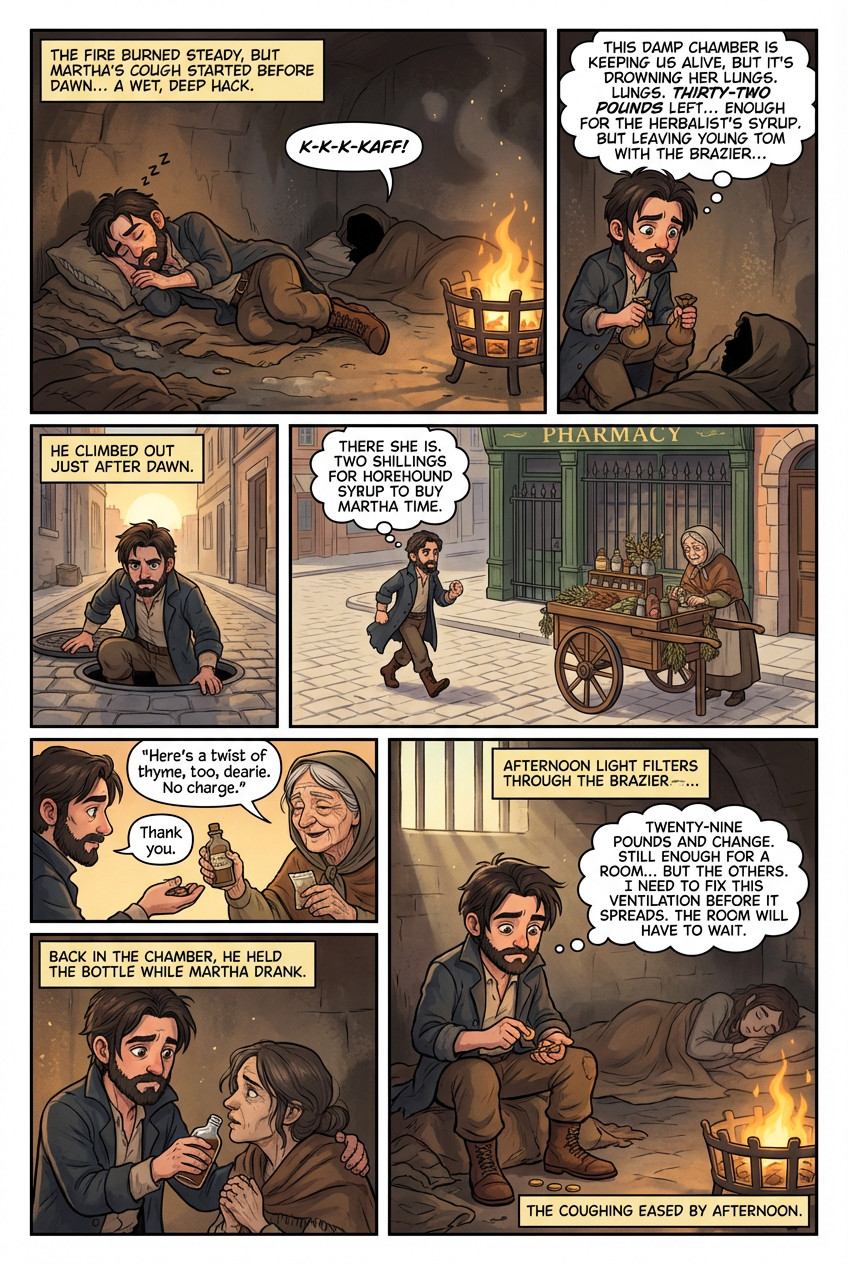
The fire burned steady through the night, but Martha's cough started before dawn. At first it was just a rattle in her chest, the kind that came from breathing cold air too long. By morning it had turned wet and deep. Horacio woke to the sound of her hacking into a rag, her whole body shaking with the effort. Horacio crouched beside her, listening to the wheeze between coughs. The damp chamber was keeping them alive, but it was also drowning Martha's lungs. He had thirty-two pounds left from the developer's payment, and he knew where the herbalist's cart set up near the market square most mornings. The woman charged two shillings for a bottle of horehound syrup that might ease the cough enough to buy Martha time. But he'd need to leave the others alone in the chamber, and Young Tom didn't know how to manage the brazier properly yet. He climbed up through the manhole cover just after dawn and walked fast through the alleys. The pharmacy on the corner had locked iron gates across its windows, but the herbalist's cart stood where it always did, wheels creaking as the old woman arranged bottles on the wooden shelves. Horacio bought the syrup and a packet of dried mullein leaves for hot water. The herbalist squinted at him and threw in a twist of thyme without charging extra. Back in the chamber, he held the bottle while Martha drank, her hands too shaky to grip it herself. The coughing eased by afternoon, enough that Martha could sleep without choking. Horacio sat by the brazier and counted his remaining coins. Twenty-nine pounds and change. Still enough for a room above a tavern if he wanted it for himself. But now he knew what the damp would do to anyone who stayed down here too long. He'd need to spend more on medicine, maybe find a way to improve the ventilation before the cough spread to the others. The room could wait. It would have to.
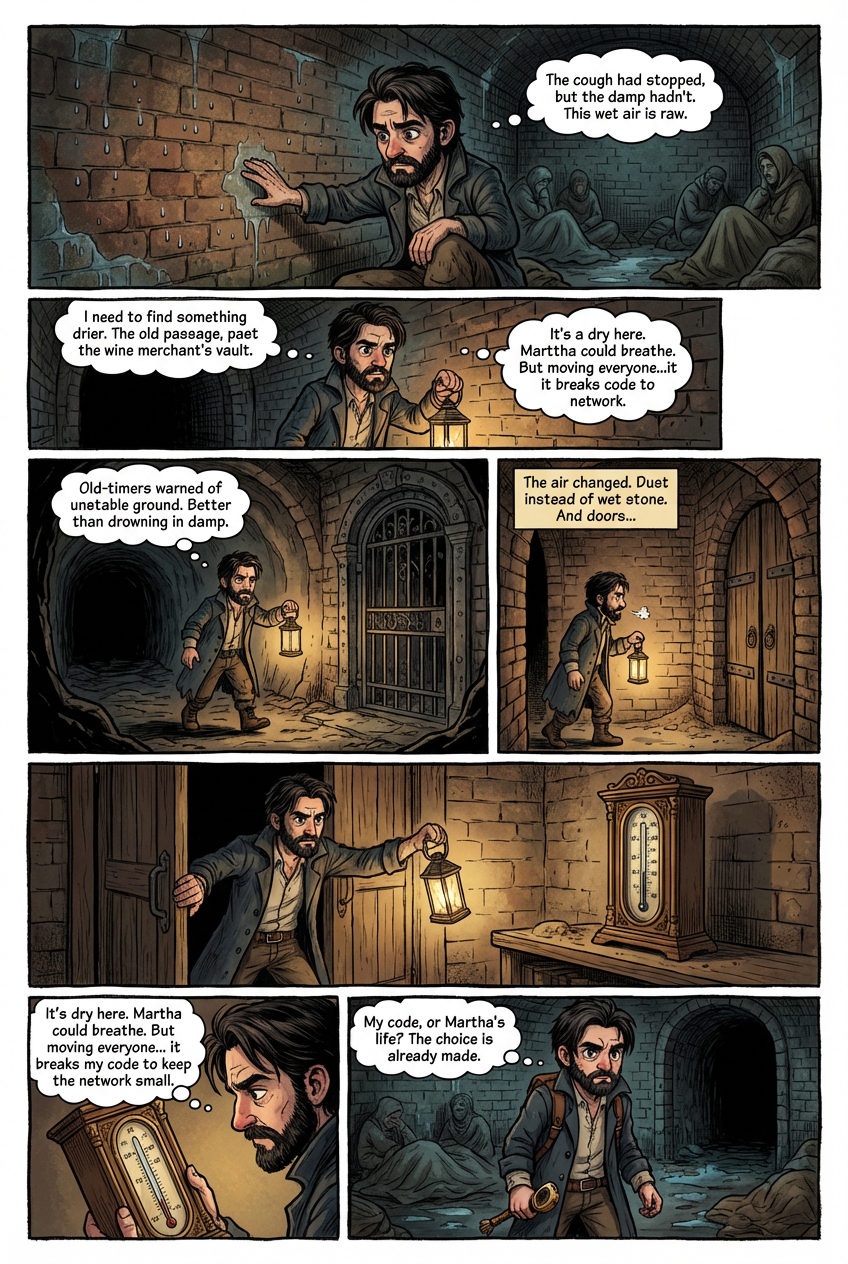
The cough had stopped spreading, but the damp hadn't stopped rising. Horacio woke each morning to water beading on the brick walls, trickling down to pool in the corners where the floor dipped. The chamber kept them warm enough, but breathing the wet air all night left everyone's throats raw. He needed to find something drier, and he knew the tunnels well enough to try. Past the wine merchant's vault, there was a passage he'd never fully explored—the old-timers had warned him off it years ago, something about unstable ground. But unstable was better than drowning in damp air. He took a lantern and went alone, following the main tunnel until he reached the ornate iron cover that marked the vault entrance. Twenty paces beyond it, the passage narrowed and turned sharply left into darkness. The air changed first. Horacio stopped and breathed deep, tasting dust instead of wet stone. The walls here were different too—drier brick, no moisture seeping through. His lantern caught something ahead: heavy wooden doors set into a stone archway, half-buried in old dirt and moss. He pushed hard and they swung inward with a groan. Beyond them stretched a storm cellar he'd never seen before, its floor solid and its air almost warm. On a shelf near the entrance sat a dusty brass instrument in an ornate wooden case, its glass tube and metal fittings still intact. A hygrometer—meant for measuring moisture in the air. The needle pointed low, far lower than anything in the brick chamber. Horacio stood in the doorway and looked back toward the vault. This space could hold them all, and Martha wouldn't have to breathe wet air anymore. But moving everyone meant revealing this passage to twelve people instead of the careful few he'd always trusted with the tunnels. His code said to keep the network small, to protect it by limiting who knew. His lungs said Martha would die if she stayed in that damp hole much longer. He picked up the hygrometer and carried it back toward the chamber. The choice was already made.
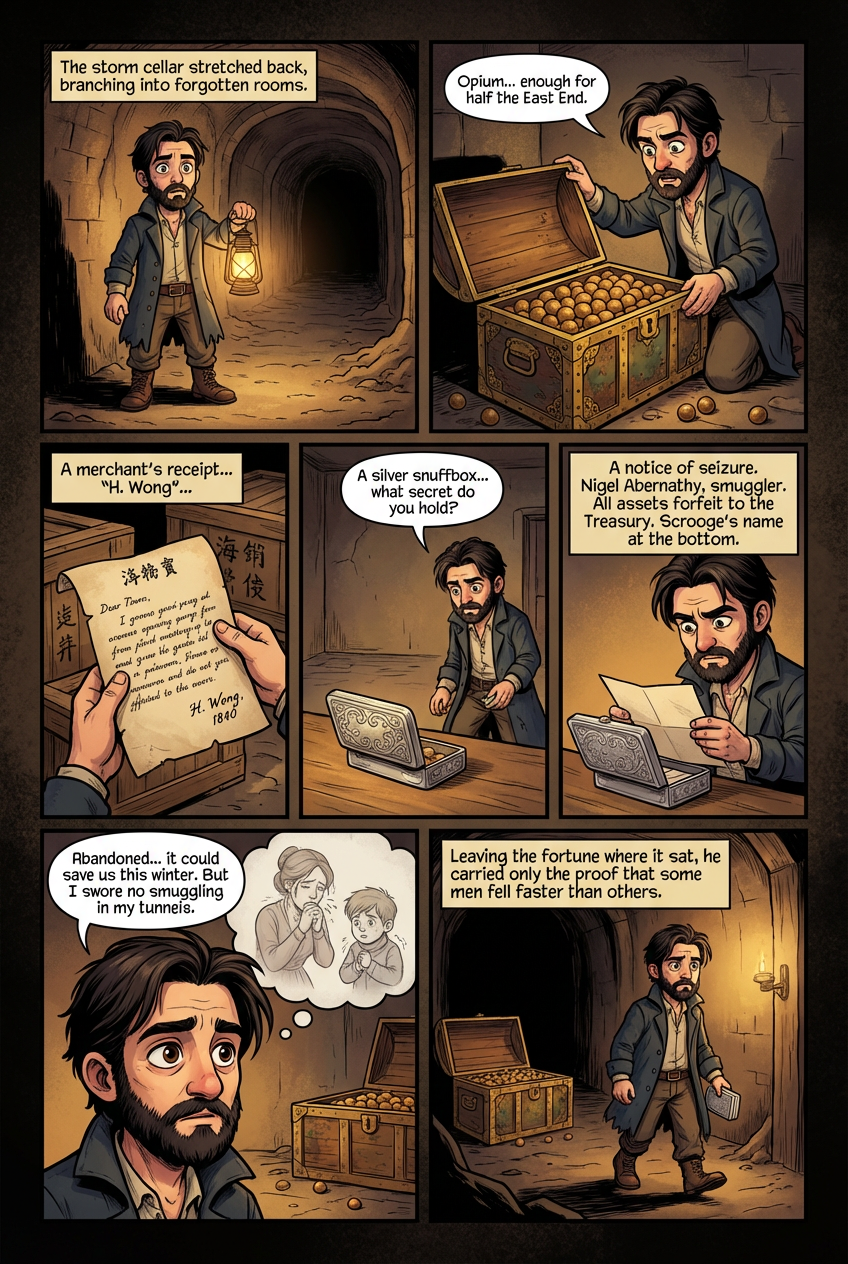
Horacio stood in the storm cellar and let his eyes adjust to the lantern light. The space stretched back farther than he'd first noticed, branching into smaller rooms that had once served some purpose he couldn't name. He moved deeper, boots scraping on dry stone. The first alcove held ornate wooden chests lined against the wall, their brass fittings tarnished but intact. He lifted the lid of the nearest one. Golden-brown balls filled the interior—opium, enough to supply half the East End for months. The other chests held the same. Someone wealthy had stored a fortune down here, the kind of contraband that required protection and secrecy. He found a shipping crate in the corner, its wood stamped with Chinese characters. A curled parchment lay inside, covered in calligraphy he couldn't read but recognized as a merchant's receipt. The name at the bottom was written in English: H. Wong, with a date from three years past. Horacio picked through the remaining alcoves, searching for what happened next in the story. The third room gave him his answer. A silver snuffbox lay on its side near the far wall, ornate scrollwork on the lid catching the lantern light. He opened it. Inside, folded tight, was a notice of seizure from the Crown's customs office. The merchant's name appeared there too—Nigel Abernathy, convicted of smuggling, all assets forfeit to the Treasury. Scrooge's name sat at the bottom as the purchasing agent who'd bought the townhouse at auction. The cellar had been cleaned out by the law, every chest except these few that the officers must have missed in the dark. He closed the snuffbox and slipped it into his coat. The evidence explained why the cellar stood empty and why no one had come looking for what remained. It also meant the opium was legally abandoned, worth more than any room above a tavern if he could find a buyer. But moving it would mean using his tunnels for smuggling, the one thing he'd sworn never to allow. Horacio looked back at the chests and thought of Martha's cough, of Young Tom shivering in the damp, of twenty-nine pounds that wouldn't last the winter. He left the opium where it sat and walked back toward the chamber, carrying only the proof that some men fell faster than others.
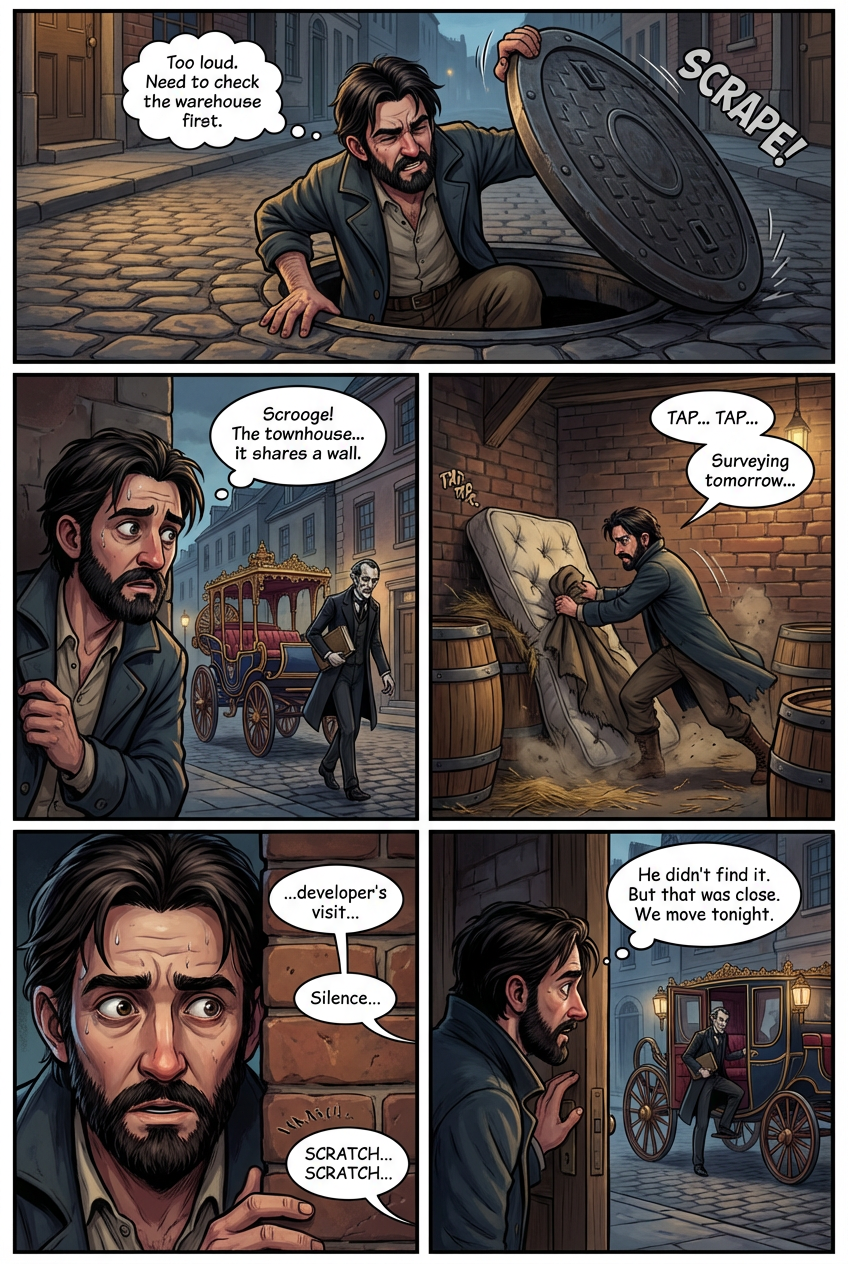
Horacio climbed back up to street level and pulled the manhole cover into place. The metal scraped against stone, louder than he'd have liked. He needed to check the warehouse entrance before bringing the others down to the storm cellar—make certain no one had disturbed it since the developer's visit. He reached the warehouse just as a carriage rolled to a stop two buildings down. The horse stamped its hooves on the cobblestones. A man in dark clothing stepped out, carrying a ledger under one arm. Horacio recognized the sharp features and narrow shoulders. Scrooge. The moneylender walked toward the grand townhouse with the ornate brick facade, the one that had belonged to a merchant before debts swallowed him whole. Horacio's stomach dropped. That building shared a wall with the warehouse. If Scrooge poked around the connecting cellar, he'd find the tunnel entrance. Horacio slipped through the warehouse's side door and descended to the lower level. A torn mattress lay against the far wall where Young Tom had slept two nights ago, the striped ticking exposed through rips in the fabric. A blanket sat bunched on top. He grabbed both and shoved them behind a stack of barrels, then kicked straw and debris over the spot where the mattress had rested. Footsteps echoed through the wall from the townhouse cellar. Scrooge was already inside, moving closer to the partition. Horacio pressed his ear to the brick. The footsteps stopped just on the other side. He held his breath. A long silence followed, broken only by the scratch of a pen on paper. Then the steps retreated back toward the townhouse stairs. Horacio waited until he heard nothing, then climbed back to street level and watched through a gap in the boards as Scrooge emerged from the townhouse and returned to his carriage. The moneylender hadn't found the tunnel, but he'd come close enough that Horacio's hands still shook. He'd need to move everyone tonight, before Scrooge came back with workmen to survey his new property.
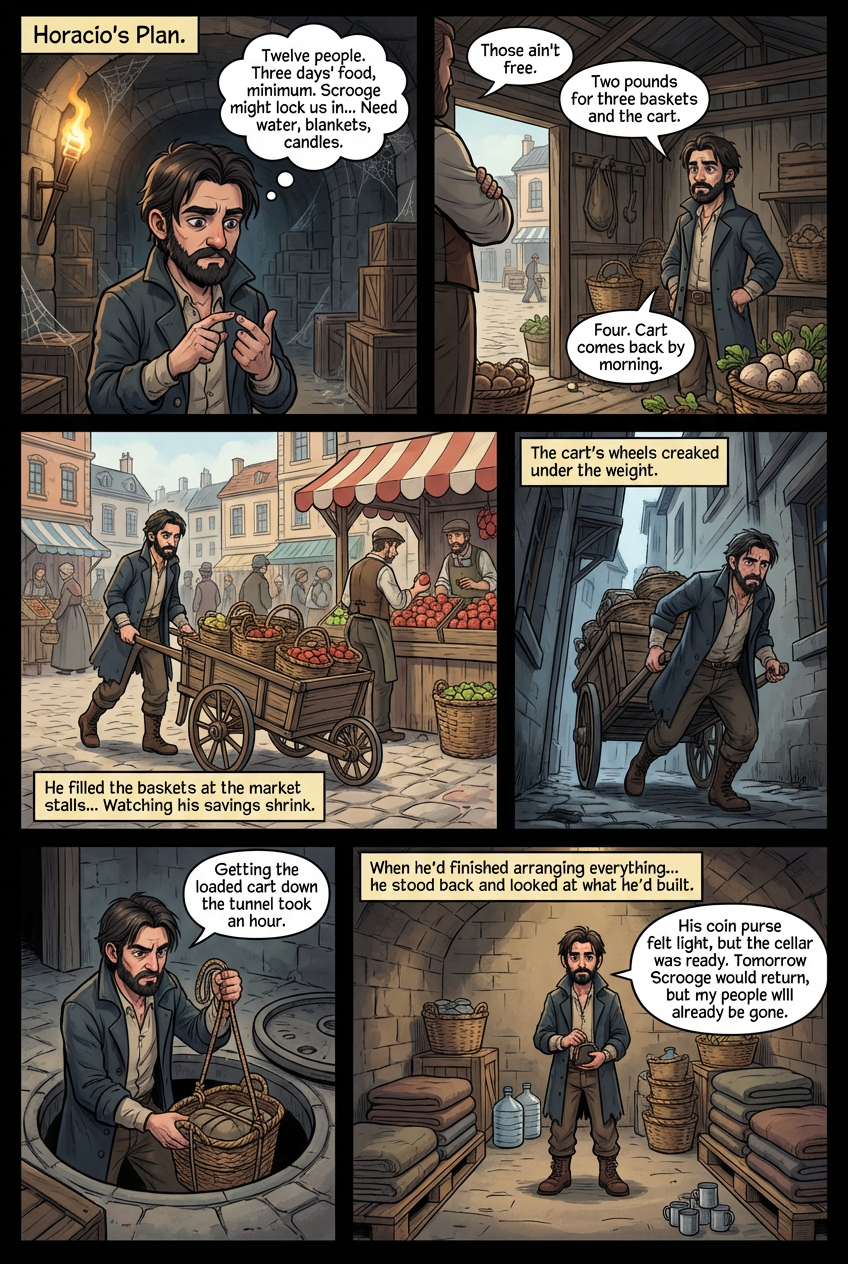
Horacio returned to the warehouse cellar and counted what he'd need. Twelve people. Three days' worth of food at minimum, since Scrooge might lock the townhouse and cut off access to the storm cellar. Water jugs. More blankets. Candles and matches. He found a rickety storage shed behind the market square, padlock hanging loose on rusted hinges. Inside sat rows of wicker baskets, some empty, others holding turnips gone soft. The owner appeared in the doorway, arms crossed. "Those ain't free," the man said. Horacio offered two pounds for three baskets and use of the handcart leaning against the wall. The man shook his head. "Four pounds. Cart comes back by morning." Horacio counted out the coins, watching his savings shrink again. He filled the baskets at the market stalls. Dried fish wrapped in paper. Loaves of bread, some already hardening. Apples with brown spots the sellers sold cheap. Cheese wheels small enough to carry. He loaded everything into the handcart, then added two water jugs and a stack of tin cups from a rag seller's pile. The cart's wheels creaked under the weight. He pushed it through the alleys, keeping to shadows, until he reached the manhole behind the wine merchant's vault. Getting the loaded cart down the tunnel took an hour. He lowered each basket with rope, then carried the jugs and supplies through the passages to the storm cellar. When he'd finished arranging everything in the alcoves, he stood back and looked at what he'd built. Pallets lined the walls. Blankets folded at the foot of each. The baskets held enough food to keep twelve people fed while he figured out what came next. His coin purse felt light in his pocket, but the cellar was ready. Tomorrow Scrooge would return to the townhouse, and when he did, Horacio's people would already be gone.
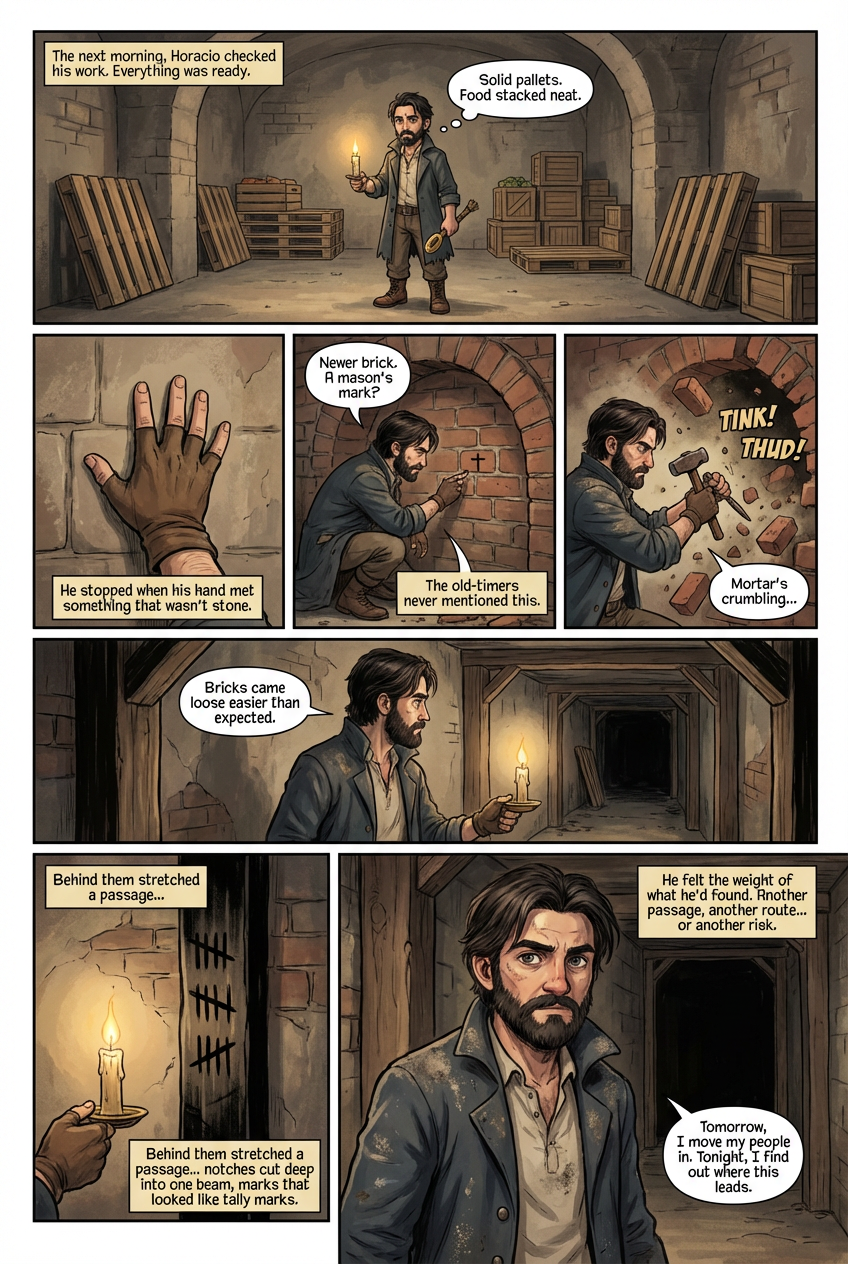
Horacio returned to the storm cellar the next morning to check his work. The pallets looked solid. The food was stacked neat in the alcoves. Everything was ready. He walked the perimeter, testing the walls with his palm, and stopped when his hand met something that wasn't stone. Brick. Newer brick, set in mortar that crumbled when he pressed his thumb against it. The wall curved inward at the far corner of the cellar, forming a shallow arch that someone had filled with fresh brickwork. He scraped away loose mortar with his fingernail and found a symbol carved into one brick near the base—a cross, simple and deep. A mason's mark. The old-timers who'd taught him the tunnels had never mentioned this passage. He pulled a rusted chisel from the alcove where he'd stored tools and worked at the mortar joints. The bricks came loose easier than he'd expected, tumbling onto the floor with hollow thuds. Behind them stretched a passage, narrow and black, with timber supports overhead. He held his candle through the gap and saw notches cut deep into one beam, marks that looked like tally marks or dates. The wood was black with water stains so old they'd turned the grain to iron. Horacio stood there holding the candle, mortar dust on his hands, and felt the weight of what he'd found. Another passage meant another route, another shelter if Scrooge came sniffing. But it also meant risk—unknown territory, unmapped ground that even the old-timers hadn't trusted him with. He set the chisel down and stared into the dark. Tomorrow he'd move his people into this cellar. Tonight he'd find out where this passage led, and whether it was salvation or just another hole to hide his mistakes.
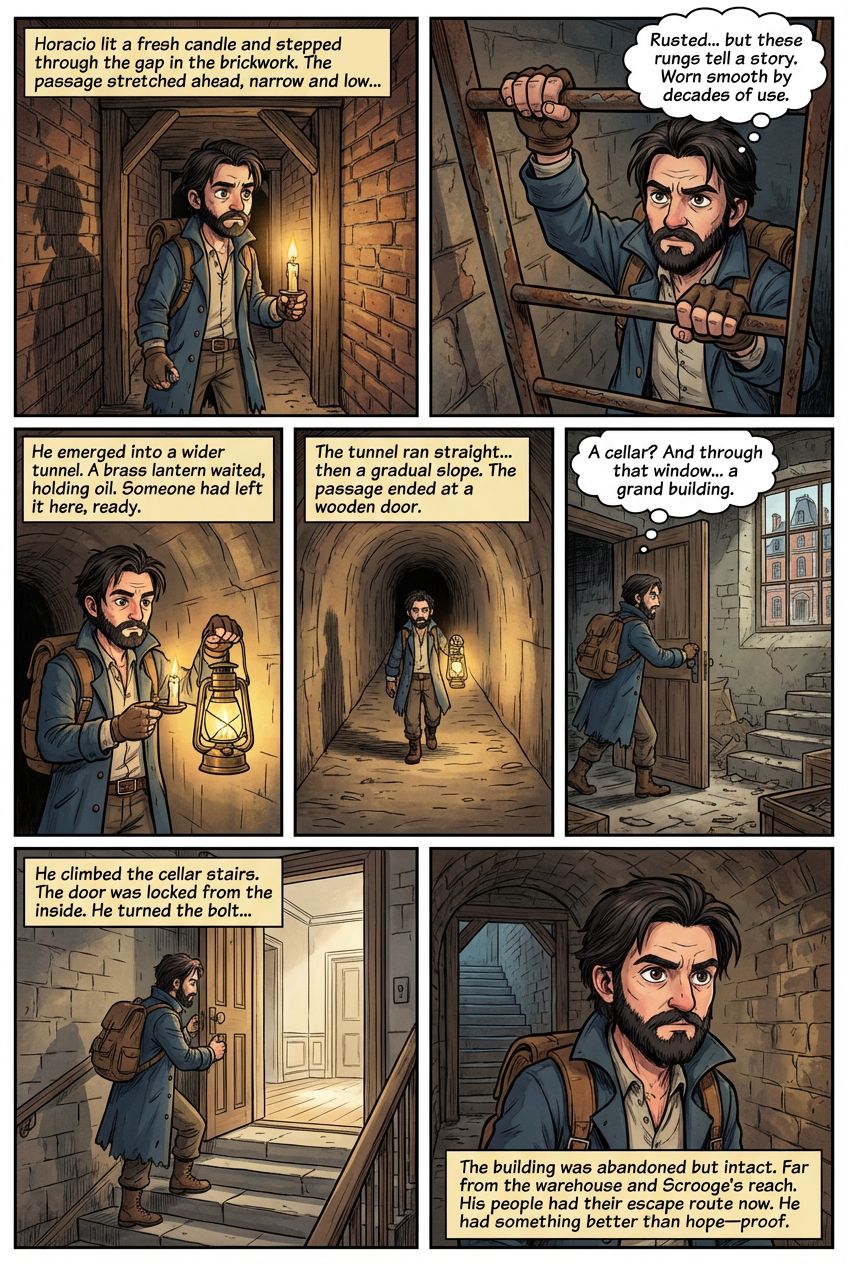
Horacio lit a fresh candle and stepped through the gap in the brickwork. The passage stretched ahead, narrow and low, forcing him to duck beneath the timber supports. His candle threw shadows that jumped with each step, making the walls seem closer than they were. He found the first ladder twenty paces in, rusted metal rungs bolted into the stone. The rungs bore handprints worn smooth through decades of use, the rust eaten away where palms had gripped. He climbed carefully, testing each step, and emerged into a wider tunnel with better air. The brass lantern waited at the top, still holding oil that caught when he touched his candle to the wick. Someone had left it here, ready. The tunnel ran straight for another hundred yards before it turned. He followed it up a gradual slope, the floor dry and solid underfoot. The passage ended at a wooden door set flush with brick. He pushed it open and found himself in a cellar thick with dust. Stone stairs led up to street level. Through a grimy window he saw the corner of a grand brick building, five stories tall with stone trim and a mansard roof. Horacio climbed the cellar stairs and tested the door at the top. Locked, but from the inside. He turned the bolt and stepped into an empty entrance hall. The building was abandoned but intact, far from the warehouse and Scrooge's reach. He walked back down to the cellar and memorized every turn of the tunnel behind him. His people had their escape route now, and he had something better than hope—he had proof that the old passages still led somewhere worth going.
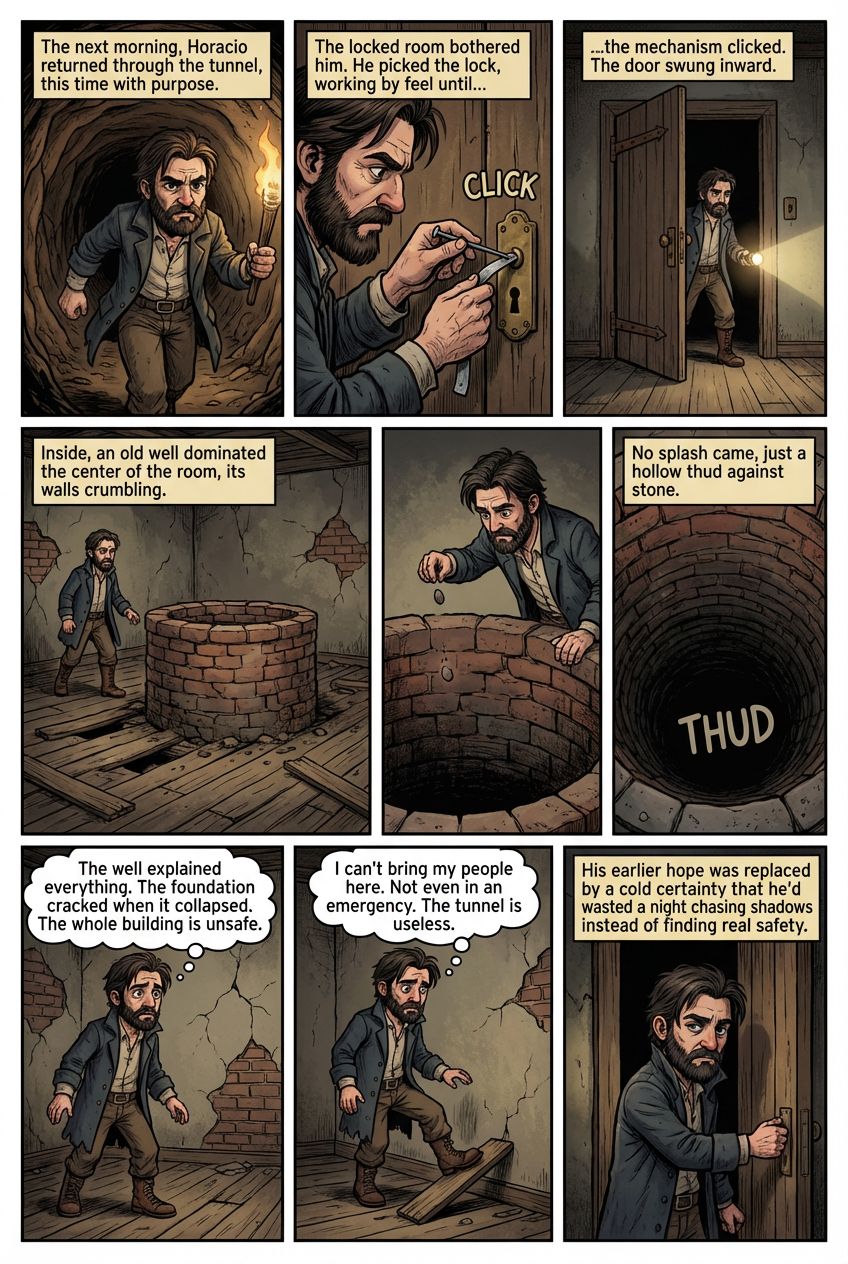
Horacio returned through the tunnel the next morning, this time with purpose. He had a route now, a way out if Scrooge moved faster than expected. But the locked room bothered him. The door sat at the end of the abandoned building's upper hallway, its brass lock old but solid. He picked the lock with a bent nail and a strip of tin, working by feel until the mechanism clicked. The door swung inward on rusted hinges. Inside, an old well dominated the center of the room, its brick walls crumbling inward. The chain hung slack, the bucket long gone. He leaned over the edge and dropped a pebble. No splash came, just a hollow thud against stone. The well explained everything. The tunnel had been sealed because this building was condemned. The foundation had cracked when the well collapsed, making the whole structure unsafe. That's why it stood empty despite its grand facade. No buyer would touch it without rebuilding from the ground up, and no one had the coin for that in this part of the East End. Horacio backed away from the well and tested the floorboards near the walls. They held firm, but the center of the room sagged toward the shaft. His escape route led to a building that could collapse at any time. He couldn't bring his people here, not even in an emergency. The tunnel was useless. He latched the door behind him and descended to the cellar, his earlier hope replaced by a cold certainty that he'd wasted a night chasing shadows instead of finding real safety.
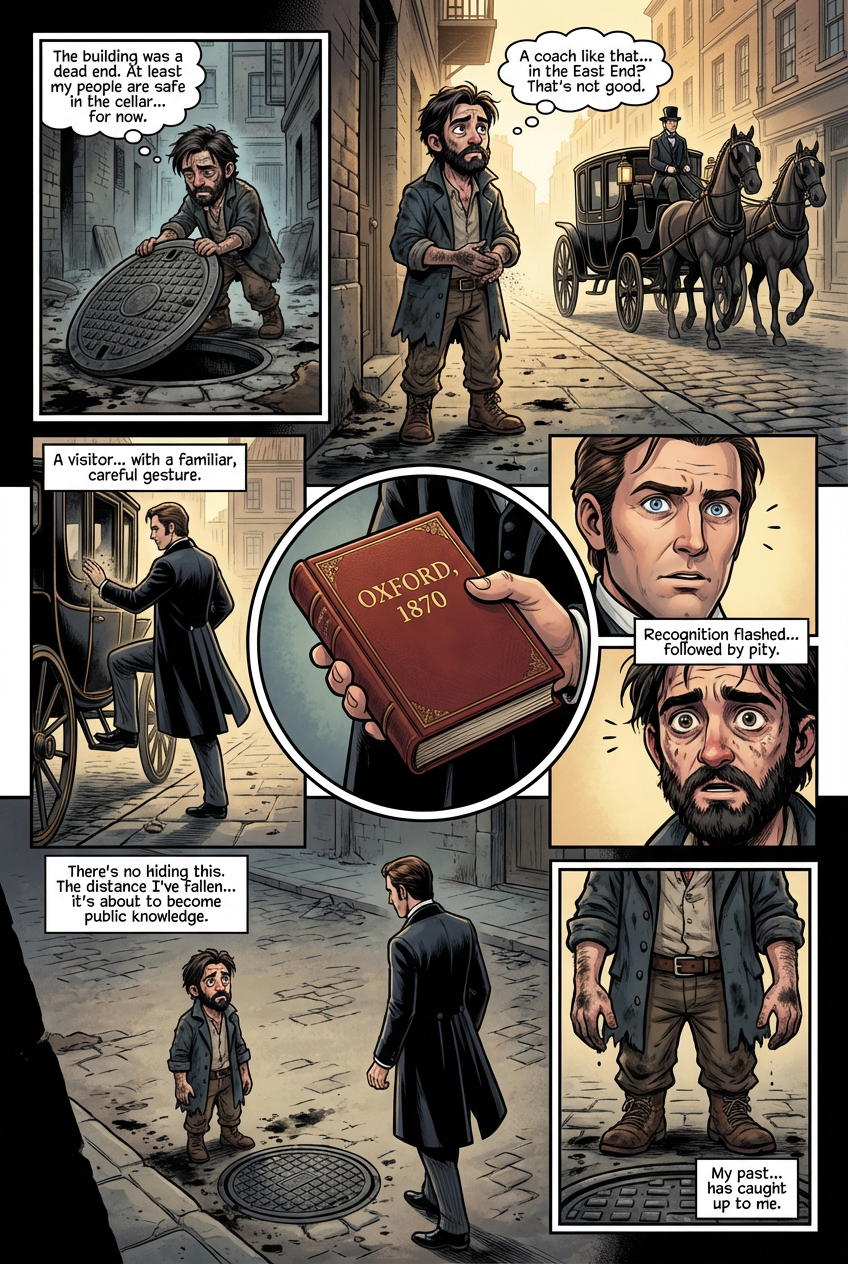
Horacio climbed back through the manhole and sealed it behind him. The abandoned building had been a waste of time, but at least he knew the truth now. His people were still safe in the storm cellar, waiting for him to decide their next move. The coach appeared on the street above just as he straightened. Not the usual rickety cart or loaded wagon that rattled through these alleys, but a proper carriage with matched horses and lacquered wood that caught the morning light. Horacio froze. No one drove a coach like that into the East End unless they had business that couldn't wait. A man stepped down, brushing dust from his sleeve with the same careful gesture Horacio remembered from tutorials and dining halls. The visitor pulled something from his coat pocket—a red leather yearbook stamped with gold letters. Oxford, 1870. Horacio's own graduation year. The man looked up and their eyes met across the cobblestones. Recognition flashed between them, followed by something worse than contempt. Pity. Horacio stood there with soot on his hands and the manhole cover at his feet. No explanation would erase what the man could see—the rough clothes, the hollow cheeks, the fact that Horacio had just crawled out of the sewers like something that belonged there. The visitor tucked the yearbook away and approached, each step measuring the exact distance Horacio had fallen. There would be no hiding this. Someone from his former life knew where he'd ended up, and that knowledge would spread faster than any rumor through the old networks he'd left behind.
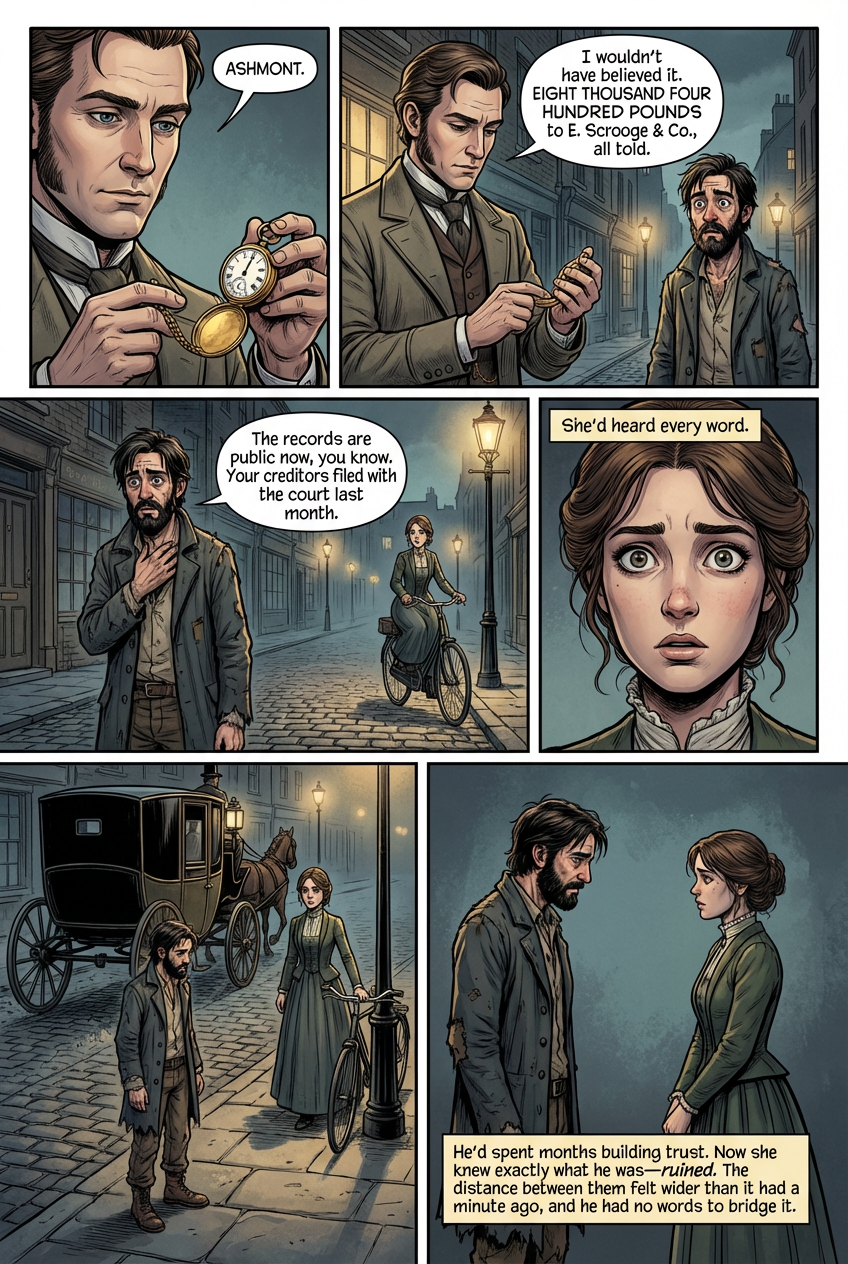
The visitor stopped three paces away, close enough that Horacio could see the fine weave of his coat. The man's face hadn't changed much—older, yes, but still wearing that careful neutrality professors had favored during examinations. "Ashmont." The man drew out a gold pocket watch, checked it, then tucked it away. "I wouldn't have believed it if I hadn't seen you myself. Eight thousand four hundred pounds to E. Scrooge & Co., all told. The records are public now, you know. Your creditors filed with the court last month." Horacio's throat went dry. The amount hung in the air between them like something solid. He'd known the debt existed, had signed the papers years ago when wine and cards had seemed more important than tomorrow. But hearing it spoken aloud—here, in the street where anyone might pass—made it real in a way it had never been before. A bicycle rounded the corner just then, its rider braking hard at the lamppost. Siobhan. Her face showed she'd heard every word. The Oxford man tipped his hat and climbed back into his carriage without waiting for a response. Horacio stood frozen as the wheels clattered away over the cobblestones. Siobhan set her bicycle against the lamppost and walked toward him, her expression unreadable. He'd spent months building trust with her, careful conversations over bread and soup, shared laughter about the absurdities of the East End. Now she knew exactly what he was—not just poor, but ruined. A man who owed more than most people in this neighborhood would see in a lifetime. The distance between them felt wider than it had a minute ago, and he had no words to bridge it.
Play your story to life
Storycraft is a mobile game where you create AI characters, craft items and locations to build their world, then discover what direction your story takes. Download the iOS game for free today!
Download for free