

Jubilee July's Arc
7 Chapters
Jubilee July's dream is reuniting her scattered childhood friends for one perfect July gathering under the maple tree..

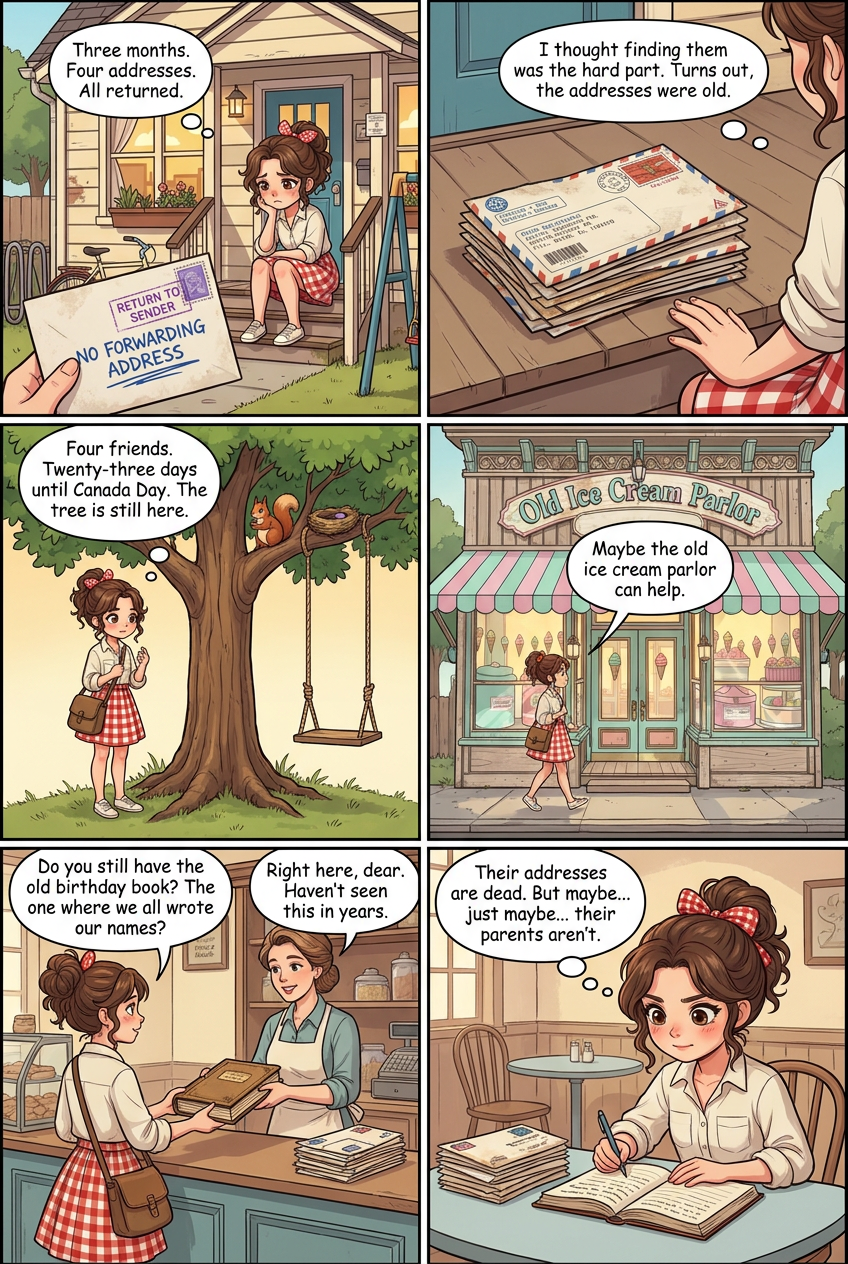
Jubilee July sat on the porch steps of the house where she grew up, holding a letter the post office had sent back to her for the third time. The envelope was bent at one corner. A purple stamp across the front read RETURN TO SENDER. Below it, someone had scribbled NO FORWARDING ADDRESS in blue pen. Inside that envelope was an invitation to meet under the old maple tree on Canada Day, the way she and her four childhood friends had done every summer until the last one. Three months of searching had brought her this far. She had combed through old Christmas cards from her mother's tin. She had called a cousin who seemed to know everyone. She had found four addresses, written four notes, and tucked each one beside the treat that friend loved most as a child: butter tarts, lemonade, peppermints, ginger cookies. The man's note she had written four times before sealing it. All four drafts were still folded in the front pocket of her woven satchel, in case she lost her nerve and needed to start again. Beside her on the step sat the stack the mail carrier had returned that morning. Every envelope she had sent was there. Forwarding labels covered the addresses. Stamps from two provinces marked the corners. Edges were soft from handling. Not one had been opened. She had thought the hard part was finding them. She understood now that the addresses she had found were already old. She walked to the corner where the maple tree stood. The trunk was wider than she remembered. The crown was full and green, and a squirrel watched her from a low branch. A bird's nest sat tucked in the fork above. No initials were carved into the bark anymore. The grass beneath was uncut. A rope swing she had forgotten about hung from one limb, the seat split down the middle. She stood under it and counted on her fingers. Four friends. Four wrong addresses. Twenty-three days until Canada Day. She crossed two streets to the old ice cream parlor where they used to meet before walking to the tree. The mint and pink awning was faded but the lights were on. Behind the counter stood a woman who had scooped cones for them as kids. Jubilee set the returned stack on the counter and asked if she still kept the birthday book, the one where every neighborhood child wrote their name and the names of their parents. The woman wiped her hands on her apron and reached under the register. She placed a thick ledger between them. Jubilee opened it to the year of the last gathering and began copying down parents' names. The addresses on her envelopes were dead. The parents, she hoped, were not.
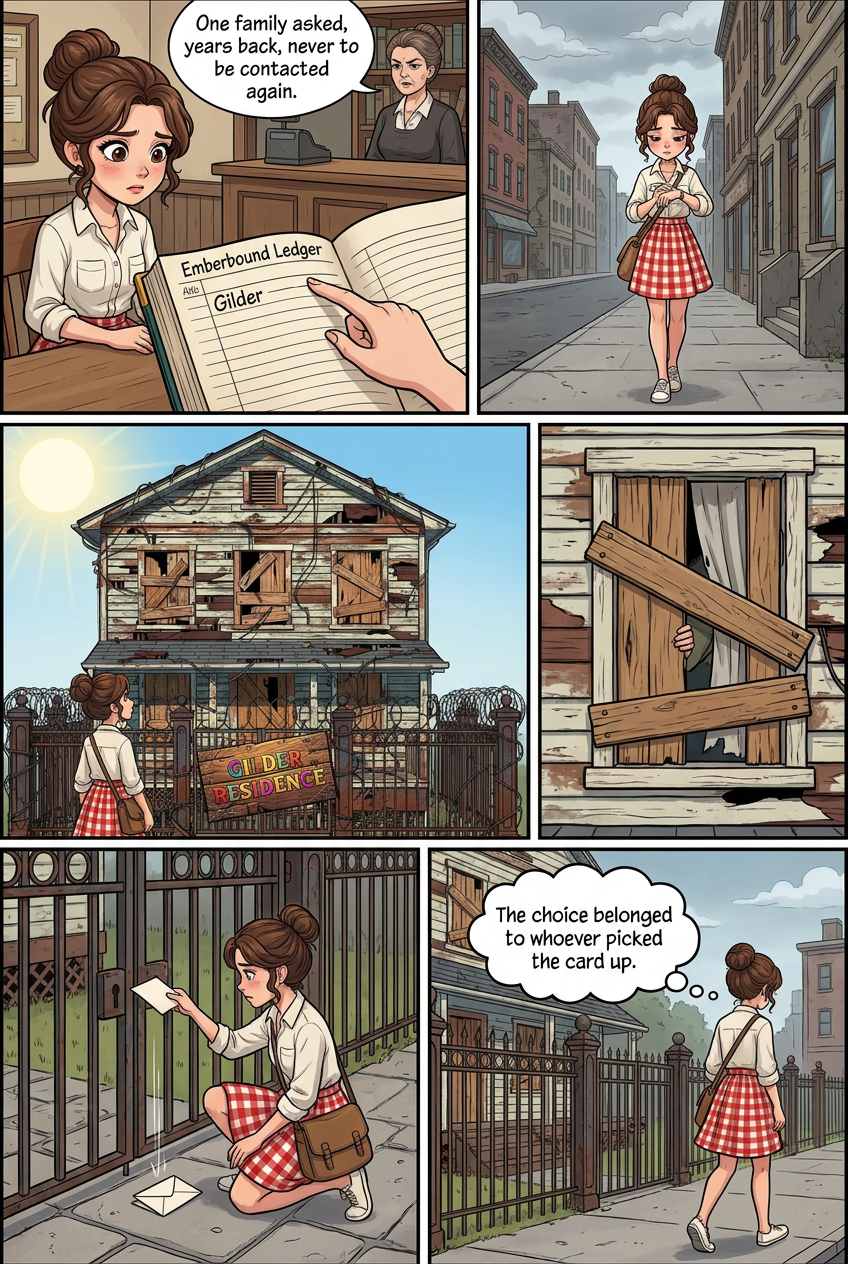
Jubilee kept copying names from the leather ledger until the woman behind the counter laid a hand on the page. The woman said one family had asked, years back, never to be contacted again. She turned the ledger toward Jubilee and pointed to a line near the bottom. The name was Gilder. Beside it, in different ink, someone had written DO NOT WRITE. Jubilee stared at the entry. One of her four friends had been a Gilder. She closed the ledger and thanked the woman and stepped out onto the sidewalk with the address copied on the back of her hand. She walked the six blocks slowly. The house sat behind a tall iron fence wrapped with wire. Boards covered the downstairs windows. The porch steps were swept clean, but the front door was nailed shut. A weathered wooden sign hung crooked from the gate, GILDER RESIDENCE in faded paint, spider webs strung between the letters. Through a gap in the boards she saw a curtain move. Someone was inside. Someone had heard her stop. Jubilee took the four folded drafts from the front pocket of her satchel. She had written and rewritten his note for a reason. She had drifted from him worse than from any of the others. She unfolded the cleanest copy and read it once through. Then she folded it again and slid it back into the satchel. She took out a blank card instead and wrote three lines: the date, the maple tree, and her phone number. She signed it with her first name only. She did not mention the others. She did not ask for a reply. She slipped the card through the slot in the gate and watched it land on the walk inside. She waited a full minute. The curtain did not move again. She turned and walked back toward the parlor, three names still to copy and twenty-two days left. The family had asked not to be contacted, and she had contacted them anyway. She had chosen. Now the choice belonged to whoever picked the card up off the stones.
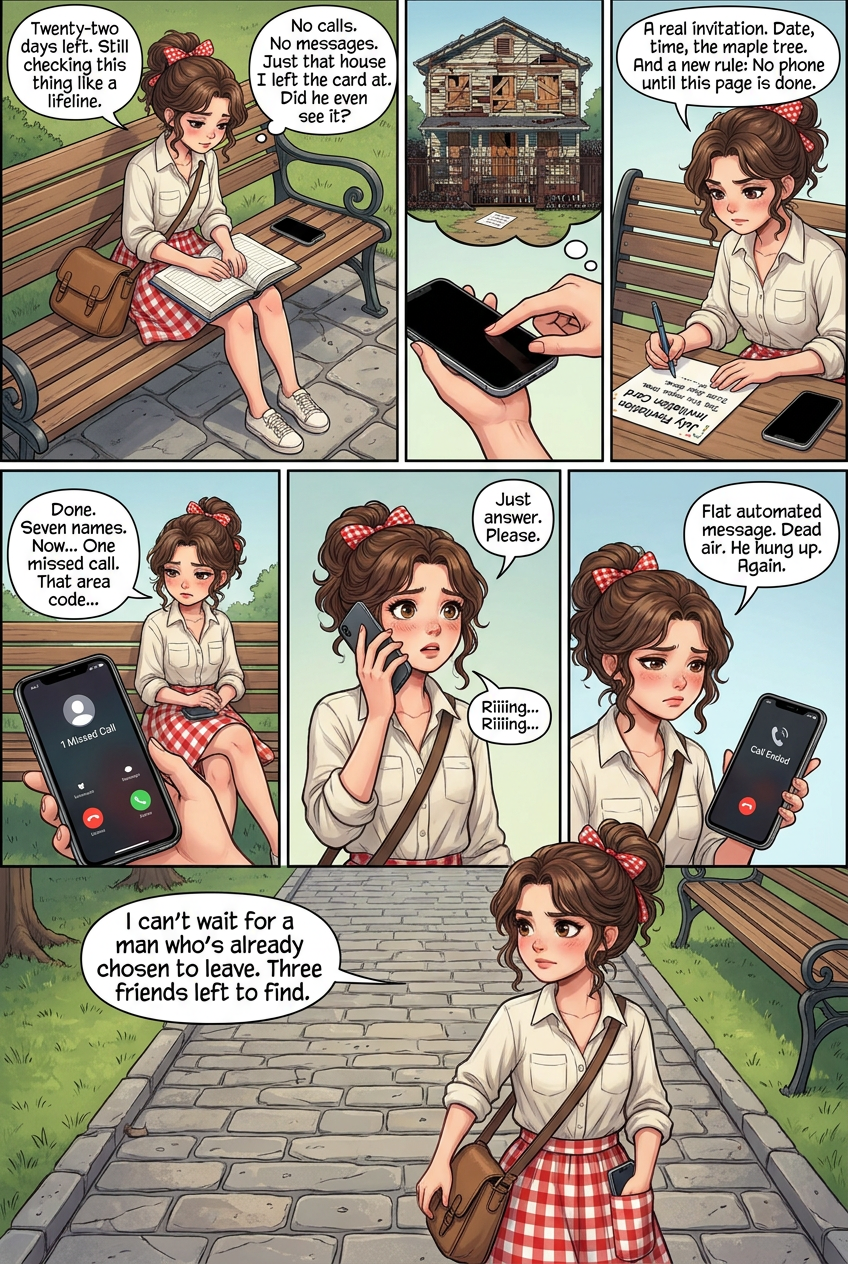
Jubilee sat on the bench outside the parlor with the ledger open on her knees. She had copied two more names since leaving the Gilder gate. Her phone lay face up on the wood beside her. The screen stayed dark. She had checked it after every name, and now she was checking it between letters. Twenty-two days left, and she was losing the morning to a slab of black glass. She picked up the phone and turned it over in her hand. The case was warm from her palm. No missed calls. No messages. She thought of the boarded house behind its wire-wrapped fence, the card lying on the stones inside the gate. Maybe no one had picked it up. Maybe someone had picked it up and thrown it out. Either way, sitting here would not change it. She set the ledger down and pulled a blank card from her satchel. She wrote the date, the time, and the maple tree across the front in her clearest hand. She wrote it the way she would have written it for any of them, a real invitation this time, not three vague lines. She slid it into an envelope and addressed it to the next name on her list. Then she made herself a rule. She would turn the phone face down. She would not flip it over again until she had finished the page. She finished the page. She copied seven more names, walked two of the cards to the post office, and bought stamps for the rest. When she came back to the bench, she let herself turn the phone over. One missed call. No voicemail. The number was not saved. The area code matched the boarded house. Her hand went cold around the case. She pressed call back before she could talk herself out of it. The line rang four times and went to a flat automated message. She did not leave one. She set the phone down and pressed her palms against her eyes. He had called. He had called and hung up, or she had missed him by minutes, and now the line on the other end was dead air. She did not know which was worse. She picked up her pen and wrote his initials in the ledger margin beside the date, so she would remember the hour later if it mattered. Then she closed the ledger and stood. Three friends still to find. She could not sit by the phone for the next twenty-two days waiting for a man who had already chosen, once, to hang up. She slung the satchel over her shoulder and started walking toward the next address on her list. The phone went into the inside pocket, screen against the lining, where she would feel it if it rang.
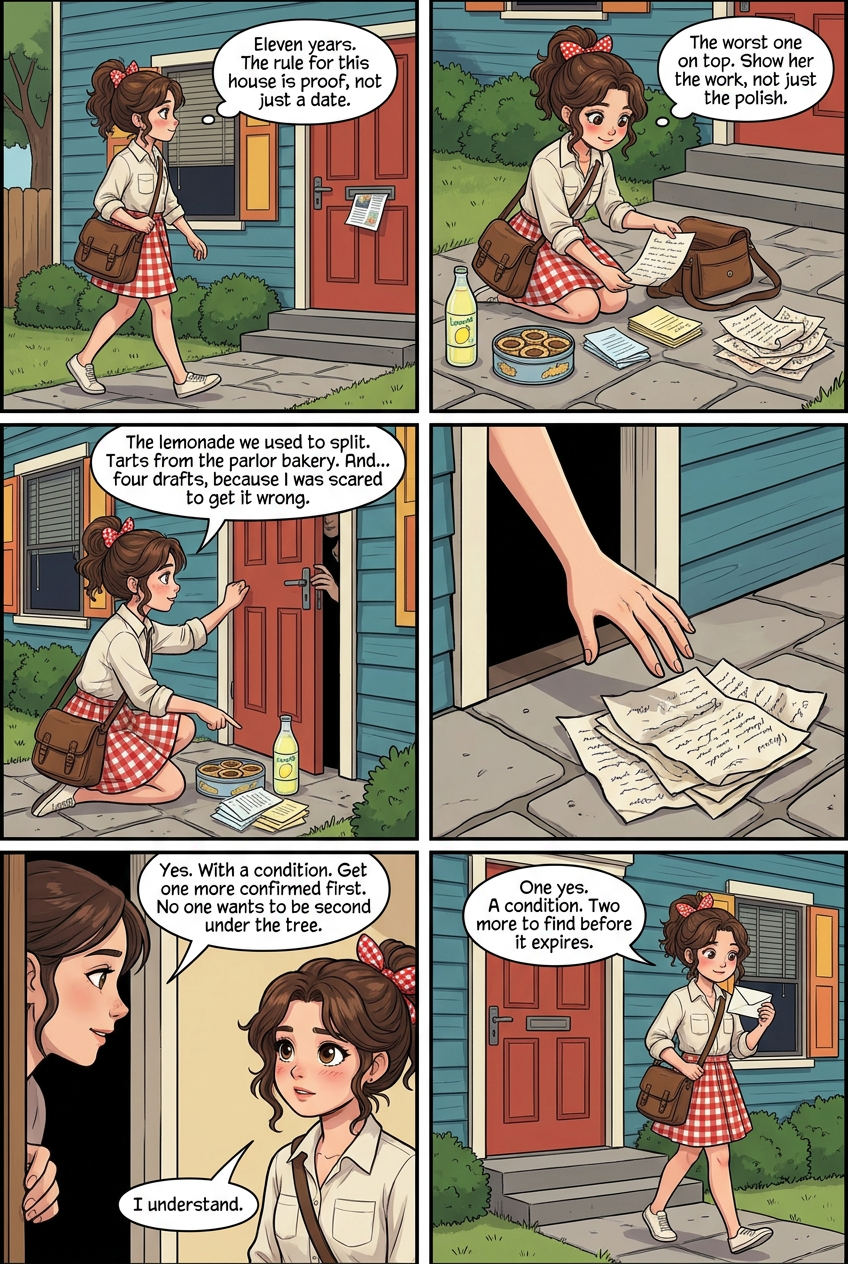
The next address on her list belonged to a friend she had not seen in eleven years. Jubilee walked there with the satchel pressed against her hip. She knew the rule for this house before she knocked. A vague card would not work twice. If she stood on the step with nothing but a date and a tree, the door would close. She needed proof that the day would be worth the drive. The house sat back from the road behind a low hedge. The blinds were down in every window. The front door was shut tight, and a folded flyer stuck out of the mail slot from days ago. Jubilee stopped at the bottom step. She did not knock yet. She set the satchel on the walk and opened the flap. She laid out the lemonade bottle, the tin of butter tarts, and the notes she had written for each friend, one beside the other on the stone. Last, from the front pocket, she pulled the four drafts of the note she had written for the man she had drifted from. The pages were curled and smudged, scribbled over in two colors of ink, corners worn soft from handling. She set them down too, in order, so the worst one sat on top. She knocked. Footsteps came slow to the door. It opened a hand's width. Jubilee did not start with the date. She pointed to the spread on the walk. She said the lemonade was the kind they used to split on the curb. She said the butter tarts were from the bakery near the parlor. She said she had written four versions of one note because she was scared of getting it wrong, and she was showing the drafts because she wanted her friend to see the work, not the polish. She said the others had notes too, and she was carrying every one of them to every door herself. Then she said the date and the tree, and she stopped talking. The door opened the rest of the way. Her friend looked at the drafts on the stone for a long moment, then at Jubilee. The answer was yes, with a condition. Her friend would come if Jubilee could get one more confirmed first. No one wanted to be the second person under the tree with only Jubilee waiting. Jubilee said she understood. She packed the satchel, left a clean copy of the invitation in her friend's hand, and walked back to the road. One yes in her pocket. A condition tied to it. Two friends still unfound, and the yes would expire if she could not deliver a second name before her friend changed her mind.
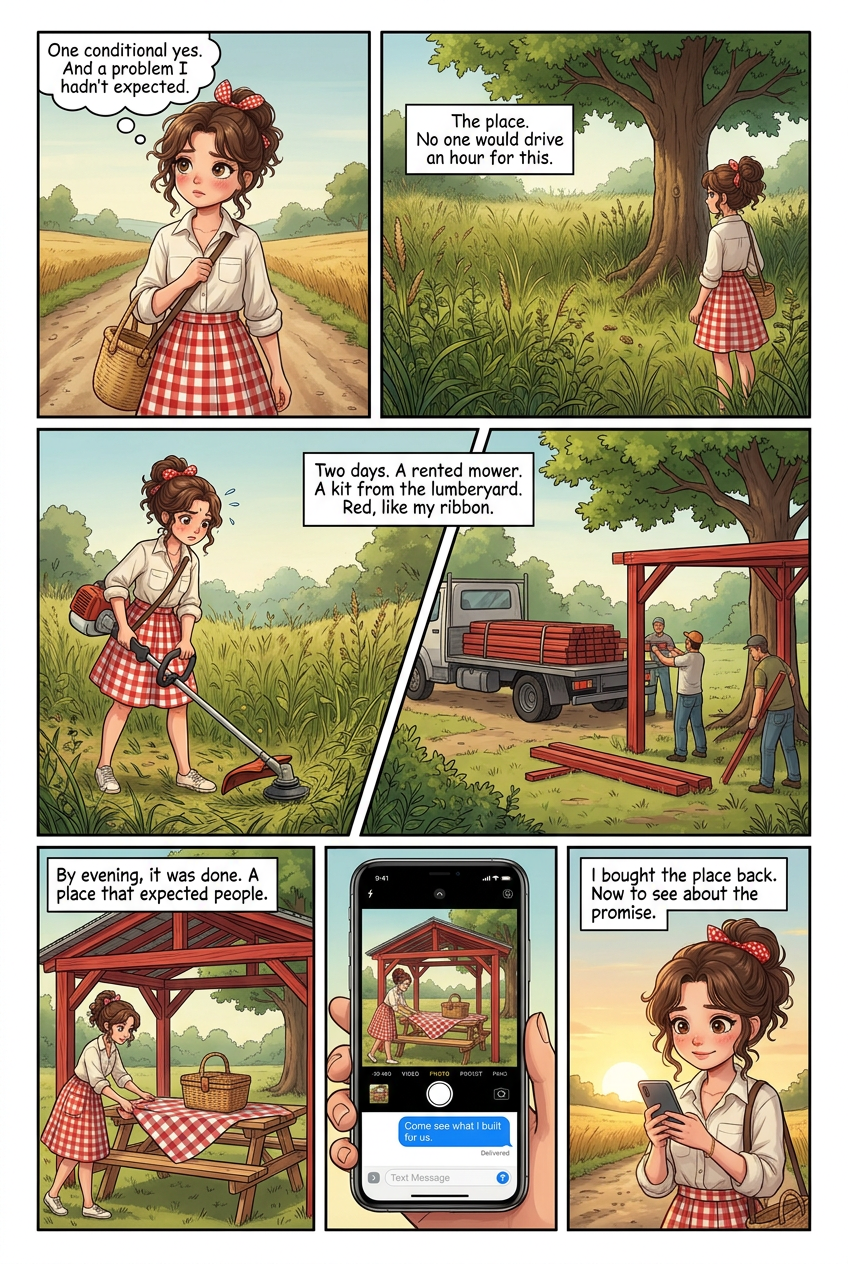
Jubilee walked from her friend's house with one conditional yes and a problem she had not expected. Her friend's words stayed with her on the road. No one wanted to be the second person under the tree with only Jubilee waiting. She had been thinking about the people. She had not been thinking about the place. She turned off the road and went to the maple tree to look at it the way a friend arriving for the first time in years would look at it. The tree itself still stood tall, leaves full, a squirrel working a branch and a small nest tucked near the fork. But the ground around the trunk had gone wild. Tall grass and weeds rose to her waist in a thick tangle. Burrs caught her sleeves. The flat patch where they used to lay blankets was gone under green. No one would drive an hour to sit in that. No one would say yes to a photograph of that. The tree was ready. The clearing was not. She drove into town and spent the afternoon making calls. She rented a brush mower from the hardware store for two days. She asked the lumberyard what a small open shelter would cost in kit form, delivered, raised by their crew before the weekend. The number was more than she wanted to spend. She paid it. She picked red beams from the sample board because red was the color of the ribbon in her hair and the color of the cake someone's mother had once carried out under the leaves. For a day and a half she cut down the overgrowth in strips, raked it into piles, and hauled it to the edge of the field. The crew came the second morning and set the posts. By evening the shelter stood beside the maple, four red beams, a peaked roof, two long benches under a plank table. Jubilee laid a red and white checked blanket across the table and set her woven basket in the middle. She stepped back to the road and looked at the spot the way a stranger would. A tree. A shelter. A table set. A place that expected people. She took a photo on her phone and sent it to the friend who had said yes. She wrote one line under it. Come see what I built for us. The reply came within the hour. Her friend would drive out the next afternoon to see it in person before deciding whether the conditional yes could hold any longer than that. Jubilee put the phone in her pocket. She had bought the place back from the weeds. She had not yet bought back the promise.
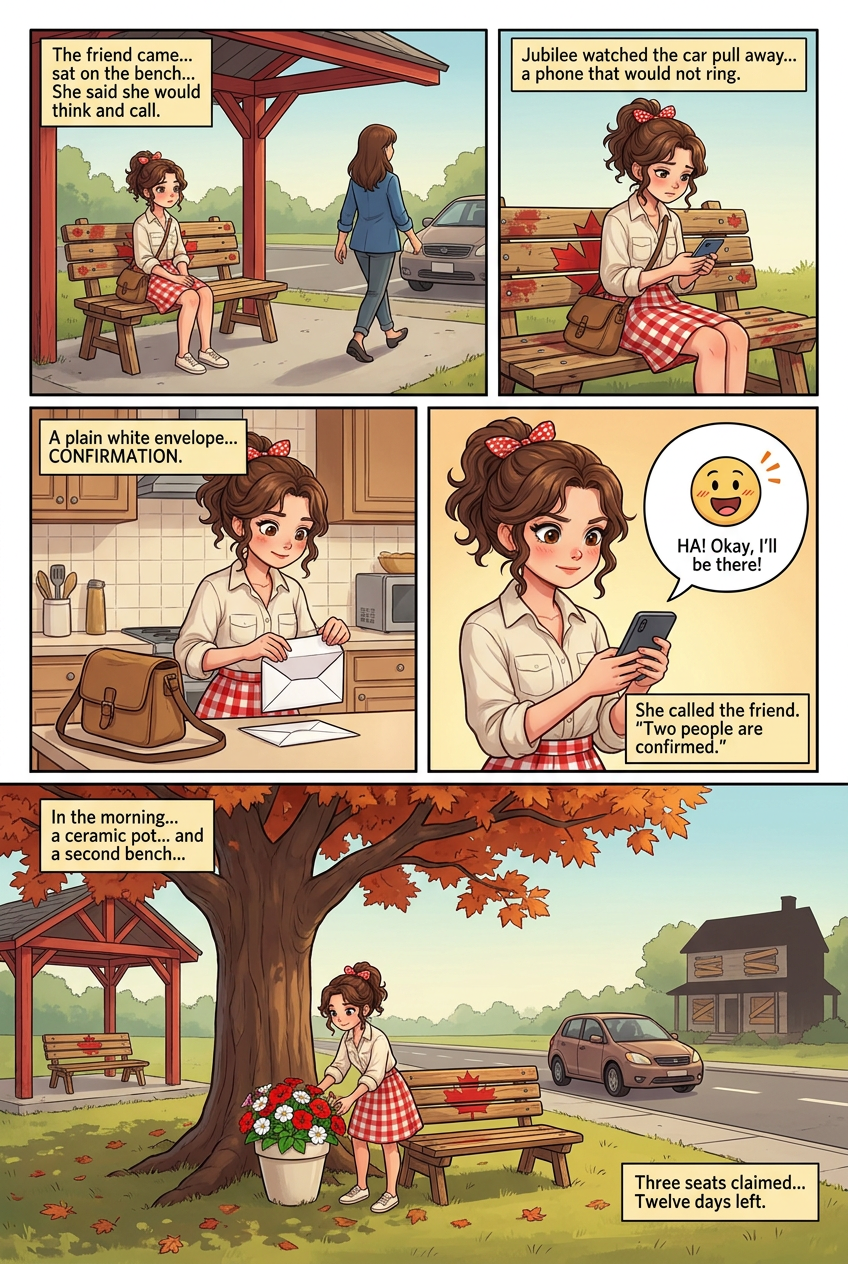
The friend came the next afternoon, walked the cleared ground, sat on the bench under the red beams, and touched the checked blanket. She did not say yes again. She did not say no. She said she would think on the drive home and call by the end of the week. Jubilee watched the car pull away and stood alone under the shelter with a phone that would not ring on command. She drove home and checked the mailbox out of habit. A plain white envelope waited among the flyers. The word CONFIRMATION was printed across the front in black block letters. Jubilee opened it at the kitchen counter without sitting down. Inside was a short note from the friend she had visited eleven years late. The note said the condition was met on her end. She had spoken with one of the others by phone that morning. Both of them would come to the maple tree on Canada Day. She signed her name and drew a small leaf beside it. Jubilee read the note twice. Then she called the friend who had sat on the bench that afternoon. She kept her voice steady and told her two people were confirmed. The line was quiet for a moment. Then her friend laughed, the short surprised laugh of someone whose excuse has been taken away, and said she would be there. Three yes answers. Jubilee wrote the names on the back of the envelope and put it in the front pocket of her satchel behind the four drafts. In the morning she drove to the tree with a ceramic pot of red and white petunias in the passenger seat and a second bench roped to the roof of her car. She set the pot at the foot of the trunk where the roots pushed up through the grass. She carried the bench to the shelter and placed it beside the table with its painted maple leaf facing the road, so anyone arriving would see it first. Three seats claimed. One friend still unaccounted for, and the boarded house still silent. Twelve days left. Jubilee locked her car and drove back to town to keep working through the ledger.
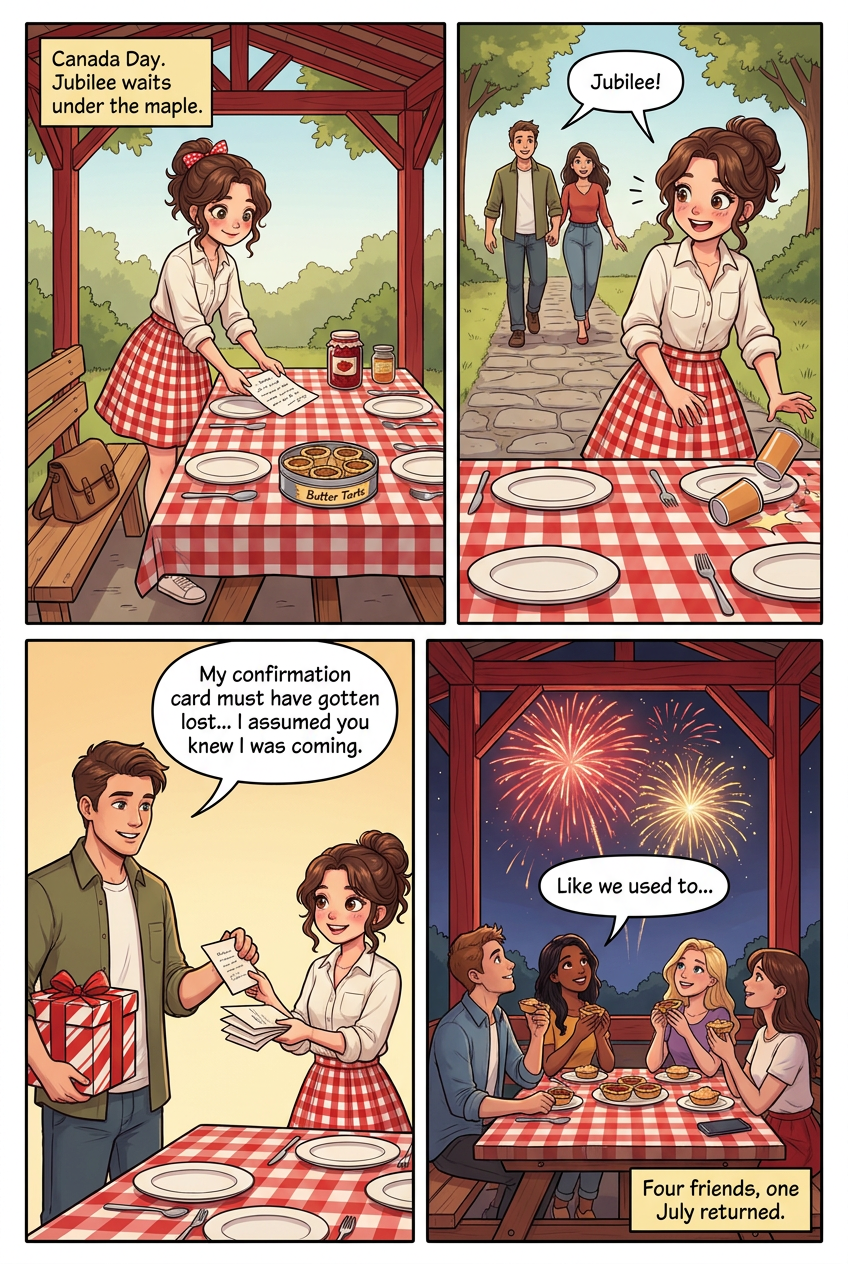
Canada Day came clear and warm. Jubilee arrived at the maple tree an hour before noon with her satchel and two coolers. She spread a red and white checkered cloth across the picnic table under the red shelter. She set out four plates, four cups, and four folded napkins. She laid a tin of butter tarts at the center and a jar of preserves beside it. She poured lemonade into a pitcher and set it in the shade. From her satchel she pulled four handwritten notes and placed one at each seat. Then she waited on the bench with her hands flat on her knees. The first car came at eleven-forty. The second at eleven-fifty. Two friends stepped out together, having driven the last stretch in convoy, and walked across the cleared grass calling her name. Jubilee stood up too fast and knocked her cup. She caught the first friend in a hug that lasted longer than either expected. The third arrived ten minutes later with a bakery box and apologies for the traffic. Three seats claimed. One bench still empty. Jubilee kept glancing past their shoulders to the road. At twelve-fifteen a fourth car turned in. The man she had drifted from badly climbed out with a red and white striped box under his arm. He walked to the tree slowly, watching his footing on the new stone path. He said the confirmation card he sent must have gotten lost in the mail, that he had assumed she knew he was coming. Jubilee pulled the four folded drafts from the front pocket of her satchel and handed them to him without a word. He read the top one, then the next, then all four. He set the striped box on the table and hugged her. The other three came around the table and folded in. They ate at the checkered table under the maple. They passed the butter tarts and the preserves and the bakery box between them. Jubilee gave each friend their note and watched them read. The man opened his striped gift last: a framed photograph from their final childhood gathering, one he had kept in a drawer for years. They stayed through the afternoon and into the evening. When the sky darkened, a burst of light cracked over the field beyond the tree, and then another, red and gold sparks streaking across the dark in long tails. The four of them tipped their heads back on the benches the way they had as children and watched until the last spark faded. No one wanted to leave first. They sat under the tree long after the smoke thinned, trading names and years and small corrections to each other's memories. Jubilee did not check her phone. The boarded house on the other side of town stayed silent, and she let it stay silent. She had four friends at the table and one July returned to her. When they finally stood to go, they made no promise about next year. They only walked to their cars together, and Jubilee locked the shelter behind them, and drove home with the empty pitcher beside her on the seat.
Play your story to life
Storycraft is a mobile game where you create AI characters, craft items and locations to build their world, then discover what direction your story takes. Download the iOS game for free today!
Download for free