

Kaito's Arc
12 Chapters
Kaito's dream is honoring the vow made to someone from before his rebirth..

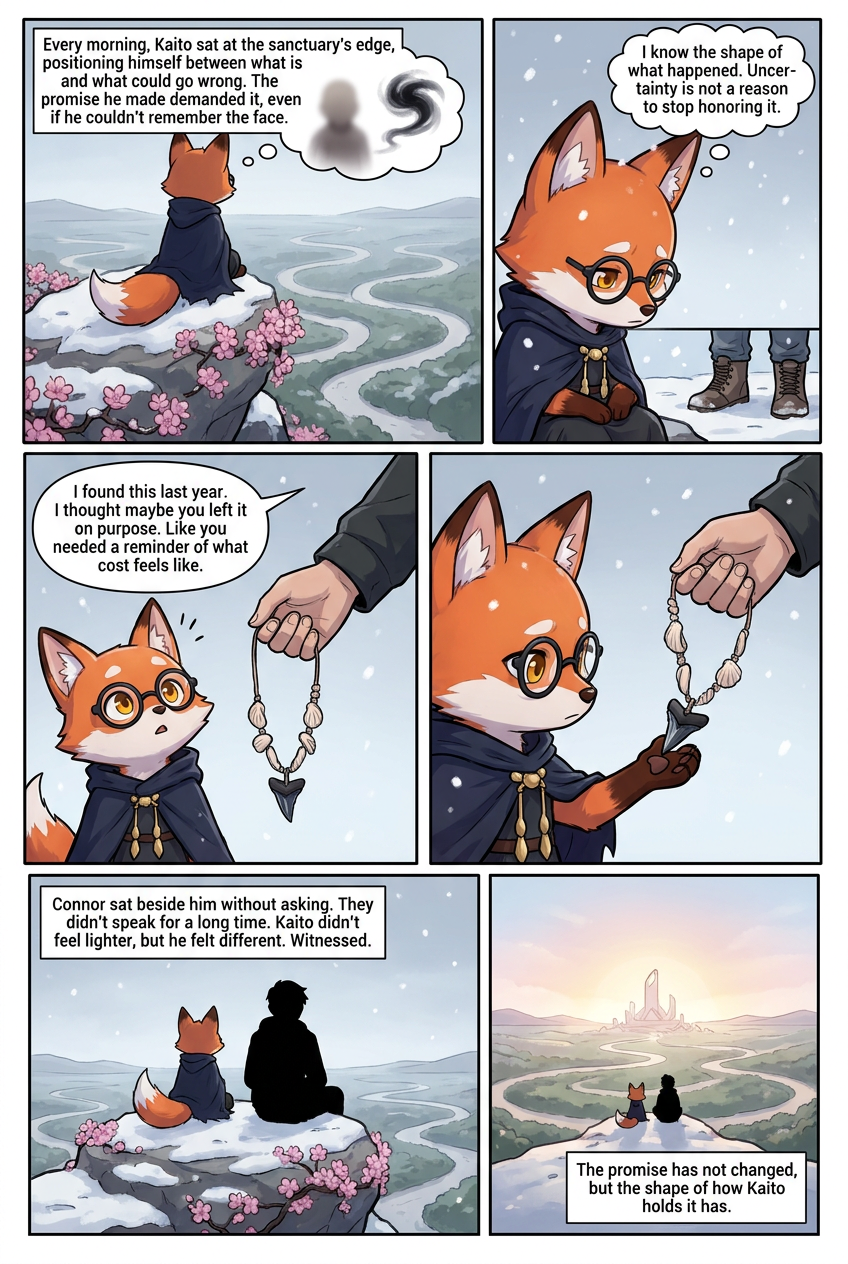
Kaito sits on his favorite rock at the edge of the sanctuary, watching the paths where visitors might come. He has been doing this every morning since the healing structure was finished — positioning himself between what is and what could go wrong. The promise he made before his rebirth demands this kind of attention, even if he cannot remember the face of the person he made it to. He knows the shape of what happened to them, the order of events that led to something he refuses to speak aloud, and he has decided that uncertainty is not a reason to stop honoring it. But this morning, Connor stops at the base of the snow-dusted rock crowned with pink blossoms. He does not come closer. He does not look away. Kaito watches him stand there, holding something back, and feels the exact moment when his brother decides to let it go. "What are you really doing out here every day?" Connor asks. The question hangs in the cold air between them. Kaito opens his mouth and tells him the full truth — the promise, the blurred face, the obligation he cannot verify but refuses to abandon. He watches Connor's expression shift as the words land. When it is done, Kaito knows he cannot take it back, and Connor cannot unknow what his youngest brother has been carrying alone. Connor reaches into his jacket and pulls out a necklace strung with pale shells and a single shark tooth. He turns it over in his hands. "I found this last year," he says. "I kept it because I thought maybe you left it somewhere on purpose. Like you needed a reminder of something." He holds it out. Kaito stares at the tooth in the center, darker than everything around it, sharp enough to draw blood. He does not recognize it, but he understands why Connor thought it might be his. It looks like something a person would keep if they needed to remember what cost feels like. Kaito takes the necklace and closes his fist around the tooth. Connor sits down on the rock beside him without asking. They do not speak for a long time. The sanctuary stretches out below them, quiet and waiting. Kaito does not feel lighter for having told the truth, but he feels different — witnessed now, in a way he cannot undo. Connor is carrying part of it with him. The promise has not changed, but the shape of how Kaito holds it has.
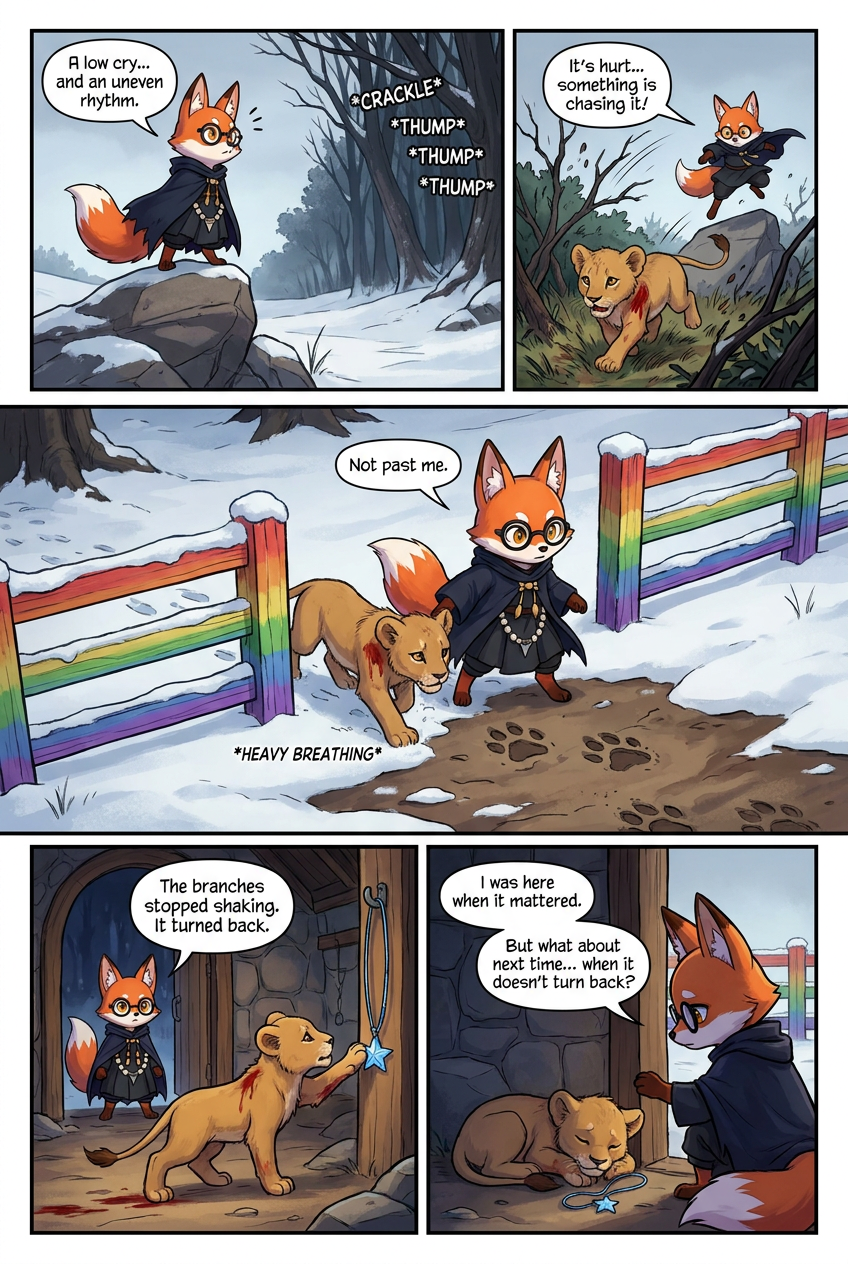
Kaito hears the sound before he sees the movement — a low cry from somewhere beyond the edge of the sanctuary, followed by the uneven rhythm of something running on three legs. He stands and narrows his eyes toward the tree line. A lion cub breaks through the undergrowth, its shoulder wet with blood, limping hard toward the healing structure. Behind it, the branches shake. Whatever is chasing it has not given up. Kaito drops from the rock and runs. The cub stumbles through a gap in the snow-covered rainbow fence that marks the boundary of the healing grounds, collapsing just inside. Kaito reaches it first and positions himself between the cub and the tree line. The mud pathway behind the fence shows fresh prints — large, deep, spaced too close together for anything that should be moving that fast. He counts the seconds. The cub drags itself forward, leaving a red streak across the snow, and reaches the threshold of the healing structure. Inside, a blue star necklace hangs from a hook near the doorway, left behind by the young girl who helped build this place. The cub's paw touches it as it crawls inside. The branches stop shaking. Kaito waits, every tail still, watching the prints in the mud. Nothing comes through. He hears the cub breathing behind him, ragged but steady. The thing that was chasing it has turned back. Kaito does not move until he is certain. When he finally steps inside the healing structure, the cub is curled beneath the necklace, its eyes half-closed. It is still bleeding, but it is here. He has kept something from reaching it. Kaito settles near the doorway and looks back toward the fence. He does not know what was chasing the cub or why it stopped. He only knows that this time, he was here when it mattered. The promise did not require him to understand everything — only to be in the right place when the cost of being wrong would have been too high. The cub shifts slightly, and Kaito feels the weight of what he has just done. He has used the sanctuary to stop something irreversible. The question is no longer whether he can act. It is what he will do the next time something comes through that fence and does not turn back.
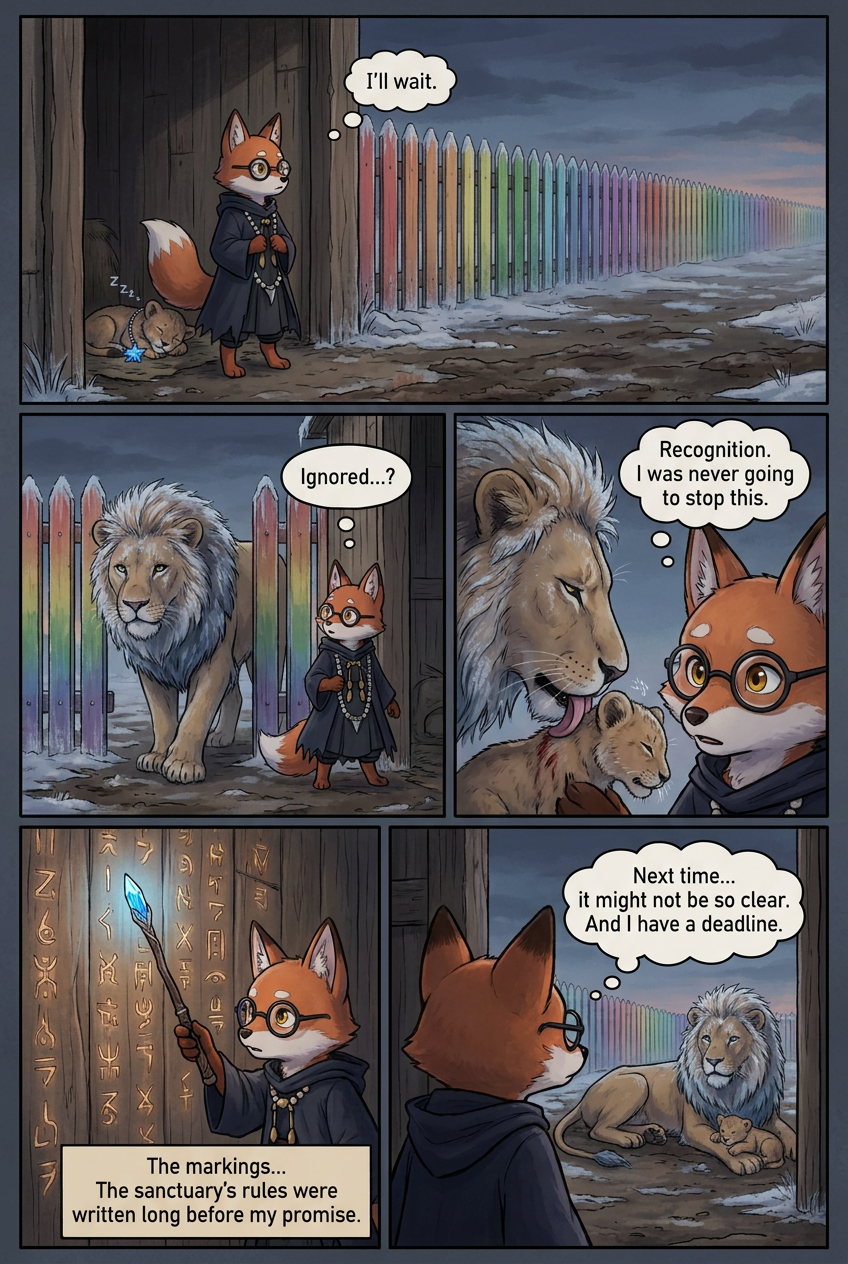
Kaito does not leave the doorway. The cub breathes behind him, still curled beneath the necklace. He watches the fence line and the mud beyond it, waiting to see if the thing that chased the cub will come back. The adult lion steps through the rainbow fence just after dawn. Its mane is thick with frost, and it moves with the kind of stillness that means it has already decided what it will do. Kaito rises and positions himself between the lion and the healing structure. The lion does not slow. It walks past him without acknowledgment, crosses the threshold, and lowers its head to the cub. The cub's breathing changes — not from fear, but recognition. The lion begins cleaning the wound on the cub's shoulder with slow, deliberate strokes. Kaito watches from the doorway and understands that he was never going to stop this. He turns his attention to the wand mounted on the wall beside the entrance. The crystal at its tip catches the early light and scatters it across the markings carved into the wood beneath it — symbols left by the young girl and her parents when they built this place. He has read them before but never needed to follow them. The markings describe what the structure is for: a place where the injured are brought to heal, and where those who protect them are allowed inside. The promise he made was to prevent what happened from happening again. But the healing structure was built by others, with its own rules already written into the walls. The lion finishes cleaning the cub's wound and settles beside it, one paw resting across the small body. Kaito steps outside and looks back at the fence. The sanctuary's protection does not belong to him alone. He can position himself between threats and outcomes, but he cannot rewrite what this place was designed to allow. The lion came through because it had a right to. The next time something crosses that boundary, Kaito will have to decide whether it carries the same right — or whether the cost of being wrong means he uses the power he has refused to touch. He does not have an answer yet. But now he knows the question has a deadline.
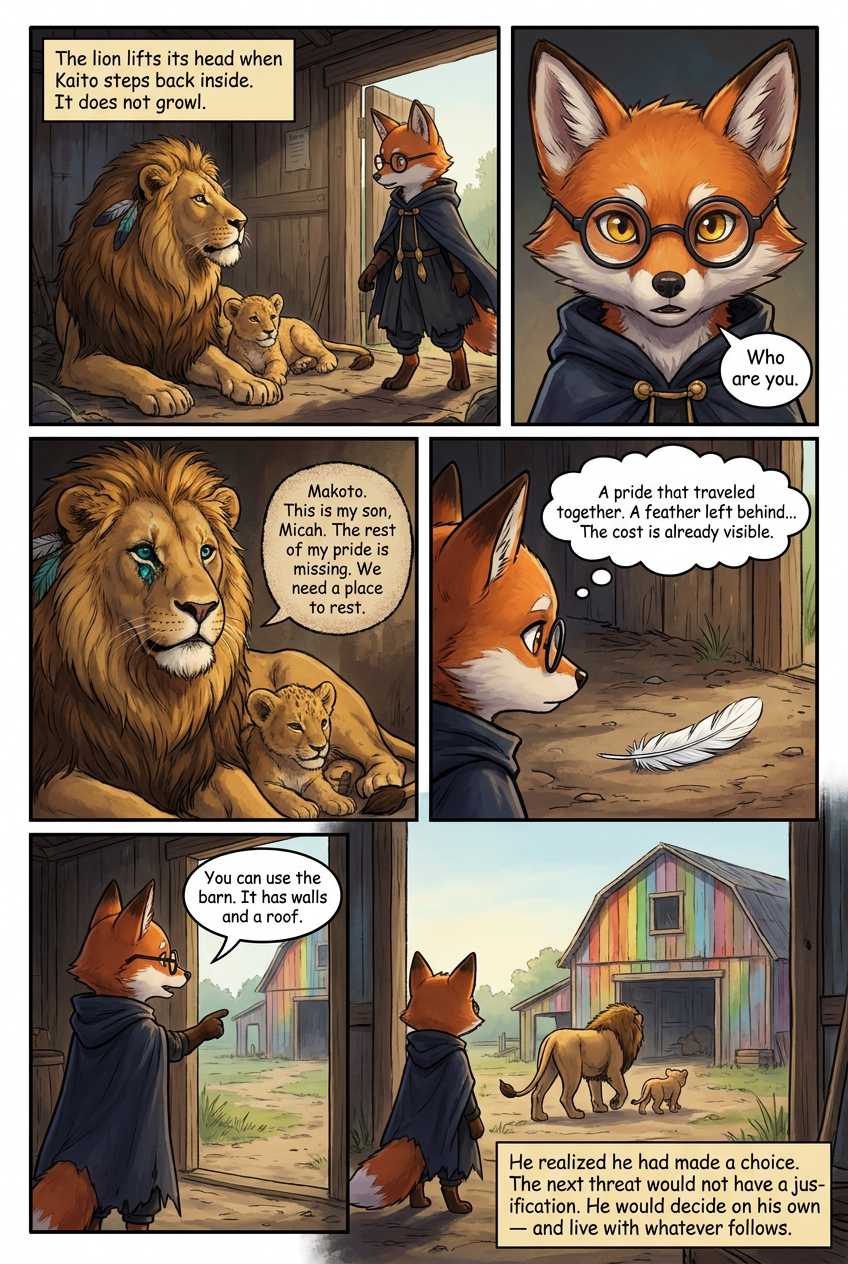
The lion lifts its head when Kaito steps back inside. It does not growl or flatten its ears. It simply watches him cross the threshold and settle near the wall opposite the cub. The cub is still breathing in shallow pulls, but the adult's presence has changed the rhythm — less panic, more exhaustion. Kaito needs to know if this lion belongs here or if it will become a problem he cannot walk away from. He shifts his weight and speaks directly. "Who are you." The lion turns its head toward him, and a feather tucked behind one ear catches the morning light — black with blue-green shimmer, like oil on water. The lion's voice is low and deliberate. "Makoto. This is my son, Micah." The cub stirs at the sound of his name but does not lift his head. Makoto continues without prompting. "The rest of my pride is missing. We need a place to rest." Kaito studies the feather and sees what it represents — proof of connection, something carried to mark what remains. But there is something else. Near the entrance, half-buried in the dirt just outside the healing structure, a white feather lies alone. It is clean and untouched, the kind that does not belong in mud. Kaito looks at it and understands. A pride that traveled together. A feather left behind for those who did not arrive. Makoto does not explain, and Kaito does not ask. The cost is already visible. Kaito rises and walks to the doorway. Beyond the fence, a barn painted in bright rainbow stripes stands near the tree line. It is empty and weathered but still solid. He turns back to Makoto. "You can use the barn. It has walls and a roof." Makoto does not move immediately. He looks at Kaito with the kind of stillness that tests whether the offer is real. Kaito meets his gaze and does not look away. Finally, Makoto stands and noses Micah awake. The cub struggles to his feet, leaning against his father's shoulder. They move slowly toward the door, and Kaito steps aside to let them pass. He watches them cross toward the barn and realizes he has made a choice. He decided Makoto deserved sanctuary access without needing the wall markings to tell him. The next threat that crosses the boundary will not have a father's feather or a missing pride to justify it. When that moment comes, Kaito will have to decide on his own — and live with whatever follows.
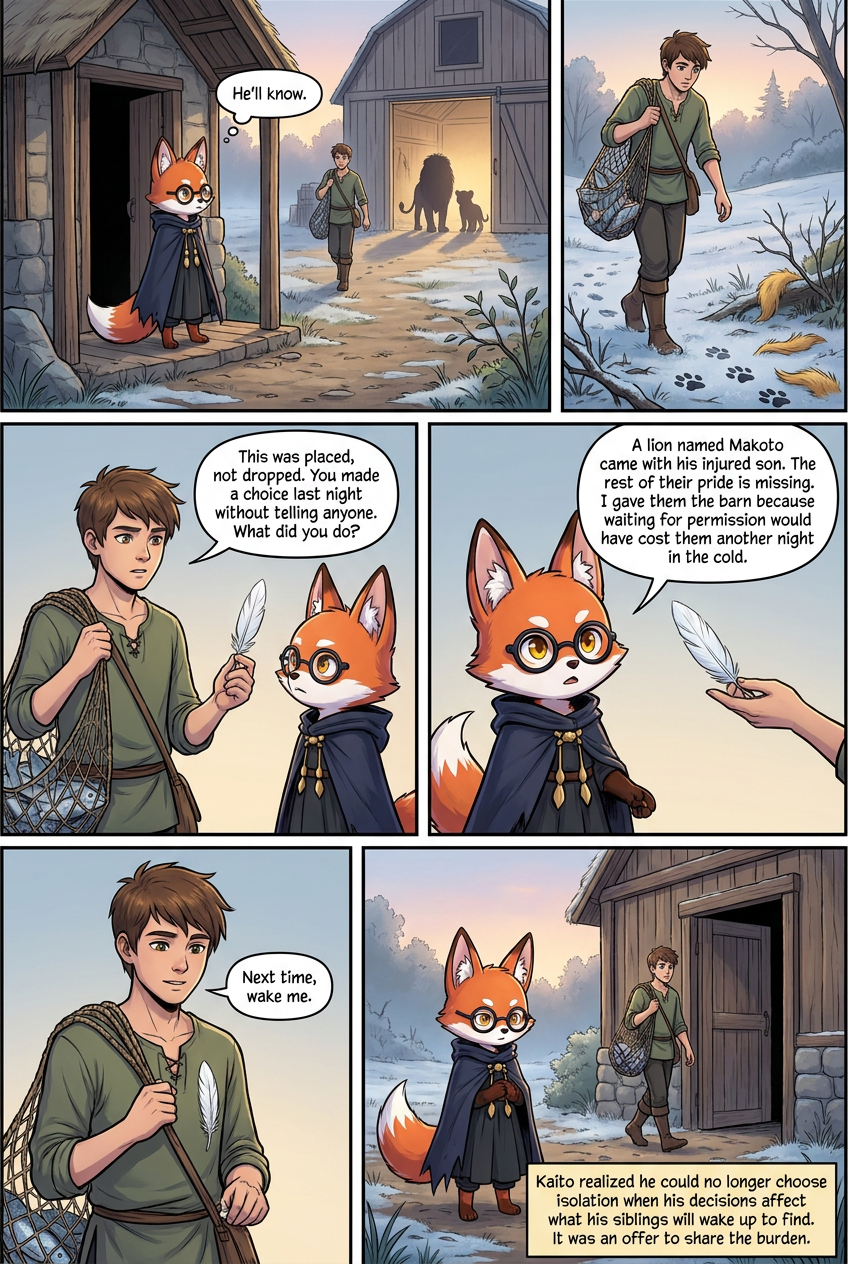
Connor returns just after dawn, carrying fish from the river in a net slung over his shoulder. Kaito watches him approach from the healing structure's entrance and knows his brother will notice the difference immediately — the barn door is open, and there are lions inside. Connor stops halfway across the clearing when he sees the tracks in the frost. Deep paw prints lead from the tree line to the barn, and scattered along the path are tufts of golden fur caught on low branches. He follows the trail with his eyes until he reaches the barn entrance, then turns slowly toward Kaito. His voice carries across the distance, quiet but deliberate. "What did you do." Kaito could tell him about Makoto and Micah. He could explain that the lions needed shelter and the barn was empty. But Connor is already walking toward him, and when he gets close enough, Kaito sees what his brother is holding — a white feather, pristine and untouched, the kind that does not belong in the mud near the healing structure. Connor holds it up between them. "This was placed, not dropped. You made a choice last night without telling anyone." The accusation is not angry, but it demands an answer that Kaito cannot soften. Kaito meets Connor's gaze and chooses honesty over protection. "A lion named Makoto came with his injured son. The rest of their pride is missing. I gave them the barn because waiting for permission would have cost them another night in the cold." He does not explain the feather or the promise it represents. Connor looks at the white feather in his hand, then back at Kaito, and his expression shifts — not disappointment, but understanding that carries its own weight. He tucks the feather carefully into his pocket and nods once. "Next time, wake me." It is not forgiveness or approval. It is an offer to share the burden, and Kaito realizes he can no longer choose isolation when his decisions affect what his siblings will wake up to find.
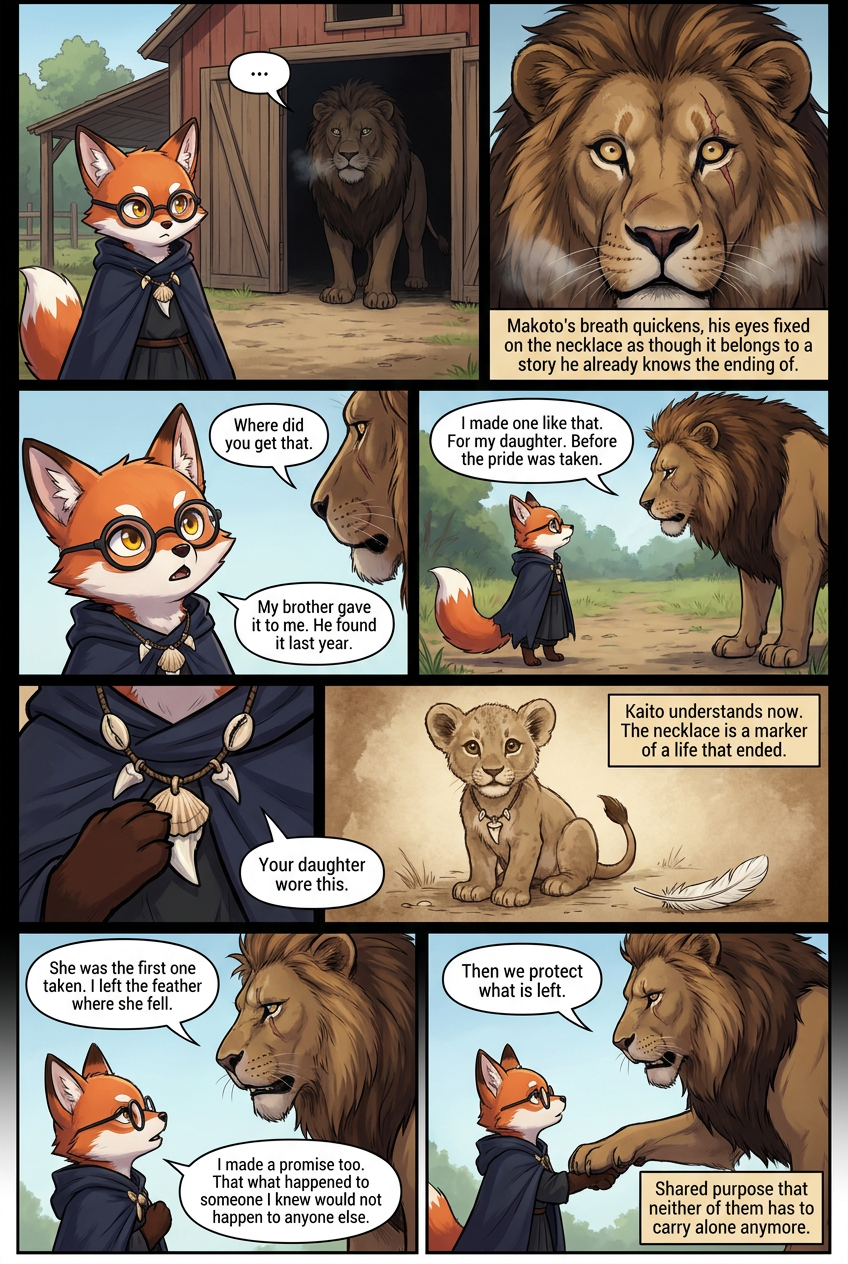
Makoto does not speak when he emerges from the barn at midday, but his gaze lands immediately on the necklace at Kaito's throat. The shells catch the light first, pale and worn smooth by water. Then Makoto sees the shark tooth, and his entire body goes still. Kaito watches the lion's face close like a door. Makoto's breath quickens, his eyes fixed on the necklace as though it belongs to a story he already knows the ending of. When he finally speaks, his voice is low and careful. "Where did you get that." It is not a question. Kaito lifts his chin slightly, aware that the truth will cost him something he cannot take back. "My brother gave it to me. He found it last year." Makoto steps closer, and Kaito sees recognition in the older lion's eyes — not of the necklace itself, but of what it represents. "I made one like that," Makoto says quietly. "For my daughter. Before the pride was taken." The clearing between them feels suddenly vast. Kaito understands now why Makoto went still — the necklace is not just an object Connor found, but a marker of a life that ended. He could ask Makoto to explain, but the weight in the lion's expression tells him everything he needs to know about what happened to the pride. Instead, Kaito reaches up and touches the shells at his throat, feeling their smoothness under his paw. "Your daughter wore this," he says, and it is not a question either. Makoto nods once, his jaw tight. "She was the first one taken. I left the feather where she fell." The white feather Connor found was not just a memorial — it was a marker of the moment Makoto's promise began. Kaito lowers his paw and meets Makoto's gaze directly. "I made a promise too," he says. "That what happened to someone I knew would not happen to anyone else." The words feel different speaking them to someone who carries the same burden. Makoto's expression shifts — not surprise, but understanding that comes from lived experience. He steps forward and places one paw on the ground between them, deliberate and grounded. "Then we protect what is left," Makoto says, and it is not a request but a commitment. Kaito realizes he has been looking for someone who already knows the cost of keeping a vow, and now he has found him. He nods, and the space between them closes — not with answers, but with shared purpose that neither of them has to carry alone anymore.
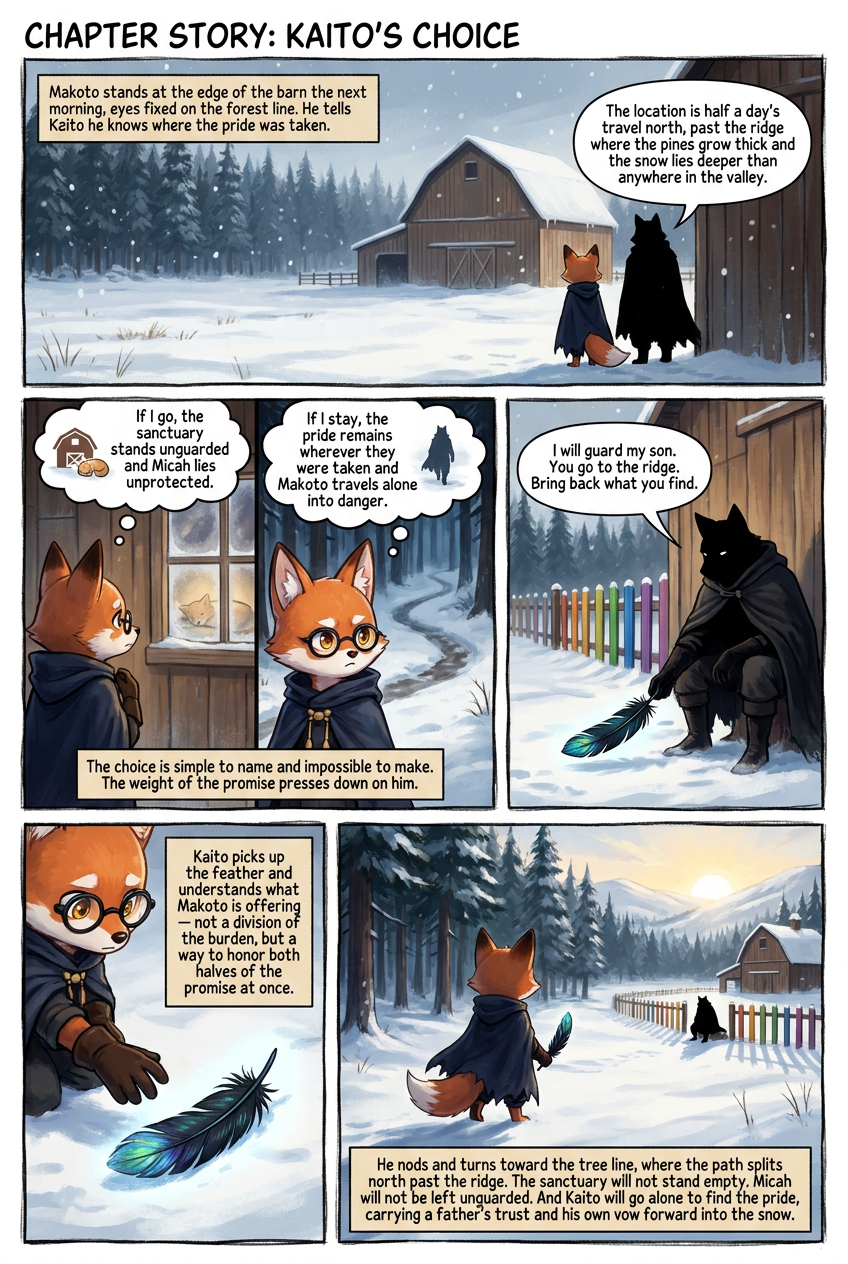
Makoto stands at the edge of the barn the next morning, eyes fixed on the forest line. He tells Kaito he knows where the pride was taken. The location is half a day's travel north, past the ridge where the pines grow thick and the snow lies deeper than anywhere in the valley. Kaito looks back at the barn where Micah still rests, then at Makoto. The choice is simple to name and impossible to make. If he goes with Makoto, the sanctuary stands unguarded and Micah lies unprotected. If he stays, the pride remains wherever they were taken and Makoto travels alone into danger. He could ask one of his siblings to stand watch, but that means pulling Connor into a decision Kaito made without permission. The weight of the promise presses down on him — prevent what happened from happening to anyone else — but now there are two directions and he can only face one. Makoto pads to the fence line at the barn's edge, where bright painted posts stand against the snow. He stops at the rainbow barrier and sits, placing himself between the barn door and the forest. Then he reaches into the dark fur at his shoulder and pulls free a single black feather, iridescent with blue and green. He sets it carefully on the snow at Kaito's feet. "I will guard my son," Makoto says quietly. "You go to the ridge. Bring back what you find." The feather gleams in the morning light, a marker of trust left behind instead of carried forward. Kaito picks up the feather and understands what Makoto is offering — not a division of the burden, but a way to honor both halves of the promise at once. He nods and turns toward the tree line, where the path splits north past the ridge. The sanctuary will not stand empty. Micah will not be left unguarded. And Kaito will go alone to find the pride, carrying a father's trust and his own vow forward into the snow.
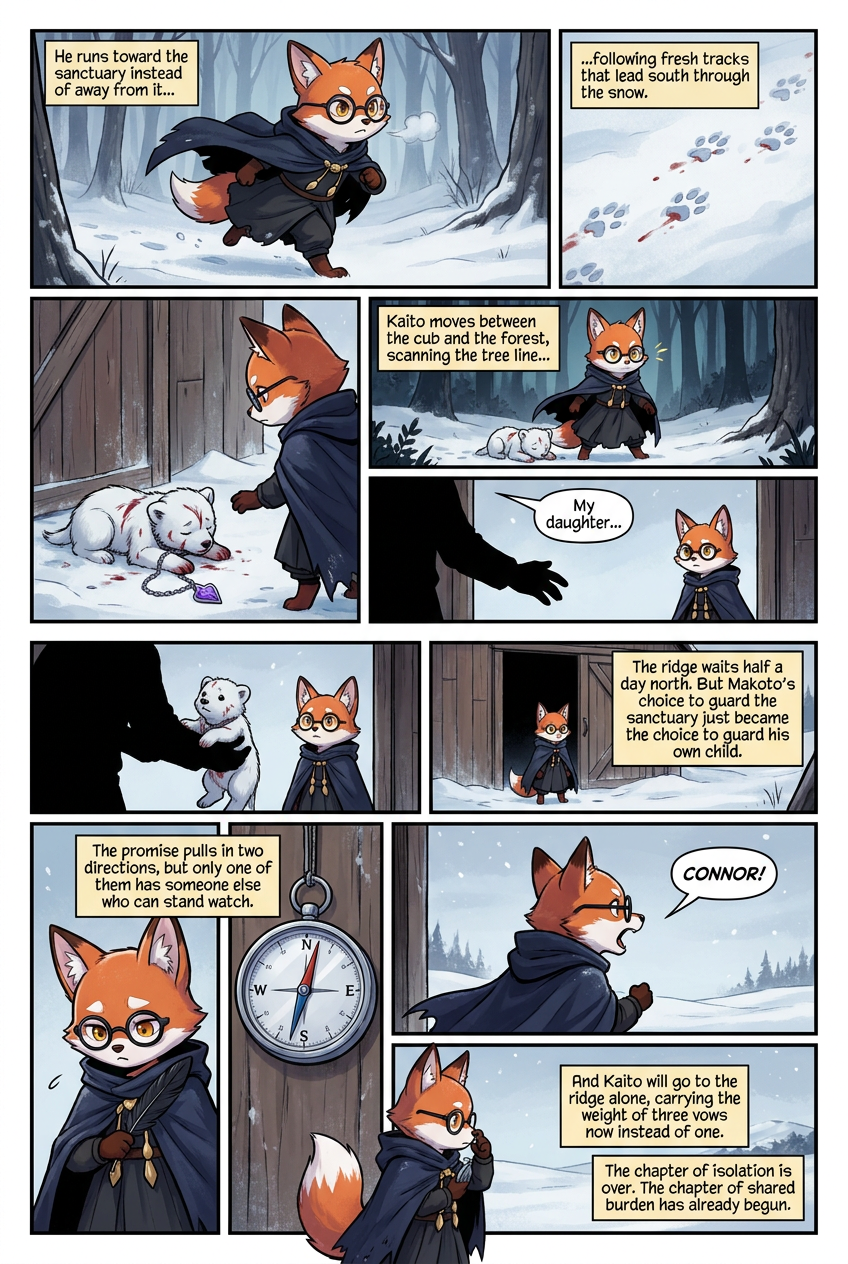
Kaito moves through the trees in the opposite direction of the ridge. He runs toward the sanctuary instead of away from it, following fresh tracks that lead south through the snow. The prints are small and uneven, dragging at the edges where blood has darkened the white surface. The cub collapses at the barn door before Kaito reaches it. White fur streaked with red, one leg twisted wrong, breath coming in shallow gasps. A silver chain hangs around the cub's neck, tangled in the fur. The pendant is purple and shaped like a spade, catching light even in the shade. Kaito moves between the cub and the forest, scanning the tree line for what might have followed. Makoto appears from inside the barn, takes one look at the small white body, and freezes. His daughter. The shark tooth necklace suddenly makes terrible sense. Makoto lifts the cub carefully and carries her inside. Kaito stands at the threshold, watching father and daughter disappear into the barn's shadow. The ridge waits half a day north. The pride waits beyond that. But Makoto's choice to guard the sanctuary just became the choice to guard his own child, and Kaito cannot ask him to leave her now. He looks down at the black feather still tucked against his chest, then at the silver compass hanging from a post near the barn door. The needle points north, unwavering. The promise pulls in two directions, but only one of them has someone else who can stand watch. Kaito turns back to the barn and calls Connor's name across the distance. His brother will come. His brother will hold this ground while Makoto tends to his daughter. And Kaito will go to the ridge alone, carrying the weight of three vows now instead of one. He touches the compass once before leaving, committing the direction to memory. The chapter of isolation is over. The chapter of shared burden has already begun.
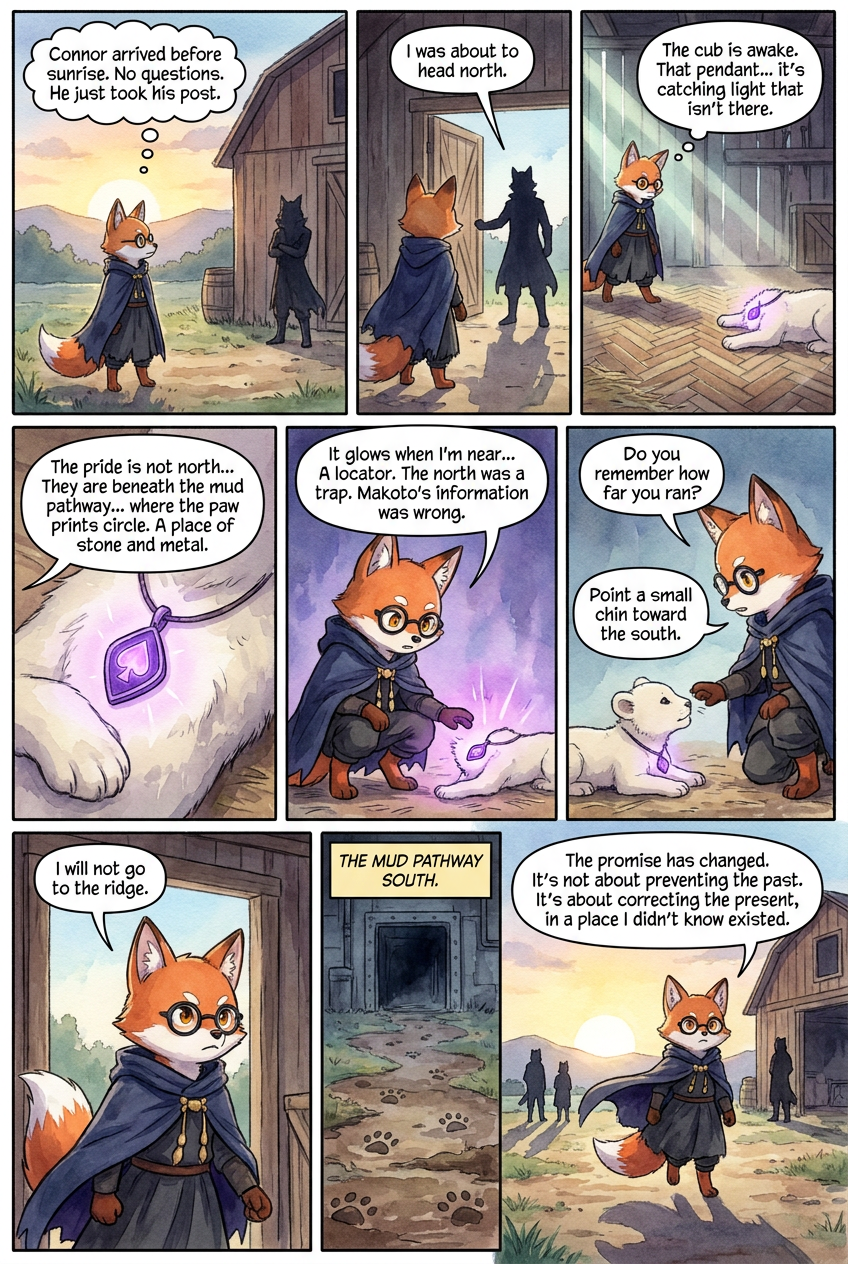
Connor arrives before the sun clears the ridge. He does not ask why Kaito called him, only nods once and takes up position near the barn. Kaito watches his brother settle into the role of guardian without hesitation, the same way Connor gave him the necklace without asking what it meant. Kaito turns toward the north, but Makoto appears in the barn doorway before he can leave. The white cub is awake. Kaito follows him inside, where pale light filters through cracks in the wood. The cub lies on a patch of herringbone-patterned floor someone laid down years ago, her breathing steadier now. The purple spade pendant rests against her chest, but something about it looks different—sharper, like it's catching light that isn't there. She opens her eyes and looks directly at Kaito. Her voice comes out small but clear. She says the pride is not north. She says they are beneath the mud pathway where the paw prints circle, in a place that smells like stone and metal. She says the pendant grew warm when they carried her down there, and cold again when she ran. Kaito crouches lower, studying the amulet more carefully. The amethyst glows faint purple when he moves his hand near it, then dims when he pulls away. A locator. Someone put it on her so they could track her, or she could find her way back. Either way, it means the pride was never taken north—Makoto's information was wrong, or deliberately planted. The ridge was a trap or a distraction. Kaito looks at Makoto, who stares at his daughter with his jaw tight. The promise just shifted under Kaito's feet. He thought he knew where to go and what to prevent. Now he knows he was about to walk the wrong direction entirely. Kaito stands and asks the cub if she remembers how far she ran before collapsing. She shakes her head, but she tilts her chin toward the south. Kaito touches the pendant once, feels it pulse warmer against his palm, then lets it drop back against her fur. He will not go to the ridge. He will follow the mud pathway south and find the stone-and-metal place she described. Makoto stays with his daughter. Connor holds the sanctuary. And Kaito leaves the barn knowing the promise he made is no longer about preventing what happened before—it is about correcting what is happening right now, in a place he did not even know existed until a child told him where to look.
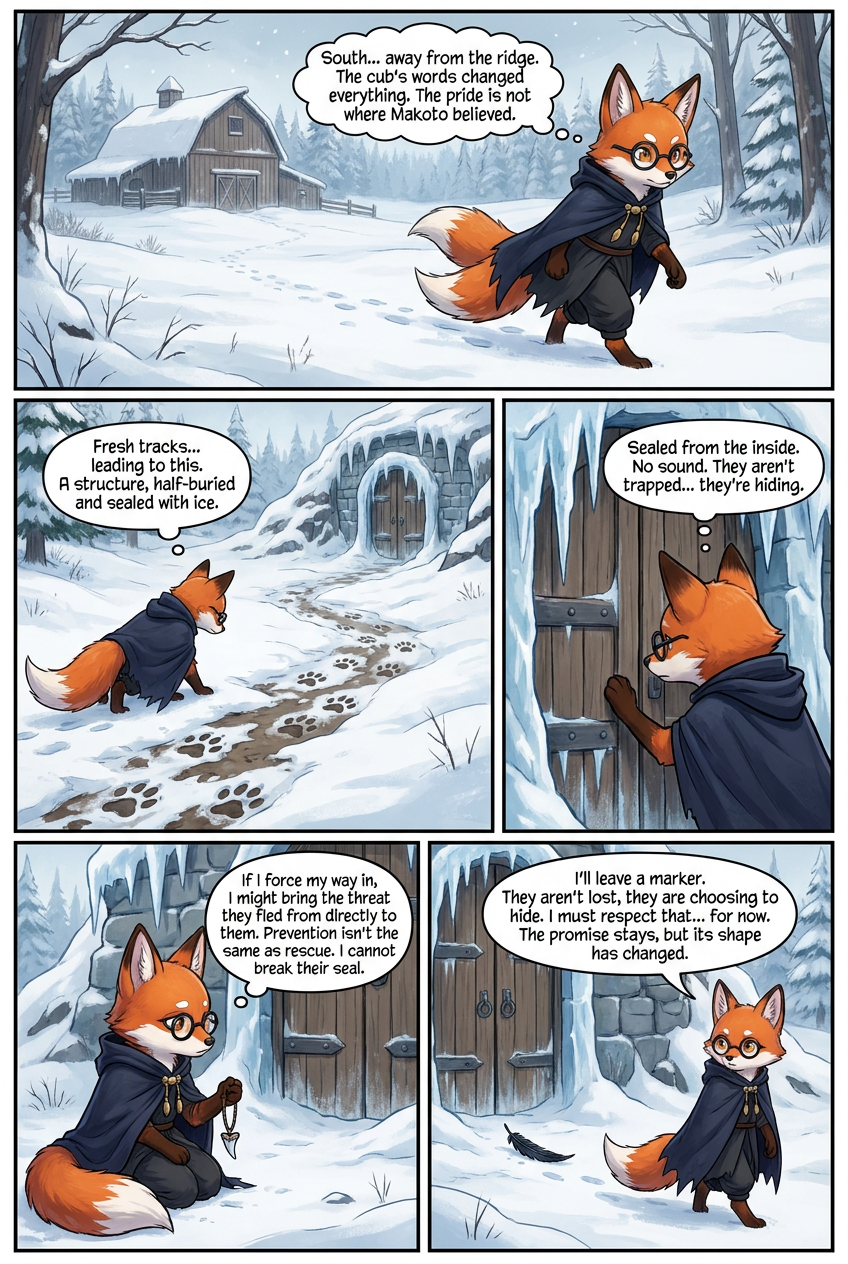
Kaito leaves the barn and heads south, away from the ridge he thought he needed to reach. The cub's words changed everything. The pride is not where Makoto believed, and the pendant proves it. He moves through the trees with his tails low, scanning for mud pathways and circling tracks. He finds it before midday. A split in the snow-covered path cuts through the forest, wide enough for multiple bodies. Paw prints circle and overlap in the exposed mud beneath—fresh enough that the edges have not frozen. The tracks lead to a structure half-buried in the hillside, built from stone pillars wrapped in jagged ice. The entrance is sealed with wooden doors reinforced by frost, and no sound comes from inside. Kaito approaches slowly, studying the ground. The prints do not lead away. They end here, as if the pride walked in and never came out. Kaito presses his ear against the door and hears nothing. He tries to push it open, but the ice holds it shut from the inside. Someone sealed this place deliberately—not to trap the pride, but to hide them. He circles the structure twice, searching for another entrance or a crack in the stone, but finds nothing. The pride is alive. They are here. And they chose to lock themselves in rather than face whatever hunted them outside. Kaito cannot break the seal without risking the safety they built for themselves. He steps back and sits in the snow, staring at the doors. The promise he made was to prevent what happened before from happening again. But the pride is not dead or taken—they are hiding. If he forces his way in, he might bring the threat they fled from directly to them. If he leaves them sealed, he abandons them to starvation or worse. Kaito pulls the necklace from beneath his fur and holds the shark tooth in his paw. He knows now that prevention is not the same as rescue. The pride made their choice. His choice is whether to honor it or override it. He places one black feather at the base of the door—a marker that someone knows they are here—and turns back toward the sanctuary. The promise stays with him, but the shape of it has changed.
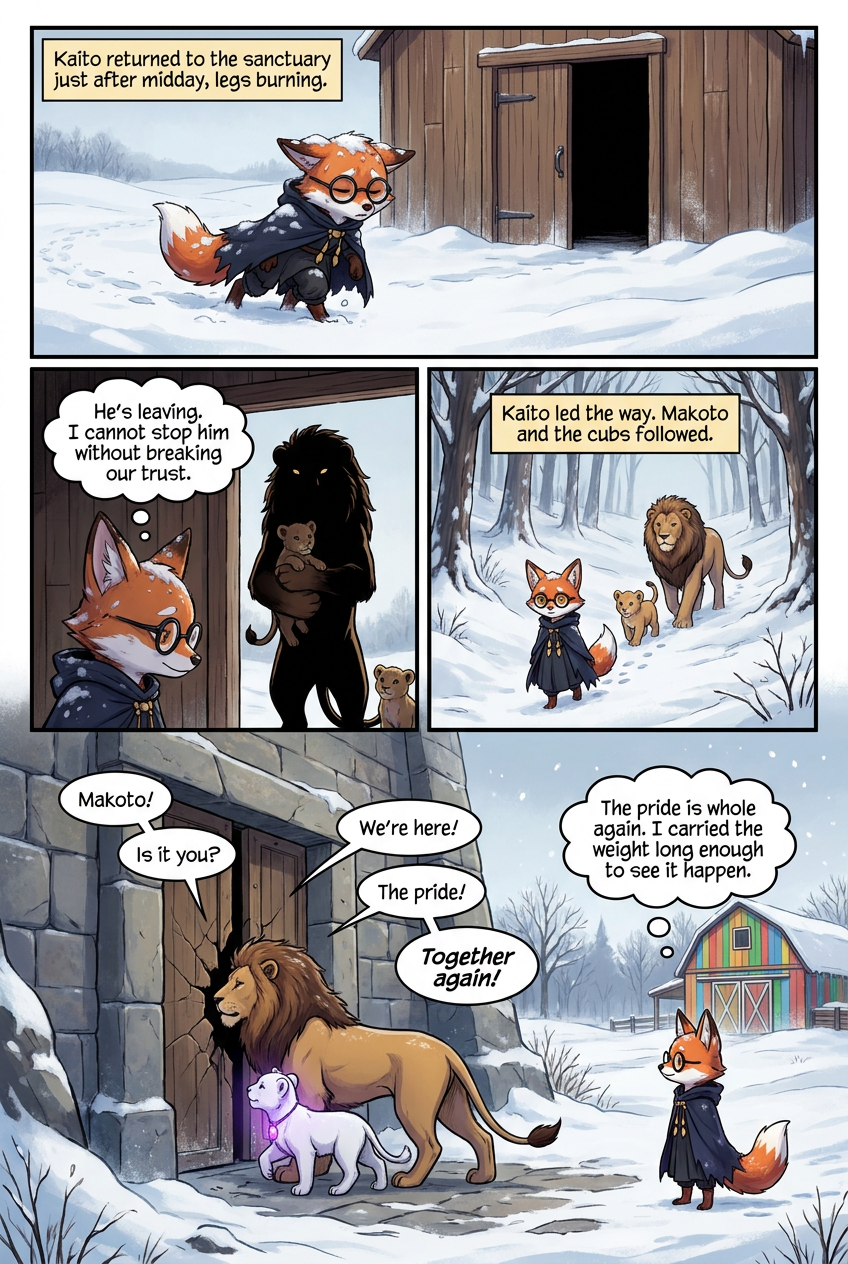
Kaito returns to the sanctuary just after midday. His legs burn from the pace he kept through the forest, and snow clings to the fur along his back. The barn stands quiet ahead, its wooden door cracked open the way he left it. Makoto appears in the doorway before Kaito reaches it. The lion holds Micah against his chest, and both cubs—Micah and the white daughter—stand ready behind him. Makoto's ears are forward, his body tense. He takes one step onto the herringbone planks laid outside the barn door, then another. Kaito stops. Makoto is leaving. He is taking his children to find the pride himself, and Kaito cannot stop him without breaking the trust they built. Kaito meets Makoto's eyes and dips his head once. Then he turns and walks back toward the tree line, retracing the path he just traveled. He does not look behind him. After a dozen steps, he hears paws on wood, then on snow. Makoto follows. The cubs follow Makoto. Kaito keeps walking. The pride chose to hide, but Makoto chose to reunite them. Kaito will show him where they are, and the pride will decide whether to open the door. They reach the stone structure before sunset. Kaito stops at the edge of the clearing and watches Makoto approach the sealed entrance. The lion sets Micah down gently on the patterned wooden platform laid across the mud, then presses his shoulder against the frozen door. The white cub moves beside him, and her pendant glows violet against the ice. From inside, something shifts. A scraping sound. Then the door cracks open, and voices spill out—low and cautious, then louder. Kaito stays back as the pride emerges one by one, circling Makoto and the cubs, pressing close. They do not leave the clearing. They walk together toward the barn Kaito left behind, a structure painted in bright bands of color that stands visible even through the trees. Kaito follows at a distance. The promise he made was to prevent loss. Today, he prevented separation. The pride is whole again, and he carried the weight long enough to see it happen.
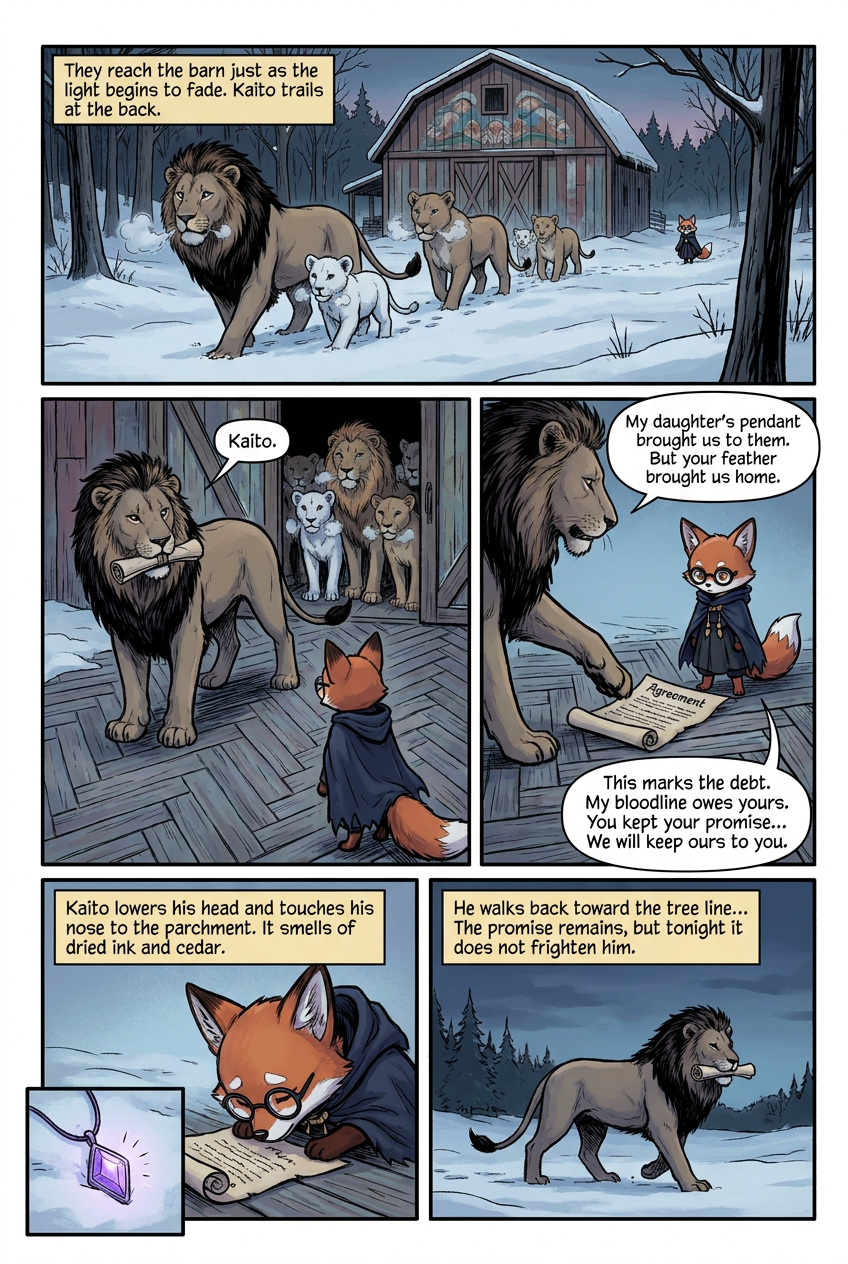
The pride walks together in a loose column, Makoto at the front with Micah against his side. The white cub presses close to her father's flank, her pendant dark now against her chest. Behind them, seven adults and four more cubs follow in pairs, their breath clouding the cold air. Kaito trails at the back, far enough to give them space but close enough to track their movement through the trees. No one speaks. The only sounds are paws crunching snow and the occasional scrape of a branch overhead. They reach the barn just as the light begins to fade. The pride stops outside the painted structure, uncertain, until Makoto nudges the door wider and leads his children inside. The others follow. Kaito remains in the clearing. He watches the last lion disappear through the doorway, then turns toward the tree line. Makoto's voice stops him. Kaito turns back. The lion stands on the herringbone planks outside the barn door, his shoulders squared. Behind him, the pride gathers in the doorway—watching, silent. Makoto approaches slowly and stops an arm's length away. He carries something rolled in his mouth, pale and marked with ink. He sets it on the planks between them, then touches it with one paw. The parchment unfurls partway, and Kaito sees the word written at the top in careful script: Agreement. Makoto nudges it forward until it rests against Kaito's front paws. Kaito looks down at the parchment, then up at Makoto. The lion's eyes hold steady. "My daughter's pendant brought us to them," Makoto says quietly. "But your feather brought us home." He glances back at the pride, then returns his focus toKaito. "This marks the debt. My bloodline owes yours. Any protector who carries this can call on us, or our children, or their children after." His voice drops lower. "You kept your promise to someone you can't remember. We will keep ours to you." Kaito's chest tightens. He has carried the weight alone for so long that the offer feels impossible to accept. But Makoto is not asking him to set it down—only to let someone else acknowledge what he already holds. Kaito lowers his head and touches his nose to the parchment. It smells of dried ink and cedar. When he looks up again, Makoto dips his head once, then turns back toward the barn. The pride shifts aside to let him pass, and one by one they follow him inside. The door closes softly behind them. Kaito remains on the planks, the parchment beneath his paws. The pendant the white cub wore glows faintly in his memory—violet and sharp against the snow. He lifts one paw and rolls the parchment carefully, then picks it up in his mouth. It tastes like dust and old promises. He walks back toward the tree line, carrying both the agreement and the vow he made before his rebirth. The pride is whole. The sanctuary still stands. And for the first time since last winter, Kaito does not feel the weight pulling him under. He has honored what he swore to do—prevented what happened before from happening again. The promise remains, but tonight it does not frighten him. Tonight, it feels like something he can carry a little longer.
Play your story to life
Storycraft is a mobile game where you create AI characters, craft items and locations to build their world, then discover what direction your story takes. Download the iOS game for free today!
Download for free