

Ken Raptor's Arc
6 Chapters
Ken Raptor's dream is transforming his small clinic into a bustling regional bird emergency hospital.

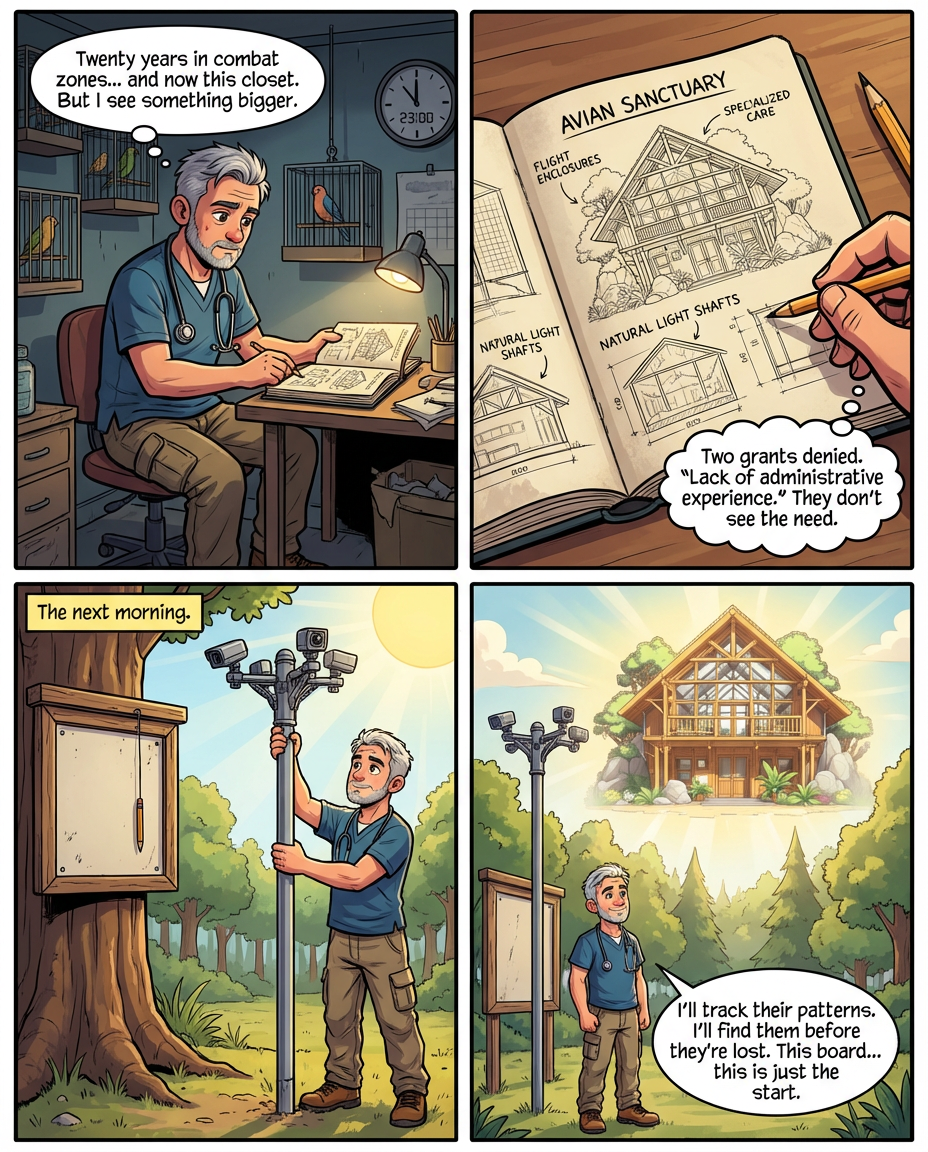
Ken poured disinfectant over the steel examination table and watched it pool in the corners. At forty-two, he'd spent twenty years keeping soldiers alive in combat zones, and now he treated injured birds in a clinic barely larger than a supply closet. The cramped cages lining the walls held three sparrows and a robin, each one needing space to fly before release. He wanted to build something bigger—a real regional bird emergency hospital with proper flight enclosures and round-the-clock staff. He pulled out his notebook at 2300, just like every night. The pages showed detailed sketches of what the facility would become—a timber-framed building with wings dedicated to different species. Natural light would pour through shaft openings in the roof. Each section would have room for specialized care and proper recovery space. He'd labeled every measurement, every angle, every door swing. Two grant committees had already said no, citing his lack of administrative experience. The next morning, Ken drove a wooden post into the ground outside the clinic. He mounted a camera to the top, angling it toward the tree line. Birds followed patterns when they flew, and injured ones broke those patterns. If he could track their movements, he'd know when something was wrong before anyone called. He adjusted the lens and stepped back. The camera would record everything that passed through its view. He walked to the edge of the property and bolted a weathered message board to a tree. The glass front protected a cork panel inside. People could pin notes here about injured birds they'd found—location, species, condition. Ken taped a pencil to a string and hung it from a nail. The board would be his early warning system until he had the staff and space to do more. He scrubbed his hands on his pants and headed back inside for the 0600 treatment rounds.
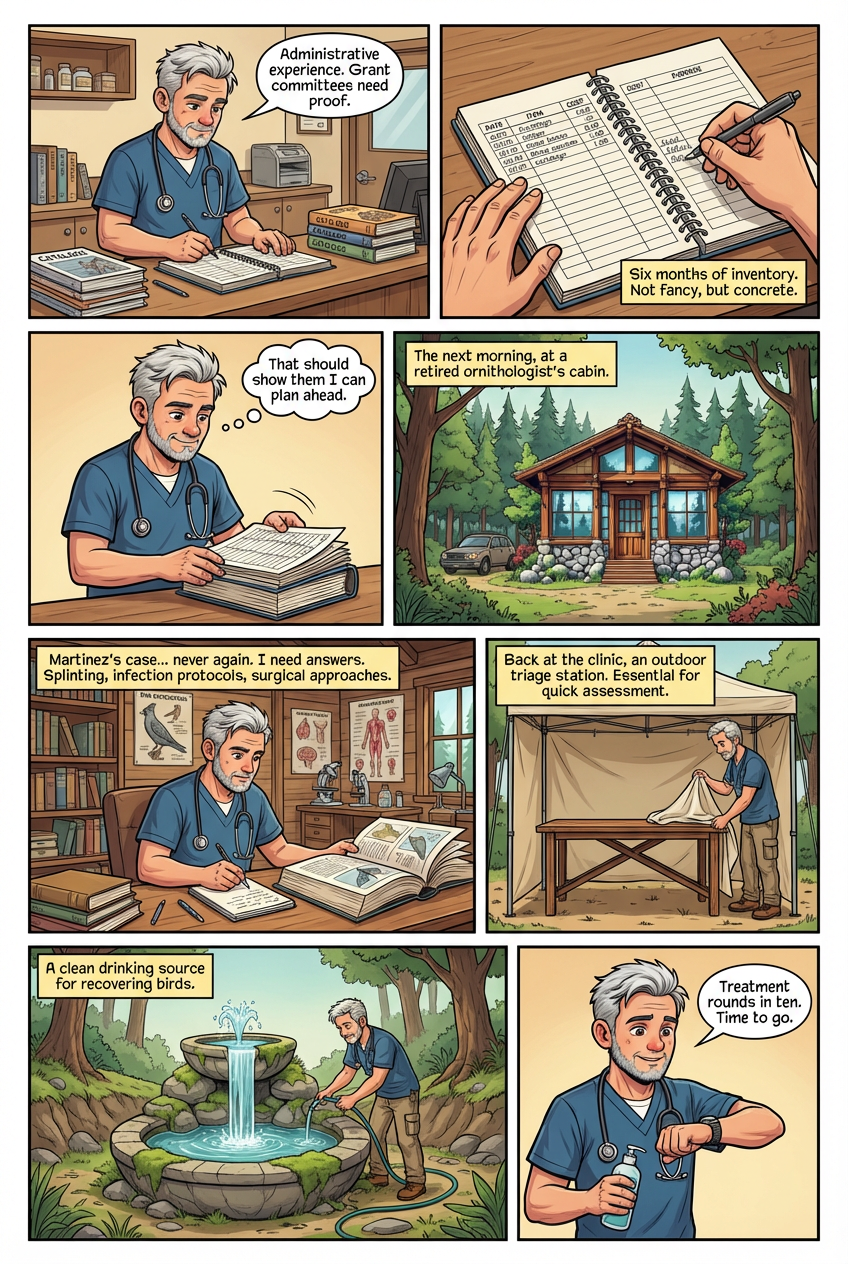
Ken stood at the counter inside the clinic, sorting through a stack of veterinary supply catalogs. He needed to order basics—syringes, gauze, antibiotic ointment. The grant committees wanted administrative experience, so he'd give them something concrete to review. He opened a spiral-bound ledger and began logging every supply purchase from the past six months. Each entry got a date, item description, cost, and purpose. His handwriting stayed tight and precise across the columns. After an hour, he had twelve pages of documented inventory management. It wasn't fancy, but it proved he could track resources and plan ahead. He closed the ledger and set it aside for the next application. The next morning, Ken drove to a cabin he'd heard about from a retired ornithologist. The stone foundation sat solid under wide windows that looked out over the forest. Inside, bird encyclopedias filled every shelf. Research stations lined the walls with anatomy charts and medical journals. He pulled down a volume on wing fractures and flipped through diagrams of bone structure. Martinez had bled out because Ken didn't know enough fast enough. These books held answers he needed—proper splinting techniques, infection protocols, surgical approaches for different species. He spent six hours reading, taking notes in his fourth notebook. When he left, he had contact information for three wildlife veterinarians and a list of advanced procedures to master. Back at the clinic, Ken assembled a wooden examination table outside the entrance. The polished top sat on sturdy metal legs. He stretched a canvas pup tent over it to keep off rain and sun. Birds arriving in crisis needed assessment before he brought them into the sterile treatment area inside. This outdoor station would let him triage quickly—check breathing, look for blood, feel for breaks. He tested the table height with his hands. Perfect for standing work. He placed a plastic bin underneath for emergency supplies. He walked to the back of the property and found a natural depression in the ground. Ken hauled flat stones from the tree line and built them into a wide basin. He fitted a recirculating pump and ran a hose from the clinic's water line. Water trickled down moss-covered rocks into lower pools. The fountain would give recovering birds a clean drinking source when they moved to outdoor recovery cages. He watched the water flow for a minute, then checked his watch. 1350 hours. Treatment rounds in ten minutes. He headed back inside, his hands already reaching for the disinfectant.
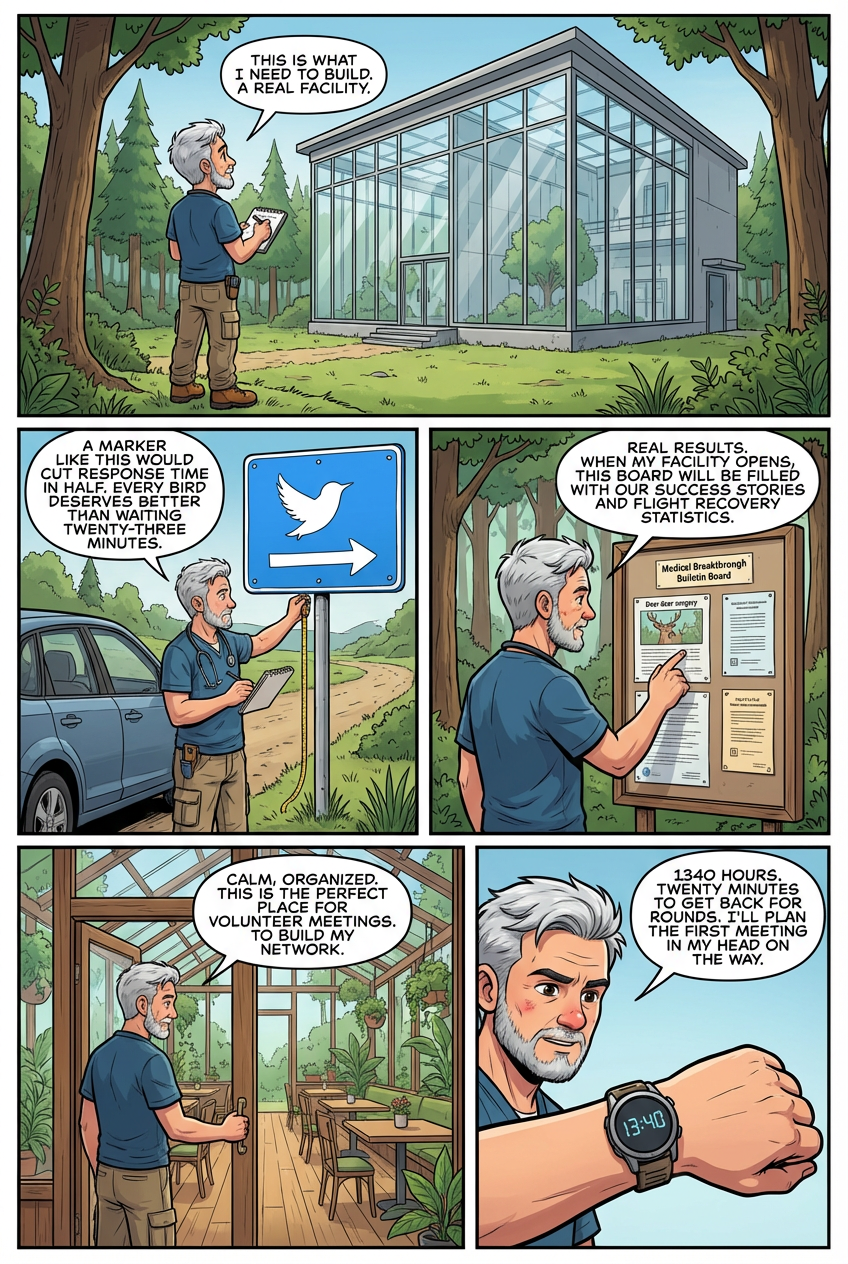
Ken walked three miles into the forest until he reached the state wildlife rehabilitation center. The building stretched across a clearing with separate wings for different species and glass-walled flight chambers where injured raptors could test their wings before release. He pressed his face close to the observation window and watched a red-tailed hawk glide from perch to perch inside a space ten times larger than his entire clinic. A staff member in scrubs moved between treatment stations, checking charts mounted on each enclosure. This was what he needed to build—a real facility with room for proper care and recovery. Ken pulled out his notebook and sketched the layout of the flight chambers, measuring the window frames with his eyes and noting the ventilation system running along the ceiling. He drove back toward his clinic and stopped when he spotted a metal highway sign near the main road. The light blue background showed a white bird silhouette with an arrow pointing right. Ken pulled over and studied it. People needed to know where to bring injured birds—fast, without getting lost or wasting time making calls. He wrote down the sign's exact dimensions in his notebook. A marker like this at the main intersection would cut response time in half. Martinez had waited twenty-three minutes. Every bird that came to him deserved better than that. The next morning, Ken walked through the center of the forest settlement and found a wooden bulletin board mounted outside a supply building. Glass panels protected portraits and written accounts inside—medical cases, treatment breakthroughs, recovery statistics. He read through each one, his eyes catching on a surgical procedure that saved a deer with internal bleeding. The board proved that people cared about documenting real results. When his facility opened, he'd fill a board like this with data—success rates, species treated, flight recovery percentages. Numbers that showed the work mattered. He kept walking until he reached a greenhouse structure with glass panels and wooden shelves holding potted plants. Small tables and chairs sat inside where people could meet. Ken pushed the door open and stepped in. The space felt calm, organized. Volunteers could gather here to coordinate rescue efforts—who covered which areas, what species needed transport, when rehabilitation slots opened up. He needed people who understood that injured birds couldn't wait for paperwork. A meeting place like this would let him build a network before the facility even had walls. Ken checked his watch. 1340 hours. He had twenty minutes to get back for treatment rounds. He turned and headed out, already planning the first volunteer meeting in his head.
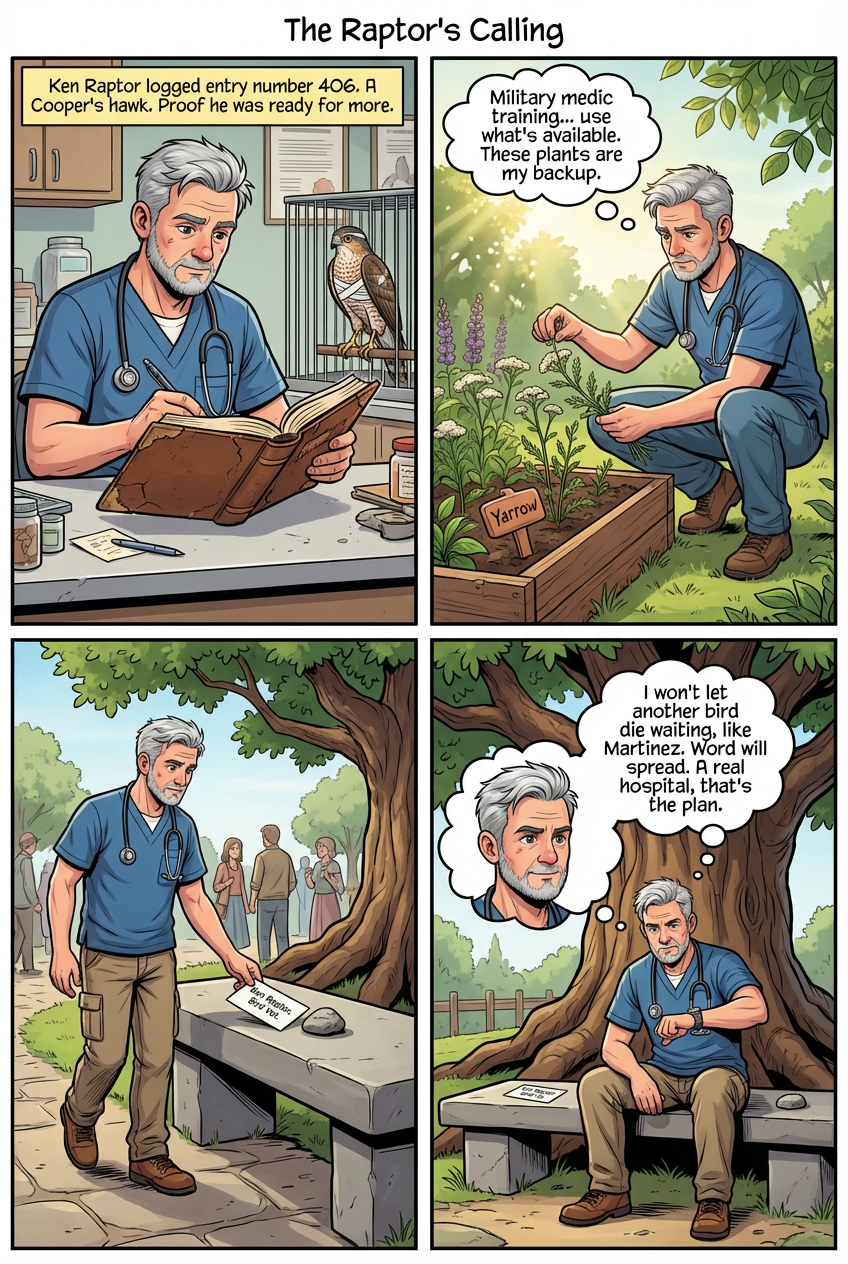
Ken set his ledger on the clinic counter and pulled a worn journal from the supply cabinet. The brown leather cover showed cracks along the spine where he'd opened it hundreds of times before. Inside, he'd logged every bird that came through his doors—species, injury type, treatment given, outcome. Twenty-three pages of data that proved he could run something bigger than this cramped room. He flipped to a blank page and wrote today's date at the top. A Cooper's hawk with a fractured ulna would be entry number four hundred and six. The grant committees wanted proof he could manage a real facility. This journal showed he already did. He closed the journal and walked outside to check his medicinal plant supply. Behind the clinic, he'd built raised wooden beds filled with herbs that worked on bird patients. Clay markers identified each plant—comfrey for inflammation, calendula for wound cleaning, chamomile for stress. He crouched beside the yarrow and pinched off three stems. The flowers would make a poultice for the hawk's swelling. His military medic training had taught him to use what was available when supplies ran short. These plants gave him backup options when antibiotics couldn't arrive fast enough. He stood and carried the stems inside, already calculating dosage in his head. At 1400 hours, Ken finished the hawk's treatment and walked toward the large oak tree that marked the town center. A smooth stone bench sat beneath its branches. He'd seen people gather there before, talking about forest business and community needs. Today he needed to be visible—to let people know where to bring injured birds without wasting time searching. He sat on the bench and placed his clinic business card on the armrest, weighted down with a small rock. Someone would see it. Someone would spread the word. Martinez had died waiting. Ken wouldn't let that happen to any bird under his watch. He checked his schedule. Six hours until the next treatment round. He headed back to work on his hospital plans.
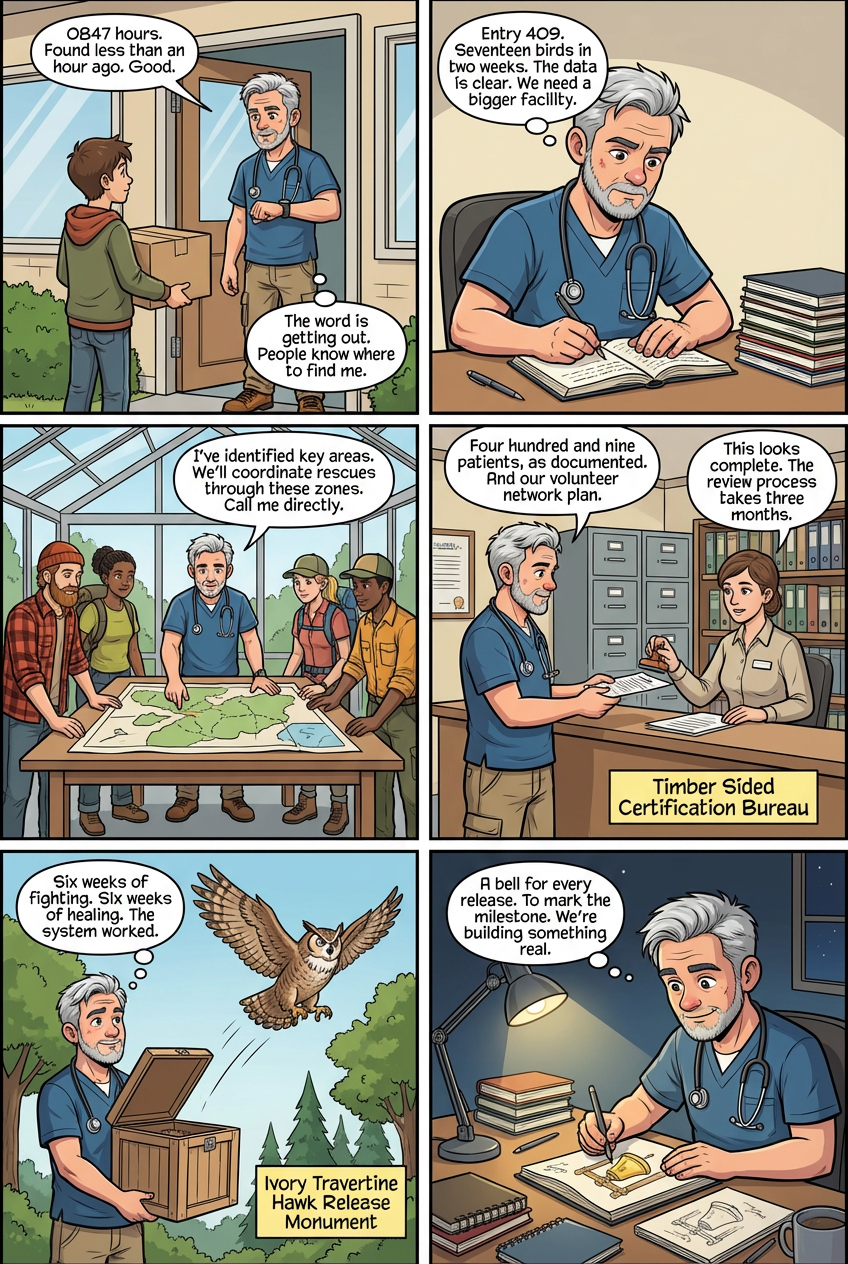
Ken stood at his clinic door and watched a teenager carry a cardboard box up the path. The kid had driven forty minutes after seeing Ken's card at the oak tree bench. Inside the box, a screech owl blinked up at him with one wing held at an odd angle. Ken took the box and checked his watch—0847 hours. The bird had been found less than an hour ago. No wasted time calling wrong numbers or driving in circles. He carried the owl inside and set up for examination. This was working. People knew where to find him now. He finished the owl's splint at 1015 hours and updated his journal. Entry four hundred and nine. Ken flipped back through the pages and counted the last two weeks. Seventeen birds. Before he'd put out the card and visited the settlement center, he averaged nine birds per week. The numbers proved something he'd suspected—injured birds were out there, but people didn't know where to bring them. He closed the journal and filed it next to his hospital plans. When the grant committee asked for evidence of community need, he'd show them this data. Seventeen birds in two weeks meant the region needed a bigger facility. At 1340 hours, Ken walked to the greenhouse meeting space he'd found during his last trip to the settlement. Four people sat at the tables inside—a logger, two hikers, and someone who worked at the supply building. Ken had posted a note on the bulletin board asking for volunteers interested in bird rescue coordination. He pulled out a hand-drawn map of the forest region and spread it on the table. He pointed to areas where injured birds got found most often and assigned each person a coverage zone. The logger nodded and wrote down Ken's clinic coordinates. They'd call him directly now instead of waiting to figure out next steps. Ken rolled up the map. His volunteer network had just gone from zero to four. It wasn't much, but it was a foundation. The next morning at 0830 hours, Ken drove to the timber-sided certification bureau with expansive windows. Filing cabinets filled the space behind the front desk in neat rows. A clerk pulled out the forms for regional emergency center registration and slid them across the counter. Ken opened his journal and turned it so she could see the patient entries. Four hundred and nine birds. She read through several pages, then asked about his coverage area and response procedures. He unfolded his volunteer coordination map and explained the four-zone system. The clerk made notes on her form and stamped the first page. She told him the review process would take three months. Ken walked out with a copy of the application. The paperwork had started. His clinic was officially in the system now. Back at the clinic, Ken checked on Sergeant in the recovery cage. The great horned owl had fought treatment for six weeks, but his shattered wing had finally healed enough for short flights. Ken opened the cage door and watched Sergeant hop to the higher perch. The owl spread both wings and held them steady. No trembling. No collapse. Ken made a note in the treatment log—ready for release evaluation next week. He walked to his desk and pulled out his three notebooks filled with hospital designs. The volunteer network was running. The certification application was filed. The patient data proved the need. Ken opened the first notebook and added a new sketch—a proper intake station with separate exam rooms. Each piece he built now would make the hospital real when the funding came through. Martinez had waited twenty-three minutes because the system failed him. Ken's birds wouldn't wait. Not anymore. At 1630 hours, Ken loaded Sergeant into a transport crate and drove to the clearing near the settlement. Someone had built a monument there—a stone carving of a hawk being released by a kneeling figure, set in a fountain with a circular bench around it. Water trickled over the ivory travertine stone. Ken had seen it twice before but never stopped. Today felt different. He carried Sergeant's crate to the bench and set it down. The owl's eyes tracked his movements. Ken opened the door and stepped back. Sergeant hopped to the edge of the crate and paused. His wings opened wide, testing the air. Then he launched himself up and out, pumping hard toward the trees. Ken watched until the owl disappeared into the branches. Six weeks of fighting. Six weeks of healing. The system had worked this time. Ken sat on the bench and pulled out his journal. Entry four hundred and nine—released. He wrote the time and location, then closed the cover. The monument showed a bird being set free. That's what the hospital would do—fix them fast and send them back where they belonged. He stood and picked up the empty crate. Three months until the certification review finished. He had treatment rounds at 1800 hours and hospital planning from 2300 to 0200. The work didn't stop. But now he could see it building into something real. One volunteer network. One application filed. One owl flying free. Ken walked back to his truck and headed home. At 2330 hours, Ken sat at his desk with his notebooks spread open. He sketched a wooden frame structure with a golden bell hanging from it. He'd seen ceremonial bells mark important occasions at the military base—rung for arrivals, departures, milestones. Each
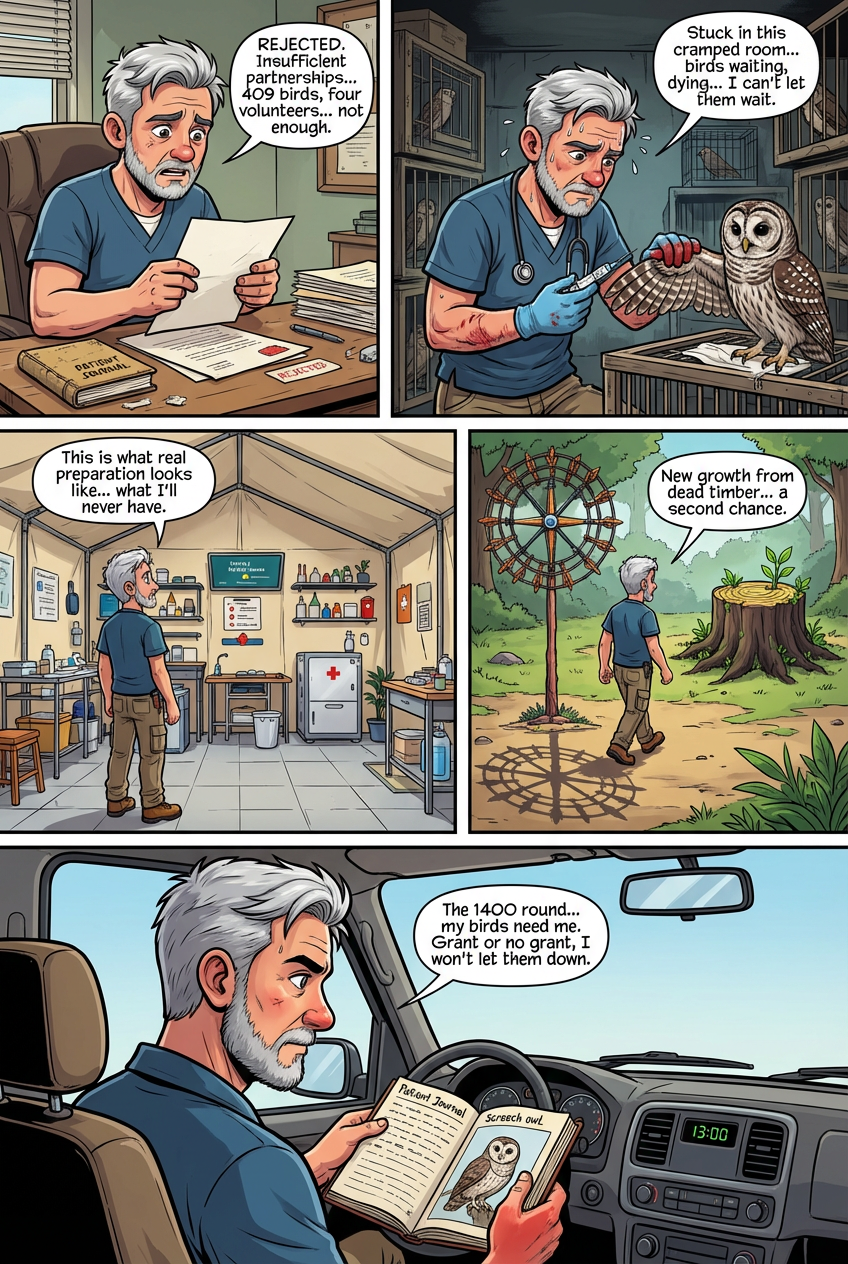
Ken's grant application came back on a Thursday morning with a single-page rejection letter. The committee cited insufficient partnerships with existing wildlife organizations. He read it twice, then set it on his desk next to his patient journal. Four hundred and nine birds weren't enough. His volunteer network of four people wasn't enough. He walked to the cabinet and pulled out his notebooks filled with hospital designs. All those hours from 2300 to 0200, sketching flight enclosures and intake stations that would never get built. His hands started to shake. He shoved the notebooks back and slammed the cabinet door hard enough to rattle the supply shelves. At 0600 hours, Ken forced himself through treatment rounds. His hands felt numb as he changed bandages and checked wing splints. A barred owl watched him from the recovery cage, eyes tracking his movements. Ken dropped a syringe twice before getting the antibiotic dose right. The certification application he'd filed three weeks ago didn't matter anymore. Without grant funding, the regional emergency center designation meant nothing. He'd still be working in this cramped room with secondhand cages while birds died waiting for proper care. He scrubbed his hands at the sink until the skin turned red and raw. The water ran pink down the drain. By 1100 hours, Ken drove out to a canvas medical tent someone had set up in a clearing. The structure held supply stations and practice dummies—a training setup for emergency response drills. He'd heard about it from one of his volunteers and thought it might offer ideas for his hospital. But standing inside the tent now, looking at the organized stations and proper equipment, only made his chest tighten. This was what real preparation looked like. His clinic had four mismatched cages and a desk covered in rejection letters. He walked past a wooden weathervane near the tent that cast long shadows across the ground. Beyond it, a charred tree stump showed green shoots pushing through blackened wood. New growth from dead timber. Ken stared at it for a full minute, then turned back to his truck. He sat in the driver's seat and pulled out his patient journal. Entry four hundred and nine stared back at him—the screech owl from yesterday. Ken flipped through the pages, reading injury notes and treatment outcomes he'd logged over months of work. Martinez had bled out in twenty-three minutes because the system failed. Ken had promised himself his birds wouldn't wait like that. But without funding or partnerships, he was just one person with notebooks full of plans that would never get built. He closed the journal and set it on the passenger seat. The 1400 treatment round was in three hours. The birds in his clinic needed him whether the grant committees believed in his work or not. Ken started the engine and headed back.
Play your story to life
Storycraft is a mobile game where you create AI characters, craft items and locations to build their world, then discover what direction your story takes. Download the iOS game for free today!
Download for free