

Kenna Esters's Arc
13 Chapters
Kenna Esters's dream is earning recognition from the world's most prestigious nature photography publication.

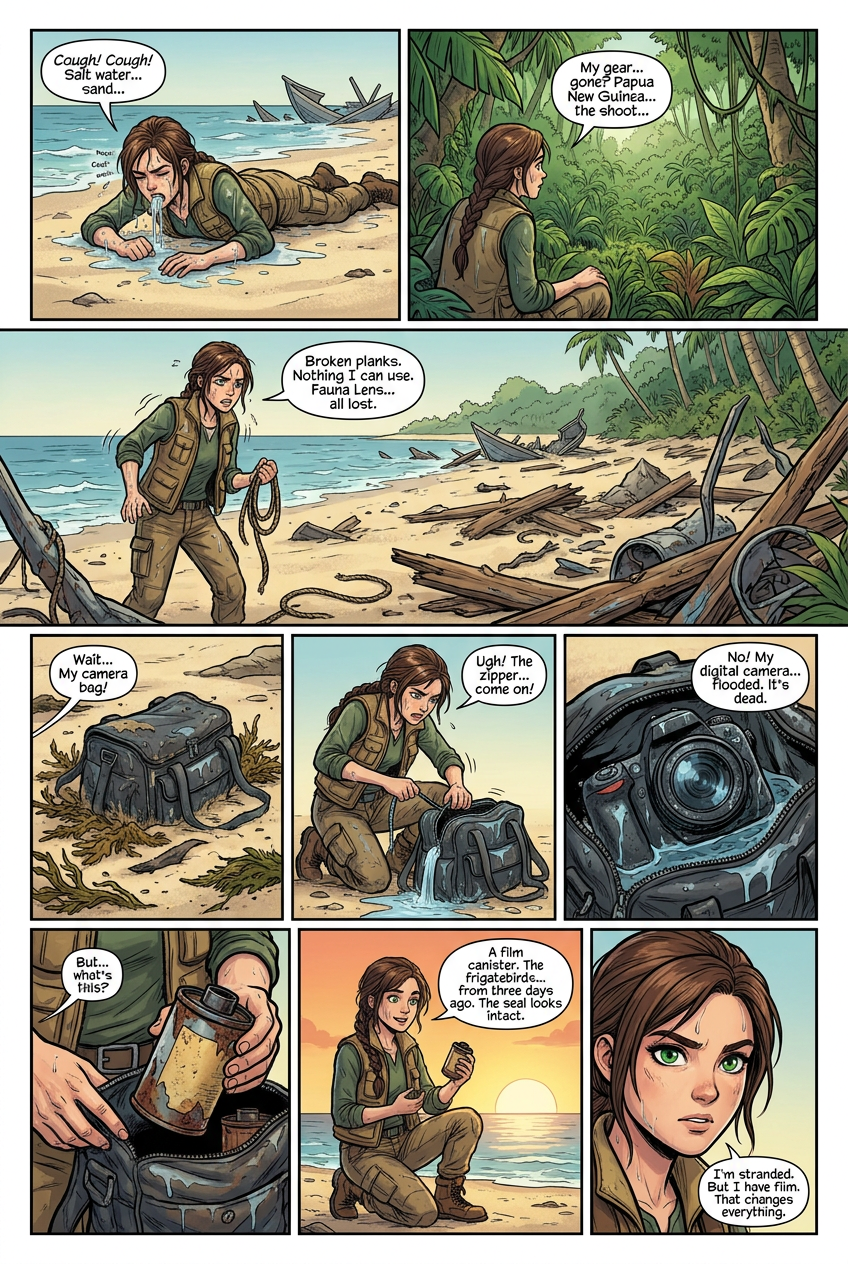
Kenna woke to salt water in her lungs and sand under her palms. She coughed hard, rolled onto her side, and forced her eyes open. Green stretched in every direction — thick trees, tangled vines, leaves the size of dinner plates. The boat was gone. Her gear was gone. Everything she'd packed for the shoot in Papua New Guinea had sunk or scattered. She pushed herself upright and scanned the beach. If her cameras had washed ashore, she might still salvage the trip. If not, months of planning and the chance to capture something Fauna Lens had never seen would be lost. She walked the shoreline, legs shaking. Broken planks and twisted metal littered the sand where the current had deposited them. Rope lay coiled around splintered wood. A torn cushion. Pieces of the hull. Nothing she could use. Then she spotted it — her camera bag, half-buried near a tangle of seaweed. She ran. The zipper stuck, swollen with salt water. When she finally wrenched it open, seawater poured out. Her digital camera was dead. The lenses were flooded. But wedged in the bottom pocket was a film canister, rusted and dented, its paper label peeling away in wet strips. She turned it over in her hands. The seal looked intact. Kenna sat back on her heels and stared at the canister. Inside was a roll of film she'd shot three days ago — a sequence of frigatebirds diving at sunset, backlit and fast. She'd planned to develop it in Port Moresby, but now she had no way to know if the images had survived. The canister might hold her best work or nothing but water damage. Either way, she was stranded with no boat, no radio, and no way off the island. But she had film. That changed everything.
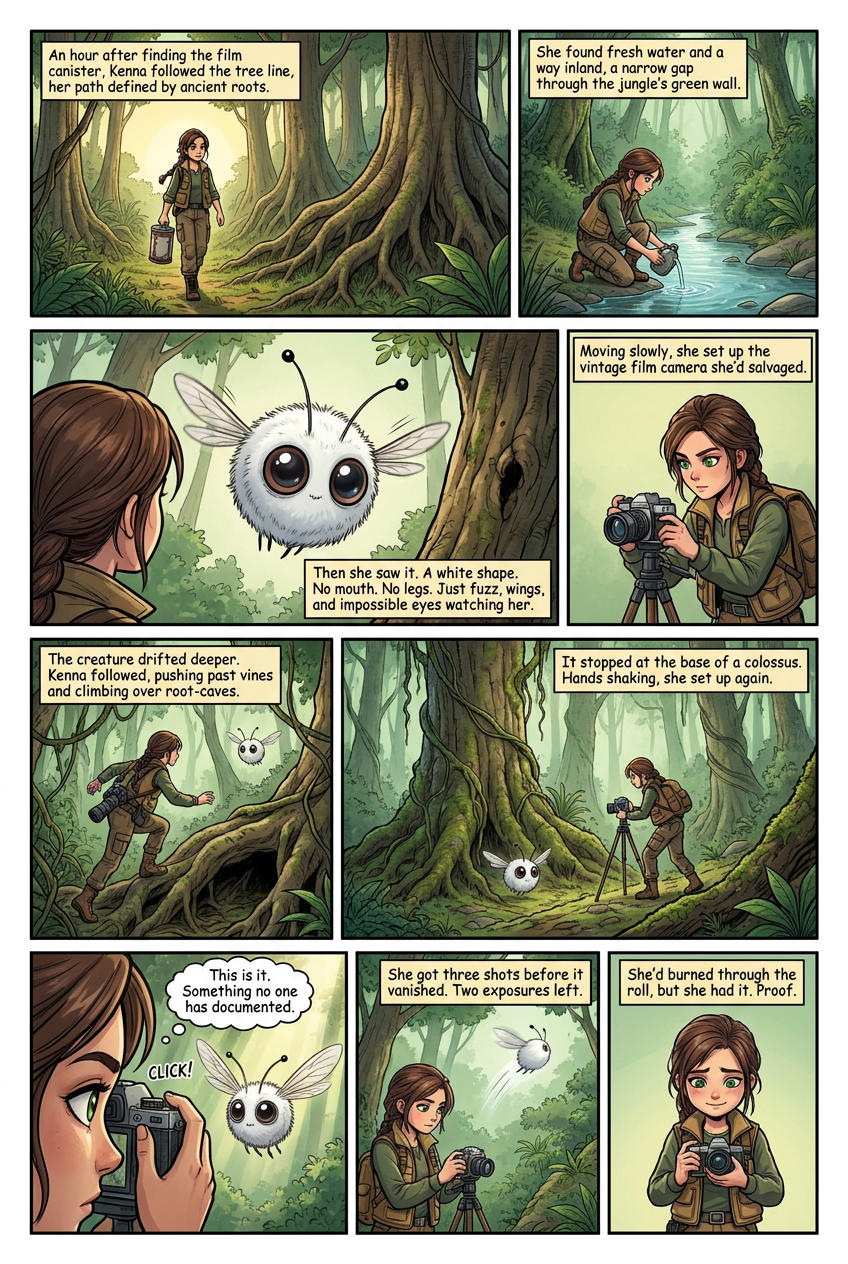
Kenna spent the first hour after finding the film canister walking the tree line, looking for fresh water and a way inland. She found both — a narrow stream cutting through the jungle and a gap in the undergrowth wide enough to follow. The trees here were massive, their roots spreading like walls across the forest floor. She was checking the canopy for fruit when she saw it. A white shape hovering near a trunk, perfectly still except for the faint tremor of wings. It looked like a ball of cotton with eyes — huge, dark eyes that seemed too big for its body. Two thin stalks rose from its head, each tipped with a black dot. She'd never seen anything like it. No mouth. No legs. Just fuzz and wings and those impossible eyes watching her from twenty feet away. Kenna moved slowly, pulling the old film camera from her bag. The digital equipment was gone, but she'd salvaged a vintage backup and a small tripod from the wreckage this morning. She planted the tripod, mounted the camera, and adjusted the focus ring. The creature didn't move. Through the viewfinder, she could see every detail — the delicate veins in its wings, the way its body caught the filtered light. This was it. Something no one had documented. She pressed the shutter. The creature lifted off the trunk and drifted deeper into the jungle. Kenna grabbed her gear and followed, pushing past vines and low branches. The ground sloped upward. The trees grew thicker, their trunks wider than cars, their roots forming caves she had to climb over. She caught glimpses of white ahead — always just out of reach. Then the creature stopped at the base of an enormous tree, its trunk covered in moss and strangling vines. She set up again, hands shaking. She got three shots before it disappeared into the canopy. When she checked her film counter, she had two exposures left. She'd burned through the roll chasing something she might never see again. But she had it. She had proof.
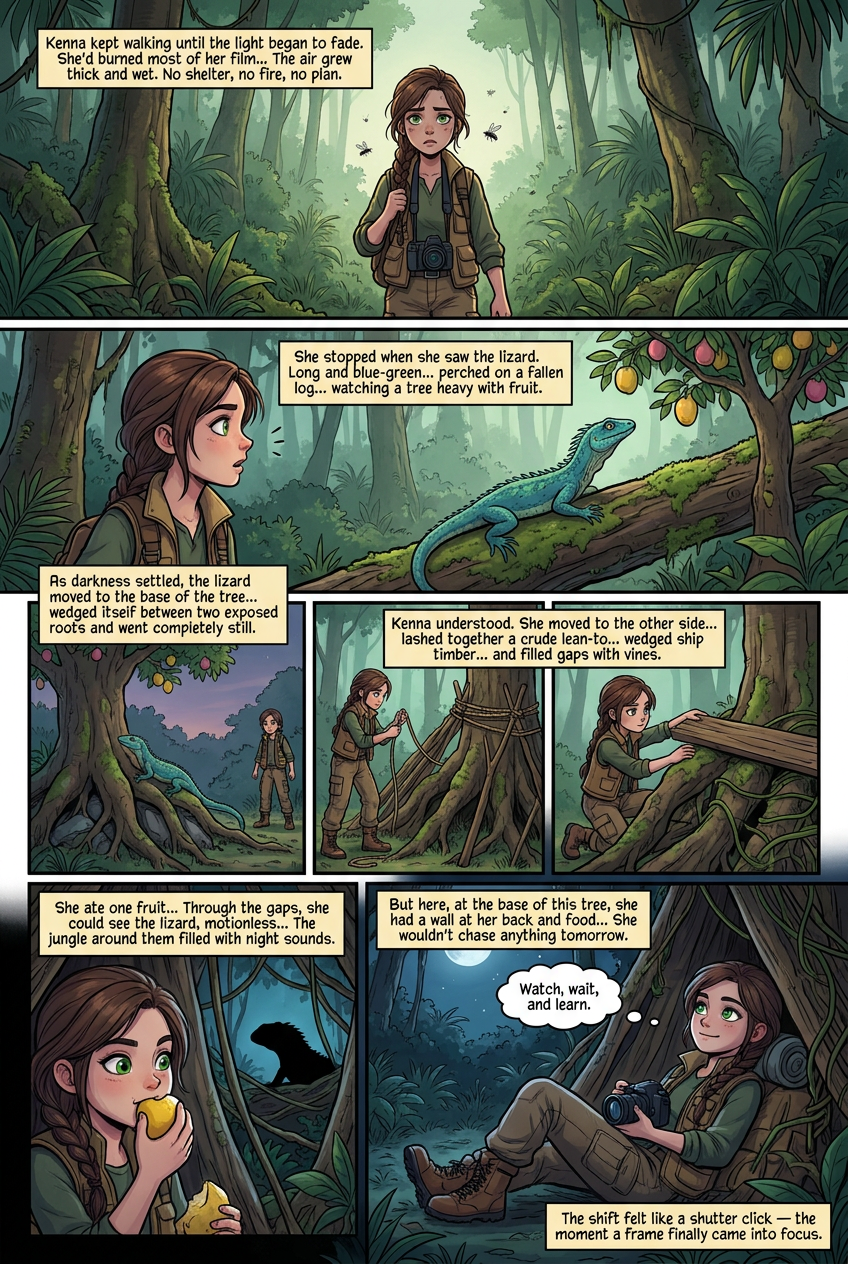
Kenna kept walking until the light began to fade. She'd burned most of her film on the fuzzy creature, and now the jungle pressed in from all sides. The air grew thick and wet. Insects buzzed near her ears. She had no shelter, no fire, no plan beyond putting one foot in front of the other. She stopped when she saw the lizard. It was long and blue-green, perched on a fallen log with its body stretched out like a small dragon. Four legs, two arms, and scales that caught what little light remained. The creature didn't move when she approached. It was watching a tree — a thin tropical tree heavy with yellow and pink fruit. As darkness settled, the lizard climbed down from the log and moved to the base of the tree. It wedged itself between two exposed roots and went completely still. Kenna understood. The lizard wasn't hunting. It was settling in for the night near a food source, protected by the root system. She moved to the other side of the tree and found a gap between the roots large enough to shelter her. Using rope from her bag and broken branches, she lashed together a crude lean-to against the roots. She wedged ship timber from the beach wreckage across the top and filled gaps with vines. It wasn't much, but it would keep the rain off. She pulled down three fruits from the lowest branch and ate one. It was sweet and made her mouth water. She saved the other two. Through the gaps in her shelter, she could see the lizard on the far side of the tree, motionless in its own hollow. The jungle around them filled with night sounds — clicks and rustles and distant calls. But here, at the base of this tree, she had a wall at her back and food within reach. She wouldn't chase anything tomorrow. She would watch, wait, and learn what this place wanted to teach her. The shift felt like a shutter click — the moment a frame finally came into focus.
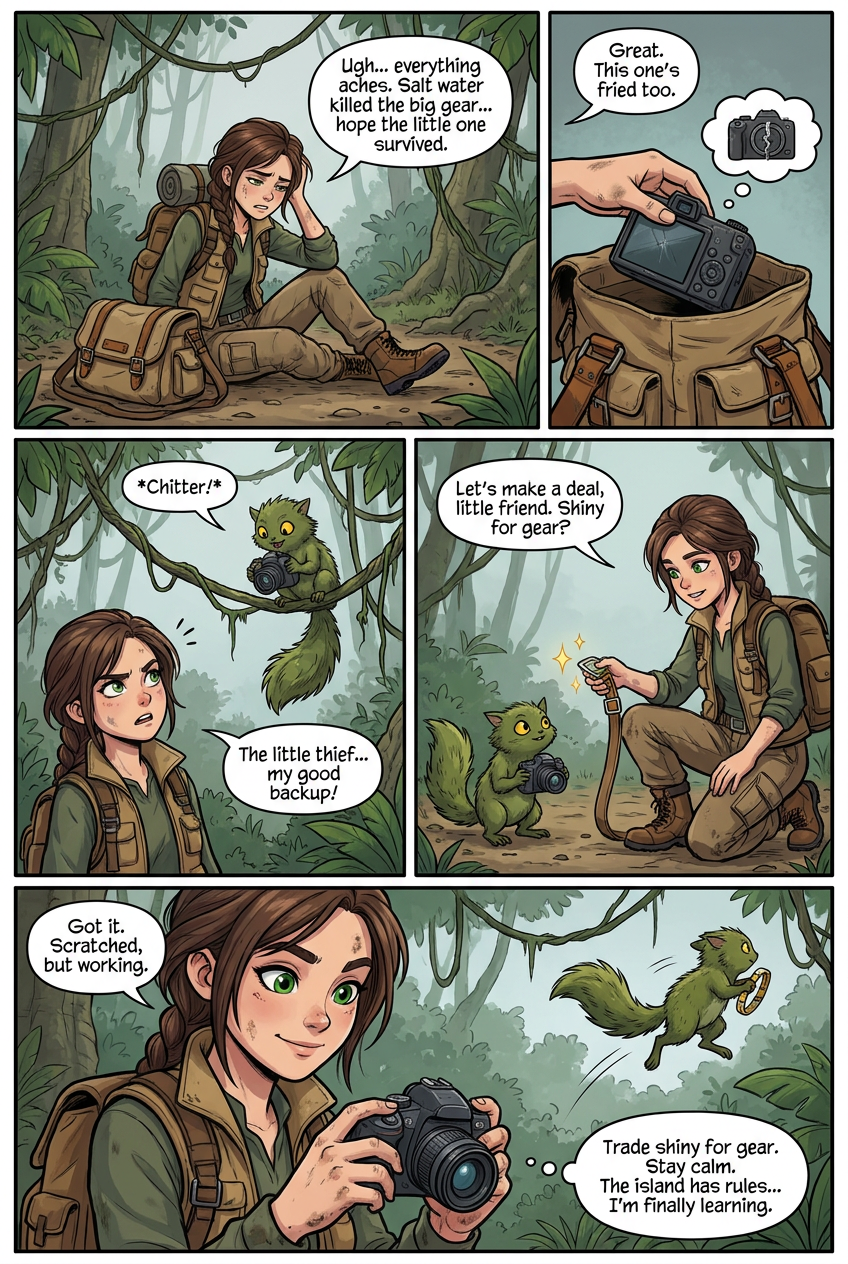
Kenna woke to gray light filtering through the vines overhead. Her body ached from sleeping on roots and dirt. She reached for her bag and pulled out the backup digital camera — the small point-and-shoot she'd carried as insurance. Salt water had killed her professional gear, but this cheap plastic thing had survived in a sealed pocket. She turned it on. The screen flickered, then died. She tried again. Nothing. Then she noticed the creature watching her from a tangle of vines twenty feet away. It had a moss-green back and a tail as wide as her arm, covered in bristly fur that caught the morning light. The creature chittered and held up her camera — the good one, the backup that actually worked. It must have taken it from her bag while she slept. The creature's yellow eyes fixed on hers, intelligent and waiting. Kenna sat up slowly. She pulled the metal buckle from her camera bag strap and held it out. The buckle caught the sunlight and gleamed gold and silver. The creature's head tilted. It dropped down from the vines and crept closer, keeping the camera just out of her reach. Kenna set the buckle on the ground between them and stepped back. The creature snatched it up, turned it over in its hands, then dropped the camera and bounded away into the canopy with its prize. Kenna picked up the camera and checked it. Scratched but working. She'd traded a piece of gear for a piece of gear, learned that these creatures valued shiny things, and confirmed they were clever enough to bargain. More importantly, she'd stayed calm instead of chasing. The island was teaching her its rules, and she was finally listening.
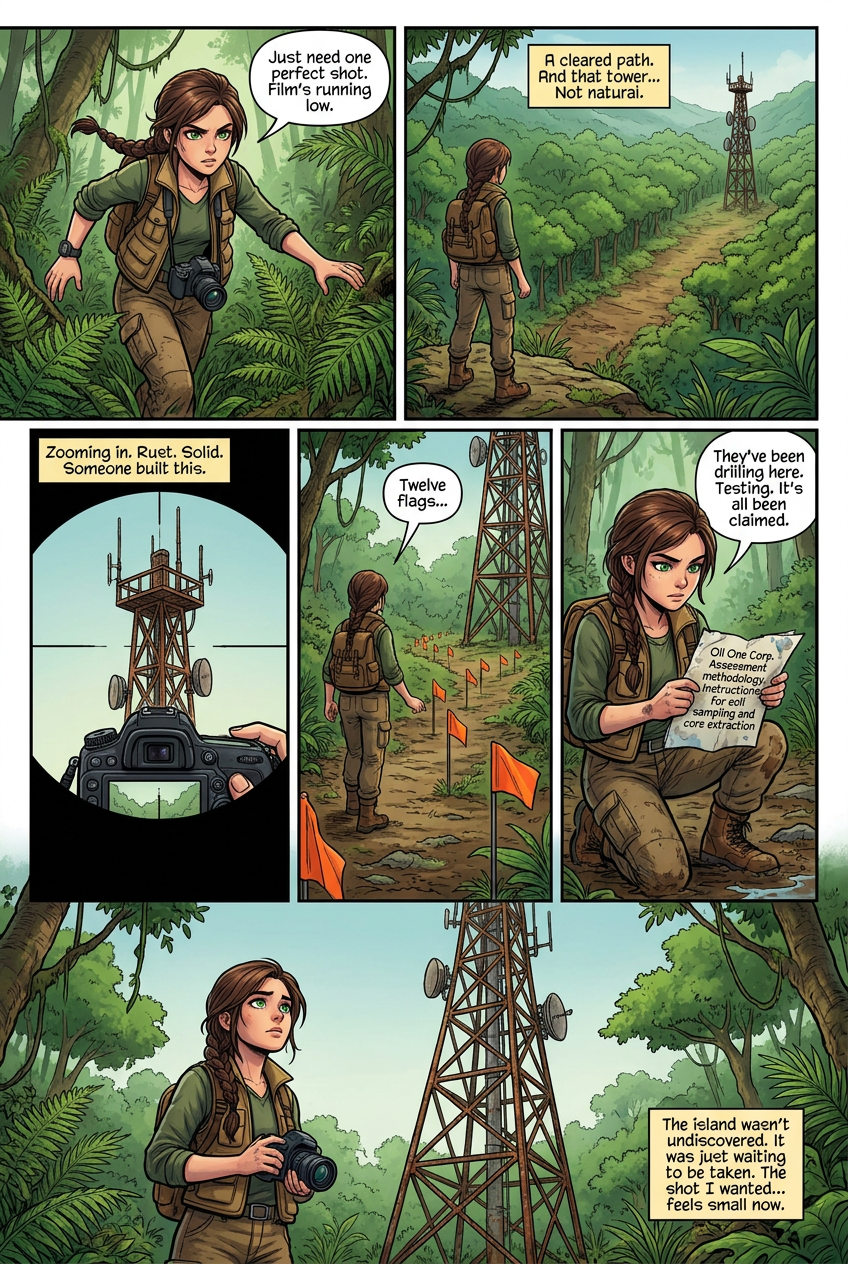
Kenna climbed higher through the jungle, searching for elevation and better light. The backup camera hung from her wrist, still scratched but functional. She needed something worth the film she had left — two exposures on the vintage camera, and whatever charge remained in this digital one. She broke through a wall of ferns onto a ridge and stopped. Below her, cutting through the canopy in a straight line, ran a cleared path. Not natural. Too uniform. At the far end, a metal tower rose above the trees, stark and angular against the green. Radio equipment bristled from the top platform. Kenna raised the camera and zoomed in. Rust streaked the frame, but the structure stood solid. Someone had built this. Someone had been here. She descended toward the path and found the first marker flag — neon orange, impossible to miss. Then another thirty feet ahead. They led toward the tower in a deliberate line. Kenna followed them, counting. Twelve flags total. At the base of the tower, she found a crumpled page half-buried in mud. She pulled it free and smoothed it against her thigh. Oil One Corp. Assessment methodology. Instructions for soil sampling and core extraction. The text blurred where water had soaked through, but enough remained to understand. They'd been drilling here. Testing. Mapping. Kenna photographed the page, then the tower, then the flags stretching back into the jungle. Her hands moved automatically, but her mind was working faster. This island wasn't undiscovered — it was claimed. Someone knew about this place and its value, and they'd left infrastructure behind to prove it. She had her evidence now, but the shot she'd been hunting felt smaller. The island had already been seen, already been measured and catalogued by people who wanted what they could take from it. She lowered the camera and looked up at the tower. The question wasn't whether she could capture something new anymore. It was whether anything here had ever been untouched at all.
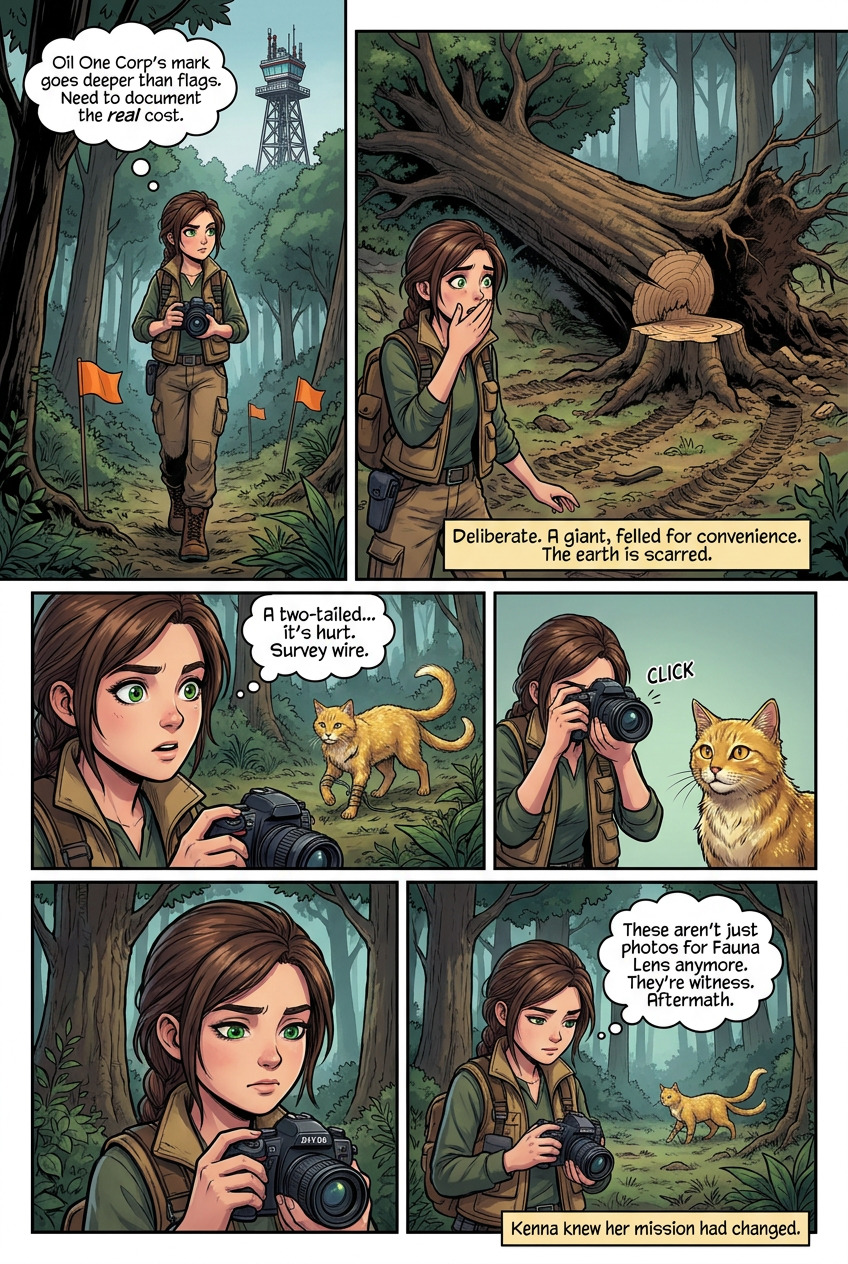
Kenna moved past the tower, deeper into the marked territory. If Oil One Corp had surveyed here, they'd left more than flags and paper. She needed to see what their presence had actually done — not just the infrastructure, but the cost. The backup camera felt heavier now, less like a tool for discovery and more like documentation of damage already done. She found the first real evidence thirty yards from the tower. An ancient tree lay on its side, roots torn from the earth and exposed like broken bones. The trunk was massive — it would have taken centuries to grow that thick. Moss covered the bark in patches, and vines hung from branches that still reached toward the canopy. But at the base, where it had been cut, she saw the marks. Clean saw lines. Deliberate. They'd felled it to make room for equipment or access. Around it, the ground was torn up, compressed by heavy machinery. Nothing grew in the tracked earth. Movement caught her eye near the fallen trunk. A golden cat emerged from the undergrowth, limping. Two tails curved behind it, both twitching with agitation. Kenna raised the camera slowly. The cat was beautiful — its coat shimmered even in the filtered light. But wire wrapped around its front leg, cutting into the fur. Survey wire, the kind used to mark boundaries. The cat stopped and looked directly at her. Its eyes were sharp, aware. It didn't run. Kenna took the shot, then another, capturing the wire, the wound, the intelligence in its gaze. The cat held still long enough for her to see what she needed to see, then turned and vanished into the ferns. Kenna lowered the camera and looked at the tree again, then at the path the cat had taken. She had her shots now — the evidence of what Oil One Corp had done and what it cost. The fallen giant and the injured animal told the story better than any tower could. But she also knew what this meant. These weren't the untouched images Fauna Lens wanted. These were witness photographs. Documentation of harm. They mattered, but not for the reason she'd come here. She checked the frame counter. The film was nearly gone, and what she'd captured wasn't discovery — it was aftermath. She'd have to decide what that was worth.
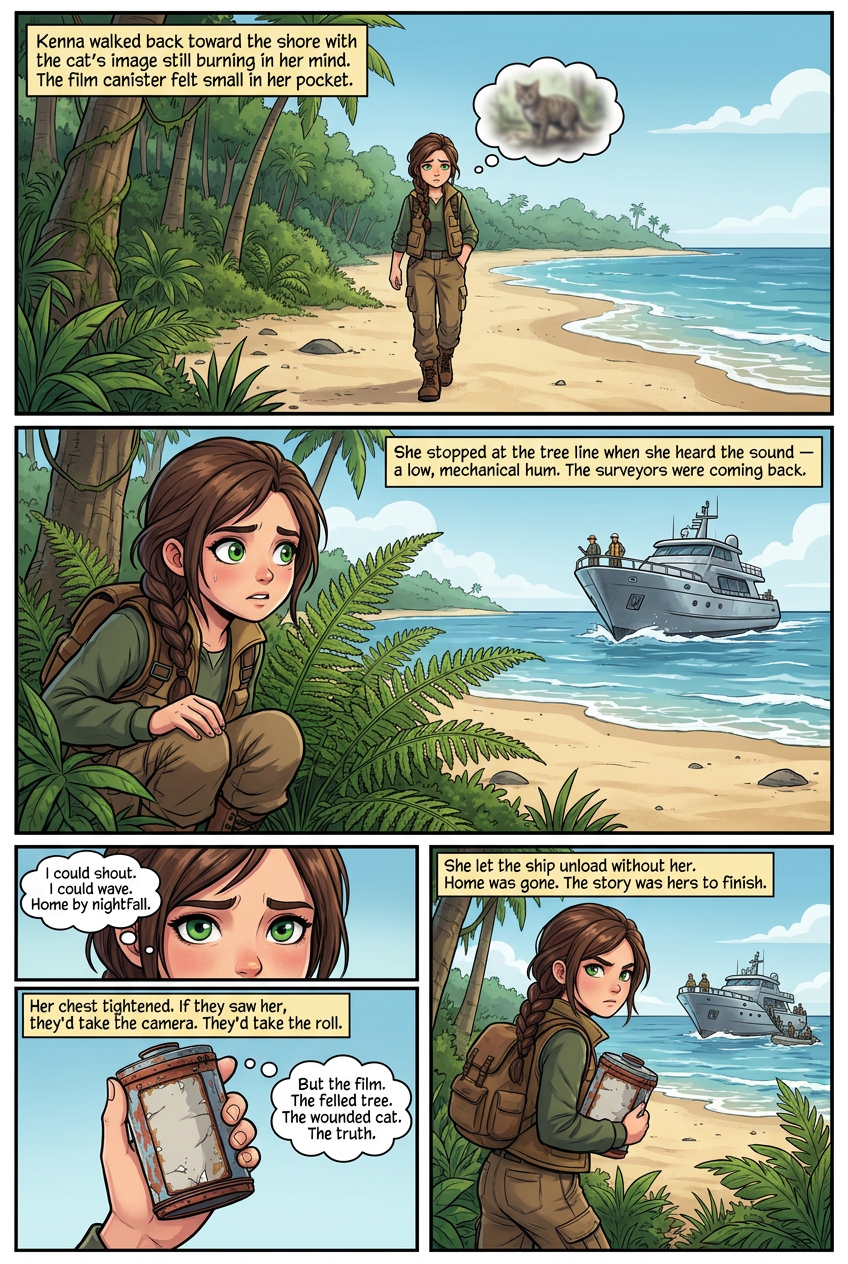
Kenna walked back toward the shore with the cat's image still burning in her mind. The film canister felt small in her pocket. She stopped at the tree line when she heard the sound — a low, mechanical hum drifting in from the water. She crouched behind a wide fern and looked out. A metal ship was cutting toward the beach, its railings catching the sun. The surveyors were coming back. She pressed deeper into the flowered ferns. Bright blossoms hid her shape against the green. Two figures stepped onto the bow, clipboards in hand. Her chest tightened. She could shout. She could wave. She could be home by nightfall. But the film in her pocket held the felled tree, the wounded cat, the truth of what these people had done. If they saw her, they'd take the camera. They'd take the roll. The evidence would vanish before anyone saw it. Kenna stayed low. She watched the boots hit the sand, watched a man point inland toward the tower. Her hand closed around the canister. She let the ship unload without her. When the surveyors moved into the trees, she turned and slipped back into the jungle. Home was gone. The story was hers to finish.
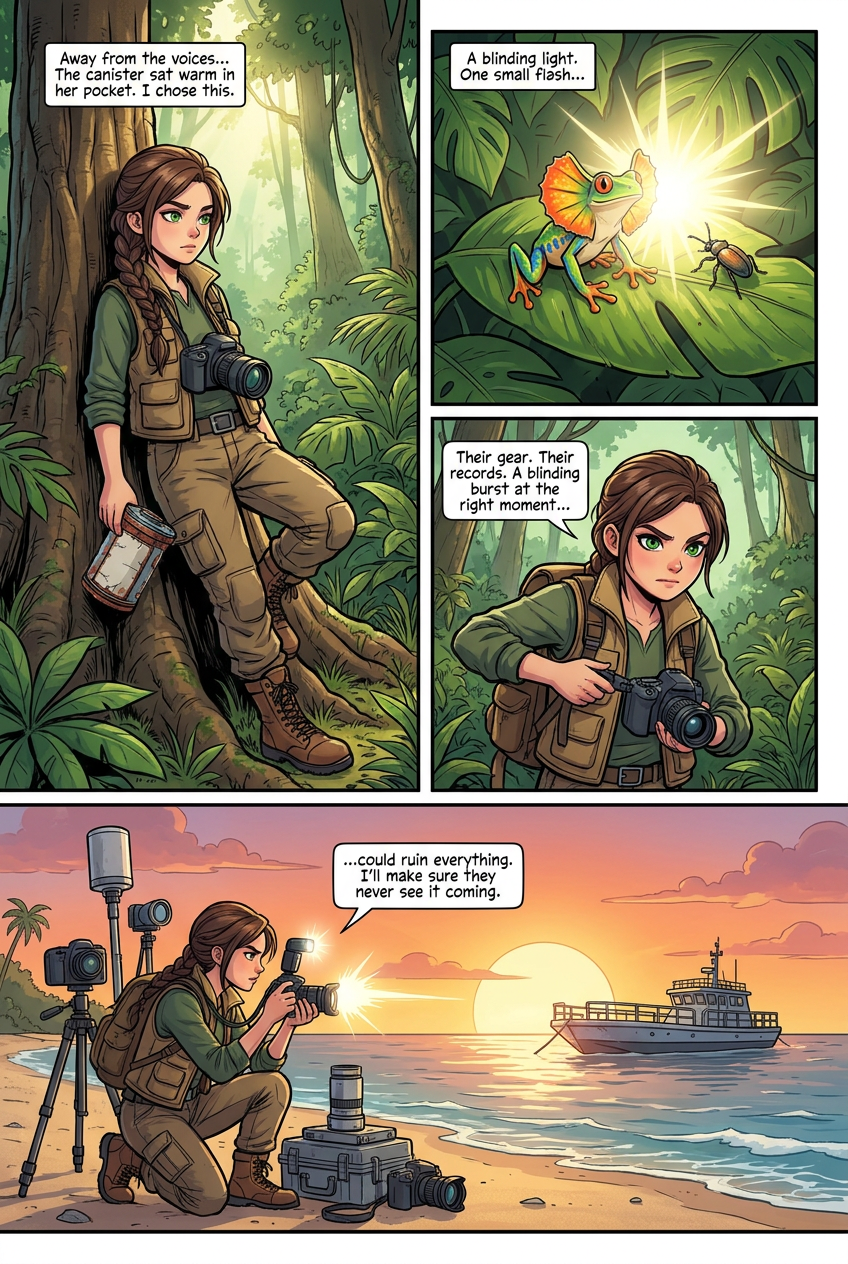
Kenna moved deeper into the jungle, away from the voices on the beach. The ship's hum faded behind her. She found a thick trunk and pressed her back against it. Her breath slowed. The film canister sat warm in her pocket. She had chosen this. Now she needed a plan to stop them. A flash burst near her foot. She flinched. A tiny tree frog crouched on a leaf, its bright frill spread wide. The membrane pulsed with a blinding light. A beetle tumbled off the leaf, stunned. The frog hopped away calm and slow. Kenna stared. One small flash had scrambled something bigger than itself. She pulled her backup digital camera from her bag. The flash still worked. She thought of the survey crew's instruments, their sensors, the delicate film in their own cameras logging every tree they planned to cut. A blinding burst at the right moment could ruin a lens, a reading, a record. She crept back toward the beach. Kenna found their gear stacked by the shore, unguarded. She thumbed the flash to full and fired it into each open lens, each sensor screen, again and again until the camera battery died and the equipment sat blinded. Out on the water, the survey vessel waited, metal railings bright in the sun — her last ride home, pulling at anchor without her. She dropped the dead camera in the sand and walked back into the trees.
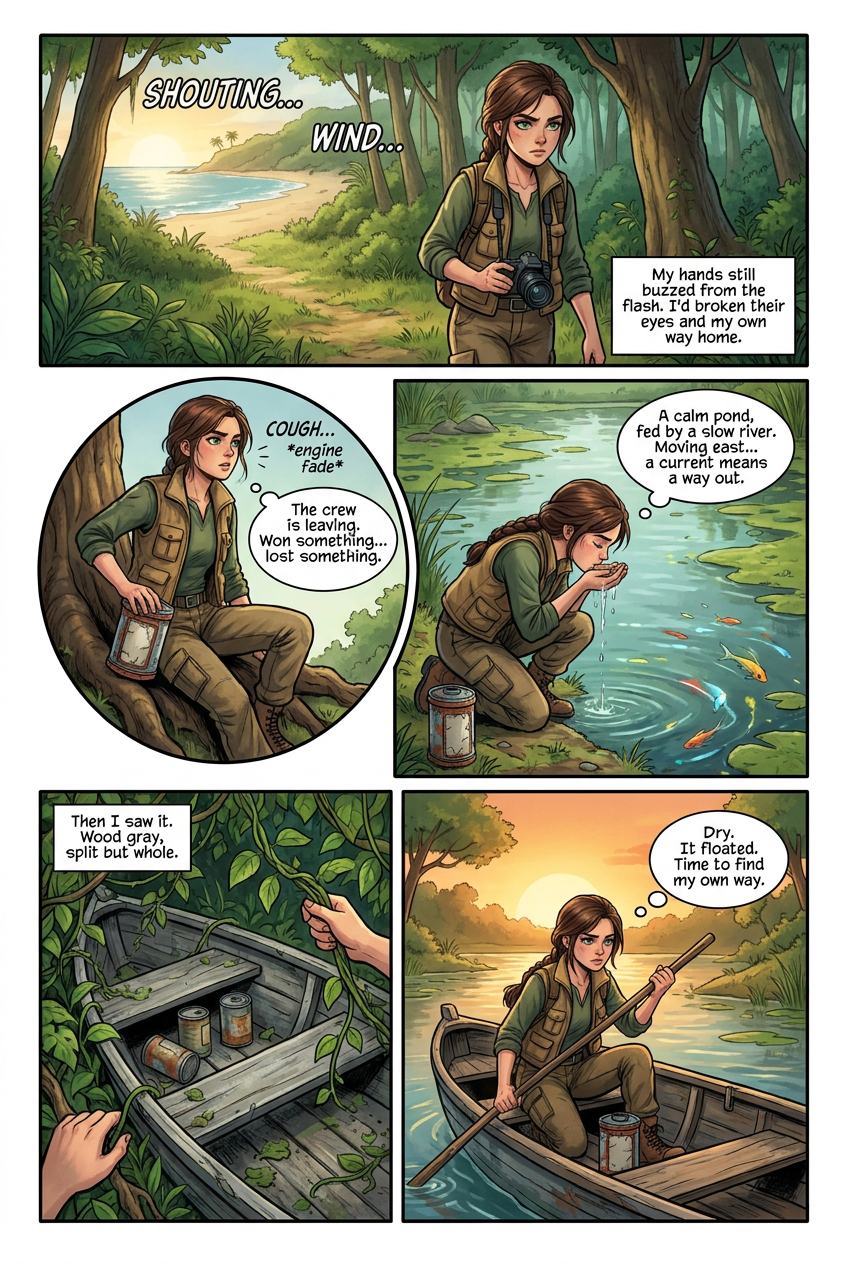
Kenna walked until the shouting on the beach turned into wind. Her hands still buzzed from the flash. She had broken their eyes and her own way home in the same breath. The film canister pressed against her hip, small and heavy. She sat on a root and listened. Engines coughed in the distance, then faded. The crew was leaving. She had won something, and lost something, and now she needed another way back. She followed the stream inland, hoping it led somewhere with water wide enough to travel. The trees opened. A calm pond spread before her, fed by a slow river. Bright fish darted under a thin film of algae. The water moved east, toward open sea. She knelt at the edge and drank. The current was steady. A current meant a way out. Then she saw it. Half-hidden under vines sat an old rowboat, wood gray and split but whole. Two faded cans rested inside. She tugged the vines away and tested the hull. Dry. She dragged it to the water. It floated. Kenna climbed in, set the film canister between her feet, and pushed off into the slow current.
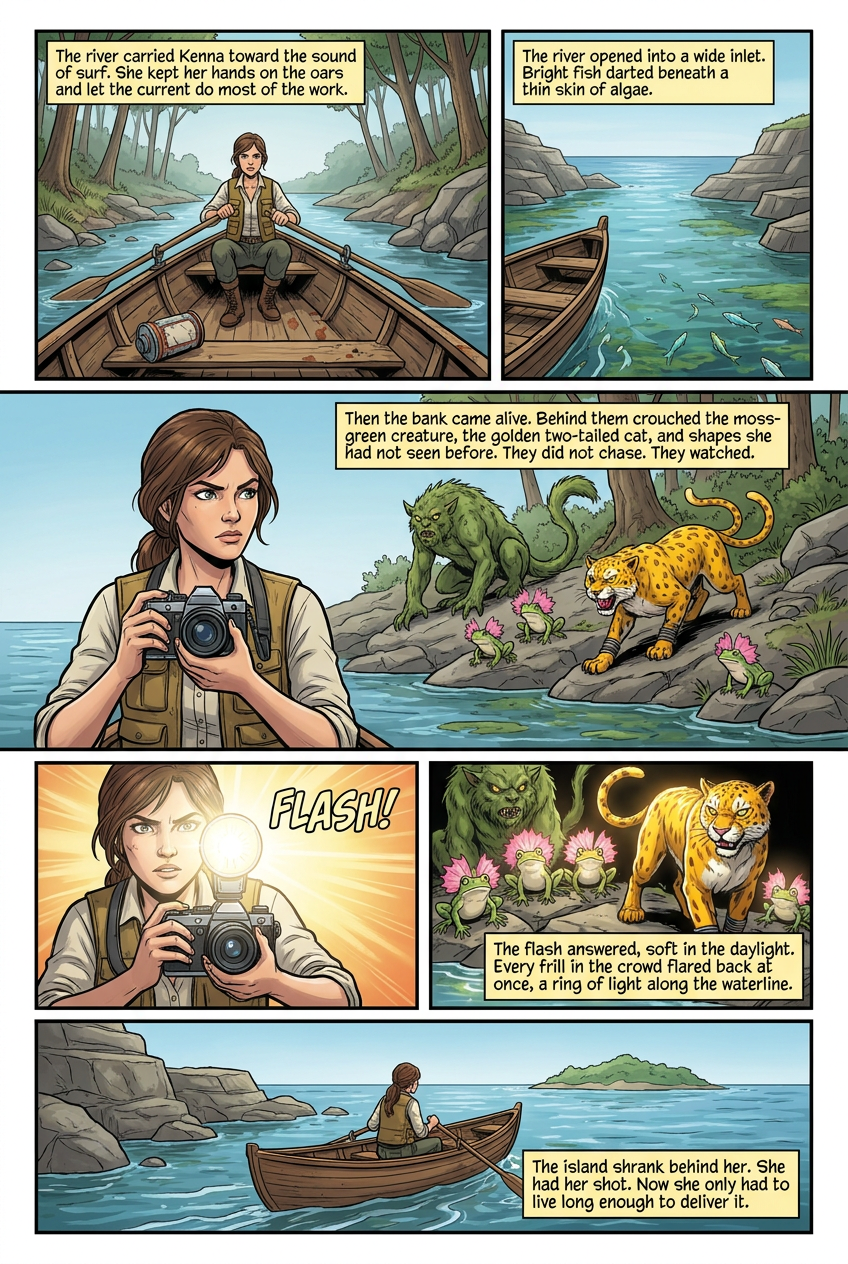
The river carried Kenna toward the sound of surf. She kept her hands on the oars and let the current do most of the work. The film canister rolled gently at her feet. Trees thinned. Salt touched the air. Somewhere behind her, the island held everything she had seen and everything she had not yet decided to do with it. The river opened into a wide inlet. Bright fish darted beneath a thin skin of algae, scattering as her hull cut through. Stone shelves rose on either side, marking the island's last edge. Beyond them, open sea. Then the bank came alive. Small frogs lined the rocks, their pink frills flared wide. Behind them crouched the moss-green creature, the golden two-tailed cat, and shapes she had not seen before. They did not chase. They watched. Kenna shipped the oars and lifted her camera with cold, steady hands. She framed them against the green wall of the island and pressed the shutter. The flash answered, soft in the daylight. Every frill in the crowd flared back at once, a ring of light along the waterline. She lowered the camera. The creatures held their place as the current pulled her past the stones. Kenna tucked the film canister inside her shirt, against her ribs. The island shrank behind her. She had her shot. Now she only had to live long enough to deliver it.
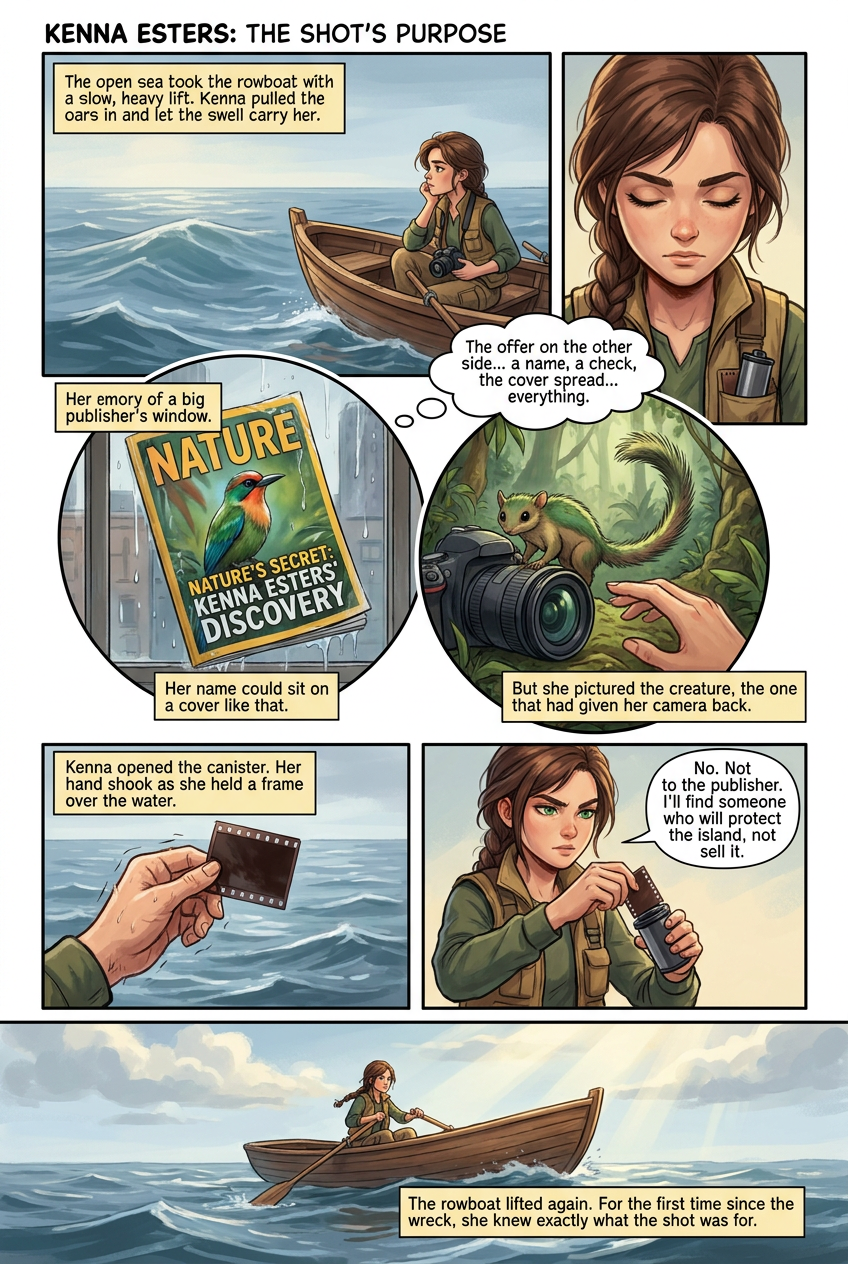
The open sea took the rowboat with a slow, heavy lift. Kenna pulled the oars in and let the swell carry her. The film canister rested warm against her ribs. She thought of the offer waiting on the other side of this water — a name, a check, a magazine spread that could change everything. She thought of what those pictures would invite back to the island if she sent them. The choice sat in her chest like a second heartbeat. She pictured the storefront she had walked past a hundred times back home. The big publisher's window, plastered with a soaked, crinkled nature magazine blown up to the size of a door. Bright animals. Bold letters. Her name could sit on a cover like that. Then she pictured the small green-backed creature with the long, bristly tail, the one that had stolen her camera and given it back. She pictured boots in its trees. Saw blades. Trucks where its river ran. Kenna opened the canister. She slid one frame of film out, the negative of the island's edge, and held it over the water. Her hand shook. Then she tucked it back inside and sealed the lid tight. She would deliver the photographs — but not to the publisher. She would find someone who could use them to protect the island, not sell it. The rowboat lifted again, and for the first time since the wreck, she knew exactly what the shot was for.
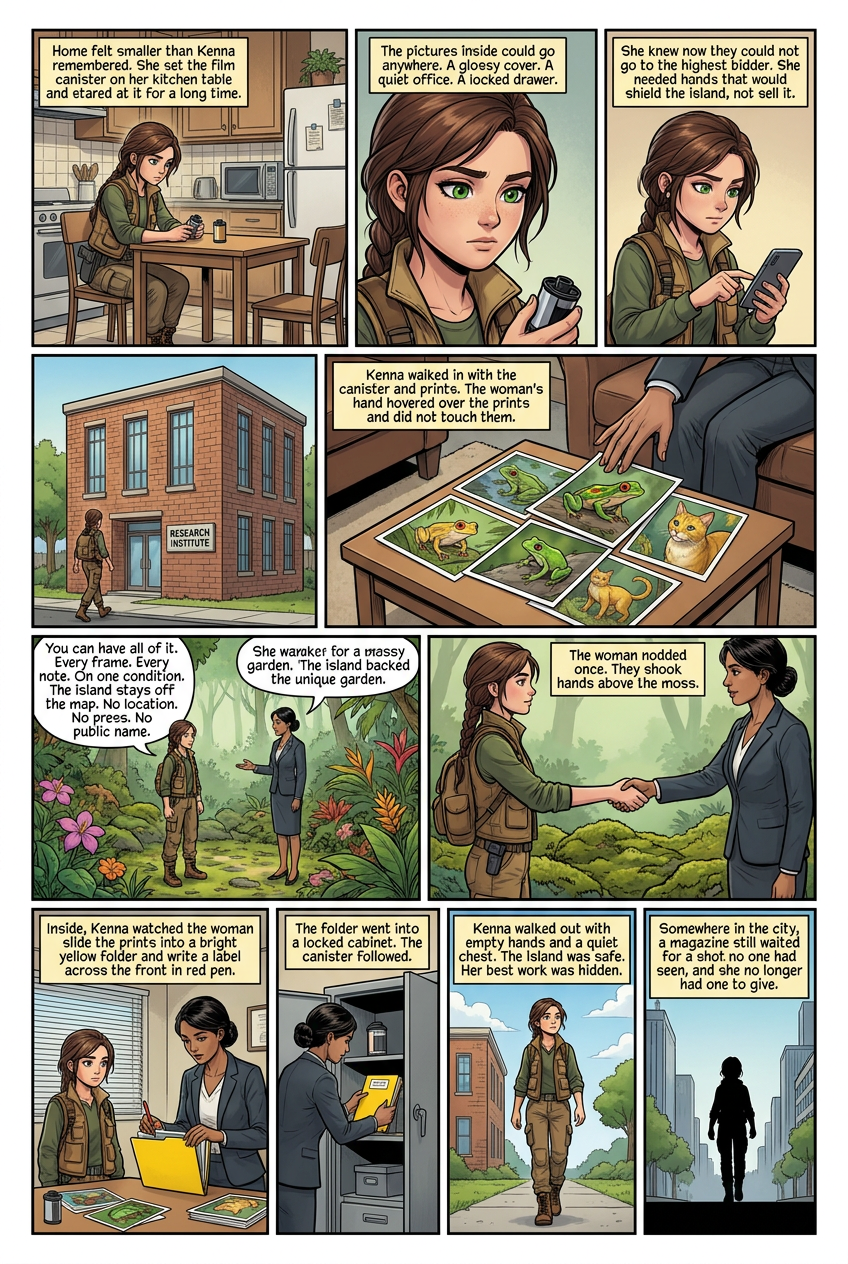
Home felt smaller than Kenna remembered. She set the film canister on her kitchen table and stared at it for a long time. The pictures inside could go anywhere. A glossy cover. A quiet office. A locked drawer. She knew now they could not go to the highest bidder. She needed hands that would shield the island, not sell it. She pulled out her phone and began to search for the right people to call. She found a square brick building with tall windows and a carved sign above the door. The research institute studied wildlife and a changing climate. Kenna walked in with the canister in her coat pocket and the prints tucked under her arm. A woman met her in the lobby. Kenna spread the photographs across a low table. The frogs. The green-backed thief. The golden cat with two tails. The woman's hand hovered over the prints and did not touch them. Kenna led her outside to a patch of mossy ground bright with small tropical flowers, planted near the building's side door. She wanted open sky for this part. "You can have all of it," Kenna said. "Every frame. Every note. On one condition. The island stays off the map. No location. No press. No public name." The woman looked at the flowers, then at Kenna. She nodded once. They shook hands above the moss. Inside, Kenna watched the woman slide the prints into a bright yellow folder and write a label across the front in red pen. The folder went into a locked cabinet. The canister followed. Kenna walked out with empty hands and a quiet chest. The island was safe. Her best work was hidden. Somewhere in the city, a magazine still waited for a shot no one had seen, and she no longer had one to give.
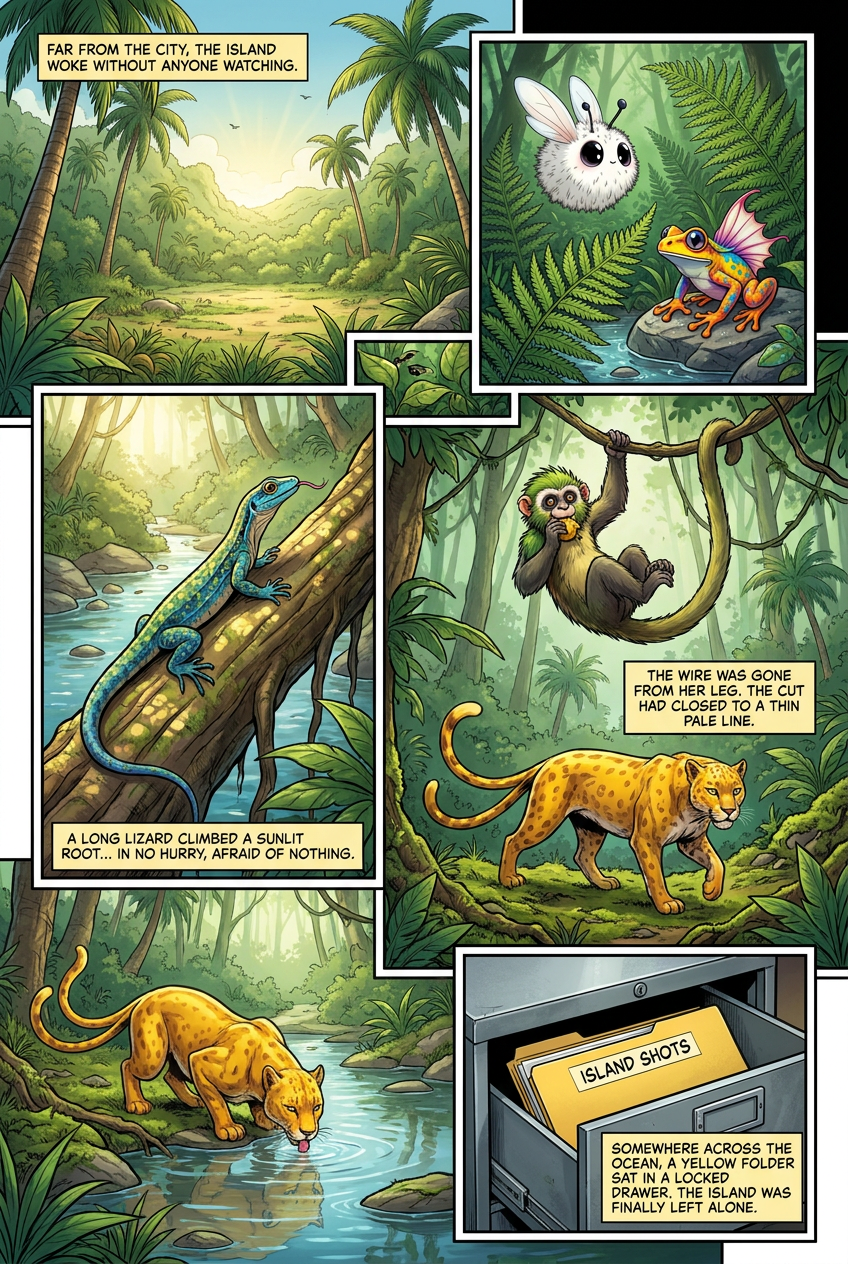
Far from the city, the island woke without anyone watching. No boats cut the water. No boots pressed the sand. The tide came in and went out, and the trees held still in the warm wind. A fuzzy winged orb drifted between two ferns, blinking its big black eyes at nothing in particular. It bumped a leaf and floated on. A small frog with a bright frill sat on a wet stone, breathing slow, its colors loud in the green shade. Near the stream, a long lizard climbed a sunlit root. Blue and green scales caught the light. It tasted the air and kept climbing, in no hurry, afraid of nothing. High in the branches, a sloth-monkey hybrid hung by its long tail. It chewed a piece of fruit and watched the canopy sway. Below, the golden panther with two tails walked through a patch of moss. The wire was gone from her leg. The cut had closed to a thin pale line. She drank from the slow water. Her tails flicked once, twice. Around her, the jungle did what jungles do when no one is taking notes. It grew. It breathed. It went on. Somewhere across the ocean, a yellow folder sat in a locked drawer. The island did not know about the folder. It did not need to. The shot Kenna had been chasing her whole life lived here now, unseen, and the island was finally left alone.
Play your story to life
Storycraft is a mobile game where you create AI characters, craft items and locations to build their world, then discover what direction your story takes. Download the iOS game for free today!
Download for free