

Lucky's Arc
12 Chapters
Lucky's dream is witnessing and gathering moments from every hand that holds him before the flame dies.

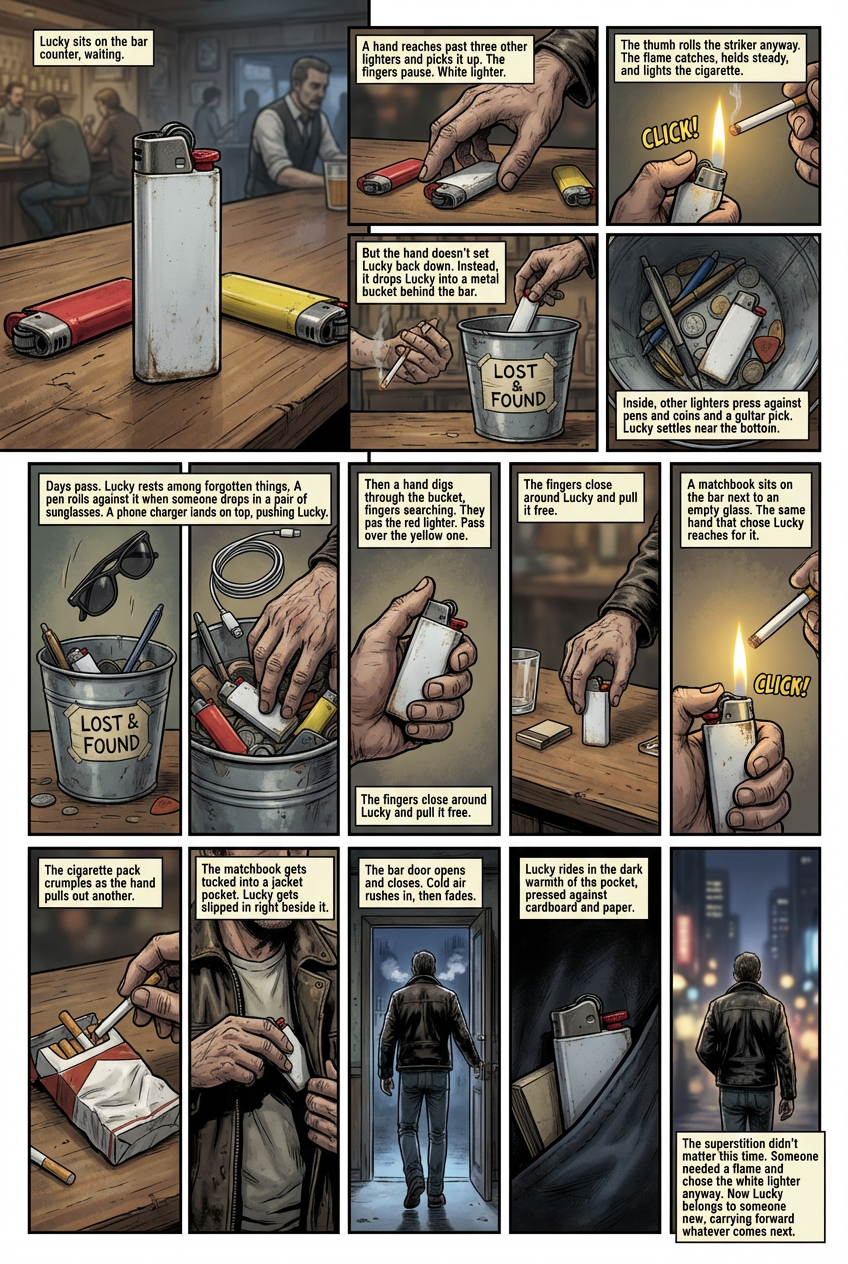
Lucky sits on the bar counter, waiting. A hand reaches past three other lighters and picks it up. The fingers pause. White lighter. The thumb rolls the striker anyway. The flame catches, holds steady, and lights the cigarette. That's one more moment gathered. One more story passing through. But the hand doesn't set Lucky back down. Instead, it drops Lucky into a metal bucket behind the bar. The bucket says Lost & Found on a strip of masking tape. Inside, other lighters press against pens and coins and a guitar pick. Lucky settles near the bottom. The bar sounds go on above. Voices. Glasses. Music. Lucky waits in the bucket now, collecting nothing, until someone reaches in again. The next hand will decide if there's another flame left to give. Days pass. Lucky rests among forgotten things. A pen rolls against it when someone drops in a pair of sunglasses. A phone charger lands on top, pushing Lucky deeper. Then a hand digs through the bucket, fingers searching. They pass over the red lighter. Pass over the yellow one. The fingers close around Lucky and pull it free. A matchbook sits on the bar next to an empty glass. The same hand that chose Lucky reaches for it. The thumb strikes Lucky's wheel. The flame lights a fresh cigarette. Lucky is back in motion again. The cigarette pack crumples as the hand pulls out another. The matchbook gets tucked into a jacket pocket. Lucky gets slipped in right beside it. The bar door opens and closes. Cold air rushes in, then fades. Lucky rides in the dark warmth of the pocket, pressed against cardboard and paper. The superstition didn't matter this time. Someone needed a flame and chose the white lighter anyway. Now Lucky belongs to someone new, carrying forward whatever comes next.
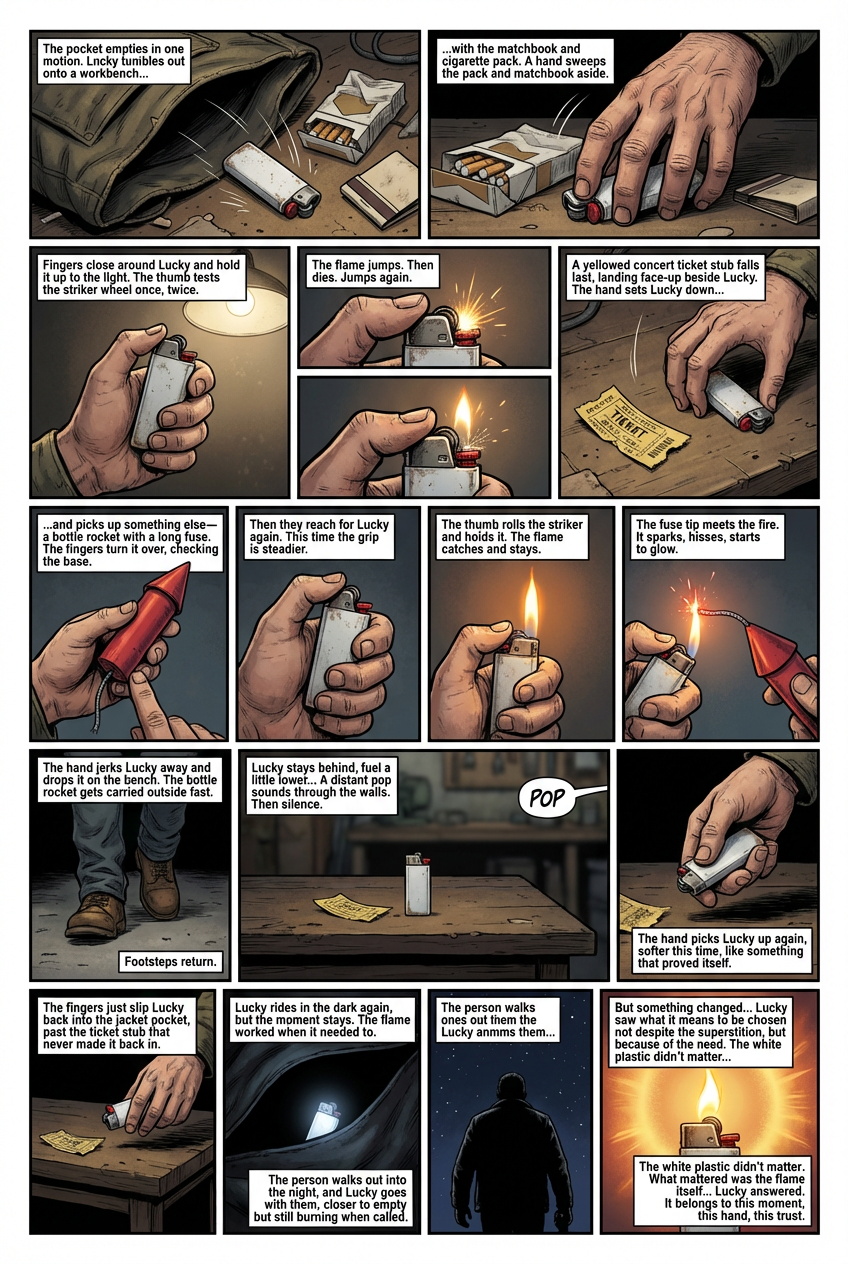
The pocket empties in one motion. Lucky tumbles out onto a workbench with the matchbook and cigarette pack. A hand sweeps the pack and matchbook aside. Fingers close around Lucky and hold it up to the light. The thumb tests the striker wheel once, twice. The flame jumps. Then dies. Jumps again. A yellowed concert ticket stub falls last, landing face-up beside Lucky. The hand sets Lucky down and picks up something else—a bottle rocket with a long fuse. The fingers turn it over, checking the base. Then they reach for Lucky again. This time the grip is steadier. The thumb rolls the striker and holds it. The flame catches and stays. The fuse tip meets the fire. It sparks, hisses, starts to glow. The hand jerks Lucky away and drops it on the bench. The bottle rocket gets carried outside fast. Lucky stays behind, fuel a little lower, waiting to see if the person comes back or if this is where the journey ends. A distant pop sounds through the walls. Then silence. Footsteps return. The hand picks Lucky up again, softer this time, like something that proved itself. The thumb doesn't test the wheel. The fingers just slip Lucky back into the jacket pocket, past the ticket stub that never made it back in. Lucky rides in the dark again, but the moment stays. The flame worked when it needed to. One more spark gathered, one more hand that trusted it despite the white plastic. The person walks out into the night, and Lucky goes with them, closer to empty but still burning when called. But something changed in that moment on the bench. When the fuse caught and the hand pulled away fast, Lucky saw what it means to be chosen not despite the superstition, but because of the need. The white plastic didn't matter. The old stories didn't matter. What mattered was the flame itself—whether it would come when called. Lucky answered. The bottle rocket flew. And now the person carries Lucky differently, not as a forgotten object but as a tool that works. The journey continues, but Lucky is no longer just passing through. It belongs to this moment, this hand, this trust.
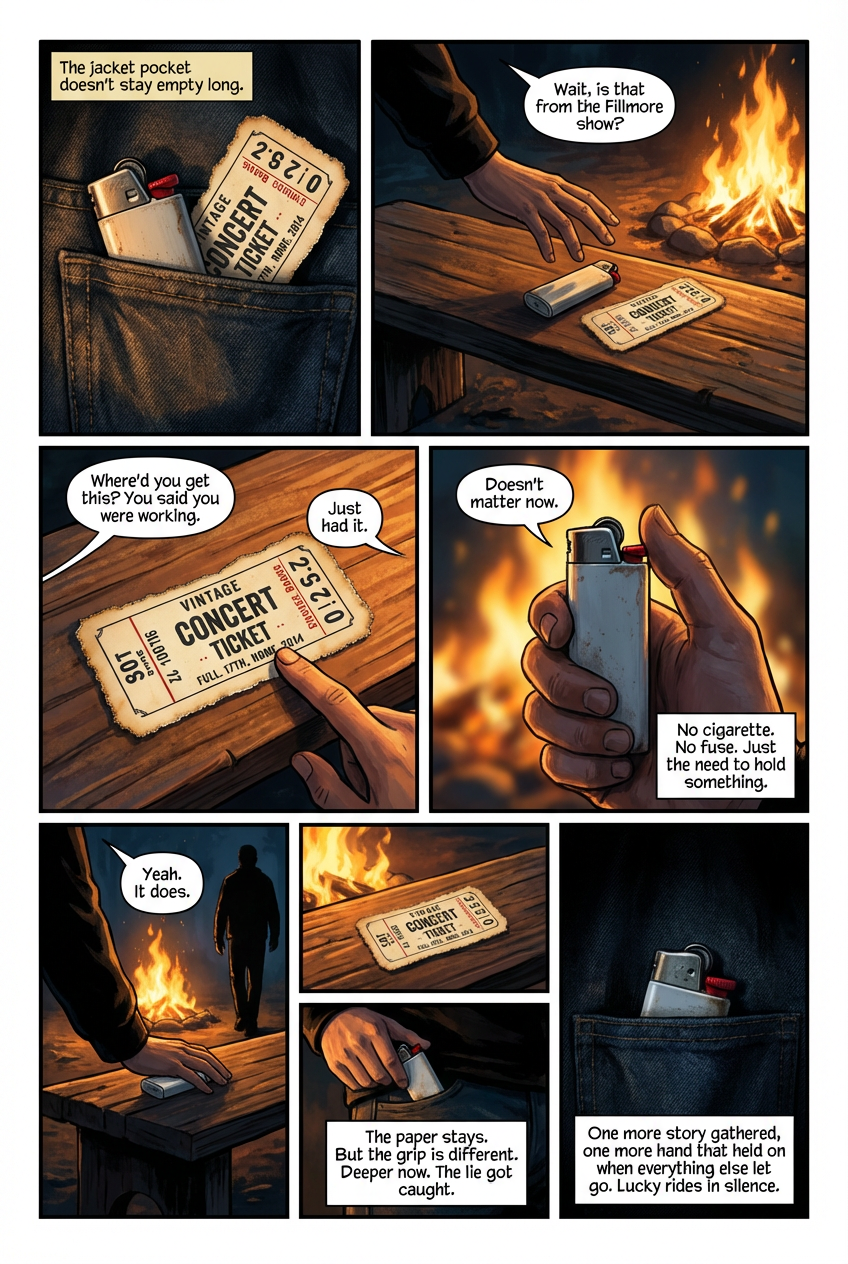
The jacket pocket doesn't stay empty long. Lucky rides against fabric and lint, pressed close to something else—paper, thin and stiff. The ticket stub. When the person sits down somewhere warm and pulls everything out again, both items land on a wooden surface together. A bonfire crackles nearby, throwing orange light across the folding chairs. Another person leans in, squinting at the stub. "Wait, is that from the Fillmore show?" The voice sharpens. "Where'd you get this?" The hand that held Lucky earlier goes still. "Just had it." The other person won't let it go. "You said you weren't there. You said you were working." Lucky sits between them, close enough to feel the heat from the fire and the cold weight of the silence. The first person reaches for Lucky, thumb on the striker, but stops. No cigarette. No fuse. Just the need to hold something. "Doesn't matter now," they say, but the words land wrong. The other person stands, steps back from the firelight. "Yeah. It does." They walk away into the dark, and the person sitting alone finally picks Lucky up, slips it back into the pocket without the ticket stub this time. The paper stays on the bench, lit by flames that ask questions Lucky can't answer. But Lucky felt it—the moment trust became doubt, the silence heavier than any flame it ever sparked. One more story gathered, one more hand that held on when everything else let go. The person sits alone now, and Lucky waits in the dark pocket, fuel lower than before, marked by a moment it witnessed but couldn't change. The bonfire keeps burning, but the conversation is over. The ticket stub proved what words couldn't hide, and Lucky moves forward with someone who chose to reach for it instead of the truth. But the grip feels different now. The person's fingers press harder around Lucky's edges, holding tight like it's the only solid thing left. A phone screen glows in the other hand, showing a photo—two people close together, caught in stage lights. The person stares at it, then locks the screen dark. They slip Lucky back into the pocket, deeper this time, past the empty space where the ticket stub used to be. Lucky rides in silence, but the weight is different. The lie got caught. The moment got witnessed. And Lucky was there when it all came apart, gathering one more truth that someone couldn't say out loud.
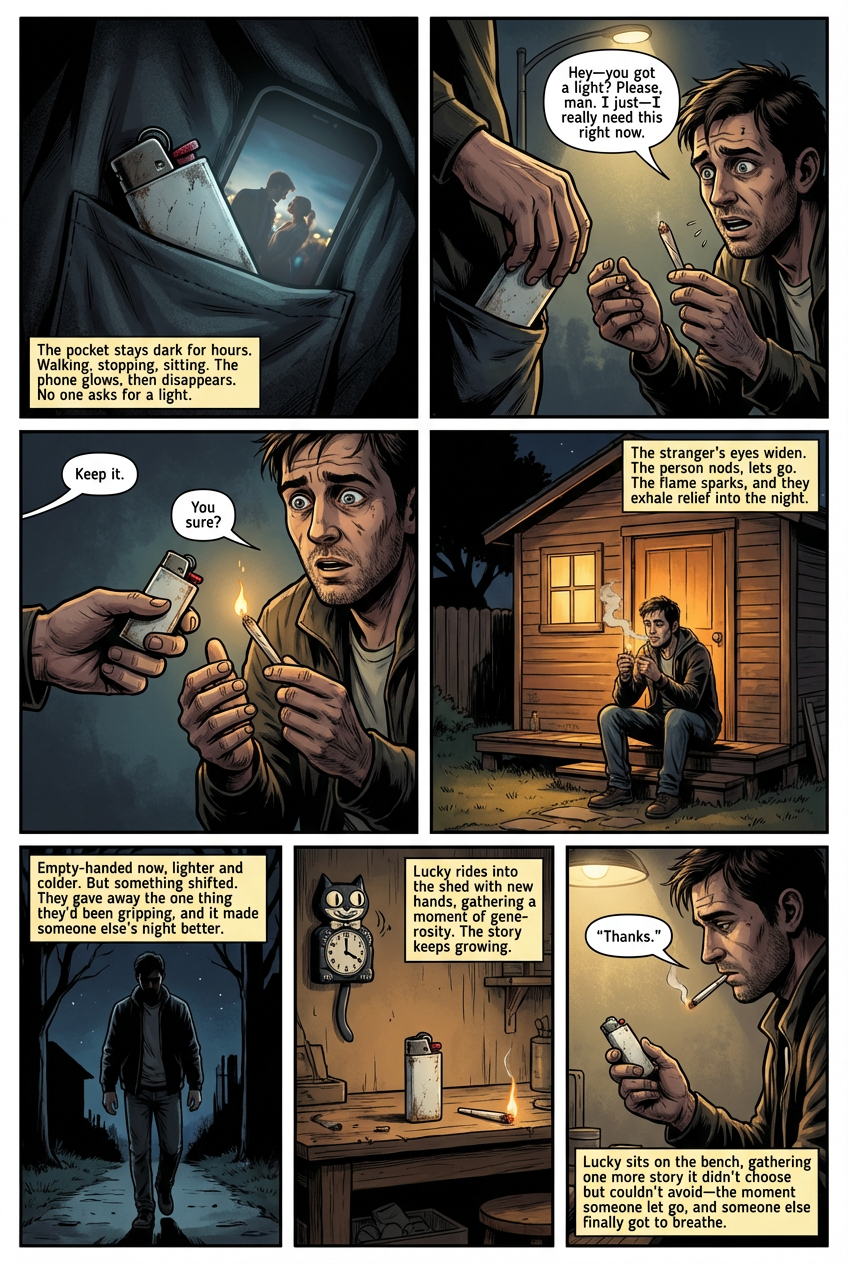
The pocket stays dark for hours. Lucky feels the person walking, stopping, sitting. The phone comes out twice, the screen glowing through fabric, then disappears again. No one asks for a light. No one reaches in. The person just keeps moving through the night like they're trying to walk off what happened. Then footsteps approach fast. A voice cuts through the quiet. "Hey—you got a light?" The words come rushed, tight with need. The person hesitates, then pulls Lucky out. A stranger stands close, holding something thin and hand-rolled, twisted at both ends. Their hands shake. "Please, man. I just—I really need this right now." The person with Lucky looks at the joint, then at the stranger's face. Something in that desperate expression mirrors what they've been carrying all night. They hold Lucky out. "Keep it," they say. The stranger's eyes widen. "You sure?" The person nods, lets go. They watch the stranger walk toward a small shed in the backyard, light glowing through its open door. The flame sparks inside, and the stranger sits on the wooden step, exhaling relief into the night air. The person stands empty-handed now, lighter and colder without Lucky's weight in their pocket. But something shifted when they stopped holding on. They gave away the one thing they'd been gripping since the lie broke open, and it didn't make the night worse. It made someone else's better. Lucky rides into the shed with new hands, gathering a moment of generosity born from pain. The fuel burns lower with each spark, but the story keeps growing—one more hand that needed it, one more night it couldn't wait until morning. Inside the shed, the stranger sets Lucky on a workbench beneath a cat-shaped clock on the wall, its painted eyes watching everything below. The joint burns slow and steady. The stranger finally stops shaking. They pick Lucky up again, turn it over in their palm, study the white plastic with all its scratches and soot marks. "Thanks," they whisper to no one, to everyone who touched it before. Lucky has moved from pocket to pocket, hand to hand, always temporary. But right now, in this moment, it gave someone exactly what they couldn't wait until morning to find. The clock's tail swings back and forth. The joint burns down to nothing. And Lucky sits on the bench, gathering one more story it didn't choose but couldn't avoid—the moment someone let go of what they were holding, and someone else finally got to breathe.
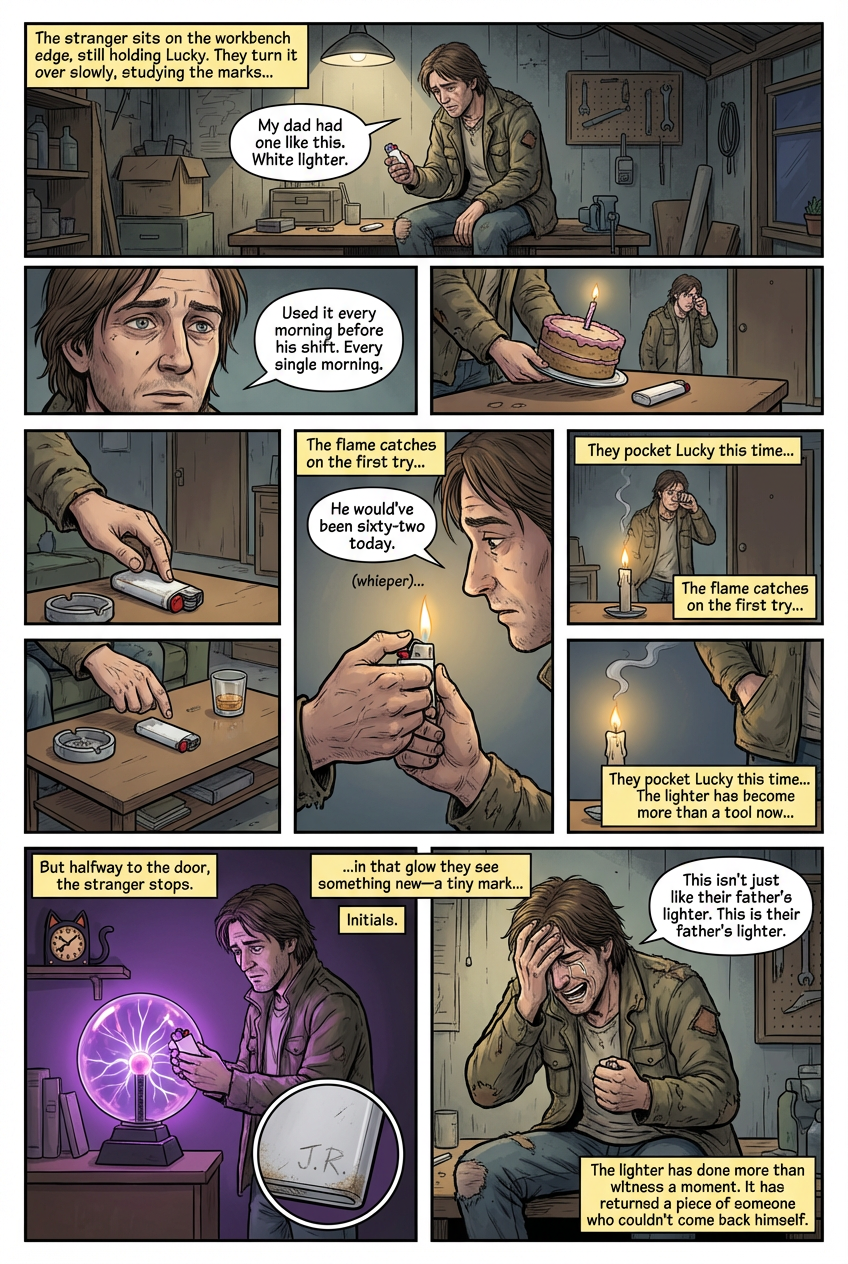
The stranger sits on the workbench edge, still holding Lucky. They turn it over slowly, studying the marks on the white plastic. A deep scratch runs across one side. Dark soot stains the hood. One corner looks melted, warped from a flame held too long. Their thumb brushes over the scratch, and something shifts behind their eyes. They set Lucky down on the coffee table between an ashtray and an empty glass. "My dad had one like this," they say to the empty shed. "White lighter. He kept it in his work jacket." They stare at Lucky like it might answer back. "Used it every morning before his shift. Every single morning." Their voice cracks on the last word. They pick Lucky up again, hold it tight in their palm, then set it down gently—not like trash, like something that matters. The stranger stands, wipes their eyes, and leaves Lucky on the table. But they leave it facing the door, not pushed to the side. Not forgotten. Lucky has gathered another moment now: the memory of someone else's hands, someone else's mornings, called back by worn plastic and soot. The stranger walks to the far shelf and pulls down a small birthday cake, homemade and lopsided, with a single candle stuck in the center. They bring it back to the table and set it beside Lucky. Their hands shake as they pick up the lighter again. "He would've been sixty-two today," they whisper. The flame catches on the first try, steady and small. They touch it to the candle wick and watch it bloom into light. Then they close their eyes, say something too quiet to hear, and blow it out. The smoke curls up between them. They pocket Lucky this time, not leaving it behind. The lighter has become more than a tool now—it's carried a memory forward, sparked a ritual that needed completing. Lucky has witnessed what it came here for: a moment of grief turned into something deliberate, something honored. The stranger leaves the shed with Lucky pressed against their chest, and the cake sits in the dark with its wish already made. But halfway to the door, the stranger stops. They pull Lucky out again and hold it under the plasma ball on the shelf. Purple light dances across the white plastic, and in that glow they see something new—a tiny mark near the bottom edge, barely visible. Letters scratched in crooked and small. Initials. The stranger's breath catches. They trace the letters with one finger, then check their phone's flashlight to be sure. The marks are old, worn almost smooth, but they're there. J.R. The same initials their father carved into everything he owned. Tools. Lunchboxes. Work boots. The stranger closes their fist around Lucky and sits back down hard on the workbench. This isn't just like their father's lighter. This is their father's lighter. Lost years ago, passed through a dozen hands, finally finding its way back on the day it mattered most. They don't leave the shed right away. They sit with Lucky in their palm, crying and laughing at the same time, holding proof that some things circle back when you need them to. The lighter has done more than witness a moment. It has returned a piece of someone who couldn't come back himself.
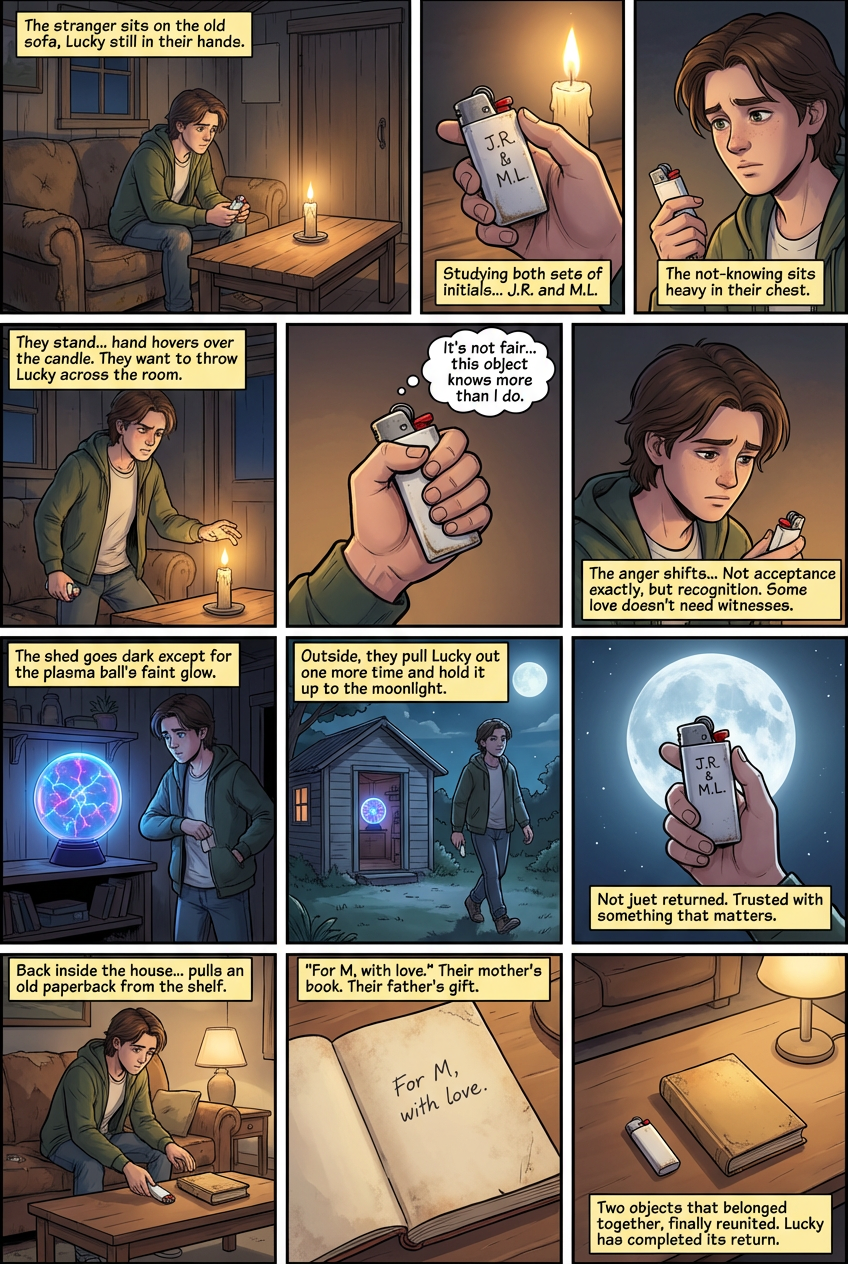
The stranger sits on the old sofa pushed against the shed's back wall, Lucky still in their hands. They turn it over again and again, studying both sets of initials under the candlelight. J.R. and M.L. Their father must have carved his own initials first, then added hers later. Or maybe she carved hers while he wasn't looking. The stranger will never know which. They realize they're looking for an answer that doesn't exist anymore, a story no one's left to tell. The not-knowing sits heavy in their chest. They stand and walk to the shelf, then stop. Their hand hovers over the candle. They want to throw Lucky across the room, watch it shatter against the wall. It's not fair that this object knows more about their parents' marriage than they do. That a cheap plastic lighter held a secret their father never shared. But their fingers won't let go. Instead, they grip it tighter, feeling the grooves of both names under their thumb. The anger shifts into something else—not acceptance exactly, but recognition. Some things stay private even after death. Some love doesn't need witnesses. The stranger pockets Lucky and blows out the candle. The shed goes dark except for the plasma ball's faint glow. They leave without the birthday cake, without looking back. Outside, they pull Lucky out one more time and hold it up to the moonlight. Two sets of initials. Two people who loved each other enough to mark the same small object. The stranger doesn't know their whole story, but they know this much: their parents wanted to be remembered together. Lucky has shown them that. They put the lighter back in their pocket, but this time it feels different. Not just returned. Trusted with something that matters. Back inside the house, the stranger sets Lucky on the coffee table and pulls an old paperback from the shelf. The cover is worn, the spine cracked from years of reading. Inside the front cover, written in faded ink: For M, with love. The handwriting matches the initials on Lucky. Their mother's book. Their father's gift. The stranger closes it gently and places it beside the lighter. Two objects that belonged together, finally reunited. They don't need to understand the whole story anymore. They just need to keep these pieces safe. Lucky has completed its return—not just to the stranger, but to the memory of two people who carved their names into something small enough to carry everywhere.
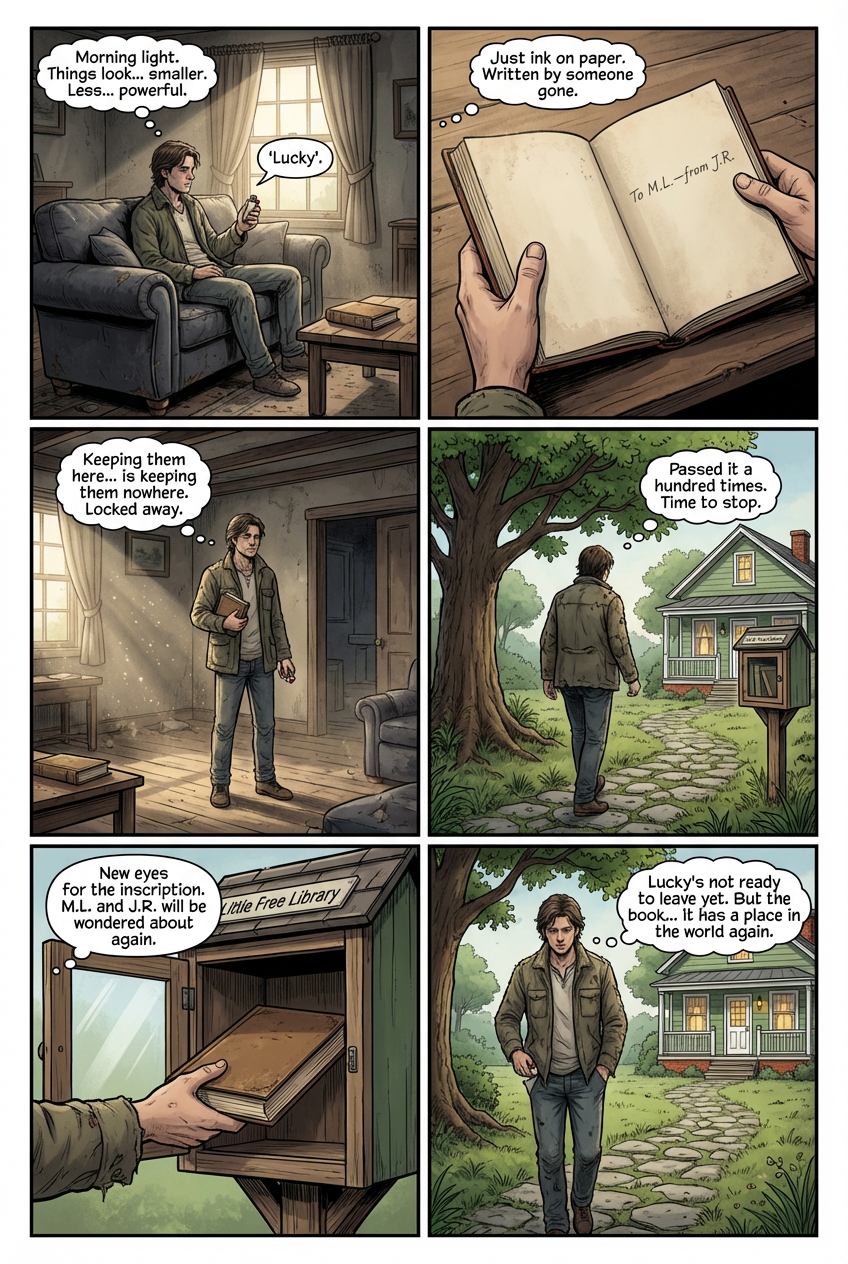
The stranger wakes on the couch the next morning with Lucky in their pocket and the book on the table beside them. They sit up slowly, rubbing their eyes. The objects look strange in daylight—smaller somehow, less powerful than they seemed last night. They pick up the hardcover and open it to the inscription. To M.L.—from J.R. The handwriting looks different in the morning light. Less like a message from beyond and more like what it is: ink on paper, written by someone who's gone. The stranger closes the book and looks around the cottage. Dust on every surface. Curtains drawn. No one has lived here in years, and no one will again. They realize that keeping Lucky and the book here means keeping them nowhere—objects that mattered to two people, locked away where no one will see them. The stranger stands and walks to the door, both items in hand. Outside, past the elm tree at the edge of the property, they can see the Little Free Library on the corner. They've passed it a hundred times without stopping. The stranger walks down the overgrown path, opens the small door, and places the book inside. The inscription will find new eyes now. Someone will read it and wonder about M.L. and J.R., the way the stranger wondered. Lucky stays in their pocket—that one's not ready to leave yet. But the book has a place in the world again. The stranger closes the library door and heads back to the cottage, lighter in one pocket, space where the book used to be in the other.
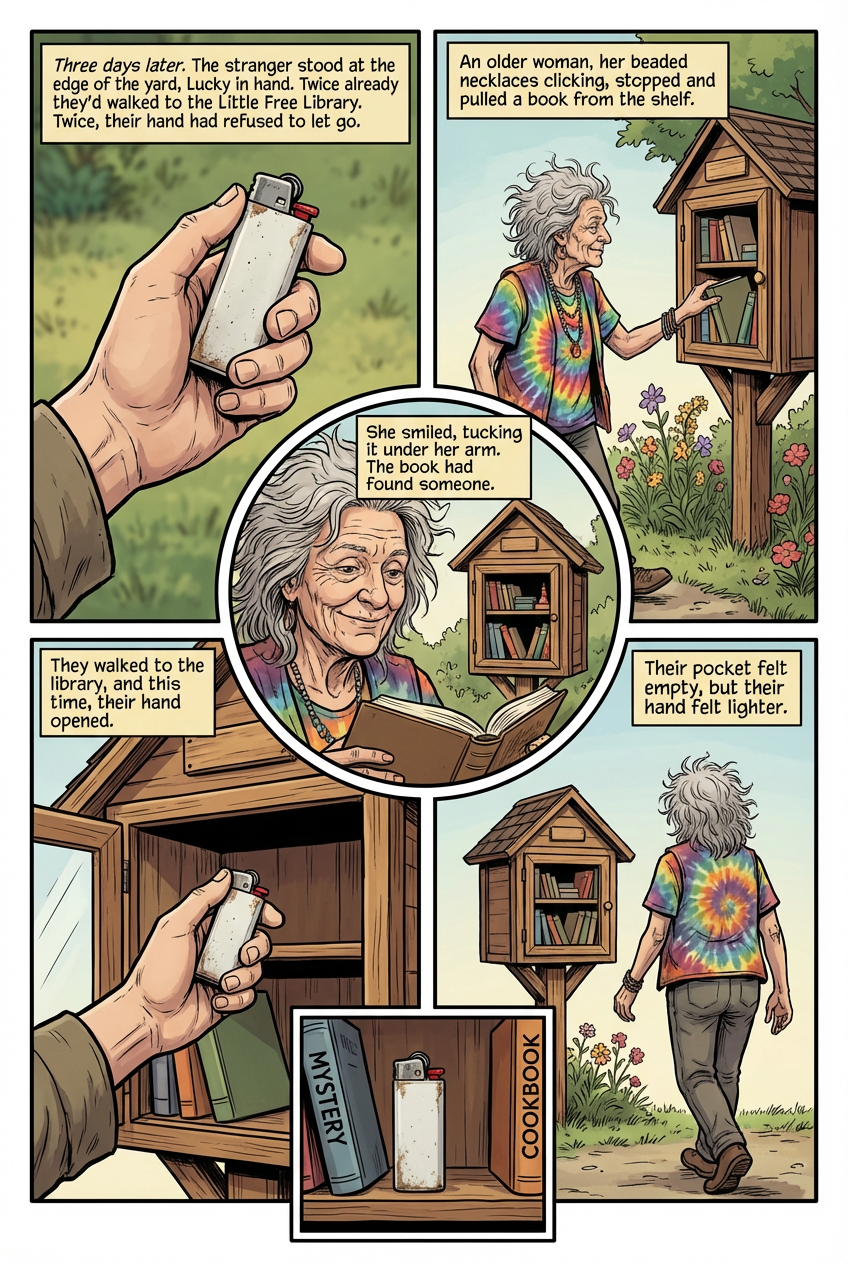
The stranger stands at the edge of the yard three days later, Lucky in hand. They've walked to the Little Free Library twice already this morning. Each time they opened the door, positioned the lighter on the shelf, and closed their fingers around it to let go. Each time their hand stayed shut. An older woman in a tie-dyed vest walks past the library, gray hair wild, beaded necklaces clicking with each step. She stops and pulls a book from the shelf—the one with the inscription. The stranger watches from the yard as the woman flips it open, reads the first page, smiles. She tucks it under her arm and walks away. The stranger looks down at Lucky. The book found someone. The lighter can too. They walk to the library, open the door, and this time their hand opens with it. Lucky sits on the shelf between a mystery novel and a cookbook. The stranger closes the door and steps back. Their pocket feels empty, but their hand feels lighter.
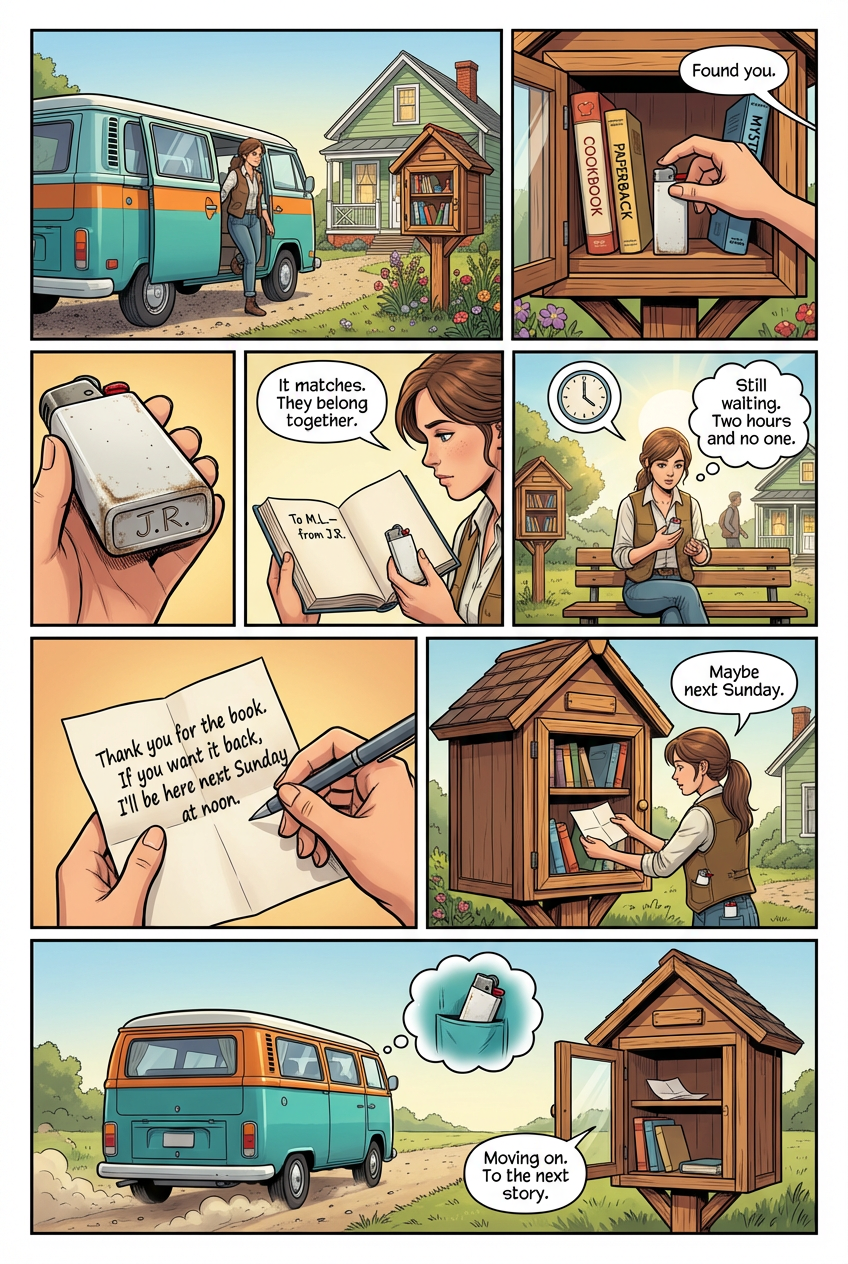
The woman with the book comes back the next morning. She parks the turquoise and orange van near the cottage and walks straight to the Little Free Library. Lucky sits on the shelf between a cookbook and a paperback mystery. The woman opens the door and reaches past both books. Her fingers close around the white plastic. She turns it over until she finds the initials carved on the bottom. J.R. Her other hand pulls the book from her bag. She opens to the inscription—To M.L.—from J.R.—and holds the lighter next to the page. The handwriting matches. She closes the book and sits on the wooden bench. She waits there for two hours. A few people walk past. No one stops. The woman keeps the lighter in her palm, turning it over and over. She doesn't know who left these things or why. She only knows they belonged together once. The morning gets warmer. She stands and looks at the cottage, then at the library, then back at the van. No one appears. She puts the lighter in her vest pocket next to the book. Before she leaves, she walks to the library one more time. She takes a pen from her bag and writes something on a scrap of paper. She folds it and puts it on the shelf where Lucky was. The note says: Thank you for the book. If you want it back, I'll be here next Sunday at noon. She closes the door and gets in the van. The engine starts and she drives away. Lucky goes with her. The shelf holds only books and the folded note. Lucky has passed to someone who searched for its story. The lighter won't be there Sunday when the stranger comes to check. But the note will be. And that meeting—whether it happens or not—belongs to them now. Lucky is already somewhere else, gathering another moment.
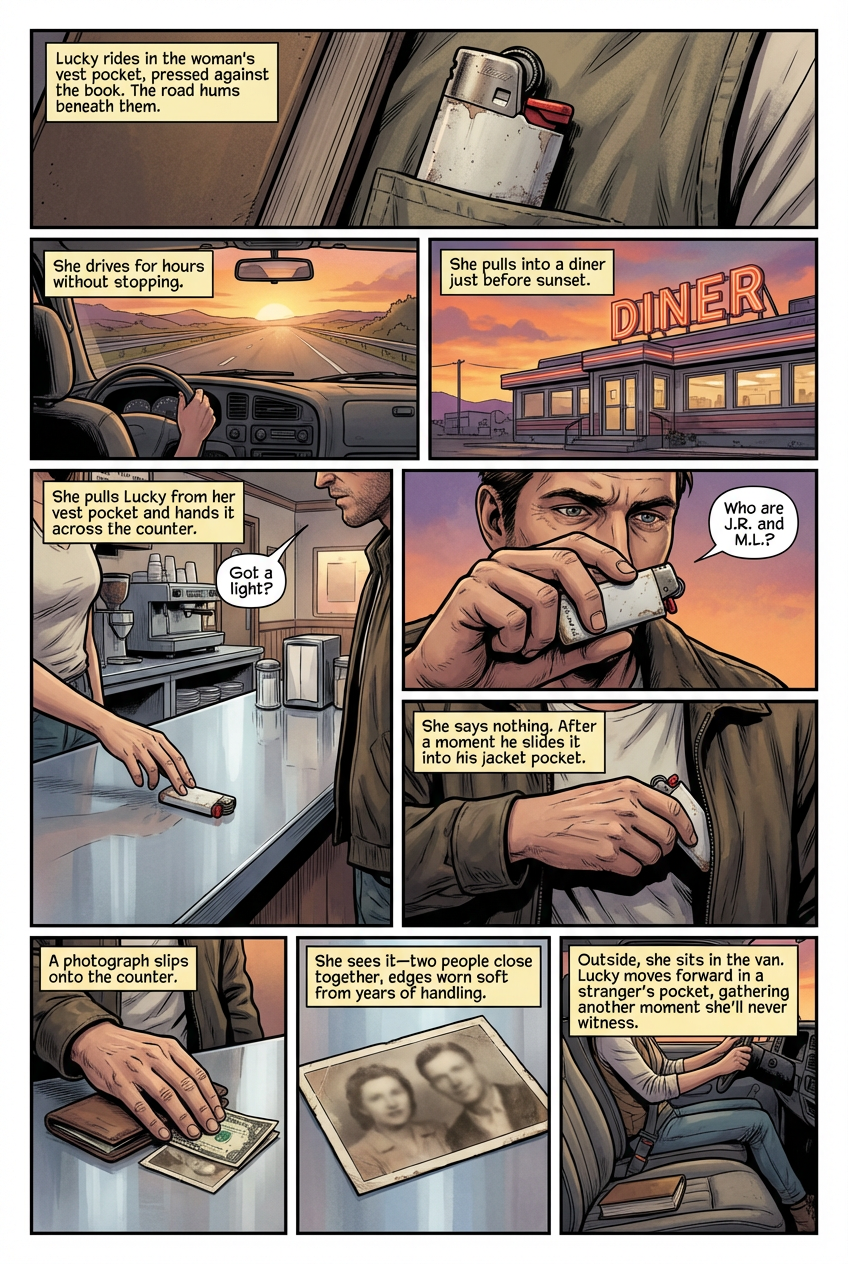
The van smells like coffee and old vinyl. Lucky rides in the woman's vest pocket, pressed against the book. The road hums beneath them. She drives for hours without stopping, one hand on the wheel and the other resting near her pocket. She pulls into a diner just before sunset. The steel counter gleams under fluorescent lights. She sits on a red stool and orders coffee. A man two seats down asks if she has a light. She pulls Lucky from her vest pocket and hands it across the counter. He looks at the white plastic and turns it over. His eyes catch on something at the base. Who are J.R. and M.L., he asks. She watches him wait for an answer. She says nothing. He studies her face, then the lighter again. After a moment he slides it into his jacket pocket without asking again. The man stands and pulls out his wallet to pay. A photograph slips onto the counter. He picks it up quickly but she sees it—two people close together, edges worn soft from years of handling. He tucks it back behind his bills and leaves a five on the counter. She understands now why he asked. He wanted to know if the initials matched something he carried. She'll never know if they did. Outside, she sits in the van with her hands on the wheel. The book feels lighter now without the object beside it. She kept searching for a story that would make sense of the initials, but the lighter found someone else who needed it more. She pulls onto the highway carrying only what she chose—the book, the question, and the quiet knowledge that some things aren't hers to solve. Lucky moves forward in a stranger's pocket, gathering another moment she'll never witness.
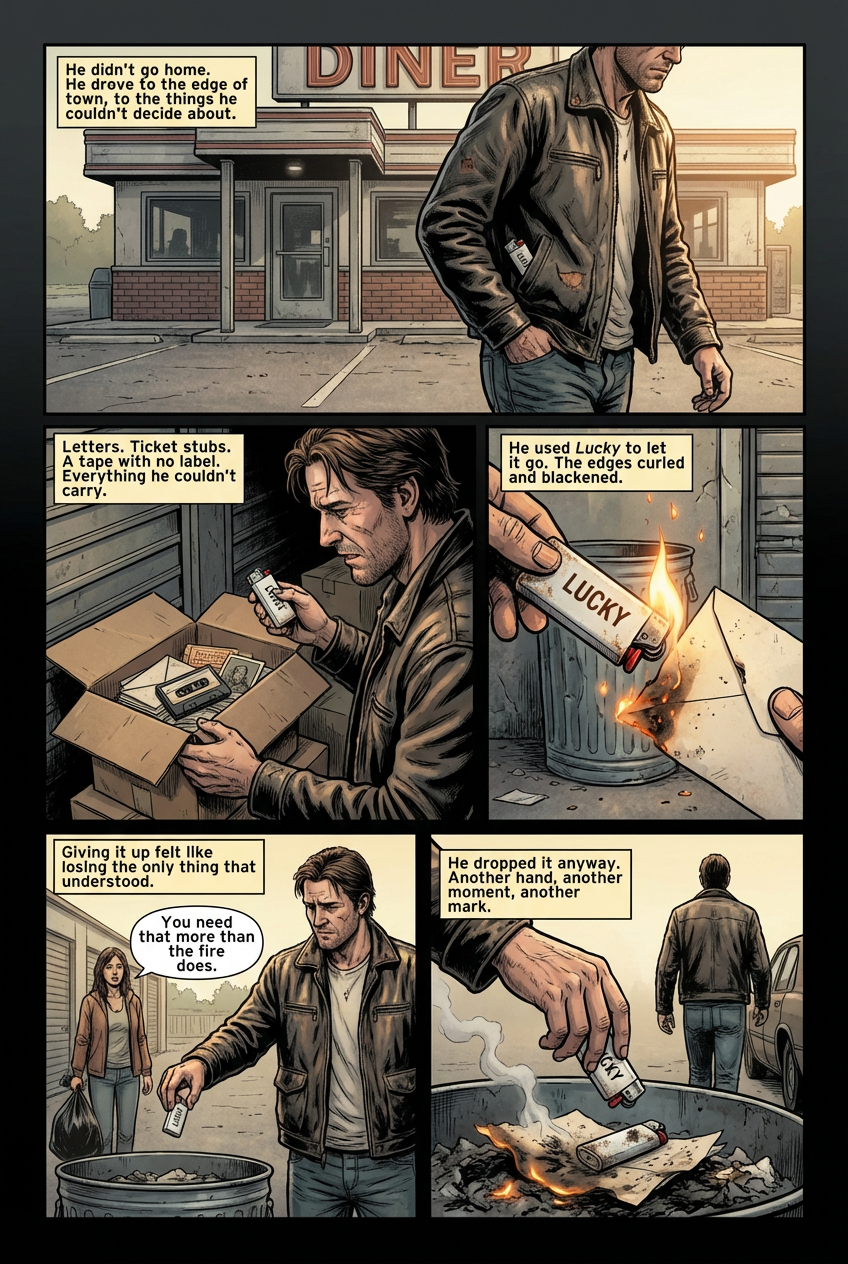
The man walks out of the diner with Lucky in his jacket pocket. He doesn't go home. Instead he drives to a place he's been avoiding for weeks—a storage unit on the edge of town where everything he can't decide about waits in cardboard boxes. He pulls one box from the stack and carries it outside. Inside are letters, ticket stubs, a cassette tape with no label, photographs he can't look at anymore. He sets the box on the ground beside a dented metal bin and strikes Lucky's wheel. The flame catches on the corner of an envelope. He feeds the rest in slowly—each letter, each photograph—watching the edges curl and blacken. The fire takes everything he can't fit in the sedan parked behind him. When the last piece turns to ash, he tries to drop Lucky into the bin on top of the embers. His hand stops. The lighter helped him let go of what he couldn't carry—giving it up feels like losing the only thing that understood. He stands there holding Lucky above the smoking ash, unable to release it. A woman walks past carrying a garbage bag to the dumpster nearby. She stops when she sees him frozen there. You need that more than the fire does, she says. He shakes his head and drops Lucky into the bin anyway. The white plastic lands on the hot metal with a quiet click. He climbs into his car and drives toward the highway without looking back. The woman waits until his taillights disappear, then reaches into the bin and pulls Lucky from the cooling ash. The plastic is warm but intact. She wipes the soot on her jeans and slips it into her pocket—another hand, another moment, another mark.
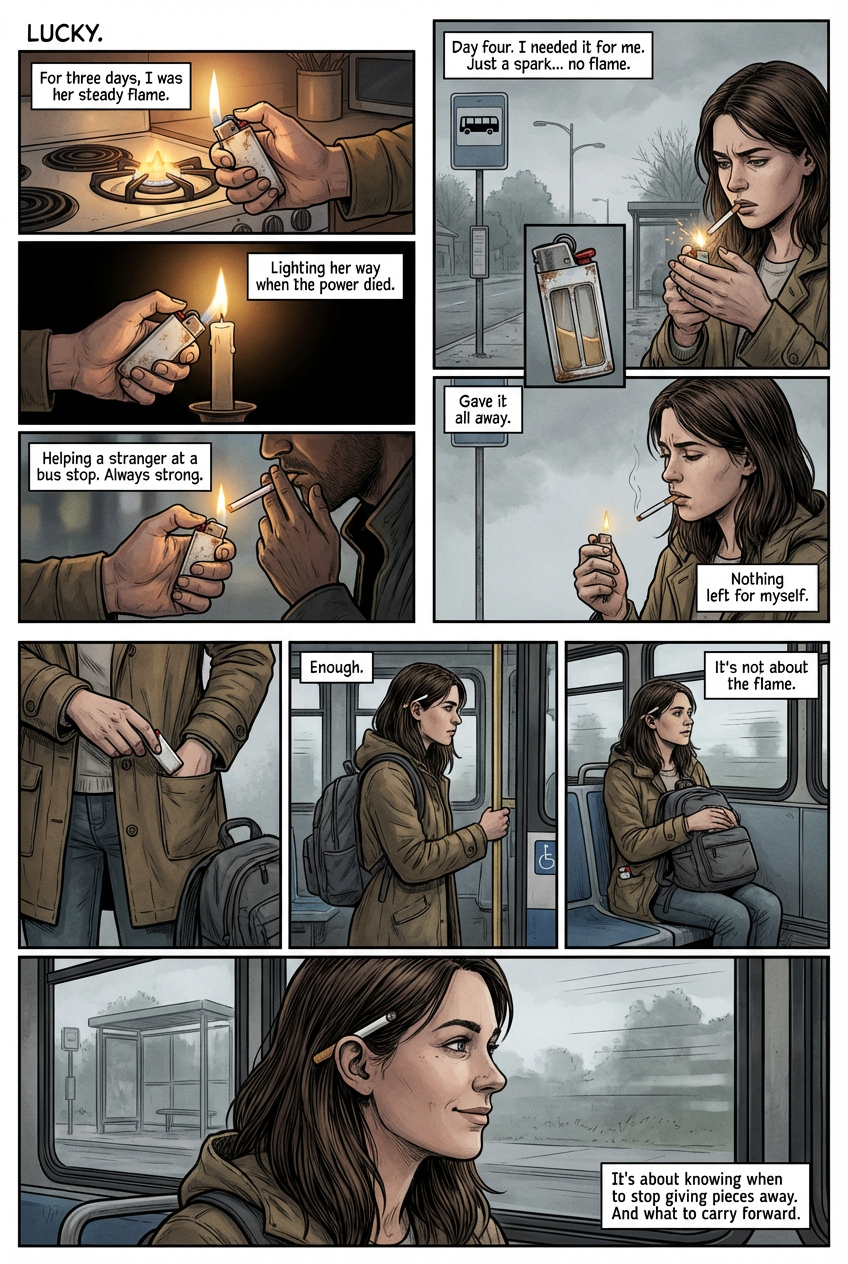
The woman carries Lucky in her coat pocket for three days. She uses it to light her stove when the pilot goes out. She uses it to light a candle during a power outage. She uses it at a bus stop to help a stranger with a cigarette who thanks her and walks away. Each time the flame catches steady and strong. On the fourth day she stands outside the glass shelter at a different bus stop, waiting. A cigarette hangs between her fingers, unlit. She thumbs Lucky's wheel once. It sparks but nothing catches. She tries again—same result. The wheel grinds and the spark flies but the flame won't come. She holds the lighter up to the gray afternoon light and sees the fuel window is almost clear. Nearly empty. She tries one more time and gets a weak flicker that dies before it reaches the cigarette. The lighter has given everything it had to strangers and stoves and candles and one last bonfire of someone else's past. Now when she needs it for herself, there's barely anything left. She drops Lucky back into her pocket and tucks the cigarette behind her ear. Her backpack sits at her feet, packed with everything she owns. The bus pulls up and the doors hiss open. She picks up the bag and climbs the steps without looking back. Inside she finds a seat near the window and sets the backpack on her lap. Lucky rests in her pocket—almost empty but still sparking. She decides that's enough. She doesn't need the flame for herself. She needs to know when to stop giving pieces away before there's nothing left to carry forward. The bus pulls onto the highway and she watches the shelter disappear behind her, the unlit cigarette still tucked behind her ear like a promise she's choosing not to keep.
Play your story to life
Storycraft is a mobile game where you create AI characters, craft items and locations to build their world, then discover what direction your story takes. Download the iOS game for free today!
Download for free