

Lyra Thornwing's Arc
3 Chapters
Lyra Thornwing's dream is being named royal keeper of magical creatures for the fairy court..

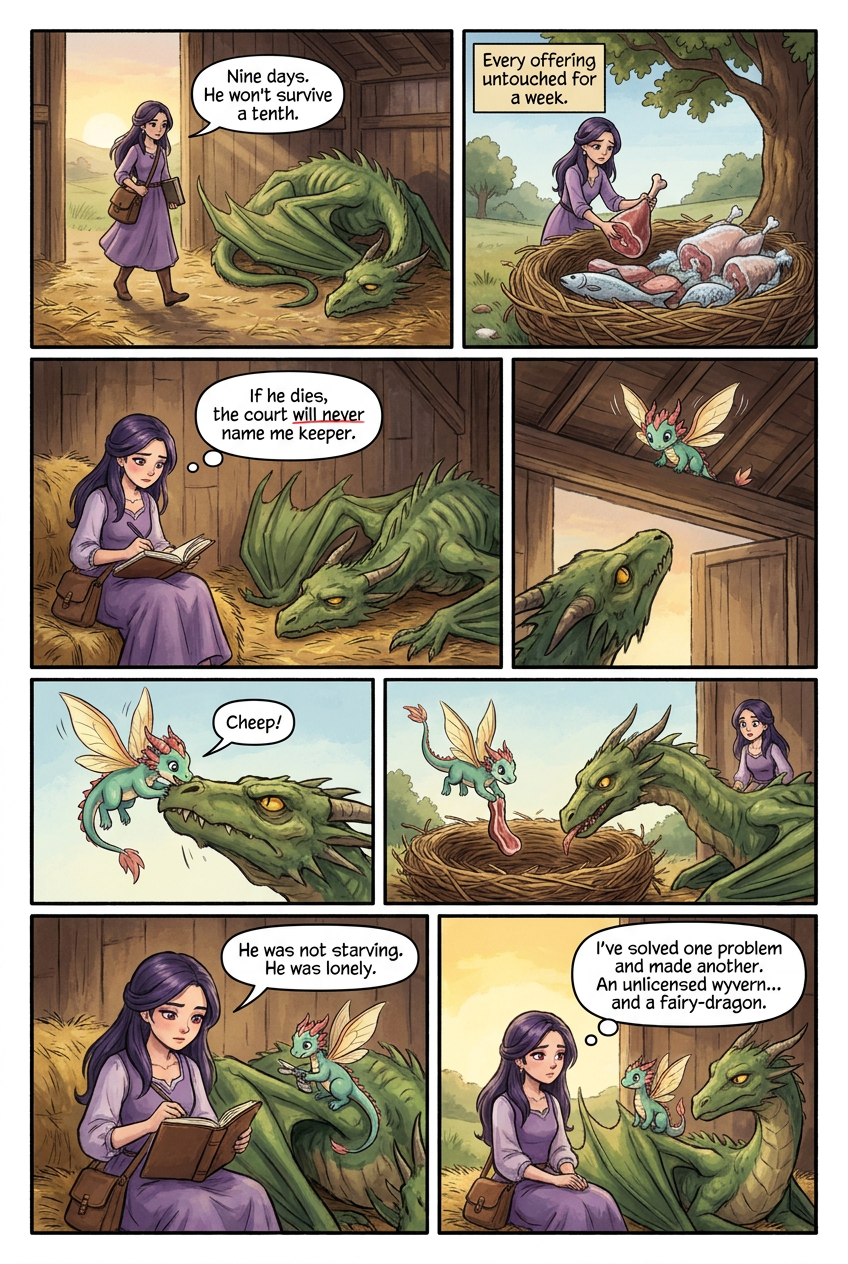
The wyvern had not eaten in nine days, and Lyra Thornwing knew he would not survive a tenth. She crossed the yard at dawn with her journal tucked under one arm and a satchel of fresh goat meat over her shoulder. The little barn she had built for him sat beside her cottage, its door propped open so he could leave if he chose. He never chose. He lay curled in the straw, ribs sharp beneath green scales, watching her with the flat gold eyes of an animal who had decided to die. Lyra set the meat in the woven nest outside his door, where she had laid every offering for a week. Rabbit. River fish. Honeyed lamb. The nest was broad enough for a gryphon and shaded by the oak, and each morning she found the food untouched and stiff with frost. She opened her journal and wrote the date, the weather, the refused meal. Nine days. Beneath that she wrote the sentence she had been avoiding: If he dies, the court will never name me keeper. She struck it through. It was the wrong reason to save him, and she knew it. She sat in the straw beside the wyvern and opened the journal to older pages. Her notes on the female she had released two summers ago. A moon-serpent who had refused water in captivity and drunk from the river the moment Lyra unlatched the crate. She had written then: Some creatures sicken from the walls, not the wound. Lyra looked at the propped door. Looked at the wyvern. He was not caged. He could walk out. He had not. A rustle came from the rafters. Lyra glanced up and found a baby fairy-dragon peering down at her, wings twitching, eyes bright with the kind of hunger the wyvern had lost. The small creature had been living in her barn for weeks, stealing scraps. Lyra had let her stay. Now the fairy-dragon dropped to the straw, waddled to the wyvern's snout, and bit his lip. The wyvern flinched. He had not moved in two days. The fairy-dragon bit him again, then scampered to the nest outside, tore a strip of goat meat, and dragged it back through the door. She dropped it in front of him. She waited. The wyvern lowered his head and ate. Lyra did not move until he had swallowed three strips. Then she wrote in the journal, slowly, in a hand that shook: He was not starving. He was lonely. She closed the book. The fairy-dragon climbed onto the wyvern's shoulder and began grooming a torn scale. Lyra understood, sitting in the straw with two creatures who had chosen each other, that she had solved one problem and made another. The court would not name a keeper who kept a wyvern and an unlicensed fairy-dragon. She would have to decide which truth to tell them.
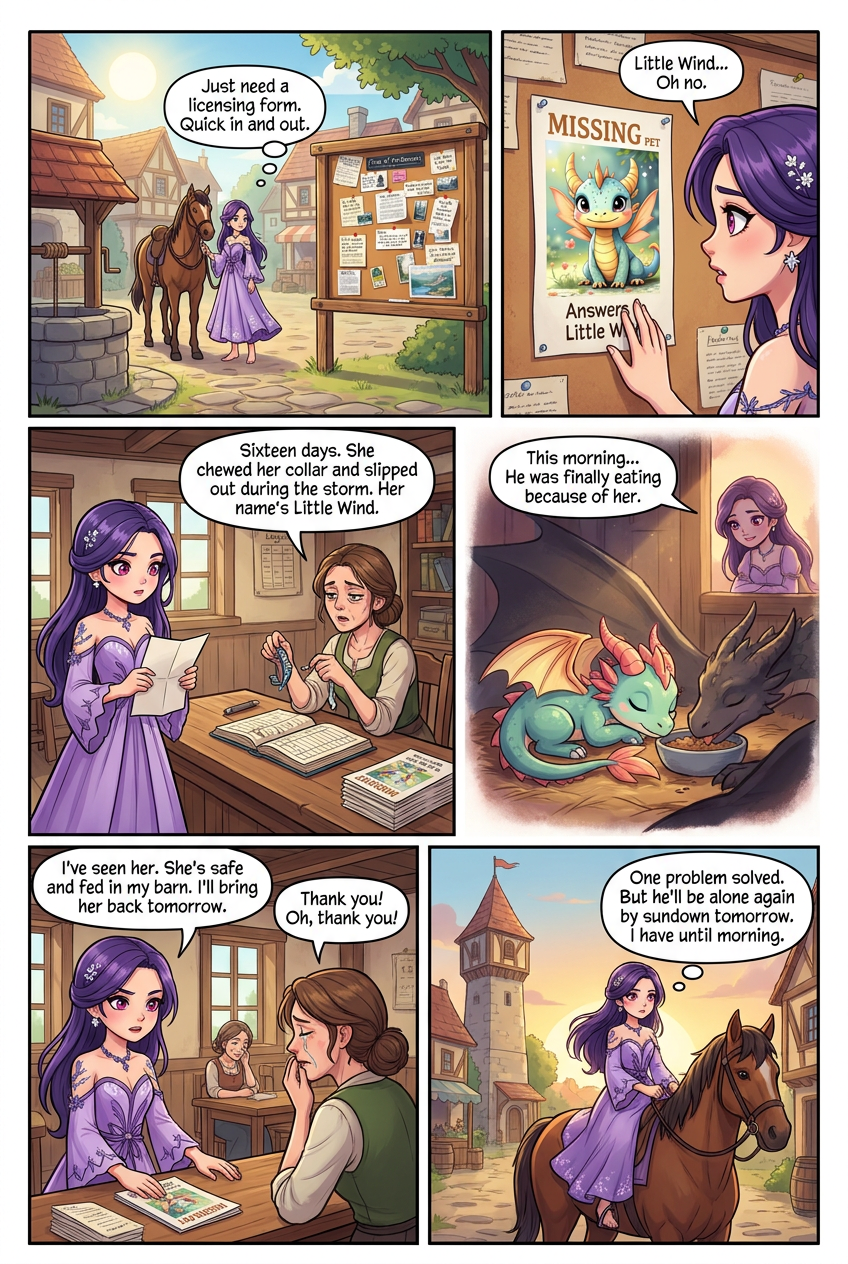
Lyra rode into the market village at midday, hoping to buy a licensing form and read it in private before she chose which creature to declare. She tied her horse near the well and walked toward the clerk's office. She did not reach it. A notice board stood at the crossroads, and a fresh flyer had been pinned dead center. A cheerful drawing of a fairy-dragon smiled out at her. The word MISSING ran across the top in thick brown letters. Below it: Answers to Little Wind. Reward offered. Inquire at the tavern past the mill. Lyra took the flyer down, folded it small, and put it in her pocket. She knew the tavern. She had passed it that morning without noticing the new sign hung above the door, or the pens visible through the side yard fence. Someone had turned the place into a shelter for strays and lost pets. A tower rose off the back for flyers. She could hear a goat bleating from inside. She walked there because pretending she had not seen the flyer would be worse than knowing. Inside the tavern a woman sat at a long table with a stack of the same flyers and a ledger open beside her. She had the tired eyes of someone who had been asking the same question in every village for a week. She looked up when Lyra came in. Lyra did not sit. She asked how long the fairy-dragon had been missing. Sixteen days, the woman said. She lifted a small painted collar from the table. Little Wind had chewed through it and slipped the yard during a storm. The woman turned the collar so Lyra could see the name stitched inside. Lyra thought of the baby fairy-dragon curled against the wyvern's shoulder that morning, grooming a scale she had already cleaned twice. She thought of the wyvern eating for the first time in nine days because that small creature had bitten his lip. She thought of the keeper's post, and the license she did not have, and the moon-serpent she had once carried to the river. She set the folded flyer on the table. She said she had seen the fairy-dragon in her barn. She said the creature was well, and fed, and she would bring her back the next morning. The woman began to cry, and thanked her, and offered the reward. Lyra refused the coin. She rode home with the flyer still in her pocket and one problem gone and another sharpened to a point. The wyvern would be alone again by sundown tomorrow. He had eaten because of the fairy-dragon, not because of her. She had until morning to find another way to keep him eating, or she would lose him after all, and with him the post she had not yet told anyone she wanted.
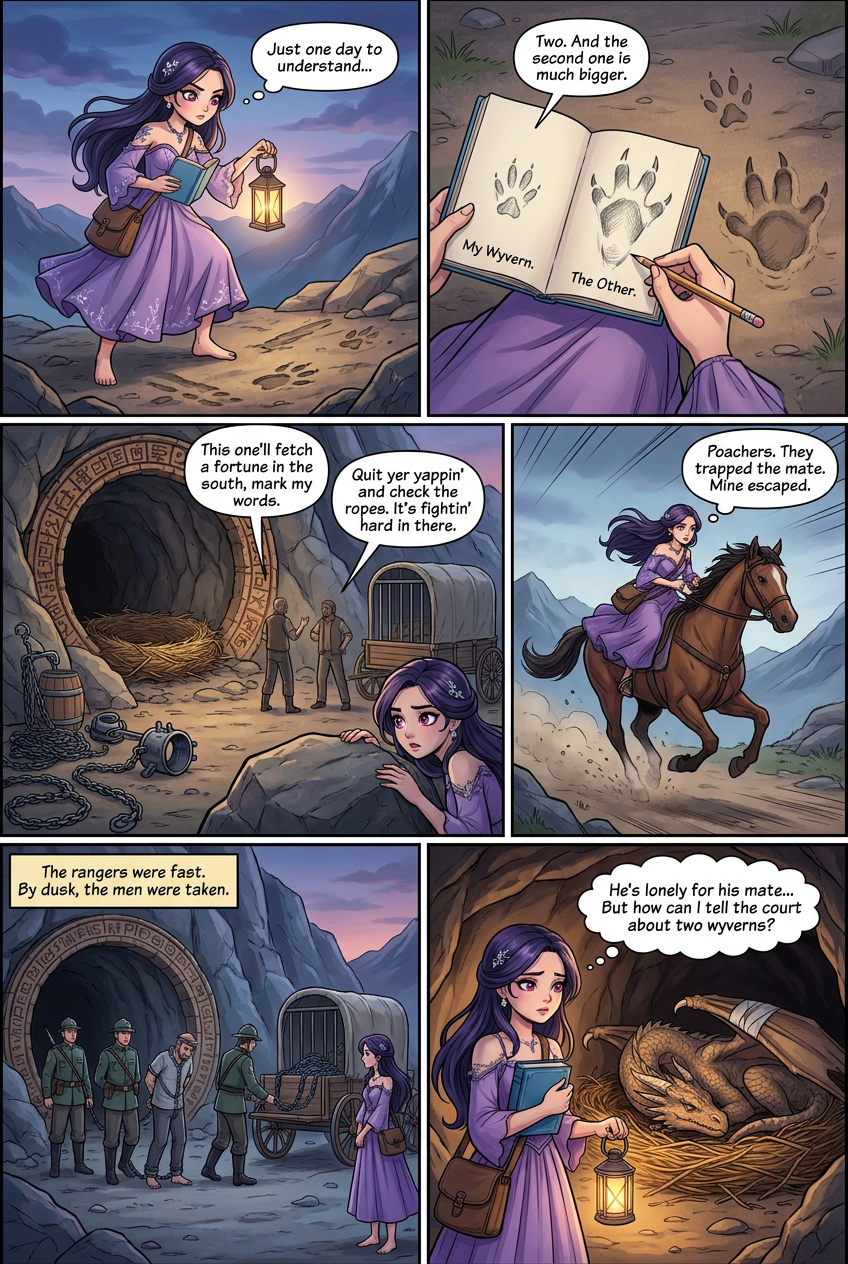
Lyra left the barn before dawn with a small blue diary in her satchel and a lantern in her hand. She had one day to learn what else might keep the wyvern eating once the fairy-dragon was gone. She rode to the ridge where she had first found him, half-starved among the rocks. She meant to read the ground again, slower this time, and write down anything she had missed. She found the old scuff marks near the fallen pine and knelt. Then she saw the second print. It sat a pace off from the first, deeper in the heel, wider across the toe pads. She opened the diary and sketched both tracks side by side. One was her wyvern. The other was larger. She followed the second trail up the slope, past a snarl of blackened wood where sap had eaten the bark from the inside. Venom stains dotted the twigs. Something had fought here, or bled here, and not long ago. The trail climbed for an hour and ended at a cave mouth ringed by old carved stone. The markings were half-eaten by weather, but she knew them from her books. A wyvern had claimed this place long before her wyvern was hatched. She crouched behind a boulder and listened. Voices. Two men, low and careful, arguing about rope length and the price a live wyvern would fetch in the southern markets. She saw their gear stacked by the entrance: chains, a muzzle, a covered cage on a cart. She understood then. The fight on the ridge had not been between two wild wyverns. It had been men trying to net the pair. The larger one, the mate, was still inside the cave, cornered. Her wyvern was the one who had broken free and dragged himself down the mountain to her fields. She wrote it in the diary in three quick lines. Then she backed down the slope, mounted her horse, and rode hard for the nearest ranger post. She named the poachers' location, the cart, the chains. She said a protected creature was inside. The ranger sent three riders within the hour. By dusk the men were in irons and the cave was quiet. Lyra stood at the entrance and looked in. The larger wyvern lay in a woven mass of branches at the back, breathing shallow, one wing torn. It was not a nest she could move. She could not bring this creature to her barn, and it could not survive alone in the state the poachers had left it. She closed the diary against her chest. Her wyvern was not lonely for a fairy-dragon. He was lonely for the mate still bleeding on the cave floor, and she had until morning to decide what to tell the court about two wyverns instead of one.
Play your story to life
Storycraft is a mobile game where you create AI characters, craft items and locations to build their world, then discover what direction your story takes. Download the iOS game for free today!
Download for free