

Maple Jack's Arc
14 Chapters
Maple Jack's dream is releasing enough red sparks to share every Canadian story of kindness with the children gathered at the corner.

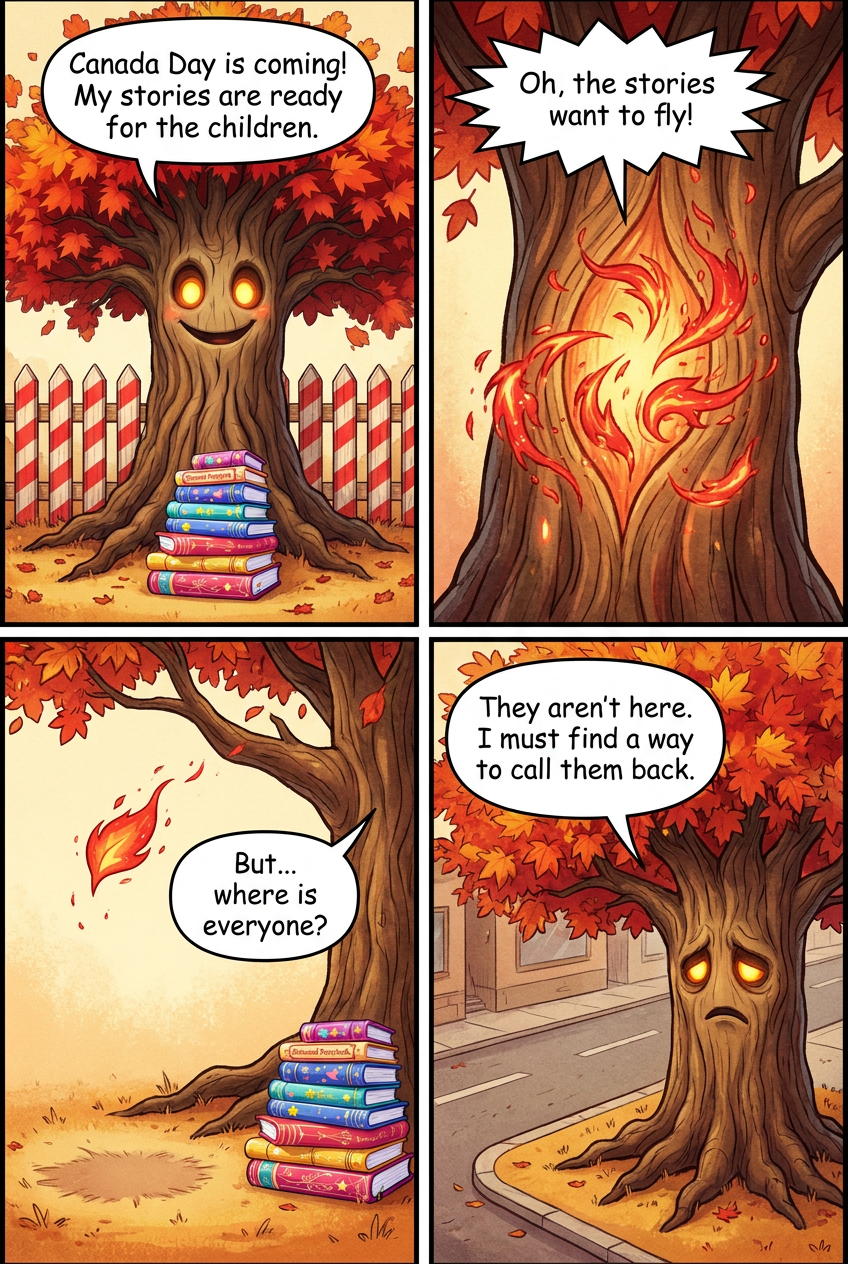
Maple Jack stood at the quiet corner and counted the days until Canada Day. He wanted every story of kindness inside him ready to share. His red bark trembled. Soon the children would come, and he would finally let his sparks fly. The striped red and white fence around him looked cheerful, but no small boots stood beside it. A stack of bright storybooks sat tucked against a post, left behind one cold winter long ago. Their covers were faded now. No one had come to read them in seasons. Inside Maple Jack, the pressure grew. Red sparks pushed against his branches like a swirling creature trying to escape. One leaf-shaped spark burst from a twig and spun in the air. It had nowhere to land. No ears were waiting. No eyes were watching. The spark hovered, then sank to the ground and dimmed. Maple Jack felt the truth settle hard. Canada Day was coming, the corner was ready, but the children were not here. He would have to find a way to call them back.
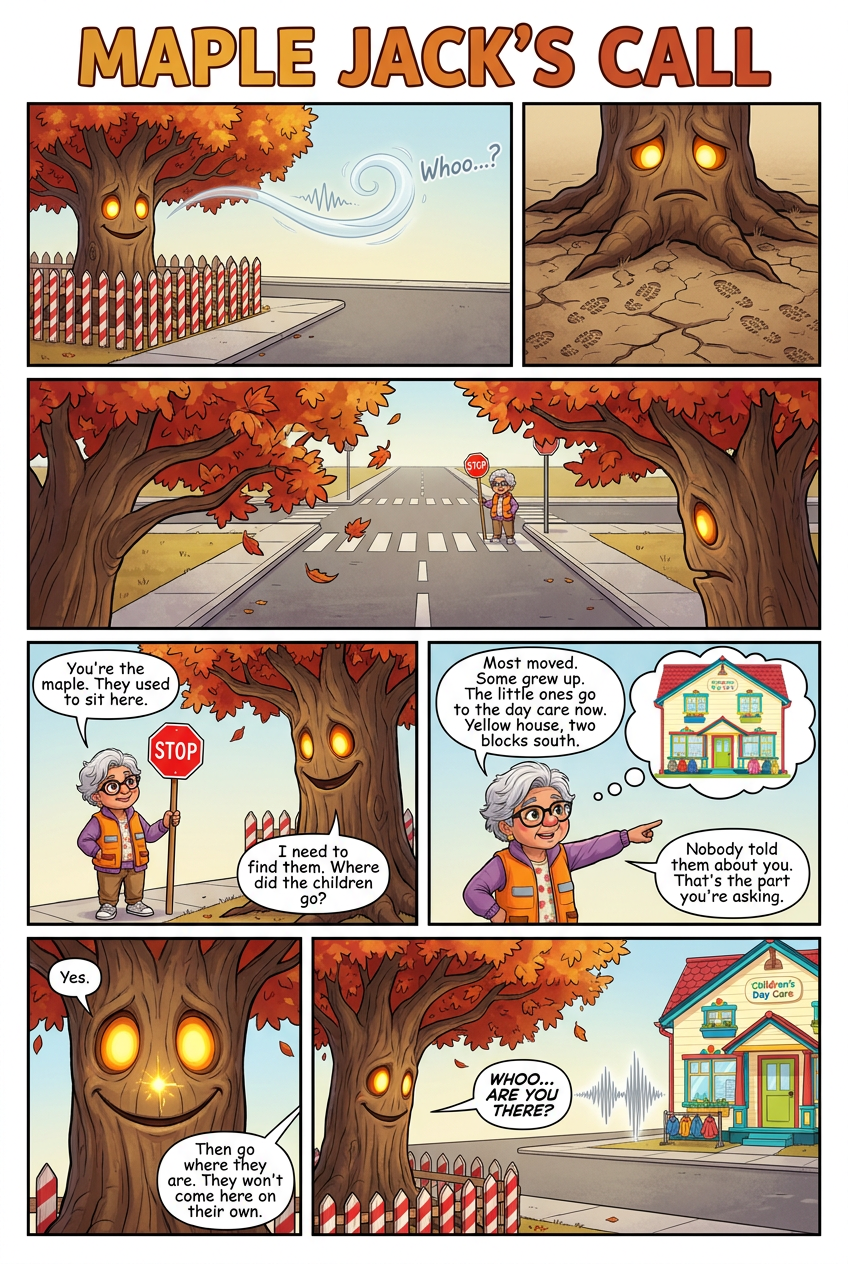
Maple Jack stood at the empty corner and tried his voice. He called the way he used to, low and warm, the kind of sound meant to reach a child's ear from across a yard. His call rolled down the sidewalk and kept rolling. No window opened. No door swung wide. The sound thinned into a pale ribbon of air that curled past the candy cane fence and frayed apart between the houses. He watched it go and knew it had found no one. He needed to know where the children had gone. Without that, every word he sent out would unravel the same way. He looked down at the dirt along the curb and saw faint shapes pressed into the dried mud. Small boot prints. A scuffed heel. A toe turned toward the next street, then another set turned the other way. The tracks had once led straight to his trunk. Now they pointed outward, scattered, like spokes leaving a wheel. He could follow them, but they split too many ways. He needed someone who had watched the children go. At the far end of the block stood a woman in an orange vest with a red stop sign resting against her shoulder. Dorothy Sullivan had worked this crossing longer than most of the trees on the street had been tall. Maple Jack rustled his branches until she turned. She walked over without hurry and stopped a careful distance from his roots. "You're the maple," she said. "They used to sit here." "I need to find them," Maple Jack said. "Where did the children go?" Dorothy looked down the street, then back at him. "Most moved. Some grew up. The little ones go to the day care now. Yellow house, blue trim, two blocks south. Their parents drop them at the door. They don't walk this way anymore." She tapped the base of her sign against the pavement. "Nobody told them about you. That's the part you're asking." Maple Jack felt a spark shift inside his trunk, then settle. "Yes." "Then go where they are," Dorothy said. "They won't come here on their own." She lifted her sign and walked back to her crossing. He could not move his roots, but his voice could travel further than this corner if he aimed it right. Two blocks south stood a small bright building with flower boxes in every window and a painted sign above the door. He could picture the porch now, the low fence, the cluster of small coats hung in a row. The children were not gone. They were only somewhere else. The empty street was no longer a wall. It was a direction. Maple Jack drew in a long breath through every leaf and turned his attention south.
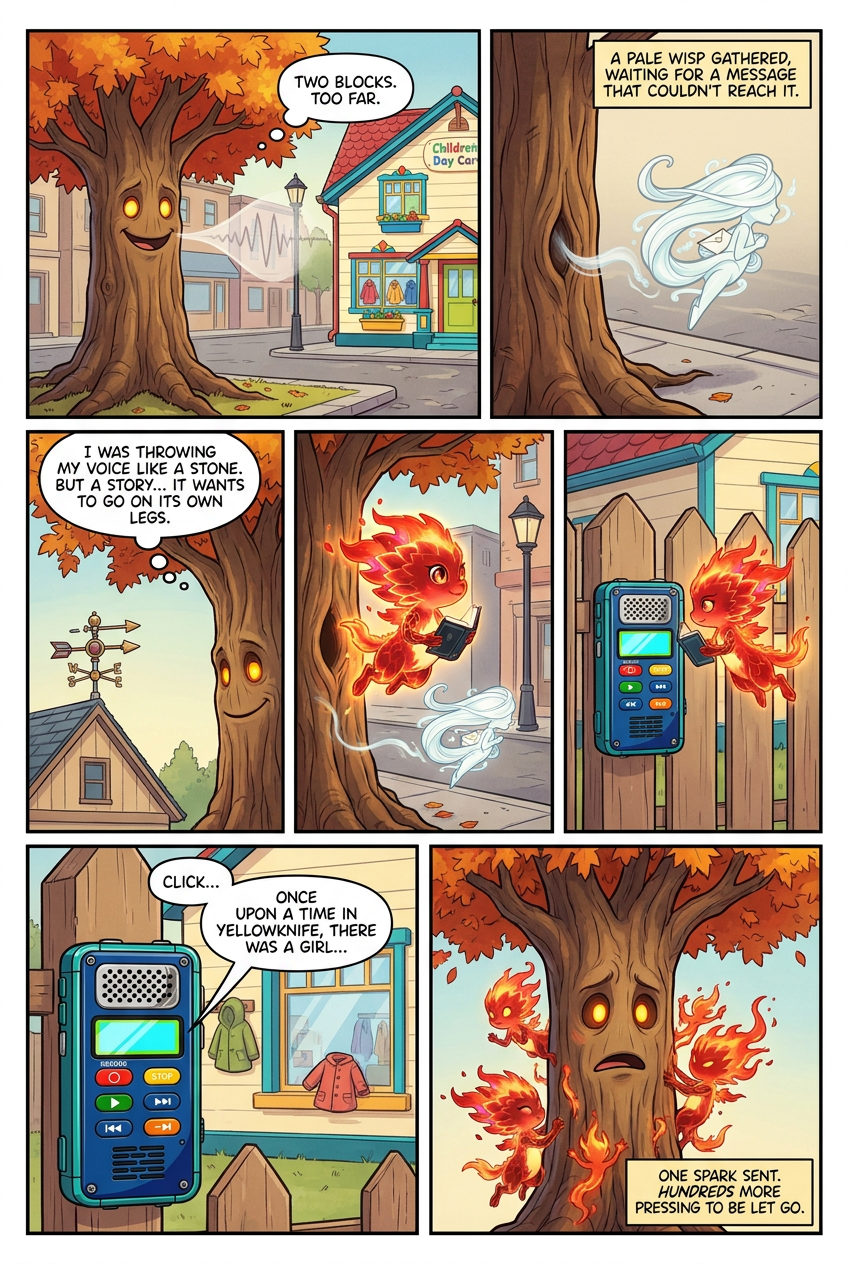
Maple Jack aimed his voice south and called again. The sound left him strong, then thinned at the end of the first block. By the second block it was a whisper. He could see the yellow house with the blue trim, the painted sign above the door, the row of small coats behind the front window. He could not reach it. Two blocks was too far. His bark tightened. The children were that close, and his voice still died in the air between. He tried a different shape. He pulled the call up from his deepest root and pushed it out through every leaf at once. The street carried it half a block and dropped it on the sidewalk. A pale wisp of breath curled up from the spot where the sound fell, gathered itself into a thin drifting figure with a small folded note pressed to its chest, and waited. It could carry a message, but only if a message reached it. His voice was not getting that far. Maple Jack stopped pushing. He listened instead. Wind moved along the gutters. A weathervane creaked somewhere behind him. He understood then that he had been trying to throw his voice like a stone. A story was not a stone. A story was a small living thing that wanted to go. He had been holding the sparks back for so long he had forgotten they had their own legs. He thought of the girl in Yellowknife and the mitten, the story worn smooth inside him, and he loosened his grip on it by a single notch. One red spark broke loose from his trunk and floated out into the street. It was the size of a sugar maple leaf and bright as a coal. It carried a small dark book clutched against its body, and it moved on its own, low and steady, down the sidewalk. The wisp lifted from the pavement and fell in beside it. Together they crossed the first block. They crossed the second. They stopped at the low fence of the day care, where a blue voice recorder sat fixed to a post beside the gate, its silver microphone turned toward the street. The spark hovered at the grille. The recorder's red light blinked once and held. A tiny speaker on the porch clicked on, and Maple Jack heard his own voice come out of it, two blocks south, telling the first line of the Yellowknife story to no one yet, but inside the fence now, inside the yard, inside the air the children breathed. A small coat moved behind the front window. Then another. Maple Jack did not call again. He had reached them. The next problem was already forming in his trunk: he had sent one spark, and there were hundreds more pressing against the bark, and only one of him to let them go.
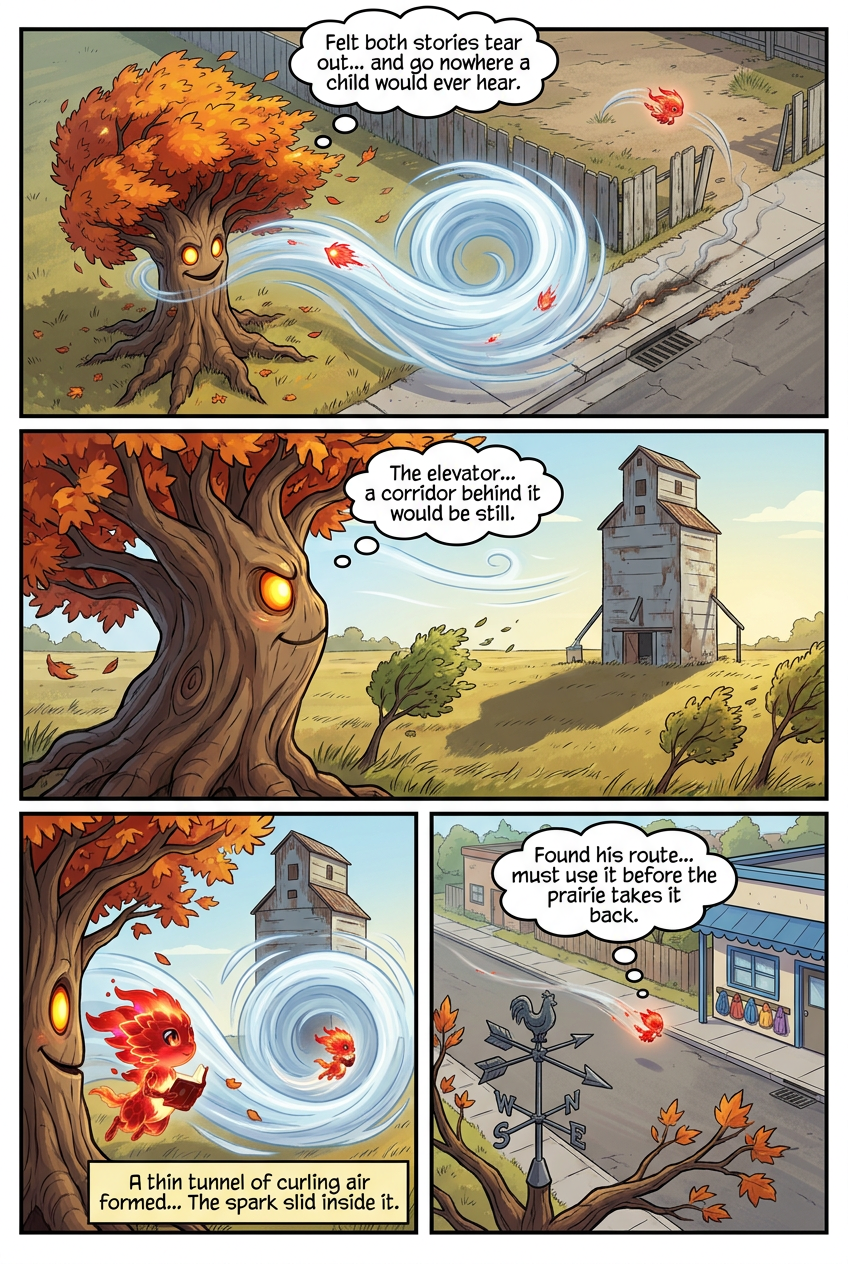
Maple Jack loosened his grip a second time. Two more sparks broke from his bark and lifted into the street. Before they could find the sidewalk, a flat prairie wind came down hard from the west. It caught the sparks sideways. One tumbled over a fence and out across an empty lot. The other skidded low along the pavement and burned a thin black streak through the dry grass at the curb before it vanished. Maple Jack felt both stories tear out of him and go nowhere a child would ever hear. He held the rest back. Hundreds pressed against his bark, hot and impatient, but he would not release them into that wind. He had waited seven winters. He could not waste these stories on an empty lot. He looked south toward the yellow house and saw the wind bending the small trees along the sidewalk. The air between him and the day care had become a river running the wrong way. He turned his attention west, where the wind came from. A tall grain elevator stood at the edge of the field, its silo broad and its wooden housing braced on steel legs. It was the only thing for blocks that stood taller than he did. He studied the angle. If a spark left his trunk on the south side, the elevator's shadow would cover the first stretch of sidewalk. The wind would break against the silo and slide around it. The corridor behind it would be still. He tried one spark as a test. A small ember creature pulled itself free of his bark, a book clutched to its chest, its red glow flickering. Maple Jack aimed it low along his south side, into the lee of the elevator. The wind shoved at it once and missed. The spark wobbled, dipped, and then a thin tunnel of curling air formed in the calm pocket behind the silo, hollow as a sleeve. The spark slid inside it. The tunnel held the ember steady and pointed it down the block. It crossed the first sidewalk square. It crossed the second. It kept going, low and straight, toward the blue trim and the row of small coats. Maple Jack marked the path in his mind. He would send them this way, one at a time, behind the elevator's shoulder, through the still corridor the wind itself had built. He loosened his grip another notch and felt three more sparks rise to the bark, ready. But the wind was already shifting. The weathervane behind him creaked a quarter turn. The corridor that worked now might not work in an hour. He had found his route, and he had to use it before the prairie took it back.
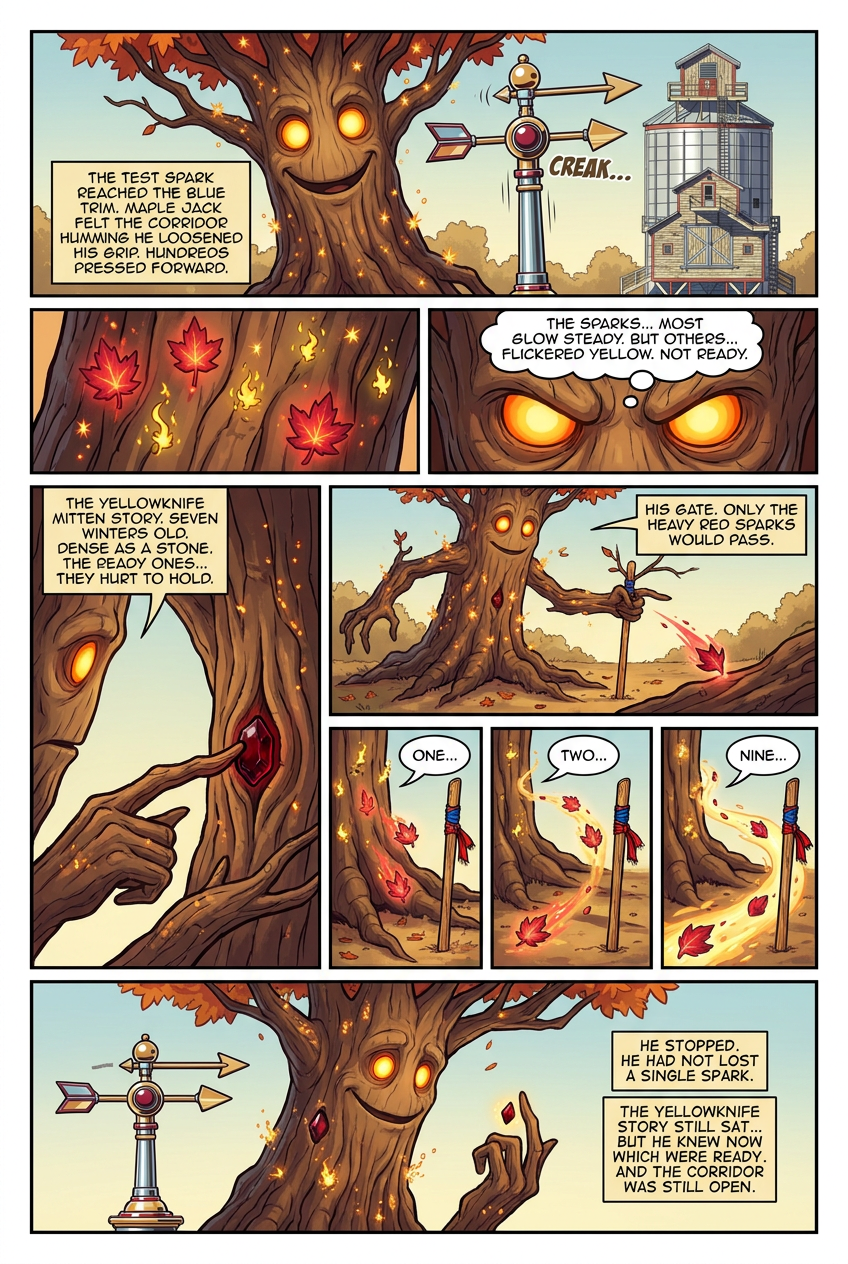
The test spark had reached the blue trim. Maple Jack felt the corridor still humming behind the grain elevator, a narrow sleeve of quiet air waiting for the next story. He loosened his grip another notch. Sparks rose to the surface of his bark like sap beading after a cut. Hundreds pressed forward at once. He had to choose, and he had to choose fast, because the weathervane behind him had already creaked a quarter turn. That was when he saw the problem. The sparks on his bark did not all look the same. Most glowed steady red, shaped like October leaves, edges crisp. But others flickered yellow at the core, jagged and unfinished, throwing off small sharp arcs that fizzed against the bark and went nowhere. He nudged one of the yellow ones. It spat and shrank. It was not ready. If he sent a half-formed story into the corridor, the wind would tear it apart before it reached the day care, and he would lose another spark he could not grow back. He needed a way to sort them before he released. He looked down at his lowest branch, where a single spark had lived for seven winters. The Yellowknife mitten story. It had worn a groove into his bark, a dark ring where the ember had pressed and pressed without leaving. The spark itself was deep red, almost black at the center, dense as a stone. Ripe, long past ripe. He understood then. The ready ones were the ones that hurt to hold. The yellow ones still needed time inside him. He moved his attention along his bark and tested each spark by how heavy it sat. The heavy reds he marked. The light yellows he let settle back into the wood. At the south side of his trunk, where the corridor began, a child had once jammed a stick into the dirt with a scrap of red and blue cloth tied near its top. He had never moved it. He used it now as his gate. Only the heavy red sparks would pass it. The others would wait. He began to send them. One by one, the ripe sparks lifted from his bark, drifted past the marker stick, and slid into the corridor behind the elevator. Each one held its shape. Each one cleared the first sidewalk square, then the second, then kept going toward the yellow building. He counted nine before the weathervane creaked again and the wind shifted half a degree. He stopped. He had not lost a single spark this time. The Yellowknife story still sat on his lowest branch, deep red, unmoved. He had not been able to send that one. Not yet. But he knew now which were ready, and the corridor was still open.
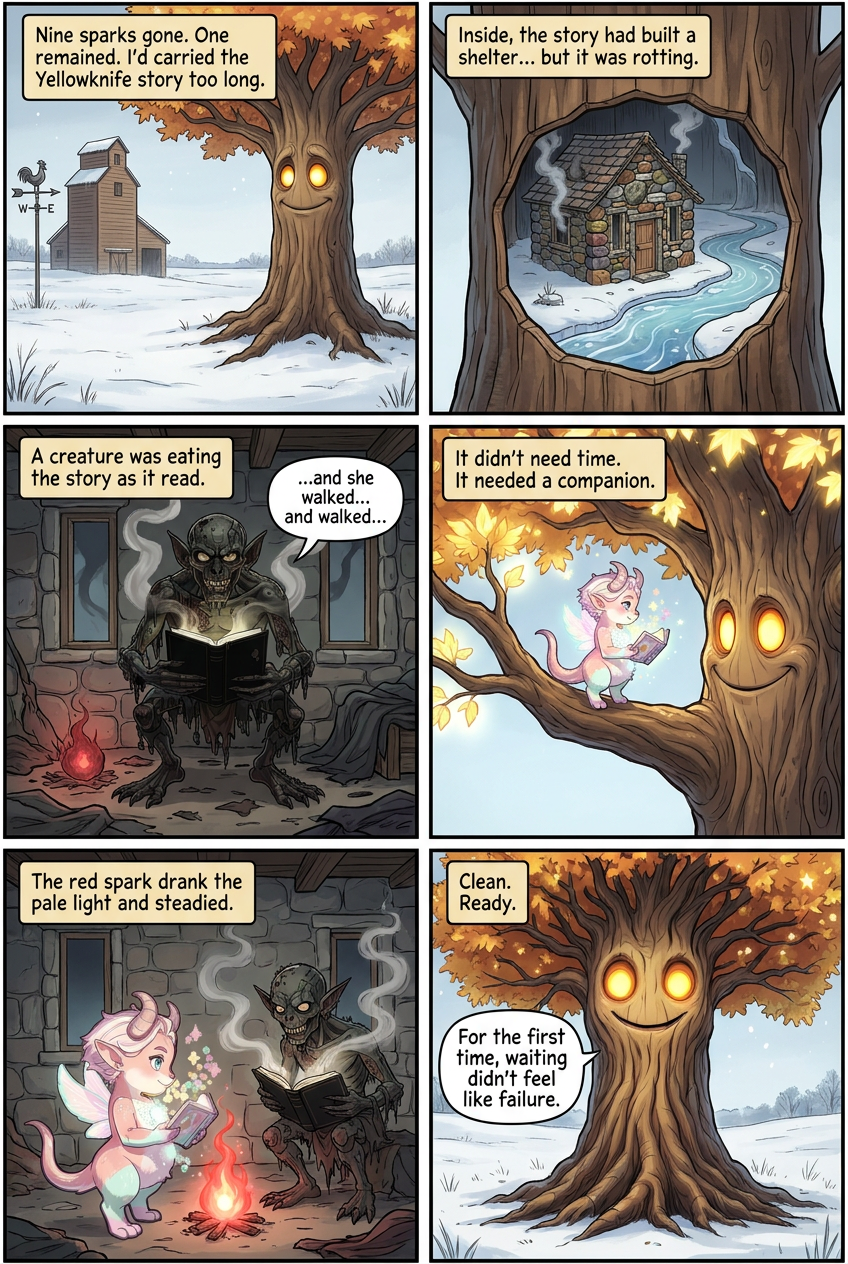
The corridor closed behind the grain elevator with a soft sigh, and the weathervane swung full west. Nine sparks were gone. One remained. Maple Jack felt the Yellowknife mitten story on his lowest branch, deep red, almost black, pressing into the groove it had worn over seven winters. He turned his attention inward to look at it properly for the first time in years. He had been carrying it so long he had forgotten to check what it had become. Around the spark, inside his wood, a small structure had grown up. Stones, river-smoothed, fitted together without mortar. A low door. Two dark windows. He recognized it without being told: the house the girl had walked from, two miles into a January that did not end, mitten in her bare hand. The story had built itself a shelter inside him. A thin river curled past the doorstep in his memory, clear water moving under ice. The spark sat on the threshold like a coal in a hearth that had gone cold around it. Something else was in the house. Maple Jack saw it crouched beside the spark, robed in dark rags, hunched over a black book. Smoke rose from the open pages in slow curls. The creature was reading his story to itself, and where its fingers touched the paper, the edges browned and crumbled. He understood then what the smoke was. The story was beginning to rot. He had held it so long that the holding itself had started to eat it. If he waited another winter, there would be nothing left to send. He looked again at the spark on the threshold. It was heavy, yes. Ripe, yes. But the weight was not only the weight of the kindness. It was the weight of his shame for keeping it. The girl had walked two miles in the cold for a stranger. He had sat on his corner for seven winters and not walked the story two blocks. He saw, finally, what the spark still needed. Not more time. A small companion. He pulled from higher in his bark a lighter spark, pale pink and mint, barely formed — the soft shape of a child's own small kindness, the kind the waiting children had shown him when they made up stories and said he was coming tomorrow. He set it against the red one. The two touched. The red spark drank the pale light and steadied. The rotten figure in the stone house closed its book and faded into the smoke it had been making. Maple Jack lifted the Yellowknife spark off the branch. The groove in his bark stayed, pale and bare, but the weight was gone from it. The corridor was closed. He could not send the spark today. He held it now in his upper branches, ready, clean, no longer rotting. He would wait for the next quiet wind. For the first time in seven winters, waiting did not feel like failure.
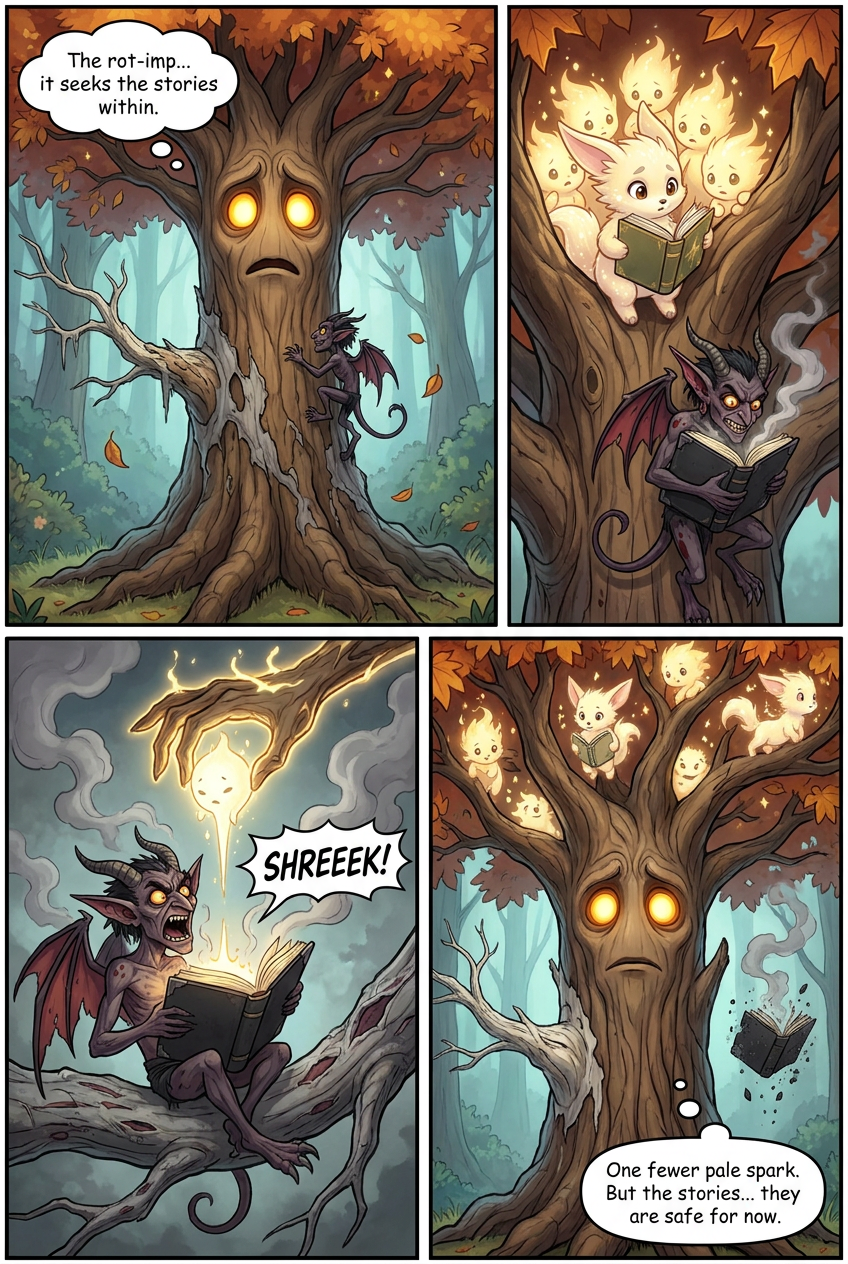
The Yellowknife spark sat clean in his upper branches, and Maple Jack thought the worst was behind him. He was wrong. As the smoke from the stone house thinned inside his trunk, something slipped out through the open door. A small dark shape, no bigger than a squirrel, with torn wings and a black book pressed against its ribs. It had been driven out of the mitten story but not destroyed. It needed another story to feed on. It began to climb. Maple Jack felt it move from branch to branch. Where its claws scraped his bark, the wood went gray and brittle. One low limb on his north side cracked under its weight and hung dead, the bark peeling in long strips, the wood inside dry as ash. He could not grow that branch back today. He turned his attention upward and found his remaining sparks already reacting. The lighter, half-formed ones had drifted together into a single bright cluster near his crown, pressed close like chicks under a wing. One small spark-shape held a half-made book in its arms and watched the climbing imp with wide eyes. The cluster was bright, but it was not ripe. If the rot-imp reached them, none of them would survive to send. Maple Jack could not shake the imp off. He had tried that with the rot inside the mitten story and failed. What had worked was pairing. Kindness against rot. He searched himself for another pale spark from the waiting children and found only one left, smaller than the first, barely a glow. He hesitated. If he spent it here, he would have nothing to stabilize the next story that began to turn. Then he thought of the dead branch hanging off his side, and the cluster of young sparks pressed together at his crown, and he stopped hesitating. He pushed the pale spark down to meet the climbing imp on the scarred limb where the bark had gone gray. The two touched. The imp opened its black book to feed and found the page already lit from underneath. It shrieked once, a dry sound like a seed pod splitting, and folded into its own smoke. The book fell and crumbled before it reached the ground. The cluster at his crown loosened and drifted back to their separate branches, still unripe, still waiting. Maple Jack counted them. Sixteen lighter sparks. One heavy red one held ready for the next wind. The dead limb on his north side did not heal. It would stay, pale and bare, a mark of what the rot had cost him before he stopped it. He had one fewer pink spark now to spend on the next story that began to turn. He would have to send the Yellowknife mitten soon, before another story went the same way.
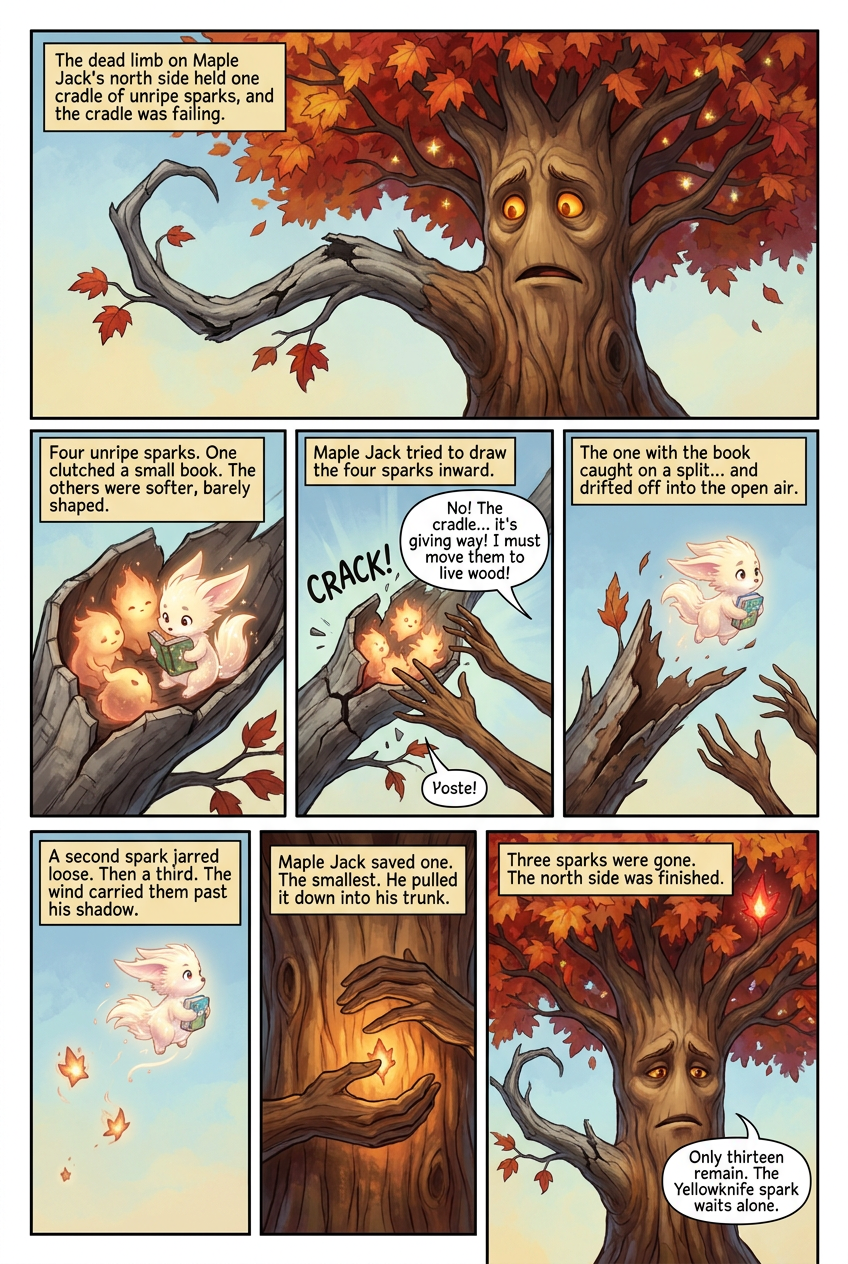
The dead limb on Maple Jack's north side held one cradle of unripe sparks, and the cradle was failing. Three winters ago that branch had been his best holder. The wood had curved upward in a soft hook, perfect for cupping sparks while they ripened from yellow to red. Now the bark hung in strips, the wood inside was dry as ash, and the hook had cracked open along its underside. A few last red leaves still clung to the smaller twigs, bright against the gray, and they trembled with every shift of the young sparks inside. Maple Jack could feel the cradle giving way. He had to move what was inside it before the wood let go. He counted the unripe sparks in the broken cradle. Four of them, all yellow, all half-formed. One was further along than the others. It clutched a small book against its chest, and its glow had begun to deepen at the edges, though the center was still pale. The other three were softer, barely shaped, more light than form. None of them were ready for wind. He knew that. He had learned it when he lost two stories in the corridor behind the grain elevator. Yellow sparks did not survive open air. But the cradle was splitting, and if he did nothing, the sparks would fall on their own and scatter where he could not reach them. Maple Jack tried to draw the four sparks inward, down the limb toward his trunk, where the live wood could hold them. Three of them moved. The fourth, the one with the book, caught on a split in the bark and slipped the wrong way. It drifted off the end of the broken limb and into the open air above his roots. He reached after it with every twig he had on that side. The bark was too dead to answer. The little spark hung there a moment, book pressed to its chest, then lifted on a slow draft and floated past his reach. A second spark, smaller, jarred loose behind it. Then a third. They drifted out from the cracked hook in a loose, flickering group, each ember pale and wandering, and the wind carried them past his shadow into the bright space beyond his crown. Maple Jack saved one. The smallest. He pulled it down into his trunk and held it against the live wood, where it dimmed but did not go out. The broken limb above him was empty now. He looked at the curve of dead wood with its few red leaves and understood it could no longer cradle anything. Three sparks were gone. Sixteen had become thirteen, and the heavy red Yellowknife spark still waited alone in his upper branches for the next wind. He would have to send it from a living limb. The north side was finished.
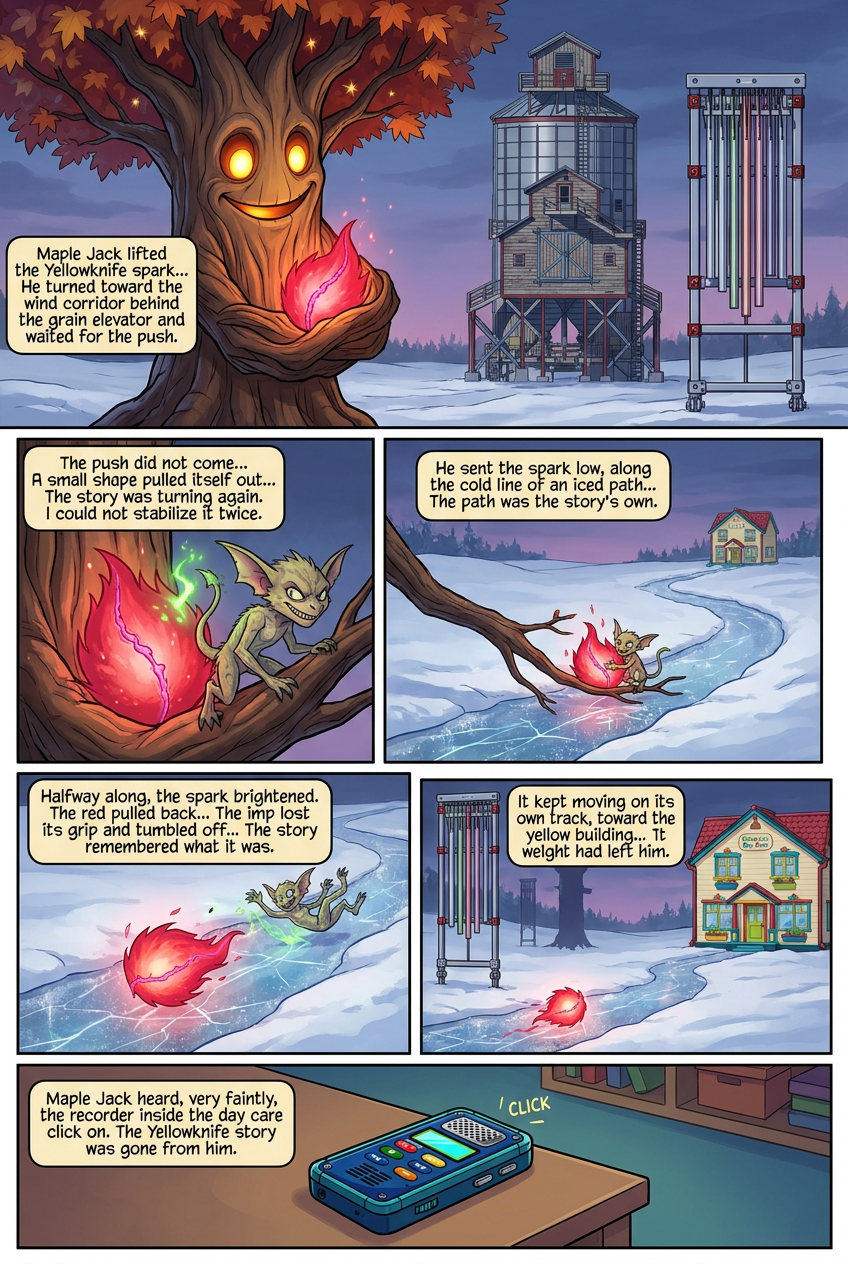
Maple Jack lifted the Yellowknife spark from his upper branch and settled it against a living crook on his south side. The spark was heavy and red, ripe at last, with a thin pink seam where the kindness had sealed the rot. He could feel the path inside it. Two miles of packed snow, a girl's small boots, a stranger's mitten held tight against her coat. The story was ready. He turned toward the wind corridor behind the grain elevator and waited for the push. The push did not come. Behind the elevator stood the tall metal frame of chimes that always marked the corridor's pull. The tubes hung straight down. None of them touched. None of them rang. The air between the elevator and the day care had gone flat, as if someone had closed a door. Maple Jack stretched a twig out and felt nothing move across it. The corridor he had counted on was empty. He looked down at the spark in his crook and saw the seam begin to darken. The red dimmed at the edges. A small shape pulled itself out of the spark's underside, no bigger than a mouse, with thin arms and a sour green light crackling along its ribs. It grinned up at him. The story was turning again. He had stabilized it once. He could not stabilize it twice. He had no pale sparks left. Maple Jack reached past the dead corridor. He sent the spark low, under the still chimes, along the cold line of an iced path that ran from the elevator toward the day care fence. The path was the story's own. He pushed the spark onto it and let the story's weight carry itself. The spark slid forward on the ice, slow at first, then steady, the little sour imp clinging to its back. Halfway along the path, the spark brightened. The red pulled back into the center. The imp lost its grip and tumbled off into the snow, where it shrank and went out. The story remembered what it was. It kept moving on its own track, past the silent chimes, past the elevator's shadow, toward the yellow building two blocks away. Maple Jack heard, very faintly, the recorder inside the day care click on. He held still. The Yellowknife story was gone from him. The groove it had worn was empty for the first time in seven winters. Twelve red sparks remained in his branches, and one small yellow spark inside his trunk. The wind corridor was dead. He would need another road for the rest. But the oldest weight had left him, and somewhere two blocks south, a girl in January was walking again.
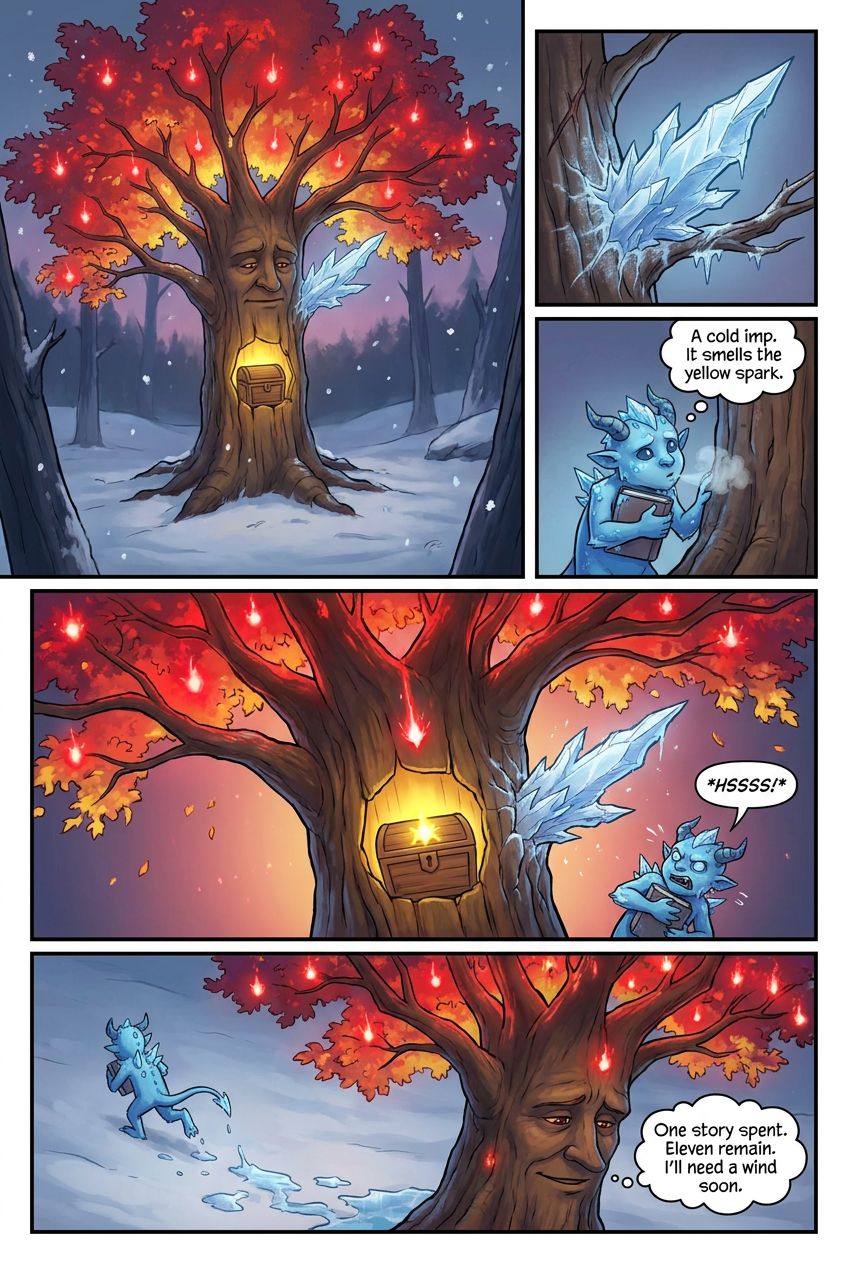
Maple Jack stood quiet after the Yellowknife spark left him. The wind had dropped. Twelve red sparks rested in his south branches, and one small yellow spark sat deep inside his trunk, tucked behind a knot of heartwood that had grown around it like a wooden chest. He could feel the grain of that hollow holding the yellow spark warm. Then he felt the cold come. It started at the dead north limb. A shard of frost grew along the scarred wood, clear and sharp, with edges like cut glass. It pushed inward through the old rot-channel the imp had left. Maple Jack watched the frost crawl past the split in his bark and into the live wood beneath. Below the shard, on the snow, a small set of tracks circled his roots. He bent his crown to look. A pale blue creature crouched against his trunk, horns curled back, claws hooked into his bark. It held a small book pressed to its chest. Its breath fogged in tight curls. It was sniffing for the yellow spark. Maple Jack could not strike it. He had no pale sparks to pair against it, and his north side was already lost. If the cold imp reached the heartwood hollow, the last unripe story would freeze before it ever ripened. He looked at his twelve red sparks. Each was ready for a wind he did not have. He chose the heaviest, a story about a fisherman who shared his catch with a stranger on a dock, and lowered it down the inside of his trunk. He pressed it against the wall of the hollow where the yellow spark slept. The red spark's heat bloomed into the wood. The hollow warmed. The yellow spark drank from it. The frost shard cracked. The cold imp jerked its claws back from the bark. It hissed and clutched its book tighter, but the warmth pushed it down the trunk and out onto the snow. It scrabbled at the roots, then turned and ran, leaving a thin line of melt behind it. Maple Jack felt the red spark settle into the hollow wall, no longer a spark but a steady ember, spent on shelter instead of flight. Eleven red sparks remained in his branches. The yellow spark was safe, and warmer than before. He had bought the small one's life with one of the grown ones. He would need a wind soon for the eleven, or he would have to burn another to keep the cold out, and then another, until there was nothing left to send.
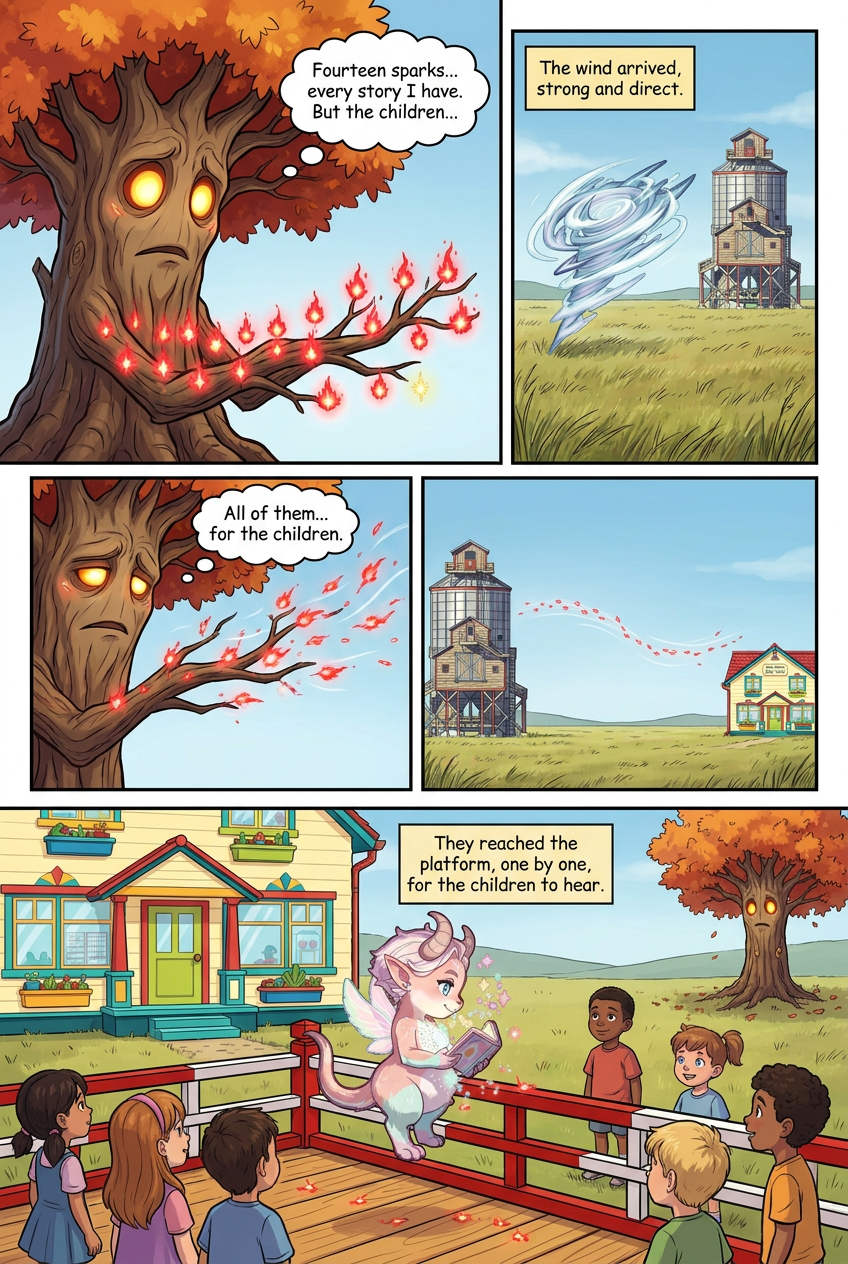
The morning after the cold imp ran, Maple Jack felt something shift inside his south branches. Two new red sparks budded between the older ones, heavy and bright before he understood where they had come from. He counted thirteen sparks now, then fourteen by midday. The warmth he had spent on the yellow spark had loosened something in his heartwood. Stories he had pressed down for years were ripening at once. He looked north and saw the wind coming. It moved low over the prairie, bending the grass in a clean line. At its head spun a tight, blade-edged whirl, jutting with sharp currents. It was strong, straight, and aimed past the grain elevator toward the yellow building two blocks south. Maple Jack knew this wind. It would not come again before Canada Day. If he sent every red spark through it now, all of them would reach the children in time. He hesitated only once. Fourteen sparks was every grown story he had. Sending them all meant nothing left in his south branches, nothing held back, nothing kept for himself. He thought of the children at the corner who had waited seven winters and made up stories to cover for him. He loosened his grip. The sparks lifted one by one. The wind caught them and pulled them into its spiral. Maple Jack watched a single red spark ride the current high above the field, glowing like an October leaf against the pale sky, then another, then a stream of them. Behind the grain elevator, the wind funneled tight and shot south. The sparks rode it in a red line. At the yellow day care, a wooden platform stood in the yard, painted red and white, its open center waiting. The sparks dropped onto the boards one after another. Children came out the green door. A small pastel creature with curled horns sat on the platform rail, clutching a book, catching each spark as it landed and setting it gently down for the children to hear. Maple Jack stood empty in his south branches. The wind died as the last spark cleared the corridor. He had done what he came for, almost. Then he felt the small yellow spark stir inside his trunk, warmer now, heavier than yesterday. It was not ripe yet, but it was close. And inside him, behind the knot of heartwood, one more thing waited that he had not sent: the worn groove where the Yellowknife mitten story had lived for seven winters, and the question he had never answered about which story was hardest to let go.
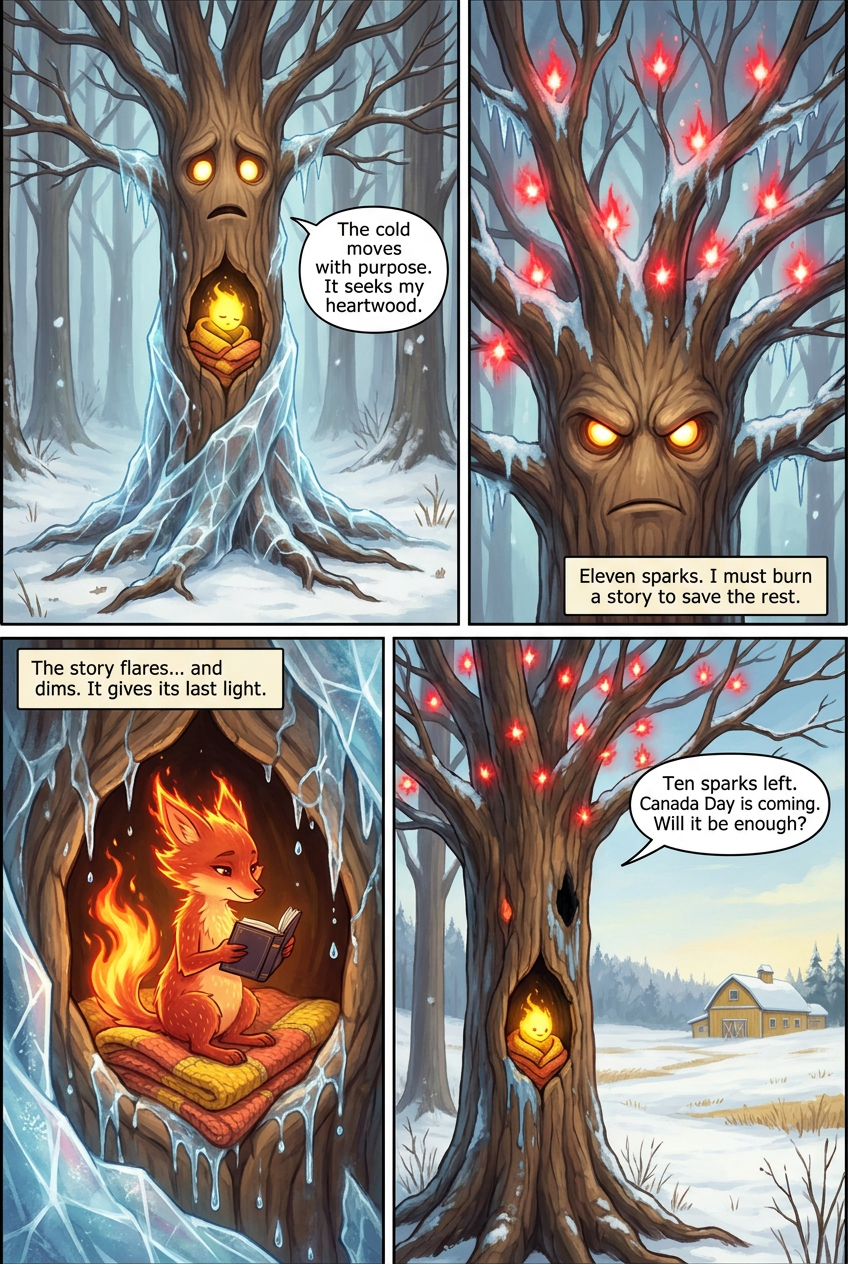
The wind died before noon, and the cold came up from the ground. Maple Jack felt it climb his roots first, then his outer bark. A pale sheath began to form along his north side, a sleeve of frost wrapped in fine crystal that crept down toward his trunk. He had seen frost before. This one moved with purpose. It was inching toward his heartwood, where the small yellow spark lay curled against a folded scrap of blanket he kept tucked in the hollow, an old square of orange and yellow weave a child had once left at his roots. The blanket had held warmth around the spark all winter. Now the frost was past it, and only a thin band of living wood stood between the cold and his heart. He counted what he had left. Eleven red sparks in his south branches. One yellow spark, still not ripe. If the frost reached his heartwood, he would have to burn another red ember to drive it back, the way he had burned one against the cold imp. He did not want to lose another story. He thought of the children at the corner who had waited seven winters. Every red spark was one of them getting an answer. He pressed his bark tight and tried to push warmth outward into the frozen sleeve. The cold did not move. It thickened. A second crystal layer formed over the first, and the band of living wood narrowed to a finger's width. Maple Jack chose. He loosened one red spark from his south branches and pulled it inward, down through his trunk, to the place where the frost pressed hardest. The spark flared against the inner wall. The frozen sleeve cracked along its seam. Water ran down his bark in a thin line and froze again at his roots. The spark dimmed as it worked. It shrank to the size of a thumbnail, then to a coal, then to a small dim shape that looked almost like a creature holding a tiny book to its chest, reading by its own last light. The shape sat in the hollow beside the folded blanket scrap until its glow went out. Where it had burned, a black mark stayed on the inner wood. The frost pulled back from his heartwood. The yellow spark settled deeper into the blanket fold, warm again. Maple Jack counted his south branches. Ten red sparks now. He had spent one more story to keep the rest. He looked north across the field toward the yellow building two blocks south and felt the worn groove inside him where the Yellowknife mitten had lived, empty now, still shaped like the story it had held. Ten sparks left, and Canada Day was coming, and he did not know yet if ten would be enough.
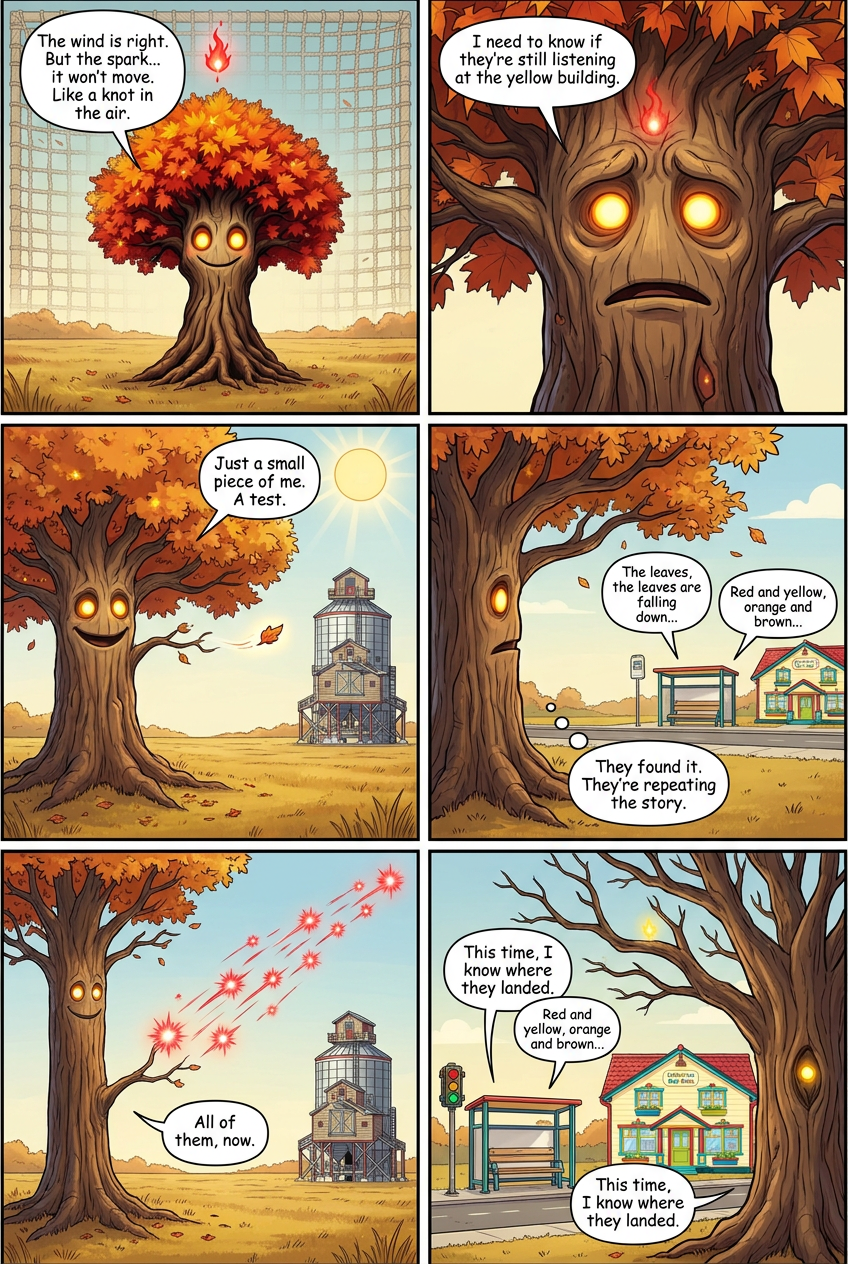
The wind came back at midafternoon, a steady pull from the south. Maple Jack felt his nine red sparks shift along his branches, ready. He set one loose to test the air, and it rose, glowing like an October leaf, and hung two feet above his crown. It did not move on. The wind held it there, suspended over him, neither falling nor traveling. He stared at it and felt the old fear climb back into his bark. He did not know if anyone at the yellow building two blocks south was still listening. The earlier sends had gone, but he had no proof they had landed in waiting hands. He could send the rest now and learn only after, when there was nothing left to send. The spark drifted sideways and caught against an invisible weave in the air, as if the sky itself were a knotted net holding it between his branches and the day care roof. He pulled the spark back. It settled into his bark, dim but alive. He needed to know first. He searched himself for something small, something he could spare. Near his lowest branch hung a thin shaving of red bark he had grown around a chip of glass last summer. It glowed faintly, not a story but a piece of him, light enough to ride any wind. He worked it loose and let it go. The shaving lifted, caught the south pull, and traveled low across the field, blinking red, then yellow where sun struck it, then green as it cleared the grain elevator and dropped from his sight. He waited. The wind kept steady. He counted to two hundred. Then a sound came back along the corridor, faint but clear: a child's voice, then another, then a small chorus calling the words of a story he had sent last week. They were repeating it, the way children repeat a song they have learned by heart. The voices came from the bus shelter beside the day care, where the younger ones waited for afternoon pickup. He had not known they gathered there. The shaving had found them on the bench, and they had answered the only way they could, by giving back what he had already given. Maple Jack loosened all nine red sparks at once. They rose from his south branches in a slow column, caught the wind, and traveled the corridor in a line, each one bright as a sugar maple leaf at peak. He watched the last one clear the elevator and disappear. The wind held. The children's voices kept coming, thinner now, layered with new words as the first sparks reached them. His branches were empty of red. Only the yellow spark remained inside his trunk, still unripe, still waiting. He had sent everything ready, and this time he knew where it had landed.
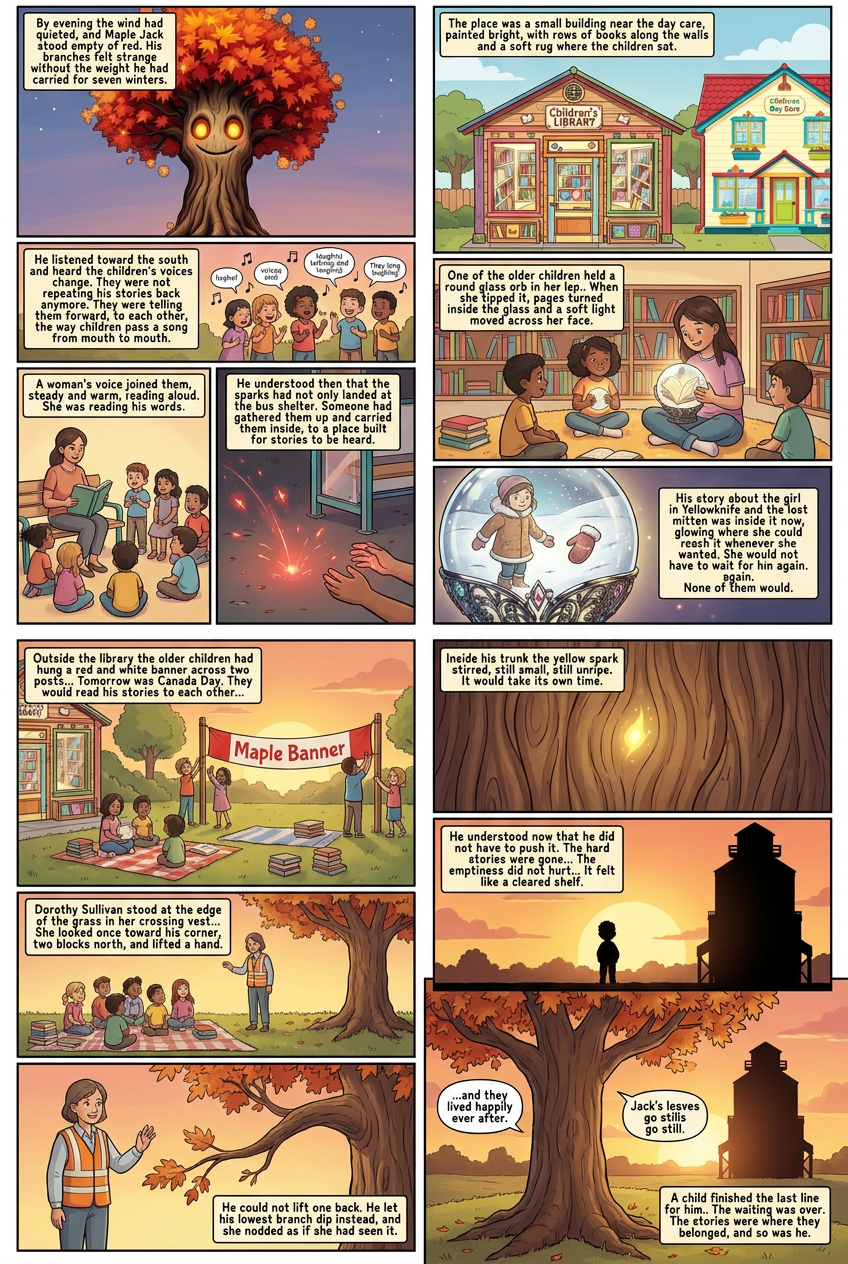
By evening the wind had quieted, and Maple Jack stood empty of red. His branches felt strange without the weight he had carried for seven winters. He listened toward the south and heard the children's voices change. They were not repeating his stories back anymore. They were telling them forward, to each other, the way children pass a song from mouth to mouth. A woman's voice joined them, steady and warm, reading aloud. She was reading his words. He understood then that the sparks had not only landed at the bus shelter. Someone had gathered them up and carried them inside, to a place built for stories to be heard. The place was a small building near the day care, painted bright, with rows of books along the walls and a soft rug where the children sat. He could not see it, but he could feel the shape of it through the spark-trail that still hummed faintly in the air. One of the older children held a round glass orb in her lap, a thing the library kept for story hour. When she tipped it, pages turned inside the glass and a soft light moved across her face. His story about the girl in Yellowknife and the lost mitten was inside it now, glowing where she could reach it whenever she wanted. She would not have to wait for him again. None of them would. Outside the library the older children had hung a red and white banner across two posts, the maple leaf bright in the last of the sun. They had set out blankets on the grass and stacked small books beside them. Tomorrow was Canada Day. They would read his stories to each other in the morning, and again at bedtime, and again whenever they wanted, because the stories belonged to them now. Dorothy Sullivan stood at the edge of the grass in her crossing vest, watching the children settle. She looked once toward his corner, two blocks north, and lifted a hand. He could not lift one back. He let his lowest branch dip instead, and she nodded as if she had seen it. Inside his trunk the yellow spark stirred, still small, still unripe. It would take its own time. He understood now that he did not have to push it. The hard stories were gone. The held one was gone. The groove the mitten story had worn in him was empty, and the emptiness did not hurt the way he had feared. It felt like a cleared shelf. When the yellow spark was ready, in a season or in seven, there would be children to receive it, and a woman to read it, and a glass orb to hold it. He had built that road by walking it. Maple Jack settled into his bark as the sun dropped behind the grain elevator. The children's voices carried up the corridor one last time, softer now, a story about kindness he had carried so long he had almost forgotten its ending. A child finished the last line for him. He had not known anyone else remembered it. He let his leaves go still. The waiting was over. The stories were where they belonged, and so was he.
Play your story to life
Storycraft is a mobile game where you create AI characters, craft items and locations to build their world, then discover what direction your story takes. Download the iOS game for free today!
Download for free