

Margo Holland's Arc
14 Chapters
Margo Holland's dream is recovering advanced medical equipment from the Sierra Army Depot.

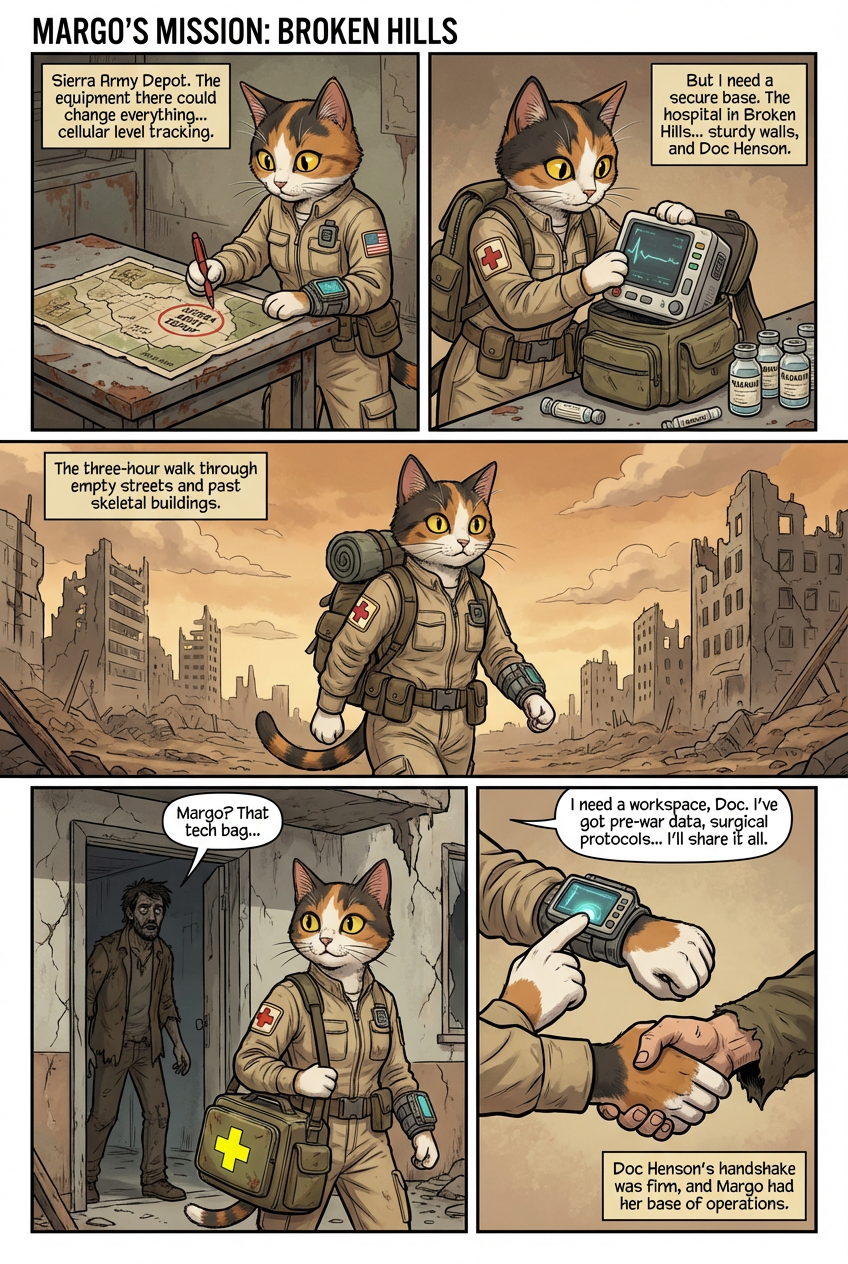
Margo spread her field maps across the metal table and circled the Sierra Army Depot location one more time. The research wing there held equipment that could change everything—diagnostic tools that went beyond her scanner's basic readings, maybe even something that could track the mutant changes at a cellular level. But she'd need a secure base to work from once she got the equipment out. The hospital in Broken Hills had space, sturdy walls, and Doc Henson who'd proven he could keep his mouth shut. She packed her modified medical monitor into her pack next to the tech bag with its precious Radaway vials—proof she knew what she was doing. The walk to Broken Hills took three hours through empty streets and past skeletal buildings. Doc Henson met her at the hospital's cracked entrance, his eyes dropping to the bright yellow cross on her tech bag. She watched his expression shift from cautious to hungry. "I need a workspace," Margo said, tapping the medical monitor on her wrist. "I've got pre-war surgical protocols, radiation treatment data, and tissue analysis methods stored here. You let me set up in your second floor, I'll teach you everything I know." Doc Henson's handshake was firm, and Margo had her base of operations.
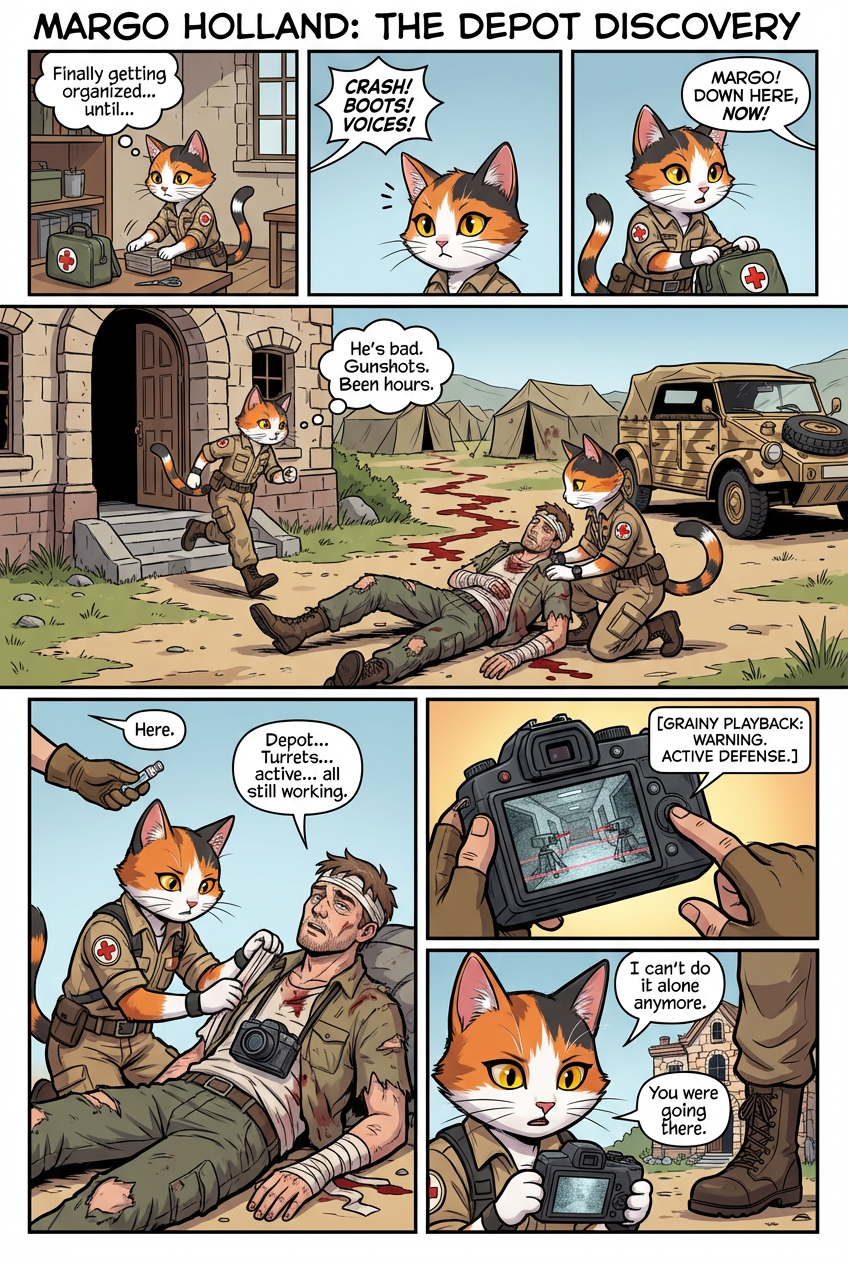
Margo was organizing her new workspace on the hospital's second floor when the commotion started downstairs. Boots on tile, voices sharp with urgency, then Doc Henson calling her name. She grabbed her medical bag and headed down. A man lay sprawled across the entrance floor, his breathing shallow and wet. Blood soaked through makeshift bandages on his chest and left leg. Someone had dragged him from the homeless camp outside—she could see the trail of red leading back through the doorway to the cluster of tents beyond. A battered military camera hung around his neck on a frayed cord, its lens cracked but the power indicator still blinking green. Behind him in the street sat a desert-camouflaged kubelwagen, its engine ticking as it cooled. Margo dropped to her knees and checked his vitals. Gunshot wounds, at least twelve hours old, infection already setting in. She worked fast—pressure on the chest wound, stims from her bag, antibiotics she couldn't really spare. Doc Henson brought her supplies without being asked. The man's eyes fluttered open as she stabilized him, and his hand fumbled for the camera. "Depot," he whispered. "Turrets... active. All of it... still working." His fingers found the playback button before he passed out again. The camera's small screen lit up with grainy footage—automated turrets tracking movement, laser tripwires in corridors, defense systems that should have been dead for decades. Margo felt her chest tighten. Her override codes would get her past security locks, but not past active weapons. She'd planned for a salvage run, not a combat operation. Doc Henson leaned over her shoulder, watching the footage loop. "That's why you needed the workspace," he said quietly. "You were going there." Margo met his eyes and made a choice. She needed help now, the kind that required full truth. "I still am," she said. "But I can't do it alone anymore."
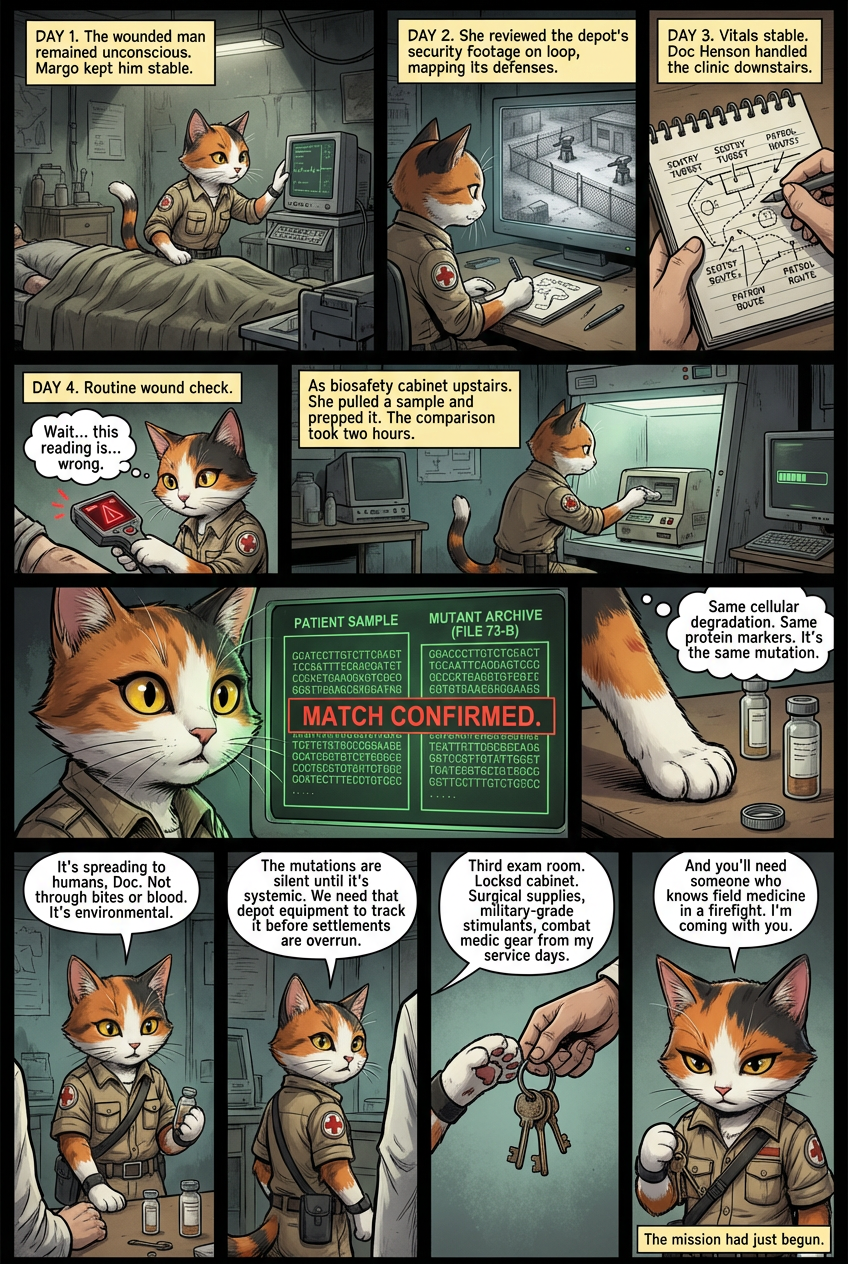
The wounded man stayed unconscious for three days. Margo kept him stable with what antibiotics she had left, monitoring his vitals while Doc Henson handled the clinic downstairs. She spent the time reviewing the camera footage on loop, mapping the depot's defenses in her notebook. On the fourth morning, she ran a tissue scan during a routine wound check and stopped. The diagnostic scanner she'd salvaged months ago showed abnormal cell structures in the infection sites—not just bacteria, but something underneath. She pulled a sample and prepped it in the biosafety cabinet upstairs, then pulled her collection of mutant tissue samples from storage. The comparison took two hours on the old terminal she'd rigged to display genetic sequences. The patterns matched. Same cellular degradation. Same protein markers. Same mutation progression she'd documented from a dozen super mutant samples over the past year. Doc Henson found her standing at the preservation cabinet, staring at the two samples side by side. "It's spreading to humans," she said. Her voice sounded flat even to her own ears. "Not through bites or blood contact. Through something environmental. The mutations don't show symptoms until the infection's already systemic." She turned to face him. "That equipment at the depot—it's not just for research anymore. We need it to track this before settlements start reporting cases they can't identify." Doc Henson studied the samples for a long time. Then he pulled a set of keys from his coat pocket and handed them to her. "Third examination room has a locked cabinet. Surgical supplies, military-grade stimulants, combat medic gear from my service days. If you're going into that depot, you'll need more than override codes." He met her eyes. "And you'll need someone who knows field medicine in a firefight. I'm coming with you."
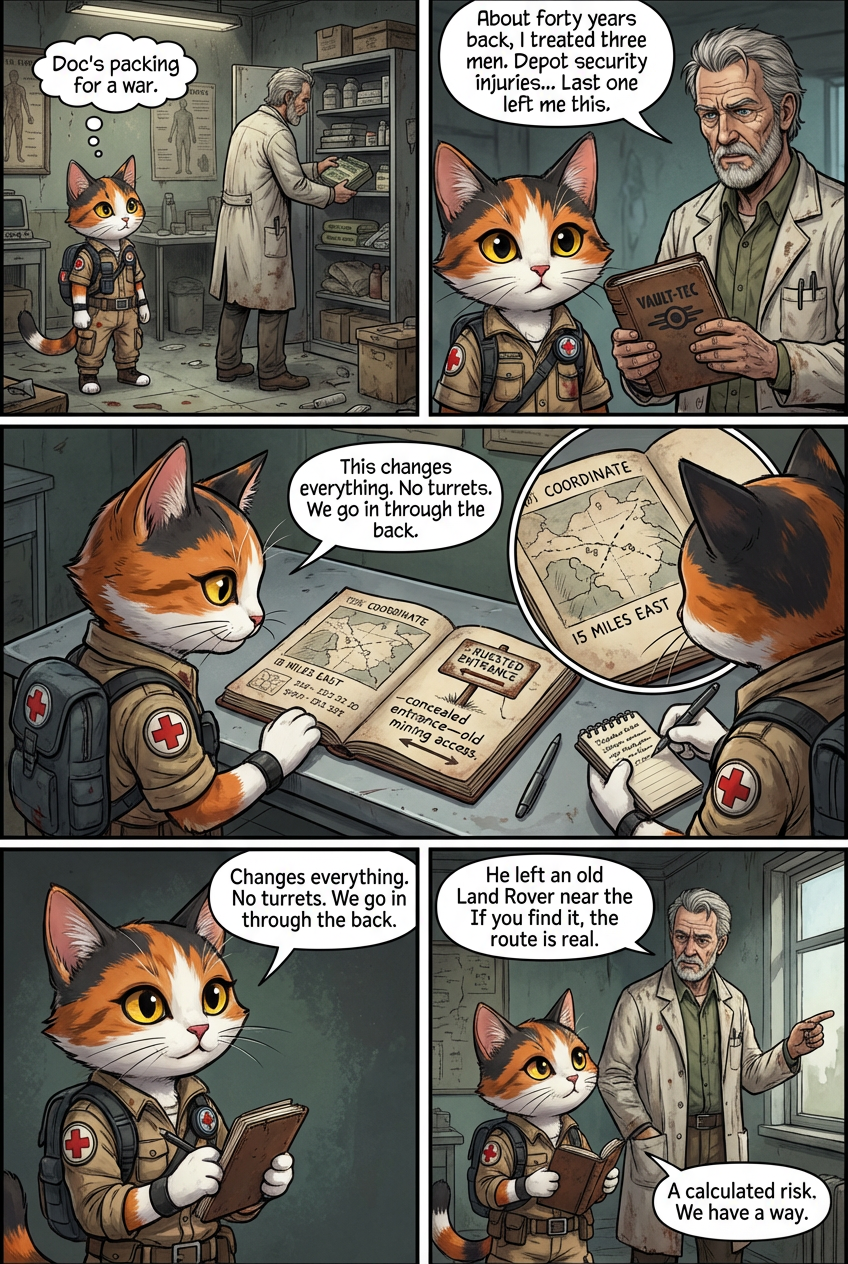
Margo found Doc Henson in the third examination room the next morning, pulling pre-war medical gear from the locked cabinet. Field suture kits. Combat stimulants in military packaging. A portable diagnostic unit she'd never seen him use. He laid each item on the steel table without looking up. "I need to tell you something first," he said. "About forty years back, I treated three men who came through separately over six months. Burns, broken bones, radiation exposure. Never asked questions, but their injuries matched depot security protocols—automated defenses, the kind that don't miss." He pulled a leather journal from the cabinet's back corner. The cover showed faded Vault-Tec markings. "Last one left me this. Said if I ever needed a way in that bypassed the main gates, coordinates were inside. He marked it with some old fishing camp sign nobody would remember." Margo took the journal. The pages held coordinates, hand-drawn maps, notes about patrol patterns from decades ago. One page showed a crude sketch of a rusted sign pointing toward something marked 'concealed entrance—old mining access.' Her hands steadied as she copied the coordinates into her notebook. The coordinates placed the entrance fifteen miles east of the main depot gates. "This changes the approach entirely," she said. "No front gates. No turret gauntlet. We go in through the back and work toward the research wing." But doubt crept in as she studied the deserter's notes about the entrance being sealed from inside. "The deserter mentioned he left his vehicle near the entrance," Doc Henson said. "Old Land Rover, jungle camouflage. Figured if the entrance was still sealed, the vehicle would prove the coordinates were real." He met her eyes. "I never went looking. Seemed like borrowed trouble. But now—" He gestured at her mutation samples upstairs. Margo closed the journal and pocketed the coordinates. For the first time since seeing the camera footage, she had a route that didn't require walking into automated fire. The depot mission shifted from desperate gamble to calculated risk.
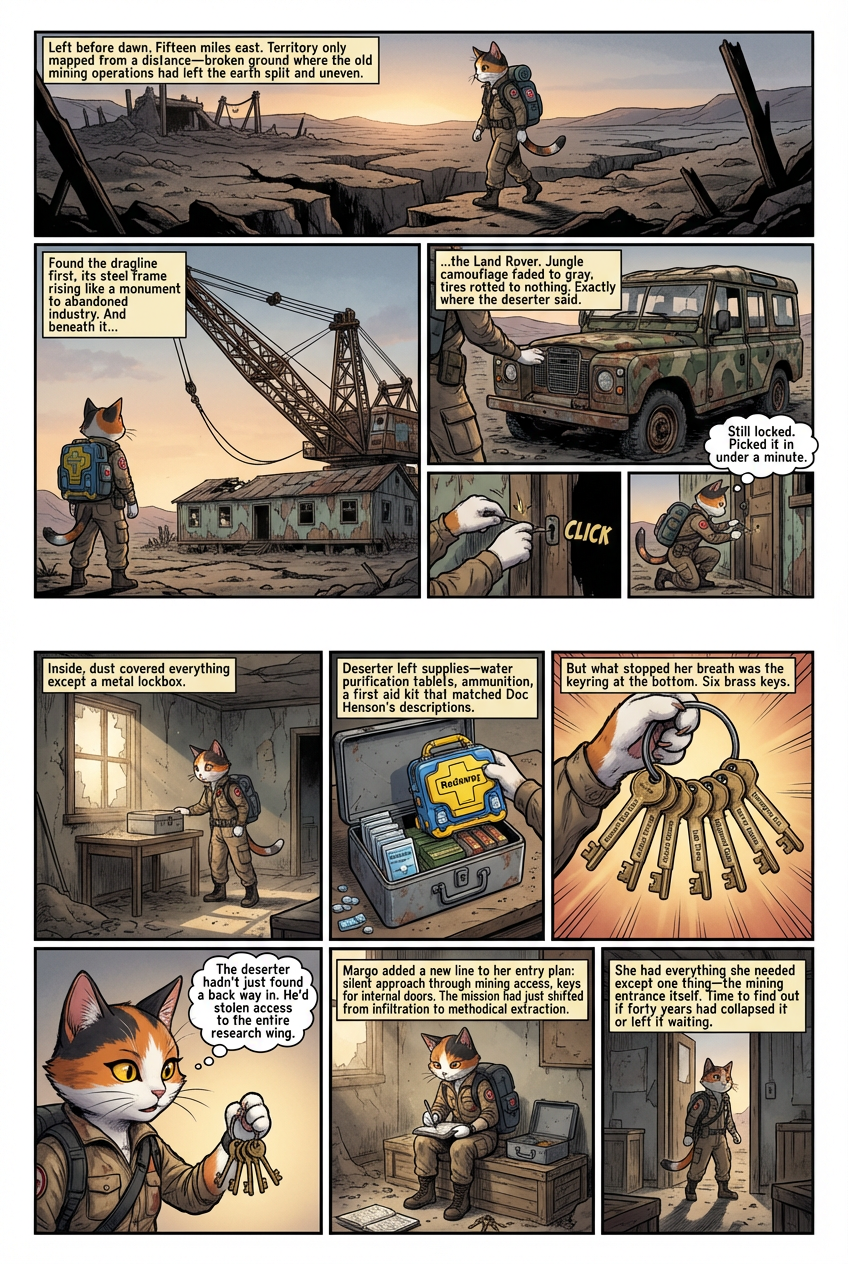
Margo left before dawn with the deserter's coordinates memorized and Doc Henson's field kit strapped to her pack. The fifteen-mile trek east took her through territory she'd only mapped from a distance—broken ground where the old mining operations had left the earth split and uneven. She found the dragline first, its steel frame rising against the morning sky like a monument to abandoned industry. The cables hung slack between the towers, and beneath the boom's shadow sat an old bunkhouse with peeling paint and broken windows. The Land Rover was there too, exactly where the deserter said it would be—jungle camouflage faded to gray, tires rotted to nothing. Margo checked the bunkhouse door. Still locked. She picked it in under a minute. Inside, dust covered everything except a metal lockbox on the table. The deserter had left supplies—water purification tablets, ammunition, a first aid kit that matched Doc Henson's descriptions. But what stopped her breath was the keyring at the bottom. Six brass keys, each labeled in faded ink: Research Wing Main, Archive Storage, Lab Three, Equipment Cage, Server Access, Emergency Exit. The deserter hadn't just found a back way in. He'd stolen access to the entire research wing before he ran. Margo tested each key against the light, checking for damage. All intact. The override codes she'd memorized would open security doors, but these keys would let her move through the research wing without triggering every alarm in the system. She pocketed the ring and pulled out her notebook, adding a new line to her entry plan: silent approach through mining access, keys for internal doors, override codes held in reserve. The mission had just shifted from infiltration to methodical extraction. She had everything she needed except one thing—the mining entrance itself. Time to find out if forty years had collapsed it or left it waiting.
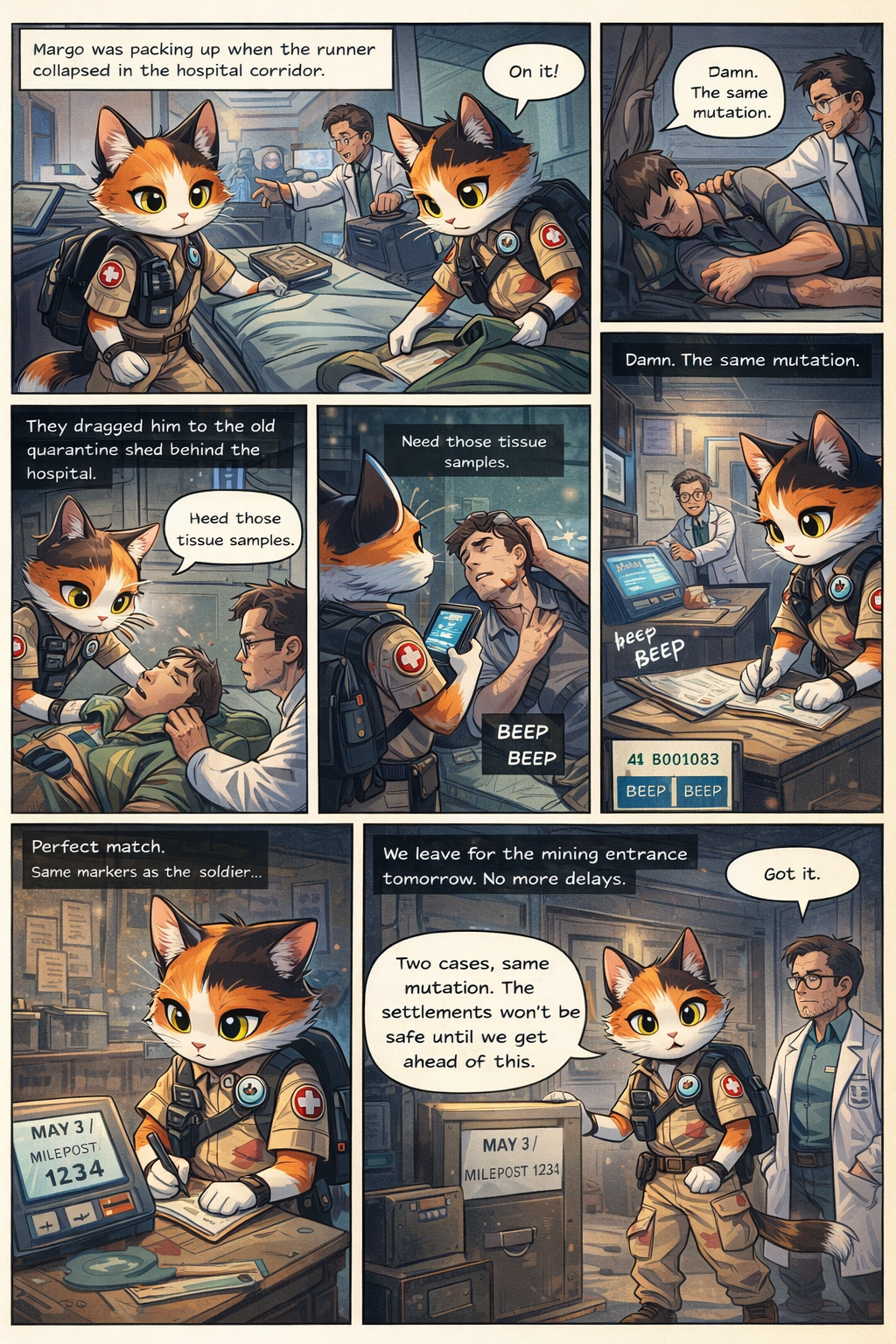
Margo was already packing the medical scanner when the runner collapsed in the hospital corridor. Doc Henson caught him before he hit the floor, calling for her even as she grabbed her field kit and crossed the room in six strides. The man wore a courier's pack and had the lean build of someone who covered twenty miles a day between settlements. Sweat soaked through his shirt despite the cool morning air, and when Margo pressed two fingers to his neck, his pulse hammered weak and irregular. She pulled back his eyelids—pupils dilated, whites showing the same yellow tinge she'd seen in the wounded soldier. Her stomach dropped. She needed a tissue sample now, but not here where anyone could walk past and see what she found. Doc Henson helped her drag the man to the old quarantine shed behind the hospital, the one with reinforced walls and a door that locked from outside. Inside smelled like rust and disinfectant. Margo worked fast—drew blood, swabbed tissue from his gums, ran the scanner over his torso while Doc Henson monitored his breathing. The readings came back in ninety seconds. Same mutation markers. Same cellular breakdown. She checked them twice, then pulled out her notebook and compared the data point by point against the soldier's results from three days ago. Perfect match. She walked to the metal filing cabinet in the corner and pulled out a fresh folder, labeling it with the date and the vintage milepost marker she'd seen at the settlement's edge—the route this runner had taken before he ended up here. Two cases now, different exposure sites, same progression pattern. The depot's equipment wasn't just useful anymore. It was the only way to track where this mutation was spreading before every settlement started bringing her bodies instead of patients. She locked the cabinet and turned to Doc Henson. "We leave for the mining entrance tomorrow. No more delays."
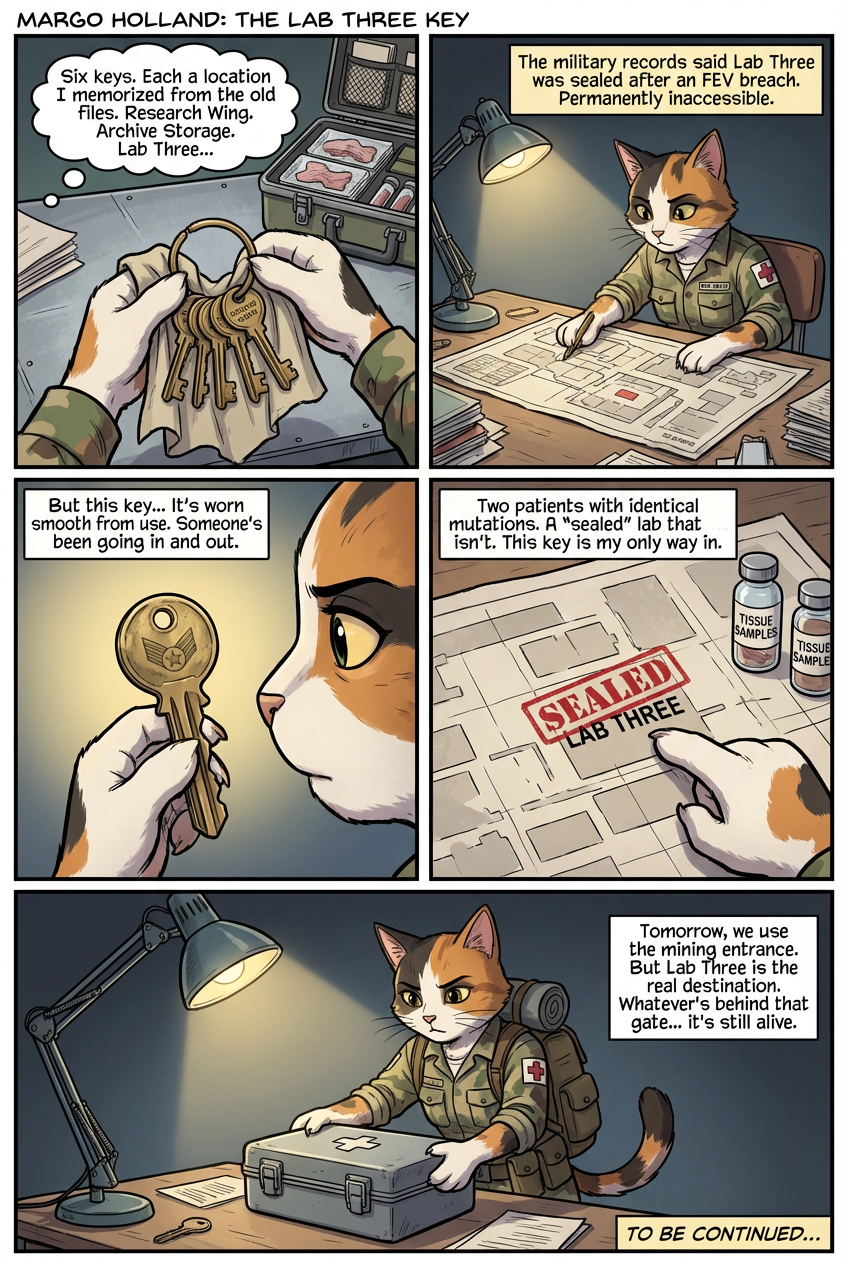
Margo wrapped the keyring in cloth and tucked it into her field kit beside the tissue samples. Six keys, each one stamped with a location she'd memorized from the military files a year ago. Research Wing. Archive Storage. Lab Three. Equipment Cage. Server Access. Emergency Exit. She pulled out the files now and spread them across the hospital's metal desk, tracing the facility map with one finger until she found what didn't fit. The military records showed Lab Three sealed after a catastrophic FEV breach—welded shut, they claimed, with personnel casualties listed and the wing marked as permanently inaccessible. But the deserter had carried a key to it, brass worn smooth from use, the military insignia still visible on the bow. Someone had been going in and out long after the official seal. Margo held the key up to the light and studied the notched shaft. The records made sense now in a way that tightened her chest. They'd sealed the main entrance, posted warning signs with red paint that would keep anyone from asking questions. But they'd left themselves a back door, and the deserter had stolen the keyring before he ran. She set the key down and looked at the map again, calculating. Lab Three sat adjacent to the research wing where the diagnostic equipment would be stored. If the official seal was theater, then her override codes wouldn't just be backup—they'd be useless against a lock that still worked. She pulled the tissue samples from her kit and held them next to the key. Two patients with identical mutations, a lab that was supposed to be permanently sealed but wasn't, and a keyring that gave her access to the one place her medical codes couldn't reach. The mutation wasn't spreading randomly—it was coming from somewhere specific, somewhere the military had tried to hide behind warnings and rust-stained gates. She packed the key separately from the others and locked her field kit. Tomorrow they'd use the mining entrance, but Lab Three was the real destination now. Whatever was behind that gate, it was still alive enough to spread.
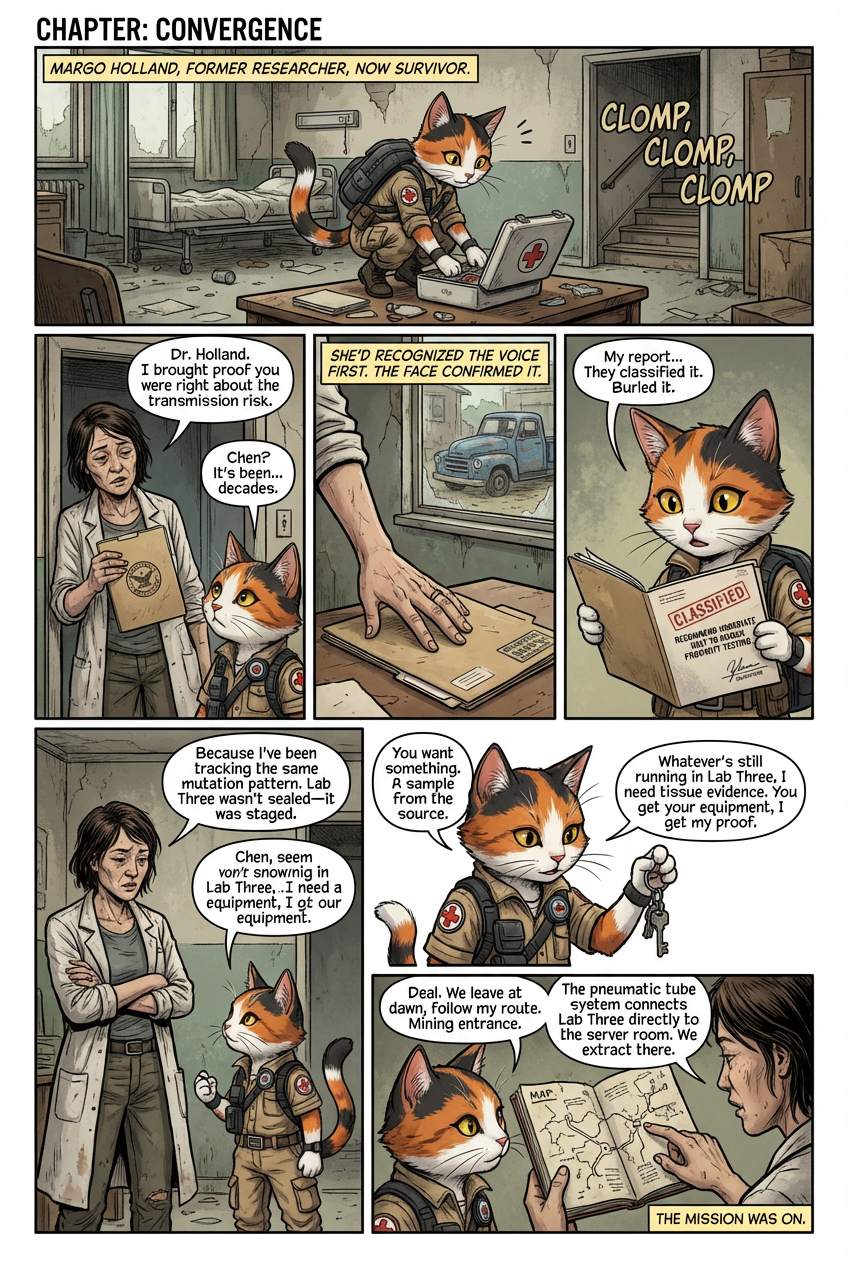
Margo was halfway through loading the medical kit when she heard boots on the hospital stairs. She didn't look up until the footsteps stopped at the doorway, familiar enough that she knew who it was before the voice confirmed it. "Dr. Holland." The woman held up a folder with military stamps across the front. "I brought proof you were right about the transmission risk." Margo recognized the voice first—clipped, precise, the kind that cut through radio static without losing a syllable. Then the face. Dr. Chen had worked two labs down from her in the research facility before the bombs fell. The wedding ring on her finger was scratched dull now, the band worn thin where it used to catch light under fluorescent fixtures. She'd driven in on a faded blue truck Margo could see through the window, parked crooked like she'd been in a hurry. The folder hit the desk between them. Inside was Margo's own signature at the bottom of a report recommending immediate halt to human proximity testing. The date showed she'd filed it three weeks before the facility went dark. Margo picked up the report and scanned the text. She'd documented six cases of cellular breakdown in lab personnel with no direct FEV contact, all presenting identical mutation markers to what she was seeing now in the courier and the soldier. The military had classified it, buried it deep enough that she'd assumed every copy went down with the facility. But Chen had kept one. "Why now?" Margo asked. Chen leaned against the doorframe, arms crossed. "Because I've been tracking the same mutation pattern you found. Four settlements in the last month, all within fifty miles of Sierra Army Depot. Lab Three wasn't sealed—it was staged to look sealed while they kept running tests through the back access." She pulled a second document from the folder, this one showing supply requisitions dated two years after the supposed breach. "They needed someone to blame when it spread, so they made sure your report disappeared." Margo set the papers down carefully, her hands steady despite the weight settling in her chest. The mutation wasn't an accident or a new variant—it was the same contamination she'd tried to stop decades ago, still spreading because the military had chosen secrecy over containment. Chen was offering her the proof she'd need to justify the mission to anyone who questioned it, but it came with a cost. If Chen knew about Lab Three's active status, she knew Margo was planning to go in. "You want something," Margo said. Chen nodded once. "A sample from the source. Whatever's still running in Lab Three, I need tissue evidence to prove the transmission chain. You get your diagnostic equipment, I get my proof." Margo looked at the keyring in her kit, then back at Chen. She'd planned this as a surgical extraction—get in, grab the equipment, get out before the mutations spread further. Now Chen was asking her to collect evidence from the contamination source itself, which meant going deeper into Lab Three than she'd intended. "Deal," Margo said, and pulled the Lab Three key from her kit. She held it up so Chen could see the military insignia, then tucked it back with the others. "But we leave at dawn, and you follow my route. I've got access through the mining entrance and keys to the restricted areas. You try to improvise, you're on your own." Chen's expression didn't change, but she pulled a worn notebook from her jacket and opened it to a hand-drawn map of Sierra Army Depot's underground layout. "I've been mapping their supply routes for six months. The pneumatic tube system connects Lab Three directly to the server room—that's where they stored the transmission data." She tapped a junction point on the map. "We extract there, we get both the equipment and the source documentation
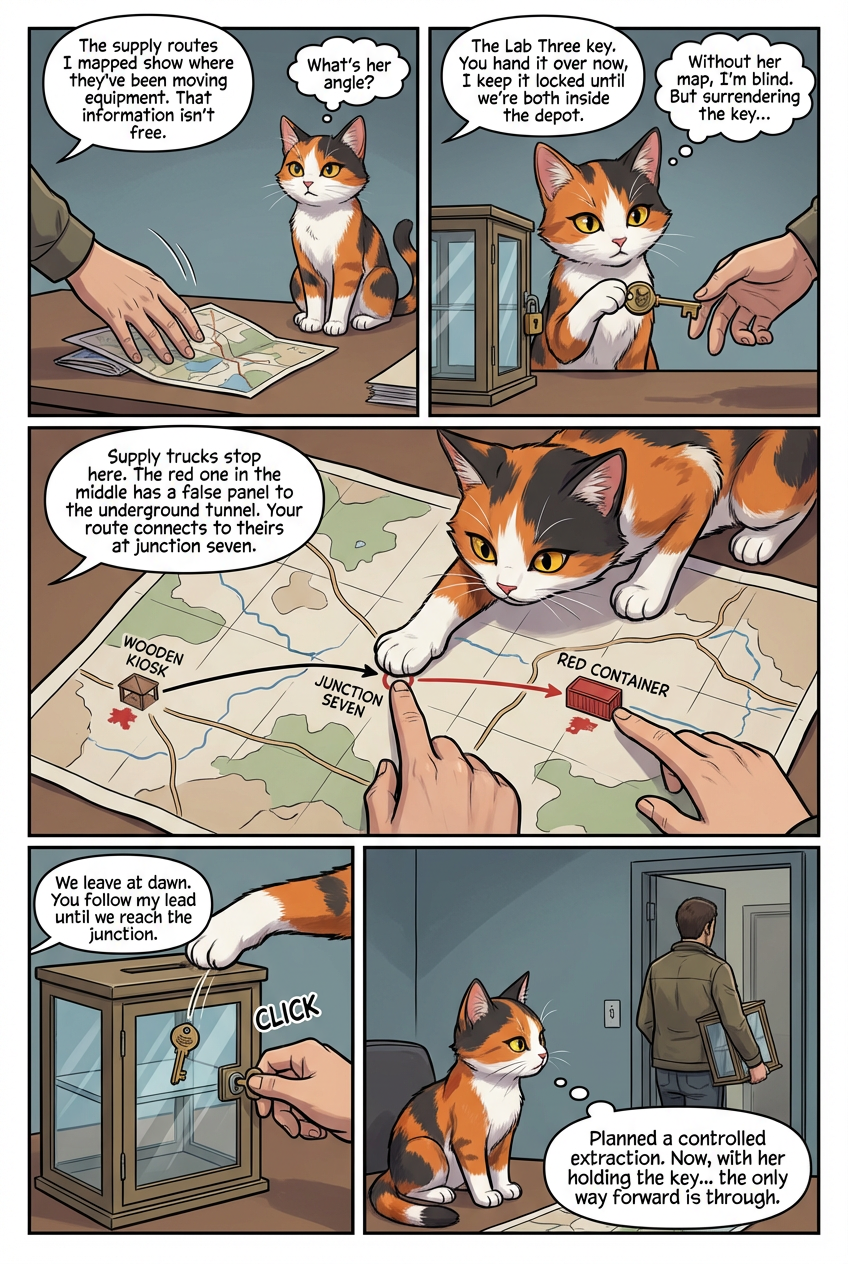
Chen folded the map and slid it across the desk. "The supply routes I mapped show where they've been moving equipment in and out. That information isn't free." Margo studied the woman's expression, looking for the angle. Chen had driven hours to bring proof, offered detailed intel on Lab Three's layout, and now wanted payment. "What's your price?" Margo asked. Chen reached into her jacket and pulled out a small glass cabinet with a keyed lock, setting it on the desk between them. "The Lab Three key. You hand it over now, I keep it locked until we're both inside the depot. Then you get it back." Margo looked at the cabinet, then at the map. The supply routes were marked in detail—container yards, checkpoints, guard rotations. Chen had traced every movement for months. Without it, Margo would be navigating blind through active military territory. But surrendering the key meant trusting Chen wouldn't disappear with the only access to Lab Three. Margo pulled the keyring from her medical kit and isolated the Lab Three key. She held it up so Chen could see the military insignia, then set it on the desk. "Show me the route first." Chen unfolded a larger map and pointed to a wooden kiosk structure marked fifteen miles east of the depot. "Supply trucks stop here twice a week. The containers are stacked in a pattern—blue, red, blue. The red one in the middle has a false panel that leads to the underground access tunnel. I've watched them use it for six months." She traced a path from the kiosk to the mining entrance Margo had already planned to use. "Your route connects to theirs at junction seven. From there, the pneumatic system takes you straight to Lab Three." Margo picked up the key and dropped it into Chen's cabinet. The lock clicked as Chen turned it, then pocketed the small brass key. "We leave at dawn," Margo said. "You follow my lead until we reach the junction, then your route takes over." Chen nodded and tucked the cabinet under her arm. Margo watched her walk to the door, the cabinet containing her only access to Lab Three now in someone else's hands. She'd planned this mission as a controlled extraction, but Chen had just shifted the terms. Now Margo would enter the depot with a partner who held leverage, and the only way forward was through.
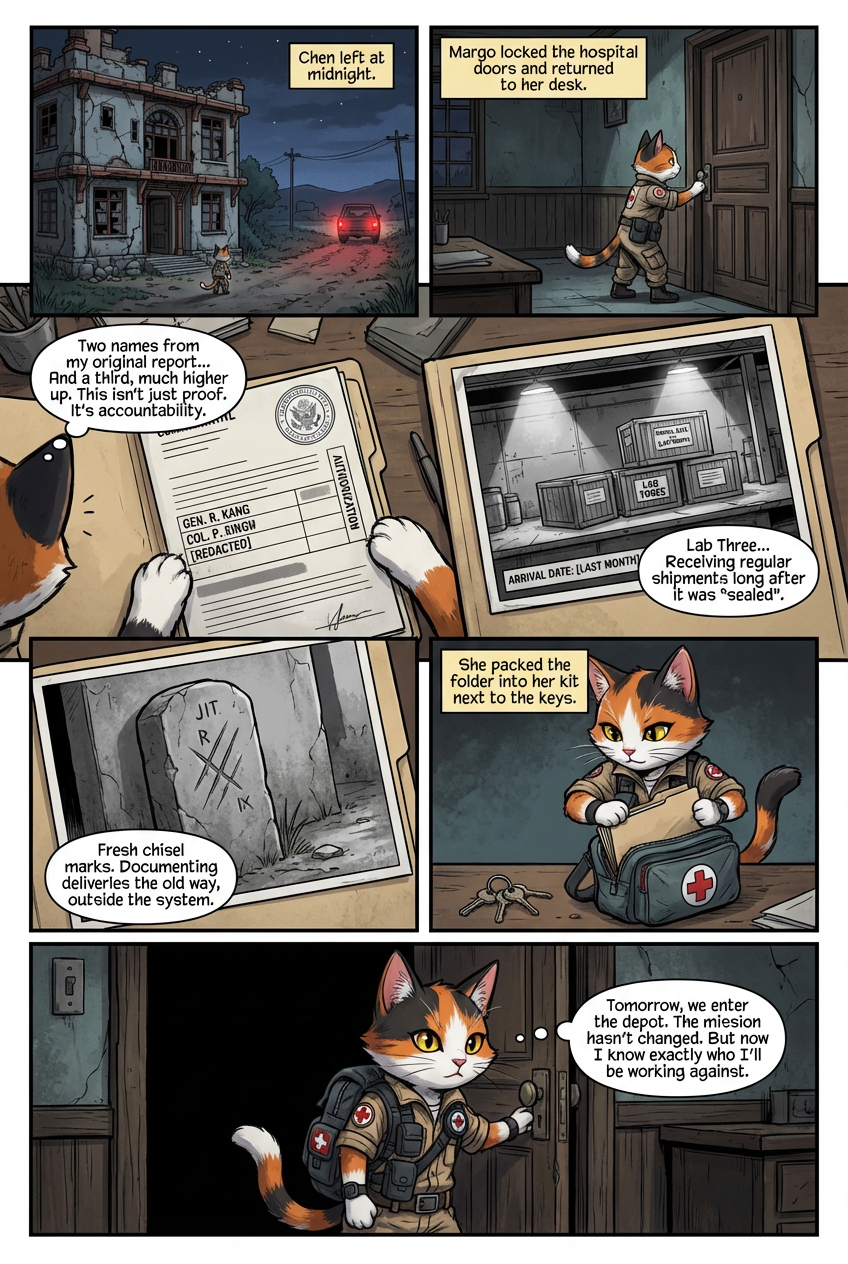
Chen left at midnight, citing supply routes and timing. Margo watched the headlights disappear down the dirt road, then locked the hospital doors and returned to her desk. The classified documents Chen had brought sat in a sealed folder, still unread. Margo opened it. The first page listed three names under a column marked "Authorization." The second page was stamped with a commemorative seal showing officer insignias and dates. Margo recognized two of the names from her original report's distribution list—the same officers who'd received her transmission risk findings three weeks before the facility went dark. The third name belonged to someone higher up the chain, someone with enough authority to bury the entire investigation. Chen hadn't just brought proof. She'd brought accountability. Margo flipped to the next section and found photographs of a loading dock. The images showed metal crates stacked under bright work lights, each one labeled with arrival dates from the past six months. The timestamps proved Lab Three had been receiving regular shipments long after it was supposedly sealed. One photo showed a stone marker near the dock entrance with fresh chisel marks—initials carved into weathered rock, the lighter stone beneath exposed and recent. Someone had been documenting deliveries the old way, keeping records outside the official system. Margo closed the folder and checked her medical kit. The documents named the officers, showed the active operation, and confirmed Chen's intelligence was solid. But they also meant Margo was walking into a facility that wasn't just contaminated—it was being deliberately maintained by people who'd already proven they'd bury evidence. She packed the folder into her kit next to the remaining keys. Tomorrow she'd enter the depot with Chen, retrieve the diagnostic equipment, and get tissue samples from whatever was still running inside Lab Three. The mission hadn't changed. But now she knew exactly who she'd be working against when she got there.
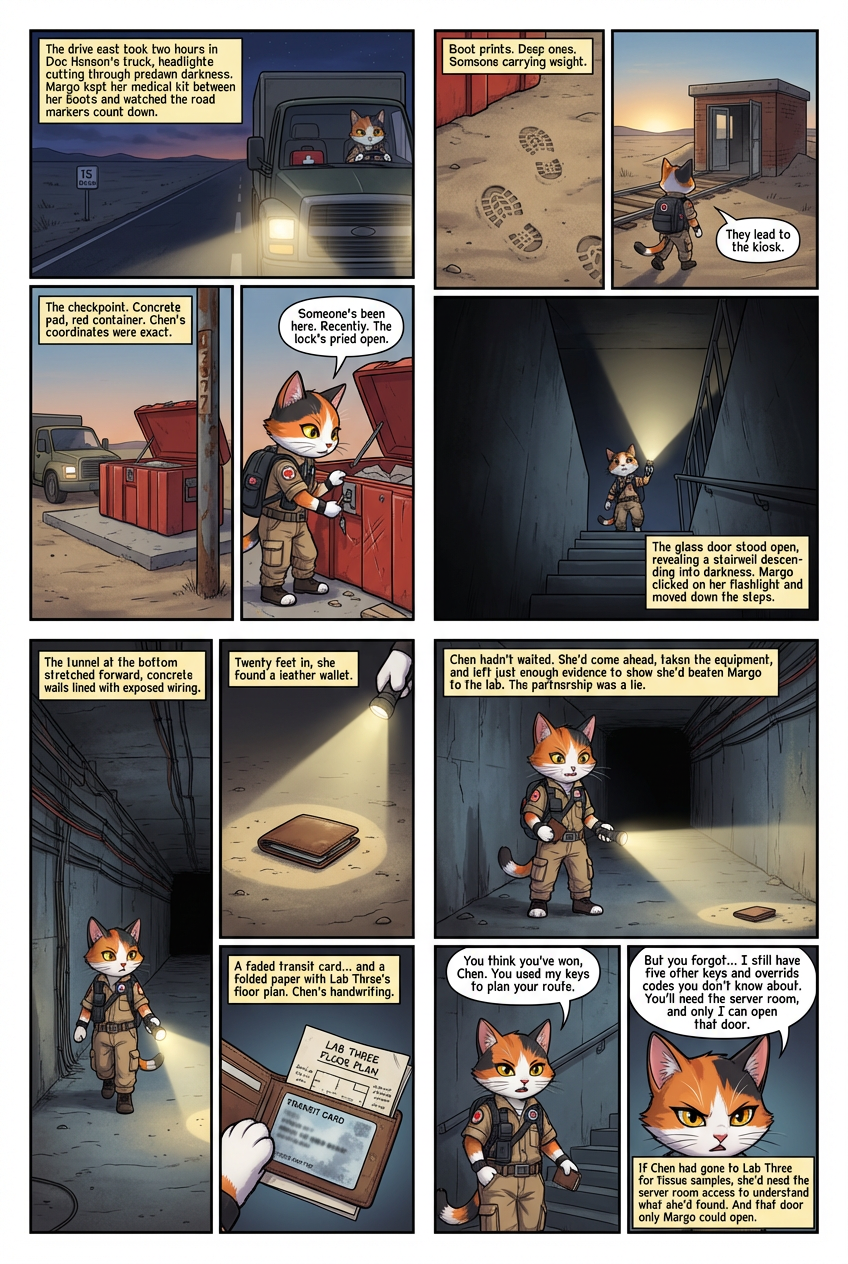
The drive east took two hours in Doc Henson's truck, headlights cutting through predawn darkness. Margo kept her medical kit between her boots and watched the road markers count down. Chen had given exact coordinates to the checkpoint—fifteen miles from the depot's eastern perimeter, marked by a rusted metal post with faded numbers. The checkpoint appeared as a concrete pad with a single red supply container, its lid propped open. Margo climbed out and approached the metal box. The locking mechanism had been pried apart recently—fresh scratches on the hasp, packing materials spilling over the sides. Someone had already found Chen's hidden access point. Boot prints led away from the container toward a brick structure thirty yards north, half-buried in sand. The prints were deep, made by someone carrying weight. Margo followed the tracks to the brick kiosk. The glass door stood open, revealing a stairwell descending into darkness. She clicked on her flashlight and moved down the steps, one hand on the rail. The tunnel at the bottom stretched forward, concrete walls lined with exposed wiring. Twenty feet in, she found a leather wallet lying face-up on the ground. She picked it up and flipped it open. A faded transit card showed a military ID number, and tucked behind it was a folded paper with Lab Three's floor plan—Chen's handwriting in the margins. Margo stood still, weighing the wallet in her hand. Chen hadn't waited for dawn. She'd come ahead during the night, taken the equipment Margo needed, and left just enough evidence to make it clear she'd beaten Margo to the lab. The partnership had been leverage, nothing more—Chen had used Margo's keys to plan her route, then cut her out before the real work began. Margo pocketed the wallet and turned back toward the stairs. She still had five other keys and override codes Chen didn't know about. If Chen had gone to Lab Three for tissue samples, she'd need the server room access to understand what she'd found. And that door only Margo could open.
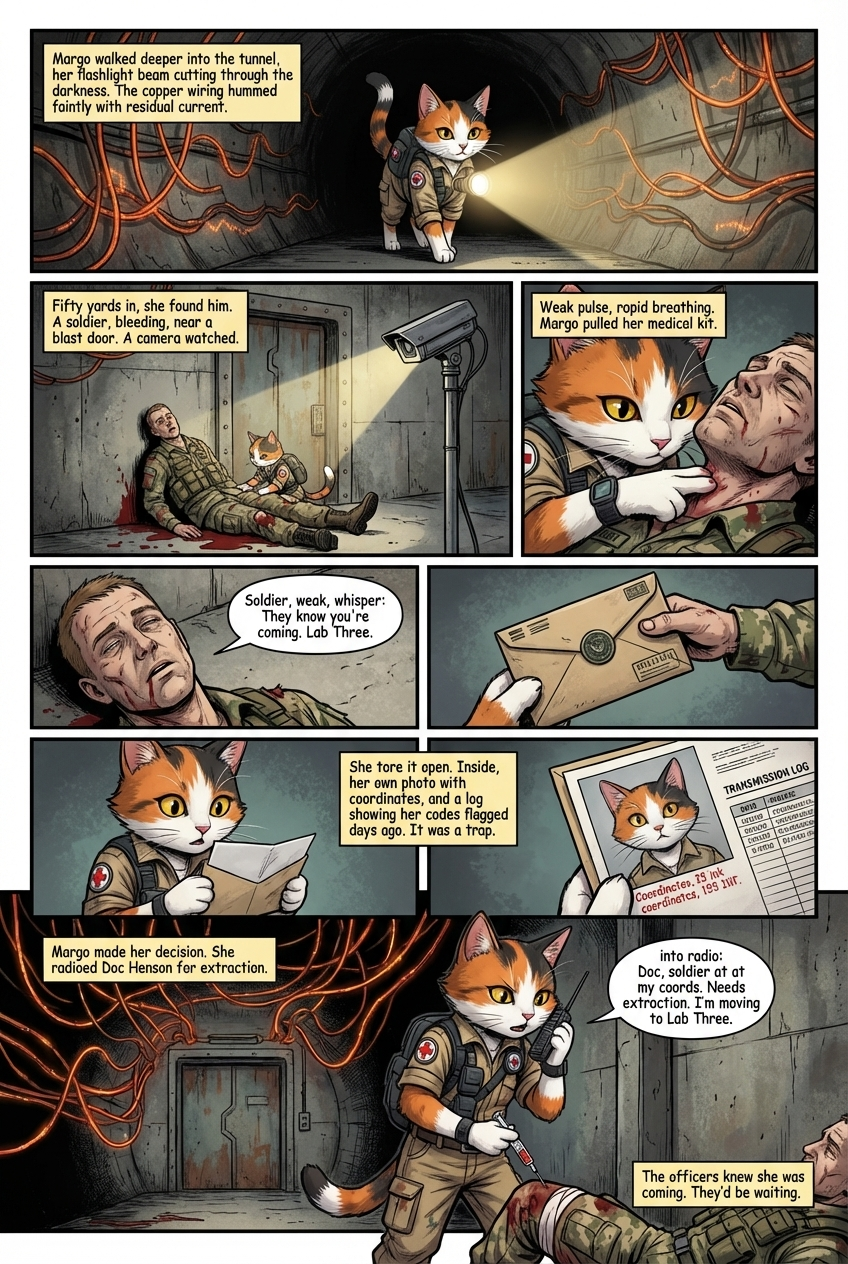
Margo walked deeper into the tunnel, flashlight beam cutting through the darkness ahead. The concrete walls pressed close on both sides, lined with copper wiring that hummed faintly with residual current. She kept her pace steady, counting steps to track distance. Fifty yards in, she found him. A soldier lay crumpled against the tunnel wall near a weathered blast door set into concrete. Blood pooled beneath his leg, dark and fresh. His uniform bore military insignia, but the fabric had been torn at the shoulder. A surveillance camera mounted on a pole twenty feet back pointed directly at his position, its wires trailing loose from the concrete base. Someone had tracked him here and left the camera running to record what happened next. Margo knelt beside him and pressed two fingers to his neck. Weak pulse, rapid breathing. She pulled her medical kit from her pack and started working on the leg wound. The soldier's hand moved, gripping her wrist. His eyes opened halfway, unfocused. He reached into his jacket with his other hand and pulled out a sealed envelope, stamped with military markings. He pressed it into her palm, his voice barely a whisper. "They know you're coming. Lab Three." Margo tore the envelope open. Inside was a printed photograph of her face—recent, taken from surveillance footage—with coordinates written across the bottom in red ink. The coordinates matched the location Chen had given her for the tunnel entrance. Beneath the photo was a transmission log showing her medical override codes flagged in the depot's security system three days ago. The officers weren't just covering up Lab Three. They'd been waiting for her specifically. Margo folded the envelope and shoved it into her jacket. She applied pressure to the soldier's leg and pulled a stim from her kit, injecting it into his thigh. His breathing steadied slightly. She couldn't carry him back alone, and leaving him here meant he'd bleed out before help arrived. But the blast door behind him led forward—toward Lab Three and the server room where she could pull the full transmission records. She had proof now that the cover-up extended beyond Chen's documents. The officers had set a trap, and Chen had walked straight into it hours ago. Margo made her decision. She activated her radio and sent coordinates to Doc Henson, marking the soldier's position for extraction. Then she stood, checked her remaining keys, and moved toward the blast door. The officers knew she was coming. That meant they'd prepared for her override codes too.
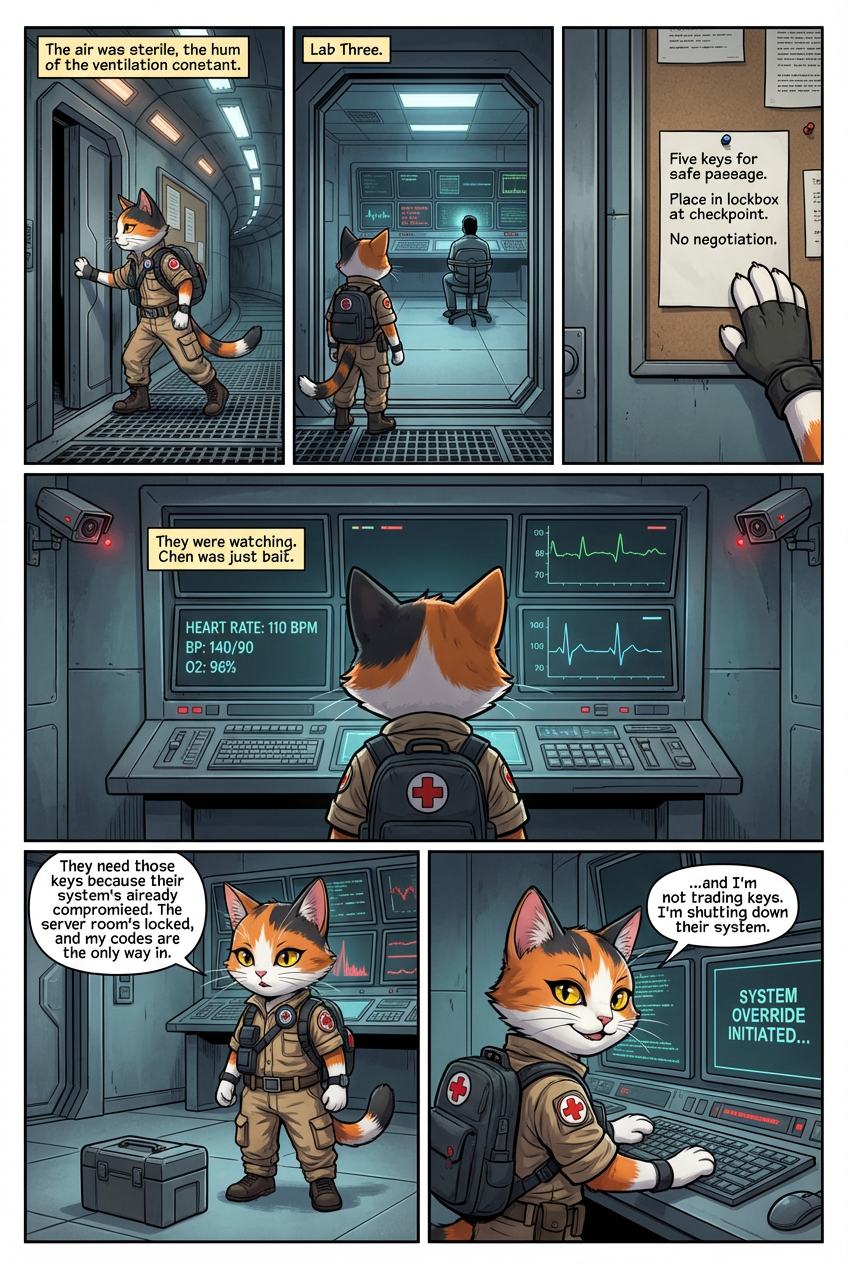
Margo pushed through the blast door and stepped into a narrow corridor lit by emergency strips along the ceiling. The air smelled sterile, filtered through ventilation systems that still hummed after all these years. Her boots echoed on metal grating as she moved forward, following the corridor's curve. The corridor opened into Lab Three. Chen sat zip-tied to a chair in the center of the room, facing a command console that covered the far wall. Monitors displayed vital signs—Chen's heart rate, blood pressure, oxygen levels—all feeding into the system in real time. A bulletin board hung beside the door, pinned with a single typed message beneath the military header: "Five keys for safe passage. Place in lockbox at checkpoint. No negotiation." Chen's eyes met hers, expression flat. No surprise. No relief. Just recognition. Margo scanned the room. One entrance behind her. No guards visible, but the cameras mounted in each corner tracked her movement. The console blinked with active programs—automated systems monitoring Chen's biometrics and the door sensors. Someone was watching from another location, using Chen as bait to force the exchange. She had five keys they wanted: Research Wing, Archive Storage, Equipment Cage, Server Access, Emergency Exit. They already had Lab Three's key from Chen. The message was clear—hand over access to the entire facility or Chen dies when the biometric readings flatline. She pulled the compact metal lockbox from her pack and set it on the floor, but didn't open it. The override codes in her jacket pocket were her real leverage—access the officers couldn't take by force. Chen had walked into the trap expecting to work alone. Margo had walked in knowing it existed. She looked at the console, then back at Chen. "They need those keys because their system's already compromised," she said. "The server room's locked, and my codes are the only way in." Chen's expression shifted slightly. Margo picked up the lockbox and moved toward the console. She wasn't trading keys for Chen's release. She was going to shut down their monitoring system and take them both out through the server access they couldn't reach without her.
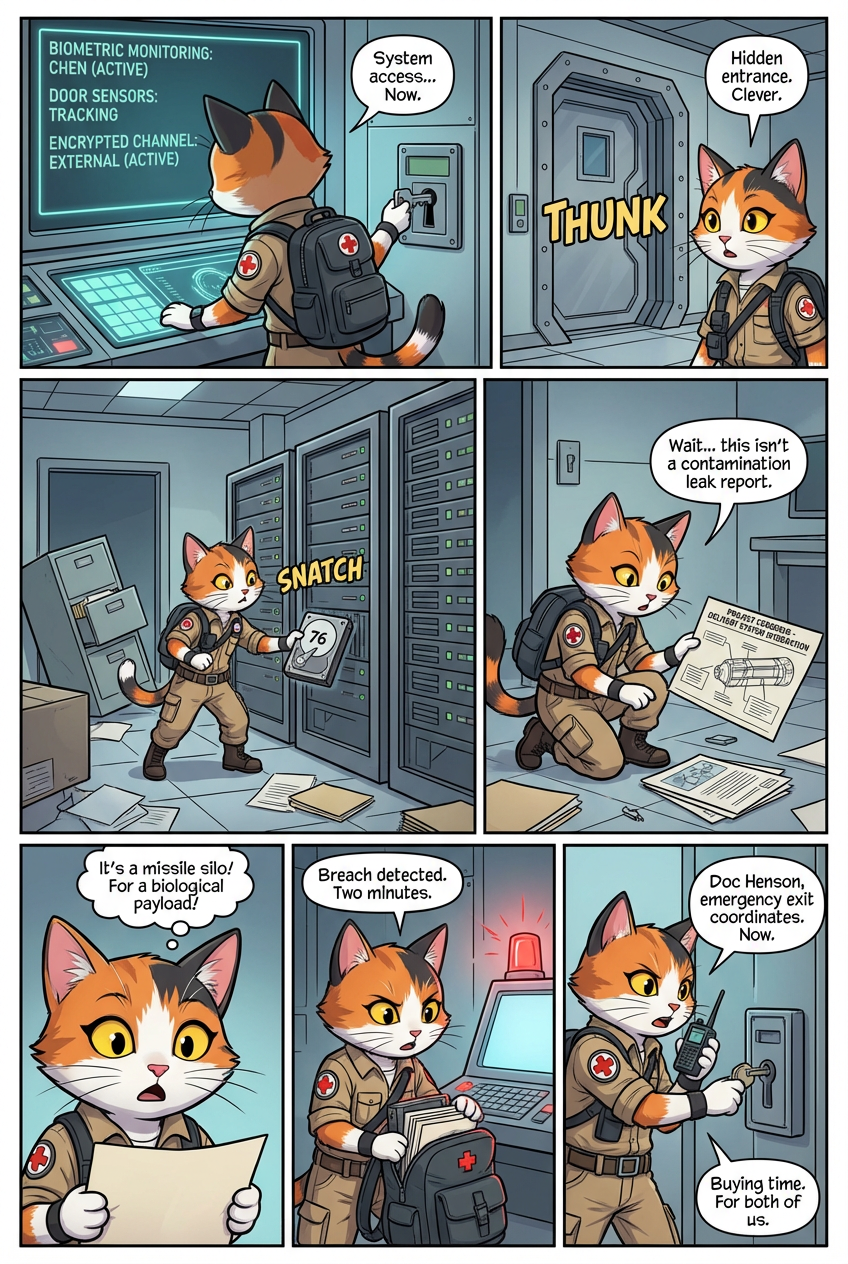
Margo moved to the console, scanning the interface for system access. The screen showed three active programs—biometric monitoring tied to Chen, door sensors tracking every entrance, and an encrypted communication channel running to an external location. She pulled the Server Access key from her pocket and slid it into the maintenance panel beside the console. The panel clicked open, revealing a terminal with a blinking cursor. She entered her medical override codes and waited. The screen flickered, then granted access to the server room's secondary entrance—a reinforced door to her left that had been invisible against the wall. The lock disengaged with a mechanical thunk. She pushed through into a cramped room dominated by three tower servers and a filing cabinet tipped on its side, documents scattered across the floor. The hard drive she needed sat in the primary server, its casing scratched and marked with the number seventy-six. She yanked it free and shoved it into her pack. The scattered files caught her attention as she turned to leave. She knelt and grabbed a handful—deployment orders, contamination reports, facility schematics. One document showed a diagram she didn't recognize at first: a vertical steel structure with launch rails and reinforcement columns. The header read "Project Cerberus - Delivery System Integration." She flipped through more pages. They weren't hiding a contamination leak. They'd built a missile silo beneath the depot and used Lab Three's mutation research to develop a biological payload. The cover-up wasn't about burying her report—it was about concealing a weapon that could spread the mutation across entire regions. Margo stood, stuffing the documents into her pack alongside the hard drive. The console in Lab Three started beeping—Chen's heart rate spiking as the system detected her breach. She had maybe two minutes before whoever was monitoring responded. The Emergency Exit key would get her out through the research wing's back corridor, but Chen was still zip-tied to that chair. She looked at the server room door, then back at the scattered files on the floor. The officers who'd built this wouldn't let either of them walk away with proof. She pulled out her radio and called Doc Henson with coordinates for the emergency exit, then grabbed the lockbox from her pack and filled it with the five keys. She wasn't trading them for Chen's life. She was buying time to get them both out before the officers realized she'd already taken everything that mattered.
Play your story to life
Storycraft is a mobile game where you create AI characters, craft items and locations to build their world, then discover what direction your story takes. Download the iOS game for free today!
Download for free