

Me at 10's Arc
9 Chapters
Me at 10's dream is being daddy’s girl forever.

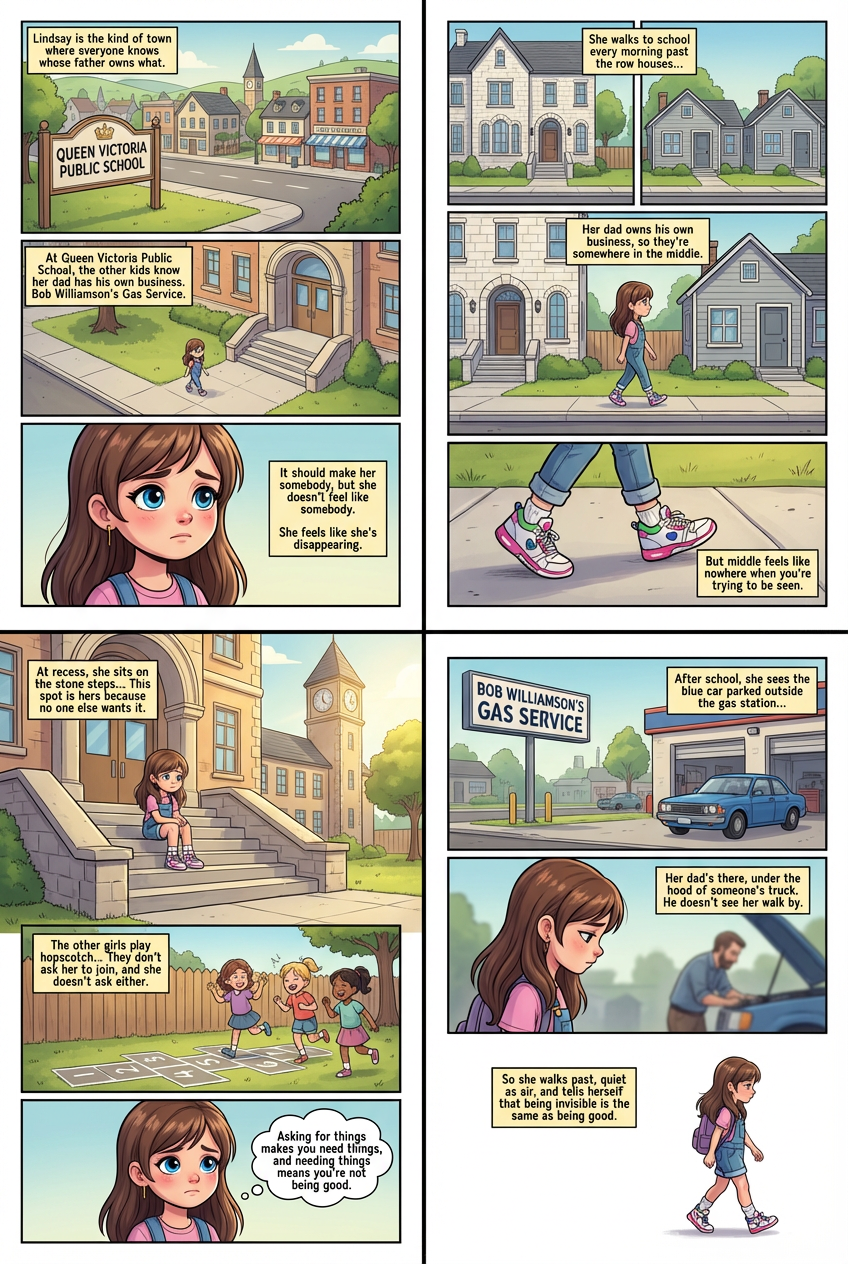
Lindsay is the kind of town where everyone knows whose father owns what. At Queen Victoria Public School, the other kids in Grade 5 know her dad has his own business. Bob Williamson's Gas Service. It should make her somebody, but she doesn't feel like somebody. She feels like she's disappearing. She walks to school every morning past the row houses on the north side of town. The white stone ones with the arched doorways and the big windows. Those belong to the doctors and the lawyers. Her house isn't like that, but it isn't like the small gray houses on the south side either. Her dad owns his own business, so they're somewhere in the middle. But middle feels like nowhere when you're trying to be seen. At recess, she sits on the stone steps at the front of the school building. The brick is warm in the sun. She can see the clock tower from here, and the heavy wooden doors behind her. This spot is hers because no one else wants it. The other girls play hopscotch by the fence. They don't ask her to join, and she doesn't ask either. Asking for things makes you need things, and needing things means you're not being good. After school, she sees the blue car parked outside the gas station down the street. Her dad's there, under the hood of someone's truck. He doesn't see her walk by. She keeps her head down and keeps walking. She used to stop in after school, just to be near him. But lately he's been busy, and she doesn't want to be the thing that gets in the way. So she walks past, quiet as air, and tells herself that being invisible is the same as being good.
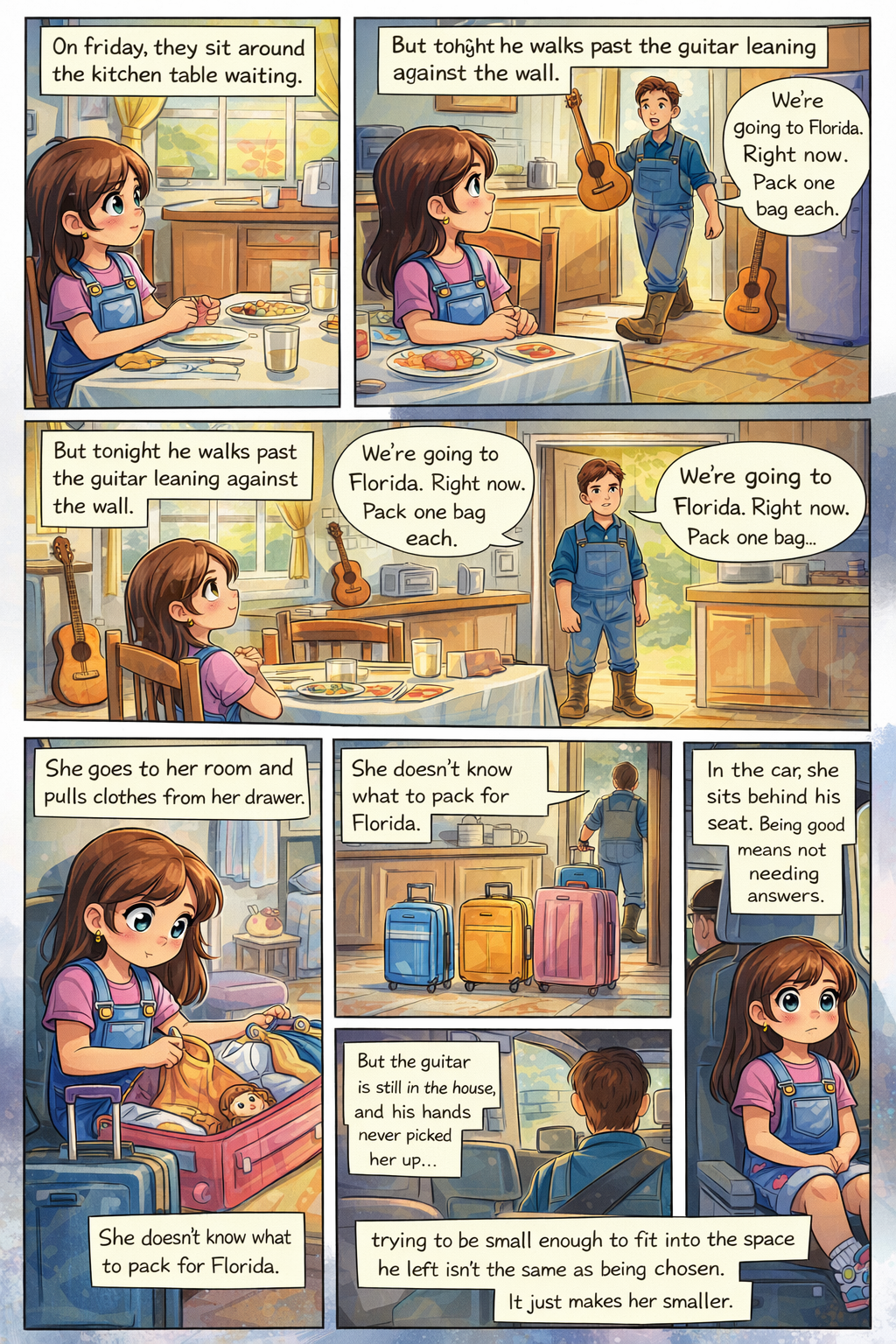
On Friday, they sit around the kitchen table waiting. This is how it always goes. Dad comes home from work, takes off his overalls and muddy boots, pulls out his guitar. He sings old country songs while they eat. She sits close enough that her knee touches the table leg. Close enough to be picked. But tonight he walks past the guitar leaning against the wall. He doesn't pull out a chair. He stands in the doorway with his boots still on and says they're going to Florida. Right now. Pack one bag each. She watches his hands. They're not reaching for her. They're not reaching for anything. She goes to her room and pulls clothes from her drawer. She doesn't know what to pack for Florida. She doesn't know why they're going. She fills her suitcase with shirts and shorts and the brown-haired doll from her bed. When she comes back to the kitchen, three bright suitcases sit by the door. Hers is the smallest. Her father is carrying them to the car, one by one, and he doesn't look at her when she stands beside him. In the car, she sits behind his seat. She can see the back of his head. She stays quiet. She doesn't ask why they're leaving or when they'll come back. Being good means not needing answers. But the guitar is still in the house, and his hands never picked her up, and she knows now that trying to be small enough to fit into the space he left isn't the same as being chosen. It just makes her smaller.
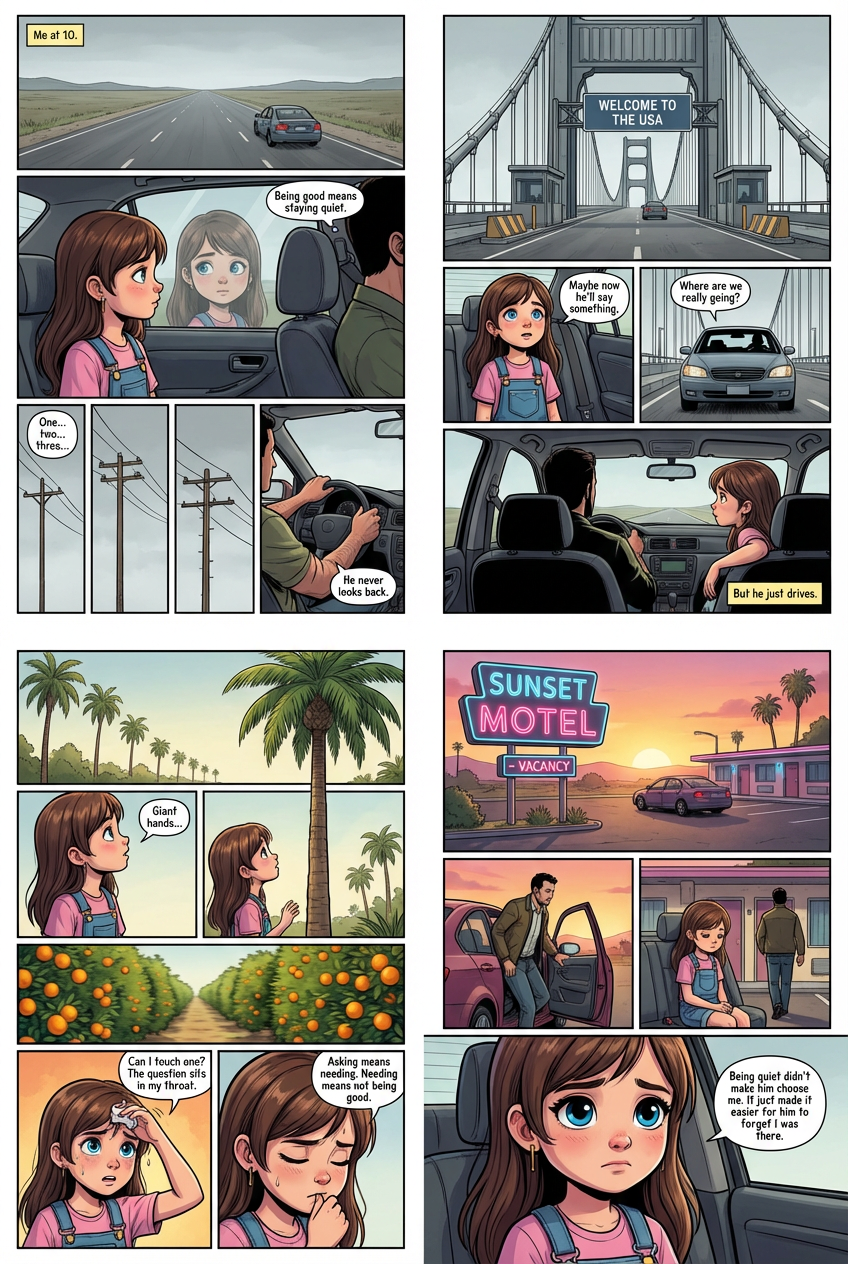
They drive and drive. She watches the back of his head and counts telephone poles. She doesn't ask where they are or how long until they stop. Being good means staying quiet, so she stays quiet. Then the bridge comes. It's bigger than any bridge she's ever seen, with guards at gates and a sign that says "Welcome to the USA". She sits up straighter. Maybe crossing into a different country will make him turn around. Maybe he'll say something to her, explain why they left, where they're really going. She leans forward in her seat and waits. But he just drives. His hands stay on the wheel. He doesn't look back. They keep going and the world outside changes. Palm trees appear, tall and strange with leaves that fan out at the top like giant hands. Then orange groves, row after row of trees heavy with bright fruit. The air coming through the window turns hot and thick. She's never seen trees like this. She's never felt heat like this. She wants to ask if they can stop, if she can touch one of the oranges, if he sees what she sees. The question sits in her throat. But asking means needing something, and needing something means she isn't being good enough. So she swallows it down and watches the trees blur past. When he finally pulls into a motel parking lot, the sun is setting and the neon sign glows pink against the sky. He gets out and slams his door. She sits in the back seat and waits for him to open hers, the way he used to. He doesn't. He walks to the motel office without looking back. She understands then. Being quiet didn't make him choose her. It just made it easier for him to forget she was there.
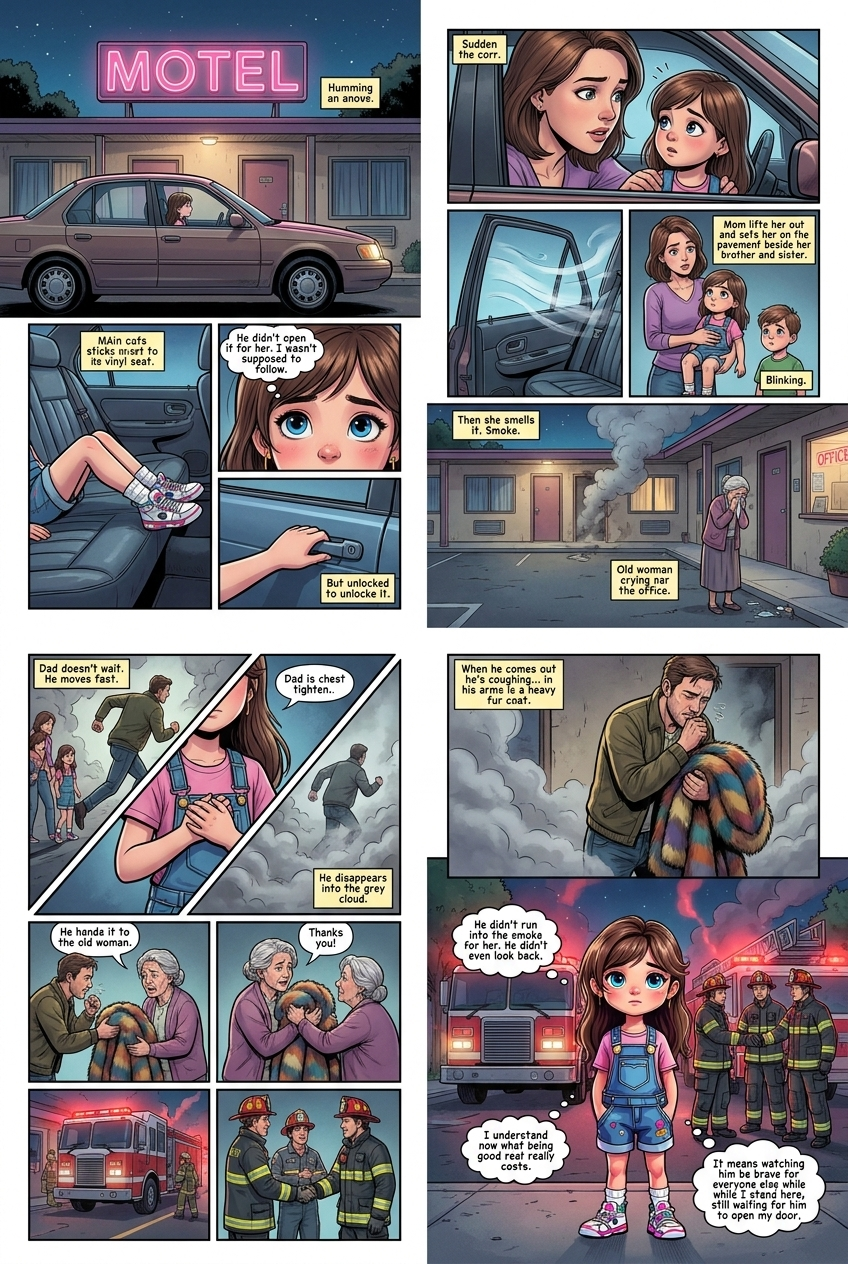
She sits in the back seat and watches him disappear through the motel office door. The neon sign hums above her. Her legs stick to the vinyl seat. She could get out now. The door isn't locked. But he didn't open it for her, which means she wasn't supposed to follow. Then someone is shaking her shoulder and she wakes up. Mom's face fills the window. The door opens and cool night air rushes in. Mom lifts her out and sets her on the pavement beside her brother and sister, all three of them blinking and confused. That's when she smells it. Smoke. Grey ribbons of it curl from a doorway three rooms down, thick and strange in the pink glow of the motel sign. An old woman stands near the office crying, her hands pressed to her face. She keeps saying something about a coat. Dad doesn't wait. He moves fast across the pavement toward the smoke, and she feels her chest go tight. This is different from the gas station, different from the long silent drive. This is him moving toward something instead of away. He disappears into the grey cloud and she holds her breath without meaning to. When he comes out he's coughing, and in his arms is a heavy fur coat with colors like rust and gold. He hands it to the woman and she clutches it to her chest, thanking him over and over. Then the fire trucks arrive, red lights spinning, and the firefighters shake his hand like he's one of them. Like he matters. She watches him standing there in the flashing lights, talking and laughing with the firefighters, and something breaks open inside her. He didn't run into the smoke for her. He didn't even look back to see if she was safe. But he ran in for a stranger's coat. She understands now what being good really costs. It means watching him be brave for everyone else while she stands on the pavement, still waiting for him to open her door.
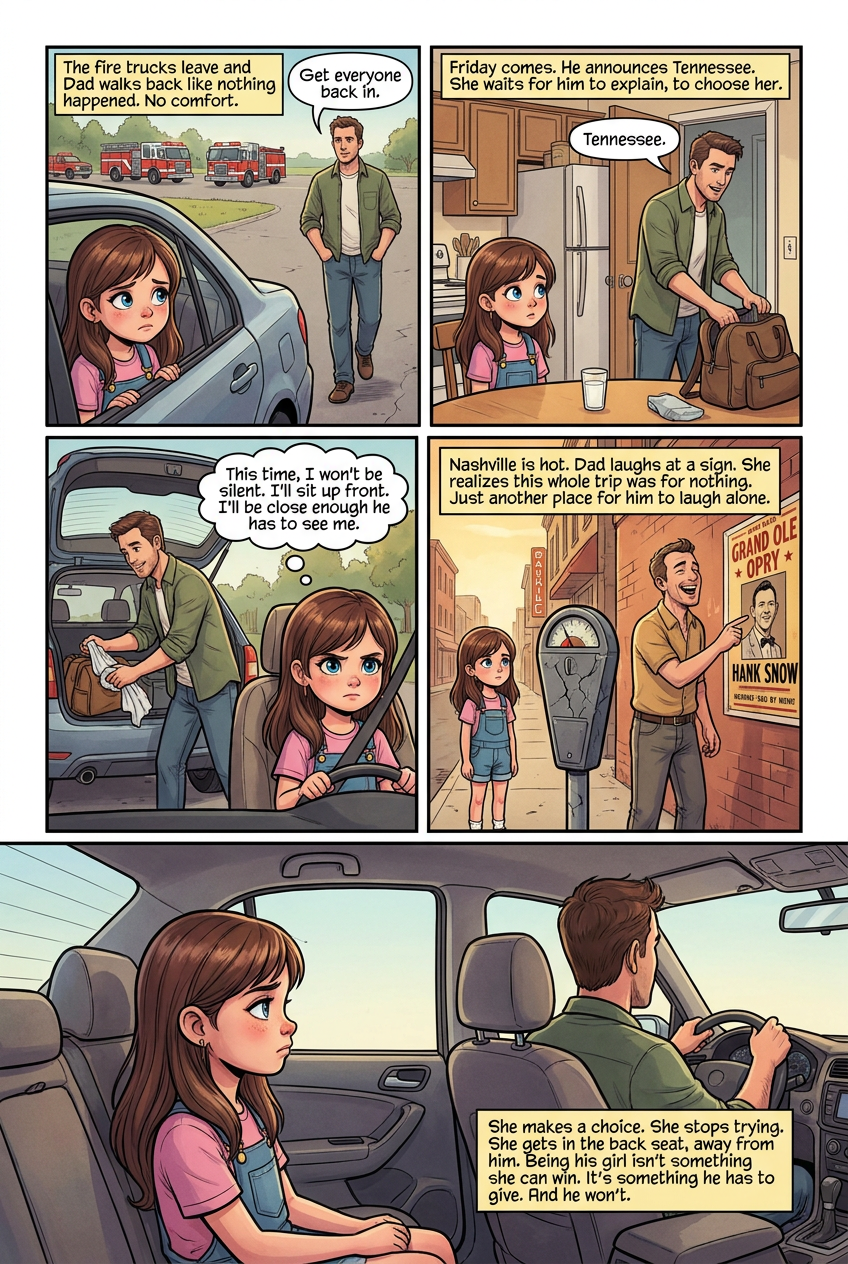
The fire trucks leave and Dad walks back to the car like nothing happened. He doesn't ask if she's okay. He doesn't put his hand on her shoulder or check on her brother and sister. He just opens the driver's door and tells Mom to get everyone back in. Friday comes and he's standing in the kitchen doorway saying Tennessee. Not asking. Just announcing it like he announced Florida. She sits perfectly still at the table and waits for him to look at her, to explain, to pick her. But he's already loading bags into the car. She watches through the window as he slams the trunk and wipes his hands on his jeans. This time she decides she won't wait in silence. This time she'll sit up front. She'll be close enough that he has to see her. Close enough that she matters more than whatever he's driving toward. Nashville is hot and the buildings are taller than she expected. Dad parks on a street she doesn't know and points at a building with tall windows and a sign that says Grand Ole Opry. She climbs out and stands beside a parking meter with a cracked face while he reads a poster near the entrance. Hank Snow's name stretches across it in big letters. Dad starts laughing. Not the kind that invites her in, but the kind that seals him off. He says they could have stayed in Canada and keeps laughing like it's the best joke he's ever told. She looks at the poster and the building and the cracked meter and understands that this whole trip was for nothing. Tennessee was just another place for him to laugh alone. She doesn't cry. She stands there on the hot pavement and makes a choice. She stops trying to be close. She stops believing that sitting up front or being quiet or being good will make him pick her. He brought her all this way to laugh at a sign. She gets back in the car without asking where they're going next. She sits in the back seat this time, away from him, and when he starts the engine she looks out the window instead of at his face. Being his girl forever isn't something she can win. It's something he has to give. And he won't.
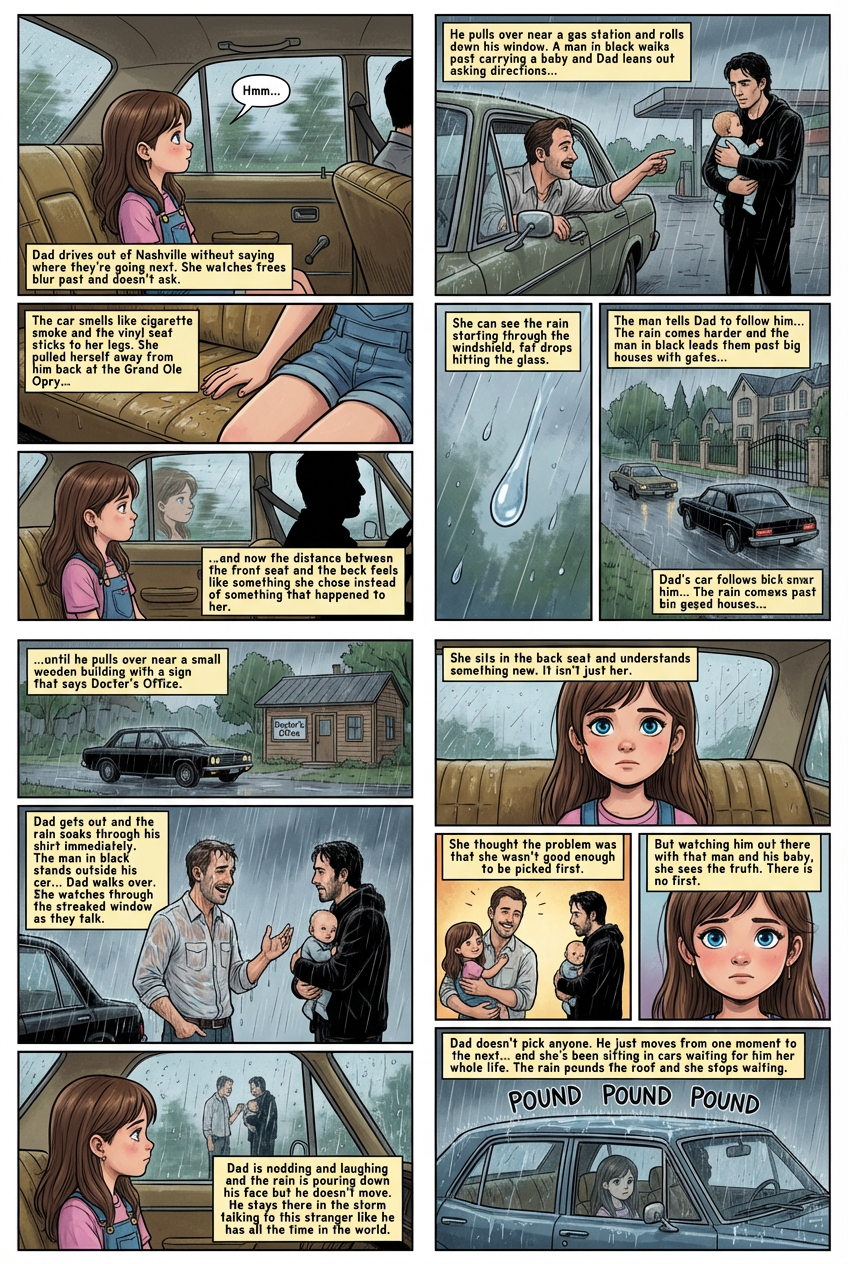
Dad drives out of Nashville without saying where they're going next. She watches trees blur past the window and doesn't ask. The car smells like cigarette smoke and the vinyl seat sticks to her legs. She pulled herself away from him back at the Grand Ole Opry and now the distance between the front seat and the back feels like something she chose instead of something that happened to her. He pulls over near a gas station and rolls down his window. A man in black walks past carrying a baby and Dad leans out asking directions to some mansion he saw on a brochure. The man stops and listens and then points down the road. She can see the rain starting through the windshield, fat drops hitting the glass. The man tells Dad to follow him and walks toward a black car parked under the trees. Dad starts the engine and follows. The rain comes harder and the man in black leads them past big houses with gates and long driveways until he pulls over near a small wooden building with a sign that says Doctor's Office. Dad gets out and the rain soaks through his shirt immediately. The man in black stands outside his car holding the baby under his jacket and Dad walks over. She watches through the streaked window as they talk. Dad is nodding and laughing and the rain is pouring down his face but he doesn't move. He stays there in the storm talking to this stranger like he has all the time in the world. She sits in the back seat and understands something new. It isn't just her. Dad will stop for anyone. He'll drive strangers anywhere, stand in the rain with men he doesn't know, laugh at their jokes while water runs down his neck. She thought the problem was that she wasn't good enough to be picked first. But watching him out there with that man and his baby, she sees the truth. There is no first. Dad doesn't pick anyone. He just moves from one moment to the next, stops for whoever crosses his path, and she's been sitting in cars waiting for him her whole life. The rain pounds the roof and she stops waiting.
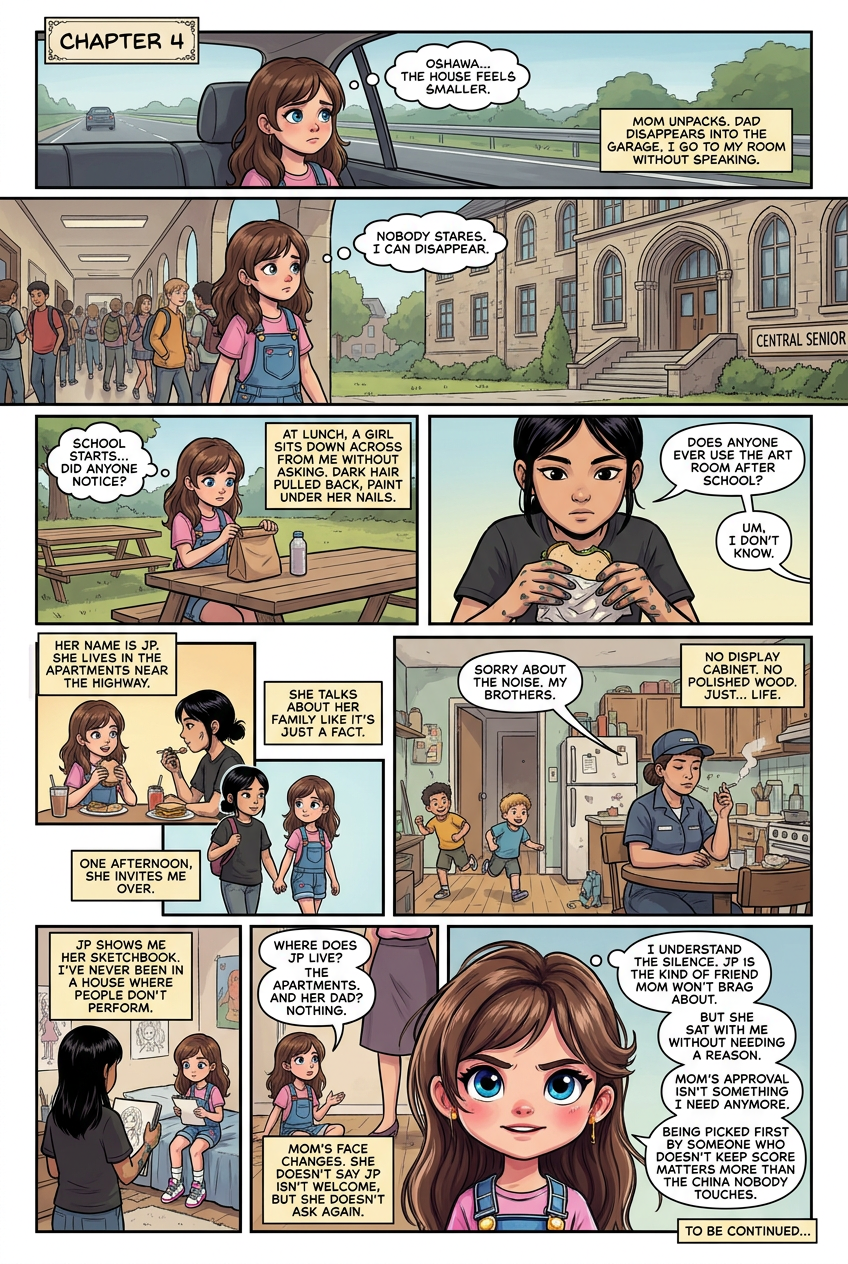
They drive back to Oshawa and the house feels smaller than before. Mom unpacks the suitcases while Dad disappears into the garage and she goes to her room without speaking. School starts again on Monday and she doesn't know if anyone noticed she was gone. Central Senior has stone walls and arched windows that make it look like it belongs in a different time. She walks through the front doors and nobody stares. The hallways are crowded enough that she can disappear into them without trying. At lunch she sits at a picnic table outside near the edge of the yard and opens her bag. A girl sits down across from her without asking. The girl has dark hair pulled back and paint under her fingernails and she unwraps a sandwich like she's been sitting here all along. She doesn't introduce herself or explain why she chose this table. She just eats and watches the yard and after a while she asks if anyone ever uses the art room after school. The question isn't pointed at anyone in particular but the protagonist answers anyway. They talk about nothing important until the bell rings. The girl starts sitting with her every day. Her name is JP and she lives in the apartments near the highway with her mom and two younger brothers. She talks about her family like it's just a fact, not something to apologize for or hide. One afternoon JP invites her over and she says yes before thinking it through. JP's apartment is small and loud and there's no display cabinet in the front room, no polished wood or glass doors holding things that nobody uses. Her brothers are running through the kitchen and JP's mom is smoking at the table in her work uniform and nobody tells them to be quiet or sit still. JP pulls her into the bedroom they all share and shows her a sketchbook full of drawings. The protagonist realizes she's never been in a house where people don't perform. She doesn't tell Mom about JP right away. When she finally does, Mom asks where JP's family lives and what her father does and the protagonist says the apartments and nothing. Mom's face changes. She doesn't say JP isn't welcome but she doesn't ask about her again either. The protagonist understands what the silence means. JP is the kind of friend Mom won't brag about at church or mention to the neighbors. But JP is the first person in years who chose to sit with her without needing a reason. She decides Mom's approval isn't something she needs anymore. She's been picked first by someone who doesn't keep score and that matters more than the china nobody touches.
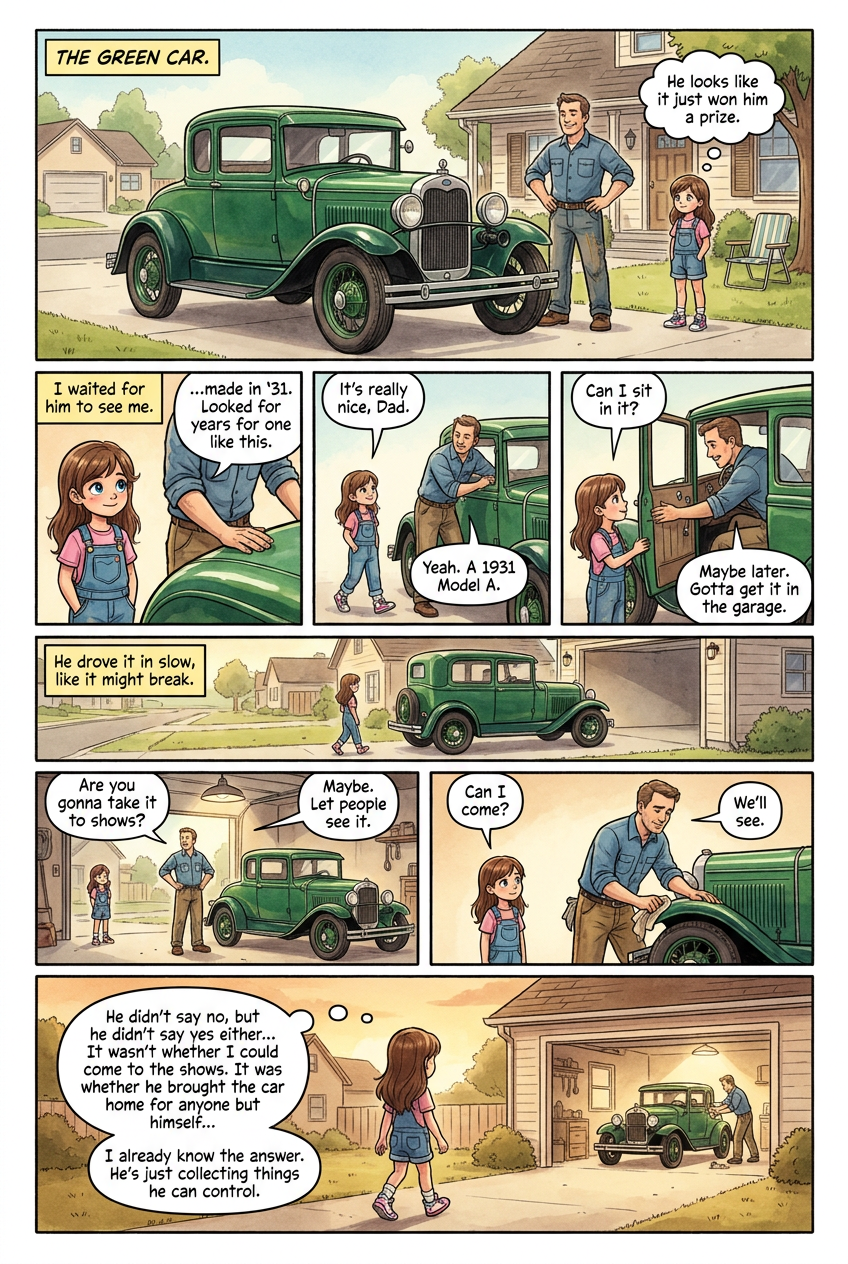
Dad comes home on a Saturday afternoon with a car so old it looks like it drove out of a picture book. The paint is green and shiny like someone spent hours making it perfect. He parks it in front of the house and stands there with his hands on his hips, smiling at it like it just won him a prize. She walks outside and stands near the lawn chair by the driveway. The car has round headlights and curves that look hand-shaped. Dad runs his hand along the hood and talks about the year it was made and how long he looked for one like this. She waits for him to turn around and see her standing there. He opens the driver's door and leans inside to check something. She takes three steps closer and says it's really nice. He nods without looking up and says it's a 1931 Model A. She asks if she can sit in it. He says maybe later, he wants to get it into the garage first. He drives it around back and she follows on foot. The garage door is already open and he pulls the car inside slowly like he's carrying something that might break. He gets out and stands looking at it under the hanging light. She stays in the doorway and watches him walk around it twice, touching the mirrors and checking the tires. She asks if he's going to drive it places. He says he'll take it to shows maybe, let people see it. She asks if she can come. He says we'll see, then pulls a rag from his back pocket and starts wiping dust off the fender that she can't even see. She turns and walks back to the house. He didn't say no but he didn't say yes either. The car sits in the garage where he'll spend his evenings now, polishing something that's already perfect. She realizes she was asking the wrong question. It wasn't whether she could come to the car shows. It was whether he brought the car home for anyone but himself. She already knows the answer. He doesn't need her to admire it. He doesn't need her to sit beside him while he works on it. The car is his and that's enough for him. She's been trying to be picked first but he's not picking anyone. He's just collecting things he can control.
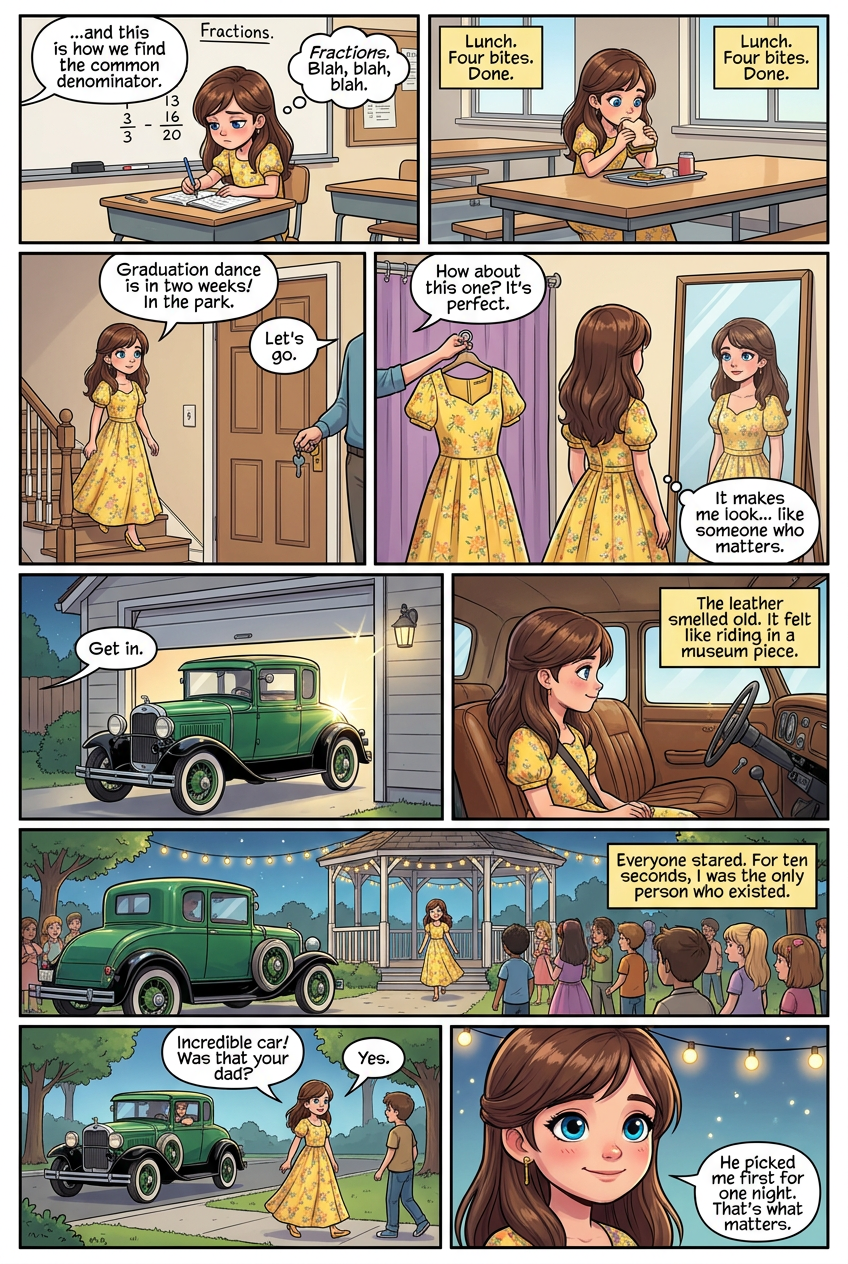
She goes back to school on Monday and sits at her desk in the middle row where nobody notices her. The teacher talks about fractions and she copies numbers into her notebook without thinking about what they mean. At lunch she sits at an empty table near the window and eats her sandwich in four bites. Two weeks later the teacher announces that graduation is coming and there will be a dance in the park. She doesn't think about it until Mom says they need to find her a dress. They go to three stores and Mom keeps pulling things off the rack that are too short or too pink. Then Mom holds up a long yellow dress with flowers all over it and says this one. She tries it on in the dressing room and when she comes out Mom nods once and says it's perfect. She looks at herself in the mirror and the dress makes her look older, like someone who matters. On the night of the dance Dad says he'll drive her. She comes downstairs in the yellow dress and he's standing by the front door with his keys. He doesn't say she looks nice but he opens the door for her and walks to the garage. She expects him to get the regular car but he opens the garage and there's the Model A with the green paint shining under the light. He says get in. She climbs into the passenger seat and the leather smells old and the whole car feels like riding in something from a museum. He drives slow through town and parks right in front of the park where the lights are strung up in the gazebo. Kids from her class are already there and they turn to look when the Model A pulls up. Dad gets out and opens her door and she steps onto the curb in her long yellow dress. Everyone is staring at the car and at her and for ten seconds she feels like the only person who exists. Dad drives away and she walks toward the music. JP comes over and says that car is incredible and asks if that was her dad. She says yes. JP asks if he always drives cars like that and she says no, just tonight. She realizes Dad didn't bring the Model A because she asked to come to car shows. He brought it because it was graduation and he wanted to. He picked her first for one night. It won't last and she knows that but right now she's standing in a yellow dress and everyone saw her arrive in a car that looked like it drove out of a picture book. She doesn't need it to mean forever. She just needs to remember that tonight it meant something.
Play your story to life
Storycraft is a mobile game where you create AI characters, craft items and locations to build their world, then discover what direction your story takes. Download the iOS game for free today!
Download for free