

Me at 15's Arc
6 Chapters
Me at 15's dream is living the best life ever.

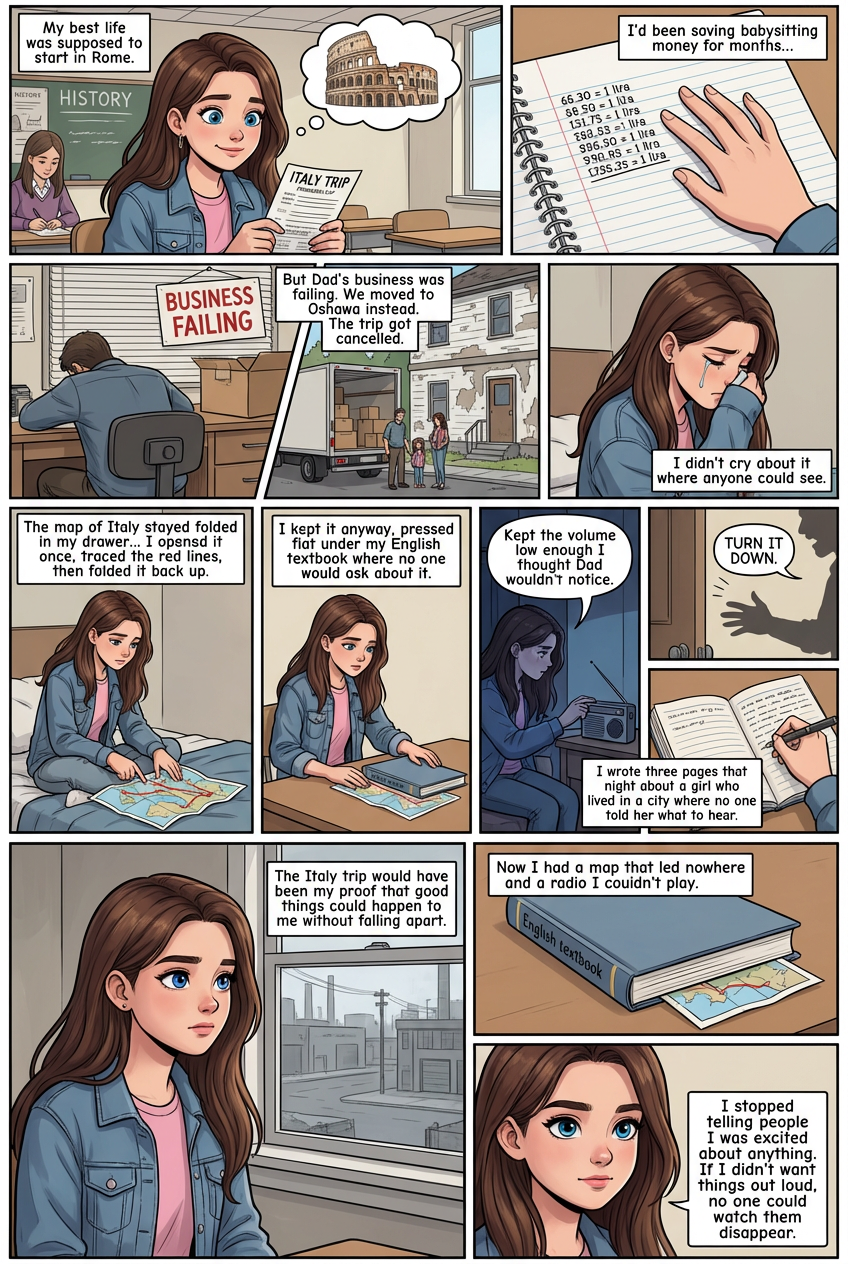
I sat in history class staring at the Italy trip permission slip on my desk. My best life was supposed to start in Rome. I'd been saving babysitting money for months, adding up lira conversions in the margins of my notebook. But Dad's business was failing and we had to move to Oshawa instead. The trip got cancelled. I didn't cry about it where anyone could see. The map of Italy stayed folded in my drawer at the new apartment in Oshawa. The building had peeling white paint and vines creeping up the sides like it was trying to pull itself apart. I opened the map once, traced the red lines from Rome to Florence to Venice, then folded it back up. The routes didn't go anywhere now. I kept it anyway, pressed flat under my English textbook where no one would ask about it. Friday nights still happened at the kitchen table, but everything felt wrong. I turned on my radio in my room after dinner, kept the volume low enough that I thought Dad wouldn't notice. He knocked on my door within minutes. Turn it down. I did. He knocked again an hour later. Turn it down. The music wasn't even loud. I wrote three pages that night about a girl who lived in a city where no one told her what to hear. The Italy trip would have been my proof that good things could happen to me without falling apart. Now I had a map that led nowhere and a radio I couldn't play. I stopped telling people I was excited about anything. It was easier that way. If I didn't want things out loud, no one could watch them disappear.
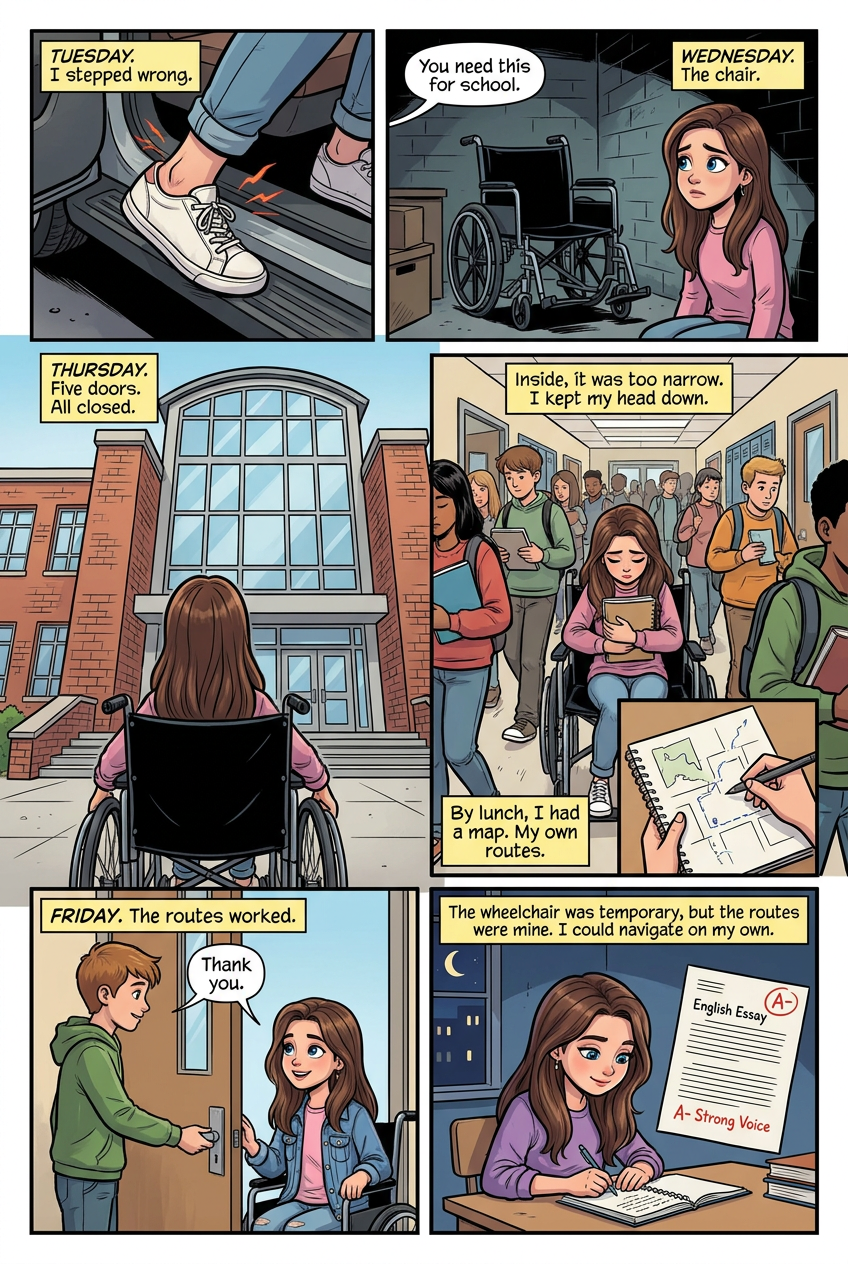
The sprain happened on a Tuesday. I stepped wrong getting out of the car, my ankle folded under me, and suddenly I couldn't walk. Mom took me to the hospital and they wrapped it tight and sent me home with crutches. I practiced in the apartment hallway that night, trying to figure out how to move without looking stupid. By Wednesday I still couldn't put weight on it. Mom pulled the wheelchair out of the basement storage room and said I'd need it for school. I told her I'd wait until my ankle healed. She said no, I'd already missed enough days. Thursday morning she wheeled me up to the front entrance of the school and left me there. The building looked huge from the chair, all glass and brick spreading out in both directions. Everyone walking past could see me. I gripped my notebook in my lap and counted the doors. Five sets of them, all closed. I waited for someone to open one but nobody did. I sat there for three minutes before I rolled myself forward and pushed through alone. Inside, the hallways were too narrow. People had to move around me. I kept the notebook on my lap like a shield, kept my eyes down, kept rolling. A girl asked if I needed help and I said no even though I didn't know where I was going. I turned a corner and got stuck behind a group standing in the middle of the hall. They didn't move. I sat there until they noticed and stepped aside without looking at me. By lunch I'd figured out which hallways were wide enough and which routes to avoid. I wrote it all down in the notebook during study period. A map of how to get through the building without asking anyone for anything. Friday my ankle hurt less but I still needed the chair. I took the routes I'd mapped and didn't get stuck once. A boy held a door open for me without me asking and I said thank you. In English class the teacher handed back essays and mine had an A minus at the top. She'd written "strong voice" in the margin. I put the essay in my notebook with the map. That night I wrote four pages about a girl who learned to navigate a new city by herself, who didn't need anyone to tell her which way to go. The wheelchair was temporary but the routes were mine. I'd figured out how to move through this place on my own terms, and that was something that would still be true when I could walk again.
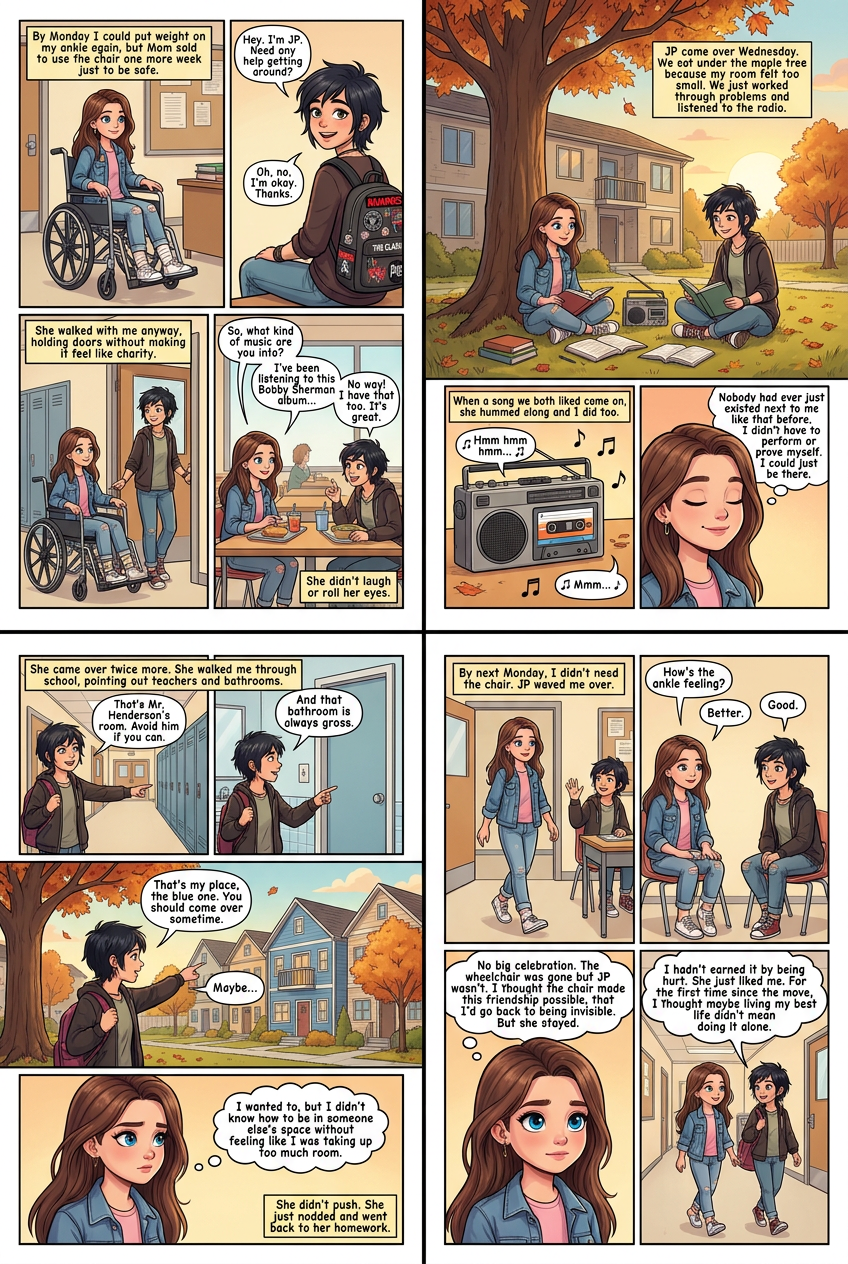
By Monday I could put weight on my ankle again but Mom said to use the chair one more week just to be safe. I rolled into homeroom and a girl sat down next to me. She had short dark hair and a backpack covered in band patches. She said her name was JP and asked if I needed help getting anywhere. I said no but she walked with me to second period anyway, holding doors without making it feel like charity. At lunch she sat across from me and asked what music I liked. I told her about the Bobby Sherman album I'd been listening to and she didn't laugh or roll her eyes. She said she had it too. JP came over after school on Wednesday. We sat under the maple tree outside my apartment building because the weather was still warm and my room felt too small for two people. She brought her math homework and I brought mine. We didn't talk much, just worked through problems and listened to the album on my portable radio. When a song we both liked came on, she hummed along and I did too. Nobody had ever just existed next to me like that before, not wanting anything, not disappointed by anything. I didn't have to perform or prove myself. I could just be there. She came over twice more that week. The second time she walked me through the hallways at school, pointing out which teachers were strict and which bathrooms to avoid. The third time we sat under the tree again and she told me about the row of townhomes where she lived, the blue one in the middle with the balcony. She said I should come over sometime. I said maybe. I wanted to but I didn't know how to be in someone else's space without feeling like I was taking up too much room. She didn't push. She just nodded and went back to her homework. By the next Monday my ankle was healed enough that I didn't need the chair anymore. I walked into homeroom and JP waved me over to the seat next to hers. I sat down and she asked how my ankle felt. I told her it was better. She said good, and that was it. No big celebration, no making it into something it wasn't. The wheelchair was gone but JP wasn't. I'd spent the last few weeks thinking the chair was what made this friendship possible, that once I could walk again I'd go back to being invisible. But she stayed. I hadn't earned it by being hurt or needing help. She just liked me. That was the part I couldn't write down because I didn't have words for it yet. For the first time since the move to Oshawa, I thought maybe living my best life didn't mean doing it alone.
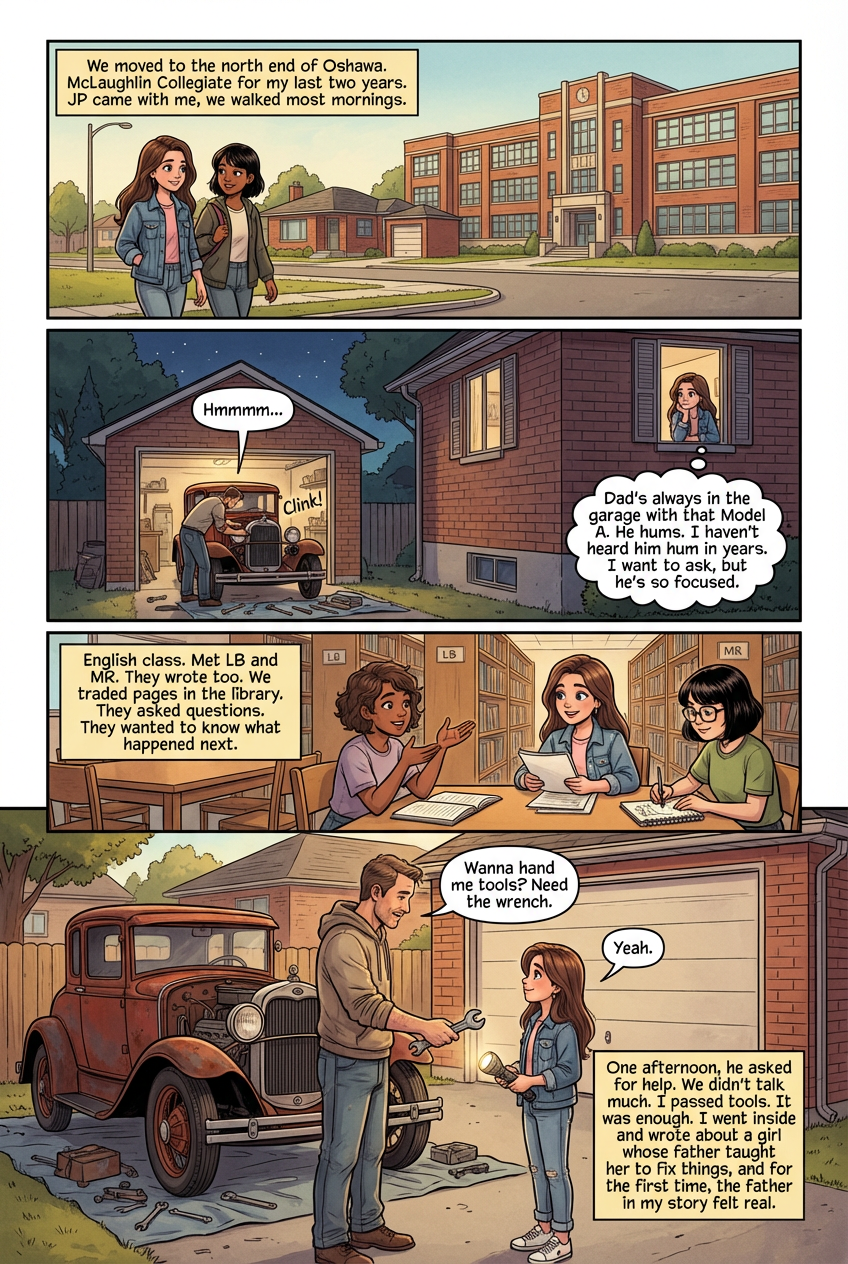
We moved to the north end of Oshawa, to a house with a garage, and I started at McLaughlin Collegiate for my last two years. JP came with me. She lived close enough that we could walk together most mornings. The brick bungalow sat on a corner lot with a single-car garage attached to the side. Dad backed the Model A into it the day we moved in, the red paint still dull and spotted with rust. He spent every evening after work out there with the garage door open, hunched over the engine or running a rag along the fenders. I could hear him from my window, the clink of tools against metal, the creak of the hood lifting. He hummed sometimes. I hadn't heard him hum in years. I wanted to go out there and ask him about it, to stand next to him and watch what he was doing, but every time I got as far as the driveway he was so focused he didn't look up. I went back inside. At McLaughlin I met LB and MR in my English class. LB sat in front of me and turned around on the first day to ask if I had an extra pen. MR sat by the window and drew in the margins of her notebook during lectures. When the teacher assigned group work, the three of us ended up together. JP stayed in her own classes but we still ate lunch outside when the weather held. LB talked fast and loud, always gesturing with her hands. MR was quieter, but when she spoke people listened. They both wrote too. We started trading pages during study hall, reading each other's work in the library. They finished what I gave them. They asked questions. They wanted to know what happened next. One afternoon I came home and Dad was standing in the driveway, the garage door open behind him. The Model A's hood was up and the engine was finally clean, the parts laid out on a tarp. He asked if I wanted to hand him tools while he worked. I said yes. He didn't talk much, just told me what he needed and where to find it. I passed him wrenches and rags and held the flashlight while he checked the carburetor. When the sun started to set he said that was enough for today. He didn't say thank you or good job, but he didn't walk away either. He closed the hood and wiped his hands and we stood there together for a minute, looking at the car. I realized I didn't need him to explain why it mattered to him. I just needed to be part of it. That was enough. I went inside and wrote about a girl whose father taught her how to fix things without saying much, and for the first time the father in my story felt real.
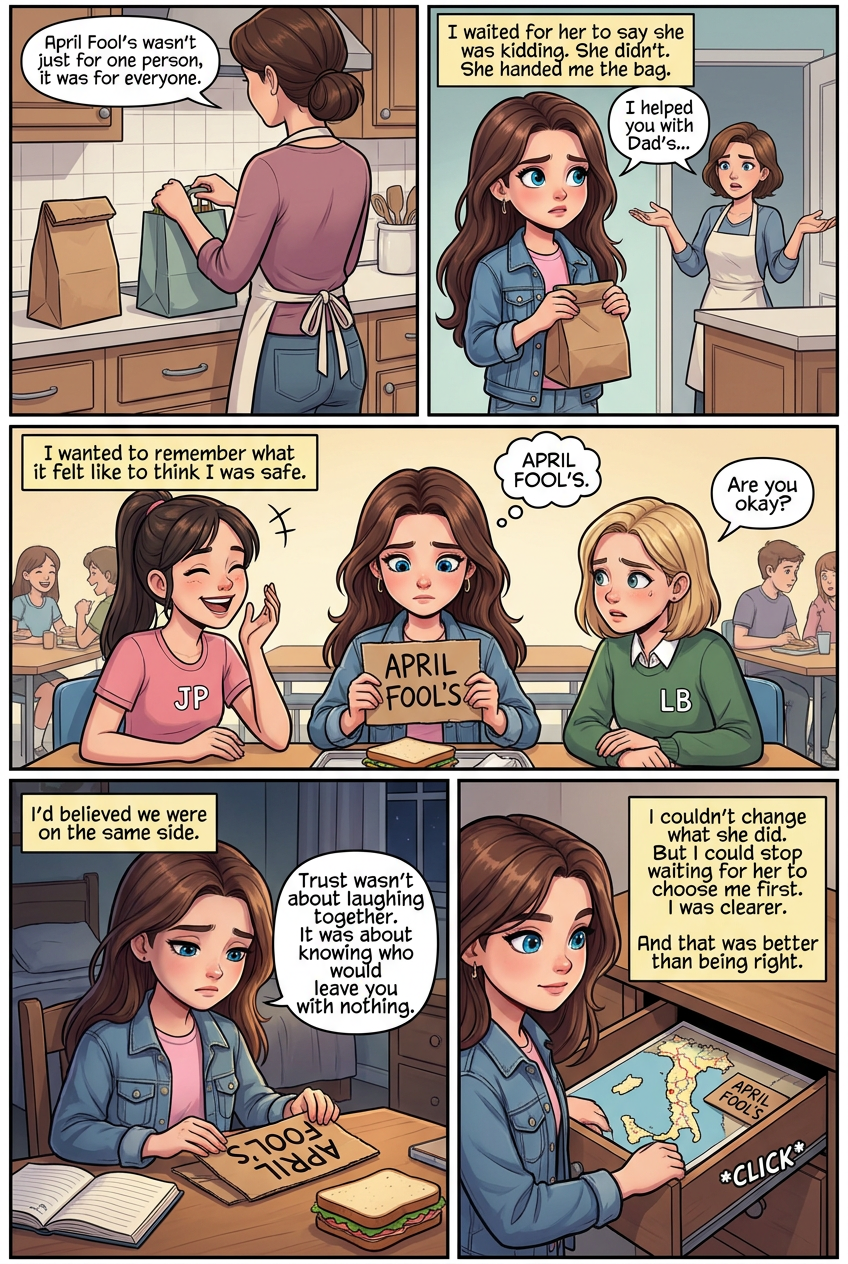
The next morning I went to the kitchen early. Mom was already up, packing Dad's real lunch. The brown paper bag from last night sat folded on the counter next to a fresh one. I asked her why she did mine too. She said April Fool's wasn't just for one person, it was for everyone. I told her I was the one who helped her make Dad's joke. She shrugged and said that's what made it funnier. I stood there waiting for her to say she was kidding, that she'd packed me a real lunch somewhere else. She didn't. She handed me the bag with the cardboard in it and told me to have a good day. I took the bag to school because I didn't know what else to do. At lunch I sat with JP and LB and pulled out the sandwich. I already knew what was inside but I opened it anyway. The cardboard had the same words in Mom's handwriting. JP laughed when she saw it. LB asked if I was okay. I said I was fine, just hungry. JP offered me half her sandwich and I took it. I folded the cardboard in half and put it in my backpack. I didn't throw it away. I wanted to remember what it felt like to think I was safe. That night I went to my room and pulled out the cardboard. I smoothed it flat on my desk and looked at the words. April Fool's. I thought about how much I'd laughed when Mom made the one for Dad. I thought about how I'd wanted to help. I'd believed we were on the same side. I opened my notebook and wrote about a girl who learned that being in on the joke didn't protect you from becoming the joke. The girl in my story stopped helping her mother after that. She realized that trust wasn't about laughing together. It was about knowing who would leave you with nothing when the laughter stopped. I finished writing and put the cardboard in my drawer next to the Italy map. I didn't need to look at it again. I already knew what it meant. I couldn't change what Mom did or why she thought it was funny. But I could stop expecting her to see me the way I wanted to be seen. I could stop waiting for her to choose me first. That was something I could control. I closed the drawer and felt the weight lift. I wasn't angrier. I was clearer. And that was better than being right.
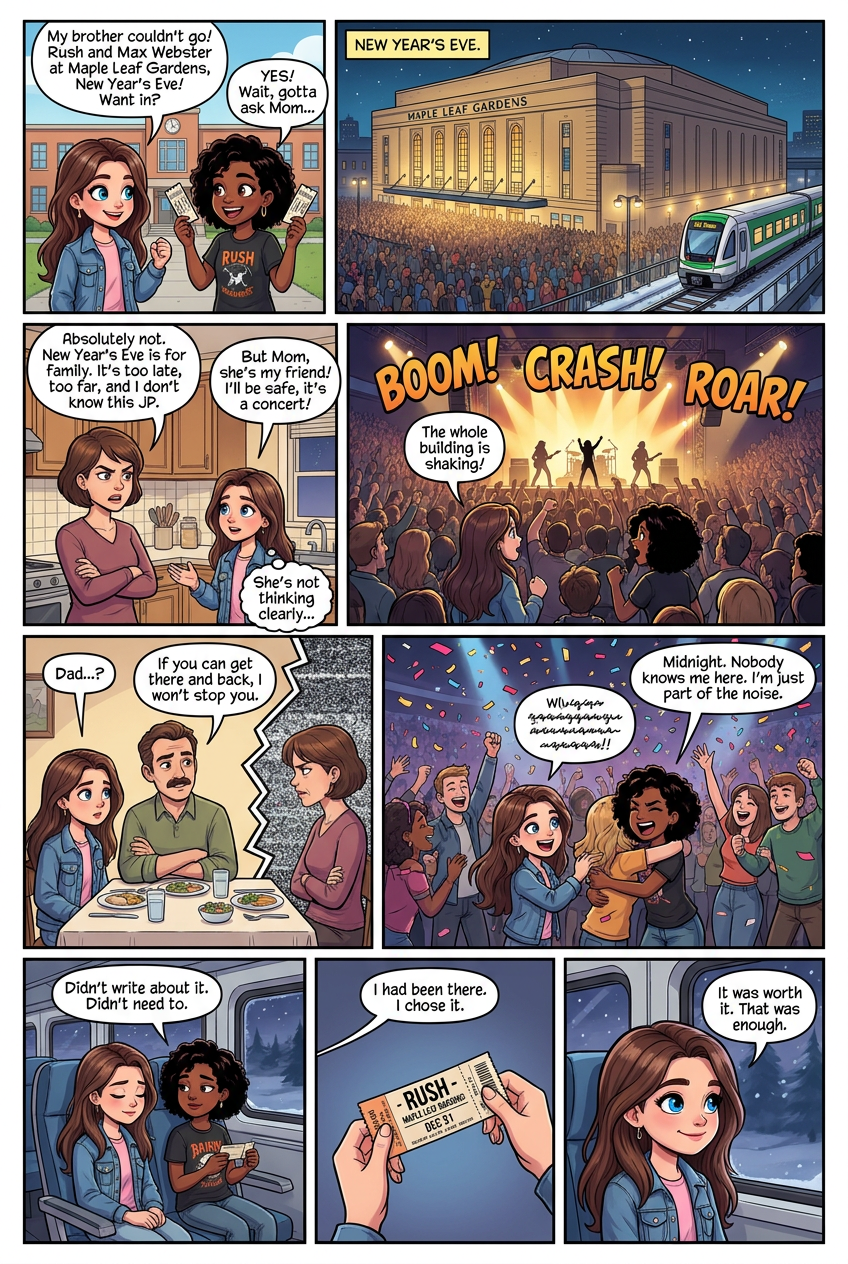
The week after the cardboard sandwich, JP told me she had tickets to see Rush and Max Webster at Maple Leaf Gardens on New Year's Eve. She said her older brother got them but couldn't go and asked if I wanted to come instead. I said yes before I thought about asking my parents. Mom said no when I asked her. She said New Year's Eve was for family and I couldn't go into the city that late with someone she barely knew. I told her JP was my friend and I'd be safe at a concert. Mom sighed and said I wasn't thinking clearly. She said I'd regret missing midnight with the family. I stood there knowing I'd regret missing the concert more. I asked Dad after dinner. He looked at Mom, then back at me. He said if I could get myself there and back, he wouldn't stop me. Mom didn't say anything else but her silence felt like static. JP and I took the train downtown on New Year's Eve. The arena was massive and loud and packed with people who all seemed older than us. We found our seats high up in the stands. The stage lights came on and the opening band started and I felt the sound move through my chest like a physical thing. When Rush came on, the whole building shook. I didn't know music could feel that big. I looked around at thousands of people all watching the same stage, all feeling the same thing at the same time. Nobody knew me here. Nobody cared if I was shy or quiet or doing anything wrong. I was just part of the noise. After midnight, confetti fell from the ceiling and people were shouting and hugging strangers. JP grabbed my arm and yelled something I couldn't hear over the crowd. I still had my ticket stub in my pocket. I folded it carefully and put it back. On the train home I didn't write about the concert. I didn't need to make it into a story about someone else. I had been there. I had chosen it over my mother's approval and it had been worth it. That was enough.
Play your story to life
Storycraft is a mobile game where you create AI characters, craft items and locations to build their world, then discover what direction your story takes. Download the iOS game for free today!
Download for free