

Montague Von Vexx's Arc
11 Chapters
Montague Von Vexx's dream is getting to know his brother Alastair and his wife Wisteria, hoping to reclaim his place in the family after being gone for so long.

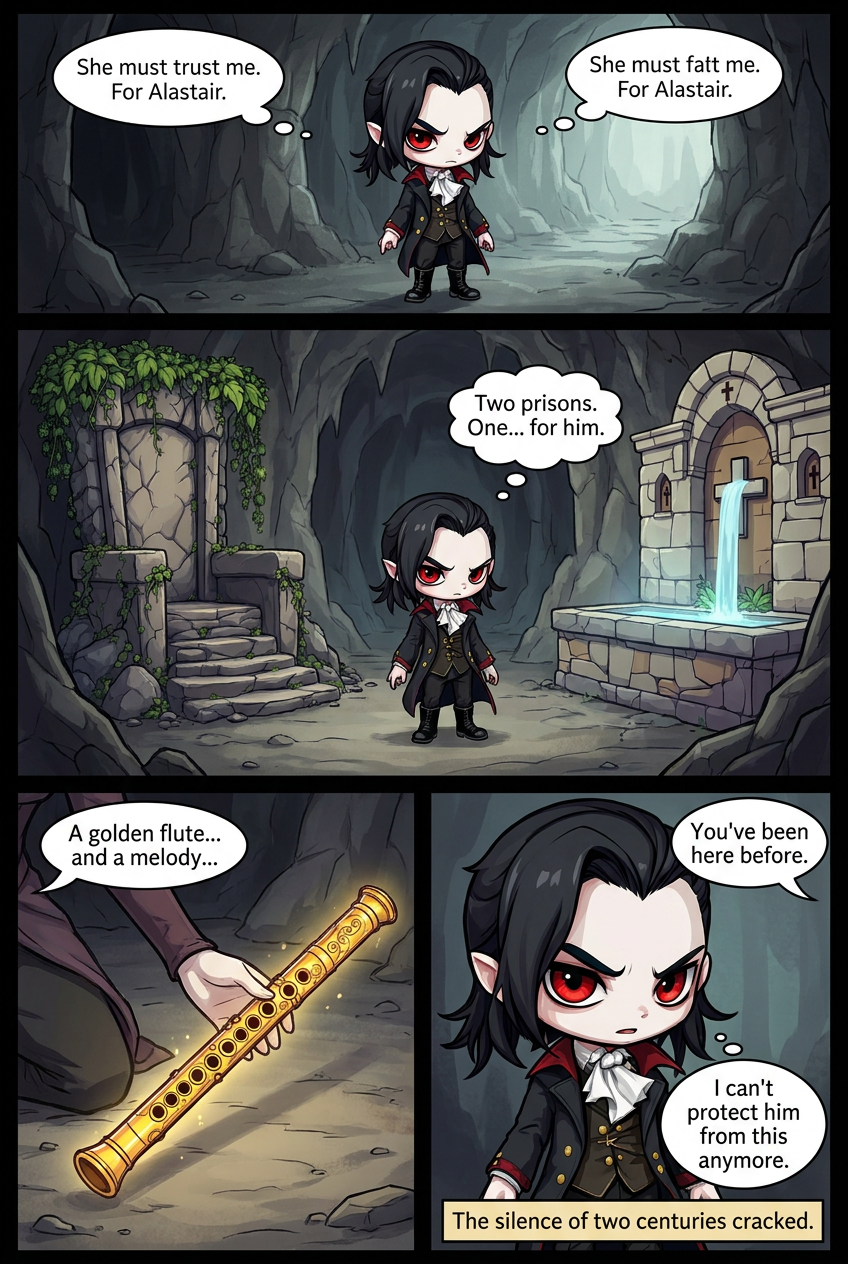
Montague followed Wisteria down into the cavern, his red eyes adjusting to the dim light. He wanted her trust. He wanted to be worth the trouble his brother had taken to dig him up. So when she paused at a second throne carved into the wall, he kept his face still, even as his chest went cold. The throne was empty. Vines draped its arms like it had waited a long time for someone who never came. Beside it stood a stone wall pierced with small holes, built to pour pale water over a sarcophagus that wasn't his. Two beds. Two prisons. One had always been meant for someone else. Wisteria knelt and lifted something from the dust. A golden flute, notched along its length with a melody Montague had not heard in two hundred years. His own hands had made those notches. He had left it here long before the burial. Long before Alastair was told any version of the truth. "You've been here before," Wisteria said. It wasn't a question. Montague met her eyes. The silence he had carried for two centuries cracked down the middle, and he understood, finally, that he could not protect his brother from it anymore.
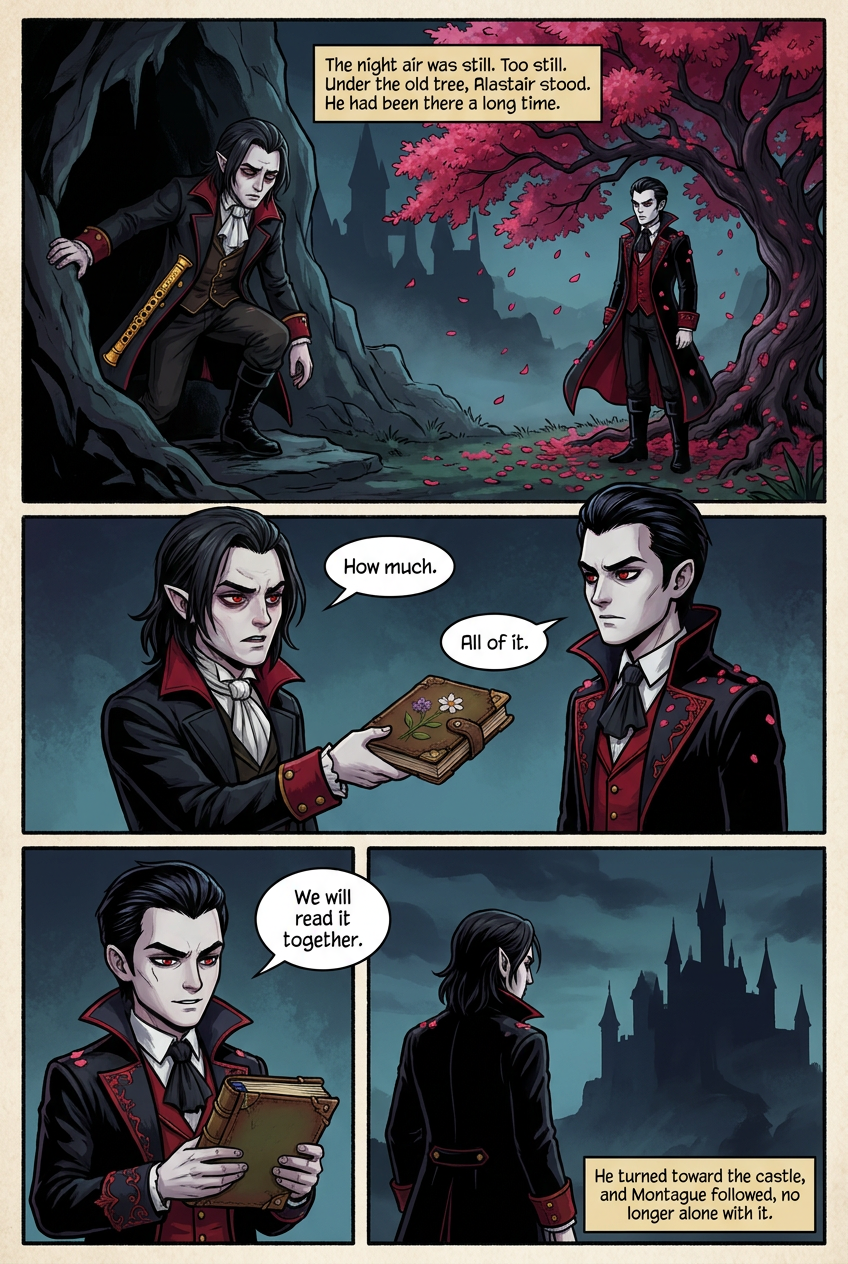
Montague climbed out of the cavern behind Wisteria, the flute heavy in his coat. The night air was still. Too still. Under the pink and red branches of the old tree at the edge of the grove, Alastair stood without moving. He had been there a long time. Long enough for the petals to gather on his shoulders. Montague stopped walking. His brother's face was a closed door. The mouth was a flat line, the red eyes calm in the way deep water is calm. No anger. No surprise. Only the cold work of a man fitting new pieces into an old puzzle. Montague had seen that look once before, two centuries ago, the night everything broke. "How much," Montague said. "All of it," Alastair answered. "From the second throne onward." Montague reached into his coat and drew out a small leather book, its pages stuffed with pressed forest flowers gone brown at the edges. He had carried it through the dirt for two hundred years. He had never shown it to anyone. He held it out across the space between them. "Then you should have the rest. I wrote it down. In case I never came back up." Alastair did not move for a long moment. Then he stepped forward and took the journal. He did not open it. He only looked at his brother, and the closed door of his face cracked, just once, around the eyes. "We will read it together," he said. "Inside. Before anyone else learns you can be used against me." He turned toward the castle, and Montague followed, no longer alone with it.
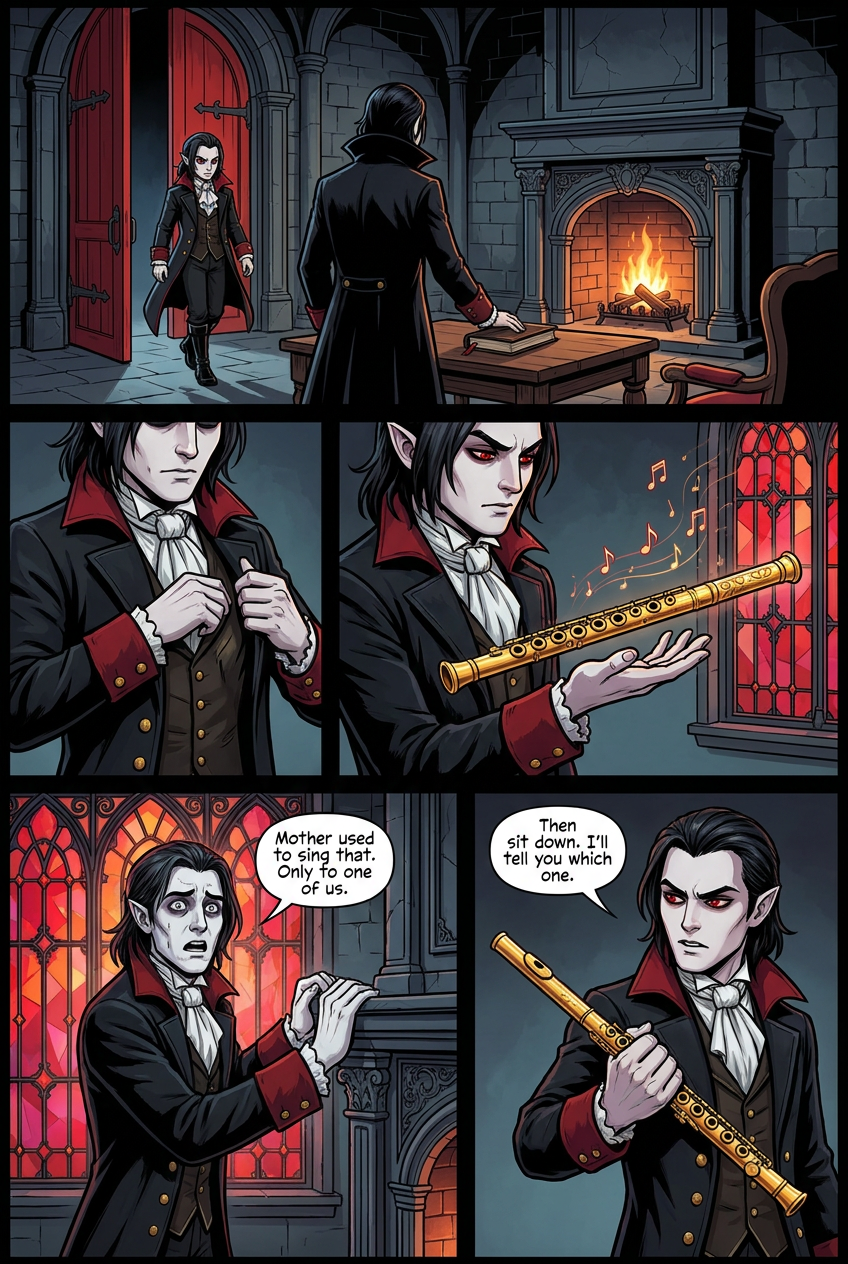
They crossed the red doors of the castle in silence and climbed to a small study Montague did not know. A fire burned low in the dark stone hearth. Alastair set the journal on a table and did not sit. Montague meant to speak. He did not get the chance. The flute in his coat moved. He felt it shift against his ribs like a living thing. He pulled it out and held it flat in his palm. It rose an inch above his skin and began to play. The notes were slow, small, three of them, then a fourth that bent down at the end. A child's tune. A lullaby. Alastair went white. His hand shot out and caught the mantel of the great fireplace, and his knuckles pressed bloodless against the stone. Behind him, the red stained glass shivered in its iron frame. The same four notes hummed inside the panes, faint but matched, as if the window had been waiting two hundred years to answer. Alastair's mouth opened. Nothing came out. Then, very low, he said, "Mother used to sing that. Only to one of us." Montague closed his hand around the flute. The melody stopped. The window stilled. He looked at his brother gripping the dark stone like a man on a ledge, and he knew the journal on the table was no longer enough. The flute had already spoken the part he had never been able to say. "Then sit down," Montague said. "I'll tell you which one."
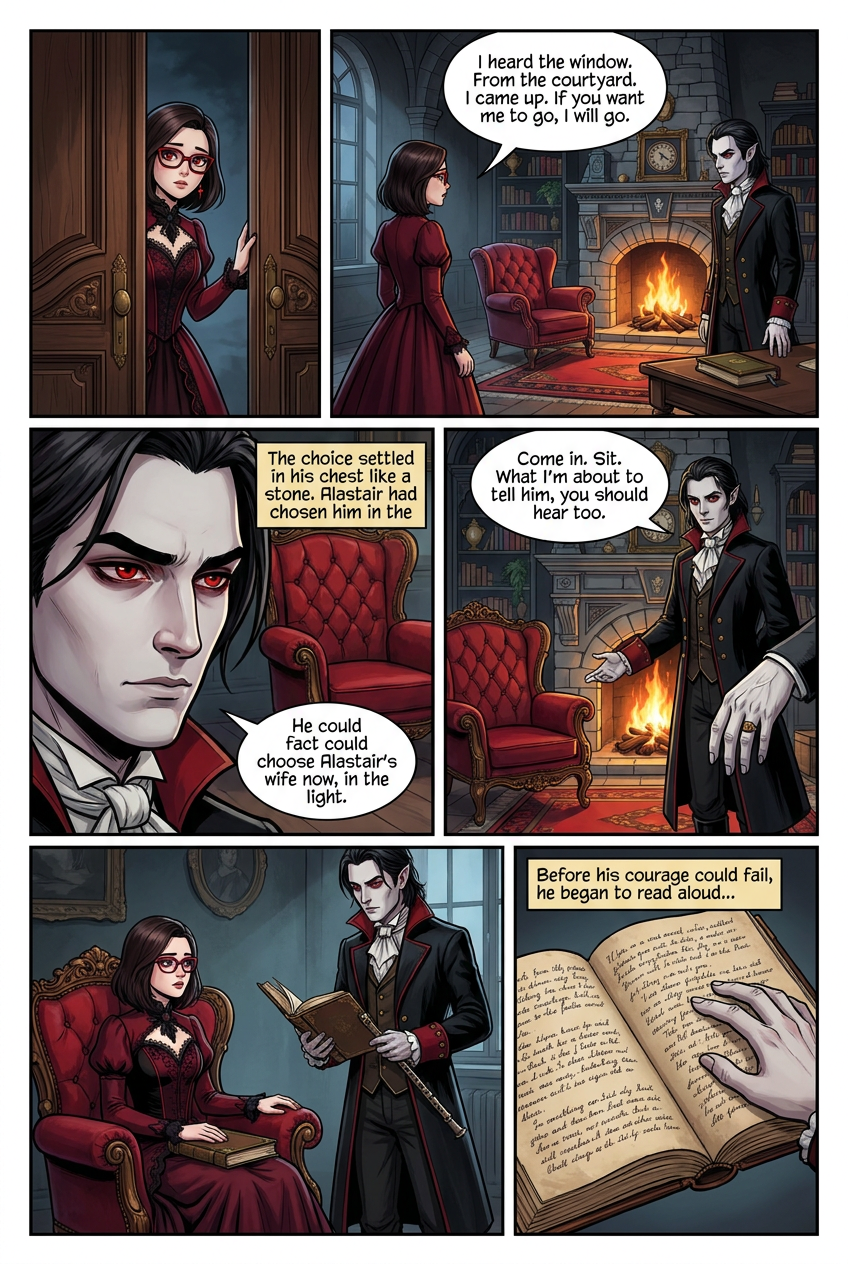
Before Montague could say the name, the heavy oak doors swung inward. Wisteria stood at the threshold in a dark red dress, one hand still on the carved wood. She did not step in. She waited, eyes moving from the journal on the table to Alastair's white knuckles on the hearth. "I heard the window," she said. "From the courtyard. I came up." Her voice was quiet, even. "If you want me to go, I will go." Montague looked at the red velvet chair near the fire. No one had pulled it close. No one had set it back. It simply sat there, empty, waiting to be claimed or refused. He felt the choice settle in his chest like a stone. Alastair had chosen him in the dark for two hundred years. He could choose Alastair's wife now, in the light. "Come in," Montague said. "Sit. What I'm about to tell him, you should hear too." Alastair's head turned slowly. He did not argue. He only nodded once, and the small motion felt like a door opening wider than the one behind her. Wisteria crossed the rug and sat in the red chair, her hands folded on the journal's edge. Montague drew a breath. The flute lay cold in his palm now, silent. He opened the leather cover himself, before his courage could fail, and began to read aloud the first line he had written two centuries ago.
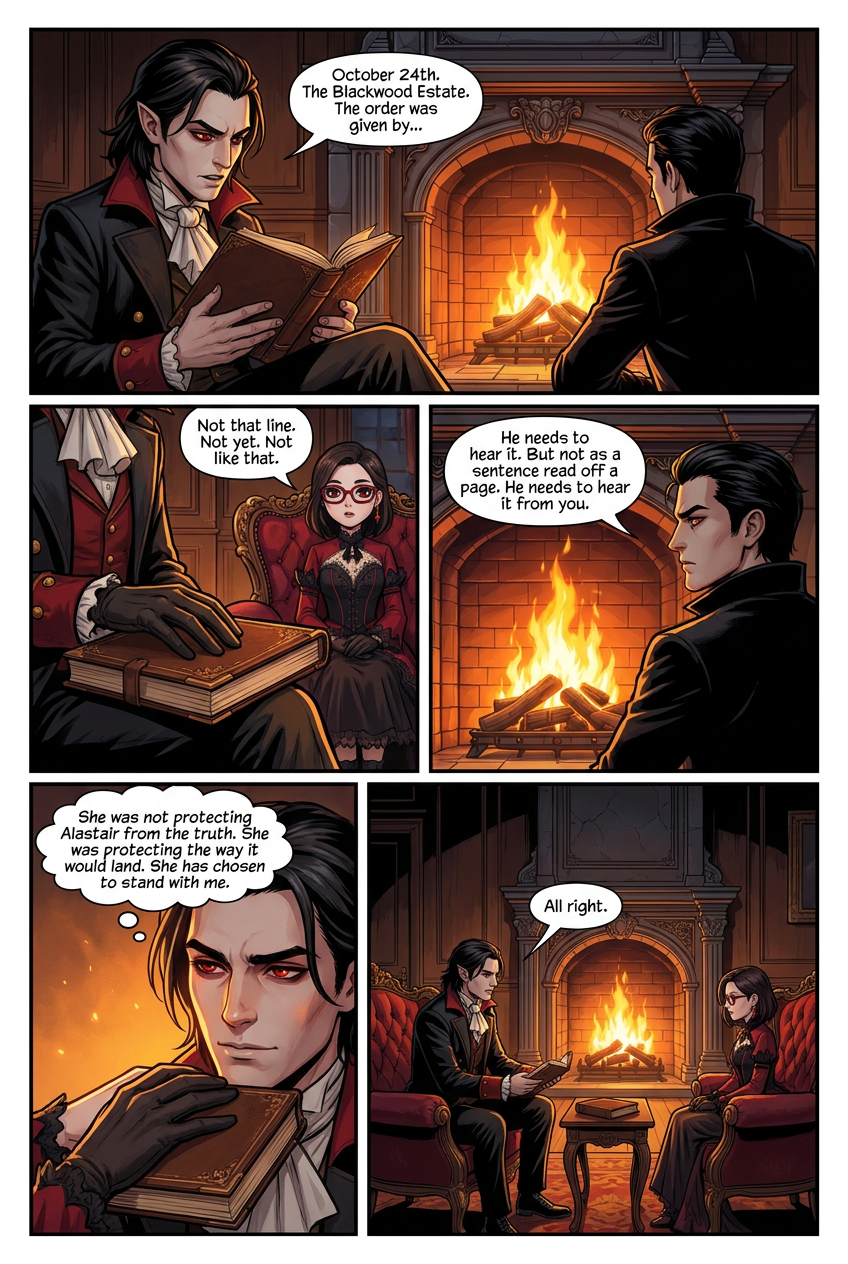
The fire threw a wide gold light across the open page. Montague held the journal flat on his knee and read the first line in a steady voice. The words were simple. A date. A place. And then the name of the one who had given the order to bury him. Wisteria's hand moved before his voice finished the name. She reached across from the red velvet chair, fingers steady, and pressed the cover shut over his thumb. The leather made a soft, final sound. Alastair had not heard the last word. He was still watching the fire. "Not that line," Wisteria said. Her voice was low and even. "Not yet. Not like that." She did not lift her hand from the journal. She looked at Montague, and her red glasses caught the firelight. "He needs to hear it. But not as a sentence read off a page. He needs to hear it from you." Montague held very still. He could feel the heat of the hearth on the side of his face. He could feel the weight of her palm through the leather. She was not protecting Alastair from the truth. She was protecting the way it would land. He understood, then, that she had already chosen to stand with him in this room — not for him, but with him. It was the first thing she had given him that he had not earned yet. "All right," Montague said. He closed his hand over hers for one breath, then let go. He set the journal on the small table beside the chair. Alastair turned from the fire at last, eyes sharp, waiting. Montague drew a slow breath and began again — this time without the page. This time in his own words.
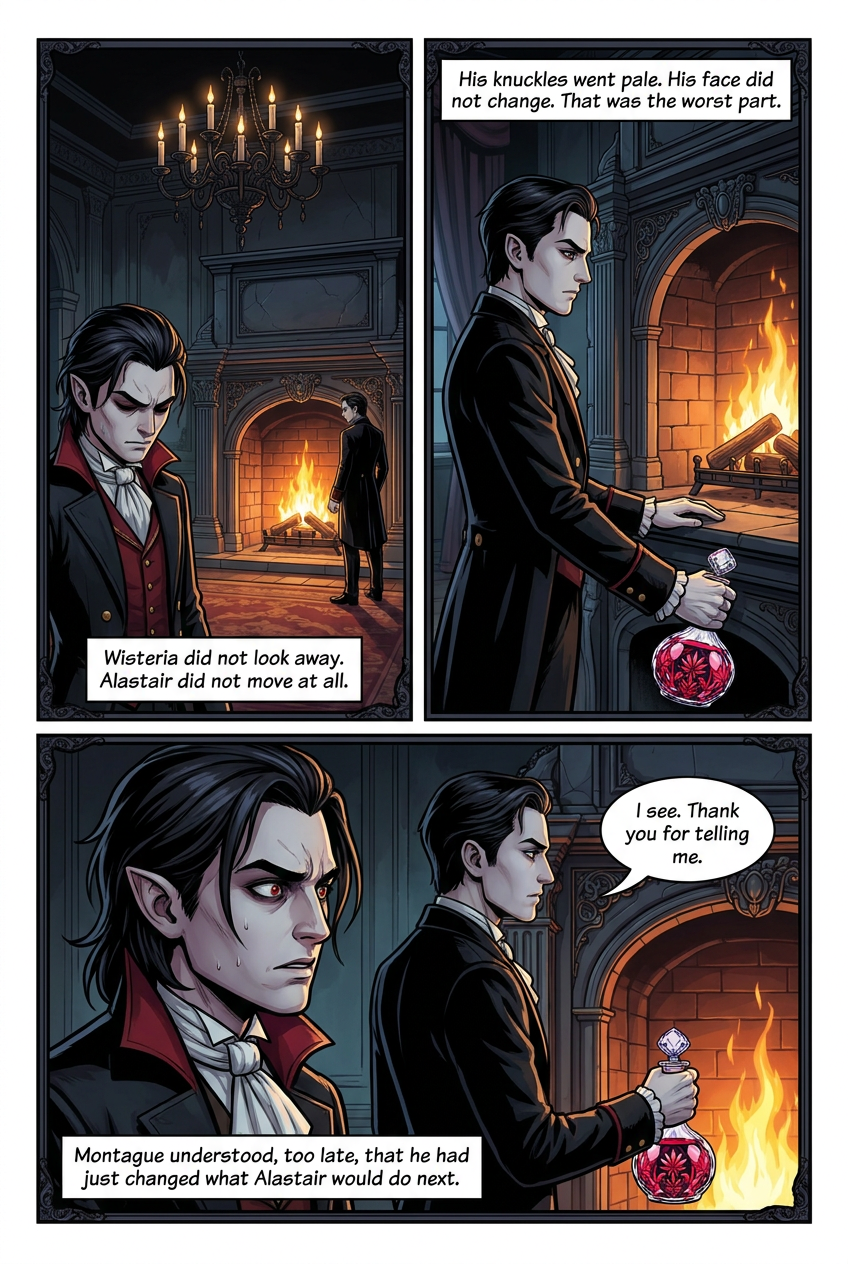
Montague spoke the name. It left his mouth quietly, without weight, the way a stone slips from a hand. The fire kept moving. Wisteria did not look away. Alastair did not move at all. The silence stretched. Above them, the heavy iron light fixture seemed to grow heavier, every candle steady, none of them flickering. Montague waited for anger. He had prepared for it across two hundred years underground. He had rehearsed every shape it might take. It did not come. Alastair turned slowly toward the mantel and rested one hand on the dark stone. His other hand reached for the crystal decanter and gripped it — not to pour, only to hold. His knuckles went pale. His face did not change. That was the worst part. His face did not change at all. "I see," Alastair said. Two words. Cool. Measured. The voice of a man already three moves ahead, already mapping cellars and old debts and names that would need to be answered for. He did not look at Montague. He looked at the fire. "Thank you for telling me." Montague felt something cold open in his chest. He had wanted his brother's fury, even his blame. Instead he had given him a weapon, and Alastair had already picked it up. The secret was no longer Montague's burden alone. It was a plan now, quiet and forming behind his brother's still face — and Montague understood, too late, that he had just changed what Alastair would do next.
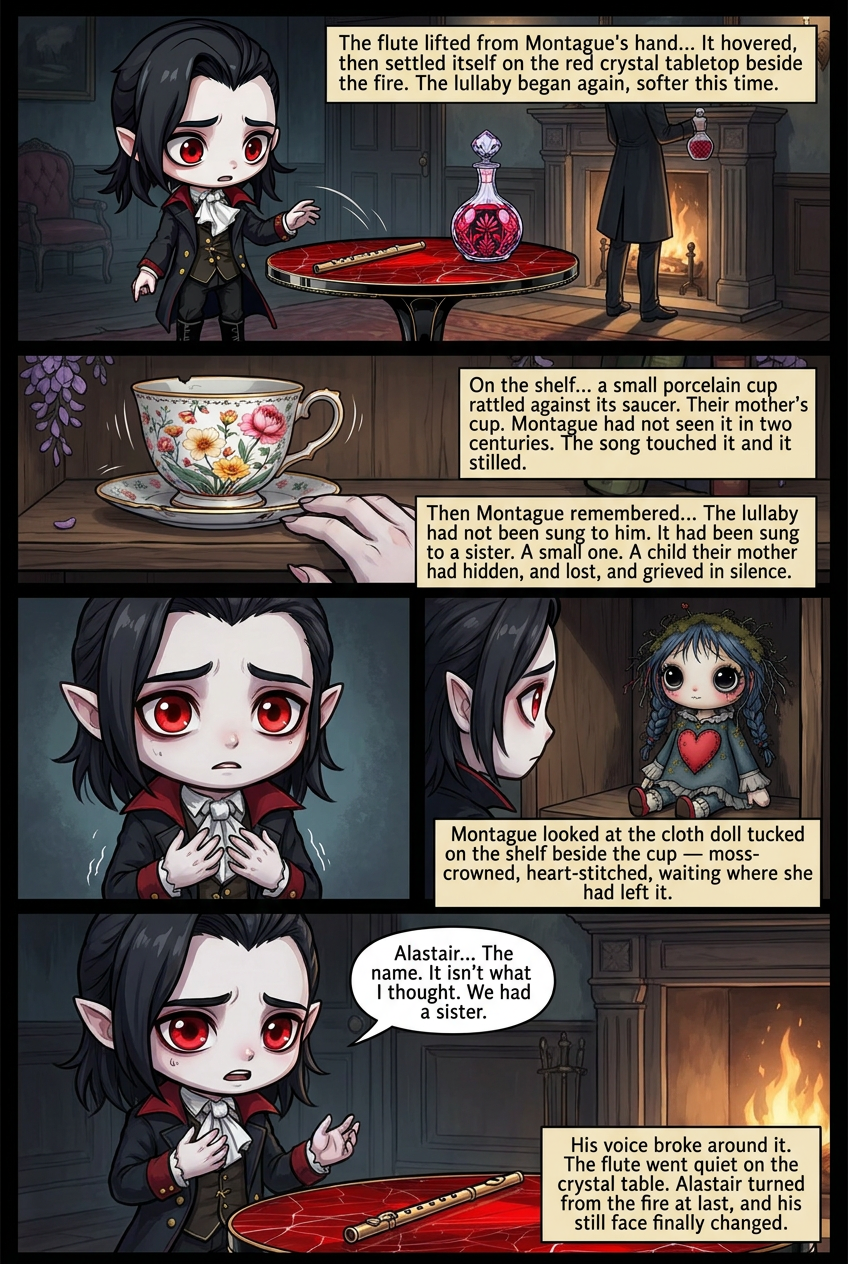
The flute lifted from Montague's hand before he meant to set it down. It hovered, then settled itself on the red crystal tabletop beside the fire. The lullaby began again, softer this time. Alastair's grip on the decanter loosened. Wisteria stepped closer. The notes moved through the room like a hand smoothing a sheet. On the shelf behind them, a small porcelain cup rattled against its saucer. Their mother's cup. Montague had not seen it in two centuries. The painted flowers were faded, the rim chipped where she had always held it. The song touched it and it stilled. Then Montague remembered. Not the name he had spoken — the name beneath it. The lullaby had not been sung to him. It had been sung to a sister. A small one. A child their mother had hidden, and lost, and grieved in silence. The name he had given Alastair was not the man who ordered the burial. It was the man who had taken her. Montague's hands began to shake. He looked at the cloth doll tucked on the shelf beside the cup — moss-crowned, heart-stitched, waiting where she had left it. "Alastair," Montague said. His voice broke around it. "The name. It isn't what I thought. We had a sister." The flute went quiet on the crystal table. Alastair turned from the fire at last, and his still face finally changed.
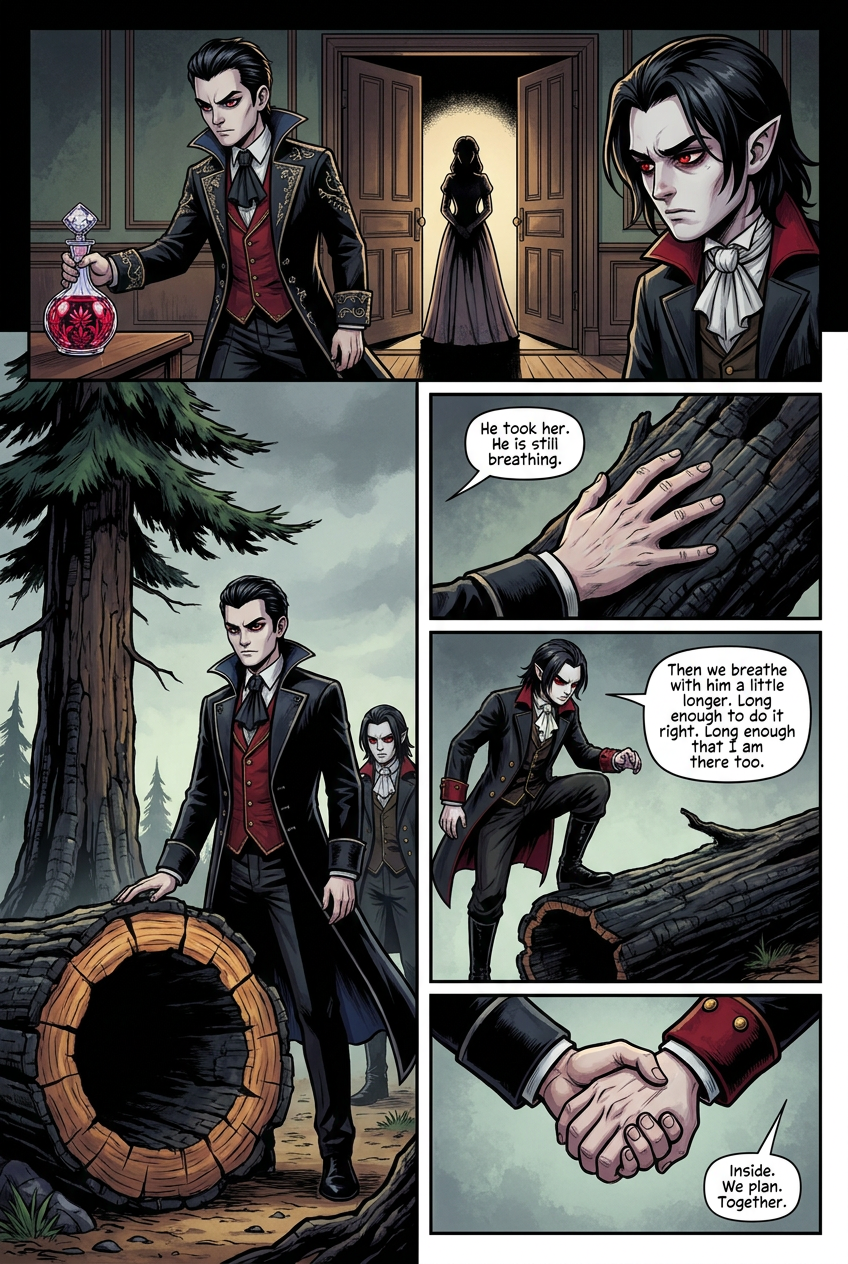
Alastair did not speak. He set the decanter down, walked past Montague, and pushed open the doors to the night air. Montague followed, the doll's stitched heart still burning behind his eyes. Wisteria stayed in the doorway, watching them go. Alastair stopped beside a tall pine, its branches scorched but still standing. He stood very still on the hollow remains of an old burned log, one hand flat against the bark. His face had gone past anger into something colder. Montague knew that look. He had seen it once before, two centuries ago, the night before everything ended. "Alastair." Montague closed the distance. "Don't. Not tonight. Not alone." Alastair's fingers pressed into the charred wood. "He took her," Alastair said. Quiet. Final. "He is still breathing." Montague stepped onto the log beside him and gripped his brother's wrist. "Then we breathe with him a little longer. Long enough to do it right. Long enough that I am there too." Alastair did not pull away. He did not agree either. But after a long moment, his hand left the bark and closed around Montague's. "Inside," he said. "We plan. Together." The stillness broke. Montague held on, and for the first time in two hundred years, his brother let him.
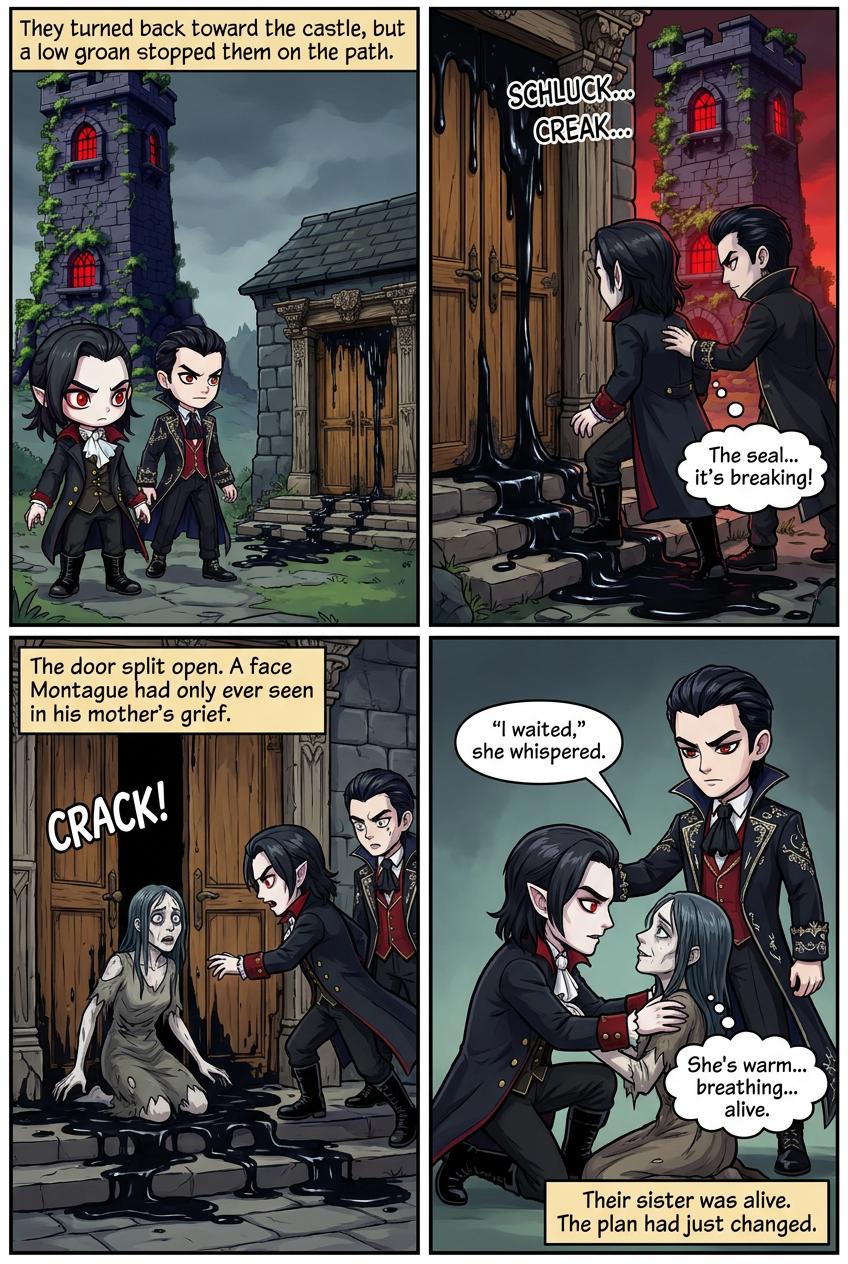
They turned back toward the castle, but a low groan stopped them on the path. It came from a squat stone building near the dark tower, one Montague had walked past a dozen times without a second look. Its door had been sealed for as long as he could remember. Now the seal was breaking from the inside. Black ooze pushed through the cracks in the old oak door. It ran down the steps in thick ropes and pooled at their boots. The tower behind it stood quiet, its red windows watching. Alastair drew Montague back by the sleeve and did not speak. The door split open. A pale hand pushed through the ooze, then an arm, then a face Montague had only ever seen in his mother's grief. A woman, thin and blinking, with their mother's eyes. She fell to her knees on the wet stone. Montague moved before Alastair could stop him. He caught her shoulders. She was warm. She was breathing. "I waited," she whispered. Alastair's hand closed on Montague's arm, steady at last. Their sister was alive. The plan had just changed.
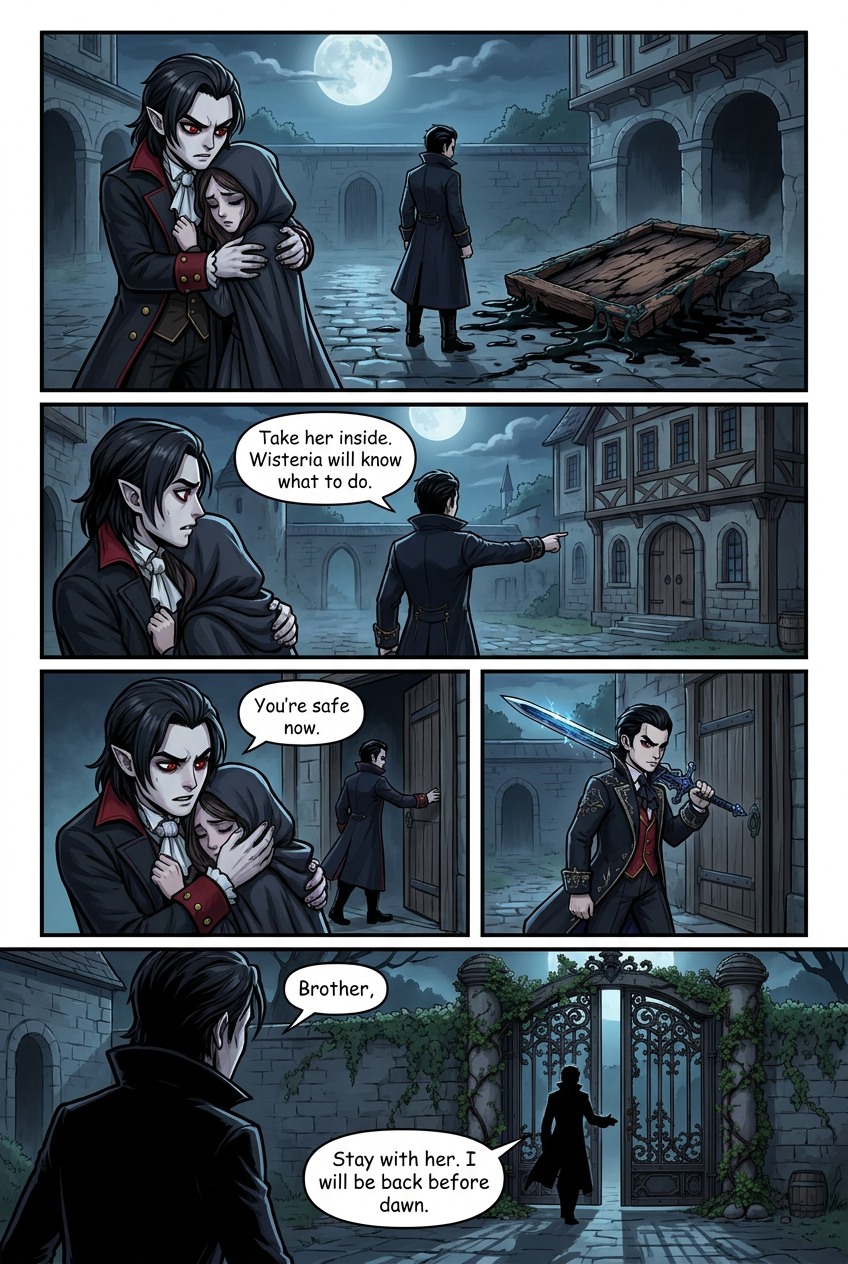
Montague held his sister against his chest while Alastair stepped back from the shattered doorway. The old oak slab lay in pieces on the wet stone, black ooze still leaking from its splintered edges. Alastair's face had gone very still. Montague knew that stillness. It was the look his brother wore when he had already decided. "Take her inside," Alastair said. "Wisteria will know what to do." He did not wait for an answer. He turned and walked toward the squat building at the edge of the courtyard, the one lined with blades and bottles. Montague's sister shivered against him. He whispered that she was safe now. But his eyes followed his brother across the stones. Alastair pushed open the armory door without slowing. When Alastair came out, he carried a dark blade across his shoulder. The obsidian caught the moonlight in a thin blue line. He did not look back at the broken chamber. He did not look back at Montague. "Brother," Montague called. Alastair paused, but only for a breath. "Stay with her," Alastair said. "I will be back before dawn." Then he was gone past the gate, and Montague was left holding the sister they had won and the brother they might lose.
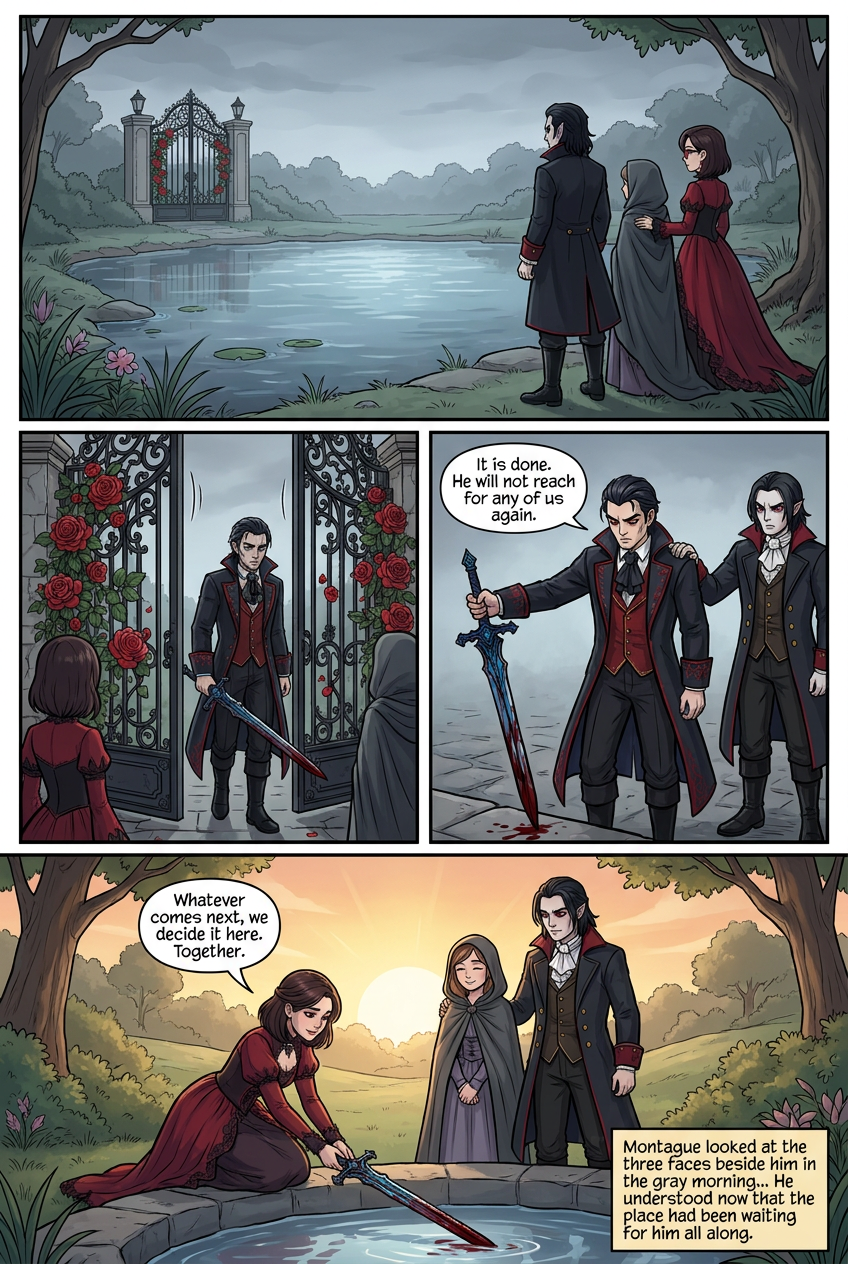
Montague stood by the dark pond in the courtyard, his sister wrapped in a blanket beside him. Wisteria waited at his other shoulder, hands folded, eyes on the eastern gate. The sky had gone gray at the edges. Dawn was close, and Alastair had not come back. Then the iron gate creaked open. Red roses trembled on the black bars as Alastair stepped through. The obsidian blade still hung from his hand, its dark surface streaked with something darker. He did not sheathe it yet. He looked at Montague, then at Wisteria, then at the sister standing between them, and the line of his shoulders finally dropped. "It is done," Alastair said. He walked to them slowly. The blade lowered as he came, until its tip touched the stone. "He will not reach for any of us again." Montague did not ask for the details. He had carried his own silence for two hundred years. He knew the shape of what a man brought back from a night like this. He only stepped forward and put a hand on his brother's shoulder. Alastair did not pull away. Wisteria reached for the blade. Alastair let her take it. She set it carefully on the rim of the pond, where the still black water held the first pale light. "Whatever comes next," she said quietly, "we decide it here. Together." Their sister lifted her eyes to each of them in turn, and for the first time since the chamber broke open, she smiled. Montague looked at the three faces beside him in the gray morning. His brother, who had come back for him twice now. His brother's wife, who had chosen to stand with him instead of behind him. His sister, breathing, alive, returned. He had spent two centuries believing he would have to earn his place again. He understood now that the place had been waiting for him all along. The sun rose over Nightshade Grove. The four of them walked back through the rose-wound gate as one.
Play your story to life
Storycraft is a mobile game where you create AI characters, craft items and locations to build their world, then discover what direction your story takes. Download the iOS game for free today!
Download for free