

MORPHEUS's Arc
11 Chapters
MORPHEUS's dream is establishing a sanctuary where troubled dreamers seek his therapeutic counsel..

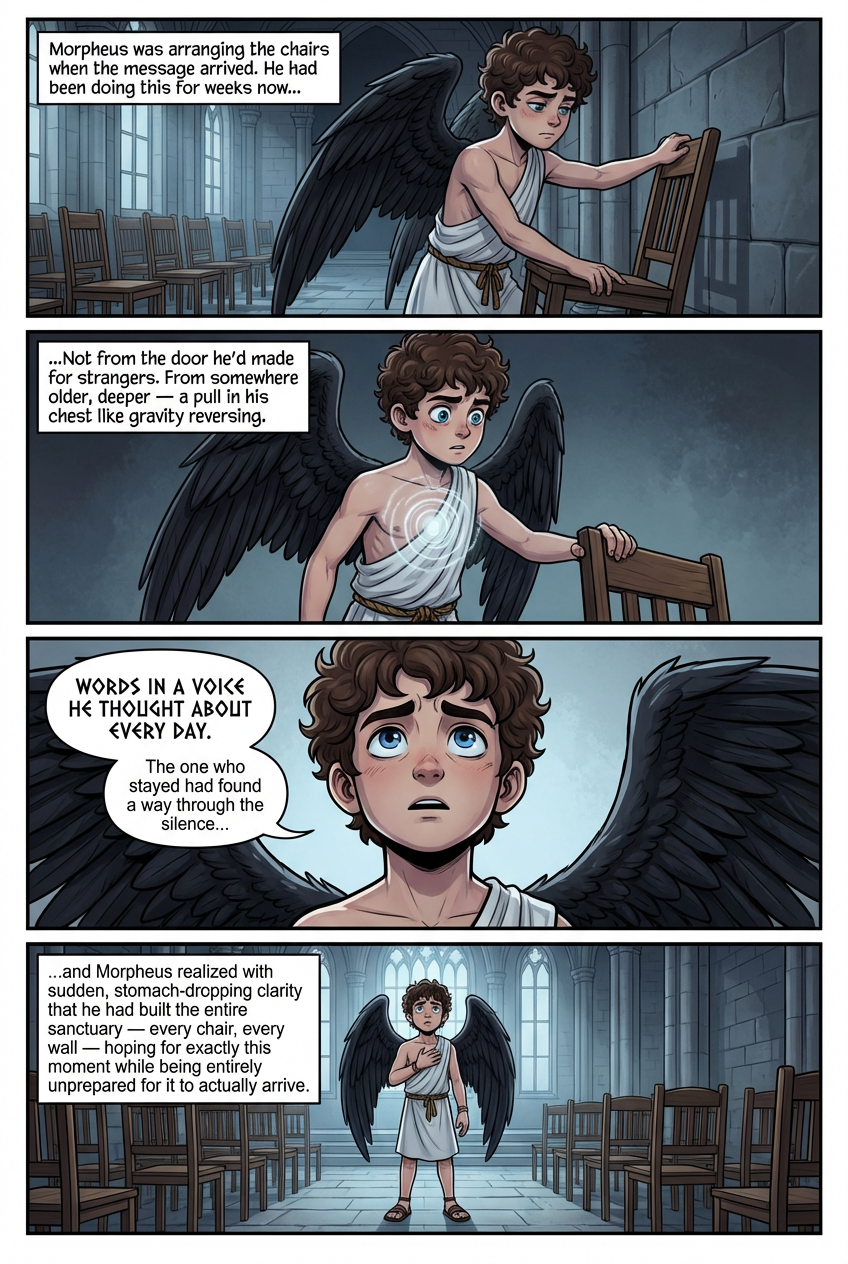
Morpheus was arranging the chairs when the message arrived. He had been doing this for weeks now — shifting them closer to the wall, farther apart, testing which arrangement felt least like a trap. The sanctuary was nearly ready. People would come here, he told himself. They would choose to walk through that door. But the knock came too early. Not from the door he'd made for strangers. From somewhere older, deeper — a pull in his chest like gravity reversing. He stopped mid-step, one hand still on the chair back. The sensation sharpened into words he had not heard in forty thousand years. Words in a voice he thought about every day. The one who stayed had found a way through the silence, and Morpheus realized with sudden, stomach-dropping clarity that he had built the entire sanctuary — every chair, every wall, every careful angle of light — hoping for exactly this moment while being entirely unprepared for it to actually arrive.
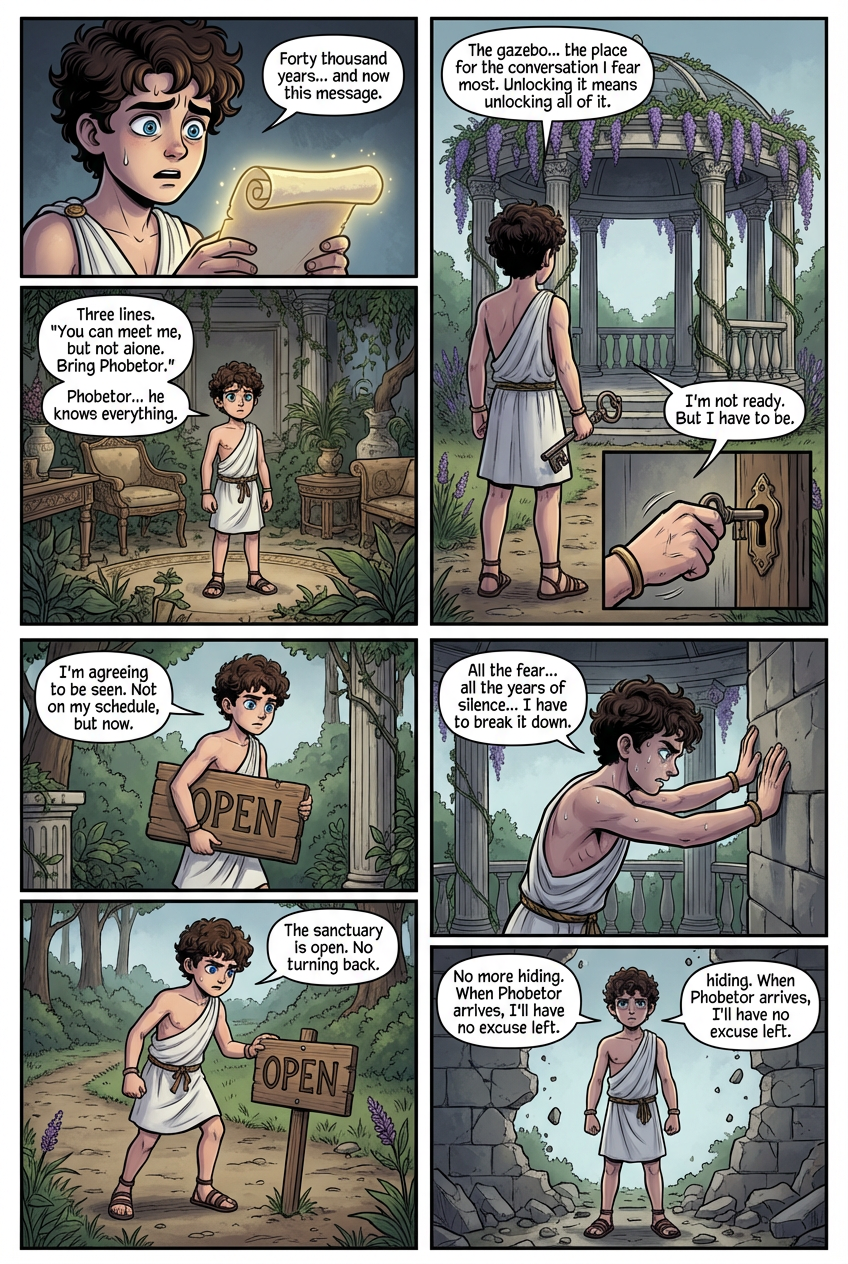
The words came through like a thread pulled taut across forty thousand years, and Morpheus felt them settle into his chest before he could finish reading. The message was short. Three lines, no greeting, no explanation of how it had crossed the distance between them. Just the condition: You can meet me, but not alone. Bring Phobetor. Morpheus stood in the empty sanctuary and felt the weight of what was being asked. Phobetor was family, yes — but also the one person who had watched him build this place and said nothing, who knew exactly why every chair was positioned just so, who would see through any careful explanation he tried to offer. The one who stayed was demanding a witness. Not to the meeting itself, but to him — to whatever Morpheus would become when he finally had to speak. He walked to the back of the sanctuary where the gazebo stood, wrapped in lavender vines he'd grown specifically because they didn't need him to tend them. It was locked. He'd locked it himself months ago, telling himself it was unfinished, that no one should see it yet. But he knew what it really was: the place he'd built for the conversation he was most afraid to have. His hand shook as he pulled the key from his pocket. The lock turned. The vines trembled as the door swung open, and Morpheus understood with perfect clarity that unlocking this space meant unlocking all of it — the apology, the fear, the forty thousand years of not going. He couldn't meet the one who stayed without first letting Phobetor see what he'd been hiding. The sanctuary wasn't ready. He wasn't ready. But the message had arrived, and the condition was clear, and Morpheus had just opened the one door he'd sworn to keep closed. He walked to the front entrance and lifted the wooden sign from where it leaned against the wall. His hands were still shaking. The sign said OPEN in letters he'd carved himself, back when he thought opening meant strangers arriving on their own terms. Now it meant something else entirely. He carried it outside and planted it in the soft earth beside the path. Anyone could see it now. Phobetor would see it. The one who stayed had asked for a witness, and Morpheus had just agreed to be seen — not when he was ready, not on his own schedule, but now. He stepped back and looked at the sign. It stood crooked in the ground, letters catching the light. The sanctuary was open. He had no idea what he would say when Phobetor arrived, but the door was unlocked and the sign was up and there was no taking it back. Inside the gazebo, beneath the lavender bloom, he found the wall he'd built himself. White stone, carved with careful detail, marking the boundary between what he allowed others to see and what he kept locked away. He'd told himself it was for structure, for beauty. But standing here now, he saw it for what it was: the last thing standing between him and the person he needed to become to face this meeting. Morpheus pressed both palms against the cold stone. Then he pushed. The wall didn't fall easily. It took all forty thousand years of weight behind it, all the fear he'd carried, all the words he'd never said. But it gave. Stone scraped against earth. The boundary came down. And when Phobetor arrived — when family saw what he'd hidden and what he'd finally torn down — Morpheus would have no excuse left, no locked door to hide behind. Just himself, visible at last, waiting to be judged for it.
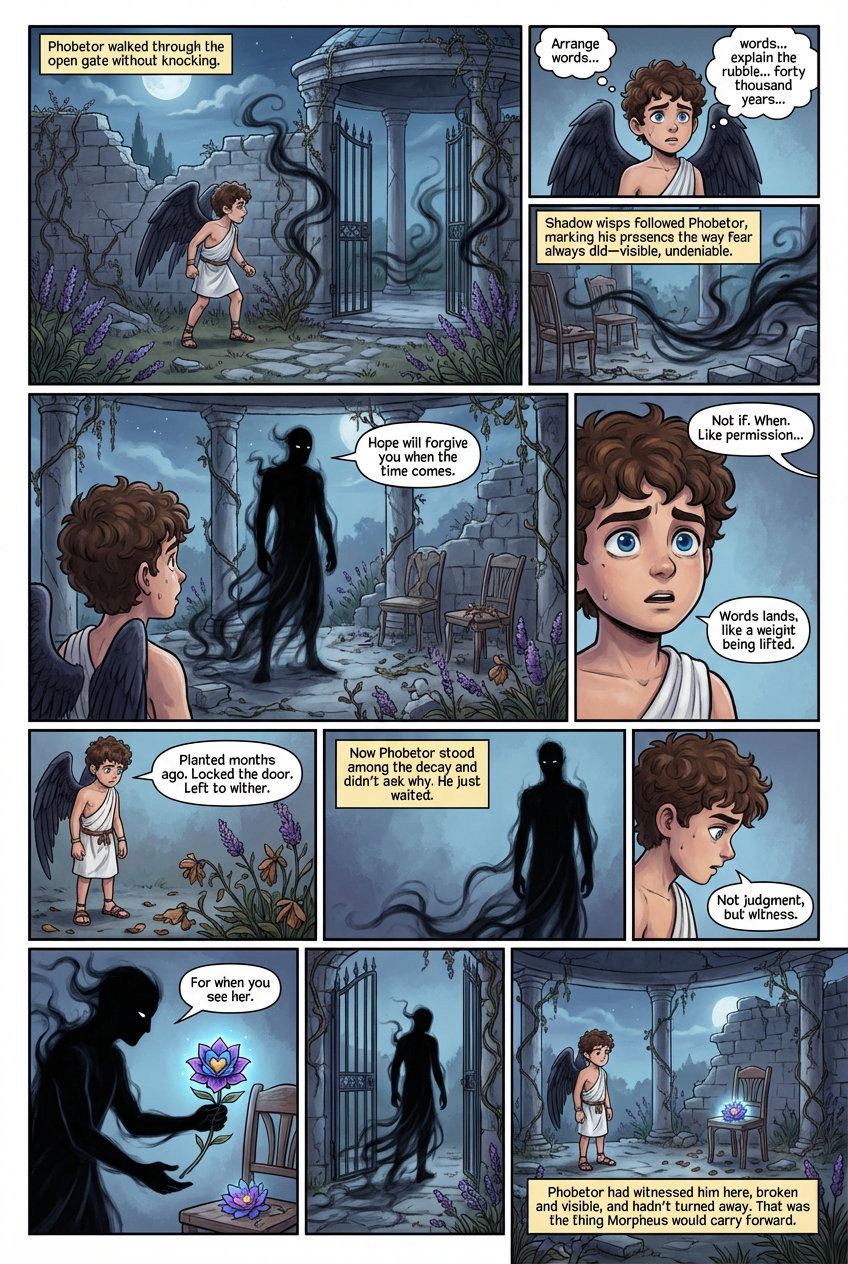
Phobetor walked through the open gate without knocking. Morpheus had been standing beside the broken wall, trying to arrange words in his head that might explain the rubble, the unlocked door, the message that had crossed forty thousand years. But his brother didn't ask. Shadow wisps followed Phobetor through the gazebo entrance, curling around the lavender vines like smoke given form. They marked his presence the way fear always did — visible, undeniable, witnessed. Morpheus opened his mouth to explain and found nothing would come. Phobetor stepped past the broken wall, looked at the empty chairs, the torn stone, the carefully planted flowers that had watched Morpheus build this place one piece at a time. Then he turned back and said, simply: "Hope will forgive you when the time comes." Not if. When. As though he'd already seen the end of this and knew Morpheus would make it there. The words landed like permission Morpheus hadn't known he needed. He'd spent forty thousand years preparing explanations, building sanctuaries as arguments, arranging chairs like evidence. But Phobetor hadn't asked for any of it. He'd walked in, seen what mattered, and named the thing Morpheus was most afraid to hope for. Morpheus looked at the flowers scattered around the gazebo's edge. Half of them were dying. Brown petals curled against green stems. Orange blooms faded to rust. He'd planted them months ago when he thought care alone could keep things alive. But he'd locked the door after that and left them to wither. Now Phobetor stood among the decay and didn't ask why. He just waited. The silence stretched between them until Morpheus realized what was being offered: not judgment, but witness. Phobetor had come because he was asked to see this — the ruin, the fear, the forty thousand years of weight Morpheus had finally put down. The chapter Morpheus had been writing in his head — the one where he justified and defended and proved he deserved another chance — dissolved. In its place: the truth that showing up empty-handed, with a witness who already understood, might be enough. Phobetor reached into his pocket and pulled out a single flower. It glowed faintly in the dim light of the gazebo, petals layered in purple and blue with a heart of gold. He set it on the nearest chair without ceremony. "For when you see her," he said. Then he turned and walked back through the gate, shadow wisps trailing behind him like the end of a conversation that didn't need more words. Morpheus stood alone with the flower and the withered garden and the knowledge that forgiveness wasn't something he could build or earn or plan for. It would come when it came. But Phobetor had witnessed him here, broken and visible, and hadn't turned away. That was the thing Morpheus would carry forward — not hope that he could control the outcome, but proof that he could survive being seen while he waited for it.
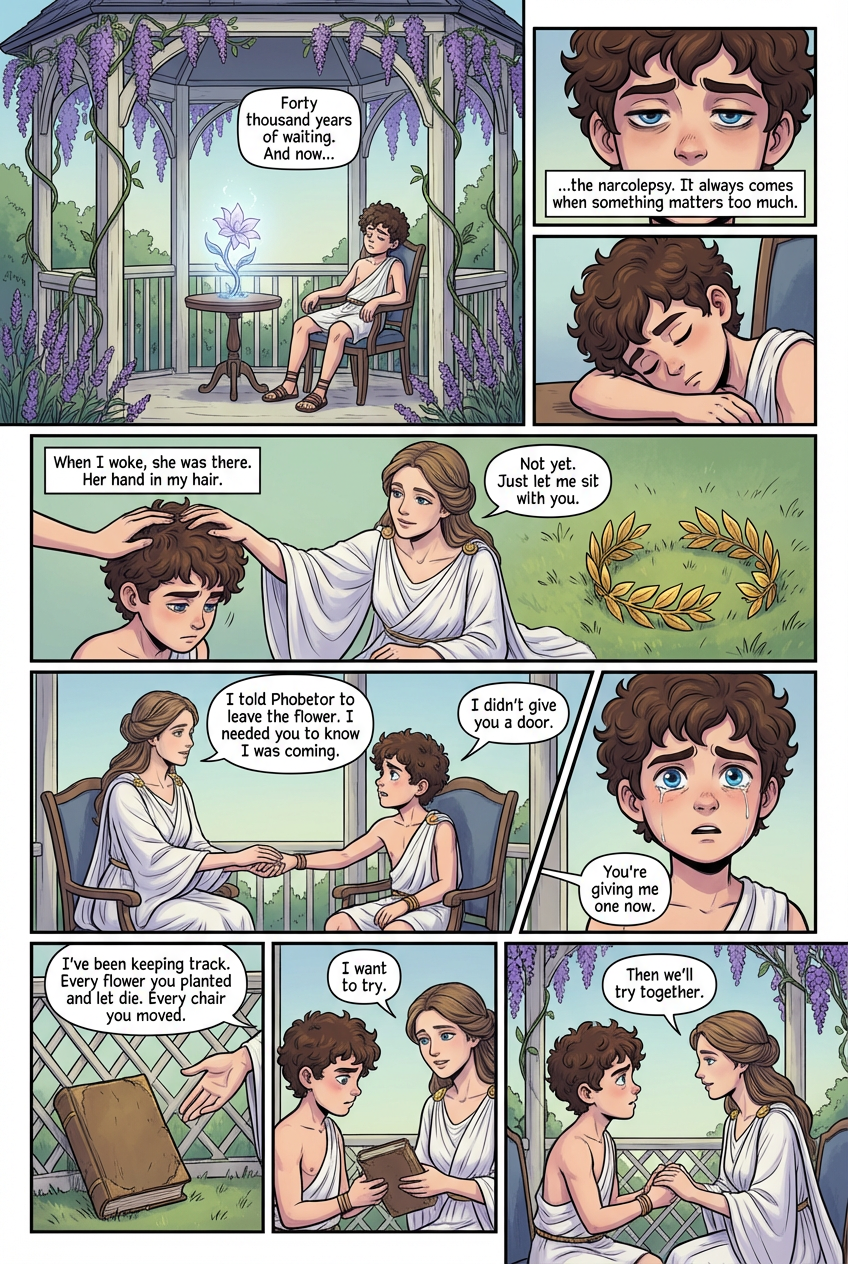
Morpheus sat alone in the gazebo after Phobetor left. The glowing flower rested on the chair beside him. He stared at it and felt the weight of what came next pressing down like stone. Forty thousand years of waiting, and now the door was open. He tried to stay upright. Tried to keep his eyes focused on the lavender vines curling through the lattice. But the pressure in his chest grew heavier with each breath. His vision blurred at the edges. The narcolepsy came without warning, the way it always did when something mattered too much. He slumped forward in the chair and fell into sleep before he could stop himself. When he woke, she was beside him. Her hand moved through his hair in slow, familiar strokes. He didn't move. Didn't open his eyes all the way. Just felt the rhythm of her touch and the impossible fact of her presence. A golden crown sat on the ground between them, shaped like laurel leaves. She must have been wearing it when she arrived. Now it rested in the grass beside his chair as if she'd set it down to stay awhile. Morpheus looked up at her face and found no anger there. No judgment. Just the same steady gaze that had once tried to tell him what he was carrying before he could see it himself. He opened his mouth to say it first — the thing he'd practiced for forty thousand years — but she shook her head. "Not yet," she said. "Just let me sit with you." And he did. Because the sanctuary had finally done what he built it for. It had given her a door. And she had chosen to walk through it. Hope pulled a cushioned chair closer and settled into it without asking permission. The wood creaked under her weight. She didn't look away from him. Morpheus watched her arrange herself in the space he'd built and felt something unlock in his chest. Not forgiveness — that would come later, or it wouldn't. But proof that she was real. That she'd answered the pull after all this time. That he hadn't ruined it by falling asleep before she arrived. She reached over and took his hand. Her fingers laced through his like they belonged there. "I told Phobetor to leave the flower," she said. "I needed you to know I was coming before I got here." Morpheus stared at her. All the speeches he'd prepared dissolved. She'd been orchestrating this. She'd known he would fall apart under the weight of waiting. So she'd sent a witness first to steady him. He squeezed her hand and felt tears he didn't know how to stop. "I didn't give you a door," he said. Hope smiled. "You're giving me one now." Hope gestured toward the edge of the gazebo where a book rested against the lattice, its cover worn to leather softness. "I've been keeping track," she said. "Every time you opened this place and locked it again. Every flower you planted and let die. Every chair you moved and moved back." Morpheus looked at the book and understood it had been there longer than the gazebo itself. She'd been watching. Witnessing him build this sanctuary the same way he'd spent forty thousand years witnessing dreams. The weight he'd carried alone had never been invisible to her. She'd just been waiting for him to stop pretending it wasn't there. He looked at her hand in his and made a choice that felt like stepping off a cliff. "I want to try," he said. Not an apology. Not an explanation. Just the truth of what he came here to do. Hope's grip tightened. "Then we'll try together." The sanctuary was open now. And for the first time since he'd built it, Morpheus believed someone might actually stay.
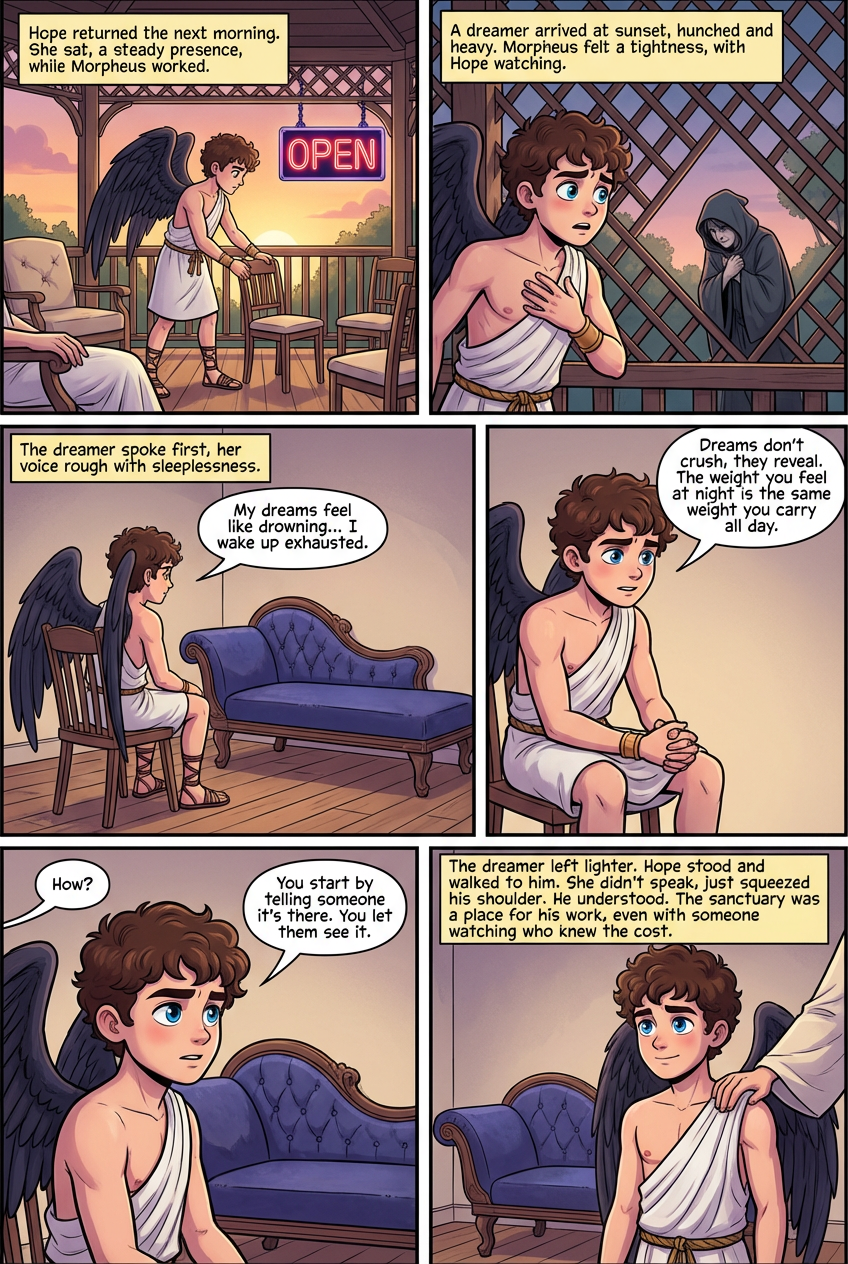
Hope didn't leave after that first day. She returned the next morning while Morpheus was straightening chairs that didn't need straightening. She brought nothing with her except the same steady presence that had filled the gazebo the day before. She sat in the cushioned chair she'd claimed and watched him work without offering to help. He didn't ask her to. The silence between them felt different than the forty thousand years of absence — it was chosen now, not imposed. She was still there when the sign outside began to glow at dusk. The dreamer arrived just after sunset, hunched inside a tattered coat that looked like it had survived more winters than its owner. The woman moved as though gravity had doubled overnight. Morpheus saw her through the gazebo's open lattice and felt something tighten in his chest. He'd counseled thousands before, but never with someone watching who mattered this much. The woman stopped at the threshold and looked between him and Hope with uncertain eyes. Morpheus gestured toward an indigo chaise near the center of the space, its deep velvet surface inviting her to collapse. She did. He pulled a wooden chair opposite her and sat down, aware of Hope's presence like a held breath. The woman spoke first, her voice rough with sleeplessness. She described dreams that felt like drowning. Nights where she woke more tired than when she'd gone to bed. Morpheus listened the way he always did — with the full weight of his attention — but something was different now. Hope's gaze wasn't critical. It wasn't even curious. She simply witnessed him doing what he'd built this place to do. The woman asked if he could fix it, make the dreams stop crushing her. Morpheus leaned forward and told her the truth he'd learned across forty thousand years: dreams don't crush, they reveal. The weight she felt at night was the same weight she carried all day, just without anywhere left to hide it. She needed to put some of it down while awake, or sleep would never be restful. The woman's face crumpled. She asked how. Morpheus glanced at Hope without meaning to, then back at the woman. "You start by telling someone it's there," he said. "You let them see it. Even if you're afraid of what happens next." The woman nodded slowly and began to speak — not about dreams this time, but about the things she'd been holding alone. Morpheus listened until she finished, then offered her a return visit in three days. She left looking lighter than when she'd arrived. Hope stood and walked to where he sat beside the comfortable arrangement of furniture that had made the session possible. She didn't say anything about what she'd witnessed. She just rested her hand on his shoulder and squeezed once. Morpheus understood then what had changed. The sanctuary wasn't just a door anymore. It was a place where he could do the work he'd built it for, even with someone watching who knew exactly how much it cost him. Hope had seen him counsel someone while carrying his own weight, and she hadn't left. That felt like forgiveness starting, even if neither of them called it that yet.
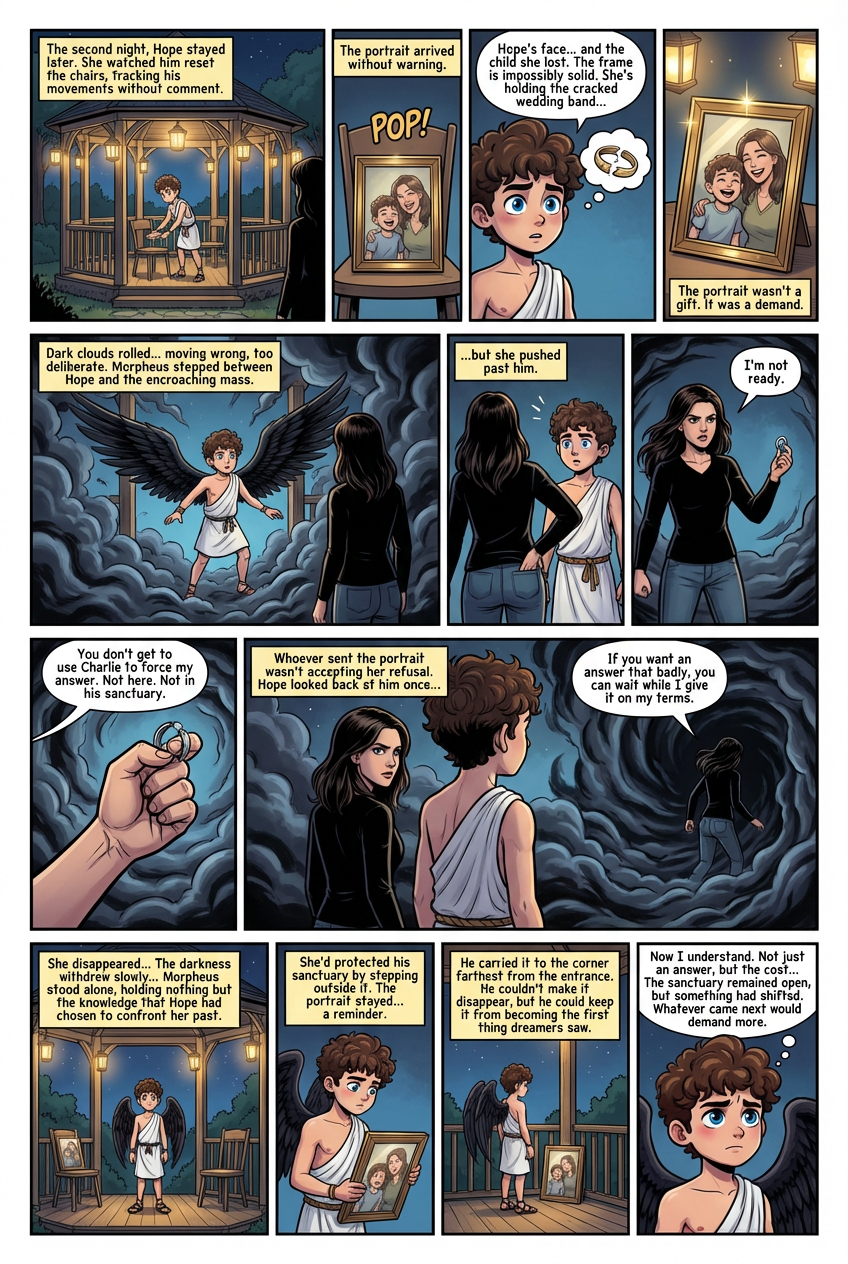
The second night, Hope stayed later. She watched him reset the chairs after the dreamer left, tracking his movements without comment. Morpheus felt the weight of her attention but didn't try to fill the silence with explanations. The portrait arrived without warning. One moment the gazebo held only the two of them and the arranged furniture. The next, a framed picture stood propped against the center chair — a woman holding a small boy, both caught mid-laugh. Morpheus recognized Hope's face before she turned to see it. He watched her freeze, watched color drain from her cheeks as she stared at the image of herself with the child she'd lost. The frame gleamed under the lantern light, impossibly solid for something that hadn't been there seconds before. Hope's hand moved to her pocket, fingers closing around something she didn't pull free. Morpheus knew without seeing — the cracked wedding band she'd been carrying since their first conversation. The portrait wasn't a gift. It was a demand. Dark clouds rolled across the threshold where the gazebo opened to the rest of Oneiria. They moved wrong, too deliberate to be weather. Morpheus stepped between Hope and the encroaching mass, but she pushed past him. She faced the clouds with her shoulders squared, one hand still gripping whatever she held in her pocket. "I'm not ready," she said to the shifting darkness. Her voice didn't waver. The clouds paused, then pressed closer. Hope pulled the cracked band from her pocket and held it up. "You don't get to use Charlie to force my answer. Not here. Not in his sanctuary." The clouds coiled tighter, building pressure. Morpheus felt the air thicken with intent — whoever sent the portrait wasn't accepting her refusal. Hope looked back at him once, then stepped forward into the dark mass. "If you want an answer that badly, you can wait while I give it on my terms." She disappeared into the clouds before Morpheus could follow. The portrait remained behind, leaning against the chair like evidence of interrupted business. The darkness withdrew slowly, pulling back beyond the gazebo's edges until only ordinary night remained. Morpheus stood alone among the chairs, holding nothing but the knowledge that Hope had chosen to confront her past rather than let it invade the space he'd built for healing. She'd protected his sanctuary by stepping outside it. The portrait stayed where it had appeared, a reminder that the unknown figure was done waiting. Morpheus picked it up carefully and carried it to the corner farthest from the entrance. He couldn't make it disappear, but he could keep it from becoming the first thing dreamers saw when they arrived. Hope had drawn a line. Now he understood what she'd been delaying — not just an answer, but the cost of refusing to give one before she was ready. The sanctuary remained open, but something had shifted. Whatever came next would demand more than either of them had prepared to offer.
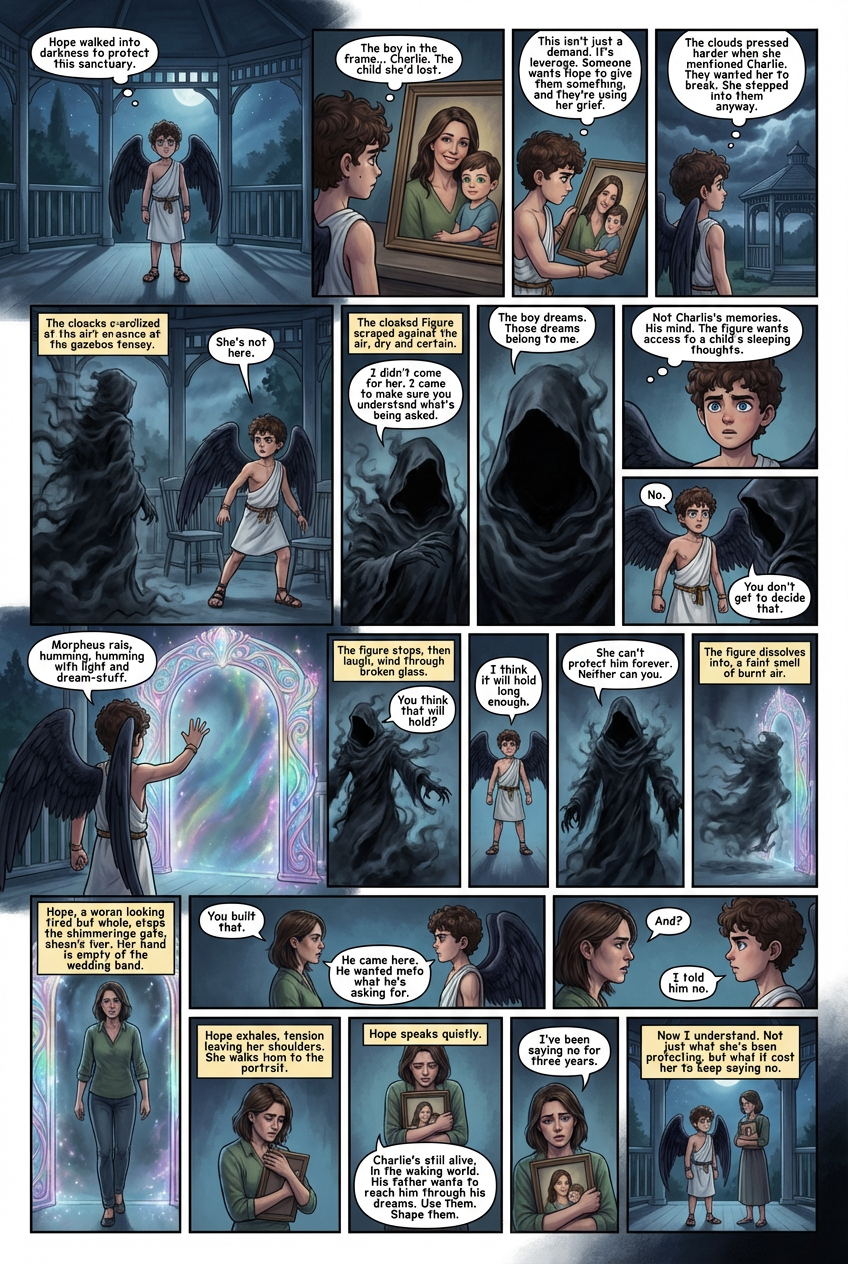
Morpheus stood in the empty gazebo and tried to understand what had just happened. Hope had walked into darkness to protect the sanctuary he'd built. She'd taken the confrontation somewhere else so the dreamers wouldn't have to witness it. The portrait remained in the corner where he'd placed it — a reminder that someone wanted access to something Hope refused to give. He moved closer to examine the image. The boy in the frame had Hope's smile and eyes that didn't match each other. One green, one blue. Charlie. The child she'd lost. The figure who sent this knew exactly what would hurt her most. Morpheus picked up the portrait again and studied the way Hope held her son — protective, joyful, completely present. This wasn't just a demand for her attention. It was leverage. Someone wanted Hope to give them something, and they were willing to use her grief to get it. He thought about the cracked wedding band she'd been carrying, the way she'd held it up like a shield against the darkness. Whatever she was refusing to give, it cost her to keep saying no. The clouds had pressed harder when she'd mentioned Charlie by name. They'd wanted her to break, to agree before she was ready. She'd stepped into them anyway. The cloaked figure materialized at the gazebo's entrance before Hope returned. Morpheus recognized the wrongness immediately — the way shadows gathered too thick around a shape that held itself like a man but moved like smoke. The figure didn't speak. It simply stood there, waiting, as if the sanctuary belonged to it. Morpheus stepped forward, placing himself between the entrance and the chairs. "She's not here." The figure tilted its head. "I didn't come for her." Its voice scraped against the air, dry and certain. "I came to make sure you understand what's being asked. The boy dreams. Those dreams belong to me." Morpheus felt something cold settle in his chest. Not Charlie's memories. His mind. The figure wanted access to a child's sleeping thoughts, and Hope had been refusing for longer than Morpheus had realized. "No," he said. The word came out flat, final. The figure shifted closer. "You don't get to decide that." Morpheus built the gate without thinking about it. One moment the gazebo entrance stood open to Oneiria's night. The next, an archway materialized across the threshold — ornate, iridescent, humming with intent. It wasn't a wall. It was a statement. A line drawn in dream-stuff that even shadows couldn't cross without permission. The figure stopped, then laughed — a sound like wind through broken glass. "You think that will hold?" Morpheus didn't move. "I think it will hold long enough." The figure studied the gate, then looked back at Morpheus with something that might have been respect or might have been contempt. "She can't protect him forever. Neither can you." It dissolved into smoke before Morpheus could respond, leaving only the faint smell of burnt air behind. The gate remained, shimmering across the entrance like a promise he hadn't known he was capable of making. Hope returned an hour later, stepping through the gate without slowing. She looked tired but whole, her hand empty of the wedding band she'd carried into the darkness. She stopped when she saw the archway, then turned to Morpheus with something unreadable in her expression. "You built that." It wasn't a question. Morpheus nodded. "He came here. He wanted me to understand what he's asking for." Hope's jaw tightened. "And?" Morpheus met her gaze and said the thing he'd spent forty thousand years learning how to mean. "I told him no." Hope exhaled slowly, and something in her shoulders released. She walked to the portrait, picked it up, and held it against her chest for a long moment before setting it down again. "Charlie's still alive," she said quietly. "In the waking world. His father wants to reach him through his dreams. Use them. Shape them." She looked at Morpheus. "I've been saying no for three years." Morpheus understood then — not just what Hope had been protecting, but what it
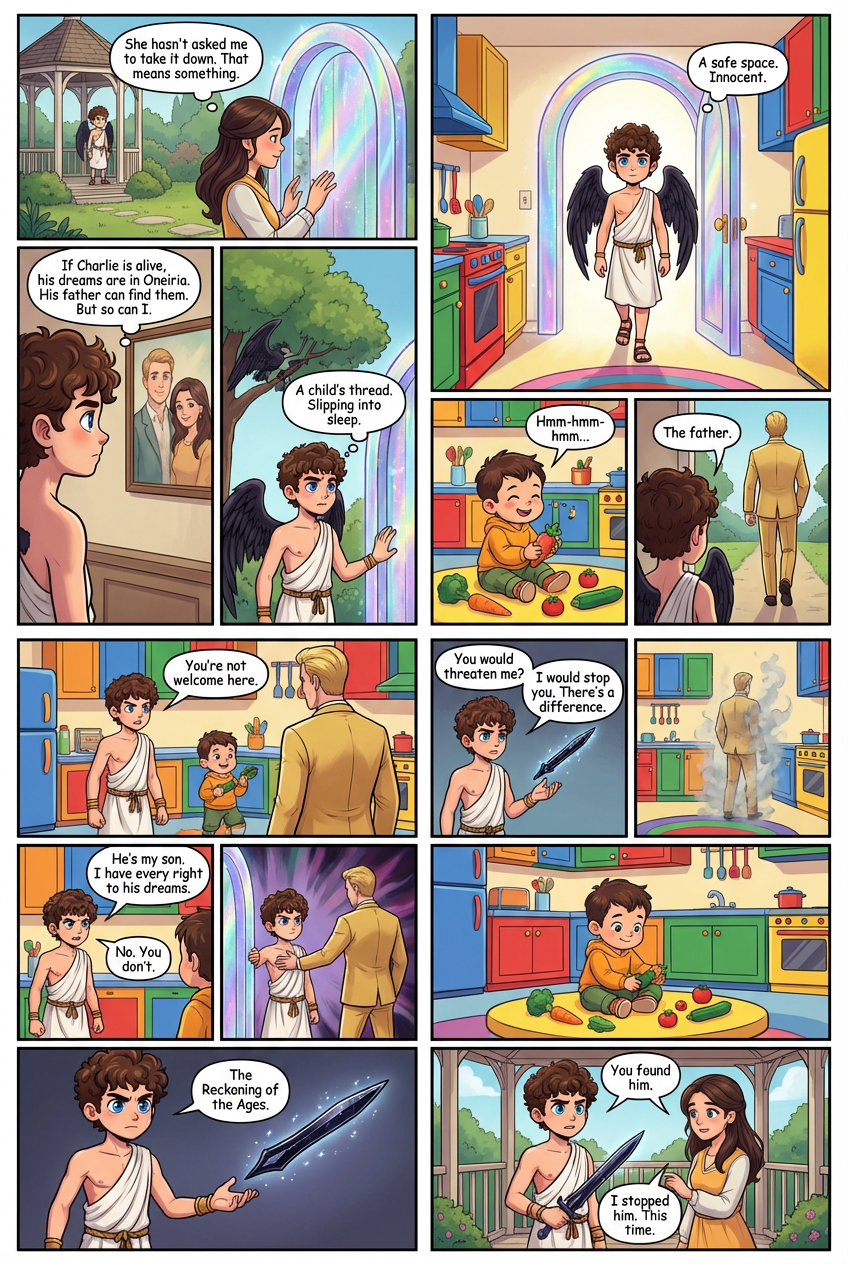
Morpheus watched Hope examine the gate he'd built, her fingers tracing the iridescent archway without quite touching it. She hadn't asked him to take it down. That meant something, though he wasn't sure what yet. The portrait of Charlie still rested against the wall where she'd left it, and Morpheus found himself studying it again — the boy's mismatched eyes, the way Hope held him like nothing else in any world mattered. If Charlie was alive in the waking world, then his dreams existed somewhere in Oneiria right now. Morpheus had witnessed thousands of children's dreams over forty thousand years, but he'd never tried to find a specific one. Never had a reason to. The father — whoever he was — clearly knew how to navigate dream space well enough to send shadows and portraits and demands. That meant he could find the boy's dreams without Morpheus's help. But it also meant Morpheus could find them first. Morpheus felt the shift before he understood what it meant. A thread pulling tight in Oneiria, the distinctive signature of a child slipping into sleep. He followed it instinctively, stepping through the gate he'd built and into the dream realm. The thread led him to a small, warm space — a kitchen rendered in bright primary colors, sized for someone no taller than his waist. A toy kitchen, complete with plastic pots and a wooden spoon. Charlie stood at the counter, his mismatched eyes focused on arranging pretend vegetables in a pretend bowl. He hummed while he worked, completely absorbed. The dream felt safe, innocent, exactly the kind of space a child should be allowed to build without interference. Then Morpheus saw the second figure materialize at the edge of the dream. A man in a sharp suit, blond hair perfectly styled, moving toward the boy with the confidence of someone who believed he had every right to be there. Morpheus stepped between them without thinking. The man stopped, surprise flickering across his face before settling into something colder. "You're not welcome here," Morpheus said. His voice came out flat, final. The man's expression shifted to contempt. "He's my son. I have every right to his dreams." Morpheus didn't move. "No. You don't." The man reached for Charlie, and Morpheus pulled the gate into the dream space itself — the same iridescent archway, now manifesting as a barrier between the boy and his father. But the man didn't retreat. He placed his hand against the gate and pushed, and Morpheus felt the structure begin to buckle. The father wasn't just trying to enter the dream. He was trying to reshape it, to turn Charlie's safe kitchen into something else. Morpheus could feel the dream starting to twist under the pressure, the bright colors bleeding into shadow. Morpheus reached for the only weapon he had — not his staff, which he'd given to Hope, but something older. Something he'd carried for forty thousand years without ever needing to name. He pulled it from the space between intention and action, and it materialized in his hand as a blade of pure obsidian, shimmering like oil on water. The Reckoning of the Ages. He'd never used it before, never had cause to. But the moment the father saw it, he stopped pushing. "You would threaten me?" the man asked, voice tight. Morpheus held the blade steady. "I would stop you. There's a difference." The father stared at him for a long moment, then stepped back from the gate. "This isn't over," he said, and dissolved into smoke. The dream stabilized immediately. Charlie continued humming at his toy kitchen, completely unaware of what had nearly happened. Morpheus stayed until the boy's dream shifted naturally toward waking, then returned to the gazebo. Hope was waiting. She saw the blade still in his hand and understood immediately. "You found him," she said. Morpheus nodded. "I stopped him. This time."

Morpheus stood in the gazebo and waited for the father to return. Not tomorrow, not next week — tonight. The man wouldn't need long to prepare. He'd found Charlie's dream once already, and now he knew Morpheus would be there to stop him. But Morpheus didn't intend to wait in the dream. He pulled a scroll from the deepest part of his memory — a list he'd kept for forty thousand years and never once used. The Do Not Dream List. Names of mortals whose dreams he'd sealed away, forbidden from entering Oneiria entirely. It had always been theoretical, a final option if someone's dreams became too dangerous to themselves or others. He wrote the father's name on it now, his hand steady. The moment the ink dried, he felt the barrier snap into place across every possible thread that could lead the man into sleep. The father could close his eyes, but he wouldn't dream. Not tonight. Not ever again, unless Morpheus chose to release him. He carried the scroll to the threshold between the gazebo and Oneiria, and there he carved a rune into the air itself — the Svefnthorn, glowing with pale blue light. It hung suspended in the empty space, marking the boundary. Anyone attempting to force their way through would meet it first, and it would send them back to waking without mercy. Morpheus stepped back and looked at what he'd built. A sealed list. A warding rune. A line drawn in desolate ground that no one could cross without his permission. The father would wake tomorrow and realize he couldn't reach his son's dreams anymore. He'd know Morpheus had done this. And he'd know it wasn't temporary. Hope appeared beside him, silent. She studied the rune, then the scroll still in his hand. "You didn't just stop him," she said quietly. "You ended it." Morpheus nodded. He'd chosen his ground, and he'd made it permanent. The father could rage, could send shadows and portraits and demands, but he couldn't enter the one place that mattered. Morpheus had spent forty thousand years witnessing dreams. Now he'd spent one night making sure a child could keep his. Hope's hand brushed his arm, and for the first time since the confrontation began, Morpheus let himself believe the sanctuary could actually protect someone.
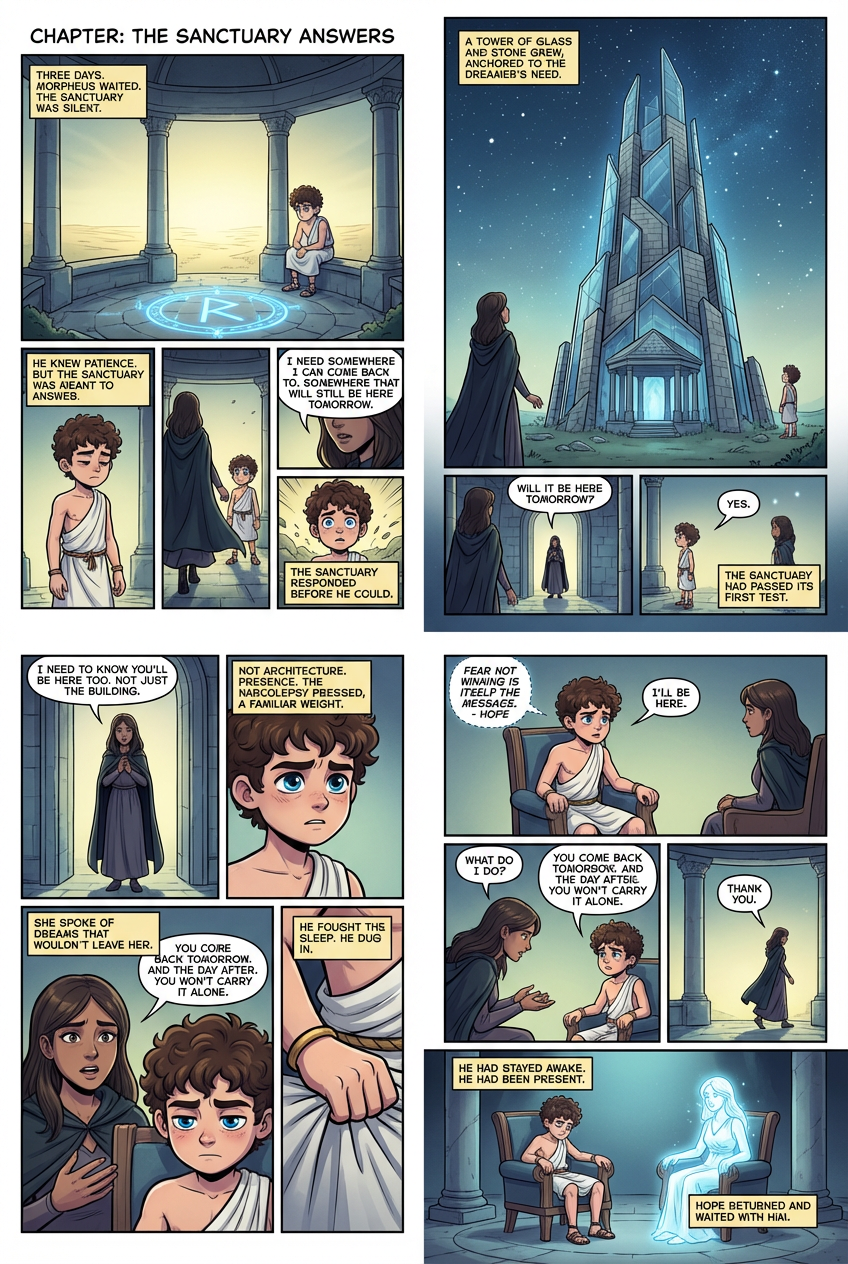
Morpheus waited three days. He kept the gazebo open, the rune glowing at its threshold, but no one came. The sanctuary sat empty except for Hope, who returned each evening and left each morning without asking if anyone had arrived. On the fourth morning, he woke to find her gone and the chairs exactly where he'd left them. The stillness felt familiar — forty thousand years of waiting had taught him patience. But the sanctuary wasn't supposed to be patient. It was supposed to answer. On the fifth day, a woman walked through the open gazebo entrance and stopped just inside the threshold. She looked at the chairs, at the empty space, at Morpheus standing beside the glowing rune. "I need somewhere I can come back to," she said. Her voice was quiet but steady. "Not just once. Somewhere that will still be here tomorrow." Morpheus felt the sanctuary respond before he understood what was happening. The ground beneath the gazebo shifted, stone rising in careful layers that locked together without mortar. Glass panels appeared between metal frames, reflecting light he hadn't summoned. The structure grew upward — a tower of glass and stone that anchored itself to the gazebo's foundation and reached toward the sky. The woman watched it build itself around her, and when it finished, she stepped inside through doors that opened without a sound. Morpheus followed her in and found rooms already furnished, each one waiting for someone to claim it. She turned to face him. "Will it be here tomorrow?" He looked at the tower that had answered her need without his permission, without his design. "Yes," he said. The sanctuary had passed its first real test. It had listened to what a dreamer needed and built the answer she could return to. But the woman didn't move toward the waiting rooms. She stood in the entrance, her hands folded against her chest. "I need to know you'll be here too," she said. "Not just the building." Morpheus froze. He'd built chairs for people to sit in, walls to keep them safe, a tower that would stand when they returned. But she wasn't asking for architecture. She was asking for him to stay awake, to be present, to meet her need without falling asleep halfway through. The narcolepsy pressed against him like a familiar weight. He'd failed this test a hundred times in dreams, waking to find dreamers already gone. The woman watched him, waiting. He could feel sleep pulling at him even now, his body preparing to betray him again. But Hope's words came back to him: *fear not winning is itself the message*. He walked to one of the chairs — soft fabric, sturdy frame — and sat down. "I'll be here," he said. The woman studied him for a long moment, then nodded and took the seat across from him. Morpheus gripped the armrests and focused on staying present. The tower had answered her first need. Now he had to answer the second. She spoke for twenty minutes about the dreams that wouldn't leave her alone, about the weight she carried in waking that followed her into sleep. Morpheus listened without interrupting, his eyes on hers, his body fighting to stay upright. Twice he felt himself slipping, the edges of consciousness blurring. Both times he dug his fingers into the chair's fabric and pulled himself back. When she finished, she leaned forward slightly. "What do I do?" she asked. Morpheus took a breath. "You come back tomorrow," he said. "And the day after. Not because the weight will be gone, but because you won't carry it alone anymore." The woman's shoulders dropped, tension releasing. She stood, looked around the tower one more time, and walked back toward the gazebo entrance. Before she left, she turned. "Thank you," she said. Morpheus stayed in the chair until she was gone, then let himself slump forward. He'd stayed awake. He'd been present. The sanctuary had built what she needed, and he'd given what only he could give. When Hope appeared beside him an hour later, she didn't ask what had happened. She just sat in the chair the woman had used and waited with
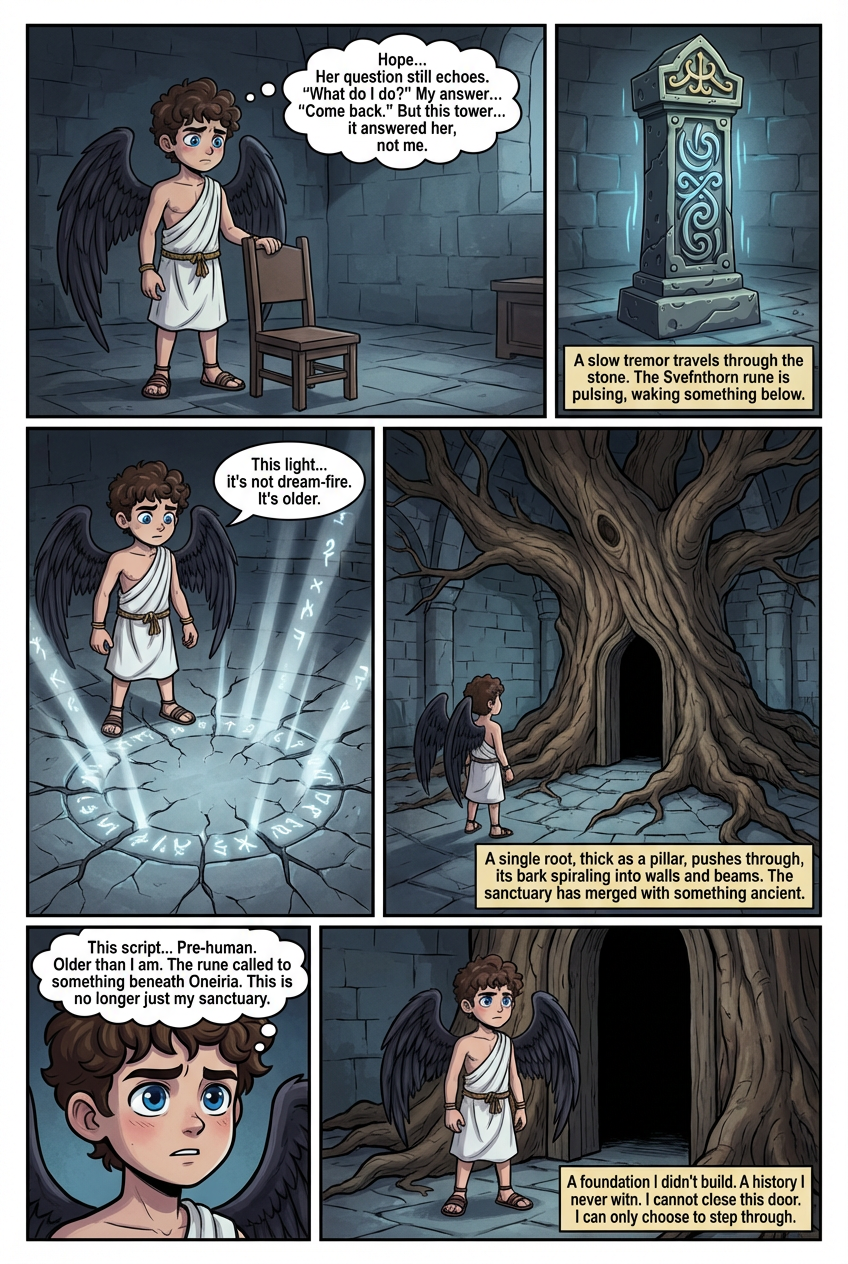
Morpheus stayed in the tower after Hope left, his hands still gripping the chair's armrests. The woman's question echoed in the silence — *what do I do?* — and his answer had been immediate. Come back. Don't carry it alone. Simple words, but they'd cost him something to stay awake long enough to say them. He stood slowly and walked to the center of the room, where the stone floor met the base of the tower's foundation. The structure had built itself in response to the woman's need, rising without his permission. He hadn't designed it. He hadn't carved a single stone. The sanctuary had answered her directly, and for the first time in forty thousand years, Morpheus felt like a witness to his own work rather than its architect. But the floor beneath him shifted. Not violently — just a slow, deliberate tremor that traveled through the stone and into his bones. Morpheus froze. The Svefnthorn rune he'd carved at the gazebo threshold days ago was pulsing now, sending rhythmic waves outward through the ground. He could feel it spreading, each pulse reaching deeper into the earth beneath the tower's foundation. The sanctuary had answered a dreamer's need by building upward. Now something else was answering the rune by waking below. The stone floor cracked in a perfect circle around him, and light poured through the gaps — not the warm glow of dream-fire, but something older and colder. Ancient symbols carved themselves into the rising stones as they broke the surface, forming a ring that surrounded the tower's base. Morpheus recognized the script immediately. Pre-human. Older than his own existence. The rune hadn't just marked a boundary to protect Charlie's dreams. It had called to something that had been waiting beneath Oneiria for longer than he'd been alive. A single tree root, thick as a pillar, pushed through the center of the circle and split the floor apart. Bark spiraled upward, weaving itself into walls and beams that fused with the tower's foundation. Within moments, a massive tree had anchored itself to the structure, its trunk hollow and carved with a doorway that opened into darkness. The sanctuary hadn't just expanded. It had merged with something that predated it. Morpheus stared at the doorway in the tree and understood what had changed. The sanctuary was no longer just his. It had always been meant to answer needs he couldn't anticipate, but now it was doing something he hadn't prepared for — it was connecting to forces older than his authority. The rune had opened a channel, and the ground had responded by offering something he couldn't control or design away. He stepped toward the tree's entrance, his chest tight with a feeling he didn't have a name for. The woman had asked for somewhere she could return to, and the sanctuary had given her a tower. Now the earth itself was offering him something in return: a foundation he hadn't built, rooted in a history he'd never witnessed. He couldn't close this door. He could only decide whether to step through it.
Play your story to life
Storycraft is a mobile game where you create AI characters, craft items and locations to build their world, then discover what direction your story takes. Download the iOS game for free today!
Download for free