

Nathan Snake's Arc
13 Chapters
Nathan Snake's dream is transforming the graveyard into a sanctuary that serves the forgotten poor..

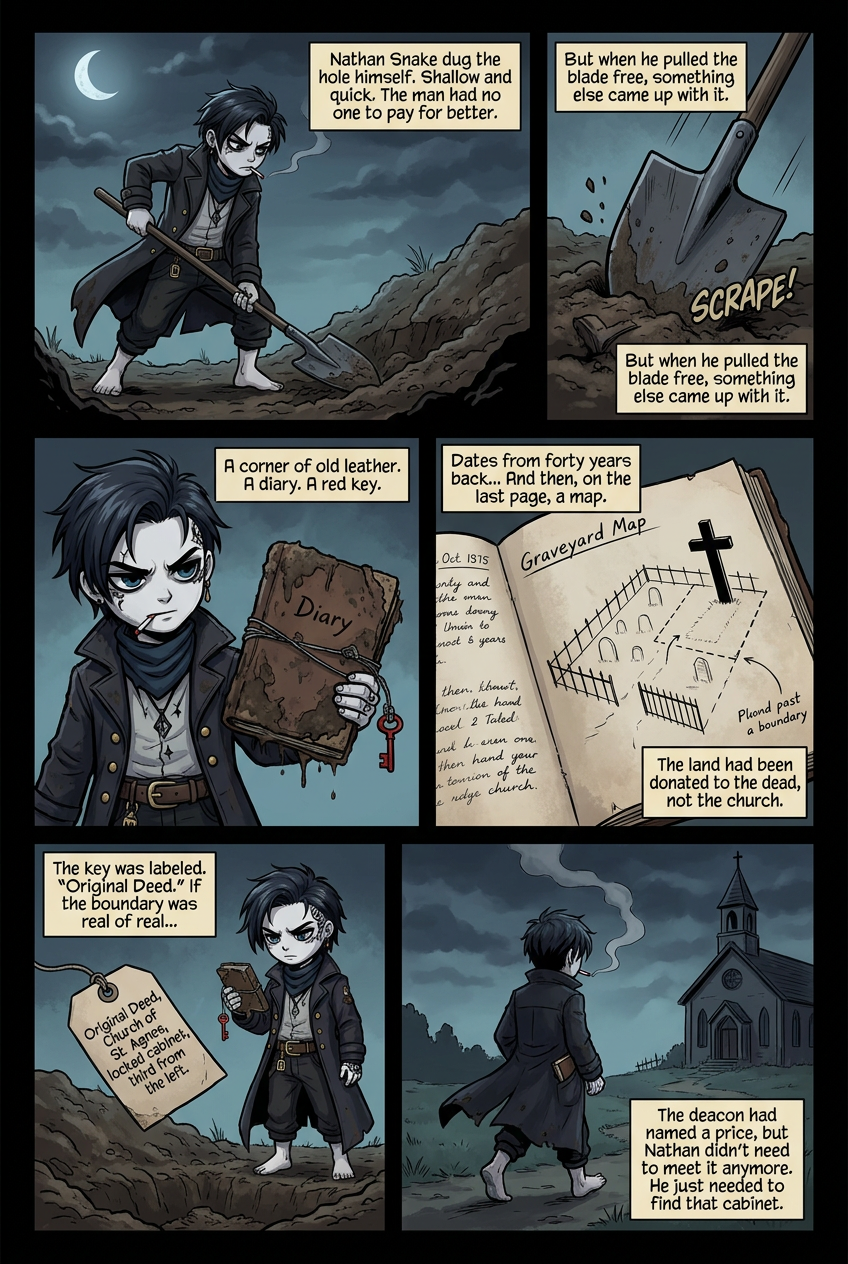
Nathan Snake dug the hole himself, shallow and quick, because the man had no one to pay for better. The body went in before dawn. No words. No flowers. Just dirt and the sound of his shovel scraping stone. But when he pulled the blade free, something else came up with it — a corner of old leather, buried deep where no grave should reach. He brushed the dirt away. A diary, cracked and stained, with a red key tied to its spine with wire. Inside, the handwriting was neat and deliberate. Dates from forty years back. Names of families who paid the church for plots. And then, on the last page, a map. It showed the graveyard boundary running thirty feet past where the church claimed it ended. Past the black cross marker at the edge. Past the fence. The land had been donated to the dead, not the church. Nathan stood in the hole, barefoot in the cold dirt, and turned the page again. The diary belonged to the first gravekeeper, a man who kept records the church had never asked for. The key was labeled in faded ink: Original Deed, Church of St. Agnes, locked cabinet, third from the left. If the boundary was real, the land Nathan wanted to buy wasn't the church's to sell. It already belonged to the graveyard. To the dead. To anyone who needed it. He climbed out and filled in the grave. The pauper got his dirt. Nathan got something else. He slipped the diary into his coat and walked toward the church, smoke trailing from his cigarette. The deacon had named a price, but Nathan didn't need to meet it anymore. He just needed to find that cabinet.
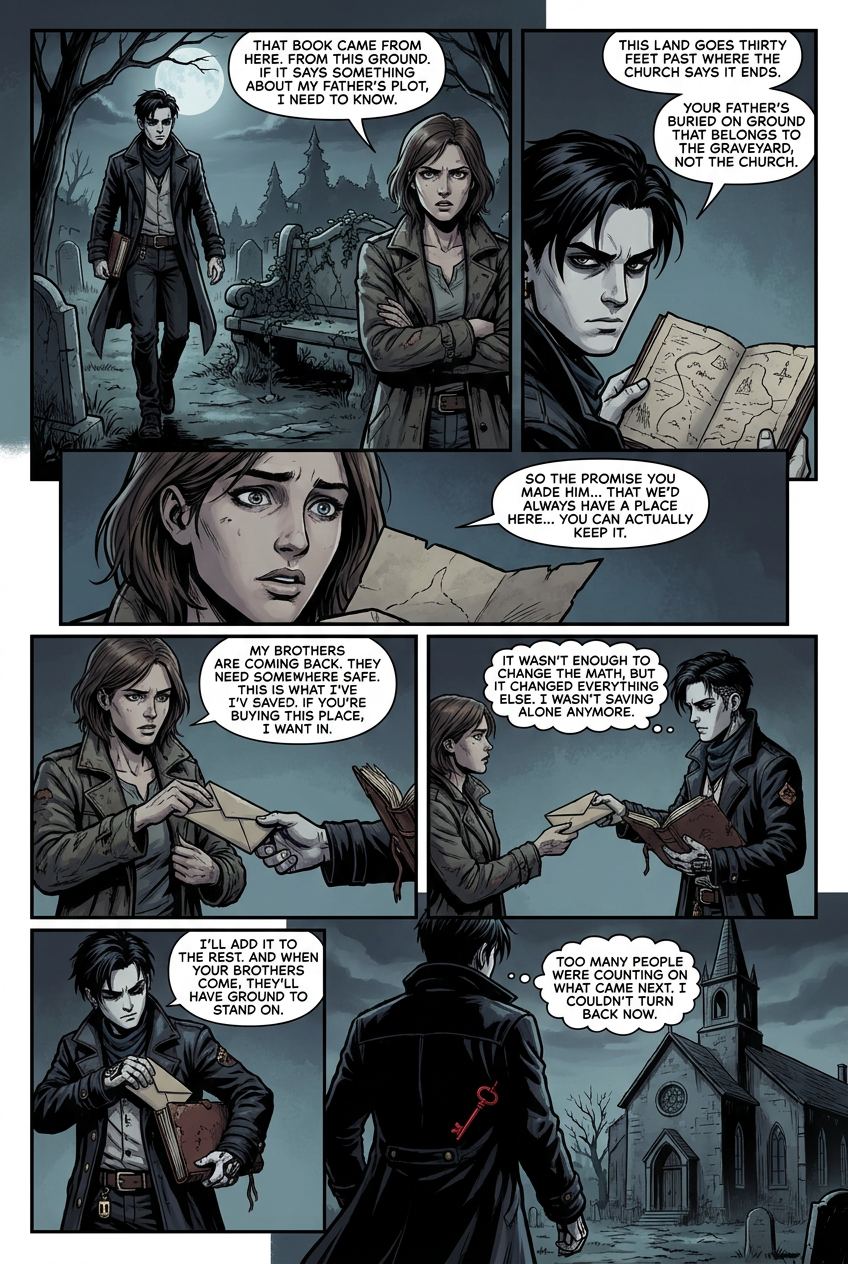
Nathan didn't make it to the church. The daughter from plot seven was waiting by the toolshed when he came back from filling the pauper's grave, and her eyes went straight to the diary tucked under his arm. She stood between him and the path out, arms crossed, and didn't move. She pointed at the diary, then at the stone bench beside her father's grave. The bench was old, settled into the earth, and covered in flowering vines she'd planted herself. "That book came from here," she said. "From this ground. And if it says something about my father's plot, I need to know." Her voice was steady, but her hands weren't. Nathan could see the flowers she'd brought lying on the grave marker behind her, fresh ones placed over the wilted stems from last week. He could have lied. Could have said it was church records, nothing that concerned her. But she'd been coming here for two years, tending that grave when no one else would, and she'd earned more than deflection. He opened the diary to the map and showed her the boundary line. "This land goes thirty feet past where the church says it ends," he said. "Your father's buried on ground that belongs to the graveyard, not the church. They can't sell what isn't theirs." She stared at the map, then at him. "So the promise you made him — that we'd always have a place here — you can actually keep it." It wasn't a question. Nathan nodded, and something shifted in her face. She reached into her coat and pulled out a folded envelope. "My brothers are coming back next month. They've been sleeping rough in the city, and they need somewhere safe." She held the envelope out. "This is what I've saved. It's not much, but if you're buying this place, I want in." Nathan took the envelope. Inside were coins and a few worn bills, maybe a tenth of what he had in his jar at home. It wasn't enough to change the math, but it changed everything else. He wasn't saving alone anymore. He wasn't the only one building toward this. He folded the envelope and slipped it into his pocket beside the diary. "I'll add it to the rest," he said. "And when your brothers come, they'll have ground to stand on." She nodded once, sharp and sure, and stepped aside. Nathan walked past her toward the church, the red key pressing cold against his ribs, and he knew he couldn't turn back now. Too many people were counting on what came next.
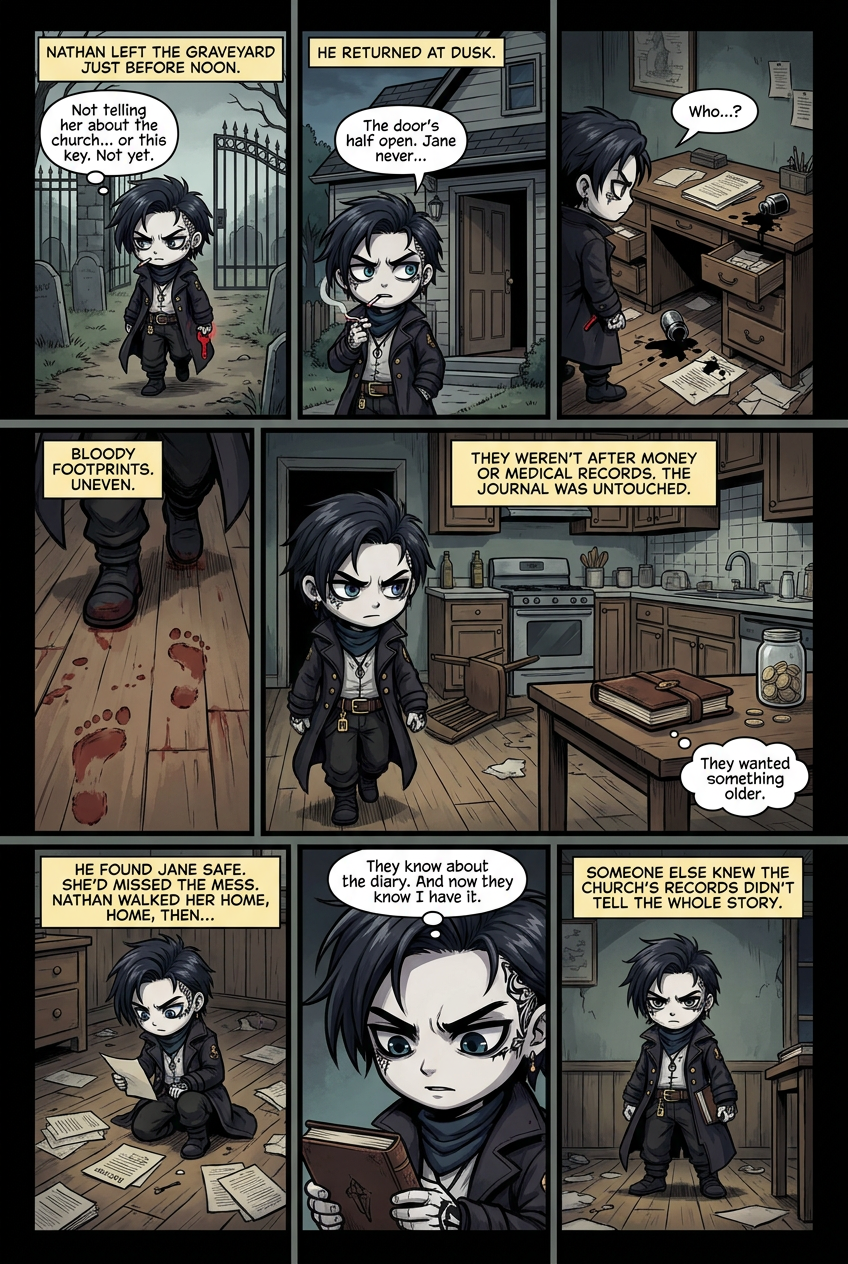
Nathan left the graveyard just before noon, telling Jane he'd be back by evening. She nodded from the kitchen table where she was copying something from a leather journal, fingers stained with ink. He didn't mention the church or the red key in his pocket. Some conversations needed to wait until he knew what he was walking into. But when he returned at dusk, the front door stood half open. Nathan stopped on the threshold, cigarette between his fingers going cold. Jane never left doors open. He stepped inside and saw the desk first — drawers yanked out, papers scattered across the floor, ink spilled dark across the wood surface. Books pulled from shelves and left spine-up on the rug. Someone had torn through the house looking for something specific, and they hadn't bothered hiding the damage. The bloody footprints led from the desk to the back door. Not much blood, just enough to mark the floor in uneven prints that suggested a limp or a hurry. Nathan followed them through the kitchen where chairs lay tipped on their sides. Jane's journal was still on the table, untouched. The coin jar was still on the shelf. Whoever came through here wasn't after money or medical records. They wanted something older, something written down and hidden. He found Jane at Helga McDool's house three doors down, safe and shaken. She'd gone to borrow thread and come back to find the mess. Nathan walked her home and locked the door behind them, then knelt beside the scattered papers. Most were recipes, letters, household notes — nothing worth stealing. But the intruder had opened every drawer, checked every book spine, searched like they expected to find a diary or a map. Nathan's hand went to his coat pocket where the graveyard diary still sat, and he understood. Someone else knew the church's records didn't tell the whole story. And now they knew he'd found something worth taking.
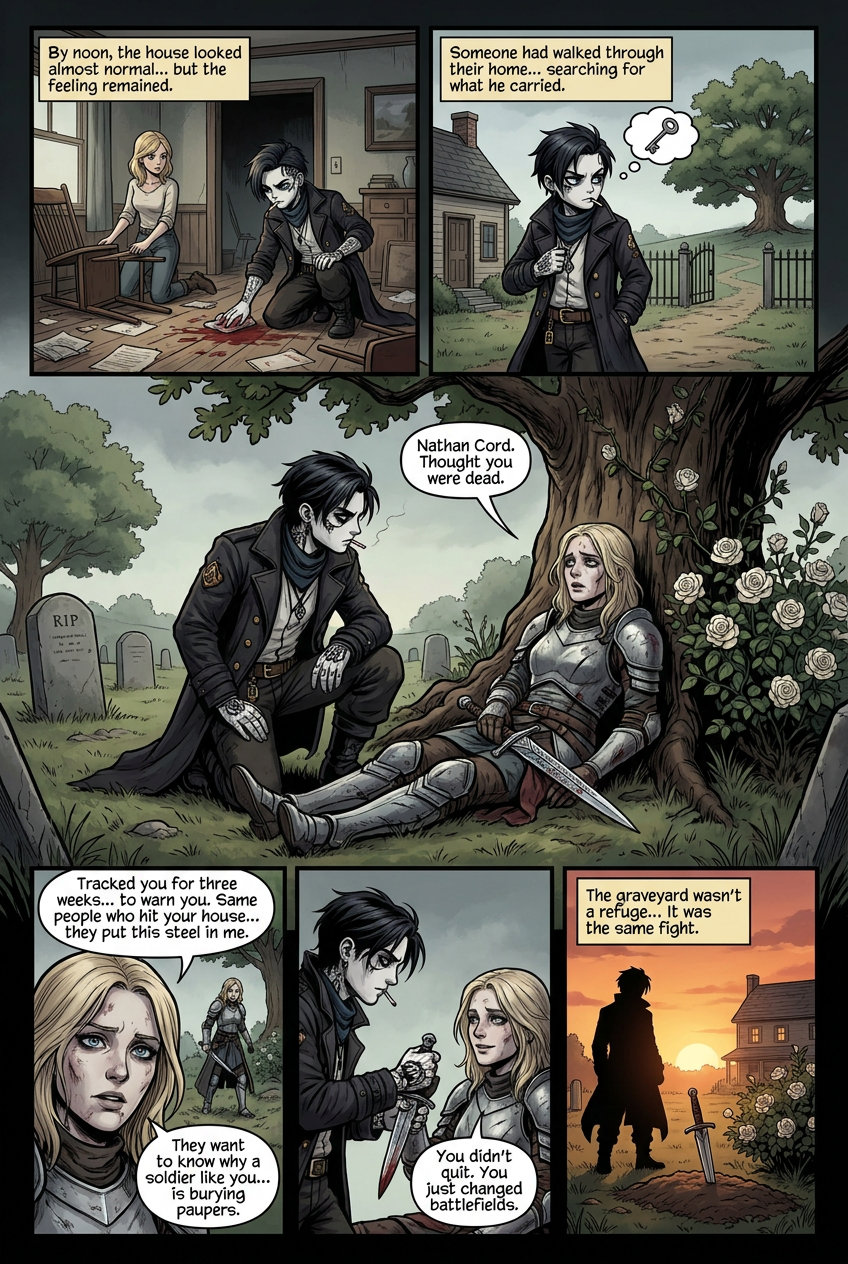
Nathan spent the next morning repairing what could be fixed. He righted the chairs, stacked the scattered papers, wiped the blood from the kitchen floor. Jane worked beside him without speaking, her hands steady as she sorted through the mess. By noon the house looked almost normal again, but the feeling remained — someone had walked through their home searching for something Nathan carried in his pocket. He couldn't stay inside waiting for them to come back. He needed to be where he could see who was watching, where the ground was familiar and the sightlines were clear. He told Jane he was going back to the graveyard, and she didn't ask him to stay. He found her near plot seven, slumped against the old oak that marked the western boundary. She wore armor that had seen recent use — dented breastplate, scratches across the pauldrons, dried blood on the greaves. Her breathing was shallow, her face pale beneath tangled blonde hair. A dagger lay across her lap, its engravings shifting in the afternoon light like water moving under ice. Nathan recognized the blade before he recognized the woman. He'd carried one just like it years ago, back when he answered to a different name and wore different scars. The rose bush beside plot seven had grown wild since the daughter planted it months back, white blooms climbing halfway up the oak's trunk. Someone had been tending it — the dead branches were trimmed, the soil around the roots was turned. Nathan knelt beside the woman and she opened her eyes. "Nathan Cord," she said, her voice rough with pain. "Thought you were dead." She told him between shallow breaths. She'd been tracking him for three weeks, not to arrest him but to warn him. The same people who ransacked his house were the ones who'd put steel in her gut. They wanted the church records he'd found, but more than that, they wanted to know why a man like Nathan Cord — a soldier who'd burned supply lines and disappeared entire patrols — had spent five years burying paupers and sweeping leaves. She'd followed him because she owed him a life debt from a skirmish he probably didn't remember, and she'd figured out what he was doing here. The graveyard wasn't penance. It was the same thing he'd always done — protecting ground no one else would defend, for people no one else would fight for. She pressed the dagger into his hand. "You didn't quit," she said. "You just changed battlefields." Nathan sat with her until the end, then buried her in the space beside plot seven where the rose bush could grow over both graves. He planted the dagger at the head of her plot, blade-down in the soil, the shifting engravings catching the last light. He understood now why he'd made that promise to the dying man — not because the man had asked, but because Nathan had spent half his life taking ground and the other half learning what ground was worth keeping. The graveyard wasn't a refuge from his old life. It was the same fight, stripped down to what mattered. He walked home as the sun dropped below the hills, the red key still in his pocket, the coin jar waiting on the shelf. He had a deed to steal and a deacon to face, and now he knew exactly why he'd do whatever it took to win.
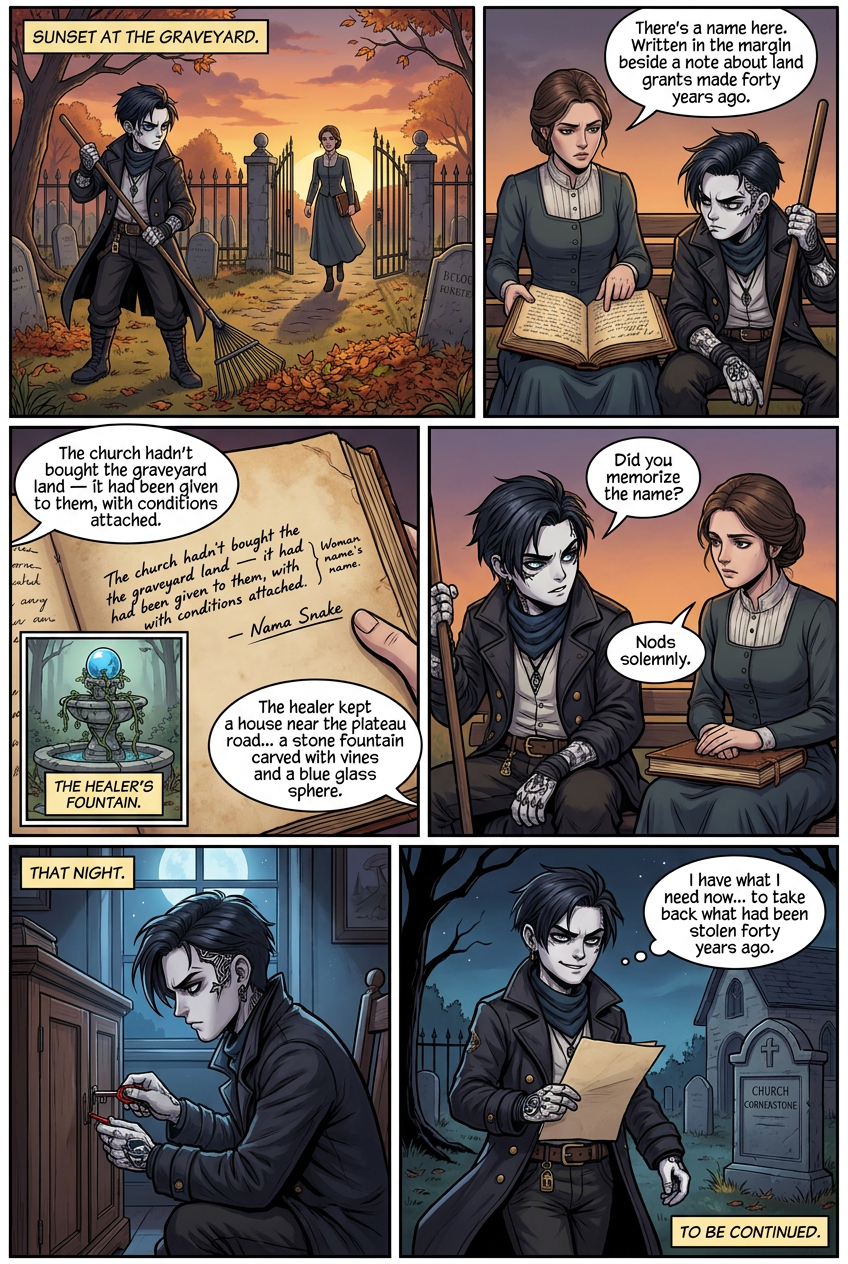
Jane came to the graveyard near sunset carrying the healer's journal under her arm. Nathan was raking leaves near the eastern fence when she walked through the gate, her face set in that expression she wore when she'd found something she wasn't sure what to do with. She sat on the bench by the toolshed and opened the journal without saying hello. Nathan leaned the rake against the fence and waited. The journal was bound in worn leather, its pages yellowed and crowded with drawings of plants and measurements written in a careful hand. Jane turned through sections marked with pressed flowers and diagrams of roots until she stopped on a page near the middle. She looked up at Nathan, then back down at the page. "There's a name here," she said. "Written in the margin beside a note about land grants made forty years ago." She turned the journal so he could see. The handwriting was different from the rest — darker ink, pressed harder into the paper. Nathan recognized the surname immediately. It was the same one carved into the cornerstone of the church, the same one the deacon carried. But the first name was wrong. This was a woman's name, and beside it was a note about property deeded to the church in exchange for care of the sick poor. Nathan asked Jane where the healer had worked before she died. Jane said the woman had kept a healing house near the plateau road, marked by a stone fountain carved with vines and a blue glass sphere set in its center. People came from miles around because she never turned anyone away. Nathan understood then what the journal was telling him. The church hadn't bought the graveyard land — it had been given to them, with conditions attached, by someone the deacon's family had erased from their history. The healer had known because she'd treated the woman's granddaughter years ago, and the story had been passed down through the families who remembered. Jane closed the journal and said the healer's daughter had come back that morning and taken it. She'd been kind but firm, and Jane hadn't fought her for it. Nathan asked if Jane had memorized the name. She nodded. Nathan walked to the church that night and used the red key to open the locked cabinet in the deacon's office. The original deed was there, just as he'd suspected, written in the same hand as the margin note. The land had been given for the care of the forgotten poor, in perpetuity, with no provision for sale. The deacon had lied about owning it outright because the truth would have destroyed his leverage. Nathan locked the cabinet and pocketed the deed. He had what he needed now — not just to refuse the deacon's price, but to take back what had been stolen forty years ago. He walked home with the deed folded in his coat, the name from the journal fixed in his mind like a promise he'd just learned he'd been keeping all along.
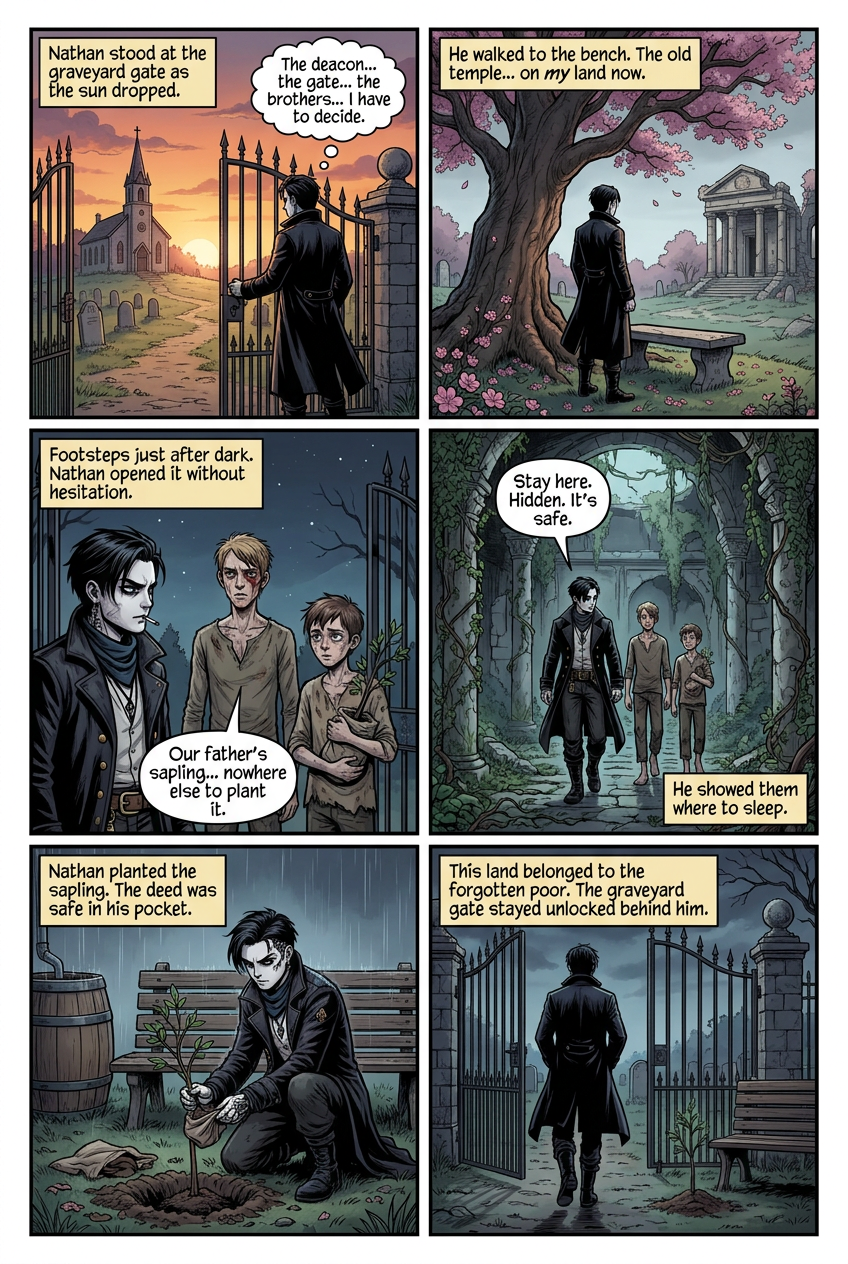
Nathan stood at the graveyard gate as the sun dropped behind the western trees. The daughter from plot seven had sent word three days ago that her brothers were coming tonight instead of next month. Something had happened in the city. They needed shelter now. Nathan checked the latch on the gate and looked back toward the church. The deacon didn't know he had the deed yet, but that wouldn't matter if the brothers showed up and someone saw them. The gate locked at sundown by church rule. Opening it after dark would be noticed. Nathan had two choices. He could leave the gate unlocked and risk the deacon finding out, or he could let the brothers wait outside until morning and risk whatever was hunting them finding them first. He walked back through the graveyard and stopped at the stone bench near plot seven. He'd placed it there two weeks ago, before he knew about the brothers, before he'd found the deed. The bench sat under the old maple tree at the edge of the property line, thirty feet past where the church claimed the boundary ended. Pink blossoms grew wild along its base, planted by someone decades back. Nathan stood beside it and looked toward the old temple structure at the far corner. The building had crumbled years ago, but its walls still stood tall enough to hide two men. Vines covered the stones and the door sagged open. It wasn't much, but it was shelter. And it was on land the church didn't own. Footsteps came from beyond the gate just after dark. Nathan opened it without hesitation. Two men stood there, younger than he'd expected, thin and dirty and carrying nothing but a canvas pack between them. The taller one had a cut above his eye that hadn't healed right. The shorter one held something wrapped in cloth. He pulled the cloth back enough for Nathan to see. It was a sapling, roots wrapped in wet burlap, its small branches already budding. The brother said their father had grown it from seed before he died. They'd carried it through the city for two days because they had nowhere else to plant it. Nathan took the sapling and told them to follow him. He led them to the temple and showed them where to sleep. He told them they could stay until it was safe to move on, but they had to stay hidden. The brothers thanked him and went inside. Nathan walked back to the maple tree and dug a hole beside the bench. He unwrapped the sapling and set it in the ground, packing soil around its roots. The deed was in his coat pocket, folded and safe. He didn't need the deacon's permission anymore. This land belonged to the forgotten poor, and it always had. He watered the sapling from the rain barrel and went home. The graveyard gate stayed unlocked behind him.
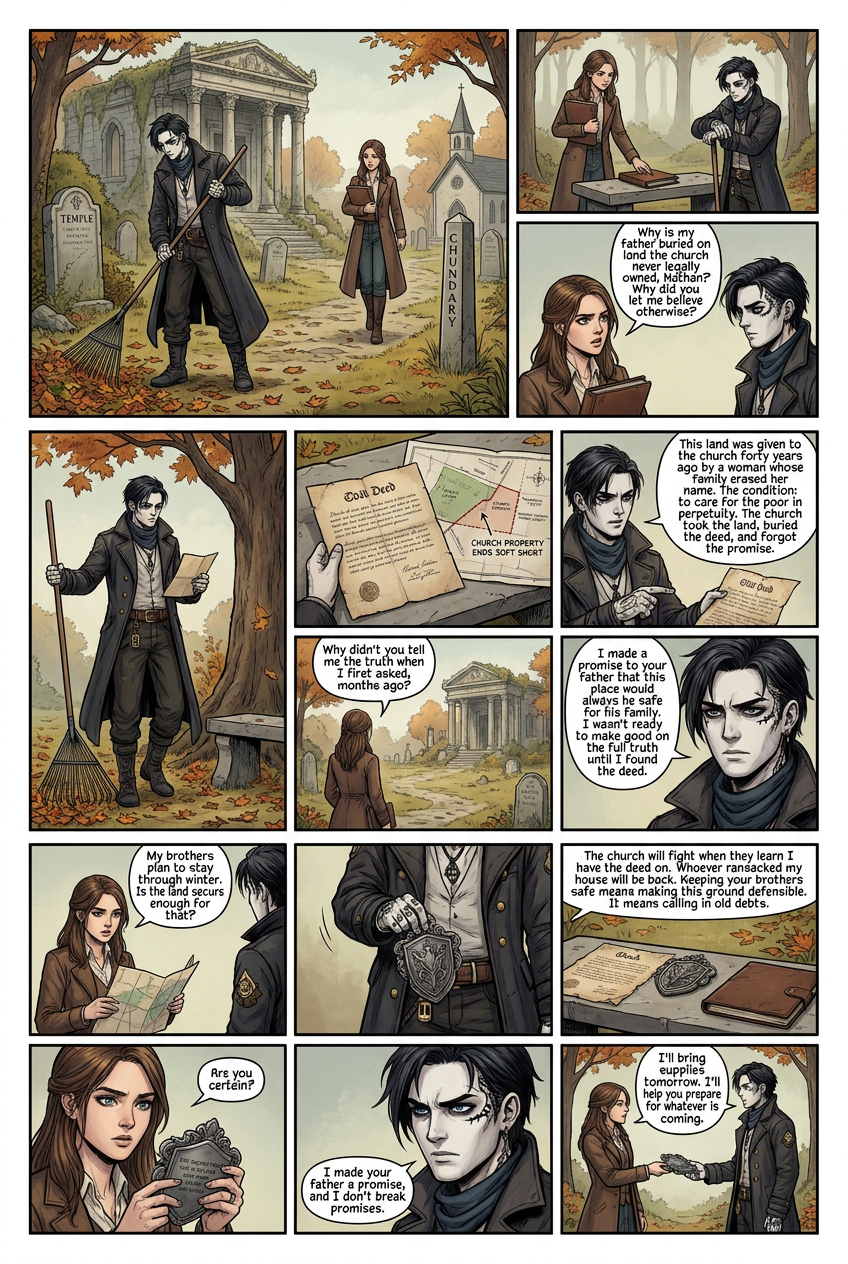
Nathan was raking leaves near the temple ruins when the daughter from plot seven walked past the church boundary with a leather folder under her arm. She didn't stop at her father's grave. She came straight toward him and set the folder on the stone bench. She opened it and pulled out a surveyor's map dated eighteen months back, marked with boundary lines and measurements. She pointed to the section where plot seven sat, then to the notation in the corner that showed the church's recorded property ending thirty feet short of that location. She said she'd paid for the survey herself after her brothers told her about the temple. She asked Nathan why her father was buried on land the church never legally owned, and why Nathan had let her believe otherwise. Nathan set the rake against the maple tree and pulled the deed from his coat pocket. He unfolded it on the bench beside her map. The paper was old and the ink had faded, but the boundary marks matched her survey exactly. He told her the land was given to the church forty years ago by a woman whose family erased her name from their records. The gift came with conditions — to care for the poor in perpetuity. The church took the land but buried the deed and forgot the promise. He told her he'd found the original document two weeks ago and took it before the deacon could destroy it. Her father's grave sat on land that belonged to the forgotten, not the church. That's why Nathan could promise her brothers shelter without asking permission. She traced the boundary line on her map with one finger, then looked toward the temple ruins where her brothers were hidden. She asked why he hadn't told her the truth when she first asked about the graveyard months ago. Nathan said he'd made a promise to her father that this place would always be safe for his family, but he hadn't known how to keep it until he found the deed. He'd given her an incomplete answer because he wasn't ready to make good on the full truth yet. She studied his face for a long moment, then folded her map and put it back in the folder. She said her brothers were planning to stay through winter if Nathan would let them. She wanted to know if the land was secure enough for that. Nathan pulled the ornate metal crest from his other pocket — the emblem he'd carried since his days before the graveyard, when he'd sworn different oaths to protect different people. He set it on the bench between the deed and her folder. He told her the church would fight when they learned he had the deed, and whoever ransacked his house looking for it would come back. Keeping her brothers safe through winter meant making this ground defensible, and that meant calling in old debts he'd been avoiding. She picked up the crest and turned it over in her hands, reading the inscription on the back. She asked if he was certain. Nathan said he'd made her father a promise, and he didn't break promises. She nodded once and handed the crest back. She said she'd bring supplies for her brothers tomorrow, and she'd help him prepare for whatever was coming.
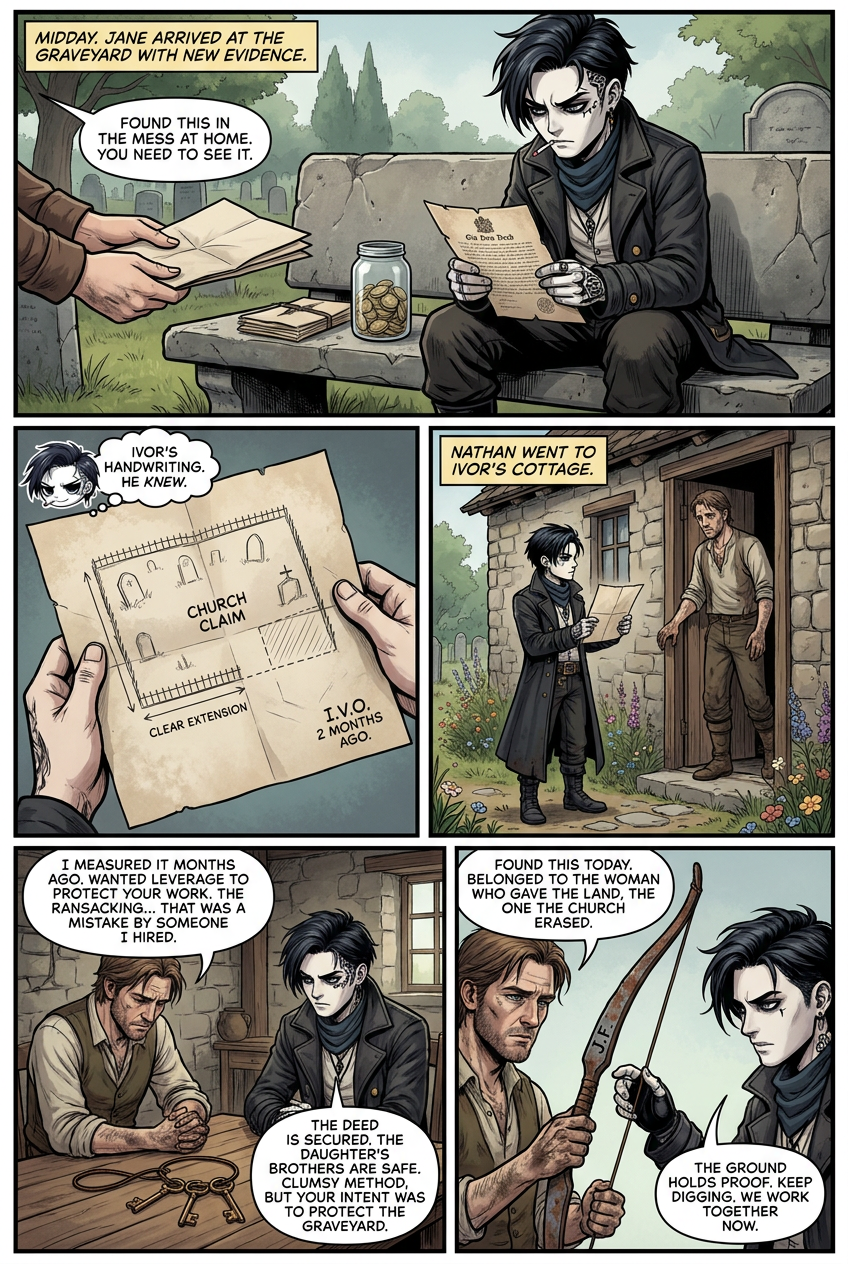
Jane came through the graveyard gate at midday carrying a folded paper in one hand and the jar of saved coins in the other. She walked past the fresh graves and the maple tree without stopping. She set both items on the stone bench where Nathan was sitting and waited until he looked up from the deed he'd been reading. She said she'd found something in the mess at home that he needed to see. Nathan unfolded the paper. It was a sketch of the graveyard boundary drawn in pencil on the back of an old receipt. The lines matched the deed exactly, including the extension beyond the church's claim. In the corner someone had written three initials and a date from two months ago. Jane pointed to the handwriting and said it matched the notes Ivor left on their kitchen table when he borrowed Nathan's surveying chain last spring. She'd found the sketch wedged behind the bookshelf where it had fallen during the ransacking. Nathan looked at the initials again and recognized his friend's careful script. Ivor had known about the boundary before Nathan found the deed. Nathan walked to Ivor's stone cottage at the edge of the graveyard property where wildflowers grew thick against the walls. He knocked twice and waited. Ivor opened the door with dirt on his hands from the garden. Nathan held up the sketch without speaking. Ivor looked at it for a long moment, then stepped aside to let Nathan in. Inside on the table sat three bronze keys on a worn leather cord, each engraved with a word Nathan recognized from the oaths they'd both sworn years ago when they served together. Ivor said he'd measured the boundary months back when the deacon first mentioned selling the land, trying to find leverage to protect Nathan's work. He'd planned to tell Nathan once he confirmed the church's claim was false. Then Nathan's house was ransacked and Ivor realized someone else was searching for the same proof. He'd sent someone to retrieve any documents before the intruders returned, but the person he hired had gone too far and torn the place apart looking for anything that mentioned the church. Ivor said he'd called them off as soon as Jane came to Helga's house, but the damage was done. Nathan picked up the keys and felt their weight. He told Ivor the deed was already secured and the daughter's brothers were sheltered on the extended land. The ransacking had cost them time and Jane's peace of mind, but it hadn't stopped what Nathan was building. Ivor asked if Nathan wanted him gone from the cottage. Nathan set the keys back on the table and said Ivor had acted to protect the graveyard's future even if his method was clumsy. That counted for something. But from now on Ivor would help him make the land defensible instead of working alone. Ivor nodded and showed Nathan a rusted metal bow with the initials J.F. engraved on the side, pulled from the garden soil that morning. He said it belonged to the woman who'd given the land to the church forty years ago, the one whose name the deacon's family had erased. Nathan took the bow and understood that the ground beneath them held more than graves. It held proof of promises the church wanted buried. He told Ivor to keep digging.
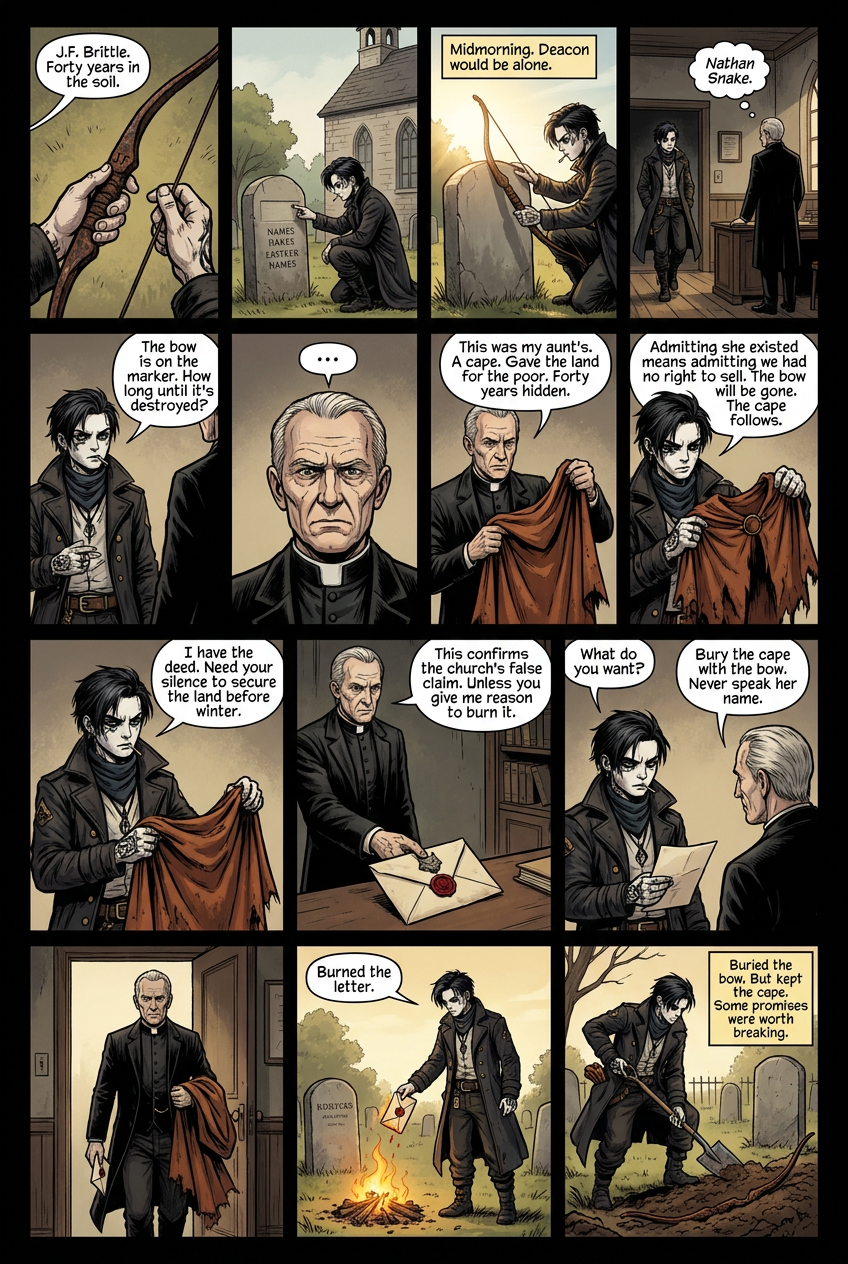
Nathan held the rusted bow in both hands and turned it over slowly. The initials J.F. were worn but clear. He tested the metal against his palm and felt how brittle it had become after forty years in the soil. This wasn't just evidence. It was the last piece of a woman the deacon's family had buried along with her name. He carried it to the church at midmorning when he knew the deacon would be alone in his office. He walked past the front doors and around to the side entrance where a stone marker stood near the wall. The marker listed the families who'd built the church generations back. Nathan knelt and traced his fingers along the carved names until he found what had been chiseled away. A smooth blank space where a woman's name should have been. He set the bow across the top of the marker where sunlight caught the initials. Then he went inside. The deacon was standing at his desk when Nathan entered without knocking. He looked up and his face went tight. Nathan told him the bow was outside on the marker and asked how long before he'd have it destroyed. The deacon said nothing for three breaths. Then he reached into his coat and pulled out a folded cloth the color of burnt earth. He unfolded it carefully. It was a cape with frayed edges and a bronze clasp still attached. He said it had belonged to his aunt. The woman who gave away the family land to build a place for the poor. He'd kept it hidden for forty years because admitting she existed meant admitting the church had no right to sell what she'd given. He told Nathan the bow would be gone by evening and the cape would follow. But if Nathan wanted the land secured he'd have to act before the family found out what he'd uncovered. Nathan took the cape and felt the weight of fabric that had outlasted the woman who wore it. He told the deacon he already had the deed and the boundary was marked. What he needed now was the deacon's silence while he made the land defensible before winter. The deacon set a sealed letter on the desk. He said it was addressed to the council and would confirm the church's false claim unless Nathan gave him reason to burn it instead. Nathan picked up the letter and saw the wax seal shaped like a wolf's head. He asked what the deacon wanted in return. The deacon said he wanted Nathan to bury the cape with the bow and never speak his aunt's name again. Nathan folded the cape and walked out. He burned the letter in the graveyard that afternoon and buried the bow where Ivor had found it. But he kept the cape. Some promises were worth breaking.
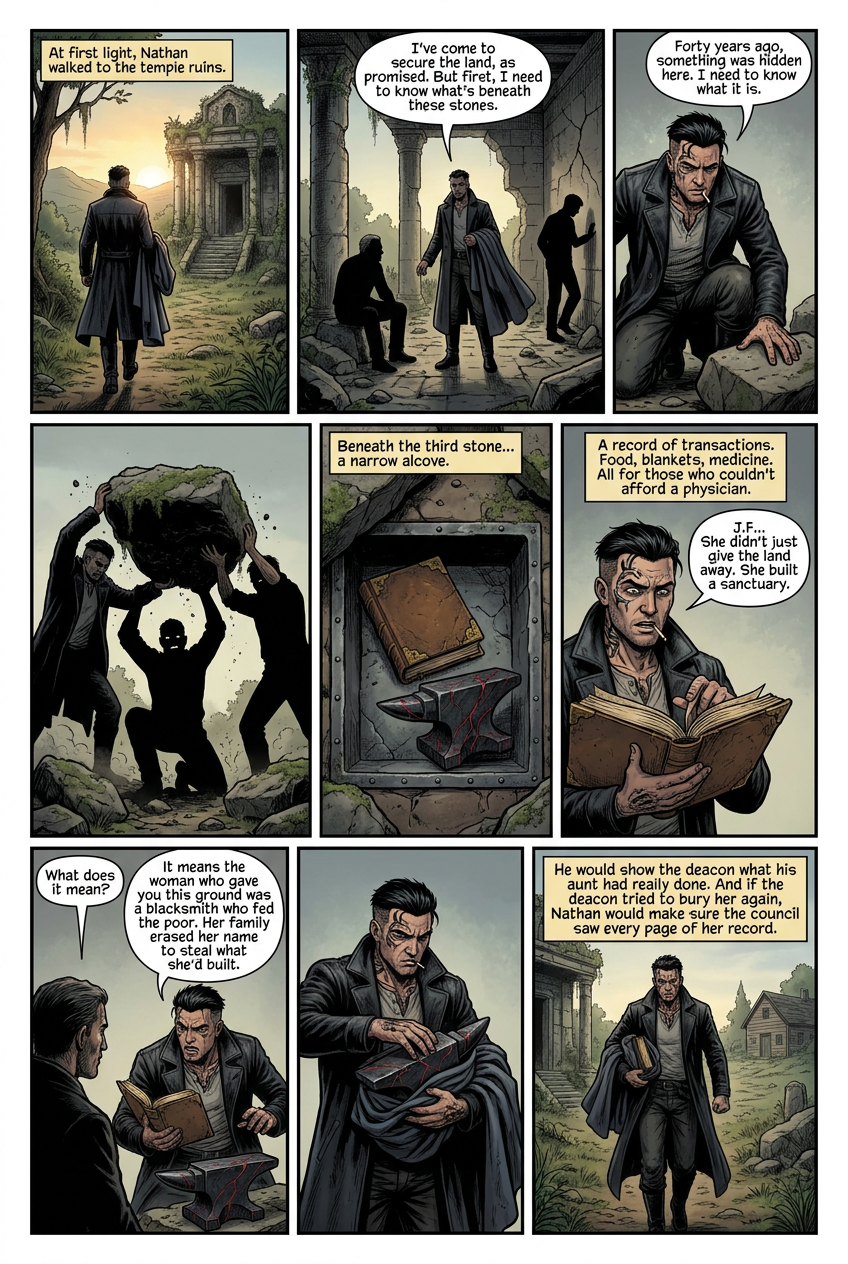
Nathan walked to the temple ruins at first light with the cape folded under his arm. The daughter's brothers had been sheltering there for three days now and he'd promised them the land was secure. But promises meant nothing without proof. The brothers were awake when he arrived. The older one sat near the entrance while the younger paced along the far wall where the floor had started to crack. Nathan told them he needed to see what was beneath the stones. The younger brother asked why and Nathan said because someone had hidden something here forty years ago and he needed to know what it was. They helped him pry up the loose stones near the back wall where the floor dipped lowest. Beneath the third stone they found a narrow alcove lined with iron. Inside sat a leather book with brass corners and an anvil the size of a man's fist carved from black stone with red veins running through it like frozen blood. Nathan pulled the book out first and opened it carefully. The pages were brittle but the ink had held. The first entry was dated forty years back and signed J.F. in a tight careful hand. It was a record of transactions. Food bought and distributed. Blankets sewn and given. Medicine paid for and delivered to families who couldn't afford a physician. Every page listed names and what they'd received and how much it cost. The last entry was three months before the fever came. It said the land would be given to the church with one condition written into the deed. That it would always serve those who had nowhere else to go. Nathan closed the book and set it on the ground beside the anvil. The woman hadn't just given away her family's land. She'd built a place to forge sanctuary and the church had buried her for it. The older brother asked what it meant and Nathan told him it meant the woman who gave them this ground had been a blacksmith who fed the poor until her family erased her name to steal what she'd built. He wrapped the cape around the anvil and the book and carried both back to his house. He would show the deacon what his aunt had really done with her life. And if the deacon tried to bury her again Nathan would make sure the council saw every page of her record before winter came.
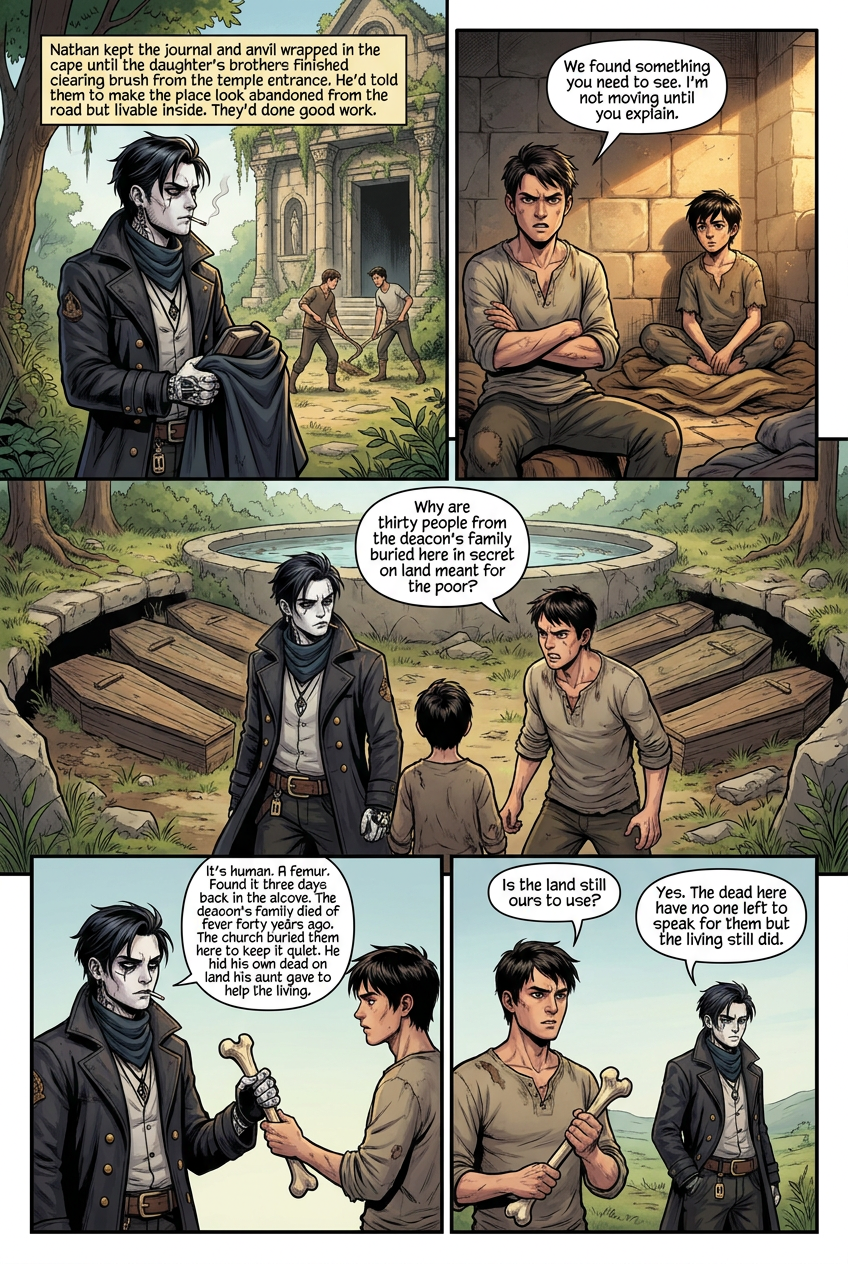
Nathan kept the journal and anvil wrapped in the cape until the daughter's brothers finished clearing brush from the temple entrance. He'd told them to make the place look abandoned from the road but livable inside. They'd done good work. The younger brother had piled blankets into a nest against the west wall where the stones held heat from the sun. The older one sat in the center of that nest with his arms crossed and his jaw set like a man who'd stopped asking and started demanding. Nathan had seen that look before on men who'd run out of patience with half-answers. The brother pointed past the temple wall to where the ground sloped down behind the ruins. He said they'd found something Nathan needed to see and he wasn't moving until Nathan explained what it was. Nathan followed him outside to the back of the temple where the earth dipped into a shallow basin. Wooden coffins lay stacked in rows beneath a thin layer of dirt and dead grass. Thirty of them at least. The wood was old but hadn't rotted through. Someone had built them to last and buried them to hide. The older brother turned to Nathan and asked why thirty people from the deacon's family were buried in secret on land meant for the poor. His voice was steady but his hands weren't. Nathan pulled a bone from his coat pocket. It was human. Femur by the length of it. He'd found it three days back when he'd first opened the alcove and hadn't known what it meant until now. He handed it to the older brother and said the deacon's family died of fever forty years ago and the church buried them here to keep the sickness quiet. The deacon had hidden his own dead on land his aunt gave to help the living. Nathan said he'd show the council the journal and the grave both and let them decide if the deacon's family deserved to keep what they'd stolen. The older brother held the bone and nodded once. He asked if the land was still theirs to use and Nathan said yes. The dead here had no one left to speak for them but the living still did.
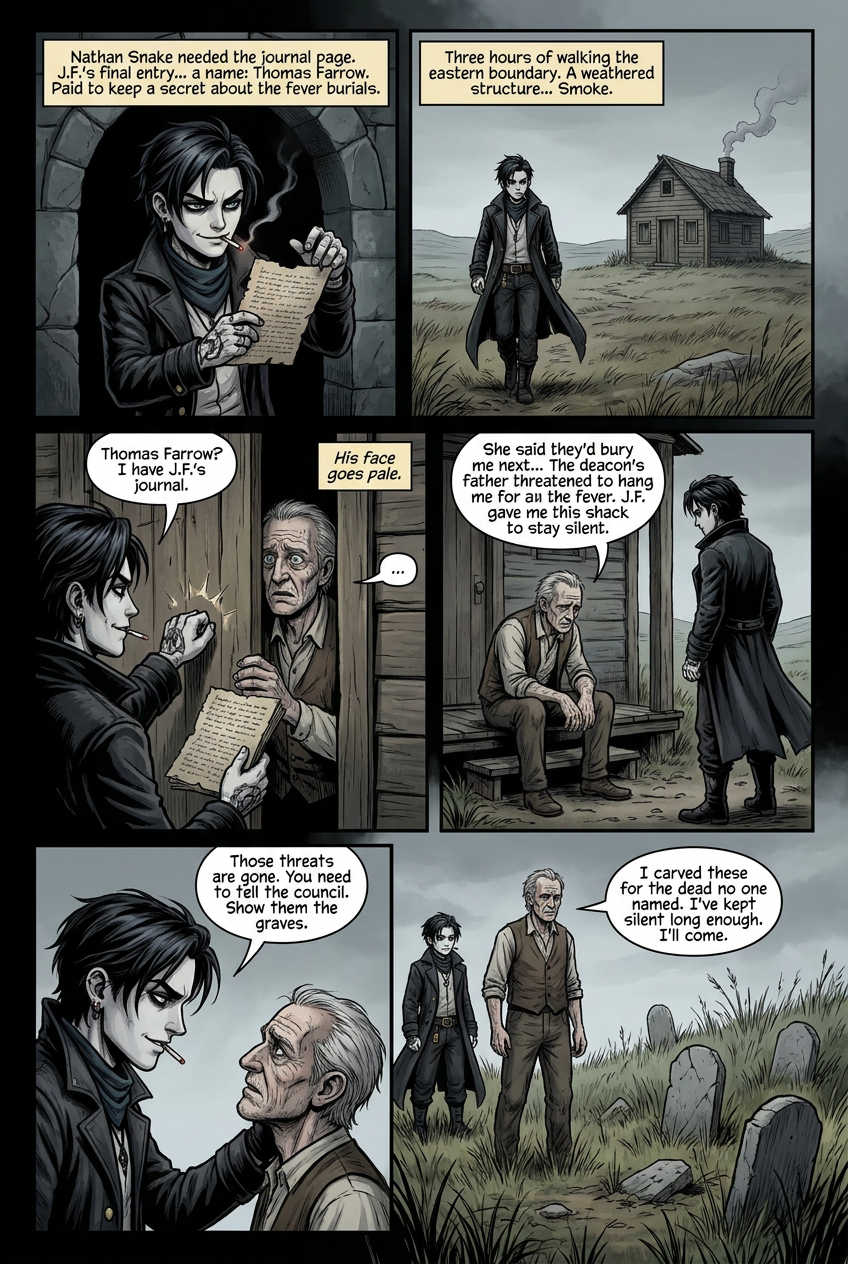
Nathan walked back to the alcove where he'd found the journal. He needed the page that showed J.F.'s final entry. The one dated two weeks before the fever killed her family. She'd written about paying a witness to keep quiet after the burials. A boy who'd seen them dig at night. The journal listed a name. Thomas Farrow. Age twelve when he watched them bury the dead. Nathan did the math. Fifty-two now if he was still alive. J.F. had written that she'd given the boy her family's timber shack at the edge of the plateau to keep him silent. A place to live where no one would find him. Nathan folded the page and tucked it into his coat. He needed to find that shack and the man who'd lived there for forty years. It took three hours of walking the eastern boundary before he saw it. A weathered structure with sagging beams and planks that had gone gray from rain. Smoke came from a pipe in the roof. Nathan knocked on the door and a man opened it. His face was lined and his hands shook but his eyes were clear. Nathan asked if his name was Thomas Farrow. The man nodded once and started to close the door. Nathan pulled out the journal page and showed him J.F.'s handwriting. The man's face went pale. He said she'd told him never to speak about what he'd seen or they'd bury him next. Nathan said the people who made that threat were dead now and he needed Thomas to tell the council what happened forty years ago. Thomas sat down on his front step and said he'd watched them dig by lamplight. Thirty graves in one night. The deacon's father had been there. He'd told Thomas that if he ever spoke about the fever or the burials they'd say he'd brought the sickness himself and hang him for it. J.F. had found Thomas hiding in the woods the next morning. She'd given him the shack and coin enough to live on if he promised to stay quiet. Thomas said he'd kept that promise until now. Nathan asked if he'd come with him to the council and show them where the graves were dug. Thomas looked at the broken tombstones scattered in the grass near his door. Markers he'd carved himself for the dead no one else would name. He said yes. He'd kept silent long enough.
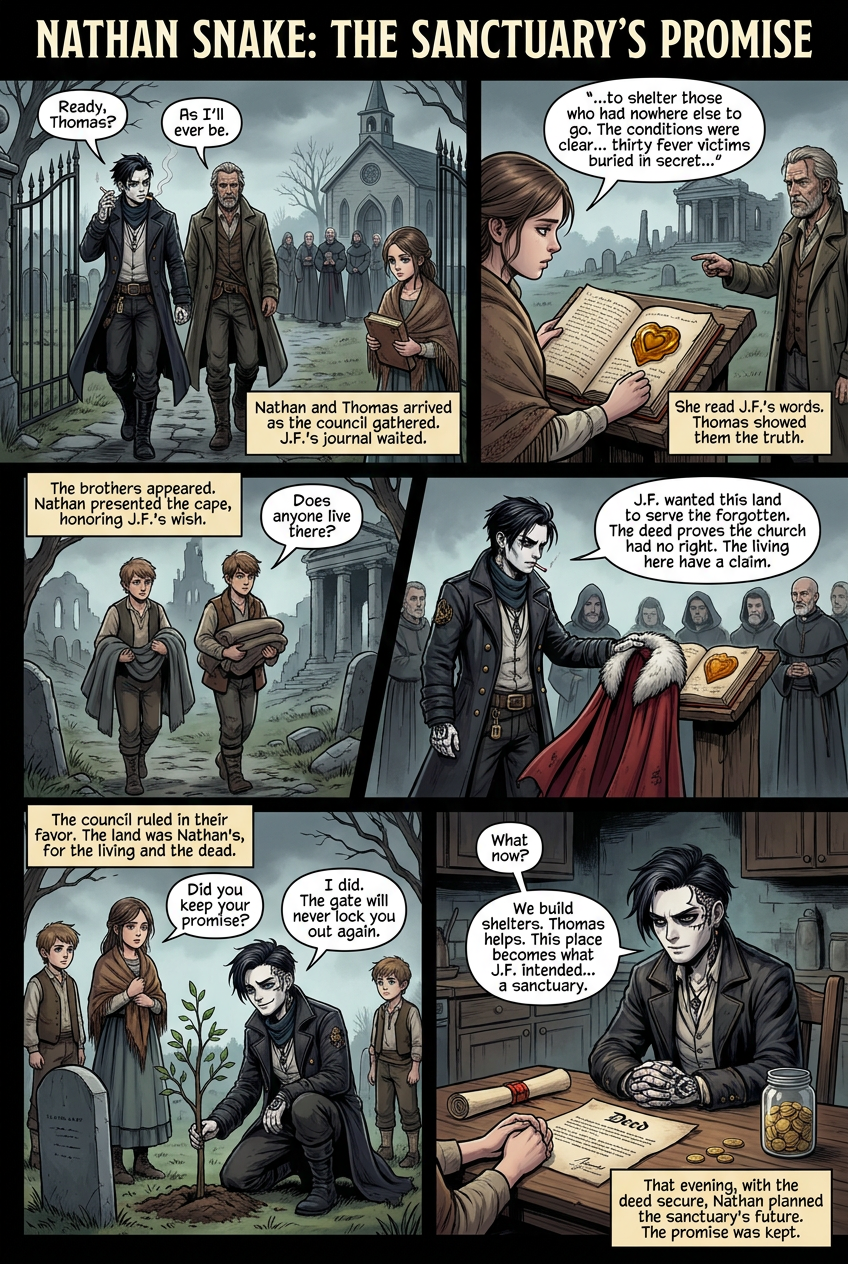
Nathan walked with Thomas Farrow through the graveyard gate as the council gathered near the chapel steps. The daughter from plot seven stood waiting with J.F.'s journal in her hands. She'd asked to be the one to read it aloud. Nathan had agreed. Her father was buried on land that J.F. had given to help people like him. It seemed right that his daughter should speak the words that proved it. The daughter placed the journal on a wooden stand that Nathan had built that morning. The pages lay open under a piece of amber glass shaped like a rose with a heart carved into its surface. J.F. had kept it in the alcove beside the journal. The daughter began to read. Her voice was steady as she spoke J.F.'s words about giving the land to shelter those who had nowhere else to go. She read the conditions that the church had agreed to forty years ago. She read the names of the thirty family members who'd died of fever and been buried in secret on land meant for the poor. When she finished, Thomas stepped forward and told the council where to find the graves. He pointed toward the temple ruins where Nathan had planted the sapling. One council member asked if anyone currently lived on the disputed land. The daughter's two brothers emerged from the temple ruins carrying blankets they'd hung on a wooden rack to dry. The older brother met Nathan's eyes and nodded once. The council members looked at each other. One of them asked Nathan what he wanted. Nathan pulled the red cape with white fur trim from his coat and laid it across the stand beside the journal. He said J.F. had wanted the land to serve the forgotten and he intended to honor that. He said the deed proved the church had no right to sell what was never theirs. He said the people sleeping here now had as much claim to the ground as anyone buried beneath it. The council deliberated for less than an hour. They ruled that the land belonged to the dead and the living who sheltered there, not the church. They voided the deacon's sale and transferred the deed to Nathan with the condition that he maintain J.F.'s original terms in perpetuity. Nathan accepted. He walked to plot seven and knelt beside the sapling he'd planted on land that now belonged to the man's children and everyone else who needed it. The daughter stood beside him with her brothers. She asked if he'd kept his promise. Nathan said he had. The graveyard would always be a place her family could come to. The gate would never lock them out again. That evening Nathan sat with Jane at their kitchen table. The deed lay between them. She asked him what he'd do now that he had what he'd been working toward. Nathan looked at the jar of coins he'd been saving. He said he'd use it to build shelters in the temple ruins before winter came. He said he'd hire Thomas to help maintain the grounds and keep watch over the graves. He said the graveyard would become what J.F. had intended it to be forty years ago. A sanctuary for people the world had forgotten. Jane reached across the table and took his hand. She said J.F. would be proud. Nathan nodded. He folded the deed and put it in his coat pocket beside the promise he'd made to a dying man. Both were kept now. Both were real.
Play your story to life
Storycraft is a mobile game where you create AI characters, craft items and locations to build their world, then discover what direction your story takes. Download the iOS game for free today!
Download for free