

Peter Rabbit's Arc
13 Chapters
Peter Rabbit's dream is growing the finest carrot patch in Oakhollow to feed every hungry rabbit through winter..

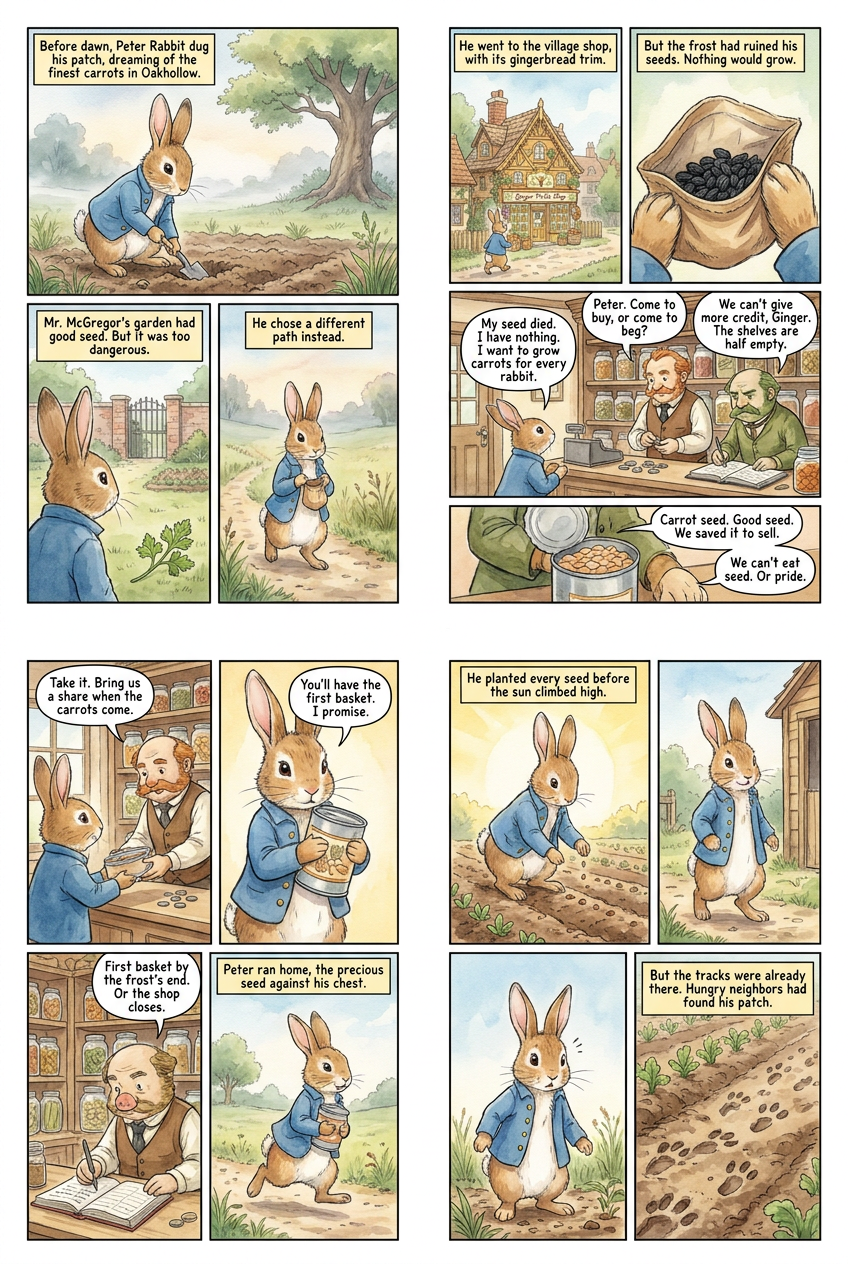
Peter Rabbit dug his patch of soft dirt before dawn, planning the finest carrot rows in all of Oakhollow. He wanted enough carrots to feed every hungry rabbit through the cold months. But when he opened his seed pouch, the seeds inside were black and shriveled. Frost had spoiled every one. Nothing dead would ever grow, and winter was already creeping close. He knew only one place with good seed. Mr. McGregor's garden had killed his father. His mother had begged him to stay away. Peter went anyway, most days, leaving a sprig of parsley at the gate. But stealing seed there meant crossing the rows McGregor checked first. Peter looked at his empty pouch, then at the fading meadow. He chose a different path instead. He walked to the village shop with the gingerbread trim and pickle-green paint. Inside, jars of vegetables lined the shelves. A ginger cat in a green coat stood behind the counter, counting coins into two small piles. Both piles were tiny. "Peter," Ginger said, and his whiskers lifted. "Come to buy, or come to beg? Everyone else begs. I'm collecting them, like stamps." Beside him, a tri-colored terrier in a brown coat frowned over a ledger. Pickles set down his pen. "We can't give more credit, Ginger. The shelves are half empty already." Peter set his ruined seeds on the counter. "My seed died in the frost. I have nothing to plant. I want to grow carrots for every rabbit this winter, not just me." He looked at the two piles of coins. "I know you're short. I don't want a gift." Ginger and Pickles glanced at each other. Pickles opened a drawer and lifted out a small tin. He shook it. Seeds rattled inside, plump and pale orange. "Carrot seed," Pickles said. "Good seed. We saved it to sell." "We can't eat seed," Ginger said softly. "But we can't eat pride either." He slid the tin across the counter. "Take it. Grow your patch. When the carrots come, you bring us a share to sell. Real payment, not credit." Peter's paws closed around the tin. "You'll have the first basket. I promise." Pickles wrote the deal in his ledger, slow and careful. "First basket by the frost's end," he read aloud. "Or the shop closes, and this seed was our last coin spent wrong." Peter ran home with the tin held to his chest. He pushed each seed into his prepared rows before the sun climbed high. The soil was ready. The seed was good. But walking back to the shed, he saw the tracks. Deep prints crossed his fresh rows, pressed into the wet dirt. Rabbit prints, many of them. Hungry neighbors had already found his patch. His whole crop was owed before a single sprout had shown. And he had promised the first basket to the shop.
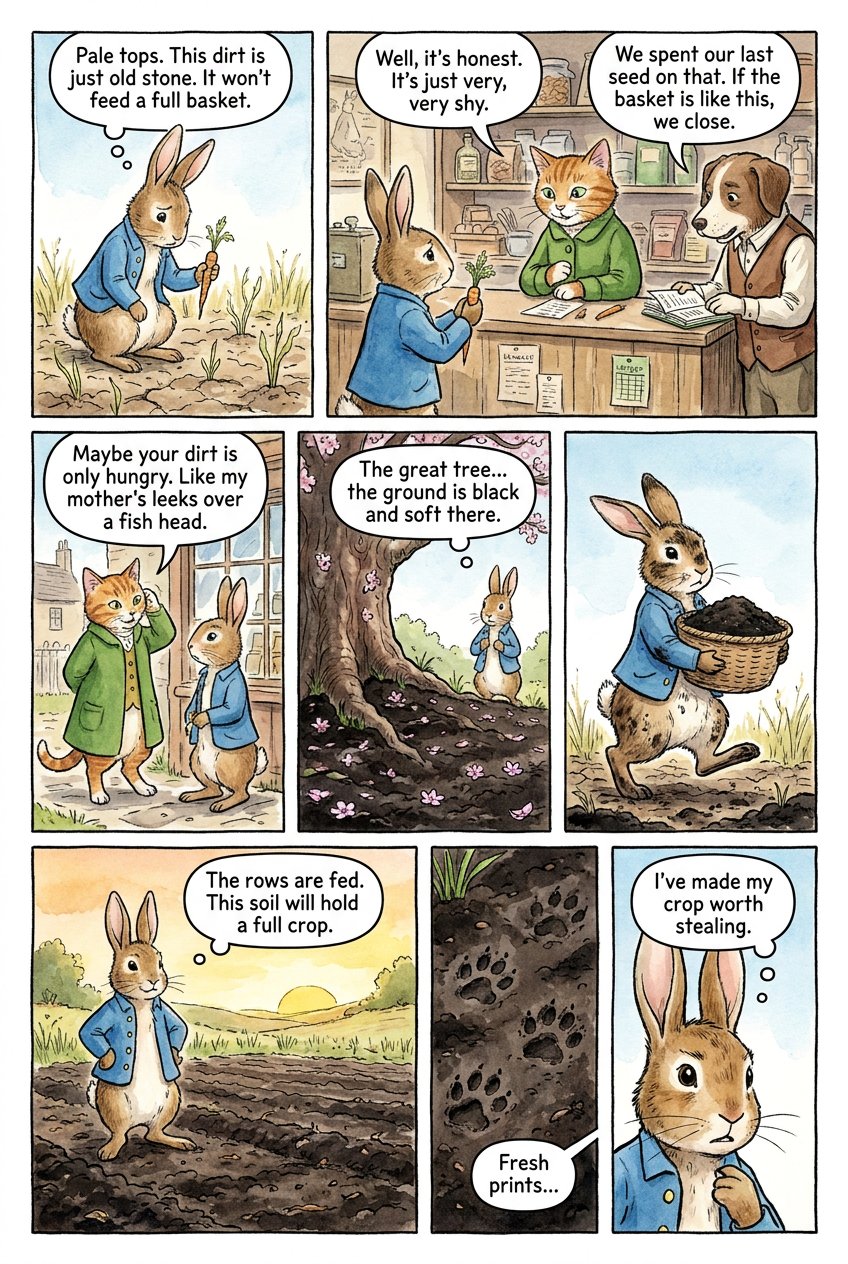
The seeds sprouted, but the sprouts came up thin. Peter knelt in his rows each morning and counted them. The green tops were pale. He dug one carrot to check. It slid out short and skinny, no thicker than his finger. He tasted the soil and found it dry and grainy, a bare skin over old stone. This dirt could not feed a full basket. His crop would come up too small to repay the shop, and he had already promised the first basket by winter's end. He carried the skinny carrot to the shop and set it on the counter. Ginger picked it up and turned it in his paw. "Well," he said, "it's honest. It's just very, very shy." He set it down gently, as if it might break. His green coat hung looser than Peter remembered. Pickles came from the back with his ledger. He looked at the carrot, then at the two coin piles by the till. Both were smaller than last time. "We spent our last seed on that," he said. His voice stayed even, but his paw pressed flat on the counter. "If the basket comes up like this, we close." "My soil's too thin," Peter said. "There's stone under it. Nothing grows fat in it." He looked at the empty jars on the shelves. He had made a promise, and the ground would not keep it for him. Ginger was quiet a moment. Then he scratched behind one ear. "When I was small, my mother grew leeks over a fish head. Buried it deep. She swore the leeks grew twice as tall." He shrugged. "Cats remember fish. Maybe your dirt is only hungry." Peter thought of the great tree near his warren, the one with roots like the backs of animals. Under its broad leaves the ground was black and soft, thick with fallen blossom and rotted leaf, year on year. He had napped there a hundred times and never once thought to dig it. He ran home before dark. He filled his basket again and again with the rich black soil from under the tree's roots. He carried load after load to his patch. He spread the dark dirt over his thin rows and worked it in with his paws until the ground turned soft and deep. His arms ached. His fur was black to the elbow. By the last light he stood and looked at his patch. The rows were fed now. The soil could hold a full-grown crop. He had solved the thin ground. But kneeling there, he saw the paw prints again. Fresh ones, pressed deep in his new dark soil. The neighbors had smelled the rich dirt too. And richer soil meant fatter carrots, the kind hungry rabbits could not walk past. He had made his crop worth stealing.
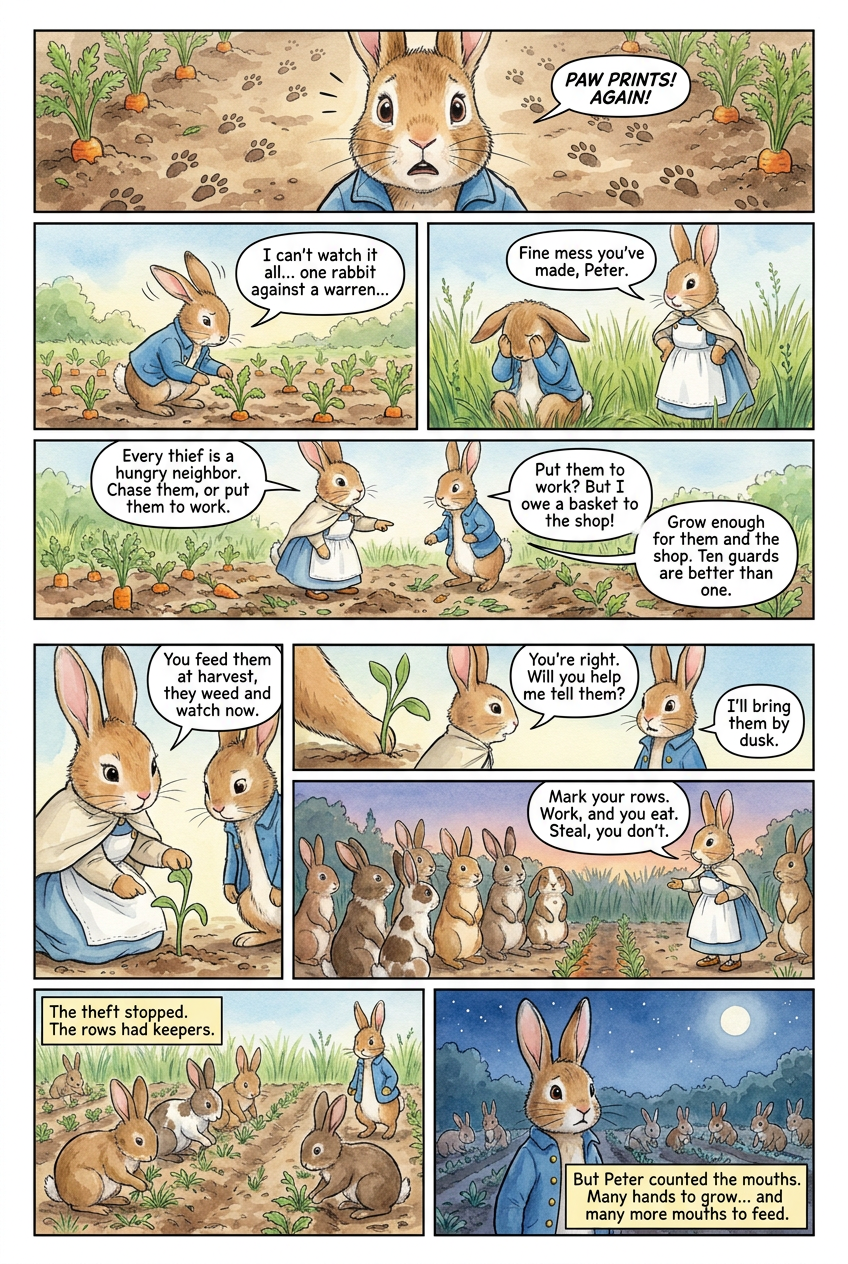
The paw prints scared Peter awake before dawn. He ran to his patch and found more of them, pressed deep across every row. His rich new soil had drawn the whole warren. He crouched between the seedlings and tried to guard them himself. He watched until his eyes stung. But one rabbit cannot circle a whole patch at once. By noon he saw the truth: alone, he would lose every carrot before winter. He sat in the tall spring grass and put his head in his paws. That was where Clementine Cottontail found him. She lived two burrows over and had known his father. She wore a white apron and a cape thrown loose over her shoulders, and she walked straight up to his rows like she owned them. "You've made a fine mess of good dirt," she said. She toed a paw print. "Half of Oakhollow's been through here. You planning to grow all this by yourself?" "I have to," Peter said. "I owe a basket to the shop by winter. If they don't get it, they close." Clementine looked at the thin green tops, then at the trampled soil. She did not offer comfort. "Every rabbit stealing from you is a rabbit who's hungry," she said. "You can chase them off, or you can put them to work." Peter lifted his head. "They'd only eat what they grow." "Then grow more than they can eat." She knelt and pressed a seedling upright with one finger. "You feed them at harvest, they weed and watch for you now. One rabbit guards nothing. Ten guard everything." Peter thought of the basket he owed. He thought of the fat carrots he needed and the many empty bellies that wanted them. For weeks he had treated the neighbors as thieves. Clementine had turned them into hands. He stood. "Will you help me tell them?" Clementine was already walking toward the burrows. "I'll bring them by dusk," she called. "You mark out the rows. Give each family a stretch to tend. Anyone who works, eats. Anyone who steals, doesn't." By evening they came. A dozen rabbits crossed the grass and stood at the edge of his patch, ears up, unsure. Peter walked the rows and gave each one a share to weed and guard. Clementine stood beside him and named the rules plain. The rabbits who had trampled his soil now knelt in it, pulling weeds. Peter watched them work in the fading light. His patch was no longer his alone. The theft had stopped, and the rows had a dozen keepers now. But as the last light went, Peter counted the mouths bent over his carrots. A dozen families expected a share at harvest. He still owed the shop its full first basket. His crop had many hands to grow it now. It also had many more mouths waiting to be fed.
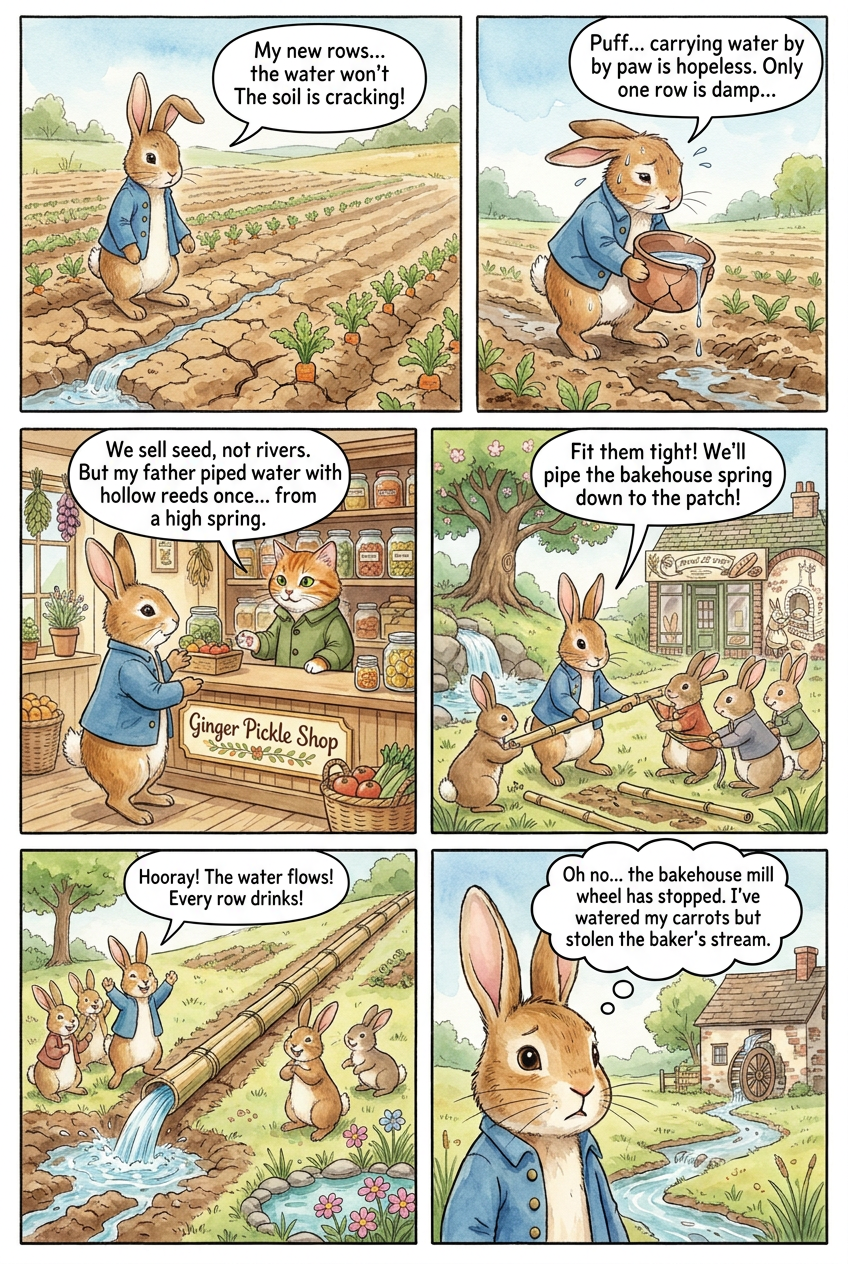
The new rows changed everything. A dozen families now weeded and watched Peter's patch, and the crop had doubled in size. But the morning after, Peter walked the far edge and found the trouble. His single trickle of water, the one thin stream that fed his old rows, could not reach the new ones. The soil there was already cracking. If he did nothing, half his carrots would wither before winter. Peter dug a shallow channel with his paws, hoping the water would run downhill to the dry rows. It soaked into the dirt after three feet and stopped. He tried carrying water in a cracked pot, back and forth from the trickle. By midday his arms shook and only one row was damp. A dozen more waited, drying in the sun. Carrying water by paw would never save the crop. He needed better help. Peter went to the shop with the gingerbread trim, where he owed his basket. Ginger and Pickles kept it stocked with seeds and tools. He hoped they had something for water. Ginger met him at the door in his green coat, wiping his paws. He listened, then shook his head. "We sell seed, not rivers," he said. "But my father piped water once. He hollowed reeds and joined them end to end. Ran a whole line from a high spring down to a low field." He tapped the counter. "You've got the bakehouse spring above your patch, haven't you?" Peter had. Behind the bakery with the brick oven ran a strong spring, higher than his rows. He thanked Ginger and hurried off. He cut armfuls of hollow reeds from the pond edge. Then he called the warren families together and showed them the plan. Each rabbit fit one reed inside the next, sealing the joints with mud, building a long pipe from the high spring down to the dry rows. They worked until dusk. The line sagged twice and had to be propped with stones. When the last joint sealed, Peter climbed to the spring behind the bakehouse and pulled the plug of moss. Water rushed into the reeds. He ran down the slope beside it, faster than the flow. At the dry rows, water spilled from the pipe's mouth and darkened the cracked soil. The rabbits cheered. Every row now drank. Peter's whole patch, old and new, had water at last. But the spring above the bakehouse was not his alone. As the water ran to his rows, Peter saw the stream that fed the oven's mill wheel had slowed to a dribble. The baker would find her wheel stopped by morning. Peter had watered his carrots by draining the spring that ran the bakehouse. He had solved his drought and stolen another's water in the same afternoon.
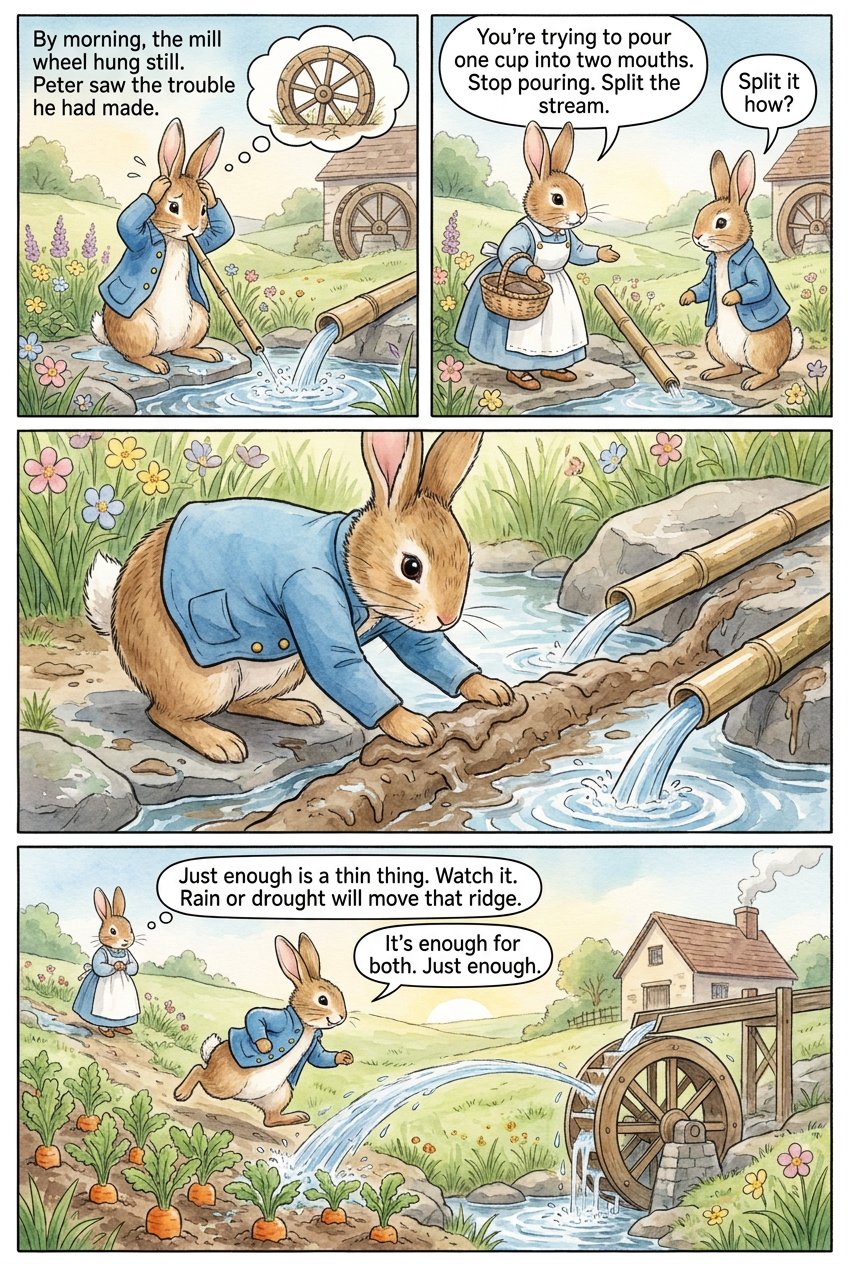
By morning the mill wheel hung still. Peter climbed to the spring behind the bakehouse and saw the trouble he had made. His reed pipe drank the whole flow. Nothing was left to turn the baker's wheel. He had watered his carrots and stopped the bakehouse in one afternoon. He could not take all the water. But he had no way to give the wheel its share. He pulled the moss plug and stuffed it back. The pipe went dry and his rows would thirst by noon. He pulled it out again. Water rushed down to his patch, and the wheel sat dead. All or nothing. Peter sat on a wet stone and held his ears. Clementine Cottontail found him there. She was the rabbit who had once told him to hire the raiders instead of chasing them. She wore her apron and her cape, and she carried a basket of wet clay from the pond ringed with flowers. She looked at the pipe, then at the still wheel below. "You're trying to pour one cup into two mouths," she said. "Stop pouring. Split the stream." "Split it how?" Peter asked. "It only goes one way." Clementine knelt at the spring's mouth. She scooped clay and packed a low ridge across the flow, right where the water left the pool. "Build a fork," she said. "One reed feeds your rows. One reed feeds the wheel. The ridge decides how much each takes." Peter understood. He cut two fresh reeds from the pond. He set one low toward his patch and one low toward the mill. Then he built the clay ridge between them, higher on his side, lower on the baker's. He worked the mud with both paws until it held. He pulled the moss plug. Water spread against the ridge and slid into both reeds at once. Half ran down to his carrots. Half ran to the mill. Peter raced down the slope. Water darkened his dry rows, slower now, but steady. He turned and watched the wheel. It shuddered, dripped, then began to turn. The bakehouse creaked back to life. He climbed up to Clementine, out of breath. "It's enough for both," he said. "Just enough." Clementine wiped her paws on her apron. "Just enough is a thin thing," she said. "Watch it. Rain or drought will move that ridge." She was right. The clay fork held for now. But it was soft, and the spring was small. Peter had bought peace with the baker and saved his crop with one wall of mud. His carrots would grow. The wheel would grind. Yet the whole bargain sat on a ridge of clay no thicker than his paw, and every dry week would test it.
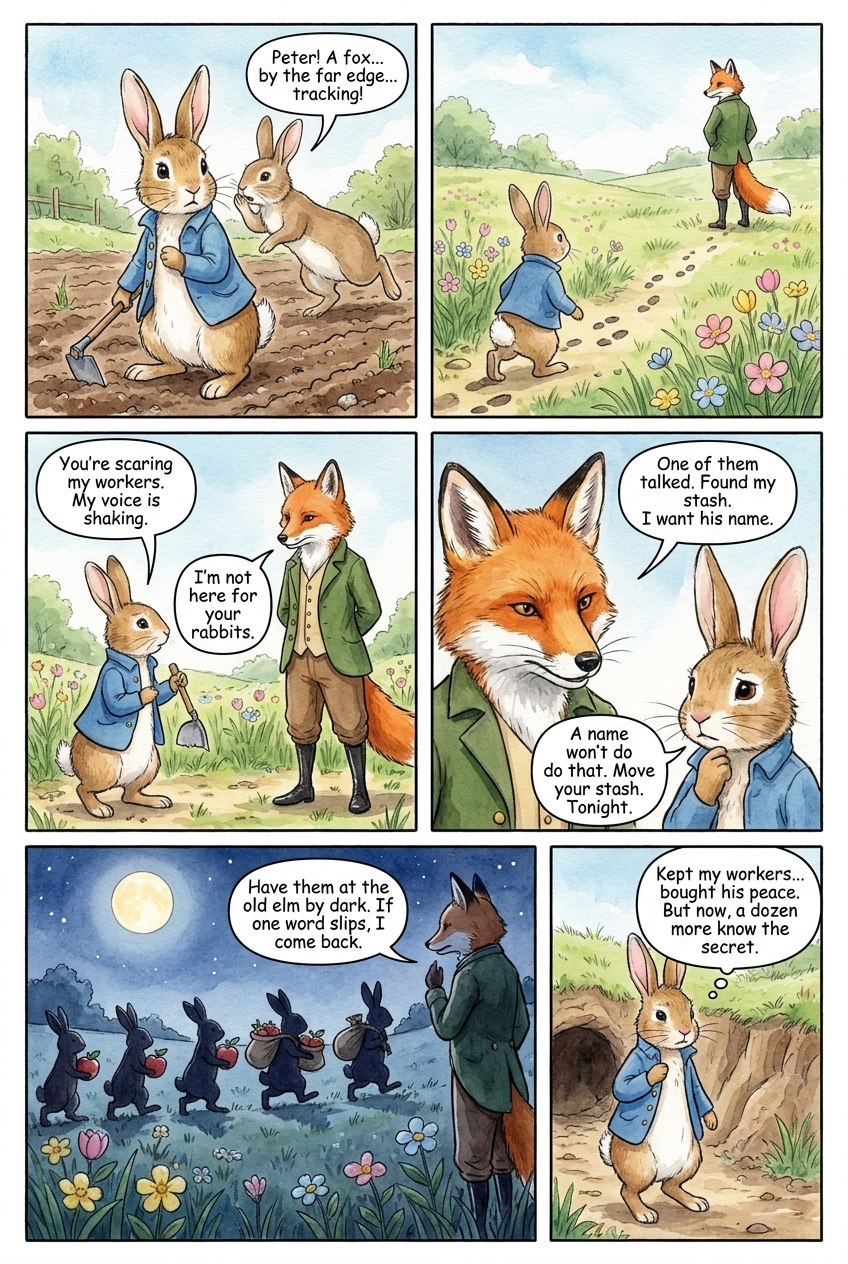
The clay ridge held through the week, so Peter turned back to his rows. Then a warren mother came running. She had seen a fox by the far edge of the patch, nose down, tracking. The workers stopped digging. If a fox took even one of them, whole rows would go untended, and the crop Peter owed would rot in the ground. He could not lose a single pair of paws before winter. Peter followed the fox tracks to a soft patch of spring grass dotted with blossoms. There the fox stood on two legs, green coat buttoned, tail low. Peter had heard the warren whisper his name. Mr. Todd. The fox who guarded his food stores and told strangers nothing. "You're scaring my workers off my rows," Peter said. His voice shook. Mr. Todd did not turn. "I'm not here for your rabbits." "Then why sniff my patch?" "One of them talked." Mr. Todd looked at Peter now. His eyes were flat. "A rabbit found my stash. I could live with that. Then he told others where it was. I want his name." Peter's ears went cold. He knew the rabbit. A young worker had come to the patch last week bragging about a fox's buried apples. Peter had told him to hush. If he gave the name, Mr. Todd would hunt the worker down, and the warren would scatter in fear. If he refused, the fox would keep circling, and no one would tend the rows. Peter thought fast. "You want the talking to stop," he said. "A name won't do that. Others heard him." Mr. Todd's tail twitched. "Go on." "Move your stash. Tonight. My workers will carry it for you, wherever you say. No one will know the new place but you." Peter stepped closer. "They keep their paws. You keep your secret. And they owe you a quiet mouth for the favor." The fox studied him a long moment. "Rabbits carrying my food. That's a strange trust." "You watch every step," Peter said. "Any rabbit who talks answers to you." Mr. Todd almost smiled. "Have them at the old elm by dark." He turned and walked into the grass. "If one word slips, I come back. And next time I won't ask." That night the warren carried Mr. Todd's stores to a new hollow. The fox watched from the shadows, counting every apple. By moonrise the work was done, and Mr. Todd was gone without a sound. Peter walked home tired but whole. He had kept his workers and bought the fox's peace. Yet the young rabbit who talked still lived in the warren, and now a dozen more knew where a fox hid his winter food. Peter had traded one loose tongue for many. The rows were safe tonight. Keeping that many secrets was another matter.
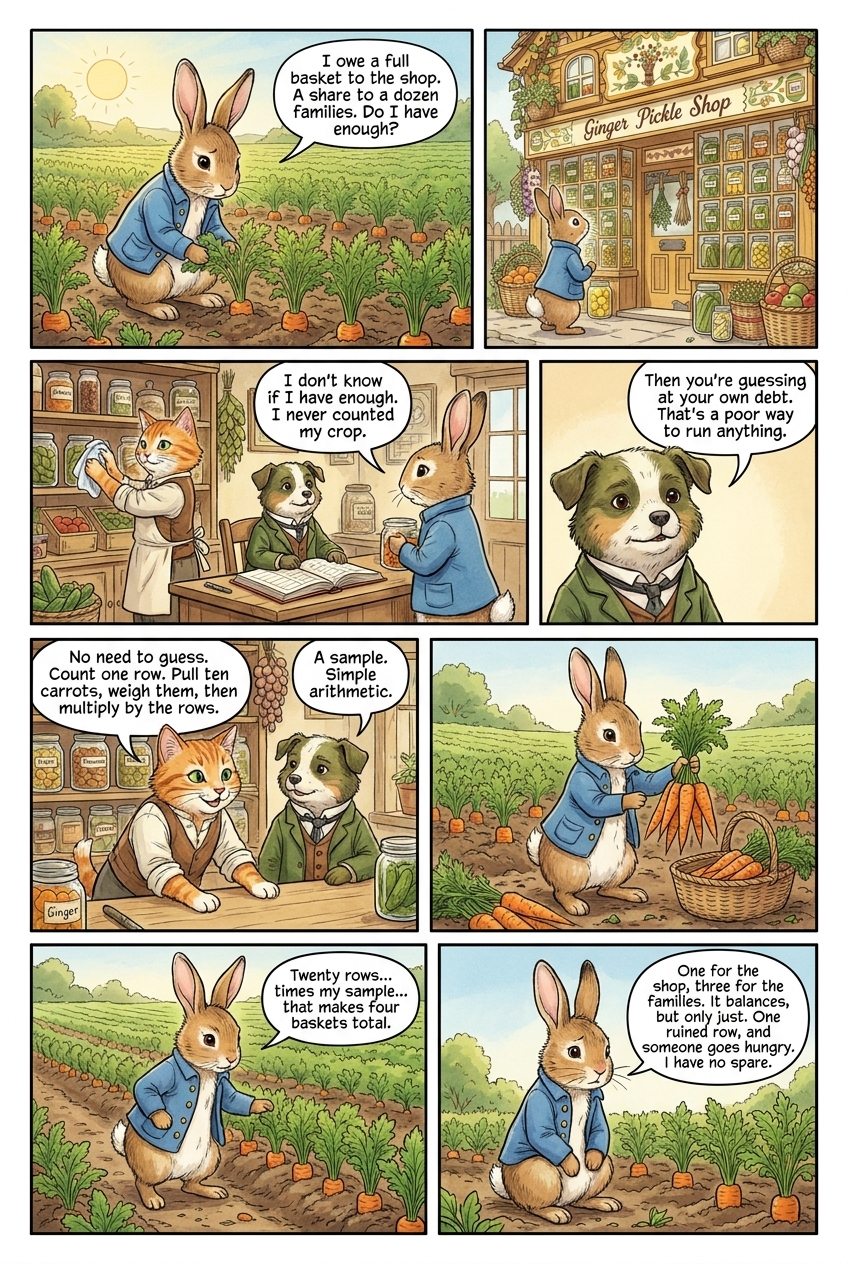
The fox's peace held, and the rows stayed quiet. But one morning Peter walked his patch and felt a cold worry. He owed a full basket to the shop. He owed a share to a dozen warren families. He had never once counted how many carrots his rows would give. He knelt by the first row and stared at the green tops. He had no idea if there was enough for everyone. He pulled one carrot to test its size. Then he stopped himself. Pulling early would waste the crop. He needed a way to count without digging up the whole patch. He could not answer that alone, so he set off for the shop. The Ginger Pickle Shop sat with garlic and pickle jars crowding its windows. Inside, Ginger stood on two feet in his green coat, wiping a jar he did not need to wipe. Pickles, the tri-colored terrier in his brown coat, bent over a ledger, his brow tight. They ran the only shop in the village, and Peter owed them the first basket by winter's end. If he failed, the shop closed. "I don't know if I have enough," Peter said. "I never counted my crop." Pickles set down his pen. "Then you're guessing at your own debt. That's a poor way to run anything." His voice was flat, but his eyes were kind. Ginger smiled and leaned on the counter. "No need to guess, young one. Count one row you can see. Pull ten carrots, weigh what they'd fill, then measure the rest by rows. One row tells you all of them." "A sample," Pickles said. "Ten roots, times the rows. Simple arithmetic." Peter ran home with the plan burning in his ears. He chose the fullest row and pulled ten carrots. He lined them in a basket and marked how much they filled. Then he walked the patch, counting rows, tapping each with a paw. Twenty rows. He set the numbers side by side and multiplied the way Pickles had shown him. The answer landed hard. His whole harvest would fill four baskets. The shop needed one. Twelve warren families needed the other three, split thin between them. It balanced, but only just. One ruined row, one bad frost, and someone went hungry. Peter sat back on his heels. For the first time he knew the true size of what he owed. The guessing was over. He had a number now, and the number was tight. Then a colder thought struck him. Four baskets left nothing spare. If even one family lost its rows, he could not cover the gap. His count had shown him the danger it could not fix. He would have to grow more, and soon, or the whole bargain would crack under its own weight.
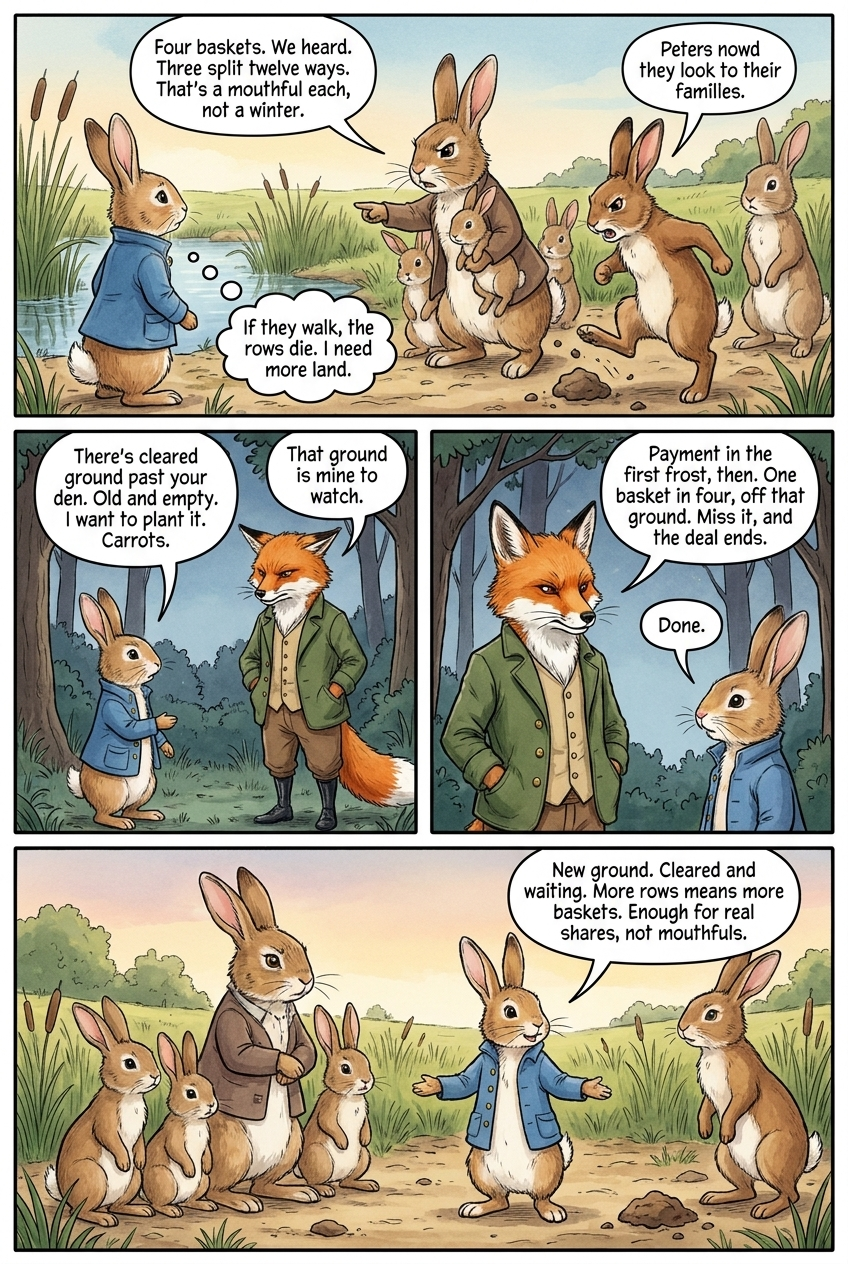
Peter's count had shown him the danger. Now the danger spoke. He walked his rows at dawn and heard the workers before he saw them. Two rabbit families stood by the water reeds, tails twitching, voices low and hard. When they saw Peter, they stopped. "Four baskets," one mother said. "We heard. Three split twelve ways. That's a mouthful each, not a winter." Others nodded behind her. A young buck kicked a clod of dirt. "We worked your rows all season. For what? A promise that keeps shrinking?" Peter's stomach dropped. If they walked, the rows died. If the rows died, everyone starved, and the shop closed too. He could not lie to them. He had run the numbers himself. "You're right," he said. "There isn't enough yet. But there could be. I need more land to plant, and I need it now." The families said nothing. He had no land. He had no answer. Then he thought of the one creature in Oakhollow who guarded more ground than anyone. He found Mr. Todd near the tree line at dusk. The fox stood in his green coat, paws in his pockets, watching Peter approach without moving. They had made a truce once. Peter's warren had moved the fox's food cache to a new hiding place, and Mr. Todd had spared the workers. The peace still held, but it was thin. "You again," Mr. Todd said. Short. Cool. "There's cleared ground past your den," Peter said. "Old and empty. I want to plant it. Carrots." Mr. Todd's ears flattened. "That ground is mine to watch." "It's bare," Peter said. "It grows nothing for you. Let my families work it, and I'll owe you a share of every basket it gives. Food you don't have to hide or hunt." The fox studied him a long moment. "You bring your rabbits close to my cache." "They already know your secret," Peter said. "This gives them a reason to keep it. A hungry rabbit talks. A fed one guards." Mr. Todd's tail swept once, slow. "Payment in the first frost, then. One basket in four, off that ground. Miss it, and the deal ends." "Done," Peter said. He ran back to the grumbling families in the last light. "New ground," he told them. "Cleared and waiting. More rows means more baskets. Enough for real shares, not mouthfuls." The mother who had spoken first looked at the young buck, then back at Peter. Slowly, she nodded. The others loosened. No one packed up. No one left. That night Peter sat by his patch, relieved and cold at once. He had held the workers. He had won new land. But he had promised Mr. Todd a full basket he did not yet have, off soil he had never planted. His debts had grown again. Now four baskets had to become five, or the fox would come collecting.
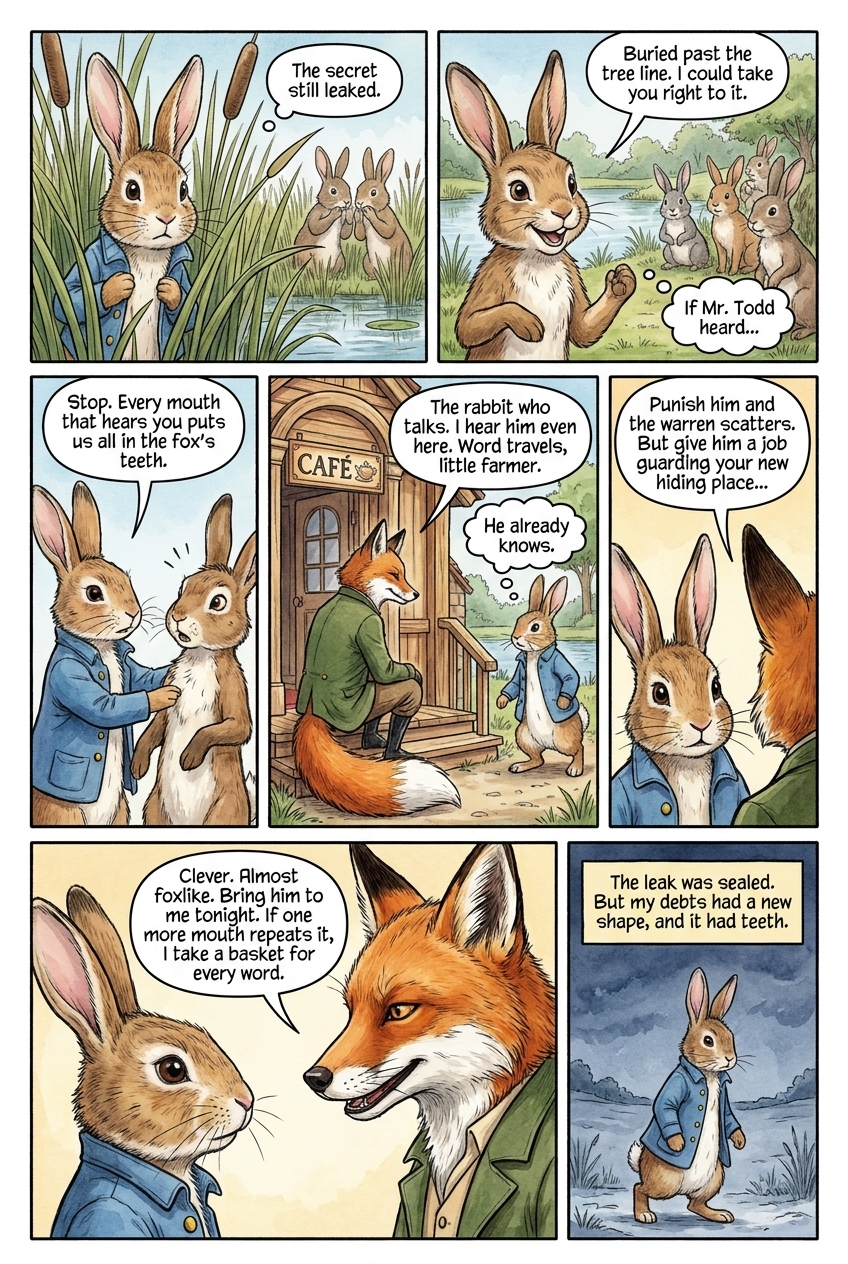
The new land was won, but the secret still leaked. Peter learned it at the water reeds one morning. Two workers whispered about the fox's cache, and a third asked where it lay. The young buck who first found it was telling everyone. Peter's throat went dry. If Mr. Todd heard the secret had spread, the truce would break. The new ground would vanish. Then the fox would come for the rows, and the workers with them. Peter found the young buck by the pond, boasting to a knot of listeners. "Buried past the tree line," the buck said, grinning. "I could take you right to it." "Stop," Peter said. He pulled the buck aside. "Every mouth that hears you puts us all in the fox's teeth. You want to feed your family this winter? Then keep this shut." The buck's grin faded. He nodded, but his eyes still shone with the thrill of the secret. Peter knew a warning would not hold him. He had to reach Mr. Todd first, before rumor did. He found the fox at the lakeside cafe, seated alone on the porch, paws folded, tail curled beneath the bench. Mr. Todd did not look up. "The rabbit who talks," he said softly. "I hear him even here. Word travels, little farmer. It always travels to me." Peter's stomach clenched. So the fox already knew. He sat down uninvited. "He talked. I won't lie about it. But listen to me first." Mr. Todd's ears turned. "You have one breath." "Punish him and the warren scatters," Peter said. "Scattered rabbits gossip. But give him a job guarding your new hiding place, and every secret he holds becomes his own to protect. A guard doesn't betray the thing he's paid to keep." The fox studied him a long moment. His mouth curved. "You would make the leak into the lock." "He knows the ground already," Peter said. "Better him watching it than wandering loose." Mr. Todd tapped one claw on the wood. "Clever. Almost foxlike." He leaned close. "Bring him to me tonight. He swears silence to my face, and he watches the cache from now on. If one more mouth repeats it, I take a basket for every word. Off your ground. Understand?" "Understood," Peter said. That night Peter marched the young buck to the tree line. The buck stood stiff before the fox and swore to guard the cache and speak of it to no one. Mr. Todd accepted with a slow nod. The truce held. Peter walked home under a cold sky. The leak was sealed. But he had bound a careless rabbit to the fox's service, and staked his whole harvest on the buck's silence. One slip now would cost baskets he did not have. His debts had a new shape, and it had teeth.
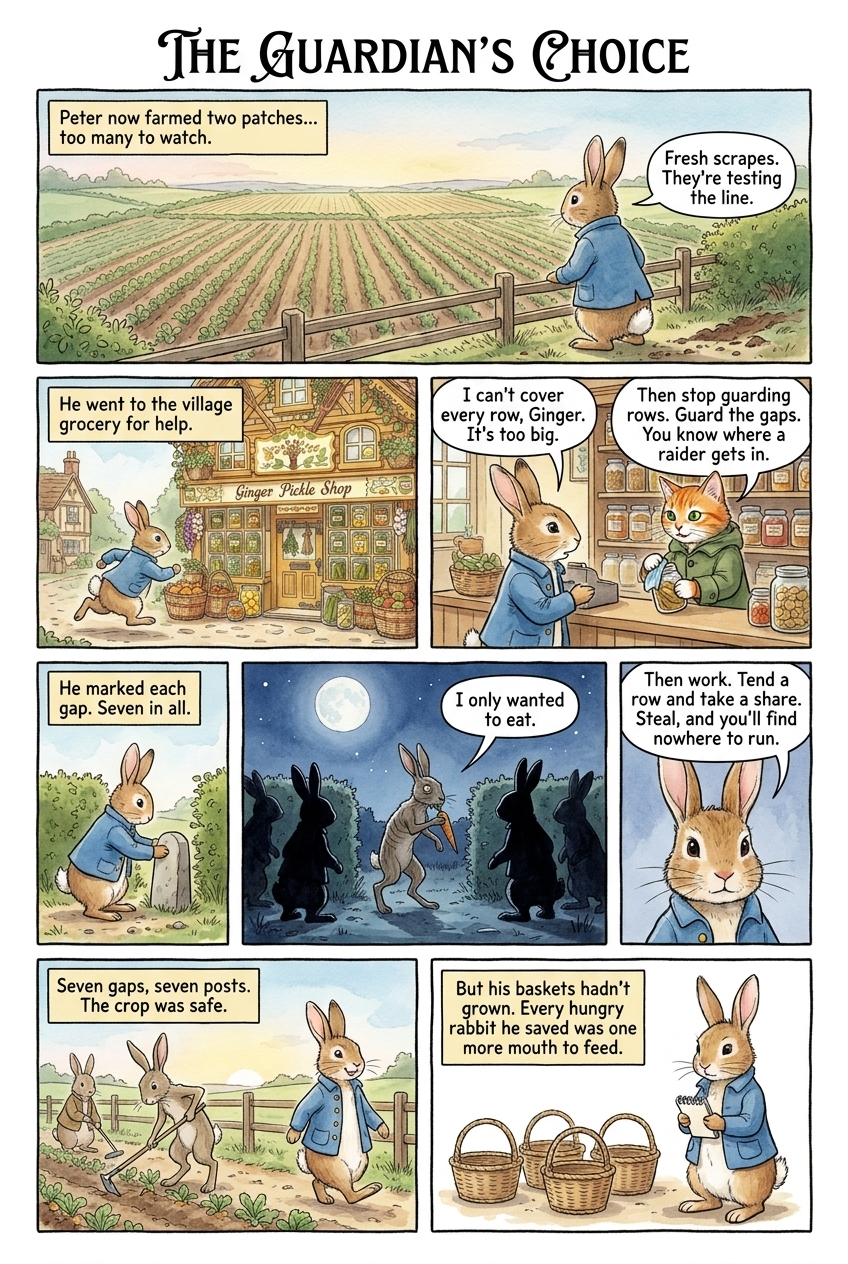
The truce held, but the new ground made it worse. Peter now farmed two patches, the old rows and Mr. Todd's cleared field, and a dozen families could not watch both at once. He walked the fence at dawn and counted the gaps. Too many. A hungry raider could slip through while every rabbit hoed on the far side. He had seen the fresh scrapes under the hedge. Something had already tested the line. He went to the village grocery for help. The shop sat under its gingerbread trim, jars of pickles stacked in the windows, baskets of vegetables crowding the door. Peter needed the shop to survive as much as it needed his basket. He pushed inside and found Ginger behind the counter in his green coat, wiping a jar with a cloth. "Your patch is too big to guard," Peter said. "Twelve families, two fields. I can't cover every row." Ginger set the jar down. "Then stop guarding rows. Guard the gaps." He tapped the counter. "You know where a raider gets in. You told me once you know every hole in a fence." Peter did. He knew McGregor's fence by heart. He knew his own worse. "I've been watching the whole line," he said. "I should watch the doors." "Fewer eyes, better placed," Ginger said. "A fence is only as weak as its holes." Peter ran home. He walked both patches slowly and marked each gap with a stone. He found seven. Then he pulled the families off the open rows. He posted two rabbits at each broken spot, hidden in the hedge, and left the middle rows unwatched. It felt wrong to leave the carrots bare. But nothing crossed the middle. Everything crossed the edges. That night he waited at the widest gap with three others. The moon rose. Near midnight a shape pushed through the hedge below them, a lean rabbit from beyond the warren, ribs showing, nose down for the carrot tops. Peter did not shout. He let the stranger step fully inside. Then the four of them rose together and blocked the gap behind him. The raider froze, trapped between them and the rows. "I only wanted to eat," he said. Peter kept his voice low. "Then work. Tend a row and take a share, same as the rest. Steal, and you'll find every hole plugged and nowhere to run." The stranger looked at the ring of rabbits. He nodded. By morning Peter had a new worker and a guarded fence. Seven gaps, seven posts, no more open line. He walked the rows in the gray light and found them untouched. The crop was safe. But he counted the mouths again as he walked. Thirteen families now, not twelve. Another share promised. His four baskets had not grown. Every hungry rabbit he turned into a worker was one more rabbit waiting to be fed.
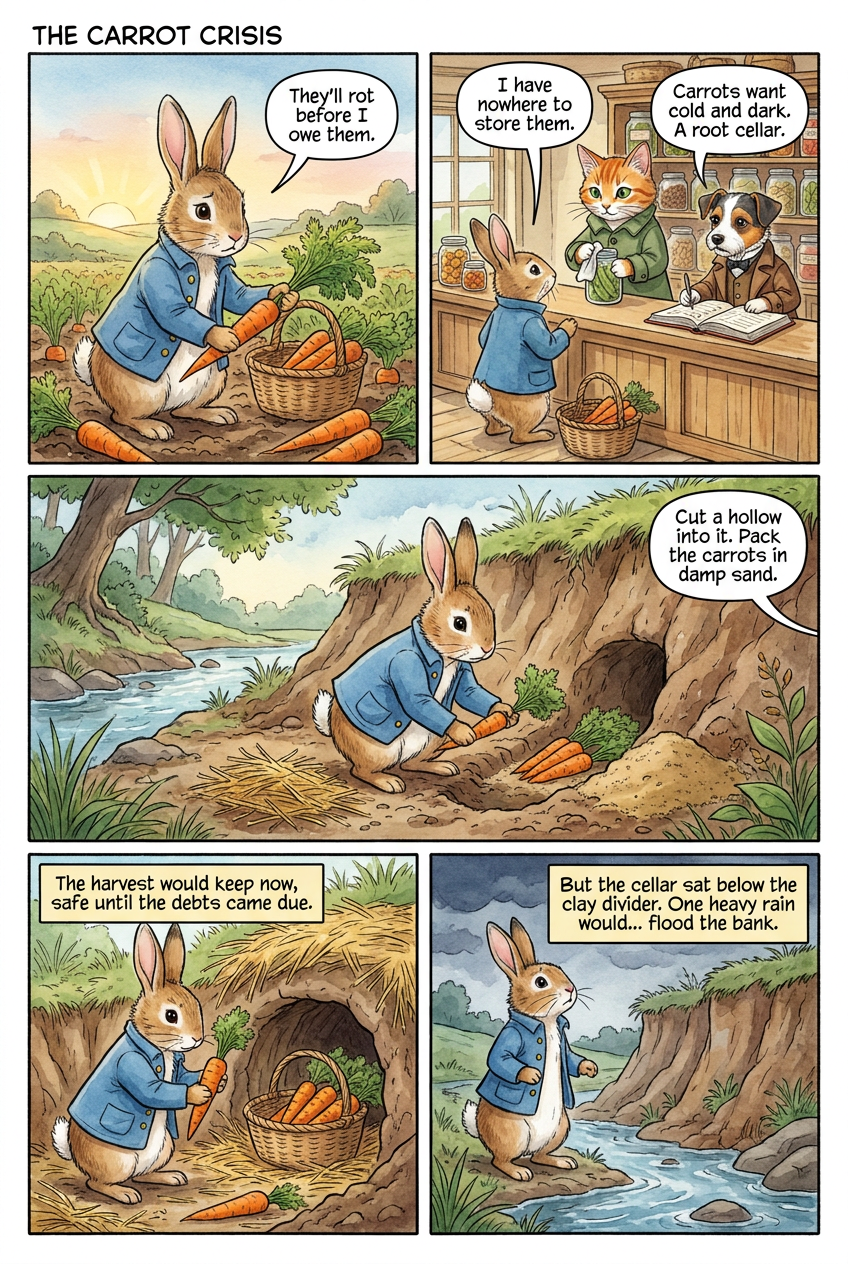
The fence held now, but the harvest could not wait. Peter pulled his oldest carrots at dawn and found them fat and orange. He laid them in a basket and felt no relief. Picked carrots do not keep. Left in a warm burrow, they soften and rot in days. Winter's debts were weeks away. One basket owed to the shop, three to the families, one in four to Mr. Todd. If the crop spoiled before then, every promise broke at once. He needed a cool, dry place to hold them, and he had none. He carried the basket to the village grocery. Ginger stood behind the counter in his green coat, wiping a jar. Beside him Pickles knelt over the ledger, his brown coat open, running one paw down a column of numbers that never balanced. Both looked up when Peter set the basket down. "They're ready," Peter said. "But they'll rot before I owe them. I have nowhere to store them." Pickles closed the ledger. "Carrots want cold and dark. A root cellar." He tapped the floor with his paw. "We keep ours under the shop. Stone walls, dry sand." "I can't dig a cellar in two weeks," Peter said. Ginger set the jar down and grinned. "You don't dig. You borrow the cold that's already there." He came around the counter. "A stream bank. Clay soil, north side, out of the sun. Cut a hollow into it. Pack the carrots in damp sand. The bank stays cool all winter." "I have a stream," Peter said. He thought of the bakehouse spring above his patch. The clay divider he had built held the flow. The bank there was firm and shaded. "Damp sand, not wet," Pickles said. "Wet rots them. Layer the roots so they don't touch. Cover the mouth with straw." Peter ran home with the basket. He found the shaded bank below the divider, where the clay stayed cool under his paws. He dug a hollow arm-deep into it, careful not to weaken the barrier that fed both his rows and the mill. He hauled sand from the stream shallows and let it drain. Then he laid the carrots in rows, each one apart, packed in the cool sand. He stuffed straw across the mouth and stepped back. The next morning he pulled one out. It was firm and cold, no soft spots. He rebuilt the wall of straw and let the rabbits keep picking. The oldest rows came out row by row, and each basket went into the bank. The harvest would keep now, safe until the debts came due. But the cellar sat below the clay divider. Peter looked up at the fragile barrier holding back the spring. One heavy rain would swell the flow, break the mud, and flood the bank. Every stored carrot lay in the path of that water. He had found a place to keep them. Now he had to keep the water out.
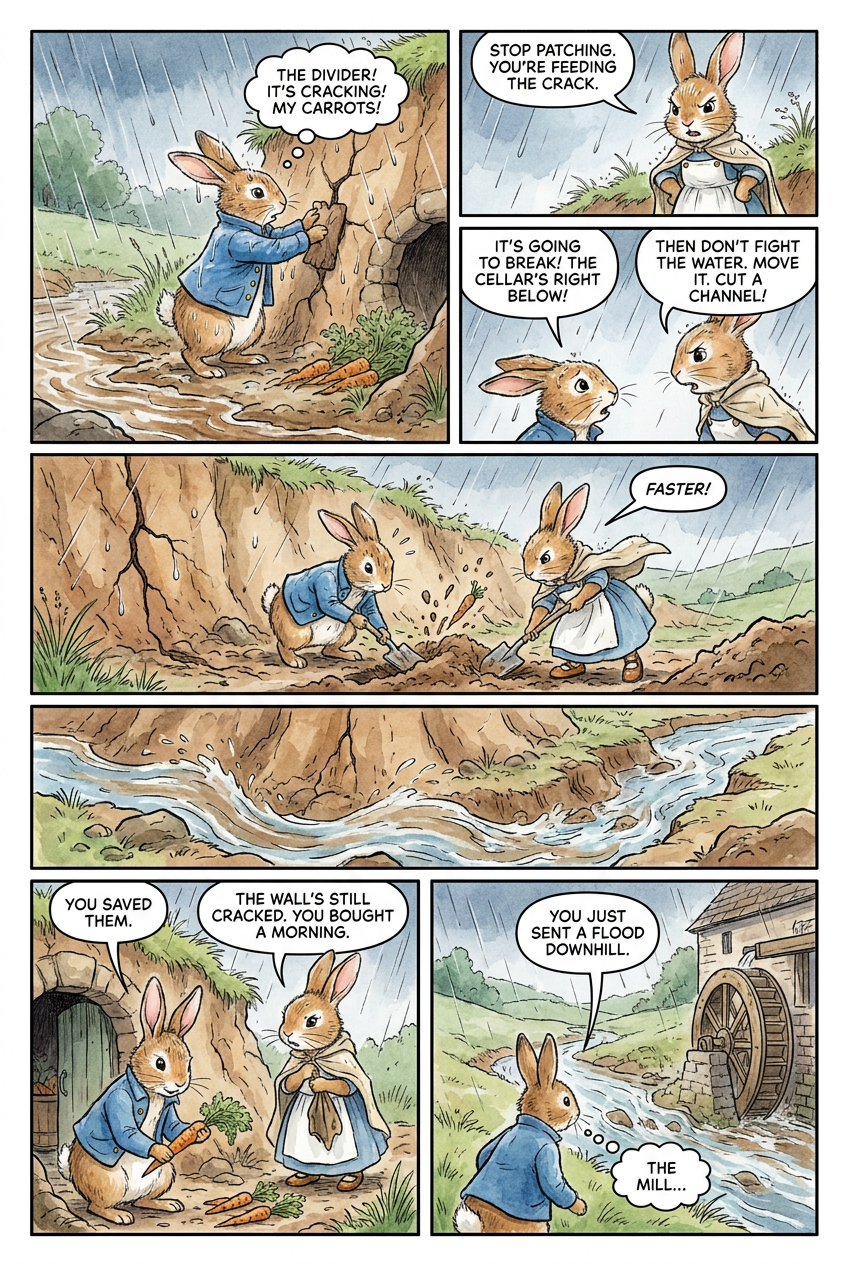
The rain came hard before dawn. Peter woke to water hammering his stump roof and ran outside. Up the hill, the spring had swollen brown and loud. His clay divider strained against it. A crack ran down the middle, thin as a whisker but growing. Below the bank sat his cellar, packed with every carrot he owed. One burst of that water would flood the sand and rot the whole harvest. He threw himself at the divider and pressed mud into the crack. It washed out as fast as he packed it. The water only pushed harder. He could not hold it with his paws alone. A voice cut through the rain. "Stop patching. You're feeding the crack." Clementine Cottontail stood on the bank in her apron and cloak, both soaked flat. She had steered Peter right before, when she told him to build this divider in the first place. Now she frowned at it like a job half done. "It's going to break," Peter said. "The cellar's right below." "Then don't fight the water. Move it." She pointed uphill, above the spring. "Cut a channel. Send the flood off to the side before it ever reaches your wall." Peter looked where she pointed. The land sloped away toward a low ditch. If he opened a path, the swollen water could run there instead of pounding his divider. "There's no time to dig it," he said. "There's no time to stand here." She was already clawing at the soft ground. "Two of us. Go." Peter dug beside her. The rain made the soil loose and heavy. They cut a trench from the spring's high edge toward the ditch, throwing mud behind them. His arms burned. The crack in the divider widened. Water began to weep through it and darken the bank above his carrots. "Faster," Clementine said. They broke through the last wall of dirt. The swollen spring found the new path and rushed sideways, away from the divider and down into the ditch. The roar dropped. The pressure on the cracked clay eased. The weeping slowed, then stopped. Peter dropped to his knees by the cellar mouth. He pulled back the straw. The sand was damp but firm. The carrots lay cold and whole, every basket safe. "You saved them," he said. Clementine wrung out her cloak. "The wall's still cracked. You bought a morning, not a winter." She nodded at the ditch, now running full and fast. "And that water has to go somewhere. You just sent a flood downhill." Peter followed her gaze. The channel poured straight toward the lower slope, where the mill wheel turned below. His new trench aimed the whole swollen spring at the baker's works. He had saved his harvest. Now the flood he made was racing down to the mill.
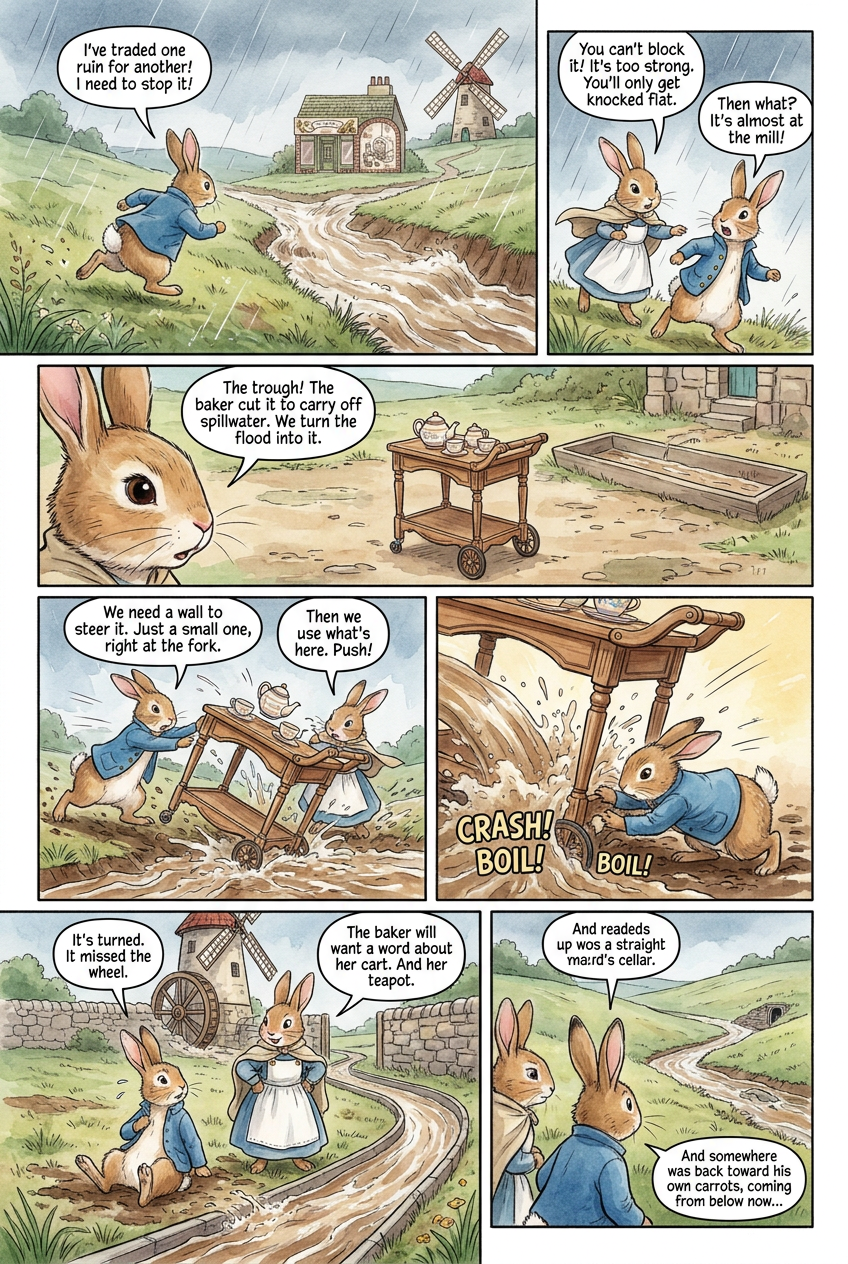
Peter ran down the slope after the flood. The diverted water tore along the ditch, brown and fast. It aimed straight at the bakehouse and the mill wheel below. If it hit, the wheel would splinter and the baker would lose her trade. Peter had traded one ruin for another. He needed to stop the water before it reached the wall, and he had no dam and no time. Clementine caught up, her cloak flapping. "You can't block it," she called. "It's too strong. You'll only get knocked flat." "Then what?" Peter shouted. "It's almost at the mill." She scanned the ground, quick as ever. Her eyes stopped on the flat yard beside the bakehouse. A wooden tea cart stood there, forgotten, its teapot and cups rattling in the wind. Beyond it lay the mill's own drainage trough, dry and empty. "The trough," she said, pointing. "The baker cut it to carry off spillwater. It runs away from the wheel. We turn the flood into it." Peter saw it. The trough curved wide around the mill. If he could nudge the water sideways into that channel, it would miss the wheel and drain past. But the flood was already close. "We need a wall to steer it," he said. "Just a small one, right at the fork." Clementine was already shoving the tea cart. "Then we use what's here. Push!" They rolled the heavy cart into the flood's path at the fork. Teapot and cups crashed into the mud. The cart's wide wooden side met the rushing water and held. The flood struck it, boiled up, and swung sideways. Peter dropped to his knees and clawed a lip of mud along the cart's base, sealing the gap underneath. The water hunted for a new path. It found the dry trough and poured in. The roar shifted. The flood rushed down the trough, curved around the mill, and ran off harmlessly past the wall. The wheel spun on, untouched. Peter sat back in the mud, chest heaving. "It's turned. It missed the wheel." Clementine wiped her paws on her ruined apron and grinned. "The baker will want a word about her cart. And her teapot." But the grin faded as she looked up the hill. Peter followed her gaze. The trough carried the flood off to the side, safe from the mill. It ran straight down toward the low stream bank where his cellar sat. The same bank. The same sand. Peter got to his feet slowly. He had saved the mill by sending the water somewhere. And somewhere was back toward his own carrots, coming from below now, where no divider stood to stop it.
Play your story to life
Storycraft is a mobile game where you create AI characters, craft items and locations to build their world, then discover what direction your story takes. Download the iOS game for free today!
Download for free