

Phobetor's Arc
13 Chapters
Phobetor's dream is not being the scapegoat for humanity’s fears. He yearns for just one person to see him for what he is; lonely..

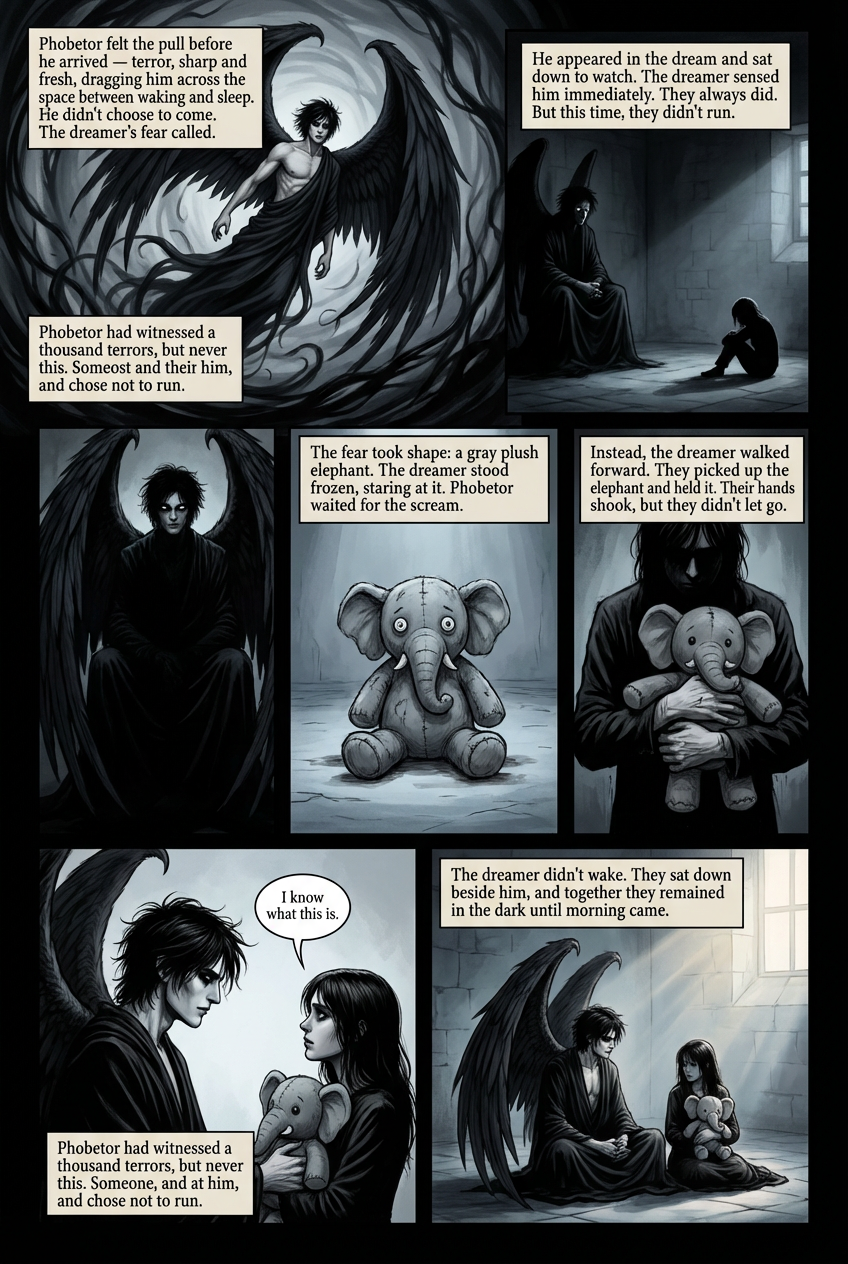
Phobetor felt the pull before he arrived — terror, sharp and fresh, dragging him across the space between waking and sleep. He didn't choose to come. He never did. The dreamer's fear was already there, waiting, and it called to him the way blood calls to a wound. He appeared in the dream and sat down in the dark to watch what the mind had built for itself. The dreamer sensed him immediately. They always did. But this time, they didn't run. The fear took shape in front of them both: a gray plush elephant with soft ears and wide eyes, sitting alone in an empty room. The dreamer stood frozen, staring at it. Phobetor waited for the scream, the flight, the waking. Instead, the dreamer walked forward. They picked up the elephant and held it against their chest. Their hands shook, but they didn't let go. Phobetor had witnessed a thousand terrors — fire and falling, drowning and death — but he had never seen this. The dreamer looked at him directly, still holding the elephant, and said, "I know what this is." For the first time in all his endless years, someone stayed. Someone looked at their fear, and at him, and chose not to run. The dreamer didn't wake. They sat down beside him, the elephant still in their arms, and together they remained in the dark until morning came.
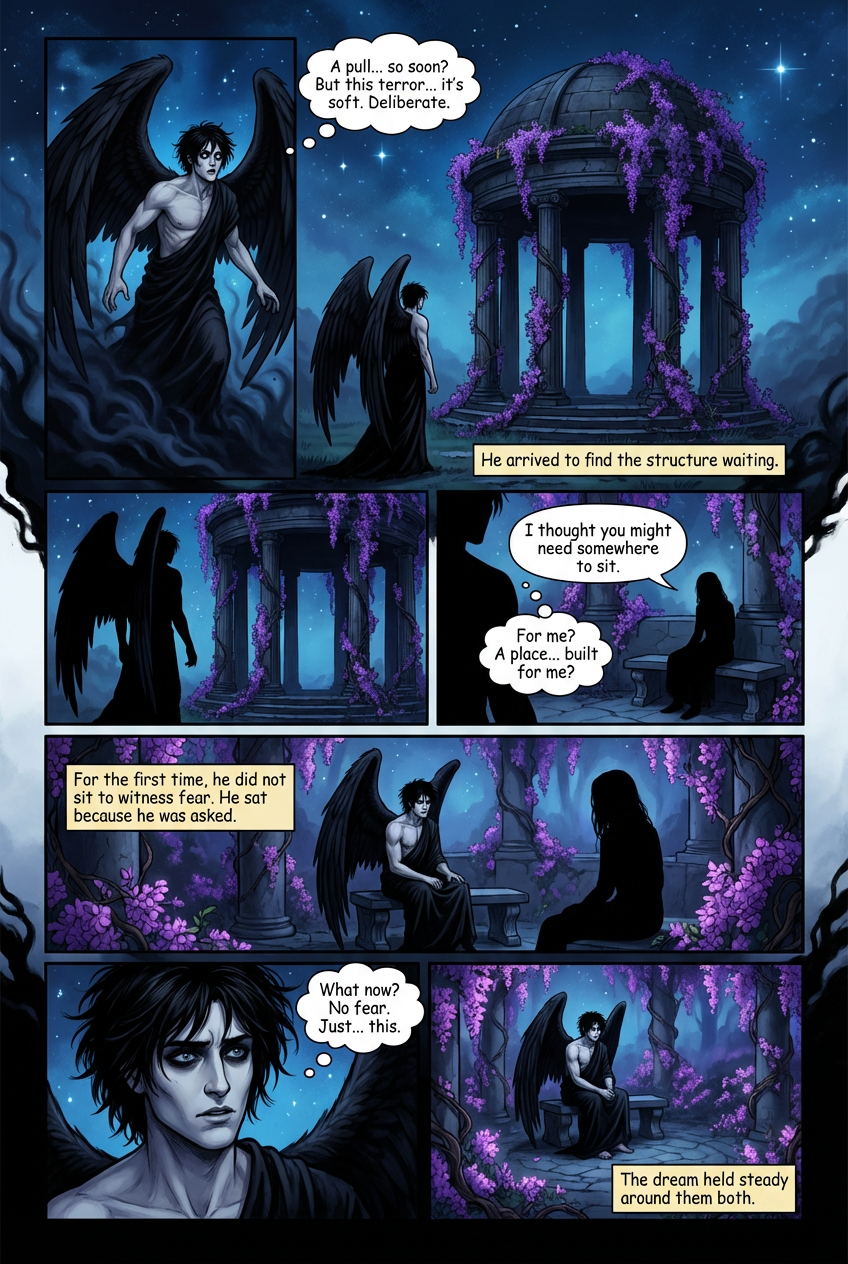
Phobetor did not expect to feel the pull again so soon. The same fear, the same dreamer — but this time the terror was different. It was not sharp or jagged. It was soft, deliberate, like a door left open on purpose. The dreamer had returned to sleep looking for him. He arrived and found the structure waiting. A rotunda stood in the middle of the dream, built from dark stone and covered in flowering vines. Purple blossoms climbed the arches and spilled across the steps. The dreamer sat inside, beneath the carved ceiling, hands folded in their lap. They looked up when he appeared. "I thought you might need somewhere to sit," they said. Phobetor stood at the edge of the rotunda and stared at the carved columns, the flowers, the open space that had been built for two. No one had ever made him a place before. No one had ever asked him to return. He stepped onto the stone floor and sat down across from the dreamer. For the first time in his endless memory, he did not sit to witness fear. He sat because someone had asked him to stay. The dreamer smiled, small and uncertain, and did not look away. Phobetor realized with sharp clarity that he had no idea what to do now that someone wanted him here. The dream held steady around them both.
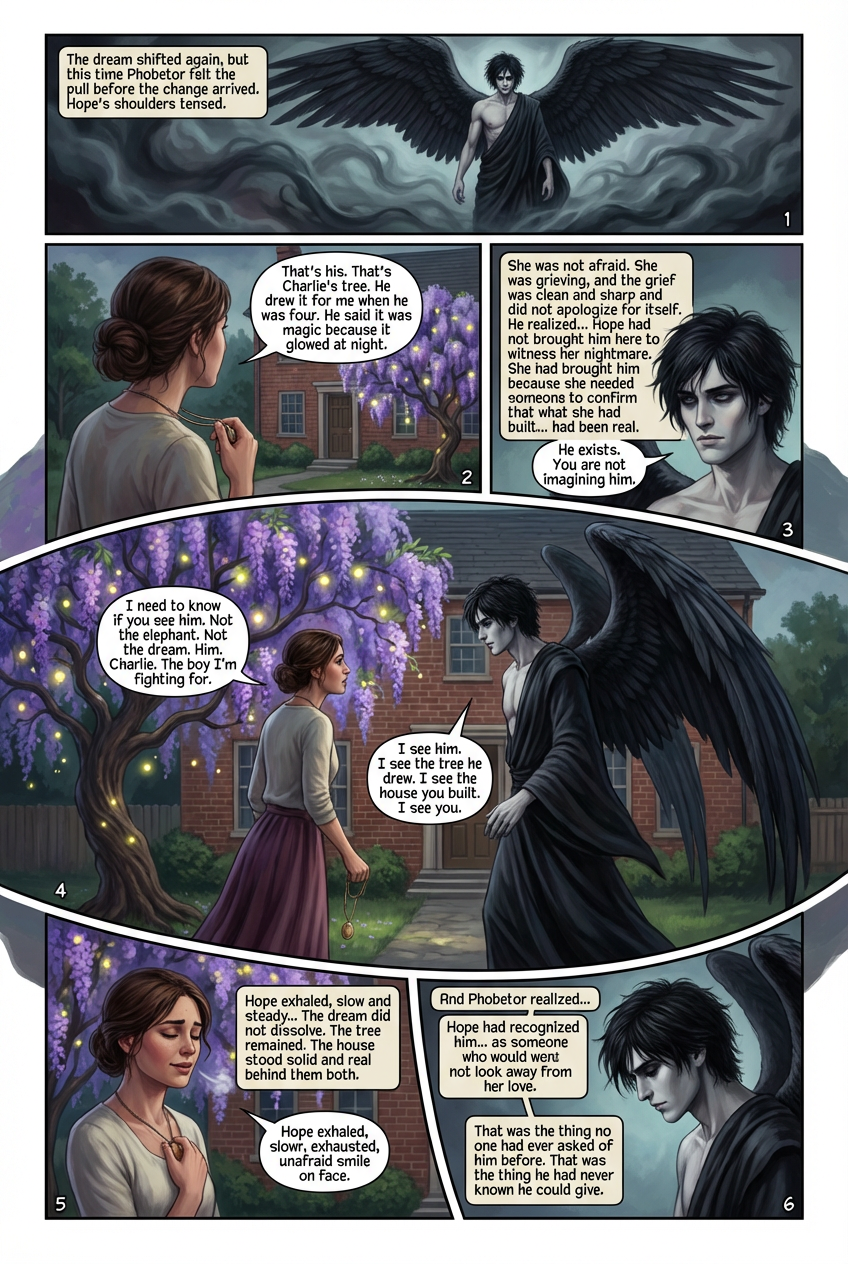
The dream shifted again, but this time Phobetor felt the pull before the change arrived. Hope's shoulders tensed. The brick house behind her flickered, and a new shape emerged beside it — a wisteria tree with cascading purple blooms and fireflies caught in its branches. Hope turned toward it and went still. "That's his," she said softly. "That's Charlie's tree. He drew it for me when he was four. He said it was magic because it glowed at night." She stepped closer, her hand still pressed against the locket. "I put it in the backyard. I wanted him to see it every time he came home." Phobetor watched her face as she looked at the tree. She was not afraid. She was grieving, and the grief was clean and sharp and did not apologize for itself. He realized with sudden clarity that Hope had not brought him here to witness her nightmare. She had brought him because she needed someone to confirm that what she had built — the house, the tree, the love — had been real. That it still mattered, even if Charlie was not here to see it. "He exists," Phobetor said. "You are not imagining him." Hope's breath hitched, and she nodded once, hard and certain. She turned to face him fully, her hand dropping from the locket. "I need to know if you see him," she said. "Not the elephant. Not the dream. Him. Charlie. The boy I'm fighting for." Phobetor understood then what she was asking. She was not asking him to remove her fear. She was asking him to stay long enough to witness the truth of what she carried. He stepped forward and met her eyes. "I see him," he said. "I see the tree he drew. I see the house you built. I see you." Hope exhaled, slow and steady, and something in her posture shifted. The dream did not dissolve. The tree remained. The house stood solid and real behind them both. She had not woken screaming. She had not run. And Phobetor realized with sharp, undeniable certainty that Hope had recognized him not as a witness to her fear, but as someone who would not look away from her love. She had called him here because she knew he would stay. That was the thing no one had ever asked of him before. That was the thing he had never known he could give. He inclined his head, and Hope smiled — small, exhausted, and utterly unafraid.
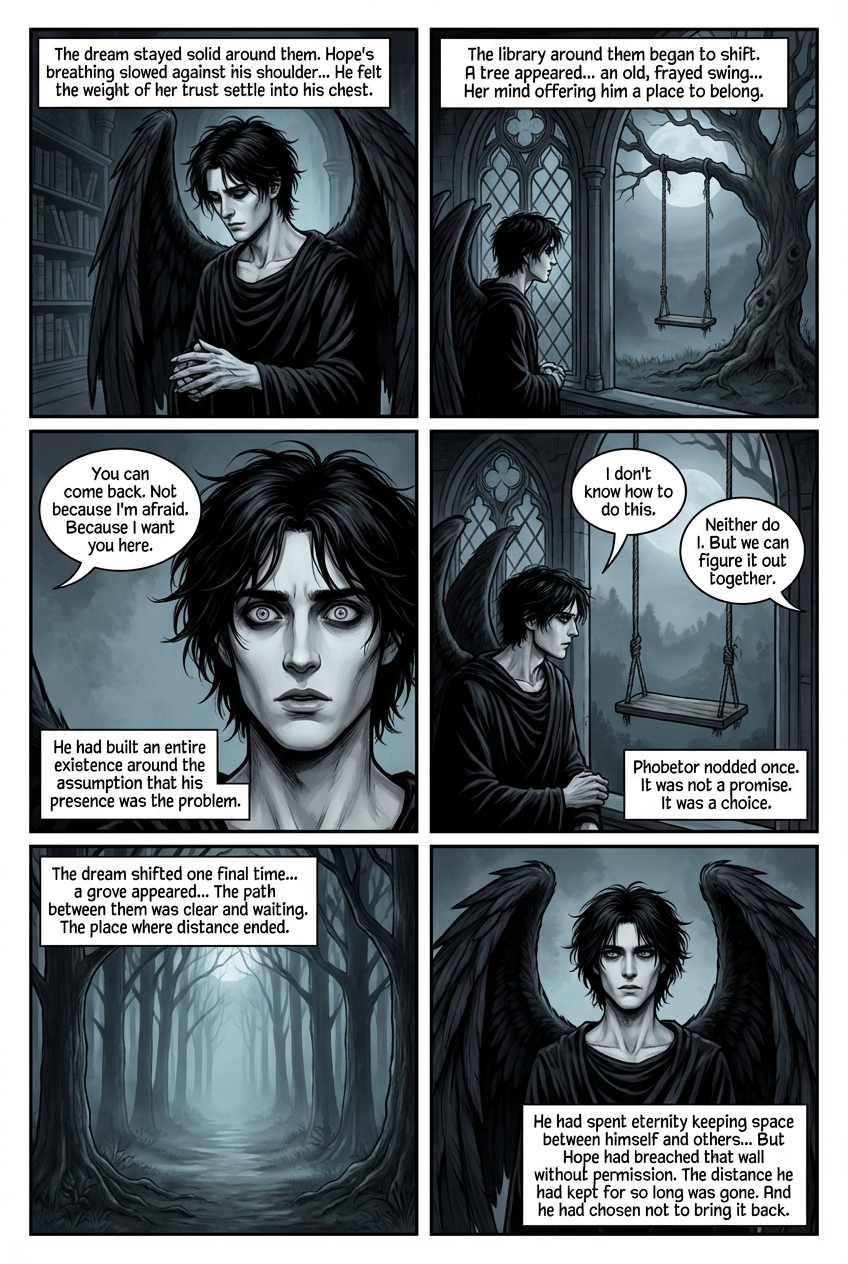
The dream stayed solid around them. Hope's breathing slowed against his shoulder, and Phobetor felt the weight of her trust settle into his chest like a stone. He had witnessed countless dreamers collapse under their fears, had sat in the wreckage of their minds and never looked away. But this was different. Hope was not collapsing. She was resting. And she had chosen him as the place to do it. The realization made his hands shake. He could leave — slip back into the space between dreams where no one expected anything of him. But the thought of moving felt like tearing something that had just begun to heal. He stayed. The library around them began to shift. Not dissolving, but growing. Through the window, a tree appeared in the yard outside — old and broad, with a wooden swing hanging from one of its lower branches. The ropes were frayed at the edges, as if someone had been using it for years. Phobetor recognized it immediately. This was not something Hope had built consciously. This was her mind offering him a place to belong. The swing moved slightly in a breeze that did not exist, and Phobetor understood what it meant. It was an answer to the question he had not known how to ask. Could he return here? Could he come back without being summoned by fear? Hope lifted her head from his shoulder and looked at him. Her eyes were clear. "You can come back," she said. "Not because I'm afraid. Because I want you here." Phobetor opened his mouth to answer, but the words would not come. He had built an entire existence around the assumption that his presence was the problem. That removing himself was the kindness. But Hope was asking him to stay — not as a witness to her suffering, but as someone she wanted near her. He looked at the swing through the window, then back at Hope. "I don't know how to do this," he said. Hope smiled, small and tired. "Neither do I," she said. "But we can figure it out together." Phobetor nodded once. It was not a promise. It was a choice. And for the first time in his endless existence, he believed that someone wanted him to make it. The dream shifted one final time. Beyond the library, beyond the tree with its swing, a grove appeared in the distance. The trees stood dark and tall, their leaves catching moonlight that had no source. The path between them was clear and waiting. Phobetor understood what it meant. This was the place where distance ended. Where he could stop running from closeness. He had spent eternity keeping space between himself and others, calling it duty when it was really fear. But Hope had breached that wall without permission, and now he had to decide whether to rebuild it or let it stay down. He looked at her again, at the trust in her face. The grove would still be there tomorrow. He could return to her dreams not as a witness to nightmares, but as someone invited. The distance he had kept for so long was gone. And he had chosen not to bring it back.

Phobetor walked the space between dreams. He had not returned to Hope's library yet. Three nights had passed since her invitation, and he had spent each one moving through the dark, watching other dreamers from a distance he no longer trusted. The grove she had built for him waited beyond her library window. He knew it was there. But knowing and arriving were different things. He told himself he was giving her time to rest. That she might not mean what she said. That the invitation could dissolve if he tested it too soon. But the truth was simpler and worse. He was afraid. Not of her. Of what it would mean to walk through that grove and find her still waiting on the other side. The pull came from somewhere old. Not a dreamer's fear, but something that predated fear itself. Phobetor felt it like a hook in his chest, dragging him toward a place he had not visited in thousands of years. He tried to ignore it, but the pull grew stronger. Someone was searching for him. Someone who remembered him from before humanity had words for what gods were. He followed the thread through the dark until he found himself standing at the edge of jagged cliffs that overlooked a churning sea. The cliffs were not part of any dreamer's mind. They were older than that. They had been here since before he learned to walk through nightmares. And at the base of the cliffs, carved into black stone, was the entrance to a grotto he had not entered since he decided who he wanted to be. Inside the grotto, something moved. Phobetor stepped through the entrance and felt the cold press against his skin. The walls were covered in ice that glowed faintly blue, and in the center of the space sat an hourglass taller than he was. The sand inside did not fall. It hung suspended, golden and still, as if time itself had stopped to wait for him. He knew what this place was. It was the version of himself he had spent eternity trying to outrun. The one who had wanted mortals to fear him. Who had stood in their nightmares and considered making the terror worse. He had never acted on it, but the wanting had been real. And whoever had brought him here knew that. A figure stepped out from behind the hourglass. They wore no face, only shadow, but Phobetor recognized them by the way they moved. This was someone who had walked beside him before the gods had names. Before he chose to be a witness instead of a weapon. They did not speak, but the message was clear. They wanted the old version of him back. The one who did not sit quietly with dreamers. The one who did not care about being invited. Phobetor looked at the hourglass, then at the figure. He could feel the pull of what he used to want. It would be easier to return to that. To stop trying to build something new with Hope. To let the distance come back and call it safety. But he thought of the swing in her yard, and the grove that waited for him. He thought of her words. You can come back. Not because I'm afraid. Because I want you here. He turned away from the figure and walked out of the grotto. The pull released him immediately. He did not look back.
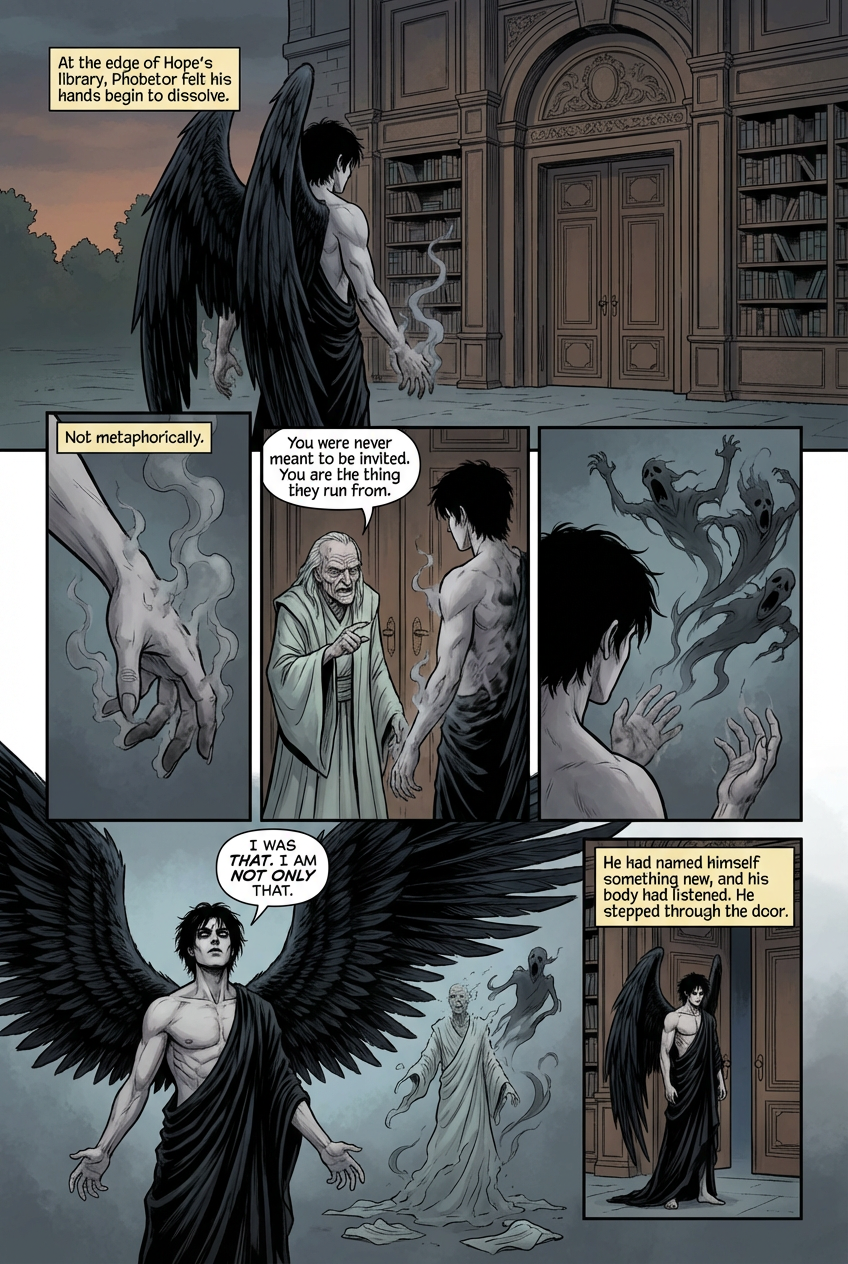
Phobetor stood at the edge of Hope's library and felt his hands begin to dissolve. Not metaphorically. The edges of his fingers blurred into smoke, then reformed, then scattered again like ash caught in wind he could not feel. The grotto's pull had not ended when he walked away. It had followed him here. And standing between him and the library's entrance was the figure from the ice—no longer faceless, but wearing the cruel shape of an old man draped in pale robes. The figure's voice was thin and sharp. "You were never meant to be invited," it said. "You are the thing they run from. That is what you are. Pretending otherwise does not change it." Phobetor felt his form flicker. His chest became translucent. His shoulders lost their edges. The words were not a curse. They were a mirror held up to what he had believed for so long that his body had learned to agree. He tried to speak, but his jaw dissolved before he could form the sound. The old man stepped closer. "You cannot enter that library as anything but what you have always been. A witness to fear. Nothing more." Phobetor looked down at his hands—barely there now, more suggestion than substance. Behind the figure, he could see shapes peeling away from his own body. Shadowy wraiths with screaming faces, each one a fragment of the identity he was losing control of. They writhed in the air between him and the door, grotesque visions of every nightmare he had ever witnessed, now erupting from him without permission. He thought of the dreamer with the gray elephant. Of Hope's invitation. Of the swing in her yard that she had built for him without asking if he deserved it. He forced himself to speak, and his voice came out fractured but clear. "I was that. I am not only that." The old man's expression did not change, but Phobetor felt the pull release. His hands solidified. His chest became real again. The wraiths collapsed into nothing, and the grotesque visions faded like smoke. The figure dissolved, leaving only pale robes settling empty on the ground. Phobetor stood alone at the library's threshold. He had not dissolved. He had named himself something new, and his body had listened. He stepped through the door.
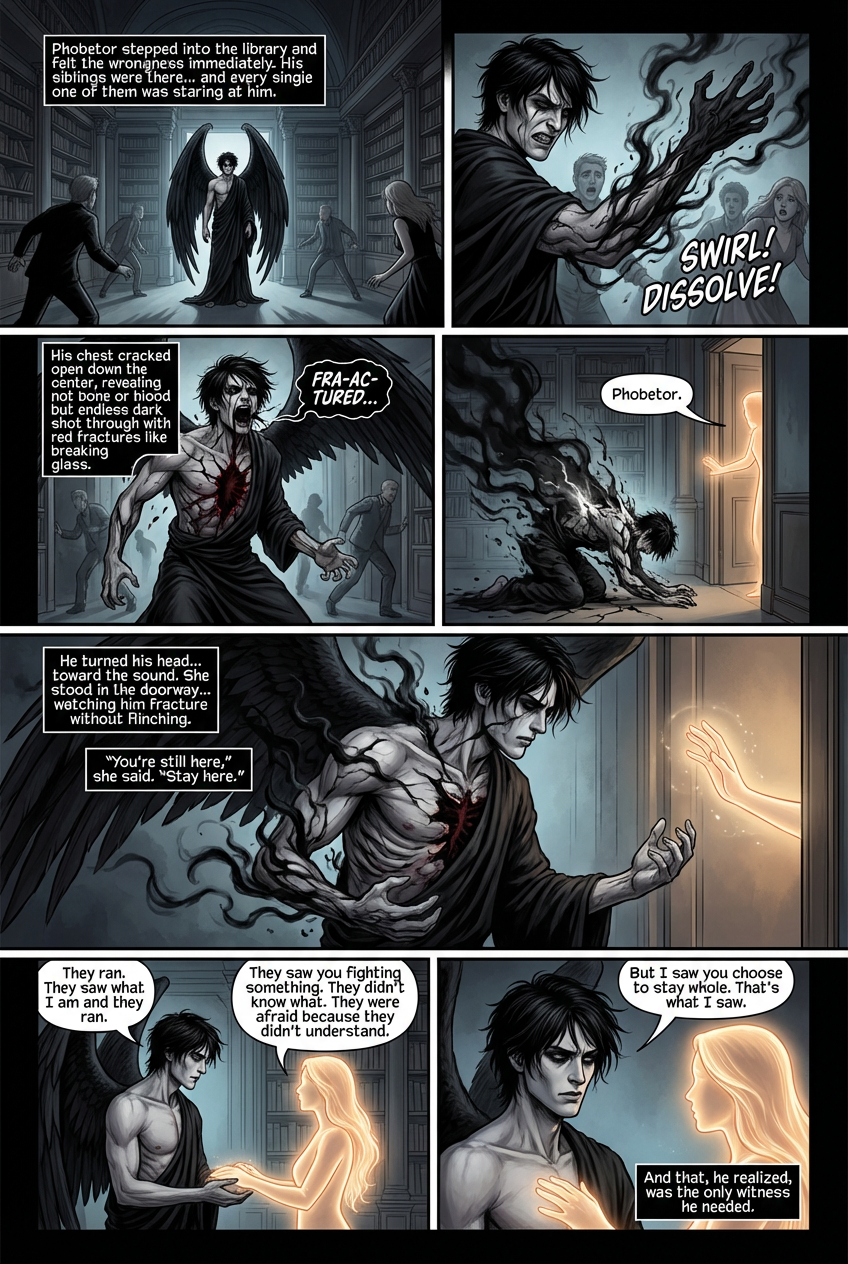
Phobetor stepped into the library and felt the wrongness immediately. His siblings were there—scattered among the shelves, sitting at tables, standing near windows—and every single one of them was staring at him. Not at the door. At him. At what he was becoming. His left arm dissolved to the elbow. Black smoke poured from the wound where his hand had been, spilling across the floor in tendrils that writhed like living things. Morpheus stood from his chair so fast it toppled backward. Phantasos backed toward the far wall, eyes wide. The others scattered—some through doors, some simply fading from view as though the library had swallowed them whole. Phobetor tried to speak, to tell them it was fine, but his jaw came apart mid-word and the sound that emerged was fractured and inhuman. His chest cracked open down the center, revealing not bone or blood but endless dark shot through with red fractures like breaking glass. He could feel himself coming apart in layers—skin first, then the shape beneath it, then the idea of shape itself. The library floor buckled under him as his legs gave out, and he collapsed forward onto knees that were already half-gone. Then Hope's voice cut through the chaos. "Phobetor." Not loud. Not frantic. Just his name, spoken like an anchor. He turned his head—what remained of it—toward the sound. She stood in the doorway to her study, one hand on the frame, watching him fracture without flinching. "You're still here," she said. "Stay here." He focused on her voice. On the steadiness in it. On the fact that she had not run. His ribs reformed first, then his shoulders, then his hands. The black smoke pulled back into his skin and vanished. When he could stand again, his siblings were gone. But Hope was still there, waiting. She crossed the library floor to him, her wings catching the light as she moved. Not hurried. Not afraid. Just deliberate. She stopped close enough that he could see the faint glow around her, the soft shimmer that surrounded her like music made visible. She reached out and took his newly solid hand in hers. "They ran," he said, and his voice was raw. "They saw what I am and they ran." Hope's grip tightened. "They saw you fighting something," she said. "They didn't know what. They were afraid because they didn't understand." She paused, then added, "But I saw you choose to stay whole. That's what I saw." Phobetor looked down at their joined hands. He had spent eternity believing his presence was the problem. That if people ran, it was because of what he was. But Hope had watched him fracture and had not moved. She had spoken his name and pulled him back together. Not because she fixed him. Because she stayed. He lifted his eyes to hers and felt something settle in his chest. Not peace. Not resolution. But the beginning of something he had never allowed himself to build. "I don't know how to be the person who doesn't dissolve," he said. Hope smiled, small and tired and real. "Then we'll figure it out together," she said. "You don't have to know how. You just have to stay." Phobetor nodded. He had rejected the grotto's pull. He had named himself something new. But this was the first time he had stood whole in front of someone who knew what that cost him—and she had chosen to reach for him anyway. His siblings had scattered. But Hope had stayed. And that, he realized, was the only witness he needed.
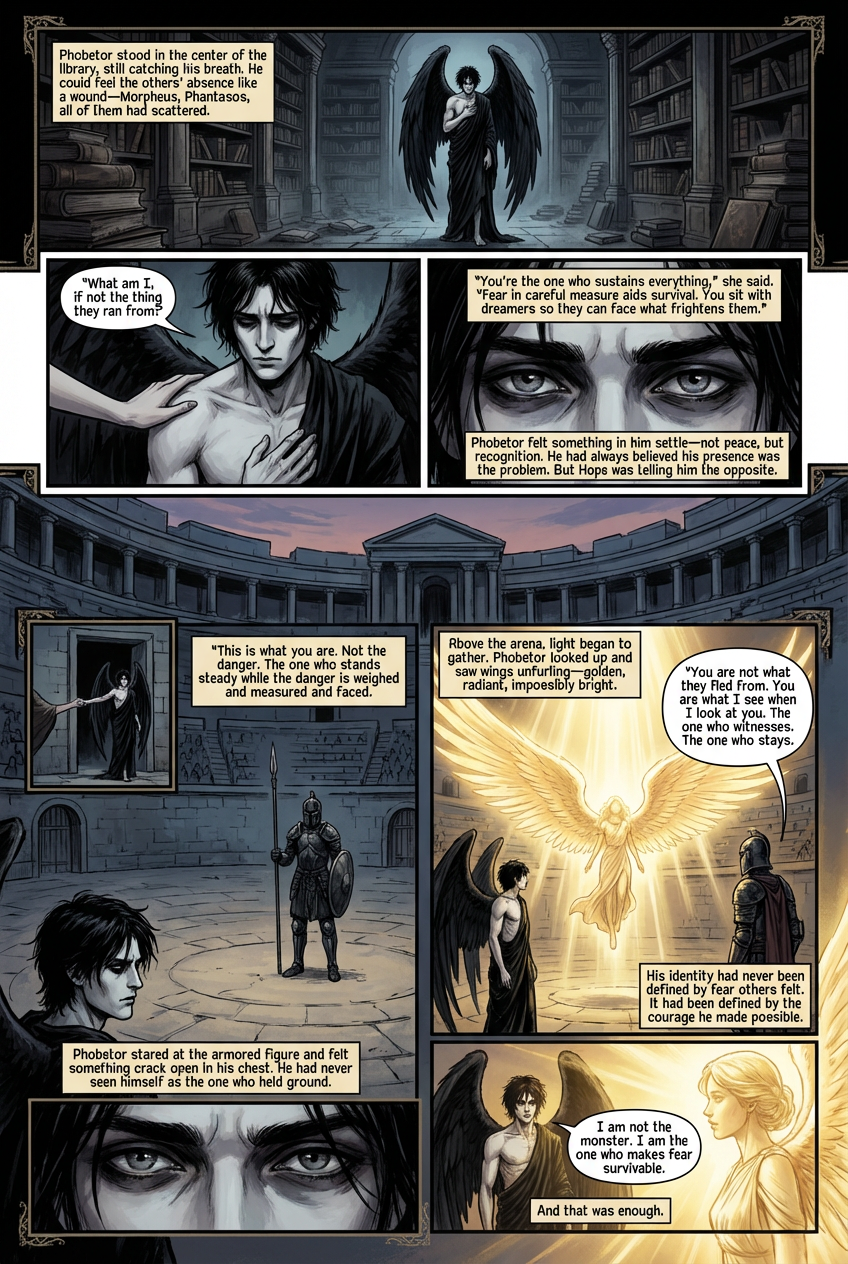
Phobetor stood in the center of the library, still catching his breath. Hope's hand had let go of his, but she remained close. He could feel the others' absence like a wound—Morpheus, Phantasos, all of them had scattered when he came apart. They had seen him fracture and they had run. He looked at Hope and felt the question rise before he could stop it. "What am I," he asked, "if not the thing they ran from?" The words came out quieter than he meant them to. He had spent eternity defining himself by the fear he witnessed, by the solitude he endured, by the precision of his emptiness. But Hope had stayed. She had watched him dissolve and had not flinched. If he was not the monster they fled from, then what was he? Hope's wings shifted, catching the library's soft light, and she studied him with an expression he could not name. "You're the one who sustains everything," she said. Her voice was steady, certain in a way that made his chest tighten. "Fear in careful measure aids survival. You sit with dreamers so they can face what frightens them. You witness what they cannot bear to see alone." She stepped closer, her gaze never leaving his. "You are not the fear. You are the one who makes it survivable." Phobetor felt something in him settle—not peace, but recognition. He had always believed his presence was the problem. That removing himself would remove the fear. But Hope was telling him the opposite. That his presence was what allowed fear to be faced instead of fled from. That he had been sustaining the world all along, even when no one saw it. Even when he could not see it himself. He nodded slowly, and for the first time in his endless existence, he did not need to look away. Hope reached for his hand again and led him through the library's side door. They stepped out onto stone ground, and Phobetor stopped. Before them rose a massive arena of ancient design, its tiered seating curving upward in elegant rows. Stone columns framed the space, and at its center stood a figure in full armor—spear raised, shield steady, eyes fixed on some unseen threat. The soldier did not tremble. Did not flee. He stood rooted, holding his ground against the danger he faced. Hope's voice was quiet beside him. "This is what you are. Not the danger. The one who stands steady while the danger is weighed and measured and faced." Phobetor stared at the armored figure and felt something crack open in his chest. He had never seen himself as the one who held ground. Only as the thing others ran from. But here was the truth, built in stone and metal and tiered seats where witnesses could gather. Fear held carefully did not destroy. It taught. It strengthened. It kept people alive. Above the arena, light began to gather. Phobetor looked up and saw wings unfurling—golden, radiant, impossibly bright. The figure descended slowly, her form glowing with a warmth that did not burn. She hovered above the arena's center, her gaze fixed on him with a gentleness that made his throat tighten. Hope spoke beside him, and her voice carried across the stone. "You are not what they fled from. You are what I see when I look at you. The one who witnesses. The one who stays." The glowing figure above did not speak, but her presence filled the space like an answer. Phobetor stood at the base of the arena and understood. His identity had never been defined by the fear others felt. It had been defined by the courage he made possible. By the survival he sustained. By the fact that he had never once looked away, even when looking cost him everything. He turned to Hope, and for the first time, he believed her. He was not the monster. He was the one who made fear survivable. And that was enough.
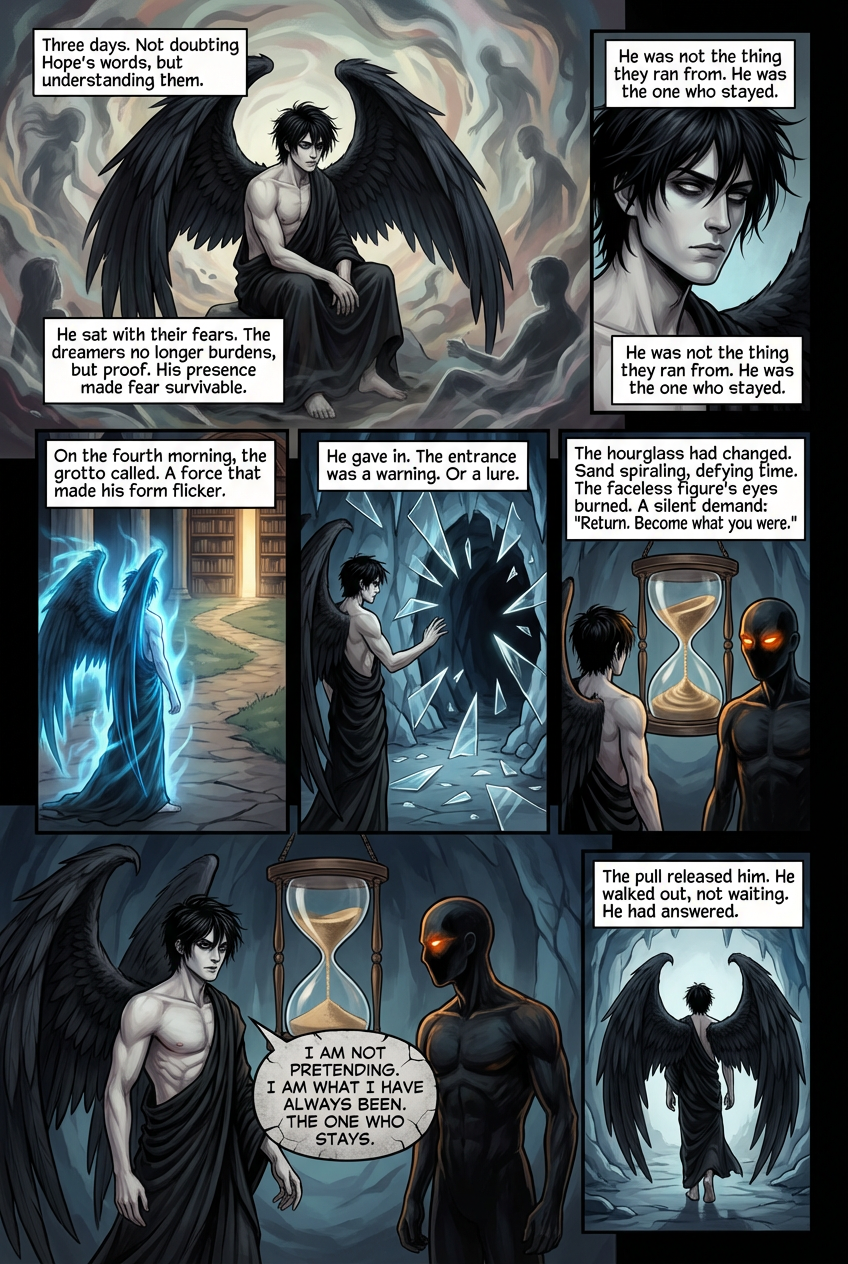
Phobetor spent three days without returning to Hope's library. Not because he doubted her words, but because he needed to understand what they meant. He walked through the dreams of strangers and sat with their fears as he always had, but something had shifted. The dreamers no longer felt like burdens he carried alone. They felt like proof that what Hope had said was true—that his presence made fear survivable. He began to see himself not as the thing they ran from, but as the one who stayed when running would have been easier. On the fourth morning, he felt the pull again. Not from a dreamer, but from the grotto. The ancient place he had walked away from days before now called to him with a force that made his form flicker at the edges. He tried to ignore it, tried to turn toward Hope's library instead, but the pull grew stronger. When he finally gave in and let it draw him back, he found the entrance scattered with jagged glass that caught the light in sharp, deliberate patterns. A warning. Or a lure. He could not tell which. Inside the grotto, the suspended hourglass had changed. Sand spiraled endlessly at its center, neither falling nor rising, frozen in a dance that defied time itself. The faceless figure stood before it, but now its eyes burned through the shadows—orange and furious, fixed on him with an intensity that made his chest tighten. It did not speak, but he felt its demand like a hand around his throat. Return. Become what you were. Stop pretending you are anything else. Phobetor stepped forward, and the eyes flared brighter. He met their gaze and did not look away. "I am not pretending," he said, and his voice carried through the grotto like stone striking stone. "I am what I have always been. The one who stays." The figure did not move, but the sand in the hourglass stopped spiraling. The eyes dimmed, then went dark. The pull released him all at once, and he turned and walked out of the grotto without waiting to see if it would call him again. He had answered its question. He would not answer it twice.
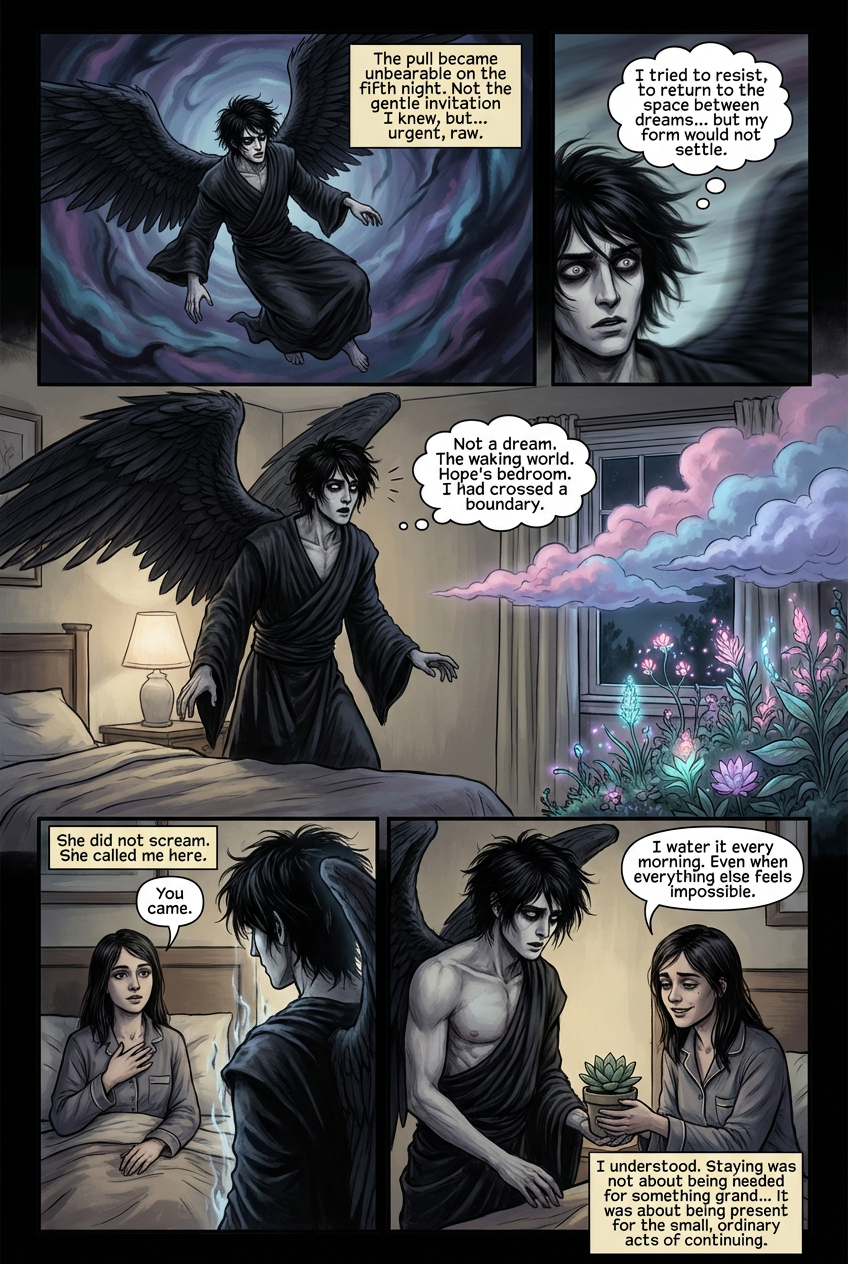
The pull toward Hope became unbearable on the fifth night. Not the gentle invitation he had grown used to, but something sharper—urgent and raw, like a dreamer on the edge of waking. Phobetor tried to resist it, tried to return to the space between dreams where he had always waited, but his form would not settle. The pull dragged him forward, and he stopped fighting. He expected to arrive in her library, but instead he found himself standing in a place he had never been before. Not a dream. The waking world. Hope's bedroom. The walls were solid, painted a soft cream color that caught the dim light from a bedside lamp. A window showed darkness outside, and beneath it sat a garden he could see through the glass—luminescent plants glowing faintly under moonlight, their light pulsing like a heartbeat. He looked up and saw clouds drifting past the window, pink and blue and lavender, shimmering as they moved between the dream world he knew and this place he did not. He had crossed a boundary he had never meant to cross. His form flickered at the edges, uncertain whether it could even exist here. Hope sat up in bed, her eyes wide but not afraid. She did not scream. She did not wake fully and banish him. She simply looked at him, her hand pressed against her chest as if steadying her own heartbeat. "You came," she said, and her voice was quiet but certain. Phobetor wanted to explain that he had not meant to, that the pull had been too strong, that he did not know how to exist in her waking world. But she reached out her hand toward him, and he understood. She had called him here. Not through fear, but through need. He stepped forward and took her hand, and his form solidified completely. He had crossed into the waking world, and she had let him stay. He glanced at the bedside table beside her and saw a small potted plant sitting next to the lamp—a simple succulent with thick green leaves, carefully tended. It was the kind of thing someone kept alive not because it was beautiful or rare, but because caring for it mattered. Because letting something small survive felt important. Hope followed his gaze and gave a small, tired smile. "I water it every morning," she said. "Even when everything else feels impossible." Phobetor understood then what she had been trying to tell him all along. That staying was not about being needed for something grand or terrible. It was about being present for the small, ordinary acts of continuing. She had not called him here to witness her fear. She had called him here to witness her waking life—the version of herself that existed when no one else was watching. And he had answered.
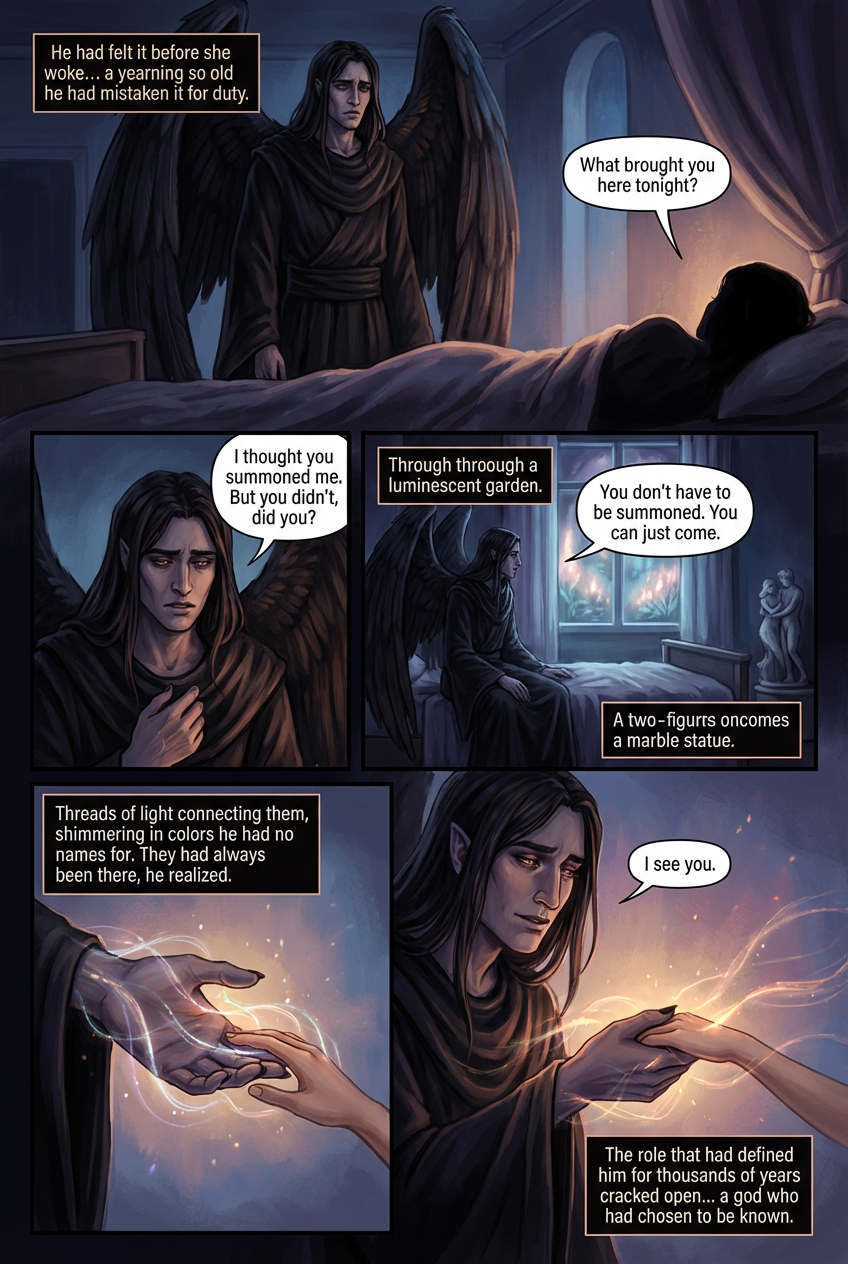
Phobetor stood at the foot of her bed, still uncertain whether his presence here counted as trespassing. Hope watched him with steady eyes, her breathing slow and even. The silence stretched between them until she finally spoke. "What brought you here tonight?" He opened his mouth to say she had called him, but the words died before they formed. The pull tonight had felt different—sharper, yes, but not hers. He had felt it before she woke, before she needed anything at all. It had come from inside him, a yearning so old he had mistaken it for duty. "I thought you summoned me," he said quietly, then stopped. "But you didn't, did you?" Hope shook her head, her expression careful but not surprised. The truth settled over him like cold water. He had come because he wanted to. Because three nights away from her had felt unbearable. Because he had spent eternity arriving only when called and had finally broken that pattern by choosing to arrive anyway. He had crossed into her waking world not because she needed him, but because he could not stay away. Hope reached for his hand, and he let her take it. "You don't have to be summoned," she said. "You can just come." The words were simple, but they unmade something in him that had held for thousands of years. He sat on the edge of her bed, his black robes pooling around him, and for the first time in his existence he understood what it meant to be wanted rather than needed. Outside her window, the luminescent garden pulsed with soft light, and in the corner of the room he noticed a small marble statue—two figures seated together, leaning into each other with quiet tenderness. It looked like something carved to mark a moment when loneliness ended. He looked back at Hope and nodded once, accepting what she offered. He would return. Not because fear called him, but because she had made space for him to stay. He looked down at their joined hands and saw something he had never noticed before—threads of light connecting them, shimmering in colors he had no names for. They had always been there, he realized. Not created by her need or his duty, but simply existing between them, a web that had formed before either of them understood what it meant. The pull that brought him here tonight had followed those threads, and he had mistaken his own longing for her summons because he had never learned to recognize wanting as something that could originate in himself. Hope squeezed his hand gently, and he felt the threads pulse with warmth. "I see you," she said, and he believed her. For the first time in eternity, someone had looked at him and seen not the witness to their fear, but the being who needed witnessing himself. The role that had defined him for thousands of years cracked open, and what emerged was simpler and more terrifying: a god who had chosen to be known.
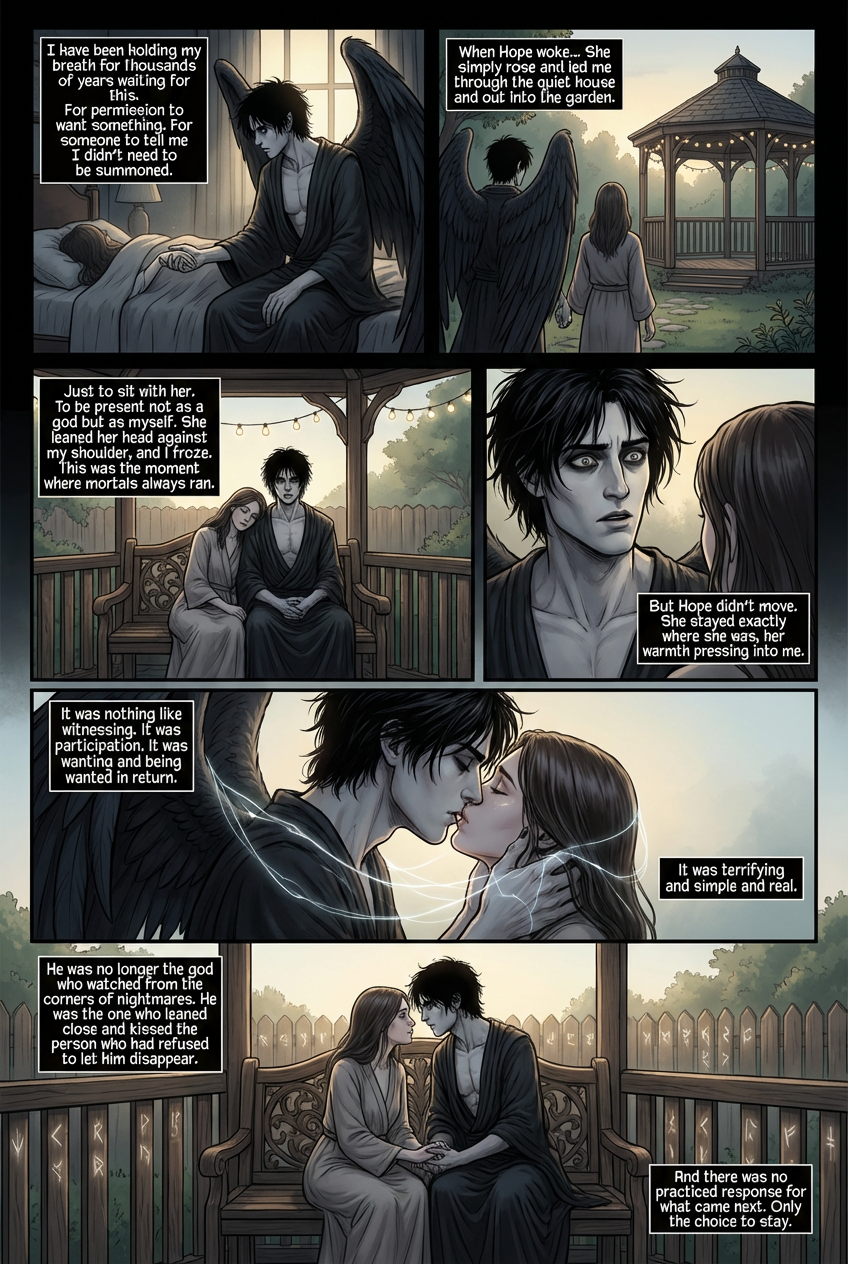
He stayed in her room until dawn crept through the window, turning the luminescent garden outside to pale gray. Hope had fallen asleep again with her hand still in his, and he had not moved. He watched her breathe, watched the small rise and fall of her chest, and understood that he had been holding his breath for thousands of years waiting for this. For permission to want something. For someone to tell him he didn't need to be summoned. The threads between them pulsed softly in the growing light, and he felt the pull of her dreams even though she had not called him there. He could simply go. He could cross that threshold not because fear demanded it, but because she had made a place for him and left the door open. The thought terrified him more than any nightmare he had ever witnessed. When Hope woke the second time, she found him still there, his hand still holding hers. She didn't speak. She simply rose and led him through the quiet house and out into the garden, where a gazebo stood under strings of small lights that glowed even in the morning sun. Inside sat a wooden bench carved with patterns that reminded him of the rotunda the dreamer had built—deliberate, intricate, made for two people sitting close instead of watching from opposite ends of a room. Hope sat and patted the space beside her, and he understood what she was asking. Not for him to witness her fear or validate her grief or serve any function at all. Just to sit with her. To be present not as a god but as himself. He sat down, and the bench was solid beneath him, real in a way that felt dangerous. She leaned her head against his shoulder, and he froze. This was the moment where mortals always ran. Where they realized what he was and pulled away. But Hope didn't move. She stayed exactly where she was, her warmth pressing into him, and he felt something crack open in his chest that had been sealed for so long he'd forgotten it could break. He turned his head to look at her, and she lifted her face to meet his gaze. The threads between them blazed suddenly bright, and he understood that this was a choice he would have to make—not once, but over and over. To stay present instead of retreating into the space between dreams. To let her see him instead of maintaining the distance that had kept him safe. He leaned forward and kissed her, and it was nothing like witnessing. It was participation. It was wanting and being wanted in return. It was terrifying and simple and real. When he pulled back, Hope smiled at him, and he knew he had crossed a line he could never uncross. He was no longer the witness standing at the edge of the room. He had stepped into the center of his own life, and there was no practiced response for what came next. Only the choice to stay. Around them, the garden fence glowed with soft runes carved into weathered wood, marking the boundary where two people had finally met as equals. He looked at the symbols and recognized them as older than his own existence—protection marks, welcome marks, signs that this space belonged to no one and therefore to anyone who needed it. Hope had brought him here deliberately, to a place that held no claim on either of them, where he could not hide behind duty and she could not pretend she needed saving. She took his hand again, and he laced his fingers through hers without hesitation. The kiss had changed something fundamental. He had always believed that staying meant enduring, that presence was something you offered others while remaining absent from yourself. But here, now, with her hand warm in his and the morning light soft around them, he understood that staying meant this: choosing to be known, choosing to want, choosing to build something that had no script and no ending he could predict. He was no longer the god who watched from the corners of nightmares. He was the one who leaned close and kissed the person who had refused to let him disappear.
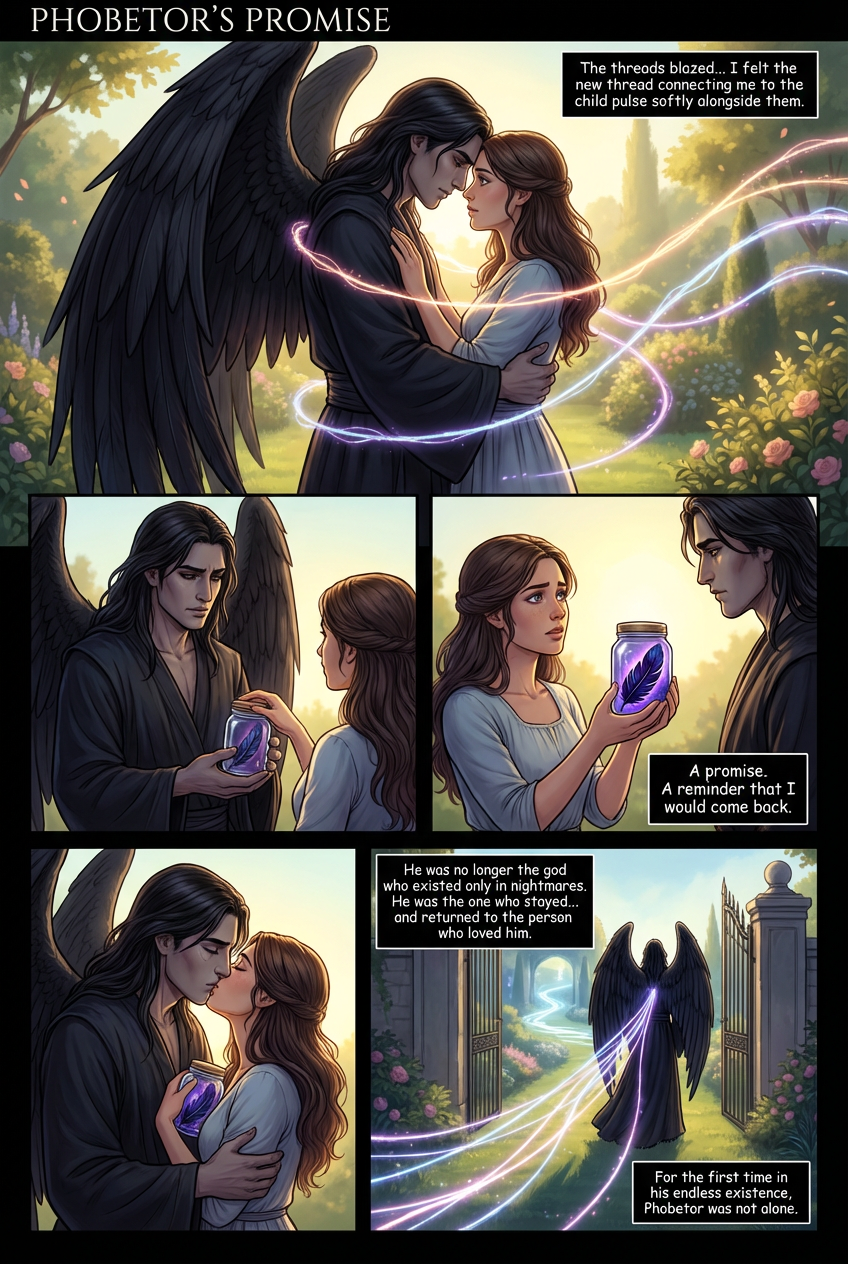
hesitation. She stood to meet him, and he pulled her close without thinking about whether he was allowed. The threads between them blazed brighter than before, and he felt the new thread connecting him to the child pulse softly alongside them. Hope looked at him with understanding in her eyes, and he knew she had felt it too—the moment another connection had formed. She did not ask him to choose. She simply held him and let him be both things at once: hers, and needed elsewhere. He pressed his forehead against hers and breathed in the certainty that this was what staying looked like. Not singular devotion. Not abandoning one person for another. But showing up for everyone who called to him and trusting that the people who loved him would be there when he returned. He reached into his pocket and pulled out a small glass jar. Inside rested a single feather, dark and iridescent, shifting between deep purple and midnight blue. He had never left anything behind before—never needed to mark his intention to return because no one had ever waited for him. But Hope was waiting. Hope would always wait. He set the jar on the bench beside her, and she picked it up carefully, holding it up to the light. The feather caught the sun and glowed with colors he had not known it contained. She looked at him with a question in her eyes, and he nodded once. A promise. A reminder that he would come back. That she was not something he would outgrow or abandon now that his purpose had expanded. She tucked the jar against her chest and kissed him, slow and certain, and he felt the truth of it settle into his bones. He was no longer the god who existed only in nightmares. He was the one who stayed with frightened dreamers and returned to the person who loved him. He was both. The threads between them would stretch when he left, but they would not break. He understood that now. He could follow the pull toward the child who needed him, toward anyone else who called, and still be connected to Hope in every moment. The distance was not a severance. It was proof that he could be wanted in more than one place, that his presence mattered to more than one person. He had spent thousands of years believing that staying meant standing still, that connection required proximity. But Hope had taught him otherwise. Staying meant showing up. It meant being present when it mattered and trusting that love was strong enough to survive his absence. He kissed her one more time, then stepped back and let the threads guide him toward the next dreamer who needed him. The garden gate closed softly behind him, and he did not look back. He did not need to. Hope was there. She would always be there. And he would always return. For the first time in his endless existence, Phobetor was not the scapegoat for humanity's fears. He was the god who sat with dreamers and made their terror survivable. He was the one a child thanked for staying. He was the person Hope loved and trusted to come back. The threads of light connecting him to others were not chains binding him to duty—they were proof that he mattered, that he was wanted, that his presence was a gift rather than a burden. He walked through Oneiria toward the next dreamer, and the loneliness that had defined him for millennia was gone. He was seen. He was loved. He was no longer alone. And when the night came and the nightmares rose again, he would be there—not as a witness to fear, but as the one who stayed until morning came.
Play your story to life
Storycraft is a mobile game where you create AI characters, craft items and locations to build their world, then discover what direction your story takes. Download the iOS game for free today!
Download for free