

Prince Kaelmar Thornshade's Arc
5 Chapters
Prince Kaelmar Thornshade's dream is creating a legendary sword that proves his worth beyond his birthright.

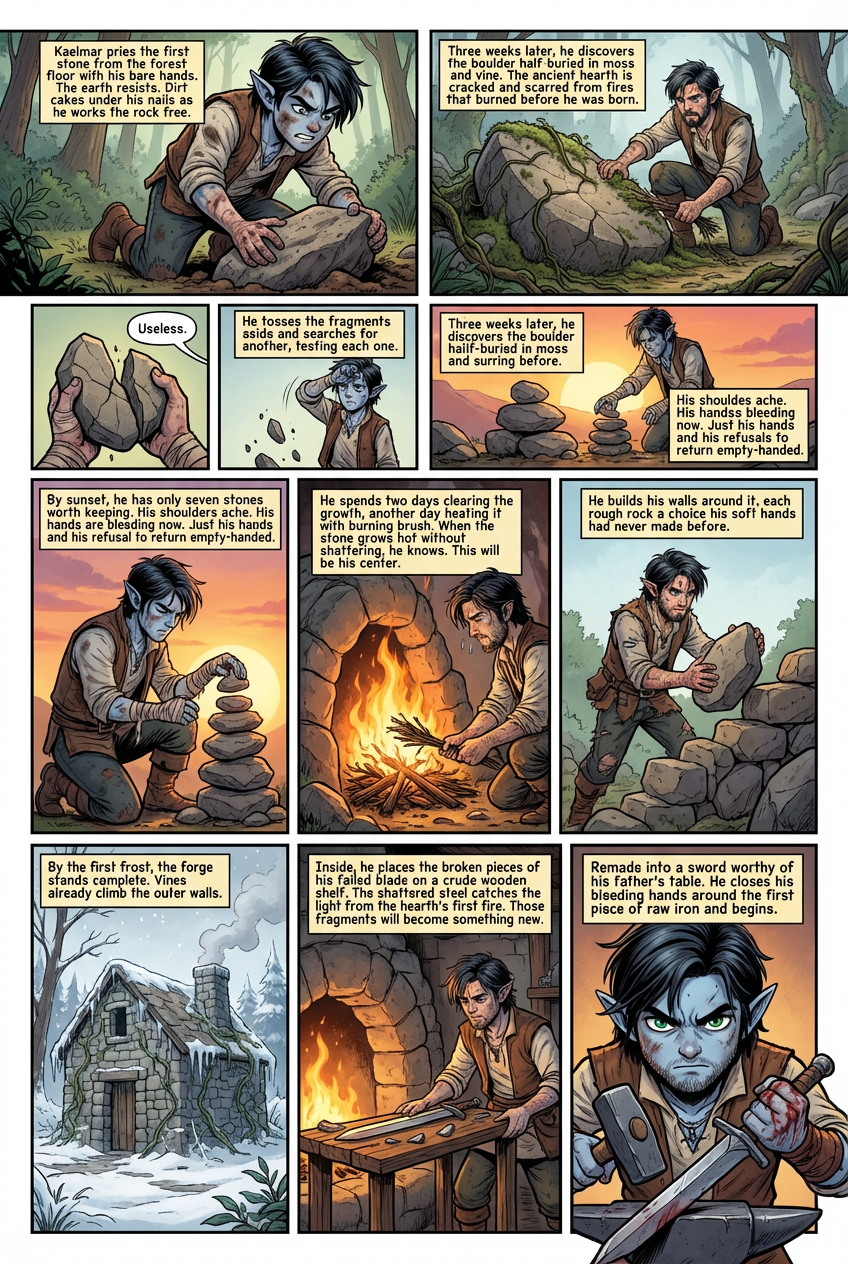
Kaelmar pries the first stone from the forest floor with his bare hands. The earth resists. Dirt cakes under his nails as he works the rock free, feeling its weight settle into his palms. This will be the foundation of his forge, built stone by stone until he can craft the blade that will speak for him when words failed. But the second stone splits when he tries to free it. Useless. He tosses the fragments aside and searches for another, testing each one before he digs. By sunset, he has only seven stones worth keeping. His shoulders ache. His hands are bleeding now. He stacks the seven stones carefully, checking that each sits level before adding the next. The pile barely reaches his knee. Tomorrow he will find more. The forge will take weeks, maybe months, but every stone he places is one he chose himself. No servants. No royal masons. Just his hands and his refusal to return empty-handed. Three weeks later, he discovers the boulder half-buried in moss and vine. The ancient hearth is cracked and scarred from fires that burned before he was born. He spends two days clearing the growth, another day heating it with burning brush to test if it will hold flame. When the stone grows hot without shattering, he knows. This will be his center. Not polished marble like the palace halls. Not gold-trimmed and perfect. Just old stone that has already survived its breaking. He builds his walls around it, each rough rock a choice his soft hands had never made before. By the first frost, the forge stands complete. Vines already climb the outer walls, claiming the structure as part of the forest. Inside, he places the broken pieces of his failed blade on a crude wooden shelf. The shattered steel catches the light from the hearth's first fire. Those fragments will become something new. Not hidden. Not thrown away. Remade into a sword worthy of his father's table. He closes his bleeding hands around the first piece of raw iron and begins.
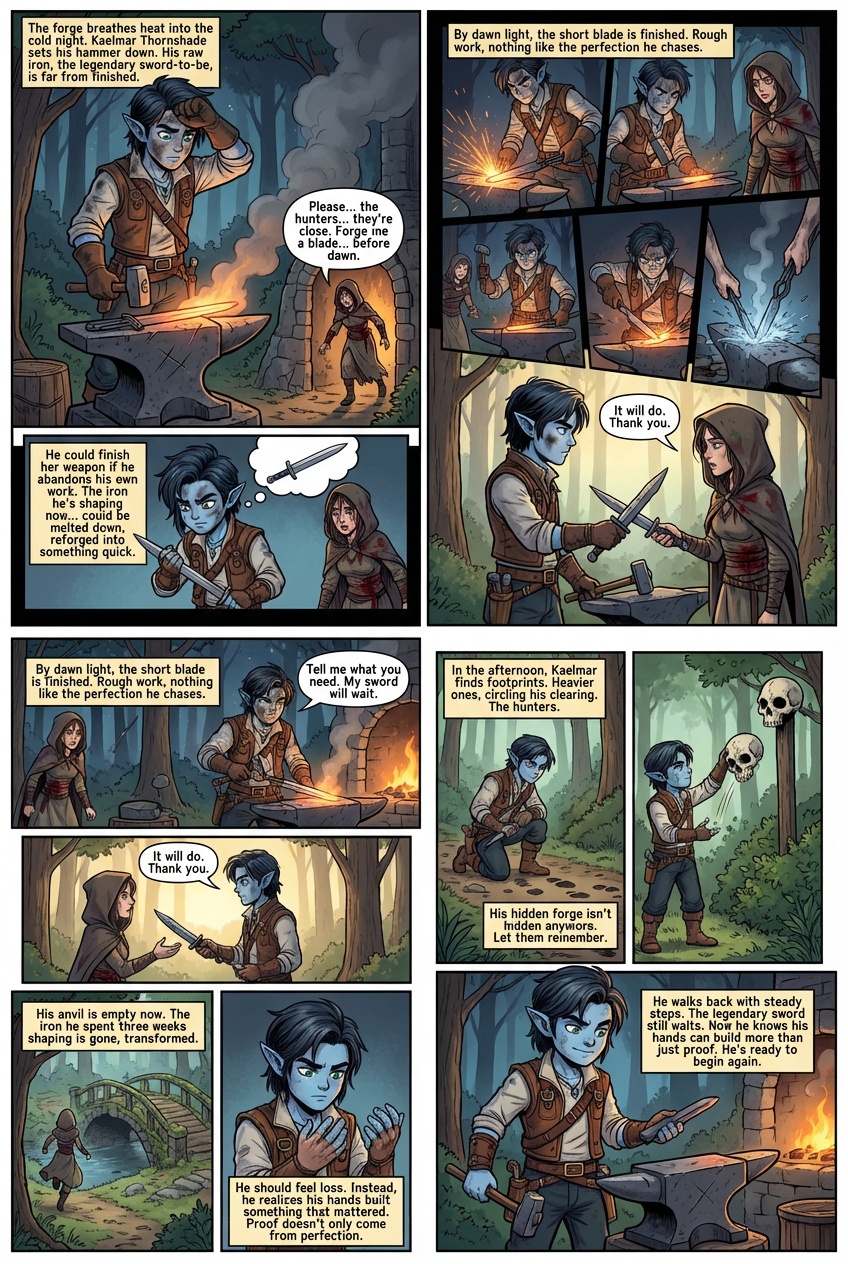
The forge breathes heat into the cold night. Kaelmar sets his hammer down and wipes soot from his hands. The raw iron on his anvil has begun to take shape, but it's nowhere near finished. He's learned that iron requires patience. Each strike must count. Each heating must be exact. But smoke from his forge has given him away. A figure stumbles through the trees, bleeding from a wound across her ribs. She falls against the doorframe and begs him to forge her a blade before the hunters tracking her arrive at dawn. Kaelmar looks at the woman, then at his half-formed iron still cooling on the old hammer stone he dragged from the riverbed weeks ago. The stone's flat surface is scarred from his learning, from all his failed attempts. He could finish her weapon in time if he abandons his own work. The iron he's shaping now could be melted down, reforged into something quick and crude that might save her life. Or he could refuse and protect the progress he's made toward the sword that matters. He picks up his hammer. The woman's blood drips onto his floor. He walks to the forge, lifts his unfinished blade with tongs, and thrusts it back into the coals. When he turns to face her, his decision is made. "Tell me what you need." The legendary sword will have to wait. Tonight, his hands will build something that serves someone other than his own proof. By the time dawn light filters through the trees, the short blade is finished. It's rough work, nothing like the perfection he chases. The edge holds true and the balance sits right in the woman's grip. She tests the weight, nods once, and runs for the old moss-covered bridge that spans the brook to the east. Kaelmar watches her disappear into the forest. His anvil is empty now. The iron he spent three weeks shaping is gone, transformed into a weapon that will never sit on his father's table. He should feel the loss like a wound. Instead, he stares at his bleeding hands and realizes they built something that mattered to someone who wasn't him. The legendary sword is no closer to finished. But when he picks up fresh iron and returns to the forge, his grip on the hammer feels different. Proof doesn't only come from perfection. Sometimes it comes from choosing what to break. In the afternoon, Kaelmar finds the trail. Footprints pressed deep into moss lead toward his forge, then veer away where the woman ran. But there are other prints too, heavier ones, circling his clearing before retreating. A wooden post stands at the forest edge, a skull fixed to its top like a warning. The hunters came close enough to see his smoke. Close enough to mark the place. They'll remember where he works now. His hidden forge isn't hidden anymore. He pulls the skull down and tosses it into the underbrush. Let them remember. He's spent months building in secret, afraid his work would be discovered before it was worthy. But the woman's blade was worthy enough to save a life, even if it wasn't perfect. He walks back to his forge with steady steps. The legendary sword still waits for him. The difference is that now he knows his hands can build more than just proof.
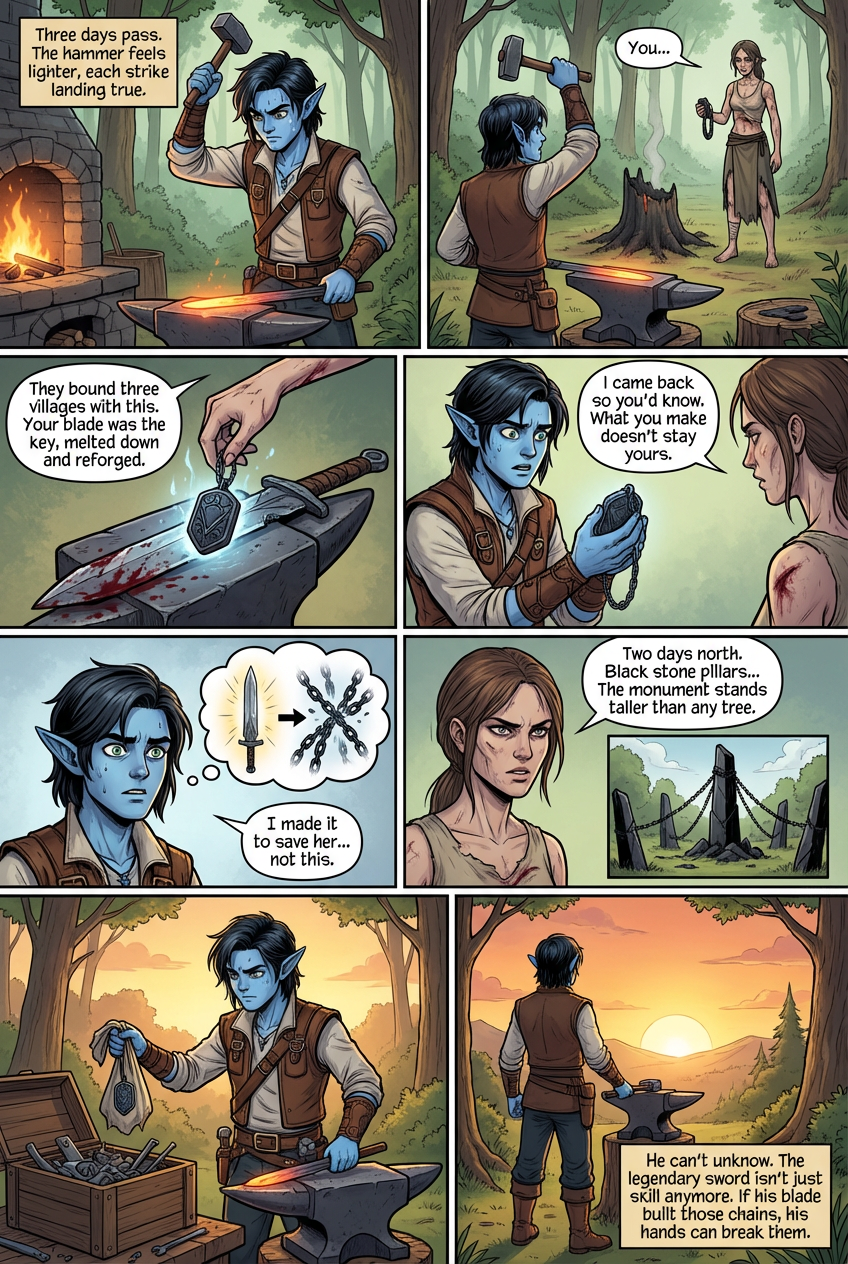
Three days pass before Kaelmar hears footsteps on the trail again. He's at the anvil, shaping a new blade from iron he smelted that morning. The hammer feels lighter in his grip now, each strike landing where he means it to. When he looks up, the woman stands at the edge of his clearing. She's thinner than before, her wound barely healed. But it's what she carries that stops him mid-strike. A dark iron amulet hangs from her fist, its surface etched with symbols that make his chest tighten. She walks past the charred stump where he burns his scrap wood and drops the amulet on his anvil. The blade he forged for her lies beside it, the edge chipped and stained. "They bound three villages with this," she says. "Your blade was the key. They melted it down and reforged it into chains." Kaelmar picks up the amulet. The weight of it feels wrong, ancient and cold. His blade wasn't supposed to become this. He made it to save her, not to bind anyone. The woman watches him, her eyes hard. "I came back so you'd know. What you make doesn't stay yours." Kaelmar sets the amulet down and asks where. The woman describes a clearing two days north, where black stone pillars rise like broken teeth. The monument stands taller than any tree, carved with warnings in the old tongue. His blade became part of the binding mechanism, she explains, melted and reforged into the locks that seal the villages in. The chains run from the monument to posts driven into the ground around each settlement. No one can leave without permission from whoever controls the amulet. He built a tool for freedom that became a prison. The realization hits like a hammer to his own chest. He wraps the amulet in cloth and places it in the wooden box where he keeps his failed projects. Then he walks to his forge and pulls out the iron he's been working. He planned to shape it into another attempt at his legendary sword, but his hands won't move. Every strike would carry the question now: what will this become when it leaves me? The woman is gone when he turns around. Kaelmar stares at the cold iron until the sun sets. He can't unknow what his work became. The legendary sword he wants to place on his father's table isn't just proof of skill anymore. It's a weapon that will outlive his intention. He sets the iron aside and walks to the monument's location in his mind, already planning. If his blade built those chains, his hands can break them.
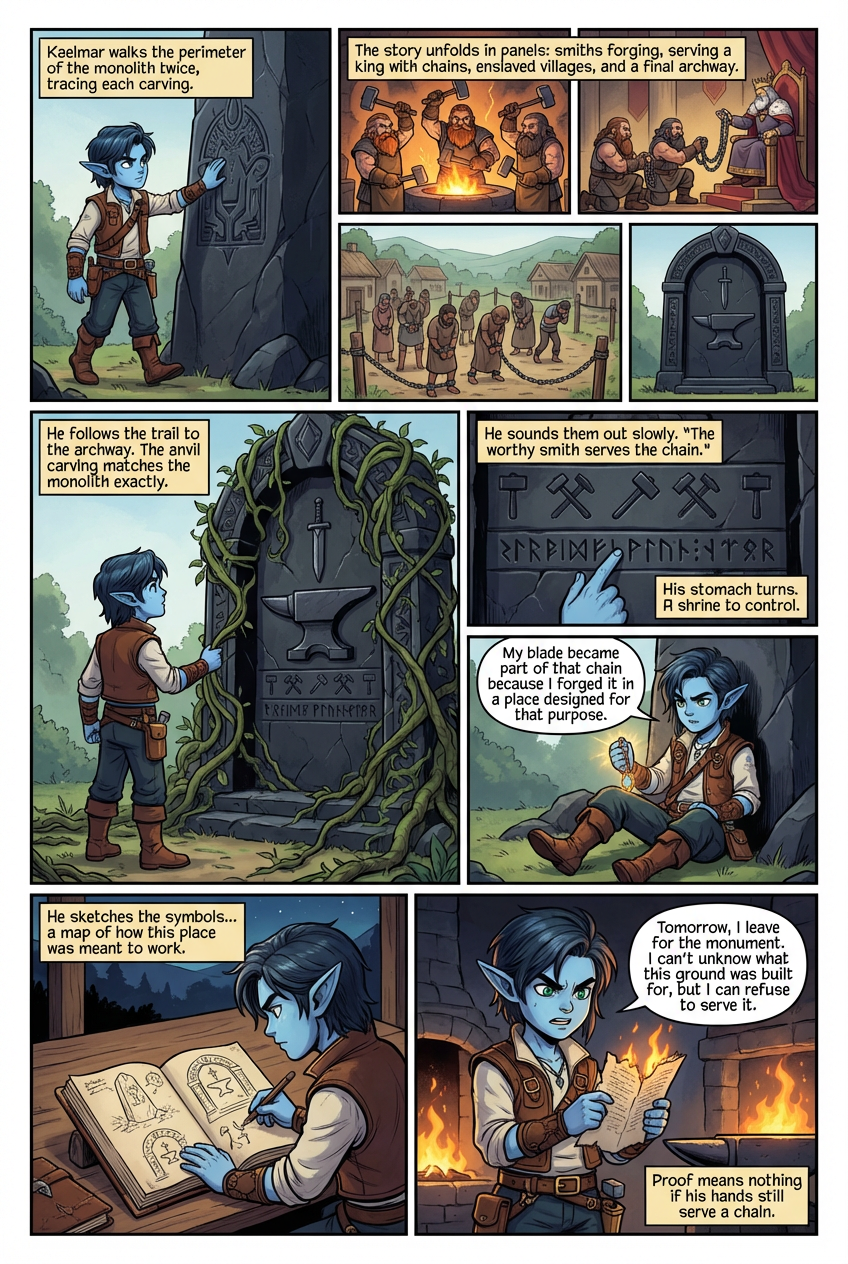
Kaelmar walks the perimeter of the monolith twice, tracing each carving with his fingers. The story unfolds in panels. First panel: smiths gather around a forge, their hammers raised. Second panel: the same smiths kneel before a figure wearing a crown, offering chains. Third panel: villages surrounded by posts, people bent under the weight of shackles. The final panel shows an archway — obsidian, like the monument to the north — with an anvil carved at its center. He's seen that archway. It stands a quarter mile from his forge, half-collapsed and swallowed by vines. He thought it was just old stonework, a ruin left by people who came before. He follows the trail to the archway and clears the vines away. The obsidian is smooth under his hands, cold even in daylight. The anvil carving matches the one on the monolith exactly. Along the archway's base, more symbols: the hammer and blade mark repeated in a pattern that runs the full width. Beneath it, words in the old tongue. He sounds them out slowly. "The worthy smith serves the chain." His stomach turns. This isn't a monument to craft. It's a shrine to control. Someone built this archway where his forge now stands, marking this place as sacred to the work of binding. He didn't choose this clearing by accident. He built his forge on ground already consecrated to the very power he ran from. Kaelmar sits with his back against the archway and unwraps the amulet. The symbols etched into its surface match the carvings on both stones — monument and monolith, linked across time. His blade became part of that chain because he forged it in a place designed for that purpose. The legendary sword he wants to make won't prove anything except that he's following a path someone else laid down centuries ago. He wraps the amulet again and stands. He can't forge the proof he wanted here, not in a place built to turn craft into chains. But he can break what was made. The monument to the north isn't just stone and metal. It's a test. If he can destroy the chains his blade became, he'll know his hands can unmake what they shouldn't have built. The legendary sword will wait. First, he needs to prove his work can choose freedom. Back at the forge, he pulls out a leather journal from his supplies and sketches the symbols from both stones. Each mark gets its own page. He draws the archway's anvil, the monolith's panels, the patterns that connect them. When he finishes, he has a map of how this place was meant to work. The forge location was chosen by someone who understood how to bind. His hands have been working in their shadow. He tears out the final page and holds it over the forge fire until it catches. The sketch curls and blackens. He can't unknow what this ground was built for, but he can refuse to serve it. Tomorrow he leaves for the monument. Tonight he documents what he found so he'll remember why the legendary sword must wait. Proof means nothing if his hands still serve a chain.
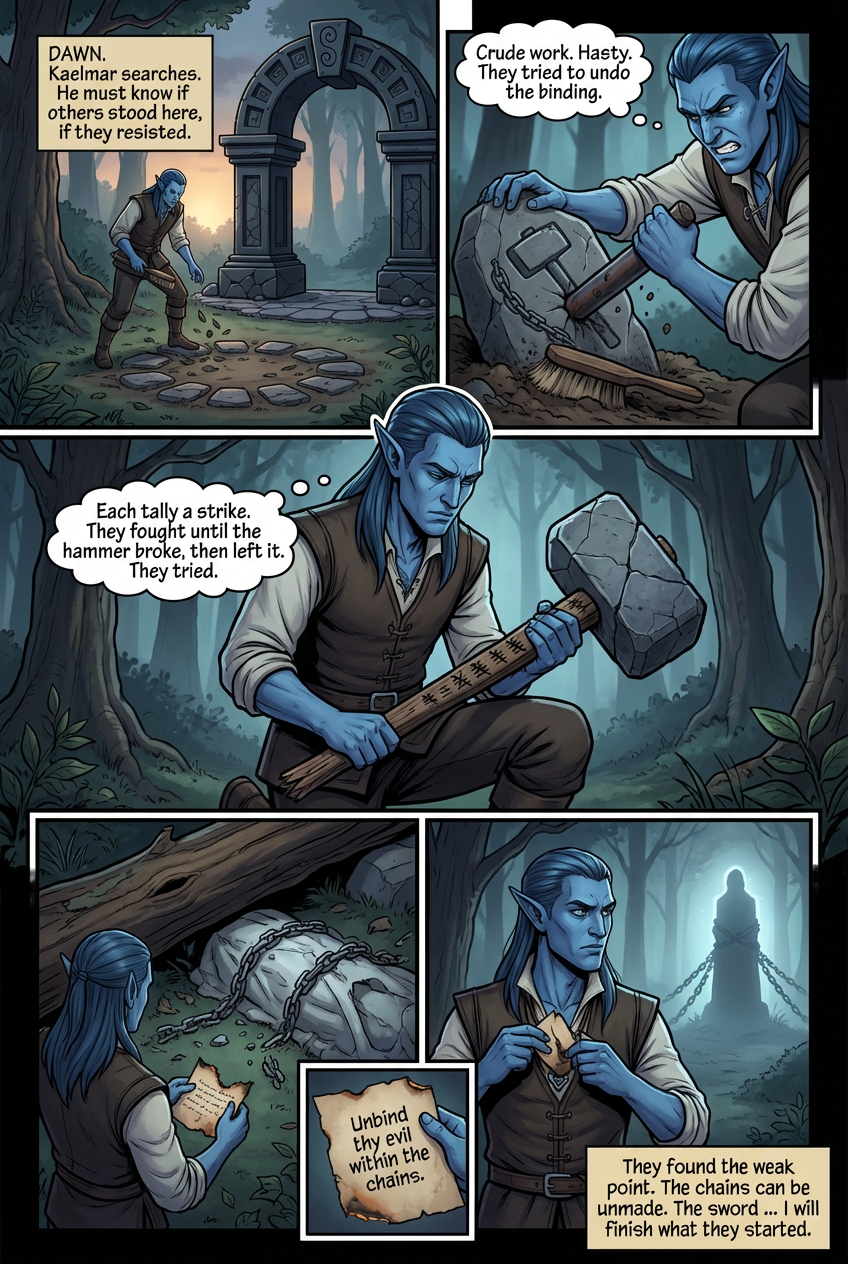
Kaelmar sets out at dawn, moving through the forest back toward the archway. He needs to know if other smiths stood where he stands now. If they fought the binding magic, they might have left something behind — a mark, a tool, a warning. The obsidian surface told him what this place was built for. The ground around it might tell him who refused. He finds it thirty paces west of the archway, hidden under decades of leaf rot. A circle of stones set flat in the earth, each one carved with runes worn almost smooth by time. Metal posts driven deep through the center of each stone, anchoring them in place. He brushes the dirt away and traces the marks. They're crude compared to the archway's perfect script — hasty work, done without ceremony. One stone shows a hammer striking a chain. Another shows the chain breaking. A third shows only the hammer, raised high. Someone stood here and tried to undo what the archway demanded. They failed. The posts drove through their stones like nails through a coffin lid, sealing their work into the ground. Kaelmar pulls at one post but it doesn't move. He wraps both hands around it and leans his full weight against the metal. Nothing. The binding magic didn't just defeat these smiths. It buried their resistance so deep that even their protest became part of the foundation. He keeps searching and finds the hammer twenty paces beyond the circle, half-buried in leaf litter. The stone head is heavy in his hands, cracked through the middle but still whole. The wooden shaft has splintered where someone gripped it too hard or swung it too many times. He turns it over and sees marks along the handle — tally marks, dozens of them, carved into the wood. Each strike counted. Each attempt recorded. Whoever held this hammer didn't give up quickly. They fought until the wood split and their hands gave out, and then they left it behind. Kaelmar sets the hammer down exactly where he found it. These smiths tried to break the binding magic and failed, but they tried. That matters. He can't forge his legendary sword here, not on ground that swallows resistance and turns it into foundation stones. But he knows now that others saw what this place was and refused to serve it. Their failure doesn't make his father's table any closer, but it makes leaving possible. He has to find new ground. Then he sees the chains under a fallen log, draped across something pale. He pulls them free and finds a letter beneath, edges blackened by fire. The chains are broken — not worn through or rusted, but deliberately shattered. Someone broke these by force. The letter is barely readable, most of the words eaten by flame. Only the center remains: "Unbind thy evil within the chains." Kaelmar reads it twice. The smiths who built the stone circle didn't just try to break the binding magic from outside. They tried to turn it against itself, to corrupt the chains from within. That's why the posts drove through their stones. The binding magic recognized the threat and crushed it. He folds the letter and tucks it inside his shirt next to the amulet. These smiths found the weak point. They just didn't have enough strength to exploit it. But they showed him where to strike. The legendary sword can wait. The monument to the north holds chains forged from his blade, and now he knows those chains might carry their own undoing. He doesn't need new ground. He needs to finish what these smiths started.
Play your story to life
Storycraft is a mobile game where you create AI characters, craft items and locations to build their world, then discover what direction your story takes. Download the iOS game for free today!
Download for free