

Purple Pop's Arc
16 Chapters
Purple Pop's dream is opening the most beloved candy parlor in Purely Purple where every visitor leaves with a smile.

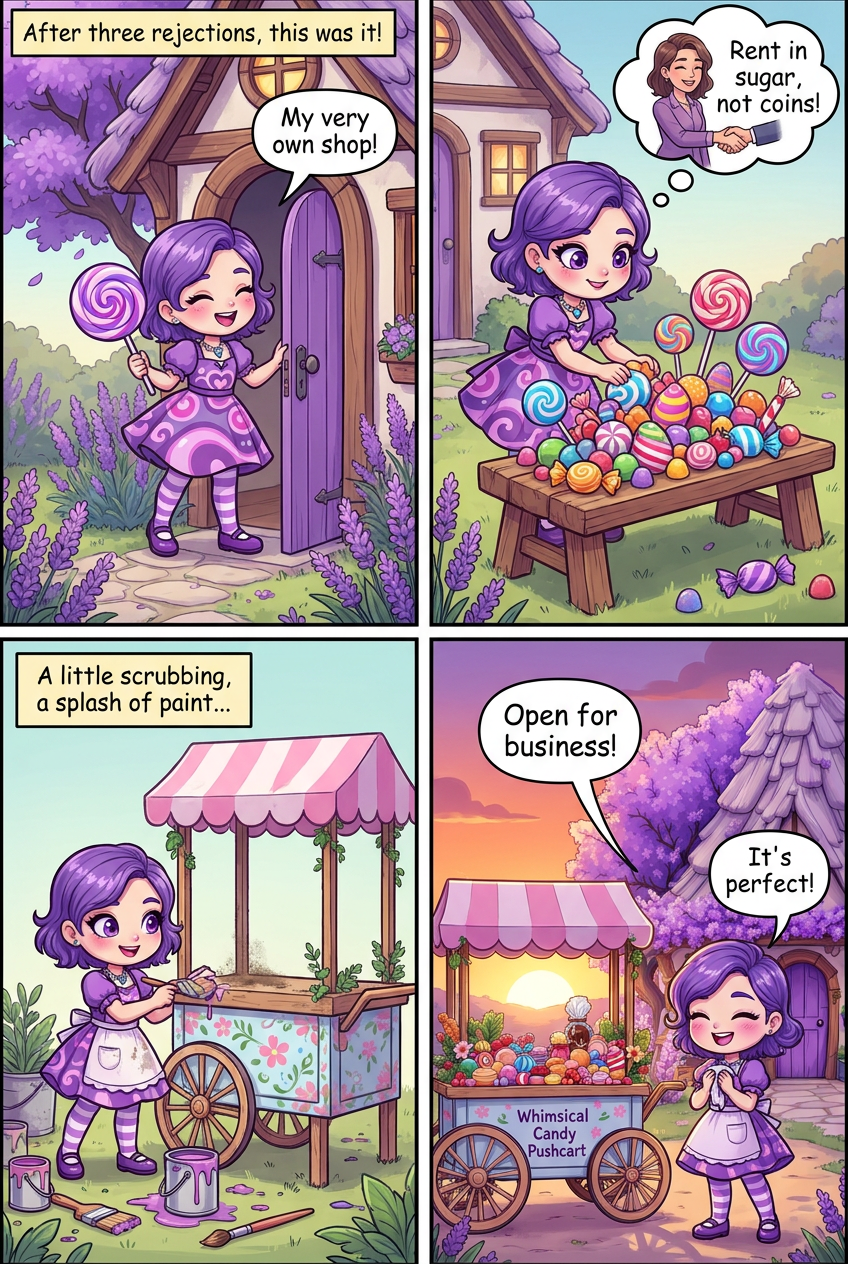
Purple Pop pushed open the little purple door and stepped inside her new cottage. After three banks slammed their doors, this small lavender house felt like a victory. She gripped her purple lollipop tight and grinned. Her dream of the most beloved candy parlor in town had a roof at last. She spread her handmade sweets across a wooden bench outside. Swirled lollipops, glossy gumdrops, and bright wrapped candies tumbled together in a colorful heap. The cottage owner had tasted one bite and shaken her hand on the spot. Rent would be paid in sugar, not coins. In the corner of the yard sat a dusty old pushcart. Purple Pop scrubbed it clean, painted soft flowers along its sides, and stretched a pink striped canopy above. She filled it with jars of candy and tucked greenery around the edges. By sunset, the pushcart stood ready. Purple Pop stepped back, wiped her hands, and smiled. Her mobile candy shop was open for business.
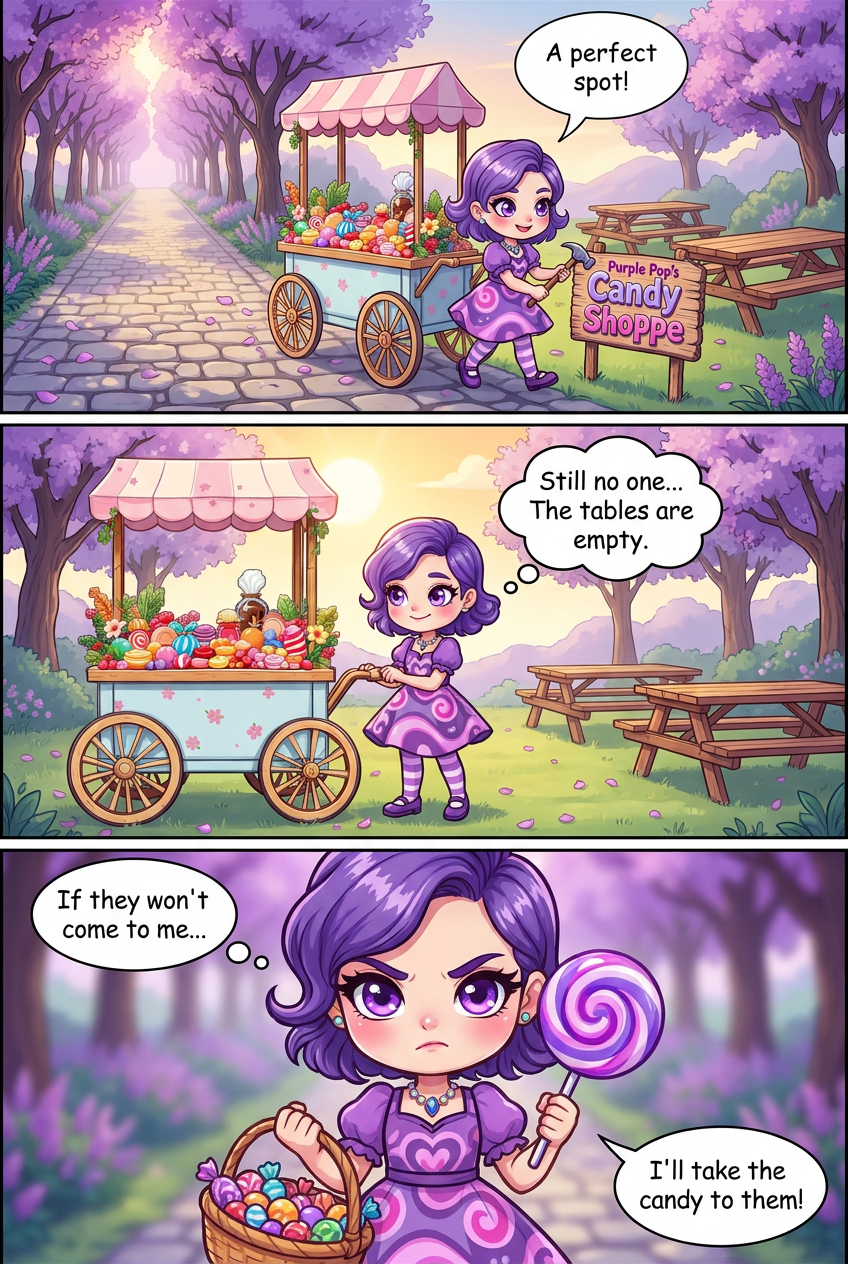
At dawn, Purple Pop rolled her cart down a quiet cobblestone path lined with lilac trees. Petals drifted around her wheels. She picked a sunny spot beside a cluster of picnic tables, perfect for resting visitors. She set the brake and waited. She hammered a bright wooden sign into the soft grass. Bold pink letters announced her candy shoppe to anyone passing by. She polished the jars, fluffed the canopy, and stood tall behind the cart. Hours crawled past. The picnic tables stayed empty. Not one stranger wandered down the path. Purple Pop's smile thinned as the sun climbed higher. She gripped her lollipop and squared her shoulders. If customers would not come to her, she would carry the candy to them. She loaded a basket with sweets and locked her eyes on the road back to town.
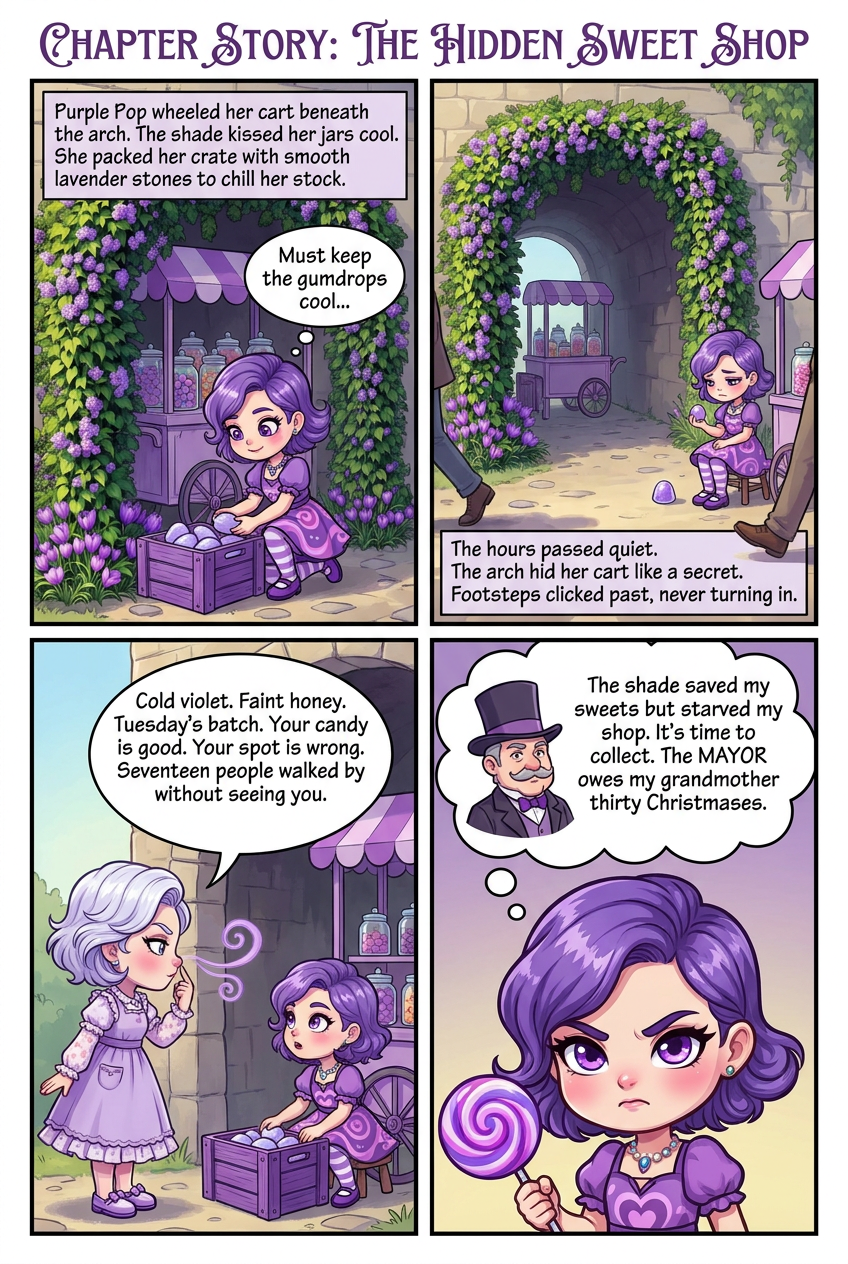
Purple Pop wheeled her cart beneath an ivy-covered stone arch, where purple crocuses bloomed at its feet. The shade kissed her jars cool. She tucked a weathered purple crate beside the wheel and packed it with smooth lavender stones to chill her stock. Her candies were safe at last. But the hours passed quiet again. The arch hid her cart like a secret. Footsteps clicked past on the path beyond, never turning in. Purple Pop watched her gumdrops glisten, perfect and unsold. A small figure paused at the edge of the shade. Pale hair, lavender dress, sharp eyes. Violet stepped closer and sniffed the air. "Cold violet. Faint honey. Tuesday's batch," she said. "Your candy is good. Your spot is wrong. Seventeen people walked by without seeing you." Purple Pop's jaw set. She gripped her lollipop tight. The shade saved her sweets but starved her shop. She would not choose between melted candy and missing customers. She would bring the customers to the shade — and she knew exactly whose name could pull a crowd. The mayor owed her grandmother thirty Christmases. It was time to collect.
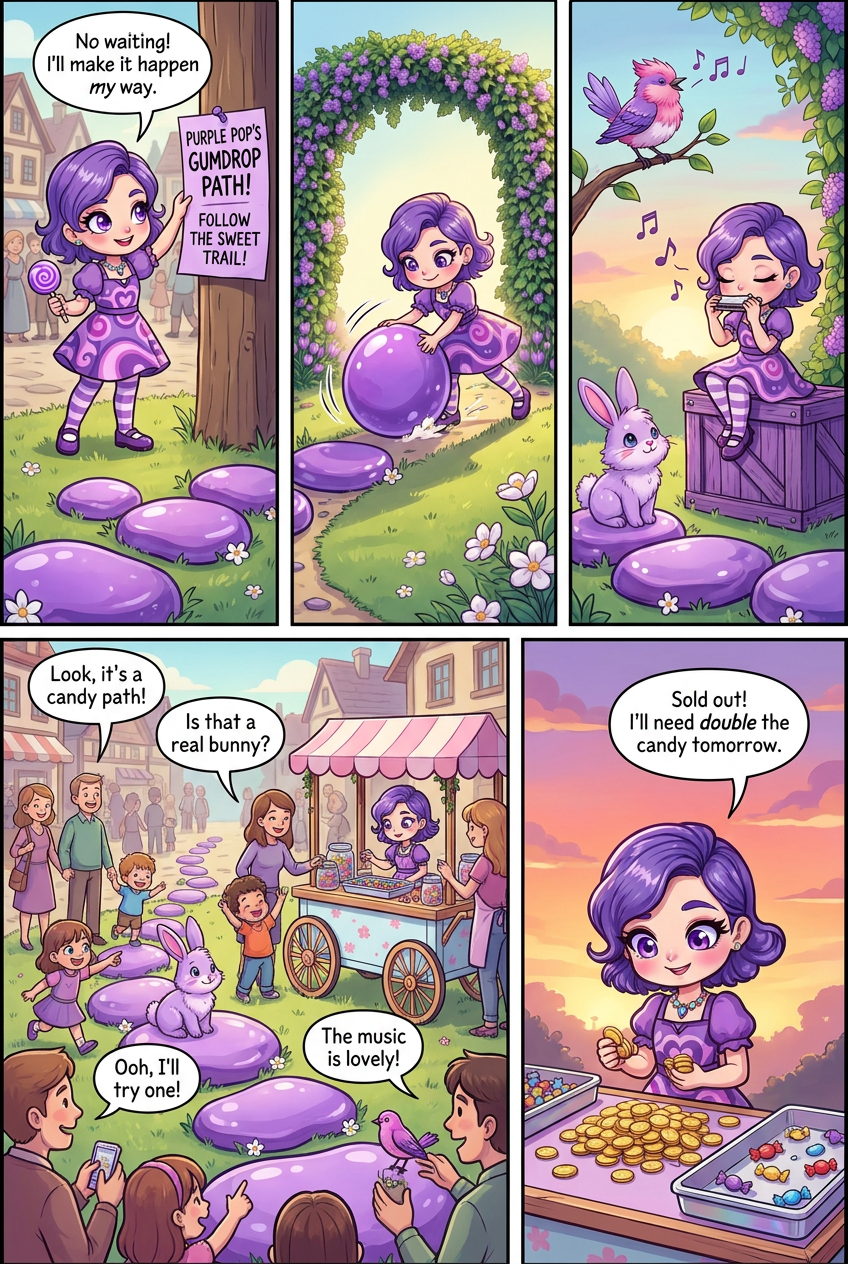
Purple Pop did not wait for the mayor's name to do her work. She did it herself. She tore a strip of purple paper, wrote bold letters, and pinned a flyer in the town square. Then she ran back to the arch and got to work on the path. She rolled fat gumdrop stones from the shade out to the main road, one by one, until a glossy purple trail curved through the grass like a ribbon. White blossoms peeked between them. The trail pointed straight to her cart. She sat on her crate and lifted a small harmonica to her lips. A soft tune drifted out. A bright pink-and-purple songbird landed on the arch and sang along. A fluffy lavender bunny hopped onto a stone and stayed. People in the square turned their heads. Feet followed the stones. Children pointed at the bunny. Grown-ups smiled at the bird. Purple Pop offered free samples on a small tray, and hands reached for jars. Coins clinked into her apron all afternoon. By sunset, her cart held only a scatter of bright wrappers on an empty tray. Purple Pop counted her coins twice. She had sold out. Tomorrow she would need more candy than she had ever made.
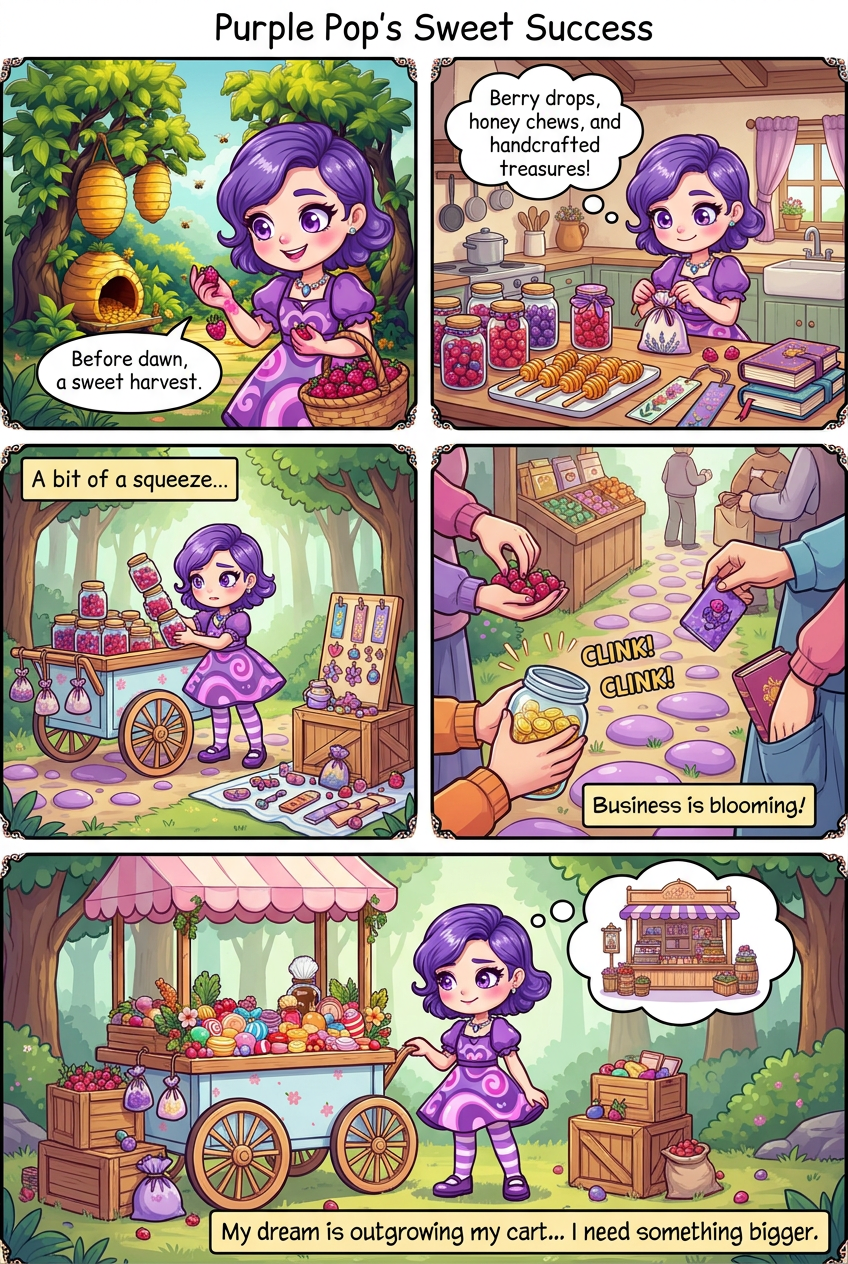
Before dawn, Purple Pop walked into the woods with empty baskets. She picked plump red berries from a sunlit clearing until her fingers were stained pink. Then she crept to a grove where round hives hung from leafy branches, and she gathered slow golden honey while the bees hummed around her. Back at the cottage, she stirred and rolled and wrapped until the table was full. Berry drops glittered in jars. Honey chews sat in neat rows. She tied ribbons on small sachets, journals, and bookmarks she had crafted from pressed flowers and scraps. At the cart, she stacked the new goods high. Jars climbed the sides. Sachets dangled from the handles. The little craft display perched on a crate beside the wheels, spilling bookmarks and tiny journals onto a cloth on the grass. Customers came back along the gumdrop path. They bought berry drops by the handful. They sniffed sachets and tucked journals into their pockets. The coin jar filled fast, then fuller, until it clinked to the brim. Purple Pop smiled, then frowned. Her cart was buried under its own bounty. Goods spilled onto crates, onto cloths, onto the ground. The cart was too small now. She would need somewhere bigger to hold her dream.
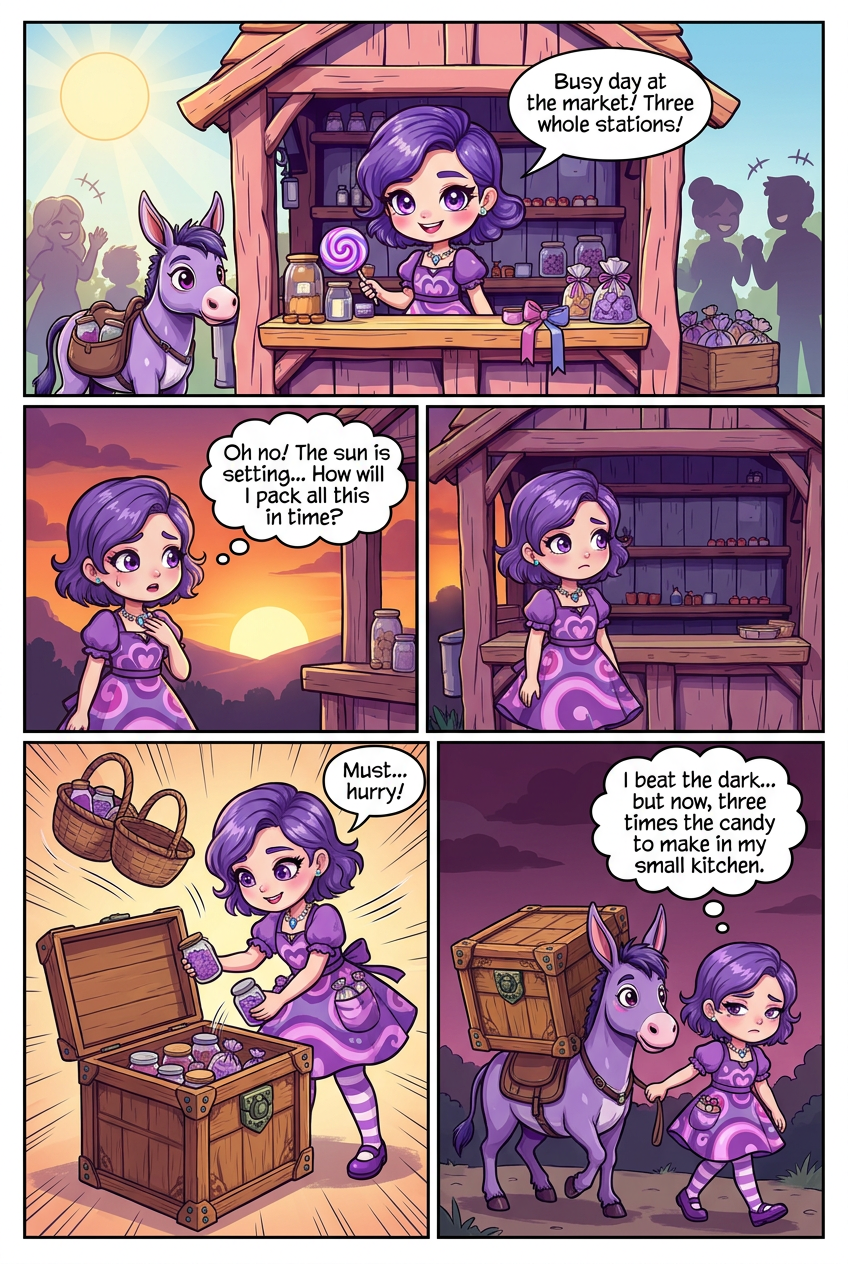
By morning, Purple Pop had stretched her shop across three spots along the path. A small wooden booth held jars on tidy shelves. A violet donkey stood nearby with baskets bouncing on her flanks. Purple Pop tied an apron of deep pockets at her waist and worked all three stations at once. Coins clinked. Customers smiled. Then the sun began to slip low, and panic pricked her chest. How would she pack it all before dark? She pulled a sturdy carved crate from beneath the booth and flipped its brass latch open. Inside, she had cut snug slots for every jar, every ribbon, every stack of sachets. She moved fast. Shelves emptied into the crate. Baskets came off the donkey and nested inside one another. The apron pockets caught the last loose wrappers. As the sky turned plum, Purple Pop snapped the latch shut. One crate. One donkey. One booth left standing for tomorrow. She had beaten the dark. But as she led the donkey home, she felt the crate's weight tug her shoulder. Three stations meant three times the candy to make by sunrise. Her kitchen was only one small room.
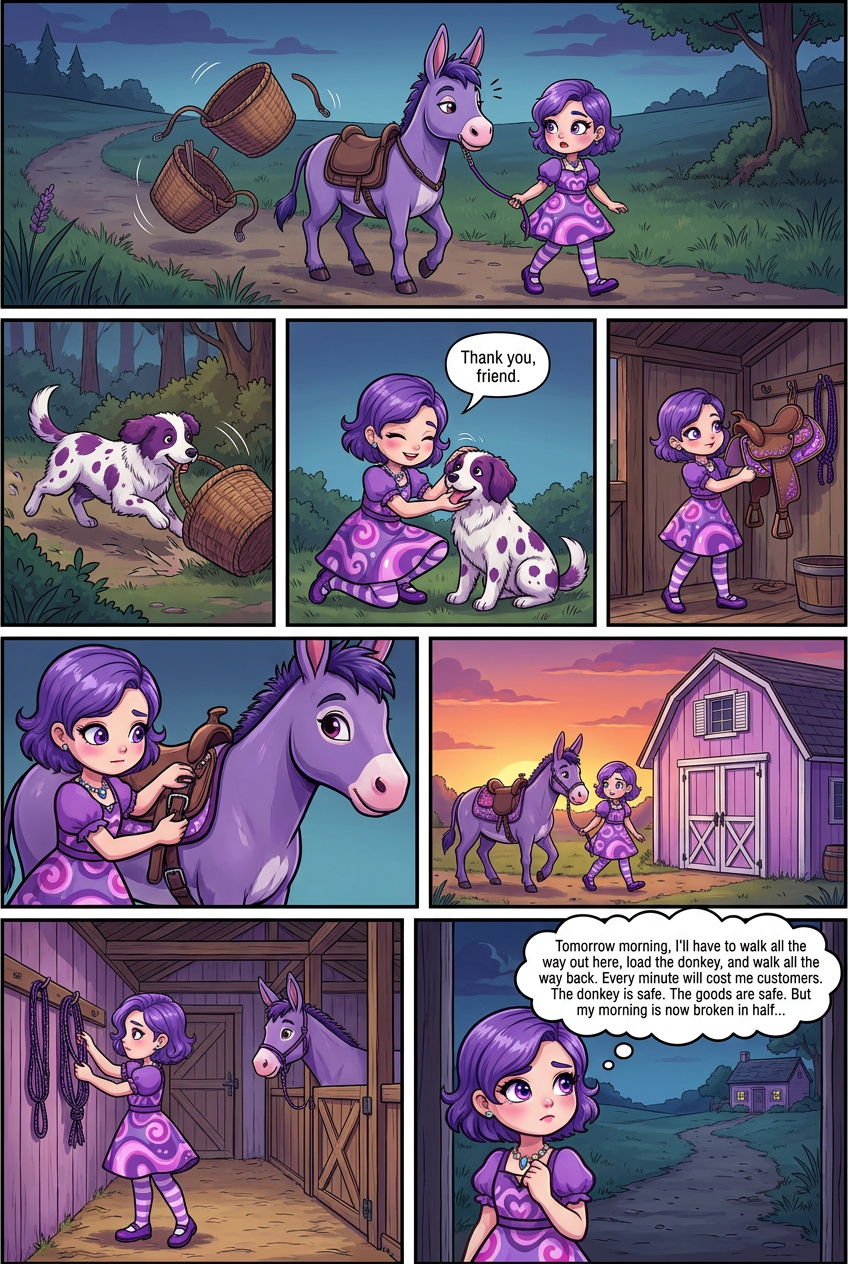
Purple Pop led her donkey home with the heavy crate swaying. Halfway down the path, she felt the straps slip. She turned just in time to see two baskets tumble into the grass. The donkey blinked at her, calm as ever, and kept walking. Before Purple Pop could scold her, a spotted sheepdog bounded out of the brush. He nosed each basket upright and pushed them back toward her feet. Not a wrapper was lost. Purple Pop knelt and scratched his ears. "Thank you, friend." She knew she could not trust loose straps again. From her cottage shed, she pulled out a sturdy pack saddle bright with pressed flowers. It had buckles that locked tight and pockets stitched deep. She fitted it over the donkey's back and clicked each strap into place. Nothing would slide free now. The sun was nearly gone. Purple Pop walked her donkey to a small lilac barn at the edge of the meadow. Its soft purple walls glowed in the last light. White doors swung open on quiet hinges. Inside smelled of clean hay. She slipped a braided lavender halter from the donkey's nose and hung it on a peg. She latched the barn door behind her and stepped back onto the path. Then she stopped. The barn sat far from her cart. Tomorrow morning, she would have to walk all the way out here, load the donkey, and walk all the way back before she could even open. Every minute would cost her customers. Purple Pop looked at the dark barn, then the long path home. The donkey was safe. The goods were safe. But her morning was now broken in half, and she would have to find a way to mend it before sunrise.
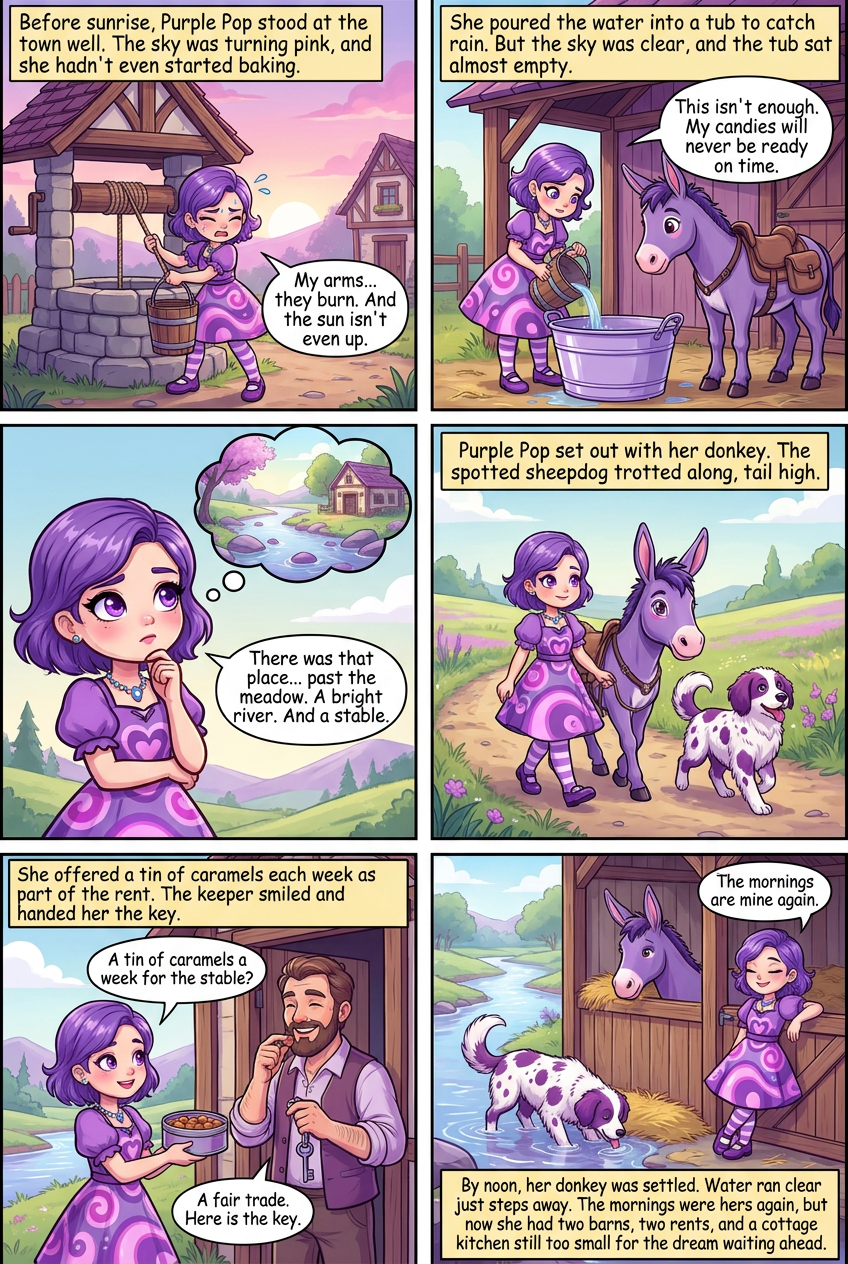
Before sunrise, Purple Pop stood at the stone well house in the town square. She cranked the rope and hauled bucket after bucket. Her arms burned. The sky was turning pink, and she had not even started baking. This could not be her every morning. She loaded the buckets onto her violet donkey and hurried back. At the barn, she poured the water into a lavender tin tub set under the eaves to catch rain. It would help on wet days. But the sky was clear, and the tub sat almost empty. Purple Pop watched the sun climb. She thought of the long walk, the heavy rope, the wasted hours. Her candies would never reach the cart on time. A real parlor needed steady water, not buckets dragged across town. She remembered a place past the meadow, where a bright river ran over smooth plum stones. A small stable stood right beside it. She had passed it once and thought it too far. Now it looked like the only answer. Purple Pop set out with her donkey. The spotted sheepdog trotted along, tail high. At the riverside stable, she knocked on the keeper's door. She offered a tin of caramels each week as part of the rent. The keeper tasted one, smiled, and handed her the key. By noon, her donkey was settled in the new stall. Water ran clear just steps away. Purple Pop closed the stall door and breathed out. The mornings were hers again, but now she had two barns, two rents, and a cottage kitchen still too small for the dream waiting ahead.
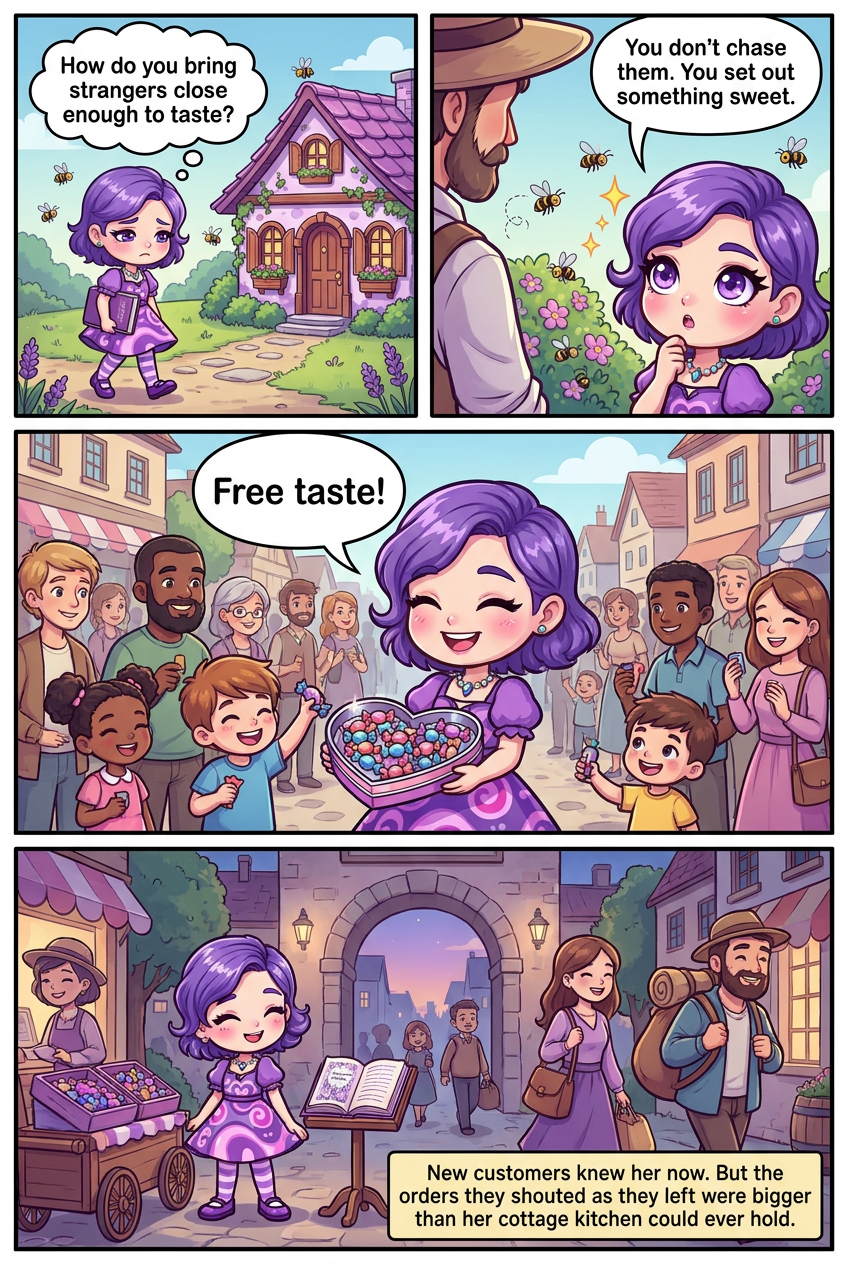
By morning, Purple Pop's recipe book was full, but her cart still stood empty of new faces. She tucked the lavender and plum book under one arm and walked back to the small cottage where the beekeeper lived. Bees hummed around its plum shingles. She asked one question: how do you bring strangers close enough to taste? The beekeeper smiled and pointed to the bees. "You don't chase them. You set out something sweet." Purple Pop walked home with a plan sharp in her mind. She polished a heart-shaped tin tray until it shone. She filled it with tiny wrapped samples, then carried it to the busiest corner of town. "Free taste," she called, holding the tray out to every passing hand. Strangers stopped. Children tugged their parents back. Mouths smiled around her candies. Back at the arch, she set her finished recipe book open on a small stand beside the path, weighted against the breeze. Passersby paused to read her grandmother's name and her own. By dusk, the samples were gone and her cart was nearly empty. New customers knew her now. But the orders they shouted as they left were bigger than her cottage kitchen could ever hold.
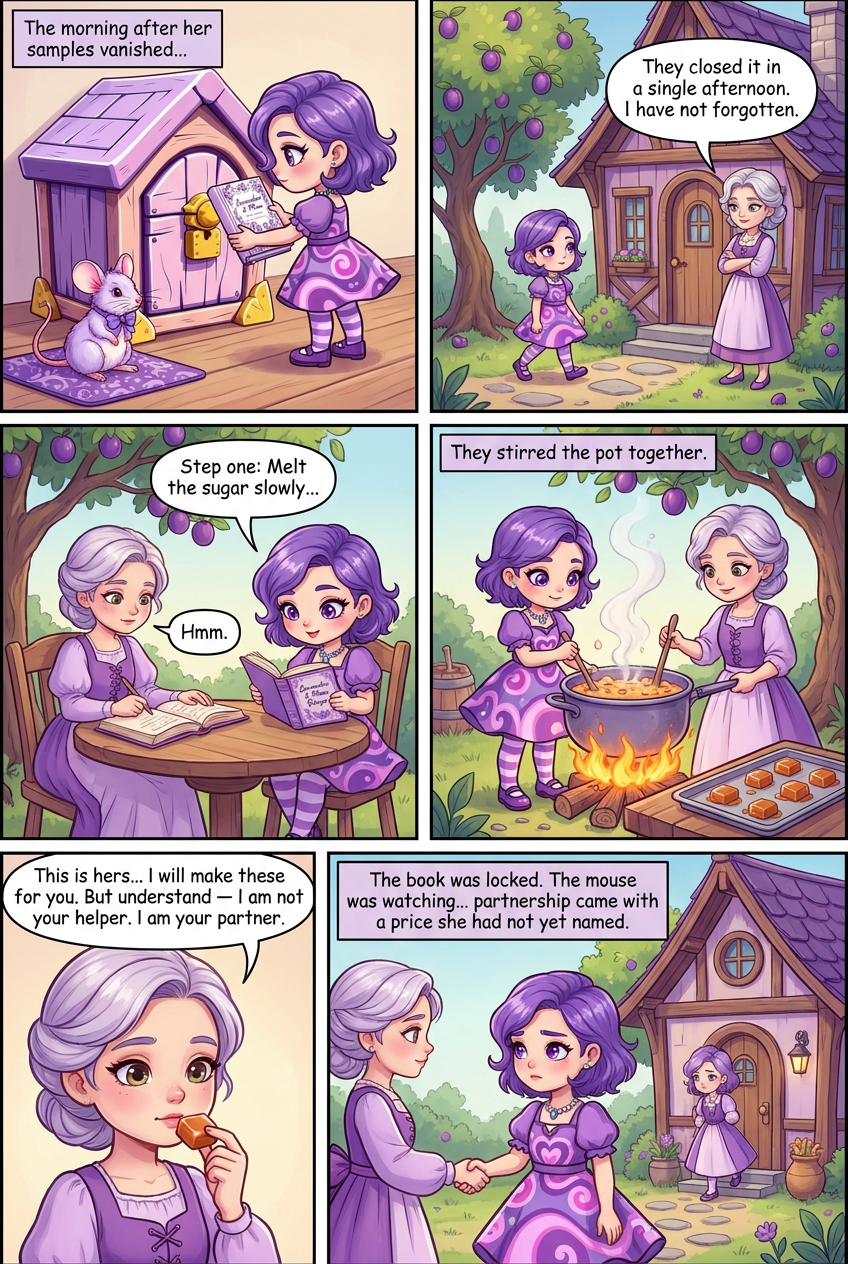
The morning after her samples vanished, Purple Pop knew she could not guard her recipes and bake enough at the same time. She carried her lavender and plum book outside and set it inside a small lilac-wood cubby with a brass lock. A white mouse in a ribbon climbed onto a patterned pad beside the door. He sat up straight, whiskers twitching, eyes sharp on the path. Next, Purple Pop walked to a plum-colored cook house ringed with lilacs. A retired witch in candy-bright robes waited by the ripe plum tree at the door. Her name was Rosalind Sweetbriar, and she had baked in this town long before the banks ever existed. "I kept a shop here for twenty-two years," Rosalind said. "They closed it in a single afternoon. I have not forgotten." Purple Pop set one recipe on the outdoor table between them. Caramels. Her grandmother's first. She read each step aloud, then watched Rosalind copy it in a careful hand. They stirred the pot together under the plum tree. The first tin cooled by noon, glossy and perfect. Rosalind tasted one square. Her face went very still. "This is hers," she said quietly. "I remember the year. I will make these for you. But understand — I am not your helper. I am your partner." Purple Pop nodded and shook her hand. The book was locked. The mouse was watching. An apprentice was working. But as she walked home, she counted the day's new orders against two kitchens instead of one — and realized partnership came with a price she had not yet named.
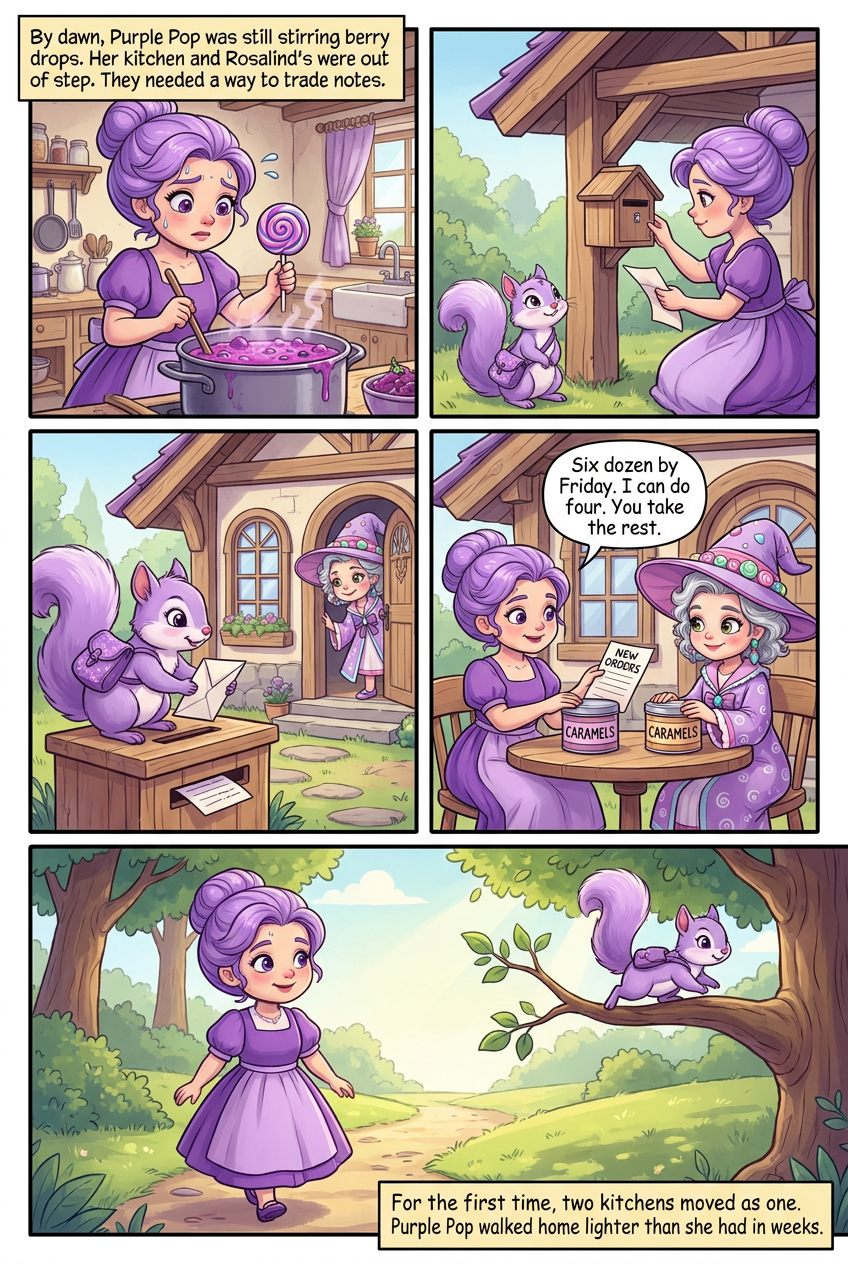
By the next morning, Purple Pop's two kitchens were already out of step. Rosalind had finished a tin of caramels by dawn. Purple Pop was still stirring berry drops at her cottage. They needed a way to trade notes without losing half a day walking back and forth. She trained a small lilac squirrel to run the route. The squirrel wore a flowered pouch across its chest, just big enough for folded paper. Purple Pop tucked each task list inside and tied the flap shut. At the flowered tea house in town, she fixed a little wooden box to the front post under the eaves. The squirrel learned to drop notes inside and wait for a reply. Rosalind checked the box each morning before her oven warmed. That afternoon, they met at the small table beside the tea house door. Rosalind set down two tins of caramels. Purple Pop set down a list of new orders. "Six dozen by Friday," Rosalind said. "I can do four. You take the rest." They split the work cleanly, line by line. Purple Pop walked home lighter than she had in weeks. The squirrel darted ahead along the branches, pouch flat and empty. For the first time, two kitchens moved as one.
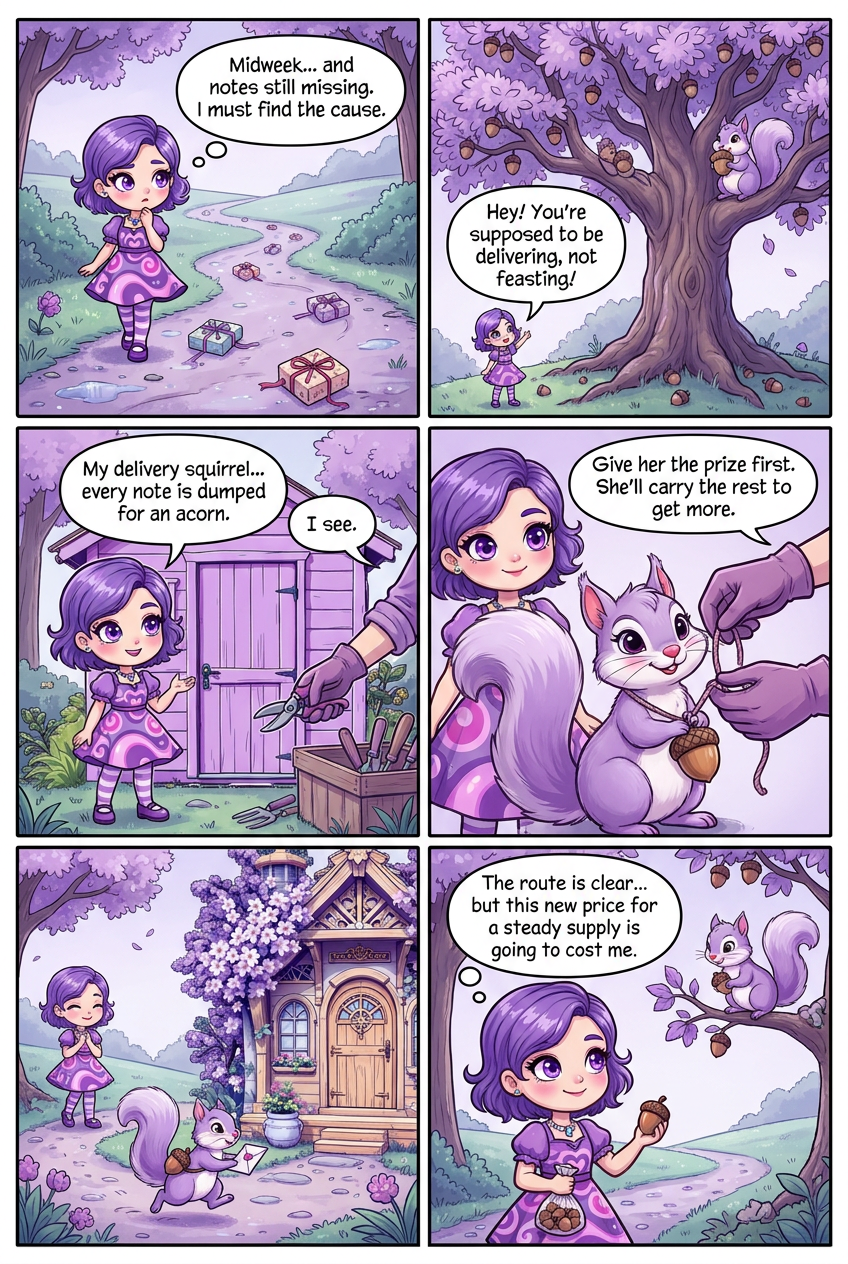
By midweek, the squirrel's route had broken down. Notes that should have reached Rosalind's kitchen by breakfast were still missing at noon. Purple Pop walked the lane herself to find out why. She found the trail first. Small wrapped parcels and folded notes lay scattered across the path, their ribbons loose, their symbols smudged by dew. The trail led straight to a wide oak with lilac leaves and a heavy crop of acorns at its roots. The squirrel sat in the branches, cheeks full, pouch hanging empty. Purple Pop called. The squirrel blinked and kept chewing. Every delivery had been dumped for the nearest acorn. A stranger knelt nearby beside a small purple shed, sorting clippers, gloves, and a coil of soft cord. A gardener, by the look of the tools. Purple Pop explained the problem. The gardener listened, then pulled an empty acorn shell from a pocket and tied it to the squirrel's pouch with the cord. "Give her the prize first," she said. "She'll carry the rest to get more." Purple Pop tested it that afternoon. The squirrel ran the full route, pouch swinging, and dropped every note in the tea house box. The lane was clear again — but now each trip cost her a fresh acorn, and the gardener had named a price for steady supply.
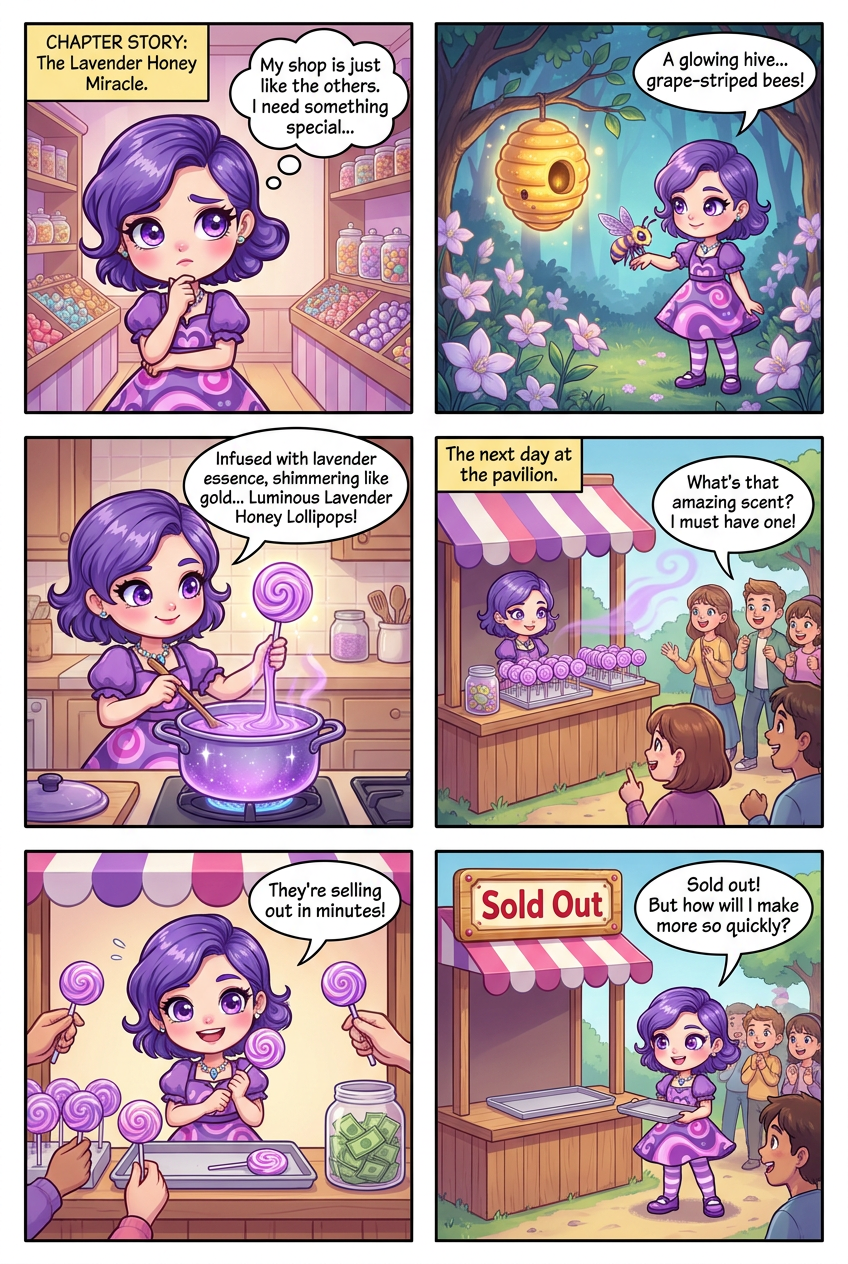
With the squirrel route running again, Purple Pop turned to a bigger worry. Her shop blended in with every other sweet stall in town. She needed one treat that no one else could make — something that would pull people in by name. Deep in the woods, past a bend of pale flowers, she found the hive. It hung from a low branch, glowing faintly under the late sun. The bees that circled it were grape-striped, their wings catching light like stained glass. One landed on her wrist. She held still and watched it drink from a drop of nectar, then followed the swarm to a small pool of honey gathered in a hollow stone. She carried the honey home and worked through the night. By morning she had pulled the syrup into swirled pops, each one coated in a glaze that shimmered gold over soft lavender. She set up a small booth at the pavilion and arranged the pops in neat rows under a striped awning. The scent reached the street first. Customers came in waves, then in crowds. By midday she hung the wooden board across the front — Sold Out, painted bright. Her jar was full, her tray was empty, and people were already asking when she'd make more. Purple Pop had her signature at last, and a line of orders she had no idea how to fill.
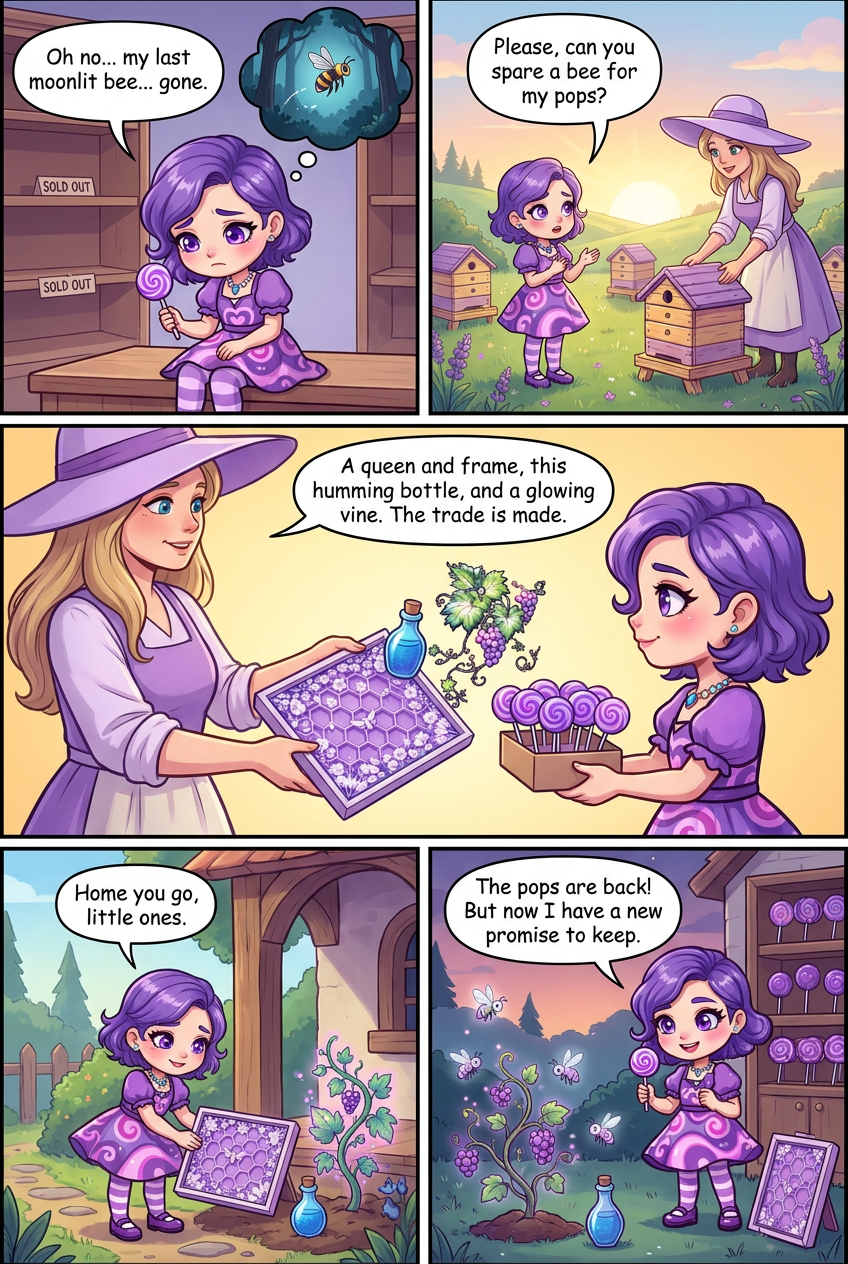
The orders piled up, but her one rare bee was gone, lost on the trip home. Without it, the moonlit honey would not flow, and her signature pops would vanish from the shelf. Purple Pop walked back into the woods at dawn, hoping the beekeeper could spare what she could not. The beekeeper's yard sat quiet under tall grass. Painted hives stood in a soft row, their lavender boards glowing in the early light. A woman in a wide lavender hat looked up from a tray of combs and listened as Purple Pop laid out her problem. They struck a trade. A young queen and a starter frame, alive with pale bees and pale petals, for a standing order of glazed pops each week. The beekeeper pressed two more gifts into her hands: a small blue bottle that hummed faintly, and a cutting of vine that glowed soft purple along its leaves. Feed the hive with one, plant the other, and her bees would grow strong. Purple Pop carried the frame home and set it under the shaded arch behind her cottage. She tucked the vine into the soil and rested the blue bottle beside it. By dusk, her new bees were circling the blooms. The shelf would fill again, but now she owed weekly pops to a second hand, and her week was already full.
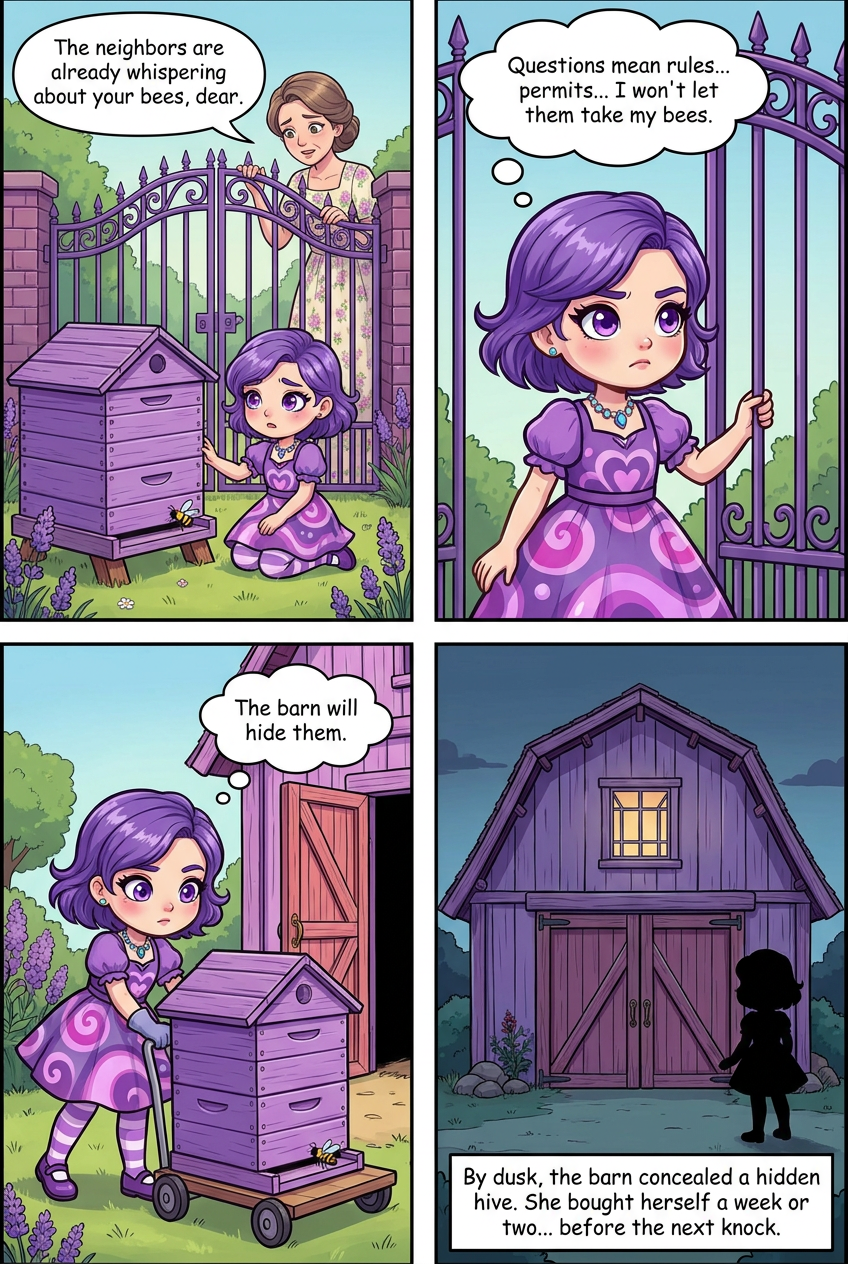
By morning the new hive buzzed strong, its lavender bees thick around the blooms. Purple Pop knelt to check the frame when a gentle woman paused at the wrought iron gate. She admired the bees, then lowered her voice. Neighbors were already whispering, she warned. Soon they would come knocking with questions Purple Pop could not afford to answer. Purple Pop thanked her and stood by the purple bars long after she left. Questions meant rules. Rules meant fees, permits, and maybe a shut door. She would not let her bees be taken from her now. She spent the afternoon clearing out a small grape and lilac barn at the edge of her garden. She moved the hive inside, set the humming bottle on a shelf, and trained the glowing vine along the rafters. A narrow window let the bees come and go without showing the box from the lane. By dusk the barn doors closed on a hidden, working hive. The whispers outside the gate faded for now. But Purple Pop knew her bees needed flowers, and flowers grew in plain sight. She had bought herself a week, maybe two, before the next knock came.
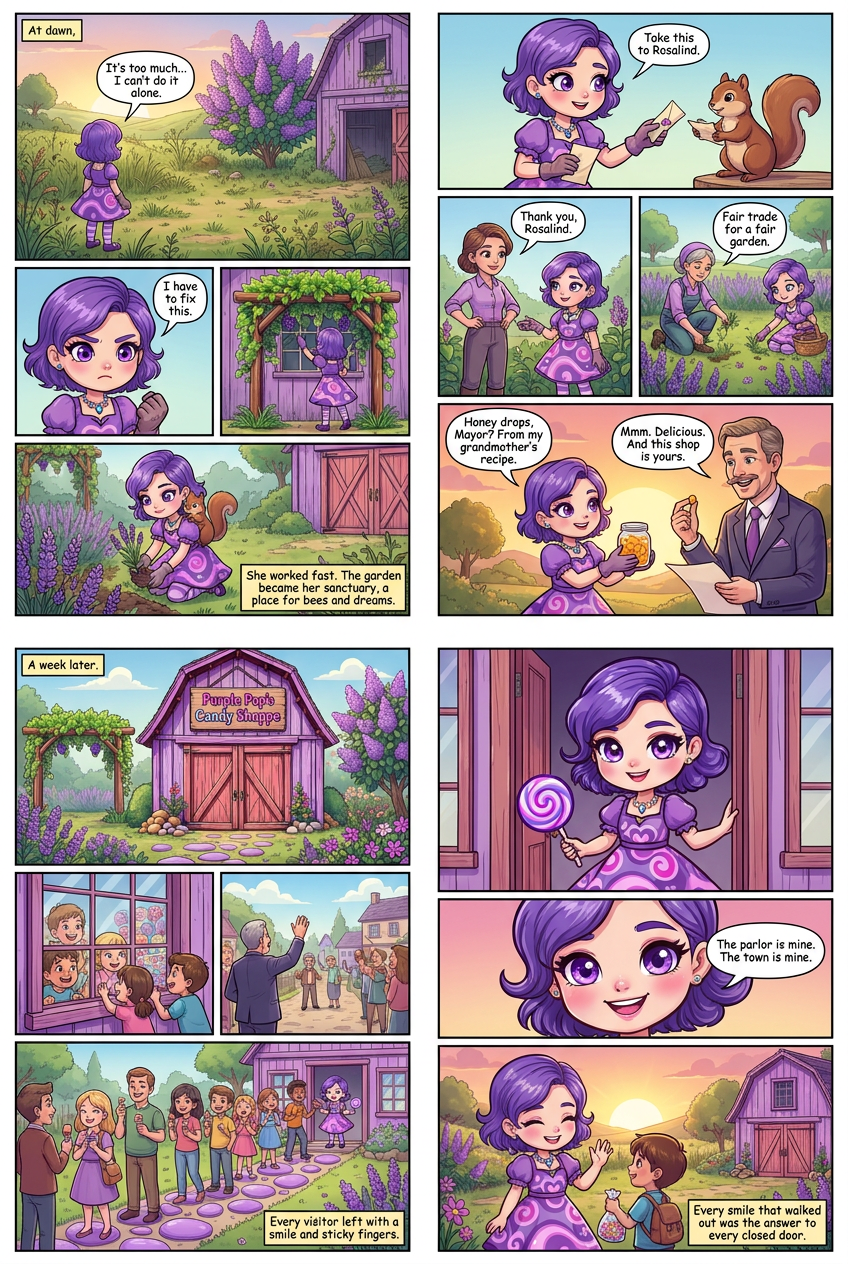
At dawn Purple Pop walked the edge of her garden and saw the truth. The beds had spread far past the barn. A towering lilac bush marked the new outer line, its purple blossoms heavy and wild. Weeds tangled the paths. She could not hide the hive and tend all this alone. She worked fast. She planted a grape arbor right against the barn wall, training the vines until thick leaves and hanging fruit swallowed the narrow window. In front of it she set a wide sweep of lavender and purple blooms, low and full, so the bees could feed without ever leaving cover. From the lane the barn looked like one more flowering corner of her yard. Then she sent her squirrel with a note to Rosalind, and another to the gardener. By afternoon Rosalind stood beside her with sleeves rolled, and the gardener knelt among the beds pulling weeds for a fair weekly trade. Purple Pop sent word to the mayor too, inviting him to taste a jar of honey drops from his old friend's recipe. He came at sundown, ate two, and signed her shop papers on the spot. A week later the sign above the cottage door read open. Children pressed to the window. The mayor's wave from the square sent neighbors streaming in. Caramels, honey pops, lavender drops, berry chews — every visitor left with a smile and sticky fingers. Purple Pop stood in the doorway with her grandmother's lollipop in her left hand and watched the line stretch down the gumdrop path. The parlor was hers. The town was hers. And every smile that walked back out the door was the answer to every door that had once closed.
Play your story to life
Storycraft is a mobile game where you create AI characters, craft items and locations to build their world, then discover what direction your story takes. Download the iOS game for free today!
Download for free