

Randy Terri's Arc
11 Chapters
Randy Terri's dream is discovering what lies inside the nearby Vault affecting his land.

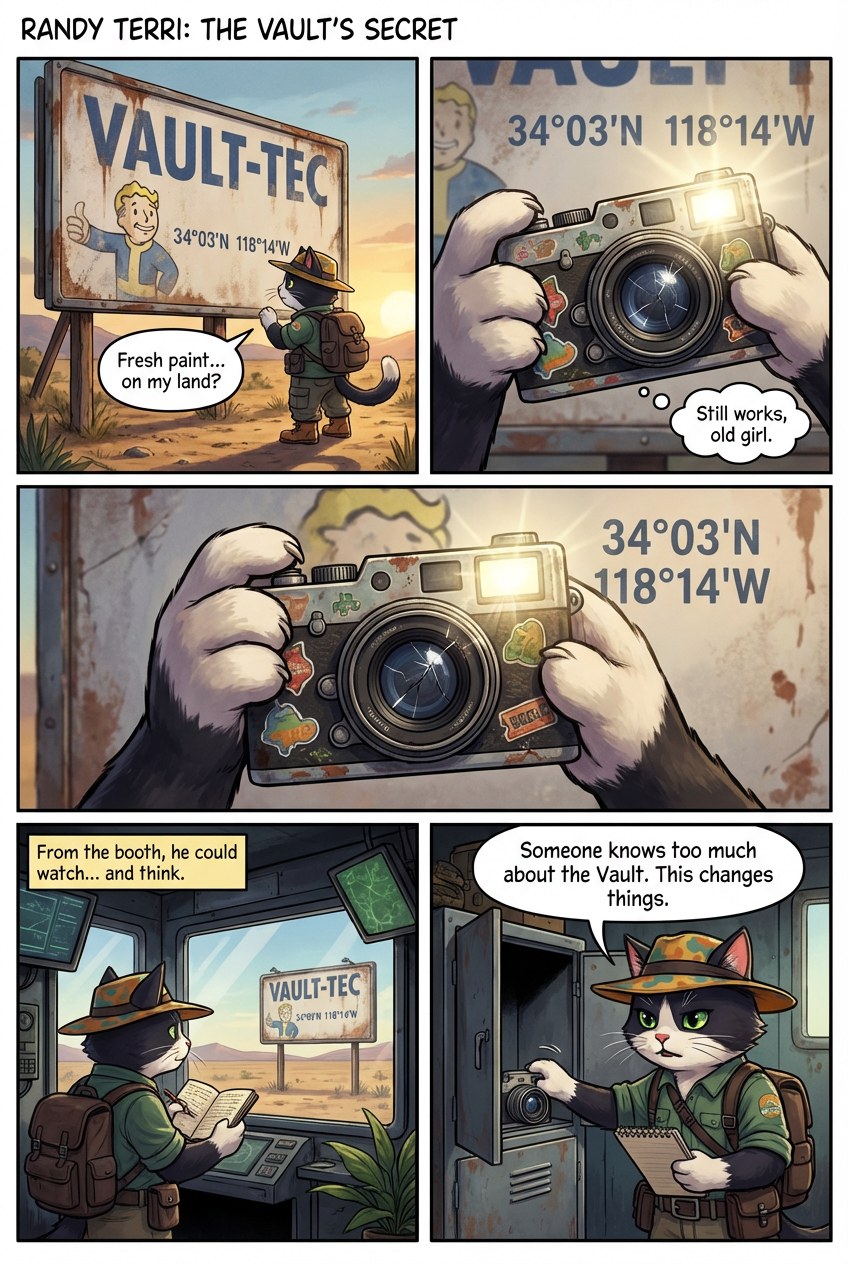
Randy stood at the edge of his property where the old billboard sat, the same rusted Vault-Tec sign that had been there since before he bought the land. Someone had painted fresh coordinates across the faded mascot's chest. The numbers were precise, written small and tight like whoever put them there wanted them hidden in plain sight. He pulled the camera from his jacket and photographed the coordinates twice. The lens was cracked but it still worked. The stickers on the body reminded him where he'd found it — some trader's abandoned pack near the eastern fields. He took a third shot, closer this time, making sure the numbers came through clear. From the observation booth near his main grow field, Randy could watch the billboard without being seen through the one-way glass. He'd built it last year when the yields started climbing and he needed a way to monitor the property without standing in the open. Now it gave him something better — a place to sit and think about who else knew the Vault was there and what they wanted with it. The coordinates pointed somewhere specific. Randy copied them into his notebook and locked the camera in the booth's cabinet. Whatever was buried at those numbers, someone had gone to the trouble of hiding the location on his land, which meant they knew more about the Vault than they should. That changed things.
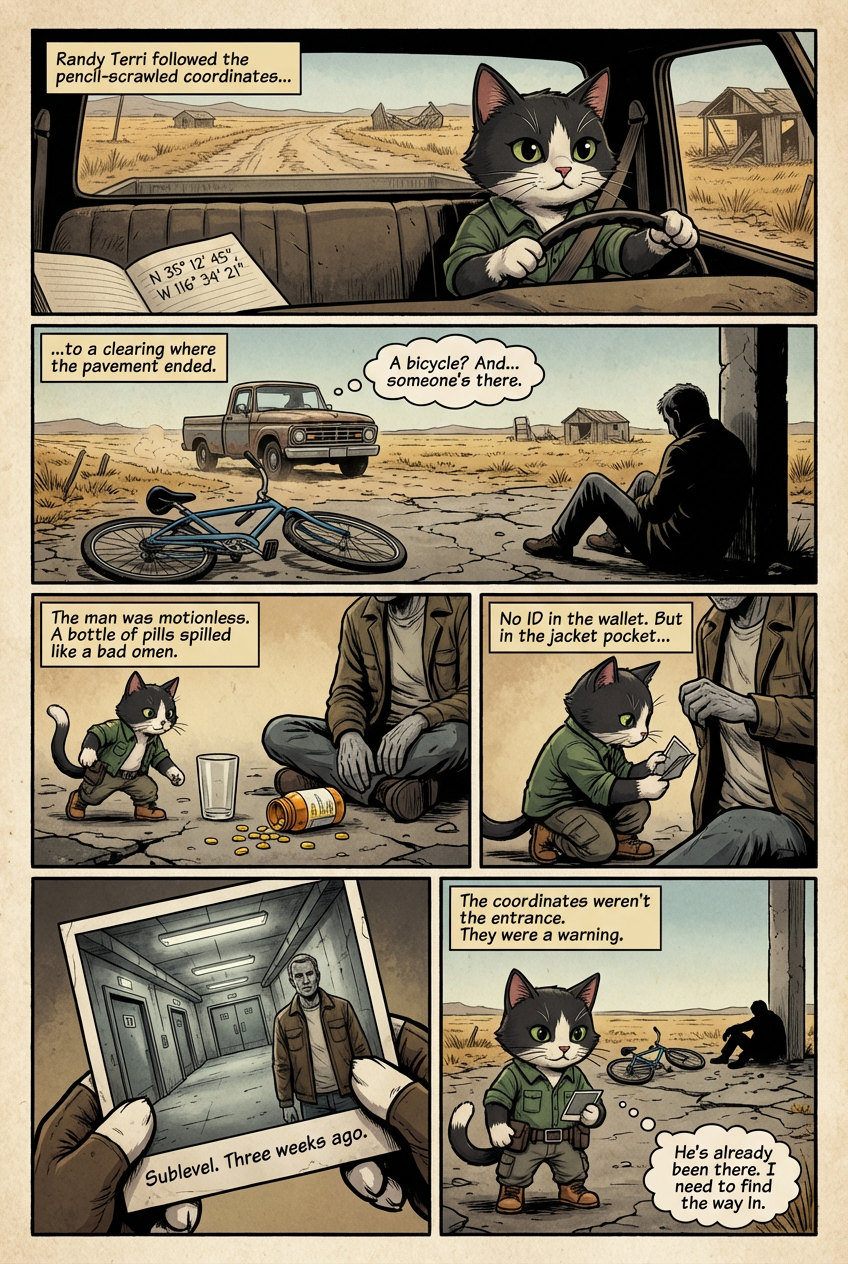
Randy drove his truck along the dirt roads that connected the scattered properties east of Calico Flats, the notebook open on the passenger seat with the coordinates written in pencil. The numbers led him past abandoned fields and collapsed sheds, through stretches of nothing that looked like every other stretch until the land started to slope. The coordinates brought him to a clearing where the pavement had cracked into pieces. A blue bicycle lay on its side near the edge, one wheel still turning slowly in the wind. Beyond it, a man sat slumped against a concrete pillar with his back to Randy. An empty glass stood upright on the ground beside him, and a medicine bottle had spilled its contents across the broken pavement, yellow pills scattered in a wide arc. Randy parked twenty feet back and approached on foot, watching for movement that didn't come. The man's hands rested palm-up in his lap, fingers curled but not clenched. Randy circled around to see his face and found skin that had gone gray and stiff. Randy knelt and checked the man's pockets without touching more than he had to. A wallet with no identification. A folded map with nothing marked on it. Then, in the inside jacket pocket, a photograph printed on thick paper that had survived the weather. It showed a concrete chamber underground, lit by harsh fluorescent light. Steel doors lined one wall, each with a number stenciled above it in white paint. A man stood in the center of the frame, facing the camera directly, wearing the same jacket the dead man had on now. Randy turned the photo over and found a date written in marker — three weeks ago — and a single word: "Sublevel." Randy stood and looked at the clearing again, at the bicycle and the pills and the man who had come here with a photograph of something underground. Someone had painted coordinates on his billboard, and this man had followed them and died here, maybe from the pills or maybe from something else Randy couldn't see. The photograph proved the man had already been inside whatever was below, which meant the way in was close. Randy folded the photo and put it in his pocket. The coordinates hadn't led to the entrance — they'd led to a warning.
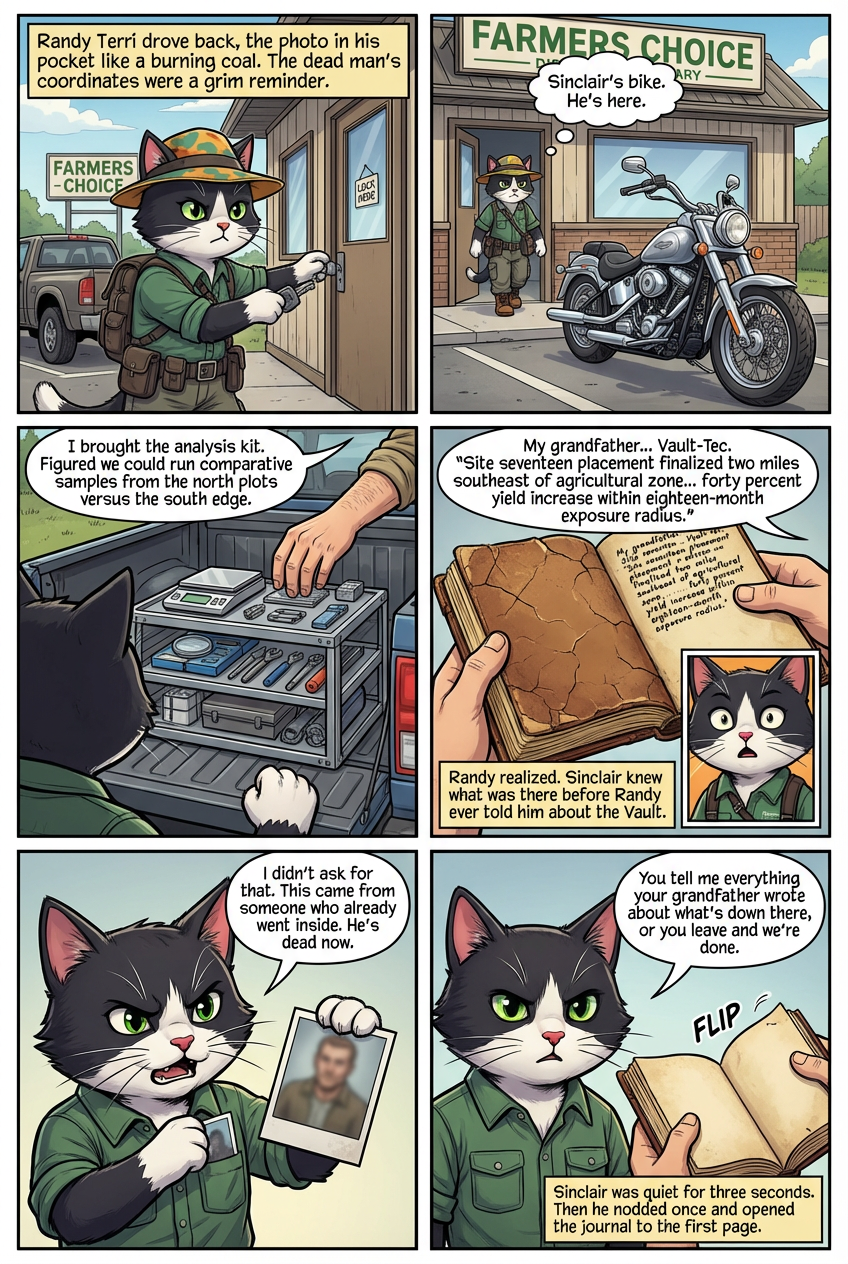
Randy drove back to Farmers Choice with the photograph in his pocket and the dead man's coordinates still written in his notebook. He parked behind the dispensary and went inside through the back door, locking it behind him. Sinclair's motorcycle stood in the gravel lot when Randy came out front an hour later. The chrome cruiser gleamed in the afternoon sun, parked at an angle that blocked the driveway. Sinclair sat on the tailgate of his truck with a steel equipment rack unfolded beside him, the shelves packed with scales and testing tools arranged in perfect rows. He looked up when Randy approached, and his expression didn't change. "I brought the analysis kit," Sinclair said. "Figured we could run comparative samples from the north plots versus the south edge." Randy stopped ten feet away. "I didn't ask for that." "No." Sinclair reached into his jacket and pulled out a leather journal with yellowed pages, the binding cracked from age. He opened it to a marked page and held it up so Randy could see the handwriting. "My grandfather worked for Vault-Tec. Kept notes on projects he wasn't supposed to remember." He turned the journal around and read aloud. "'Site seventeen placement finalized two miles southeast of agricultural zone. Iterative housing requires sustained output. Soil composition tests indicate forty percent yield increase within eighteen-month exposure radius.'" Sinclair closed the journal and looked at Randy directly. "Your third harvest was eighteen months after they sealed it." Randy felt the photograph press against his ribs through his shirt pocket. Sinclair hadn't just wanted in on what Randy found out — he'd known what was there before Randy ever told him about the Vault. The equipment rack wasn't for testing crops. It was staged to look helpful while Sinclair waited to see how much Randy would admit. Randy pulled the photograph from his pocket and held it up. "This came from someone who already went inside. He's dead now, out past the eastern ridge." Sinclair's eyes moved to the photo, and something shifted in his face — not surprise, but recognition. "So here's what's happening," Randy said. "You tell me everything your grandfather wrote about what's down there, or you leave and we're done." Sinclair was quiet for three seconds. Then he nodded once and opened the journal to the first page.
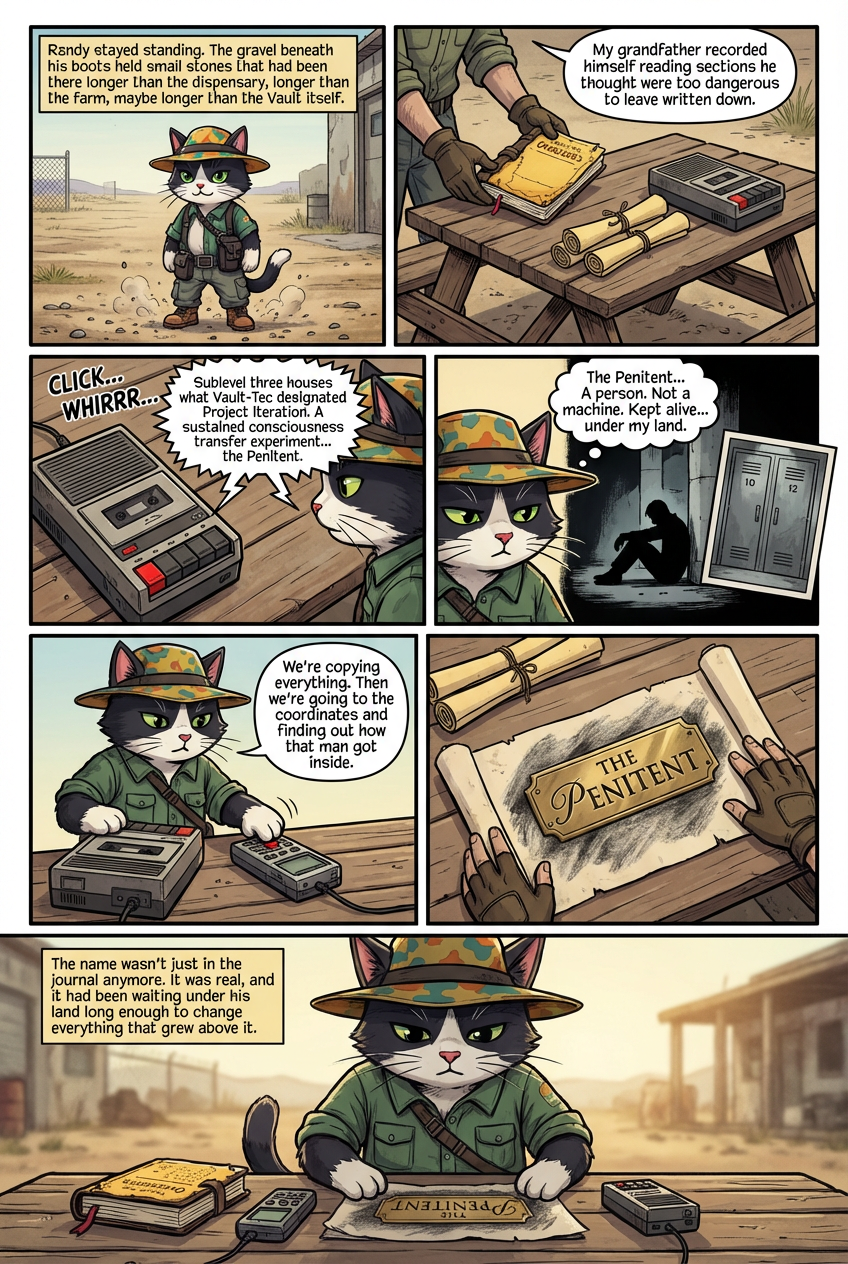
Sinclair opened the journal to the first page, but Randy stayed standing. The gravel beneath his boots held small stones that had been there longer than the dispensary, longer than the farm, maybe longer than the Vault itself. He didn't move closer to read over Sinclair's shoulder. Sinclair carried a picnic table from the side of the building and set it between them in the lot. He laid out the journal first, then three rolled papers tied with string, then a tape recorder with a red button that caught the afternoon light. "My grandfather recorded himself reading sections he thought were too dangerous to leave written down," Sinclair said. He pressed play. The voice that came through was old and careful, each word measured like it cost something to say. "Sublevel three houses what Vault-Tec designated Project Iteration. A sustained consciousness transfer experiment. The subject's name was removed from all records, but the plaque outside the chamber called it the Penitent." Randy felt the word settle into him like weight. Not radiation. Not a machine. A person, or what used to be one, kept alive in a way that made the soil richer and the crops grow forty percent stronger. The tape kept playing, describing power requirements and biological sustainment protocols, but Randy was already thinking about the dead man slumped against the pillar and the photograph of numbered steel doors. Someone had been down there three weeks ago and seen what the Penitent had become. Sinclair watched him without speaking, waiting to see if Randy would walk away or step closer to the table. Randy picked up the tape recorder and rewound it to the beginning. He set his own recorder on the table next to Sinclair's and pressed the red button. "We're copying everything," Randy said. "Then we're going to the coordinates and finding out how that man got inside." Sinclair nodded once and reached for the rolled papers. When he untied the first one, Randy saw a brass plaque rubbing — elegant script on aged metal that read THE PENITENT in letters that had been pressed into the paper hard enough to leave impressions. The name wasn't just in the journal anymore. It was real, and it had been waiting under his land long enough to change everything that grew above it.
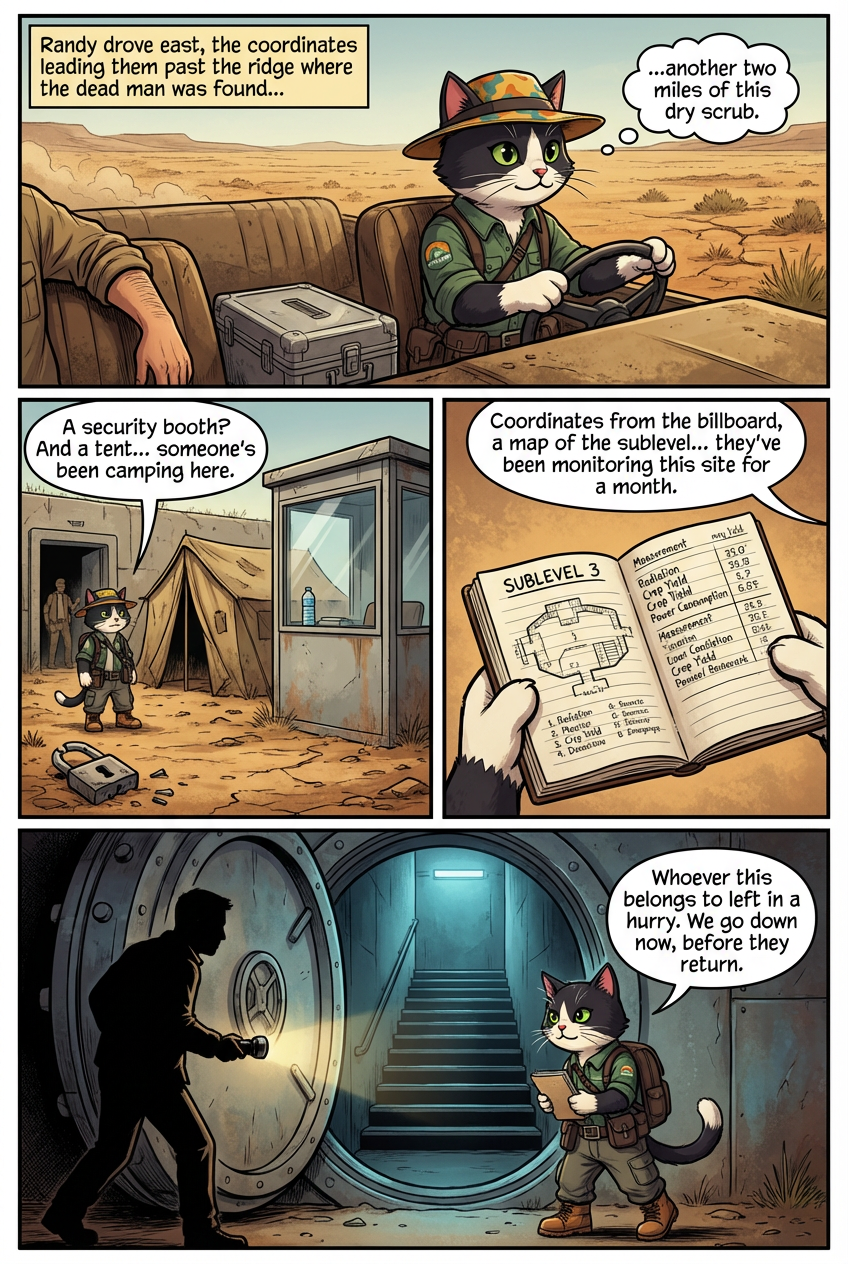
Randy drove east with Sinclair sitting quiet in the passenger seat, the journal and recordings locked in a metal case between them. The coordinates led them past the ridge where the dead man had been found, then another two miles through dry scrub until the ground changed from packed dirt to old concrete. The vault entrance sat in a shallow depression ringed by cracked foundation slabs. A canvas tent stood twenty feet from the door, its stakes driven deep and its flaps tied back like someone planned to return. Next to it was a plexiglass security booth that hadn't been there when Randy first found this site — scratched panels, metal desk inside, coffee cups stacked in a way that said weeks not days. The vault door itself hung open six inches, and a broken padlock lay in the dirt surrounded by metal shavings. Someone had cut through it with tools that left clean edges. Randy walked to the booth and looked through the plexiglass. The desk held a water bottle, a notebook with coordinates that matched the ones from his billboard, and a hand-drawn map of the underground chamber from the photograph. Whoever had been here knew exactly where sublevel three was and had been monitoring it long enough to set up a permanent station. He picked up the notebook and flipped through pages of measurements and timestamps — radiation readings taken every six hours for the past month, crop yield correlations, power consumption estimates that matched what Sinclair's grandfather had described. Sinclair stood at the vault door and pushed it wider. The metal groaned but swung open, revealing stairs that descended into darkness lit by emergency strips still glowing after all these years. Randy closed the notebook and put it in his jacket. The person who'd been living here had left in a hurry or hadn't planned to stay gone long, and either way that meant Randy had a choice — go down now while the entrance was open and unguarded, or wait and risk losing access when whoever owned this camp came back. He looked at Sinclair, who was already pulling a flashlight from his pack, and stepped past him toward the stairs.
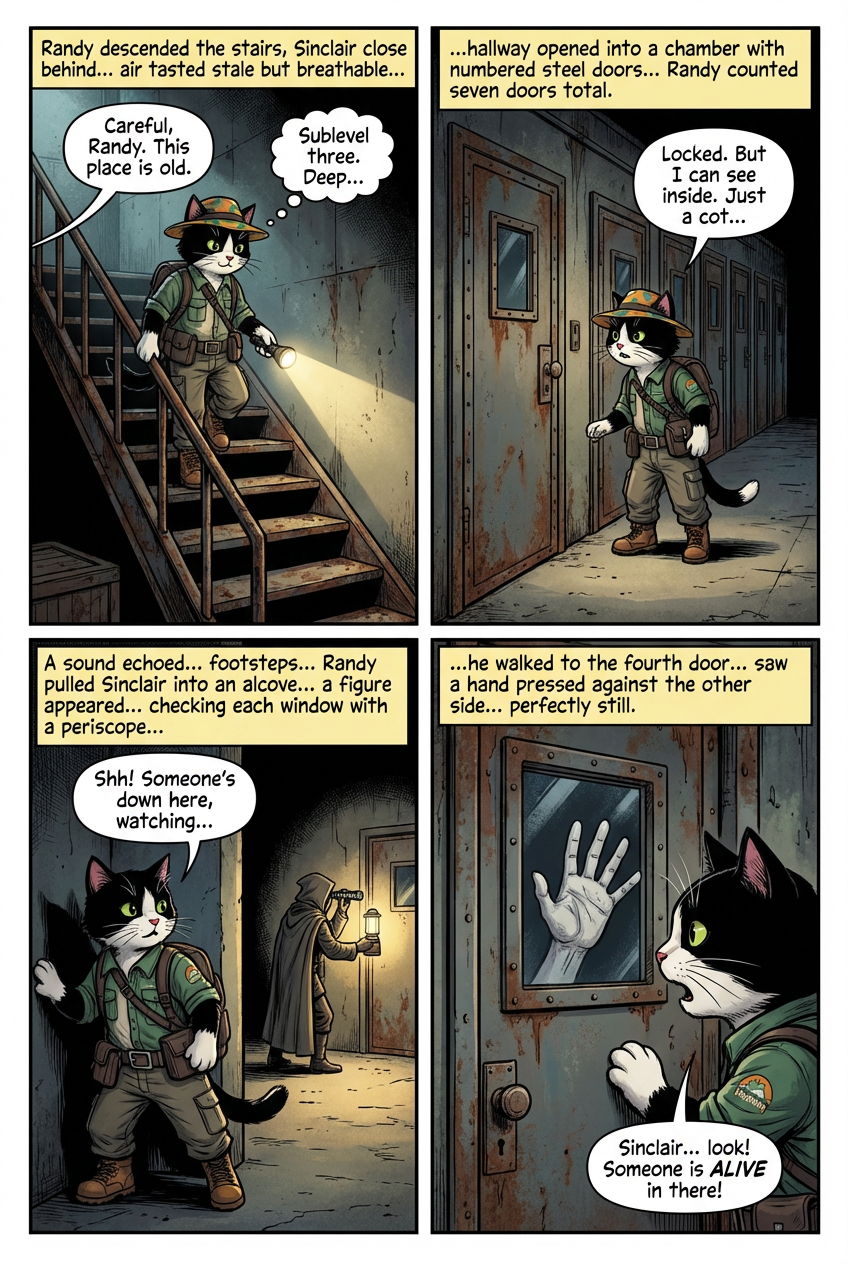
Randy descended the stairs with Sinclair close behind, their flashlights cutting through the emergency-lit corridor that stretched deeper than the vault door had suggested. The air tasted stale but breathable, filtered through systems that still worked after decades. They reached sublevel three twenty minutes later, moving past rusted doors and cable conduits until the hallway opened into a chamber with numbered steel doors identical to the photograph. Randy counted seven doors total, each with a small window at eye level and a manual lock that required a key he didn't have. He moved to the first door and looked through the glass. Inside was a narrow room with a metal cot, a sink, and walls covered in handwritten notes he couldn't read from this distance. The second and third doors showed similar rooms, but the fourth door's window had been covered from the inside with something dark and fibrous. A sound echoed down the stairwell behind them — footsteps on metal, descending fast. Randy pulled Sinclair into an alcove and killed his flashlight. Through the darkness he could see the stairwell entrance fifty feet away, and a moment later a figure appeared carrying a battery lamp and moving with the confidence of someone who knew exactly where they were going. The person walked straight to the security booth they'd passed on the upper level, then stopped and turned back toward the stairs. Randy stayed frozen in the alcove, watching the lamp's glow sweep across the chamber's entrance. The figure pulled something from their jacket — a periscope with scratched metal tubing — and angled it toward the numbered doors, checking each window systematically before returning to the stairs and climbing back up. Randy waited until the footsteps faded completely before stepping out of the alcove. He walked to the fourth door and pressed his face against the window, trying to see past whatever blocked the glass. The material shifted slightly, revealing a narrow gap, and through it he saw a hand pressed against the other side of the window — pale skin, fingers spread wide, perfectly still. Randy stepped back from the door and looked at Sinclair, who had gone rigid at the sight. Someone was alive down here, and whoever had just descended those stairs with the periscope knew it and was monitoring them from above.
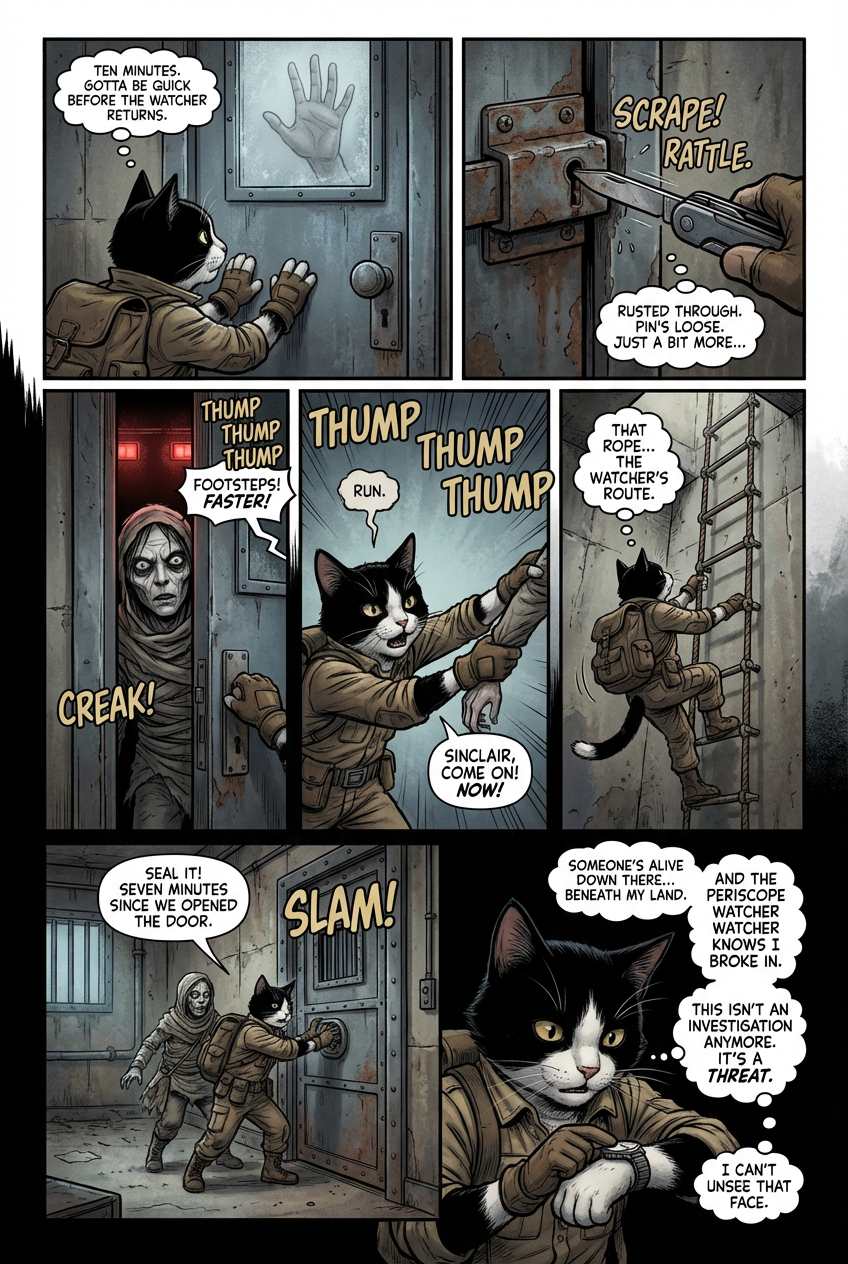
Randy turned back to the fourth door and pressed his hands flat against the cold metal frame. The hand inside the window remained motionless, fingers still spread wide against the glass. He had maybe ten minutes before the periscope watcher descended again. He examined the door's lock mechanism — a heavy deadbolt with rusted teeth and a loose pin that rattled when he tested the handle. The metal had corroded where moisture had seeped through the frame, weakening the bolt's grip on the strike plate. Randy pulled a multi-tool from his pocket and wedged the flathead into the gap between door and frame. He applied steady pressure, working the blade deeper until the bolt shifted with a metallic scrape. The pin gave way completely, and the door swung inward six inches before catching on something inside. A pale face appeared in the gap, backlit by emergency lighting. The person behind the door was emaciated, skin stretched tight over bone, but their eyes were sharp and focused. They didn't speak, just stared at Randy with an expression he couldn't read. Then footsteps echoed from the stairwell above — faster this time, descending in a rush. Randy grabbed Sinclair's arm and pulled him toward the alcove, but the person behind Door Four whispered a single word through the gap: "Run." Randy and Sinclair reached the rope ladder they'd passed on their way down, the same weathered hemp and metal rungs the watcher must have used to bypass the main entrance. They climbed fast, emerging through a concrete shaft that opened into an old medical bunker with steel blast doors and barred windows. Randy sealed the entrance behind them and checked his watch — seven minutes since they'd opened Door Four. Someone was alive down there, imprisoned in a cell beneath his land, and whoever monitored them with that periscope knew Randy had just broken through. The situation had changed from investigation to active threat, and he couldn't unsee what he'd found behind that door.
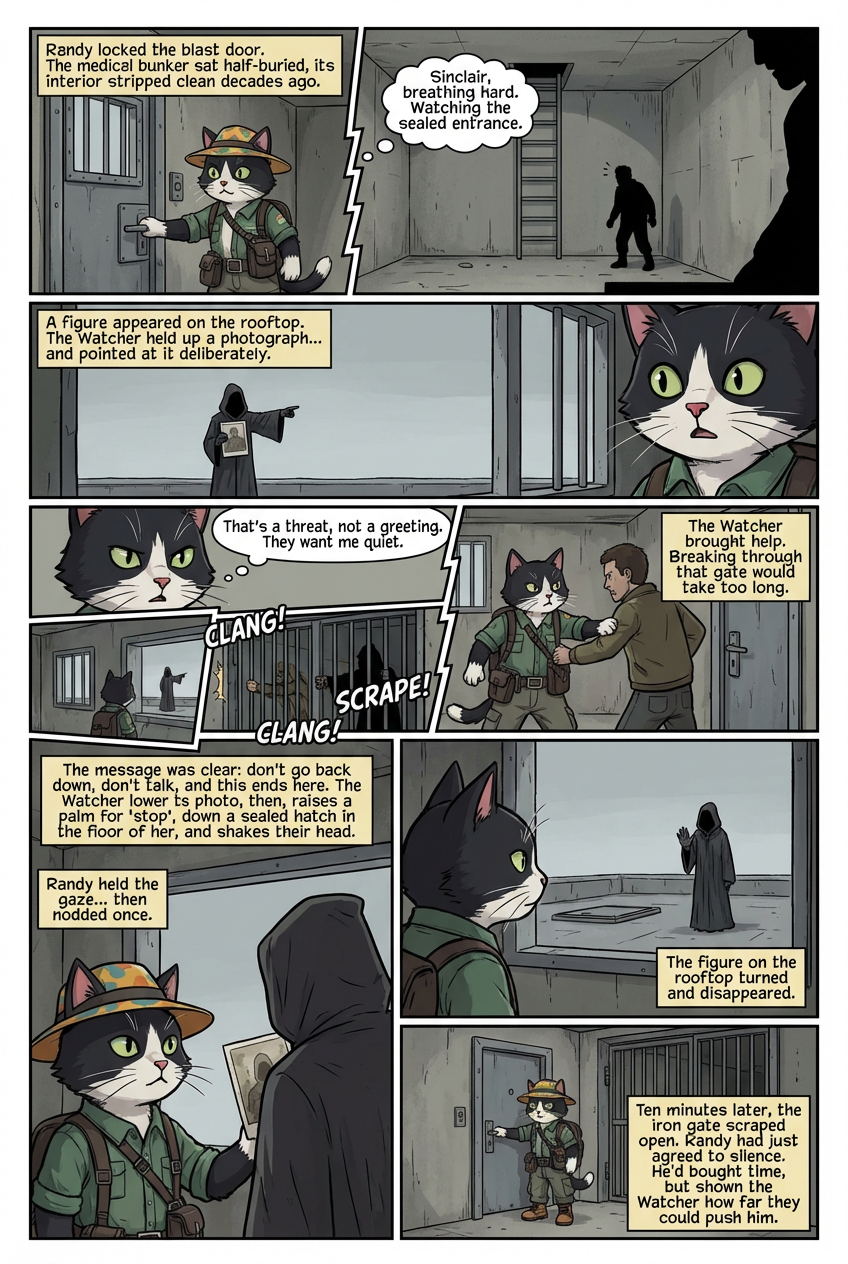
Randy locked the blast door and moved to the barred window. The medical bunker sat half-buried in hardpan, its steel frame still intact but its interior stripped clean decades ago. Sinclair stood near the ladder shaft, breathing hard, watching the sealed entrance like it might open any second. A figure appeared on the rooftop across from the bunker, silhouetted against the flat sky. The watcher stood at the metal railing, close enough for Randy to see the periscope hanging from their shoulder. They made no move to descend or approach. Instead, they held up a photograph — old paper stock with faded corners — and pointed at it deliberately. Randy recognized the gesture as a threat, not a greeting. The watcher wasn't here to capture him. They wanted him quiet. The sound of metal scraping against metal came from behind the bunker. Randy moved to the side window and saw an iron gate sliding across the only other exit, pushed into place by someone he couldn't see. Heavy bars locked into stone pillars with a final clang. The watcher had brought help, and they'd just cut off his second route out. Sinclair started toward the blast door, but Randy caught his arm. Breaking through that gate would take time they didn't have, and the watcher was still standing on that rooftop, waiting for acknowledgment. Randy stepped back to the front window where the watcher could see him clearly. The figure lowered the photograph and raised one hand, palm out — a universal gesture for stop. Then they pointed down at the sealed entrance to the sublevel and shook their head once. The message was clear: don't go back down, don't talk about what you found, and this ends here. Randy held the watcher's gaze for three long seconds, then nodded once. The figure on the rooftop turned and disappeared behind the railing. Ten minutes later, the iron gate scraped open again, pulled back by unseen hands. Randy had just agreed to silence, trading his access to the prisoner below for his freedom to leave. He'd bought time, but he'd also shown the watcher exactly how far they could push him.
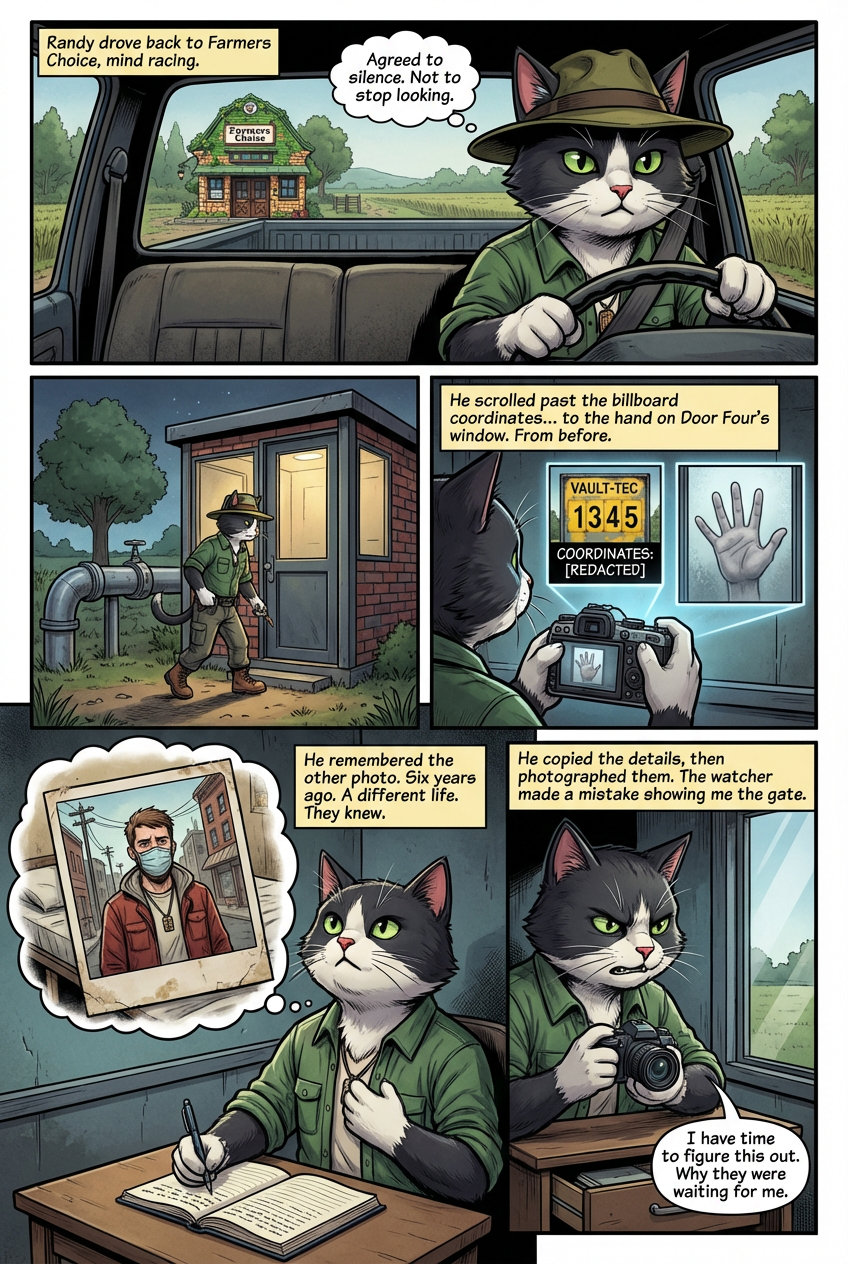
Randy drove back to Farmers Choice with his hands steady on the wheel and his mind running through what the watcher had left him with. He'd agreed to silence, but that didn't mean he'd agreed to stop looking. The prisoner in sublevel three had told him to run — not stay away, just run. He parked behind the dispensary and locked the truck. The observation booth sat at the far edge of the property, tucked against the irrigation line where he could see anyone approaching the farm. Randy opened the booth's steel door and pulled out the camera he'd stored there weeks ago, the one with the billboard coordinates. He scrolled through the photos until he found the image of Door Four's window — the pale hand pressed against the glass, fingers splayed like they were reaching for something just out of range. He'd taken it the first time he descended into sublevel three, before he knew anyone was alive down there. Before he opened that door. Randy pulled his notebook from the booth's bottom drawer and flipped to a blank page. He wrote down what he remembered from inside the cell: the cot pushed against the far wall, the tin cup on the floor, the rusted container near the door filled with torn envelopes and packaging scraps. Then he stopped. On the prisoner's cot, half-hidden under a folded blanket, had been a photograph. Not the one the watcher showed him on the rooftop. A different one. Randy closed his eyes and pulled the image back: creased edges, faded colors, a street scene with power lines overhead and brick buildings on both sides. A younger man standing in the center wearing a red jacket and a medical mask, looking straight at the camera. The pendant around his neck — Randy's hand moved to his own chest where that same pendant sat under his shirt. He'd been wearing it the day that photo was taken, six years ago in a settlement two hundred miles north. Before he bought the farm. Before anyone here knew his name. Randy copied every detail into the notebook, then photographed each page with the camera. The prisoner hadn't just known who he was. They'd been tracking him long enough to have physical proof from a different life entirely. He locked the notebook in the booth's drawer and pocketed the camera. The watcher wanted silence, but they'd made a mistake showing him that iron gate could be opened from the outside. Randy had time now to figure out who put that photograph in the cell, and why someone down there had been waiting specifically for him to show up.
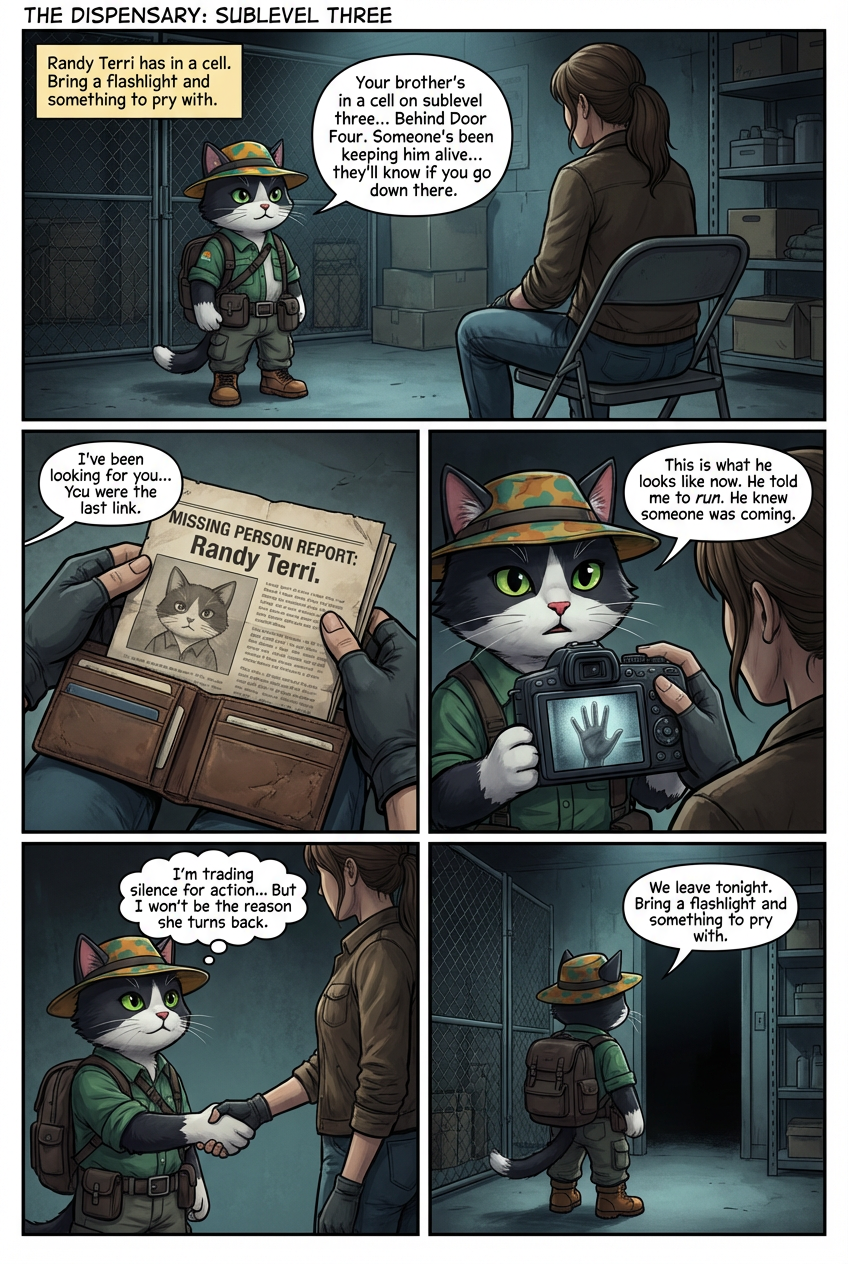
Randy led her through the dispensary's back door and into the storage room where he kept inventory locked behind chain-link fencing. He pulled two folding chairs from the corner and set them facing each other. The woman sat without hesitation, her jacket still zipped, her hands resting on her knees like she'd done this kind of conversation before. Randy stayed standing. He needed to see her reaction when he told her what the prisoner's situation actually was. "Your brother's in a cell on sublevel three," Randy said. "There are seven doors down there, all steel with observation windows. He's behind Door Four. Someone's been keeping him alive for at least six years, maybe longer. They're feeding him. Monitoring him. And whoever's doing it knows I went down there, which means they'll know if you do too." The woman pulled a worn leather wallet from her jacket and flipped it open. Inside was a newspaper clipping with Randy's face on it — the same missing person report she'd shown him at the counter, but this one was the original, creased and faded from being carried for years. She'd been looking for him specifically because he was the last link to her brother. She'd tracked him across two hundred miles and six years just to get to this moment. "I found your truck three days ago," she said. "Parked at a clearing east of here with fresh tire tracks leading back to this farm. I set up a tent near the road and waited to see if you'd go back. When you didn't, I came here." She folded the wallet and put it away. "I'm not asking you to go back down. I'm asking you to tell me how to get in, and I'll handle the rest." Randy pulled the camera from his pocket and scrolled to the photograph of Door Four's window — the pale hand pressed against glass. He turned the screen toward her. "This is what he looks like now. If you go down there and the watcher catches you, they won't just lock the gate. They'll make sure you don't come back up." He paused. "But if you're going anyway, I'll take you to the entrance. Not because I owe you, but because your brother told me to run when I opened that door. He didn't say stay away. He said run. That means he knew someone was coming." The woman stood and extended her hand. Randy shook it once, firm and deliberate. He'd just committed to taking someone back to sublevel three, directly against the watcher's warning. The watcher would know. They'd see the tent, the truck, the second set of footprints leading underground. Randy had traded silence for action, and whatever came next would be on him. But the prisoner had been waiting six years for someone to find him, and Randy wasn't going to be the reason that person turned around at the door. "We leave tonight," Randy said. "After dark. Bring a flashlight and something to pry with. The deadbolt on Door Four is corroded, but it'll take force to break it again."
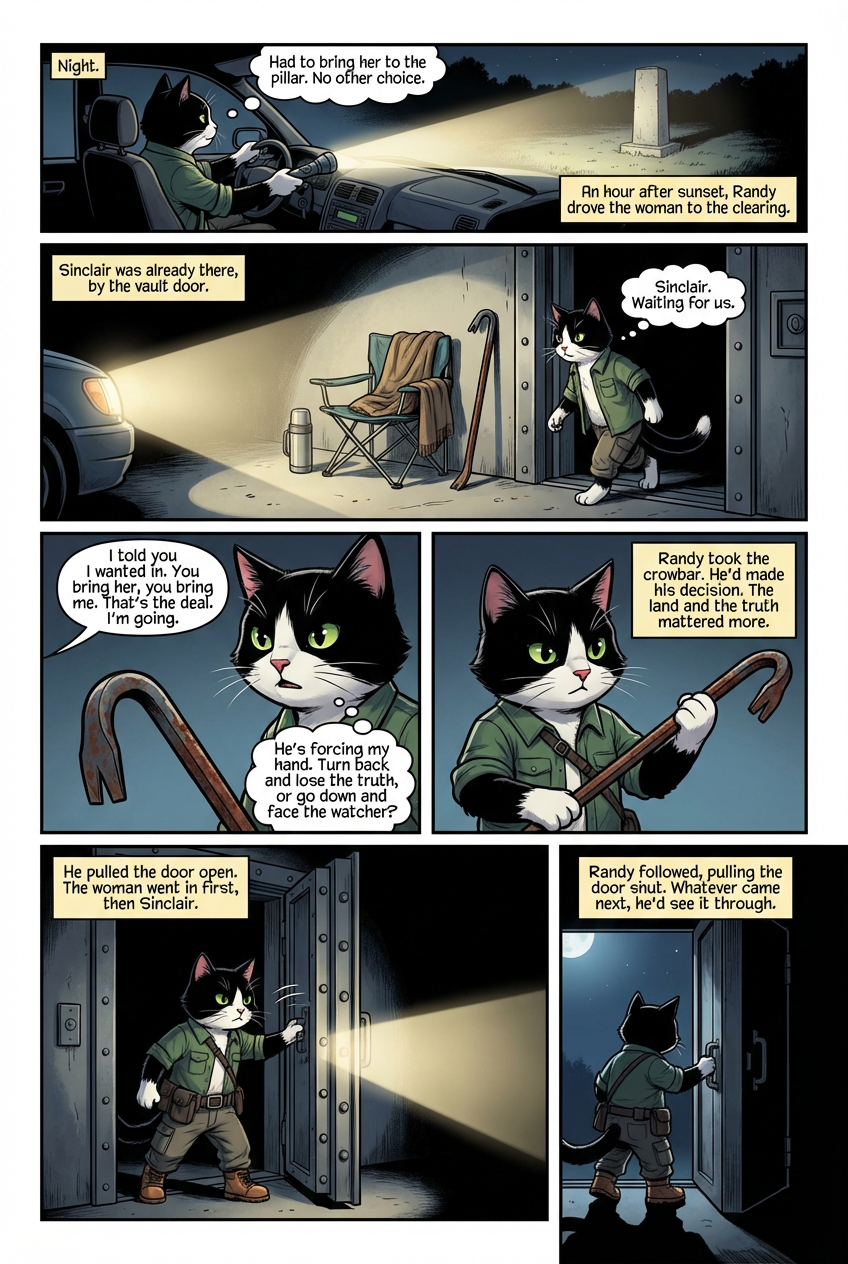
Randy drove the woman to the clearing where he'd found the dead man three weeks ago. The sun had set an hour before, and the headlights cut across empty ground until he stopped twenty feet from the concrete pillar. He left the engine running and handed her the flashlight from his glove box. Sinclair was already there. He sat in a folding chair next to the vault's steel security door, a blanket draped over his knees and a thermos at his feet. A crowbar leaned against the door frame — old metal, rust-stained, with dark patches that could have been blood or just decades of corrosion. Sinclair didn't stand when Randy's headlights swept over him. He just lifted one hand in greeting and stayed put. Randy killed the engine and stepped out. The woman followed, her hand on the door frame like she was deciding whether to stay or bolt. Randy walked toward Sinclair slowly, keeping his posture loose. Sinclair had positioned himself between them and the entrance, and the crowbar was close enough to his chair that Randy understood the message. Sinclair wasn't leaving, and he wasn't asking permission. "I told you I wanted in," Sinclair said. "You bring her, you bring me. That's the deal." He stood and picked up the crowbar, holding it low but ready. "You can pull me out, or you can follow me down. But I'm going." Randy looked at the woman. She was staring at the door, her jaw set. Then he looked back at Sinclair, who'd been sitting out here in the dark with a weapon and a chair, waiting for exactly this moment. Randy had brought someone else into this, and now Sinclair was forcing the choice Randy had been avoiding since the watcher locked that gate. He could turn around, protect what he had left, and lose access to the truth sitting under his land. Or he could go back down with two people who had their own reasons for being there, and deal with whatever the watcher did when they found out. Randy took the crowbar from Sinclair's hand and tested its weight. Then he turned toward the door and pulled it open. The woman went in first, her flashlight beam cutting down the tunnel. Sinclair followed, and Randy came last, pulling the door shut behind them. He'd made his decision. The land mattered more than the business, and the truth mattered more than safety. Whatever came next, he'd see it through.
Play your story to life
Storycraft is a mobile game where you create AI characters, craft items and locations to build their world, then discover what direction your story takes. Download the iOS game for free today!
Download for free