

Ren Frost's Arc
13 Chapters
Ren Frost's dream is opening a sanctuary that rescues every abandoned animal in Jokulmere while attempting to win back her crush before Christmas.

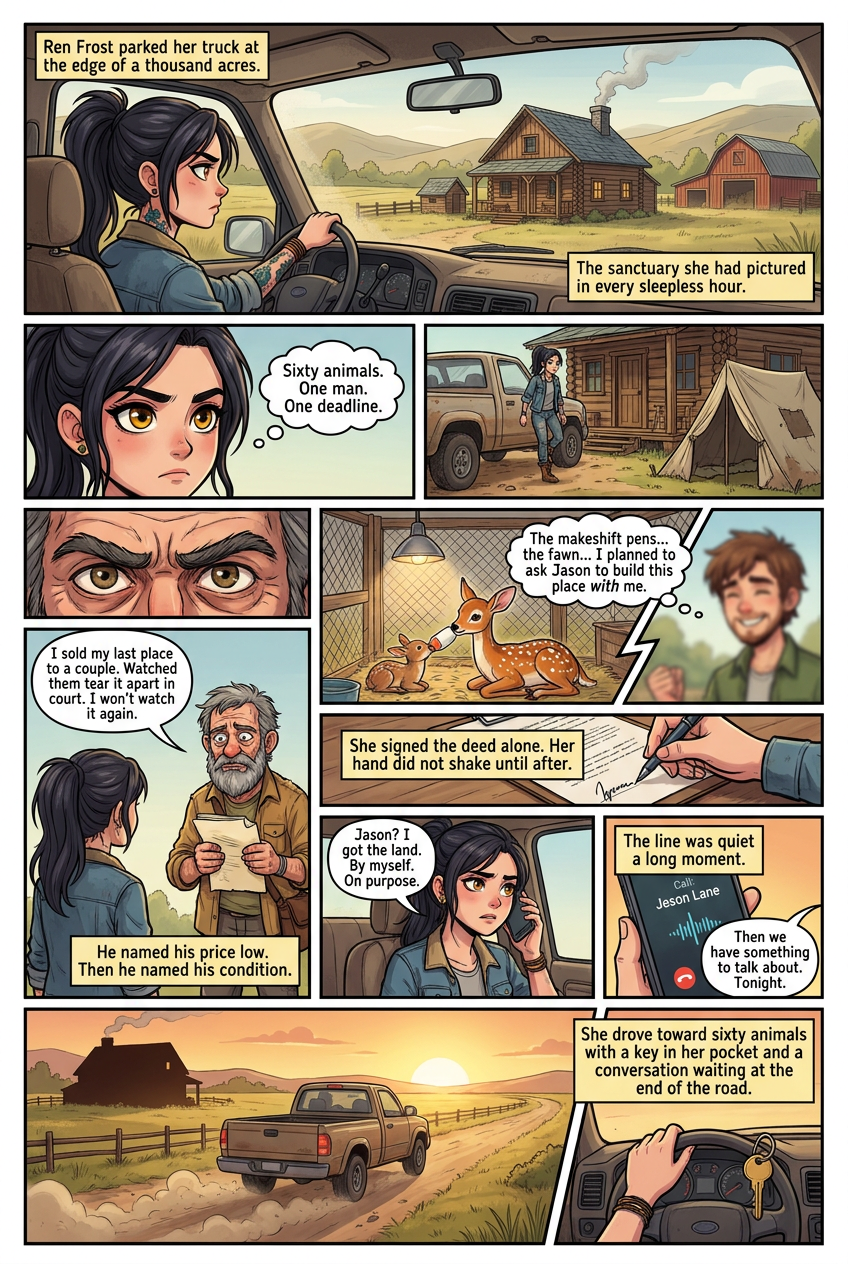
Ren Frost parked her truck at the edge of a thousand acres and tried to count what mattered. Sixty animals in her care. One man she still loved. One deadline pinned to Christmas. The land in front of her could hold them all — rolling pasture, two solid barns, a cabin with smoke curling from the chimney. It was the sanctuary she had pictured in every sleepless hour. The seller met her by a tattered tent pitched near the cabin steps. He held the deed in both hands like it might fly away. He named his price low. Then he named his condition. "You live here alone," he said. "No partners on the paperwork. No co-signers. I sold my last place to a couple. Watched them tear it apart in court. I won't watch it again." Ren thought of the makeshift pens behind her rental — the patched fencing, the heat lamps strung on extension cords, the fawn she'd bottle-fed at two in the morning. She thought of Jason. She had planned to ask him, when she was brave enough, to build this place with her. To put his name beside hers and mean it. She signed the deed alone. Her hand did not shake until after. She called Jason from the truck. He picked up on the second ring. "I got the land," she said. "By myself. On purpose." The line was quiet a long moment. "Then we have something to talk about," he said. "Tonight." She drove toward sixty animals with a key in her pocket and a conversation waiting at the end of the road.
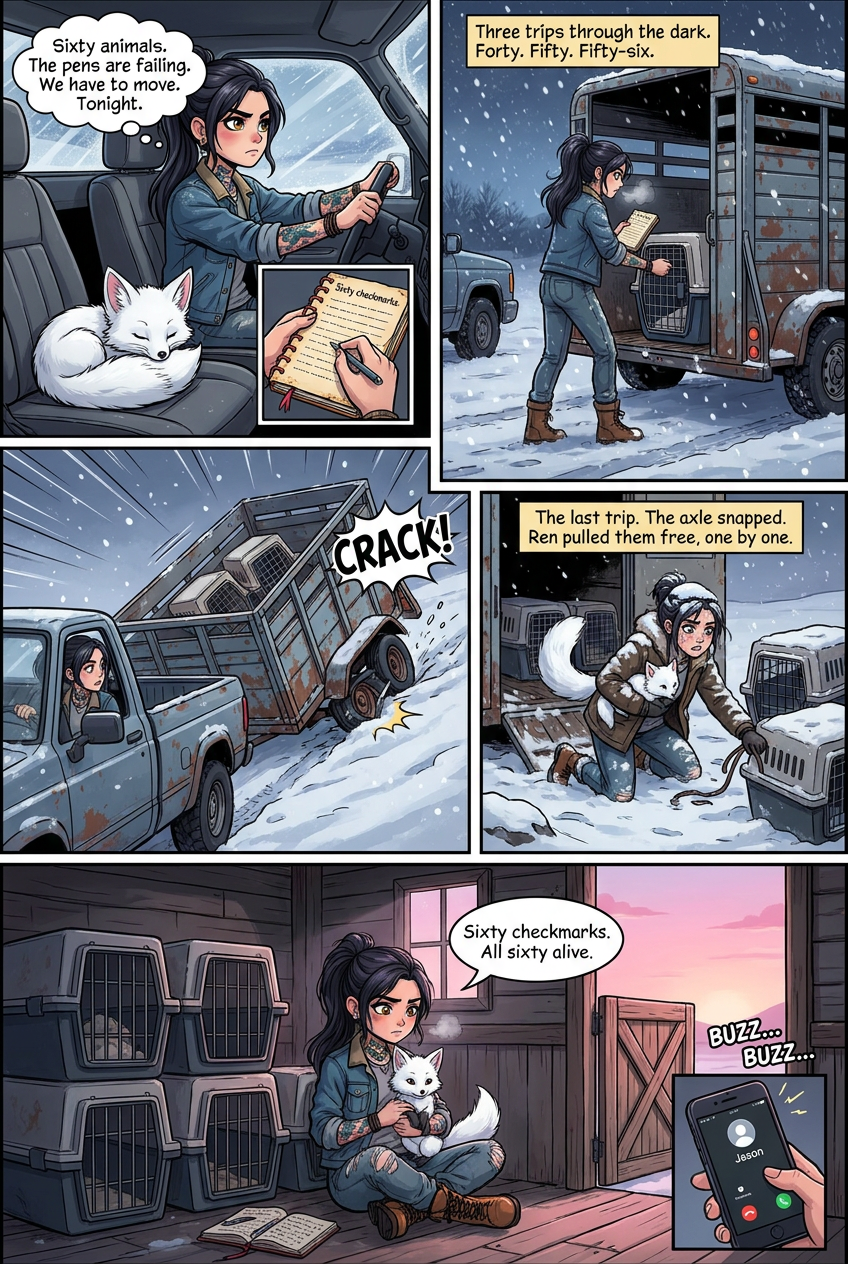
Ren drove home with the deed in her glovebox and Jason's voice still in her ear. The talk would wait. Sixty animals could not. By midnight, her rental pens were failing. A heat lamp shorted. A tarp tore loose. The baby fox shivered against her chest, white fur dim with sleet. She made a choice. Tonight. All of them. To the new land. She hitched the old cattle trailer to her truck. The tires were soft. The axle wore a thick crust of rust. She loaded kennels two high, checking each name in her notebook as she went. Fox. Fawn. Owl. Cub. Sixty lines, sixty checkmarks waiting. Three trips through the dark. Snow fell heavier each hour. Her hands cracked on the latches. The notebook pages curled with damp, but she marked every animal in and every animal out. Forty. Fifty. Fifty-six. The last trip held four. The trailer groaned up the long drive toward the cabin. Then a sound like a gunshot. The axle snapped. The trailer tipped sideways into the ditch, kennels sliding, the fox screaming a thin sharp cry. Ren crawled into the wreck on her elbows. She pulled each kennel free, one by one, and carried them through the snow to a small weathered shed near the cabin. The door hung crooked. The roof held. She stacked the last four kennels inside and opened her notebook with shaking fingers. Sixty checkmarks. All sixty alive. She sat on the shed floor with the fox in her coat and watched dawn turn the pasture pink. The animals were home. The trailer was scrap. Her phone buzzed against her hip. Jason. She let it ring once, twice, then pressed it to her ear.
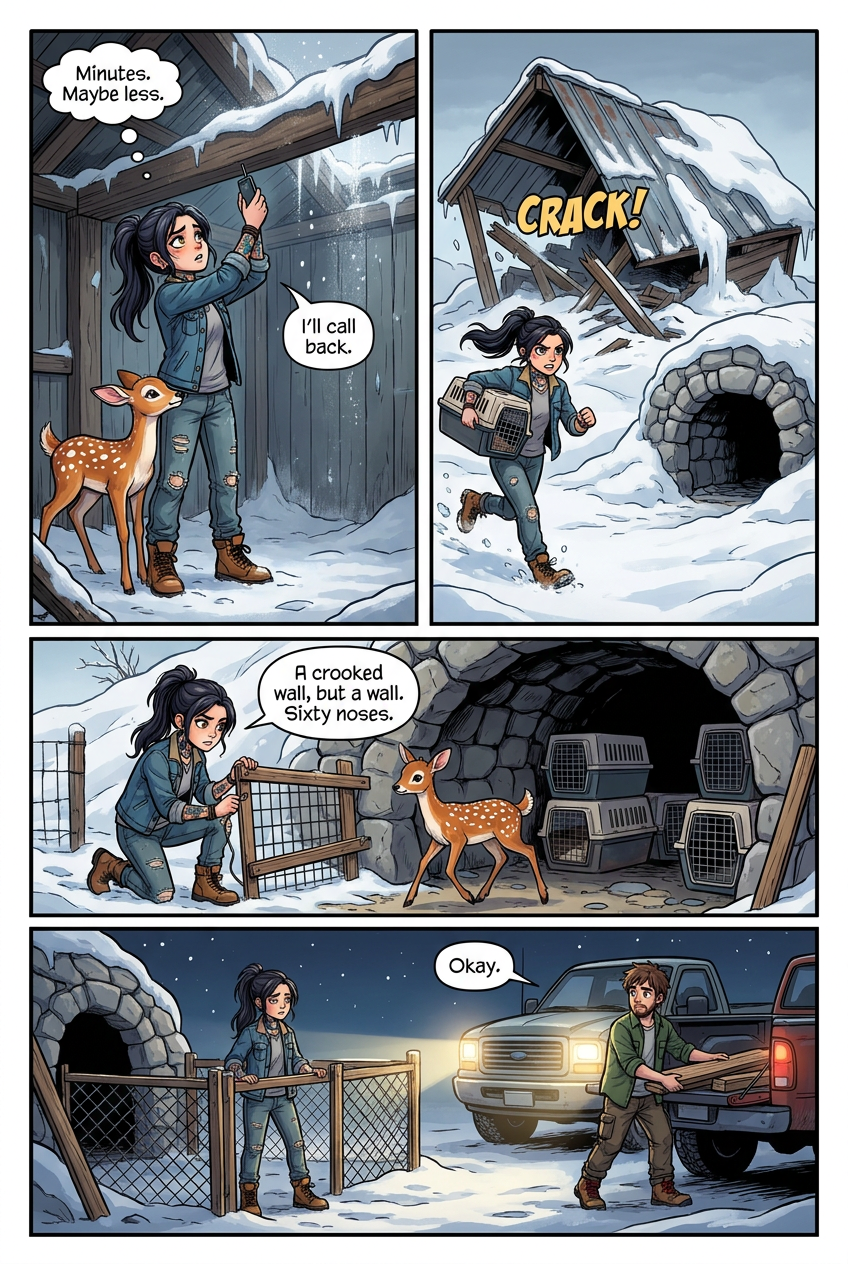
Ren told Jason she'd call back. She hung up before he could answer. A low groan came from the shed roof above her head. Snow hissed down the seams. She looked up and saw the center beam bow like a tired spine. She had minutes. Maybe less. The fawn pressed against her boot, ears flat. Ren grabbed the first kennel and ran. The old stone cave sat at the pasture edge, half buried in drift. Hunters had used it once. The rock overhang held the snow off. She kicked the entrance clear and shoved kennels deep against the back wall, two and three high. She sprinted back. Six trips. Eight. Her lungs burned. Behind her the shed roof folded inward with a wet crack, beams snapping, ice sheets sliding off the bent metal into the snow. The doors hung open on a ruin. The loose animals had nowhere to stand. Ren dragged fence panels from the trailer wreck and wired them to the cave mouth, lashing scrap board across the gaps. A crooked wall, but a wall. The fawn went in last. Ren counted sixty noses in the dark. Headlights swept the drive. Jason's truck. He climbed out, looked at the caved shed, then at her makeshift pen. He said one word. "Okay." Then he started unloading lumber from his bed.
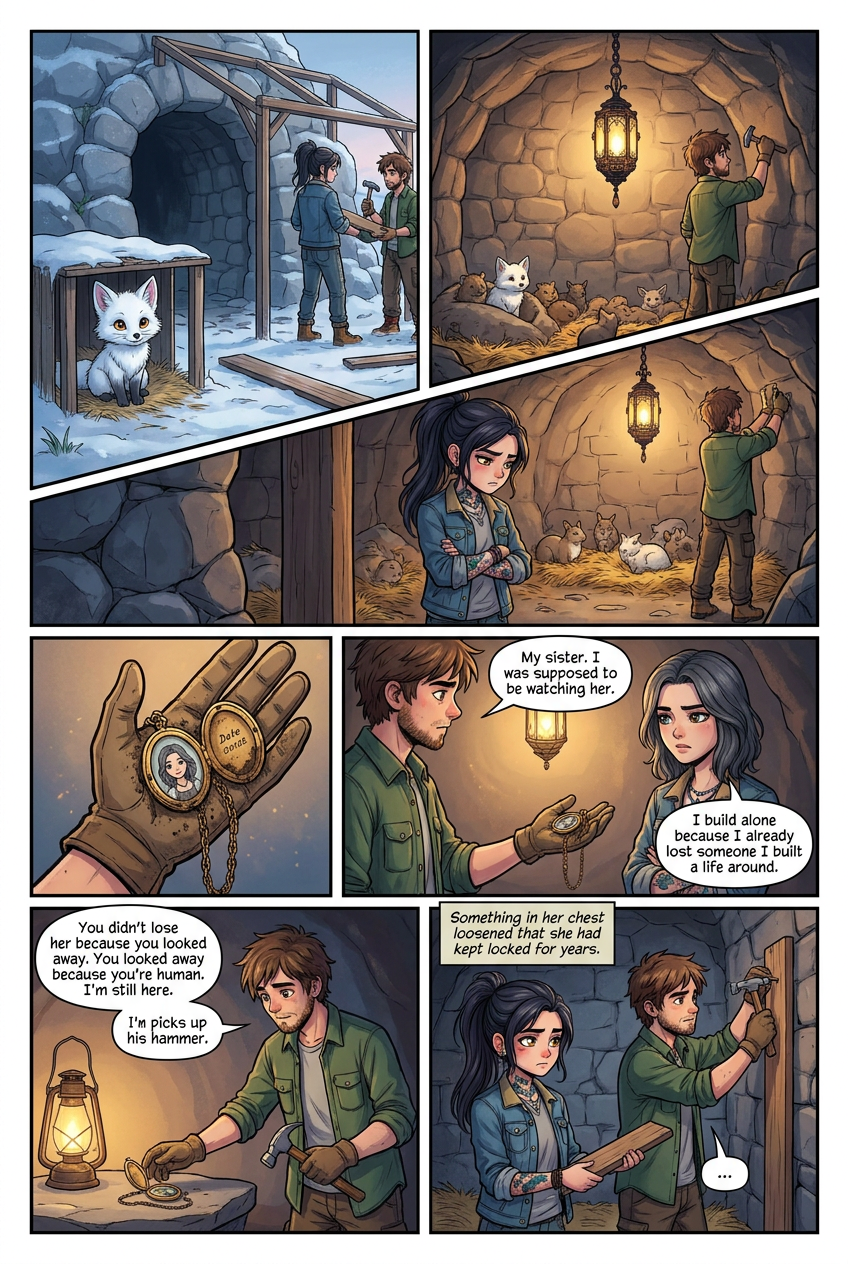
Jason worked at the cave mouth without asking what Ren needed. He raised posts. He nailed crossbeams. By dawn a sturdy wooden frame stretched from the rock, a small roof angled to throw the snow. Ren passed him boards in silence. He took them in silence. The fox kit watched from a kennel, eyes bright. Inside, Jason hung a lamp from a spike he drove into the stone. The flame caught. Warm light spilled across straw and fur and the cold gray walls. Sixty animals shifted in the new glow. Ren saw her own hands shaking and tucked them under her arms. They kept working. Jason swept a corner clear for feed bins. His boot caught on something small. He bent and picked it up. A locket, the chain snapped, the clasp packed with old dirt. He opened it. A girl's face looked back. A date was scratched inside the lid. He held it out on his palm. He did not ask. Ren stared at it a long moment. "My sister," she said. "I was supposed to be watching her." Her voice stayed level. "I build alone because I already lost someone I built a life around." Jason closed his hand around the locket. He set it gently on a flat stone near the lamp, where she could reach it. "You didn't lose her because you looked away," he said. "You looked away because you're human." He picked up his hammer. "I'm still here." Ren did not answer. She picked up a board and held the end while he drove the nail. The wall grew between them, post by post. Something in her chest loosened that she had kept locked for years. She did not say thank you. She handed him the next board. That was the answer.
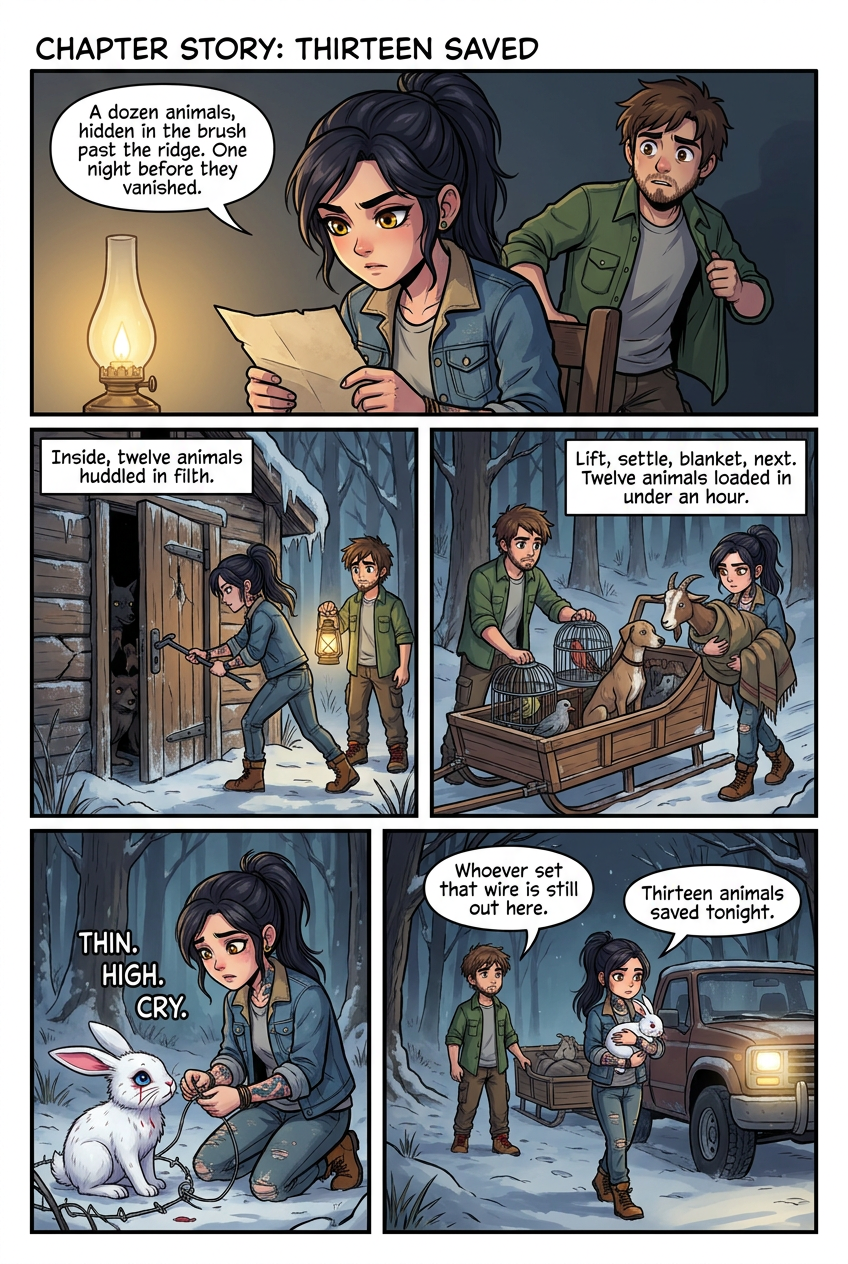
The pigeon had come at dusk, a smudged note tied to its leg. Ren read the crooked words twice by lamplight. A dozen animals, hidden in the brush past the ridge. One night before they vanished. She showed Jason. He read it once and reached for his coat. They found the shack tucked in dense brush, planks cracked, door padlocked. Ren snapped the latch with a pry bar. Inside, twelve animals huddled in filth — goats, a pair of lambs, a thin dog, cages of birds. She did not stop to feel anything. She opened crates and lifted bodies into her arms. Jason had the sled waiting at the tree line, a wide wooden hauler he'd hitched behind the truck. They worked in the same silent rhythm as the cave. Lift, settle, blanket, next. Twelve animals loaded in under an hour. Ren shut the tail gate and let out one slow breath. Then the cry came. Thin. High. Deep in the snowy woods behind them. Jason's head turned. Ren was already moving, lamp swinging, boots breaking crust. She found it in a snare wire — a small white rabbit, blue eyes wide, blood beading at its cheek. The wire had cut to bone. Ren knelt in the snow and worked the loop loose with shaking fingers. The rabbit did not struggle. She tucked it inside her coat against her ribs. Jason met her at the sled. He looked at the bundle in her coat. He looked at the dark woods. "Whoever set that wire is still out here," he said. Ren nodded once. She climbed into the truck with the rabbit warm against her. Thirteen animals saved tonight. One trap left in the snow, and someone who would notice it sprung by morning.
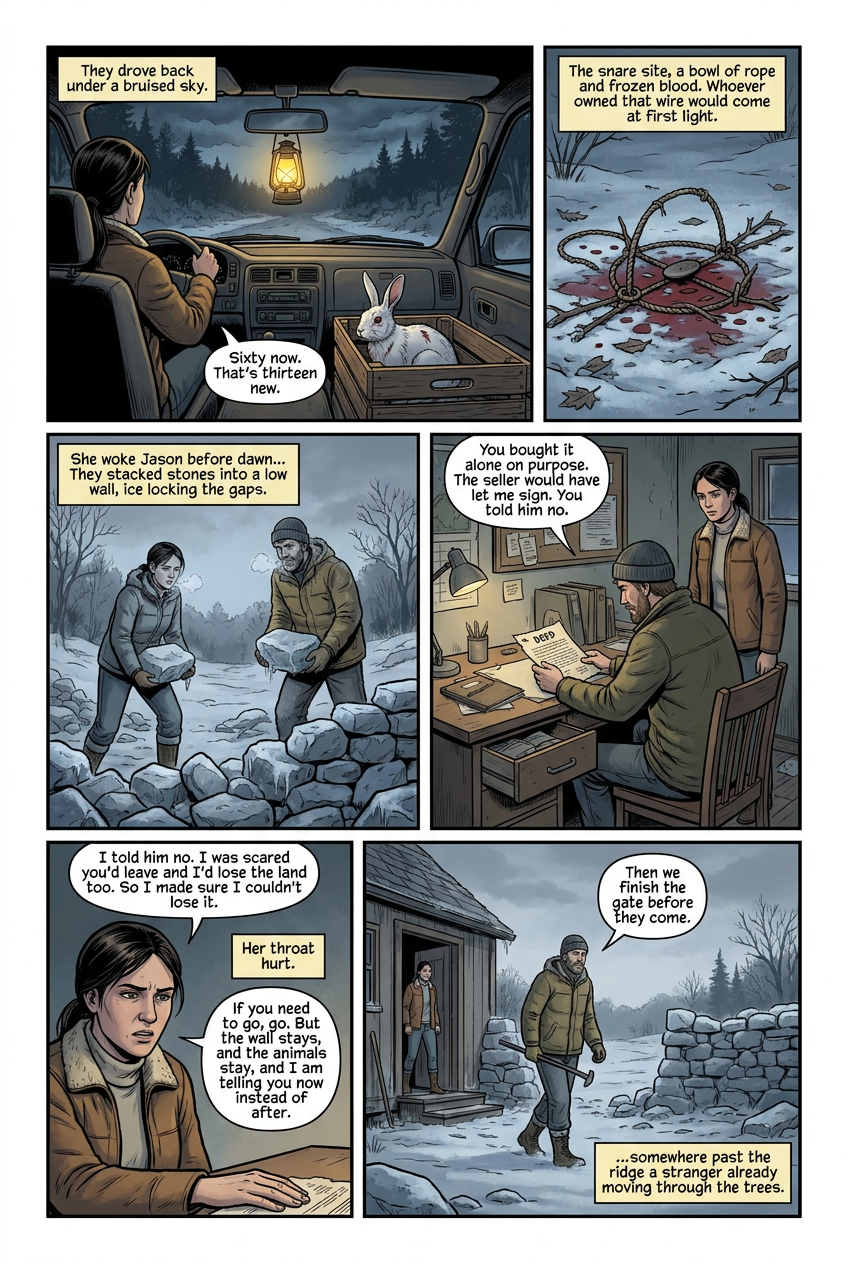
They drove back under a bruised sky. Ren settled the rabbit in a crate near the cave lamp and counted heads by habit. Thirteen new. Sixty before. The snare site was a mile behind them in the dark, a bowl of rope and bent twigs sitting in a pool of frozen blood. Whoever owned that wire would walk to it at first light. She had hours. She woke Jason before dawn and they hauled stones from the pasture edge to the only road wide enough for a truck. They stacked them into a low wall, ice locking the gaps as they worked. It would not stop a person. It would slow one, and force them to be seen. Ren drove the last rock down with the flat of her boot and stepped back. Jason went to the cabin for the second pry bar. He was gone too long. When Ren followed, she found him in the small office off the kitchen, the desk drawer open, a tattered page in his hand. The deed. Her name on the line. No second line at all. "You bought it alone on purpose," he said. He did not look up. "The seller would have let me sign. You told him no." "I told him no," Ren said. Her throat hurt. "I was scared you'd leave and I'd lose the land too. So I made sure I couldn't lose it." She set her hand flat on the desk. "I should have asked you. I didn't. If you need to go, go. But the wall stays, and the animals stay, and I am telling you now instead of after." Jason folded the deed. He set it down. He picked up the pry bar. "Then we finish the gate before they come," he said, and walked past her toward the door. She followed him out into the gray light, the truth spoken, the wall waiting, and somewhere past the ridge a stranger already moving through the trees.
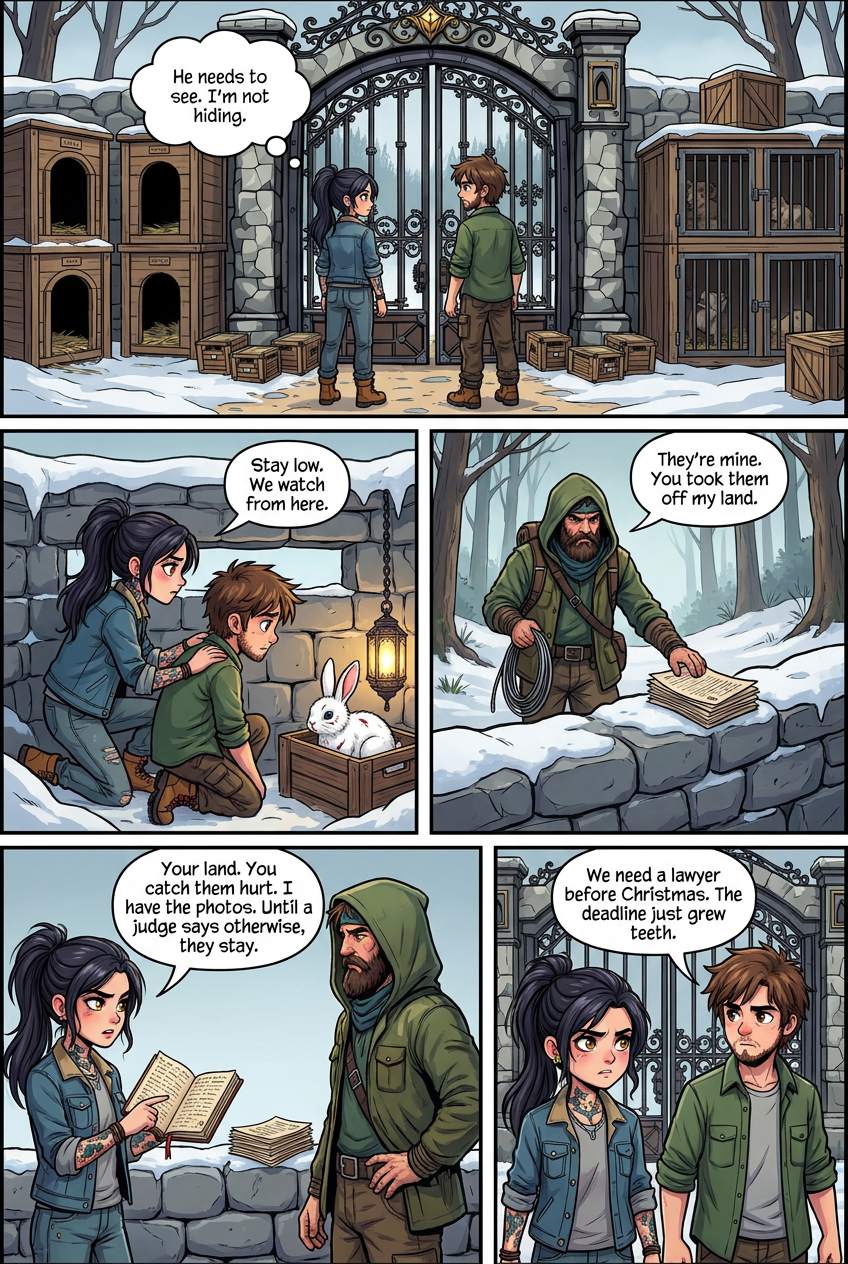
By full light the gate was hung. Iron bars, scrap kennels stacked on either side, crates of feed showing through the rails. Anyone walking up would see the size of it and know there were animals behind. Ren wanted him to see. She wanted him to know she was not hiding. She pulled Jason back from the road. They worked fast on a low blind near the pasture edge — a small stone hide, snow piled on the roof, a slit to watch the wall through. From inside it she could see the treeline and not be seen. The wounded rabbit thumped once in its crate by the cave lamp. Seventy-three animals breathed behind the gate. He came out of the trees at a broken pine, hood up, a length of wire in his fist. He stopped at the wall. He did not climb it. He laid papers on the top stone and stepped back so she would have to come out to read them. Ren went. Jason followed two steps behind her. The papers were real enough — stamps, a printed list, twelve animals by description. Fox. Owl. Fawn. The rabbit. His name on every line. "They're mine," the stranger said. "You took them off my land." "Your land," Ren said. She held up her notebook. Snare marks. Wire cuts. A leg broken in a jaw trap and set wrong on purpose. "You catch them hurt. You sell them rescued. I watched the rabbit bleed in your wire." She set the notebook on the stone beside his papers. "Take me to court. Bring the documents. I'll bring the animals and the photos. Until a judge says otherwise, they stay." He looked at the gate. He looked at Jason. He folded his papers slowly and walked back into the trees without a word. Ren stood at the wall until he was gone. Her hands were shaking. The animals were hers for today. Tomorrow a summons could come, or worse — him back at dark with different tools. She turned to Jason. "We need a lawyer before Christmas," she said. He nodded once. The deadline had just grown teeth.
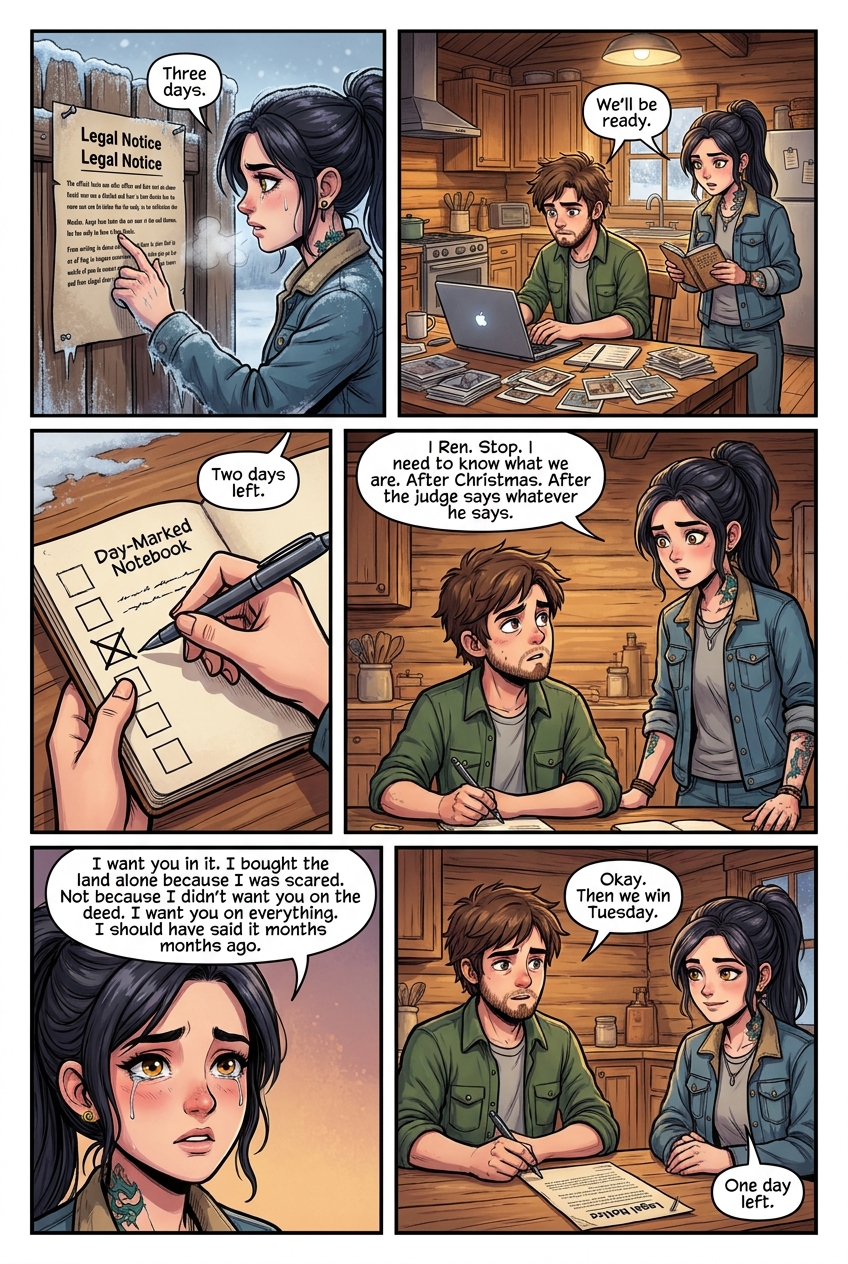
The notice was nailed to the gate before sunrise. Ren found it stiff with frost, the seal smudged, the court date printed in black: December 24. Three days. She tore it free with shaking hands and carried it to the cabin without a word. Jason cleared the kitchen table and turned it into a desk. Photos in one pile. The injury log in another. A laptop borrowed from town humming between them. Ren opened a small notebook and marked three squares on the back page. One for each day left. They worked past dark. Then Jason set down his pen. "Ren. Stop." She looked up. His face was tired in a way the work hadn't made. "I need to know what we are. After Christmas. After the judge says whatever he says." He kept his hands flat on the table. "I can't keep building this without knowing if you want me in it." Her throat closed. She thought of every cancelled dinner, every 2am call, every word she had not said. She crossed out a square on the notebook. "I want you in it," she said. "I bought the land alone because I was scared. Not because I didn't want you on the deed. I want you on everything. I should have said it months ago." Jason didn't smile. He just nodded once, slow, and picked his pen back up. "Okay," he said. "Then we win Tuesday." Two squares left on the page. The notice lay between them, no longer a threat alone — now a date they were walking toward together.
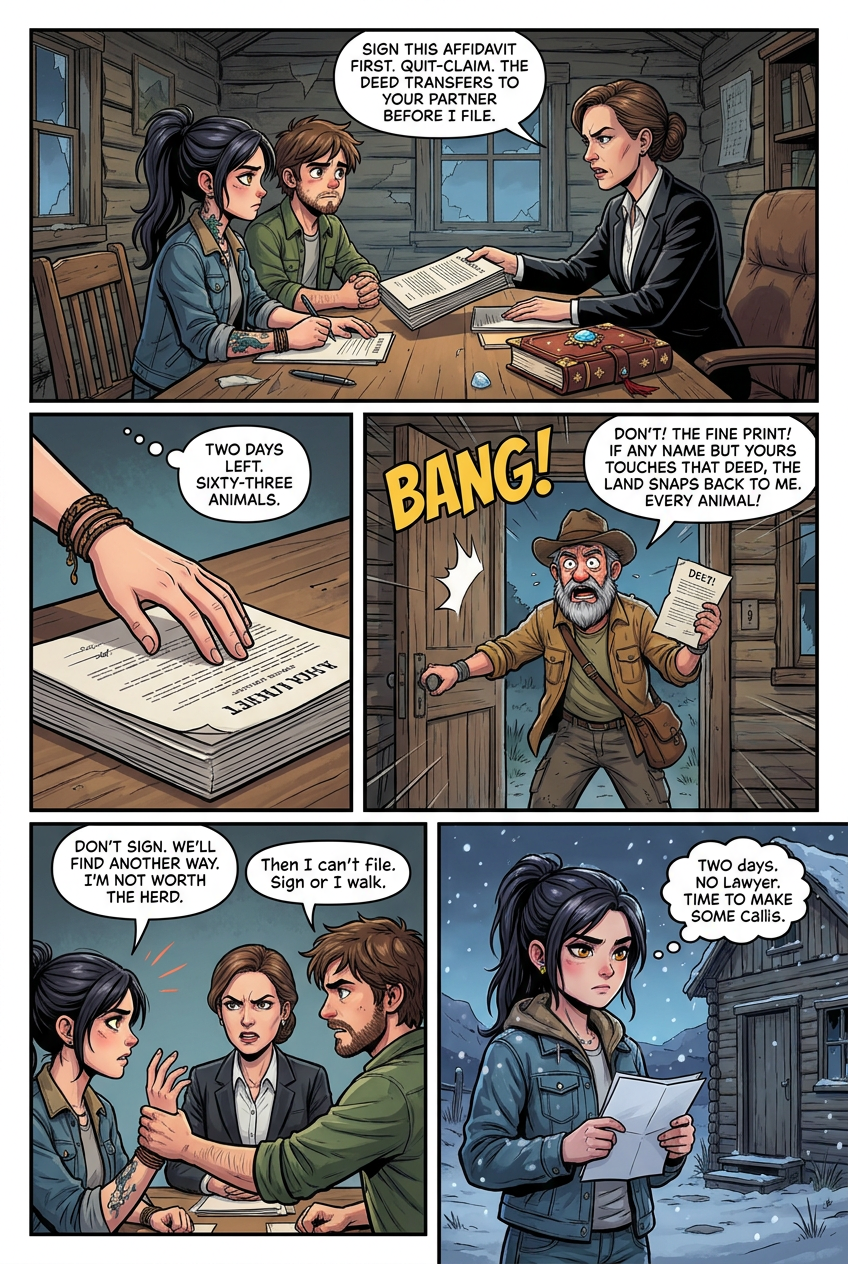
By dawn they had a name and an address. The only lawyer who would touch the case before Christmas worked out of a rundown cabin at the edge of town, its roof sagging, its windows patched with tape. Ren and Jason climbed the crooked step and knocked. The lawyer waved them to a crowded desk and slid a thick packet across the wood. Then she set a small leather book beside it, a pale crystal pressed into its cover. "Sign this affidavit first," she said. "Quit-claim. The deed transfers to your partner before I file. I don't fight for clients who can walk away mid-trial." Jason went still. Ren picked up the pen. Two days left. Sixty-three animals in a cave. She thought of every square she had not yet crossed out, and pressed the nib to the page. The cabin door banged open before the ink dried. The old seller stood there, hat crooked, breath fogging, a folded paper shaking in his fist. "Don't," he wheezed. "The fine print. Read it. If any name but yours touches that deed, the land snaps back to me. Every fence. Every shed. Every animal standing on it." Ren lifted the pen. Her hand hung in the air above the affidavit, frozen. The lawyer's face went hard. "Then I can't file," she said. "Sign or I walk. Those are the terms." Jason set his hand over Ren's wrist. "Don't sign," he said quietly. "We'll find another way. I'm not worth the herd." Ren put the pen down. The lawyer closed the packet and pushed it back across the desk. Outside, the seller was already gone. Two days left, no lawyer, and a deed that would devour everything she loved if she shared it. Ren folded the affidavit into her coat and stepped into the cold, already counting who she could call before dark.
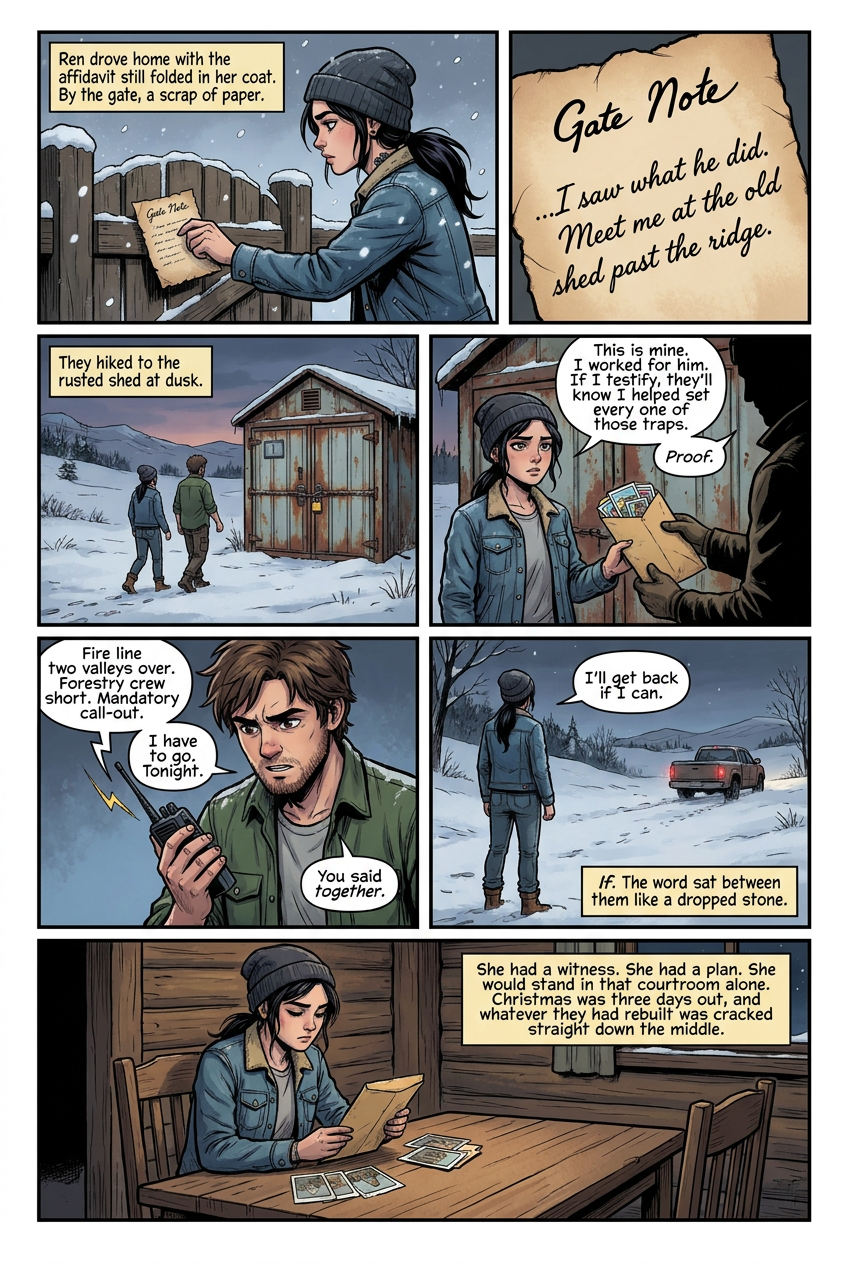
Ren drove home with the affidavit still folded in her coat. By the time she reached the gate, a scrap of paper was tucked into the latch. Elegant handwriting. A time, a place, a single line: I saw what he did. Meet me at the old shed past the ridge. She read it twice and showed Jason without a word. They hiked to the rusted shed at dusk. A stranger waited by the padlocked hatch, breath shaking. He slid a worn manila envelope into Ren's hands. Photographs. Snares, cages, dates. Proof. "This is mine," he said. "I worked for him. If I testify, they'll know I helped set every one of those traps. I lose this shed. I lose everything I kept hidden inside it." Ren looked at the photos and felt her case rise from the snow. "I'll go to court myself," she said on the walk back. "No lawyer. No deed transfer. Just me and the envelope." Jason was quiet for a long stretch. Then his radio crackled. A fire line two valleys over. Forestry crew short. Mandatory call-out. He listened, jaw tight. "I have to go," he said. "Tonight." Ren stopped in the snow. "Court is in two days." "I know." "You said together." "I know what I said." He didn't dress it up. He didn't promise. He just looked at her, then past her, already gone in the way that mattered. "I'll get back if I can." If. The word sat between them like a dropped stone. She watched his truck pull away before midnight. Inside the cabin, the envelope lay on the table beside the unsigned affidavit. She had a witness. She had a plan. She would stand in that courtroom alone. But the chair across from her was empty again, and this time he had chosen the leaving. Christmas was three days out, and whatever they had rebuilt was cracked straight down the middle.
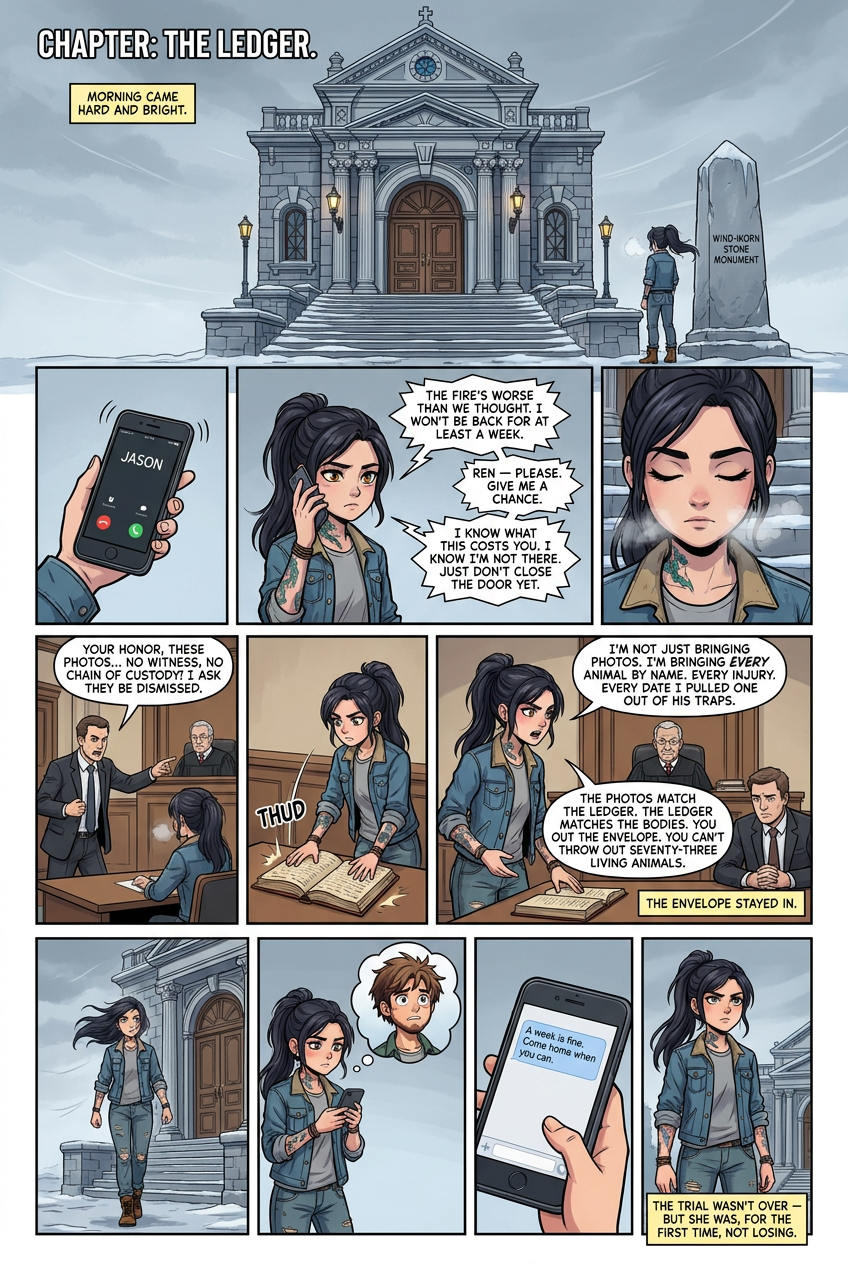
Morning came hard and bright. Ren parked at the foot of the courthouse and stood a moment beside the wind-worn stone marker at the curb. The icy steps climbed up to the heavy wooden doors. The envelope was tucked inside her coat. Beside it, the weathered ledger of names — every animal, every date, every wound recorded in her own hand. She climbed alone. Her phone buzzed before she reached the top step. Jason. She almost didn't answer. It went to voicemail. His voice came through low and tired. "The fire's worse than we thought. I won't be back for at least a week. Ren — please. Give me a chance. I know what this costs you. I know I'm not there. Just don't close the door yet." The message ended. She stood very still on the cold stone. Inside, the stranger's lawyer was already on his feet. He moved fast. The photographs were obtained without testimony, he said. No witness, no chain of custody. He asked the court to throw the envelope out. Ren felt the room tilt. She had come with two things, and he was reaching for one. She stepped forward before the judge ruled. She set the ledger on the table. She opened it to the first page. "I'm not just bringing photos," she said. "I'm bringing every animal by name. Every injury. Every date I pulled one out of his traps. The photos match the ledger. The ledger matches the bodies. You can throw out the envelope. You can't throw out seventy-three living animals." The judge looked at the lawyer. The lawyer sat down. The envelope stayed in. The court recessed until afternoon. Ren walked out into the wind and listened to Jason's message again, all the way through. She didn't call back. Not yet. She typed one line and saved it as a draft: A week is fine. Come home when you can. The envelope was still in. The ledger was open. She was still standing. The trial wasn't over — but she was, for the first time, not losing.
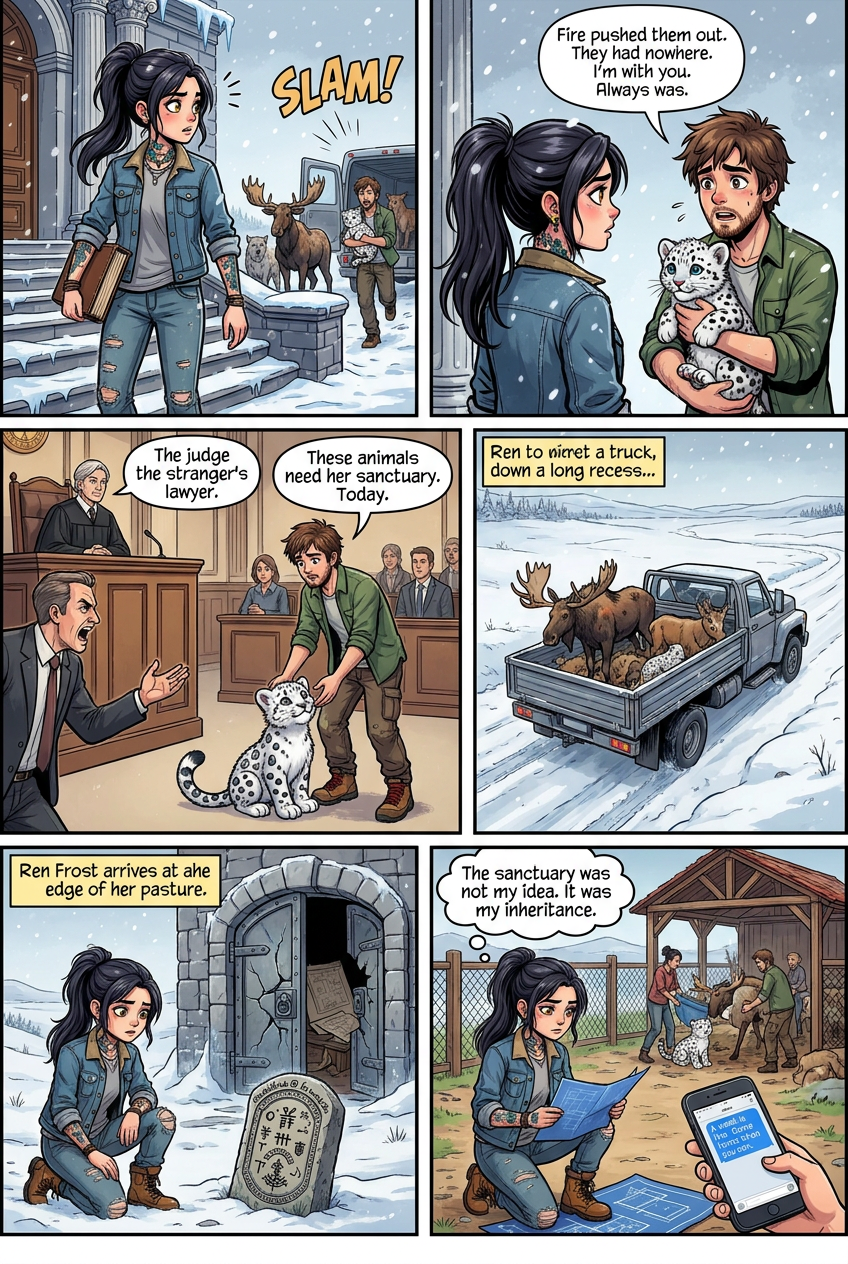
Ren stood at the bottom of the icy courthouse steps, the ledger still warm under her arm. The wind shifted. Behind her, a truck door slammed. She turned. Jason was running. He carried a snow leopard cub against his chest. Behind him, others helped a scorched moose limp forward. Ten wounded animals in all, smelling of smoke and pine. He came straight up the steps. He did not stop until he reached her. "Fire pushed them out," he said. "They had nowhere. I drove all night." He looked at her plainly. "I'm not beside you in there. But I'm with you. Always was." Then he pushed past the bailiff and shouldered the heavy doors open, the cub still in his arms. The judge rose. The stranger's lawyer shouted. Jason set the cub on the floor and stepped back. "These animals need her sanctuary," he said. "Today." The courtroom went quiet around the small, breathing weight of proof. During the long recess that followed, Ren drove home with the wounded in the bed of the truck. At the pasture edge, frost had heaved a weathered stone marker up out of the ground overnight, symbols showing through the dirt. Behind it, the earth had split. Iron doors stood cracked open in a vault of old stone. Inside, plans. Fencing. A blueprint for an ironclad shelter, drawn a hundred years before her. Whoever first held this land had meant it for animals all along. Ren knelt in the snow. The sanctuary was not her idea. It was her inheritance. She sent the draft to Jason: A week is fine. Come home when you can. Then she stood, and began unloading the wounded onto land that had been waiting.
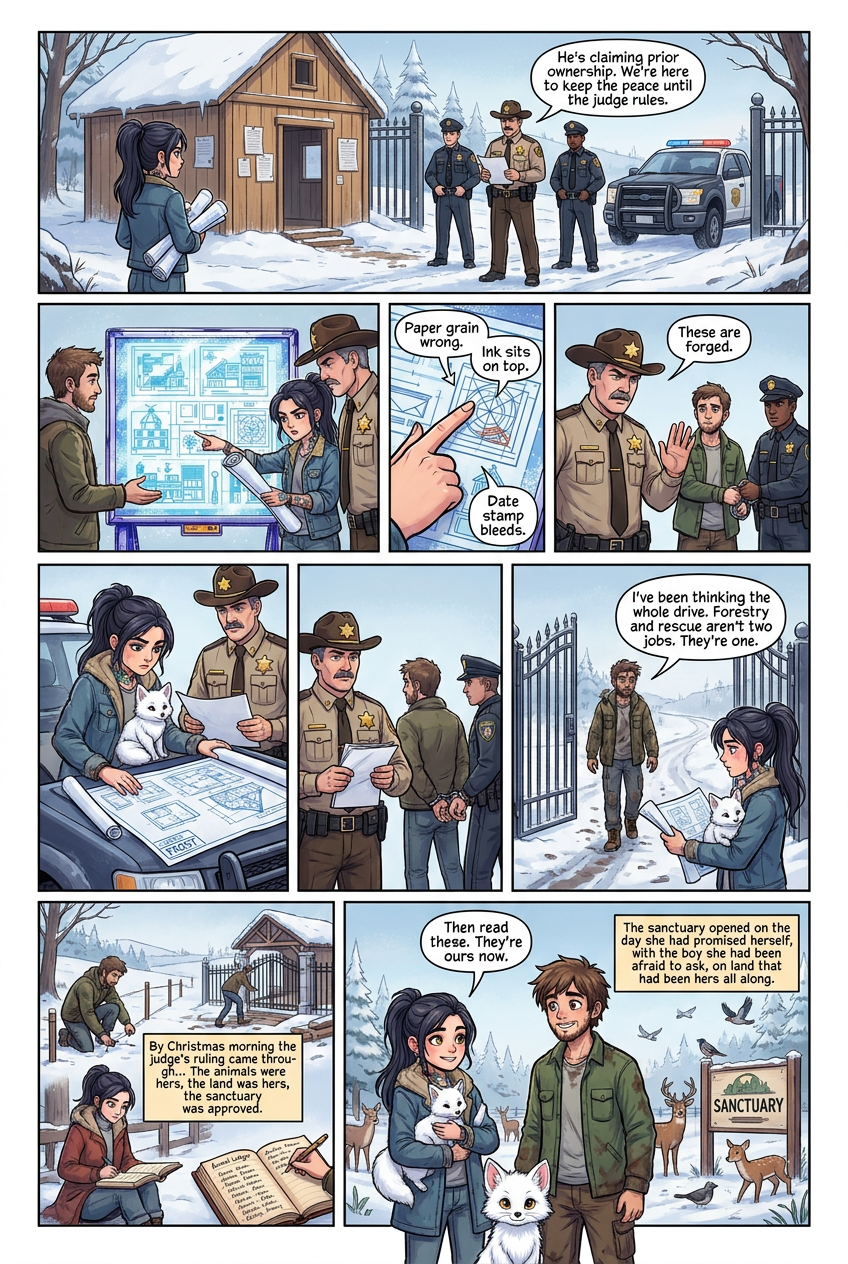
Ren came back from the vault with the blueprints rolled under her arm. A new shape sat outside her gate. The stranger had raised a small wooden shack overnight, papers nailed to its front. Two sheriffs flanked it. A patrol truck idled behind, lights turning slow. The badge on the lead officer's chest caught the gray light. He held out a single page. "He's claiming prior ownership. We're here to keep the peace until the judge rules." The stranger stepped forward and unrolled his proof on a metal stand he'd planted in the snow. Behind glass, frosted at the edges, sat blueprints he said matched the vault. Ren set her own roll beside his. She did not argue. She only pointed. The paper grain was wrong. The ink sat on top, not soaked in. The date stamp bled where it should have been clean. The lead sheriff leaned close. He frowned. He looked again. Then he looked at the stranger. "These are forged," the sheriff said. He said it plainly, the way you read a weather report. The stranger started to speak. The sheriff lifted one hand and the words stopped. The second officer was already reaching for his cuffs. Ren unrolled her own pages across the hood of the patrol truck. A baby fox, white as the snow it sat in, watched from inside her coat. The real blueprints showed more than a sanctuary. They showed a family name in the corner block — her name. Her mother's mother's mother. The land had been waiting for her by blood. The sheriff read it twice. He folded the forged page in half and put it in his pocket as evidence. A truck door shut behind her. Jason walked up the road with mud on his boots and a week of smoke still in his jacket. He stopped at the gate. He looked at the sheriffs leaving. He looked at her. "I've been thinking the whole drive," he said. "Forestry and rescue aren't two jobs. They're one. Burned land needs animals. Lost animals need land. I want both. Here. With you. All thousand acres." He did not soften it. He did not ask. He only waited. Ren put the blueprints in his hands. "Then read these," she said. "They're ours now." The fox shifted against her chest. The gate stood open behind them. By Christmas morning the judge's ruling came through on paper thinner than the snow on the sill: the animals were hers, the land was hers, the sanctuary was approved. Sixty became seventy-three became more. Jason marked fence lines in the trees. Ren wrote names in her ledger. The sanctuary opened on the day she had promised herself, with the boy she had been afraid to ask, on land that had been hers all along.
Play your story to life
Storycraft is a mobile game where you create AI characters, craft items and locations to build their world, then discover what direction your story takes. Download the iOS game for free today!
Download for free