

Rosie ‘Rustbucket’'s Arc
16 Chapters
Rosie ‘Rustbucket’'s dream is mastering the art of salvaging working parts from pre-war machinery.

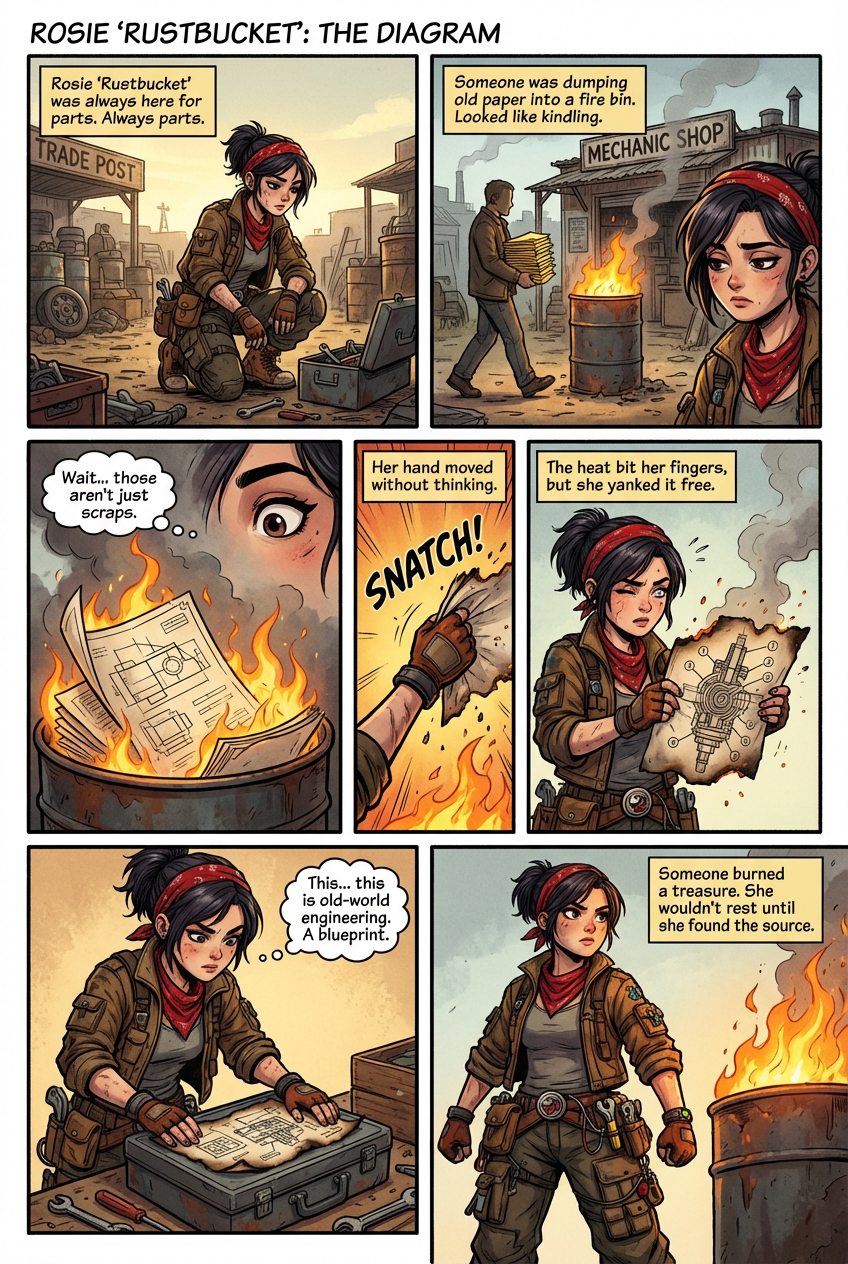
Rosie crouched beside her toolbox in the trade post yard, hands still greasy from the turbine housing she'd been working since dawn. She was here for parts, always parts — anything that might help her crack the next pre-war machine before someone else hauled it off for scrap. A man shuffled past the old mechanic shop across the yard, arms full of yellowed paper. He dumped the stack into a metal bin where flames already licked at twisted cardboard and wood scraps. The paper caught fast, edges curling black. Rosie watched him walk away, then saw it — clean lines and geometric shapes appearing through the smoke. Diagrams. Technical diagrams with the careful precision of old-world engineering. She moved without thinking. Her hand shot into the flames and grabbed the top sheet before the fire consumed it completely. The heat bit her fingers but she yanked the paper free, shaking embers from the charred edges. Half the page was already gone, blackened and crumbling. What remained showed a cross-section of something mechanical, with numbered callouts and connection points she couldn't name but recognized in her bones. Rosie laid the fragment flat on her toolbox lid, smoothing the intact portions carefully. The symbols made no sense to her, but the drawing spoke a language she understood — the language of parts fitting together in precise sequence. Someone had burned a whole pile of these for warmth, thinking them worthless. She looked at the bin, still blazing, and knew she'd be haunting this yard until she found whoever controlled that paper supply.
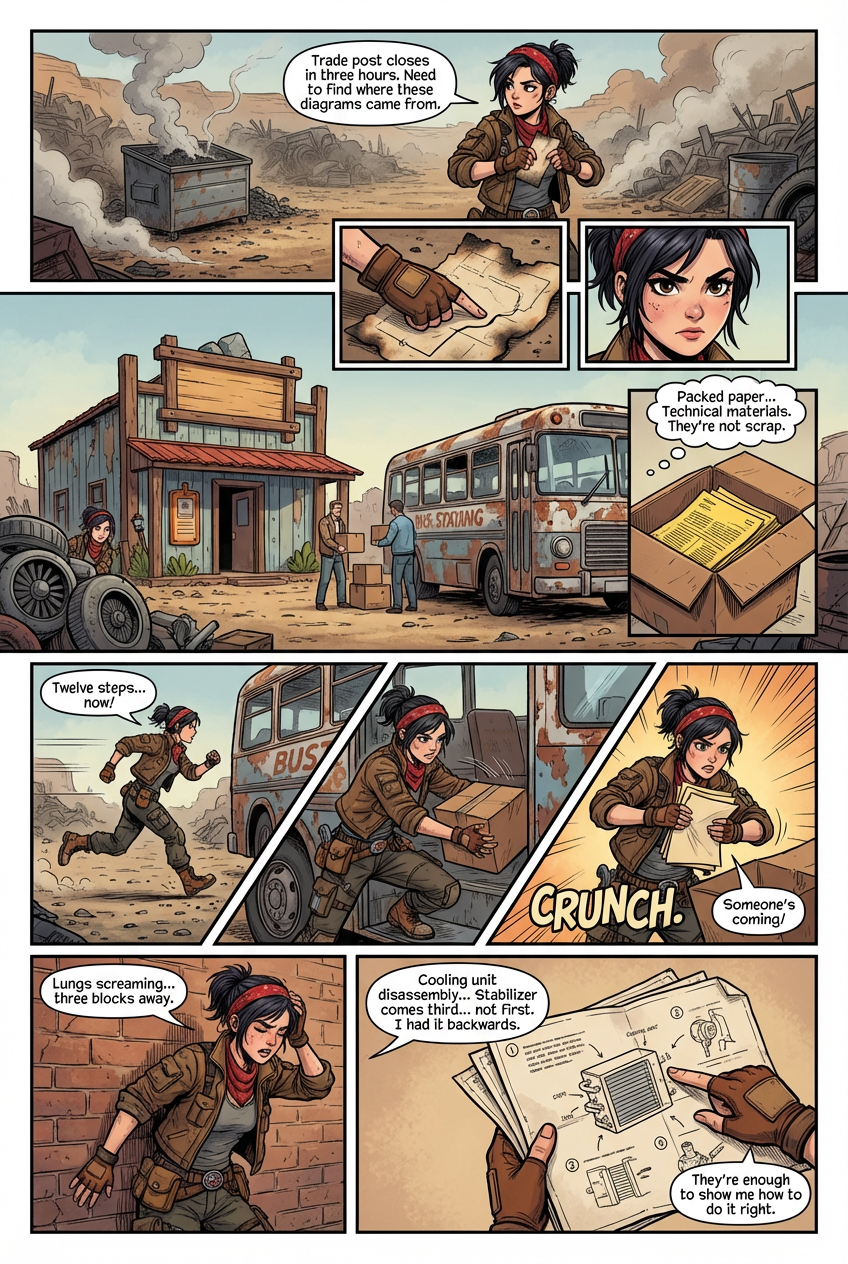
The trade post closed in three hours. Rosie tucked the charred diagram into her jacket and walked the perimeter of the yard, scanning for more paper. The metal bin still smoked near the mechanic shop, ash drifting across the dirt. She needed to know where those diagrams came from before they vanished for good. She found her answer at the old bus station on the edge of the yard. Two men in clean jackets were hauling boxes from the peeling building, loading them onto a rust-patched bus with faded lettering across its side. The boxes moved with careful handling — not scrap, not trash. Rosie watched from behind a stack of turbine housings as they worked. One box tilted and she caught a glimpse of packed paper inside, edges yellow and crisp. Technical materials. Had to be. The men worked fast, checking over their shoulders like they expected someone to notice. When they disappeared inside for another load, Rosie moved. She crossed the yard in twelve steps, grabbed the nearest box from the bus floor, and hauled it behind the turbine stack. Her hands shook as she pulled the first sheet free. Diagrams. Dozens of them. Assembly sequences, pressure tolerances, connection maps — everything she'd been teaching herself through broken housings and cracked chambers. She pulled three more sheets, folding them tight against her chest. Footsteps crunched on gravel. She shoved the box back toward the bus and ran, the papers burning against her ribs like stolen fire. Three blocks away, lungs screaming, Rosie pressed against a wall and unfolded what she'd taken. Four diagrams, all intact. One showed a cooling unit disassembly sequence with numbered steps — the exact order she'd been guessing at for months. She traced the lines with one finger, matching the drawing to the cracked housings in her memory. The stabilizer came third, not first. She'd had it backwards. Behind her, she heard the bus engine turn over, that distant rumble fading into nothing. They'd taken the rest, but she had this. Four diagrams she could study until the lines wore through. It wasn't everything, but it was enough to prove she'd been doing it wrong — and enough to show her how to do it right.
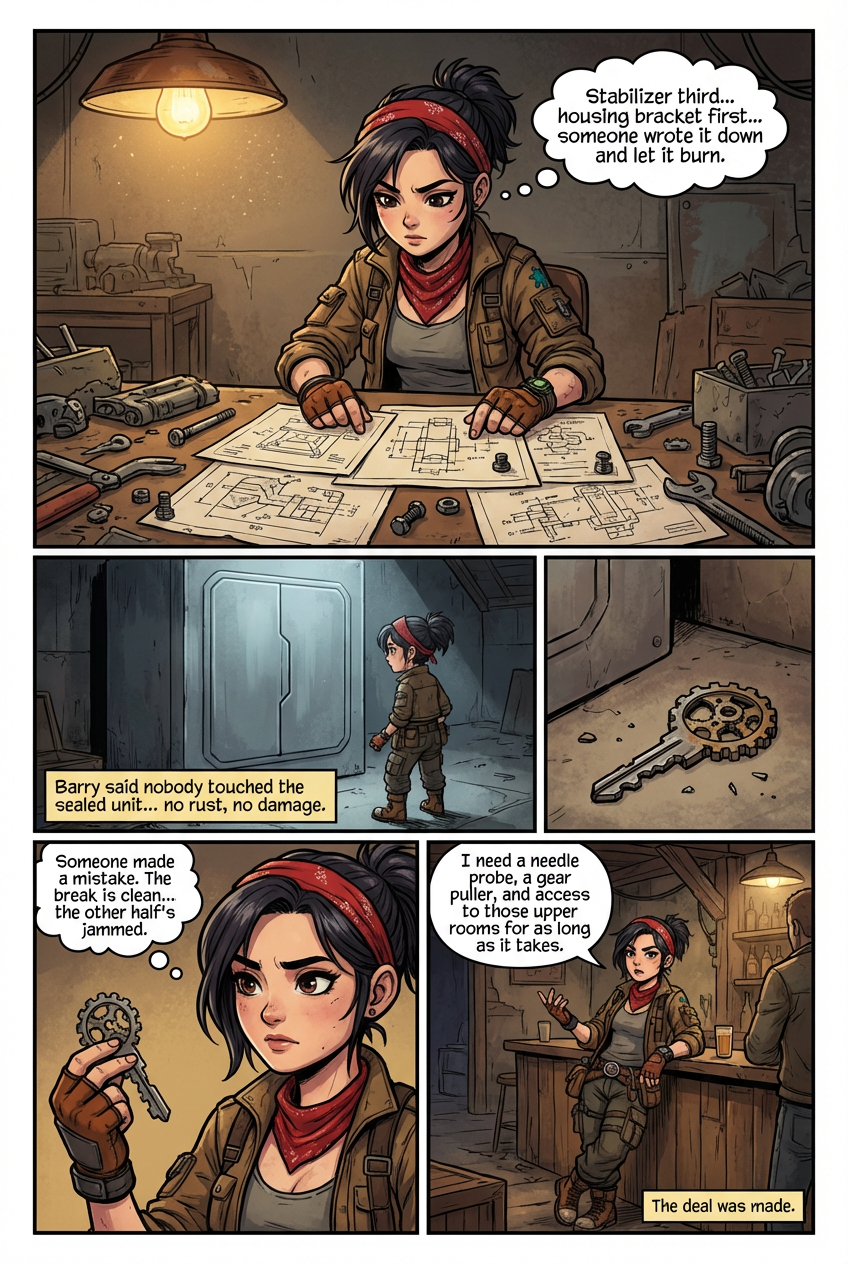
Rosie spread the four diagrams across her workbench that night, weighing down the corners with salvaged bolts. The cooling unit sequence showed everything she'd been getting wrong — the stabilizer third, not first, the housing bracket before the pressure release. She'd cracked three units learning what these papers spelled out in numbered steps. The diagrams proved she could do better, but they also proved someone else had done this work before her. Someone who'd written it all down and then let it burn. Barry mentioned the upper rooms when she traded him a working fuel pump for three nights of shelter. The rooms had been converted into living space, he said, but there was something nobody touched — a sealed unit built into the back wall before the war. Nobody knew how to open it safely, so they'd just built around it. Rosie climbed the stairs after Barry unlocked the door. The unit sat behind a makeshift partition, massive and rectangular, with panels that looked like they'd been designed to slide rather than bolt. No rust. No damage. Just smooth metal with a narrow seam running down the center. On the floor beside it lay half of a broken key, its inner gears exposed where it had snapped. Someone had tried and failed. Rosie knelt and picked up the piece, turning it over in her palm. The break was clean, which meant the other half was probably still jammed in the lock mechanism. She spent two hours tracing the seam with her fingers, testing pressure points, looking for the sequence. The diagrams had taught her that order mattered — that pulling the wrong piece first could crack everything that came after. The key fragment told her someone had already made that mistake. She found the lock slot hidden beneath a sliding cover panel, narrow and deep. The broken key piece was in there, wedged tight. She had no tools to extract it, no way to turn the mechanism with half a key missing. But she understood the problem now. The unit wasn't impossible to open — it was just waiting for someone patient enough to solve it in the right order. She pocketed the key fragment and headed back downstairs. Barry was wiping down glasses behind the bar. She told him she'd need three things: a needle probe, a gear puller, and access to those upper rooms for as long as it took. He nodded once and poured her a drink. The deal was made.
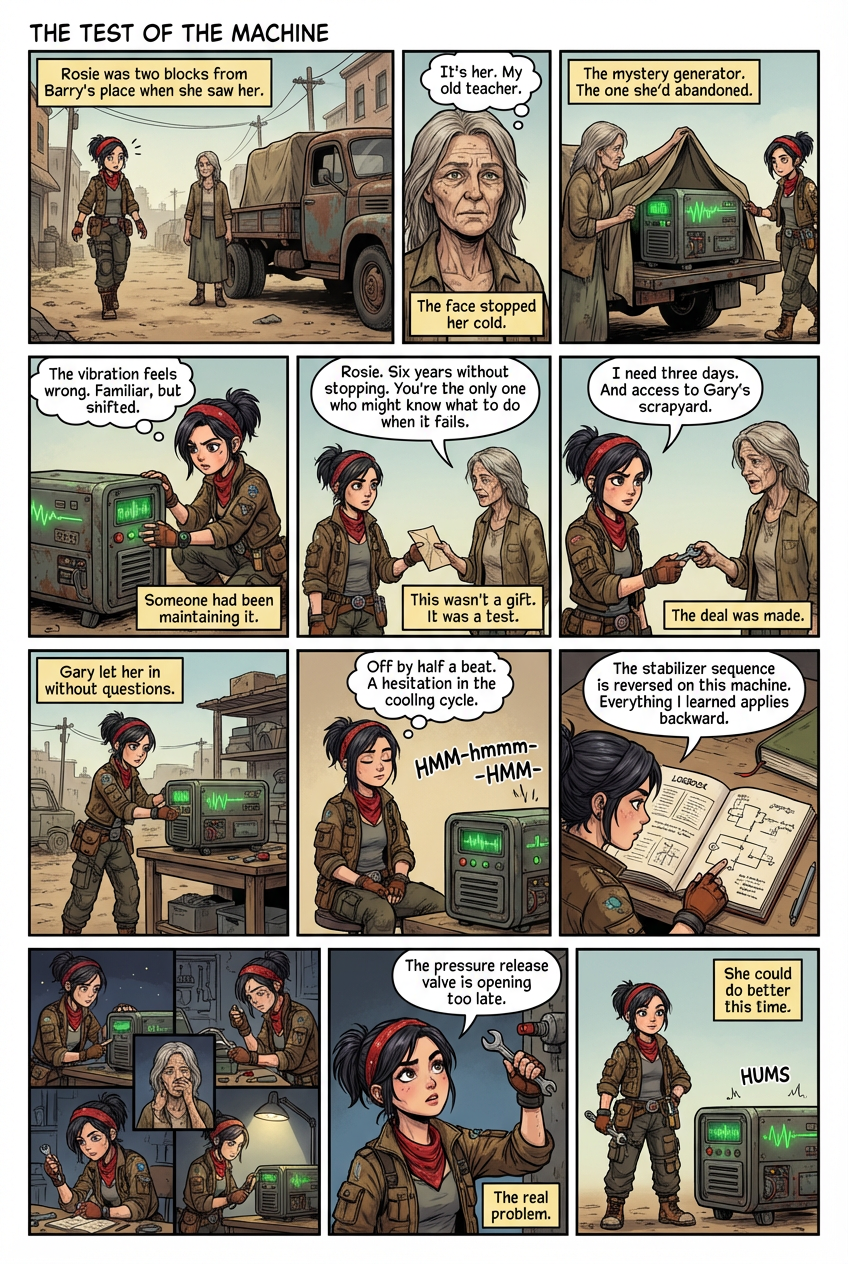
Rosie was two blocks from Barry's place when she saw the woman standing beside a rusted flatbed, one hand resting on something covered with canvas. The woman's face stopped her cold — older now, weathered by years in the waste, but still the same person who'd taught her how to read turbine pressure by sound alone. The woman pulled back the canvas. Underneath sat the mystery generator, the one Rosie had abandoned when she left the northern settlements. Its panels were scarred with travel damage, but the manufacturer stamps were unmistakable — those strange symbols she'd never seen anywhere else. The fuel indicator light blinked steady and green. Still running. Rosie crossed the distance slowly, her throat tight. She'd left that machine behind because she couldn't fix it, couldn't understand what made it different from everything else she'd worked on. Now it sat in front of her in Rust Creek, carried all this way by someone who remembered her. The woman didn't smile. She just stepped aside and gestured at the generator. Rosie knelt and pressed her palm against the housing. The vibration felt wrong — familiar but shifted, like the rhythm had changed since she'd last heard it. She traced the cooling lines with her fingers and found new welds along the pressure chamber, crude but functional. Someone had been maintaining it. Someone had kept it alive. The woman finally spoke. She said Rosie's name once, then told her the generator had been running for six years without stopping. She'd followed the trade routes south looking for the only person who might know what to do when it finally failed. Rosie looked up at her old teacher and understood the weight of what was being asked. This wasn't a gift. It was a test she'd failed once before, delivered back to her doorstep with six years of continuous operation as proof that someone else had succeeded where she'd given up. The woman pulled a folded paper from her coat — a maintenance log, handwritten, documenting every adjustment made to keep the machine running. Rosie took it and scanned the entries. Most of the technical terms were unfamiliar, but the sequencing notes made sense. Stabilizer adjustments before pressure releases. Housing checks after every third fuel cycle. The same principles the stolen diagrams had taught her, but applied to a machine she'd never fully understood. She stood and met the woman's eyes. The question hanging between them was clear: could she do better now than she had six years ago? Rosie folded the maintenance log and tucked it inside her jacket. She told the woman she'd need three days with the generator and access to her tools at Gary's scrapyard. The woman nodded once and handed her the ignition key. The deal was made. Rosie had the machine back, but this time failure meant proving she'd learned nothing from the years of trial and error that came after she'd walked away from it. Gary let her roll the generator onto his property without asking questions. She set it beside her workbench and spent the first hour just listening to it run. The rhythm was off by half a beat, a hesitation in the cooling cycle that shouldn't be there. She opened the maintenance log and found the entry from two months back: stabilizer cleaned, pressure adjusted, hesitation persists. The woman had tried to fix it and failed. That meant the problem was deeper than surface maintenance. Rosie pulled her stolen diagrams from her jacket and laid them beside the log. The cooling unit sequence showed the stabilizer coming third, after the housing bracket. But this generator had a different layout — the stabilizer sat first in the assembly chain, which meant pulling it would crack the pressure chamber. Unless the sequence was reversed. Unless everything she'd learned applied backward to this specific machine. She worked through the night, tracing every connection, testing each component without disturbing the running cycle. The woman had kept it alive with adjustments, but she'd been treating the symptoms instead of the cause. The real problem was in the pressure release valve — it was opening too late, forcing
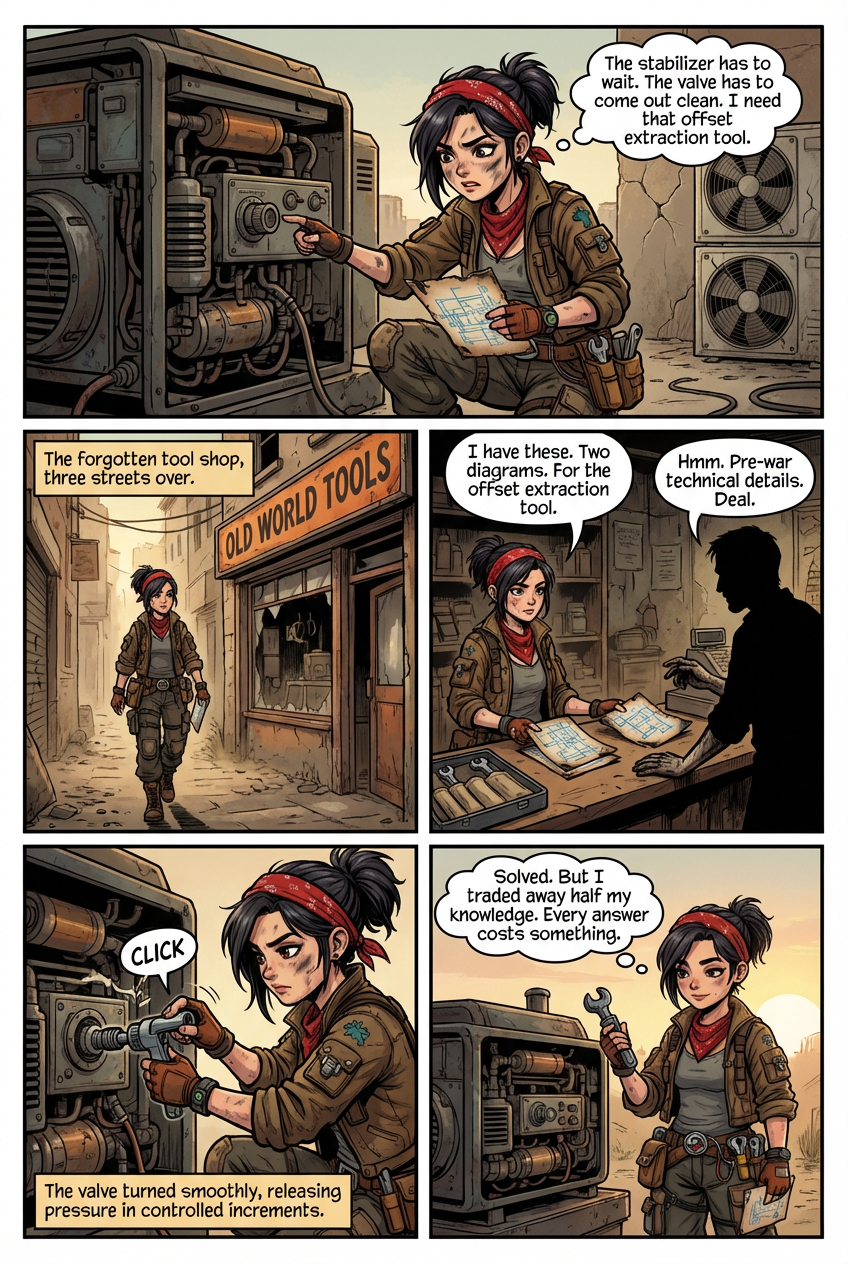
The pressure release valve needed a specialized extraction tool — something with offset teeth that could grip the threads without cracking the housing. Rosie didn't own one. She'd never needed it before because she'd always pulled stabilizers first, and that sequence didn't require the same precision. Now, with the diagrams showing her the correct order, she understood why three of her cooling units had cracked under pressure. The stabilizer had to wait. The valve had to come out clean. She sat back from the generator and considered her options. Gary might have the tool somewhere in his scrapyard, buried under years of collected parts. But there was someone else in Rust Creek who definitely had it — someone who'd been salvaging pre-war machinery long before Rosie arrived. The forgotten tool shop sat three streets over, its faded orange sign barely readable through decades of dust. Rosie had passed it a dozen times but never gone inside. The owner kept irregular hours and didn't welcome browsers. She pushed through the door and found the space cluttered with rusted shelves and boxes of salvaged parts. A man looked up from a workbench in the back, his hands black with grease. She told him what she needed — offset extraction tool, pre-war threading, capable of handling reverse-sequence disassembly. He studied her for a long moment, then walked to a metal case tucked behind a pile of engine blocks. Inside, lined with cloth compartments, sat exactly what she needed. He quoted a price that made her chest tighten. Three fuel pumps or one working turbine. Rosie thought about the deal she'd already made with Barry — one fuel pump for access to the sealed unit upstairs. She thought about the generator sitting at Gary's place, waiting for her to prove she'd learned something in six years. She couldn't afford three pumps. But she had something else. She pulled the charred diagram from her jacket, the one she'd rescued from the burning pile at the trade post. The man's expression changed when he saw it. She offered him two diagrams — this one and one of the cleaner ones she'd stolen from the bus — in exchange for the tool. He took them both and held them up to the light, examining the technical details. Then he set the case on the counter and pushed it toward her. Rosie carried the tool back to Gary's scrapyard as the sun broke over the eastern walls. She'd traded away half her stolen knowledge for one piece of precision equipment. But when she opened the case and fitted the offset teeth around the pressure release valve, the threads caught clean. The valve turned smoothly, releasing pressure in controlled increments exactly as the reversed sequence required. She pulled it free without a single crack in the housing. The generator's rhythm steadied immediately, the hesitation gone. She'd solved the problem her teacher couldn't fix, but now she had fewer diagrams to work with and Barry's sealed unit still waiting upstairs. Every answer cost her something she'd need later.
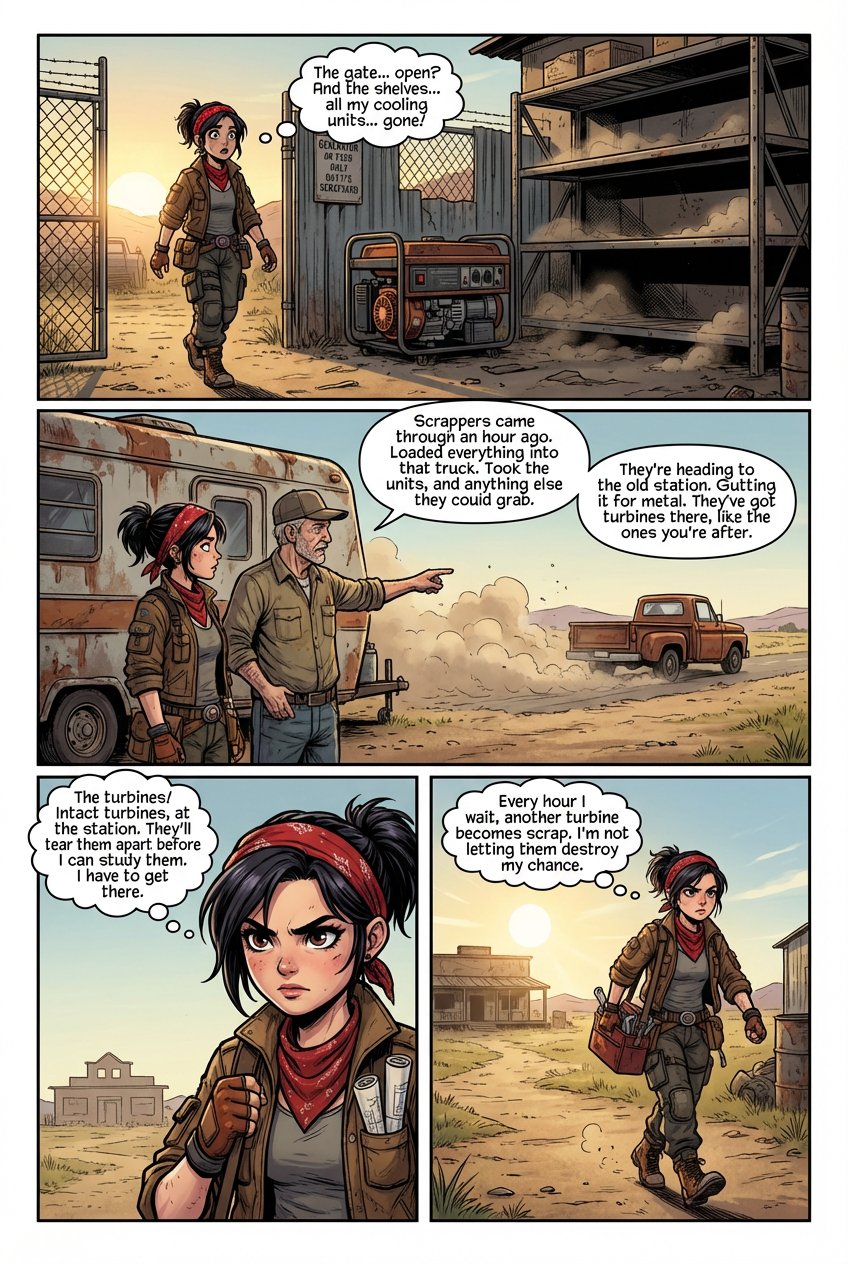
Rosie got back to Gary's scrapyard just after dawn and found the gate standing open. The generator sat where she'd left it, but the shelves along the back wall had been stripped clean. Someone had taken every cooling unit she'd been working on — six housings, three turbines, all the parts she'd carefully sorted over the past week. Gary stood by his trailer, watching a rust-colored pickup truck disappear down the road toward the old station. He told her the scrappers had come through an hour ago, loading parts into their truck bed. They'd offered him trade value for the cooling units, but he'd said no. They'd taken them anyway, along with anything else that looked salvageable. He pointed toward the station. Said they were gutting the place for metal, pulling compressors and housings faster than anyone could catalog what was being lost. The warehouse there had turbines that matched the diagrams Rosie had traded away — turbines she could have studied intact if she got there before they cracked them open for scrap. Rosie grabbed her toolkit and started walking. She still had two diagrams left and the knowledge she'd gained from fixing the generator. The scrappers would be at the station for hours, maybe days, ripping out machinery they didn't understand. She could either sit here protecting what was already gone, or she could get inside that warehouse and map the assembly sequence of at least one turbine before they reduced it to metal chunks. The diagrams had taught her how things fit together. Now she needed to see a complete system before it got torn apart. She picked up her pace. Every hour she waited meant another working turbine became worthless scrap.
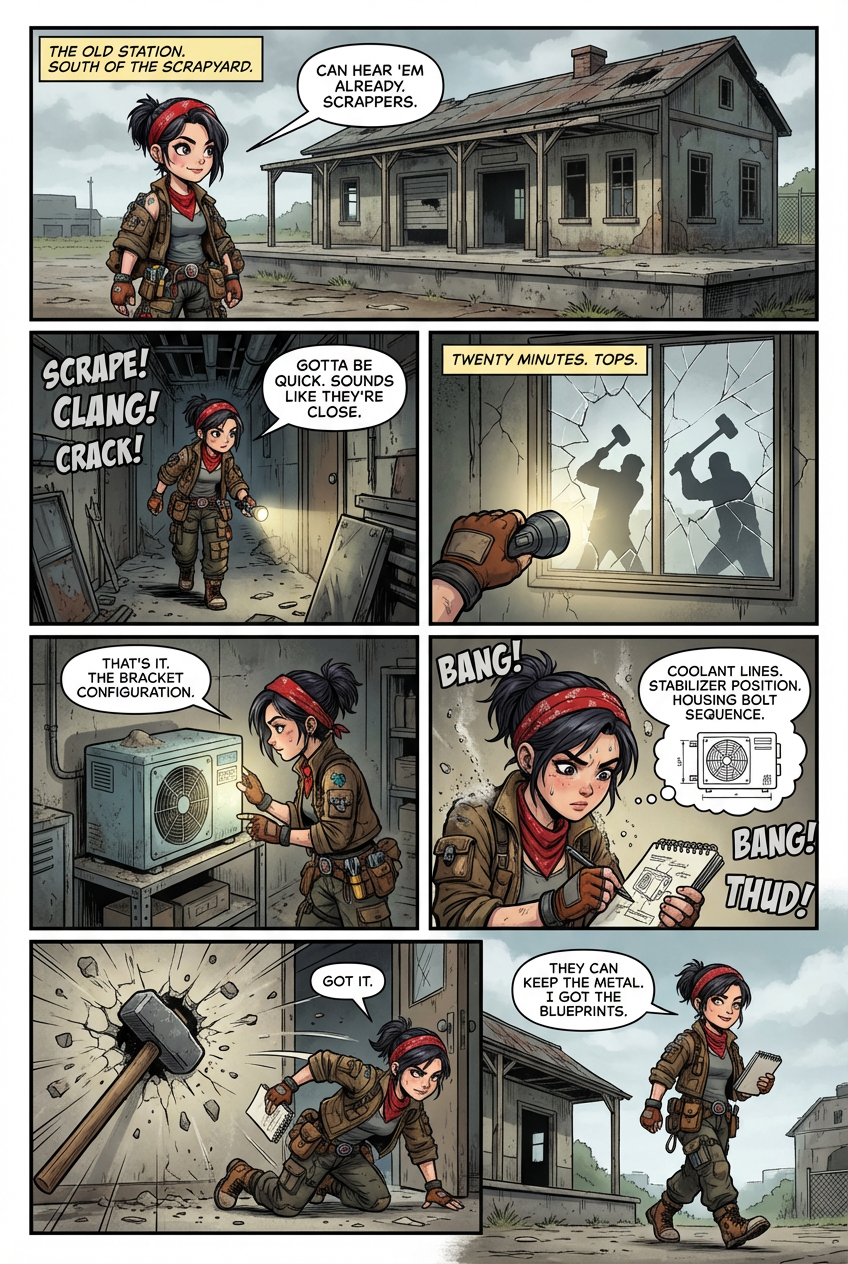
The old station sat three blocks south of the scrapyard, its loading platform stripped down to bare concrete. Rosie could hear the scrappers before she saw them — metal scraping against metal, voices shouting measurements, the sharp crack of a housing bracket breaking free. She found the side entrance through a service corridor, following the sound of sledgehammers until she spotted the room they hadn't reached yet. The door hung partway open, jammed against debris. Beyond it sat rows of equipment covered in decades of dust. A window in the adjacent wall had taken a sledgehammer blow — glass fractured outward in a spiderweb pattern from a central impact point, each crack radiating like spokes. Through the broken sections she could see two scrappers working. They'd already torn through the wall studs on their side. One more panel and they'd punch straight into this room. She had maybe twenty minutes. Rosie squeezed through the jammed door and swept her light across the shelves. A cooling unit sat on the nearest rack, its pale blue casing thick with dust but the manufacturer stamps still visible beneath. She recognized the bracket configuration from her diagrams — the same model she'd been trying to salvage for weeks. This one was complete. She pulled out her notebook and started sketching the connection points, working fast. The scrappers hit the wall again and plaster dust sifted through the fractured window. She traced the coolant lines, marked the stabilizer position, documented the housing bolt sequence. When the sledgehammer punched through the wall panel she was already crawling back out the door, notebook tucked inside her jacket. She had what she came for. Let them have the metal.
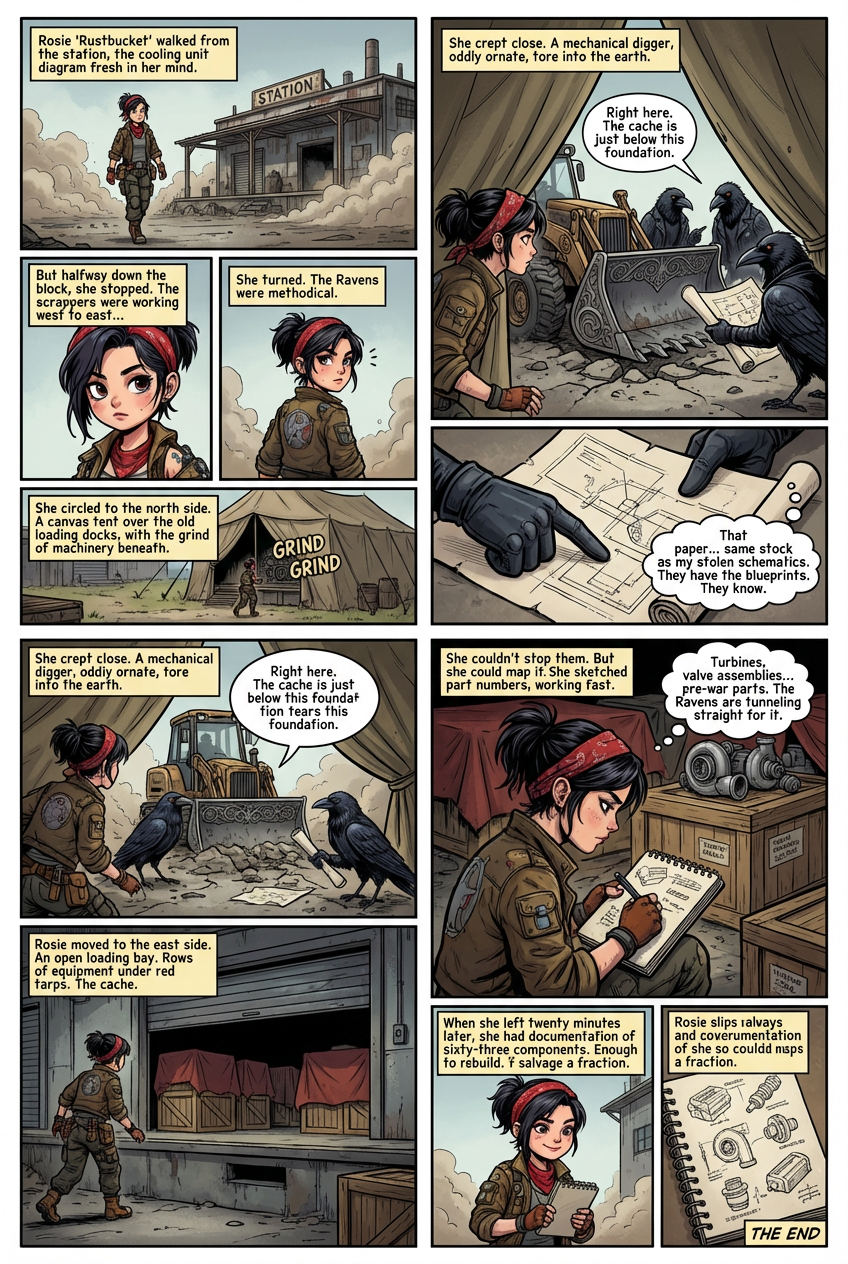
Rosie walked back toward the scrapyard with her notebook tucked inside her jacket, the cooling unit diagram still fresh in her mind. But halfway down the block she stopped. The scrappers had been working from west to east, tearing through the station floor by floor. She turned and headed back, circling to the station's north side where the loading docks used to be. A canvas tent sat erected over what had been open platform, and beneath it she could hear the grind of machinery moving earth. She crept close enough to see through the tent flap. A mechanical digger sat angled into a trench, its blade engraved with decorative metalwork that had no business on excavation equipment. Ravens stood around the hole watching the machine tear through concrete and packed dirt. One of them held a diagram, pointing at something below. Rosie recognized the paper stock — the same weight as her stolen schematics. They had blueprints. They knew exactly where they were digging. She pulled back and worked her way around to the east side of the building, counting windows until she found the loading bay door. It hung open, and inside sat rows of equipment under red tarps. She recognized the shape beneath the canvas — turbine housings, valve assemblies, pressure regulators. Pre-war parts, still crated, still organized. This was the cache her diagrams had been mapping. The Ravens were tunneling straight toward it from below. Rosie traced the excavation angle in her mind. They'd punch through the foundation in two days, maybe three. She couldn't stop them, couldn't move the cache alone, couldn't even warn anyone without explaining how she knew it existed. But she could map it. She pulled out her notebook and started sketching part numbers from the visible crate labels, working fast in the dim light. When she left twenty minutes later, she had documentation of sixty-three components — enough to rebuild her power system three times over if she could salvage even a fraction before the Ravens stripped it clean.
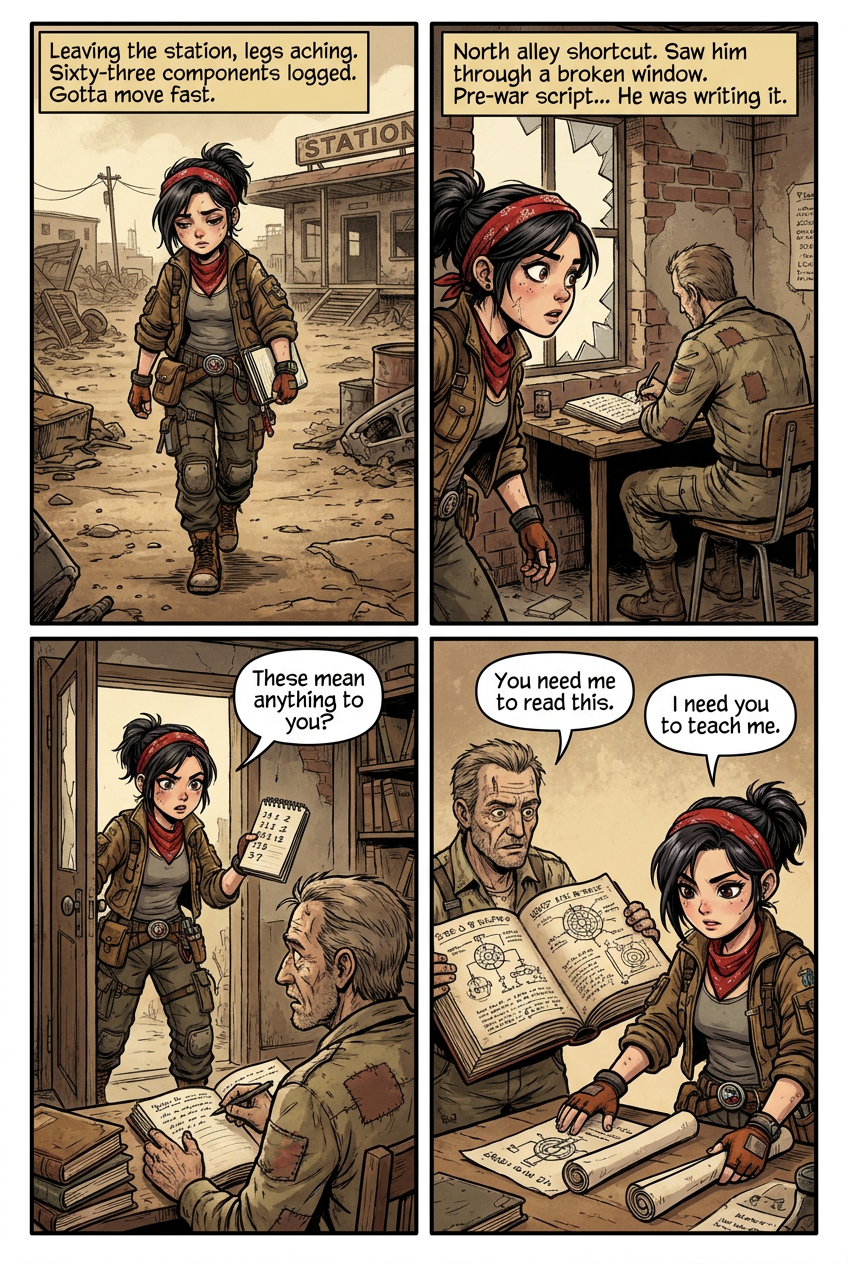
Rosie left the station with her notebook jammed under her jacket and headed back toward the scrapyard. Her legs ached from crouching in the loading bay for twenty minutes, but the part numbers were logged. Sixty-three components she could rebuild from if she moved fast enough. She cut through the north alley and spotted him through a broken window — the man in the faded uniform sitting at a makeshift desk stacked with books. He had his back to her, tracing something on paper with careful strokes. She recognized the movement. He was writing in pre-war script. The realization stopped her cold. She'd walked past this building twice before and dismissed it as empty. The man turned a page in the thick book beside him, scanning lines she couldn't read, then copied another sequence onto his sheet. He was translating. Or teaching himself. Or both. Rosie pushed through the door before she could think better of it. The man looked up, startled, his hand moving to cover the page. She held up her notebook, flipped it open to show the part numbers she'd copied from the crates. "These mean anything to you?" The man studied the numbers, his expression shifting from wariness to recognition. He reached for one of the books on his desk and opened it to a diagram that matched her cooling unit sketch exactly. The labels were in pre-war script — the same script she'd been staring at blind for six years. He tapped the page. "You need me to read this." It wasn't a question. Rosie pulled out the two remaining stolen diagrams from her jacket and laid them on his desk. "I need you to teach me."
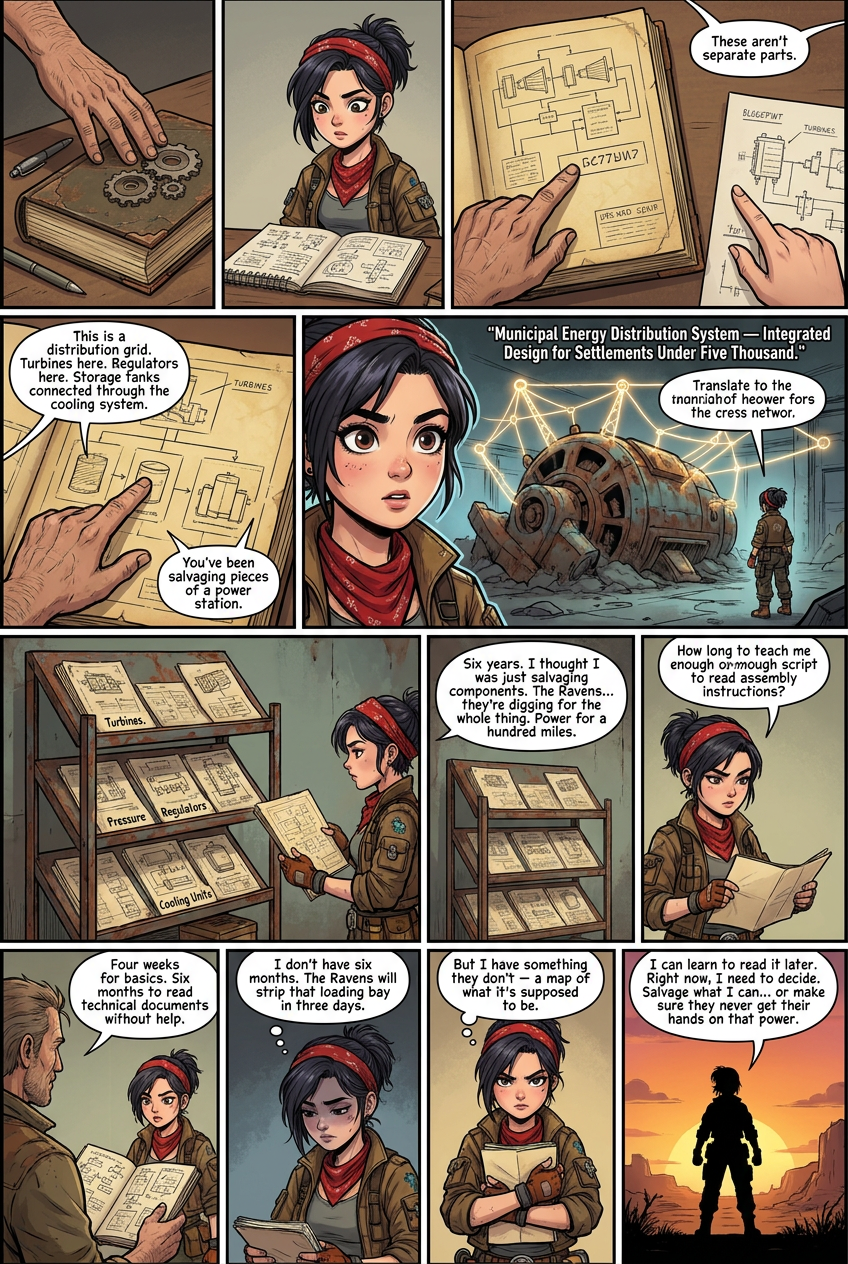
The man didn't answer right away. He set down his pen and pulled the book closer, studying the diagram she'd matched to her notes. His finger traced the labels in pre-war script, then stopped at a component number she'd copied from the loading bay. He flipped pages, checking something, then looked at her with an expression she couldn't place. "These aren't separate parts," he said. He turned the yellowed blueprint toward her and tapped three different sections. "This is a distribution grid. Turbines here. Regulators here. Storage tanks connected through the cooling system. You've been salvaging pieces of a power station." He read the header text aloud, translating as he went. "Municipal Energy Distribution System — Integrated Design for Settlements Under Five Thousand." Rosie stared at the blueprint. Every part number she'd logged matched a component on the page. The cooling units weren't standalone machines. They were nodes in a network designed to power an entire town. The man pulled a rusted rack from the corner and began arranging her diagrams on its shelves according to the blueprint's layout. Turbines on the top tier. Pressure regulators below that. Cooling units at the bottom with connection points facing outward. The system assembled itself in front of her, each bracket holding a piece that fed into the next. She'd spent six years learning to salvage individual components without understanding what they built toward. The Ravens were digging for a complete system, not scrap metal. If they pulled it intact, they'd control power for every settlement within a hundred miles. Rosie took the blueprint and folded it carefully. "How long to teach me enough script to read assembly instructions?" The man looked at the diagrams on the rack, then at her notebook. "Four weeks for basics. Six months to read technical documents without help." She didn't have six months. The Ravens would strip that loading bay clean in three days. But she had something they didn't — a map of what the system was supposed to become. She could learn to read it later. Right now, she needed to decide whether to salvage what she could before they did, or find a way to keep that power out of their hands entirely.
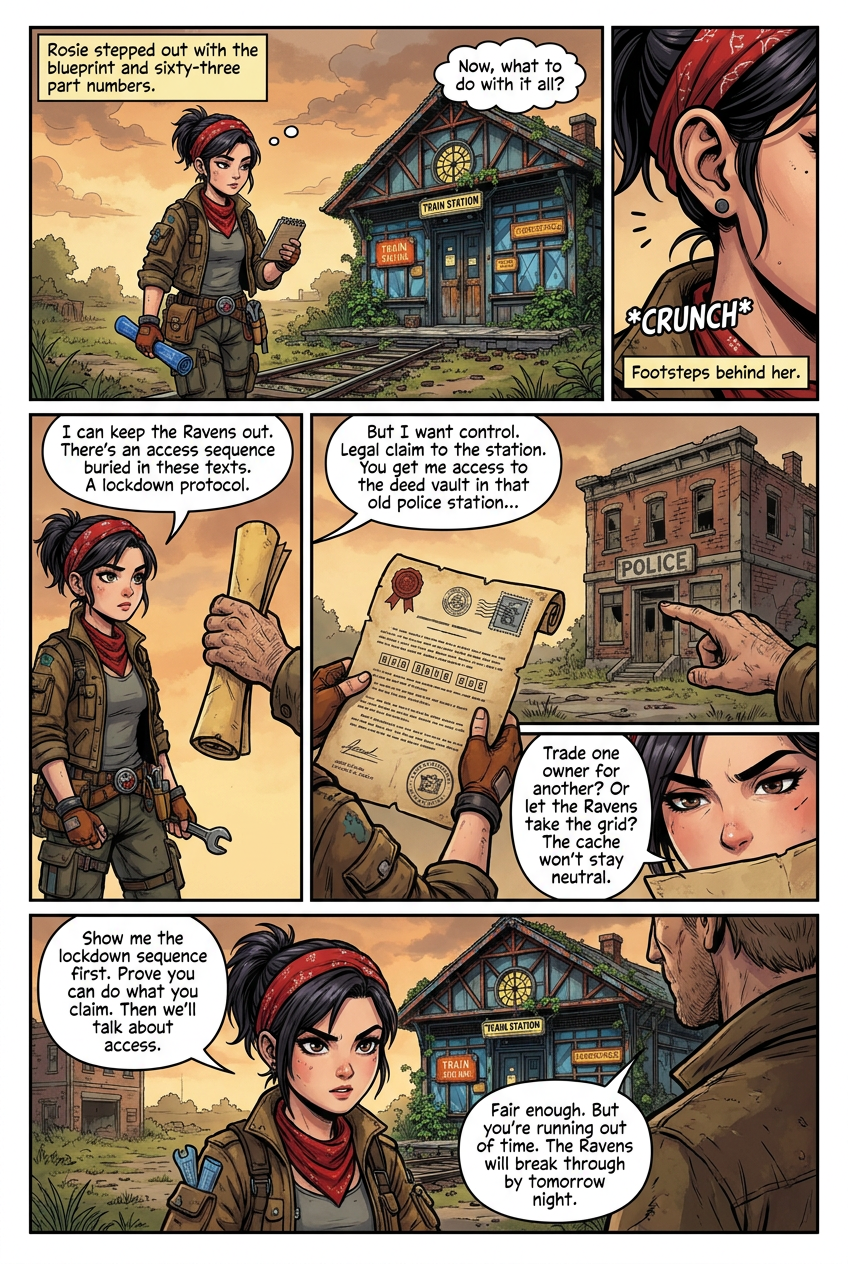
Rosie stepped out of the abandoned building with the blueprint folded in her pocket and sixty-three part numbers logged in her notebook. The man in the faded uniform had given her what she needed to understand the system. Now she had to decide what to do with it. She was halfway back to the scrapyard when she heard footsteps behind her. The man had followed her out, carrying a document that looked older than anything else she'd seen him translate. He held it up so she could see the stamps and seals pressed into yellowed paper. "I can keep the Ravens out," he said. "There's an access sequence buried in these texts. A lockdown protocol that seals the distribution system from unauthorized removal." He unrolled the document carefully. It was a deed — pre-war ownership papers for the old station building itself, complete with mechanical authorization codes printed along the margins. "But I want something in return. Control of the station. Legal claim to the building and everything in it." He pointed toward the rusted police station that still stood two blocks from the old terminal. "That's where the municipal records were kept. You get me access to the deed vault in there, I'll activate the lockdown before the Ravens pull a single turbine. But afterward, the station and its systems belong to me." Rosie studied the document in his hands. He'd found a way to stop the Ravens from stripping the power grid — but only if she gave him the keys to control it himself. She could let the Ravens take the equipment and salvage what she could from the chaos, or she could trade one owner for another and hope this man kept his word. Either way, the cache wouldn't stay neutral ground. She looked at the deed, then at the police station with its locked vault of pre-war records. "Show me the lockdown sequence first," she said. "Prove you can do what you claim. Then we'll talk about access." The man smiled and rolled the document back up. "Fair enough. But you're running out of time to decide. The Ravens will break through to the loading bay by tomorrow night."
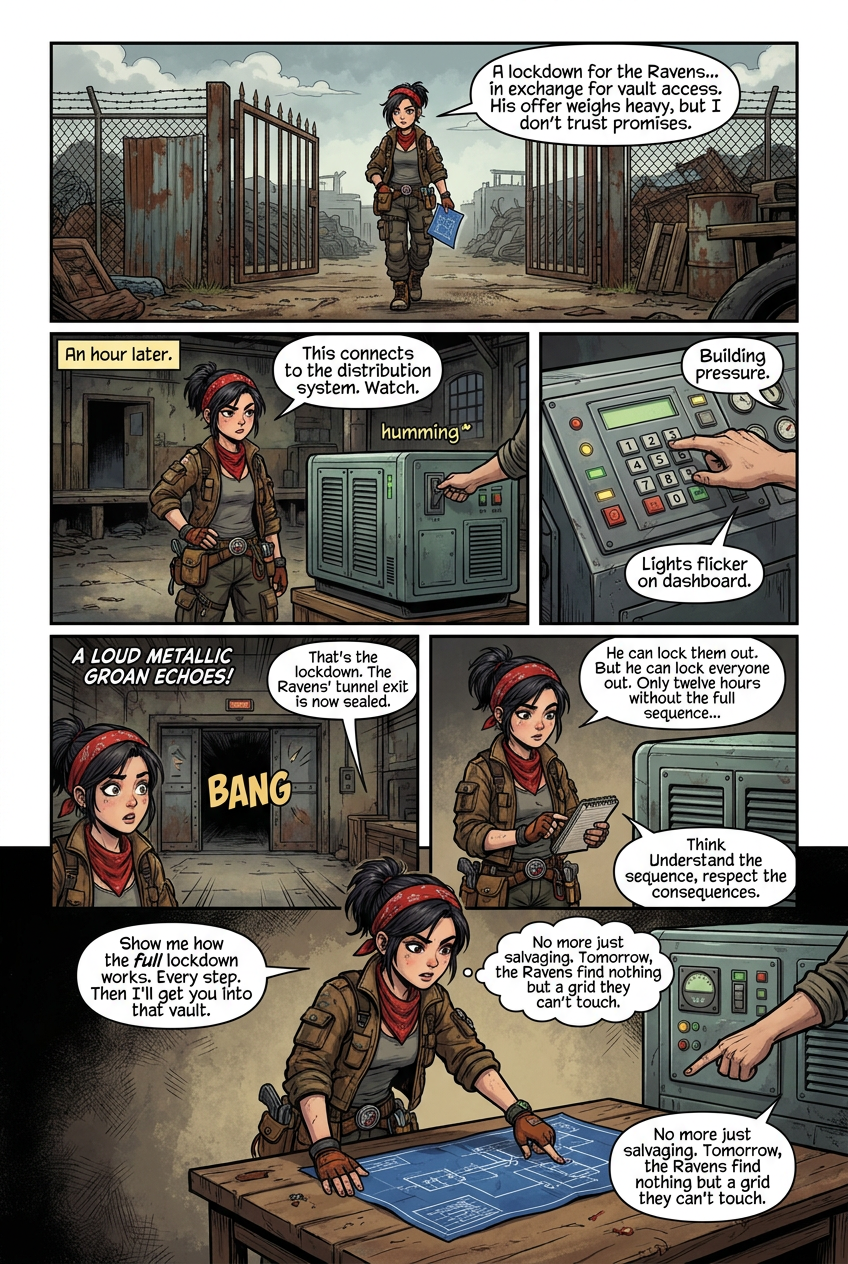
Rosie walked back through the scrapyard gates with the blueprint still folded in her pocket. The man's offer sat heavy in her mind — trade access to the deed vault for a lockdown that would stop the Ravens cold. But she'd learned the hard way not to trust promises until she saw proof. She found him an hour later near the old station's loading bay, standing beside a generator unit that looked too clean to have been salvaged from the ruins. The housing was intact, the control panel pristine, and when he flipped three switches in sequence, the lights on the dashboard came alive. "This connects to the distribution system," he said, tapping a gauge that showed pressure building in the lines. "Watch." He entered a code on the panel, and somewhere deep in the station, metal groaned. The loading bay doors that had been wedged half-open for weeks suddenly dropped shut with a bang that echoed through the terminal. The Ravens' tunnel exit was now sealed behind three tons of steel. "That's the lockdown," he said. "But it only holds for twelve hours unless I input the full sequence from the deed records. After that, the doors reset and anyone can access the equipment again." Rosie stared at the sealed doors, then at the generator humming beside him. He'd proven he could lock the Ravens out — but he'd also proven he could lock everyone else out too. She thought about the sixty-three part numbers in her notebook, the diagrams she'd stolen, the years she'd spent learning sequences by trial and error. This system was bigger than anything she'd worked on, but the principle was the same: understand the sequence, respect what happens when you get it wrong. She pulled the blueprint from her pocket and unfolded it on a weathered table nearby, the carved wood scarred with old tool marks. "Show me how the full lockdown works," she said. "Every step. Then I'll get you into that vault." He smiled and moved to the table, pointing to connection points on the blueprint that matched the generator's control panel. For the first time, she wasn't just salvaging parts — she was learning how the whole system fit together. And when the Ravens broke through tomorrow night, they'd find nothing but locked doors and a grid they couldn't touch.
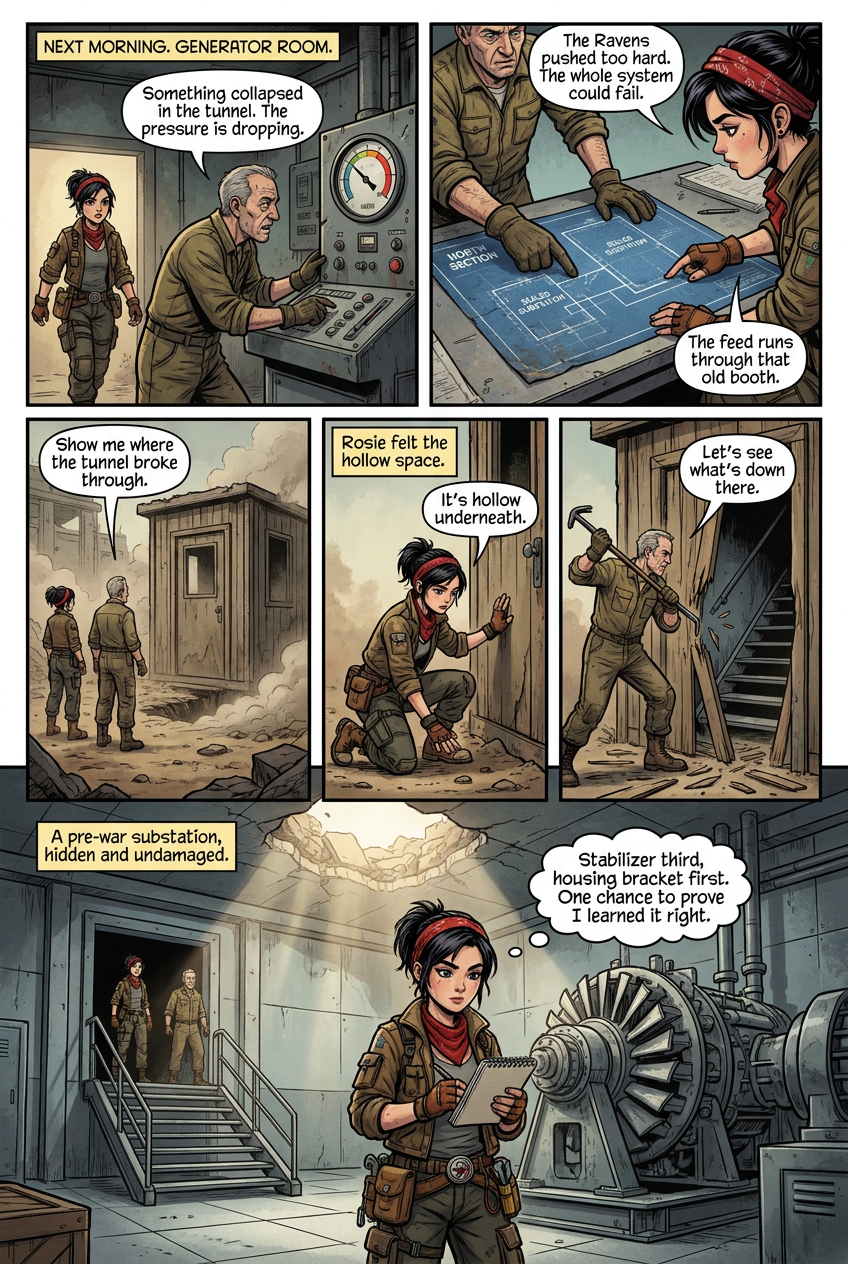
Rosie met the man at the generator the next morning, expecting to review the lockdown sequence one more time before she left for the vault. Instead, she found him staring at the control panel with his hands frozen over the switches. The pressure gauge was dropping. "Something collapsed in the tunnel," he said, pointing to a schematic on the blueprint. "The Ravens must have pushed too hard on the north section. They broke through into something that wasn't on their maps." He tapped the gauge again as the needle fell another notch. "The loading bay lockdown is pulling pressure from a sealed substation that's been buried since before the war. If that room is exposed now, the whole system could fail before we get the deed." Rosie grabbed the blueprint and traced the connection lines from the generator to the loading bay. The pressure feed ran through a maintenance booth near the old north entrance — a weathered wooden structure she'd walked past a hundred times without noticing. She'd assumed it was just another scrapper shelter. But according to the schematic, that booth sat directly above the substation, and if the Ravens had cracked it open, the lockdown wouldn't hold past midnight. She looked at the man. "Show me where the tunnel broke through," she said. He led her to the north side of the station, where dust still hung in the air from the collapse. The maintenance booth stood ten yards away, its grimy windows intact, but the ground beneath it had dropped six inches. Rosie knelt and pressed her hand to the dirt. She could feel the hollow space underneath. The man pulled a crowbar from his pack and wedged it under the booth's door. The wood splintered, and when the door swung open, Rosie saw metal stairs descending into darkness. At the bottom, lit by a shaft of daylight from the Ravens' collapsed tunnel, sat a pre-war substation. The housing was clean, the control panels undamaged, and the components inside were still connected to the distribution grid. She recognized a turbine assembly identical to the ones in her diagrams, a pressure regulator she'd only seen in schematics, and a cooling unit with manufacturer stamps she'd never encountered on any other functioning equipment. The Ravens had broken through the east wall of the substation, but they hadn't reached the equipment yet — rubble from the collapse had blocked their access. Rosie descended the stairs and stood in front of the turbine. This was the heart of the system, the part that controlled pressure flow to the entire grid. If she could stabilize it before the Ravens cleared the rubble, the lockdown would hold. But if she made a mistake, she'd crack the housing and lose the whole station. She pulled her notebook from her pocket and opened it to the diagrams she'd stolen months ago. The sequence was there — stabilizer third, housing bracket first. She'd learned it the hard way, and now she had one chance to prove she'd learned it right.
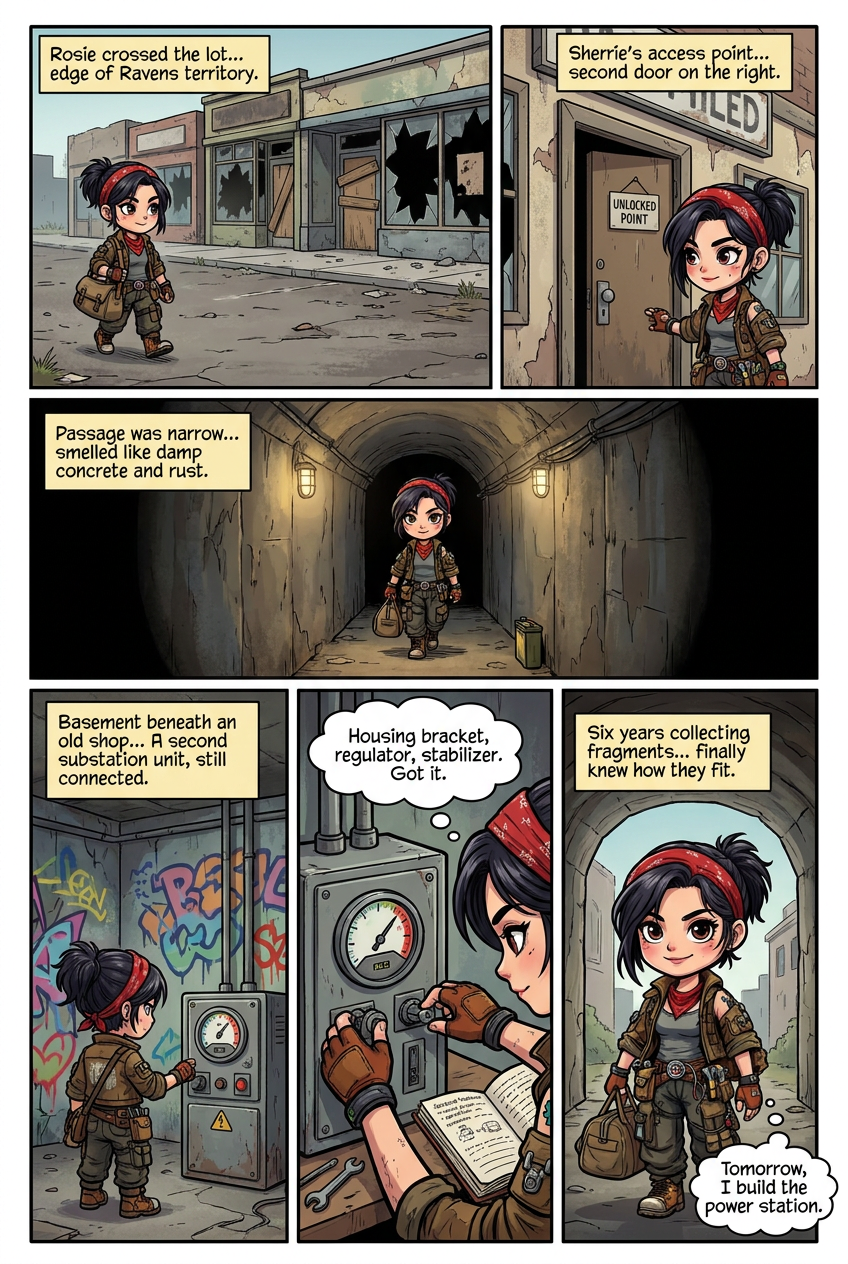
Rosie crossed the lot toward the strip of buildings, carrying the substation parts in the canvas bag. The storefronts ahead marked the edge of Ravens territory — a jewelry store with broken windows, a pawn shop with boarded doors, and a restaurant with faded paint peeling from its walls. She'd never been this far east, but the man had told her Sherrie's access point was through the second door on the right. When she reached the strip, she found the door unlocked and a set of stairs leading down to a tunnel that ran beneath the Ravens' patrols. The passage was narrow, lit by battery lamps every twenty feet, and it smelled like damp concrete and rust. She followed the tunnel for half a mile until it opened into a basement beneath what looked like an old spray-painted shop. The walls were covered in bright graffiti, layers of color stacked so thick the original brick didn't show through. In the center of the room sat a second substation unit, identical to the one she'd just dismantled. This one was still connected to the grid, its pressure gauge holding steady, but the Ravens would reach it within hours once they cleared the rubble from their tunnel. Rosie set down her bag and pulled out her notebook. She had the sequence memorized now, but she checked it anyway — housing bracket first, regulator second, stabilizer third. She worked fast, disconnecting each part and packing them into the bag alongside the components from the first unit. When she climbed back up the stairs and stepped outside, she found herself on the other side of Ravens territory with a bag full of parts that could power an entire settlement. She'd spent six years collecting fragments without understanding what they built. Now she had two complete substation units, and she finally knew how they fit together. The lockdown would hold until midnight, and by then she'd have the deed from the vault and a system the Ravens couldn't strip for scrap. She turned east and headed back toward the tunnel, knowing that tomorrow she'd start assembling the power station she'd been searching for all along.
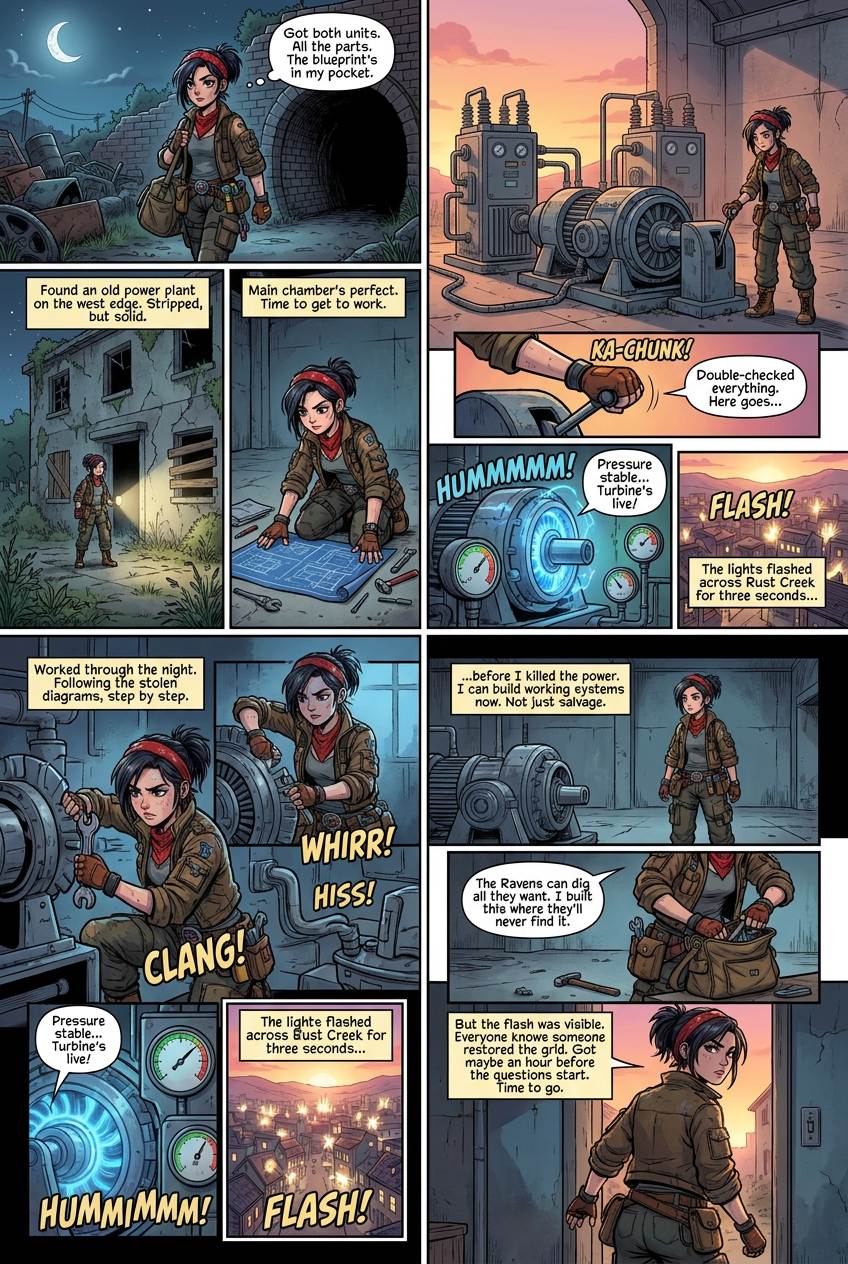
Rosie carried the bag of substation parts back through the tunnel and emerged near Gary's scrapyard just after midnight. She had both units now — every component she needed to build a complete power station. The man's blueprint was folded in her pocket, and the lockdown sequence was holding at the old station. She found an old power plant on the west edge of town, its concrete walls cracked and overgrown with weeds. The building had been stripped years ago, but the foundation was solid and the main chamber was large enough to hold the assembled system. She worked through the night, connecting turbines to housings, routing pressure lines through regulators, and mounting the stabilizers in the sequence she'd learned from stolen diagrams. By dawn, the system was complete — two substations linked together with the main turbine at the center. She double-checked every connection, then pulled the activation lever. The turbine hummed to life, pressure gauges climbed to stable levels, and the lights in every building across Rust Creek flashed on for three seconds before she killed the power. She stood there in the silence that followed, understanding what she'd just proven. She could build working systems now, not just salvage broken parts. The Ravens could tunnel wherever they wanted — she'd already taken what mattered and assembled it somewhere they'd never find it. But the flash had been visible across town, and she'd just announced to everyone in Rust Creek that someone had restored power to the grid. She grabbed her tools and headed for the exit, knowing she had maybe an hour before people started asking questions she wasn't ready to answer.
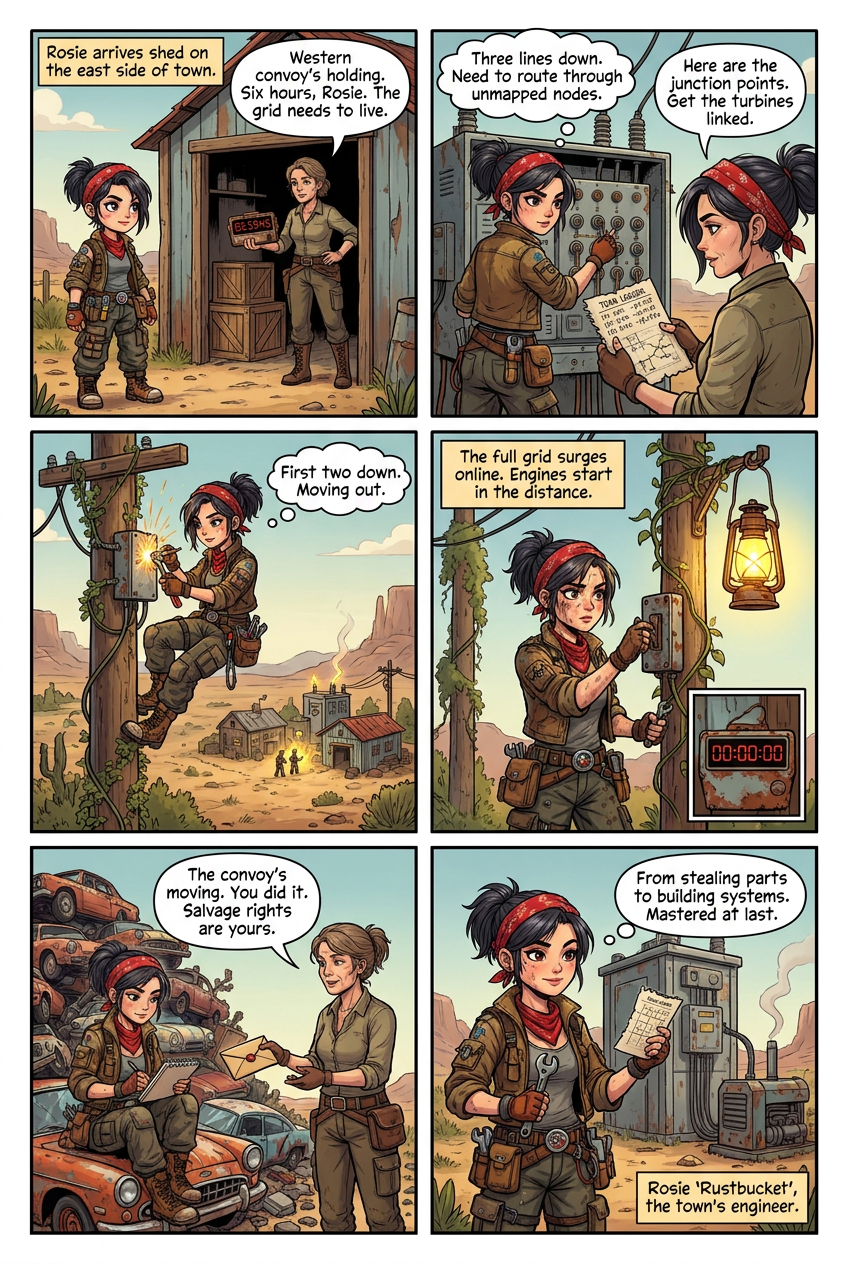
Rosie was halfway back to the scrapyard when she saw people gathering near a weathered shed on the east side of town. The structure flickered with rust patterns that caught the morning light, and someone had propped the doors open to reveal stacks of crates inside. She recognized Sherrie standing near the entrance with a rusted timer in her hand, the kind that counted down hours instead of minutes. The woman looked up as Rosie approached, then gestured toward the shed's interior. "Western convoy's holding at the border," Sherrie said. "They won't cross until the grid stays live past dawn. I need it running in six hours, or the trade routes shift south permanently." Rosie checked the substation connection points and found three distribution lines still disconnected from the main grid. She'd built the system to power the immediate area, but extending it across the full network meant routing power through nodes she hadn't mapped yet. Sherrie handed her a torn ledger page with coordinates marked in faded ink — locations of three junction boxes that needed turbine links before the full grid could activate. Rosie studied the coordinates and recognized two from her stolen diagrams, but the third was new territory. She had the parts and the knowledge, but six hours wasn't much time to connect a network this size without cracking something critical. She worked through the morning, moving between junction sites and mounting regulators to distribution panels. Each connection brought more lights online — first the buildings near the substation, then clusters spreading outward toward the trade post. At the third junction, she found a vine-covered pole with a lantern mount still intact, its wiring corroded but functional. She replaced the burned contacts and routed power through the old circuits, then watched the lantern blaze to life when she threw the switch. The timer in Sherrie's shed hit zero just as the full grid surged online, and Rosie heard engines starting at the trade post a mile away. Sherrie found her two hours later at the scrapyard, where Rosie was documenting the junction sequences in her notebook. The woman carried a sealed envelope marked with pre-war script that Rosie could now partially read — something about equipment claims and salvage rights. "The convoy's moving," Sherrie said. "You kept the routes open." She handed Rosie the envelope and a set of coordinates for another cache, this one containing turbine components she'd need for the next expansion. Rosie took both and filed them with her diagrams, understanding that she'd moved from stealing parts to building systems people depended on. The mystery generator sat silent in the corner, no longer a failure she couldn't solve but proof of how far she'd come. She picked up her tools and headed for the new coordinates, ready to salvage the next set of components with the confidence that came from finally mastering what had defeated her for six years. The cache Sherrie mentioned was buried beneath an abandoned checkpoint on the western edge of town, and Rosie spent the afternoon extracting housings that matched her blueprint specifications. By evening, she had enough parts to build a second substation, and by the following week, she'd connected three more junctions to the main grid. People started coming to her with salvage requests — turbines that needed rebuilding, cooling units that wouldn't hold pressure, distribution panels with sequences no one else could map. She worked each job the way she'd always worked, with careful sequencing and respect for the consequences of getting it wrong, but now she had the diagrams and the language to understand what she was fixing. The Ravens eventually abandoned their tunnel beneath the old station, and their cache sat untouched because Rosie had already built what they'd been trying to steal. She kept the stolen diagrams filed with her own notes, a reminder that mastery came from persistence, not from knowing everything from the start.
Play your story to life
Storycraft is a mobile game where you create AI characters, craft items and locations to build their world, then discover what direction your story takes. Download the iOS game for free today!
Download for free