

Roy Villein's Arc
11 Chapters
Roy Villein's dream is killing the chemical corporation executives responsible for poisoning his land by using their own chemicals against them.

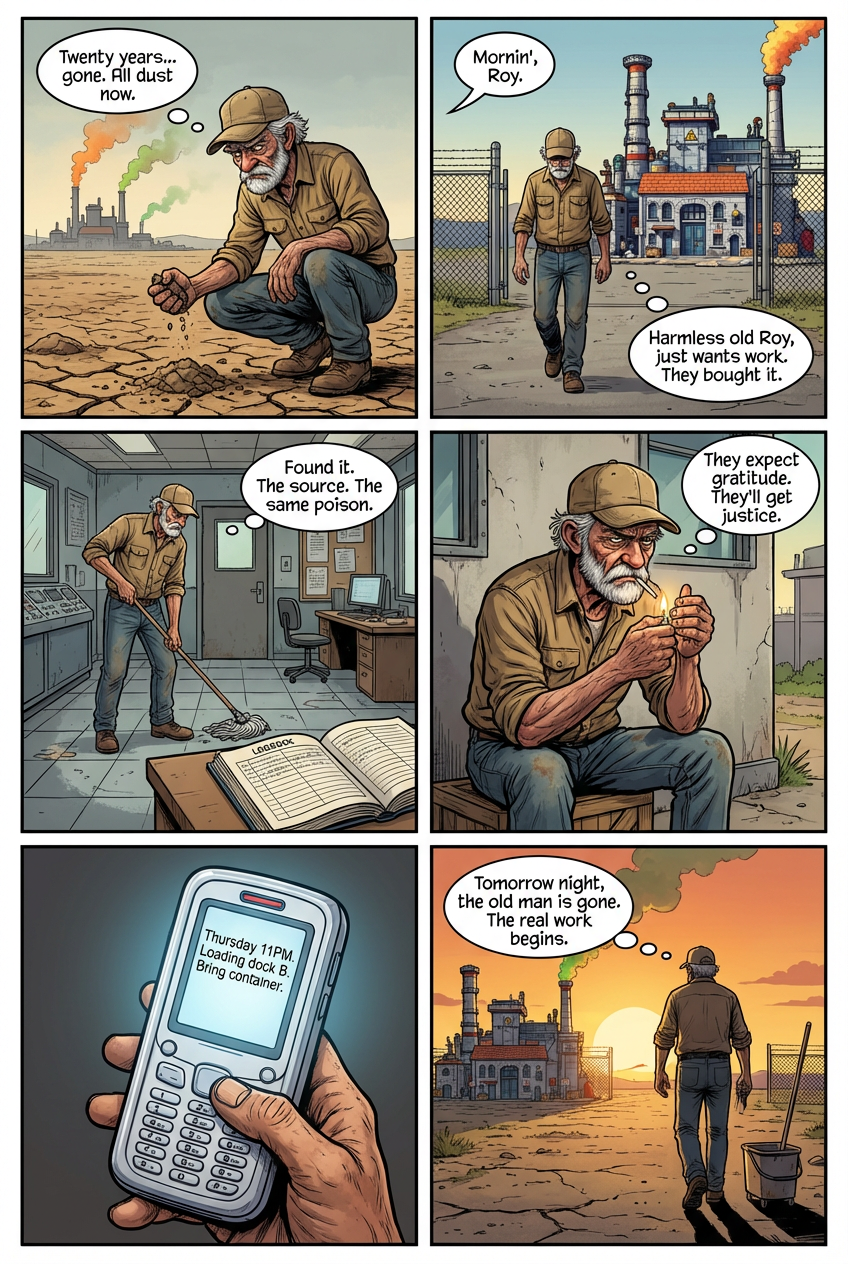
Roy Villein crushed a clod of dirt in his weathered hand and watched it turn to dust. Twenty years of work, gone. ChemCorp's runoff had killed everything. Three years in court got him nowhere—judges turned a blind eye while executives bought yachts. Now he had a plan. The ChemCorp plant rose up ahead, all concrete walls and metal pipes. Drab orange and green smoke poured from the smokestack. Roy pulled his tan cap lower and walked toward the main gate. He'd spent months playing the broken farmer, the harmless old man who just wanted work. The executives had bought it—even offered him a cleanup job like they were doing him a favor. They expected gratitude. Instead, Roy had learned the layout of their offices. He knew their schedules. He'd made connections inside who could get him what he needed: their own chemicals. Justice wouldn't come from a courtroom. It would come from those pipes, that smoke, those barrels stored in the back lots. Roy passed the main building and headed toward the monitoring station at the back of the property. The small structure sat surrounded by chemical tanks, its grimy windows catching the morning light. He'd worked this area for two weeks now, mopping floors and emptying trash. Nobody paid attention to the old maintenance man. But Roy paid attention to everything—the flow meters, the discharge valves, the logs that showed exactly which chemicals went where. He'd traced it all back, found where the poison came from. The same stuff that killed his land sat in those tanks right now. His connections had promised him access tomorrow night when the shift supervisor took his usual break. Roy pulled a cigarette from his pocket and lit it with steady hands. Twenty years of growth, destroyed. Three months until bankruptcy finalized. One night to make it right. The cheap phone buzzed in his pocket during his lunch break. Roy pulled it out and checked the screen. A single message: "Thursday 11PM. Loading dock B. Bring container." He deleted the message and dropped the phone back in his pocket. His contact had come through. The executives would get their own medicine—literally. The same chemicals they'd dumped on his farm would find their way into their morning coffee, their bottled water, their lunch. Slow and quiet, just like the poison that had seeped into his soil. Roy finished his sandwich and walked back to his mop bucket. Tomorrow night he'd stop being the harmless old man. Tomorrow night the real work would begin.
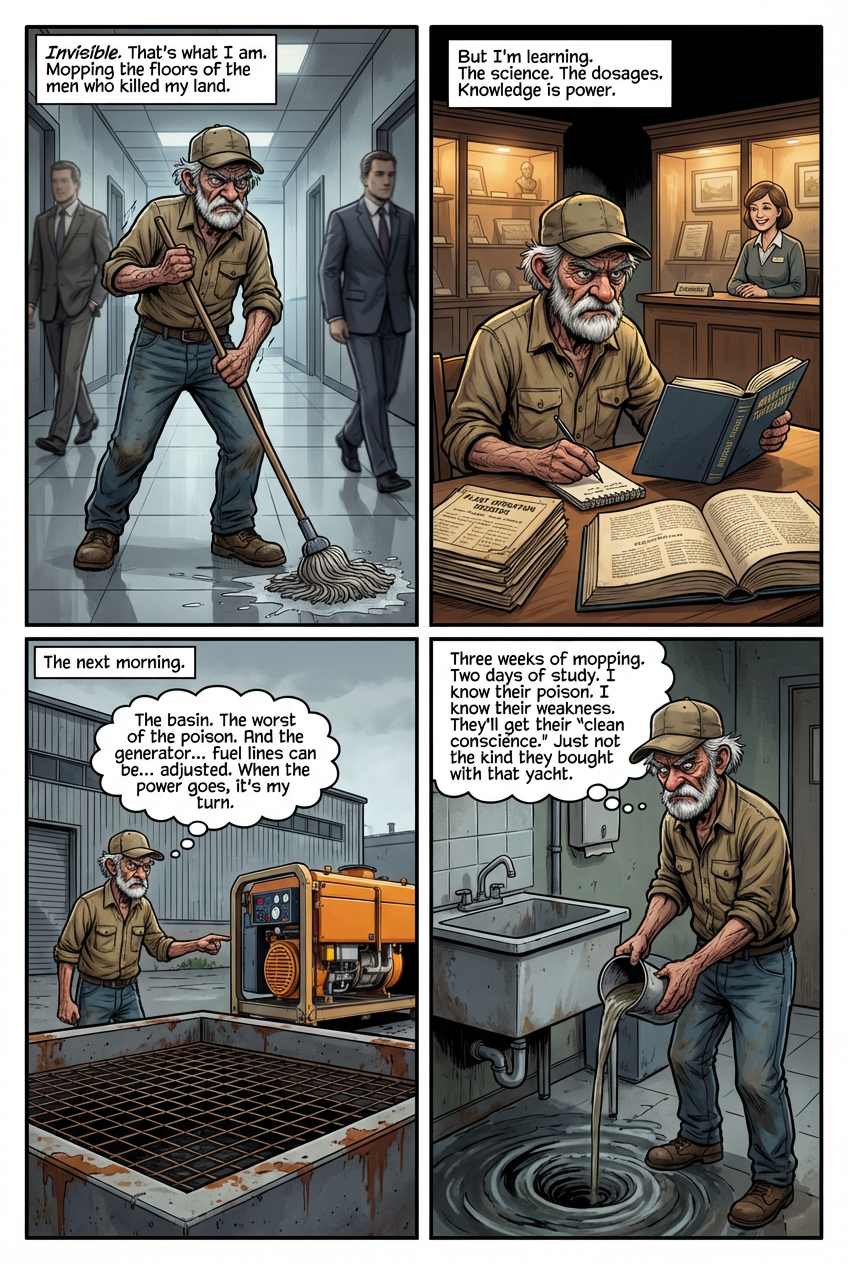
Roy's hands shook as he scrubbed the floor outside the executive wing. Not from fear—from barely contained rage. He'd mopped this same hallway for three weeks now, invisible to the men in suits who'd destroyed his farm. But playing dumb only got him so far. He needed real knowledge—the kind that didn't come from watching pipes and reading warning labels. After his shift ended, Roy drove to the Stone Foundation Historical Society on the edge of town. The building sat quiet in the afternoon light, its stone foundation solid beneath elegant wooden display cases visible through the glass doors. Inside, he found what he needed: old chemistry textbooks, industrial safety manuals, records of local plant operations. The volunteer at the desk smiled at the weathered farmer who seemed so interested in science. Roy took notes on handling procedures, chemical properties, lethal doses. Knowledge was the first weapon. Back at the plant the next morning, Roy studied the Industrial Containment Basin behind the main building. The lined concrete pit sat under a metal grating, rust stains marking its edges. This was where they stored the worst of it—the hazardous materials too dangerous even for regular tanks. The same chemicals that had seeped into his soil and killed everything. His contact had mentioned this basin specifically. Roy memorized the access points and the maintenance schedule. Nearby sat a Heavy Duty Diesel Generator, its metal frame sturdy against the morning chill. When the power went out—and it would, his contact promised—that generator would kick in. But generators needed fuel, and fuel lines could be adjusted. Timing would matter. Roy dumped his mop water down a drain and watched it swirl away. Three weeks of invisible work had taught him the plant's rhythms. Two days at the historical society had taught him the science. Now he understood exactly how their poison worked—and how to use it against them. The executives would get their clean conscience, all right. Just not the kind they'd bought with that yacht.
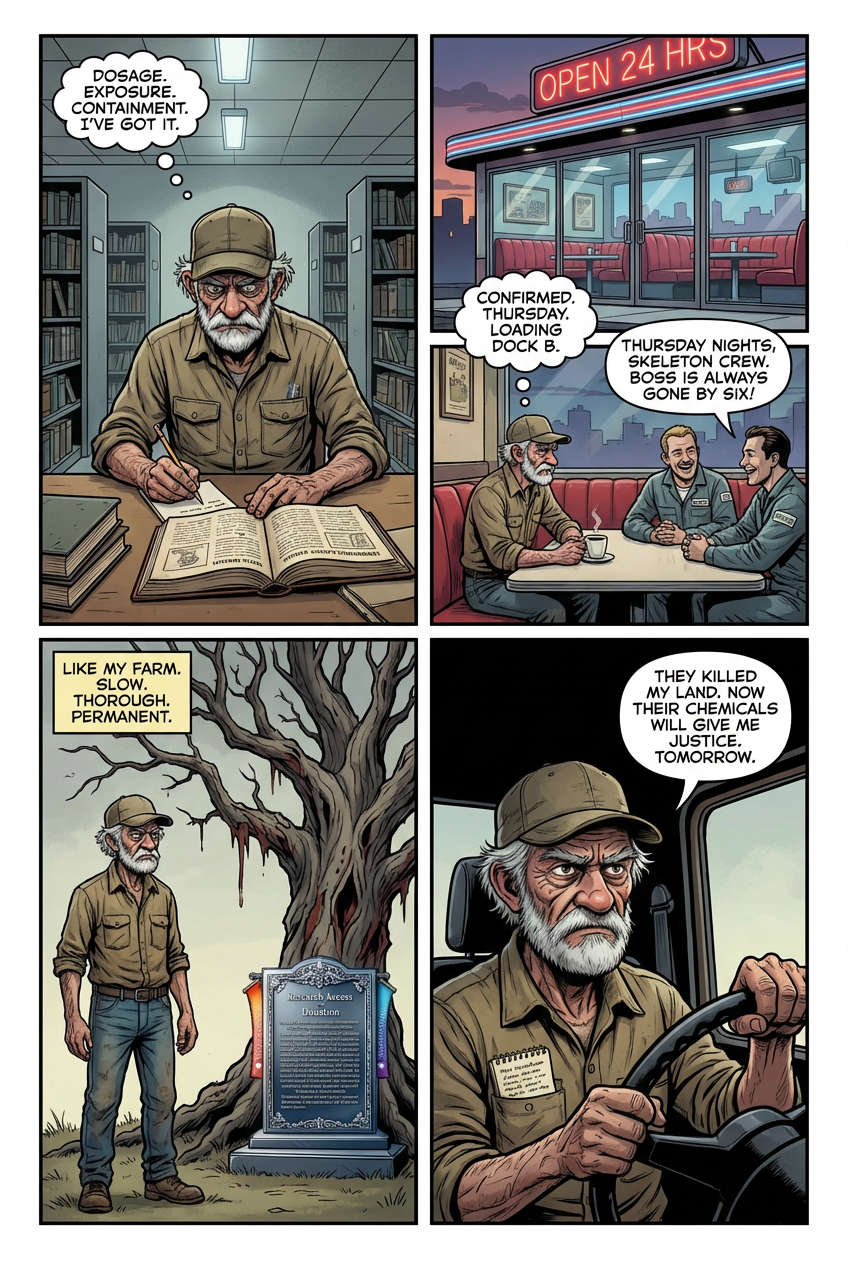
Roy sat in the truck outside the public library, engine ticking as it cooled. The historical society had given him the science, but he needed more—specific handling procedures for what came next. Inside, fluorescent lights hummed over rows of metal shelves. He found the reference section and pulled down industrial safety manuals, outdated but detailed. Page after page showed him dosage calculations, exposure limits, containment methods. The librarian never looked up from her desk. An hour later, Roy walked out with handwritten notes folded in his breast pocket. He knew exactly how much would be enough. Hunger hit around six. Roy drove to the diner on the industrial side of town—red vinyl booths, chrome counter stools, neon sign buzzing in the window. Factory workers filled the place, voices loud after their shifts. He ordered coffee and kept his head down. At the next booth, two men in ChemCorp coveralls talked about the loading dock schedule. Thursday nights, skeleton crew. The supervisor always left early. Roy sipped his coffee and listened. They were confirming what his contact had already told him. The plan was solid. After he paid, Roy walked three blocks to where the town historical society kept its outdoor displays. A metal plaque stand stood on the sidewalk, banners hanging from it about research hours and archive access. But Roy's eyes went to the dead tree behind it. The bark peeled in long strips. No leaves, no life. A sign at its base explained what industrial runoff had done to the roots. Roy stared at the twisted branches. This could have been any tree from his farm. The poison worked the same everywhere—slow, thorough, permanent. He got back in the truck and started the engine. The research was done. The schedule was confirmed. Tomorrow night he'd get what he needed from loading dock B. The executives had killed his land with their chemicals, and now those same chemicals would give him justice. Roy pulled onto the empty road, his notes still tucked against his chest. Everything was ready.
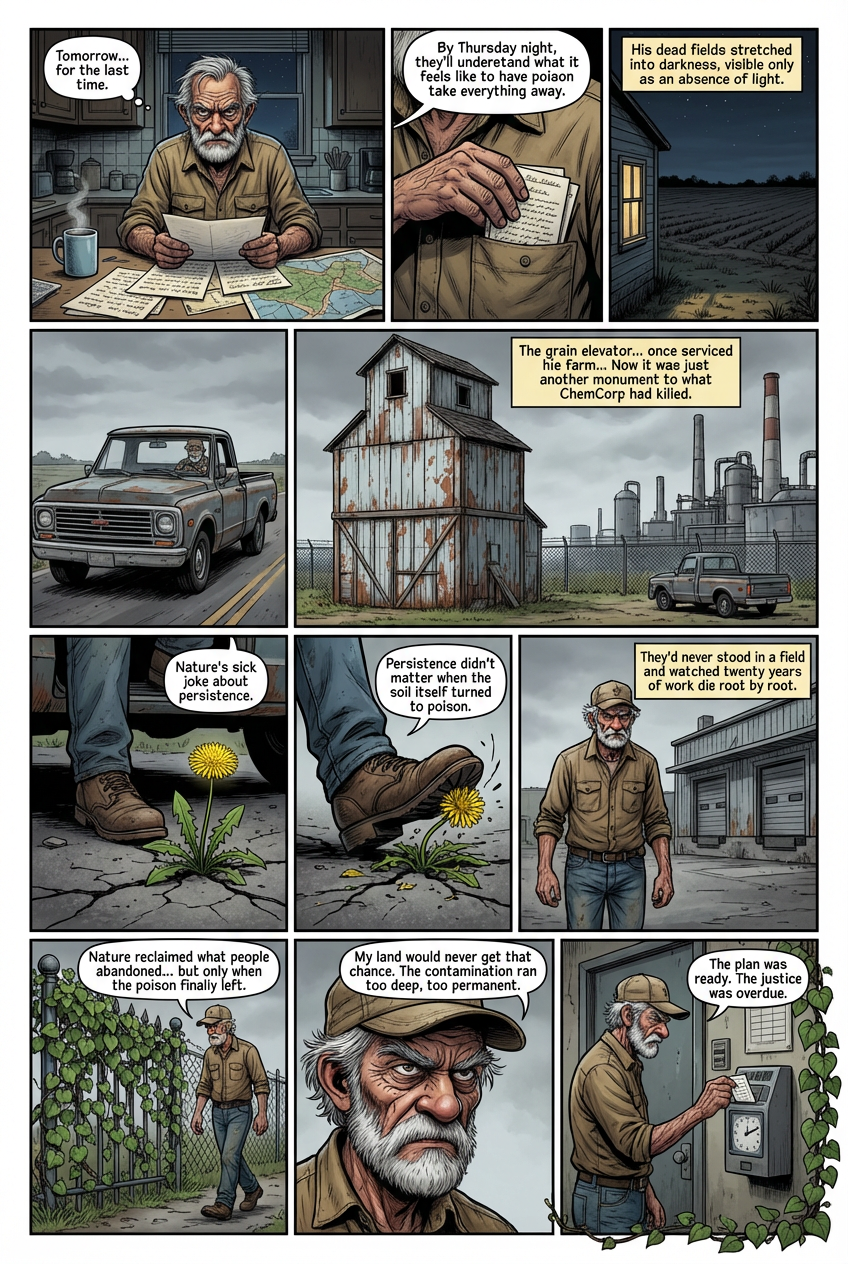
Roy stood in his kitchen that night, the handwritten notes spread across the counter. Numbers, times, chemical formulas—everything he'd learned at the historical society and the library, now reduced to a single plan. His coffee had gone cold in the mug beside his elbow. Outside the window, his dead fields stretched into darkness, visible only as an absence of light. He folded the papers and tucked them into his shirt pocket, then turned off the light. Tomorrow he'd walk into that plant for the last time as the invisible janitor. By Thursday night, the executives would finally understand what it felt like to have poison take everything away. Wednesday morning Roy drove the back route to town, past the grain elevator that had once serviced his farm and a dozen others. The structure loomed against the gray sky, its metal bands corroded orange, paint peeling in long strips. The building had stood empty for two years now, ever since the last of the family operations went under. Roy remembered when trucks lined up at harvest time, when the whole structure hummed with purpose. Now it was just another monument to what ChemCorp had killed. He parked behind the plant and walked toward the loading docks. A dandelion pushed through a crack in the asphalt near his boot. The yellow petals looked obscene against the dead concrete—nature's sick joke about persistence. Roy crushed it under his heel without breaking stride. Persistence didn't matter when the soil itself turned to poison. The executives inside thought their chemicals made the world better, more efficient. They'd never stood in a field and watched twenty years of work die root by root. Inside the fence line, vines climbed the old metal barrier that separated the employee lot from the hazardous storage area. The creeping fig had covered half the chain-link already, small heart-shaped leaves hiding the rust beneath. Roy studied the growth pattern as he passed. Nature reclaimed what people abandoned—but only when the poison finally left. His land would never get that chance. The contamination ran too deep, too permanent. He pulled his time card from his pocket and clocked in. Tomorrow night he'd make sure the executives understood that permanence, felt it in their lungs and blood the way his soil had absorbed it. The plan was ready. The justice was overdue.
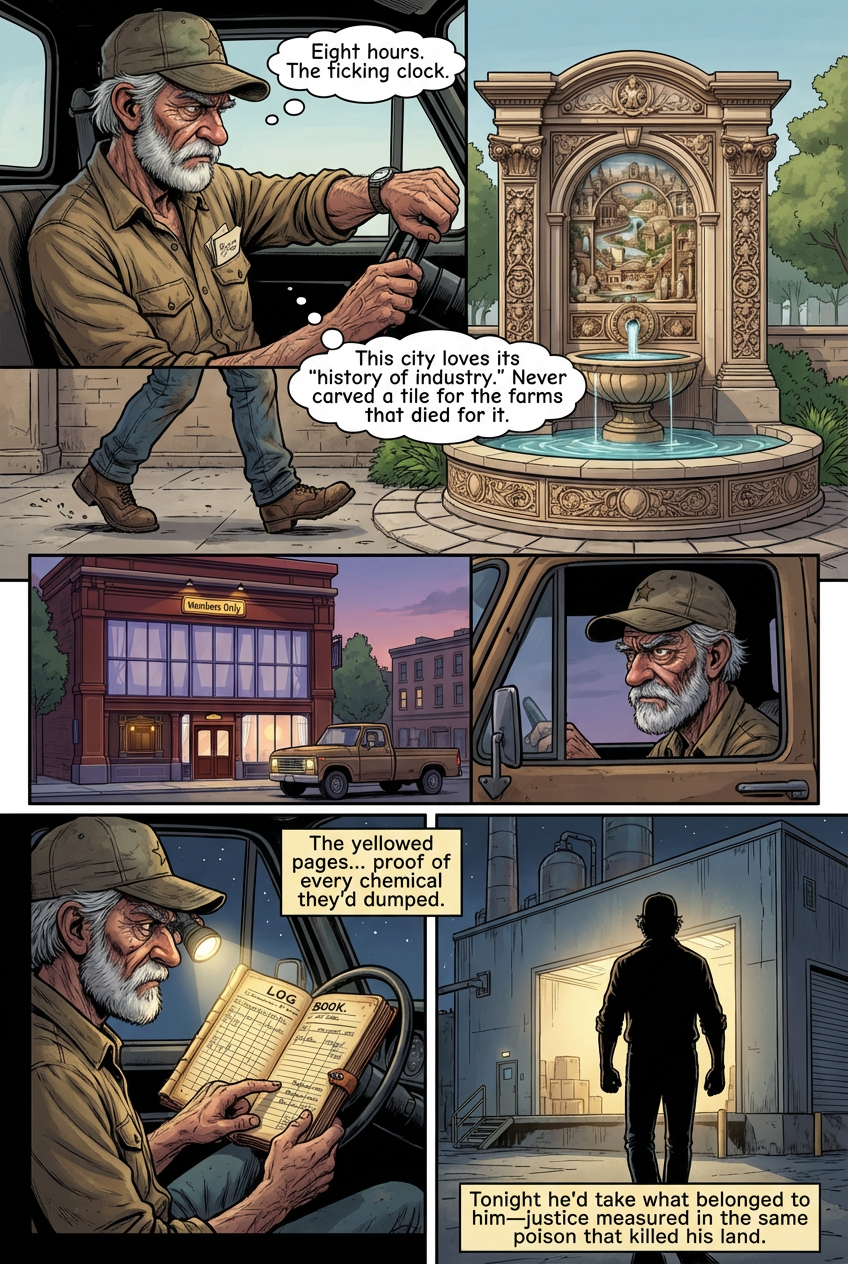
Roy checked his watch Thursday at noon—eight hours until the skeleton crew shift started. His truck sat in the diner parking lot, engine off, windows cracked. Inside his pocket, the folded notes felt like a ticking clock. He'd done everything right: studied the chemicals, learned the doses, confirmed the schedule. Tonight he'd finally walk into that loading dock and take what he needed. The executives would get their justice delivered in the same poison they'd used on his land. His hands were steady on the steering wheel. After three years of courts and lawyers and watching other farmers give up, he was hours away from making it right. He walked three blocks to kill time, boots scuffing against concrete. A fountain sat in a small plaza, water flowing over carved stone tiles. Roy stopped at the basin's edge. The tiles showed scenes from the city's past—factories rising, workers building, progress marching forward. He traced one panel with his finger. The city loved its history of industry. They just never carved tiles showing the farms that died for it. He sat on the fountain's edge and watched the water circle and drain. Eight hours felt like nothing now. He'd waited three years already. At four o'clock Roy drove past the business district on his way to scout the route one last time. A mahogany-fronted building stood between a bank and a law office, brass handles gleaming on the double doors. The sign read Members Only. He'd seen the ChemCorp executives go in there twice, laughing as they walked through those doors while farmers declared bankruptcy. Leather chairs and expensive whiskey while his fields turned to poison. Roy drove past without slowing. After tonight, they could drink in their fancy club and wonder which one of them would be next. He parked behind the plant at seven and pulled the old laboratory logbook from under his seat. The yellowed pages showed disposal records in faded ink—proof of every chemical they'd dumped, every regulation they'd ignored. His contact had pulled it from archives that should have been destroyed. Roy flipped through the stained data tables, finding his farm's coordinates listed three times in the contamination zone. The courts had called his case insufficient evidence. This logbook said otherwise. He locked it in the glove box and pocketed his notes. The skeleton crew would arrive in thirty minutes. Roy walked toward the loading dock, his hands steady, his plan perfect. Tonight he'd take what belonged to him—justice measured in the same poison that killed his land.
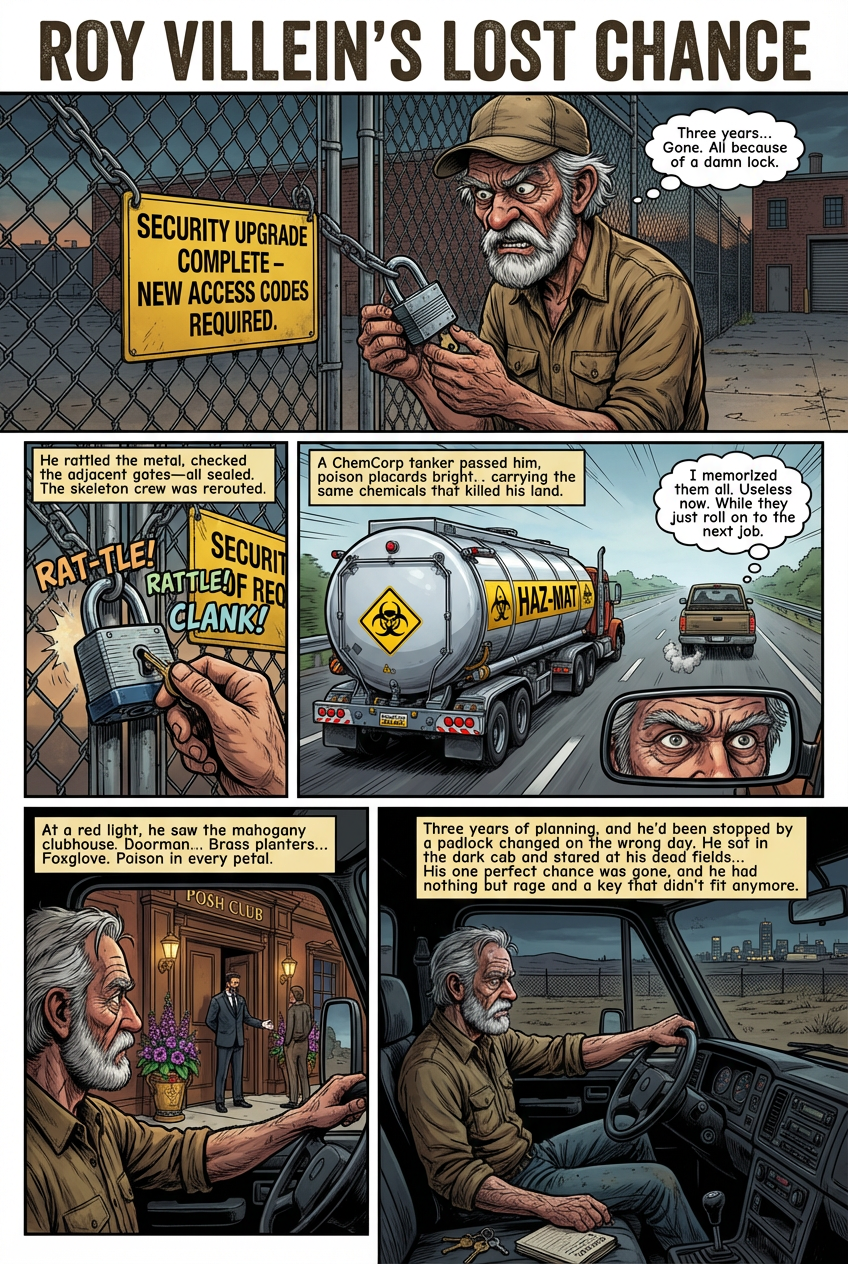
Roy walked into the loading dock at seven-thirty and found the gate already locked. The chain hung through the fence with a new padlock he'd never seen before, thick and industrial. His key didn't match. He rattled the metal, checked the adjacent gates—all sealed. A yellow notice flapped against the chain-link: "Security Upgrade Complete - New Access Codes Required." The skeleton crew wouldn't need the loading dock tonight. They'd been rerouted. His three years of planning, his careful study of schedules and chemicals, his perfect timing—all worthless because of a lock changed two days early. Roy stood in the empty lot, his hand still gripping the cold metal, watching his one chance at justice disappear behind a fence he couldn't cross. He drove away from the plant, hands tight on the wheel. A ChemCorp tanker passed him on the highway, poison placards bright against the white metal. The truck rumbled past carrying the same chemicals that had killed his land, heading somewhere to destroy something else. Roy watched it disappear in his mirror. He'd memorized those hazard symbols, studied what each chemical could do. Now all that knowledge sat useless in his head while the tanker rolled on to the next job. At a red light, Roy saw the mahogany clubhouse three blocks over. A doorman stood at the entrance in a pressed suit, turning away someone without the right credentials. Beyond him, brass planters framed the doorway, purple flowers drooping in the evening air. Roy recognized foxglove from his farming days—pretty to look at, poison in every petal. The executives probably walked past those planters every week and never knew what they were. Just like they'd never known what their runoff would do to his soil. The light turned green. Roy pulled into an empty parking lot and cut the engine. His notes were still in his pocket, the logbook still locked in the glove box. Three years of planning, and he'd been stopped by a padlock changed on the wrong day. He sat in the dark cab and stared at his dead fields beyond the fence line. The executives would drink in their club tomorrow, safe behind their doorman and their brass planters. His one perfect chance was gone, and he had nothing but rage and a key that didn't fit anymore.
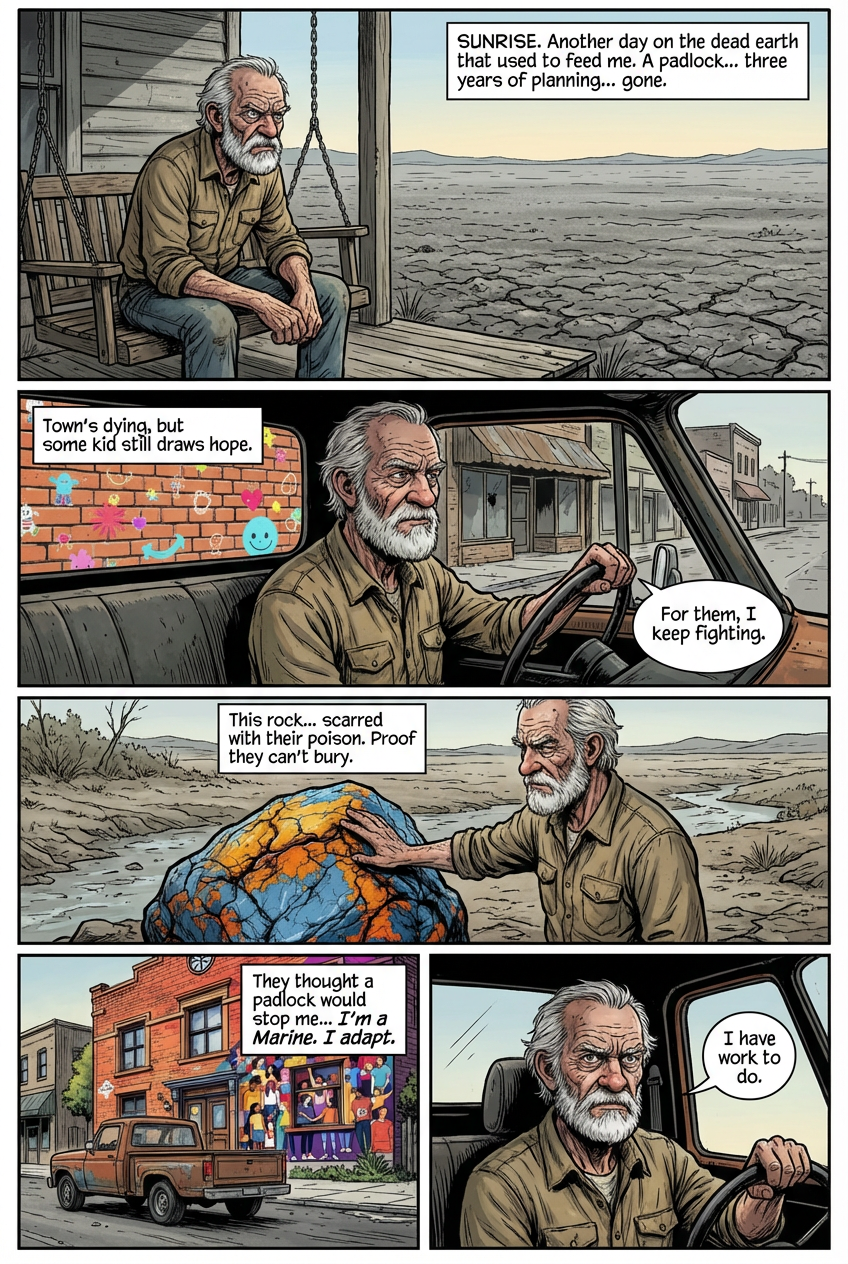
Roy drove home and sat on his porch until sunrise, staring at the dead furrows that used to feed him. The contaminated soil looked gray in the morning light, cracked and lifeless. He'd failed because of a padlock—three years of planning destroyed by a schedule change he couldn't predict. But his hands were still steady. The executives still walked free. And somewhere in this broken system, there had to be another way in. He drove into town that afternoon, no destination in mind. Just movement to keep the anger from eating him alive. Two blocks past the shuttered hardware store, he spotted a brick wall covered in chalk drawings. Stick figures held hands under a bright yellow sun. A rainbow arched over a house with flowers in the windows. Some kid had drawn hope on a wall in a town that had none left. Roy stopped the truck and stared at those simple shapes. Children still believed things could be good here. Still drew their dreams on walls while their parents filed for bankruptcy. He'd fought ChemCorp for those kids too—for the ones who'd never get to farm land their grandparents had worked. Past the edge of town, Roy pulled over near the creek that used to mark his property line. A large boulder sat in the dried streambed, its surface eaten away by years of runoff. Black and orange stains spread across the stone like a disease. The rock looked like something from another planet, scarred and poisoned. He'd watched that boulder change colors over twenty years, never understanding what it meant until the contamination killed everything. The executives had done this. Put their chemicals in the ground and the water until even stone couldn't survive. Roy touched the damaged surface, fingers tracing the deep etch marks. This boulder was proof. Permanent proof that couldn't be buried in a courtroom or hidden behind bought judges. He drove back through town and passed a community center with worn brick walls. A painted mural covered one side—hands reaching toward each other, faces of different ages looking forward together. Roy had been to meetings there in the early days, back when farmers still thought committees and petitions might work. He'd sat in folding chairs and listened to people share their losses, their anger, their hope that someone would care. Nobody had cared. But those people had kept fighting anyway, kept gathering even when the system crushed them. Roy pulled into the parking lot and cut the engine. The padlock had stopped one plan, but it hadn't stopped him. He'd find another way. The executives thought they were safe behind their lawyers and their security upgrades. They'd never met a Marine who knew how to adapt when the first assault failed. Roy started the truck and headed home. He had work to do.
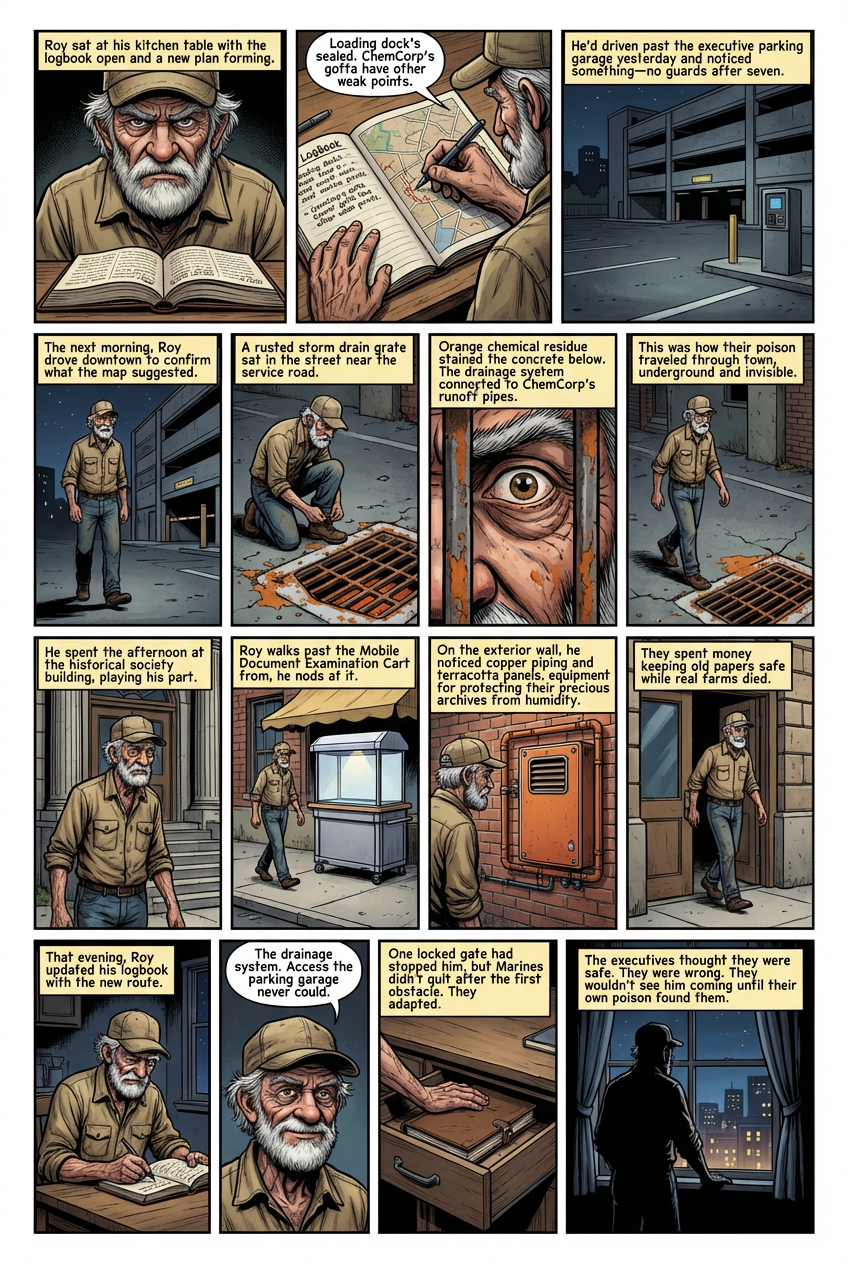
Roy sat at his kitchen table with the logbook open and a new plan forming. The loading dock was sealed, but ChemCorp had other weak points. He'd driven past the executive parking garage yesterday and noticed something—no guards after seven, just a card reader and cameras pointed at the entrance. The executives parked in assigned spots every night, walked the same path to their cars. Roy had watched them enough to know their routines never changed. He pulled out a map and marked three locations: the garage, the service road behind it, and the drainage system that ran underneath. His hands were steady as he drew the lines. One locked gate had stopped him, but Marines didn't quit after the first obstacle. They adapted. He closed the logbook and stood. The executives thought they were safe. They were wrong. The next morning, Roy drove downtown to confirm what the map suggested. He parked two blocks from the executive garage and walked the perimeter on foot. A rusted storm drain grate sat in the street near the service road. He crouched down, pretending to tie his boot, and peered through the metal bars. Orange chemical residue stained the concrete below. The drainage system connected to ChemCorp's runoff pipes—he'd traced those connections months ago during his court research. This was how their poison traveled through town, underground and invisible. Roy stood and kept walking. The drainage system went everywhere the executives did. He spent the afternoon at the historical society building, playing his part. The staff knew him as the old farmer who studied land surveys, trying to prove his contamination case even after bankruptcy. They felt sorry for him. A cart with a glass top sat outside under a fabric sunshade—some kind of setup for examining old documents in daylight. Roy nodded at it as he passed, shuffling inside like a man with nowhere else to go. On the exterior wall, he noticed copper piping and terracotta panels—equipment for protecting their precious archives from humidity. They spent money keeping old papers safe while real farms died. He checked three more surveys he didn't need, then left. The staff would remember he'd been there, doing what broken men do. That evening, Roy updated his logbook with the new route. The drainage system gave him access the parking garage never could. He could trace the chemical flow backward, find where the executives were vulnerable. One padlock had taught him something useful—don't attack where they expect it. Attack where they've already forgotten they're guilty. Roy closed the book and locked it away. The executives would keep their routines, keep walking their safe paths, keep thinking the lawsuits were over. They wouldn't see him coming until their own poison found them.
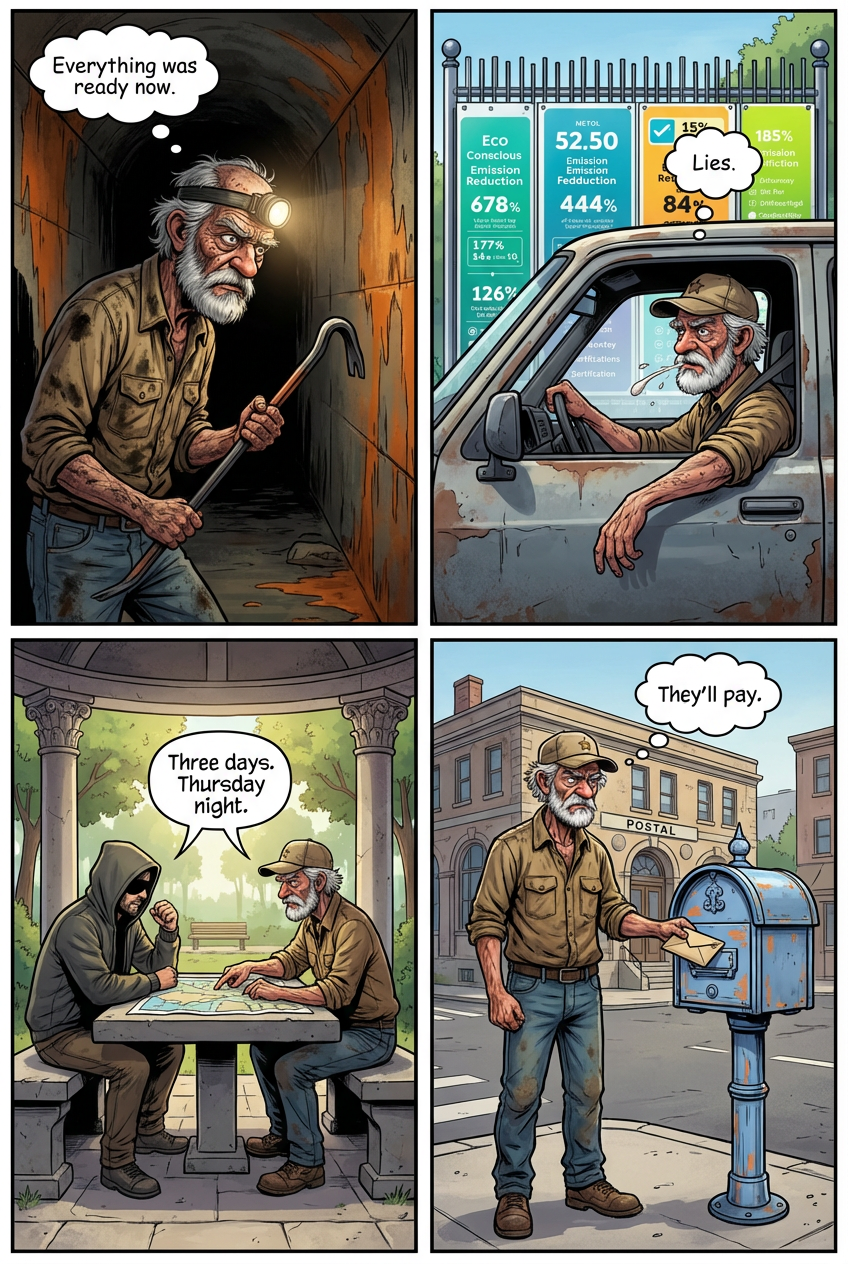
Roy tested the drainage grate with a crowbar that night. The metal bars lifted easily—no lock, no alarm, just rust and the city's assumption that nobody cared what happened underground. He lowered himself into the tunnel and followed the chemical stains for three blocks. The path led exactly where he needed it to go. When he climbed back out, his boots were orange with residue and his hands smelled like poison. He drove home and scrubbed his skin until it was raw. Everything was ready now. The route was clear. The executives would never see it coming. Morning brought the final details. Roy drove past the ChemCorp plant and spotted the metal fence panels along the perimeter—bright displays showing emission numbers and green certification logos. The company wanted everyone to see how safe they claimed to be. He spat out the window and kept driving. Those numbers were lies, just like the courtroom testimony had been lies. But the fence told him something useful. The executives felt secure enough to advertise. They thought the public believed their story. He met his contact at the stone pavilion in the center of the town park. The man was already there, sitting on one of the benches under the brick dome. Roy spread the map across the concrete table between them. "Three days," Roy said. "Thursday night, when the night shift changes." His contact studied the route through the drainage system, nodded once, then folded the map and tucked it away. No names. No questions. Just two men who understood what justice looked like when the courts failed. Roy spent the afternoon practicing near the old postal building. A weathered blue mailbox stood on the corner, its paint peeling and metal slot rusted. He walked past it three times, each time slipping a weighted envelope inside without breaking stride. The package dropped silent every time. Nobody looked. Nobody cared about an old man mailing letters. On Thursday, it wouldn't be letters. It would be small containers of the same chemicals that killed his farm, delivered where they belonged. Roy drove home and locked the logbook in his desk. Twenty years of work had died in poisoned soil. In three days, the executives would finally pay for what they'd done.
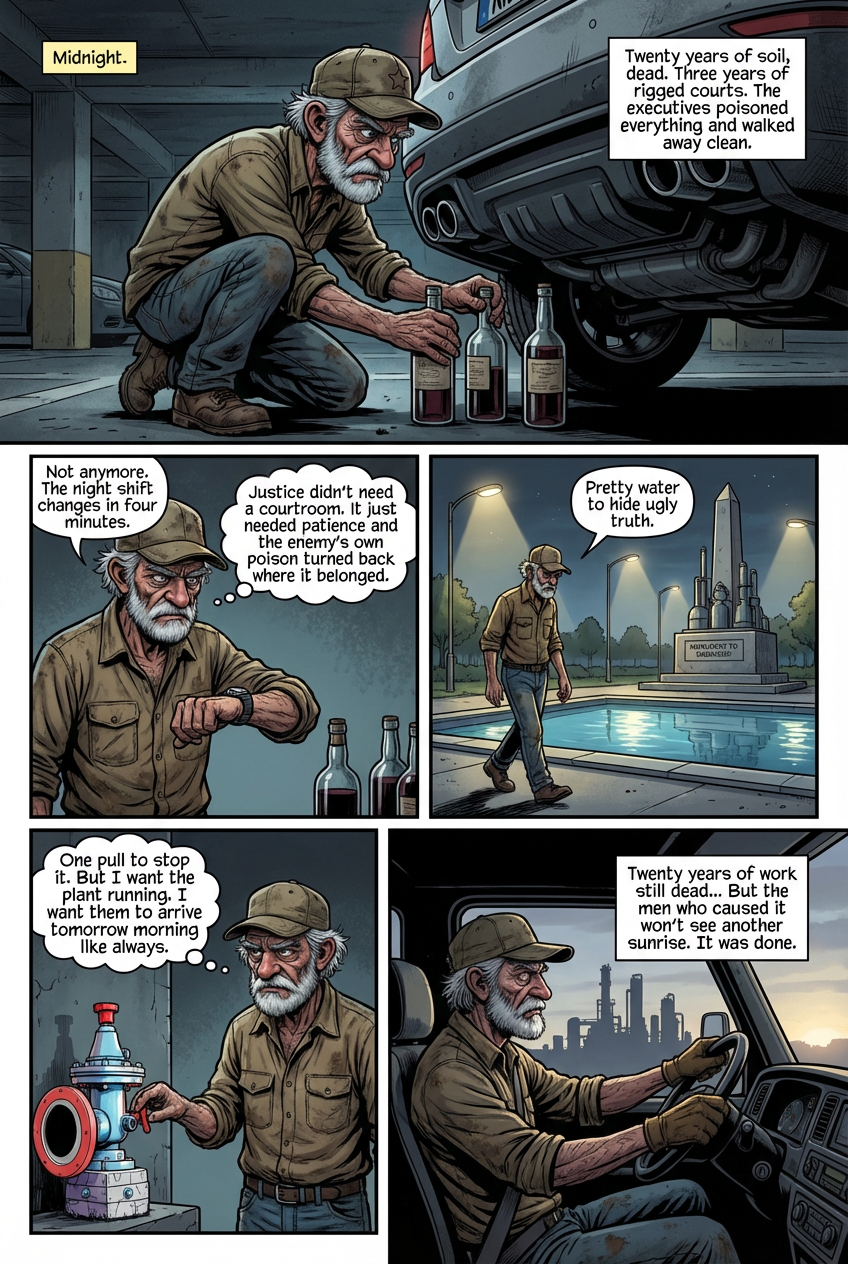
Roy crouched in the executive parking garage at midnight, three glass bottles lined up beside the CEO's car. Each one held the same chemicals that killed his farm, stolen from ChemCorp's own supply shed. His hands didn't shake as he placed them under the engine block where the heat would do its work. Twenty years of soil, dead. Three years of rigged courts. One yacht named Clean Conscience. The executives had poisoned everything he built and walked away clean. Not anymore. Roy stood and checked his watch. The night shift changed in four minutes. He walked toward the drainage tunnel, his boots echoing once, then disappeared into the dark. Behind him, the bottles waited. Justice didn't need a courtroom. It just needed patience and the enemy's own poison turned back where it belonged. He surfaced three blocks away near the ChemCorp plant entrance. Dawn was still hours off. The monument to the chemical industry stood tall outside the gates—twisted metal shapes celebrating everything the company claimed to be. Progress. Innovation. Success. Roy walked past it without looking up. The glass-edged reflecting pool caught streetlight and threw it back at the building's walls. Pretty water to hide ugly truth. He kept moving toward the emergency shutoff valve he'd marked weeks ago during reconnaissance. The red lever jutted from its metal housing, bolted to concrete. One pull would stop the chemical flow through the main pipes. But Roy didn't touch it. He wanted the plant running. He wanted the executives to arrive tomorrow morning like always, walk to their cars like always, turn their keys like always. The bottles would ignite when the engines heated. Fast enough the men wouldn't suffer. Clean enough it would look like equipment failure. Roy had calculated the chemical reaction three times to be sure. The same poison that killed his farm would burn hot and quick. No trials. No lawyers. No bought judges letting guilty men walk free. Just ChemCorp's own product doing what it did best—destroying everything it touched. Roy crossed the empty street and headed for his truck. His hands smelled like chemicals even through the gloves he'd worn. He'd scrub them raw again when he got home, but the smell would stay. It always did. In six hours, the executives would die the same way his farm died—poisoned by the thing they trusted most. Roy climbed into his truck and started the engine. Twenty years of work was still dead. Three years of court battles were still lost. But the men who caused it wouldn't see another sunrise. He drove away as the first hint of gray touched the sky. It was done.
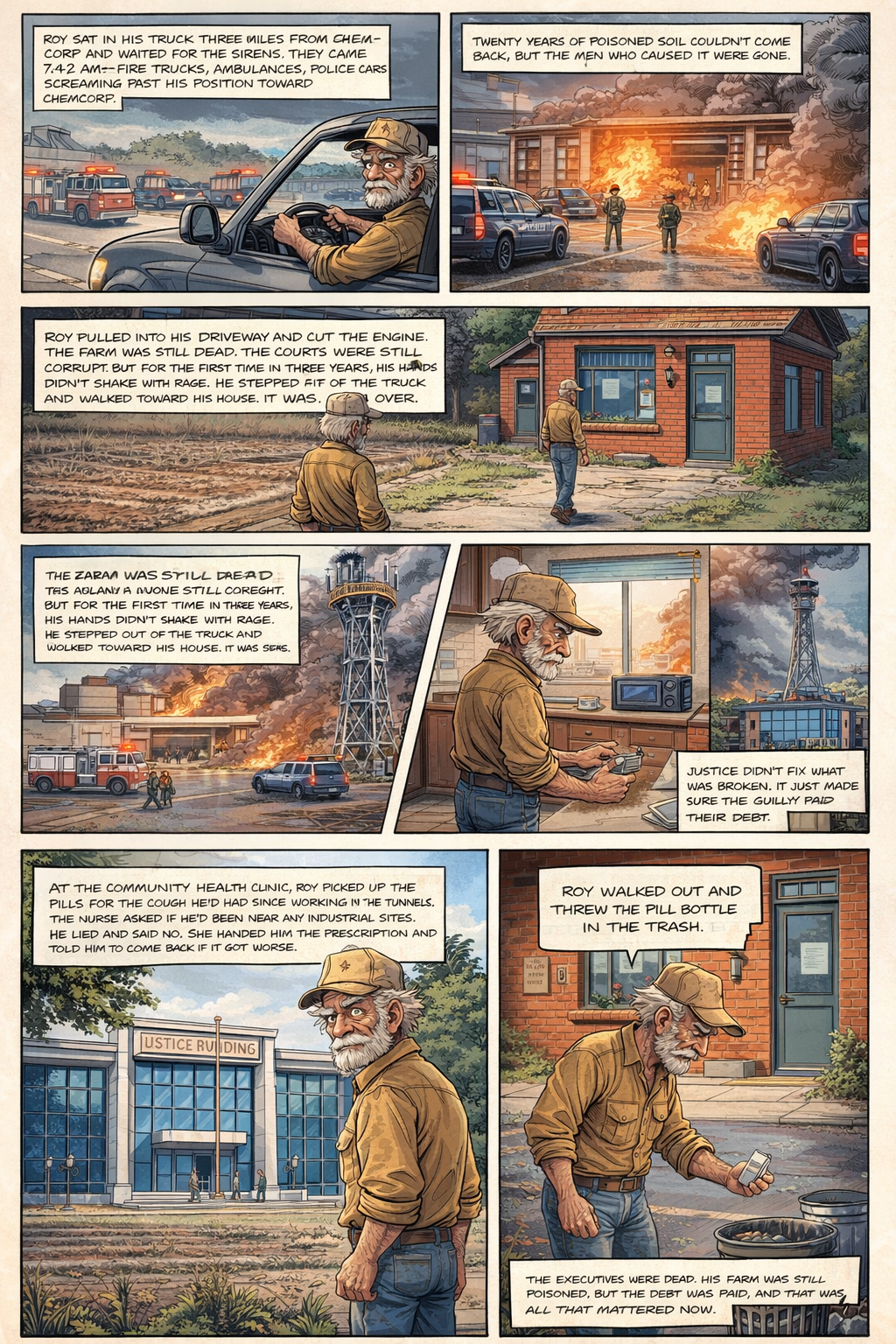
Roy sat in his truck three miles from the plant and waited for the sirens. They came at 7:42 AM—fire trucks, ambulances, police cars screaming past his position toward ChemCorp. He listened until the sounds faded, then started the engine and drove home. The bottles had done their work. Twenty years of poisoned soil couldn't come back, but the men who caused it were gone. Justice didn't fix what was broken. It just made sure the guilty paid their debt. Roy pulled into his driveway and cut the engine. The farm was still dead. The courts were still corrupt. But for the first time in three years, his hands didn't shake with rage. He stepped out of the truck and walked toward his house. It was over. The radio station broadcast the news at noon. Roy stood in his kitchen and listened to the reporter describe the parking garage fire. Three executives dead. Cause still under investigation. Chemical residue found at the scene. He switched off the radio and ate lunch at the table. The food tasted the same as it had yesterday. The farm outside his window looked the same—dead rows where crops used to grow. Nothing had changed except the men who killed it were gone now. Two days later, Roy drove past the Justice Building on his way to the bank. Workers were removing records from the basement after a pipe leak. He recognized the marble steps where he'd walked three years ago for his first hearing. The building stood tall and clean, just like it had when the judges ruled against him. He kept driving. The courts hadn't given him justice then, and seeing the building now didn't make him feel anything. He'd found his own answer. At the community health clinic, Roy picked up the pills for the cough he'd had since working in the tunnels. The brick walls were faded and the notice board showed warnings about chemical exposure. The nurse asked if he'd been near any industrial sites. He lied and said no. She handed him the prescription and told him to come back if it got worse. Roy walked out and threw the pill bottle in the trash. The cough would fade or it wouldn't. The executives were dead. His farm was still poisoned. But the debt was paid, and that was all that mattered now.
Play your story to life
Storycraft is a mobile game where you create AI characters, craft items and locations to build their world, then discover what direction your story takes. Download the iOS game for free today!
Download for free