

Sammy the Snowplough Driver's Arc
6 Chapters
Sammy the Snowplough Driver's dream is making sure all roads in Storyland Canada - Ice World are ploughed properly.

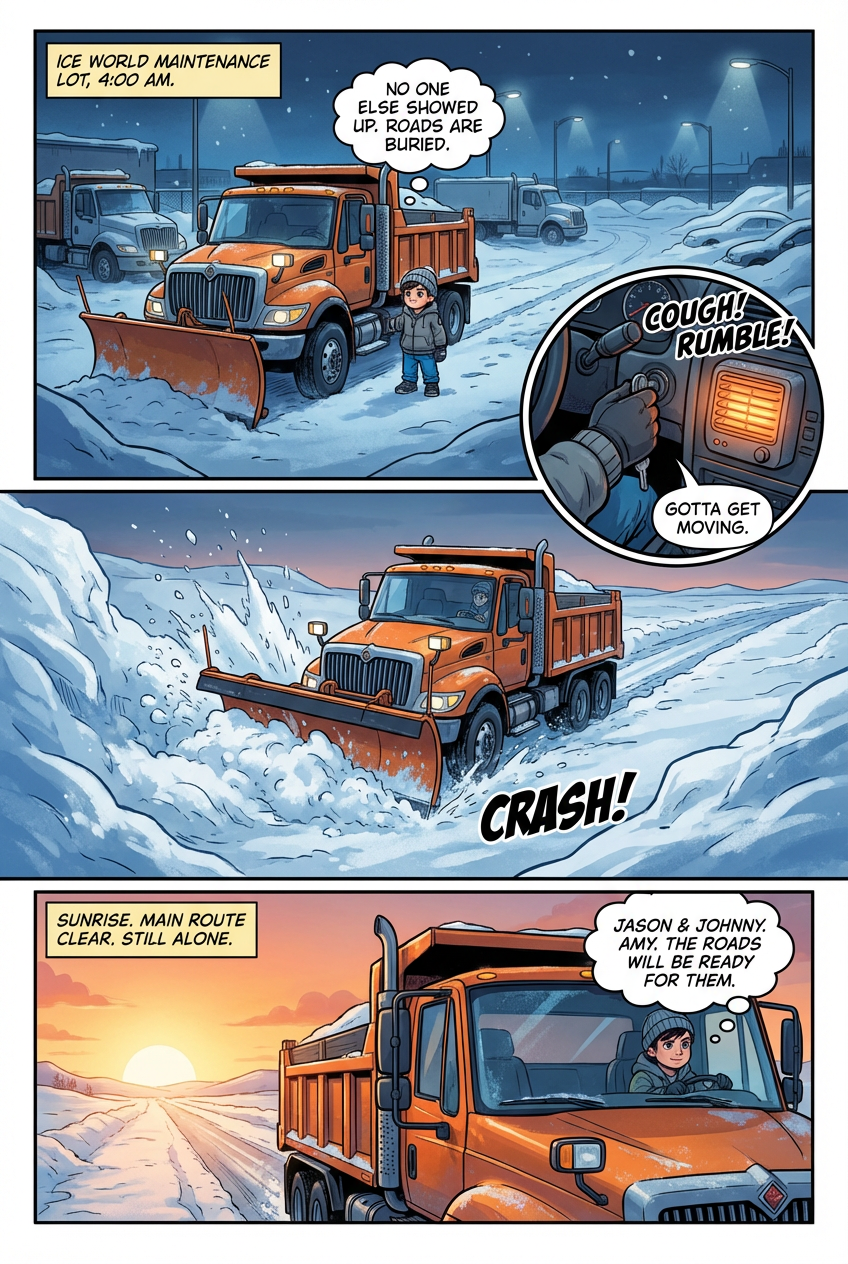
Sammy pulled into the maintenance lot at four in the morning and knew right away something was wrong. Half the roads through Ice World were already buried under drifts tall enough to swallow a car. The other trucks sat empty in their spaces, engines cold. No headlights cut through the dark. No one else had shown up. He climbed into his orange plough and turned the key. The engine coughed, caught, then settled into its familiar rumble. He flipped on the space heater wedged between the seats. It glowed orange and red through its metal grill, throwing heat across his knuckles. The warmth wouldn't last long once he dropped the blade and got moving, but it was something. He was here. The roads needed clearing. That was enough. The first snowbank rose up ahead like a frozen wave, twice the height of his hood. He angled the blade and pushed in. Snow exploded off the steel in white clouds. The plough shuddered but held. He carved a path ten feet wide, then twenty. Behind him, a single lane opened where there had been nothing. The heater rattled on the seat beside him. His breath fogged the windshield. By the time the sun came up, he'd cleared the main route and started on the side roads. His phone hadn't buzzed. No one was coming to help. He thought about Jason and Johnny waiting for the school bus, about Amy with her backpack. The roads would be clear by then. He'd make sure of it. The blade scraped against asphalt, and the sound filled the cab like a heartbeat.
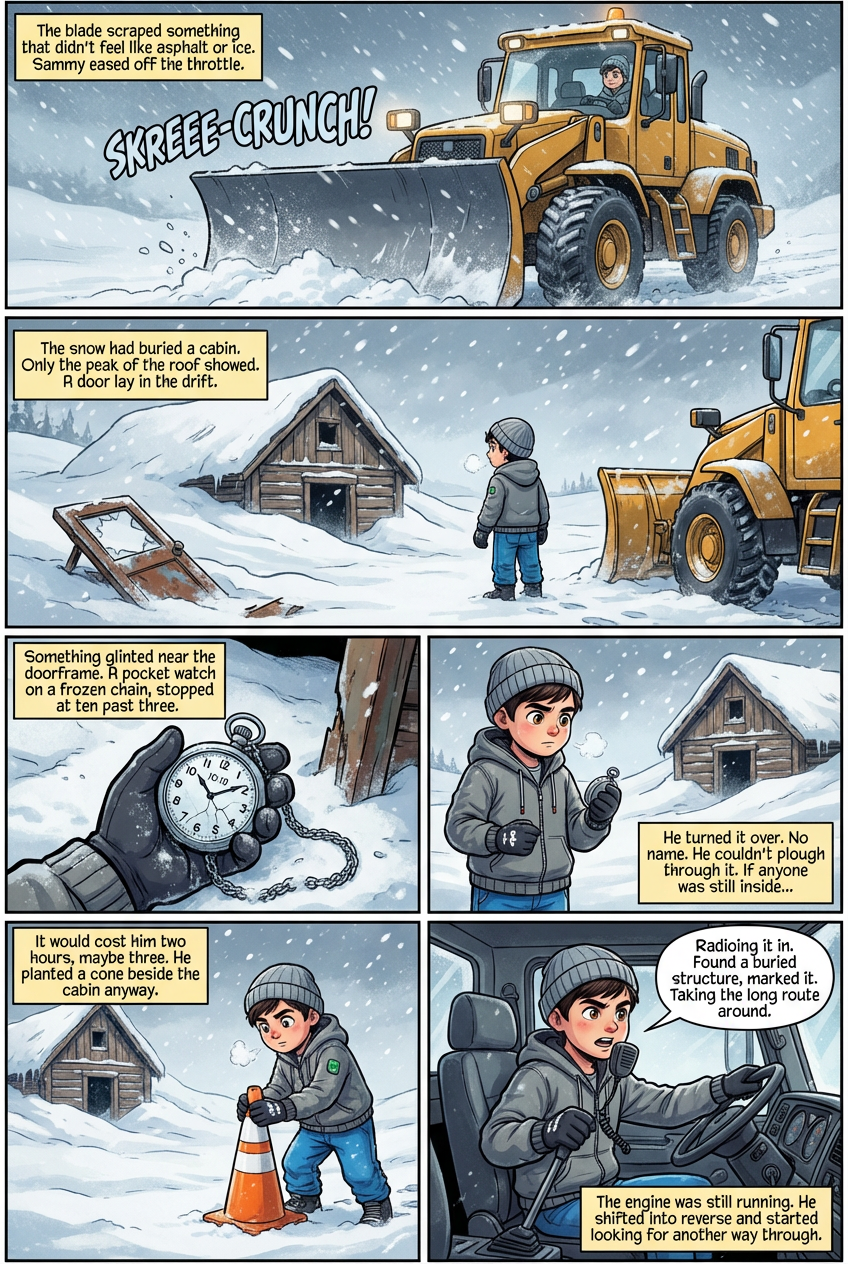
The blade scraped something that didn't feel like asphalt or ice. Sammy eased off the throttle and let the plough roll forward a few more feet before stopping. He climbed out into the cold, boots sinking into powder up to his shins. The snow had buried a cabin. Not just covered it — swallowed it whole. Only the peak of the roof showed now, wood dark with age and moisture. A door lay on its side in the drift, hinges rusted and broken, like someone had torn it off and thrown it there. Sammy knelt and brushed snow from the frame. The wood was soft under his glove, ready to fall apart. No smoke from a chimney. No footprints. Whoever lived here had left a long time ago, or never left at all. Something glinted near the doorframe. He pulled it free from the ice — a pocket watch on a frozen chain, the face cracked and stopped at ten past three. The metal burned cold through his glove. He turned it over. No name. No inscription. Just a timepiece that had stopped counting. He slipped it into his coat pocket and stood, looking at the cabin half-buried in the road he was trying to clear. He couldn't plough through it. The structure would collapse, and if anyone was still inside — even after all this time — he couldn't risk it. He'd have to mark it, radio it in, and take the long route around to finish the side roads. It would cost him two hours, maybe three. The school bus wouldn't wait. But he pulled a cone from the truck bed and planted it in the snow beside the cabin anyway, then climbed back into the cab. The engine was still running. He shifted into reverse and started looking for another way through.
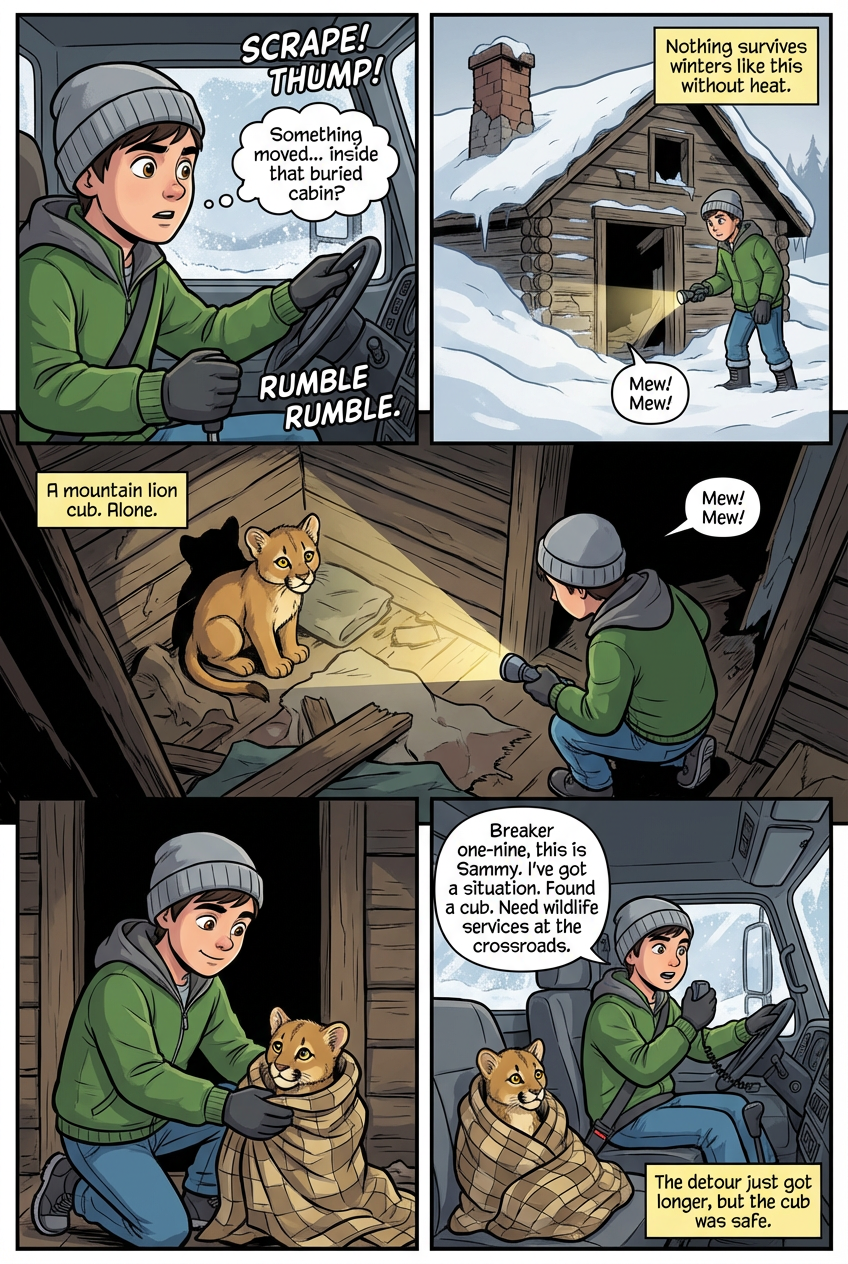
He shifted the truck into reverse, already mapping the detour in his head. The engine idled rough, waiting. Then something moved inside the buried cabin — a scrape, a thump, something alive. Sammy's hand froze on the gearshift. The sound came again, muffled but deliberate, from somewhere beneath the snow and rotted wood. He grabbed the flashlight from under his seat and climbed back out. The chimney stood half-buried beside the cabin, its bricks crumbling where ice had worked into the mortar. Whatever was inside couldn't have been there long — nothing survived winters like this without heat. He moved toward the broken doorway, boots crunching through fresh powder. A low cry came from the darkness below, high-pitched and urgent. Not human. Something smaller. Sammy knelt at the entrance and aimed the light down into what used to be the main room. The beam caught movement in the corner — a tawny shape huddled against the wall, yellow eyes reflecting back at him. A mountain lion cub, maybe three months old, shivering in a makeshift den of broken boards and old fabric. No mother. No tracks leading out. Just the cub, alone in a structure that should have collapsed years ago. He couldn't leave it. The roads needed clearing, the bus would run in two hours, but the cold would kill the cub before noon. Sammy climbed down through the broken door frame, moving slow, and wrapped the animal in his spare work blanket from the truck. It didn't fight him. He carried it back up to the cab and set it on the passenger seat, then picked up the radio. The wildlife center would have to send someone to the crossroads. His detour just got longer, but the cub was breathing steady now, and that counted for something. He put the truck in gear and started toward the main road, the engine running, the blade still down.
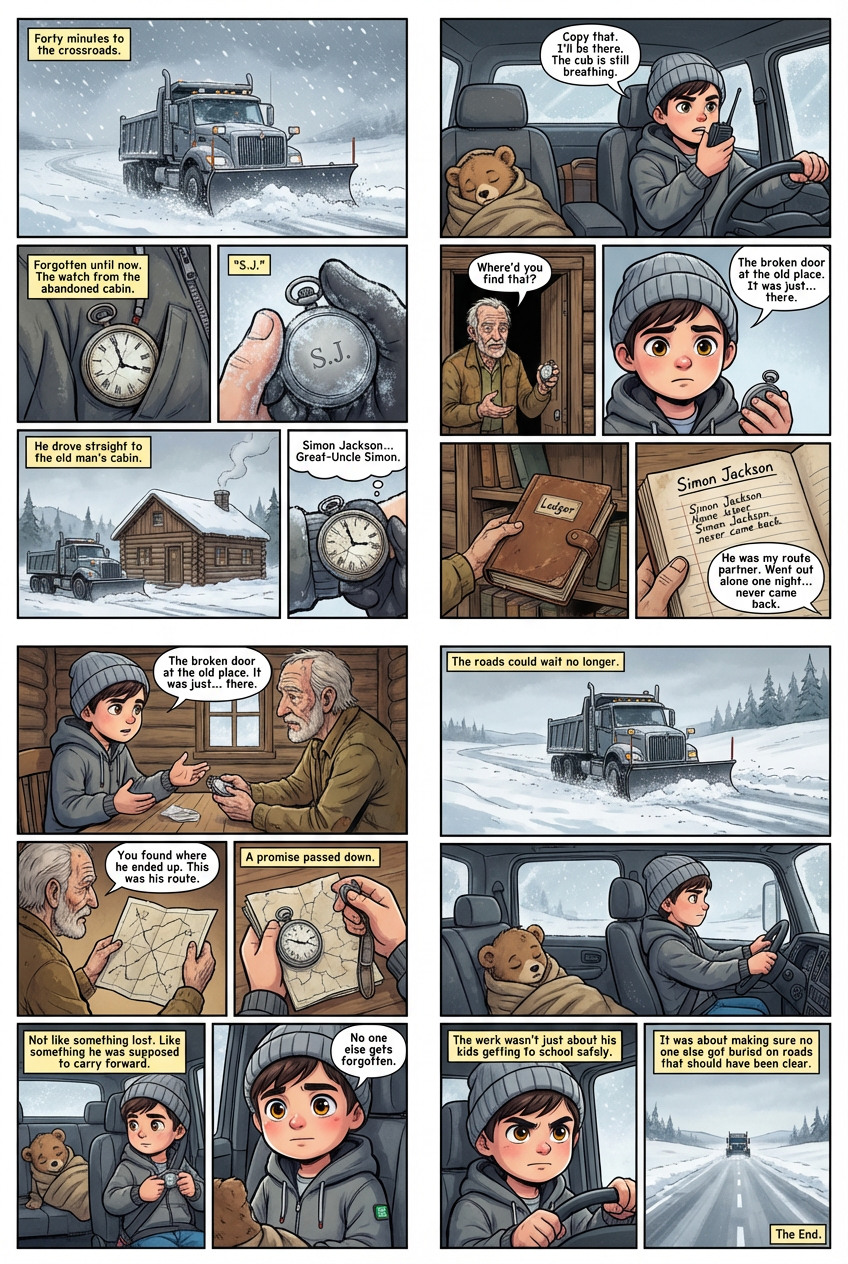
The wildlife center dispatcher promised someone would meet him at the crossroads in forty minutes. Sammy set the radio back in its cradle and checked the cub on the passenger seat — still breathing, eyes half-closed, wrapped tight in the blanket. The roads could wait that long. He pulled back onto his route, blade down, clearing what he could on the way to the meet-up point. The pocket watch shifted in his coat pocket as the truck bounced over a drift. He'd forgotten about it until now — the cracked face, the hands frozen at 3:10, the tarnished metal cold against his palm when he'd picked it up. It didn't belong to the cabin. Too well-made for a place that had rotted into the ground. Someone had dropped it there, or left it behind on purpose. He turned the watch over at a red light, wiping frost from the back casing with his thumb. Initials appeared beneath the grime: S.J., elegantly engraved in script that must have cost someone real money. Sammy felt something tighten in his chest. His great-uncle's name had been Simon Jackson — Great-Uncle Simon, who'd worked the Ice World routes thirty years ago before the roads were paved, before GPS told you where the drifts would be. Simon had disappeared one winter and never came back. The family assumed he'd moved south, chasing warmer work. But the watch told a different story. Sammy drove straight to the log cabin near the maintenance lot — the one that sat alone at the edge of the ploughing district, smoke always rising from its chimney even in spring. An old man answered the door, face weathered like driftwood. He looked at Sammy, then at the pocket watch in his outstretched hand, and his expression went carefully blank. "Where'd you find that?" the man asked. Sammy told him about the abandoned cabin, the broken door, the watch near the frame. The man was quiet for a long moment, then stepped back and pulled a leather ledger from a shelf by the door. He opened it to a page marked with a faded ribbon. The handwriting matched the engraving — Simon Jackson's name at the top of a list, dates running down the margin, the last entry from three decades ago. "He was my route partner," the man said. "Went out alone one night to check a cabin complaint. Never made it back." The man closed the ledger and handed Sammy a folded map marked with pencil lines — old routes Simon had cleared, including the one where the buried cabin sat. "You found where he ended up," the man said. "That means something." Sammy held the map, feeling its weight. The roads he'd been clearing weren't just his own anymore — they were Simon's too, a promise passed down through frozen ground and cracked metal. He pocketed the watch again, but this time it felt different. Not like something lost. Like something he was supposed to carry forward. He thanked the man, returned to his truck where the cub still slept, and drove toward the crossroads. The work wasn't just about his kids getting to school safely. It was about making sure no one else got buried and forgotten on roads that should have been clear.
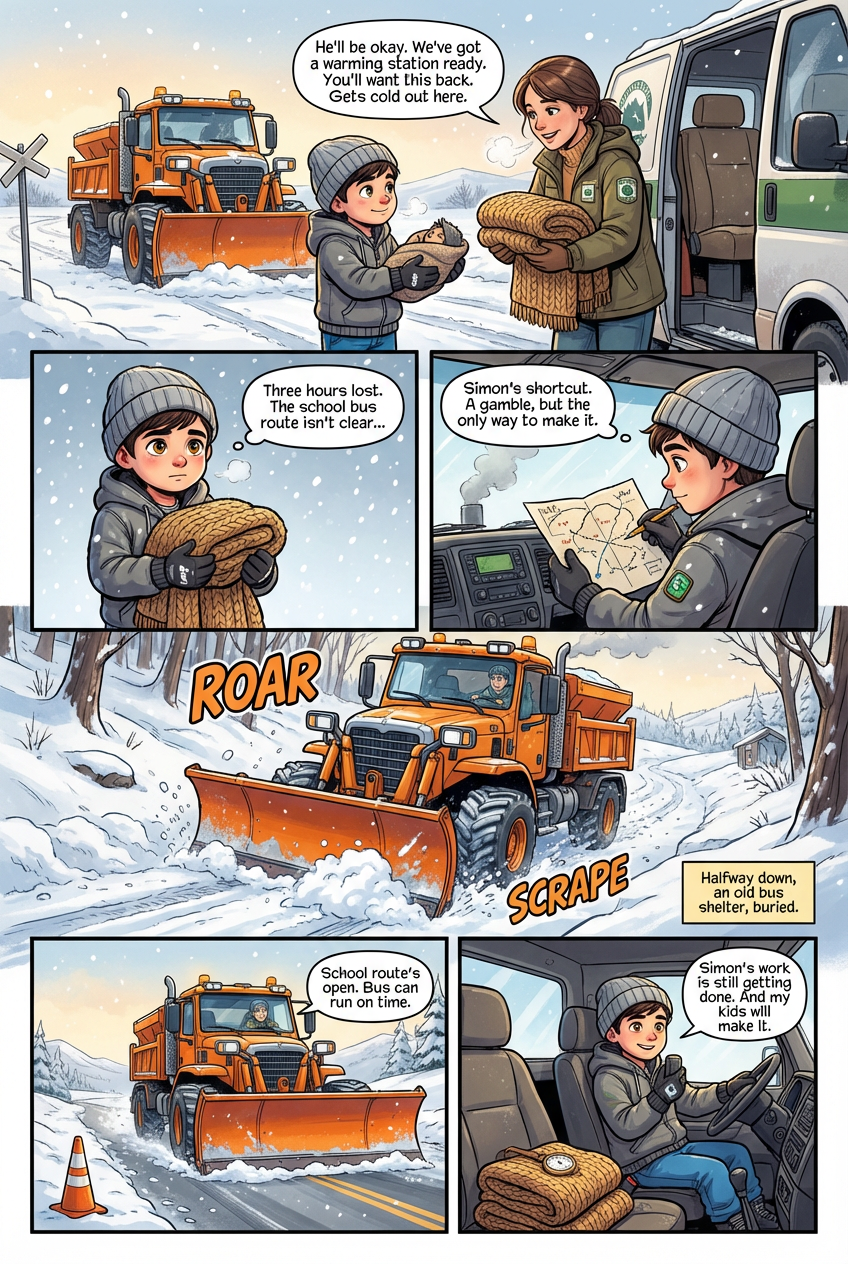
The wildlife center van met him at the crossroads exactly when promised. A woman in a thick coat stepped out and walked toward his truck, her breath hanging white in the air. Sammy carried the cub to her, still wrapped in his blanket. She took the animal gently, checking its breathing and temperature with practiced hands. "He'll be okay," she said. "We've got a warming station ready." She pulled a folded blanket from the van and handed it to him. "You'll want this back. Gets cold out here." The blanket was thick and knitted, the kind someone's grandmother might make. It wasn't his — his was going with the cub — but he took it anyway. She promised to call the maintenance lot with updates and drove off, taillights disappearing into the gray morning. Sammy stood alone at the crossroads, the new blanket heavy in his hands. The detour had cost him three hours. The main route to the school still wasn't clear, and the bus would be running in less than two. He climbed back into his truck and checked the map the old man had given him. Simon's pencil marks showed a shortcut — a narrow side road that connected to the school route half a mile up. Sammy had never used it before. The road wasn't on any official ploughing list, which meant it could be buried under four feet of drift or worse. But if it was clear enough to push through, he'd make up the lost time. If it wasn't, he'd be stuck digging himself out while the bus turned around at an impassable intersection. He turned the truck toward the shortcut and dropped the blade. Snow piled high on both sides, narrower than he liked, but the surface underneath was solid. The engine roared as he pushed forward, clearing a path barely wide enough for the school bus to squeeze through. Halfway down, he spotted an old bus shelter buried under ice, its wooden bench just visible through the frozen shell. That meant the route connected where he thought it did. He kept going, blade scraping loud against frozen asphalt, until the shortcut opened onto the main school route. An orange cone he'd placed earlier that week marked the intersection. The road beyond it was clear. He'd done it. Sammy pulled over and radioed dispatch. "School route's open," he said. "Bus can run on time." The dispatcher confirmed and signed off. He sat in the cab with the engine idling, the new blanket folded on the passenger seat where the cub had been. The pocket watch was still in his coat. He didn't take it out this time — didn't need to. Simon had known these roads well enough to mark shortcuts no one else remembered. Sammy had just proven they still worked. The watch wasn't just a relic anymore. It was a map he was learning to read. He put the truck in gear and headed back toward the main routes. The roads were clearing. His kids would make it to school. And Simon's work was still getting done.
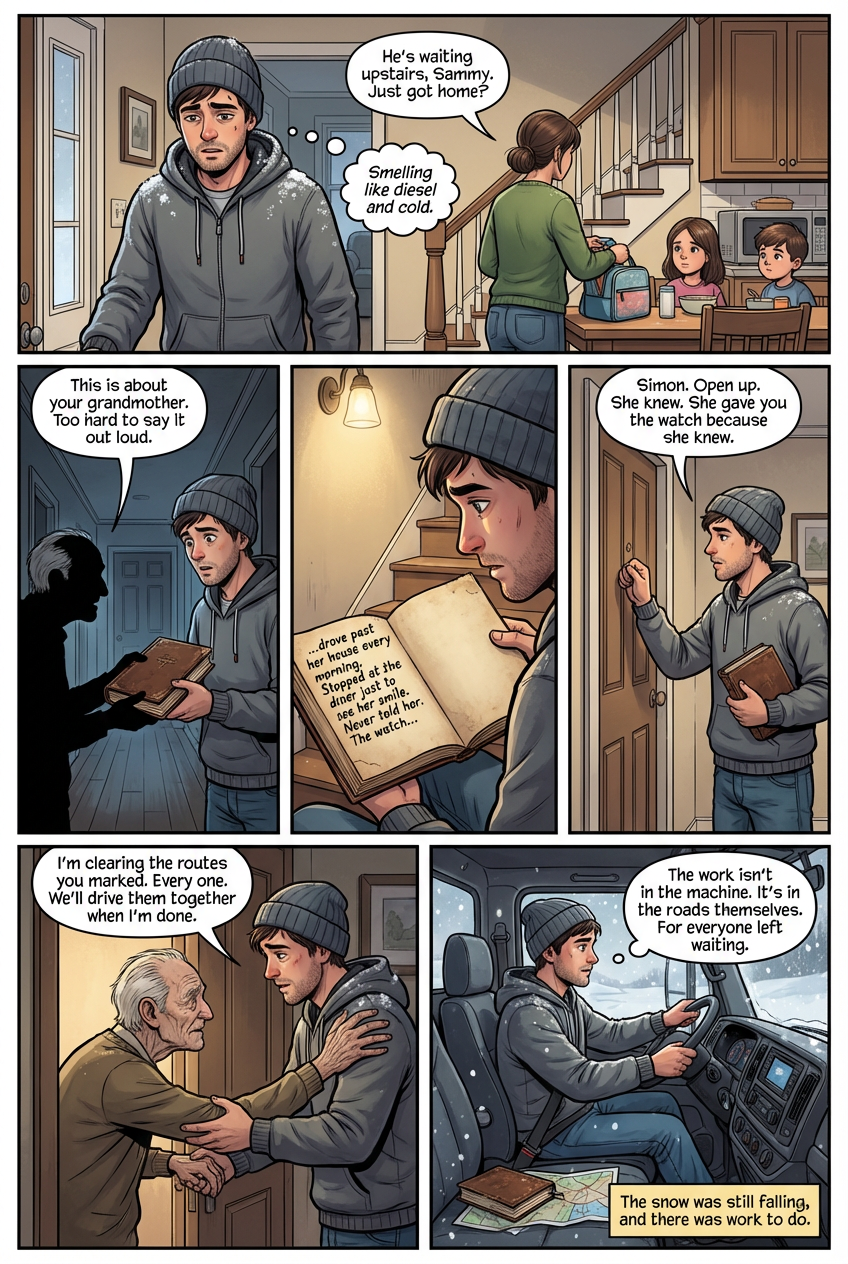
Sammy got home just after seven, parked the truck in the driveway, and walked through the front door smelling like diesel and cold. The kids were already awake, eating cereal at the kitchen table. Sasha looked up from packing lunches and nodded toward the stairs. Great-Uncle Simon was waiting in the upstairs hallway, holding something against his chest. He pressed a leather-bound book into Sammy's hands before Sammy could speak. "This is about your grandmother," Simon said, his voice barely above a whisper. "I can't tell you myself. Too hard to say it out loud." He turned and walked back to his room, closing the door before Sammy could ask anything. The diary was heavy and worn, the leather cracked at the corners. Sammy wanted to collapse into bed, but instead he sat on the top stair and opened it. The first entry was dated thirty years ago, written in careful handwriting that slanted to the right. Simon had loved her before she married Sammy's grandfather. He'd driven his routes past her house every morning, sometimes stopping at the all-night diner where she waitressed just to see her smile. He'd never told her. The watch Sammy carried wasn't just a tool for navigating roads — it was the one she'd given Simon before he disappeared, hoping he'd come back and finally say what he felt. Sammy closed the diary and stood up. His hands were shaking. He walked down the hall and knocked on Simon's door. When Simon opened it, Sammy held up the diary. "She knew," Sammy said. "She gave you the watch because she knew." Simon's face crumpled, and for a moment he looked like he might close the door again. But then he nodded, just once, and Sammy understood why Simon had never come back. Some roads were too hard to finish alone. "I'm clearing the routes you marked," Sammy said. "Every one of them. And when I'm done, we're going to drive them together." Simon didn't answer, but his hand reached out and gripped Sammy's shoulder. That was enough. Sammy went downstairs and got the kids off to school. He stood in the driveway afterward, watching the bus pull away, and thought about the old snowplough Simon must have driven — rusted and forgotten somewhere, maybe parked behind a shed or left in a field. He didn't need to find it. Simon's work wasn't in the machine. It was in the roads themselves, the ones people still used because someone had cleared them first. Sammy climbed into his truck and started the engine. The diary sat on the passenger seat next to Simon's map. He had routes to finish, and now he knew why they mattered. Not just for his kids, but for everyone who'd been left waiting for someone to come back and make the path clear. He dropped the blade and pulled onto the road. The snow was still falling, and there was work to do.
Play your story to life
Storycraft is a mobile game where you create AI characters, craft items and locations to build their world, then discover what direction your story takes. Download the iOS game for free today!
Download for free