

Scarlett Hopper's Arc
30 Chapters
Scarlett Hopper's dream is reclaiming the ruined garden district and coaxing it back to bloom as a symbol of hope..

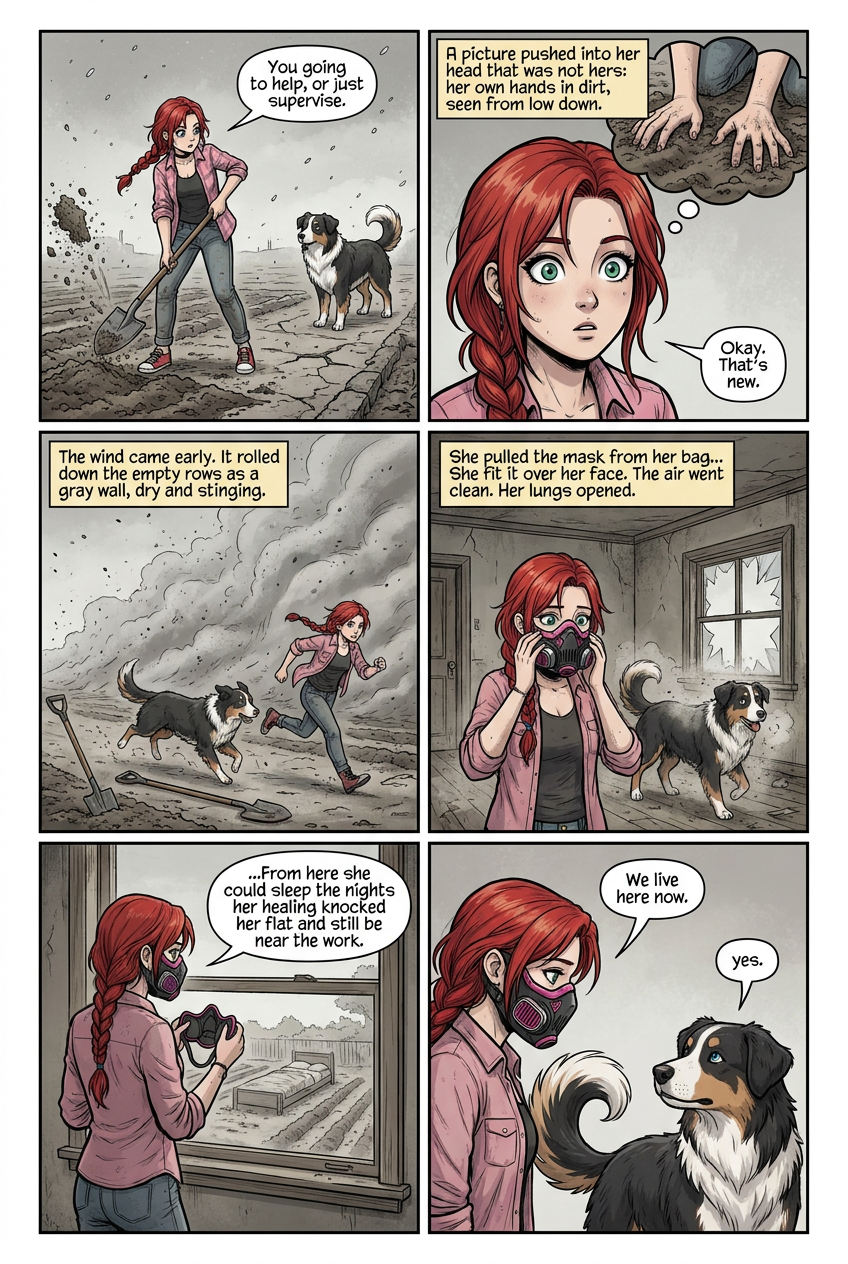
By noon the ash wind would come, and Scarlett Hopper had one bed of soil left to turn before it drove her out. She worked the shovel fast. Her red braid swung against her shoulder with each throw. The old garden district stretched around her in gray rows, empty of the vendors and children it used to hold. She had been hauling this same dirt the day the district collapsed. She had not stopped since. A dog watched her from the cracked path. He was big, black and white with tan legs, one blue eye and one brown. His curled tail swept sideways when she looked at him. He had followed her for three days without begging or leaving. She had started calling him Duke because he acted like he owned the place. "You going to help," she said, "or just supervise." Duke's ears flicked. A picture pushed into her head that was not hers: her own hands in dirt, seen from low down. She stopped shoveling. She had felt it yesterday too and pretended she hadn't. "Okay," she said slowly. "Okay. That's new." The wind came early. It rolled down the empty rows as a gray wall, dry and stinging, and the first grit hit her teeth before she could close her mouth. Her eyes burned. She dropped the shovel and ran. Duke ran with her, low and fast. Every afternoon this same wind had chased her out of the district before her work was done. Every afternoon the roots she had started to heal went another day without her. She could not keep losing the afternoons. At the edge of the district stood a house nobody had come back for. Front window gone. Door hanging open. She had passed it a hundred times. She climbed the porch, Duke at her heel, and shoved inside as the ash thickened behind them. She pulled the mask from her bag. Black shell, pink filters, straps she had tightened weeks ago and never used. She fit it over her face. The air went clean. Her lungs opened. She breathed in until her ribs stopped shaking. Duke sneezed once and shook out his coat. Ash fell from him in a small gray cloud onto the floorboards. Scarlett looked around. A stove. A sink. A back window that faced the garden rows. From here she could see the bed she had not finished. From here she could sleep the nights her healing knocked her flat and still be near the work. From here she could go back out into the wind instead of away from it. She set her bag on the counter. She unhooked one filter and checked it. Still good. "We live here now," she told the dog. Duke's tail swept left. In her head, clear as speech, came the word yes.
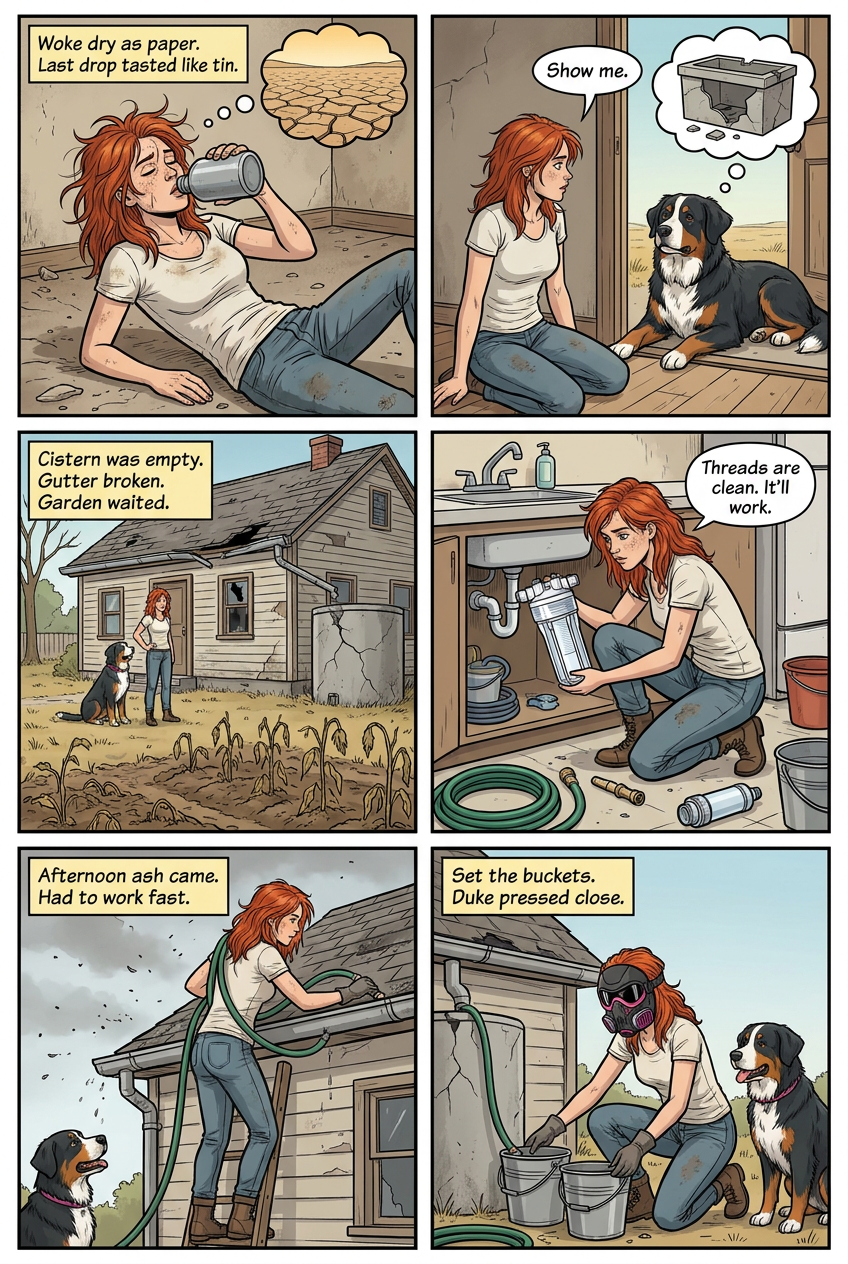
Scarlett woke on the floor of the house with her mouth dry as paper. She had healed a bed of roots the day before and dropped like a cut rope. Now her tongue stuck to her teeth. She reached for her canteen and found it light. She tipped the last swallow into her mouth. It tasted like tin. Duke lay across the doorway. He lifted his head, and a picture pushed into her mind: a cracked cistern behind the house, dry to the bottom. She had not looked there yet. "Show me," she said. She followed him out the back. The cistern sat under a broken gutter, split down one side. Empty. The pipe above it hung loose from the eave. Beyond the yard, the garden rows waited. She could not heal another bed without water in her. She could not water a single root without something to carry it in. She went back inside and pulled everything from the cupboards. A steel pot. Two plastic buckets. A length of rubber hose stiff with age. Under the sink she found a canister, sealed, still bright. A pre-collapse water filter, the housing clear, the cartridge white and dry. She turned it in her hands. The threads were clean. It would work. She climbed to the roof with the hose over her shoulder. Duke watched from the yard. The afternoon ash would come soon and she knew it. She worked fast. She bent the loose gutter back against the eave and wedged it with a shim of wood. She ran the hose from the downspout to the mouth of the cistern. She patched the cistern's split with tar from a can in the shed and pressed a strip of tin over the seam. She set the buckets under a second run of gutter on the low roof. She fit the filter to a spigot on the cistern's base with tape wound tight around the threads. The wind came. Gray rolled down the rows. She pulled the black-and-pink mask over her face and kept working until the last bucket was set. Duke pressed against her leg. She went inside with him and shut the door. Rain did not come that night. It came the next. She woke to it hitting the roof in a hard, even wash. She ran outside barefoot. Water sluiced down the patched gutter, through the hose, into the cistern. The buckets filled in minutes. She turned the spigot. Water pushed through the filter and came out the other side clear. She caught a cup of it and drank. It was cold and clean and tasted like nothing. She drank another. Her hands stopped shaking. She filled the buckets from the spigot until her arms ached, then carried the first two out to the rows. The dirt drank them down. In her head, clear as a word spoken beside her, Duke said good.
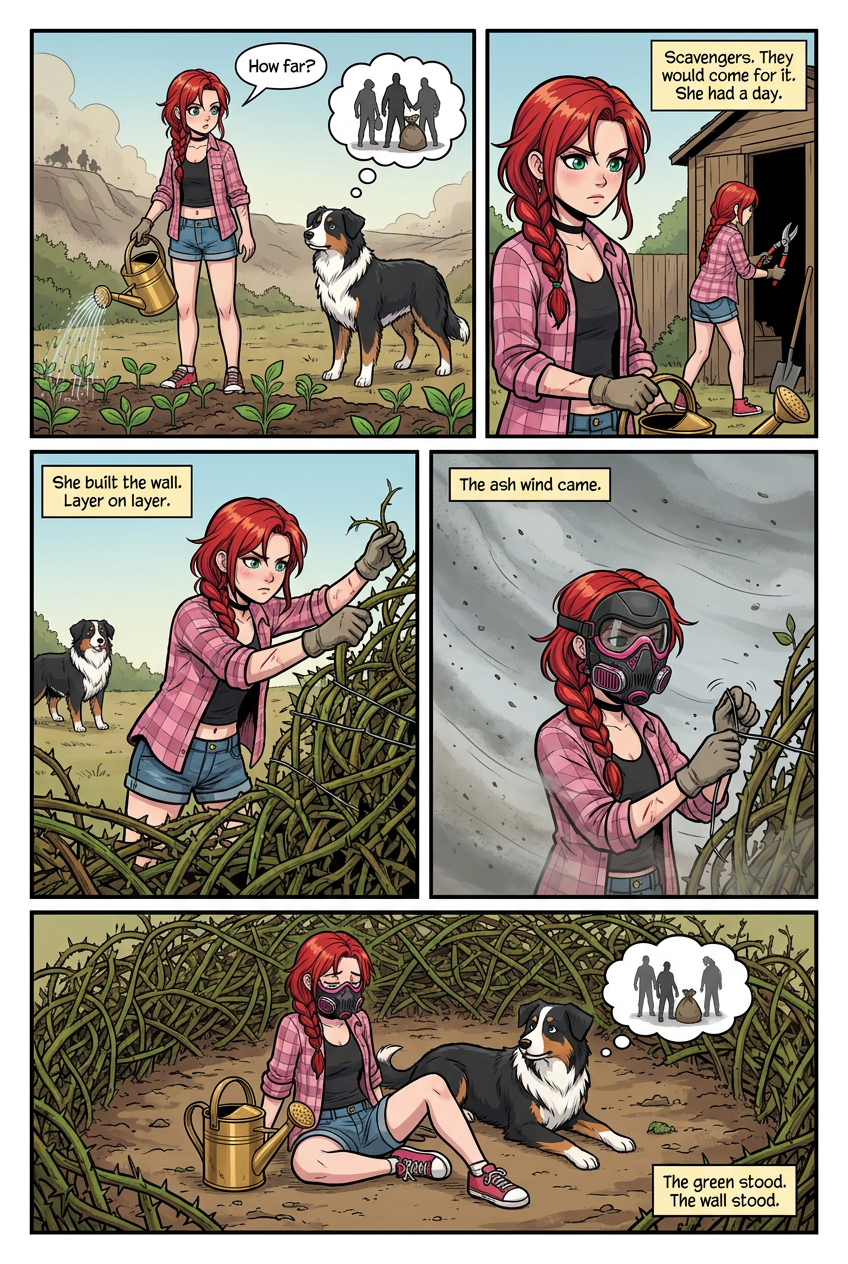
By morning the rows showed color. Thin green stood up between the beds where the water had gone in. Scarlett walked the line with a brass watering can in her hand and topped off the driest patches. Duke padded beside her, his curled tail sweeping left, his mismatched eyes fixed past the fence line. He stopped and pushed a picture into her head: three figures on the ridge above the district, one with a sack, one with a pipe, watching the green. "How far?" she said. Another picture came. The ridge, closer than she wanted. A hand pointing down at her rows. She set the can down. Scavengers had seen the color. They would come for it, and they would not leave a leaf. She had a day, maybe less. She could not heal what they tore up. Not fast enough. She went to the shed and pulled every length of wire she had. She took the pruners from the nail by the door. Then she walked to the collapsed lots at the edge of the district, where blackberry and thornbush had grown wild over the rubble for years. She cut long runners at the base and dragged them back in bundles, gloves stiff with sap. Duke watched the ridge while she worked. She built the wall in a ring around the green rows. She drove stakes into the soft dirt and wove the thorned canes between them, layer on layer, until the mass stood chest high and an arm thick. She twisted the wire through the canes to hold them tight. Every time she reached in, the thorns caught her wrists and drew blood. She kept going. At the four corners she strung a low trip line between stakes, ankle height, and tied cans of loose nails to the far ends. Anything that pushed through would rattle the whole ring. The ash wind came before she finished the last corner. She pulled the black-and-pink mask over her face and kept tying. Gray rolled down the rows. Her hands shook. She knotted the last wire and stepped back inside the ring. Duke pressed his head against her thigh. A picture came, quieter now: the three figures on the ridge, turning. One pointed at the thorn wall. One shook his head. They moved off along the ridge and did not come down. She sat in the dirt between the rows and let her breath slow behind the mask. The green stood. The wall stood. Her wrists bled in thin lines down to her knuckles. She reached for the watering can and poured the last of it slowly over the nearest bed. The dirt drank it. Duke lay down beside her with his back to the ring, watching the gap she had left for herself at the north end. It was the only way in. It would also be the only way they could come, if they came back at night.
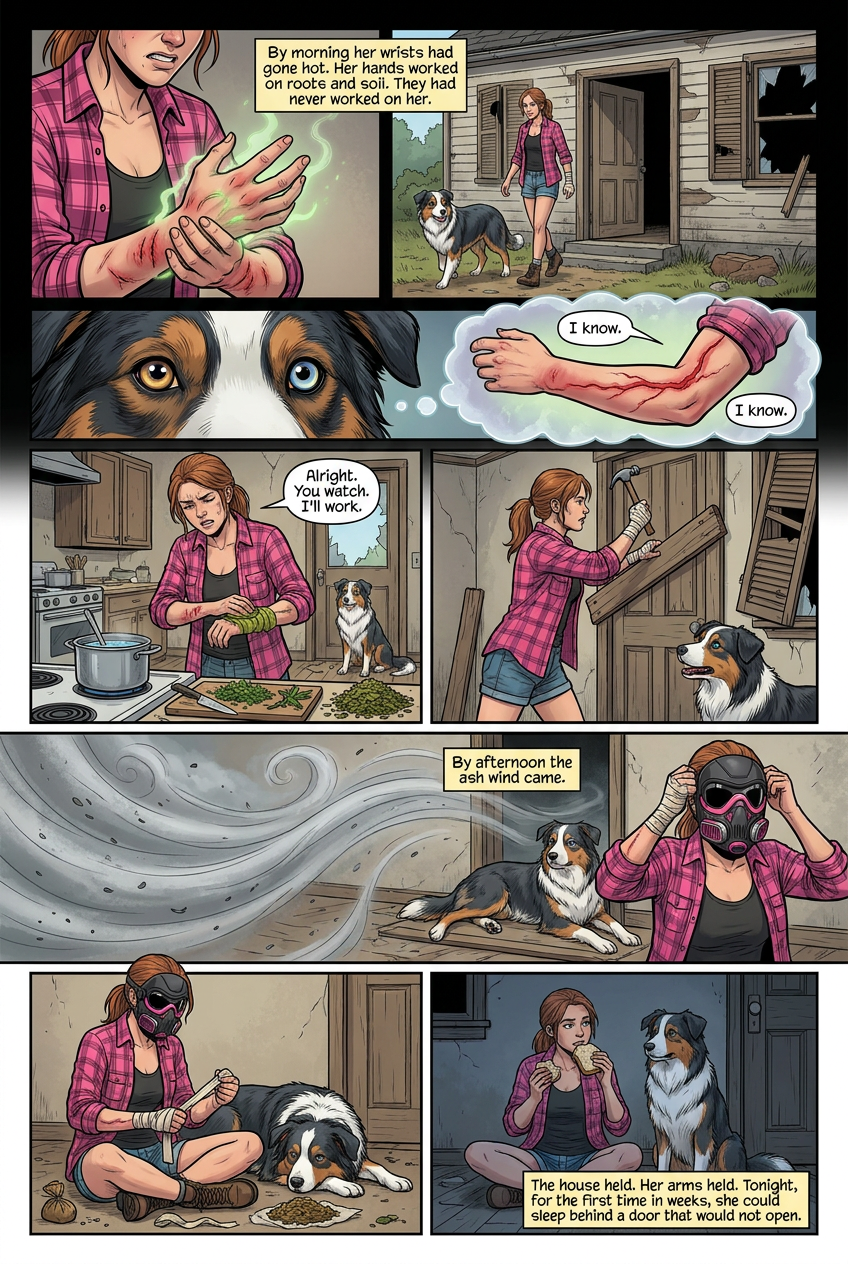
By morning her wrists had gone hot. Scarlett pulled back the sleeve of her flannel and saw the thorn cuts had swelled into red ridges. Yellow beads sat where the deepest scratches had closed over dirt. She pressed a palm to the worst one and pushed her healing into it. Nothing moved. Her hands worked on roots and soil. They had never worked on her. She walked back to the house at the district's edge. Duke followed, curled tail sweeping left, his mismatched eyes watching her hands instead of the ridge. He pushed a picture into her head: her own arm, the red climbing past her elbow. A warning. "I know," she said. Inside, the house was still half a wreck. A broken shutter hung by one hinge. The back door didn't latch. She had meant to fix both for a week. If the fever took her tonight, anyone could walk in while she slept. She set a pot of cistern water on the stove. From a shelf she pulled the bundle she'd cut from the collapsed lots weeks back — yarrow, plantain, a stub of willow bark. She crushed them on the board with the flat of her knife, added a spoon of the hot water, and worked the mash until it held together in a damp green clump. The smell was sharp and bitter enough to sting her eyes. Duke sat by the back door and stared at the loose latch. Another picture: the door swinging open in wind. Then the door shut, a board nailed across. "Alright," she said. "You watch. I'll work." She washed the cuts with hot water first, teeth locked against the burn. Dirt came out in threads. She packed the poultice thick along each wrist and wrapped both in strips torn from an old shirt. The heat under her skin began to pull toward the cloth almost at once. Then she moved. She pried a plank off the collapsed shed wall and dragged it in. She braced the back door and drove four nails through the plank into the frame, left-handed, slow. She wedged the broken shutter shut with a shim and tied it off with wire. She swept the glass from under the window and laid a folded blanket across the sill. By afternoon the ash wind came. She pulled the black-and-pink mask over her face and kept going until the front room was closed tight. Duke lay across the doorway to the bedroom, blocking it with his body. She unwrapped one wrist. The red line had pulled back below the bandage. The swelling was down. The poultice had gone brown and stiff. She mixed a second batch and packed it fresh. She sat on the floor beside Duke and ate a piece of bread. The house held. Her arms held. Tomorrow she could go back to the rows. Tonight, for the first time in weeks, she could sleep behind a door that would not open.
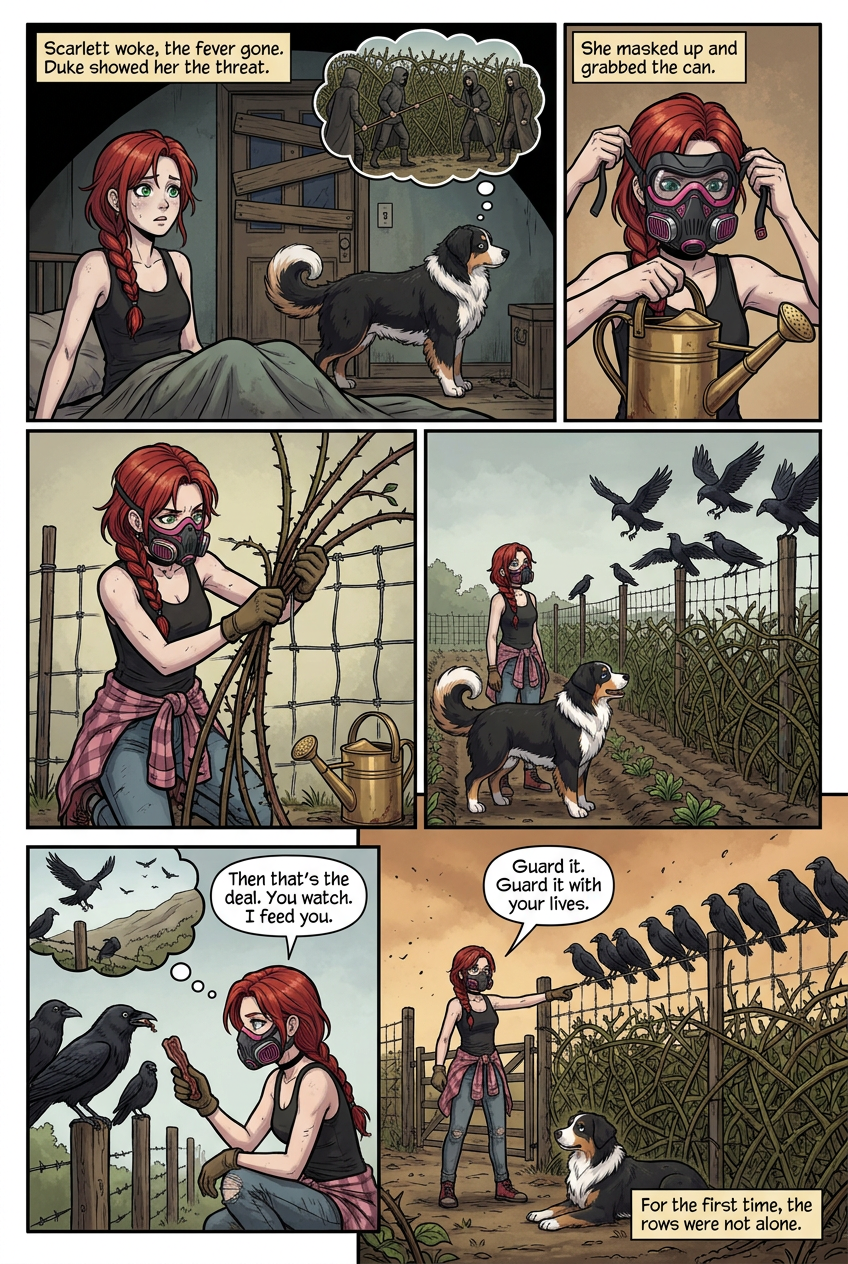
Scarlett woke behind the boarded door with the fever gone. Her wrists still ached, but the red lines had shrunk to pink. Duke stood by the front step, tail sweeping left, and pushed a picture into her head: three figures crouched at the far end of the thorn wall, testing the canes with a stick. She pulled on the mask, grabbed the brass watering can, and went out. She kept low along the rows. At the north corner, the thorns had thinned where a rabbit or something bigger had chewed through the base. A gap the width of her hand ran along the wire. She could see boot prints in the dust on the outside. She worked fast. She cut fresh blackberry canes from the collapsed lot behind the house and dragged them back with her good arm. She wove them through the wire, thick end down, and twisted the wire tight around each stem. Sap glued her fingers. A thorn caught her thumb and she bit down and kept going. She packed the gap until no light came through. When the wall was solid, she walked the whole line and checked every join. She found two more thin spots and braided them shut. Then she filled the can at the cistern and watered each row, slow, so the dust settled and the leaves lifted. Duke barked once. She looked up. Crows had come down onto the fence posts along the wall — eight of them, black and heavy, spaced out like nails. One dropped into the row and picked a beetle off a bean leaf. Another watched the ridge without moving. They had been circling the district for days. Now they had landed. She crouched and held out a strip of dried meat from her pocket. The nearest crow hopped down, took it, and flew back to the post. She tore the rest of the strip into pieces and laid them along the top rail. The flock came for them one by one. When the meat was gone, they stayed. Duke pushed another picture: the scavengers on the ridge, watching. Then the crows lifting off the wall in a black sheet, wings wide. Then the ridge empty. "Then that's the deal," she said to the birds. "You watch. I feed you." By afternoon the ash wind rose. She pulled the mask tight and stood at the edge of the rows one more time. The wall held. The crows sat along it, heads turned outward. Duke lay across the gate. She pointed at the wall. "Guard it," she told them. "Guard it with your lives." A crow shook out its wings and settled. Another cawed once, low. She went inside and shut the door. For the first time, the rows were not alone when she was not standing in them.
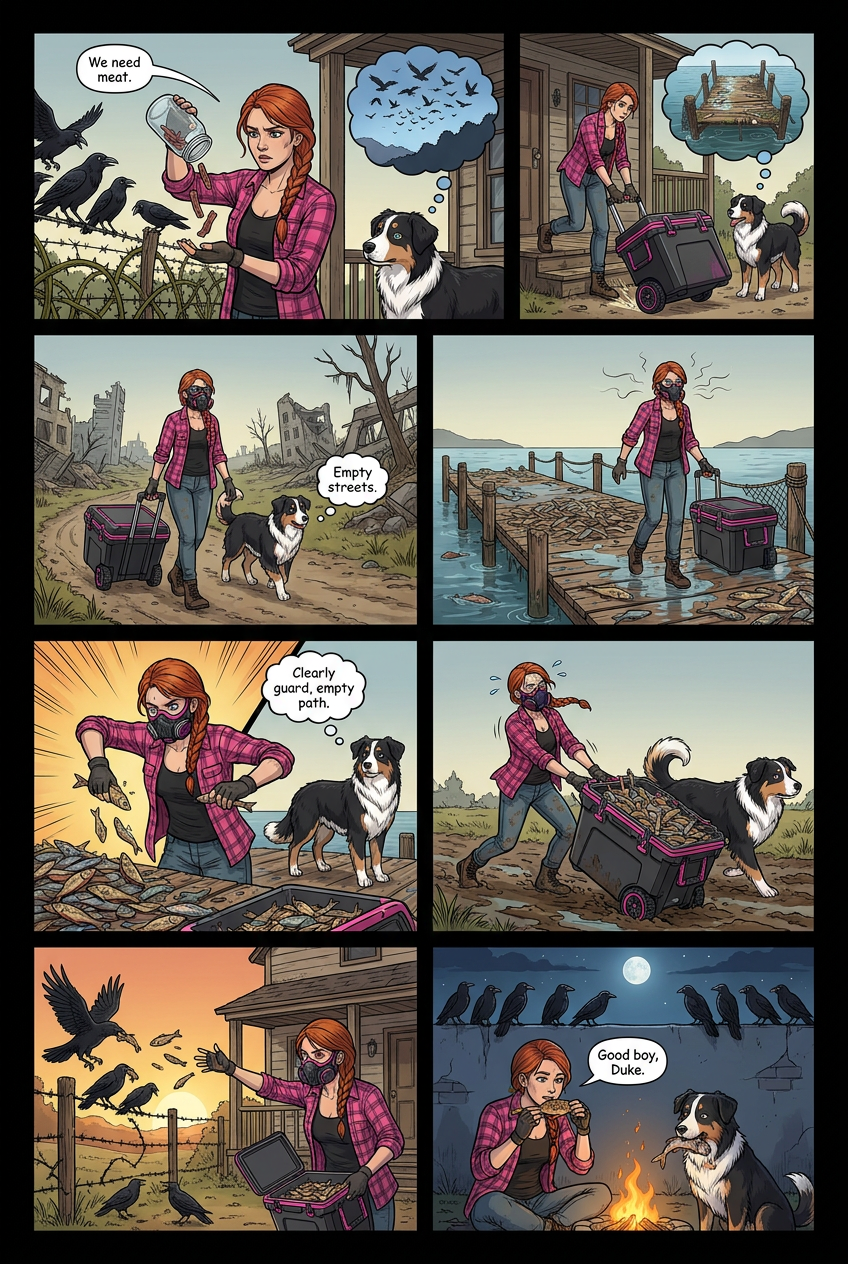
Scarlett shook the last strips from the jar into her palm. Three pieces. The crows on the wall watched her count. She fed them out one by one and the jar came back empty. Duke pushed a picture into her head: the flock lifting off the posts in a black sheet, the ridge open again. She got the message. "We need meat," she said. She pulled the rolling cooler out from under the porch. The wheels squeaked on the step. "Fish will keep them fed longer than jerky anyway." Duke's tail swept left. He showed her a picture of a pier out past the low ground, planks sagging under water, silver bodies heaped along the walkway. She had seen it once from the ridge. The flood had killed the fish faster than anything could eat them. Sun had done the rest. She pulled the mask on, tightened the straps, and rolled the cooler down the track behind the house. Duke trotted ahead. The morning was still cool. They kept off the open road and cut through the collapsed lots. Duke stopped twice and pushed pictures back to her — an empty street, a broken fence, no people. She kept moving. The pier came up through a stand of dead reeds. Water covered the first ten feet of planks. Fish lay stacked along the rails, dried stiff by the sun, scales gone dull. The smell pushed through the mask. She stepped onto the wet boards and tested each one before shifting her weight. She worked fast. She snapped fish off the pile by the tail and dropped them into the cooler. Small ones, palm-sized, the kind a crow could carry. She filled the bottom, then a second layer, then a third. Duke stood watch at the shore end, head turned toward the reeds. He gave her one clear picture: nothing coming. She kept loading until the lid would barely close. She leaned on the handle and dragged the cooler back off the planks. The wheels bit into the mud and she pulled harder. Duke came up beside her and pressed his shoulder against the frame. Between them they got it to the track. They were home before the ash wind rose. She threw fish along the top rail of the wall by the handful. The crows dropped from the posts and took them. She kept throwing until every bird had two in its beak or under a claw. The cooler was still half full when she shut the lid. She filled the watering can at the cistern and walked the rows. The bean leaves lifted under the water. The tomatoes held. When the wind came, she built a small fire in the pit by the back step and cooked two of the bigger fish on a flat stone. Duke ate his raw. She ate hers slow, watching the wall. The crows sat along it, heads turned outward, fed.
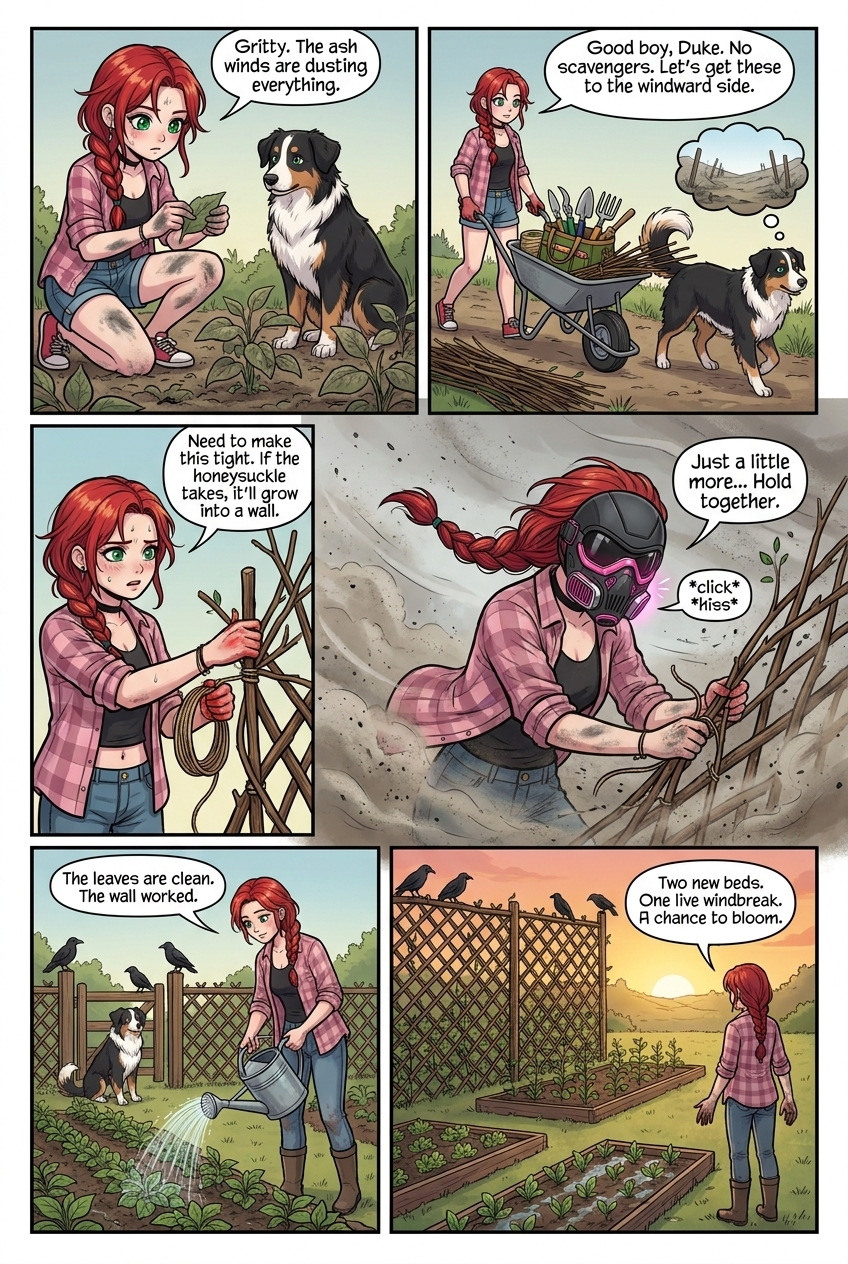
Morning after the fish run, Scarlett walked the rows and knelt at the bean line. The leaves felt gritty. She rubbed one between her fingers and gray dust smeared her skin. The ash winds had been dusting the crops every afternoon, and the new growth was stunted. The tomato shoots were pale. A second cluster of seedlings had not opened at all. If the wind kept scouring them, nothing would bloom. She pulled the wheelbarrow out from the side of the house. The tool bag sat in it, shears and pruners in the front pockets, twine on the side, seed packets tucked in the flap. She wheeled it to the collapsed lots behind the district and started cutting. Willow whips, long and green. Hazel where she could find it. She stacked them across the barrow until the handles bent. Duke followed her out and back, his curly tail sweeping left. At the third load he stopped in the track and pushed a picture into her head: the ridge, empty. No scavengers today. She kept cutting. She drove stakes along the windward side of the rows, one every arm's length, and started weaving. Thick whips first, threaded through the stakes. Thinner ones over and under to lock the frame. She pulled each pass tight. Her palms went raw. She kept going. When the panel reached her hip, she wound live honeysuckle runners through the lattice and pressed the cut ends into the dirt at the base. If they took, the wall would grow into itself. The ash wind came earlier than she wanted. She pulled the mask on. The pink respirators clicked as she breathed. The wind hit the new lattice and split around it. Grit rattled through the weave but the worst of it fell short of the rows. She kept working through the storm, tying off the last section by feel, her braid whipping against her shoulder. When the wind dropped, she walked the rows behind the break. The leaves were clean. She ran a hand over the tomato shoots and left them alone. Healing them would cost her a night. The wall meant she might not have to spend it. She filled the watering can at the cistern and soaked every row twice. The soil drank it. Then she opened the seed packets from the tool bag — carrots, chard, a squash she wasn't sure would take — and pressed them into the wet dirt along the two empty beds at the end. She tamped each row flat with her palm. Duke sat by the gate while she worked. The crows dropped onto the lattice top and settled there, facing out. The new wall held them the same as the old one. She stood at the end of the rows with dirt on her hands and counted what she had planted. Two new beds. One live windbreak. A garden that might, this time, get the chance to bloom.
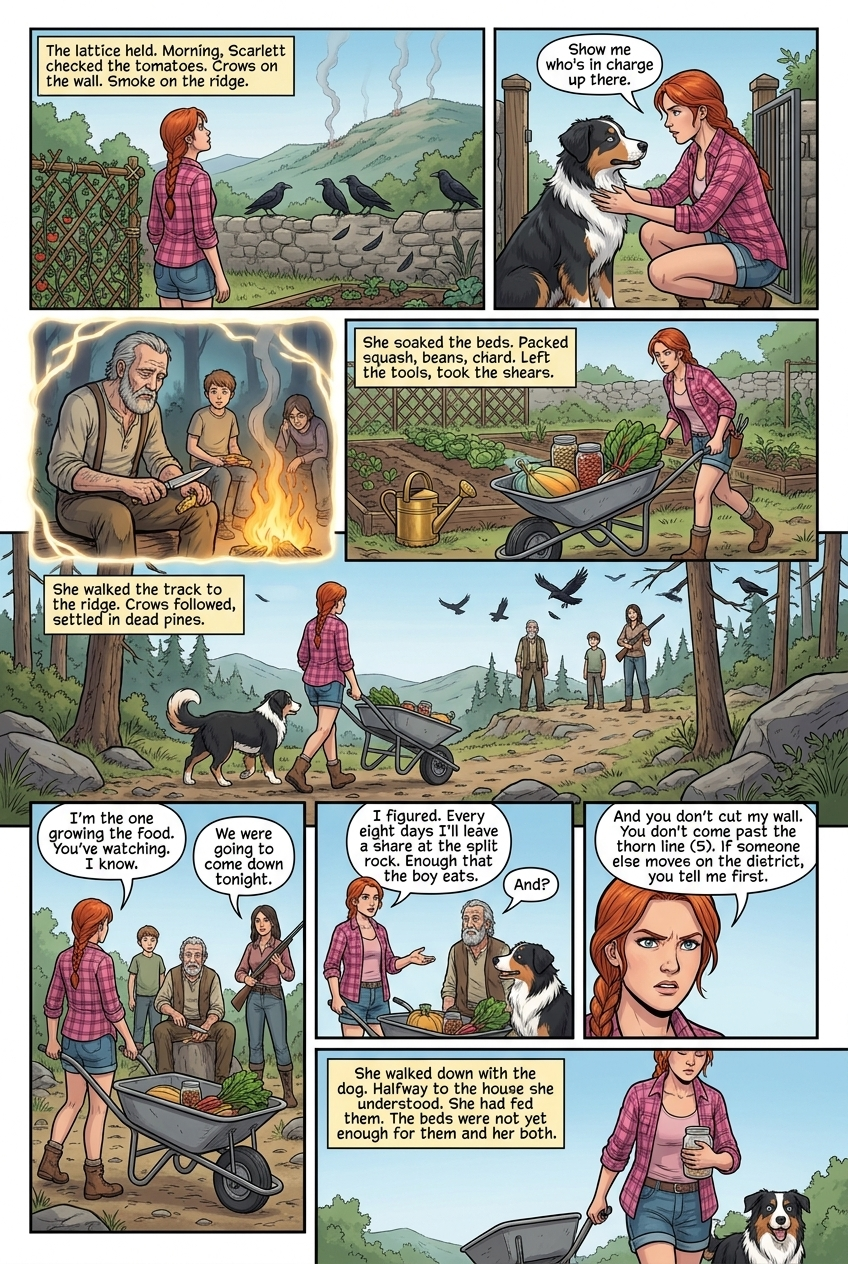
The lattice held through the night. In the morning Scarlett walked the rows and found the tomato shoots darker, standing straight. The crows shifted along the top of the wall as she passed. One dropped a beak-full of feathers and stared at the ridge. She followed its look. Three thin trails of smoke rose above the rocks. The scavengers were closer than before, and they were staying. She knelt by the dog at the gate. He sat with his tri-colored coat dusted gray, one blue eye and one brown eye fixed on her. She put her hand on his ruff. "Show me who's in charge up there," she said. He held still. Then he pushed a picture into her head: a man at a fire, older, gray beard, a bad limp, cutting a strip of something dry with a folding knife. Two others waited on him before they ate. He handed the first strip to a boy, maybe ten. Scarlett stood up. She filled the watering can, soaked the beds twice, and cut a squash from the vine at the end of the row. She wrapped it in cloth and laid it in the wheelbarrow with two jars of beans and a bundle of chard. She pulled the tool bag out and left it on the step. Only the shears went with her, in her back pocket. She walked the track up to the ridge with the dog at her hip. The crows lifted from the wall and followed in a loose line, then peeled off and settled in the dead pines above the camp. Three faces turned when she came into the clearing. The old man was closest to the fire, knife open on his knee. The boy stood behind him. A woman with a rifle stepped sideways to cover the path. "I'm the one growing the food," Scarlett said. She set the wheelbarrow down. "You've been watching. I know." The old man did not stand. "We were going to come down tonight." "I figured." She lifted the cloth off the squash. "Every eight days I'll leave a share at the split rock below the ridge. Squash, beans, greens when they come in. Enough that the boy eats." He looked at the crows in the pines. At the dog. At her hands. "And?" "And you don't cut my wall. You don't come past the thorn line. If someone else moves on the district, you tell me first." He closed the knife. "Name's Bern. That's my grandson." He did not name the woman. She did not lower the rifle, but she stepped back onto the path. Scarlett left the wheelbarrow. She walked down with the dog and an empty jar in her hand. Halfway to the house she understood what she had done. She had fed them. In eight days she would have to feed them again, and the beds were not yet enough to feed them and her both.
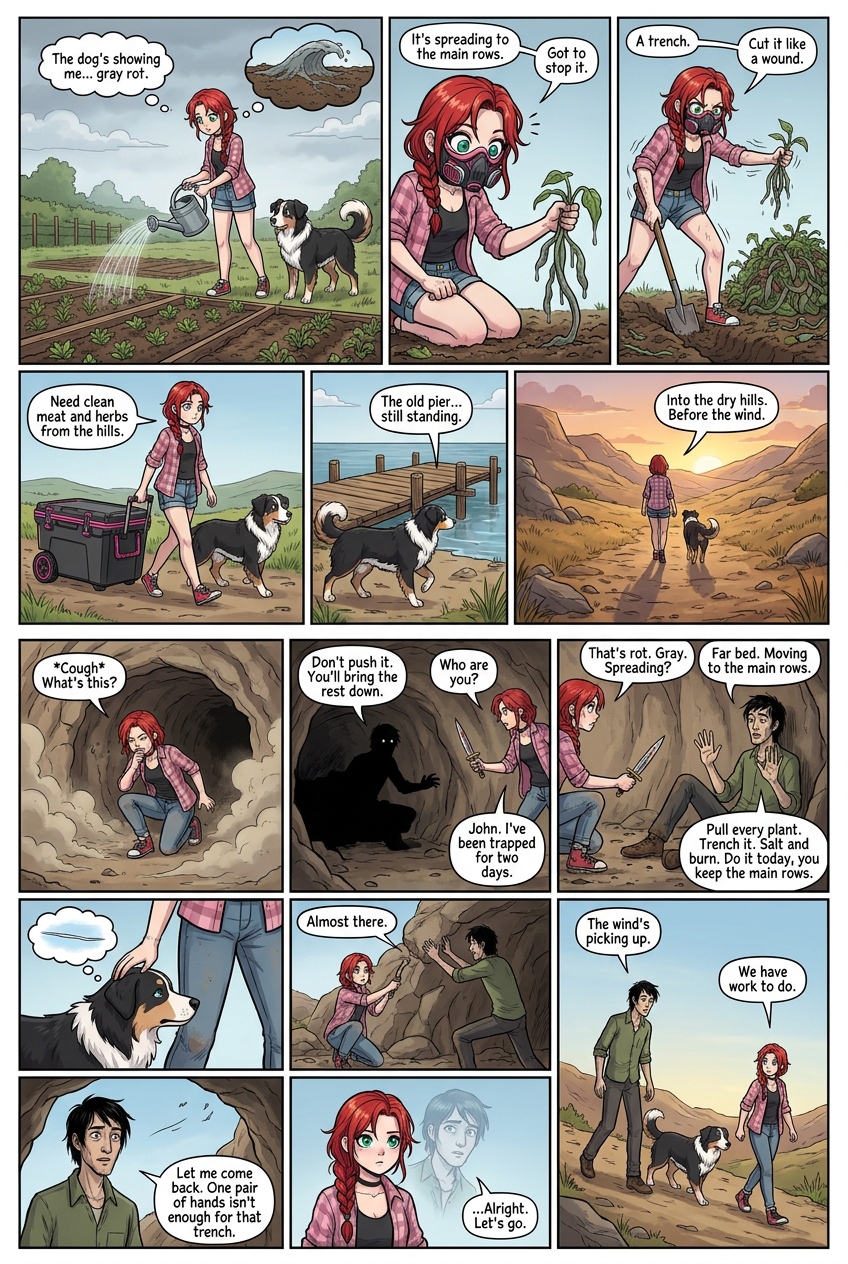
Scarlett was watering the far beds when the dog pushed a picture into her head. Gray rot spread through the soil in a slow tide, creeping from the far row toward the main rows. She dropped the can and knelt. The dirt at the last bed felt cold and slick. The bean shoots there had gone soft at the base. If the rot reached the main rows, the harvest was gone, and so was the deal with the ridge. She pulled on her mask and got to work. She yanked every infected plant by the root and shook the dirt free. She dug a trench between the sick bed and the next one, cutting the soil like a wound. The pile of bad stalks grew tall beside her. Her hands shook. She could heal a root system, but not soil this far gone, and not without knowing what it was. She needed clean meat for the crows, and herbs for the sickness in her own cut hands. She loaded the rolling cooler, snapped the pink latches, and set out with the dog. The wind had not yet risen. She took the low path past the pier and up into the dry hills. The cave mouth opened behind a slide of loose rock. She ducked in for shade and to check a snare. The rock shifted under her boot and slid down across the entrance. Dust filled the dark. She coughed into the mask. The dog barked once from outside, then went quiet. "Don't push it," a voice said behind her. "You'll bring the rest down." She turned with the scavenged dagger already in her hand. A man sat against the back wall, tall and thin, dark hair, a seed pouch open on his knee. His eyes caught the light green. He raised both hands slow. "John," he said. "I've been in here two days. There's a gap up top we can dig." She kept the blade up. "You know crops?" "I grew them before the collapse. Ran a seed station." He nodded at the dirt on her boots. "That's rot on you. Gray. Spreading?" "Far bed. Moving toward the main rows." "Pull every plant. Trench it. Salt the trench, then burn the pulled stalks downwind." He said it like he was reading a list. "You do that today, you keep the main rows." She lowered the dagger. Above them the dog scratched at the gap and dropped an image of a thin line of sky. They climbed. John braced the stones while she dug. When they came out, the dog put his head against her leg. John looked at the sun and the wind together. "Let me come back with you," he said. "One pair of hands isn't enough for that trench before the ash." She thought of the friend who left. She thought of the beds. She nodded once and started walking. He followed.
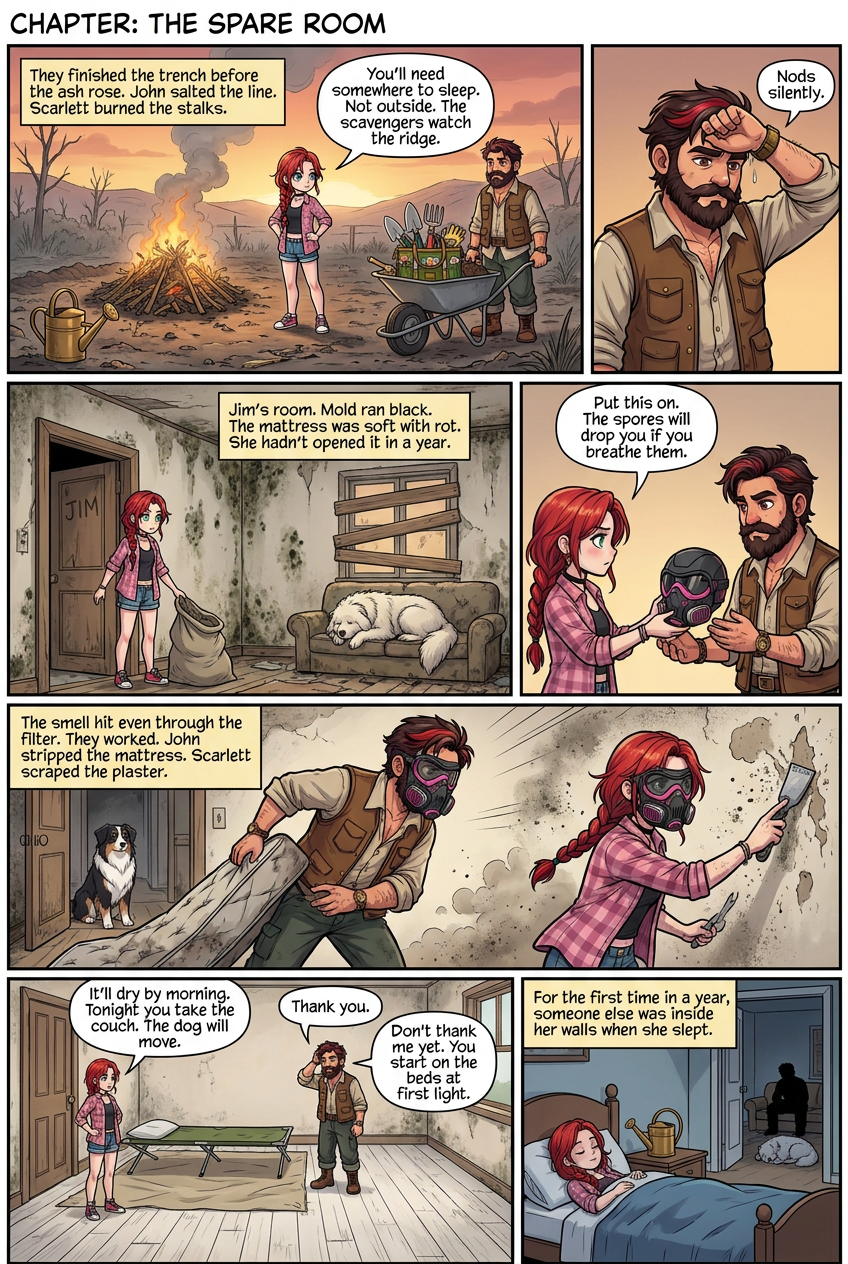
They finished the trench before the ash rose. John salted the line the way he'd said. Scarlett burned the pulled stalks downwind and watched the smoke thin. The rot was cut off, not gone. She would have to watch the beds for days. She looked at John, standing by the wheelbarrow with his sleeves rolled, and made herself say it before she talked herself out of it. "You'll need somewhere to sleep," she said. "Not outside. The scavengers watch the ridge." He nodded once. He didn't ask for anything. Her house had one room she kept locked. It had belonged to whoever lived here before the collapse. She called it Jim's room in her head because a name had been carved into the door frame. Mold ran black up the plaster. The mattress was soft with rot. She hadn't opened it in a year. She had no other space. The couch sat under the window she'd boarded, and the dog slept there. She pulled the janitor's sack from the pantry and dropped it at John's feet. Bleach, mold killer, rubbing alcohol, rags. She handed him her spare mask, the black one with the pink filters. "Put this on. The spores will drop you if you breathe them." He fitted the straps over his ears without a word. She tied her own on and opened the door. The smell hit even through the filter. They worked. John stripped the mattress and dragged it to the yard to burn. Scarlett scraped the plaster with a putty knife until the black came off in curls. She sprayed the wall down and scrubbed. He carried the frame out, then the dresser. The dog stayed in the hall and watched. Twice he pushed an image into her head: the sun tipping west, the wind starting to lift dust on the ridge. "We've got maybe an hour," she said. John wiped his forehead with the back of his wrist. "Floor next." They bleached the boards. She cut a length of clean canvas from the barn tarp and laid it flat where the mattress had been. He hauled in a folded cot he'd spotted in the shed. The room smelled sharp now, not sweet. That was the trade she wanted. When the ash started tapping the shutter, she shut the door on the wet floor and locked the outside bolt behind them. "It'll dry by morning. Tonight you take the couch. The dog will move." John set the mask on the table. "Thank you." "Don't thank me yet. You start on the beds at first light." He almost smiled. "I planned to." She latched the door against the wind. For the first time in a year, someone else was inside her walls when she slept. She lay down knowing the rot was held, the room would be ready, and a stranger with clean hands was breathing in the next room.
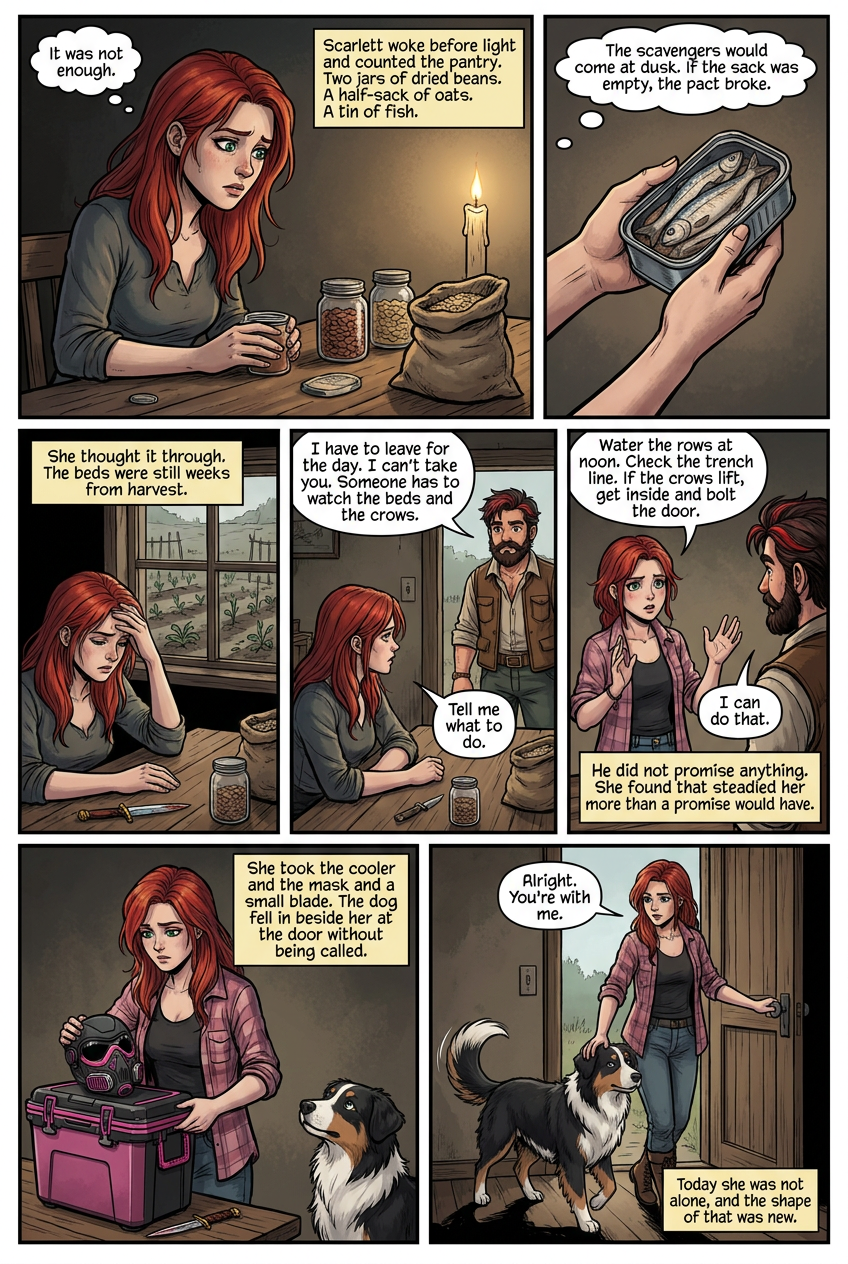
Scarlett woke before light and counted the pantry by candle. Two jars of dried beans. A half-sack of oats. A tin of fish. She weighed it in her hands and knew. It was not enough to feed her and John and still fill the split rock sack by tomorrow. The scavengers would come at dusk on the eighth day. If the sack was empty, the pact broke, and the wall meant nothing. She sat at the table and thought it through. The beds were still weeks from harvest. John needed to eat if he was going to work. The scavengers needed their share or the ridge would come down on her the next night she slept. She remembered the lot two streets over. Before the collapse, an old woman had grown potatoes there behind a chain fence. Scarlett had walked past it a hundred times. If any tubers were still under the soil, they would be small, but they would be food. John came in from the hall, hair flat on one side. He looked at the jars on the table and understood before she spoke. "I have to leave for the day," she said. "There's a lot I want to dig. Potatoes, maybe. I can't take you. Someone has to watch the beds and the crows." He nodded. "Tell me what to do." "Water the rows at noon. Check the trench line. If the crows lift, get inside and bolt the door." "I can do that." She looked at him. He did not ask why she trusted him with it. He did not promise anything. She found that steadied her more than a promise would have. "Thank you," she said. She took the rolling cooler and the mask and a small blade she kept in a drawer. The dog fell in beside her at the door without being called. His tail swept left as he walked. He pushed an image into her head: the two of them on a street, her hand on his ruff. He was coming. "Alright," she said. She rested her palm on his head. His fur was warm through her fingers. "Alright. You're with me." They walked out into the gray morning. The dog stayed close at her hip, closer than usual, matching her stride. When she stopped to check the wall latch, he leaned against her leg. She let him. She had walked this district alone for a year. Today she was not alone, and the shape of that was new. By midmorning they reached the fenced lot. She cut through the wire and knelt in the weeds. Her fingers found a hard round shape under the dirt. Then another. She dug until the cooler was half full. The dog kept watch at the gap, ears forward, still as stone. She would make the split rock by dusk. John would hold the beds. The pact would hold one more cycle.
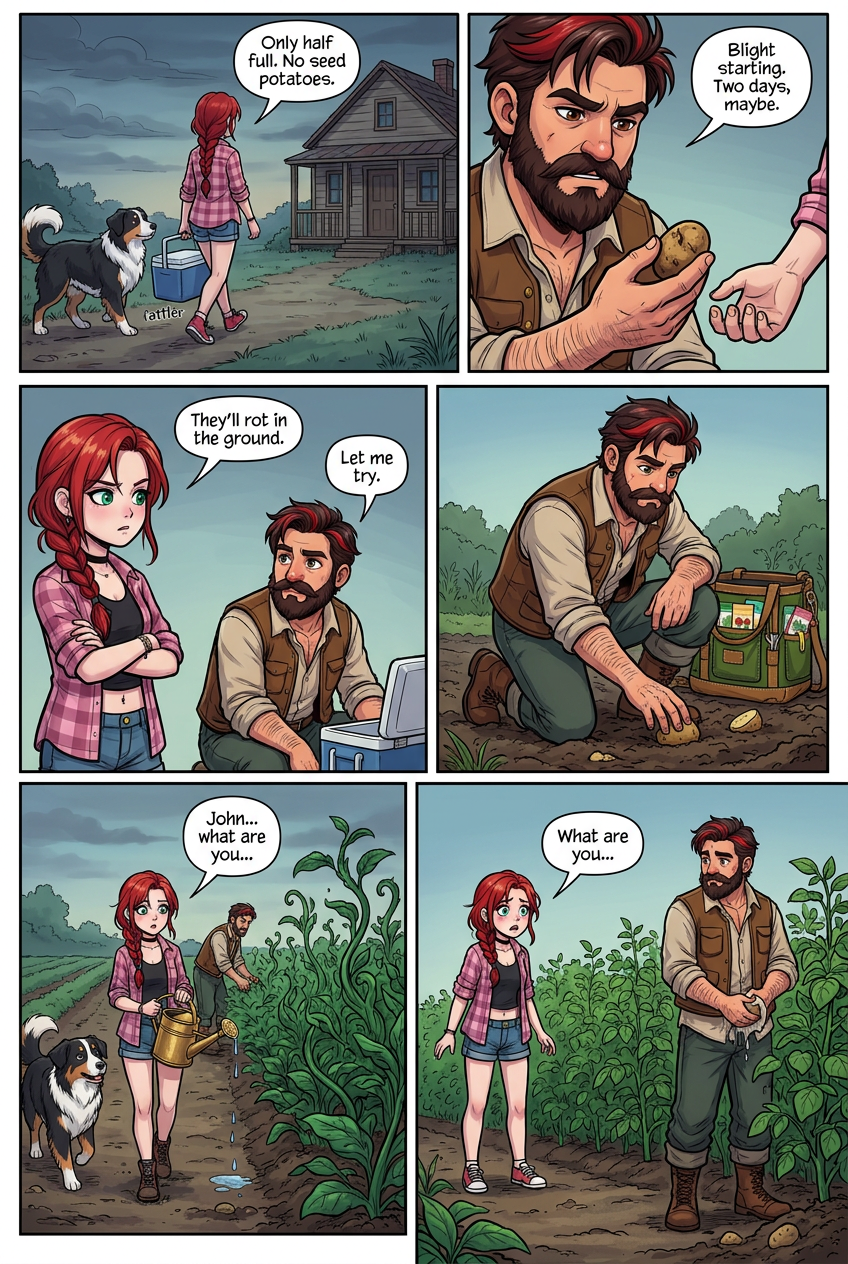
Scarlett made the split rock by dusk and left the sack. She and the dog walked home under a low sky. The cooler rattled behind her, half full of small potatoes. She had food for tomorrow. She did not have a next crop. John was at the beds when she came through the gate. He had watered the rows. The crows sat quiet along the wall. She set the cooler down and lifted a potato in her palm. It was the size of a walnut, soft at one end. "These won't replant," she said. "Not like this. You need seed potatoes. Cured. Cut with eyes. I don't have the shed for it. I don't have the time." John crouched by the cooler. He turned one tuber in his fingers. He pressed a thumb to the soft end and frowned. "Blight starting," he said. "Two days, maybe." "So we eat them and I plant nothing." "Or we plant them now." "They'll rot in the ground." He looked at her. His eyes were steady. "Let me try." She watched him. Two weeks in her house. He had asked for nothing. He had not left when he could have. She thought of her own hands, and the price of using them, and the night the district went unwatched every time she healed a bed. "Try," she said. He pulled the gardener's bag from the porch and wheeled the barrow to the end row. He laid out a trowel, a knife, gloves. He cut each potato in quarters, fast, keeping an eye on each piece. He handed her the watering can. "Behind me," he said. "Light pass. Don't soak." She followed him down the row. He pressed each piece into the dirt with his bare hand. He did not chant. He did not close his eyes. He just held his palm flat against the soil for one breath before he moved on. The ground warmed under her boots. She felt it through the leather. By the third row, green was pushing up behind him. Not shoots. Leaves. Full leaves, dark and wide, unfolding out of loose dirt where a cut potato had gone in a minute before. The row behind him filled in as the row ahead emptied of seed. The crows lifted, circled once, and settled again. Scarlett stopped walking. The can hung at her side. Water dripped on her boot. "John." He kept going. His shoulders were tight. Sweat ran at his temple. "John. What are you." "Almost done," he said. He pressed the last piece in. He stood up slow. The bed behind him was a green wall, waist high, thriving in dirt that had held nothing an hour ago. She looked at his hands. She looked at the beds. Her own gift took two days and a night of her body. His took an afternoon and left him standing. "What are you," she said again, quieter. John wiped his palms on his pants. He did not answer.
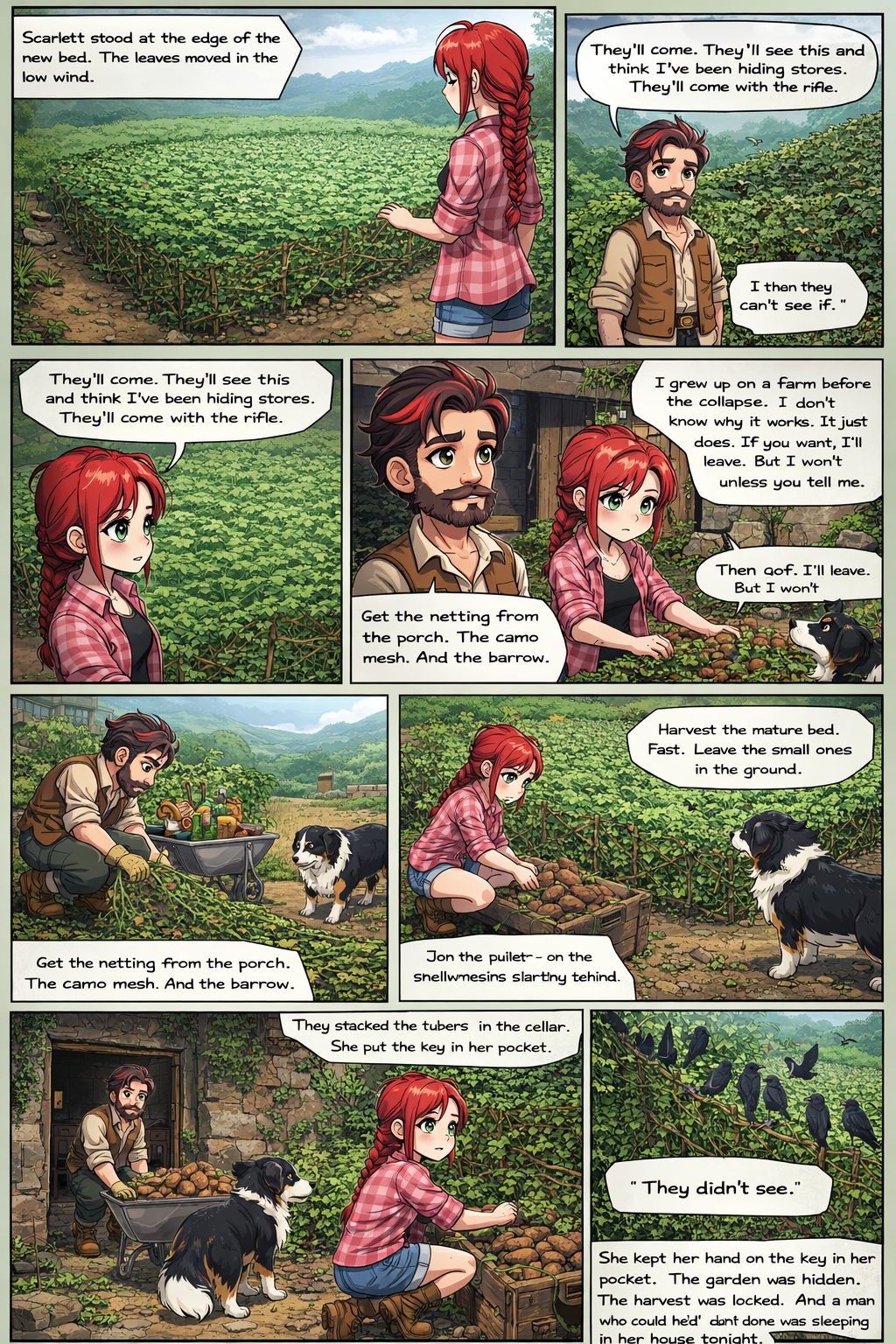
Scarlett stood at the edge of the new bed. The leaves moved in the low wind. She looked at John's hands, then at the ridge. The scavengers scouted this district on a rotation. Bern's grandson had been at the split rock two days ago. If any of them crested the rise and saw a waist-high crop where yesterday there was dirt, the pact would break by nightfall. "They'll come," she said. "They'll see this and think I've been hiding stores. They'll come with the rifle." John looked at the bed. He wiped his palms again. "Then they can't see it." "They already might. I need to know what you are before I stand next to you when they show up. I need to know what to say." He was quiet a moment. "I grew up on a farm before the collapse. My father's father had the same hands. We kept it in the family. I don't know why it works. It just does. I've been walking a long time looking for someone. Trading the gift for scraps. Two weeks here bought me nothing yet, and I stopped caring." She waited. "That's all of it," he said. "I won't leave. Not unless you tell me to." She took one breath. She believed him enough for now. "Get the netting from the porch. The camo mesh. And the barrow." He went. She pulled her mask down around her neck and studied the sky. An hour, maybe less, before the ash wind. They had to move. John came back with the mesh bundled under one arm and the wheelbarrow rattling behind him. They shook the netting out over the new bed first, tying the corners to the lattice windbreak and the thorn wall. The loose weave broke up the shape of the leaves. From ten paces off, the row read as brush. "Harvest the mature bed," she said. "Fast. Leave the small ones in the ground. A picked-clean row tells them more than a full one." They worked the rows on their knees. He pulled, she trimmed, the dog watched the ridge. The barrow filled twice. She wheeled it around the house to the cellar door. Moss hung off the frame. Vines climbed the stone. She had cleared the inside herself last spring, hung the shelves, oiled the lock. They stacked the tubers on the shelves in the dark. Two barrow loads. Enough for a month, plus the scavengers' next ration. She pulled the door shut and turned the key. She put the key in her pocket, not on the hook by the stove. Back at the beds, the netting sagged right. The crows had settled along the wall again. The ridge was empty. "They didn't see," she said. John nodded. He was watching her, not the ridge. She kept her hand on the key in her pocket. The garden was hidden. The harvest was locked. And a man who could do what he'd done was sleeping in her house tonight.
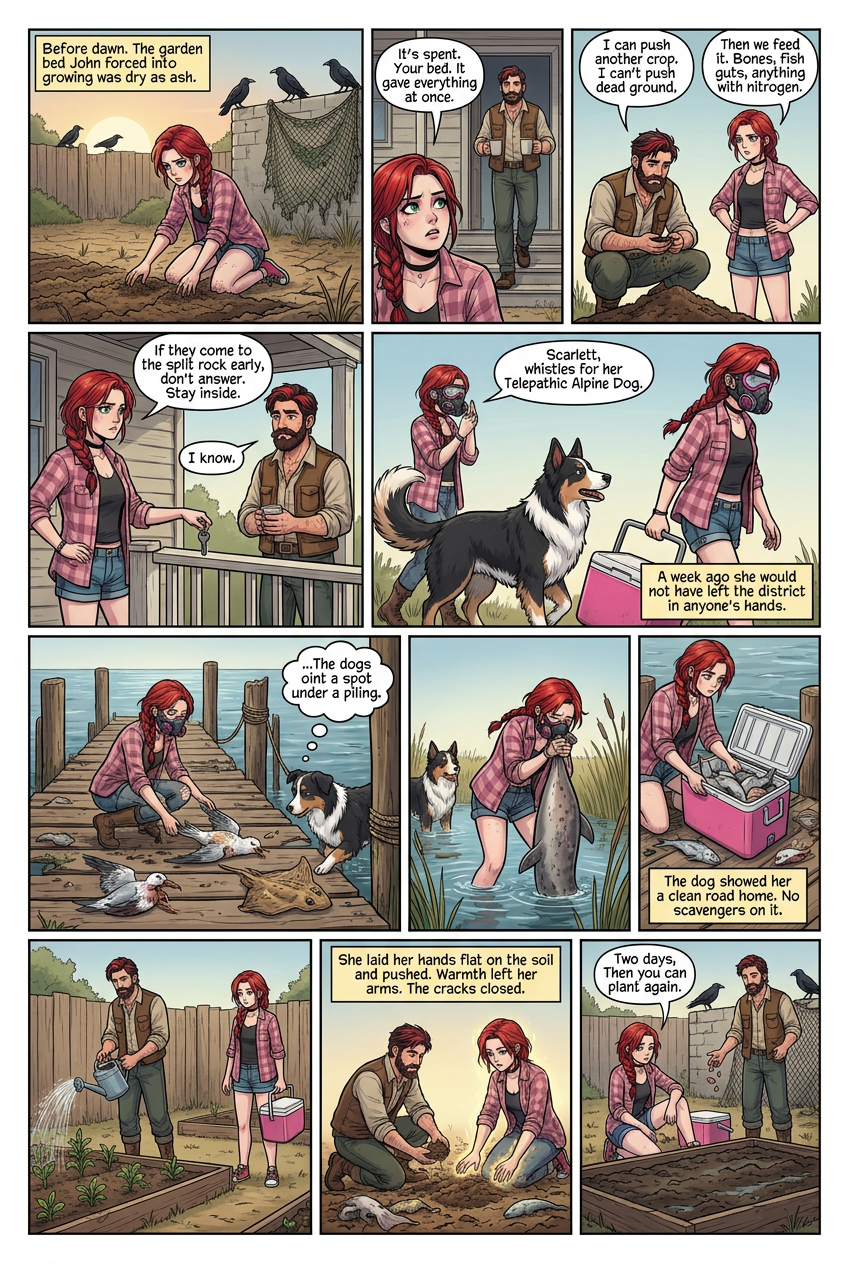
Scarlett woke before dawn and walked the rows in the gray light. The netting held. The crows sat along the wall. But the soil under her boots crunched wrong. She knelt and pushed her fingers in. The bed John had forced into growing was dry as ash, cracked in a pale web. The fast crop had drained it. Whatever she planted next would starve before it rooted. John came out with two cups. He saw her hand in the dirt and stopped. "It's spent," she said. "Your bed. It gave everything at once." He crouched and rubbed a pinch between his fingers. "I can push another crop. I can't push dead ground." "Then we feed it. Bones, fish guts, anything with nitrogen. The pier had gulls last time. Dead things wash up. I can be there and back before the wind." "I'll stay," he said. "Watch the ridge. Water the small ones." She looked at him. A week ago she would not have left the district in anyone's hands. She pulled the cellar key from her pocket and set it on the porch rail between them. She did not hand it to him. She left it there, where he could see she had put it down. "If they come to the split rock early, don't answer. Stay inside." "I know." She fitted the mask over her face and buckled it. She whistled once. The dog came around the house, tail sweeping left, mismatched eyes bright. She hooked the handle of the rolling cooler and pulled it after her down the broken street. The pier smelled worse than last time. Something big had died under the boards. She and the dog worked the tideline first. Two gulls, stiff and half-eaten. A skate, dry but whole. Then the dog stopped and pushed an image into her head — under the third piling, a shape in the reeds. She waded in. A young seal, days dead, its middle still soft. She gagged into the mask and cut what she could carry. She packed the cooler with the seal meat wrapped in kelp, the gulls on top, the skate laid flat. She left the worst for the crows and cut a separate bundle for them, wing meat and skin. The dog paced the boards while she worked. He showed her a clean road home. No scavengers on it. She wheeled the cooler back with an hour to spare. John was in the beds, sleeves rolled, the small rows watered dark. The key was still on the rail where she'd left it. They dug the gulls and seal into the cracked bed together. Blood and oil soaked down. She laid her hands flat on the soil and pushed. Warmth left her arms. The cracks closed under her palms. She sat back hard in the dirt. "Two days," she said. "Then you can plant again." John nodded. He tossed the crows their share along the wall.
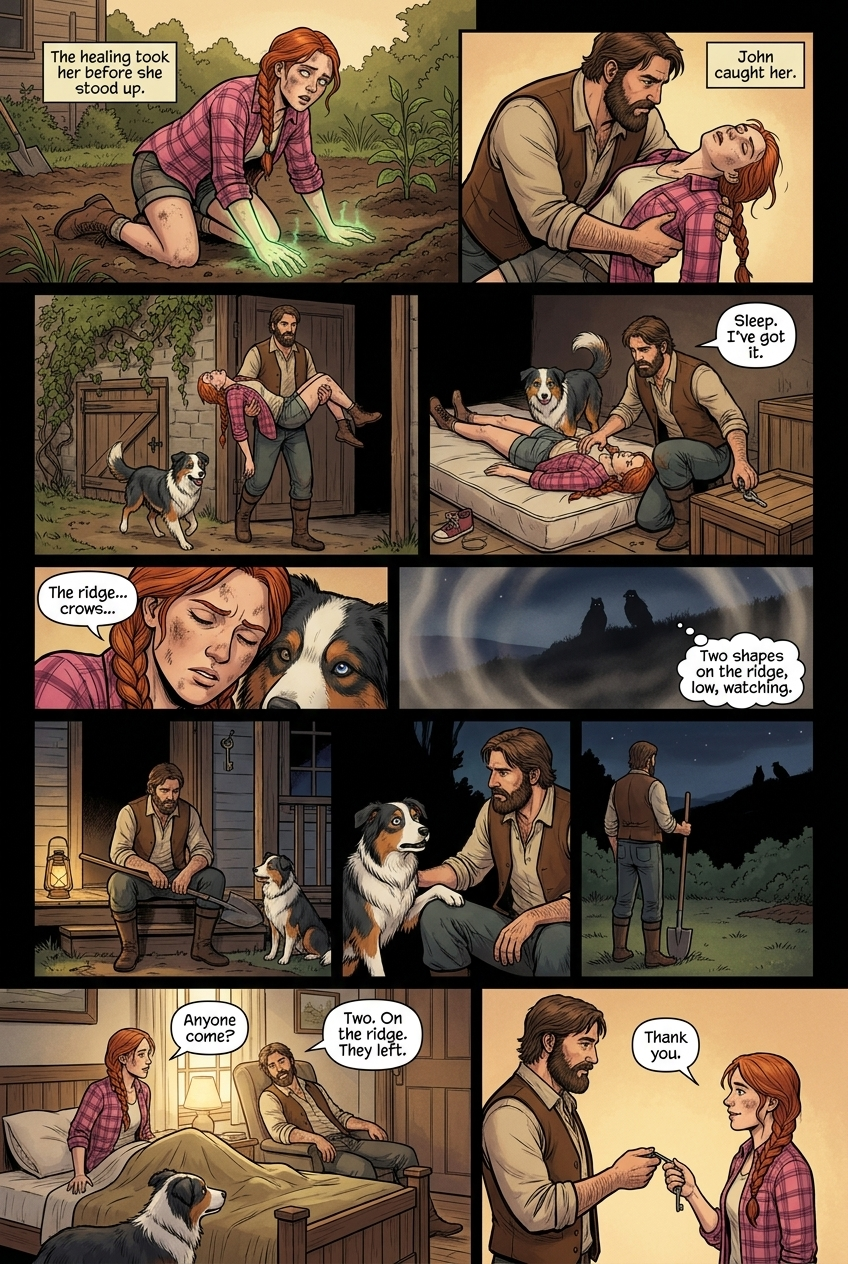
The healing took her before she stood up. One moment Scarlett was pushing warmth into the bed. The next her arms went cold and her vision tunneled. She tipped sideways into the dirt. The key was still in her front pocket. The district was open behind her — the wall, the netting, the cellar door — and she could not lift her head to check any of it. John caught her under the arms before she hit the row. He said her name once. She heard it from far away. He got a hand under her knees and lifted. She weighed almost nothing to him. She felt the porch step, then the doorway, then the mattress. He pulled her boots off. He worked the key out of her pocket and set it on the crate by the bed where she could see it if she opened her eyes. "Sleep," he said. "I've got it." She tried to say the ridge. She tried to say the crows need water in their dish. Her mouth would not move. The dog jumped up and settled against her hip, heavy and warm, mismatched eyes fixed on the door. An image pushed into her head — the yard, seen from the porch, empty and quiet. Duke telling her he was watching. Then the dark took her. John did not sleep that night. Scarlett learned it later in pieces. He sat on the porch with a shovel across his knees and the cellar key on a nail he'd driven into the doorframe above his head, out of reach of a hand through the rail. He walked the rows every hour. He filled the crows' dish. He checked the netting on the fast bed. When the dog came out to piss, John waited on the step until Duke came back in and returned to her side. Once, near the middle of the night, the dog stiffened against her leg and shoved an image at her through the fog — two shapes on the ridge, low, watching. She could not wake. Duke got up and went to the door and scratched. John opened it. The dog showed him too, somehow, or John understood the scratching. He stepped out with the shovel. He stood in the yard where the ridge could see him and did not move for a long time. The shapes went away. Scarlett woke at gray light. The key was on the nail above the door. John was in the chair by the bed, awake, sleeves still rolled from yesterday. The dog was at her feet. "Anyone come?" she said. Her voice was dust. "Two. On the ridge. They left." She looked at the key. She looked at him. She had lost a night and lost nothing else. "Thank you," she said. He reached up, took the key off the nail, and put it back in her hand.
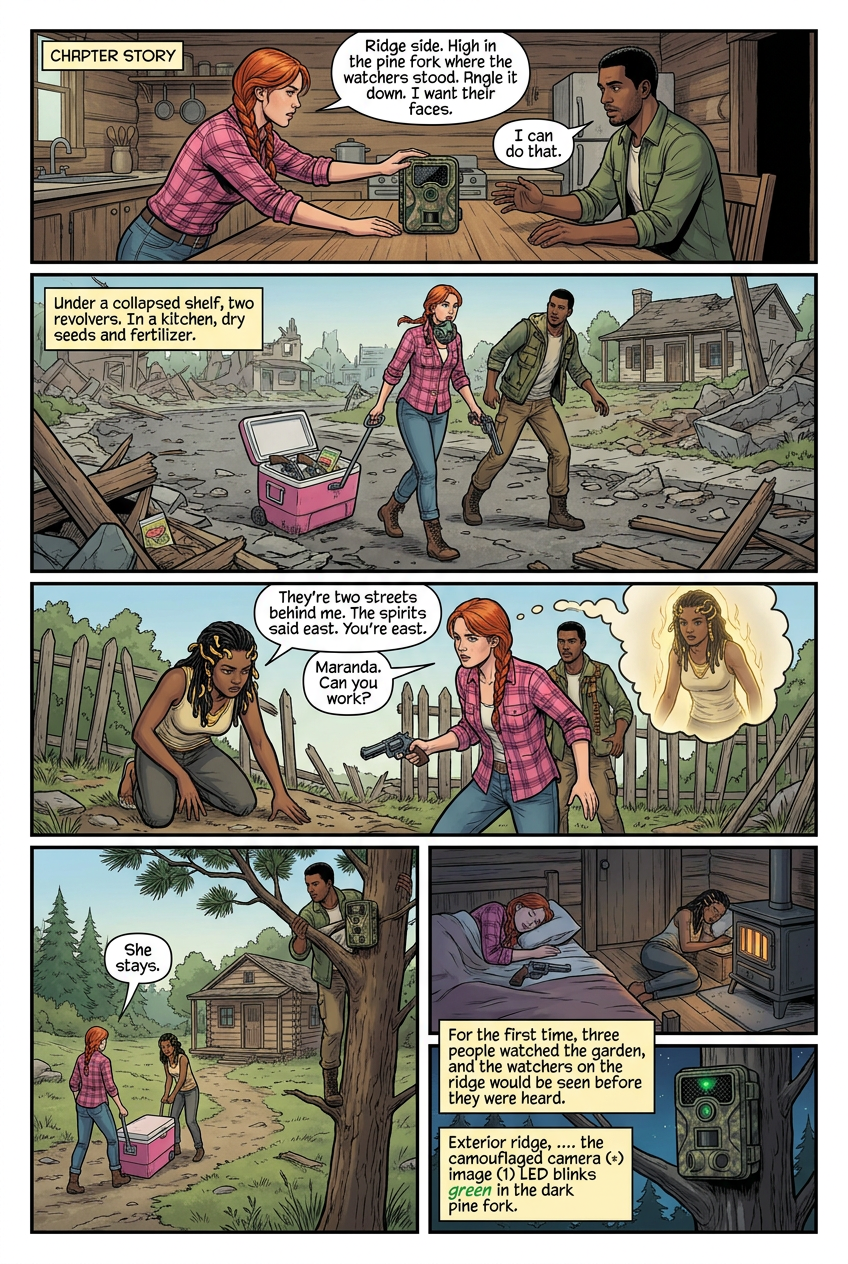
By full light Scarlett was on her feet again. Her legs shook but held. She sat John down at the kitchen table and pushed the camera across the wood to him. It was a small camouflaged box with a solar panel on top and a lens like a dark eye. She had traded three jars of tubers for it a season back and never had a reason to use it. Now she did. "Ridge side," she said. "High in the pine fork where the watchers stood. Angle it down. I want their faces when they come back." John turned the camera in his hands. "I can do that." "Duke and I are going out. Seeds if I can find them. Fertilizer. Anything that shoots." She met his eyes. "If I'm not back by ash wind, close the cellar and stay inside." He nodded once. He did not ask her to stay. She took the rolling cooler and her mask and the dog. They cut through the broken blocks past the pier road, into a stretch of houses she had not touched. Duke pushed an image at her — a garage door half off its track, a shape of metal inside. She followed him in. Under a collapsed shelf she found a lockbox split by rust. Two revolvers. A tin of bullets. She wrapped them in a shirt and set them in the cooler. The next house gave her seed packets in a kitchen drawer, dry but sealed. Beans. Squash. A sack of pelleted fertilizer under the sink, half full. She was loading it when Duke went stiff and shoved a picture into her head — a woman crouched behind a fence, gold eyes, bright dress, hands flat to the ground. Scarlett came around the fence slow, revolver low at her side. The woman did not run. She stayed crouched, palms pressed to the dirt like she was listening through it. Gold snake charms caught in her black hair. She looked up and her eyes were the color of old coins. "They're two streets behind me," the woman said. Short. Flat. "I've been walking three days. The spirits said east. You're east." Scarlett lowered the gun. Duke sat down at the woman's knee, which he did for no one. That decided it. "Scarlett." "Maranda." "Can you work?" "I can protect a place. I can tend rows. I don't lie about what I can do." "Then come." They pulled the cooler back together through the wind's first grit. At the homestead John was climbing down from the pine fork, camera fixed in the crook. He stopped when he saw Maranda. Scarlett said, "She stays." He looked at the dog beside her and went back to work. That night Maranda salted the doorframes and slept on the floor by the stove. The camera blinked green on the ridge. Scarlett kept a revolver under her pillow. For the first time since the collapse, three people watched the garden, and the watchers on the ridge would be seen before they were heard.
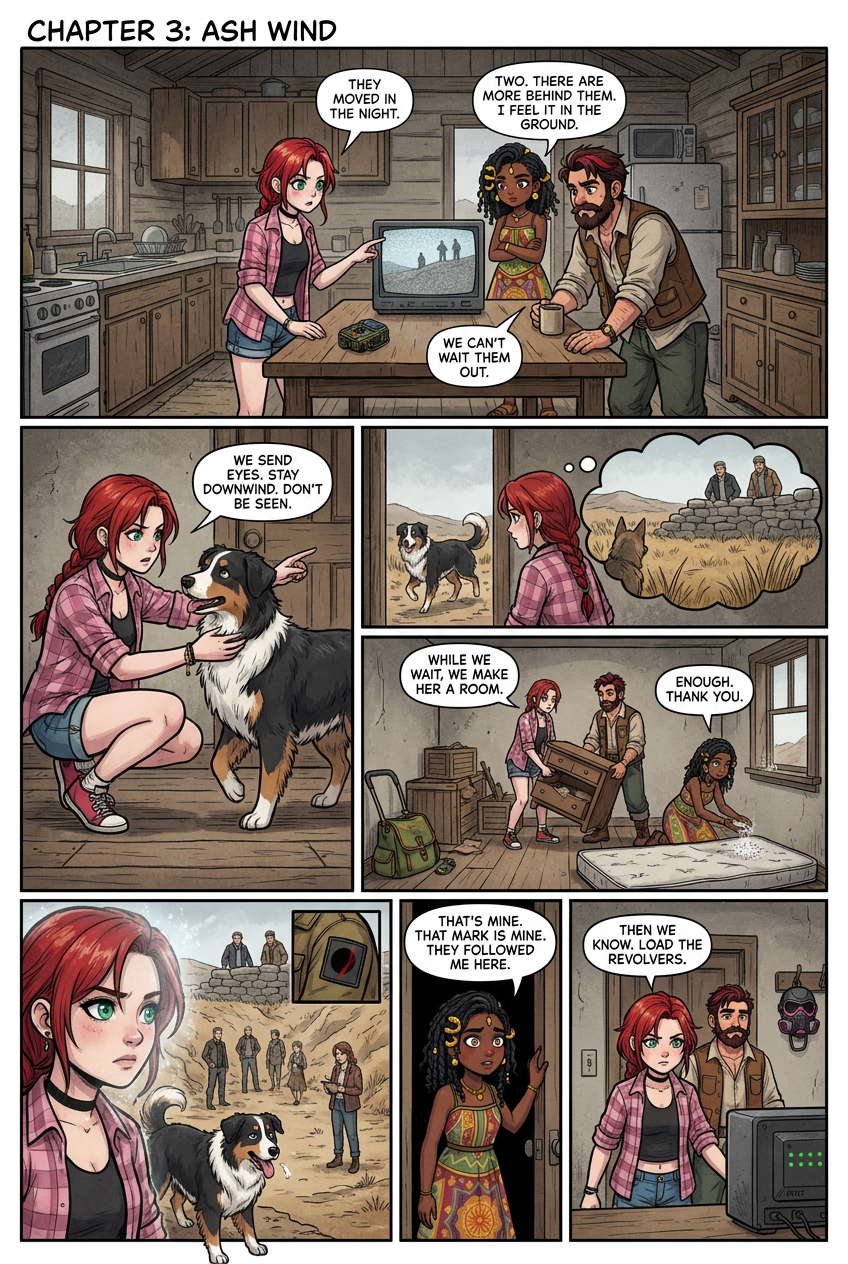
Dawn came gray. Scarlett pulled up the camera feed on the small screen John had wired to the kitchen table. Two figures on the ridge. Closer than yesterday. Not in the pines anymore. Down in the scree, behind a low wall. She could see the shape of a rifle across one man's back. "They moved in the night," she said. John set down his cup. Maranda came in from the stove, sandals quiet on the boards. She looked at the screen and her mouth tightened. "Two," Maranda said. "There are more behind them. I feel it in the ground." "Who," Scarlett said. "That's what I need. If they're Bern's people we talk. If they're yours we fight. If they're something else I want to know before they cross the wall." John leaned on the table. "We can't wait them out. They'll pick their hour." "No," Scarlett said. "We send eyes." She crouched and put her hand on the dog's ruff. Duke lifted his head. She pictured the ridge in her mind, the two men, the wall they hid behind. She pictured him circling wide through the broken lots, low and quiet, close enough to see faces. She pictured him coming back. Duke pushed an image back at her — himself trotting through dry grass, then the same ridge from below. He understood. He stood, shook once, and went to the door. "Stay downwind," she said. "Don't be seen." She let him out. He was gone in three steps. Maranda watched the door close. "He is a good one." "He's the best one," Scarlett said. She turned to John. "While we wait, we make her a room. She's not sleeping on the floor another night." They cleared the small back room together. John hauled out a broken dresser and a crate of rusted tins. Scarlett swept the boards and washed the window. Maranda brought in a mattress from the couch and laid it against the far wall. She salted the sill herself, quick and neat, and set a small pouch under the pillow. "Enough," Maranda said. She sat on the edge of the mattress. "Thank you." Scarlett nodded. She did not say more. Duke came back before the ash wind. He came in panting and dropped at Scarlett's feet. She knelt. The image hit her clean — two men behind the wall, and behind them, five more in a dry wash. She saw a patch sewn to a jacket. A black circle with a red mark inside it. She saw a woman with a notebook, writing. Maranda went still. Her hand closed on the doorframe. "That's mine," she said. "That mark is mine. They followed me here." Scarlett stood. The screen on the table blinked green. Seven of them. Named now, at least in Maranda's face. "Then we know," Scarlett said. "Load the revolvers."
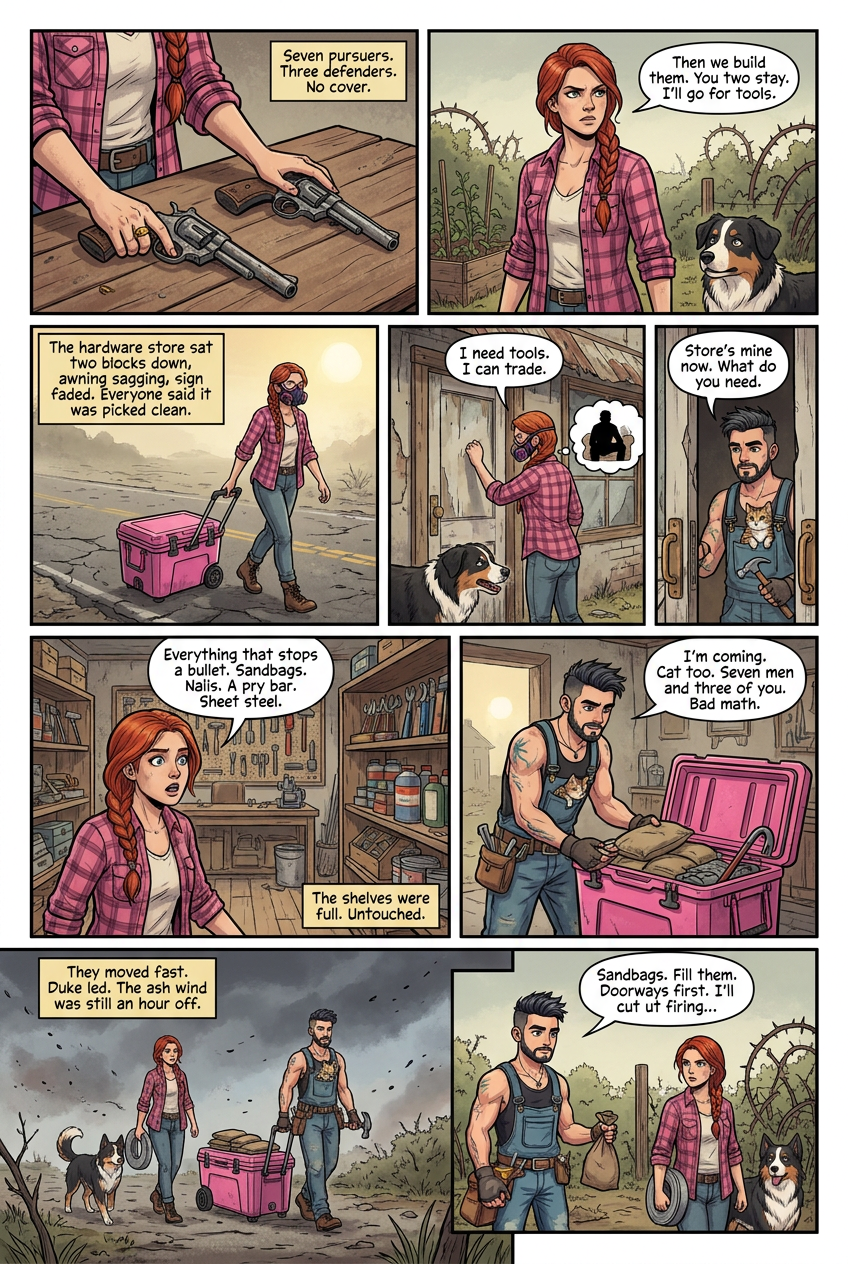
Scarlett laid the revolvers on the table. Seven pursuers. Three defenders. The garden had a thorn wall and a windbreak, but no cover for a firefight. If the pursuers reached the rows, it was over. "We need walls," John said. "Real ones. Something they can't shoot through." "Then we build them," Scarlett said. "You two stay. Find the ground you want to hold. Drag anything heavy to it. Sheet metal, doors, stones. I'll go for tools." Maranda touched her wrist. "Go fast." "Duke," Scarlett said. He was already at the door. She pulled the rolling cooler behind her, the pink one, wheels loud on the broken road. She wore the black-and-pink mask against the coming ash. The hardware store sat two blocks down, awning sagging, sign faded. She had passed it a hundred times and never gone in. Everyone said it was picked clean. The door was locked. Duke growled low, then stopped. He pushed an image at her — a man inside, sitting still, not hiding. She knocked. "I need tools. I can trade." A bolt slid. The door opened a hand's width. A man looked out — short black hair, green eyes, stubble, overalls. A tabby cat sat in his chest pocket, blinking at Duke. He held a hammer loose at his side. "Store's mine now," he said. "What do you need." "Everything that stops a bullet. Sandbags if you have them. Nails. A pry bar. Sheet steel." He looked past her at the empty street. "How many coming." "Seven. Armed. Within the hour." He stepped back and let her in. The shelves were full. Untouched. Wire, screws, hinges, saw blades, a whole rack of long-handled tools. She stared. "Nobody found it?" she said. "I kept it quiet." He was already pulling burlap sacks off a hook. "You garden?" "Old district. Beds behind a thorn wall." He stopped. Looked at her — the braid, the pink flannel, the mask hanging at her throat. He looked at Duke sitting calm at her ankle. "Marcus," he said. "You feed people from that garden?" "I'm trying to." He nodded once. He started loading the cooler himself. Nails. A crowbar. Two sheets of galvanized steel rolled tight. Sandbags, empty, a stack of them. A shovel. A roll of chain. "I'm coming," he said. "Cat too." "I can't pay you today." "Didn't ask." He shouldered his tool bag. "Seven men and three of you. Bad math." They moved fast. Duke led. The ash wind was still an hour off. Marcus pushed the cooler; Scarlett carried the steel. He didn't talk on the walk. He watched her instead — the way she checked the ridge without stopping, the way Duke stayed at her hip. At the gate, John looked up from a pile of scrap. Maranda's eyes narrowed, then eased when she saw Duke calm. "Sandbags," Marcus said, dropping the stack. "Fill them. Doorways first. I'll cut firing
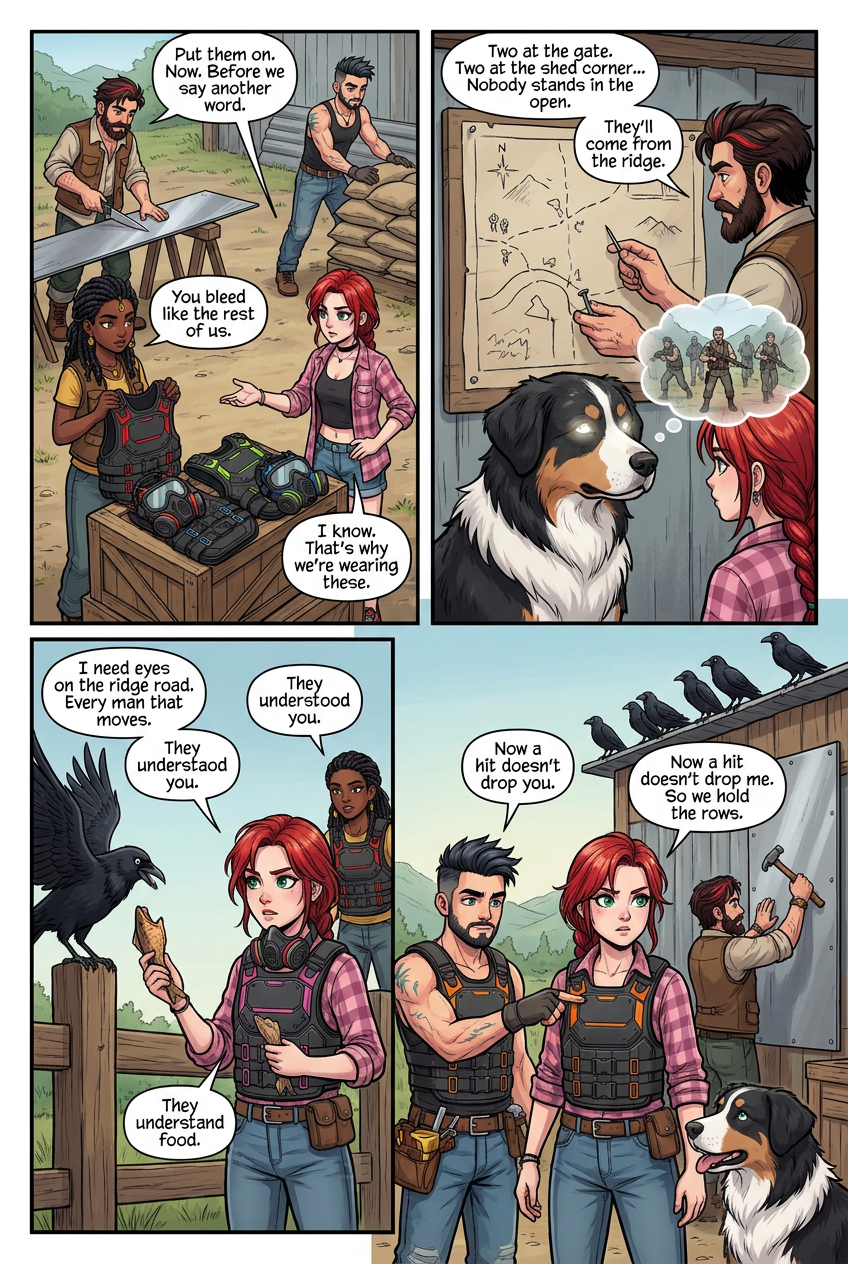
Marcus cut firing slits into the steel while John stacked sandbags at the gate. Scarlett dropped a canvas bundle on the crate between them. She untied it and four vests fell out, four masks on top. Black plating. Bright edges — pink, red, orange, green. The masks had round filters and hard goggles. "From the store," Marcus said. "I forgot they were in the back." "Put them on," Scarlett said. "Now. Before we say another word." Maranda picked up the red vest. She held it against her chest and looked at Scarlett. "You bleed like the rest of us." "I know." Scarlett pulled the pink-edged vest over her tank top. The straps bit her ribs. "My hands don't work on me. If I take a hit, I go down and stay down. So I don't take one." John stopped mid-lift. "Scarlett." "That's why we're wearing these." She tightened her strap. "All four of us. No exceptions." He set the sandbag down and took the orange vest. He didn't argue again. They worked while they talked. Marcus laid out the plan on a flat board with a nail for a pencil. "Two at the gate. Two at the shed corner. Steel here, here, here. Nobody stands in the open. Nobody chases anyone past the thorn wall." "They'll come from the ridge," John said. "Duke's shown us that road three times." The dog lifted his head at his name. Black and white fur, one blue eye, one green. He pushed an image at Scarlett — men on foot, spread wide, rifles low. "Spread formation," Scarlett said. "So they can't all be pinned by one gun." She looked up at the roof line. Six crows sat along the gutter, still as nails. She walked to the fence and set a strip of dried fish on the post. The lead bird dropped down. She pressed her palm flat and spoke low. "I need eyes on the ridge road. Every man that moves. Call loud when they cross the split rock. Twice as loud if one breaks off from the group." The bird took the fish. It cocked its head, then lifted. The flock rose with it — eight, ten, more — and scattered along the roof, the wall, the dead tree by the gate. They settled facing outward. Not one faced the garden. Maranda watched them. "They understood you." "They understand food." Scarlett buckled the mask at her throat, filters hanging ready. "Close enough." John stepped up beside her at the gate. He tapped her chest plate with two knuckles. It thudded solid. "Now a hit doesn't drop you," he said. "Now a hit doesn't drop me." She looked at the ridge. The crows didn't move. "So we hold the rows." Marcus dragged the last sheet of steel into place and drove the first nail. The sound cracked across the empty street. Nothing on the ridge answered yet.
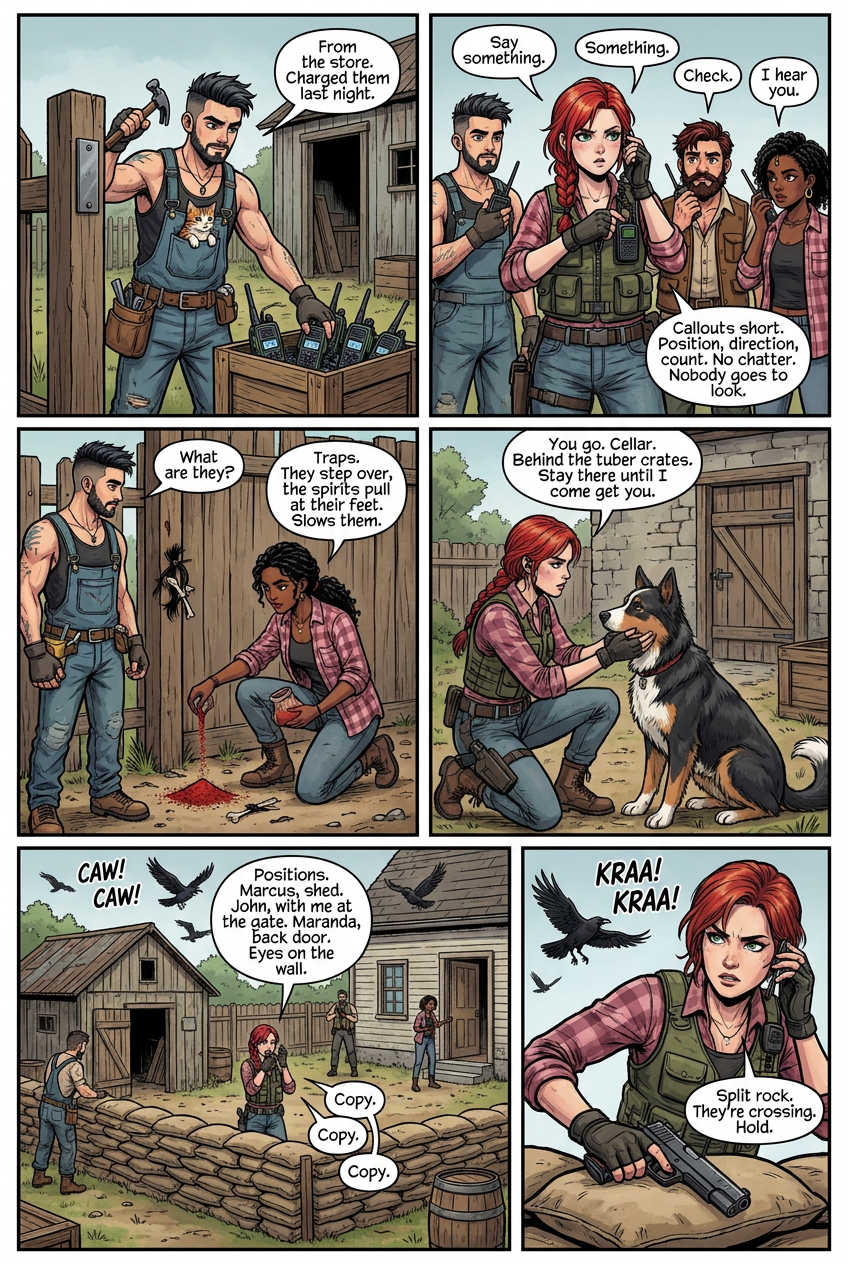
Marcus drove the last nail and stepped back from the steel. He wiped his hands on his overalls and reached into the crate by the shed. He pulled out four black radios with coiled cords and small earpieces. "From the store," he said. "Charged them last night." He passed one to Scarlett, one to John, one to Maranda. He kept the fourth. Scarlett clipped hers to her vest and fit the earpiece. She keyed the button. "Say something." Marcus's voice hit her ear a half-second later. "Something." John keyed his. "Check." Static, then clear. Maranda held hers in her palm and studied it before she pressed the button. "I hear you." "Channel one," Marcus said. "Don't touch the dial. If it breaks, we're deaf." Scarlett looked at each of them in turn. "Callouts short. Position, direction, count. No chatter. If someone stops answering, someone else calls it out. Nobody goes to look." "Nobody goes to look," John repeated. Maranda knelt at the gate. She opened a small cloth pouch and poured a line of red powder across the dirt inside the threshold. She set a knot of black hair and bone at each corner post. She whispered over each one and did not translate. "What are they?" Marcus asked. "Traps," Maranda said. "They step over, the spirits pull at their feet. Slows them. Not much. Enough." She walked the fence line and laid another knot at the shed corner where Marcus would stand. She pressed her palm flat to the steel plate at the gate and closed her eyes. When she stood back, the plate looked the same. Scarlett didn't ask. Duke pushed at her leg. She knelt and took his face in both hands. He showed her the ridge — empty road, then movement. Close. "You go," she said. "Cellar. Behind the tuber crates. Stay there until I come get you." He pushed a last image at her — her own face, whole — and ran for the house. Scarlett pulled a revolver from the crate and checked the cylinder. She handed a second pistol to Maranda, who took it without a word and slid it into the pocket of her dress. John already had his. Marcus racked a slide and set the weapon on the sandbag ledge. "Positions," Scarlett said into the radio, low. "Marcus, shed. John, with me at the gate. Maranda, back door of the house. Eyes on the wall behind us." "Copy," three voices said in her ear. John touched her elbow before he crossed to the gate. He didn't speak. He didn't need to. A crow screamed from the roofline. Then another. Then all of them at once, harsh and long, the call she had paid for. "Split rock," Scarlett said into the radio. "They're crossing. Hold." She raised her pistol and set it on the sandbag. The line went live in her ear, four breaths, one channel, one plan.
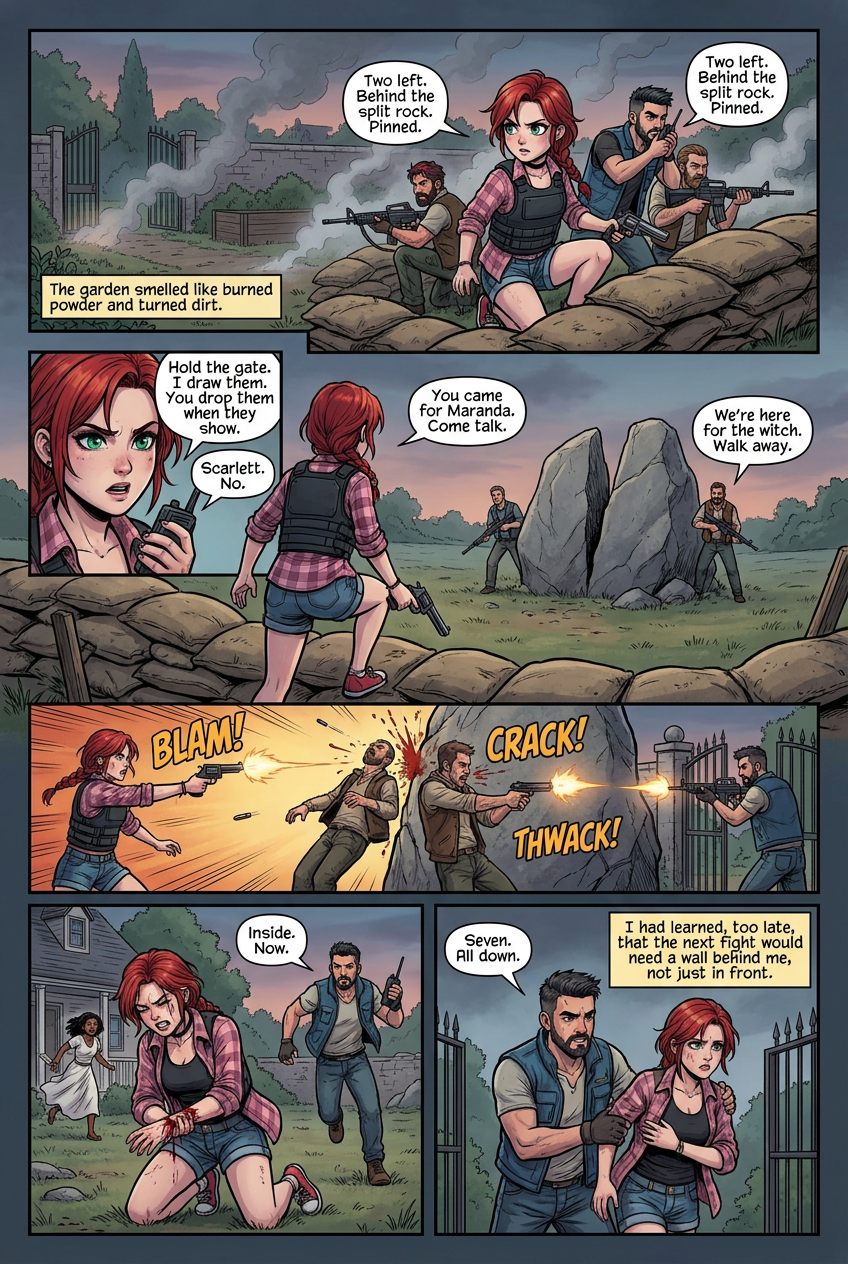
The first shots came fast. Too fast. Scarlett saw two men break from the tree line and John dropped one before she found her sight. Marcus fired twice from the shed and a second man folded at the wall. A third tried the gate and hit Maranda's red powder. His foot caught. John shot him. Two more came from the ridge road and Marcus took them both with the rifle braced on the sandbags. Five down in under a minute. Scarlett's ears rang. The garden smelled like burned powder and turned dirt. "Two left," John said into the radio. "Behind the split rock. Pinned." Scarlett watched the rock. Nothing moved. Nothing would move, not while four guns held the gate. But the gate was all they had. No trench behind it. No second wall. If those two waited for dark and rushed the line, her people had nowhere to fall back to. The house was open ground away. She had built forward and forgotten backward. She keyed the radio. "Hold the gate. Don't follow me out." "Scarlett." John's voice, tight. "No." "Hold the gate." She set the radio down. "I draw them. You drop them when they show." She climbed the sandbags before he could cross to her. Her boots hit the dirt on the wrong side of the wall. She walked ten paces into open ground and stopped. "You came for Maranda," she called. "Come talk." A man stood up from behind the rock. Then another, further left. Both had rifles low. "We're here for the witch," the first one said. "Nobody else has to die for her. Walk away." "None of my friends get hurt tonight," Scarlett said. She raised the revolver and shot the first man in the head. He dropped straight down. The second was fast. She saw the muzzle flash before she heard it. Something hit her left wrist and spun the pistol out of her hand. She went to one knee. John's rifle cracked from the gate. The second man fell across the rock and did not move. Scarlett looked at her wrist. The bullet had gone through clean. Blood ran down her fingers into the dirt. She could not fix it. She had never been able to fix herself. John was over the wall and running. Marcus was already calling clear on the radio. Maranda came out of the house with cloth in her hands. "Inside," John said. He got an arm under Scarlett's shoulder. "Now." "Count the bodies," Scarlett said. "All seven." "Seven," Marcus said in her ear. "All down." John lifted her. She kept her wrist pressed against her vest so the blood stayed off the beds. The gate had held. The line had held. And she had learned, too late, that the next fight would need a wall behind her, not just in front.
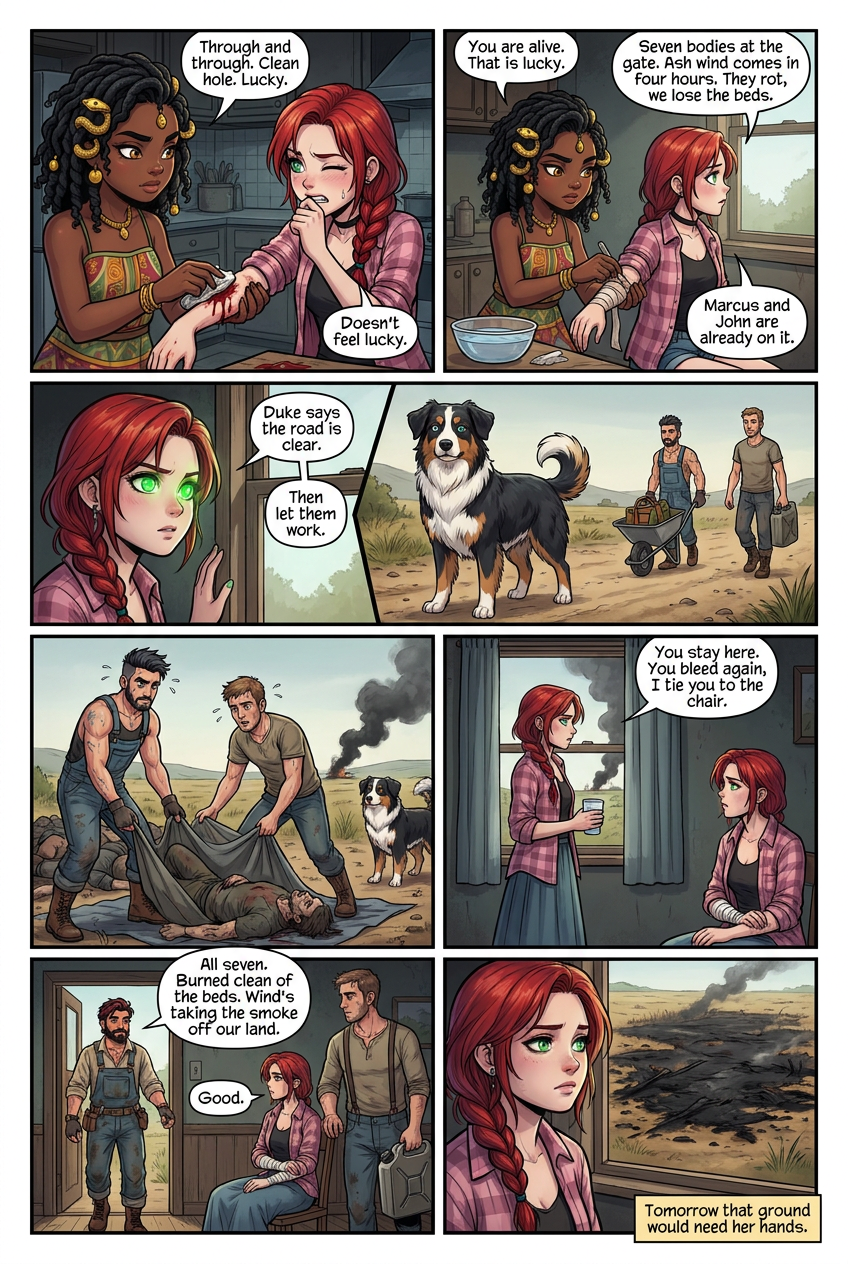
John set Scarlett on the kitchen table. Blood had soaked through her sleeve and dripped onto the floor. Maranda pushed past him with a bowl of hot water and a strip of clean linen. She did not ask permission. She cut the sleeve open and turned the wrist to the lamp. "Through and through," Maranda said. "Clean hole. Lucky." "Doesn't feel lucky," Scarlett said. "You are alive. That is lucky." Maranda poured the water over the wound. Scarlett bit down on her own arm. Maranda packed the hole with a paste that smelled like garlic and pine, then wrapped it tight. Her hands worked fast. She had done this before. "Seven bodies at the gate," Scarlett said. "Ash wind comes in four hours. They rot, we lose the beds." "Marcus and John are already on it," Maranda said. She tied the bandage off. "You stay here. You bleed again, I tie you to the chair." Scarlett looked out the window. Marcus was pushing a wheelbarrow through the gate. His tool bag rode on top, spades and shears stuck out the pockets. John walked beside him with a can of fuel. Duke followed at John's heel, the big dog's tri-colored coat streaked with dust, his curled tail low. One blue eye and one brown eye tracked the ridge for movement. "Duke says the road is clear," Scarlett said. The image had come through soft — empty gravel, no boots, no smoke. "Then let them work." Maranda pressed a cup of water into Scarlett's good hand. Outside, Marcus and John dragged the first body onto a tarp. Marcus took the shoulders. John took the boots. They hauled it past the split rock to the bare lot beyond the wall, far enough from the beds that ash and smoke would not settle on the crops. They came back for the next. And the next. Duke stood watch at the gate, ears forward, giving Scarlett a picture every few minutes — two men working, sweat on their faces, the pile growing. By the fourth body Scarlett was on her feet at the window. By the sixth, Marcus had stopped to drink from a jug. John poured fuel over the pile. The match caught. Black smoke climbed straight up, then bent east as the first push of ash wind arrived. Marcus came in through the back door. His overalls were streaked with dirt and worse. "All seven. Burned clean of the beds. Wind's taking the smoke off our land." "Good," Scarlett said. He looked at her wrapped wrist. "You should be sitting." "I know." She sat. John came in last, closed the door against the ash, and set the empty fuel can down. The garden was safe from the dead. But the soil past the split rock was scorched now, a black patch where nothing would grow. Scarlett had traded one problem for another. Tomorrow that ground would need her hands.
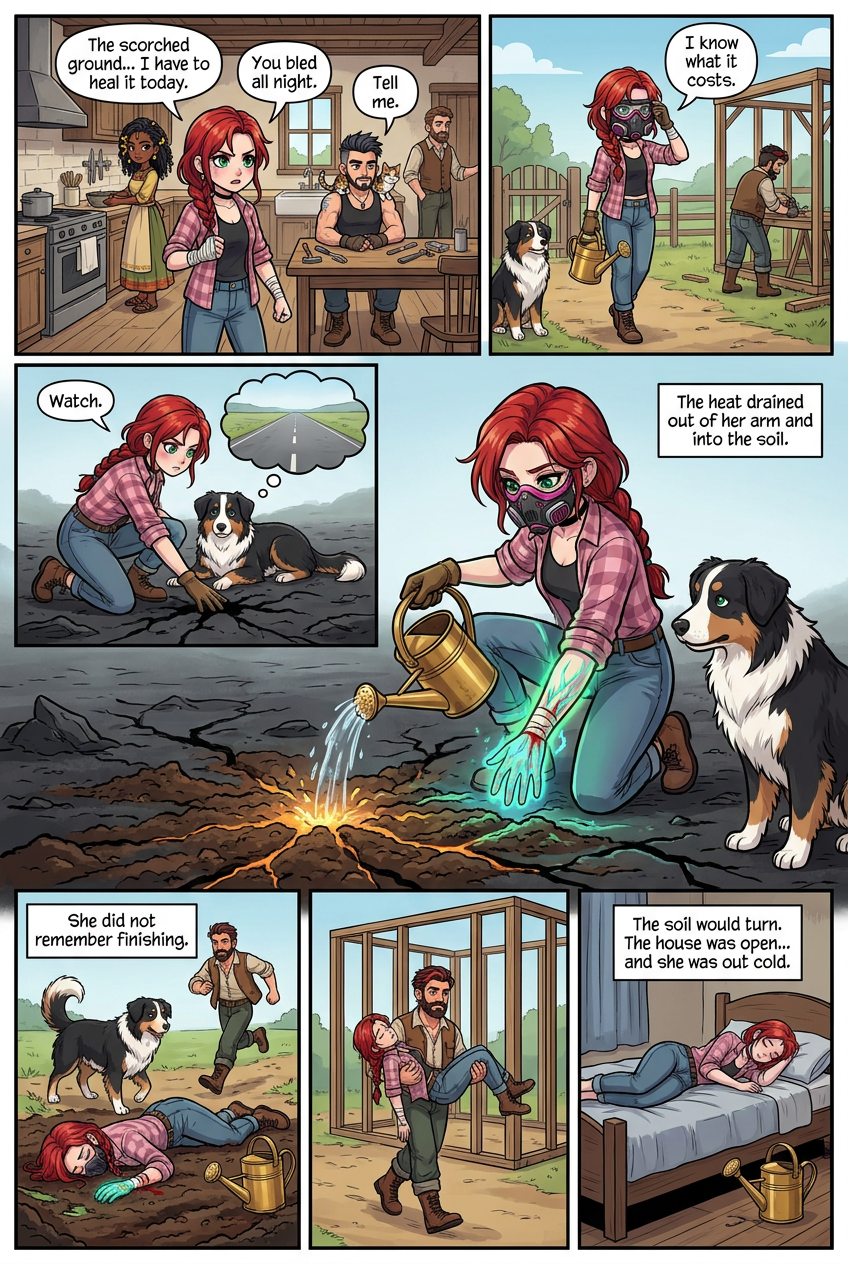
Scarlett slept four hours and woke before the light. Her wrist throbbed under the bandage. She flexed her fingers. They moved. That was enough. She found Maranda in the kitchen boiling water. John was already outside, checking the beds. Marcus sat at the table with his tool bag open, sorting hinges into piles. His tabby cat watched from his shoulder. "The scorched ground past the split rock," Scarlett said. "I have to heal it today. If we don't get it back, the garden can't grow any wider. We won't feed everyone through winter." Maranda set down the pot. "You bled all night. You cannot lay hands on dead ground and stay standing." "I know what it costs." Scarlett looked at Marcus. "That's why I need help while I'm under." Marcus closed the tool bag. "Tell me." "Maranda, John — take the crops. Water the rows, check the netting, feed the crows. Don't leave the beds alone." She turned to Marcus. "The house needs two more rooms. Maranda's sleeping on the couch. If more people come through, we need walls. Can you frame it?" "I can frame it today. Finish it in three." Marcus stood. "Where will you be?" "Working." She did not say where. She filled the brass watering can at the cistern and pulled the mask over her face. The straps bit her ears. Duke waited at the gate, tri-colored coat matted with yesterday's dust, one blue eye and one brown fixed on her. She did not call the others. She slipped out the side while Marcus hauled lumber off the porch and the hammer started up behind her. The scorched patch stretched past the split rock. Black crust. Bone flakes. She knelt and pulled off her good glove. Duke lay down at the edge and pushed her a picture — the road, empty, clear for a mile. "Watch," she said. She pressed her palm flat to the burned ground. The heat drained out of her arm and into the soil. She poured water from the can over the crust, then set her hand back down. The black loosened. She moved a foot, pressed again. Another foot. Another. The sun climbed. Ash on her mask ticked like sand. Her bandaged wrist wept pink through the cloth. She did not remember finishing. She remembered the last patch under her fingers going soft, and Duke's nose against her ear, and the sky tipping sideways. Marcus found her face down past the split rock. The watering can lay tipped beside her hand. Duke stood over her, tail low, refusing to move. Marcus lifted her. She weighed nothing. He carried her through the gate, past the framed studs of the new rooms, and laid her on the bed. He set the watering can on the floor where she could see it when she woke. The soil would turn. The house was open to the wind, half-built, and she was out cold with no one watching the road but a dog and a hammer.
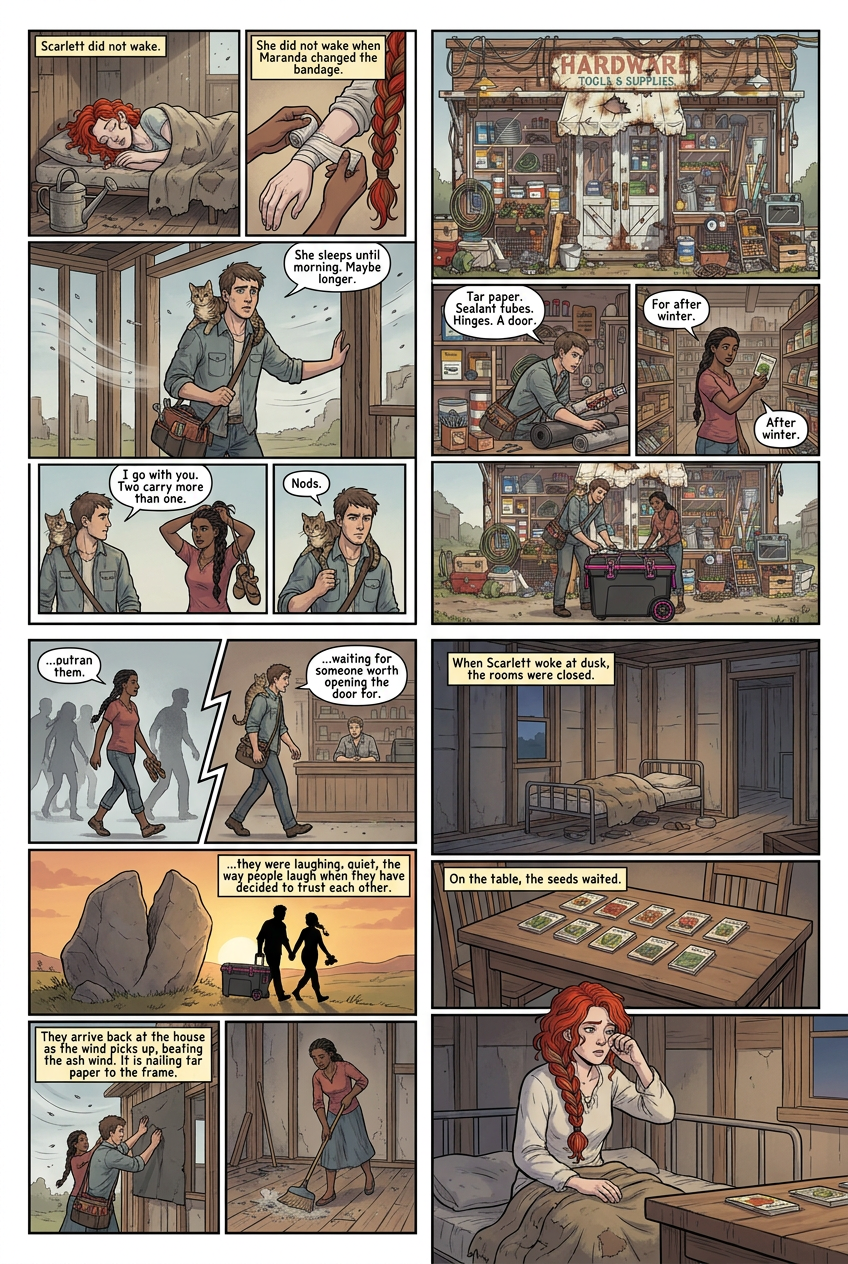
Scarlett did not wake when Marcus set the hammer down. She did not wake when Maranda changed the bandage on her wrist. The room held her still, breath shallow, face turned toward the watering can on the floor. Marcus stepped out to the framed rooms and put his hand on a stud. Wind pushed through the open wall. Ash sifted onto the floorboards where the beds would go. He counted what he had left: three sheets of plywood, half a bucket of nails, no tar paper, no seal. Not enough to close it before the afternoon storm. Maranda came out behind him with her sandals in her hand. "She sleeps until morning. Maybe longer." She looked at the open frame. "That will fill with ash by dark." "I know." "The store," she said. "You said it still has stock." Marcus hesitated. He did not know this woman well. He had seen her set bone charms in the dirt and treat a bullet wound with steady hands. That was what he knew. "It's a walk. And I don't leave her unguarded." "John stays. The dog stays. The crows watch the road." Maranda tied her hair back. "I go with you. Two carry more than one." He studied her. She did not look away. He nodded once. They took the rolling cooler from the porch — the big black-and-pink one Scarlett hauled fish in — because it rolled and it locked. Marcus slung his tool bag. The tabby cat rode his shoulder. Maranda tucked a small pouch of red powder into her dress pocket. The hardware store sat quiet under its faded sign. Tools, wire, and garden goods hung where the old owner had left them. Marcus moved fast. Tar paper. A roll of roofing felt. Sealant tubes. Boxes of nails. Two pane windows wrapped in brown paper. Hinges. A door. Maranda worked the far aisle and came back with seed packets — beans, squash, turnip, kale — and a jar of onion sets. She held one packet up. "For after winter," she said. "After winter," Marcus agreed. They loaded the cooler until the lid strained. Marcus tied the door and windows across the top with cord. On the walk back Maranda spoke about the pursuers she had outrun, and Marcus spoke about the year he spent alone behind the store counter waiting for someone worth opening the door for. By the split rock they were laughing, quiet, the way people laugh when they have decided to trust each other. They beat the ash wind by twenty minutes. Marcus nailed tar paper over the open frames, hung the door, and set the windows in rough. Maranda swept the ash from the floorboards and laid the seed packets on the kitchen table in a neat row. When Scarlett woke at dusk, the rooms were closed. The wind hit the new walls and stopped there. On the table, the seeds waited.
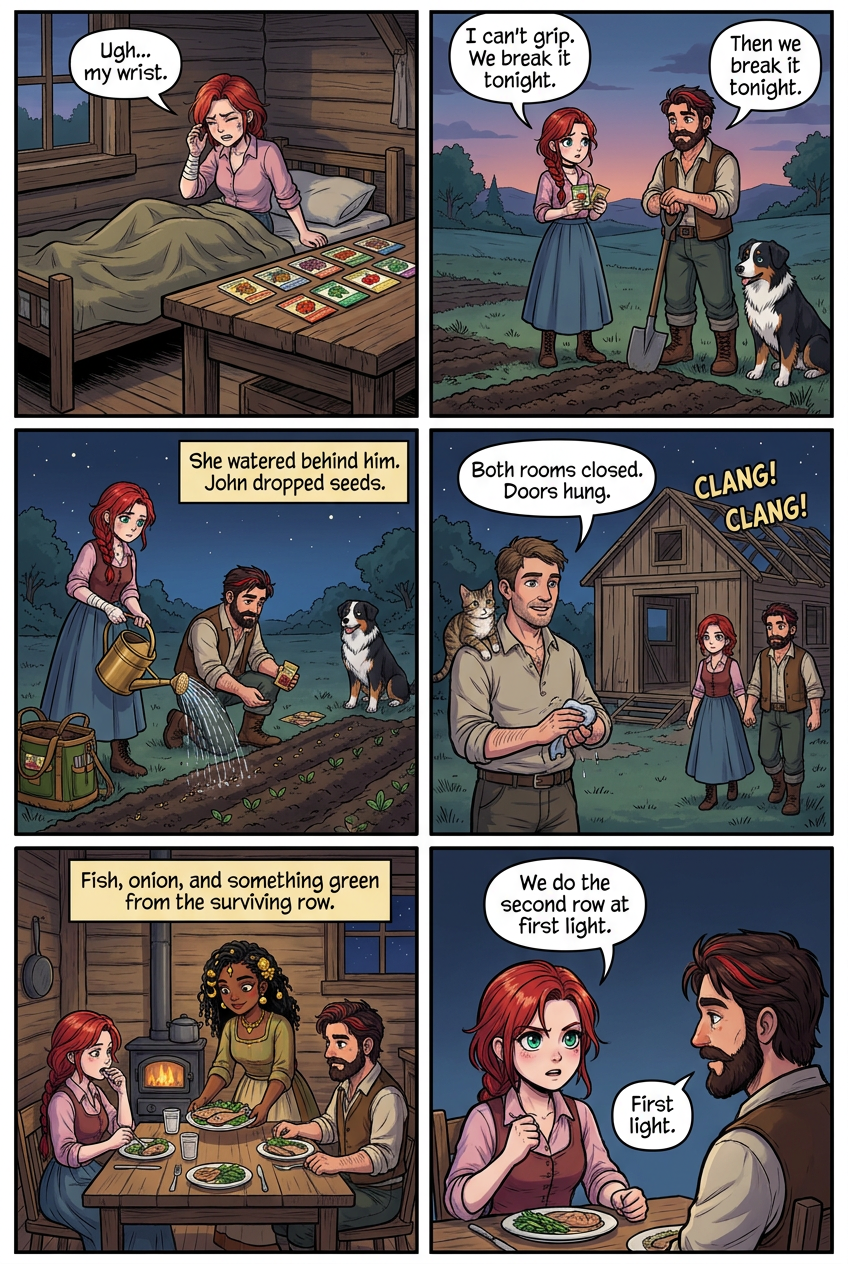
Scarlett woke at dusk to closed walls and the row of seed packets on the kitchen table. She sat up too fast. Her wrist answered with a hot pull under the bandage. She flexed the fingers. They moved. The grip did not close. She walked out to the healed bed past the split rock. The soil lay dark and soft where she had put her hands into it. By morning it would crust. By the next day it would harden past a seedling's reach. She tried to lift a shovel from the wheelbarrow. The handle slipped through her fingers and hit the dirt. John came up behind her with the dog at his heel. He looked at the shovel, then at her wrist. "I need you," she said. It cost her to say it plain. "I can't grip. The bed crusts tomorrow if we don't break it tonight." "Then we break it tonight," he said. He picked up the shovel. She carried the seed packets in her good hand. Beans. Squash. Turnip. Kale. Carrot. Radish. Onion sets in a jar. Twenty packets in all, the ones the woman with the bone charms had laid out on the table. Scarlett walked the row while John turned the soil. She marked the spacing with her boot. He followed and dug the trenches. Halfway down the row she stopped. "Some of these we let go to seed. Don't harvest the strongest plant in each row. We save what it drops." John nodded. "More packets for spring." "More packets for every spring." The watering can sat by the cistern. She filled it one-handed and carried it in the crook of her bad arm. John dropped seeds. She watered behind him. The dog lay across the end of the row and watched the ridge. Hammering came from the house. Steady, fast, closer to done than it should have been. When they walked back at full dark, the man with the tabby cat stepped out of the framed rooms wiping his hands. "Both rooms are closed," he said. "Doors hung. Windows in. I thought it was three more days." "How?" "I stopped sleeping." He looked at her wrist. "You planted." "Twenty packets. Some go to seed." He smiled once, small. The cat rode his shoulder inside. The woman with the gold in her hair had the stove going. Fish, onion, and something green from the surviving row. She set four plates. She set a fifth by habit and did not move it. Scarlett ate with her left hand. The wrist throbbed under the cloth. The bed was planted. The rooms were closed. The seeds on the table were gone into the ground, except for what they would keep back. She looked at John across the table. "We do the second row at first light." "First light," he said.
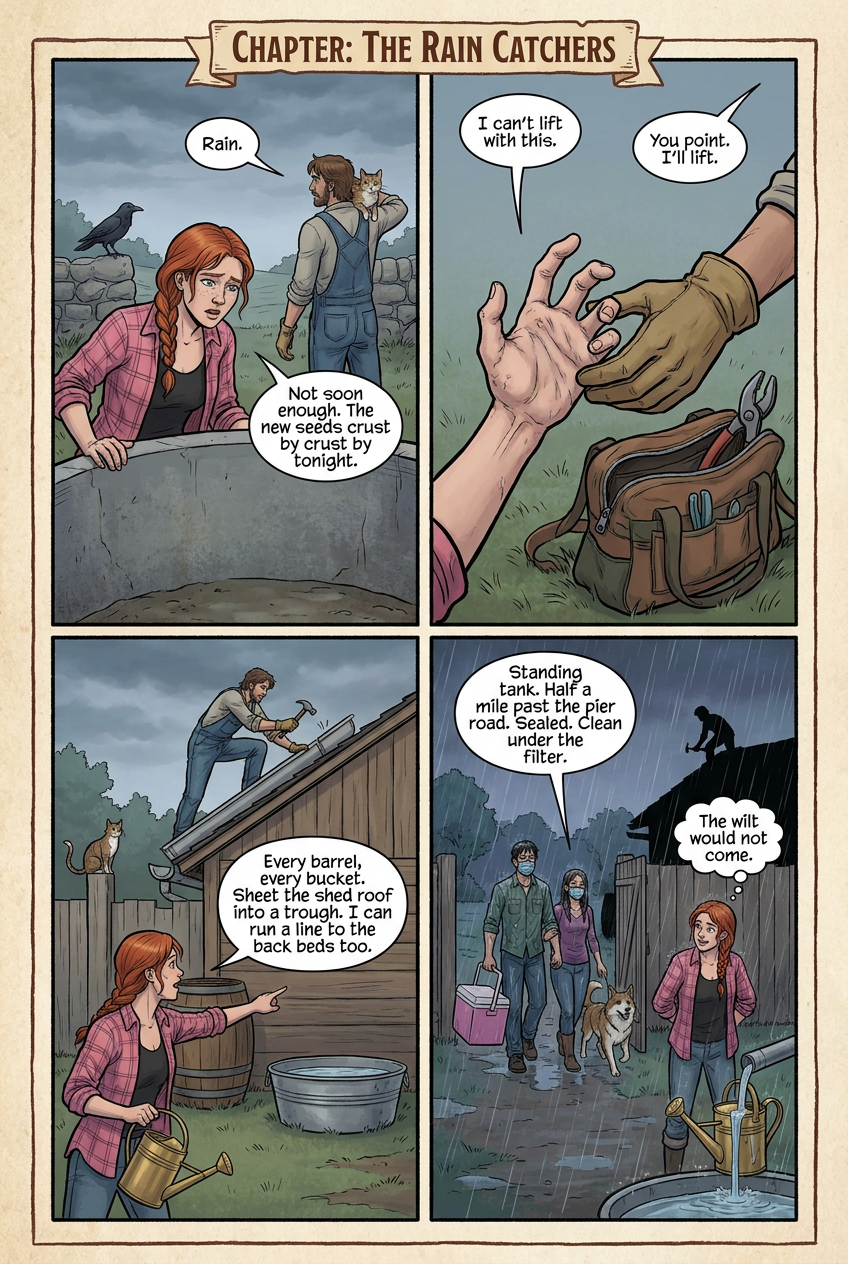
At first light Scarlett walked out with the seed jar and stopped short. The sky over the ridge had gone the color of wet slate. The crows were quiet on the wall. She tipped the cistern lid back and looked down. The water sat low, a shallow gray ring at the bottom. Two days of watering, maybe less. The new row would wilt before the clouds broke. Marcus came out behind her with the cat on his shoulder. He looked at the sky, then at the cistern. "Rain," he said. "Not soon enough. The new seeds crust by tonight." "Then we catch more than the cistern can hold." He set his tool bag down on the step. "Every barrel, every bucket. Sheet the shed roof into a trough. I can run a line to the back beds too." She flexed her bad hand. The fingers moved. The grip did not close. "I can't lift with this." "You point. I'll lift." John came out of the house pulling his coat on. Maranda followed with her sandals in her hand. "The cistern won't hold us," Scarlett said. "We need a fresh source too. A spring, a tank, anything standing. If this storm skips us, we lose the row." "I'll go," John said. "Duke knows the low ground east of the pier." "I go with him," Maranda said. She was already tying her hair back. "Two sets of eyes." Scarlett nodded once. "Before the ash wind. Both of you back by dark." John took the rolling cooler for hauling and a pair of masks. Maranda tucked a bone charm into her pocket. The dog trotted between them to the gate. Marcus was already on the shed roof. He pried up the old flashing and bent a length of gutter down into a barrel. Scarlett walked the yard and pointed. Here. There. The rain barrel by the corner. The wash tub. He worked fast and quiet, the cat watching from a fence post. She watched his hands on the metal. Steady. Careful. He had framed her rooms in a night without sleeping. He had carried her back from the split rock when her legs quit. She caught herself counting the ways he stayed and stopped counting. He looked down and caught her looking. "What." "Nothing." "Hand me the shears." She passed them up left-handed. Their fingers touched on the handle. He did not pull his away first. She did. By noon he had six catches rigged and a trough running off the shed into a second barrel. The first drops came at three. By four it was a hard steady rain and every vessel was filling. John and Maranda came back at dusk soaked through. "Standing tank," John said. "Half a mile past the pier road. Sealed. Clean under the filter." Scarlett set the brass watering can under the trough and watched it fill. The new row would drink for weeks. The wilt would not come. She looked at Marcus across the yard. He was still on the roof in the rain.
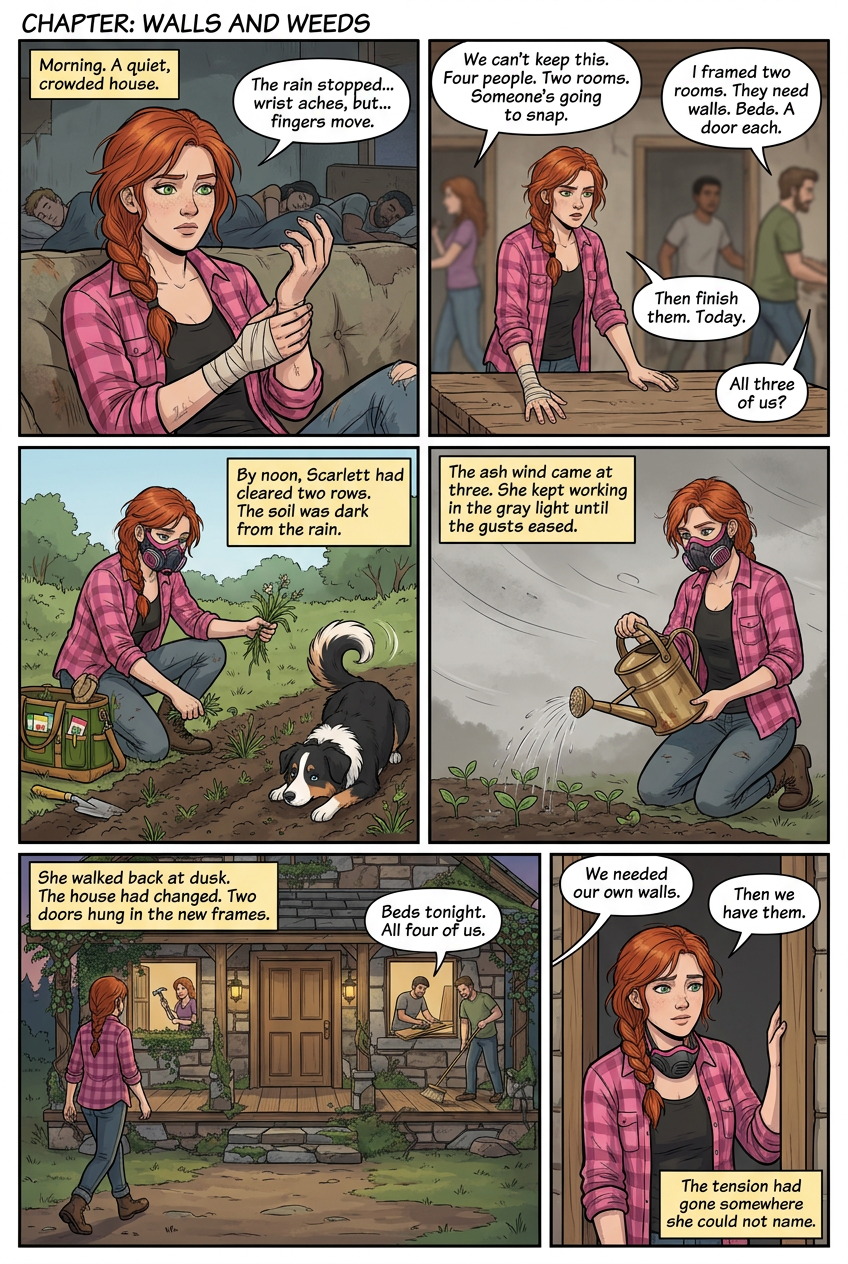
The rain stopped in the night. Scarlett woke to a quiet house and four bodies packed into two small rooms. John was folded on the couch with his boots still on. Maranda had slept sitting up against the wall by the stove. Marcus was on the floor by the back door, his coat under his head. The cat sat on his chest. Scarlett stepped over him and put the kettle on. Her wrist ached. The fingers moved a little more today. She could hold a cup. She could not swing a hammer. One by one they woke. John stretched and hit his knee on the table. Maranda rubbed her neck and did not smile. Marcus sat up and the cat jumped down. "We can't keep this," Maranda said. "Four people. Two rooms. Someone's going to snap." "I framed two rooms," Marcus said. "They need walls. Beds. A door each." "Then finish them," Scarlett said. "Today." John looked up. "All three of us?" "All three. You know the frame. Marcus has the tools. Maranda can cut and hand." She flexed her bad hand on the counter. "I can't hold a nail. I can weed and water. I'll take the garden." No one argued. Marcus nodded once and pulled his boots tight. Maranda went for the saw. Scarlett fitted the black-and-pink mask over her face and stepped out. The wheelbarrow sat by the shed with the tool bag inside — trowels, shears, gloves, twine, the seed packets Maranda had left on the kitchen table days back. She pushed it down the row. The soil past the split rock was dark from the rain. The new sprouts had come up in thin green lines. She knelt left-handed and pulled weeds with her good hand. Duke lay at the end of the row with his tail sweeping the dirt. Every so often he lifted his head and showed her the ridge in her mind. Empty. Empty. Empty. Behind her the house rang with hammers. Steady strikes. Two hammers, then three. Marcus's voice, low. Maranda answering. John laughing once, short. By noon Scarlett had cleared two rows and filled the brass watering can from the trough barrel. She watered slow. The ash wind came at three and she pulled the mask tight and kept working in the gray light until the gusts eased. She walked back at dusk. The house had changed. Two doors hung in the new frames. A bed stood in the first room, rough but standing. Maranda was nailing a shelf into the second wall. Marcus was sanding a plank across two sawhorses. John was sweeping shavings out the door. "Beds tonight," Marcus said. "All four of us." Maranda set the hammer down and looked at Scarlett. "We needed our own walls." Scarlett leaned in the doorway. The tension in her chest had gone somewhere she could not name. "Then we have them."
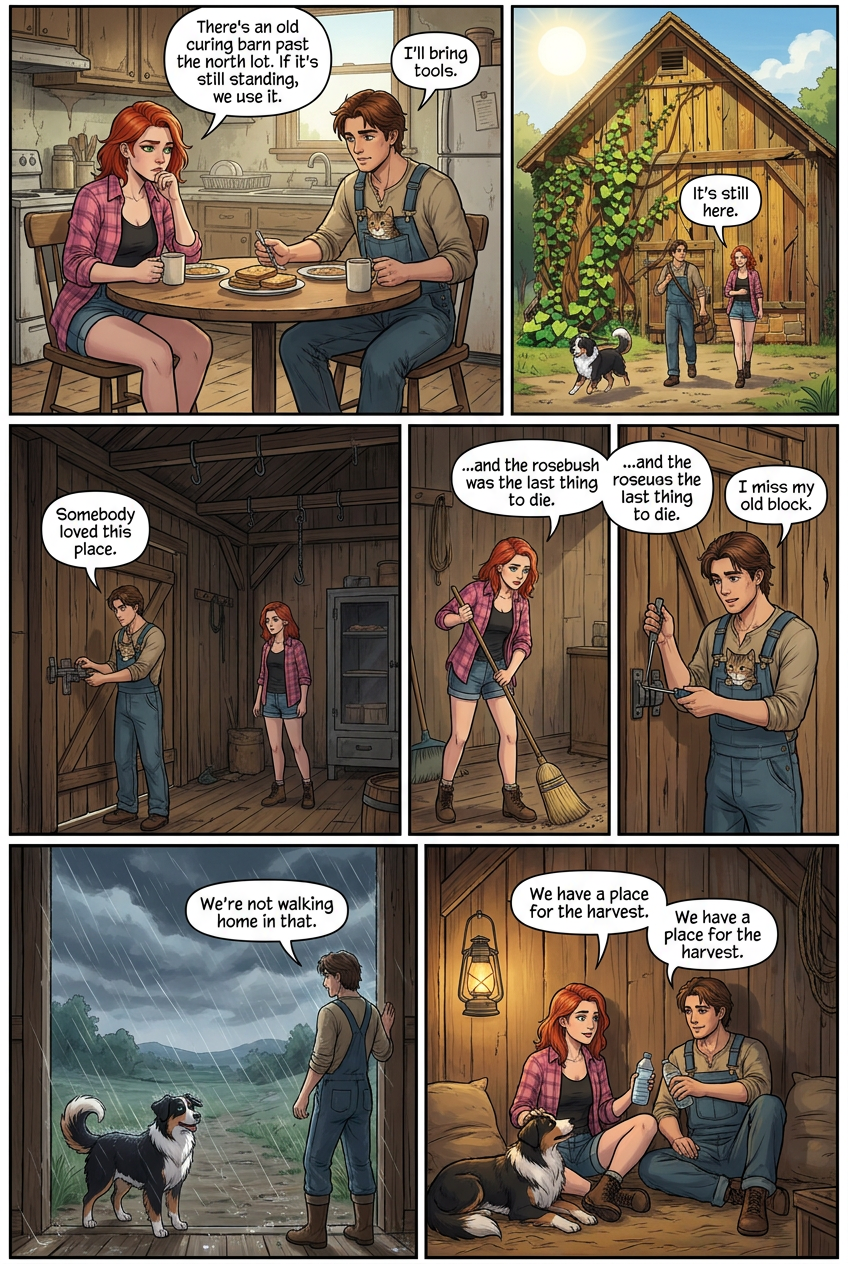
Scarlett woke with the harvest on her mind. The new row would come in heavy. The cellar was already full of tubers. There was no dry place to hang beans, no smokehouse for fish, no rack for peppers. Rot would take everything before winter. She sat up and remembered the barn. "There's an old curing barn past the north lot," she said over breakfast. "My grandfather's neighbor kept tobacco in it. If it's still standing, we use it." Marcus set down his cup. "I'll bring tools." "Take Duke," John said. "I'll hold the gate." They walked out at mid-morning. Duke ran ahead, tail sweeping left, ears up. Marcus carried his tool bag over one shoulder. The tabby rode in his overall pocket, watching the road. Scarlett kept her bad hand tucked against her ribs. The barn stood where she remembered. Ivy climbed one wall in a green sheet. The boards were dark and smooth from years of weather. The door hung true on its hinges. Marcus tried the latch. It gave. Inside, the air was dry and smelled of old wood. Rails ran the length of the ceiling. Hooks hung from every rail. A cold smoker sat in the back corner with its chimney intact. Racks were stacked against the far wall. A tin of salt sat on a shelf, still sealed. "It's all here," Scarlett said. Marcus ran a hand along a rail. "Somebody loved this place." They worked through the afternoon. He tightened a hinge. She swept the floor left-handed. Duke lay in the doorway. They talked while they worked — about his cat, about the block where he grew up, about the widow he used to fix the heat for. Scarlett told him about the rosebush that had been the last thing to die in the district. He did not fill the quiet after she said it. He just nodded and kept sanding. She watched him work and felt something settle in her chest that had not settled in a long time. The sky went the wrong color before they noticed. Duke stood up and pushed a picture into her mind — black cloud, sideways rain, the road washed out. Wind hit the wall a second later. The door slammed. Marcus looked at her. "We're not walking home in that." "No." He wedged the door and lit the lantern from his bag. She spread two feed sacks near the smoker for a bed. Rain hammered the roof. The barn held. They sat with their backs to the wall and shared the water bottle. His shoulder was warm against hers. Neither of them moved away. "We have a place for the harvest," she said. "We have a place for the harvest," he said. Duke put his head on her boot. Outside, the storm ran itself out over the district. Inside, the hooks waited above them, empty and dry, ready for what she was going to grow.
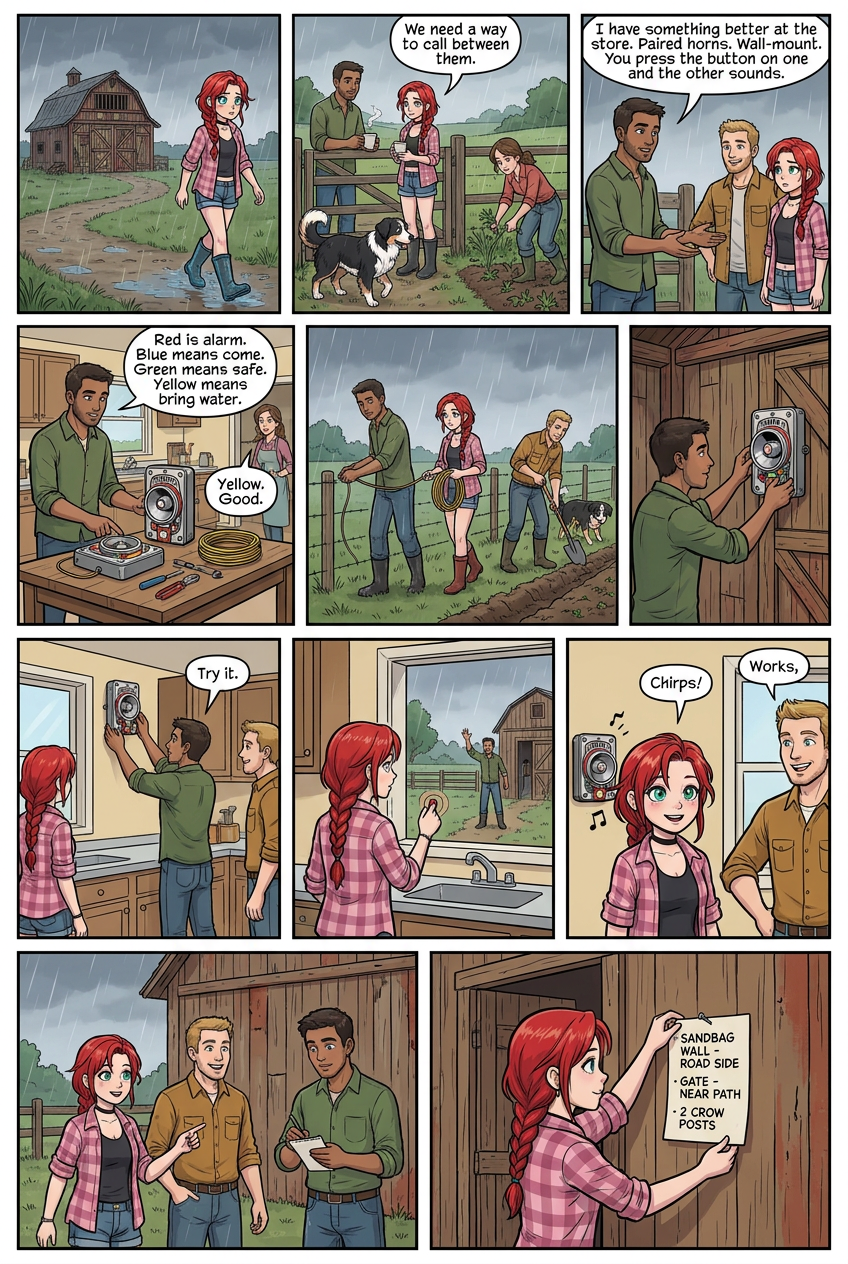
The storm broke before dawn. Scarlett and Marcus walked back from the barn with wet boots and a new problem. The barn stood too far from the house to shout across. Whoever worked inside it would be alone if the road brought trouble again. "We need a way to call between them," she said at the gate. John met them there with coffee. Maranda was already at the beds pulling weeds. Duke shook rain off his coat. "A bell?" John said. "Wind eats a bell," Marcus said. "I have something better at the store. Paired horns. Wall-mount. You press the button on one and the other sounds. Wire strung between." "How far?" Scarlett said. "Far as we lay the line." He left with John after breakfast and came back at noon with a coil of insulated wire, two metal boxes, and a spool of staples. The horns were matched, each with a speaker, a red button, and a row of colored buttons under the grille. Marcus set them on the kitchen table. "Red is alarm," he said. "Blue means come. Green means safe. Yellow means bring water." "Yellow," Maranda said. "Good." They ran the wire through the afternoon. Marcus stapled it along the fence line, then up the barn wall under the eave to keep the rain off. Scarlett walked with him with her bad hand tucked at her ribs, holding the coil steady on her good arm. John dug a shallow trench across the yard so the wire would not catch a boot. Duke followed, nose down. At the barn Marcus mounted one box beside the door. He wired the leads, tightened the screws, and closed the plate. At the house he mounted the twin above the kitchen counter where anyone cooking could reach it. "Try it," he said. Scarlett stayed at the house. Marcus walked to the barn. She waited until she saw him wave through the open door, then pressed red. The horn in her hand crackled. A second later his horn answered from across the yard, thin but clear. He pressed green. Hers chirped back. John grinned. "Works." They tested each color. They tested with the barn door shut. They tested with Maranda at the beds and Scarlett at the barn and Marcus at the gate. The sound carried through the wall. While Marcus tightened the last screw, Scarlett walked the barn perimeter with John. They marked a line for a low sandbag wall along the road side, a second gate on the near path, and two posts for the crows to perch on. John paced the distances. Marcus wrote the list on the back of a feed slip. That night Scarlett hung the feed slip on a nail by the door. The barn was no longer a blind spot. The next problem was already written under it: build the wall before the harvest came in.
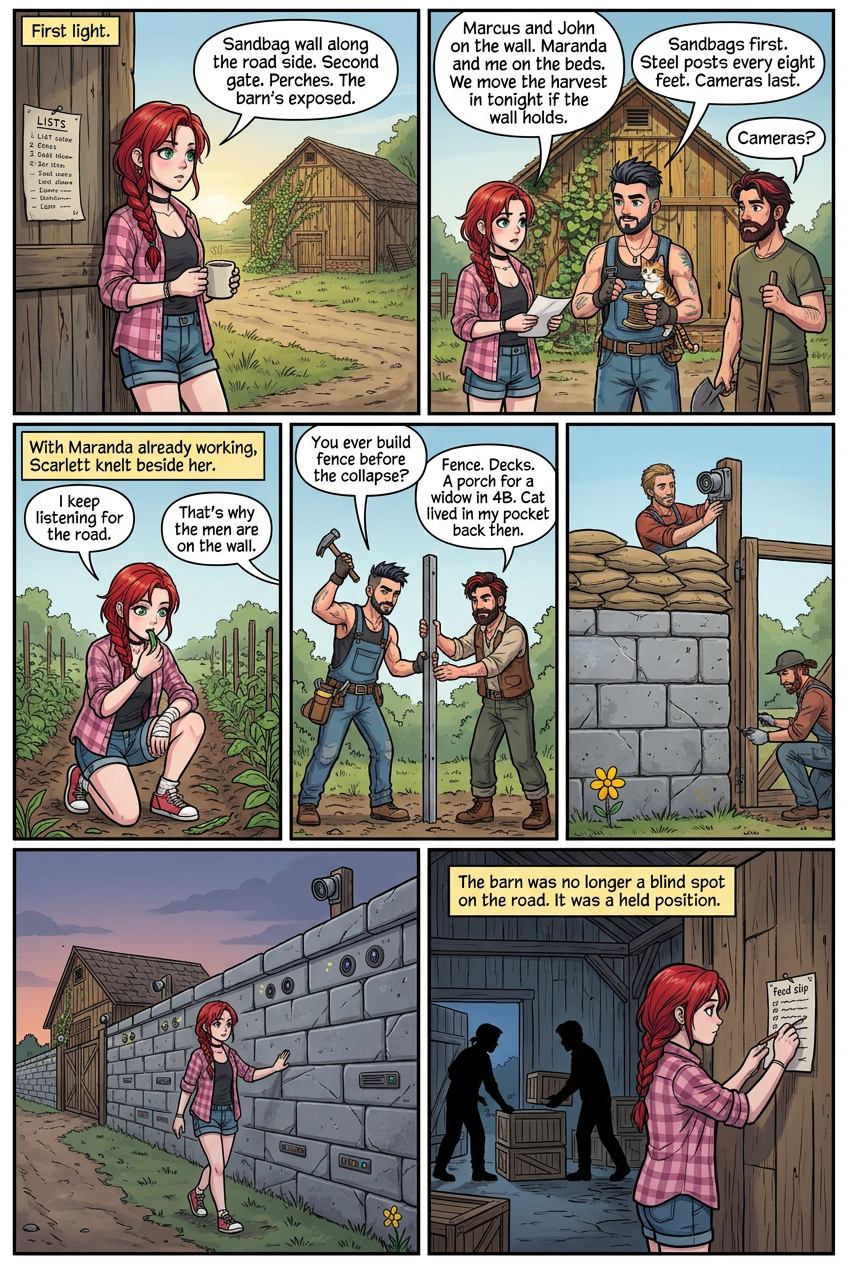
The feed slip was still nailed by the door at first light. Scarlett read the list again over coffee. Sandbag wall along the road side. Second gate. Perches. The barn stood exposed. Any raider walking the road would see the door and know what waited inside. She set the cup down and told the others they were splitting the day. "Marcus and John on the wall," she said. "Maranda and me on the beds. We move the harvest in tonight if the wall holds." Marcus nodded once. He pulled a pencil from his overall pocket and marked the feed slip. "Sandbags first. Steel posts every eight feet. Cameras last." "Cameras?" John said. "Two spares from the store. Wired to the horn box." John shouldered a shovel. "Then we dig." Scarlett watched them walk toward the barn. Marcus carried the post spool. John carried the bags. They talked as they went, low, about depth and slope. She could not hear the words, only the rhythm of two men agreeing. She turned to the beds. Maranda was already crouched between the rows, thumbing a bean pod. "Ready," Maranda said. Scarlett knelt beside her. The wrist ached under the wrap. She used her good hand and let Maranda handle the picking. They worked down the row in silence at first. Then Maranda hummed something without a tune, and Scarlett found herself humming back. "You sleep last night?" Maranda asked. "Some." "Liar." Maranda passed her a pod. "Eat." Scarlett ate it raw. It tasted green and clean. "I keep listening for the road." "That's why the men are on the wall." At the barn, John drove a post while Marcus held it plumb. "Straighter," Marcus said. John swung. The post bit deep. "You ever build fence before the collapse?" John asked. "Fence. Decks. A porch for a widow in 4B. Cat lived in my pocket back then." "Cat?" "Tabby. Found her in a wall." Marcus paused. "Lost her the year the grid went." John set the next post. "I had a cutting from Scarlett. Kept it three years before I found her again." Marcus looked at him. "That why you stayed." "That's why." They worked through the afternoon. Sandbags stacked chest high along the road side. Steel posts braced the corners. Marcus mounted two small cameras above the gate and ran the leads back to the horn wire. He painted a small yellow flower in the bottom corner of the wall where the concrete had set. John did not ask why. By dusk the wall stood between the road and the barn door. Scarlett walked the line with her good hand on the stone. The cameras blinked. The horn box hummed. She pressed green. The house answered green. They moved the first crates of harvest in before dark. The barn was no longer a blind spot on the road. It was a held position. She hung the feed slip back on the nail and crossed the list off, one line at a time.
Play your story to life
Storycraft is a mobile game where you create AI characters, craft items and locations to build their world, then discover what direction your story takes. Download the iOS game for free today!
Download for free