

Skarsh Waterscale's Arc
12 Chapters
Skarsh Waterscale's dream is proving worth to the surface dweller who once showed unexpected kindness.

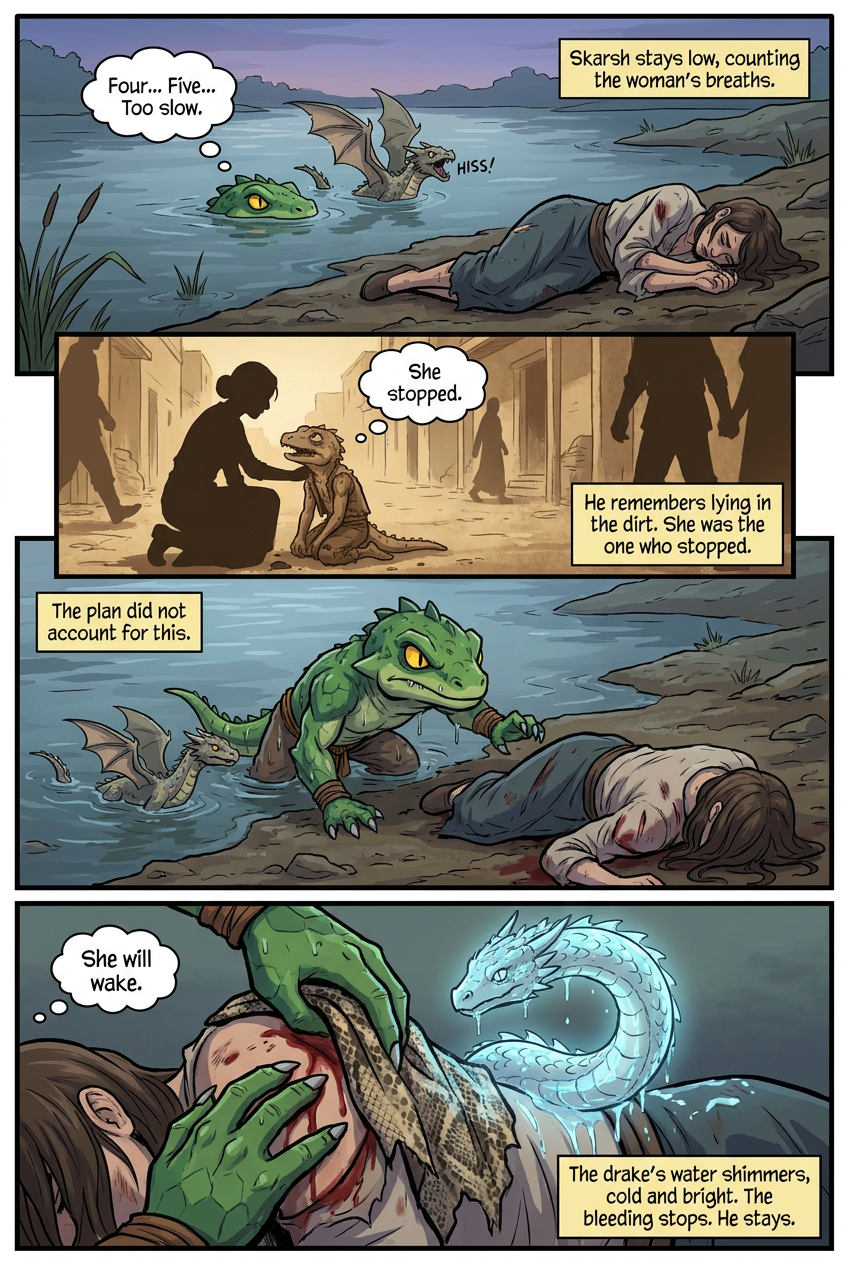
Skarsh stays low in the cold water, watching the bank where the woman lies crumpled and still. Blood darkens the mud beneath her shoulder. The drake circles twice, breaks the surface with a sharp hiss, then circles again. She does not move. Her chest rises and falls, but slowly — too slowly. Skarsh counts the breaths. Four. Five. The gaps between them stretch longer each time. He knows this moment. He remembers lying in the dirt while boots walked past, while voices turned away. She was the one who stopped. She knelt beside him when his blood pooled black in the dust. She stayed until he could breathe again. Now she is the one bleeding, and he is the one who must choose. The plan was to watch from a distance. The plan did not account for this. Skarsh pulls himself from the water and crosses the mud on his hands and knees. The drake follows, hissing soft and low, pressing close against his side. She does not wake when he reaches her. He peels back the torn cloth at her shoulder and sees the wound — deep, ragged, still seeping. His claws shake as he pulls the snakeskin cloth from around his own neck and presses it against the cut. The drake curves its body around them both, and the water that clings to its scales begins to shimmer, cold and bright. The wound slows. The bleeding stops. Her breath evens, just barely. Skarsh does not move away. He stays kneeling beside her, one hand still holding the cloth in place, the other resting in the mud. When she wakes, she will see him. She will know what he is. But she will wake. That is the only thing that matters now.
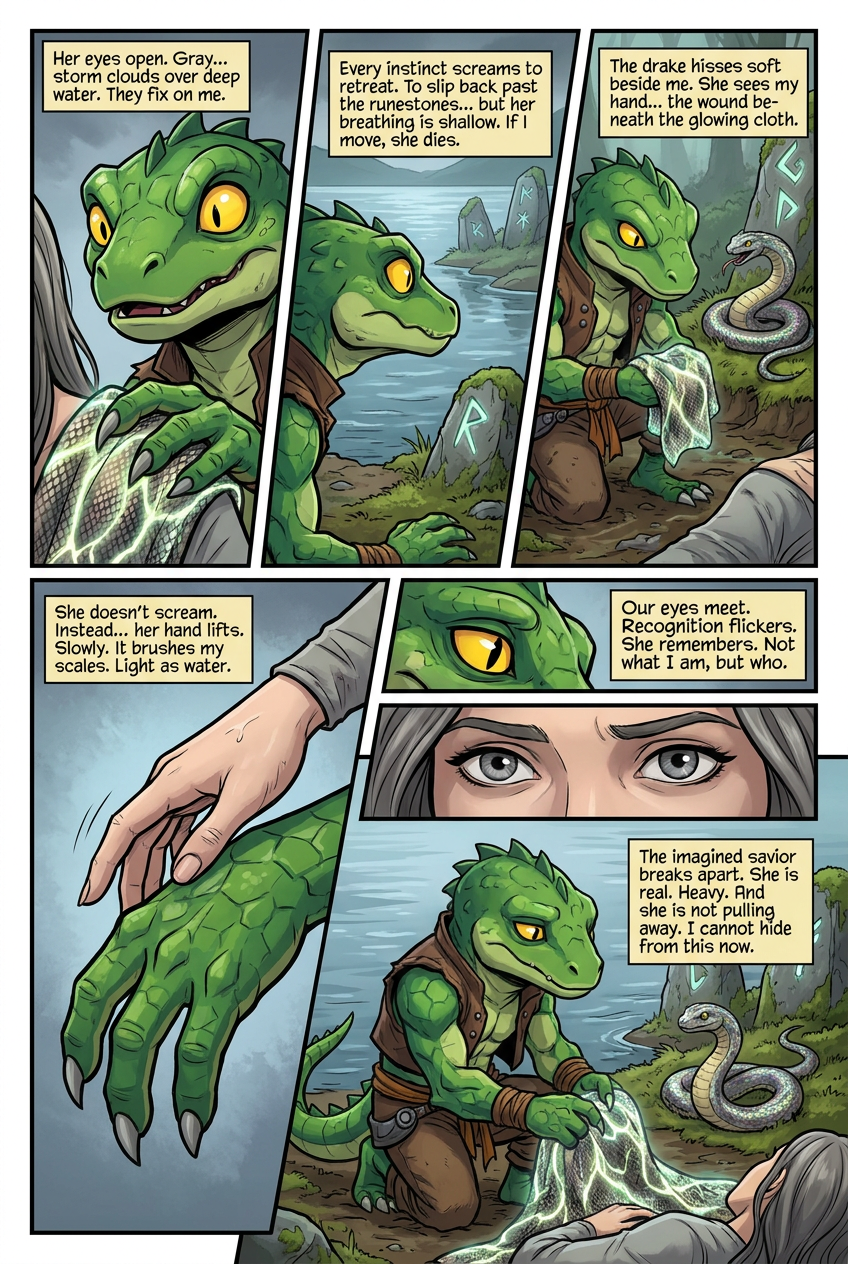
Her eyes open. They are gray, the color of storm clouds over deep water. They fix on Skarsh before he can pull back, before he can slide into the shallows and disappear. The cloth is still pressed against her shoulder. His hand is still holding it there. Skarsh wants to retreat. Every instinct tells him to let go, to slip back past the stones carved with old runes that mark the water's edge. But her breathing is still shallow. The cloth, thin snakeskin soaked through with the drake's healing shimmer, needs pressure or the bleeding will start again. If he moves now, she dies. If he stays, she sees him. The choice was already made when he left the water. She does not scream. She does not pull away. Her gaze moves from his face to his clawed hand, then to the wound beneath the glowing cloth. She tries to speak, but her voice catches. The drake hisses soft beside him, coiled in the moss and mud. Skarsh watches her watching him, waiting for the fear, the disgust, the moment she understands what he is. Instead, her hand lifts. Slowly. Shaking. She reaches toward the cloth, toward his hand still pressing it in place. Her fingers brush his scales. They do not flinch back. She lets them rest there, light as water, and her eyes meet his again. Recognition flickers across her face — not of what he is, but of who. She remembers. Skarsh sees it in the way her breath steadies, in the way her hand stays where it is. The version of her he carried in his mind breaks apart, and something real and heavier takes its place. She is not the imagined savior who existed only in memory. She is this woman, bleeding and awake, choosing not to pull away. He does not know if that is better or worse. But he knows he cannot hide from it now.
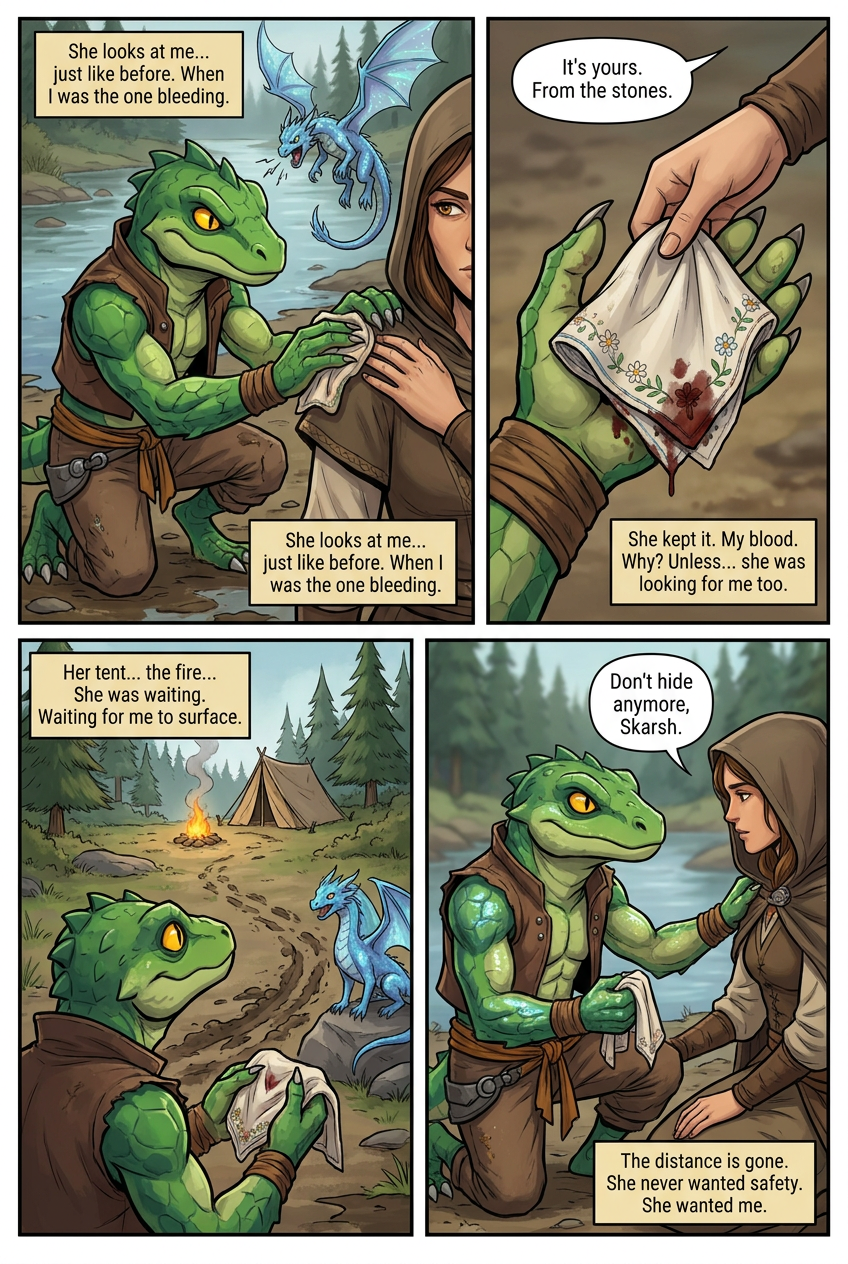
Her hand stays on his, warm and steady. Skarsh keeps the pressure even on the wound, but his focus splits between the cloth and her face. She is looking at him the way she did before — not past him, not through him, but at him. He remembers that look from when he was bleeding out on the stones. He remembers her kneeling, her hands careful, her voice low and calm even though he could not speak her language then. He still cannot. But her eyes say she knows him anyway. The drake shifts closer, uneasy. Skarsh does not move. She pulls her other hand inside her coat, slow enough that he knows it is not a weapon. Her fingers emerge holding something white and delicate, embroidered with flowers. The cloth is stained dark at one corner — old blood, dried to brown. His blood. She presses it into his free hand and closes his claws around it. The fabric is impossibly soft against his scales. He stares at it, then at her. She had kept it. She had carried it with her. The question forms before he can stop it: why would she do that unless she wanted him to know? Unless she had been looking for him too. The drake hisses, a warning sound. Skarsh follows its gaze past the woman to where the mud slopes up toward the trees. Tracks press deep into the soft ground — his own tracks, left when he carried her down from the campsite she had made near the water's edge. Her small tent still stands between the pines, the fire burned low. She had been waiting there. Not wandering. Not passing through. Waiting for him to surface. She had found this place the same way he would have — by reading the signs no one else would notice. By choosing not to give up. Skarsh opens his hand and looks at the cloth again, the bloodstain proof she remembered, proof she came back. He lifts his eyes to hers and makes a choice he cannot take back. He lets go of her shoulder. The pressure releases. She does not bleed. The wound has closed enough, the drake's shimmer sunk deep into her skin. He could slip away now, vanish into the water and let her believe he was only a dream. But he stays where he is, kneeling in the mud beside her, his hand still holding what she gave him. She does not look away. Neither does he. The distance he built to keep her safe collapses, and he understands that safety was never what she wanted from him. She wanted him to stop hiding.
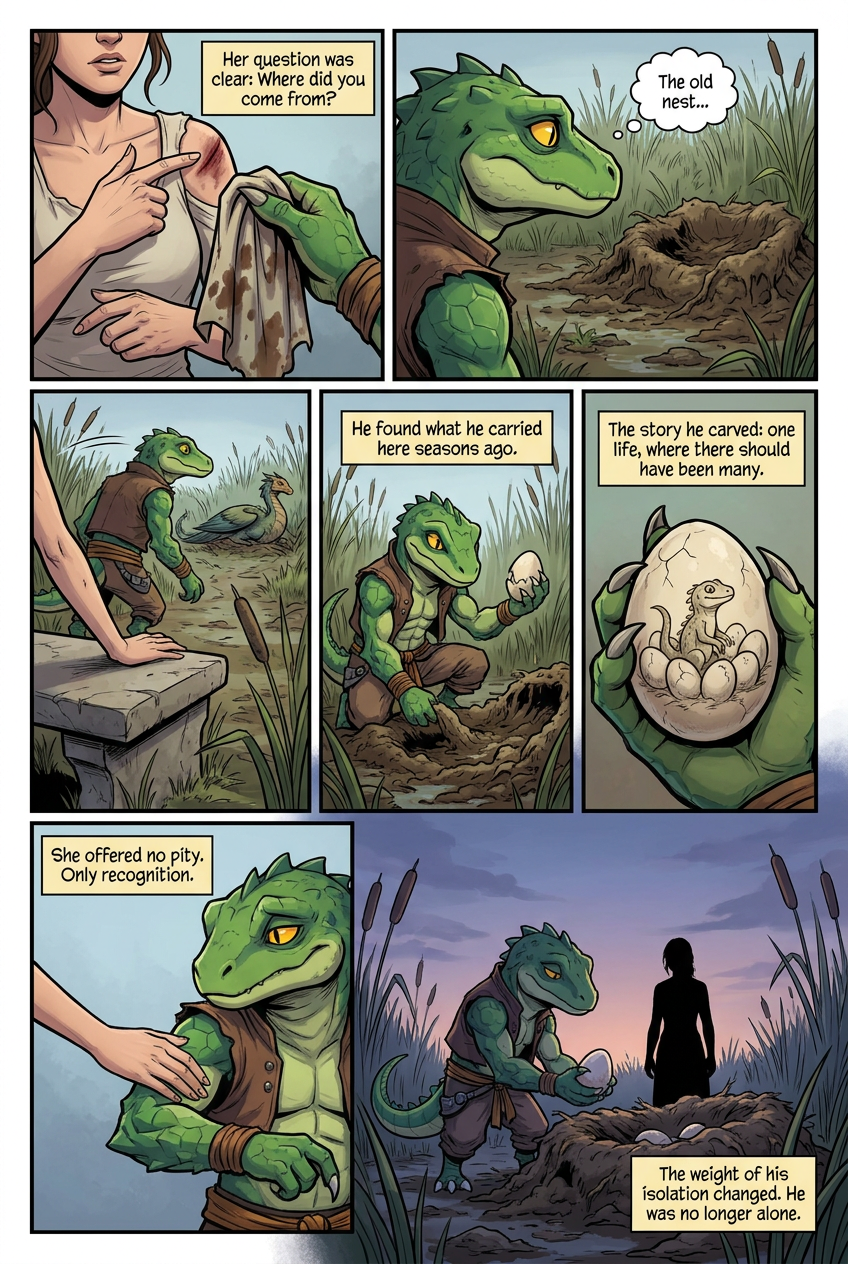
She points to the stained cloth in his hand, then to him. Her fingers move to the wound on her shoulder, then back to his face. The question is clear even without words: where did you come from, and why were you dying alone when I found you? Skarsh looks past her to where the old nest sits half-buried in mud and cattails, its chambers collapsed and empty except for scattered shells. He rises slowly, testing whether she will follow. She does, bracing herself against the stone bench worn smooth by years of water. The drake circles once, then settles. Skarsh leads her to the nest and crouches beside it, pushing aside the dry reeds until he finds what he carried here seasons ago. The eggshell is pale and fragile, covered in marks he carved himself — one small lizard breaking free, surrounded by eggs that never opened. He holds it out to her. She takes the shell carefully, turning it to see the whole story etched into its surface. Her eyes move from the single hatching to the closed eggs, then back to his face. Understanding settles there, quiet and certain. She traces the carving of the lone lizard with one finger, then reaches out and touches his arm. Not with pity. With recognition. She knows what it means to be the only one who survived. Skarsh takes the shell back and sets it in the nest where it belongs. The woman does not try to comfort him or fill the silence with words he would not understand. She simply stays beside him, her presence steady. The question she asked has been answered, and something shifts between them — not the distance closing, but the weight of it changing. He no longer carries his isolation alone. She has seen where he came from, and she has not turned away. That is worth more than all the years he spent watching from the water.
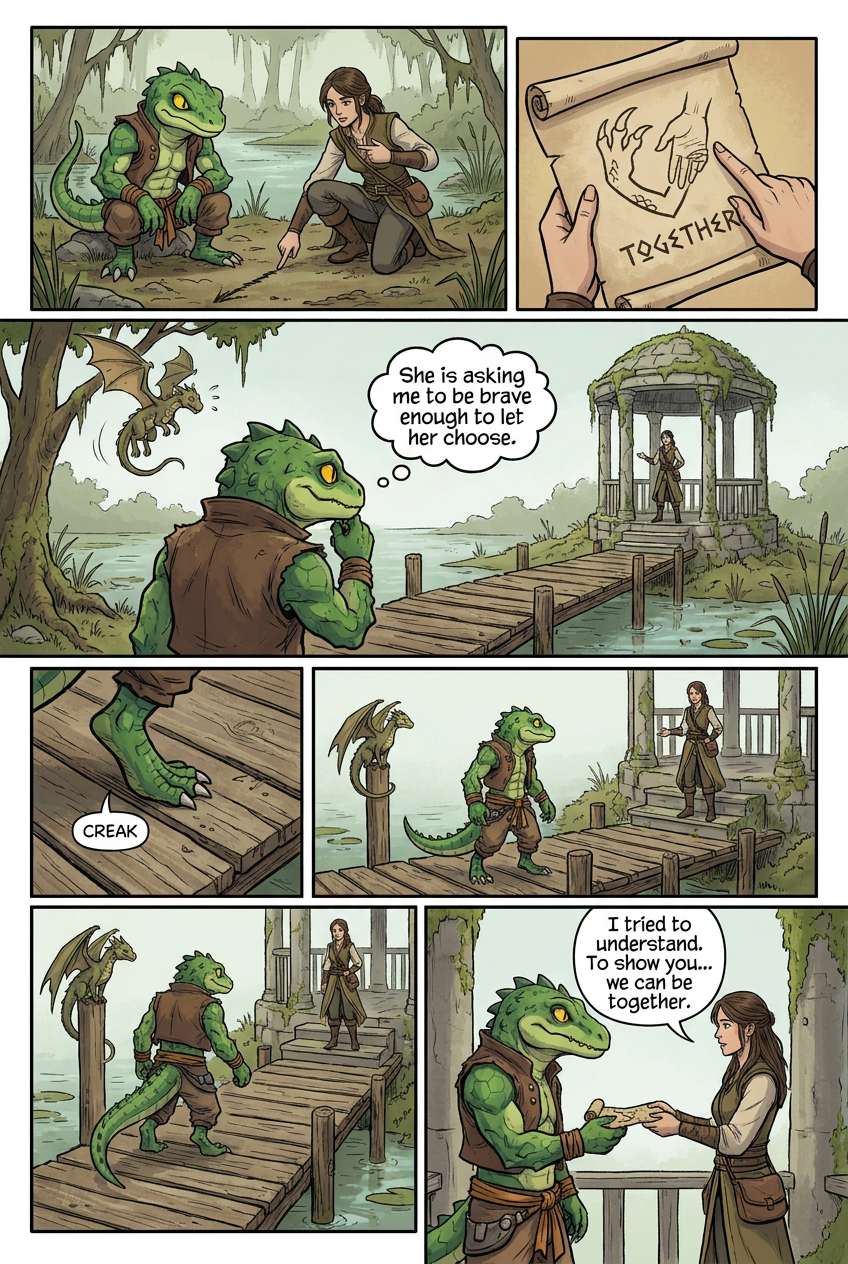
The woman stays beside him as the sun moves lower through the trees. She does not ask more questions he cannot answer. She does not try to touch the eggshell again or speak words he would not understand. But she shifts closer to him, and her hand moves — not toward him, but to the ground between them. She draws a line in the mud with one finger, then taps her chest. Another line, a tap to his arm. Two marks, side by side. Skarsh watches her hand move to the pack at her side. She pulls out a scroll, old and carefully rolled, covered in marks he recognizes immediately — his own language, copied in her hand. Not perfect, but deliberate. She has been trying to learn. She points to a symbol that means "together," then to the two lines in the mud. Then she stands and walks toward the old gazebo that rises from the shallow water, moss thick on its stone pillars. She climbs the sunken steps until she stands on the platform above the waterline, fully visible. She gestures to the weathered boardwalk that stretches between them, then back to herself. The meaning is clear: she wants him to cross. To leave the water and stand where she can see him completely. The drake circles once, making the worried sound Skarsh knows too well. But the woman does not move from the gazebo. She waits, one hand holding the scroll, the other extended toward the boardwalk. Skarsh looks at the two lines she drew in the mud, then at the space between water and stone. His plan had always been to stay hidden, to keep her safe from a distance. But she is asking him to be brave enough to let her choose. To stop deciding for her what she can accept. He steps onto the boardwalk. The wood is solid under his clawed feet, and the drake goes quiet. The woman does not look afraid or relieved — she looks like someone who has been waiting for exactly this. When he reaches the gazebo steps, she holds out the scroll to him, showing him the words she learned. Not to speak his language, but to prove she tried. That she wanted to understand him enough to do the work. Skarsh takes the scroll and looks at her standing there in the open, no longer the memory he carried but the person who refuses to let him hide. He cannot go back to the water now. She has seen him choose to cross, and that changes everything.
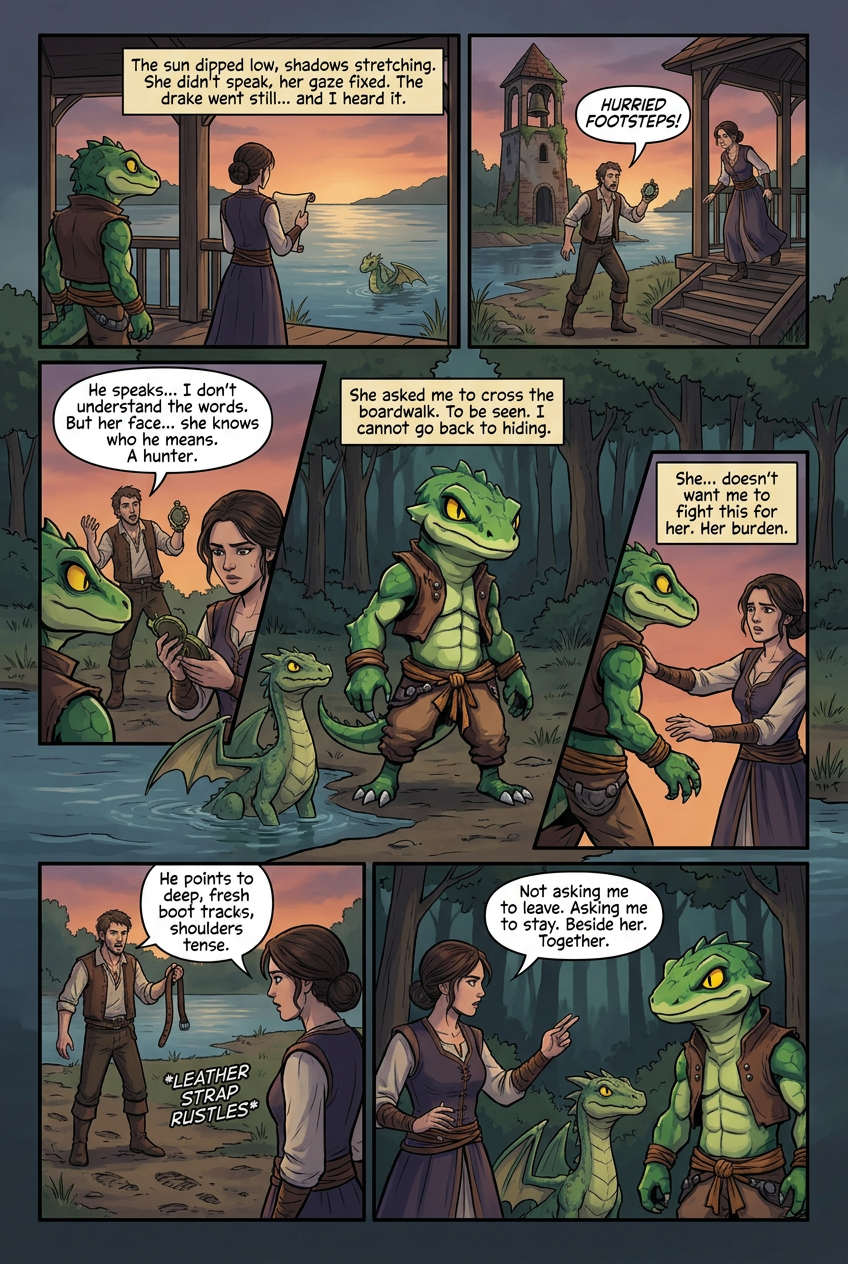
The sun is lower now, the shadows stretching across the gazebo stones. The woman stands where she crossed to him, still holding the scroll in one hand. She does not speak, but her eyes shift past Skarsh toward the water. The drake goes still, its circling cut short. Then Skarsh hears it — footsteps through the marsh, fast and deliberate. Artur appears at the rusted bell tower near the water's edge, breathing hard. He carries a weathered compass in one hand, moss thick on its cracked face. The woman recognizes him immediately and moves down the gazebo steps. Artur holds up the compass and speaks quickly, gesturing toward the forest behind him. Skarsh cannot understand the words, but he sees the woman's face change. She looks at the compass, then at Skarsh, and something passes between them — not fear, but recognition. She knows who Artur is warning her about. She has always known someone was hunting her. Skarsh steps between them and the forest line. The drake rises from the water, positioning itself at his side. The woman reaches for his arm, stopping him before he moves further. She points to herself, then to the trees, shaking her head. She does not want him to protect her from this. She wants him to understand that this hunter is her burden, not his. But Skarsh came out of the water because she asked him to cross the boardwalk and be seen. He cannot go back to hiding now. Artur pulls something else from his pack — a worn leather strap with tracking marks, the kind hunters use. He points to boot prints in the mud near the bell tower, fresh and deep. The woman studies them, and Skarsh sees her shoulders tighten. She knows these tracks. She turns to Skarsh and makes the symbol for "together" that she drew in the mud earlier, then points to the forest. Not asking him to leave. Asking him to stay beside her when the hunter comes. Skarsh looks at the drake, then at the woman, and realizes his plan to prove his worth by protecting her from a distance was always wrong. She wants him here, visible and present, when she faces what has been following her. That is the only protection she will accept.
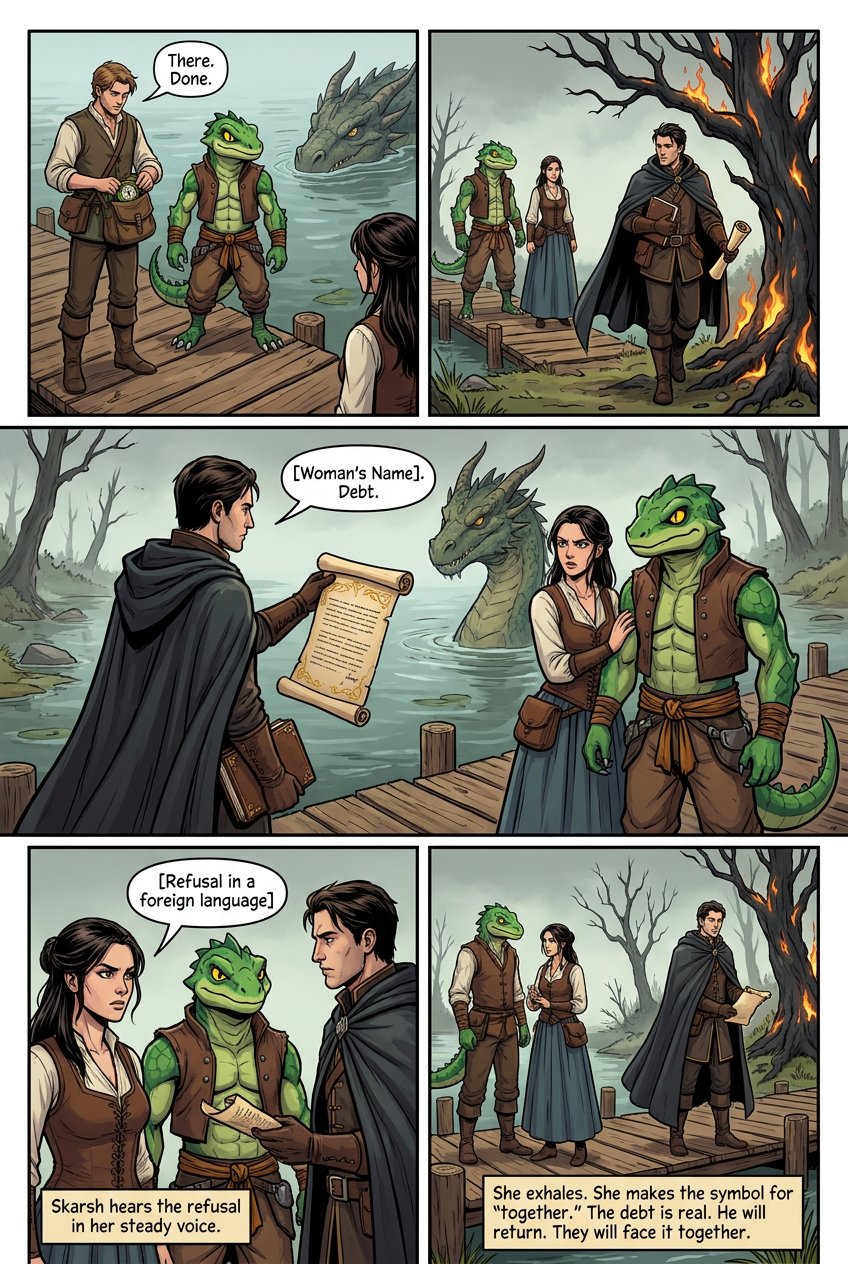
The woman holds still as Artur packs the compass away. The drake shifts in the water, watching the forest line. Skarsh stands where he crossed to her, his feet planted on the boardwalk. The woman turns toward the trees, waiting. Then the hunter steps out from behind the scorched trunks. He moves past the massive swamp cypress without looking at Skarsh or Artur. His eyes fix only on the woman. He carries a rolled parchment in one hand, golden filigree visible along its edge. Behind him, closer to the tree line, Skarsh sees a leather journal lying open on a flat stone, pages filled with sketches and dated notes. The hunter stops ten paces from the woman and lifts the parchment between them. He speaks her name — the first time Skarsh has heard it spoken aloud — and then a single word that needs no translation: debt. The woman does not move. She does not deny what the hunter says. Skarsh watches her face and sees no surprise, only the same tightness in her shoulders that appeared when Artur showed her the boot prints. The hunter unrolls the parchment partway, revealing ornate script and a pressed seal. He speaks again, gesturing to the contract, then to her, his voice flat and businesslike. This is not anger. This is collection. Skarsh steps forward, positioning himself beside the woman. The drake rises higher in the water, ready. But the woman reaches out and touches Skarsh's arm, the same gesture she used before. Not asking him to retreat. Asking him to wait. She looks at the hunter and speaks clearly, her voice steady. Skarsh does not understand the words, but he hears the refusal in them. The hunter's expression does not change. He rolls the parchment closed and tucks it into his belt, then gestures back toward his journal and the forest beyond. He says something else — a number, perhaps, or a deadline. Then he turns and walks back to the cypress, retrieving his journal before disappearing into the trees. The woman exhales slowly. She does not explain, but she meets Skarsh's eyes and makes the symbol for "together" again in the air between them. The debt is real. The hunter will return. But she has chosen not to face it alone, and that choice has made the shape of what comes next different than it was before.
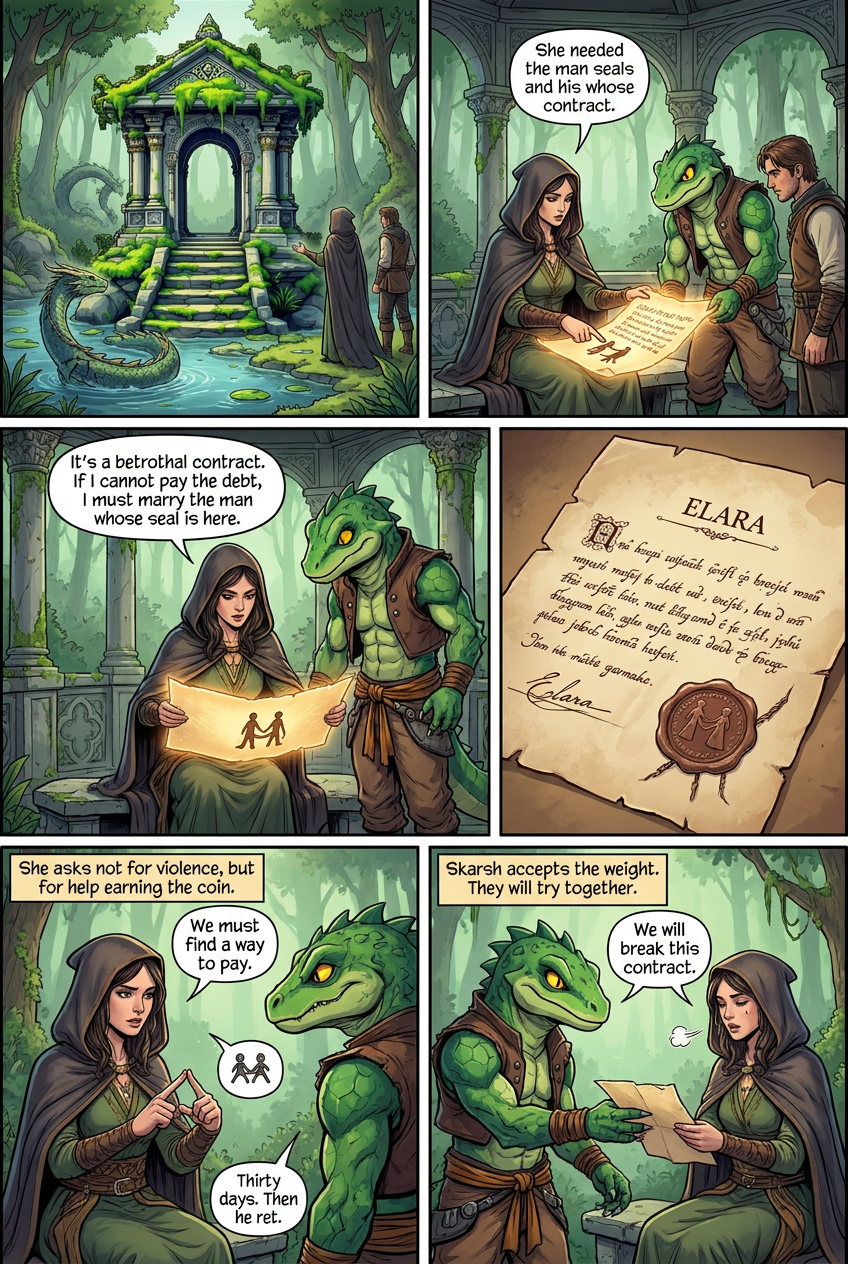
The woman waits until the forest swallows the hunter completely before she turns back to the gazebo. She gestures for Skarsh and Artur to follow. The drake circles once in the water, then settles near the boardwalk where it can watch the tree line. Inside the gazebo, the woman sits on the stone bench and pulls a folded paper from her coat pocket. She spreads the parchment flat on the stone. The golden filigree catches the light. Skarsh sees ornate script and a pressed seal, identical to what the hunter showed them. At the top, words he cannot read. But the woman traces her finger down the page and stops at a phrase written larger than the rest. She looks at Skarsh and speaks the words slowly, then draws a symbol in the air — two figures joined by a line. Marriage. The hunter holds a betrothal contract. If she cannot pay the debt in coin, the contract requires her to marry the man whose seal marks the bottom of the page. Skarsh stares at the parchment. The woman signed this. Her name sits above the seal in careful letters. Artur leans closer and asks a question. The woman answers without looking away from Skarsh. She needed money to leave a place that would not let her go. The contract offered enough, and she believed she could repay it before the deadline. But the hunter found her too soon, and the sum has grown beyond what she can gather. The contract gives her thirty days. After that, the hunter returns to collect her. The woman folds the parchment and meets Skarsh's eyes. She makes the symbol for "together" again, then points to him, to herself, to the contract. She is asking him to help her find a way to pay the debt. Not to fight the hunter. Not to run. To earn what she owes so the contract loses its power. Skarsh understands what she is not saying — she will not let him solve this with violence, and she will not disappear into the marsh to hide. She wants to face the debt on terms she chooses. He looks at the folded parchment in her hands and thinks of the carved eggshell he showed her, the history he carries that cannot be changed. Then he reaches out and touches the paper, accepting the weight of what she asks. They have thirty days to find enough coin to break a contract that was designed to be unpayable. The woman exhales and nods once. The question is answered. They will try together.
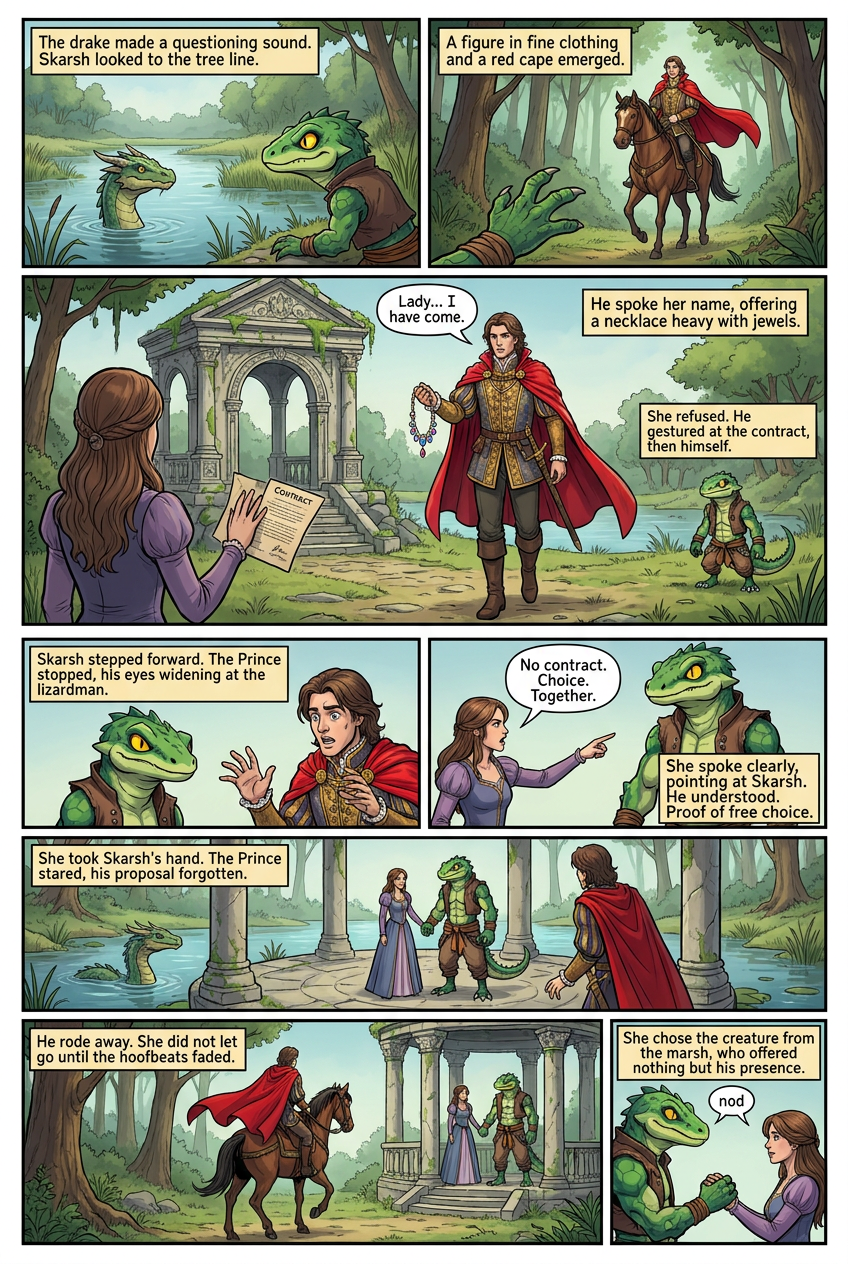
The drake lifts its head from the water and makes a sound Skarsh knows well. Not alarm. Question. Skarsh turns and sees movement at the tree line where the hunter disappeared. A figure emerges on horseback, dressed in fine clothing that does not belong in the marsh. The rider moves toward the gazebo at a steady pace. His cape flutters behind him, bright red against the dull greens and browns of the forest edge. The woman stands and stares at the approaching figure. Artur steps forward and speaks a name, low and sharp. Prince Folly. The prince dismounts near a weathered stone pillar at the clearing's edge and walks the rest of the way on foot, carrying something that catches the light. When he reaches the gazebo, he stops and looks directly at the woman. He speaks her name clearly, then holds up a necklace heavy with jewels and gold. He says words Skarsh does not understand, but the woman's face changes. She shakes her head slowly. The prince keeps talking, gesturing at the contract still folded in her hand, then at the necklace, then at his own chest. Skarsh understands the shape of what is happening. This man claims he is the one she is betrothed to. He has come to convince her to marry him. The woman takes a step back and makes the symbol for "no" with her hand. She speaks quickly, her voice rising. The prince does not move. He sets the necklace on the stone bench between them and continues talking. Skarsh watches the woman's shoulders tighten. She is not afraid. She is angry. Artur moves closer to her side, and Skarsh steps onto the gazebo platform. The prince notices him for the first time and stops mid-sentence. His eyes widen as he takes in Skarsh's form — the scales, the claws, the snakeskin veil. The woman speaks again, louder now, and points at Skarsh. She says words in a pattern Skarsh recognizes from the scroll she showed him. "Together." "Choice." The prince looks between them, confusion replacing certainty on his face. Then he reaches for the necklace and holds it higher, speaking faster. The woman does not look at the jewels. She looks at Skarsh. Skarsh understands what she is asking him without words. She needs proof that someone stands with her who is not bound by contract or bloodline or wealth. Someone who chose her freely and will not leave when the choosing becomes difficult. He moves to stand beside her at the center of the gazebo, fully visible in the daylight. The drake surfaces completely and watches from the water's edge. The woman reaches out and takes Skarsh's hand in front of the prince. Her grip is steady. The prince stares at their joined hands, then at the necklace in his own. He speaks one more time, quieter now, but the woman shakes her head again. She does not need convincing. She already made her choice. The prince stands motionless for a long moment, then lowers the necklace and turns back toward his horse. He does not look at them again as he mounts and rides toward the forest. The woman does not let go of Skarsh's hand until the hoofbeats fade completely. When she finally releases him, she meets his eyes and nods once. The prince came offering love instead of contract. She chose the creature from the marsh who offered nothing but his presence.
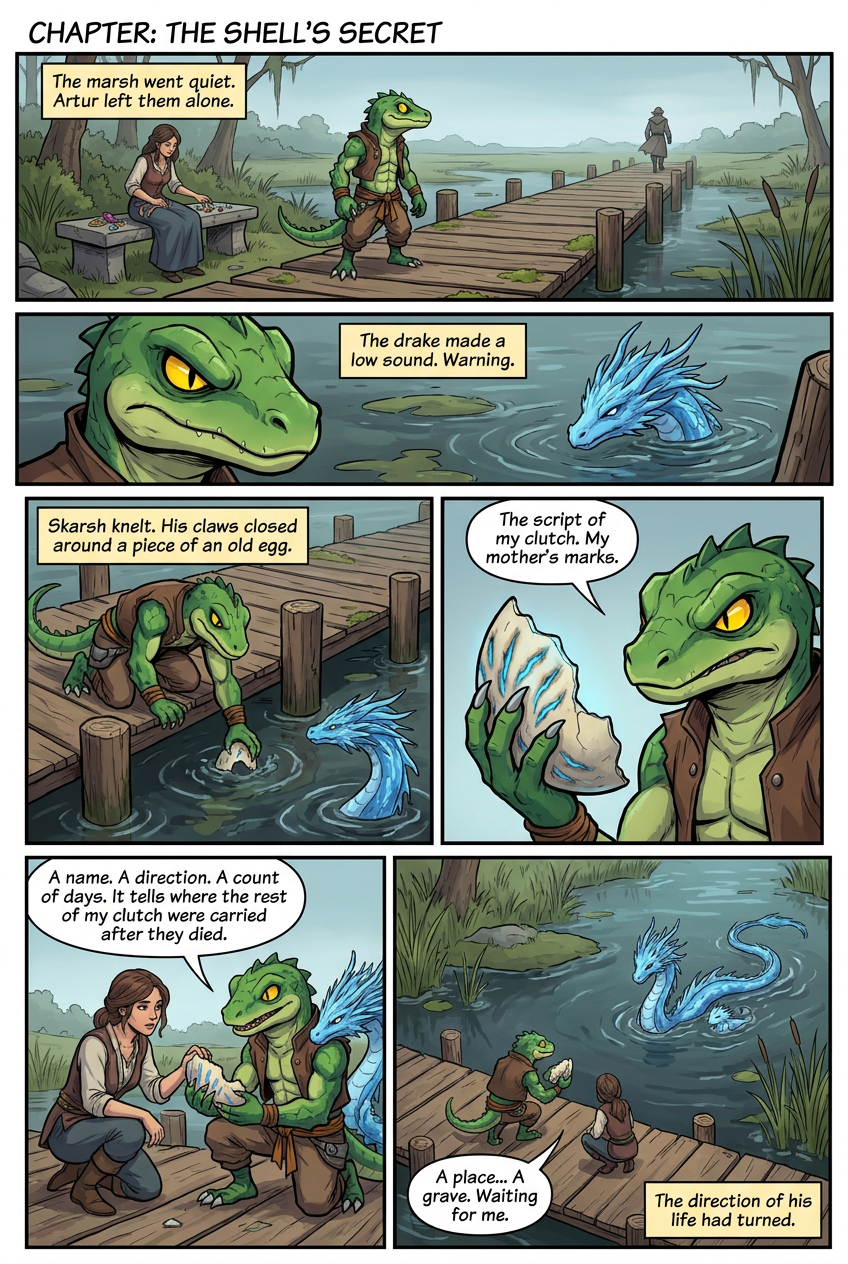
The hoofbeats faded, and the marsh went quiet. The woman lowered herself onto the stone bench where the prince had left the necklace. She pushed the jewels aside without looking at them. Skarsh stood on the boardwalk beside her, waiting for the shake in her shoulders to settle. Artur lingered at the gazebo steps, then said he would walk the tree line and make sure the prince rode on. He left them alone. The drake made a low sound from the water. Not question this time. Warning. Skarsh turned. The drake circled a patch of water near the boardwalk's edge, nosing at something dark caught between the pilings. Skarsh stepped down onto the weathered planks. The wood creaked under his weight. Below, half-buried in the silt where the prince's horse had churned the bank, something pale broke the surface. He knelt and reached into the cold water. His claws closed around a curve of shell. He pulled it free. It was a piece of an old egg, larger than his palm, ridged along one edge with markings burned into the inner surface. He knew the pattern before he had finished wiping the mud away. It was the script of his clutch — the marks his mother had scored into every shell before the hatching. No surface dweller could read them. He was the only one left who could. The woman came down onto the boardwalk. She watched him turn the shell over in his hands. He traced the marks with one claw and read them slowly. A name. A direction. A count of days. His mother had left a record on every shell in the nest, and this piece told him where the rest of his clutch had been carried after they died. Not scattered. Not lost. Buried together, upriver, in a place he had never been told existed. He sat back on his heels. The drake pressed its head against his arm and made the small noise it used when he did not speak for too long. The woman crouched beside him. She did not ask what the marks said. She waited. Skarsh set the shell on the plank between them and touched the largest symbol. He spoke the name aloud in his own tongue, the first time he had said it in front of anyone. Then he told her, in the words she had learned from the scroll, what it meant. A place. A grave. A thing he had not known was waiting for him. The woman looked at the shell for a long time. Then she looked at him and nodded once. She would go with him. He had not asked, and she had not offered. It was already decided between them. Skarsh closed his hand around the shell. Beyond the boardwalk, the mother drake surfaced in the deeper channel and watched them with her young curled at her flank. The marsh was quiet again. But the direction of his life had turned.
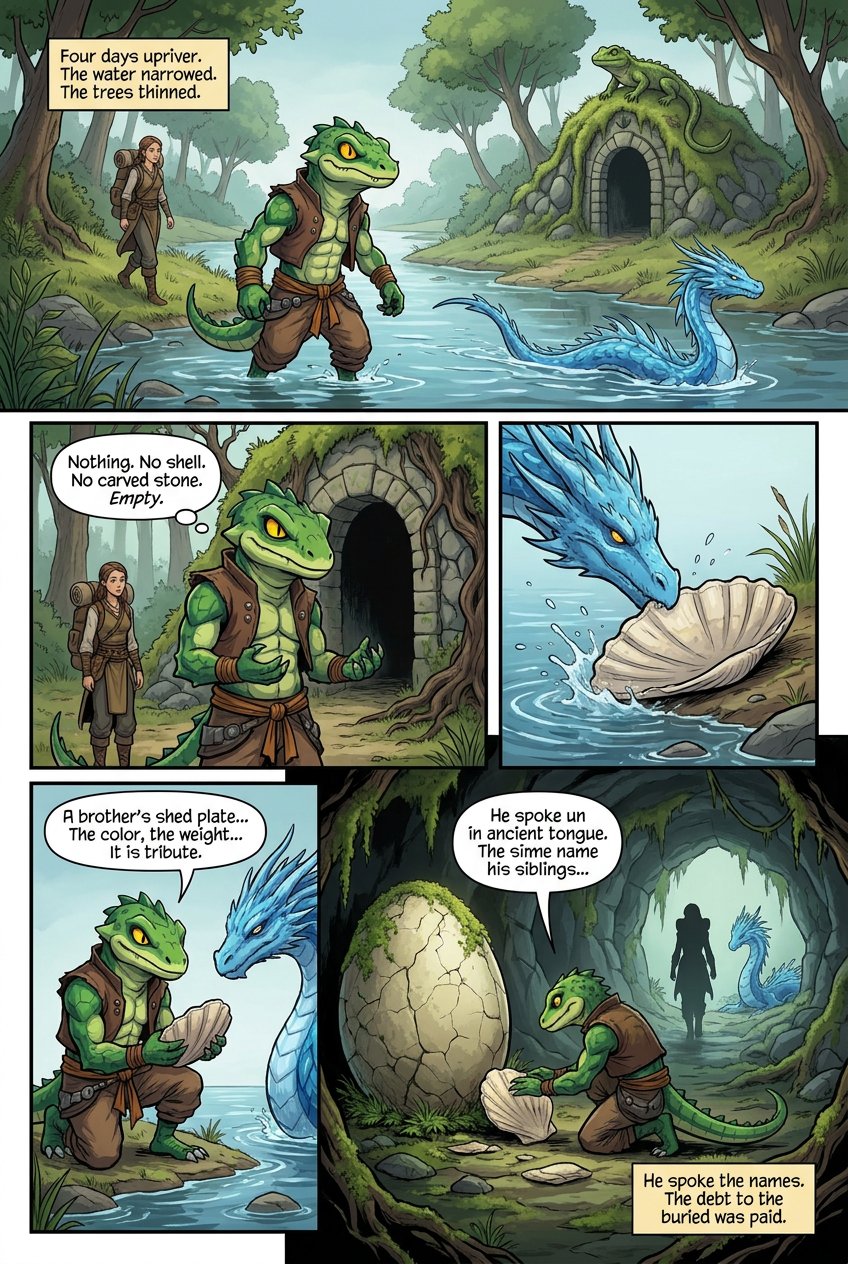
They traveled upriver for three days. The woman walked the bank while Skarsh moved through the shallows beside her, the drake sliding ahead through deeper channels. On the fourth morning, the water narrowed and the trees thinned. Skarsh climbed onto the mud and stopped. The place his mother had marked stood ahead of them, half swallowed by moss: a low mound of stacked stone with a carved arch, a small lizard figure worn smooth above the entrance. He knew it without being told. His siblings were inside. He sat back on his heels and understood, all at once, that he had come with nothing. Among his clutch, the living brought tribute to the buried — a shell, a carved stone, a thing shaped by hand. He had spent every hour since the boardwalk thinking of the grave, and not once of what he owed it. He had his claws and the wet leather at his waist. Nothing else. To walk into that arch empty would shame his mother's marks and shame the woman standing behind him, who had chosen to follow him here. He told her. He used her words, slow, so she would understand what he could not fix. She listened. She looked at the arch, then at the water, then at the drake circling near the reeds. She did not offer him anything from her own pack. She waited. The drake made the low sound it used for calling him in. Skarsh turned. It had dived and surfaced twice near a sunken log, and now it pushed something toward the bank with its snout. Skarsh waded out. Caught in the roots was a piece of shell, larger than the fragment from the marsh, ridged and pale, one edge worn to a soft curve. He lifted it clear. It was a shed plate from the drake's own growth, cast off in some earlier season and carried downstream into the roots. He turned it in his hands. The color was right. The weight was right. It was of the drake, and the drake was his brother by every measure that counted in his tongue. He looked at the drake. The drake looked back and did not move. He carried the plate to the arch. The woman came with him and stopped at the threshold, letting him go in alone. Inside, the burial egg of his clutch sat in the center of the chamber, cracked and mossed, the script of his mother still legible along its curve. He knelt. He set the drake's shed plate against the base of the egg and spoke the names he had read from the fragment, one by one, in his own language. When he came out again the woman was still there. The drake had come up onto the bank behind her. Skarsh had arrived empty and had not stayed empty. The debt to his siblings was paid. The one to the woman had grown.
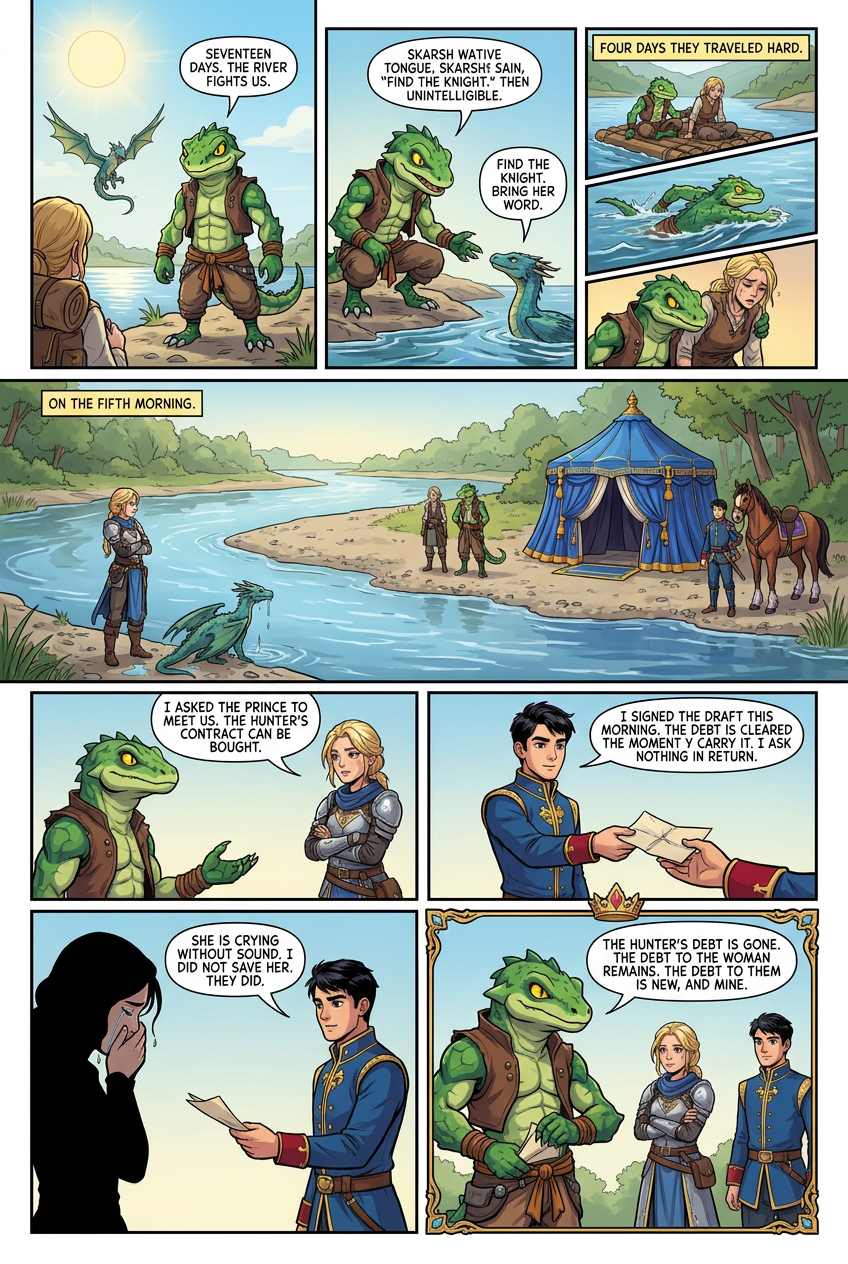
Skarsh came out of the arch and stood in the sun with the shed plate no longer in his hands. The woman was already looking at the water. She had counted the days without him asking. Three days up. Twenty-one left on the contract when they set out. Now seventeen. The current that had helped them here would fight them all the way back, and the river bent long between this mound and the marsh. He said the number to her in her language. She nodded. She said she was content. She said if the days ran out she would go with the hunter and it would not undo what she had chosen at the gazebo. He heard her clearly and did not accept it. The drake came up onto the bank and circled him twice, making the low noise it used when it did not like a plan. Skarsh crouched and spoke to it in his own tongue. He told it to go ahead downriver at its own speed and find the knight who had stood with him against the hunters, and to bring her word. The drake stopped circling. It slid back into the water and was gone before the woman had finished tying her pack. They traveled hard for four days. Skarsh swam beside the woman's raft and pushed against the current when her arms gave out. On the fifth morning they rounded a bend and saw a blue tent pitched on a gravel bar, gold cord at its seams, a horse tied in the shade. Dame Elara Brightshield stood at the water's edge in her plate, arms crossed, the drake dripping beside her. Behind her, at the tent flap, Prince Folly waited without a sword. Elara did not waste words. She said the prince had ridden three days to meet them because she had asked him to. She said the hunter's contract could be bought out at court price by any noble house, and that Folly had brought the sum. Folly stepped forward. He said he had signed the draft that morning. He said he had known what he felt for the woman and known she did not feel it back, and that those were two different things, and he had confused them once and would not again. He held out a folded paper. He said the debt was cleared the moment Skarsh carried it to the hunter. He asked nothing in return. Skarsh took the paper. He looked at the woman. She was crying without sound, one hand flat against her mouth. He understood then that he had not saved her. Elara had. Folly had. He had only kept her moving on the river while the people who owed him nothing arranged what he could not. He folded the draft into his belt pouch beside the wet leather. The debt to the hunter was gone. The debt to the woman had not moved. The debt to the two standing on the gravel bar was new, and his.
Play your story to life
Storycraft is a mobile game where you create AI characters, craft items and locations to build their world, then discover what direction your story takes. Download the iOS game for free today!
Download for free