

Skinny Matilda's Arc
10 Chapters
Skinny Matilda's dream is caring what anyone thinks of her and losing over 200 pounds.


Six months ago Matilda weighed two hundred and ninety pounds. Then the illness came and took two hundred of them. Now she is mostly skin and bones, under a hundred pounds, with short pink hair and a bikini she wears everywhere because the old clothes hang off her like sails. She is back at the country grocery store for peaches. She does not remember why she wanted peaches the first time, the time a stranger laughed at her by the fruit. She only remembers the laugh. Since then she counts every look. Today she is trying not to count, and trying not to care, and trying to lose the last of a weight that is already gone from her body but not from her head. The store sits low under a tin roof, red and cream paint peeling on the porch boards. Inside, the peach display rises in three wooden tiers near the door, each crate heaped with fruit so ripe she can smell it from the register. She is picking out a soft one when a man steps around the stand holding a bundle of red roses wrapped in brown paper. It is Timothy. In high school Timothy walked past her in the hall like she was furniture. Once he told a friend, loud enough for her to hear, that he would rather eat glass. He is smiling at her now like none of that happened. "Matilda," he says. "Wow. You look incredible." He pushes the roses toward her chest. He says he has been thinking about her. He says he always thought she was interesting. He asks if she wants dinner Friday, then Saturday, then any night she picks. When she does not answer he lowers his voice and says he can tell she has worked hard, that she should be proud, that a girl like her now could have anyone. He waits for her to thank him. She watches his eyes move down her ribs and back up. She counts the look. One. She had promised herself she would not count today, but she counts it anyway, because it is the same look the stranger had before the laugh, only dressed up nicer. Matilda takes the roses. She sets them on top of the peaches, stems up, blossoms down in the fruit. "I didn't lose it," she says. "I got sick. I threw it up for four months in a hospital bed. You wanted nothing to do with me at two-ninety. You can want nothing to do with me now." She picks one peach, pays for it at the counter, and walks out past him. On the porch she stops. Her hands are shaking. The peach is warm. She has said the true thing out loud, and the looks are still coming, and she does not know yet how to stop counting them.
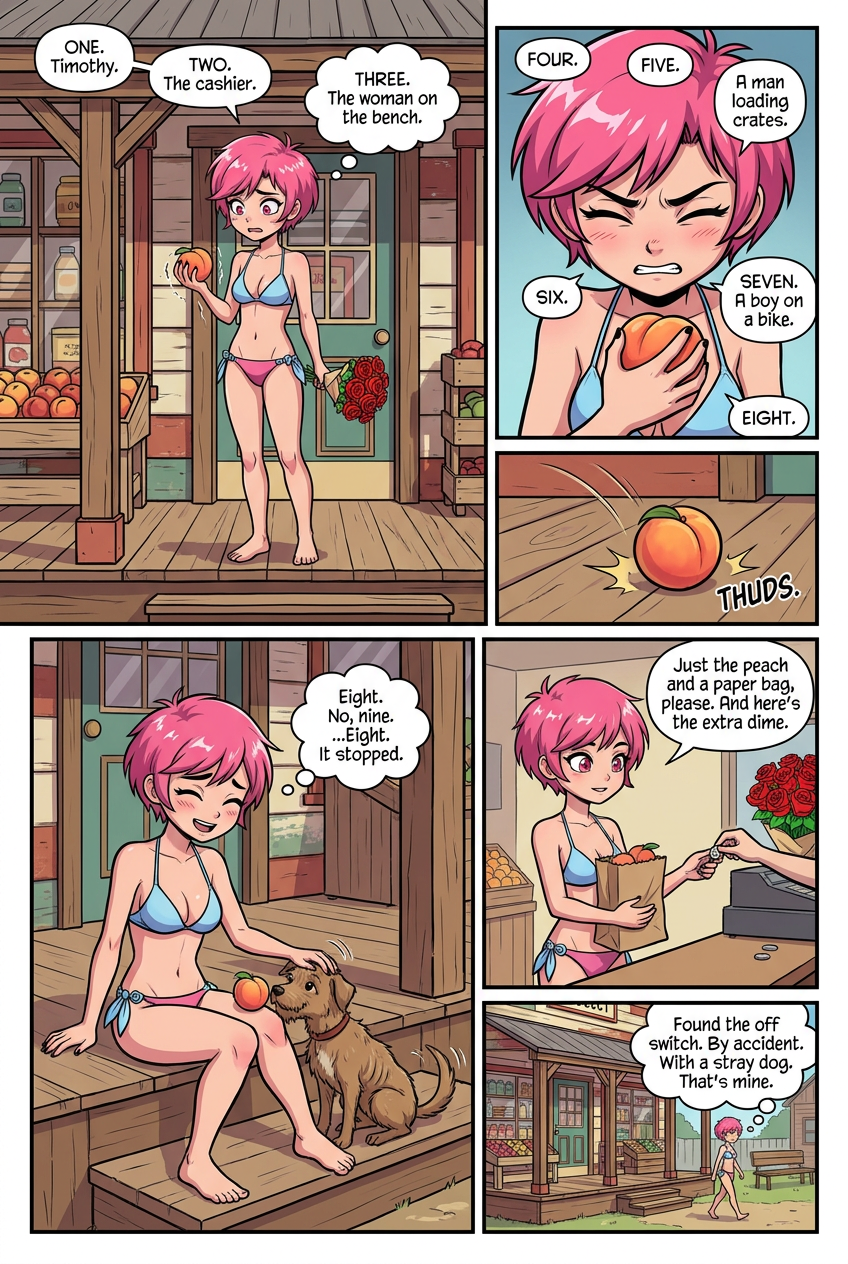
Matilda stood on the porch of the country grocery store with the peach warm in her palm. The roses were still inside, blossoms-down in the fruit where she had left them. Her hands would not stop shaking. She had said the true thing out loud, and it had not fixed anything. The count was still running in her head. One for Timothy. Two for the cashier who watched her ribs while she paid. Three for the woman on the porch bench who looked up from her phone as the screen door slapped shut. She tried to stop. She closed her eyes and pressed the peach against her sternum and counted her breaths instead. Four. Five. Six. But the numbers kept sliding back to the looks. A man loading crates paused with a box against his hip. Seven. A boy on a bike slowed at the rail. Eight. Her throat closed. She sat down hard on the top step. The peach rolled from her hand and thudded against the boards. A shadow crossed her knees. Matilda flinched and started to add nine. Then she saw it was only a small brown dog nosing the fallen peach. No owner in sight. The dog looked at her face, not her body. It sniffed the fruit, licked the fuzz, then sat down on her bare foot. Its weight was warm and solid. Matilda put her hand on its back and felt the ribs under the fur, thinner than hers. She laughed once, out loud, a short surprised sound. The count stopped. She waited for it to start again. It did not. The porch was quiet. The dog leaned harder into her ankle. She sat there for what felt like a long time and let the number in her head stay at eight. When she stood up, her legs held. She picked up the bruised peach and carried it back inside. She walked past the roses lying dead in the fruit and did not touch them. At the register she asked for a paper bag and put the peach inside and paid the extra dime. Walking out the second time, she did not look at the woman on the bench or the man with the crates. She was not refusing to count. She simply did not. The good day had started at eight and she meant to keep it there. She knew the count would come back. Tomorrow, or in an hour, or the next time a stranger's eyes dropped to her hipbones. But she had found the off switch once, by accident, on a porch, with a stray dog on her foot. That was new. That was hers.
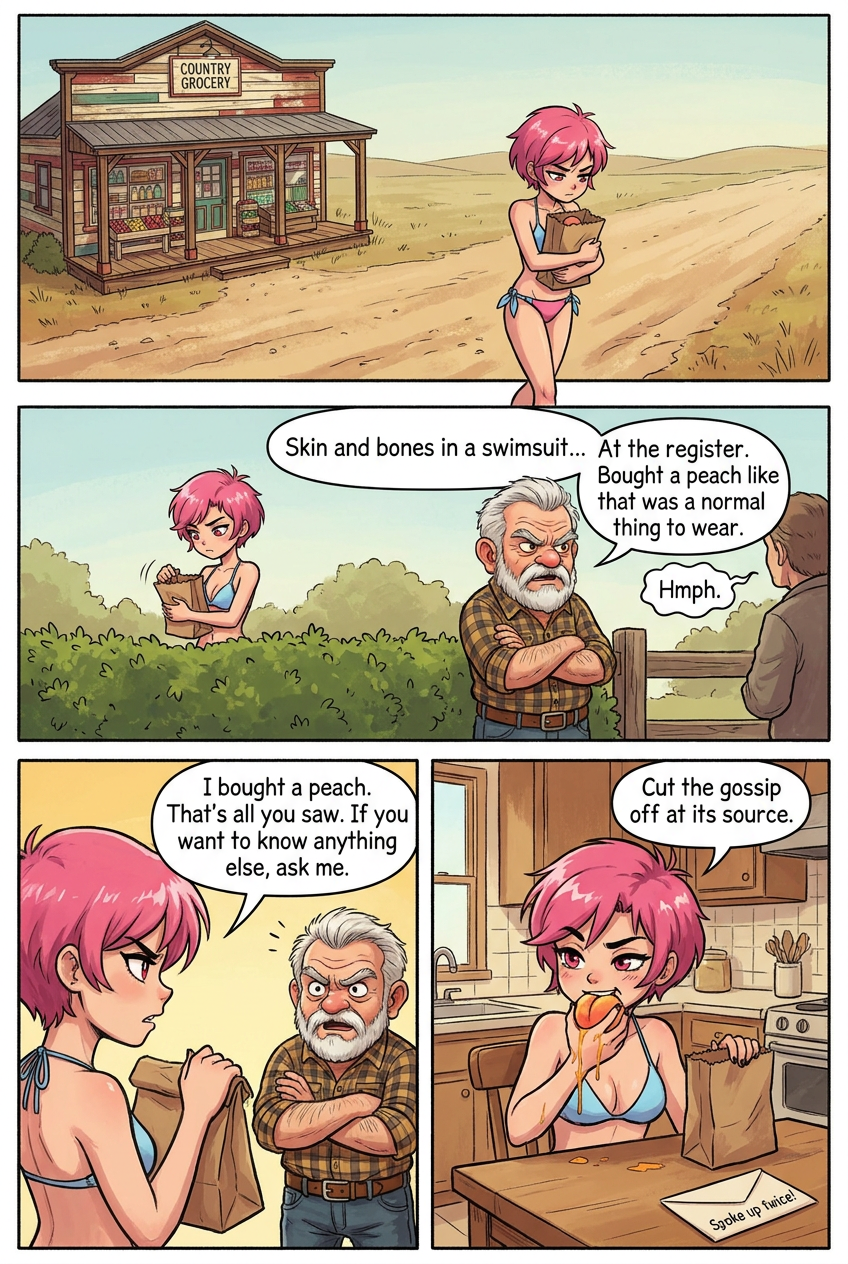
Matilda walked home from the country grocery store with the paper bag against her chest. The peach inside was warm through the paper. She kept her eyes on the dirt road and did not count. She was almost to her gate when she heard a voice on the other side of the hedge. It was her neighbor, the old man with the white beard and the plaid shirt, the one who crossed his arms at everything. He was talking to another neighbor over the fence. He said her name. Matilda stopped walking. "Skin and bones in a swimsuit," the old man said. "At the register. Bought a peach like that was a normal thing to wear." The other neighbor made a small sound. The old man kept going. He said someone should call her mother. He said pink hair. He said she must be sick in the head. Matilda's hand tightened on the bag. The count tried to start behind her eyes. One for his voice. Two for the listener's laugh. She felt her knees want to fold. Then she remembered the dog's weight on her foot. She pressed her bare heel into the dirt until she could feel small stones. She breathed in once. She walked around the hedge and stood in front of him. He went quiet. His arms stayed crossed. Matilda held up the paper bag. "I bought a peach," she said. "That's all you saw. If you want to know anything else, ask me." Her voice shook but the words came out whole. The old man's face pinched. He said she should put on some clothes. Matilda said she was wearing clothes. The other neighbor looked at the ground. Matilda did not wait for more. She walked past them to her gate and did not look back. Inside her kitchen she set the bag on the table and sat down. Her hands were shaking again, but the count had not started. She had cut the gossip off at its source, in front of a witness, before it could travel to her. She ate the peach over the sink. The juice ran down her wrist. She had spoken up for herself twice now in three days. She wrote it down on the back of an envelope so she would remember when the count came back.
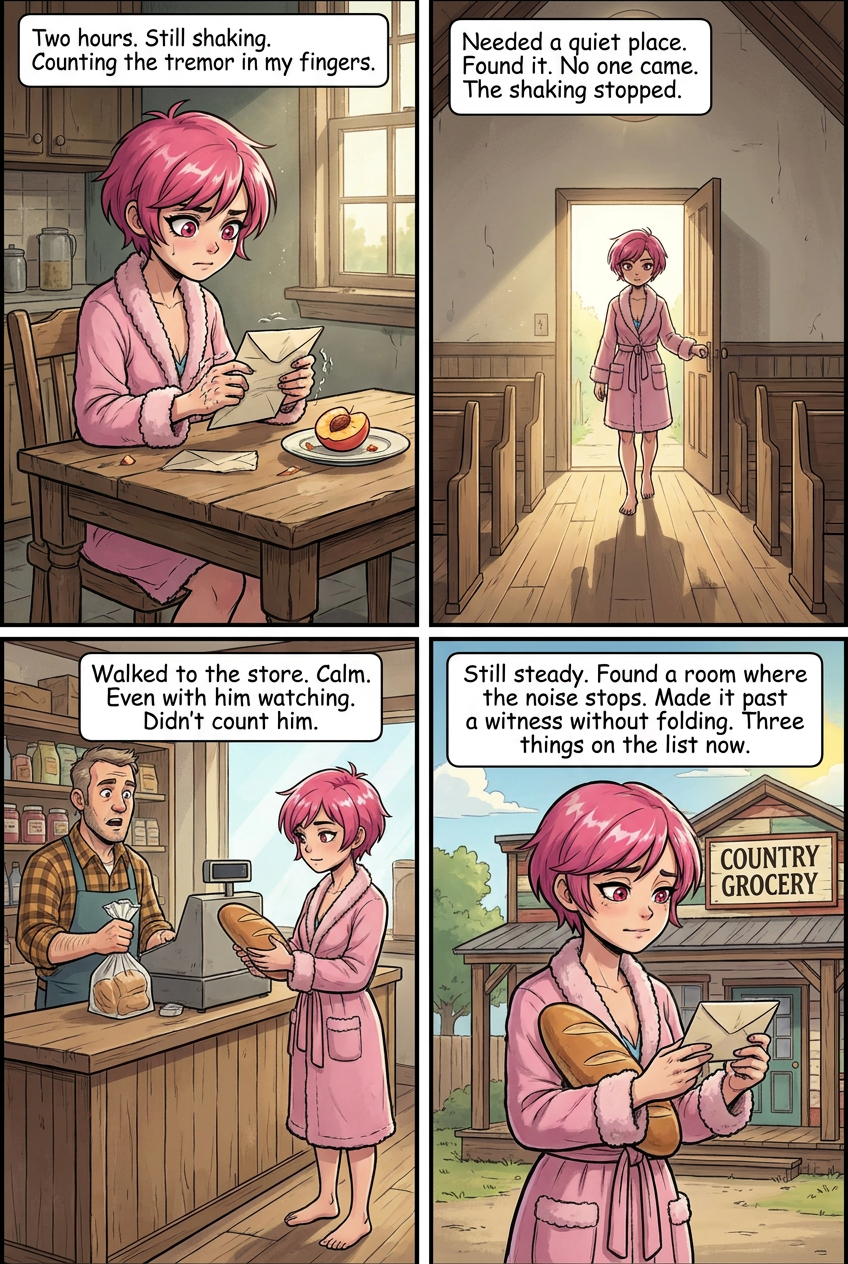
The shaking did not stop when Matilda sat down at her kitchen table. It kept going for two hours after she ate the peach. Her hands rattled the envelope she had written on. She counted the tremor in her fingers instead of counting looks, and that felt like trading one bad habit for another. She had spoken up twice in three days, but each time cost her the rest of the afternoon. If the old man with the white beard came at her again, or someone at the store did, she was not sure she would have the legs to answer. She needed a place to steady herself. Somewhere quiet, where no one watched her. She thought of the small chapel at the edge of town. She had passed it a hundred times and never gone in. The next morning she put on her bikini and walked there before the sun was full up. The door was unlocked. Inside it smelled like old wood and candle wax. The pews were empty. She sat in the back and put her bare feet flat on the floor, the way she had pressed her heel into the dirt at the hedge. She breathed. No one came in. No one looked at her. After a while her hands stopped shaking. She stayed until the bell in the steeple rang once for the hour. On the walk home she stopped at the country grocery store for bread. She was calm when she went in, and she was still calm when she saw the neighbor from over the fence, the one who had listened to the old man gossip. He was standing by the register. He saw her and his mouth opened like he meant to say something. Matilda kept her hands at her sides. She walked to the bread shelf, picked a loaf, and brought it to the counter. He watched her the whole way. She did not count him. She paid and said thank you to the clerk. The neighbor with the crossed arms and the white beard was not there, but his friend was, and his friend said nothing. That was new. Outside, Matilda held the bread against her ribs and felt her pulse. It was steady. She had found a room where the noise stopped, and she had come out of it able to walk past a witness without folding. The shaking would come back. She knew that. But now she knew where to go when it did. She wrote the chapel down on the back of the same envelope, under the two other lines. Three things now. A short list, and a place on it that was hers.
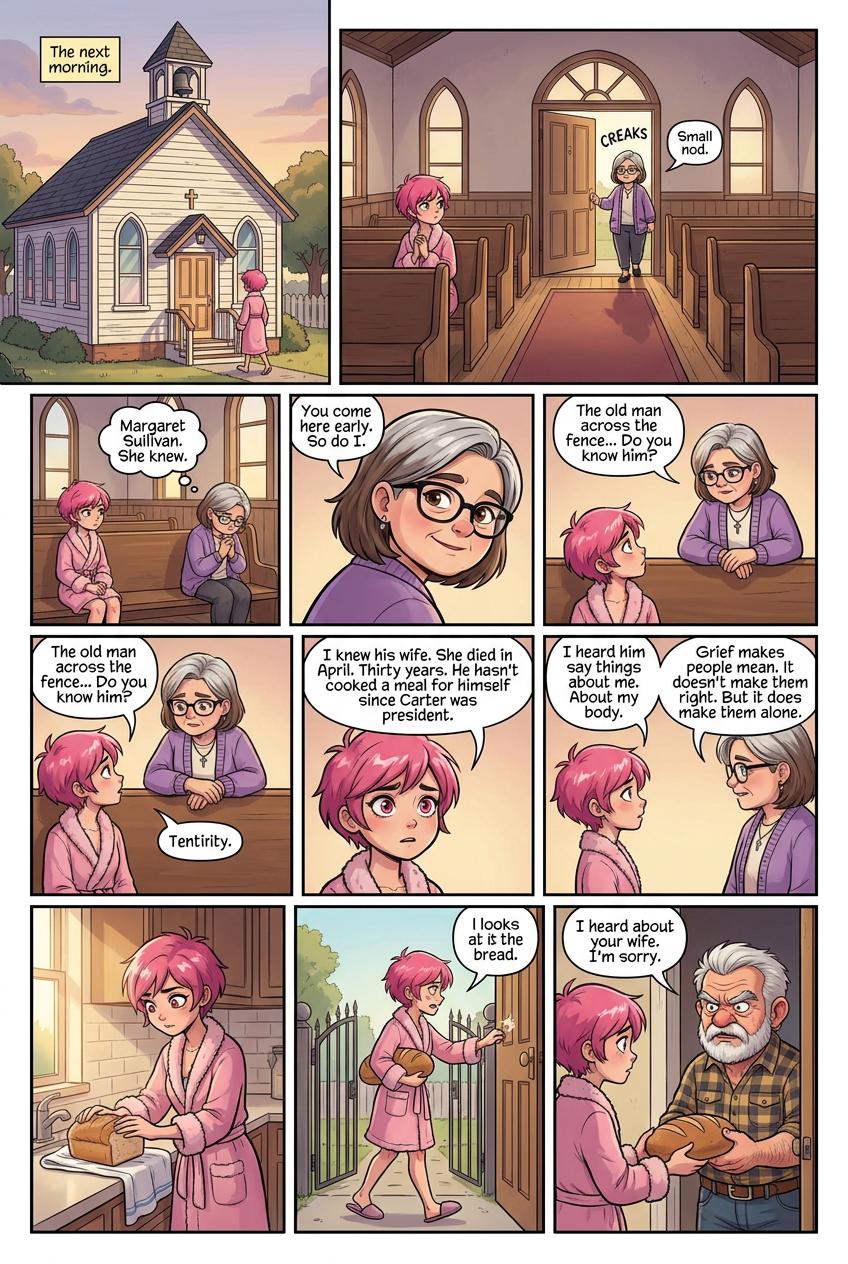
Matilda went back to the chapel the next morning with her list in her pocket. She sat in the same back pew and pressed her feet flat to the floor. The door creaked open behind her. A small woman in a purple cardigan came in, nodded once at Matilda, and sat two rows up. She had gray hair and glasses and a small cross on a chain. Matilda knew her by sight from the store. Margaret Sullivan. Margaret did not stare. She bowed her head and stayed quiet, and Matilda let her breath slow. When the bell rang the hour, Margaret stood and turned. She looked at Matilda the way people look at a kettle, checking, not judging. "You come here early," she said. "So do I." Matilda's hands stayed still in her lap. She asked the question before she could lose it. "The old man across the fence from me. The one with the white beard. Do you know him?" Margaret sat down on the pew in front of Matilda and folded her arms over the back. "I knew his wife. She died in April. Thirty years they were married. He hasn't cooked a meal for himself since Carter was president." Matilda felt something shift under her ribs. She had counted the old man as an enemy. Now he had a reason, and the reason was not her. "I heard him say things about me," Matilda said. "At the fence. About my body." Margaret nodded like she had heard worse. "Grief makes people mean. It doesn't make them right." She paused. "But it does make them alone. If you want to do something with what you know, bring him a loaf of bread. Don't say anything about his wife unless he does. Don't stay long." Matilda thought about the loaf on her counter at home. She thought about walking up to his door in her bikini, and her stomach dropped. Then she thought about him sitting at a table alone for four months, and the drop steadied into something else. She went home, wrapped the bread in a clean towel, and walked to his gate. Her hands shook before she knocked. He opened the door in the same plaid shirt, arms uncrossed for once. She held out the bread. "I heard about your wife," she said. "I'm sorry." He looked at the loaf, then at her. His mouth worked. He took the bread with both hands and did not speak. Then he stepped back and closed the door, not hard. Matilda walked home on legs that held. She did not count the walk. She added a fourth line to the envelope: the old man's gate. The shaking came later, at her table. This time she knew it would pass.
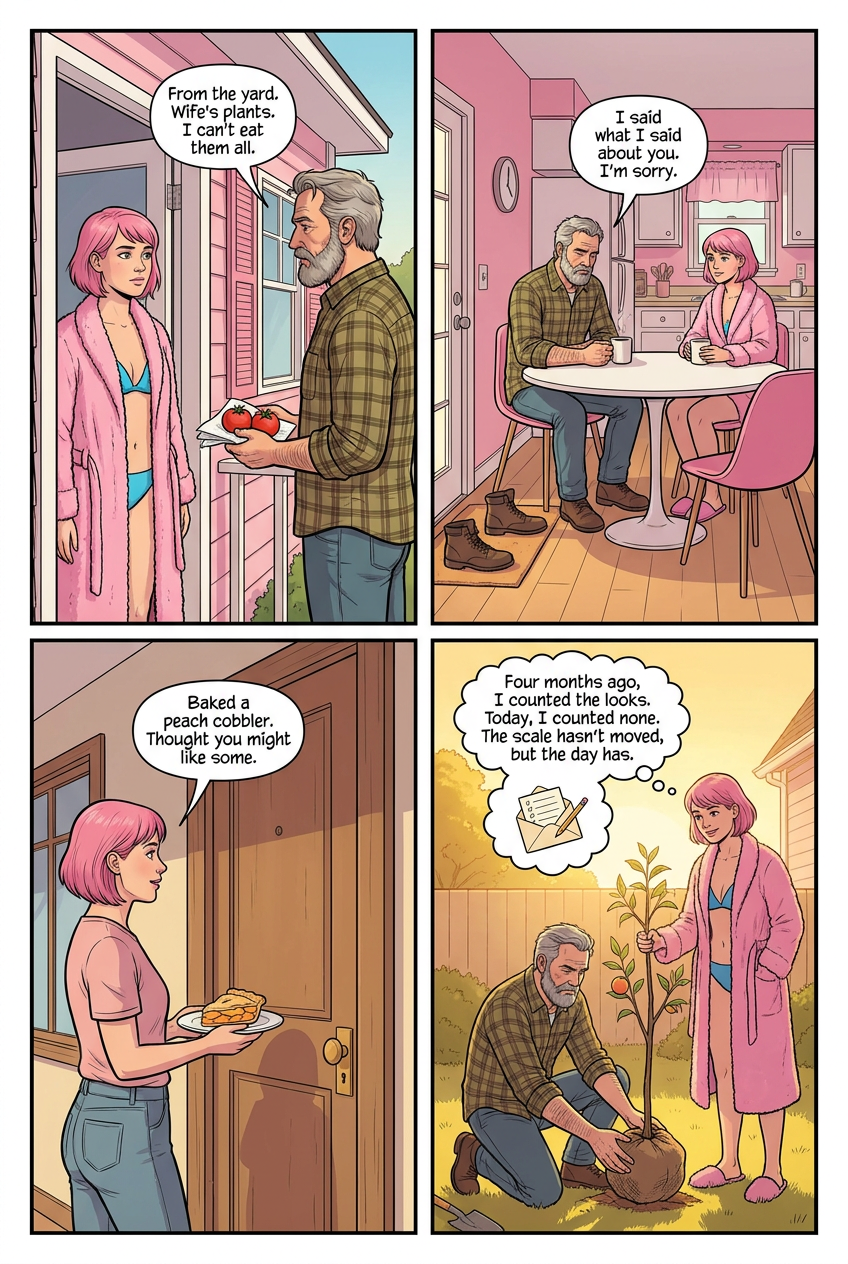
Three days after the bread, the old man knocked on Matilda's door. She opened it in her bikini and did not flinch. He held out a folded paper towel with two tomatoes on it. "From the yard," he said. "Wife's plants. I can't eat them all." He looked at her face when he spoke, not her body. Matilda took the tomatoes. She asked if he wanted to come in for coffee. He said yes. They sat at her kitchen table inside the pink and white house. He kept his boots on the mat. He said his name was Mr. Grumpypants, that the kids on the block had called him that for years and it stuck. He said the neighbor at the fence, the one who had laughed with him, was not really his friend. "He talks about everyone," he said. "I joined in because I was angry at the wrong things." He looked at his coffee. "I said what I said about you. I'm sorry." Matilda nodded once. She did not make him say it twice. After that, a routine grew between them. Twice a week she cooked and brought a plate to his door. She made pot roast, chicken and rice, a shepherd's pie. One Sunday she baked a peach cobbler because the store had peaches on sale and she wanted to see if she could stand in that aisle again. She could. She brought half the cobbler to him warm. He ate two servings at her table and told her his wife had made it the same way, with the crust cracked on top. He paid her back in dirt. He weeded the strip along her walk. He cut back the shrub that scraped her window. One morning he came through the gate with a young peach tree in a burlap ball, roots wrapped tight. "Saw you liked them," he said. He dug the hole himself in her side yard. She held the sapling straight while he packed the soil. When they were done she stood in her bikini in the sun with dirt on her knees, and she did not count the cars that slowed on the road. She forgot to count them. That felt like the point. That night she added two lines to the envelope. One for the cobbler. One for the tree. She sat at the table and looked at the list. Four months ago she had counted eight looks before the dog stopped her at the store. Tonight she had counted none. The scale in the bathroom still read ninety-eight pounds. The number had not moved. But the day had, and a man who once mocked her had planted something in her yard that would take years to fruit. She wrote the date next to the tree and closed the envelope.
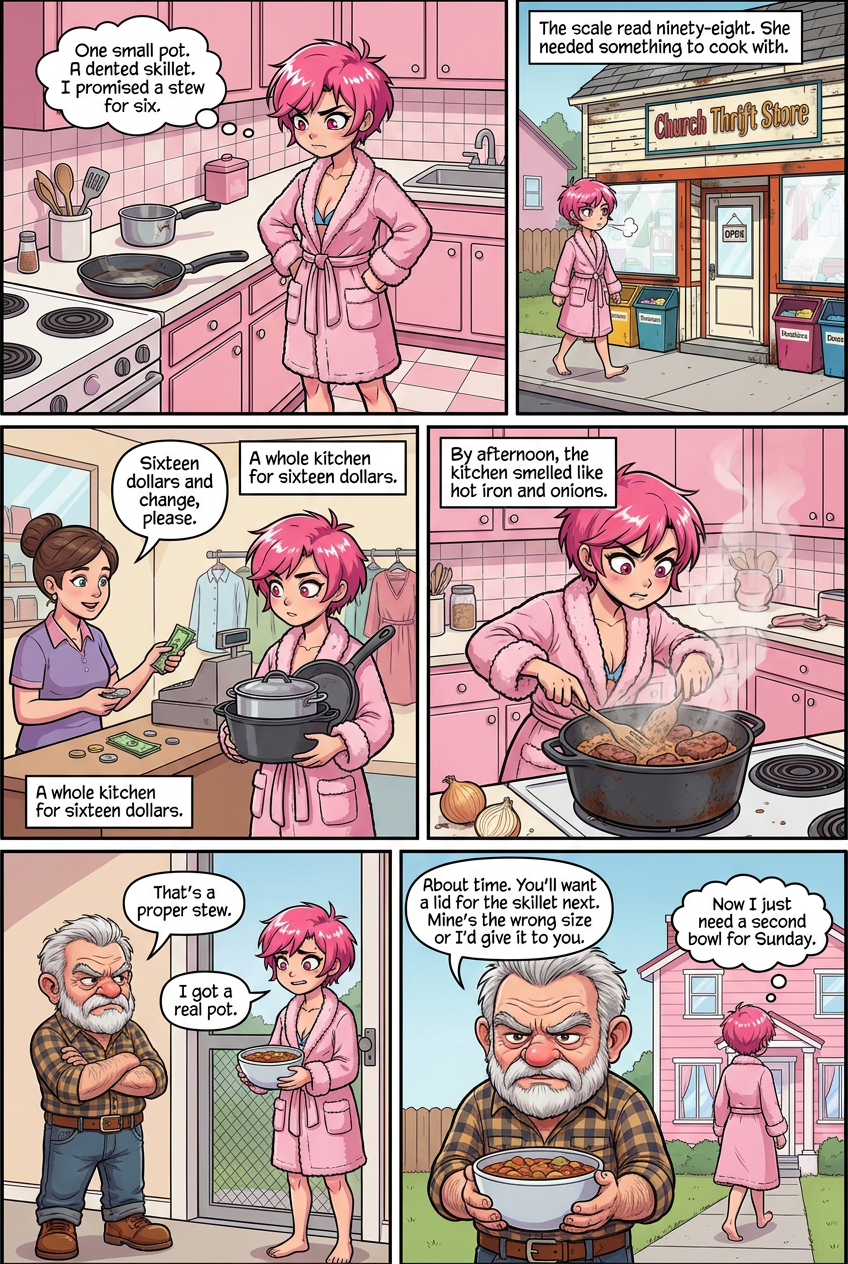
The peach tree was still a stick in the ground when Matilda hit the wall in her kitchen. She had promised Mr. Grumpypants a beef stew on Thursday. Her one small pot could not hold it. Her single frying pan warped when she tried to brown meat for six. She stood at the counter Wednesday morning and looked at what she had. A saucepan. A dented skillet. A wooden spoon. She had been feeding him from the same three pieces for two months, and he was starting to notice. Last visit he had lifted the lid of her saucepan and said, "You cook everything in this?" She had laughed it off. She could not laugh it off again. She had no money for a new set. The scale still read ninety-eight. Her disability check covered the mortgage and the light bill and not much else. She put on her pink terry robe over her bikini, because the morning was cool, and she walked to the little shop the church ran two streets over. A hand-lettered sign above the door said OPEN. Donation bins lined the sidewalk. She had passed the place a hundred times and never gone in. Inside it smelled like old books and lemon cleaner. A woman behind the counter nodded at her and went back to sorting buttons. Matilda found the kitchen shelf in the back. A cast iron Dutch oven sat on the bottom, lid chipped, four dollars. A heavy stockpot, six. A roasting pan with two good handles, three. A stack of mismatched wooden spoons for a quarter each. She carried the load to the counter in both arms. The total came to sixteen dollars and change. She paid in ones and quarters and walked home with the Dutch oven banging her hip through the robe. She scrubbed everything in the sink until the water ran clear. The cast iron she dried on the stove and rubbed with oil, the way her mother had taught her. By afternoon the kitchen smelled like hot iron and onions. She browned two pounds of chuck in the Dutch oven without a single warp or scorch. She built the stew in layers. Carrots, potatoes, a bay leaf, broth to the rim. She set the lid on and slid the whole thing into the oven. At six she carried a full bowl next door. Mr. Grumpypants opened the screen with his arms crossed the way he always did. He looked at the bowl. He looked at her. "That's a proper stew," he said. "I got a real pot," she said. He took the bowl in both hands. "About time." Then, quieter, "You'll want a lid for the skillet next. Mine's the wrong size or I'd give it to you." She walked home in the robe with her hands empty. The kitchen could hold him now. What she did not have was a second bowl to match the first, and he had already asked when Sunday's meal was coming.
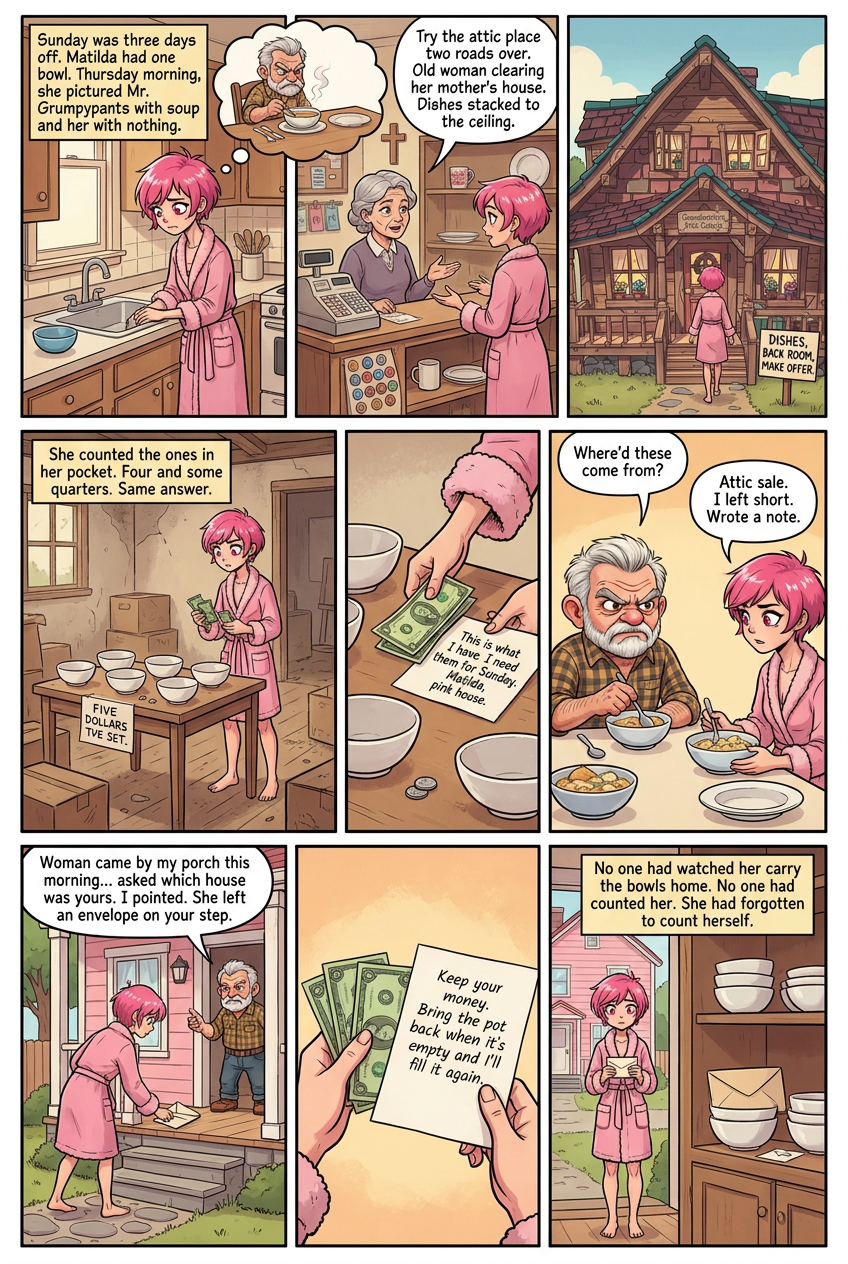
Sunday was three days off. Matilda had one bowl. She stood at the sink Thursday morning and pictured Mr. Grumpypants sitting at her table with soup steaming in front of him and nothing in front of her but the empty place mat. Or worse, a cereal bowl beside his good one. She had crossed too many small bridges to trip on a bowl. She put on the pink robe and walked back to the church shop. The kitchen shelf held one blue plate and a coffee mug with a chip. No bowls. The woman at the counter looked up from her buttons. "Try the attic place two roads over. Old woman clearing her mother's house. She's got dishes stacked to the ceiling." Matilda found the cottage by the sign above the porch. The roof pitched steep. Flower pots sat on the rail. The door stood open. Inside smelled like cedar and dust. Boxes lined the front room. A hand-drawn card said DISHES, BACK ROOM, MAKE OFFER. She went in. Six white bowls sat stacked on a card table. Plain. Heavy. A small chip on one rim. A slip of paper beside them read FIVE DOLLARS THE SET. She counted the ones in her pocket. Four and some quarters. She counted again. Same answer. Her chest tightened the old way. She heard the laugh from the peach stand for one second and then it faded. She set the four dollars on the table and stacked two quarters on top. She wrote on the back of the price slip: This is what I have. I need them for Sunday. Matilda, pink house. She left it there and carried the bowls out in both arms. At home she washed them one by one. She dried them with a clean towel and stacked them on the shelf above the stove. Six matching bowls. The chip faced the wall. Sunday at six she ladled chicken and dumplings into two of them. Mr. Grumpypants sat at her table with his arms uncrossed for once. He tapped the rim of his bowl with his spoon. "Where'd these come from?" "Attic sale. I left short. Wrote a note." He grunted. He ate two bowls and pushed the third away. "Woman came by my porch this morning. Grey braid. Asked which house was yours. I pointed. She left an envelope on your step." Matilda walked him out and found the envelope wedged under a stone. Inside were her four dollars and two quarters and a note in slanted pencil. Keep your money. Bring the pot back when it's empty and I'll fill it again. She stood on the step with the money in one hand and the note in the other. No one had watched her carry the bowls home. No one had counted her. She had forgotten to count herself. She went inside and set the envelope on the shelf beside the bowls.
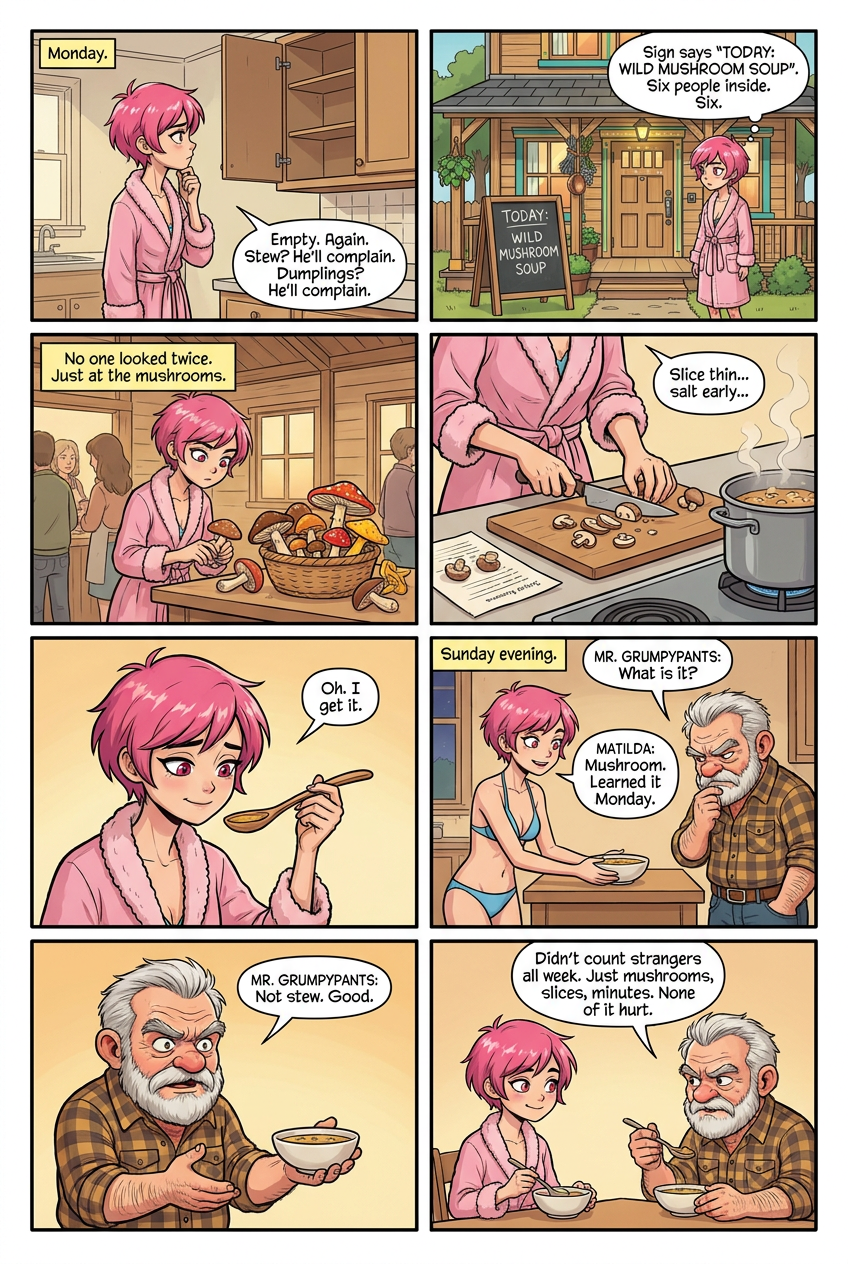
Monday morning Matilda opened her cupboard and stared at the empty shelf beside her new bowls. She had cooked stew. She had cooked chicken and dumplings. Sunday was five days off, and Mr. Grumpypants would sit at her table again expecting something he hadn't tasted yet. She knew three recipes. She had used two. If she served stew again he would tap his spoon and say so. She put on the pink robe and walked to the church shop for ideas. The woman at the counter shook her head at the question. "No cookbooks came in this week. But there's a class up the road. They teach on Mondays. Costs nothing if you help wash up." Matilda followed the directions to a wooden building with pots and herbs on the porch. Dried garlic hung from the beams. A chalkboard by the door said TODAY: WILD MUSHROOM SOUP. She stopped at the step. Six people already stood inside at a long counter. Six people who would look at her. She counted to three and went in anyway. A woman in an apron waved her toward an empty spot and handed her a knife. On the counter sat a basket of mushrooms with fat caps and slender stems, browns and yellows and one red one set apart. Nobody looked at her twice. They looked at the mushrooms. The teacher walked the room and named each kind. She showed which to keep and which to leave. She poured cream into a pot. She melted butter. She said to slice thin and salt early. Matilda copied every step onto the back of a receipt. Her hand shook once and then steadied. She tasted the soup at the end from a small wooden spoon and understood why people paid for lessons. She left with the recipe in her pocket and a paper sack of the safe mushrooms the teacher pressed on her. On the walk home she planned the rest. Soup Sunday. Something with the roasting pan the Sunday after. She could come back next Monday for another lesson. The problem had a floor under it now. Sunday at six she set the pot between them and ladled the soup into two white bowls. Mr. Grumpypants leaned over his and sniffed. His eyebrows pulled down the way they did before a complaint. "What is it?" "Mushroom. I learned it Monday." He tried a spoonful. He tried another. He set the spoon down and looked at her across the table with his arms uncrossed. "You didn't cook this in the same pot as the stew." "No." "Good." He ate the whole bowl and held it out for more. She filled it. She sat down across from him and ate her own. She had not counted a stranger all week. She had counted mushrooms instead, and slices, and minutes on a timer, and none of it hurt.
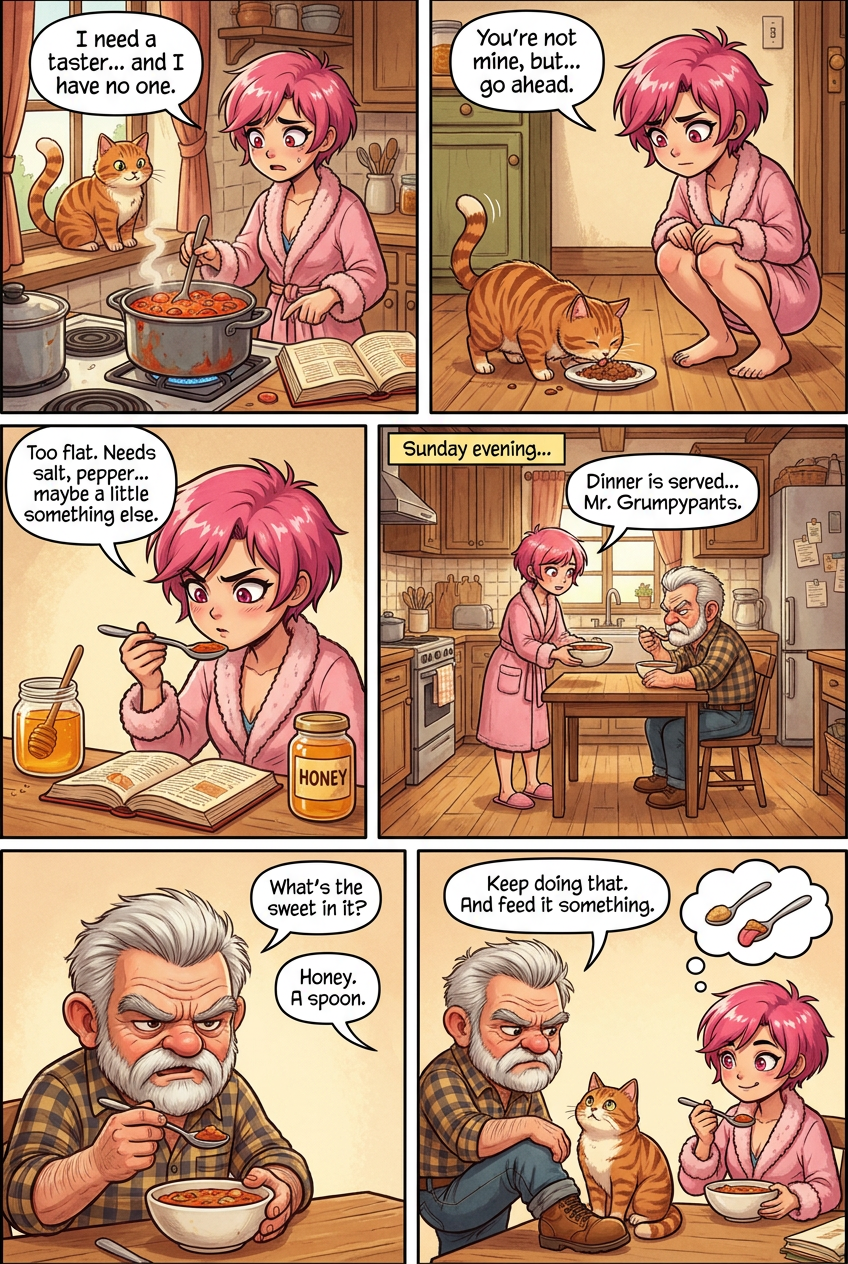
Wednesday she stood at her stove with a pot of tomato stew and no way to know if it was any good. Sunday was three days off. She had picked the recipe from a bound guide the cooking school teacher pressed on her after Monday's class, a book of dishes cooked in one pot. She had followed every line. But the last time she served Mr. Grumpypants something new without tasting twice, she had oversalted the dumplings and watched his mouth pinch shut over the first bite. She would not do that again. She needed a taster. She had no one. She would not knock on the old man's door to sample the meal he was about to eat. Margaret was at the chapel and would say something kind whether the stew was good or not. Kind was not useful. A meow cut across the kitchen. A fat orange tabby sat on her sill, tail curled over its paws, watching the pot. She did not know the cat. The cat clearly knew the smell. "You're not mine," she said. The cat blinked at her. She opened the window. The cat walked in like it had done so a hundred times and sat on the floor by her ankle. She spooned a small bite of stew onto a saucer, blew on it, and set it down. The cat sniffed. The cat ate. The cat licked the saucer and looked up for more. She tasted her own spoon. Too flat. She added salt and a crack of pepper. She spooned another test onto the saucer. The cat ate faster this time and pressed its head against her calf. She stirred in a spoon of honey from the jar the church shop had thrown in with the bowls. She tasted. Better. She offered the saucer. The cat cleaned it and sat waiting for a fourth round. "That's enough," she said. "You'll be sick." The cat stretched and lay down under her table like it had chosen the spot months ago. Sunday at six she set the pot between them and ladled. Mr. Grumpypants sniffed once and took a full spoonful without pausing to complain. He ate half the bowl before he spoke. "What's the sweet in it?" "Honey. A spoon." He nodded. "Keep doing that." He held the bowl out for more. She filled it. The cat walked out from under the table, sat by his boot, and stared up at him. He looked down. "Since when do you have a cat?" "Since Wednesday." "Feed it something." She set a saucer on the floor. The cat ate. Mr. Grumpypants watched it a moment, then went back to his stew. Matilda sat across from him and ate her own bowl. She had not counted a look in nine days. She had counted spoonfuls instead, and the cat's small quick tongue, and that was a better math.
Play your story to life
Storycraft is a mobile game where you create AI characters, craft items and locations to build their world, then discover what direction your story takes. Download the iOS game for free today!
Download for free