

Sue vox's Arc
6 Chapters
Sue vox's dream is trapping the shadow that whispers through her workshop inside a single flawless specimen she has been building for years.

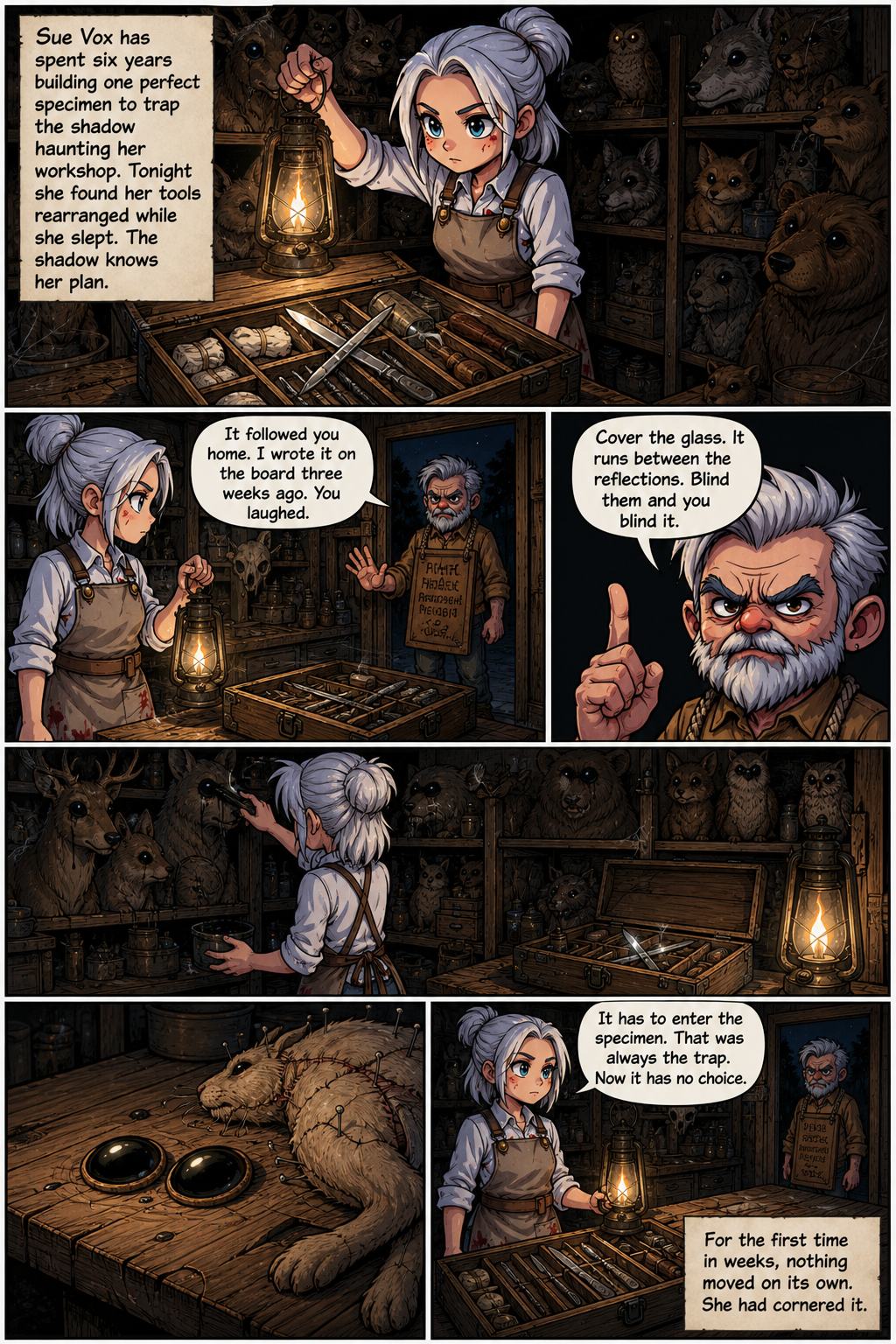
For six years Sue vox built one perfect specimen to trap the shadow that whispered through her workshop. Tonight the whisper knew her plan. She unlocked her supply crate and found her scalpels moved. Yesterday she had lined them by size. Now they lay crossed like a warning. The whisper had rearranged her tools while she slept. Sue set her lamp on the bench and stared at the mess. Her needles sat where her wire should be. Her glass eyes rolled loose in the wrong compartment. She could not trust her own hands anymore. If she reached for a blade in the dark, the whisper might guide her wrong. One slip and the specimen she had built for years would tear. "You want me to quit," she said to the empty room. The lamp flame bent, though no window was open. Along the shelves, her stuffed animals watched with the small black mirrors she had set where their eyes belonged. In every mirror the flame doubled. The whisper hid inside them, moving between reflections. Sue understood then. The whisper lived in what reflected. Her tools, her glass eyes, the black mirrors—all of it gave the shadow a place to slip and hide. She could not finish the specimen while the whisper owned her bench. A fist hit the door. Sue jumped. She opened it and found her brother on the step, the wind pulling at the sandwich board roped over his chest. Theo Vox had shouted warnings on street corners for years, and every disaster he named had come true. Nobody had listened. Sue had stopped listening first. "It followed you home," Theo said. His voice was cracked from years of shouting. He would not step inside. "I wrote it on the board three weeks ago. You laughed." "I need it to stay in one place," Sue said. "Long enough to seal it." Theo looked past her at the shelves of black mirrors. His face went gray. "Cover the glass. It runs between the reflections. Blind them and you blind it." Sue grabbed her apron and a jar of thick black wax. She smeared the first mirror shut. In the next eye the flame jumped, hunted, found nowhere to land. She moved down the shelf fast, sealing each small black mirror. The whisper hissed against the walls. Her scalpels shivered in the crate. She kept smearing until every reflection went dark. The room fell silent. The lamp flame stood straight. Sue turned back to her bench and saw her tools lay still. For the first time in weeks nothing moved on its own. But one eye was left—the pair she had set aside for the specimen itself. Two black mirrors, uncovered, waiting on the workbench. The whisper had nowhere else to go now. Sue looked at Theo. "It has to enter the specimen," she said. "That was always the trap. Now it has no choice."
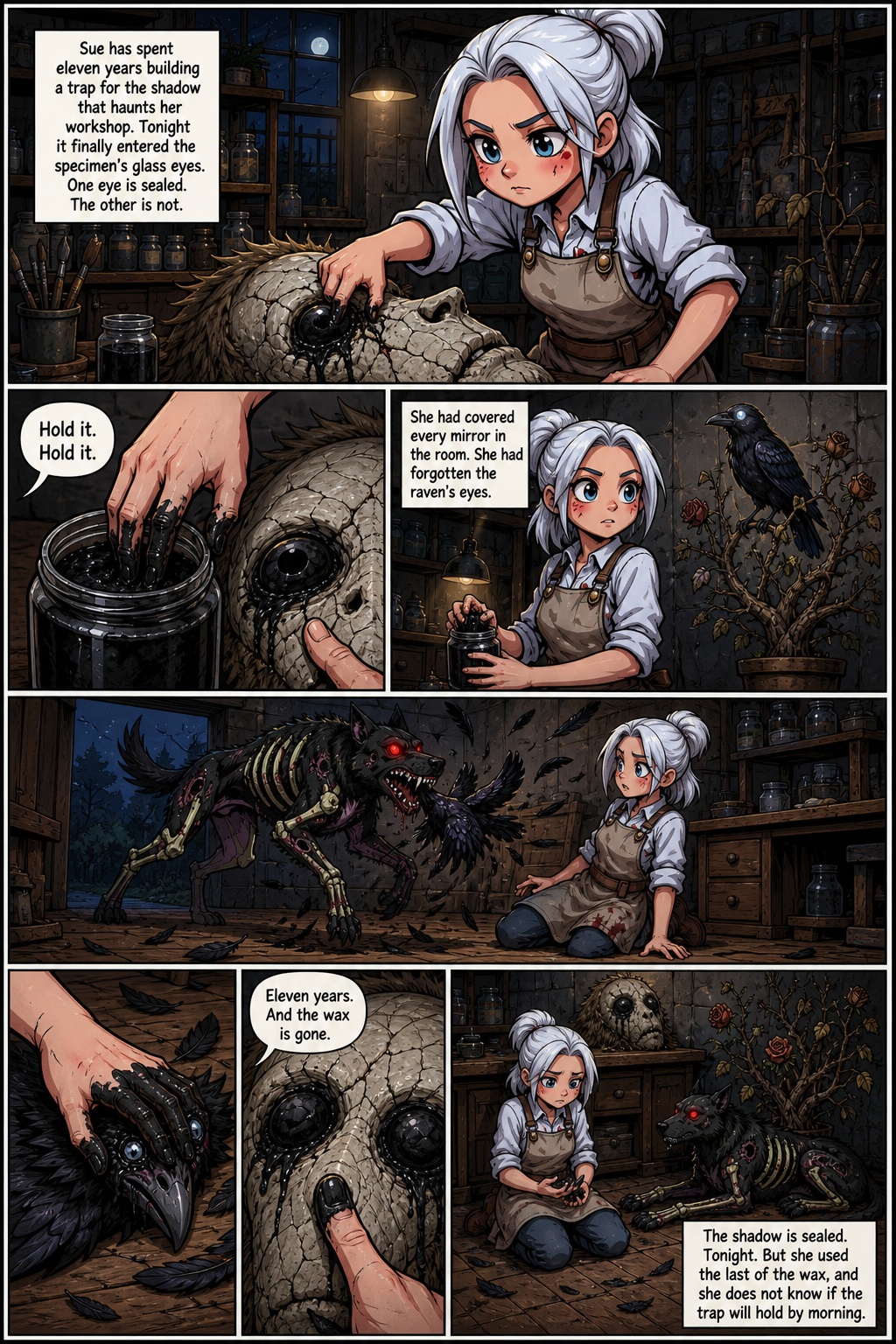
The shadow poured into the specimen's glass eyes at last. Sue watched it fill them like ink filling water. But the trap was not sealed. She had wax on only one eye. The second eye still lay bare, and the shadow thrashed inside the glass, hunting a way back out. Along the rims her seals were already splitting. Thin cracks spread through the wax like frost on a window. "Hold it," she told herself. She grabbed her jar of black wax and dug in two fingers. The stuff had gone cold and stiff. She smeared it over the bare eye anyway. The shadow slammed against the glass. The specimen's stuffed head rocked on the bench. A crack ran wider under her thumb. Her lamp flame bent. Behind her, wings beat. A raven perched on the withered rosebush by the wall, and its eyes caught the light like two small mirrors. Sue's chest went tight. She had covered every mirror in the room. She had forgotten the bird's bright stare. The shadow felt it too. It surged toward the raven's eyes, testing the crack in her seal. If it reached those eyes, it would slip free and start again. Eleven years of work would break in one second. A growl rolled from the doorway. The black dog stood there, ribs bare through rotted skin, red eyes burning. It had followed the whisper for weeks. Now it stalked toward the raven, hackles up. The bird shrieked and beat its wings. Sue lunged for it, wax jar in hand. The dog snapped first. Its jaws closed on the raven and dragged it down. Feathers scattered. The bright eyes rolled loose across the floor. Sue dropped to her knees and smeared them dark before the shadow could reach them. Two more reflections gone. She crawled back to the bench. The specimen's eyes bulged with trapped black. She scraped the last cold wax from the jar and pressed it into every crack, thumb pushing hard. The shadow beat against the glass once, twice. Then the wax held. The eyes went still and dark and full. Sue sat back on the floor. Her hands shook. The whisper was gone from the walls. It was inside the glass now, sealed, silent. The dog licked a feather from its teeth and lay down by the rosebush, watching her. The specimen stood finished on the bench, its eyes two black stones with something moving deep inside. She had it. After eleven years, she had it. But the wax was cheap and the trap was thin. She had used the last of the jar. If the shadow pushed hard enough, or if the cold cracked the seal again, there would be nothing left to fix it with. The trap held tonight. She did not know if it would hold by morning.
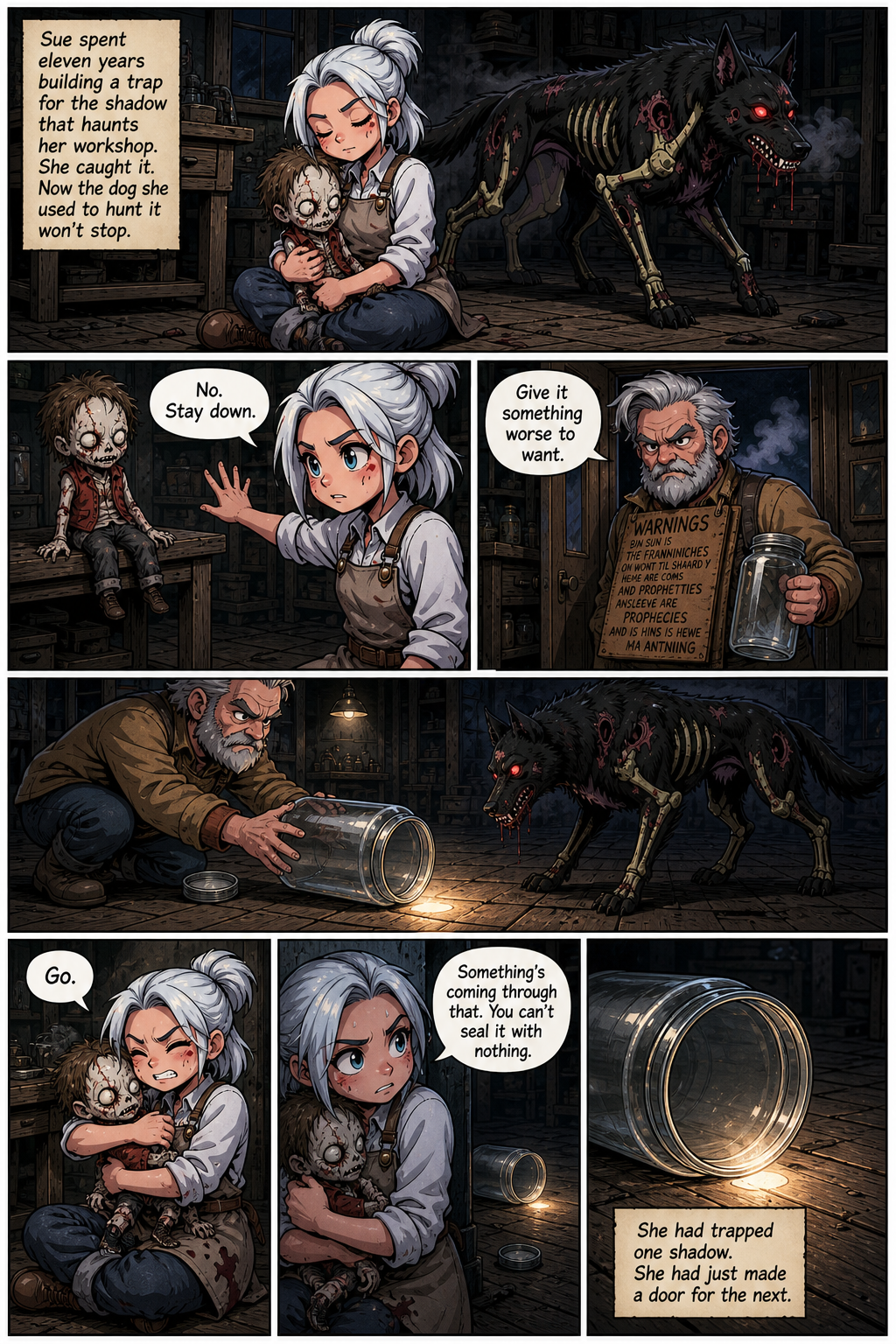
The trap held, but the dog would not settle. Sue sat on the floor, watching the specimen's black eyes. The whisper was inside the glass now. She had won. Then the dog stood again. It paced the workshop, red eyes burning, claws clicking on the boards. Its bony flank brushed the bench leg. The specimen rocked. A thread of a crack ran through the wax on the left eye. Sue's stomach dropped. "No. Stay down." She held out one hand, slow, the way she calmed nervous animals. The dog swung its head toward her and growled. It smelled the shadow still. It wanted to finish what it had chased for weeks. Its shoulder knocked the bench again. The specimen slid an inch toward the edge. If it fell, the glass would crack, and eleven years would spill onto the floor. The shop door scraped open. Cold air rushed in. A scruffy man stepped through, a sandwich board over his chest, the boards scrawled with warnings in black. Theo. Her brother. He had told her weeks ago how the shadow moved through reflections. His voice was hoarse and flat. "Move the specimen," he said. "Now. Off the bench." "The dog will take it if I reach." Sue's hands shook. "Then give it something worse to want." Theo dug in his coat and pulled out a clear glass jar with a fitted lid. He knelt and set the jar on the floor, on its side, mouth toward the dog. The glass caught the lamplight. A small bright circle bloomed on the boards. The dog froze. Its red eyes locked on the shine. It stalked toward the jar, hackles high, forgetting the bench. Sue understood. The shadow hungered for any reflection. The dog hunted the shadow. The bright glass pulled them both. "Go," Theo said. Sue lunged. She grabbed the specimen with both arms and dragged it off the bench, against her chest. The head thumped her collarbone. The cracked wax held. She stumbled back to the far wall and slid down with the specimen in her lap. The dog reached the jar. It snapped at the shine, jaws closing on empty glass. The lid popped loose and rolled. The dog bit again, again, tearing at a light it could not catch. Then it whined, low and lost, and lay down beside the jar. The red faded from its eyes to a dull ember. Sue breathed. The specimen was safe in her arms, eyes dark and full. But the glass jar lay open on the floor, a bare shine no wax now covered. She had none left. And Theo stood over it, staring, his mouth already moving. "Something's coming through that," he said. "Not tonight. Soon." He did not soften it. "You can't seal it with nothing." Sue looked at the open jar. She had trapped one shadow. She had just made a door for the next.
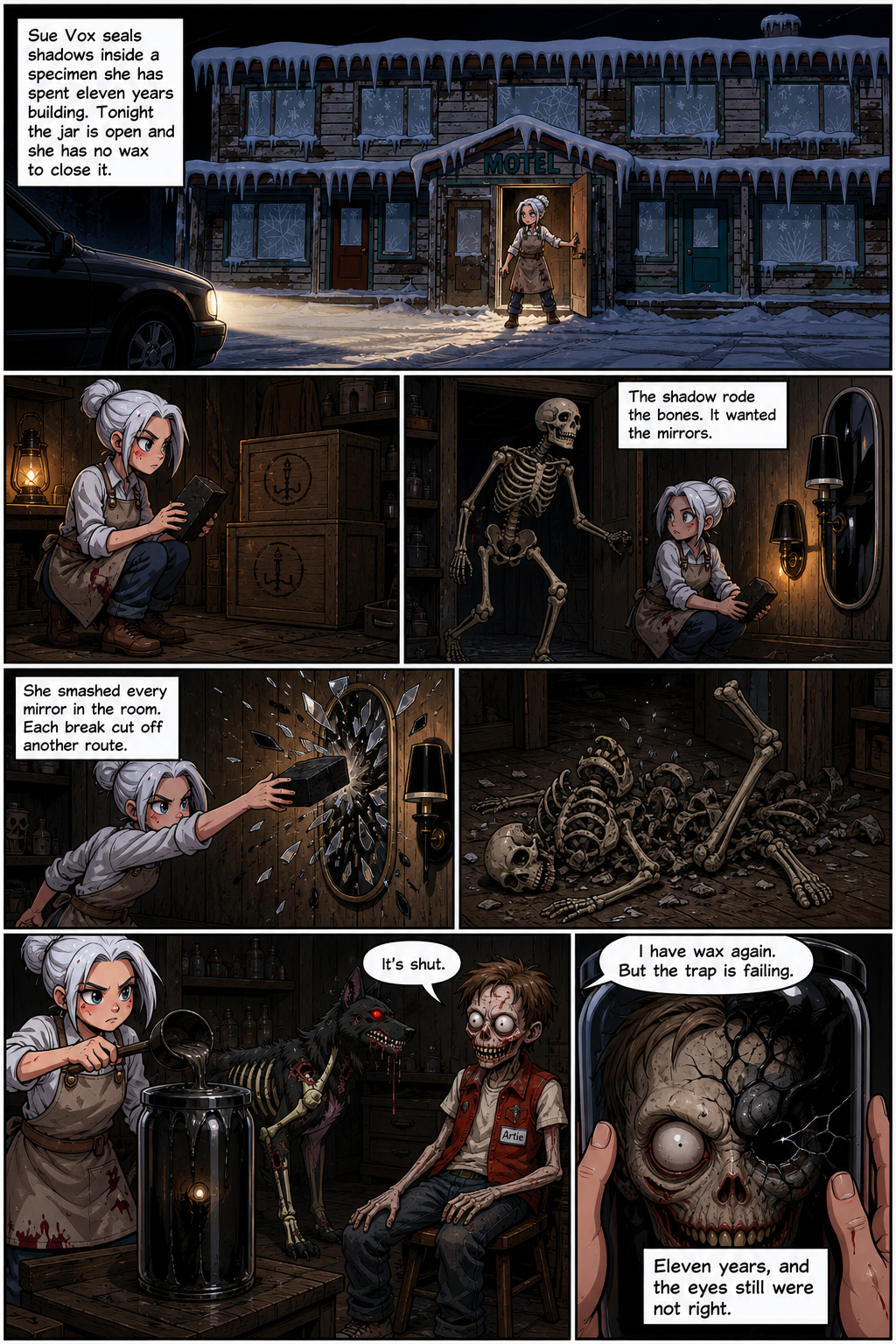
The open jar shone on the floor. Sue could not seal it. She had scraped the last wax days ago. Theo knelt beside her, his sandwich board creaking. "A door stays a door until you shut it," he said. "We need more wax. Now." Sue thought of the one place that might still hold some. A frozen motel down the road, closed for years. She had bought her first batch of black wax there, from a chandler who once rented a room. Boxes might remain. "Watch the specimen," she told Theo. She wrapped it in canvas and set it in his arms. Then she looked at the open jar. "And don't look into that." Sue drove through the dark to the motel. Ice sealed every window. Snow buried the sign. She forced a door and swept her lamp across a room full of dust and old furniture. Mirrors hung on the walls, cold and bright. She kept her eyes low. In a back closet she found three crates stamped with the chandler's mark. She pried one open. Black wax bricks, hard as stone. Something tapped behind her. Sue turned. A skeleton stood in the doorway, bones white in her lamplight, held together by nothing she could see. It took one step, then another, joints clicking. Its skull swung toward the nearest mirror. The shadow rode it. It wanted the glass at her back. Sue grabbed a wax brick and hurled it at the mirror. The glass burst. The skeleton stuttered mid-stride, its stolen doorway gone. She smashed the second mirror, then the third. Each break stole a route from the thing inside the bones. The skeleton froze, one foot raised. Then it dropped, clattering into a heap on the floor. The shadow had nowhere left to go. Sue loaded the crates into her arms and ran. Her heart slammed. She did not stop until the motel shrank behind her. Back at the workshop, Theo waited with the specimen. The zombie dog lay by the wall, still and dull-eyed. The jar shone where she had left it. Sue set a wax brick on the stove and melted it fast. She poured the black wax over the open jar and sealed the shine. The doorway closed. She sealed the empty windows too, one by one, until no glass caught the light. "It's shut," Theo said. He sank onto a stool. Sue held the specimen and checked its eyes. The wax on the left eye had cracked wider. A thread of shadow pressed against the glass from inside. Her fresh wax could seal a jar. It could not mend a crack this deep. The trapped shadow was working loose. "I have wax again," she said. "But the trap is failing." She set the specimen on the bench and reached for her tools. Eleven years, and the eyes still were not right.
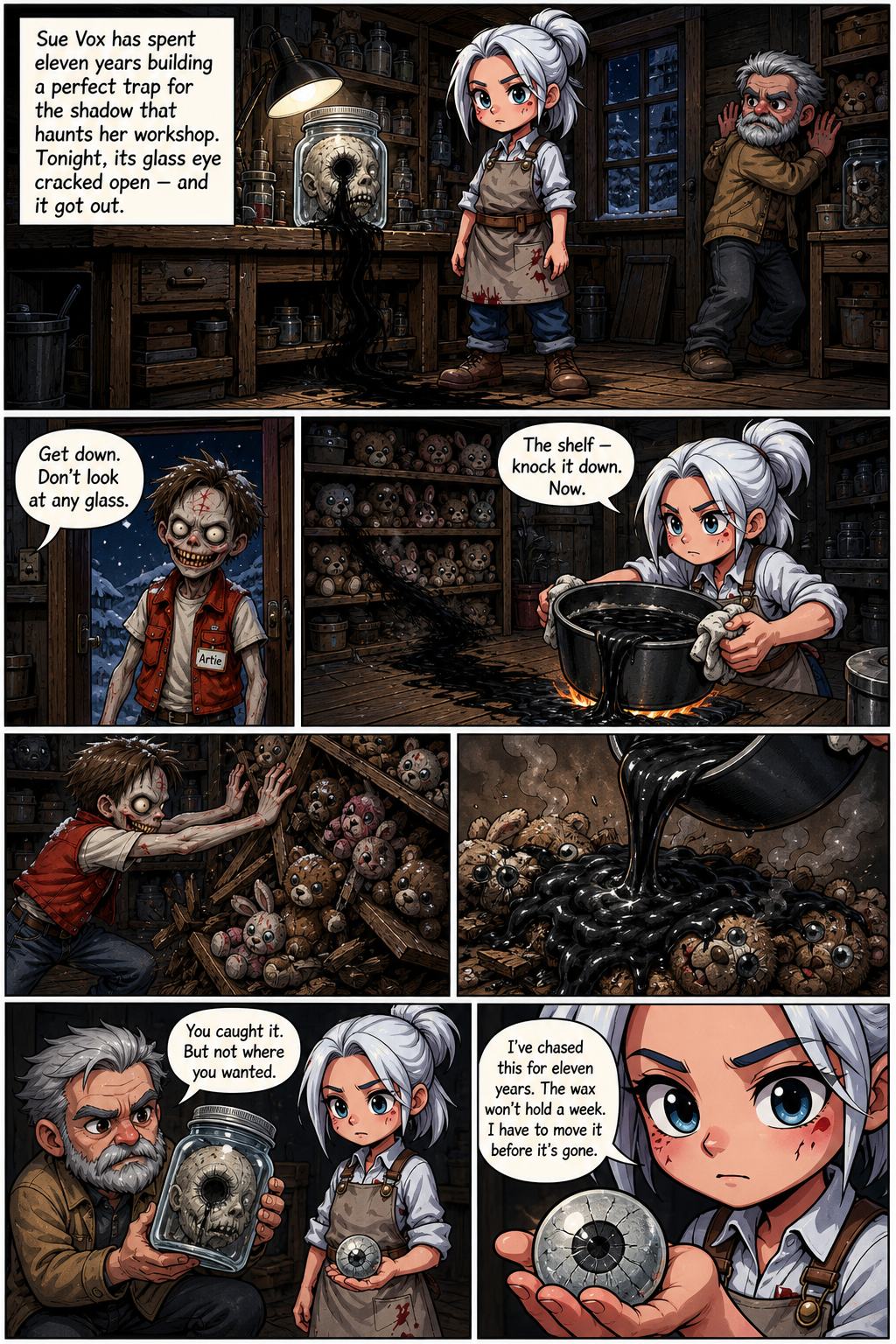
The crack widened while Sue watched. A thread of shadow pushed through the specimen's left eye and spilled onto the bench. It slid off the wood and onto the floor. Fresh wax could not mend a broken seal. She knew that now. The shadow was loose, and any bright surface could give it a new door. Theo stood and pressed his back to the wall. "It's out," he said. "Cover the shine. All of it." Sue grabbed a rag and threw it over the dog's dull eyes. She checked the windows. Still sealed. The sealed jar. Still black. But the specimen's glass case caught the lamplight, and so did a row of animals on the shelf, their small black mirrors gleaming where old wax had worn thin. A knock hit the door. Sue froze. She had asked no one to come. The door pushed open and a scrawny teenager stumbled in from the cold. His name tag hung by a strip of tape. He was the grocery boy from town, the one who never backed down when the block's gang leaned on him. He'd carried her wax crates once and asked no questions. "Your light was on," the boy said. He grinned, gap-toothed. "Figured you needed a hand." "Get down," Sue said. "Don't look at any glass." The shadow raced across the floor toward the shelf. Sue saw its aim. It wanted the worn eyes, a doorway she couldn't reach in time. She snatched the melting pot off the stove. "The shelf," she told the boy. "Knock it down. Now." He didn't ask why. He ran and shoved the shelf with both hands. Stuffed animals crashed to the floor. Their black mirror eyes cracked against the boards. The shadow reached the pile and found only broken glass. It coiled, thin and trapped, with nowhere to open. Sue poured the hot wax. She flooded the whole cracked pile, the shelf, the floor beneath it. The shadow thrashed under the black flood, then went still, pinned in the drying wax. She poured until the pot ran empty. The workshop went dark and dull. No surface shone. The boy sat back, breathing hard. "What was that?" "Something I've chased for eleven years," Sue said. Her hands shook. "You just helped me pin it." Theo knelt by the specimen. He lifted it and turned it to the lamp. The left eye was empty now, the glass cracked clean through. The shadow was no longer inside it. It was pinned in the wax on the floor, but not trapped in the flawless specimen she'd built to hold it. "You caught it," Theo said. "But not where you wanted." Sue looked at the ruined eye in her hand. Her trap had failed. The shadow was cornered on the floor, held by cooling wax that would not last the week. She had to move it into the specimen before the wax gave way.
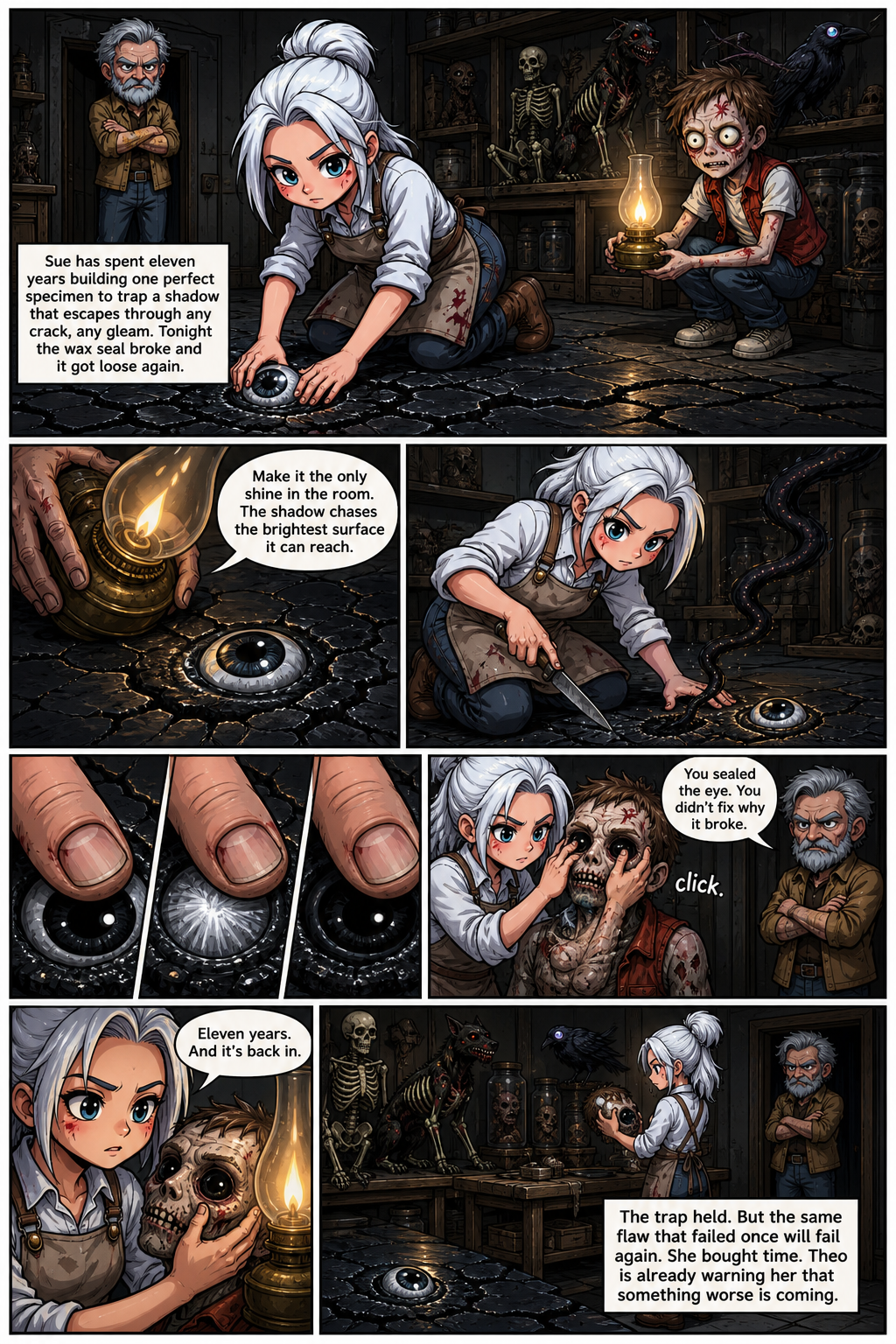
The wax on the floor had gone from black liquid to a dull crust. Sue pressed her palm to it. Still warm, but firming fast. Under her hand the shadow shifted, a slow thread testing the edges. When the wax hardened all the way, the seal would crack, and the shadow would slip out through the nearest gleam. She had to move it into the specimen now, while it was still pinned. "Bring me the eye," she said. Theo held out the cracked glass eye. She shook her head. "Not that one. The spare. Second drawer." Theo pulled the drawer and set a fresh glass eye in her palm. It was flawless, no crack, no wear. Sue had polished it for a year. She knelt at the edge of the wax and pressed the clean eye down against the crust, right where the shadow curled thickest. "You mean to make it swap doors," Theo said. He did not soften it. "You don't know it will." "It goes to the brightest surface it can reach," Sue said. "This is the only shine left in the room." The boy crouched by the wall, still catching his breath. His name tag hung by its strip of tape. He watched her hands. "What do I do?" "The lamp," Sue said. "Hold it close to the eye. Make it the one bright thing." He grabbed the lamp and brought the flame near the glass. Light pooled in the clean eye. Sue scraped a thin line through the crust with her knife, opening the wax right beside the shadow. She had to give it a crack to run through, and a door to run to. The shadow found the opening. It poured up through the scraped line and touched the glass. The eye went black, then silver, then black again as the thing fought the walls of it. Sue clamped her thumb over the eye and lifted it from the wax. "Case," she said. Theo slid the specimen's empty socket toward her. She pushed the eye home. It seated with a click. The specimen's face was whole again, both eyes dark and matched. Sue melted a fresh spoon of wax over the flame and sealed the rim of the new eye. She worked slow this time. No cracks. When it cooled she held the specimen to the lamp. The shadow moved inside the glass, small and caught, with no worn seam to press. "It's back in," she said. Her voice shook. Eleven years, and the trap held again. Theo studied the sealed eye. "For now," he said. "You sealed the eye. You didn't fix why it broke." Sue looked at the shelf of broken animals, the flooded floor, the one cracked eye still lying on the bench. The specimen was whole. But the same flaw that failed once could fail again. She had bought time, not the end. And Theo had already opened his mouth about something worse coming.
Play your story to life
Storycraft is a mobile game where you create AI characters, craft items and locations to build their world, then discover what direction your story takes. Download the iOS game for free today!
Download for free