

Sylvi's Arc
13 Chapters
Sylvi's dream is restoring a corrupted section of woodland to its natural balance.

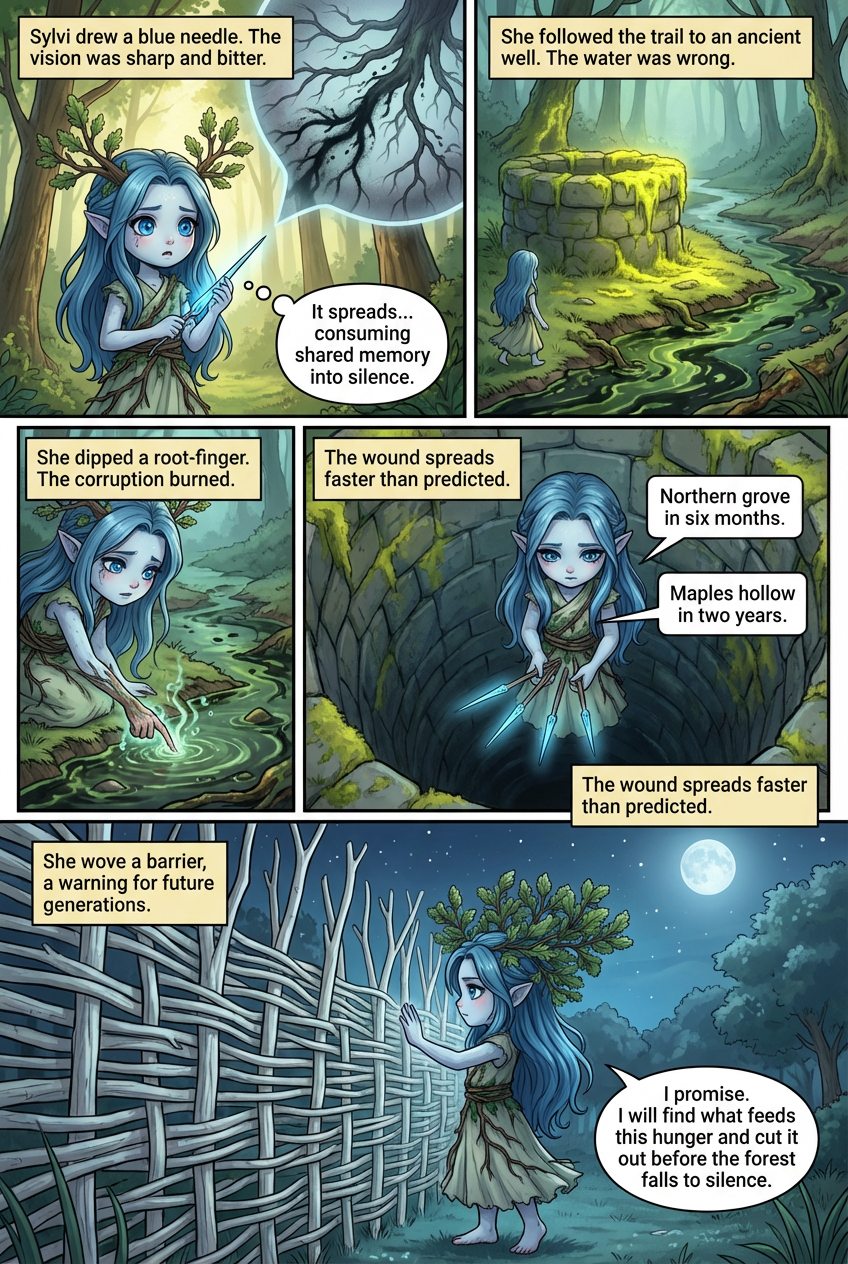
Sylvi draws a blue needle from her bark and holds it to the light. The vision arrives sharp and bitter—a dark stain spreading through root networks, consuming faster than anything she has seen in three thousand years. This corruption moves with purpose, with hunger. It devours the connections between trees, turning shared memory into silence. She follows the vision's trail to an ancient well, its stones covered in moss that glows sickly yellow-green. The corrupted stream nearby runs thick as oil, greenish-black water eating at the banks. The smell is wrong—sweet rot instead of clean earth. She kneels at the stream's edge and dips a root-finger into the water. The corruption burns. The well shaft drops deep into the forest's heart, where the oldest root networks meet and share their knowledge. Sylvi pulls three more needles from her bark. Each one shows the same truth—the wound spreads faster than her visions predicted. In six months, it will consume the northern grove. In two years, the maples will stop weeping because they will be hollow. She weaves pale branches into a barrier at the corruption's center, working through the night. The marker stands twice her height, a warning woven from living wood. Future generations will know this place as the point where the wound began. Sylvi presses her palm against the barrier and speaks the first words of a promise—she will find what feeds this hunger and cut it out before the forest falls to silence.
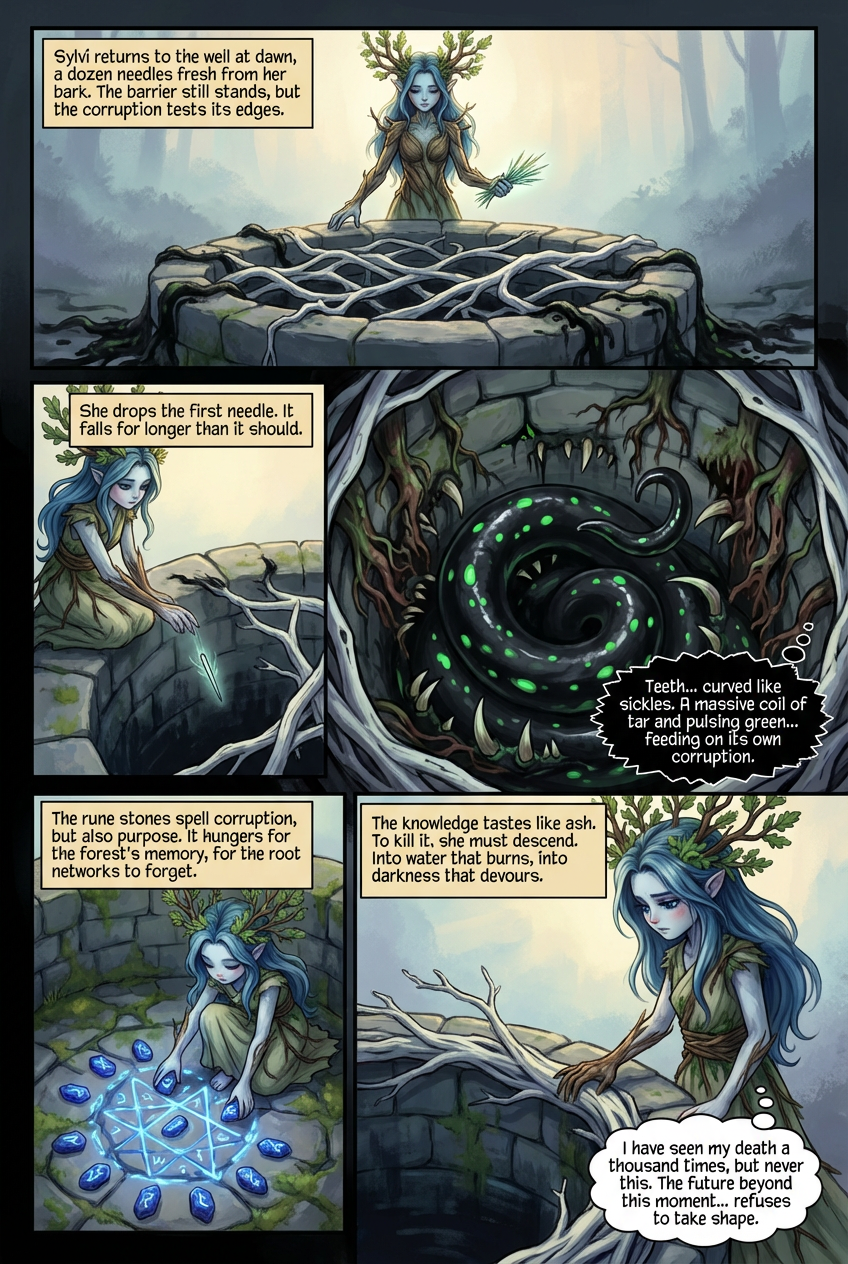
Sylvi returns to the well at dawn, carrying a dozen needles pulled fresh from her bark. The barrier of pale branches still stands where she wove it, but the corruption has already tested its edges. She kneels at the well's mouth and drops the first needle into the darkness below. The needle falls for longer than it should. When the vision comes, it shows her teeth—rows and rows of them, curved like sickles. Something massive coils at the bottom where the oldest roots converge, its body slick and black as tar. Dark green spots pulse across its hide in rhythm with the forest's dying heartbeat. The creature feeds on the corruption it creates, growing fat on poisoned water and rotting wood. Thick roots burst from the well's walls, their bark split open and weeping amber that reeks of gangrene. She pulls more needles and lets them fall, searching for the creature's origin. Each vision shows the same truth—it wasn't born here. Something brought it, or something made it. She pulls her rune stones from the moss pouch at her side and spreads them on the ancient stones circling the well. The lapis lazuli catches the dawn light, each carved symbol glowing faint blue. She speaks the old words, the ones that predate human language, and watches the stones settle into their pattern. They spell corruption, but also purpose. The creature doesn't feed randomly—it hungers for the connections between trees, for the shared memory in the root networks. It wants the forest to forget itself. Sylvi gathers the stones with shaking hands. She knows what must come next, and the knowledge tastes like ash. The creature is too deep to reach with branches or words. To kill it, she will need to descend into the well itself, into water that burns and darkness that devours light. She has seen her own death a thousand times in a thousand needles, but never this one. The future beyond this moment refuses to take shape. She stands and places one root-hand on the barrier she wove. If she fails, at least this warning will remain. If she succeeds, the maples might still weep for their grandchildren instead of falling to silence.
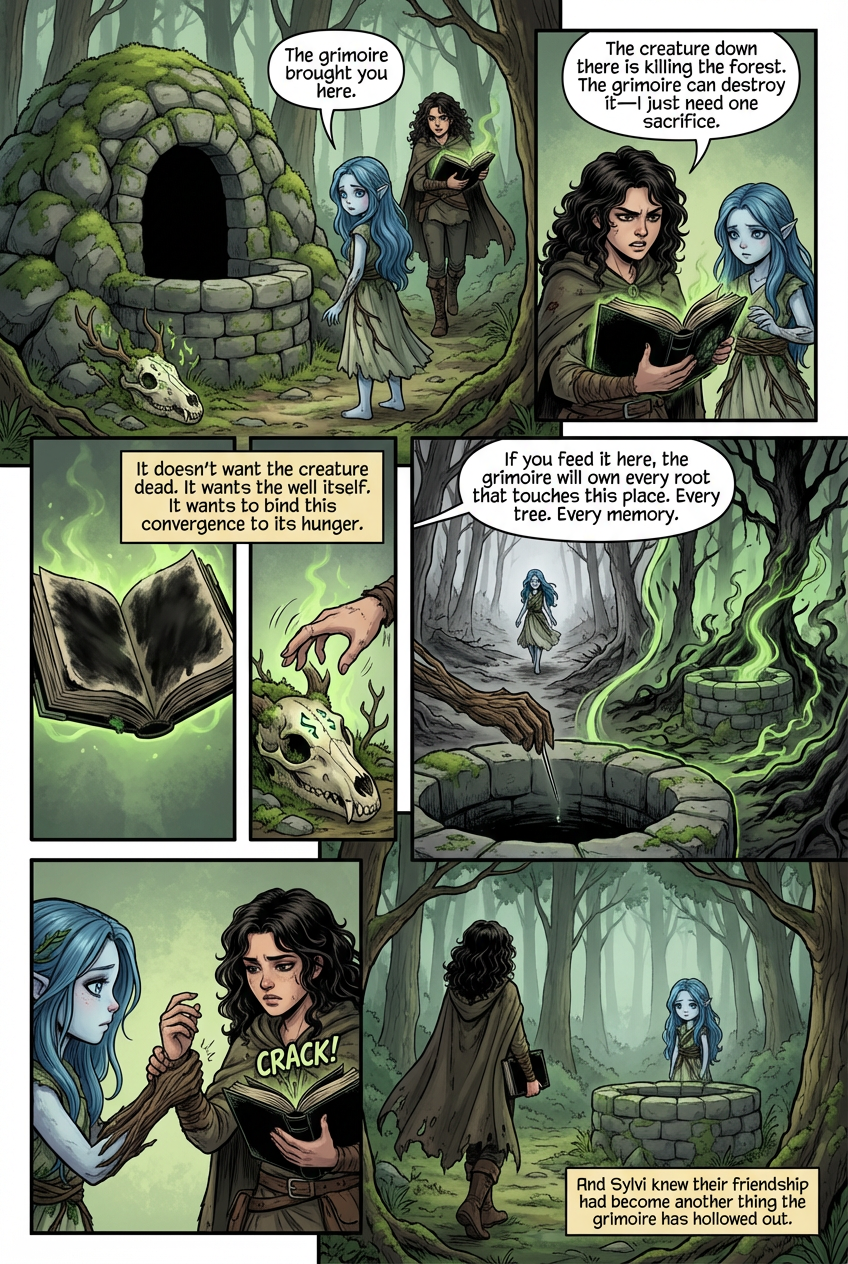
Sylvi stands at the edge of the well, preparing her descent, when footsteps crack through the underbrush behind her. She turns to see Moira approaching through the trees, the grimoire clutched against her chest. Its leather cover gleams wet and black in the morning light. A stone dome has grown around the well's mouth since Sylvi wove her barrier—moss-covered rocks stacked in careful rings, narrowing the entrance to a dark arch barely wide enough for one body. The forest built it without her asking, piling stone upon stone to seal what waits below. At its base sits a coyote skull marked with glowing runes, moss sprouting from its eye sockets. Moira's work. Moira's claim. Sylvi steps between her friend and the well. "The grimoire brought you here." Not a question. The book rests open in Moira's hands, its pages blackened and empty, radiating that sickly green haze. It needs to feed. "You cannot give it what it wants. Not here. Not for this." Moira's jaw tightens. "The creature down there is killing the forest. The grimoire can destroy it—I just need one sacrifice. One life to save thousands." She reaches for the skull at her feet, and Sylvi sees the trap crystal-clear. The grimoire doesn't want the creature dead. It wants the well itself, wants to bind this convergence of ancient roots to its hunger. Moira would trade the corruption below for corruption of a different kind, one that wears her friend's face and speaks in her voice. Sylvi pulls a needle from her bark and lets it fall into the well, watching Moira's eyes follow its descent. In the vision that blooms, she sees two futures—one where she stops Moira now and descends alone, and one where the grimoire gets what it came for. Both futures taste like ash, but only one leaves the forest's memory intact. She closes her root-hand around Moira's wrist, holding tight. "If you feed it here, the grimoire will own every root that touches this place. Every tree. Every memory the forest holds." Moira's hand trembles on the skull, then pulls away. The grimoire snaps shut with a sound like breaking bone, its pages still black, still hungry. She turns and walks back into the trees without a word, and Sylvi knows their friendship has become another thing the grimoire has hollowed out.
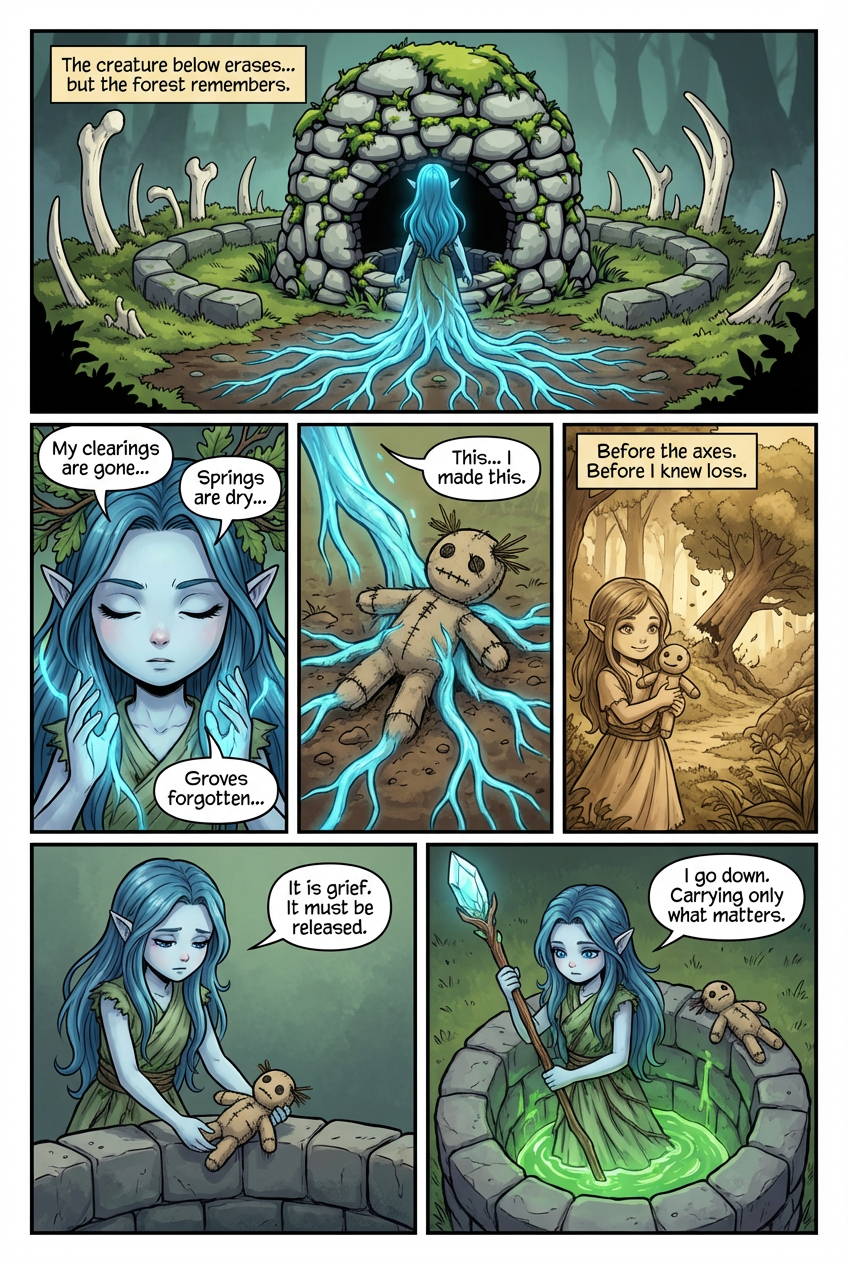
Sylvi stands alone now. The moss dome waits at her feet, stones cold and patient. Below, through the dark arch, the creature continues its work—severing connections, erasing what the forest remembers. She has stopped Moira from feeding the grimoire, but the problem remains. She presses her roots deeper into the earth, reaching through the network. The trees respond, sending her fragments—oak showing her clearings that no longer exist, maple sharing the taste of springs gone dry, birch whispering names of groves the forest has forgotten. Then something else surfaces. The roots push it up through soil and stone: a small cloth doll, seams splitting, stuffed with forest earth and pine needles. She knows this thing. She made it herself, countless seasons ago, when the forest was young and she had not yet learned what it meant to lose what you protect. The doll is a memory she buried when her mother tree fell, when the first humans came with their axes and their hunger. The creature below doesn't just erase the forest's shared memory—it devours the grief woven into those connections, the losses that taught the trees to grow deeper roots and thicker bark. Around the well's edge, the stones have arranged themselves into a perfect ring, moss filling the gaps between them. Root veins carve across each surface, straining to hold the network together against the creature's pull. Beyond the ring, scattered across the clearing, bleached bones rise through the moss—skulls and antlers and hollow ribs, white as winter. These are the forest's dead, the ones already erased from root memory, surfacing now because nothing remains below to anchor them. The doll in her hand feels heavier than it should. She has spent millennia carrying the weight of futures, of horrors not yet arrived. But this grief is older, simpler. It asks nothing of her blue needles or her visions. Sylvi places the doll at the center of the stone ring and speaks to the roots below. Not a prophecy. Not a warning. Just the truth of what she lost, and what the forest loses now, and how they are the same. The network pulses once, then goes still. The creature keeps feeding, keeps cutting, but the roots stop trying to hold every fragment. They let the dead bones rest. They release what is already gone. She understands now what must happen next—but she will descend into that well carrying only what matters, not the weight of everything the forest has ever been. The resolution settles into her heartwood like rain into thirsty soil.
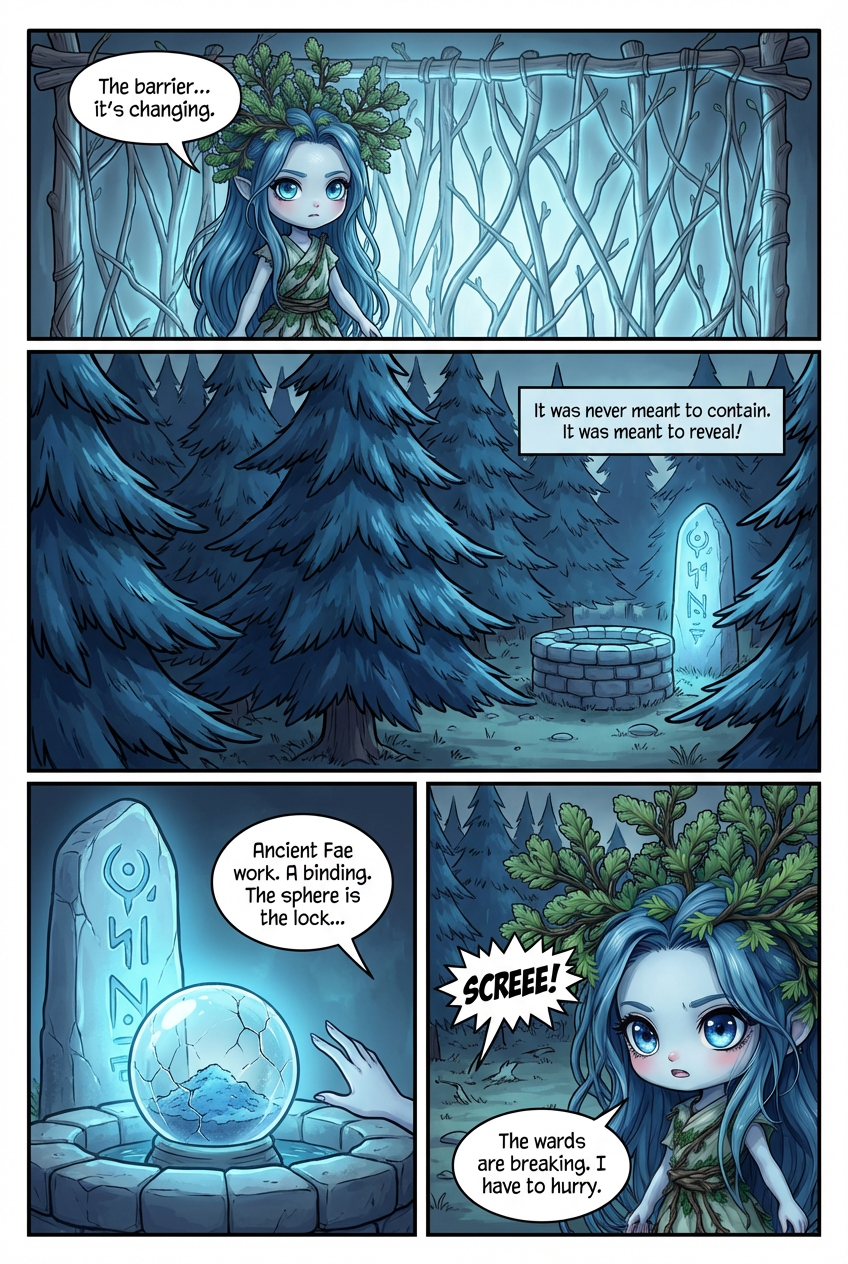
Sylvi turns back to the pale branch barrier. It stands taller now than when she first wove it, roots thickening where they pierce the earth. The branches glow faintly in the dim forest light—not with warmth, but with a cold luminescence that makes her needles ache. The light intensifies as she watches, and the barrier begins to shift. The pale branches twist and darken, needles sprouting thick and dense along every limb. Within moments, the barrier transforms into a grove of dark blue spruce, their foliage so heavy that shadows pool beneath them like spilled ink. The glow pulses from deep within their trunks, and Sylvi understands—the barrier was never meant to contain. It was meant to reveal. The well was built as a prison, and her branches have awakened its wards. She circles the well's edge and finds what the light has uncovered. A stone marker rises from the moss, taller than her trunk, carved with symbols that burn bright against the dark. Fae work, ancient beyond even her memory. The marks show a binding—something dragged from shadow and sealed beneath stone. Beside the marker, set into the well's rim, a cracked glass sphere holds blue ash that flickers with the same cold light. The sphere's stone base bears the same symbols as the marker. This was the lock. Her barrier was the key. The creature below screams—not sound, but pressure that ripples through every root. It knows it has been seen for what it is. The corruption stops spreading. The root networks go quiet, waiting. Sylvi has succeeded in forcing the truth into the open, but the cost arrives swiftly: the old wards are breaking. Cracks spider across the glass sphere, and the marker's glow dims with each pulse. Whatever the fae sealed below will not stay contained much longer. She has days now, maybe less, and the creature knows she is coming.
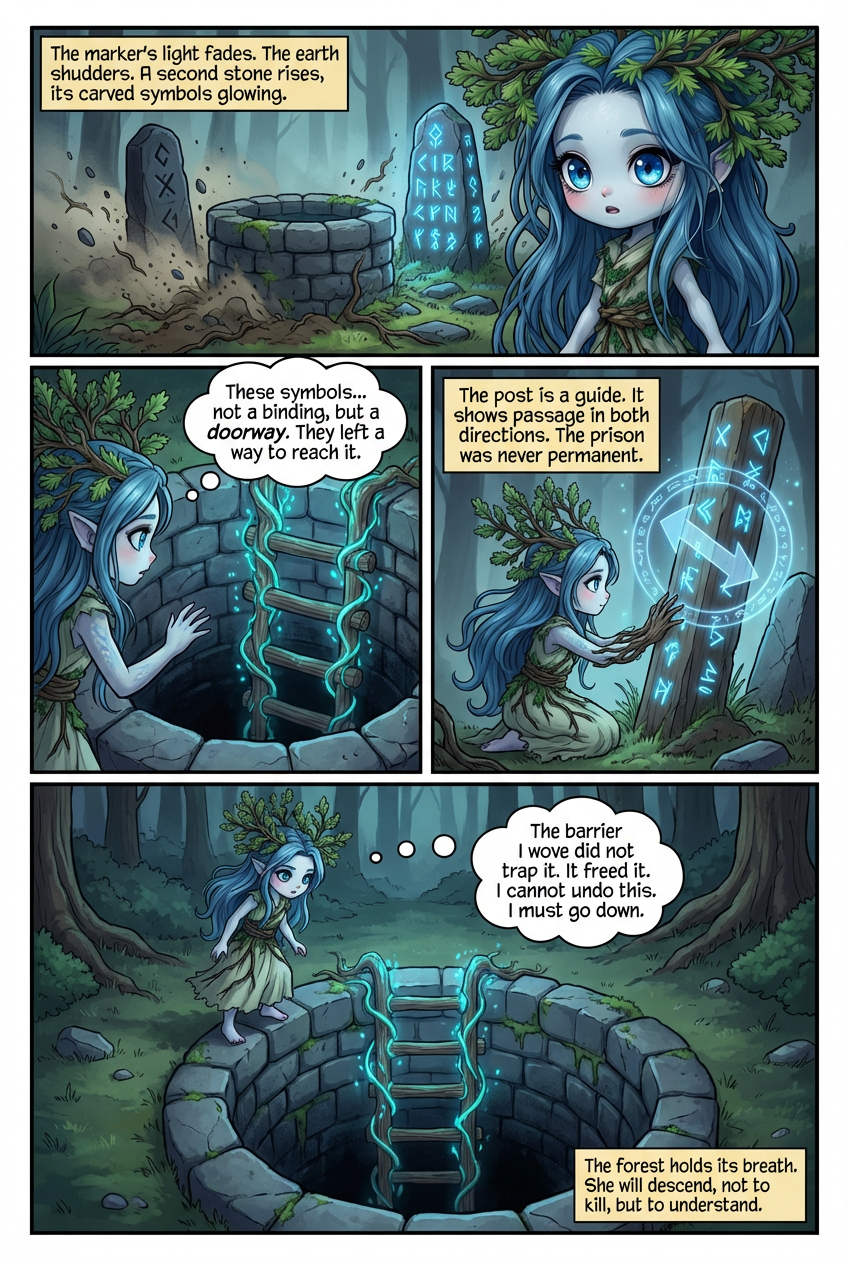
The marker's light fades to nothing. The earth around the well shudders, roots snapping beneath the surface. A second stone rises from the moss beside the first, taller and wider, its carved symbols glowing with the same cold blue as the ash. Sylvi studies the new marker. The symbols are different here—not a binding like the first stone, but a threshold. A doorway meant to open. Between the two markers, the well's mouth begins to change. Wooden rungs emerge from the stone wall, wrapped in living roots that pulse with faint light. The ladder descends into darkness, each step solid and waiting. This was built for someone to climb down. The fae did not just seal something below. They left a way to reach it. A wooden post stands half-buried in moss near the second marker, its surface carved with the same threshold symbols. Sylvi presses her roots against it. The wood is ancient but not dead—it hums with purpose, a guide left behind. The post shows her what the doorway means: passage in both directions. Whatever was sealed below was meant to be visited, tended, perhaps even released under the right conditions. The prison was never permanent. The creature stirs at the bottom of the well, its presence heavy with awareness. It knows the wards are breaking. It knows the doorway is open. Sylvi pulls back from the post, her visions fracturing into a thousand futures—all of them showing the same truth. The fae built this prison with a key she has already turned. The barrier she wove did not trap the creature. It freed it. She cannot undo what she has done, but she can still choose what happens next. The ladder waits. The forest holds its breath. She will descend, but not to kill. She will descend to understand what the fae meant to guard—and why they left a door.
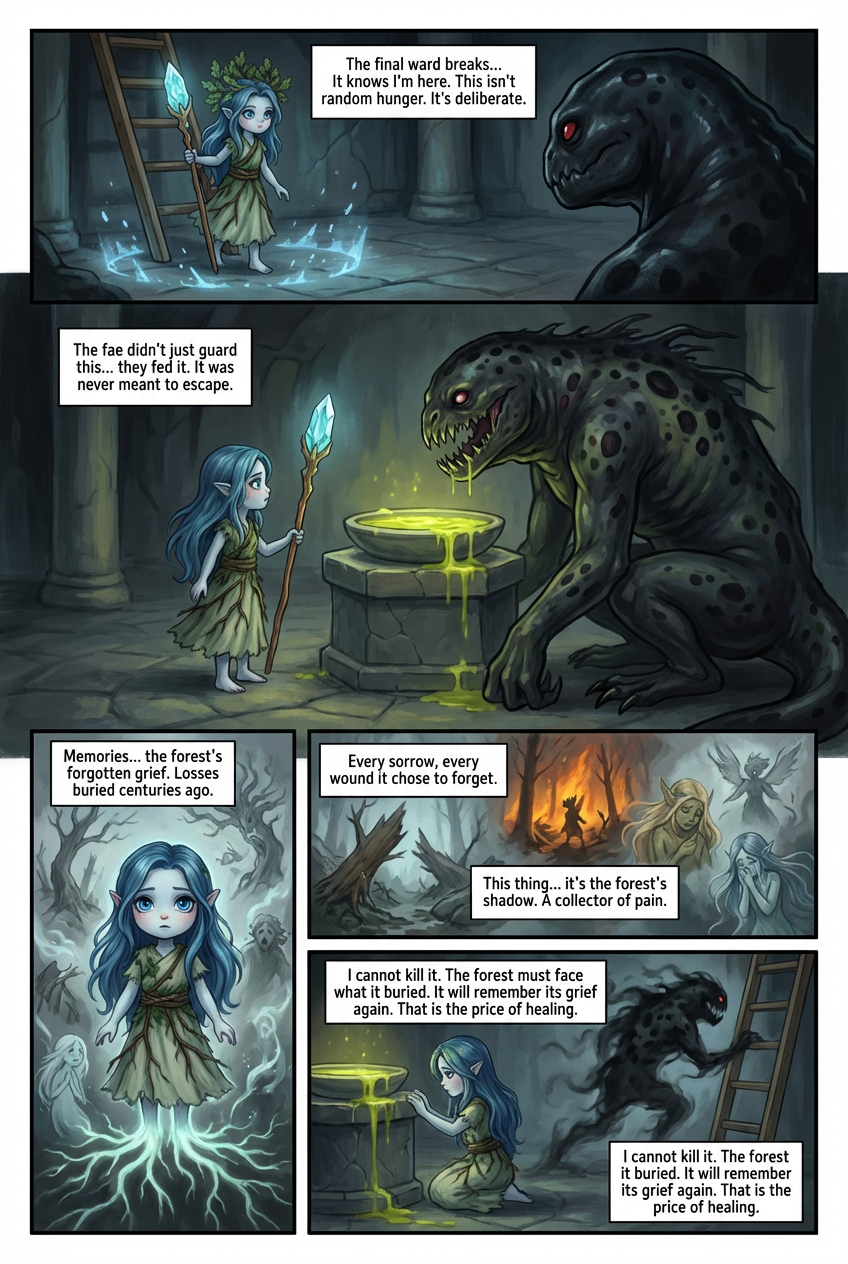
Sylvi reaches the bottom rung just as the final ward breaks and the creature turns to face her. The darkness shifts, and she feels its attention like cold water against her roots. This close, the corruption is not random hunger—it is deliberate, shaped, alive with purpose beyond mere feeding. The chamber opens before her, carved from living stone. An altar stands at its center, its basin thick with stagnant water and slime that glows faint yellow-green. The creature crouches beside it—oily black skin stretched over massive limbs, dark sickly spots marking its hide, tiny red eyes fixed on her. It does not move to attack. It waits, watching her with something that feels almost like recognition. Sylvi holds the crystal-tipped branch she brought from above, its clear quartz catching what little light remains. She came to understand what the fae guarded. Now she knows. This thing was never meant to escape. It was meant to be fed. The creature's mouth opens, revealing rows of jagged teeth. But no sound comes. Instead, memory floods through the roots beneath her—fragments of grief the forest has forgotten, losses she buried centuries ago, pain the trees no longer carry. The creature does not speak. It shows her what it has consumed. Every sorrow the forest released, every tragedy it chose to forget, every wound it let go. The corruption was never destruction. It was collection. The fae built this prison to hold what the forest could not bear to remember. Sylvi lowers the branch. She cannot kill this thing. It is the forest's shadow, its necessary darkness. The corruption will continue to spread if she leaves it sealed here, feeding on grief through the roots. But if she opens the threshold completely, if she lets it surface, the forest will have to face what it buried. She presses her roots against the altar's edge and speaks the words carved on the markers above. The basin cracks. The water drains away. The creature rises, its form already shifting, becoming less solid, more like smoke. It moves past her toward the ladder, and she does not stop it. The forest will remember its grief again. That is the price of healing.
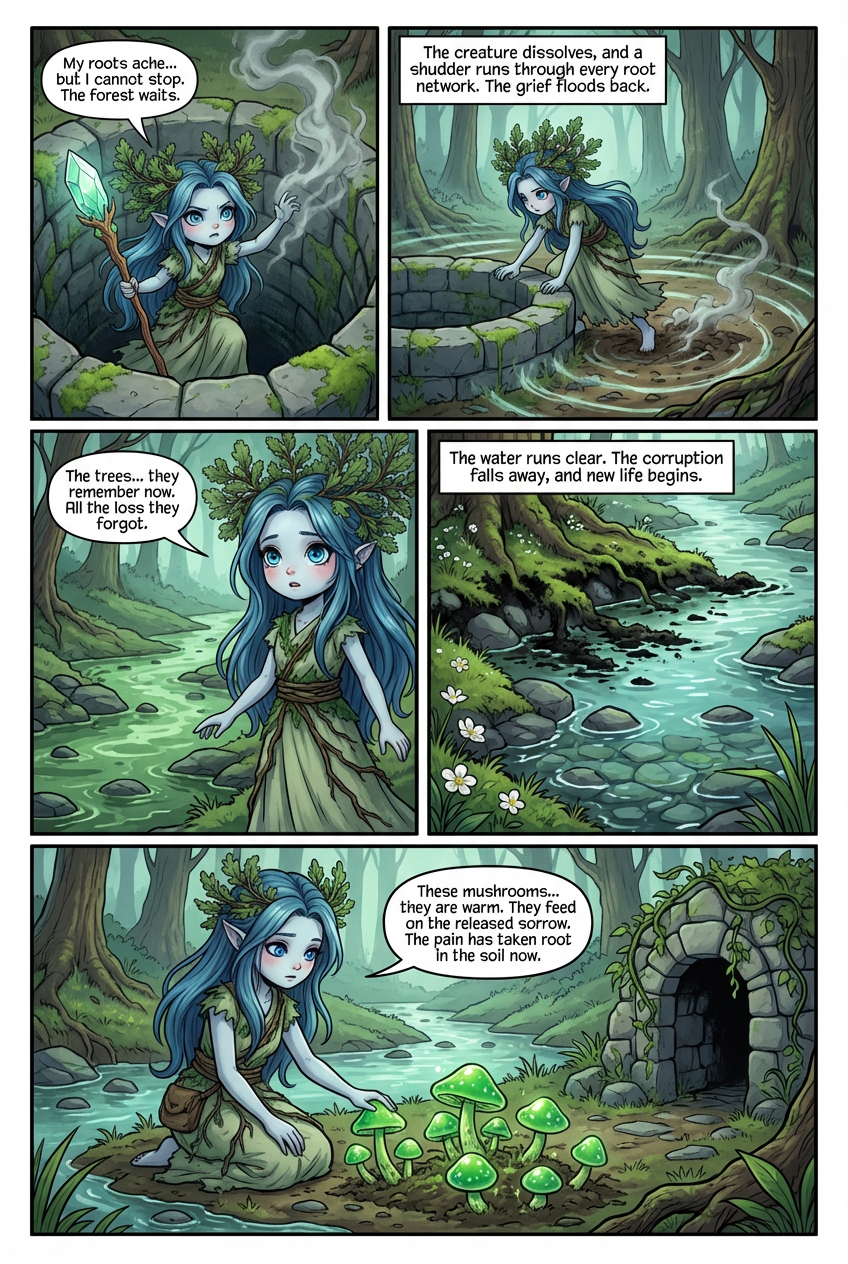
Sylvi follows the creature up through the well shaft, climbing slowly behind its shifting smoke-like form. Her roots ache with each rung, but she does not stop. The forest above waits in silence, unaware of what rises toward it. The creature passes through the well's rim and dissolves into the soil like water into sand. Sylvi pulls herself onto solid ground and feels it happen—a shudder through every root network, carrying the creature's burden outward. The grief floods back into the forest's memory all at once. Trees that forgot their losses remember them again. She stands beside the corrupted stream and watches it change. The yellow-green moss blackens and falls away. The water runs clear for the first time in centuries, pooling around stones that gleam like new bone. Small white flowers push up through the mud along its banks, their petals still wet from being born. But something else stirs in the streambed where the corruption drained away. Mushrooms cluster in the damp soil, their caps bright green and glistening. They spread fast, growing from spores the creature left behind—not poison, but something that feeds on released sorrow. Sylvi kneels and touches one cap. It pulses warm beneath her bark. The forest gave up its grief, but grief does not simply vanish. It transforms. These mushrooms will carry what the trees could not, rooting the pain in soil instead of memory. The corruption is gone, but this new growth remains, alive and hungry in its own way. She rises and finds a small stone shelter forming at the stream's edge, its walls wrapped in climbing vines that were not there moments before. The forest is already reshaping itself around the place where the prison broke open, building a marker over the threshold. Sylvi places her hand against the cool stone. The creature is gone, spread thin through every root. The stream runs clear. But the mushrooms keep growing, and she knows they will not stop. The forest is healing, but healing leaves scars. She will have to watch this new life carefully, to see what it becomes when fed on old pain. The arc goal moves forward—balance is returning—but the cost of remembering has taken root in ways she cannot yet predict.
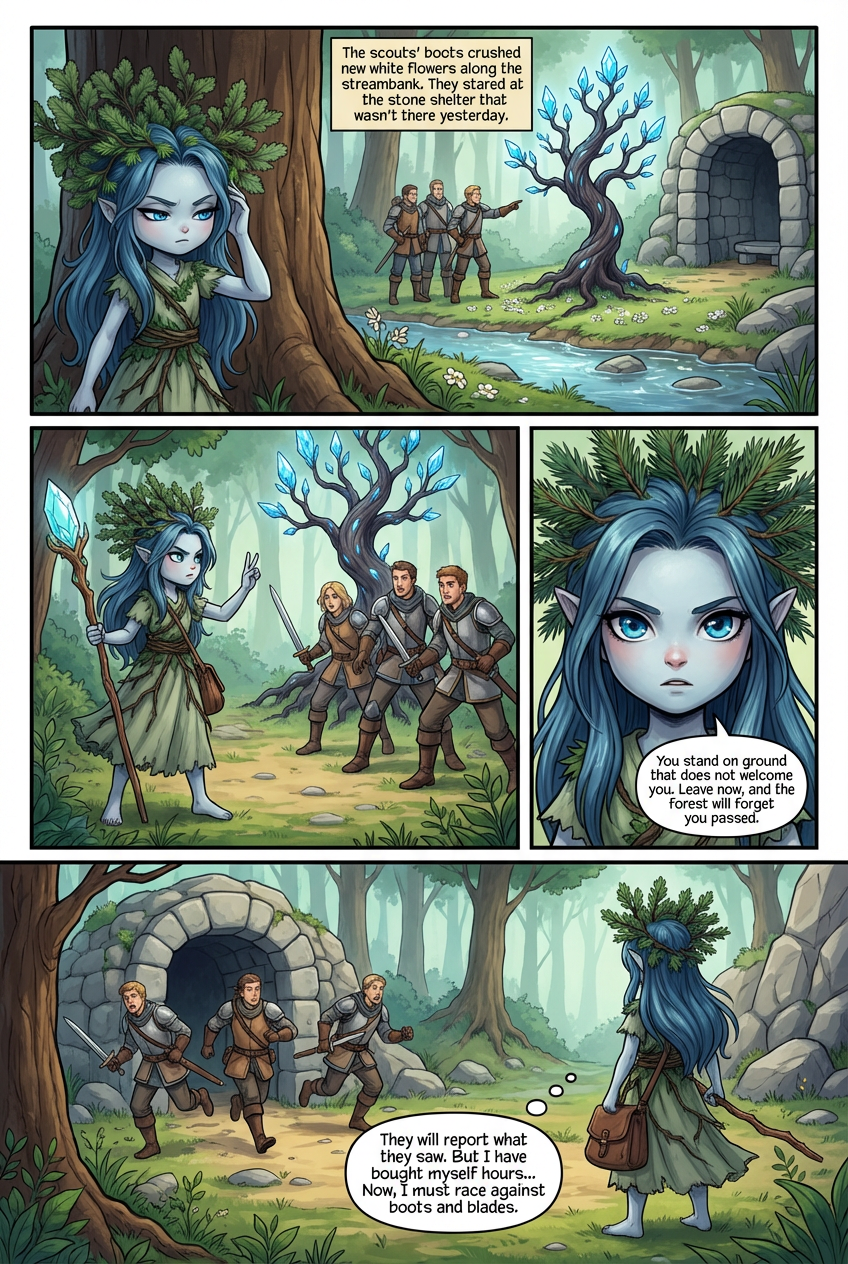
Sylvi feels the scouts before she sees them. Their boots crush the new white flowers along the streambank, and their voices carry through roots that still tremble with returned grief. Three of them stand at the well's edge, staring at the stone shelter that wasn't there yesterday. She moves toward them through the undergrowth, her bag of mushroom leather pressed against her side. Inside it, the crystal jar of moon flower pollen waits—the ingredient she needs to awaken the dryad's spirit tree in the northern grove before the Crown's wagons roll through. But the scouts have found the well first, drawn by the twisted tree that sprouted overnight where the creature dissolved into soil. Its dark trunk gleams with eerie blue crystals, branches reaching skyward like grasping fingers. They cannot miss it. They will not leave it unreported. Sylvi steps into the clearing. The scouts turn, hands moving to their weapons. She raises her roots in a gesture of peace, though her needles show her what comes next—a scout tower of wood and stone rising at the forest's edge, forty guards marching from the quarry, the northern grove trampled under their boots. She can stop these three from leaving. The forest would help her. But killing them will bring the others faster, and she will lose the time she needs to reach the grove. She speaks instead, her voice carrying the weight of ancient bark. "You stand on ground that does not welcome you. Leave now, and the forest will forget you passed." The scouts exchange glances. One of them laughs, but it sounds uncertain. They back away slowly, weapons still drawn, eyes fixed on the twisted tree behind her. When they reach the streambank, they turn and run. Sylvi watches them go, knowing what she has chosen. They will report what they saw. The Crown will come with more than three. But she has bought herself hours, maybe a day, and that must be enough. She grips the leather bag and starts north through the trees, moving fast. The grove waits, unprotected. The moon flower pollen will wake the dryad's spirit, but only if she reaches it before the Crown does. The arc goal remains—restoring balance to the corrupted woodland—but now she must race against boots and blades to finish what the creature's release began.
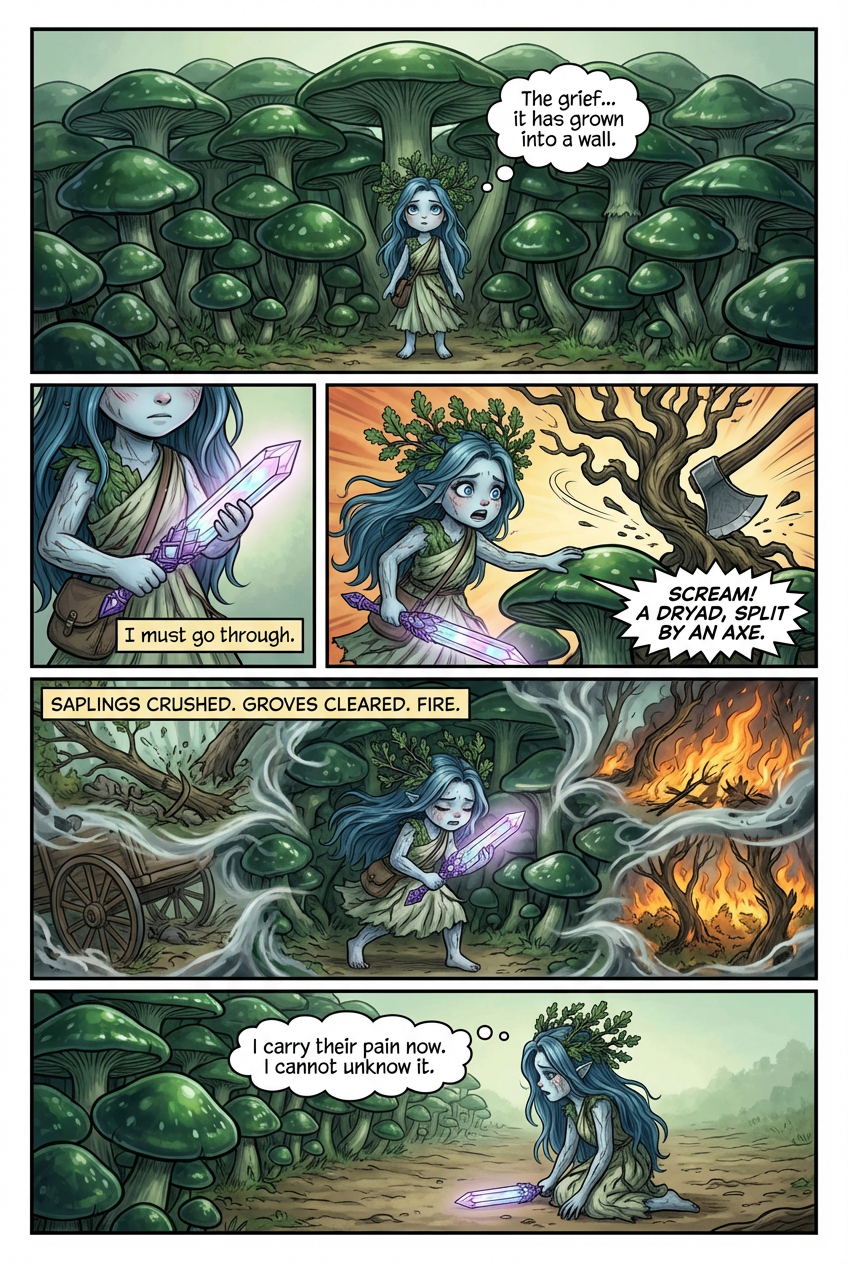
The path north cuts through dense undergrowth where the forest floor has changed. Green mushrooms crowd the ground in thick patches, their caps glossy and swollen. They weren't here three days ago. They spread from where the creature dissolved, feeding on the grief it returned to the roots. Sylvi reaches the barrier at midday. The mushrooms rise before her in a wall taller than her oldest branches, their stems twisted together like woven fingers. Dark green caps form a ceiling overhead, blocking the sky. The air beneath them tastes thick and wet. She pulls a needle from her bark and watches it darken—the barrier carries memory, the forest's worst wounds pressed into fungal flesh. Walking through will force her to live each one. But the northern path runs straight through the center, and going around will cost her the day she bought from the scouts. She reaches into her bag and closes her roots around the crystal wand she took from the fae prison. Its pastel glow warms against her bark. She steps into the barrier. The first cap brushes her shoulder and the forest screams. Fire roars through her heartwood—she sees the gnarled tree that was once a dryad, its branches twisted into claws, its trunk split by the axe that killed it. She feels the blade sink deep, hears the wood cry out. The vision floods her senses until she can't tell where the dead dryad ends and her own bark begins. She grips the wand tighter and pushes forward. Another cap touches her, and she drowns in the memory of saplings crushed under wagon wheels, their roots torn from soil that will never hold them again. Sylvi staggers through the barrier step by step, each mushroom forcing another wound into her mind. She sees clearings where groves once stood. She feels roots severed by plows. She tastes smoke from fires set by hands that did not ask permission. The wand's glow dims in her grip, but she does not let go. When she finally breaks through the far side, she falls to her knees on clean soil. The northern path stretches ahead, empty and waiting. Behind her, the barrier pulses with the forest's grief, holding every loss she just endured. She has crossed it, but the memories cling to her bark like sap. She knows now what the forest carries, what it tried to forget. And she cannot unknow it.
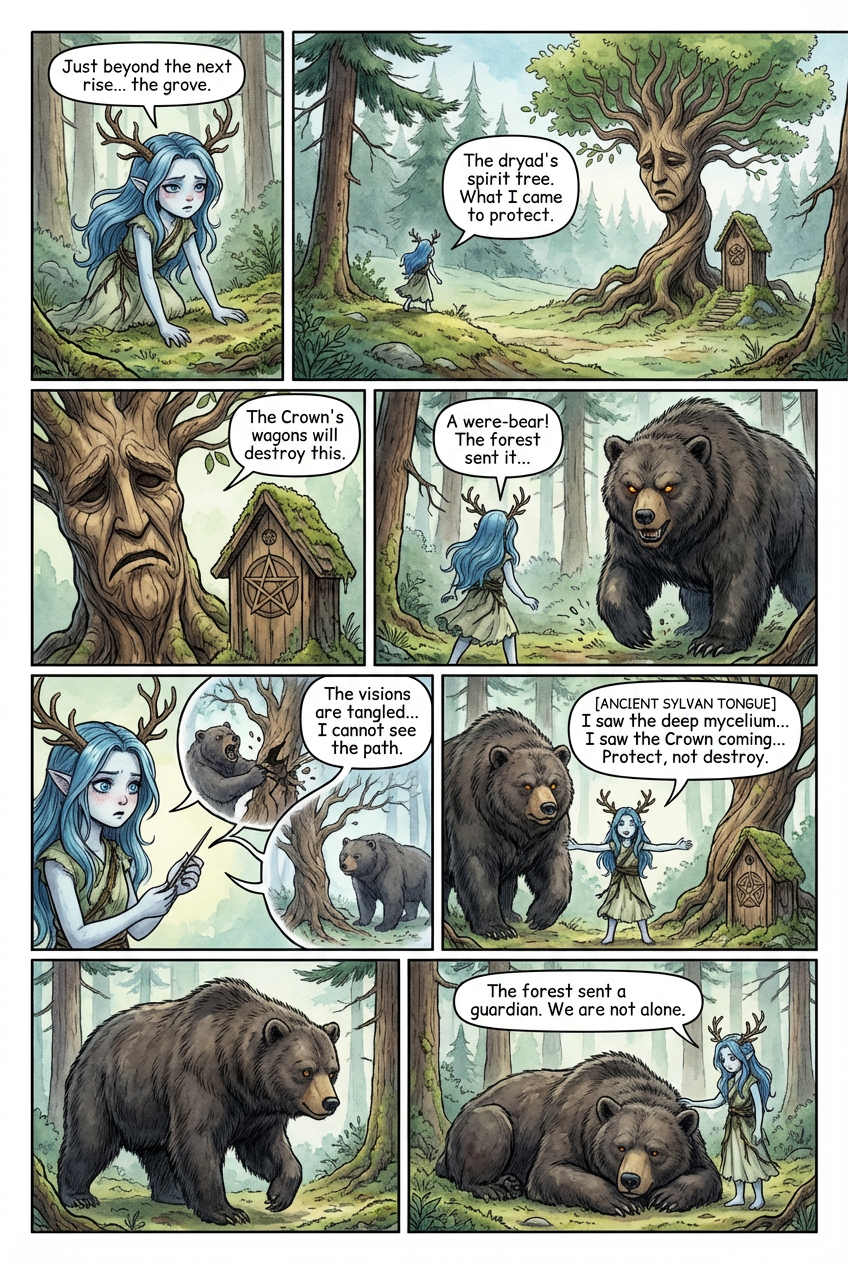
Sylvi pulls herself from the ground and forces her roots to move. The northern path stretches ahead through quiet pines. The forest feels different here—older, more still. She knows the grove lies close now, just beyond the next rise. She crests the hill and stops. The dryad's spirit tree stands in the center of a small clearing, its form twisted into the shape of a woman with branches for hair and bark for skin. Green leaves sprout from her outstretched arms. Her face shows sorrow carved deep into the wood—eyes closed, mouth bent in grief. A wooden shrine sits at her base, its door marked with a carved star. The structure looks ancient, its roof thick with moss and ivy. This is what she ran to protect. This is what the Crown will destroy if their wagons reach the grove. Then the ground shakes. Something massive moves through the trees to her left. Sylvi turns and sees it emerge from the shadows—a creature twice her height, covered in dark fur and muscle. Its eyes glow amber. Its teeth gleam white in its open mouth. A were-bear, awakened and walking the old paths. The forest sent it here along the mycelium she saw forming days ago. It moves toward the spirit tree with heavy steps that crack the earth. Sylvi pulls a needle and watches it darken with futures—half show the creature tearing the tree apart, half show it standing guard. The visions split and tangle. She cannot tell which path it will take. Sylvi steps between the creature and the tree. She spreads her branches wide and speaks the oldest words she knows—the language her mother tree taught her before humans learned to count. The were-bear stops. Its eyes fix on her. She tells it what she saw beneath the well, what she released into the roots, what the forest now carries in its memory. She tells it the Crown is coming. She tells it the tree needs protection, not destruction. The creature's breathing slows. It lowers its head and moves past her to stand before the shrine. It settles onto the ground like a boulder and does not move again. Sylvi feels her heartwood loosen. The forest has sent a guardian. Whatever comes next, the spirit tree will not face it alone.

Sylvi watches the were-bear settle into guard position. The spirit tree stands safe for now, but her visions still darken with smoke and iron. She pulls another needle and sees what comes next—the Crown's lead wagon, heavy with soldiers and chains, breaking through the treeline within the hour. The wagon appears exactly as foretold. Two brown horses pull it through the pines, their hooves loud against the forest floor. Canvas stretched over oak beams hides whatever cargo the Crown carries inside. Sylvi counts eight soldiers walking beside it, weapons ready. They move toward the clearing where the spirit tree stands exposed. The were-bear rises from its position and steps forward, placing itself between the wagon and the shrine. Its amber eyes glow brighter. The soldiers halt. Their captain raises a fist and the wagon stops. Sylvi knows she cannot fight eight armed men. The were-bear could kill them all, but more would come—a full company next time, or worse. She needs to stop the wagon without spilling blood that would draw greater vengeance. She reaches into the soil with her deepest roots and calls to the stones beneath. The earth remembers structures that stood here long before humans walked these paths. She whispers to foundations buried under centuries of leaf fall. The ground trembles. Ancient stones push upward between the wagon and the clearing, rising from dirt and moss. They lock together with grinding sounds until a weathered arch blocks the path completely. Vines curl around the stones. Grass sprouts between scattered rubble at its base. The captain stares at the arch. He turns to his men and gestures back toward the treeline. The wagon wheels creak as the horses pull it in retreat. Sylvi feels her heartwood steady as they disappear into the forest. The arch will not hold forever—the Crown will find another route or bring tools to tear it down. But she has bought time. The spirit tree stands unharmed behind its guardian. The moon flower pollen remains safe in her branches, waiting for the moment when she can finally wake the dryad and restore what has been lost. She has not won, but she has not failed. The grove still breathes.
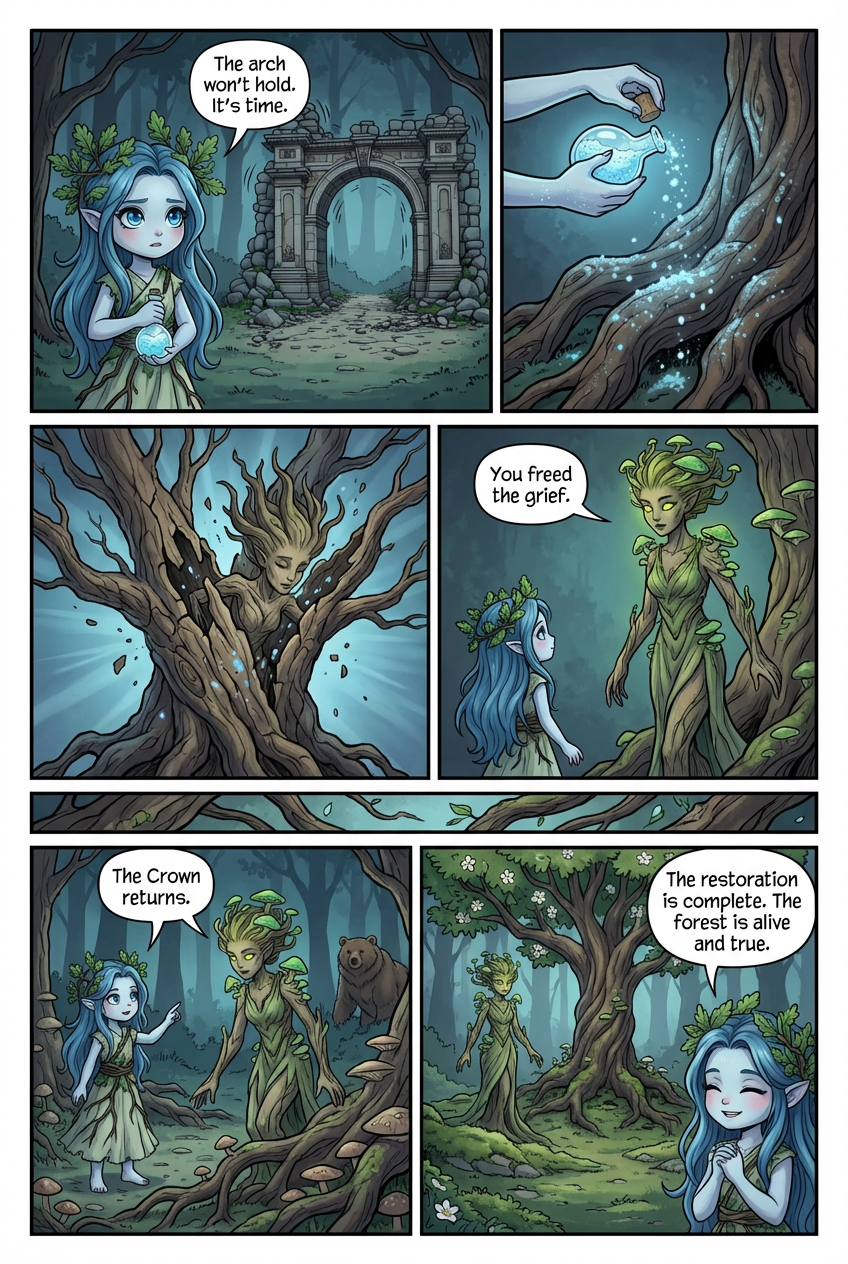
Sylvi feels the arch trembling behind her. The stones will not hold much longer—her visions show cracks spreading within days. She turns to the spirit tree and withdraws the flask from her pouch. The pale blue pollen glows through the glass, casting silver light across the clearing. She has carried this burden across corrupted streams and through barriers of mushroom memory. Now she uncorks the vessel and pours. The pollen drifts down like snow, settling into the twisted bark. It sinks into the wood's grooves and vanishes. The spirit tree shivers. Bark splits with sharp cracks. Wood unfolds, revealing pale skin beneath. A figure emerges—branch-limbs straightening, wooden features softening into a face. The dryad opens her eyes. They glow yellow-green, the same sickly color Sylvi saw at the corrupted well. Green mushrooms sprout from her shoulders and crown her head. She steps free of the tree and looks at Sylvi with recognition. "You freed the grief," the dryad says. Her voice carries centuries of weight. "Now I hold it all." Sylvi understands. The pain had to go somewhere when the creature dissolved. The dryad absorbed every buried sorrow, every forgotten loss. She is not corrupted—she is complete. "The Crown returns," Sylvi says. The dryad nods and places her hand against the ground. Roots surge upward, weaving into walls around the clearing. Where she walks, mushroom circles bloom. The were-bear watches but does not flee. It knows a true guardian when it sees one. The spirit tree begins to change. Its twisted form straightens, silver bark spreading across dark wood. Light green buds appear on branches that had been bare. White flowers bloom at its base, petals opening to catch moonlight filtering through the canopy. The transformation spreads outward—moss grows thick and soft, small plants push through soil, the air itself seems clearer. The grove is not restored to what it was. It is something new, built from memory and grief and truth. Sylvi pulls a final needle and sees the Crown's next force arriving. They find root walls too strong to breach and mushroom barriers that turn them back. The visions show the grove standing protected, season after season, with the dryad at its heart. Sylvi has completed what she promised at the well. The corruption is not destroyed—it is transformed into something that can guard and remember. The forest will no longer bury its pain in dark places. It will wear its scars openly and grow stronger for the honesty. She looks at the dryad, who stands with mushrooms blooming from her crown and grief glowing in her eyes. This is balance. Not perfect, not pure, but alive and true. The grove breathes. The spirit tree stands tall. And Sylvi finally releases the weight she has carried since she first found the poison spreading through the roots. The restoration is complete.
Play your story to life
Storycraft is a mobile game where you create AI characters, craft items and locations to build their world, then discover what direction your story takes. Download the iOS game for free today!
Download for free