

Thundar Stormstrider's Arc
10 Chapters
Thundar Stormstrider's dream is reaching the legendary peak said to lie above all clouds and rain.

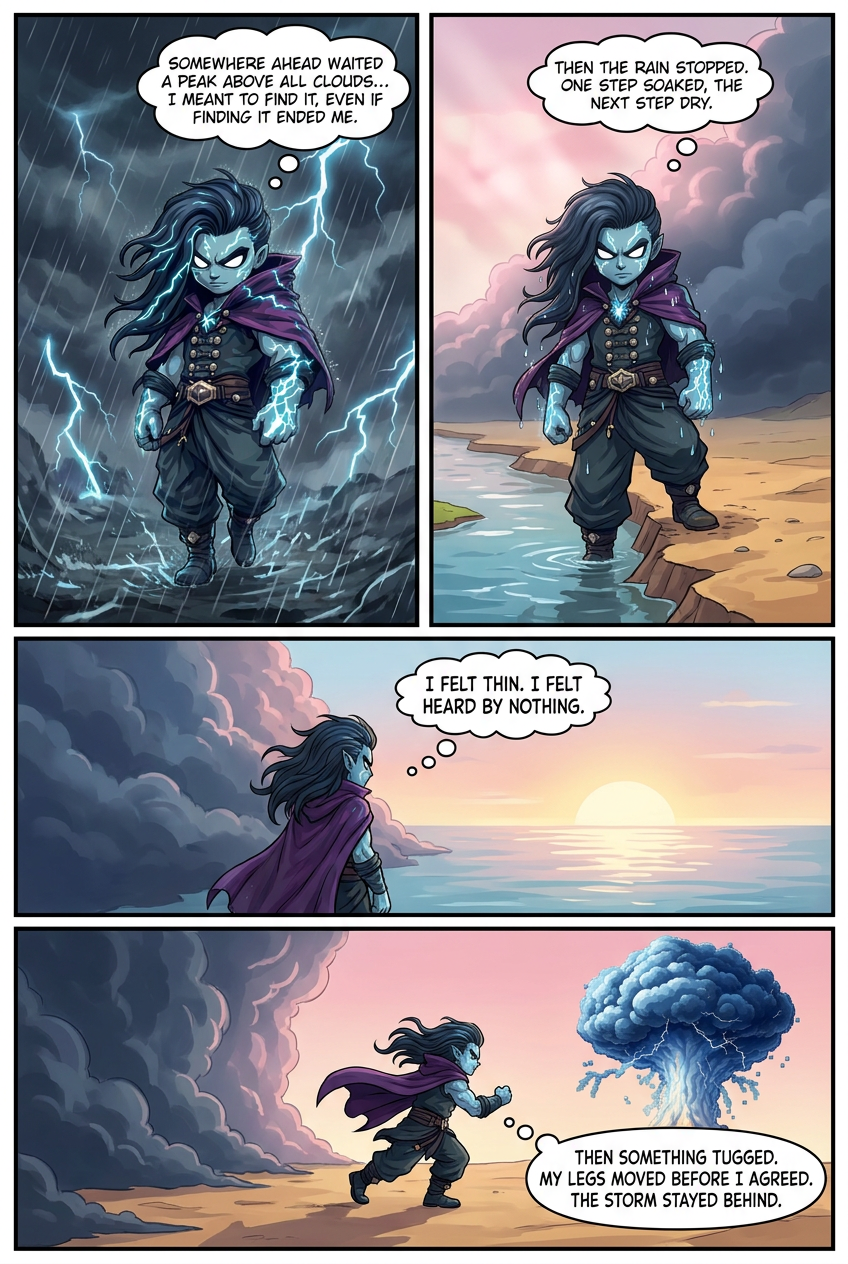
Thundar Stormstrider walked into the wall of quiet. His storm crashed around him, loud and wet, the way it had always been. He moved because moving was the only shape he knew. Somewhere ahead waited a peak above all clouds and rain, and he meant to find it, even if finding it ended him. Then the rain stopped. Not faded. Stopped. One step soaked, the next step dry. The ground split beneath his boots, half-flooded on one side, bare sand on the other. A low ridge ran along the seam like a scar, marking the exact line where his weather died. Thundar looked back. His storm hung behind him in a clean wall, sliced flat, with soft pink light bleeding through the top edge where the calm began. A few last drops clung to his shoulders and refused to fall. He felt thin. He felt heard by nothing. Then something tugged. Ahead, far past the dry line, a huge thundercloud stood pulled back on itself, crackling and bright, drawing him forward by a string he could not see. His legs moved before he agreed. He crossed the seam. The storm stayed behind.
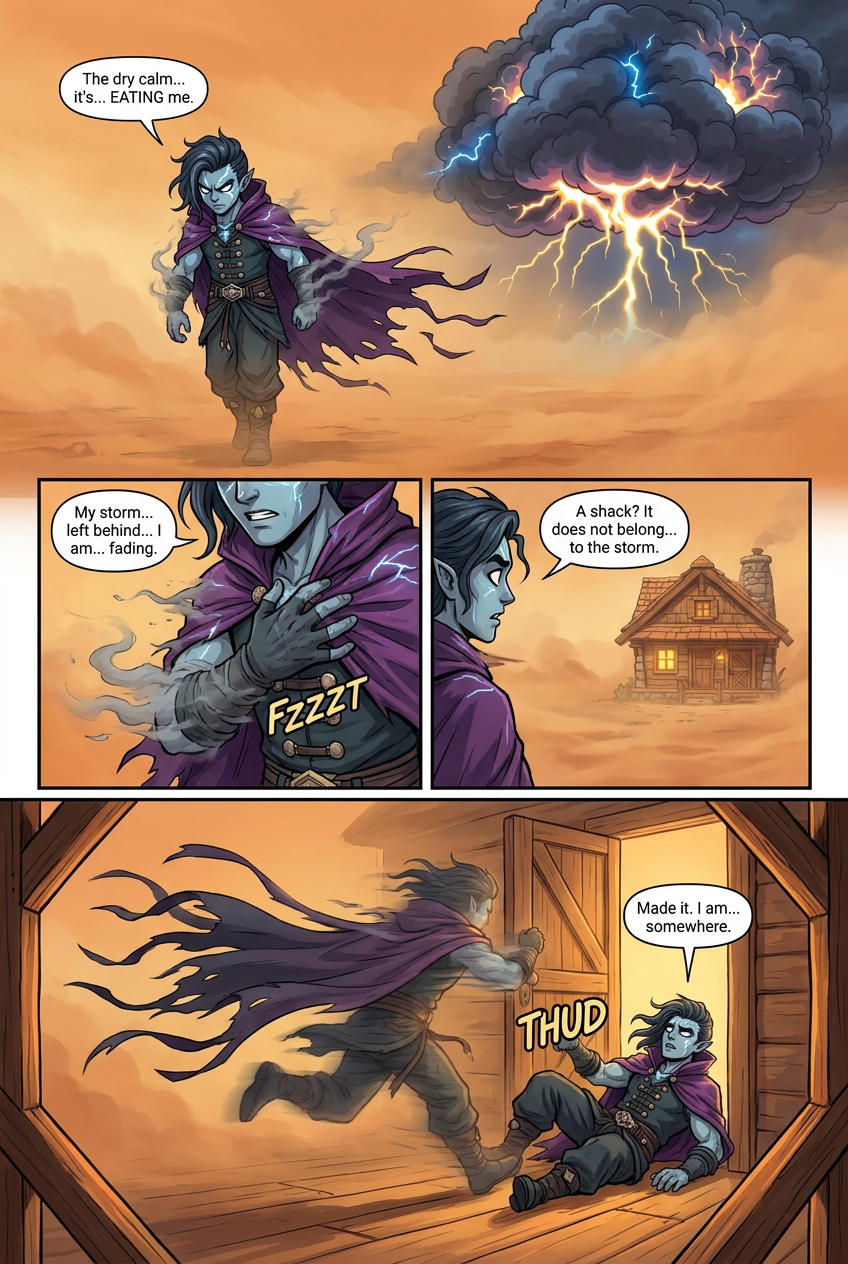
Thundar walked into the dry calm, and the dry calm began eating him. His boots still moved, but the edges of his arms blurred into thin smoke. His cape, dark and frayed and stitched with crackling lightning, lifted at the hem and started to come apart thread by thread. He looked back once. His storm hung behind the seam like a painting, a tall swirling cloud full of frozen lightning, motionless, waiting for a master who could not return. His fingers thinned to gray air. He pressed them against his chest and felt less chest to press. Without the storm, he was only weight moving through air, and now even the weight was leaking out. Then he saw the shack. A small wooden building sat in the dry calm, low roof, stone chimney, one warm window. It did not belong to any storm. It had never been rained on. He understood, plainly, that if he reached it he would have a wall to lean against while he came apart, and if he did not reach it he would simply stop. He ran. The cape shredded behind him in long dark ribbons. He hit the shack's door with a shoulder that was barely a shoulder anymore, fell inside, and lay still on dry wood. He was not dissolved. He was not whole. He was, for the first time, somewhere.
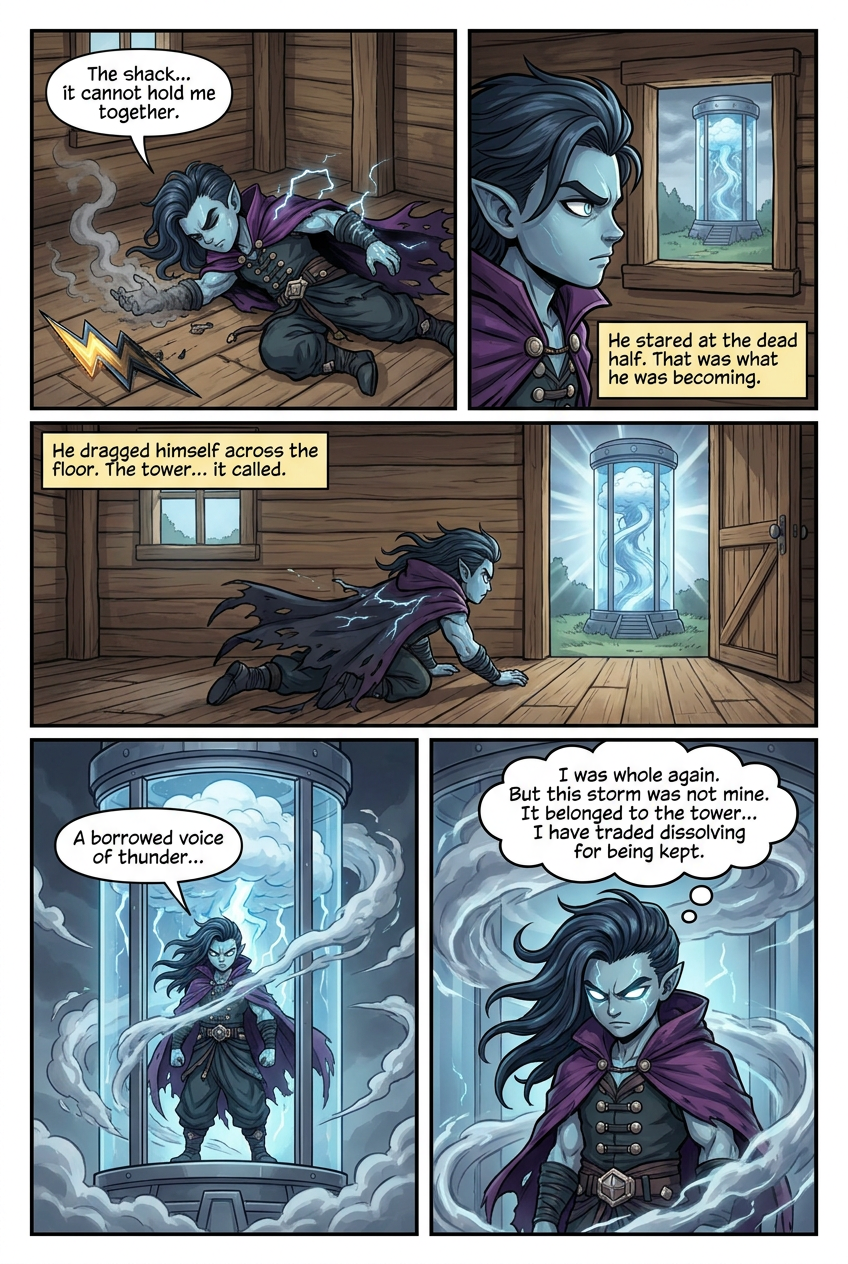
Thundar lay on the dry wood and watched his hand thin into gray smoke. The shack held him, but it could not hold him together. His tattered cloak crackled weakly, the lightning in its threads sputtering out like wet matches. On the floor beside him, a piece of his own bolt had fallen loose — one half still glowing, the other half dark and dead as stone. He stared at the dead half. That was what he was becoming. Weight without sound. He pressed his dissolving palm against the cold floor and felt the planks hum. Not wood. Glass. He pushed himself up and saw it through the back wall of the shack: a tall glass tower rising from the dry calm, a small storm spinning forever inside it. Thundar dragged himself across the floor. The door at the tower's base opened at his touch. Inside, the trapped storm pulled at him, recognized him, and the smoke at his edges slowed. He stepped onto the platform. The swirling cloud wrapped his arms, stitched his chest back into shape, and gave him a borrowed voice of thunder. He was whole again. But this storm was not his. It belonged to the tower, and the tower would not let him leave with it. Thundar stood inside the glass and understood: he had traded dissolving for being kept.
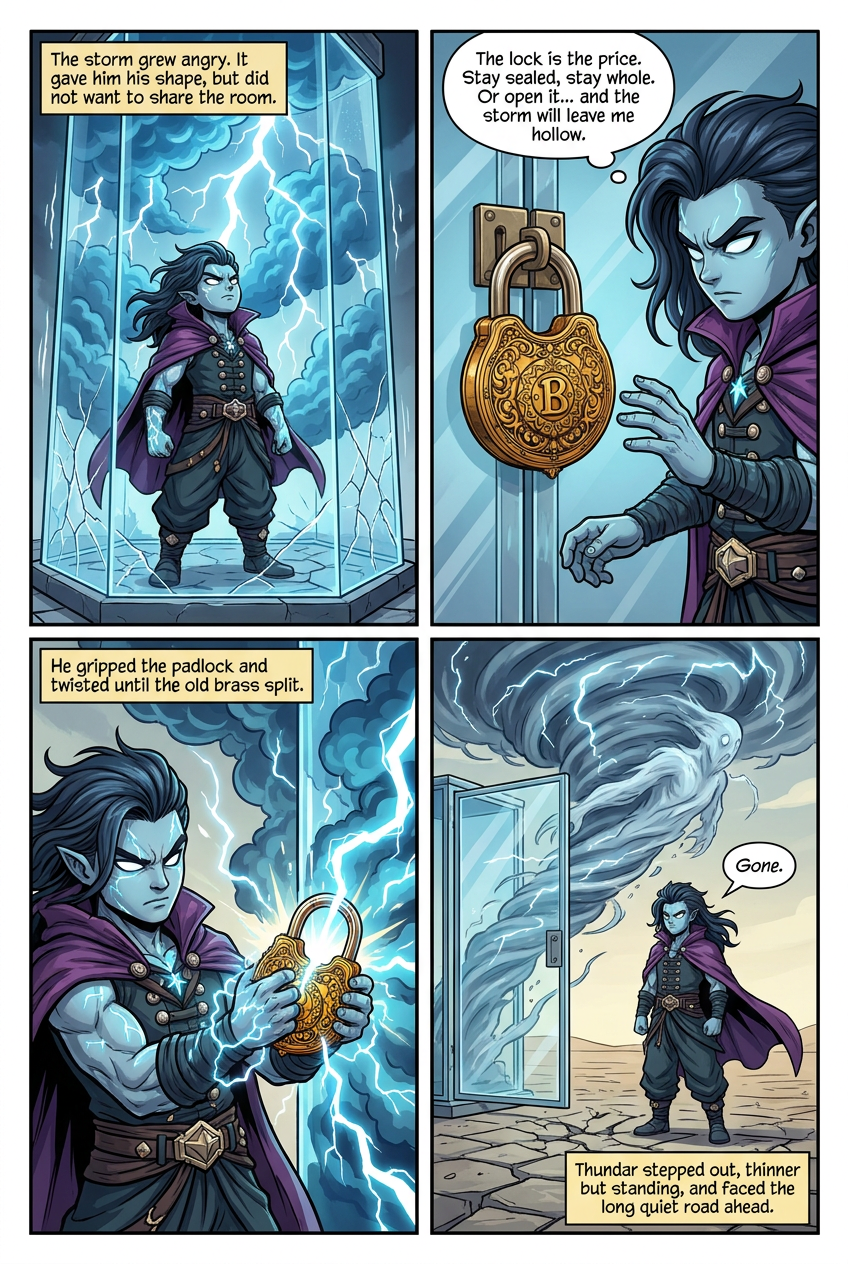
Thundar stood inside the glass and felt the storm grow angry. It had given him back his shape, but it did not want to share the room. The clouds slammed against the walls. White lightning forked across the inside of the tower and made the panes ring like struck bells. Cracks spidered out from his feet. The storm wanted out, and it did not care if he broke with it. He turned and saw the door. A heavy brass padlock now hung on the latch, ornate and warm and old. It had not been there when he stepped in. He understood at once. The lock was the price. Stay sealed, stay whole. Open it, and the storm would tear free and leave him hollow on the dry ground again. The pulses came faster. Outside, pale rings of force bent the air around the tower and shook small stones from its base. One more surge and the glass would burst on its own, and the choice would be made for him. Thundar pressed his palm flat against the cold pane. He thought of the peak above all weather. He could not reach it as a kept thing. He gripped the padlock and twisted until the old brass split. The door swung wide. The storm rushed past him in a single roaring breath and was gone into the dry sky, dragging half his thunder with it. Thundar stepped out onto the cracked stones, thinner than before but standing, and faced the long quiet road ahead.
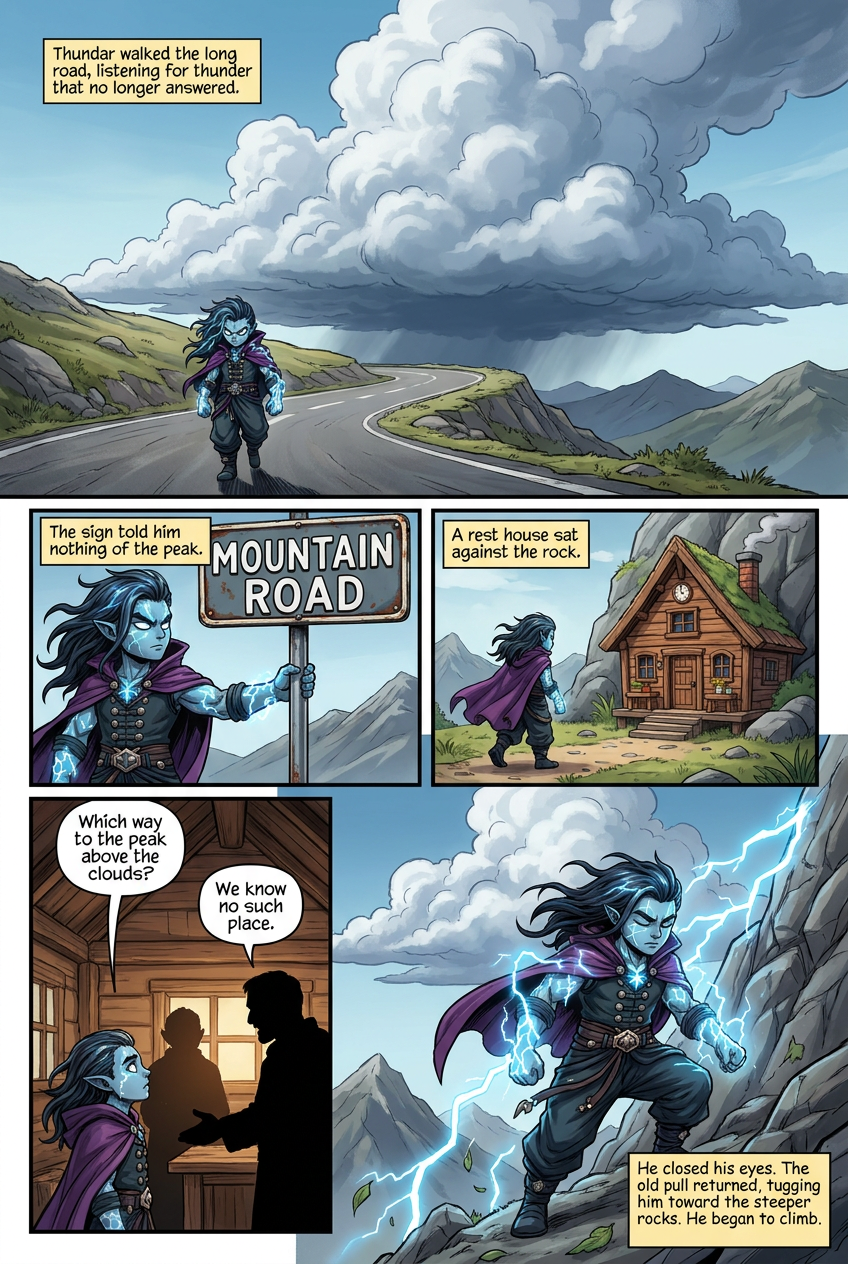
Thundar walked the long road thinner than before, listening for thunder that no longer answered. The road climbed, then flattened, then climbed again. Above him, a huge gray cloud spread across the whole sky and swallowed the horizon. He could not see the peak. He could not see the sun. Every direction looked like up. He stopped at a rusted sign that read Mountain Road. It pointed only forward, not skyward. The arrow told him nothing about which slope rose highest, or which bend led above the weather. He pressed his palm against the cold pole and felt how quiet his own chest had become. Further on, a small wooden rest house sat tucked against the rock. Smoke curled from its chimney. Thundar pushed the door open and asked the people inside which way led to the peak above all clouds. They looked at him kindly and shook their heads. No one had heard of such a place. No one could point. Thundar stepped back onto the road. He could not find the way by sight, and he could not find it by asking. So he closed his eyes and stood still. The old pull returned, faint but certain, tugging him off the road and toward the steeper rocks. He left the path behind and began to climb.
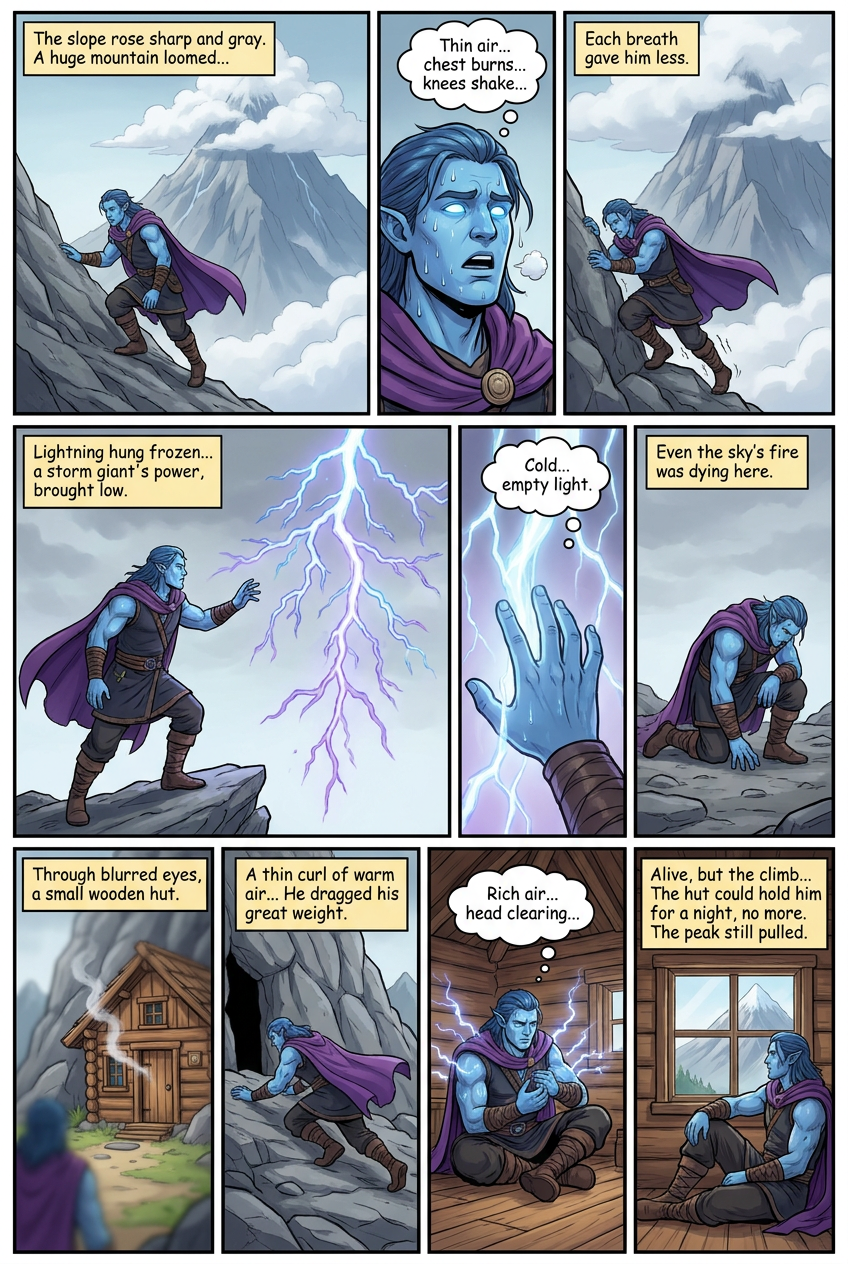
Thundar climbed the steeper rocks, following the pull in his chest. The slope rose sharp and gray, and a huge mountain loomed ahead, its top swallowed by a thick white cloud. The higher he went, the thinner the air felt. Each breath gave him less. His chest burned. His knees shook. He stopped at a strange formation near a ridge. Lightning hung frozen in the air, its bright tendrils fading into nothing. A storm giant's power, brought low by something he could not punch or push. Thundar reached for it, and his hand passed through cold, empty light. Even the sky's fire was dying here. He fell to one knee. Through blurred eyes, he saw a small wooden hut tucked against the rock. A thin curl of warm air drifted from its door. He crawled toward it, dragging his great weight across stone. The door gave way. Inside, the air was rich and full. He pulled it into his lungs in long, shaking gulps. His head cleared. His hands steadied. Thundar sat on the wooden floor and breathed. He was alive, but the climb above had just shown him its price. The hut could hold him for a night, no more. Beyond its door, the thin air still waited, and the peak still pulled.
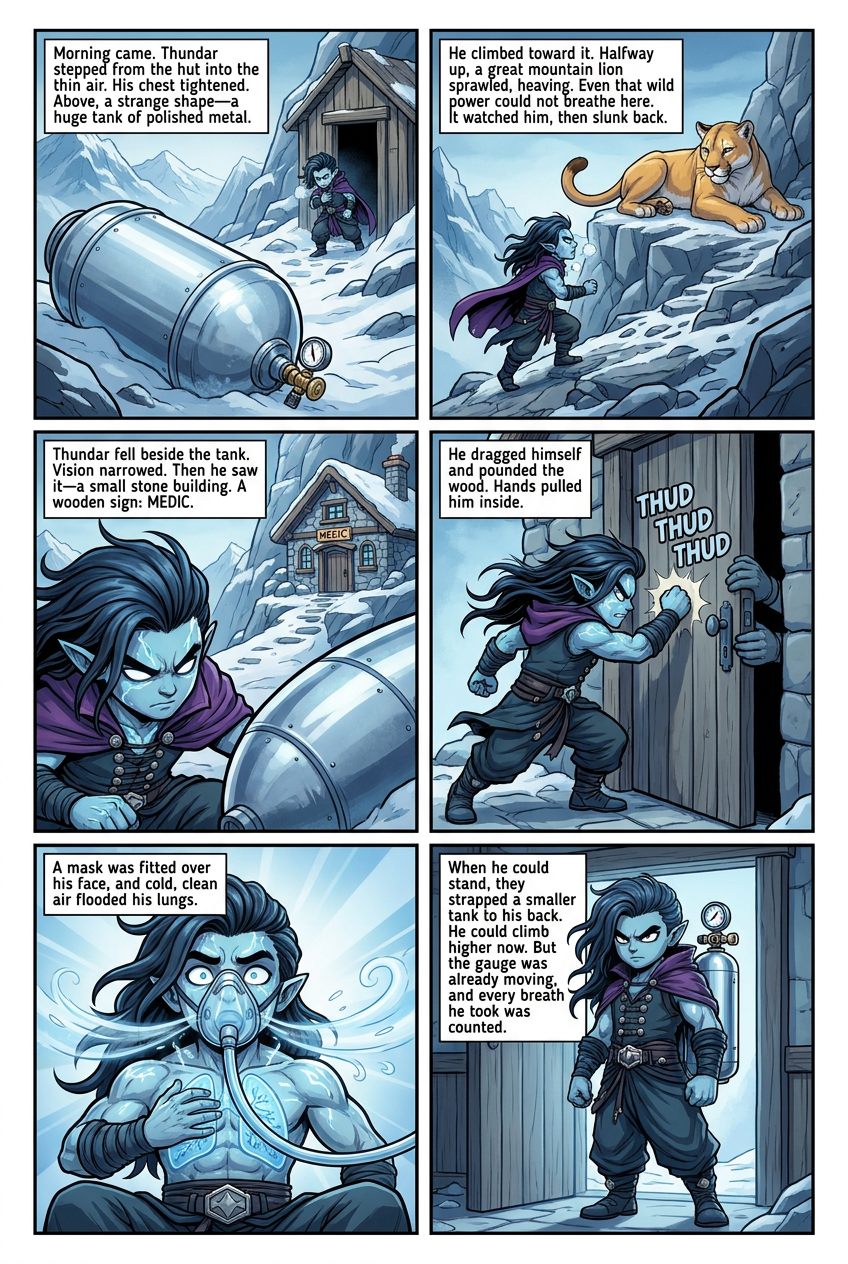
Morning came, and Thundar stepped from the hut into the thin air. His chest tightened at once. Above him, a strange shape lay across the slope — a huge tank of polished metal, its gauge ticking, the size of a fallen tower. He understood it without words. Past that mark, the air itself would kill him. He climbed toward it anyway. The pull in his chest gave him no choice. Halfway up, he saw a great mountain lion sprawled on a ledge, its golden sides heaving. Even that wild power could not breathe here. It watched him pass with dim eyes, then slunk back down the rocks. Thundar fell to his knees beside the metal tank. His vision narrowed. Then he saw it — a small stone building tucked into the cliff above, a wooden sign reading MEDIC swinging by its door. He dragged himself the last stretch and pounded the wood. Hands pulled him inside. A mask was fitted over his face, and cold, clean air flooded his lungs. When he could stand, they strapped a smaller tank to his back and showed him the valve. He could climb higher now. But the gauge was already moving, and every breath he took was counted.
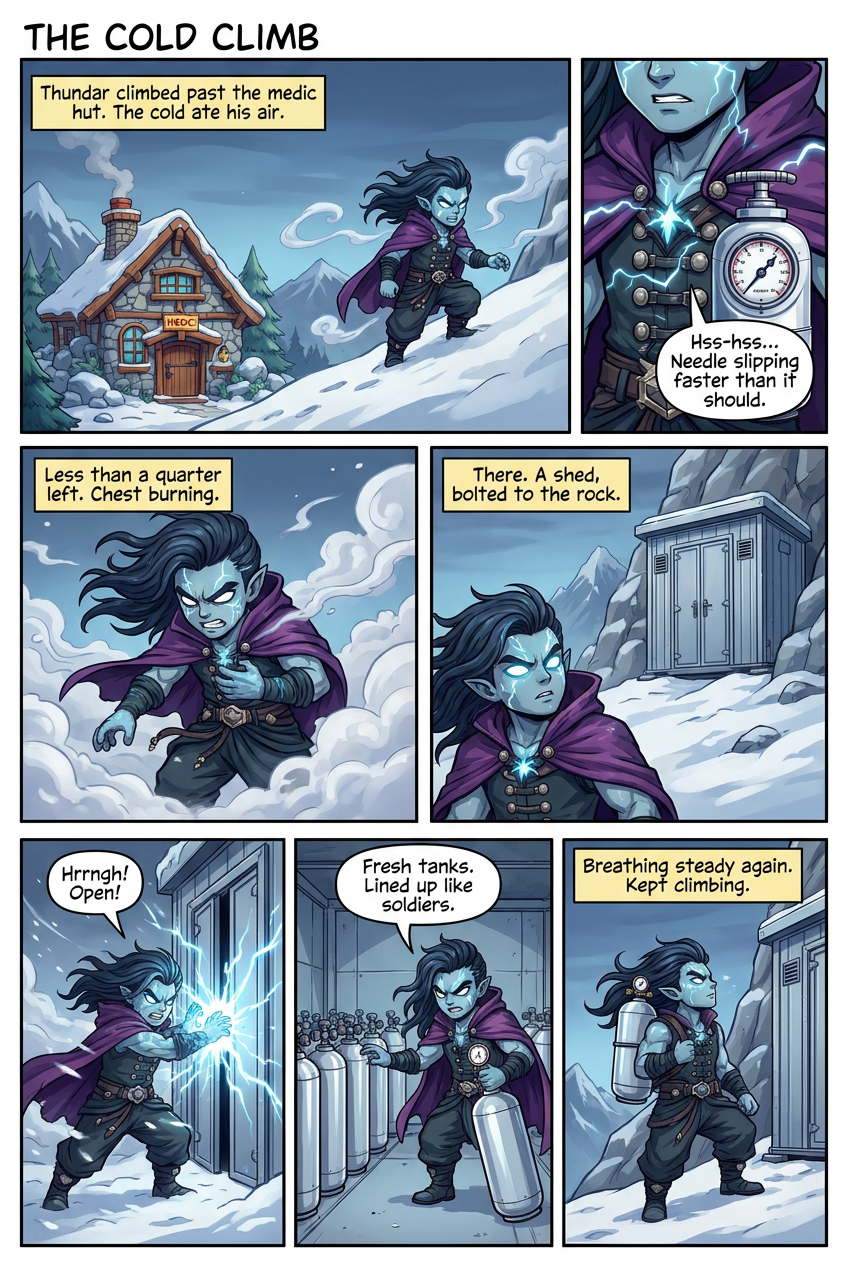
Thundar climbed past the medic hut with the small tank strapped to his back. The mask hissed with each step. He glanced at the round gauge on his chest and saw the needle slipping faster than it should. The cold up here was eating his air. He pushed on. Soft white shapes drifted across the slope — pale wisps of cloud that hung where no living thing belonged. They were beautiful and wrong. Birds did not fly here. Nothing moved but him. The needle dropped again, and his chest began to burn. He stopped and stared at the dial. Less than a quarter left. The peak still rose far above, sharp and silent. He would not make it on this tank. He turned in a slow circle, searching, and saw it — a small metal shed bolted into the rock, vents on its sides, a heavy door shut against the wind. Thundar staggered to the door and forced it open. Inside stood rows of fresh tanks, lined up like soldiers. He swapped his empty one for a full one with shaking hands. The new gauge clicked to full. He stepped back onto the slope, breathing steady again, and kept climbing.
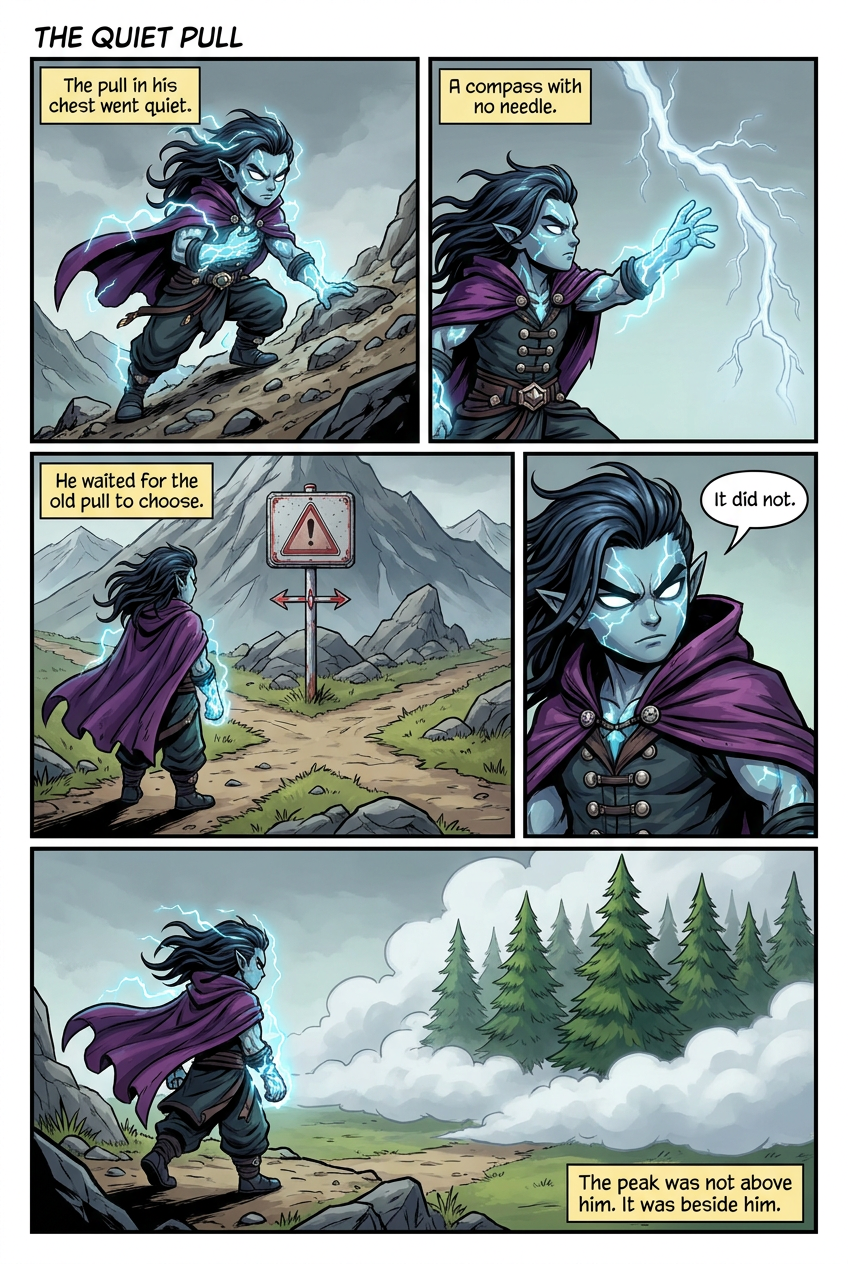
Thundar climbed past a band of loose scree, the new tank steady on his back. Then the pull in his chest went quiet. He stopped walking. For the first time on this whole climb, nothing tugged him upward. The mask hissed. His own breath was the only sound. He looked up and saw a thin shape hanging in the air — a pale lightning arc, frozen mid-strike, soft as a drawing. It did not move. It did not hum. It was a compass with no needle. He reached for it and his hand passed through cold air. Ahead, the slope split. A bolted metal sign stood at the fork, its red warning faded by wind. Two arrows pointed to two ridges. Both rose. Neither rose higher than the other. He stood between them and waited for the old pull to choose. It did not. Thundar turned his head and saw, off the left ridge, a small grove of pines wrapped in a low, unmoving cloud. The air inside the trees was perfectly still — the kind of stillness he had feared his whole life. He understood then. The peak was not above him. It was beside him, and he had been walking past it. He stepped off the marked path and started toward the grove.
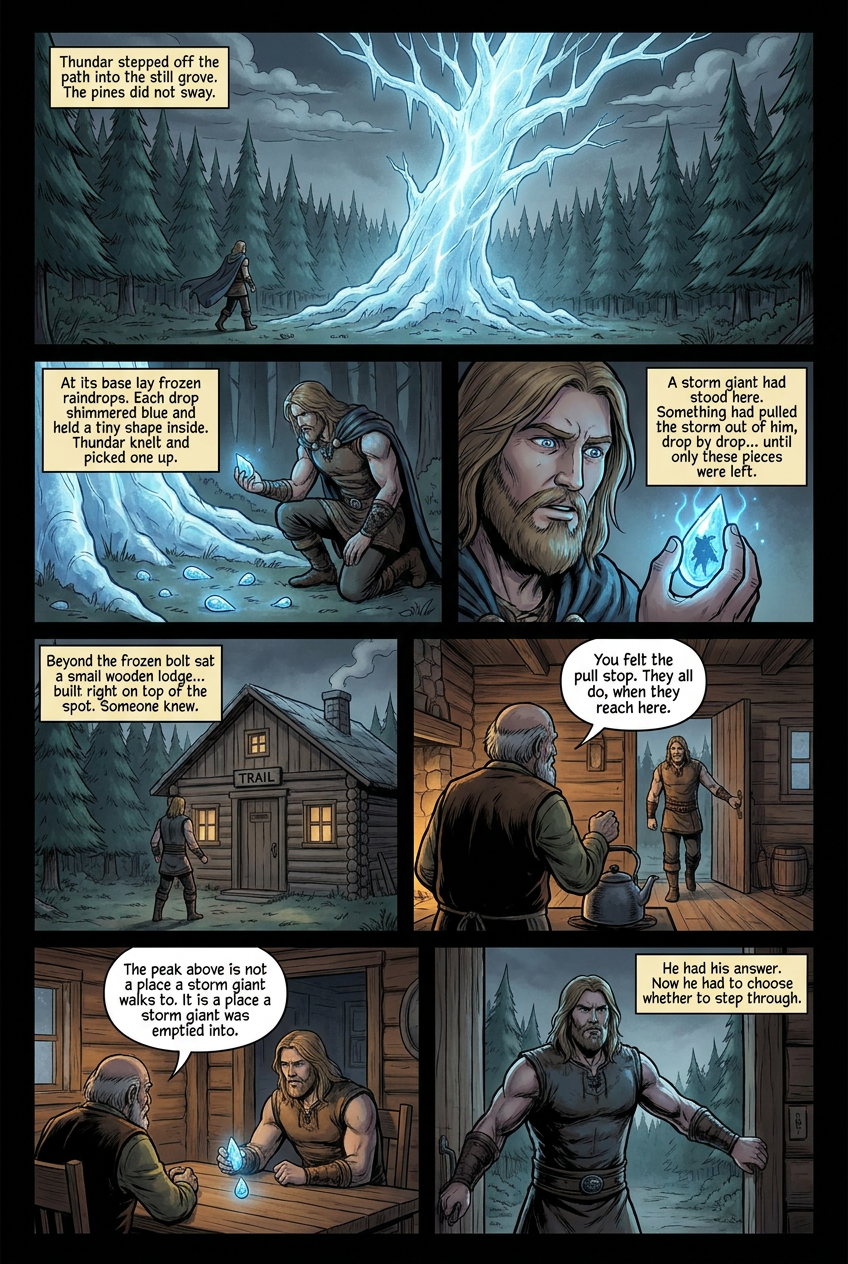
Thundar stepped off the path and walked toward the still grove. The pines did not sway. Inside the trees stood a frozen lightning arc, taller than he was, branching like a dead tree made of light. It did not hum. It did not flicker. It was simply stopped. At its base lay frozen raindrops, scattered in a wide ring. Each drop shimmered blue and held a tiny shape inside, like a sealed memory. Thundar knelt and picked one up. It was cold and heavy and did not melt. He understood. A storm giant had stood here once. Something had pulled the storm out of him, drop by drop, bolt by bolt, until only these pieces were left. Beyond the frozen bolt sat a small wooden lodge, warm and solid, with a sign reading TRAIL above the door. Smoke rose from its chimney into the unmoving cloud. The lodge had been built right on top of the spot. Someone knew. Someone marked it. Thundar walked to the door and pushed it open. An old keeper looked up from a kettle and nodded, as if expecting him. "You felt the pull stop," the keeper said. "They all do, when they reach here." Thundar set the frozen drop on the table. The keeper told him the truth in three sentences: the peak above the clouds was not a place a storm giant walked to. It was a place a storm giant was emptied into. Every giant who came this far left their storm here, drop by drop, and walked the last steps as nothing. Thundar looked at the door to the grove. He had his answer. Now he had to choose whether to step through.
Play your story to life
Storycraft is a mobile game where you create AI characters, craft items and locations to build their world, then discover what direction your story takes. Download the iOS game for free today!
Download for free