

Tom Tinkerton's Arc
5 Chapters
Tom Tinkerton's dream is rebuilding Santa's workshop into the world's most efficient toy factory.

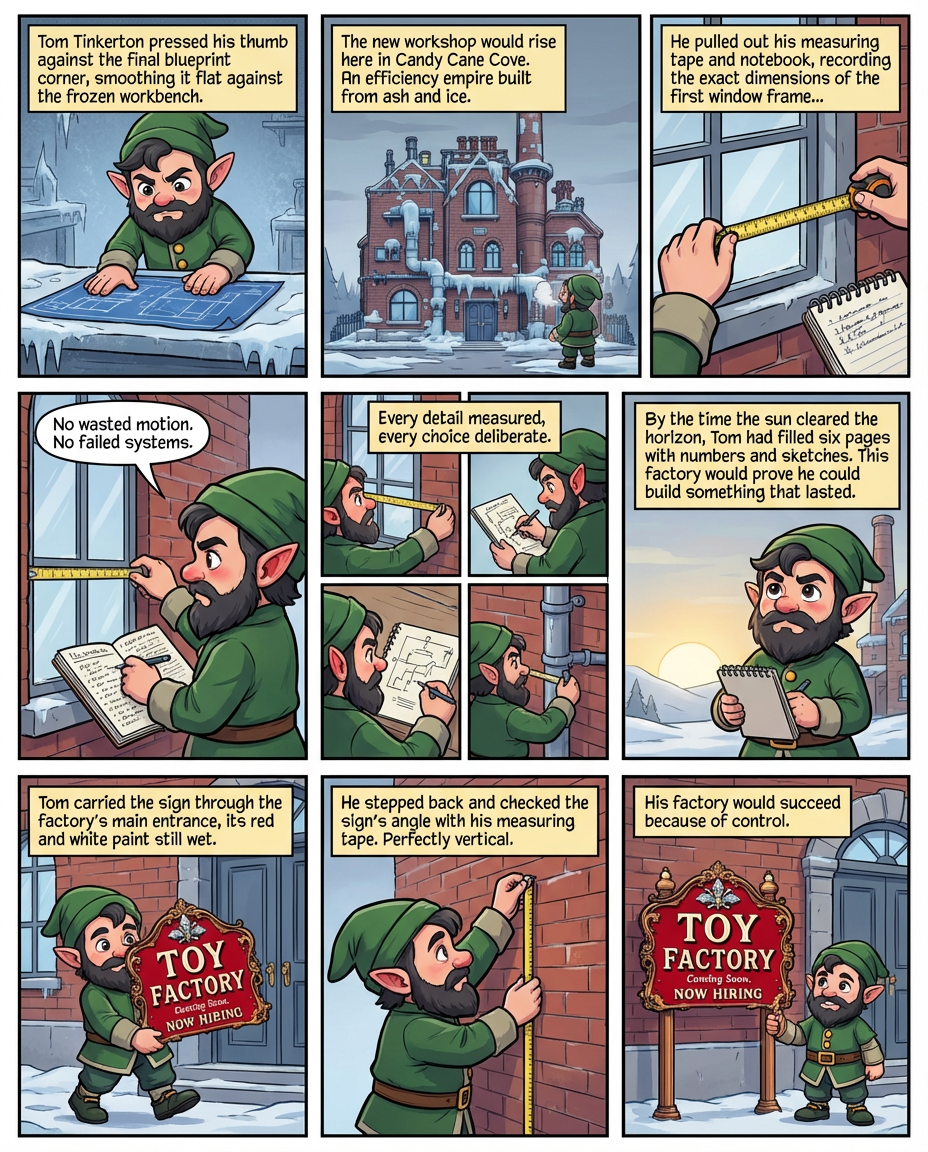
Tom Tinkerton pressed his thumb against the final blueprint corner, smoothing it flat against the frozen workbench. The new workshop would rise here in Candy Cane Cove, bigger and better than before. Three thousand toys had burned in the collapse—his collapse, starting right in his section. But that was done. Now he was chief reconstruction foreman, and this time every gear would turn exactly as planned. No wasted motion. No failed systems. He'd salvaged forty-seven components from the wreckage and documented every twisted piece in his spreadsheets. This workshop would be perfect. An efficiency empire built from ash and ice. Tom stood before the old brick chimney factory at dawn, his breath forming clouds in the cold air. The building stretched wide with towering chimneys reaching toward the gray sky. Expansive windows lined the walls, most cracked or missing glass entirely. This was it—the structure he'd transform into the world's most efficient toy factory. He pulled out his measuring tape and notebook, recording the exact dimensions of the first window frame: eight feet, three and one-half inches. Then the next. Then the next. Each measurement went into his notebook with careful precision. The factory would need new systems, better flow patterns, and reorganized production zones. No more failures. No more disasters. By the time the sun cleared the horizon, Tom had filled six pages with numbers and sketches. His pointed ears burned from the cold, but he didn't stop. This factory would prove he could build something that lasted. Tom carried the sign through the factory's main entrance, its red and white paint still wet. He'd spent two hours getting the letters exactly right: "TOY FACTORY - OPENING SOON - HELPERS NEEDED." The vintage design matched his vision perfectly—professional, clear, efficient. He set it against the brick wall near the front windows where anyone passing could see it. The factory needed workers who understood precision. People who wouldn't cut corners or ignore safety protocols. He stepped back and checked the sign's angle with his measuring tape. Perfectly vertical. This was how the new workshop would operate—every detail measured, every choice deliberate. The old workshop had failed because of carelessness. His factory would succeed because of control.
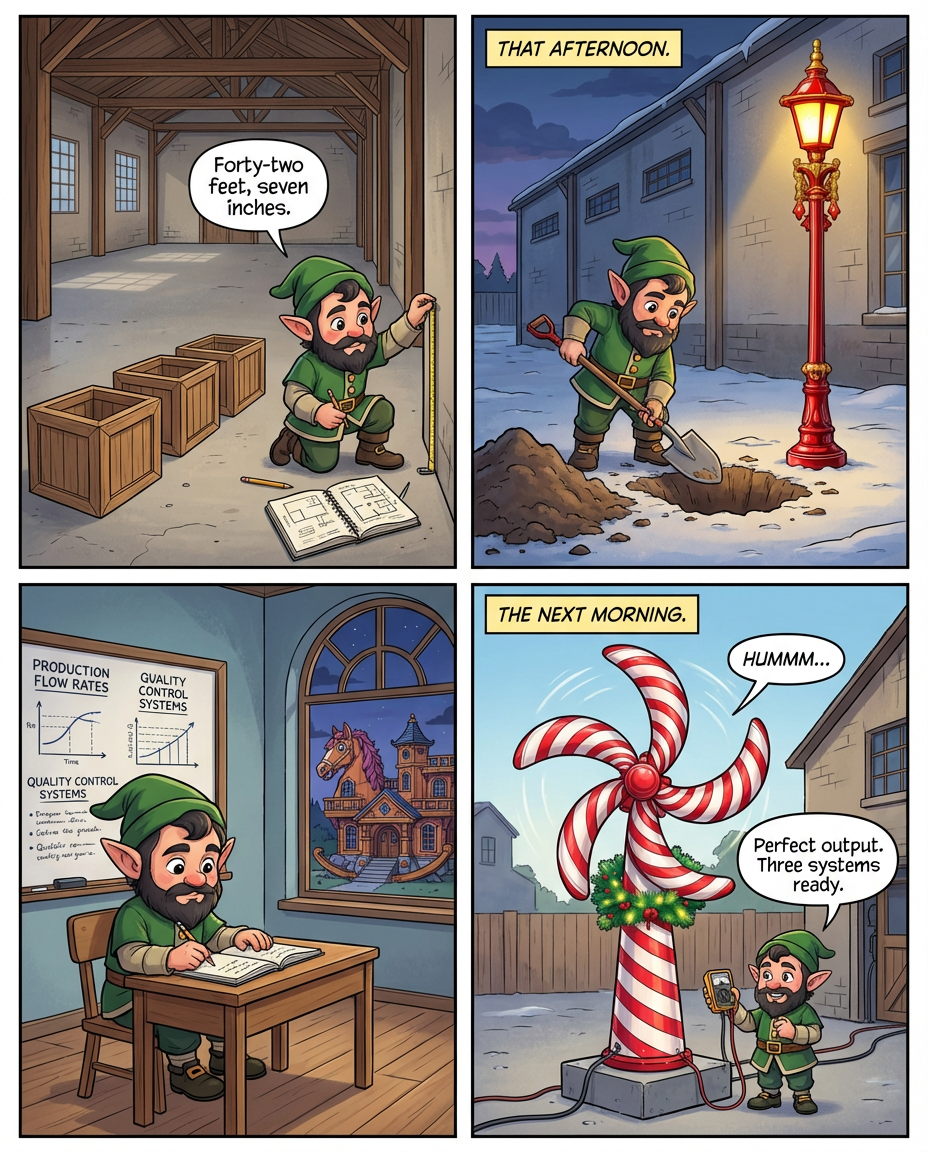
Tom lined up the three empty crates beside his measuring tools and notebooks. The factory floor stretched wide and bare before him. First, he needed to map every inch of this space. He pulled out his tape measure and started with the northeast corner, calling out numbers to himself: "Forty-two feet, seven inches." His notebook filled with sketches showing where each production station would go. The crates would hold sorted materials once workers arrived—nails in one, hinges in another, screws in the third. Everything organized. Everything tracked. By noon, his hands cramped from writing, but the floor plan was complete. He stood back and studied the measurements. The factory was taking shape, one precise number at a time. That afternoon, Tom unpacked the tall red street light from its shipping crate. The gold accents caught the dim light filtering through the factory windows. He'd ordered it specifically for the loading area outside—workers would need to move materials safely after dark. He carried it to the rear entrance and studied the frozen ground. The installation would need to be exact. He measured three feet from the doorway and marked the spot with chalk. Then he began digging through the hard earth with his shovel, checking the depth every few minutes. Six inches. Twelve inches. Eighteen inches—perfect. He set the light's base into the hole and packed dirt around it, testing its stability with both hands. When he flipped the switch, warm light spread across the empty loading zone. The first piece of his efficiency system was in place. Tom locked the factory door and walked toward the whimsical building shaped like a giant toy rocking horse. The Rocking Horse Toy University sat ready for evening classes, and he'd registered weeks ago. He needed more than measurements and floor plans—he needed the science behind toy design and modern factory management. Inside, he took his seat and opened a fresh notebook. The instructor began discussing production flow rates and quality control systems. Tom wrote down every word, his hand moving fast across the pages. His factory plans were solid, but this knowledge would make them unbreakable. When class ended three hours later, his notebook held seventeen pages of notes. He stepped back outside and looked up at the rocking horse structure against the dark sky. Learning this would take time, but that was fine. The workshop he'd build would be worth every lesson. The next morning, Tom examined the turbine that had arrived on a flatbed truck. The candy cane blades spiraled around its center, and a festive wreath with small lights decorated its housing. It looked ridiculous, but the specifications promised enough power output for every machine he planned to install. He directed the delivery workers to the clearing beside the factory, pointing to the exact spot he'd marked yesterday. The turbine would generate all the electricity the workshop needed—no dependency on outside systems that could fail. He watched them bolt it to the concrete base he'd poured last week, checking each connection point with his level. When they finished and drove away, Tom flipped the activation switch. The candy cane blades began to turn, slow at first, then faster. A low hum filled the air. Power flowed into the factory's main panel. He checked his voltage meter: perfect output. Three systems now stood ready—lighting, education, and power. The foundation was set. Everything else would build from here.
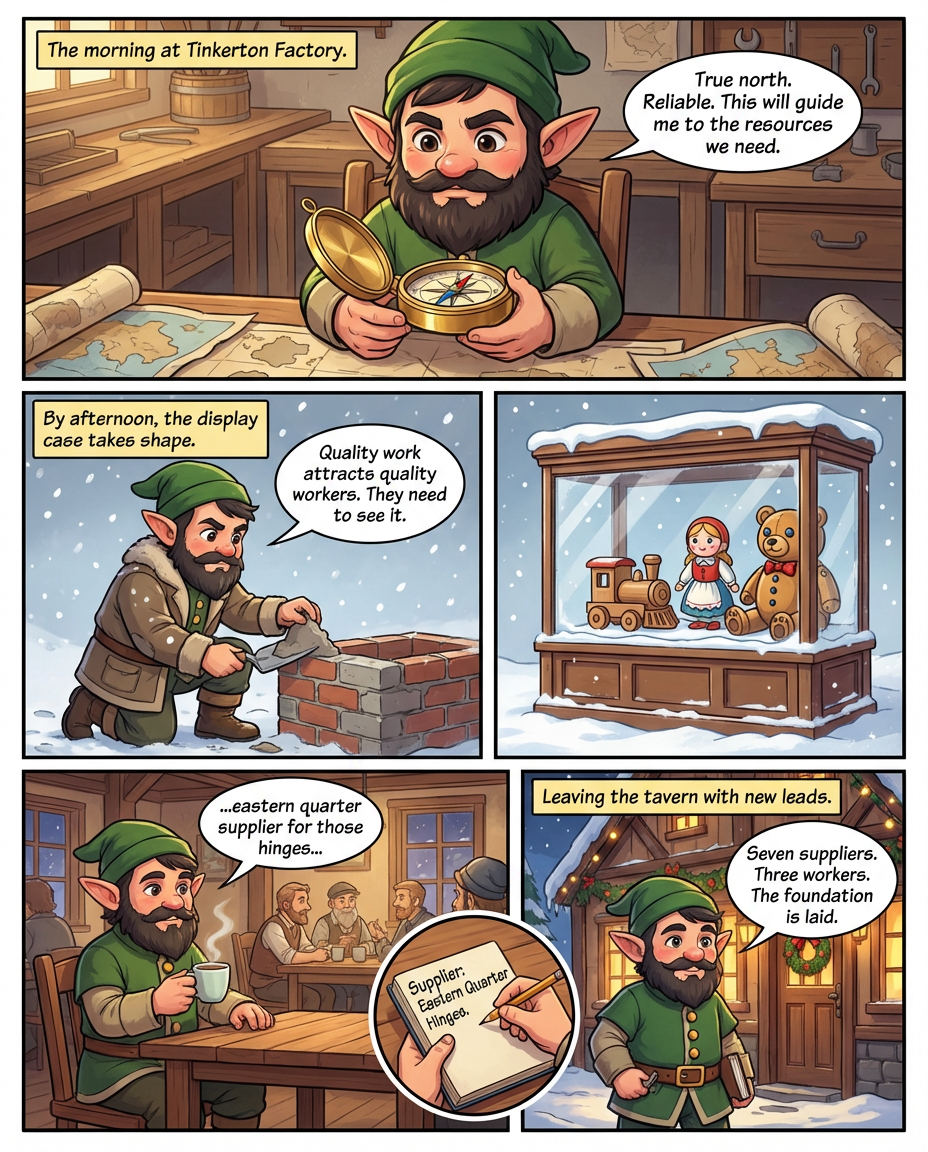
Tom stood at the factory's main workbench the next morning, examining the brass compass he'd ordered from the Frostpeak Trading Company. The needle pointed true north, steady and reliable. He'd need it for the supply runs ahead—the tundra beyond Candy Cane Cove held resources his factory would require, and getting lost meant wasted time. He tested the compass against his maps, checking its accuracy three times before slipping it into his coat pocket. The world outside his factory walls wasn't just frozen wasteland—it was a network of opportunities waiting to be measured and used. By afternoon, Tom had built the display case from salvaged bricks and glass panels. He placed it outside the factory entrance, securing each corner with mortar he'd mixed that morning. Snow dusted the top as he arranged sample toys inside—a wooden train, a painted doll, a mechanical bear. Each toy showed what skilled workers could create here. Potential toy makers needed to see proof that this factory would produce real results, not promises. He wiped the glass clean and stepped back. The toys looked sharp against the white snow, visible from fifty feet away. When workers finally arrived, they'd know exactly what standards he expected. That evening, Tom walked into the Mistletoe Mug Tavern and scanned the room. Craftspeople filled the tables, their hands wrapped around warm mugs as they talked about joint techniques and paint formulas. He ordered tea and sat near a group discussing wood grain patterns. He listened for twenty minutes, noting which workers understood precision and which ones made careless guesses. One person mentioned a supplier in the eastern quarter who stocked quality hinges. Tom wrote the name in his notebook. Another talked about a leather worker who could produce durable straps. He wrote that down too. The tavern held more than warm drinks—it held connections to the resources his factory needed. When he left an hour later, his notebook contained seven new supplier names and three potential workers worth approaching. The town wasn't just where his factory stood. It was the foundation that would make his efficiency empire possible.
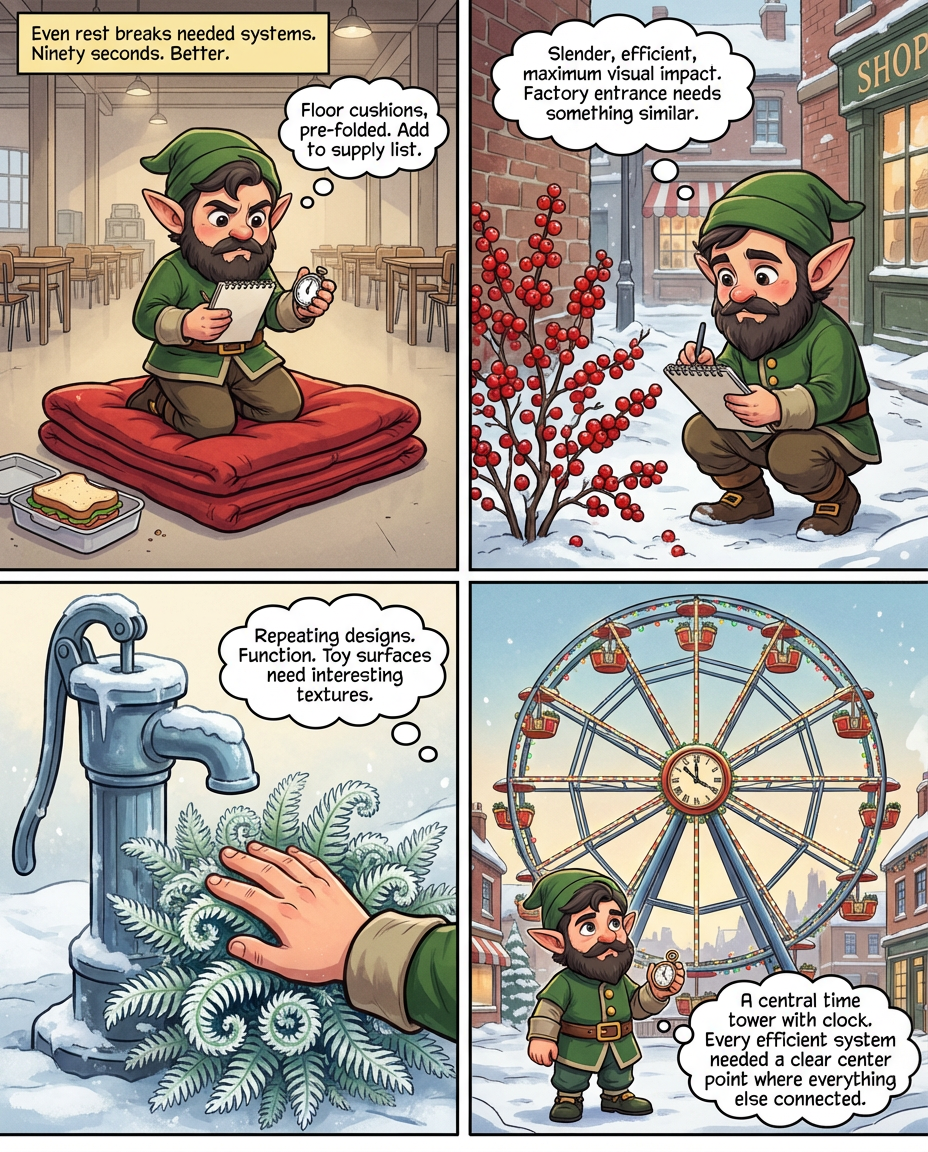
Tom spread the thick red blanket across the factory's break room floor and set down his lunch container. The space needed furniture, but that would come later—right now he wanted to test how workers would use their rest periods. He sat on the blanket and opened his notebook, timing how long it took to settle in comfortably. Four minutes. Too long. Workers would waste production time getting situated. He folded the blanket into a cushion instead and tried again. Ninety seconds. Better. He wrote down the measurements and added "floor cushions, pre-folded" to his supply list. Even rest breaks needed systems. He finished his sandwich and stood, brushing crumbs from his coat. The factory would account for every moment, even the ones spent sitting down. After lunch, Tom walked through town to study what made the streets feel complete. He stopped at a scarlet winterberry plant growing near a shop entrance. The bright red berries stood out against the snow, catching his eye from twenty feet away. He crouched down and examined the branches—slender, efficient, taking up minimal space while providing maximum visual impact. His factory entrance needed something similar, something that caught workers' attention without blocking pathways. He pulled out his notebook and sketched the plant's structure, noting the berry spacing and branch angles. Two streets over, Tom noticed frost moss growing on a frozen water pump. He knelt and ran his finger across the white-tipped fronds. They formed tight spiraling patterns, each layer building on the last. The texture reminded him of gear teeth or chain links—repeating designs that served a function. He pressed his palm against the moss and felt the raised swirls. Toy surfaces needed interesting textures, not just smooth paint. He could recreate this pattern on wooden blocks or metal train cars. He wrote "moss spiral texture" in his notebook with measurements of the frond spacing. The Holly Jolly Ferris Wheel stood tall in the center of town, its holly leaf carts and Christmas lights visible from every direction. Tom walked toward it and checked his pocket watch against the clock mounted on its center hub. Both showed three-fifteen. The structure served as a gathering point—people met near it, used it to tell time, oriented themselves by its location. His factory needed a similar marker, something workers could reference for schedules and meeting points. He circled the Ferris wheel twice, studying how its height and lights made it impossible to miss. When he returned to the factory that evening, he added "central time tower with clock" to his construction plans. Every efficient system needed a clear center point where everything else connected.
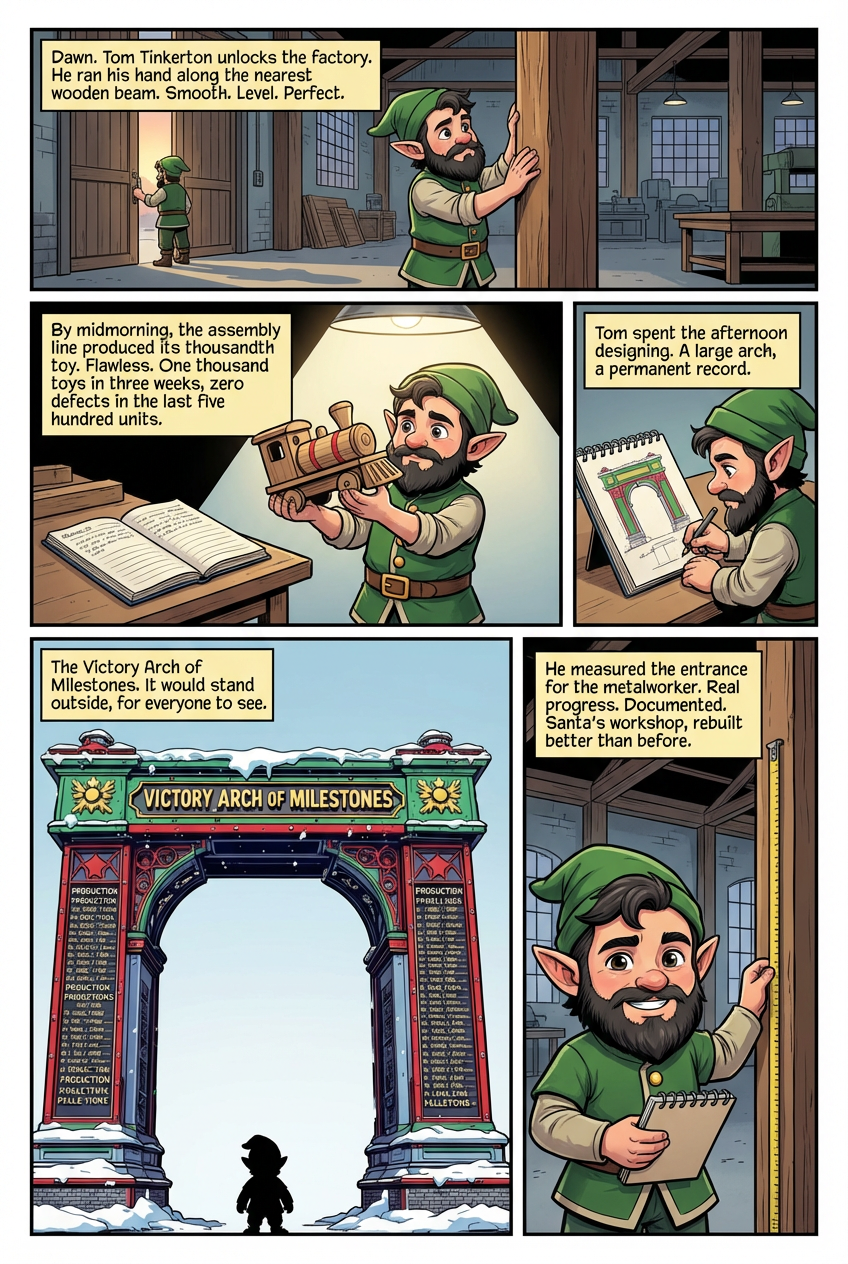
Tom unlocked the factory's main door at dawn and stepped inside to check yesterday's work. The wooden support beams stood straight and solid, each one measured to exact specifications. He ran his hand along the nearest beam, feeling for gaps or rough spots. Smooth. Level. Perfect. He pulled out his notebook and marked the framing as complete. The first major construction phase was finished ahead of schedule. His chest felt lighter as he wrote the date next to the checkmark. The factory was taking shape, piece by piece, exactly as he'd planned. By midmorning, the assembly line produced its thousandth toy—a wooden train with painted red stripes. Tom held it up to the light and inspected every joint and wheel. Flawless. He set it on the workbench and checked his production log. One thousand toys in three weeks, with zero defects in the last five hundred units. The numbers proved his systems worked. His factory could match the old workshop's output and exceed its quality standards. Tom spent the afternoon designing something to mark the achievement. He sketched a large arch in his notebook, drawing clean lines for a metal frame in green and red. He added space for engraved numbers—production milestones that would grow as the factory expanded. The arch would stand outside where everyone could see it, a permanent record of what proper planning could accomplish. He measured the factory entrance three times to calculate the arch's dimensions, then sent specifications to the metalworker in town. When workers saw those numbers rising, they'd understand that efficiency wasn't just talk. It was real progress, documented and displayed for anyone who doubted that Santa's workshop could be rebuilt better than before.
Play your story to life
Storycraft is a mobile game where you create AI characters, craft items and locations to build their world, then discover what direction your story takes. Download the iOS game for free today!
Download for free