

Tug Tug's Arc
2 Chapters
Tug Tug's dream is winning the trust of the junkyard dog who guards the eastern landfill..

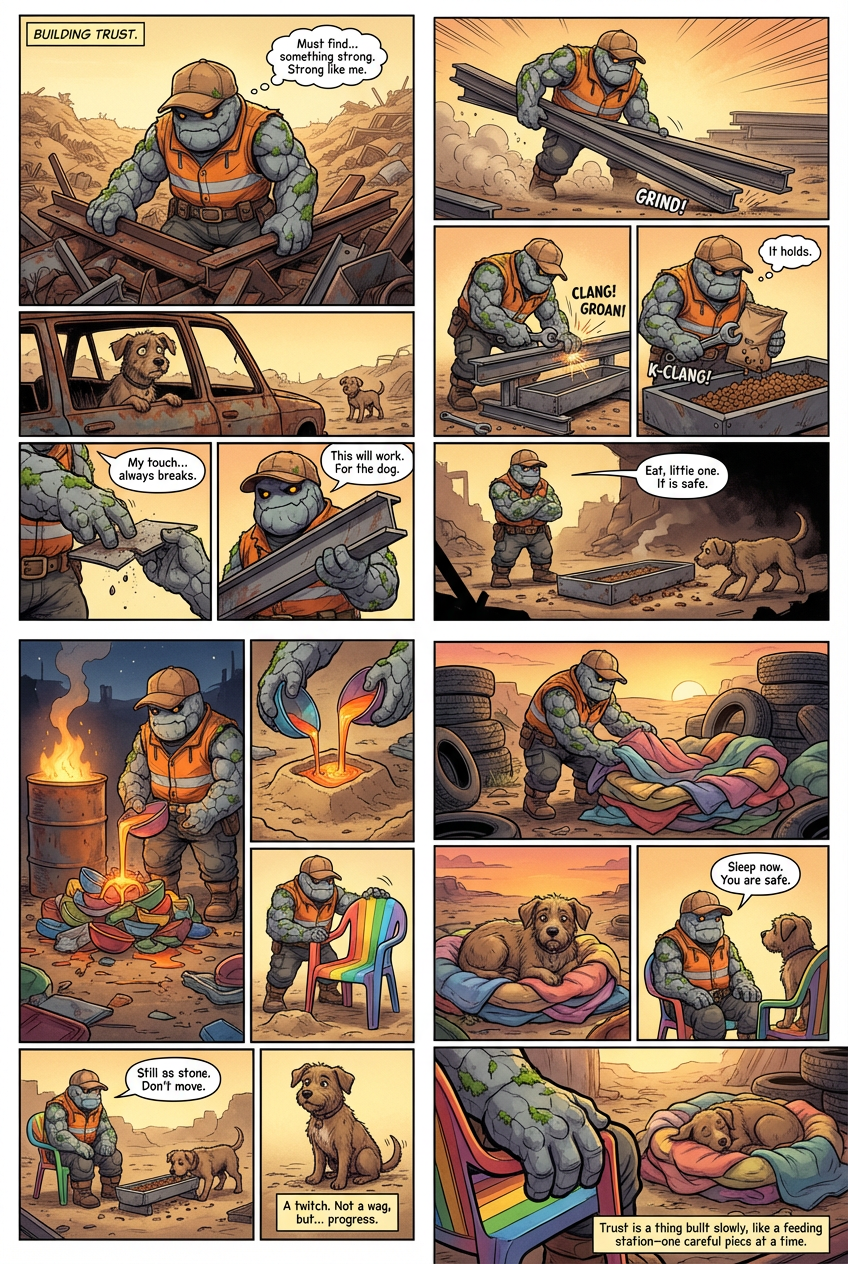
Tug Tug sorts through a pile of metal scraps at the eastern landfill, searching for pieces strong enough to hold his weight. The junkyard dog watches him from behind a rusted car frame, ears flat, ready to bolt. He needs something the dog can eat from without fear—something his stone fingers won't crush. He drags steel beams to a clearing tucked between mountains of trash. His hands shake as he bolts them together, the metal groaning but holding. He builds a low platform first, then a feeding station with thick walls and a wide trough. When he drops a wrench to test it, the structure barely dents. He fills the trough with kibble and steps back. The dog creeps forward, sniffs the food, and eats. For the first time, nothing breaks. Tug Tug gathers the broken bowls from his garbage truck—seven crushed pieces in total, including last spring's disaster. He melts them down in a barrel fire and pours the liquid plastic into a mold he shaped from sand. The next day, he pulls out a bright chair with rainbow stripes. He sets it near the feeding station and sits, careful not to lean back too hard. The dog finishes eating and doesn't run. It sits too, ten feet away, watching him. Tug Tug stays still as stone, which isn't hard for him. The dog's tail twitches once, not quite a wag, but close enough to feel like progress. The next morning, Tug Tug brings a pile of soft blankets he pulled from donation bags at the recycling center. He arranges them in a wide circle, layering colors until they form a nest big enough for the dog. He places it beside the feeding station, tucked against a stack of tires for shelter. When the dog arrives at dusk, it circles the blankets three times before curling inside. Tug Tug watches from his rainbow chair, afraid to breathe too loud. The dog rests its head on its paws but keeps its eyes open, watching him back. Trust is a thing built slowly, like a feeding station—one careful piece at a time.
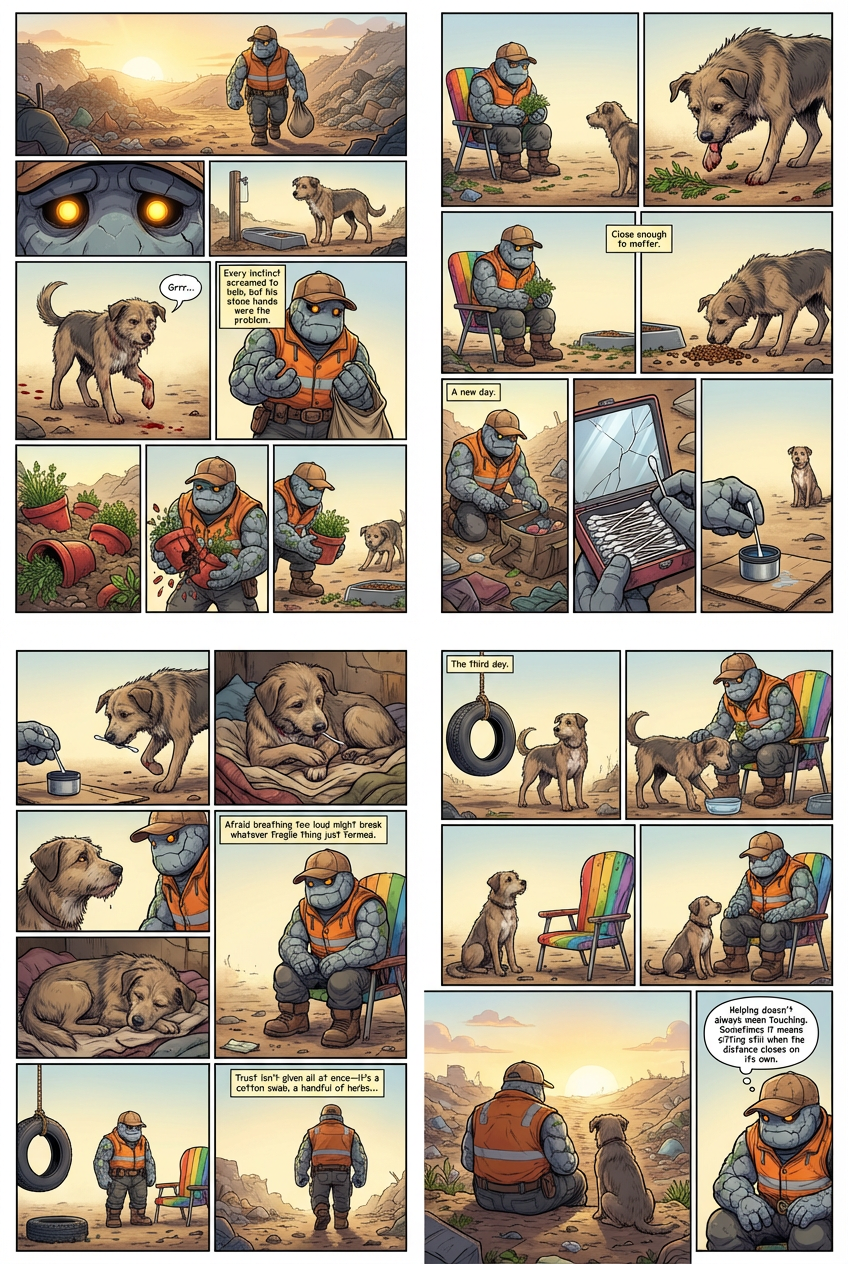
Tug Tug arrives at dawn with fresh kibble in a canvas sack. The dog waits by the feeding station, standing instead of sitting. Something's wrong. It limps forward on three legs, holding its right front paw off the ground. Blood dots the dirt behind it. Tug Tug drops the sack and freezes. Every instinct screams to help, but his stone hands are the problem—not the solution. He spots a cluster of red ceramic planters twenty feet away, half-buried in trash. Herbs spill from the cracked edges, green and stubborn. He crushes one planter trying to lift it gently, but the second one holds when he uses both palms flat. He carries it to the feeding station and sets it down. The dog backs away, ears flat. Tug Tug pulls a handful of leaves from the herbs—something that smells sharp and clean—and places them beside the food trough. Then he sits in his rainbow chair and waits. The dog watches him for ten minutes before limping forward. It sniffs the leaves, then licks its paw. Tug Tug doesn't move. The dog eats three pieces of kibble, licks its paw again, and lies down six feet from his chair instead of ten. Close enough that Tug Tug can see the cut isn't deep. Close enough to matter. The next morning, Tug Tug returns with a makeup kit he found half-buried near the herb planters. The mirror is cracked, but inside are cotton swabs—dozens of them, white and clean. He pulls one out and dips it in water from his thermos, then sets it on a flat piece of cardboard near the feeding station. The dog limps over, sniffs the wet swab, and picks it up in its mouth. It carries the swab to its nest of blankets and lies down, cleaning its paw with careful licks around the cotton tip. Tug Tug watches from his chair, his stone hands resting on his knees. The dog glances at him once, then closes its eyes. For the first time since they met, it falls asleep while Tug Tug is still there. He sits without moving until the sun climbs high, afraid that breathing too loud might break whatever fragile thing just formed between them. When he finally stands to leave, the dog's ear flicks toward him but its eyes stay closed. Trust isn't given all at once—it's a cotton swab, a handful of herbs, a bleeding paw tended from six feet away instead of ten. On the third day, the dog waits by the tire swing near the feeding station, standing on all four legs. The cut has closed. When Tug Tug sets down fresh water, the dog walks past him to drink—not around him, but past, close enough that its shoulder nearly brushes his knee. Tug Tug holds his breath. The dog finishes drinking and sits beside the rainbow chair, not in front of it. Side by side. Tug Tug lowers himself into the chair, moving slower than he's ever moved. The dog doesn't flinch. They sit together in the morning light, watching the landfill wake up around them. Tug Tug finally understands what he couldn't fix with his hands—that helping doesn't always mean touching. Sometimes it means knowing when to stay six feet away, and sometimes it means sitting still when the distance closes on its own.
Play your story to life
Storycraft is a mobile game where you create AI characters, craft items and locations to build their world, then discover what direction your story takes. Download the iOS game for free today!
Download for free