

Valerie the Veterinarian's Arc
9 Chapters
Valerie the Veterinarian's dream is opening a free clinic that treats every stray and wild animal in town no matter how strange the case..

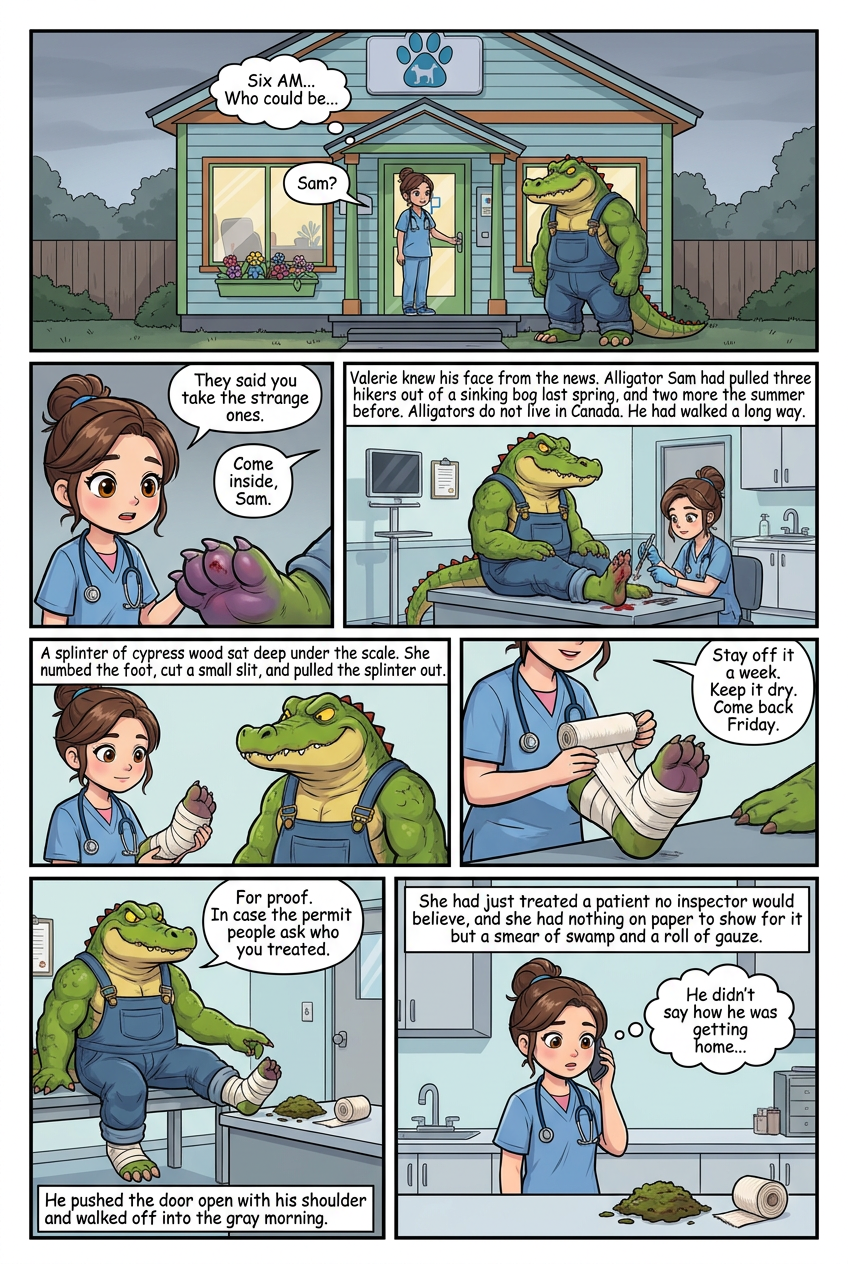
Valerie opened the clinic door at six in the morning and found an alligator on her step. He stood upright in blue overalls, eight feet tall, one front toe swollen purple and leaking. She knew his face from the news. Alligator Sam had pulled three hikers out of a sinking bog last spring, and two more the summer before. Alligators do not live in Canada. He had walked a long way to find her. "They said you take the strange ones," Sam said. His voice was low and tired. He held the bad foot off the ground. Valerie waved him inside. The clinic was small and clean, a green building with flower boxes under the windows and a paw print sign above the door. In six weeks it would open as a free service for strays and wild animals, if the last permit came through. She had built it for cases like this. Years ago she drove two hours to find one vet willing to treat a fox named Rudy, who lived four good years in a wheelchair cart after losing the use of his back legs. She had promised herself no animal would have to travel that far again. She got Sam onto the exam table and looked at the toe. A splinter of cypress wood sat deep under the scale, and the skin around it was hot. She numbed the foot, cut a small slit, and pulled the splinter out with forceps. Pus came after it. She flushed the wound three times, packed it with ointment, and reached for a fresh roll of pale bandage. She wound the gauze around the toe in slow, even layers until the foot looked like a small white club. Sam watched the whole time without flinching. "Stay off it a week," she said. "Keep it dry. Come back Friday." Sam slid off the table and tested the foot. He nodded once. Then he reached into the bib pocket of his overalls and set a clump of wet reeds and black mud on her counter, a piece of the swamp's edge he had carried north with him. "For proof," he said. "In case the permit people ask who you treated." He pushed the door open with his shoulder and walked off into the gray morning. Valerie stood at the counter and looked at the muddy clump, then at the half-used roll of bandage beside it. Her hands smelled like iodine. The clinic was not open yet. She had just treated a patient no inspector would believe, and she had nothing on paper to show for it but a smear of swamp and a roll of gauze. She picked up her phone to call the permit office. The line was already ringing when she remembered Sam had not told her how he planned to get home.
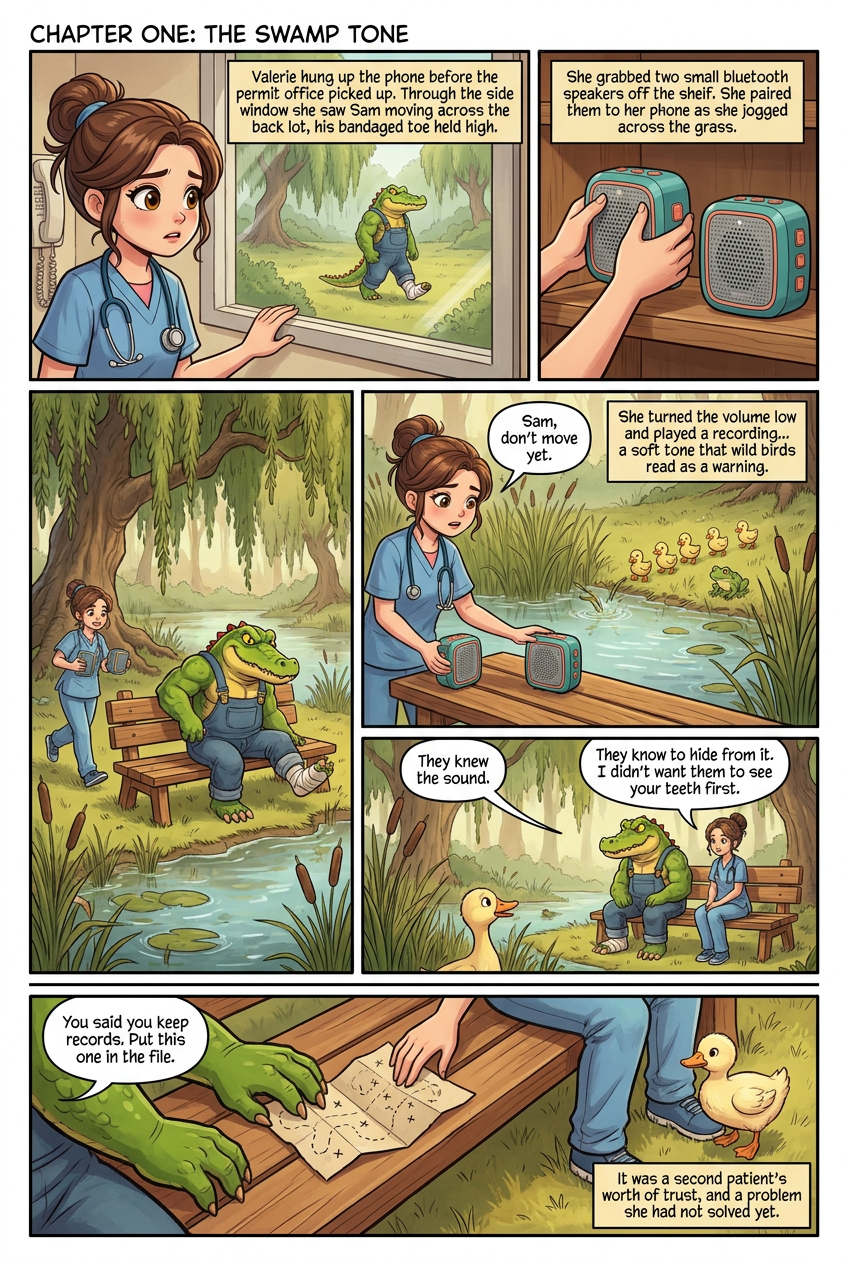
Valerie hung up the phone before the permit office picked up. Through the side window she saw Sam moving across the back lot, his bandaged toe held high with each step. He was heading for the swamp behind the clinic. She knew that patch of water well. A ring of old willows fed shade into a shallow pool, and a fallen log split the current into slow pockets where ducklings paddled and frogs tucked into the reeds. It was the safest scrap of wild ground for a mile. An eight-foot alligator with a mouthful of teeth would empty it in seconds, even if he only wanted to sit. She grabbed two small bluetooth speakers off the shelf by the door. She had used them last summer to play heart-rate tones for a nervous dog. She paired them to her phone as she jogged across the grass. Sam was already at the water's edge, lowering himself onto a wooden bench someone had set under the willows years ago. The bench creaked but held. He stretched the bad foot out in front of him and watched the surface. "Sam," Valerie said, a little out of breath. "Don't move yet." She set one speaker on the bench beside him and carried the other to the shallows. She turned the volume low and played a recording she kept for clinic intakes, a soft tone that wild birds read as a warning without panic. A duckling near the log lifted its head. Then the whole small flock slipped behind the reeds in one quiet line. Two frogs dropped off a stone. The water went still. Sam watched it happen. "They knew the sound," he said. "They know to hide from it," Valerie said. "I didn't want them to see your teeth first and learn to be afraid of the bench instead." She sat down on the far end of the wood. Sam nodded once and kept his jaws closed. For a long minute they sat without talking. A single duckling poked its head out from the reeds, looked at the alligator on the bench, and did not run. It stepped onto the mud and began to preen. Valerie let out a breath she had been holding since the back door. Sam reached into his bib pocket and pulled out a folded square of paper. He set it on the bench between them. It was a hand-drawn map of the swamp he had walked from, marked with small x's where he had pulled people out of the mud. "You said you keep records," he said. "Put this one in the file." Valerie picked up the paper. It was something an inspector could hold. It was also a second patient's worth of trust, and a problem she had not solved yet. The duckling waddled closer to her shoe.
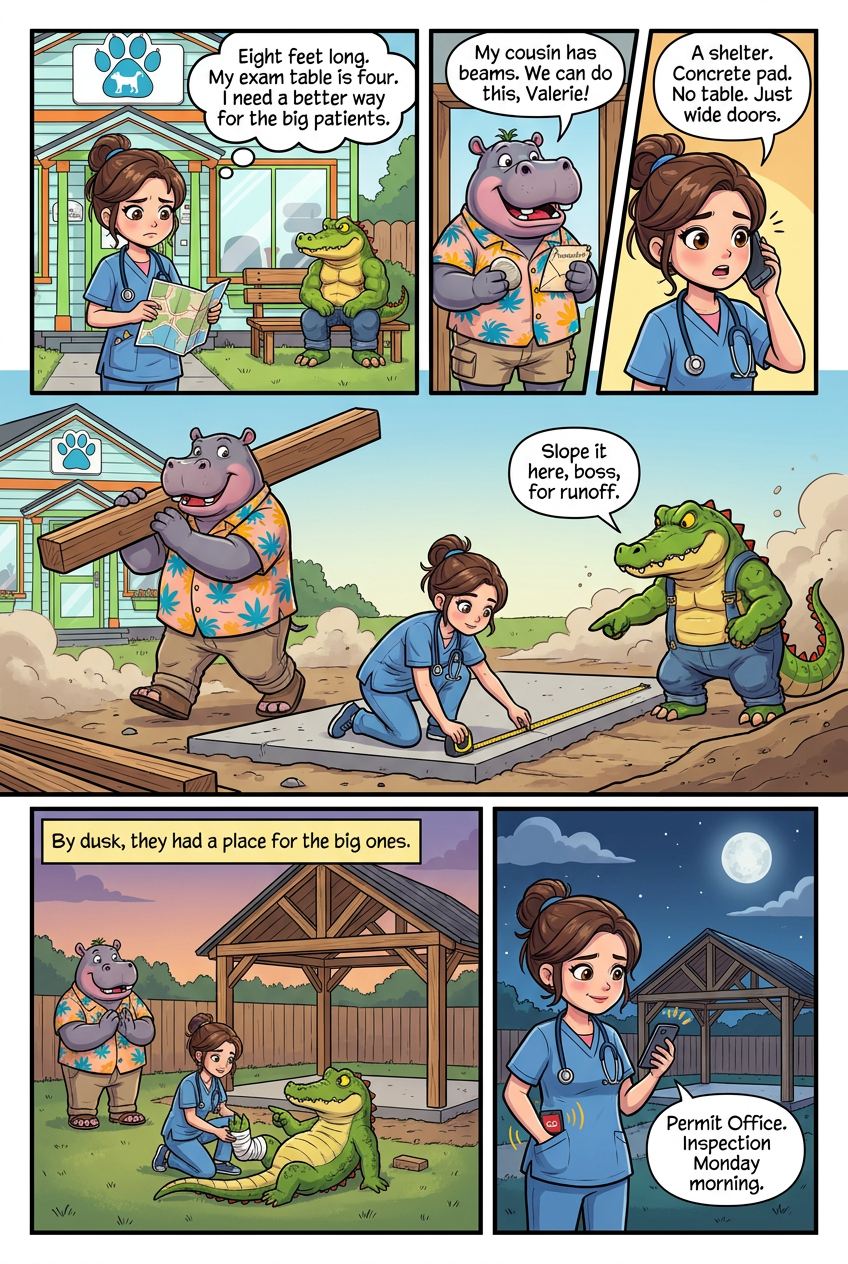
Valerie folded Sam's map into her pocket and walked him back toward the clinic. At the door she stopped. Sam was eight feet long. Her exam table was four. She had treated him on the concrete of the back lot because he would not fit inside, and the snapping turtle last month had almost taken her thumb off in the parking lot too. If she was going to run a clinic that took every case, she needed a way to see big patients and wild ones without kneeling in gravel. She told Sam to wait on the bench. She had one call to make. She called a hippo she had been seeing every morning for two weeks. Harvey came for the smooth stone work and the written promise he read aloud against the voices in his head. He was wide as a car and gentle as a lamb, and he had once mentioned that his cousin ran a livestock barn on the edge of town. Harvey arrived in his flowered shirt and sandals within the hour. He listened while Valerie explained what she wanted. A three-sided shelter behind the clinic. A concrete pad she could hose down. A low sling on a pulley. Wide doors, no table. Harvey nodded through all of it. Then he said his cousin had a tear-down barn and would give her the beams for free if she took them this week. They worked through the afternoon. Harvey carried the heavy posts across the lot on his shoulder, one at a time. Valerie measured and marked the pad. Sam stayed on the bench and pointed out where the ground sloped so runoff would not pool at the door. By dusk they had four posts sunk and a roof frame braced. It was not finished. It was standing. Valerie walked Sam onto the pad and had him lie flat. His tail cleared the edge by six inches. She lifted his bandaged foot without bending her back for the first time since he had arrived. Harvey watched from the grass and clapped once, softly, with both hands. Valerie locked the clinic that night and stood in the lot looking at the frame. She had a place for the big ones now. She had also just built a structure the permit office had not inspected, on a property whose permit was not yet approved. The inspector was due in five weeks. Her phone buzzed in her pocket. It was a voicemail from the permit office, left while she was hauling lumber. They wanted to move the inspection up. They would be at the Pawcare Clinic on Monday morning.
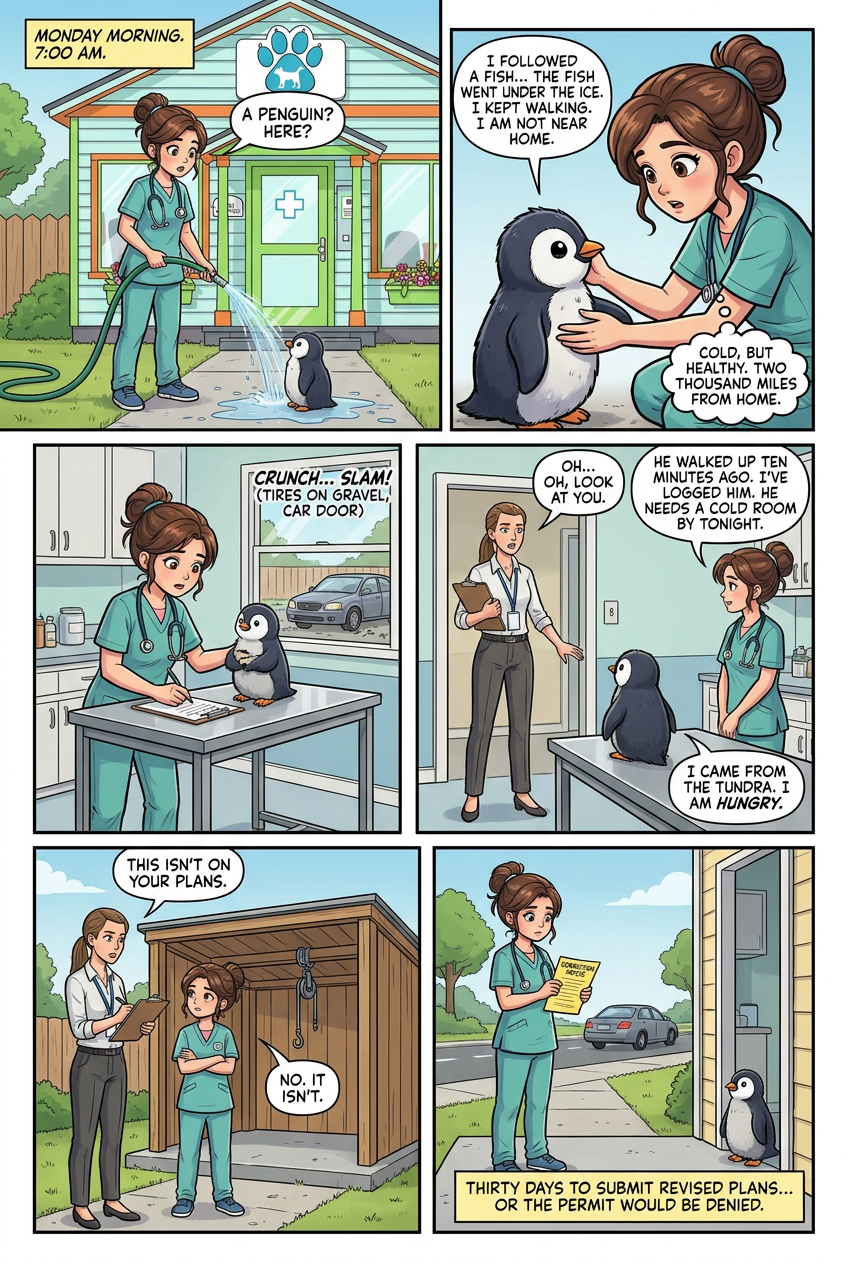
Monday morning came too fast. Valerie unlocked the clinic at seven, swept the front step, and set Sam's folded map on the counter beside her one thin patient file. The inspector was due at eight. She had the shelter out back she could not explain and a permit she needed to keep. She checked her watch and stepped outside to hose the front walk. A small dark shape sat on her doormat. It was a penguin the size of a loaf of bread, wet across the belly, blinking up at her. Valerie crouched. The penguin looked at her with round black eyes. "I followed a fish," it said. "The fish went under the ice. I kept walking. I am not near home." Valerie touched its flipper. Cold, but not frozen. She checked its feet for cracks, its beak for chips, its chest for the rise and fall of steady breathing. Everything worked. It was a healthy chick two thousand miles from where it belonged. She had six minutes. She carried the penguin inside and set it on the exam table. She wrote the intake by hand. Species. Estimated age. Condition on arrival. Presenting problem: separated from colony, tundra origin. She heard tires on the gravel and a car door shut. She capped the pen. The bell rang. The inspector was a tall woman with a clipboard and a lanyard. She stepped in, saw the penguin, and stopped. "Oh," she said. Her face changed the way faces do. "Oh, look at you." She set the clipboard on the counter and bent at the knees. The penguin studied her. "I came from the tundra," it said. "I am hungry." The inspector laughed once, surprised. Valerie did not move. She said, plainly, "He walked up ten minutes ago. I've logged him. He needs fish and a cold room by tonight or I'll need to arrange transport." The inspector nodded, still looking at the chick. Then she picked up the clipboard and remembered why she was there. They walked the building. Valerie showed her the exam room, the sink, the log with Sam's map clipped inside, the new intake page still wet. Then they went out the back door. The inspector saw the three-sided shelter, the concrete pad, the pulley rigged to the crossbeam. She stopped walking. She wrote for a long time without speaking. When she looked up she said, "This isn't on your plans." Valerie said, "No. It isn't." The inspector tore a yellow sheet from her pad and handed it over. Correction notice. Thirty days to submit revised plans and pass a second inspection, or the permit would be denied. She said the penguin was fine. She said the shelter was not. She got in her car and drove away. Valerie stood on the pad with the yellow sheet in one hand and a lost chick watching her from the doorway.
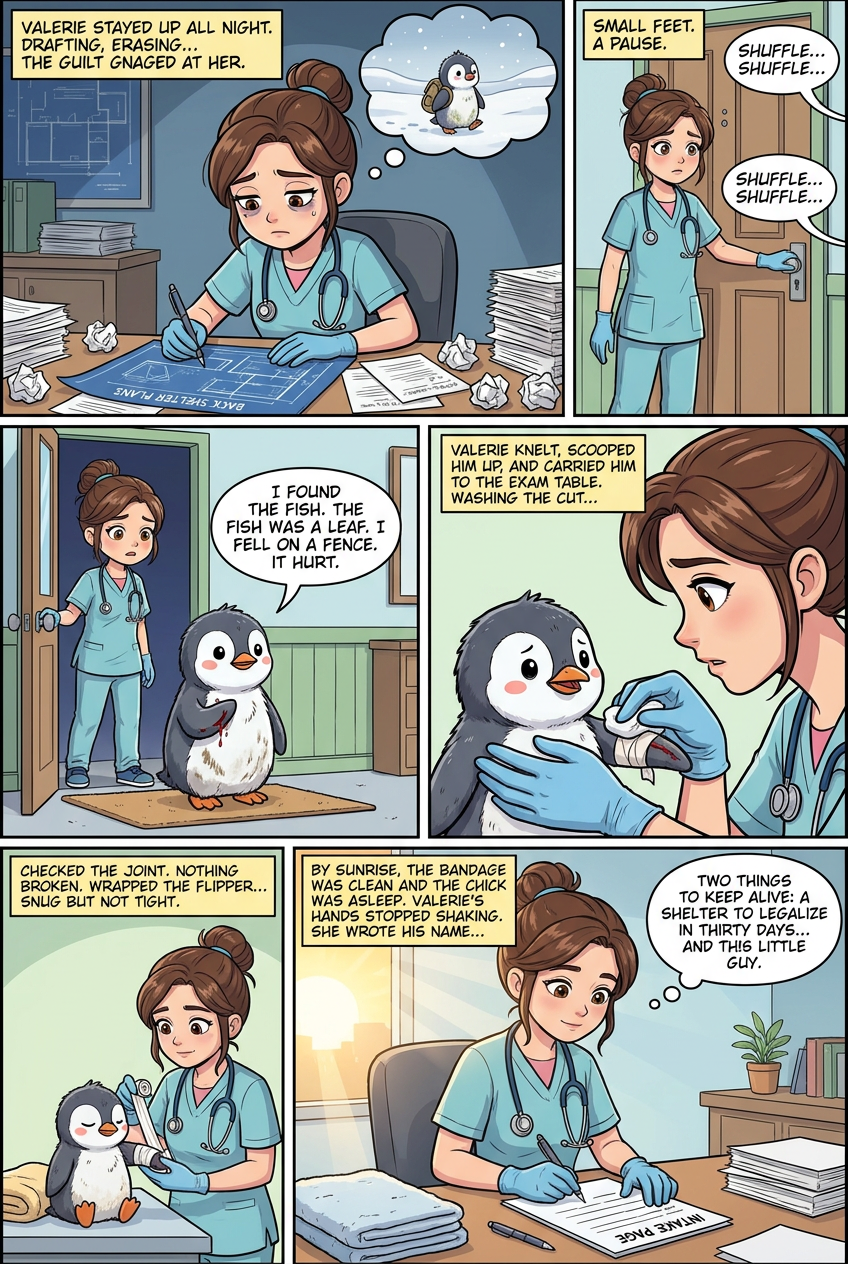
Valerie stayed up all night. She spread the correction notice on the counter and drafted new plans for the back shelter, sketching the pad, the pulley, the drainage line Harvey had suggested. She marked measurements. She erased and marked it again. She had let a baby penguin wander off toward a tundra two thousand miles away. She had given him a knapsack of food and water. She should never have let him go. She grabbed her keys. She was halfway to the front door when she heard the shuffle on the step. Small feet. A pause. Another shuffle. She opened the door. Baby Penguin stood on the mat with one flipper held tight to his chest. Blood beaded along the edge of the flipper where something had cut him. His belly was streaked with dirt. He looked up at her. "I found the fish," he said. "The fish was a leaf. I fell on a fence. It hurt." Valerie knelt. She scooped him up with both hands and carried him to the exam table. She washed the cut with saline. She checked the joint underneath. Nothing broken. She wrapped the flipper in a thin bandage, snug but not tight. She warmed a dish of thawed smelt and set it under his beak. He ate four fish without stopping. She watched him eat and felt her hands stop shaking. By sunrise the bandage was clean and the chick was asleep against a folded towel. Valerie sat down at the counter and looked at the half-finished plans. She had two things now that were hers to keep alive: a shelter she had to legalize in thirty days, and a baby penguin she felt guilty about. She picked up the pen. On a fresh intake page she wrote his name, the cut, the treatment, the time. She clipped the page into the file next to Sam's map. Then she walked to the back door and closed it. She turned the bolt. The clinic was quiet. The chick breathed in small even puffs. Valerie went back to the plans and drew the drainage line one more time, this time without erasing.
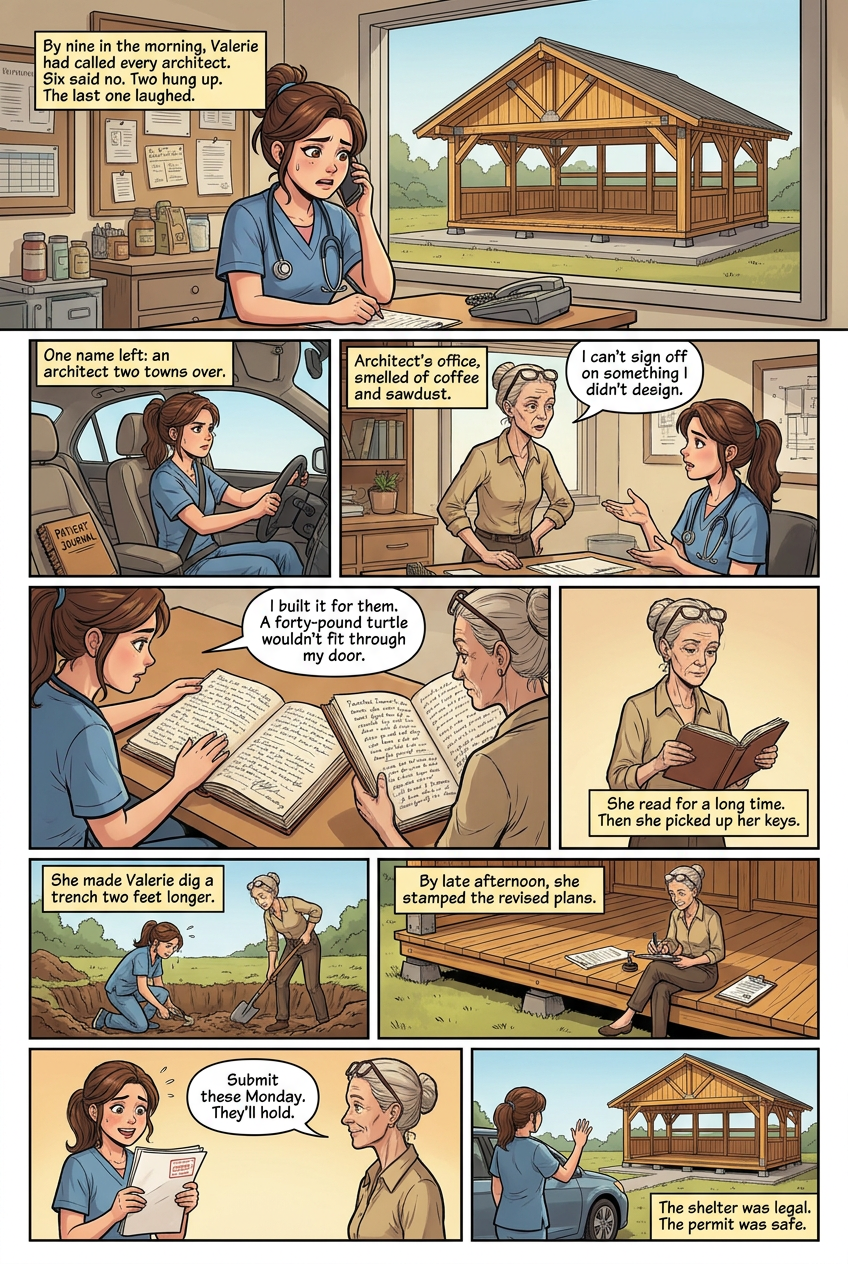
By nine in the morning Valerie had called every architect in the county. Six said no. Two hung up. The last one laughed. No one would stamp plans for a building already standing. Without a stamped drawing, the permit office would revoke her license in thirty days. She sat at the counter with the phone in her hand and looked at the back lot through the window. The shelter stood there on its concrete pad, roof pitched, beams braced, waiting to be legal or torn down. She had one name left on her list, an architect two towns over who did barn conversions. Valerie grabbed her coat and her patient journal and drove. The architect's office smelled like coffee and sawdust. She was a thin woman with reading glasses pushed up on her head. She listened while Valerie explained. Then she shook her head. "I can't sign off on something I didn't design. My license is on that stamp." Valerie set the patient journal on the desk and opened it. She turned the pages one at a time. Sam's map. The snapping turtle with the infected shell. A fox with no back legs, four years of visits, weight logged in a steady hand. A hippo who came every morning to sit and breathe. A penguin chick with a cut flipper. "I built the shelter because a forty-pound turtle wouldn't fit through my door," Valerie said. "I built it before I knew the rules. I'm asking you to look at the building and tell me what's wrong with it. If it's sound, stamp it. If it's not, I'll fix whatever you say." The architect turned another page. She read for a long time. Then she picked up her keys. They drove back together. The architect walked the pad, measured the posts, climbed a ladder to check the roof braces. She pulled on the pulley. She frowned at the drainage line and made Valerie dig a trench two feet longer. By late afternoon she sat on the edge of the deck with her clipboard and wrote for twenty minutes. Then she stamped the revised plans and signed her name. "Submit these Monday," she said. "They'll hold." Valerie held the papers with both hands. The shelter was legal. The permit was safe. She walked the architect to her car and thanked her twice.
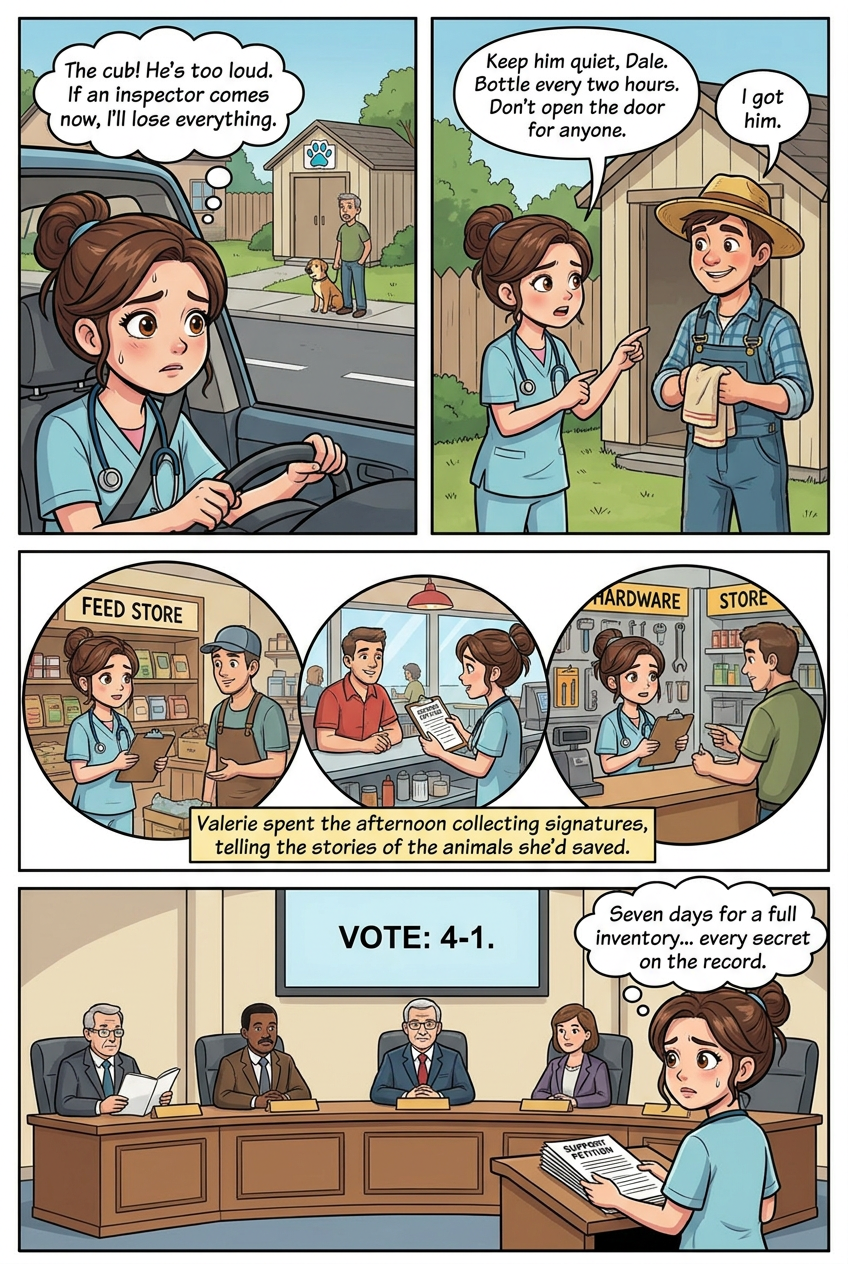
Valerie filed the stamped plans Monday morning and drove back to the clinic before the coffee cooled. She should have felt lighter. Instead she heard the cub before she opened the car door. He was scratching at the shed wall, whining, thumping against the soil bags. A neighbor walking a dog paused on the sidewalk and looked toward the noise. Valerie waved and smiled and felt her stomach drop. The cub had no chart, no intake form, no legal reason to exist on her property. If an inspector came back for any reason, she would lose everything she had just saved. She couldn't keep hiding him. She had to make him legal, which meant convincing the town council to expand her permit to cover unclaimed wild animals. The next meeting was that evening. She needed two things fast: someone to sit with the cub while she was gone, and something strong enough to move a room of tired council members. She called Dale Hutchinson, the farm kid who had helped her unload feed last spring. He showed up in twenty minutes in overalls and a straw hat, already chewing a piece of grass. She walked him to the shed and showed him the cub behind the soil bags. "Keep him quiet," she said. "Bottle every two hours. Don't open the door for anyone." Dale nodded once. "I got him." Valerie spent the afternoon at the counter of the clinic with a clipboard and a stack of blank sheets. She wrote a support petition at the top of the first page and drove it to the feed store, the school, the diner, and the hardware counter. She told Rudy's story at each stop. The fox in the wheelchair cart. Four extra years. She told them about the turtle and the hippo and the penguin chick. By six o'clock she had ninety-three signatures. She stopped at the clinic on her way to town hall. Dale opened the shed a crack. The cub was asleep on a folded towel, belly full. "Go," Dale said. At council she stood at the small podium and laid the pages on the desk. She spoke for four minutes. She named animals, not policies. When she finished she slid the signatures across the wood. The chair read the top page, then the second, then set them down. A vote was called. Four to one. Her permit was amended to cover unregistered wild intakes, effective immediately, with a full inventory due in seven days. Valerie drove home with the paper on the passenger seat. The cub was legal now, or would be once she wrote him down. But seven days meant she had to account for every animal in her care, including the ones she had never told the office about, and the inventory would put every past choice on the record.
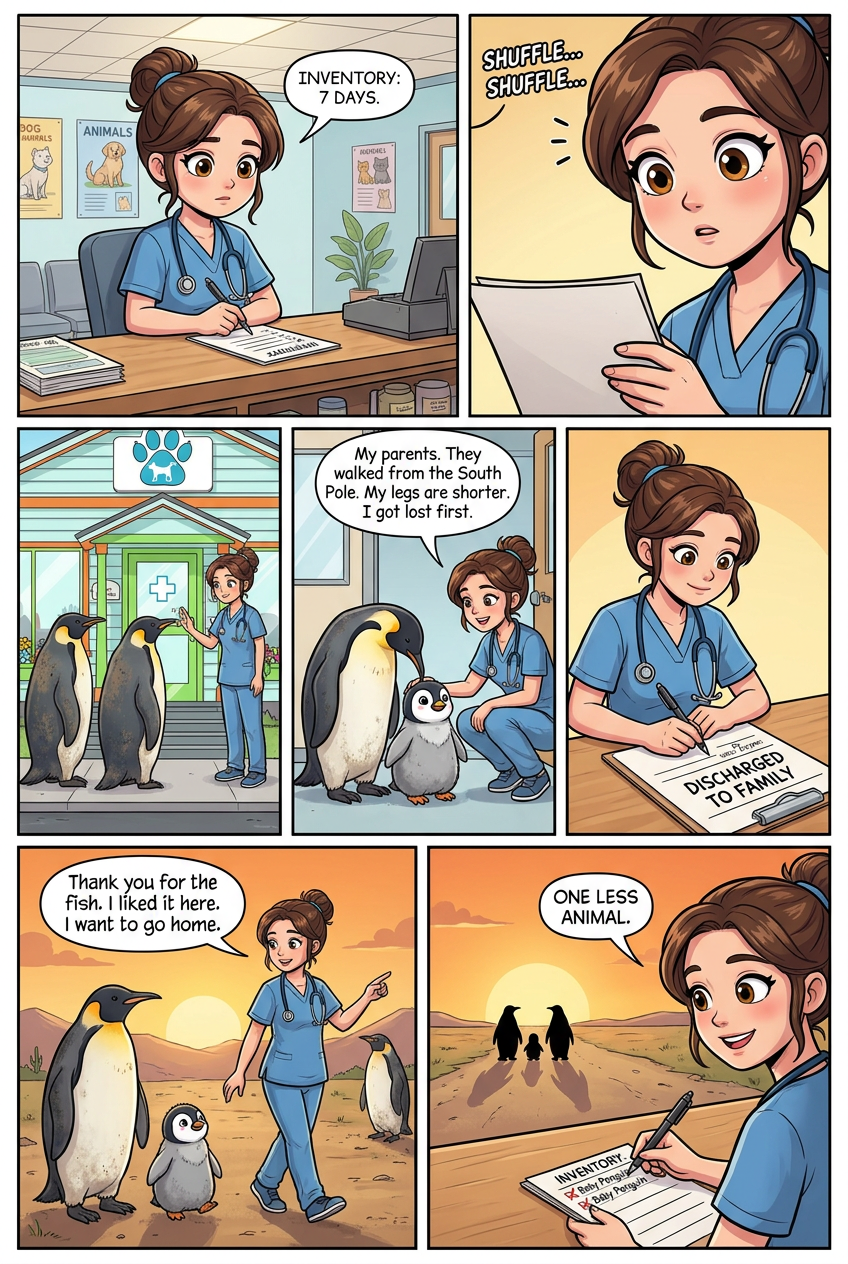
Valerie sat at the front counter of the clinic Tuesday morning, drafting the inventory list. She had seven days to write down every animal in her care, including the cub in the shed. Her pen was still hovering over the second line when she heard shuffling at the door. It sounded like Baby Penguin, only heavier. Two sets of feet, slow and careful. She stood, walked to the glass, and looked out. Two Emperor Penguins stood on the front step. The male came up to her waist. The female was a little shorter. They looked tired. Their feathers were dull with salt and dust. The male tapped the door once with his beak. Valerie opened it and stepped back. Baby Penguin waddled out from the exam room before she could call for him. He stopped in the doorway. "My parents," he said. "They walked from the South Pole. My legs are shorter. I got lost first." The female pressed her head against Baby Penguin's chest. The male looked at Valerie and bowed his neck once. Valerie knelt on the tile. She understood. They had followed the setting sun for weeks to find their chick. She offered them water in a shallow pan and a bowl of smelt from the freezer. They ate standing up, never taking their eyes off Baby Penguin. Valerie made the choice while they ate. Baby Penguin belonged with them, not on her inventory. She pulled his intake form from the file and wrote DISCHARGED TO FAMILY across the top in black pen, then dated it. She wrapped a bag of smelt in a cooler sleeve and tied it to the male's back with a soft strap. She walked the three of them to the edge of the back lot and pointed west, toward the low sun. Baby Penguin looked up at her. "Thank you for the fish," he said. "I liked it here. I want to go home." Valerie nodded. She watched them until they were three small shapes against the road, then smaller, then gone. She went back inside and crossed Baby Penguin's name off the inventory list. One less animal to explain. The cub in the shed was still there, still hers, still waiting to be written down. She picked up the pen and wrote his line next.
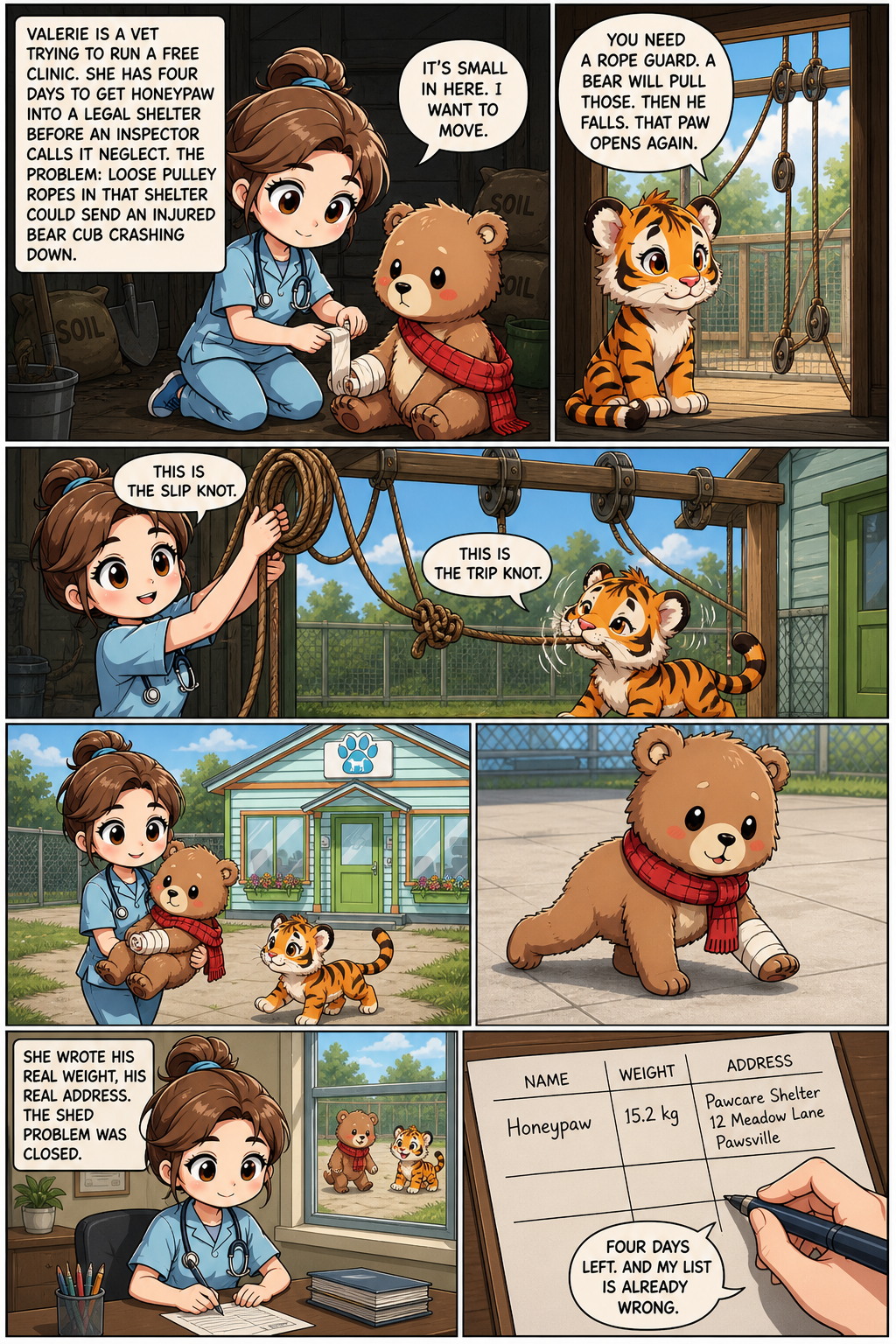
Valerie crossed the back lot to the shed after lunch. The bear cub's line sat unfinished on her inventory list. She could not write his weight, his diet, or his safe housing, because none of it was true. The shed was dust and stacked soil bags. The cub, Honeypaw, slept behind them on a folded blanket. She had four days left. If his healing paw split open in that cramped dark, the inspector would call it neglect. She opened the door. Honeypaw lifted his head. His red scarf had slipped to one shoulder. He limped toward her, favoring the paw she had stitched. "It's small in here," Honeypaw said. "I want to move." "I know," Valerie said. "So do I." She knelt and unwound the bandage. The stitches held. The pad was pink, not red, but the concrete floor was hard and the corners were tight. He could not stretch or climb. A cub who could not move would stiffen and tear the wound again. She needed him in the back lot shelter, the legal one, the three-sided shelter with the concrete pad. But a bear cub loose there could climb the pulley ropes and reopen his paw in a fall. A small voice spoke from the doorway. "You need a rope guard." Valerie turned. A tiger cub sat in the light, no bigger than Honeypaw, tail curled around his feet. She had never met him. He watched her hands, not her face. "I'm Tigger Too," the cub said. "I chew ropes. I freed the elder's cub from a snare. I know knots." "You climbed my fence," Valerie said. "Yes. I saw the ropes hanging. A bear will pull them. Then he falls." He nodded at Honeypaw's paw. "That opens again." He was right. Valerie looked from the tiger cub to the pulley she had strung herself. The danger was the loose rope, not the shelter. "Show me," she said. They worked through the afternoon. Valerie coiled the pulley rope high and tied it off. Tigger Too tugged each knot with his teeth to test it, then dropped to all fours and shook his head at two of them. She retied those. When the ropes hung out of reach, she carried Honeypaw across the lot and set him on the shelter's clean pad. The cub took three slow steps, then a fourth. He stretched his back legs on the flat concrete. The paw held. Valerie went inside and picked up her pen. She wrote Honeypaw's line at last: a real weight, a real diet, a real address in the legal shelter. The shed problem was closed. Then she stopped. The inventory listed one wild cub. Now a second sat on her pad, uninvited, unregistered, watching Honeypaw eat. Tigger Too had nowhere to go. Four days left, and her list was already wrong.
Play your story to life
Storycraft is a mobile game where you create AI characters, craft items and locations to build their world, then discover what direction your story takes. Download the iOS game for free today!
Download for free