

Webster Daily's Arc
13 Chapters
Webster Daily's dream is writing about his findings in Rust Creek.

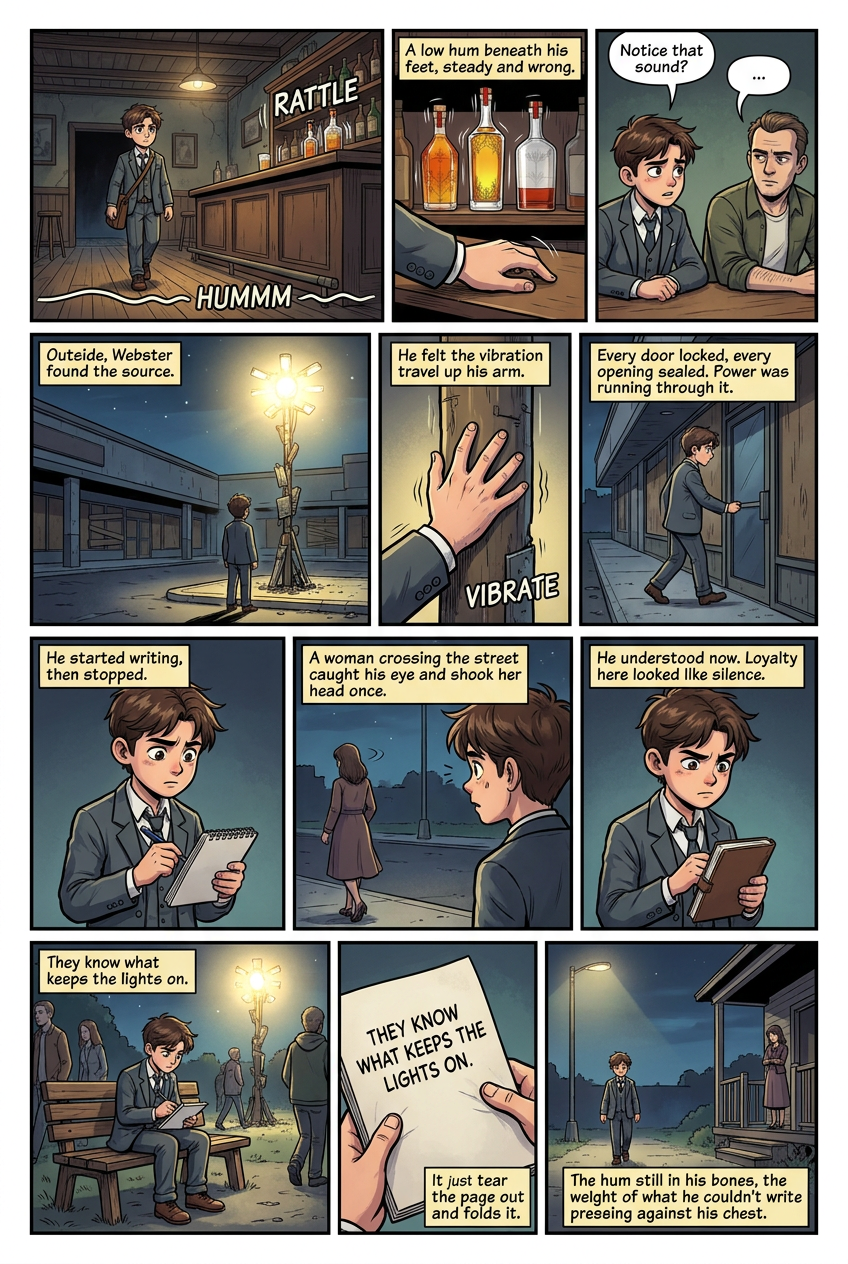
Webster stepped into the bar and felt it before he saw it — the low hum beneath his feet, steady and wrong, like machinery that had no business running. The bottles rattled slightly on their shelves. No one looked up from their drinks. He asked the man beside him if anyone else noticed the sound. The man's eyes went to his glass, then to the door, then back to Webster with a flat stare that said nothing and everything at once. Outside, Webster found the source. A light pole made of welded scrap stood at the corner of the old shopping center, glowing brighter than it had any right to. He pressed his palm against the base and felt the vibration travel up his arm. The shopping center had been empty for years, windows boarded, storefronts dark. But power was running through it. He walked the perimeter and found every door locked, every opening sealed. Whatever was underneath this place was feeding the whole block. He pulled out his notebook and started writing, then stopped. A woman crossing the street caught his eye and shook her head once, sharp and clear. She kept walking. Webster closed the notebook. He understood now why the residents spoke in circles, why the man still defended the company, why loyalty here looked like silence. The story he came to write about poison in the water had become something else entirely. Rust Creek wasn't dying from what the company had done. It was surviving on something the company left behind. And everyone who stayed had made a choice not to name it. He sat on a rough wooden bench outside the shopping center and watched the light pole glow. Three people passed him in ten minutes. Not one looked at the light. Not one asked what he was doing there. Webster opened his notebook again and wrote a single line: They know what keeps the lights on. He tore the page out, folded it twice, and slipped it into his jacket pocket. When he looked up, the woman who had shaken her head was standing on her porch two blocks down, watching him. She didn't wave this time. She just turned and went inside. Webster stood and walked back toward his car, the hum still in his bones, the weight of what he couldn't write pressing against his chest.
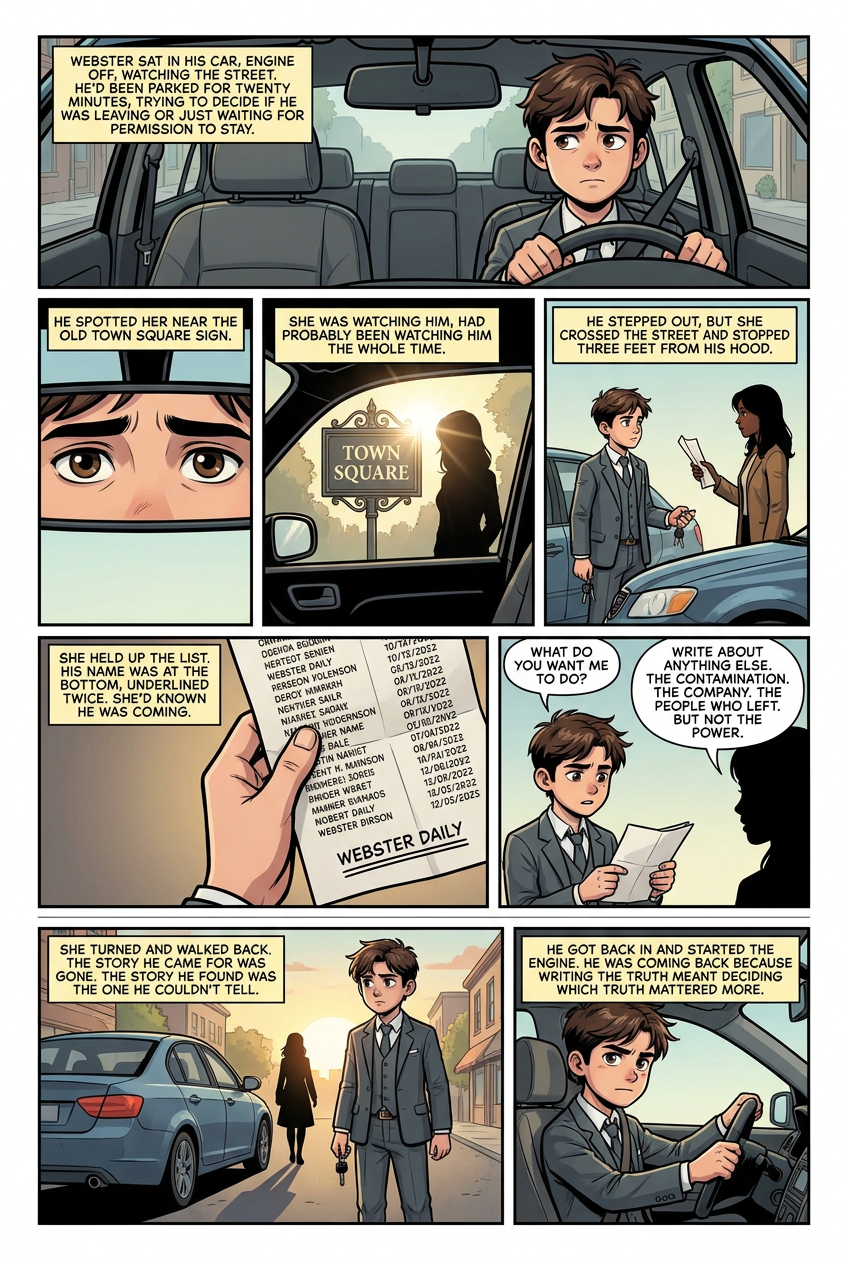
Webster sat in his car two blocks from the shopping center, engine off, watching the street in his rearview mirror. He'd been parked for twenty minutes, trying to decide if he was leaving or just waiting for permission to stay. He spotted Sherrie standing near the old town square sign, the ornate metalwork catching the afternoon light. She was watching him, had probably been watching him the whole time. Webster opened the car door and stepped out, but before he could decide what to say, she crossed the street and stopped three feet from his hood. She pulled a folded paper from her jacket pocket and held it up so he could see the list written in neat columns. Names, dates, arrival times. His name was at the bottom, underlined twice. She'd known he was coming before he'd even decided to stay. Webster looked at the list, then at her face. "What do you want me to do?" he asked. Sherrie refolded the paper and slipped it back into her pocket. "Write about anything else," she said. "The contamination. The company. The people who left. But not the power." She turned and walked back toward the square without waiting for an answer. Webster stood beside his car, keys still in his hand. The story he came for was gone. The story he found was the one he couldn't tell. He got back in the car and started the engine, but this time he knew he wasn't coming back to ask more questions. He was coming back because writing the truth meant deciding which truth mattered more.
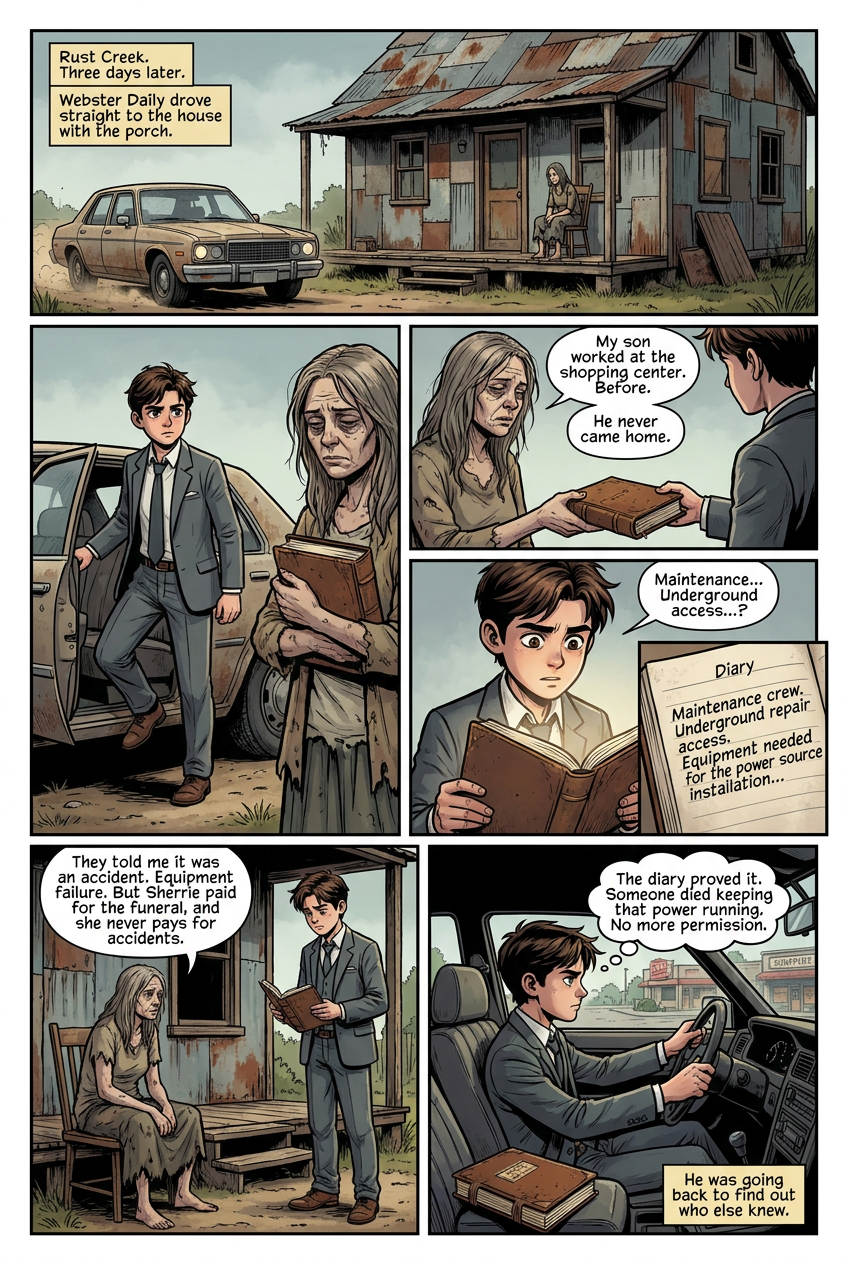
Webster drove back to Rust Creek three days later, but this time he didn't stop at the shopping center or park near the square. He went straight to the house with the porch, the one where the woman waved at him every time he passed. The structure was patchwork metal and weathered wood, rust spreading across seams like a slow-growing stain. She sat outside on a wooden chair, watching the road. When Webster's car appeared, she didn't wave. She stood and waited, hands folded at her waist. He parked and walked to the edge of her yard, but she came down the steps before he could speak. She wore tattered clothing that hung loose on her frame, and her eyes held the weight of something he'd been trying not to see. She reached into her pocket and pulled out a leather-bound book, edges worn soft from handling. "My son worked at the shopping center," she said. "Before." Webster took the diary and opened it. The first entry was dated two years back. Maintenance crew. Underground repair access. The handwriting listed equipment needed for the power source installation, then stopped mid-sentence. The next pages were blank. Webster looked up at her, but she was already turning back toward the house. He stood holding the diary as she climbed the steps and sat back down in her chair. "He never came home," she said without looking at him. "They told me it was an accident. Equipment failure. But Sherrie paid for the funeral, and she never pays for accidents." The diary felt heavier than it should. Webster wanted to ask what happened, wanted to push for details, but the woman's silence told him everything he needed to know. The power beneath the shopping center had a cost, and her son had paid it. Webster walked back to his car and sat behind the wheel, the diary on the passenger seat beside him. He could write about the water, about the company, about the people who left. He could follow Sherrie's instructions and stay safe. But the diary proved what he'd suspected since he first heard the hum beneath the shopping center. Rust Creek's power came from somewhere, and someone had died keeping it running. He started the engine and drove toward the town square, the diary still on the seat. This time he wasn't going back to ask permission. He was going back to find out who else knew what it cost to keep the lights on.
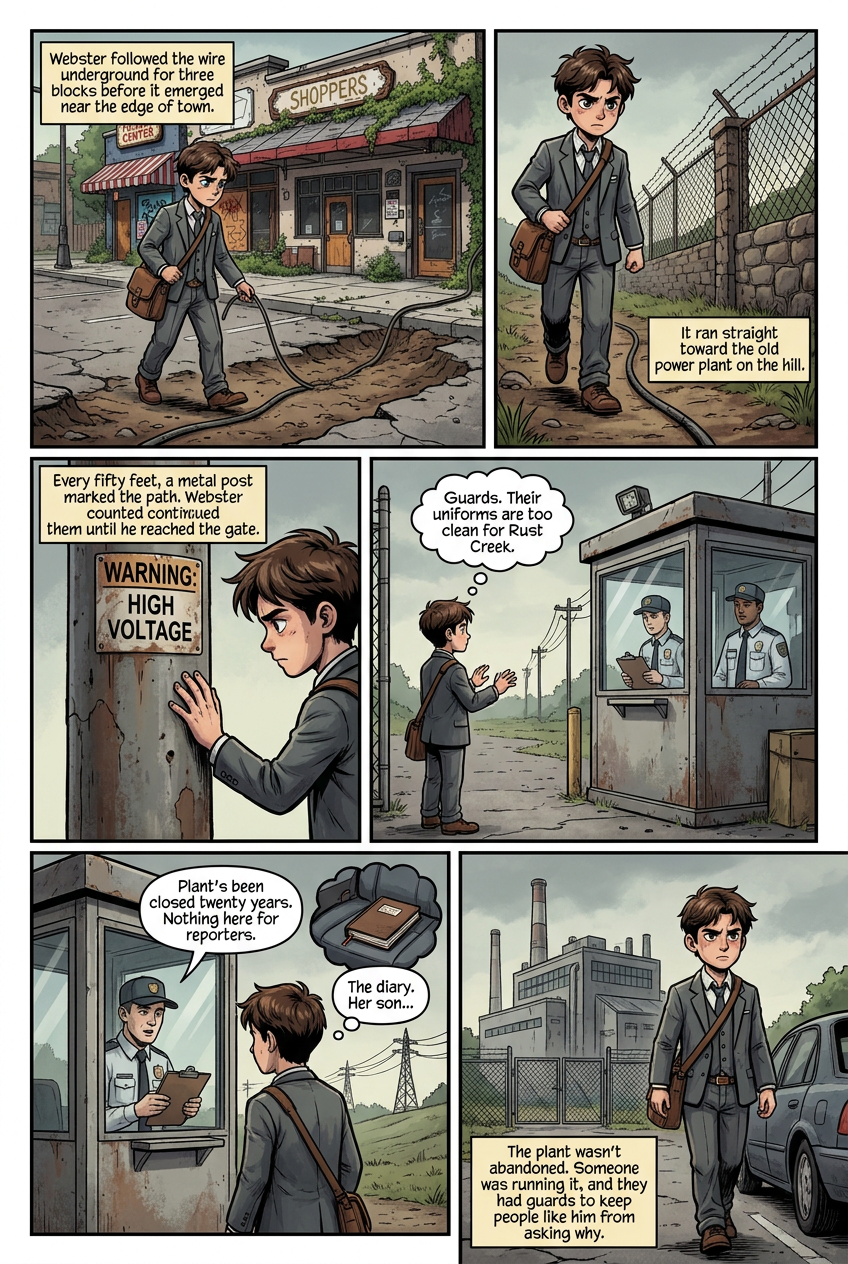
Webster followed the wire underground for three blocks before it emerged near the edge of town. He'd expected it to loop back to the shopping center, maybe connect to some hidden generator room beneath the foundation. Instead, it ran straight toward the old power plant on the hill. The fence appeared first, a stone wall topped with rusted barbed wire that leaned backward at a sharp angle. The wire he'd been following ran parallel to it, buried just beneath the dirt and grass. Every fifty feet, a metal post marked the path with faded warning signs. Webster pulled over and walked the fence line, counting posts until he reached the gate. A security booth stood at the entrance, reinforced glass on three sides and a metal desk visible inside. Two guards sat behind the window, their uniforms cleaner than anything Webster had seen in Rust Creek. One of them looked up from a clipboard as Webster approached. The other reached for something beneath the desk. Webster stopped ten feet back and raised his hands slightly, showing he wasn't armed. The first guard opened a small window slot. "Plant's been closed twenty years," the guard said. "Nothing here for reporters." Webster glanced past him at the building beyond the gate. The plant looked functional, its walls solid and free of rust. Power lines ran from the roof into the ground, disappearing toward town. He thought about the diary on his car seat, about the woman's son who never came home. The guard was still watching him, waiting for him to leave. Webster nodded once and walked back to his car. He'd found what he came for, and now he knew who was keeping the secret. The plant wasn't abandoned at all. Someone was running it, and they had guards to keep people like him from asking why.
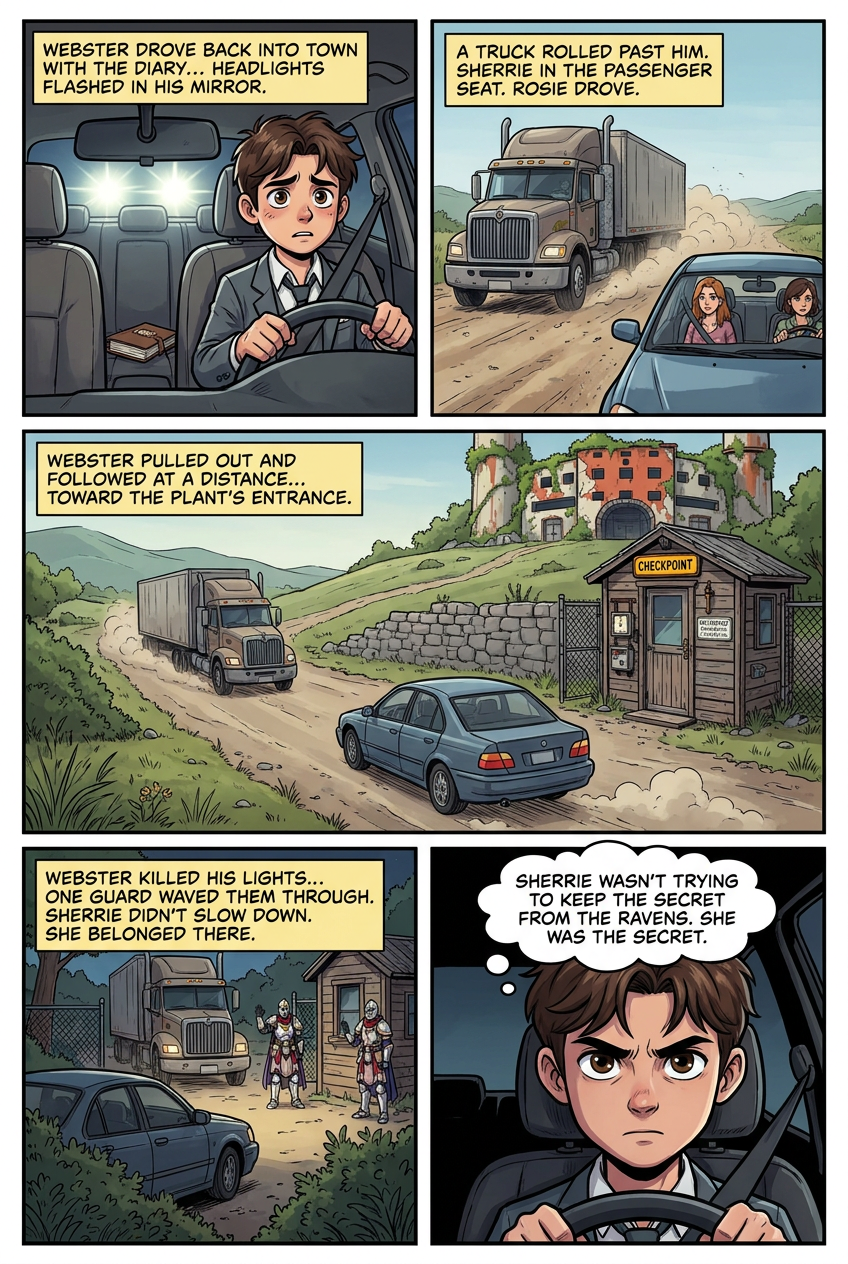
Webster drove back into town with the diary still on the seat beside him. The guards' faces stayed with him, sharper than he wanted. He'd seen the plant. He'd seen the wire. Now he sat behind the wheel, engine idling, unsure where to point the car next. Headlights flashed in his mirror. A truck rolled past him without slowing, kicking dust off the road back toward the hill. Sherrie sat in the passenger seat. Rosie drove. Webster pulled out and followed at a distance, far enough that they wouldn't notice but close enough to watch. The truck climbed the slope toward the curved stone wall and the weathered gate booth that marked the plant's entrance. Webster killed his lights and stopped behind a stand of brush. The guards stepped out before the truck even reached the gate. One waved them through. The other lifted the barrier without a word, without a clipboard, without a question. Sherrie didn't slow down. She belonged there. Webster sat in the dark and felt the last piece of his story click into place. Sherrie wasn't trying to keep the secret from the Ravens. She was the secret.
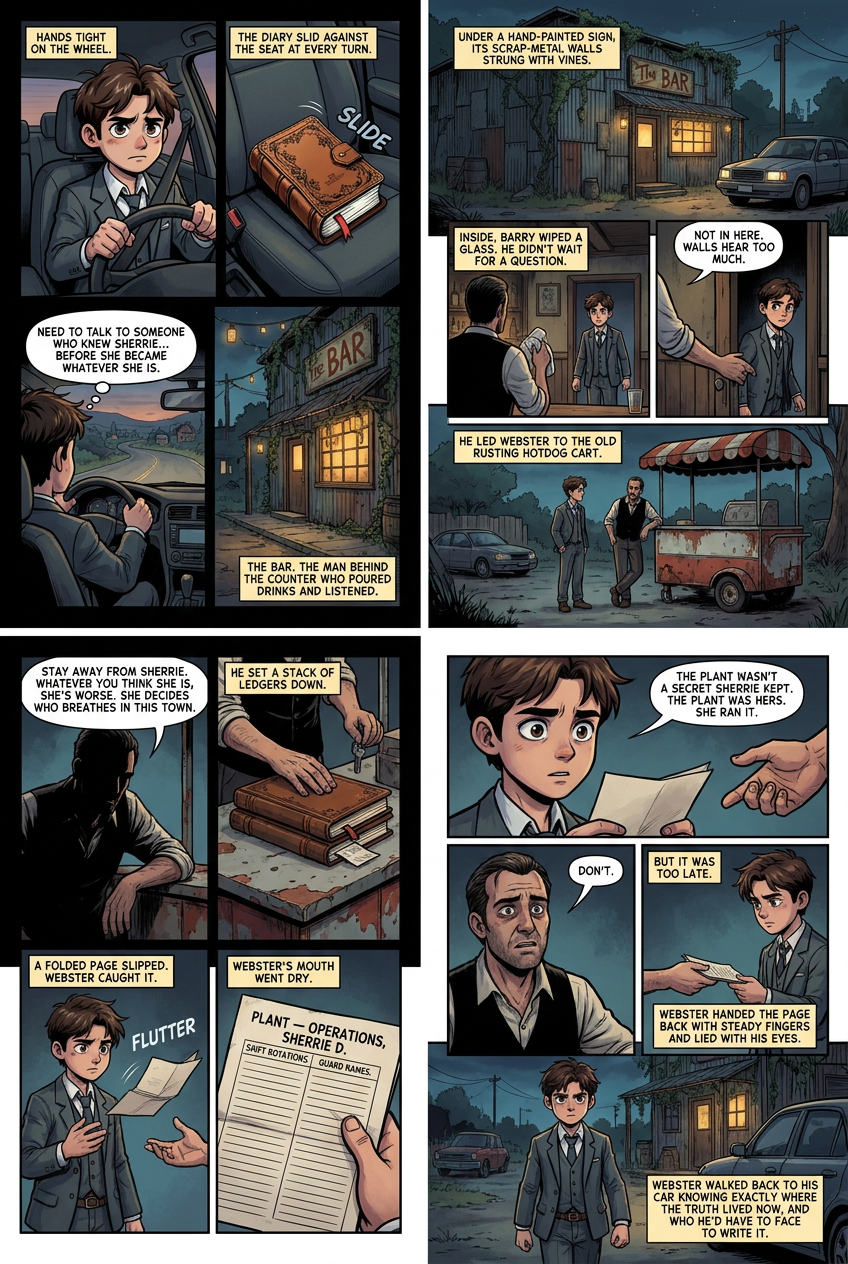
Webster drove back down the hill with his hands tight on the wheel. The diary slid against the passenger seat at every turn. He needed to talk to someone who knew Sherrie before she became whatever she was now. He thought of the bar on the main road, the warm light in its window, and the man behind the counter who poured drinks and listened more than he spoke. Webster pointed the car toward town and drove. The bar sat under a hand-painted sign, its scrap-metal walls strung with vines and dim lanterns. Inside, Barry wiped a glass and watched Webster cross the floor. He didn't wait for a question. He set the glass down and led Webster back out, past the door, to the old red-and-white hotdog cart rusting at the edge of the lot. "Not in there," Barry said. "Walls hear too much." Barry leaned against the cart. "Stay away from Sherrie," he said. "Whatever you think she is, she's worse. She decides who breathes in this town." He set a stack of three leather ledgers on the cart's chipped counter, fishing for a key in his pocket. A folded page slipped from between the covers. Webster caught it before the wind did. Shift rotations. Guard names. A header at the top read PLANT — OPERATIONS, SHERRIE D. Webster's mouth went dry. Barry's face dropped. "Don't," he said. But it was too late. Webster handed the page back with steady fingers and lied with his eyes. The plant wasn't a secret Sherrie kept. The plant was hers. She ran it. She owned it. Every road in this story bent toward that hill, and Barry, who had meant to warn him off, had just handed him the map. Webster walked back to his car knowing exactly where the truth lived now, and who he'd have to face to write it.
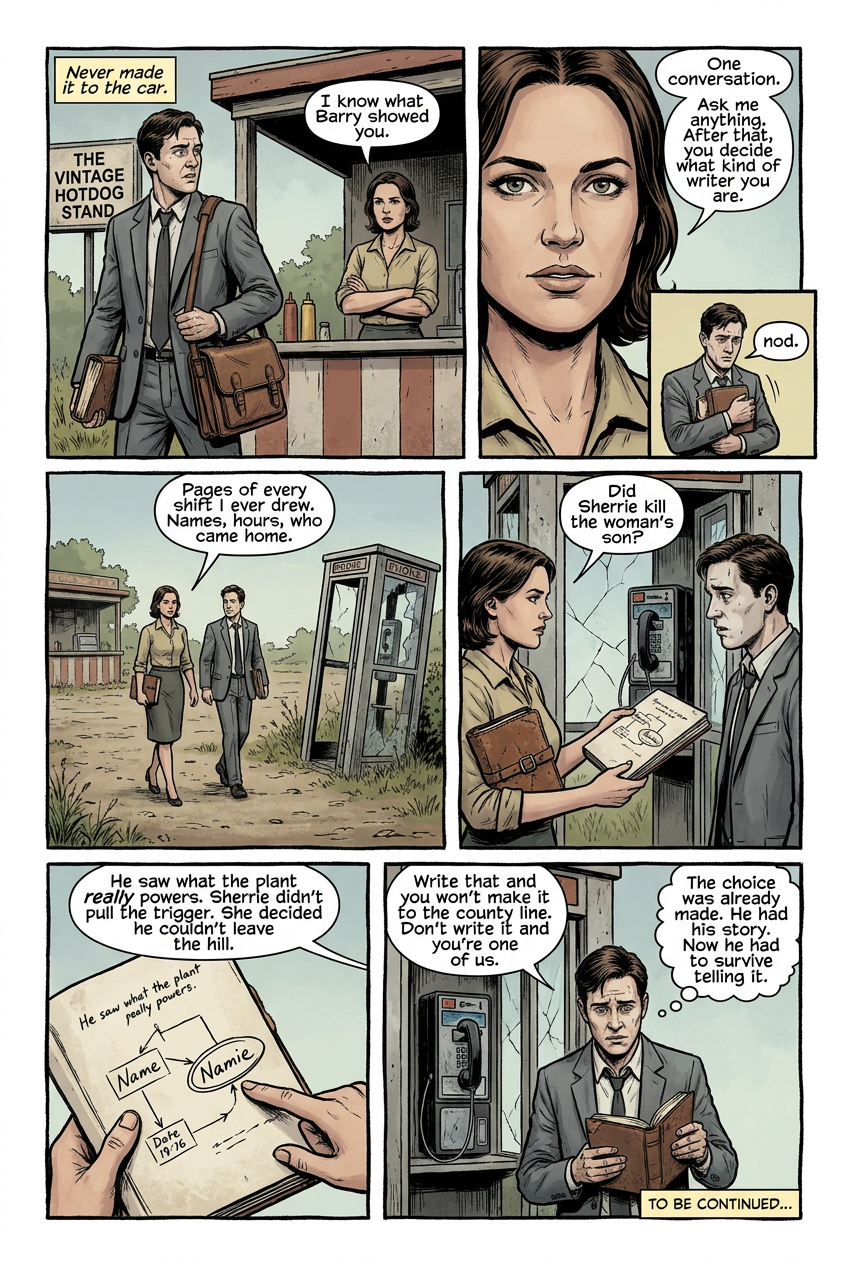
Webster never made it to his car. Rosie stepped out from behind the hotdog cart with her arms crossed, calm as a closed door. "I know what Barry showed you," she said. "One conversation. Ask me anything you want. After that, you decide what kind of writer you are." Webster's hand tightened on the diary under his arm. He nodded once. Rosie walked him across the lot to an old phone booth slumped in the weeds. Faded paint, a dead receiver, glass that watched the road in every direction. She tucked a worn sketchbook under her arm, its leather strap buckled tight. "Pages of every shift I ever drew," she said. "Names, hours, who came home. I brought it so you'd know I'm not guessing." She waited. Webster asked the only question that mattered. "Did Sherrie kill the woman's son?" Rosie opened the sketchbook to a marked page and turned it toward him. A diagram. A date. A name circled twice. "He saw what the plant really powers," she said. "Sherrie didn't pull the trigger. She decided he couldn't leave the hill." She closed the book. "Write that and you won't make it to the county line. Don't write it and you're one of us." Webster looked at the diary, then at the booth's cracked glass, and understood the choice was already made. He had his story. Now he had to survive telling it.
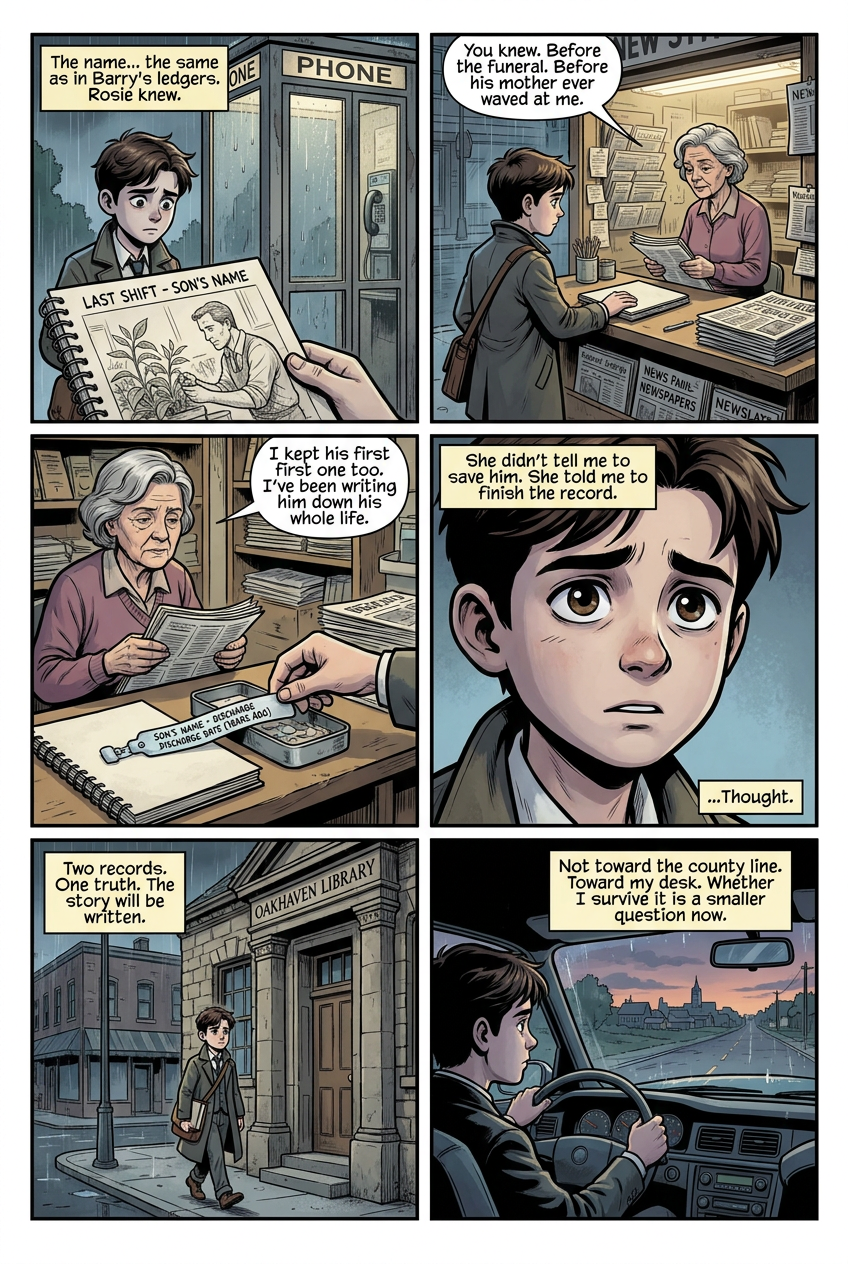
Webster stood by the phone booth long after Rosie walked away. The sketchbook stayed in his hands. He opened it again, slower this time, and saw what he'd missed. A header at the top of every page. The same word that ran across the plant's ledgers Barry had shown him. One name. One hand. Rosie had drawn the son's last shift months before she ever waved Webster toward the truth. He walked back across the lot to the bright little newspaper stand where Rosie kept her chair. She was already inside, sorting pages like nothing had happened. Webster set the sketchbook on the counter. "You knew," he said. "Before the funeral. Before his mother ever waved at me." Rosie didn't look up. She slid a faded hospital bracelet from a tin beside the register and laid it flat between them. A child's name. A discharge date from years before the plant ever hummed. "I kept his first one too," she said. "I've been writing him down his whole life." Webster understood then. She hadn't told him to save the son. She'd told him to finish the record. He walked out past the old stone library on the corner, where the town kept its visible history, and felt the sketchbook heavy under his coat. Two records. One truth. He got in his car and drove. Not toward the county line yet. Toward his desk. The story would be written. Whether he survived it was a smaller question now.
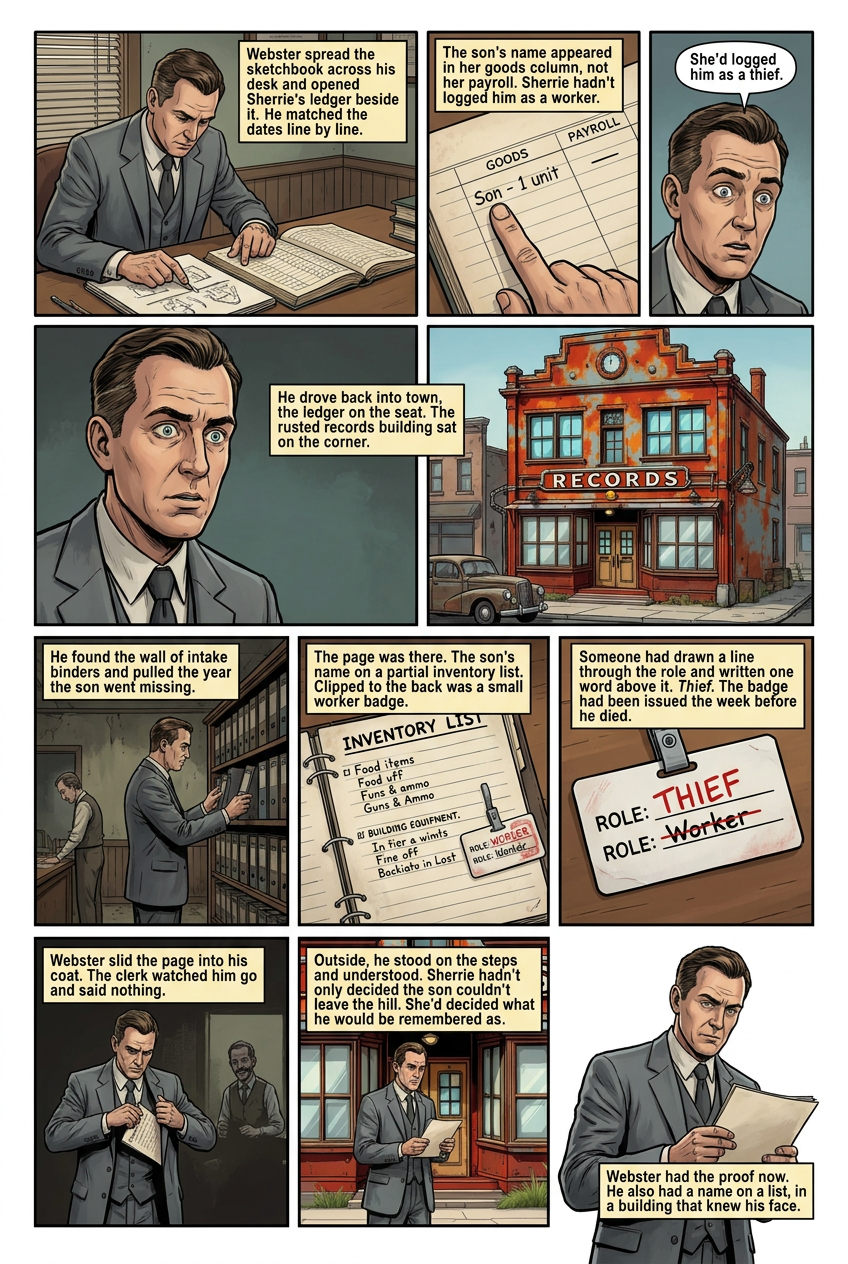
Webster spread the sketchbook across his desk and opened Sherrie's ledger beside it. He matched the dates line by line. The son's name appeared in her goods column, not her payroll. Sherrie hadn't logged him as a worker on the hill. She'd logged him as a thief. He drove back into town with the ledger on the seat. The rusted records building sat on the corner, its clock stopped, its sign still bright. Webster walked in. A clerk looked up and looked down again. He found the wall of intake binders and pulled the year the son went missing. The page was there. The son's name on a partial inventory list, half the entries scrubbed out, the rest rewritten in a steadier hand. Clipped to the back was a small worker badge with a red stamp across the face. Someone had drawn a line through the role and written one word above it. Thief. The badge had been issued the week before he died. Webster slid the page into his coat. The clerk watched him go and said nothing. Outside, he stood on the steps and understood the shape of it. Sherrie hadn't only decided the son couldn't leave the hill. She'd decided what he would be remembered as. Webster had the proof now. He also had a name on a list, in a building that knew his face.
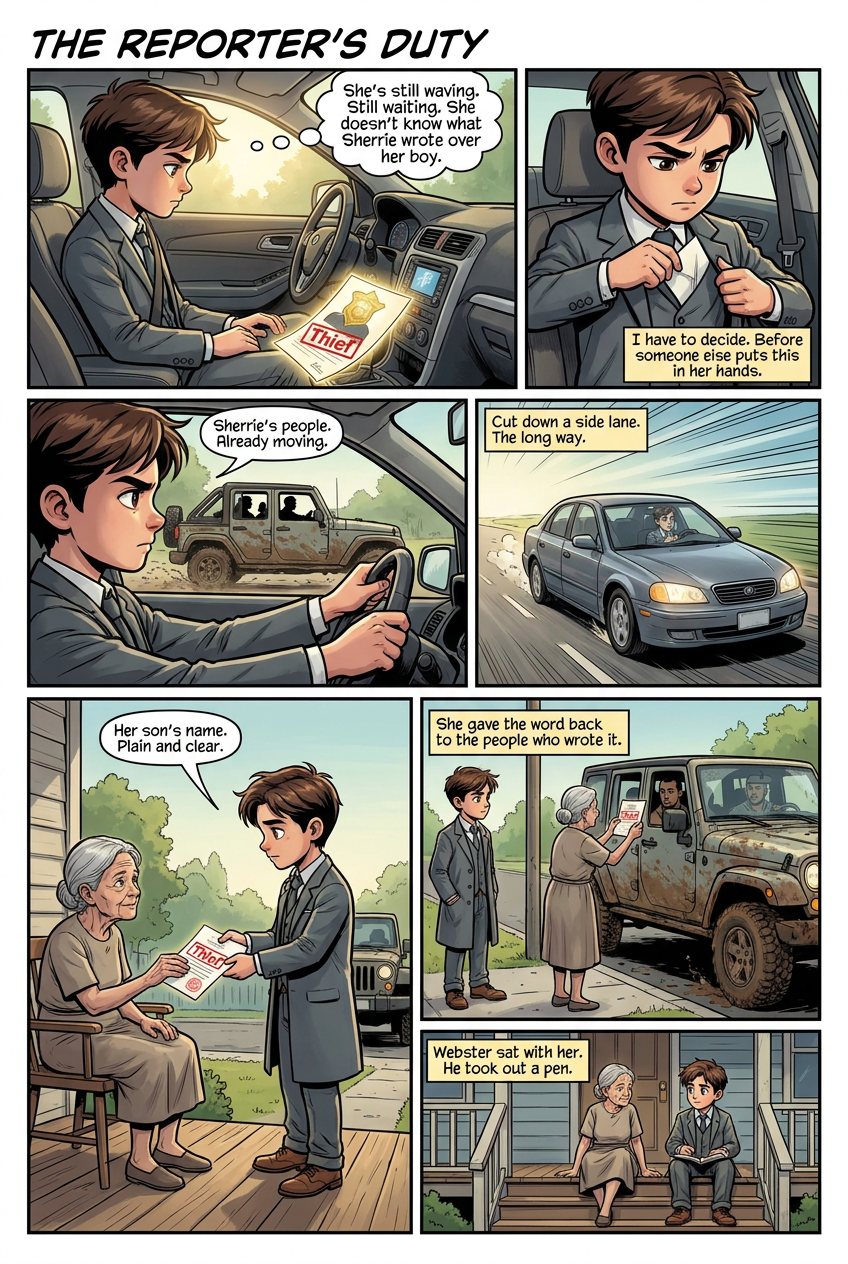
Webster sat in his car with the stolen page on his knee. The badge caught the light through the windshield. Thief, in red, across a face he had never seen. He thought of the woman on her porch, still waving, still waiting for a son who would not come back. She did not know what name her boy carried in the records. She did not know what Sherrie had written over him. Webster folded the page and slid it into his coat. He had to decide, and soon, whether to put this in her hands before someone else did. He started the engine. Two blocks on, a battered jeep rolled past him, mud-splashed and slow, two men inside scanning porches. He knew the look. Sherrie's people were already moving. Webster cut down a side lane and drove the long way to the woman's street, his hands tight on the wheel. She was on the porch. He climbed the steps, pulled the badge from his coat, and set it in her palm. Her fingers closed over the red stamp. She read the word. She did not cry. She looked up at Webster and said her son's name, plain and clear, like she was returning it to the air. Behind him, an engine slowed at the curb. Webster did not turn. The thing he came to do was done. The woman stepped past him down the steps with the badge held flat in her hand. She walked to the curb where the jeep had stopped and held the stamped face up to the window. The driver did not speak. She did not lower her arm. Webster stood on the porch and watched her give the word back to the people who wrote it. He had the rest of the page in his coat, and his notebook in the car, and a story now that someone besides him had touched. The jeep pulled away slow. The woman walked back up the steps and sat down. Webster sat with her. He took out a pen.
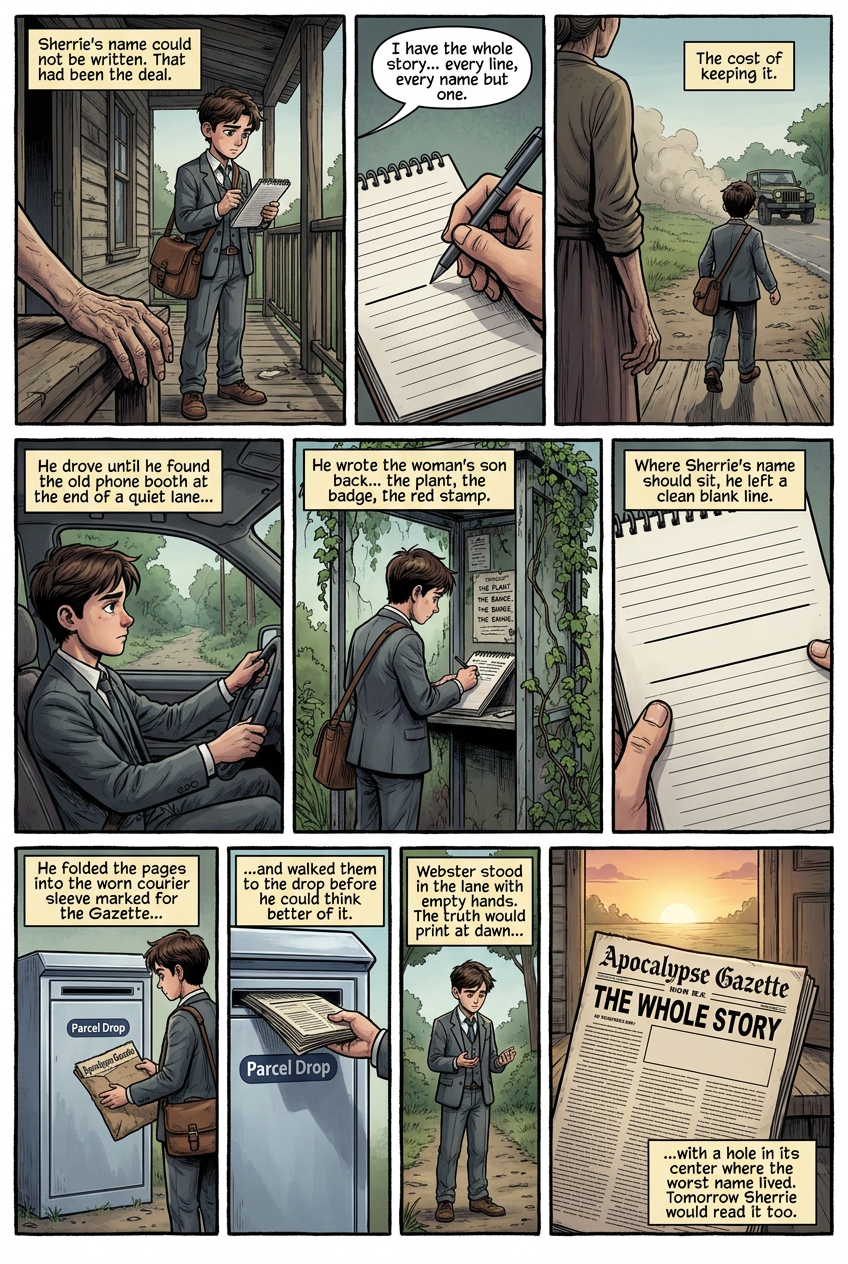
Webster's pen sat still over the page. The porch boards creaked under his shoes. The woman watched the road where the jeep had gone. He had the whole story now, every line he needed, every name but one. Sherrie's name belonged at the top, and Sherrie's name could not be written. That had been the deal. He looked at the woman's hands and knew the cost of keeping it. He drove until he found the old phone booth at the end of a quiet lane, vines crawling over its dark glass. He stepped inside and set his pages on the narrow shelf. He wrote the woman's son back into the world by his true name. He wrote the plant on the hill, the badge, the red stamp. Where Sherrie's name should sit, he left a clean blank line. The story was finished. It would go out tonight. And the one name that mattered most would never be printed beside the rest. He folded the pages into the worn courier sleeve marked for the Gazette and walked them to the drop before he could think better of it. The bundle slid through the slot and was gone. Webster stood in the lane with empty hands. The truth would print at dawn with a hole in its center where the worst name lived. He had kept his deal and broken his own work in the same hour. Tomorrow the town would read it. Tomorrow Sherrie would read it too, and know exactly what the blank line meant.
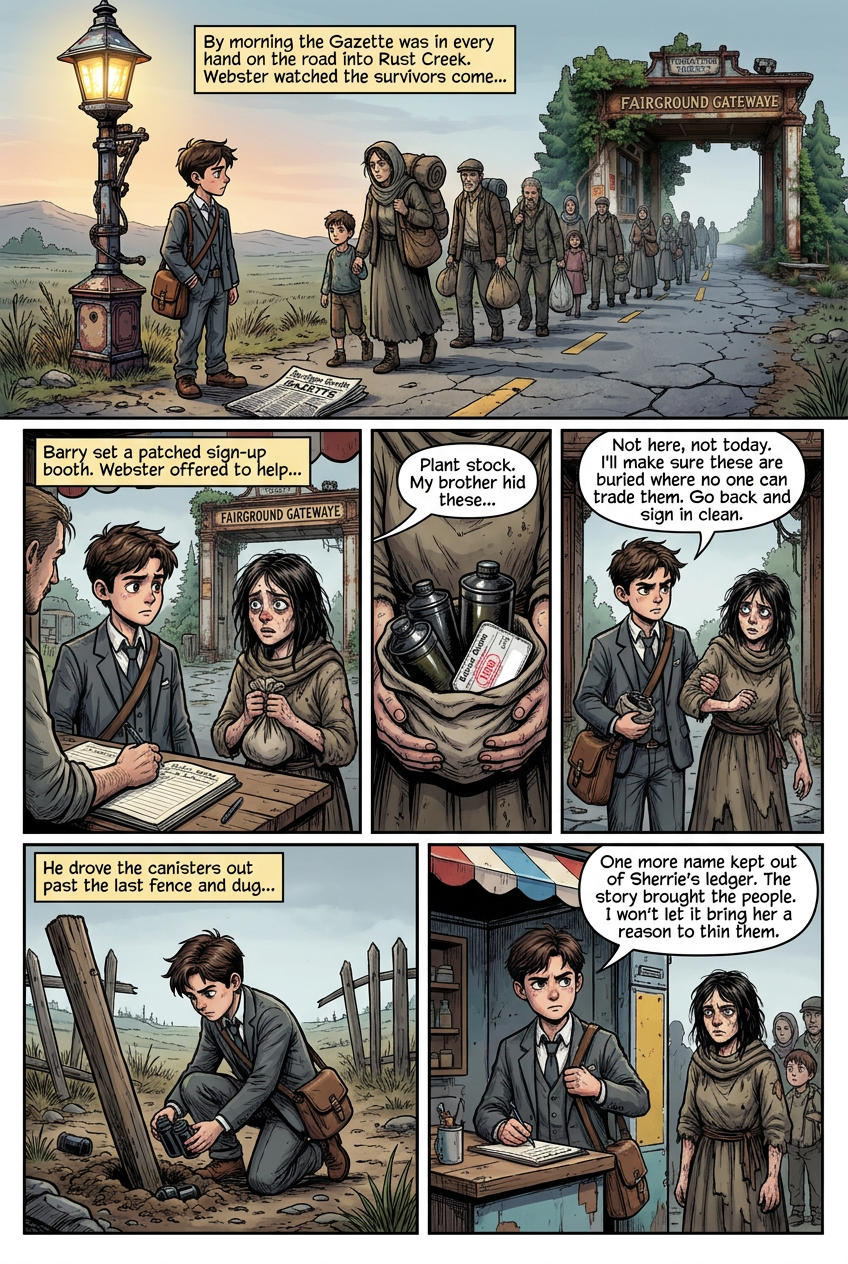
By morning the Gazette was in every hand on the road into Rust Creek. Webster watched the survivors come in slow, dusty lines past a scrap-metal lamp post that still burned from the night. They carried bundles, children, kettles. They came because the story said the town was real, that a name had been spoken again. Webster stood under the light and counted them and felt the weight of what he had pulled toward this place. Barry had set a patched sign-up booth at the old fairground arch. A list, he said. Names, trades, what each person brought. Webster offered to help and Barry waved him in without looking up. The line moved. Webster wrote down hammers, blankets, seed, a goat. Then a ragged woman stepped to the plank, eyes too wide, hands clutched at her chest. She set down a small cloth bundle. Inside lay three sealed canisters, oily and cold, and a worker ID badge with a red stamp across the front. Plant stock, she whispered. Her brother had worked the hill years back and hid these before he ran. She thought the town would want them returned. Webster's mouth went dry. The canisters were fuel cells. Bring them inside the walls and Sherrie would have a thread straight back to every soul in this line. He closed the cloth over them. He took the woman by the elbow and walked her past the booth, past the lamp post, back through the arch to the cracked road. He told her plain: not here, not today. He took the bundle from her hands and promised it would be buried where no one could trade it. She cried without sound. He gave her Barry's name and told her to go back and sign in clean, only her hands, only her work. He drove the canisters out past the last fence and dug under a leaning post until the cloth was gone under dirt. He kept the badge. He slid it into his coat beside his pen. One more name the town did not need spoken, one more thing kept out of Sherrie's ledger. The story had brought the people. He would not let it bring her a reason to thin them. When he came back the line was longer. Barry was still writing names. The ragged woman stood near the front, her hands empty, her face set. Webster took his place beside the booth and lifted the next page. The Gazette had opened a door. He had just closed a smaller one behind it. Somewhere on the hill, he knew, Sherrie was already counting who had arrived.
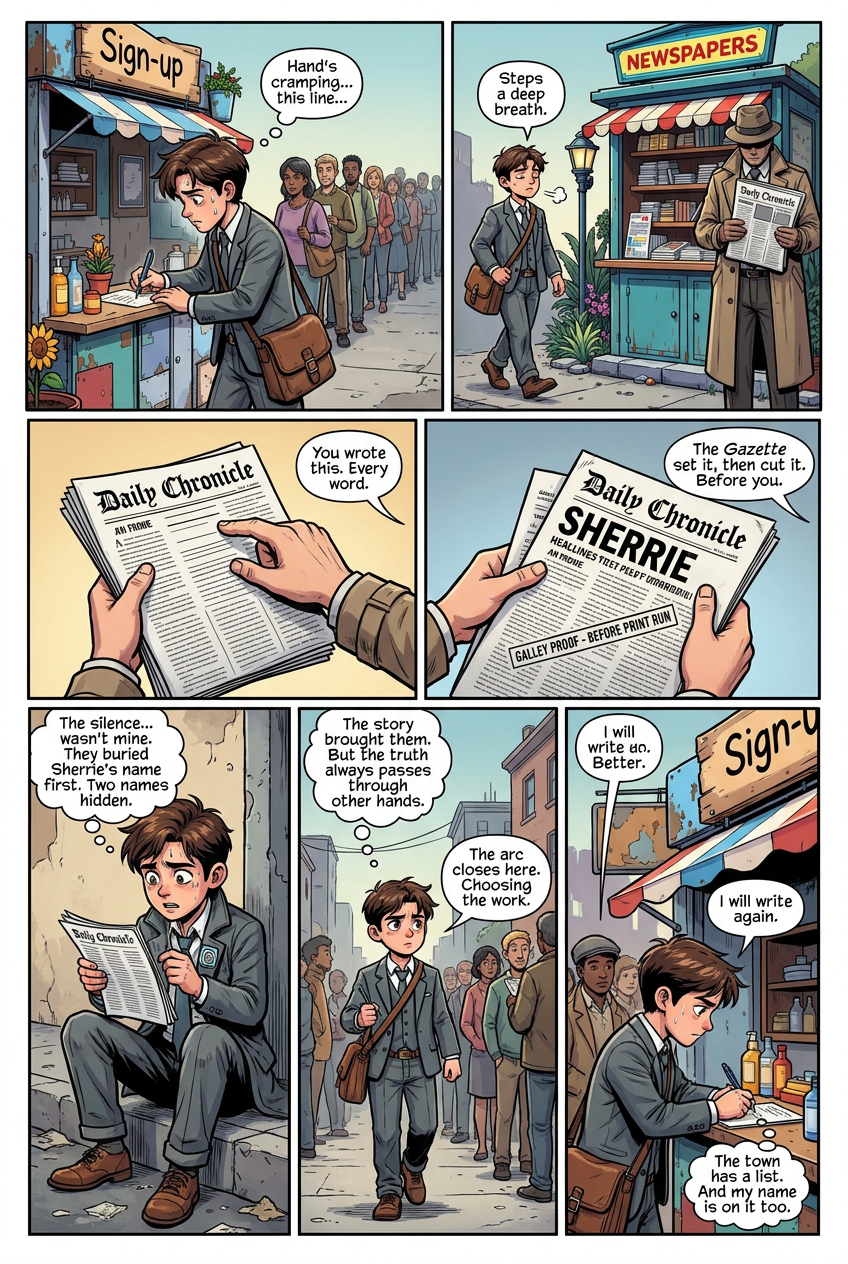
Webster worked the booth until his hand cramped. The line thinned by midday. He stepped out for air and saw a man waiting beside the old newspaper stand at the edge of the lot, a folded paper pressed flat against his chest. The man knew his byline. He had read every word. He held out the Gazette and tapped the blank line where a name should have been. Then he pulled a second page from inside the fold, a galley proof, stamped and dated before the print run. On it, in clean type, was the name Webster had left out. The Gazette had set it, then cut it. Someone inside had buried Sherrie's name before he ever made his choice. Webster took both pages and sat down on the curb. The proof shook in his hand. He had thought the silence was his. He had carried the guilt of it for a day and a night. But the paper had killed the name on its own, for its own reasons, and let him believe the cut was his mercy. He folded the proof into his coat beside the badge. Two names hidden now, one by him, one by them. He looked back at the line of new arrivals signing their trades. The story had brought them. The story had also been smaller than he knew. He understood, finally, that the truth he wrote would always pass through other hands. He stood up. He walked back to the booth and took up the pen. He wrote the next name, and the next, and the next. The arc of the story closed there, not with Sherrie undone, not with the hill cracked open, but with Webster choosing the work in front of him. He would write again. He would write better. For now, the town had a list, and his name was on it too.
Play your story to life
Storycraft is a mobile game where you create AI characters, craft items and locations to build their world, then discover what direction your story takes. Download the iOS game for free today!
Download for free