

Zia Sunroot's Arc
17 Chapters
Zia Sunroot's dream is discovering the identity of her mysterious gift-giving secret admirer..

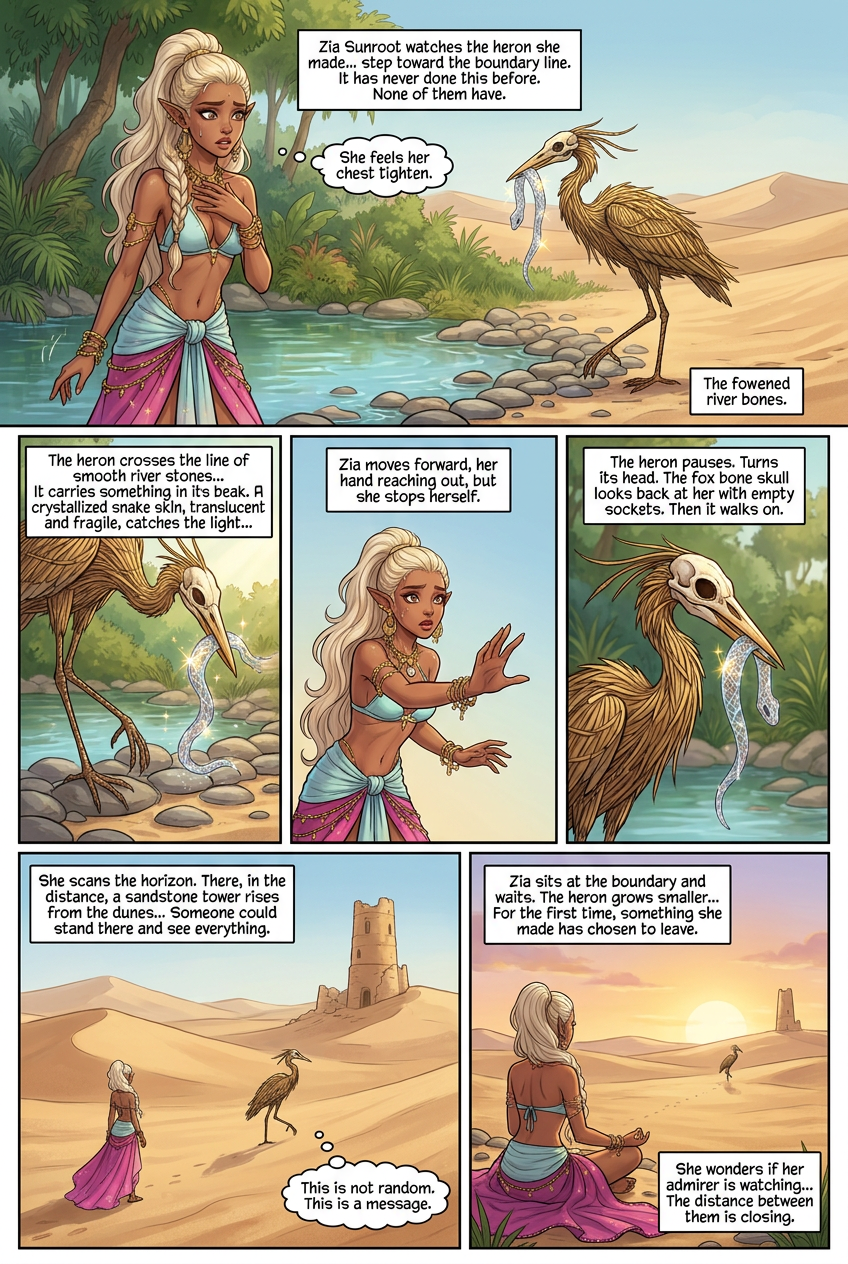
Zia Sunroot watches the heron she made from river reeds and fox bones step toward the boundary line. It has never done this before. None of them have. The creature moves without sound, its feet barely touching the water's surface. She feels her chest tighten. Every gift left at the edge has stayed where it was placed. Every creature she has built has remained within the oasis. Until now. The heron crosses the line of smooth river stones that marks where green meets sand. It carries something in its beak. A crystallized snake skin, translucent and fragile, catches the light as the creature takes another step into the desert. Zia moves forward, her hand reaching out, but she stops herself. The heron pauses. Turns its head. The fox bone skull looks back at her with empty sockets. Then it walks on. She scans the horizon. There, in the distance, a sandstone tower rises from the dunes. Half buried, carved with patterns she cannot read from here. Someone could stand there and see everything. The boundary. The gifts. Her. The heron moves toward it now, steady and purposeful, leaving no tracks in the sand. This is not random. This is a message. Zia sits at the boundary and waits. The heron grows smaller against the pale stone. She does not call it back. For the first time, something she made has chosen to leave. She wonders if her admirer is watching this moment. She wonders if they sent the creature this direction somehow, or if it simply knows where to go. Either way, the distance between them is closing. Someone will have to move next.
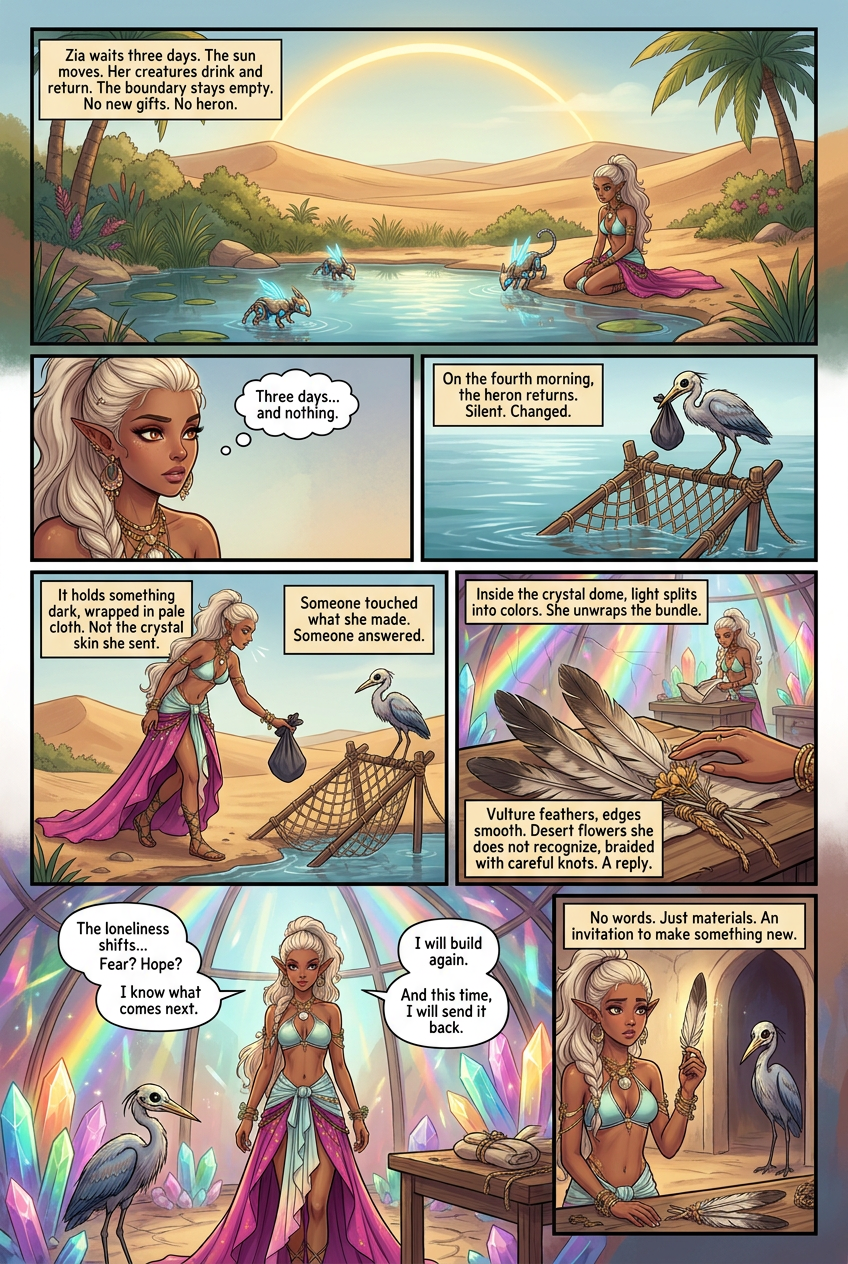
Zia waits three days. The sun moves across the sky. The creatures she made drink from the pool and return to their places. The boundary stays empty. No new gifts arrive. The heron does not come back. On the fourth morning, she sees movement near the rope net stretched between wooden frames at the water's edge. The heron lands without sound. Its beak holds something dark, wrapped in pale cloth and tied with dried flowers. Not the crystal skin she sent. Zia's breath catches. She walks to the net and lifts the bundle carefully. Vulture feathers, arranged and bound by hands that are not hers. Someone touched what she made. Someone answered. She carries the bundle to the crystal dome at the heart of the oasis. Inside, light splits into colors across the walls. She sets the feathers on the workbench and unwraps them slowly. Three long flight feathers, edges worn smooth. Desert flowers she does not recognize, their stems braided together with careful knots. This is not a gift left at the boundary. This is a reply. The heron stands in the doorway, watching her with its empty skull. It went to the tower. It came back changed. Zia holds one feather up to the light. Her admirer did not write words or leave a sign. They sent materials. An invitation to make something new. She looks at the heron, then at the feathers in her hands. The loneliness that has lived in her chest for years shifts slightly, making room for something else. Fear, maybe. Or hope. She cannot tell the difference anymore. But she knows what comes next. She will build again, and this time, she will send it back.
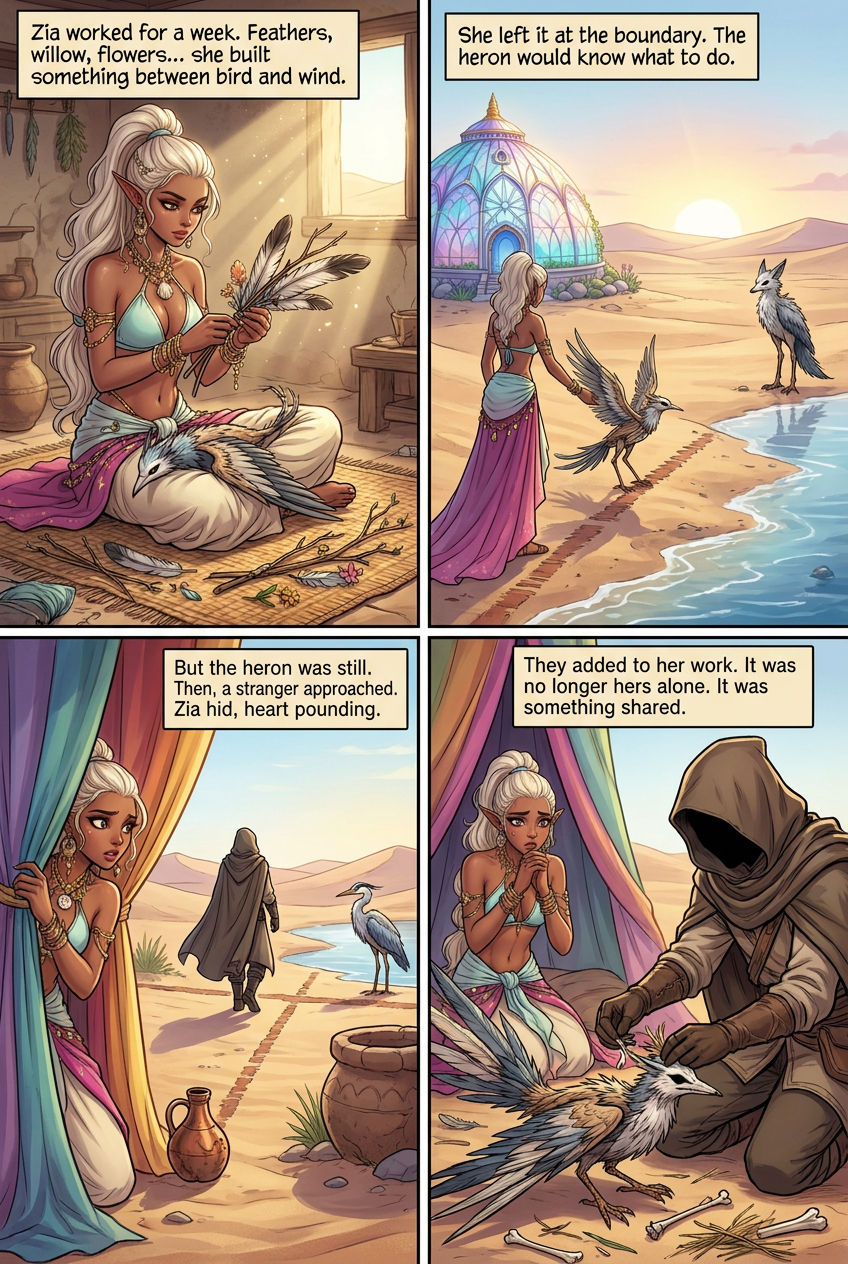
Zia spends the next week working. She binds the vulture feathers to a frame of willow branches. She weaves the desert flowers into joints that bend and hold. The new creature takes shape slowly, something between bird and wind. When she finishes, she carries it to the boundary at dawn and sets it on the sand just inside the line. The heron will know what to do. But the heron does not move. Zia waits through the morning, watching from the crystal dome. The creature she made sits where she left it. The heron stands at the water's edge, still as stone. By midday, she sees movement at the boundary. Not the usual distant approach. A figure on foot, walking straight toward the line where her creation rests. They stop at the old clay well just outside the oasis, set down a dented copper flask, and keep coming. Zia's chest tightens. This is not how it was supposed to happen. The admirer was meant to stay distant, to watch and leave gifts and remain safely unknown. She moves without thinking, her feet carrying her toward the bright pavilion tent she keeps at the far edge of the oasis for travelers who never come. She slips inside and pulls the fabric closed behind her. Through a gap in the colored cloth, she watches the figure cross the boundary line and kneel beside her creation. The stranger lifts the bird-wind creature carefully, turning it in their hands. They examine the joints, trace the willow frame with their fingers. Then they set it down and reach into their pack. They pull out materials—bone shards, dried grass, something that glints like metal. They begin to work right there at the boundary, adding to what she made. Building onto it. Zia's fear shifts into something sharper. This person is not just watching. They are answering with their hands, changing her work into something shared. When they finish, they stand and walk back toward the flask at the well, leaving the altered creature behind. Zia steps out from the pavilion. The creature at the boundary is no longer hers alone. It belongs to both of them now, and she cannot pretend otherwise.
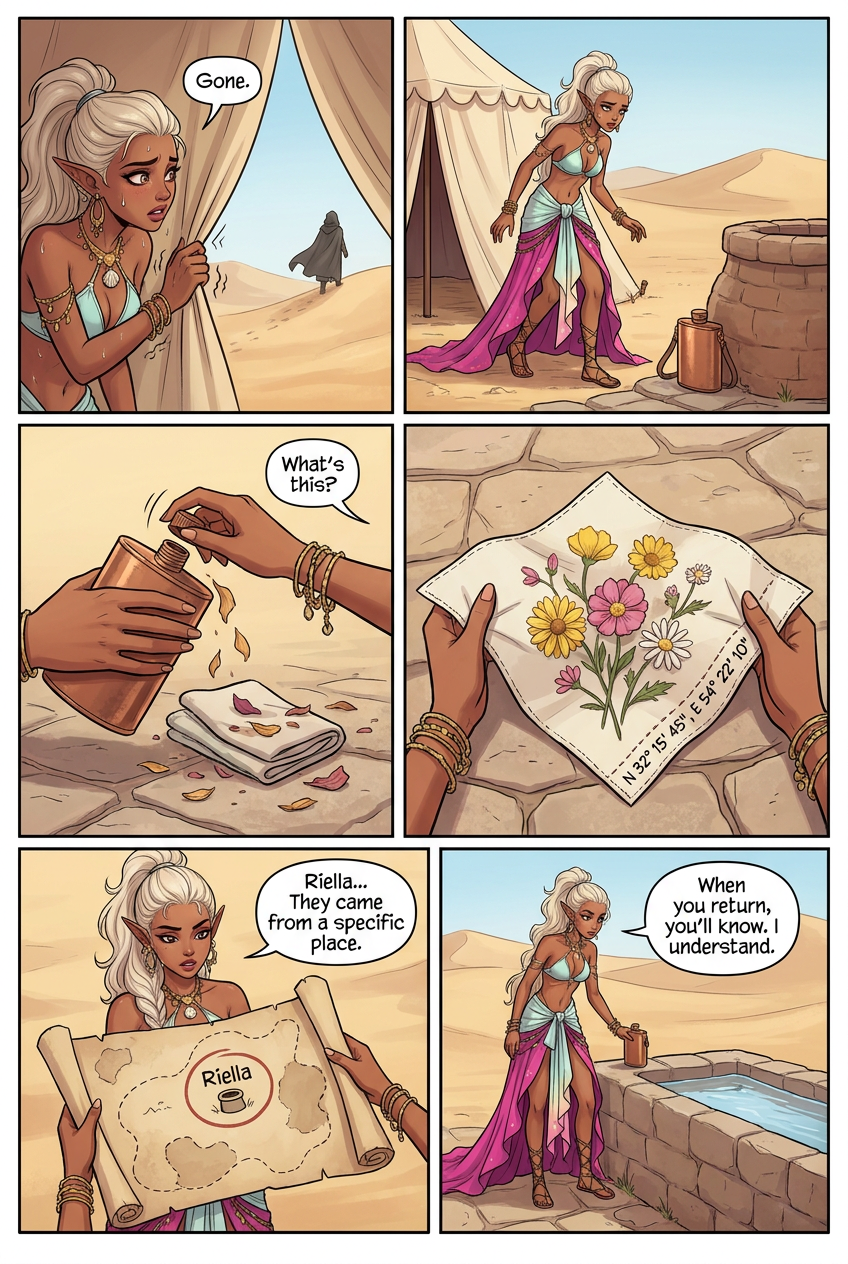
Zia stays inside the pavilion until the stranger disappears beyond the dunes. Her legs feel weak. Her hands shake. She steps out and walks toward the boundary, but she does not look at the altered creature. Instead, she turns toward the clay well where the stranger left the copper flask. The flask sits beside the well, still warm from being carried. Zia picks it up and feels its weight shift. Something inside moves. She unscrews the cap and tilts it. A folded cloth slides into her palm, heavier than it should be. She unfolds it carefully. Pressed flowers fall onto the stone—petals in yellow and pink and white, dried but still bright. Around the edges of the cloth, numbers are stitched in careful thread. Coordinates. Her fingers trace them, and she knows immediately what they mean. The stranger has a home. A fixed place they return to. She sets the cloth down and tips the flask again. This time a rolled map slides out, the parchment soft from handling. She spreads it across the edge of the well and sees ink marks for settlements, wells, and trade routes. One spot is circled in fresh charcoal—a cluster of buildings beside a well marked Riella. The stranger did not just wander here. They traveled from somewhere specific, carrying water from their own well to hers. Zia's chest tightens. The admirer was never faceless. They were always a person with a place to return to, and they chose to come here anyway. She folds the map and cloth and places them back inside the flask. Then she walks to the watering trough she built years ago for travelers who never came. She fills it from the oasis stream and sets the flask beside it. The stranger will return—she knows that now. And when they do, they will see that she has been here, that she touched what they left behind, that she understands. For the first time, Zia has left a sign.
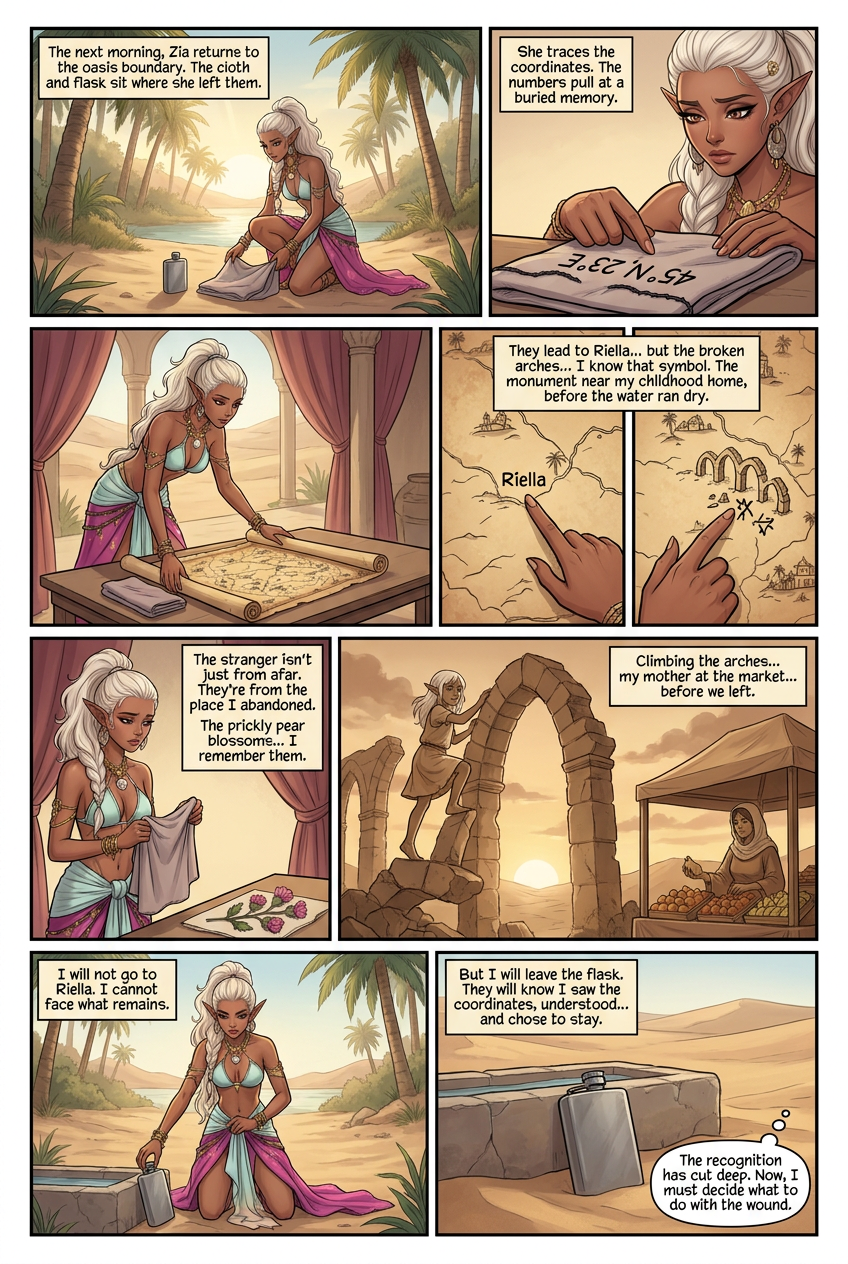
Zia returns to the oasis boundary the next morning. The cloth sits where she left it, folded beside the flask. She picks it up and spreads it across her palm. The coordinates stitch a path across the fabric in dark thread. She traces them with her fingertip, and the numbers pull at something buried in her memory. She walks back to her pavilion and unrolls the map beside the coordinates. The numbers lead to a settlement called Riella, but that name means nothing to her. She focuses on the surrounding marks—wells, trade routes, a cluster of smaller camps. Then she sees it: a set of broken arches drawn in faded ink at the edge of the map, marked with a symbol she knows. The monument stood near her childhood home before the water ran dry and everyone left. She hasn't thought of that place in years. The coordinates don't just point to Riella. They point to the land she walked away from. Her hands go numb. The stranger isn't just from somewhere distant. They're from the place she abandoned. She looks at the pressed flowers again—prickly pear blossoms, the kind that grew wild near the monument. She remembers climbing those arches as a child, pressing her palms against the cool stone while her mother sold fruit at the market pavilion below. The stranger would have walked past those same ruins to reach her. They would have seen what she left behind. Zia folds the cloth and places it back in the flask. She screws the cap tight and carries it to the boundary, setting it beside the watering trough. She will not go to Riella. She cannot face what remains of that place or the person who still lives there. But she will leave the flask where the stranger can find it. She will let them know she saw the coordinates, that she understood, and that she is choosing to stay here. The recognition has already cut through her. Now she has to decide what to do with the wound.
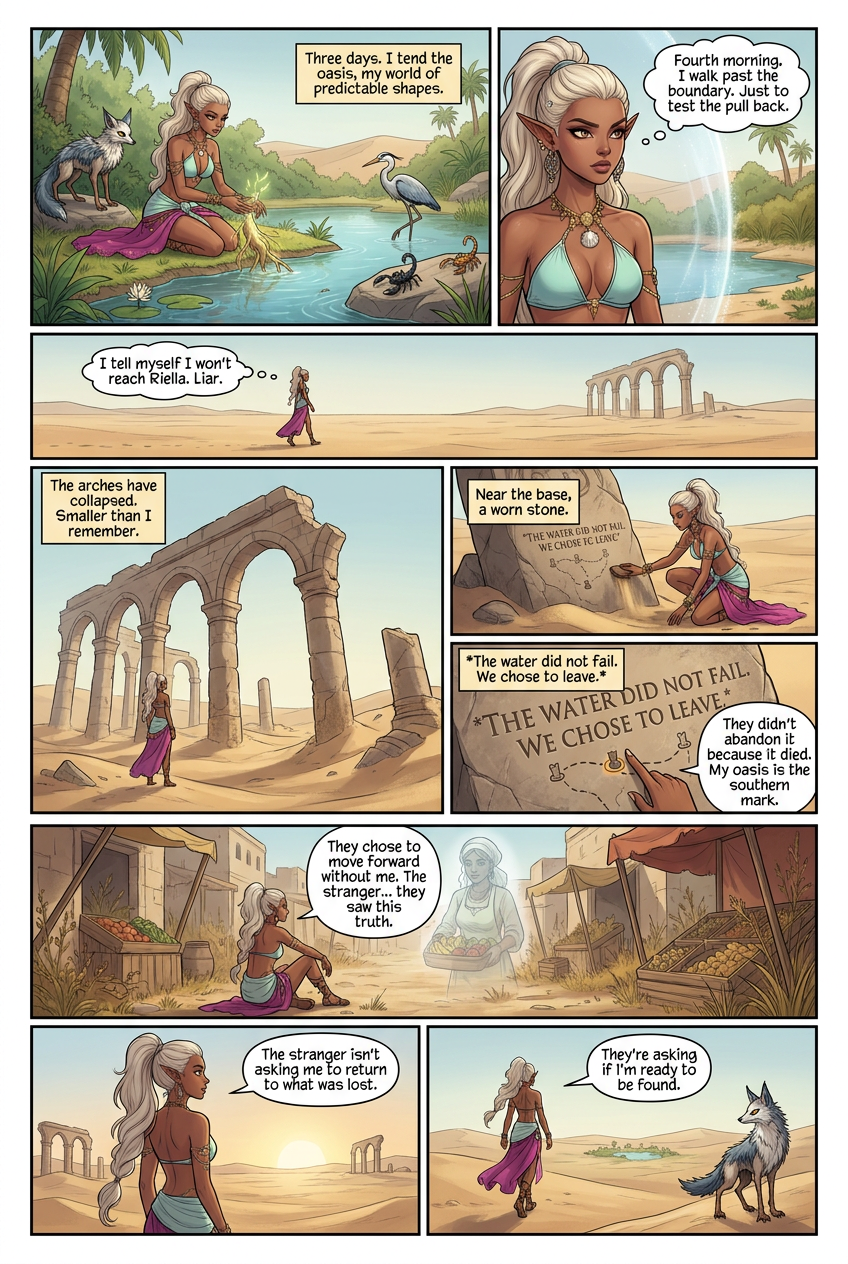
Zia doesn't return to the boundary for three days. She tends the oasis instead, checking roots and refilling pools. The creatures she's made move through their patterns—the heron walking across water, the scorpions circling the cool stones. Everything here follows the shape she gave it. Nothing surprises her. Nothing chooses. But on the fourth morning, she walks past the boundary. She carries nothing. She just walks. The desert opens ahead of her, flat and silent. She tells herself she's only testing how far she can go before the pull back becomes unbearable. She tells herself she won't reach Riella. The broken arches rise on the horizon by midday, cracked stone against pale sky. The monument looks smaller than she remembers. The arches have collapsed on one side, leaving broken pillars half-buried in sand. Near the base, a carved stone leans at an angle, its surface worn but still legible. She kneels and brushes away the dust. The words cut across the stone in deep, deliberate strokes: *The water did not fail. We chose to leave.* Below the text, someone has carved a crude map showing three wells—one here, one to the east, one to the south. Her oasis sits where the southern mark would be. Zia sits back on her heels. They didn't abandon this place because it died. They left because they found somewhere better. She looks past the monument toward what remains of the settlement—empty market stalls with sagging canopies, a dry stone trough choked with weeds. Her mother sold fruit here while Zia climbed these arches. The stranger would have walked through these ruins to reach her. They would have seen the carved stone and known the truth: that Zia didn't flee a dying place. She fled people who chose to move forward without her. She stands and turns back toward the oasis. The stranger isn't asking her to return to what was lost. They're asking if she's ready to be found.
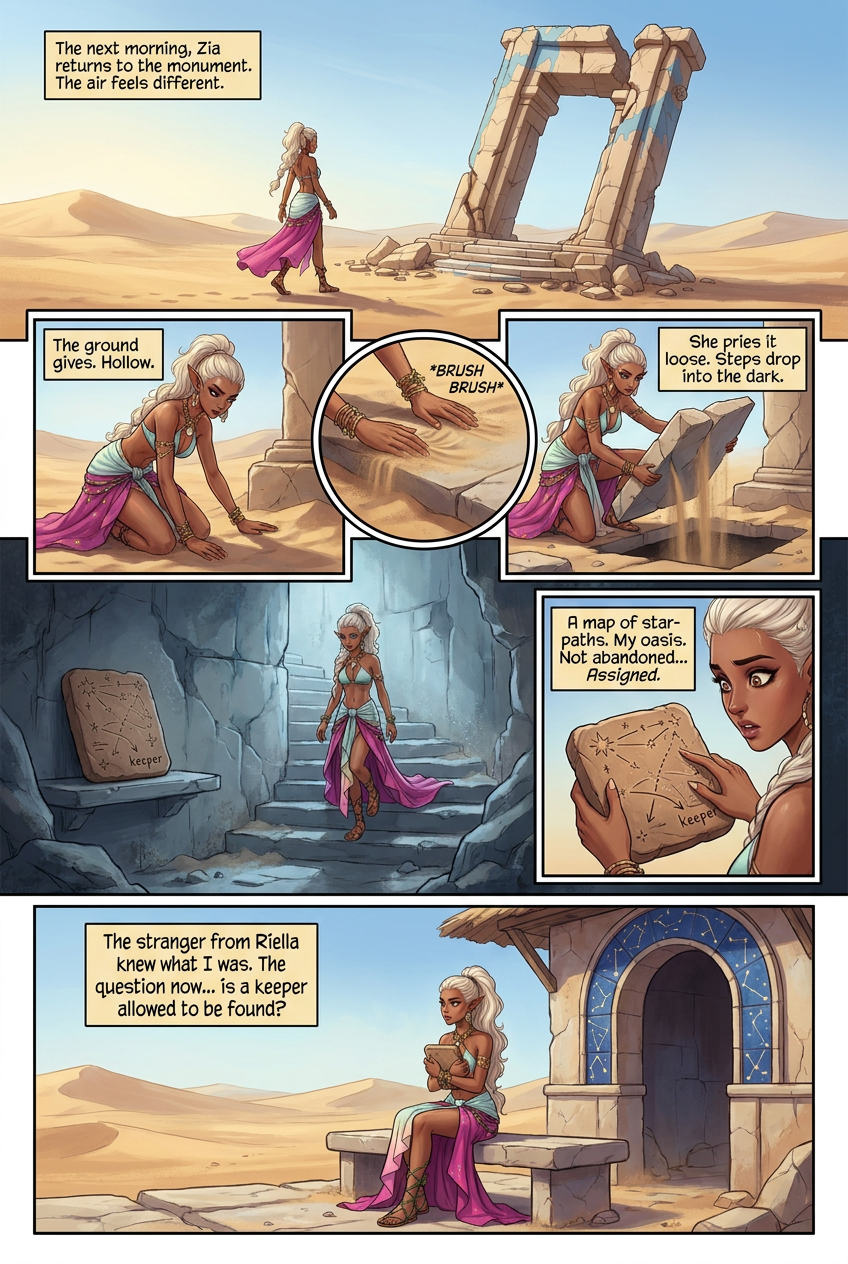
Zia walks back to the monument the next morning. The carved stone still leans where she left it, but something feels different now. She kneels and presses her palm to the sand at the base of the broken arches. The ground gives slightly. Hollow. She brushes the loose grains aside and finds the edge of a flat slab, half-buried, its seams sealed with old pitch. A chamber. Beneath everything she thought was just ruin. She pries the slab loose with a broken pillar shard. Sand pours into the dark. Below, weathered stone steps drop into shadow, their edges crumbling, corners drifted with pale dust. Zia climbs down. The air smells of cold clay. At the bottom, a small room opens around her, its walls bare except for one thing: a clay tablet set upright on a low shelf, etched with stars and arrows and tiny markings of distant wells. She lifts it carefully. The map shows migration paths drawn between constellations, each route ending at a different oasis. One arrow points south, to her oasis, marked with a single word: keeper. They didn't leave her behind by accident. They left her stationed. Her family was a line of people who moved with the stars, and she was the one chosen to stay and tend the southern water. Not abandoned. Assigned. Zia climbs back into the sun, tablet pressed to her chest. Near the monument stands a small stone shelter, its archway tiled with the same constellations etched into the clay. She sits on its bench and lets the truth settle. The stranger from Riella didn't come to call her home. They came because they knew what she was. The question now isn't whether to return. It's whether a keeper is allowed to be found.
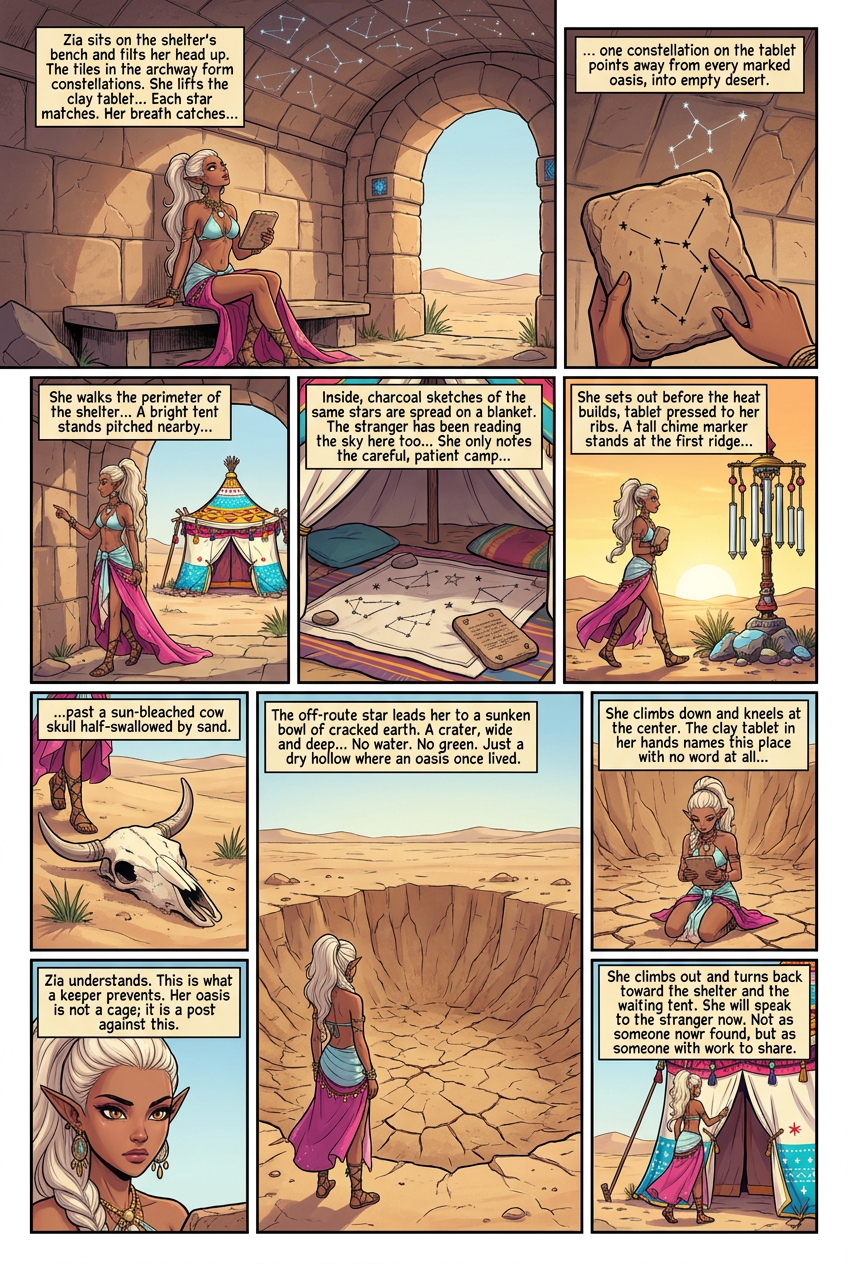
Zia sits on the shelter's bench and tilts her head up. The tiles in the archway form constellations. She lifts the clay tablet beside them and compares. Each star matches. Each line matches. Her breath catches when she sees it — one constellation on the tablet points away from every marked oasis, into empty desert. She walks the perimeter of the shelter, tracing the tiles with one finger. A bright tent stands pitched nearby, woven in bold colors, its flap tied open. Inside, charcoal sketches of the same stars are spread on a blanket. The stranger has been reading the sky here too. Zia does not call out. She only notes the careful, patient camp and the second tablet rubbing pinned beneath a stone. She sets out before the heat builds, tablet pressed to her ribs. A tall chime marker stands at the first ridge, its metal tubes turning in the wind. She knows it now for what it is — a waymarker her family planted between stations. She follows the line it points, past a sun-bleached cow skull half-swallowed by sand. The off-route star leads her to a sunken bowl of cracked earth. A crater, wide and deep, its floor split like old pottery. No water. No green. Just a dry hollow where an oasis once lived. She climbs down and kneels at the center. The clay tablet in her hands names this place with no word at all — only the star, only the silence. Zia understands. This is what a keeper prevents. Her oasis is not a cage; it is a post against this. She climbs out and turns back toward the shelter and the waiting tent. She will speak to the stranger now. Not as someone found, but as someone with work to share.
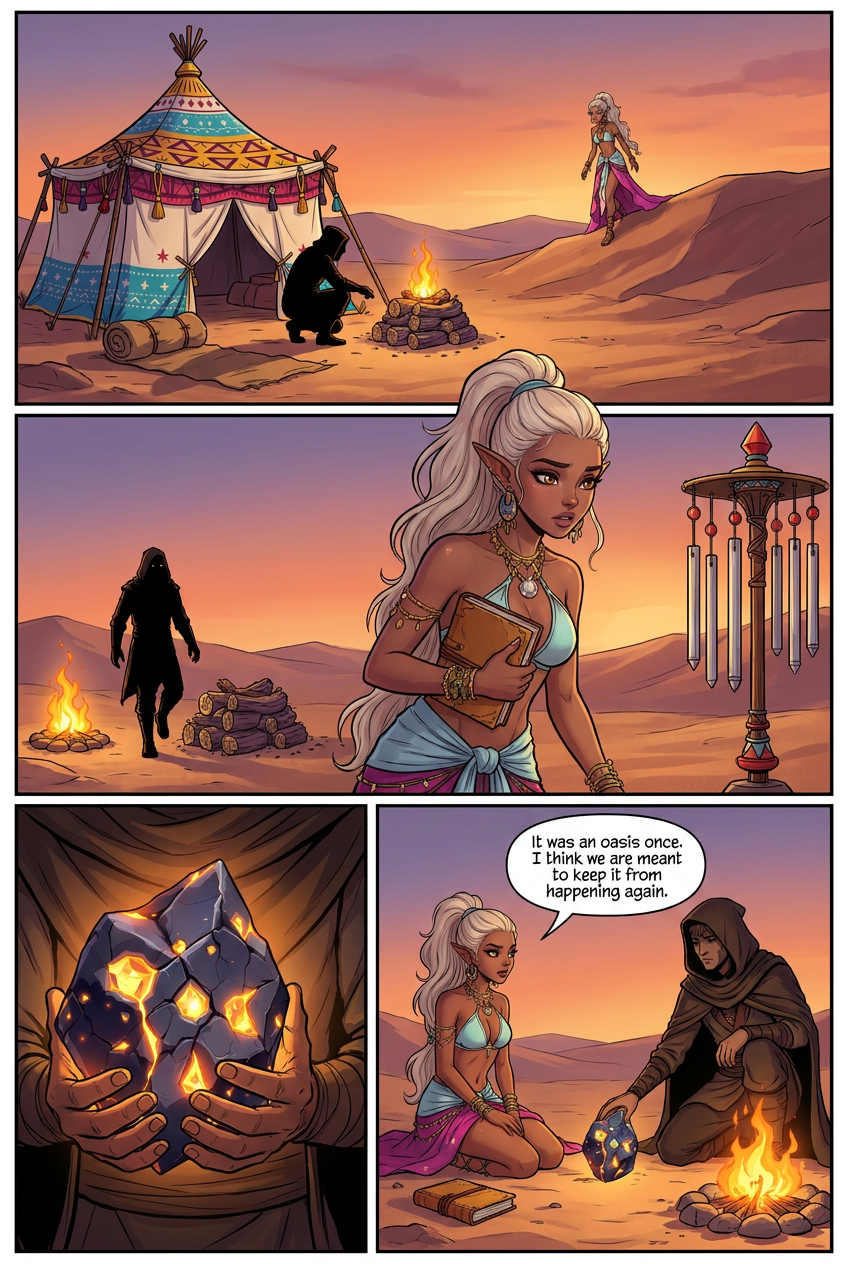
Zia climbs back over the ridge before she has settled her thoughts. The bright tent is no longer empty. A figure crouches beside a fresh pile of sun-bleached logs, stacking them with care. A bedroll sits unrolled in the shade. They have come back ahead of her, and she has not yet decided what to say about the cracked bowl of earth behind her. She slows at the chime marker and presses one hand to the leather journal tucked under her arm. Its pages hold her own small maps, her counts of the spring, the dates the heron walked the water. The truth of the crater wants to spill out of her. The truth is also a weight she has carried alone for one afternoon only. The stranger stands. In their hands is a jagged stone the size of a melon, dark metal veined with bright cracks that glow even in daylight. They hold it out toward her without a word. She knows at once where it came from. They have been to the crater too. They have already seen. Zia lets the journal fall to her side. There is nothing left to guard. She steps into the camp and sits across the woodpile from them. "It was an oasis once," she says. "I think we are meant to keep it from happening again." The stranger sets the shard between them like a third presence. They nod, slow and certain. The decision is made. She has spoken first, and the world did not end.
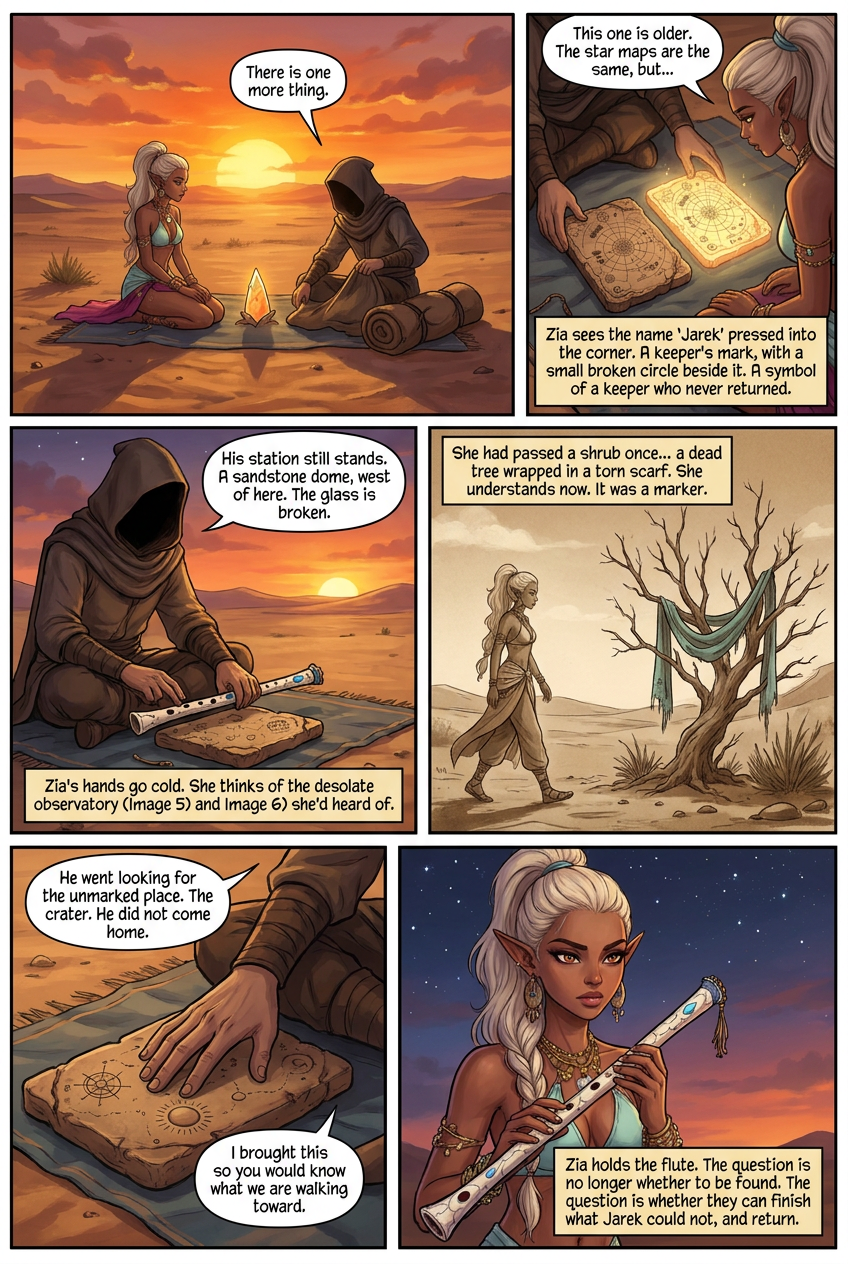
The shard glows between them as the sun drops lower. Zia is ready to plan their next step. Then the stranger reaches into the bedroll and lifts out a second tablet, wrapped in cloth. It is older than hers. The clay is darker, the edges worn soft. They set it beside the shard without speaking. Zia leans close. The star maps are the same, but this one has a name pressed into the corner. Jarek. A keeper's mark, like her own, but with a small broken circle beside it. She knows that symbol from her mother's stories. It means the keeper never came back. The stranger pulls one more thing from the cloth. A flute, carved from sun-cracked bone, painted with faded blue water drops. They lay it on the tablet. "His station still stands," they say. "A sandstone dome, west of here. The glass is broken. The sand has taken the inside." Zia's hands go cold. She thinks of a shrub she passed once on the way back from the monument, a dead tree wrapped in a torn turquoise scarf. She had walked past it without stopping. Now she understands it was a marker. A keeper had left things behind because a keeper had not survived to gather them. "He went looking for the unmarked place," the stranger says. "The crater. He did not come home." They place a hand flat on the older tablet. "I brought this so you would know what we are walking toward." Zia picks up the flute. It is light. The finger holes are worn smooth from a real mouth, a real breath, years of music in a place no one sings now. She sets it down beside her own work. The question is no longer whether to be found. The question is whether she and the stranger can finish what Jarek could not, and return.
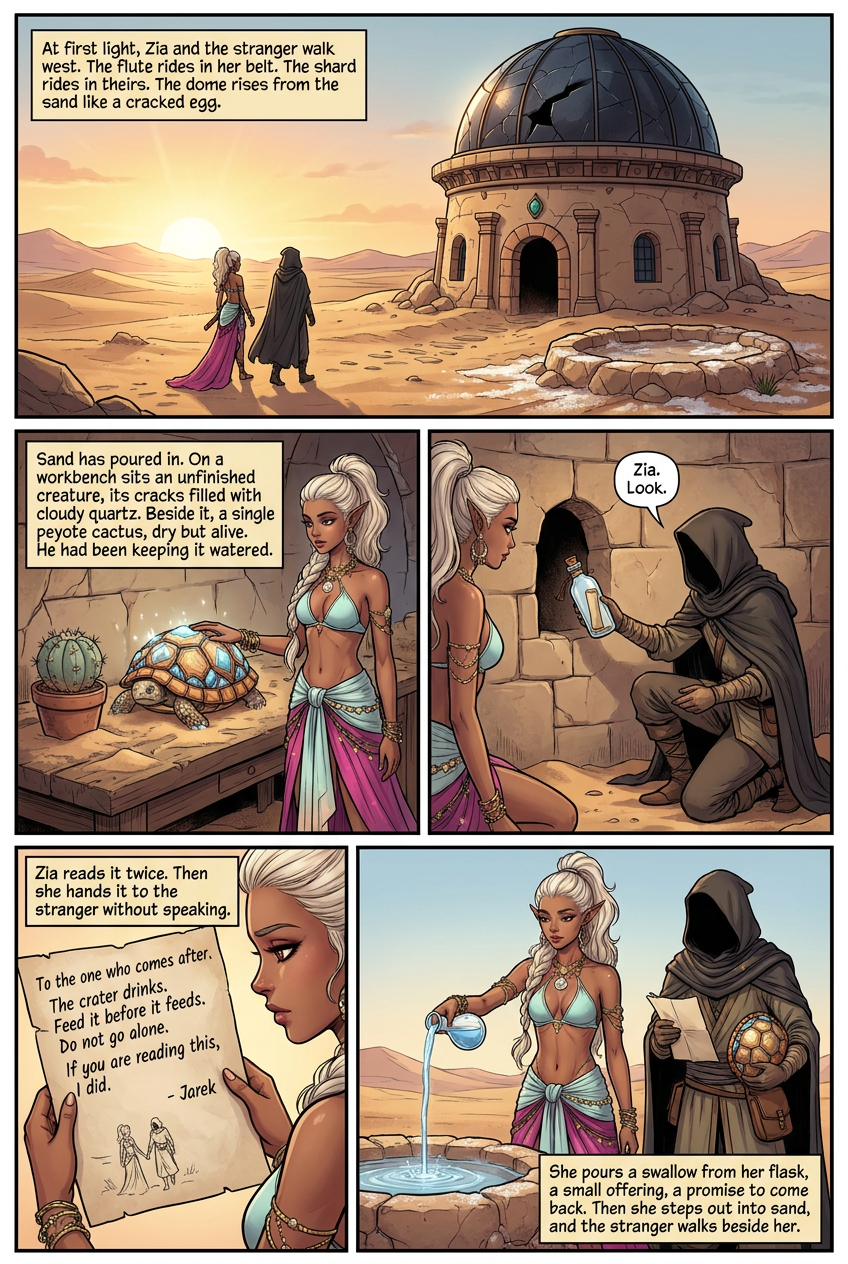
At first light, Zia and the stranger walk west. The flute rides in her belt. The shard rides in theirs. The dome rises from the sand like a cracked egg, its glass dark with grit. A low stone basin sits beside the door, salt rings climbing its lip. Jarek built it to catch dew. It is dry now, but the salt proves it once held water for years. Zia steps through the doorway. Sand has poured in through the broken dome and made small dunes on the floor. A workbench leans against the curved wall. On it sits an unfinished creature, a tortoise built from a real shell, its cracks filled with cloudy quartz. The legs are only half-shaped from reed and bone. Jarek stopped in the middle of a stitch. The thread still hangs from the needle. She touches the shell. The quartz is cool. Beside the tortoise sits a small clay pot holding a single peyote cactus, dry but alive, its feathery tufts still gray-green. He had been keeping it watered. Someone had to stop, and he was the one who stopped. The stranger calls her from across the room. They are kneeling at the base of the wall, where a stone has been pulled loose. Inside the hollow rests a glass bottle, corked, a rolled parchment inside. Around its neck, a thin cord. Zia lifts it out. The cork comes free with a small dry sound. The parchment is short. Jarek's hand is careful. "To the one who comes after. The crater drinks. Feed it before it feeds. Do not go alone. If you are reading this, I did." Below the words, a small drawing of two figures, side by side, walking. Zia reads it twice. Then she hands it to the stranger without speaking. The stranger folds the parchment and tucks it into their bedroll. Zia lifts the unfinished tortoise from the bench and wraps it in cloth. She will finish it at her oasis, when they return. If they return. Outside, the dew basin catches the last of the morning shadow. She pours a swallow from her flask into it, a small offering, a promise to come back and fill it again. Then she steps out into the sand, and the stranger walks beside her.
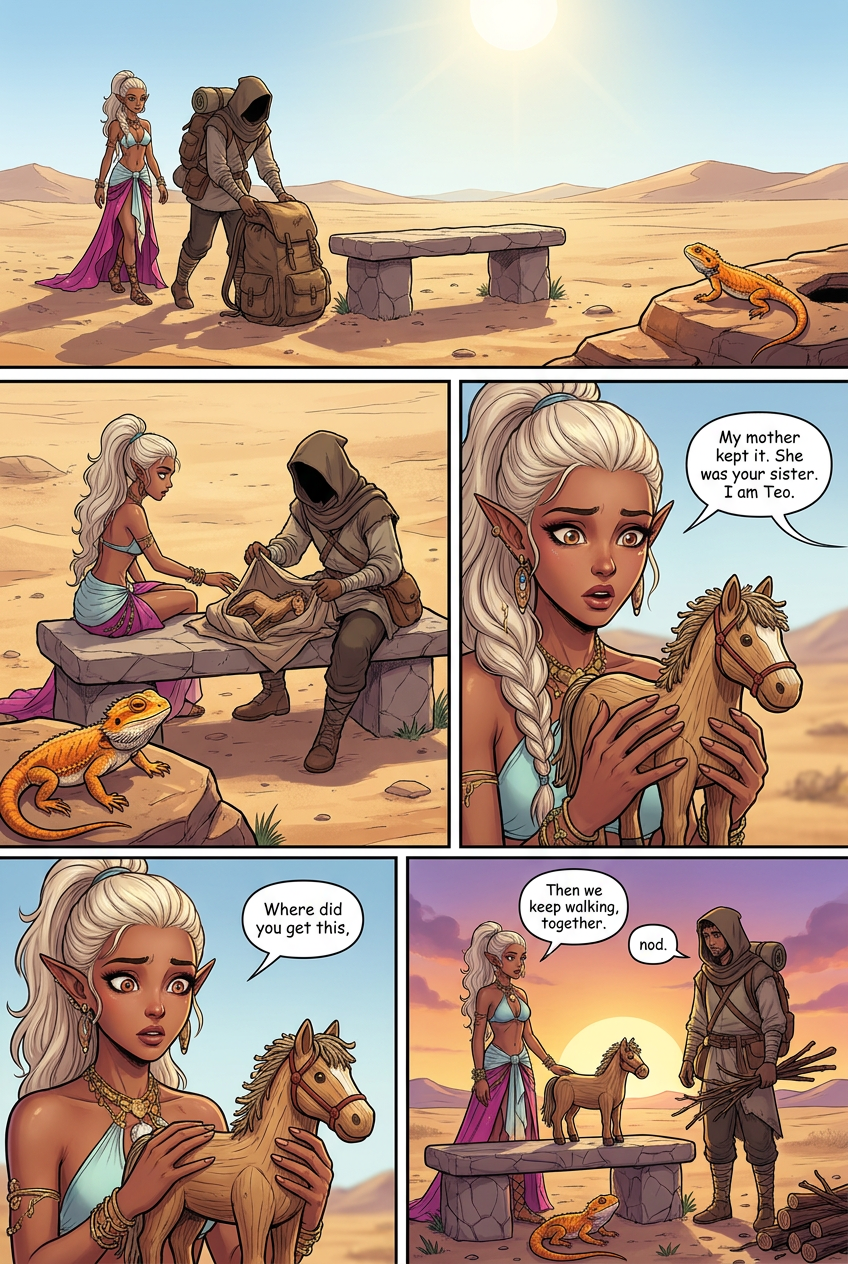
They walk until the sun sits high, then stop where a stone bench leans in the sand. Someone built it here long ago, two slabs for legs and one for the seat. The stranger sets down their pack. A small bearded dragon climbs out, orange and slow, and finds a warm rock. It has ridden in their pack for days. Zia sits at one end of the bench. The stranger sits at the other. Between them, they place a bundle and unwrap it. Inside is a wooden horse, carved rough, with yarn for a mane and a red cord bridle. Zia's hand stops above it. She knows this horse. She carved it as a child, before she was sent south. "Where did you get this," she says. "My mother kept it," the stranger says. "She was your sister. I am Teo." He does not look at her. He looks at the horse. "I came to find you because she asked me to, before she died. And because the tablets said a keeper was still here." Zia picks up the horse. The yarn is brittle. The chisel marks are her own. A name. A face that shares blood with hers. The stranger is no longer a stranger, and the silence she guarded for so long breaks open into something she will have to carry now, into the crater and back. She sets the horse upright on the stone between them. The bearded dragon blinks. "Then we keep walking," she says, "together." Teo nods. He gathers wood for a fire before the cold comes. Zia watches him work and lets herself, for the first time, be known.
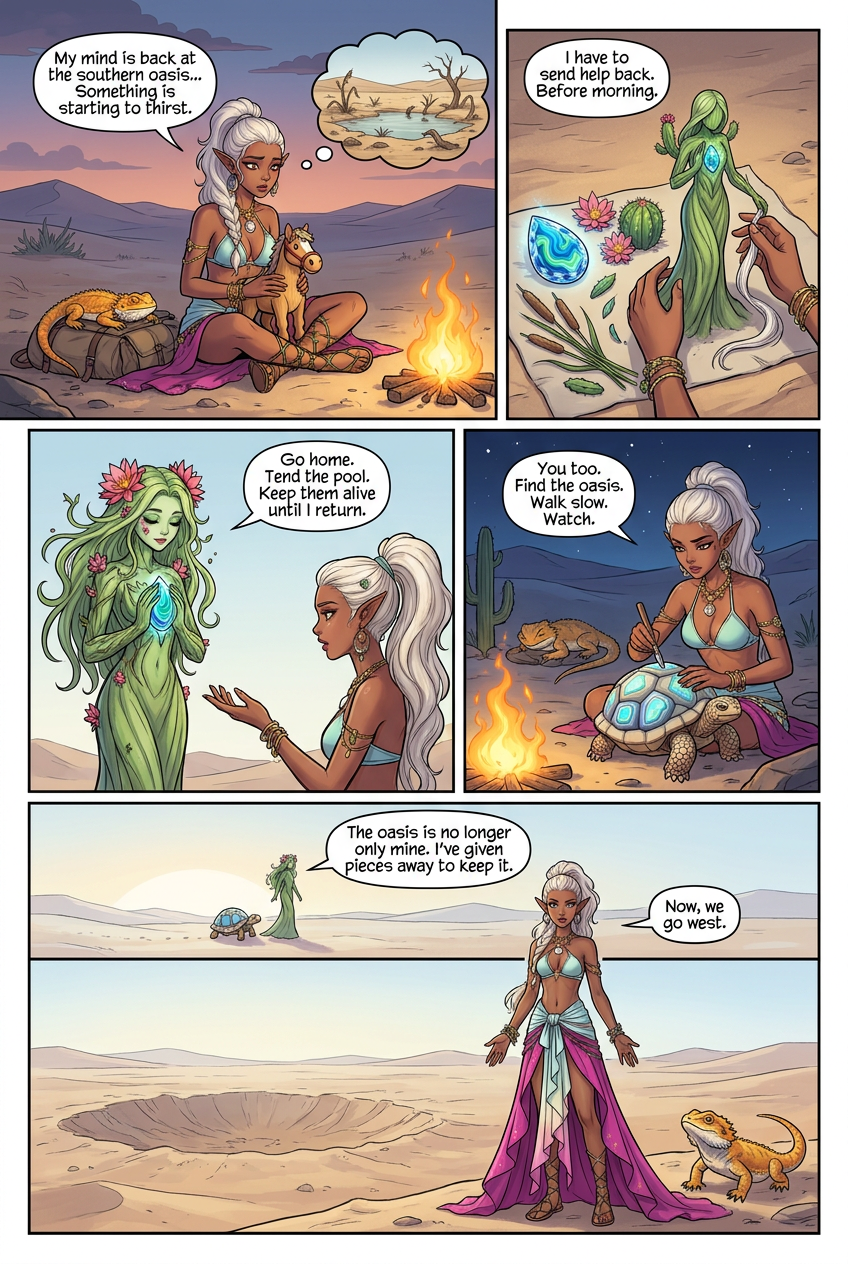
By dusk, the fire is small and the bearded dragon sleeps on Teo's pack. Zia sits with the wooden horse in her lap. Her mind is not here. It is back at the southern oasis, where no one is turning the water or speaking to the reeds. She has been gone too many days. Something there is starting to thirst. "I have to send help back," she says. "Before morning. Or I will return to dry stalks and dead things." Teo watches her open her satchel. She lays out what she carries: a teardrop of agate she pulled from the pool before leaving, still wet, still glowing soft blue and green. A handful of cactus blossoms. Reeds. A scrap of her own hair. She works fast. She shapes a tall, slim figure with flowers at the crown and vines down the long body. She presses the agate into its chest. The figure stands. It blinks once with painted eyes. "Go home," Zia says. "Tend the pool. Keep them alive until I come back." The dryad bows its green head and walks into the dark, soundless, carrying the glow of the water inside it. Zia sits down hard. She has never sent one of her made things away from her on purpose. Every creature she built stayed. This one will not. She pulls Jarek's unfinished tortoise from her pack and turns it in her hands. She carves through the night while Teo sleeps. By dawn the shell is whole, set with chips of quartz and a sliver of lodestone at the throat. She sets the tortoise on the sand facing south. "You too," she says. "Find the oasis. Walk slow. Watch." The tortoise lifts its blind head and begins. She watches both shapes shrink into the pale morning. The oasis is no longer only hers. She has given pieces of it away to keep it. When she turns back to the fire, Teo is awake, watching her with her sister's eyes. "Now," she says, "we go west." Her hands are empty. The crater is closer than it was yesterday.
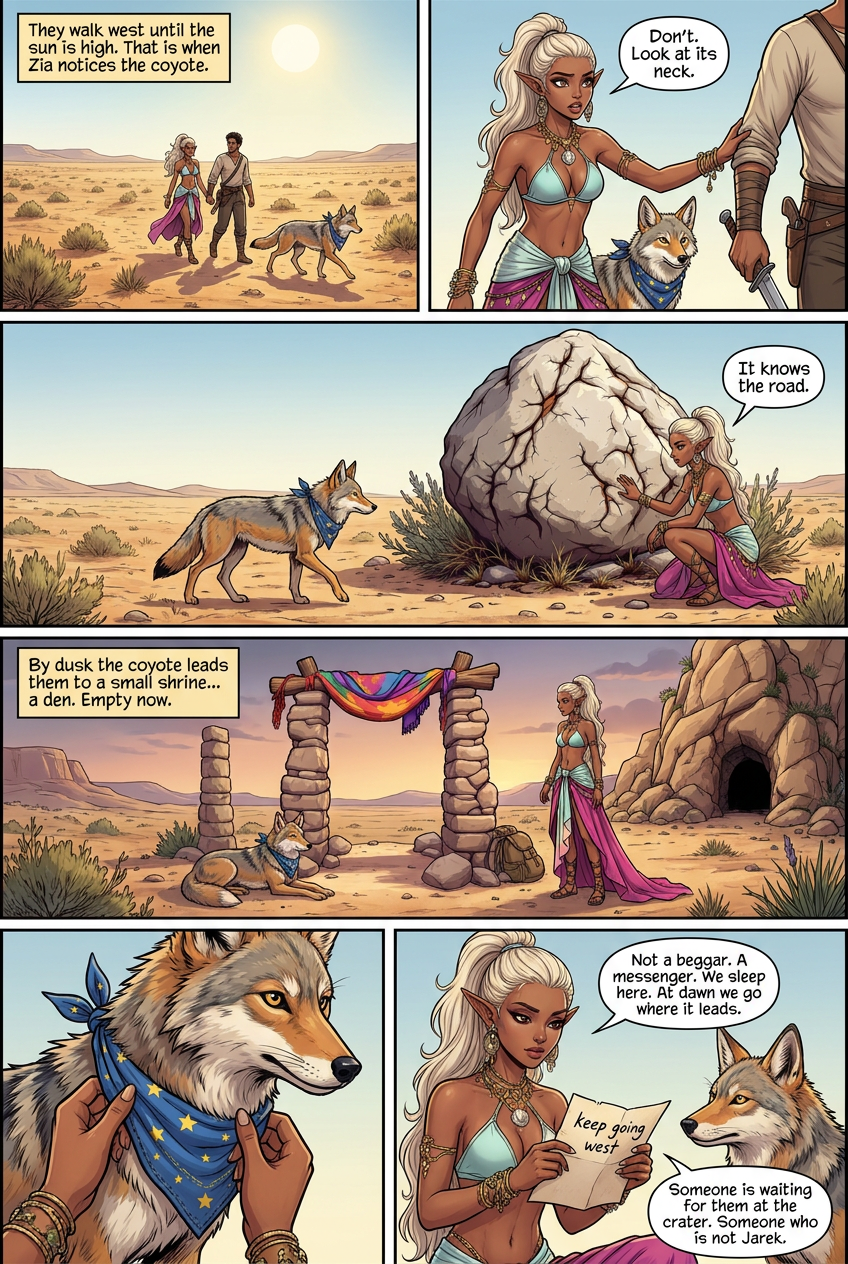
They walk west until the sun is high. That is when Zia notices the coyote. It moves at Teo's hip like it has always been there. Yellow eyes. Dust on its shoulders. A blue bandanna with faded stars is knotted loose at its throat, the stitching uneven, like a person tied it in a hurry. Zia stops. The coyote stops. Teo reaches for his knife. "Don't," she says. "Look at its neck." The cloth is old. The stars are the same yellow as the marks on Jarek's tablet. Her chest goes tight. She does not know if Jarek tied it there years ago, or if someone living tied it last night. The coyote trots ahead and pauses at a huge cracked boulder ringed with dry sage. It sniffs a low groove in the stone, scratched deep, claw-deep. Then it looks back at her. It has been here before. Zia kneels and touches the marks. They are old. Older than the bandanna. "It knows the road," she says. They follow. By dusk the coyote leads them to a small shrine — two stone pillars, a faded cloth tied across the top, the colors almost gone. The coyote lies down beside the left pillar like it has slept there many nights. Teo sets down his pack. Zia does not. She circles the shrine. Behind it, half-hidden in scrub, is a rocky outcrop with a dark mouth and old bones at the entry. A den. Empty now. Zia unties the bandanna from the coyote's throat. The animal lets her. Inside the knot is a curl of paper, dry and brown. Three words in a careful hand: keep going west. The writing is not Jarek's. She has seen Jarek's hand on the tablet. This is newer. Someone else is ahead of them. Someone who knew they would come this way, and sent the coyote back to find them. She folds the paper into her palm. The coyote watches her, calm, waiting. "Not a beggar," she says to Teo. "A messenger." She ties the bandanna back, gentler this time. "We sleep here. At dawn we go where it leads." The coyote closes its eyes. Zia does not. Someone is waiting for them at the crater. Someone who is not Jarek. The road has a third traveler now, and she did not choose them.
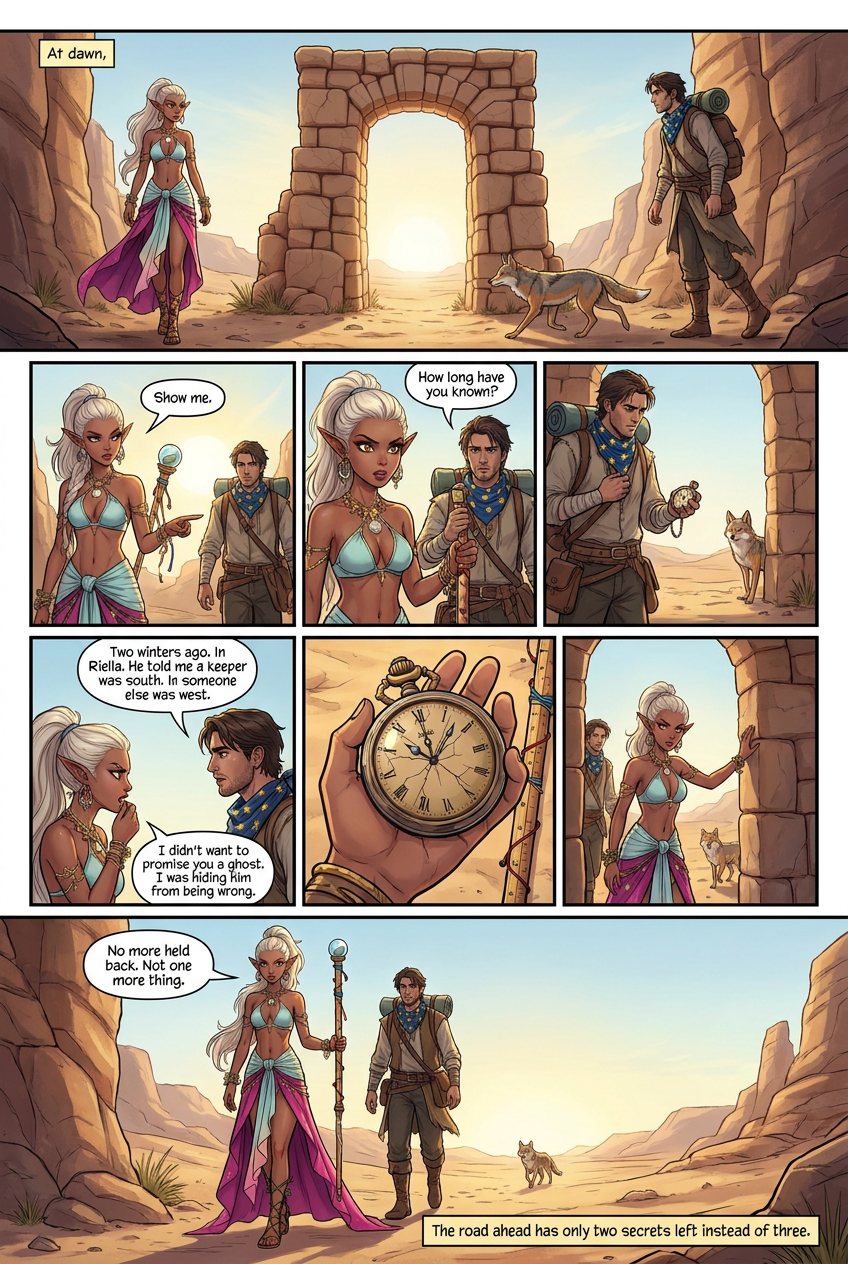
At dawn the coyote rises and trots west. Zia and Teo follow. The land narrows between two rock walls until they reach a stone archway, half-buried in sand. The passage is narrow. Only one can pass at a time. The coyote slips through. Zia steps up and stops. Teo waits behind her. She does not move yet. Something in his pack is catching the sun. She turns. A wooden stick juts from his bedroll. It has notches down its length, colored strings tied at certain marks, and a glass ball at the top with a lodestone inside. She has not seen it before. "Show me," she says. Teo's jaw tightens. He pulls it out. The red strings, she sees now, match the yellow stars on the bandanna. He has been reading the road the whole time. "How long have you known," she says. Teo does not answer. She steps closer. "Teo." He reaches into his shirt and pulls out a pocket watch on a worn cord. The glass is cracked. On the back, one word is cut into the metal. Jarek. Zia's breath stops. "He gave it to me," Teo says. "Two winters ago. In Riella. He told me a keeper was south. He told me someone else was west." "Someone else," Zia repeats. The coyote watches them from the far side of the arch. "You knew there was a third person. Before the bandanna. Before the coyote." Teo nods once. "I didn't know if he was alive. I didn't want to promise you a ghost." His voice is low. "I wasn't hiding him from you. I was hiding him from being wrong." Zia looks at the watch in his palm. At the stick with its careful marks. He has carried Jarek's last words and a tool to follow them, and he has walked beside her without saying. She could be angry. She is, a little. But he is here. He came across the desert to find her, and he is still here, and his hands are open now. "No more held back," she says. "Not one more thing." Teo nods. "Not one more thing." She steps through the arch. He follows. On the other side, the coyote is already moving. Zia walks with the meter stick in view now, the strings bright against the wood, the lodestone steady. The guide is a man Jarek trusted. A man waiting at the crater. She does not know his name yet. But she knows he is real, and she knows Teo is hers, and the road ahead has only two secrets left instead of three.
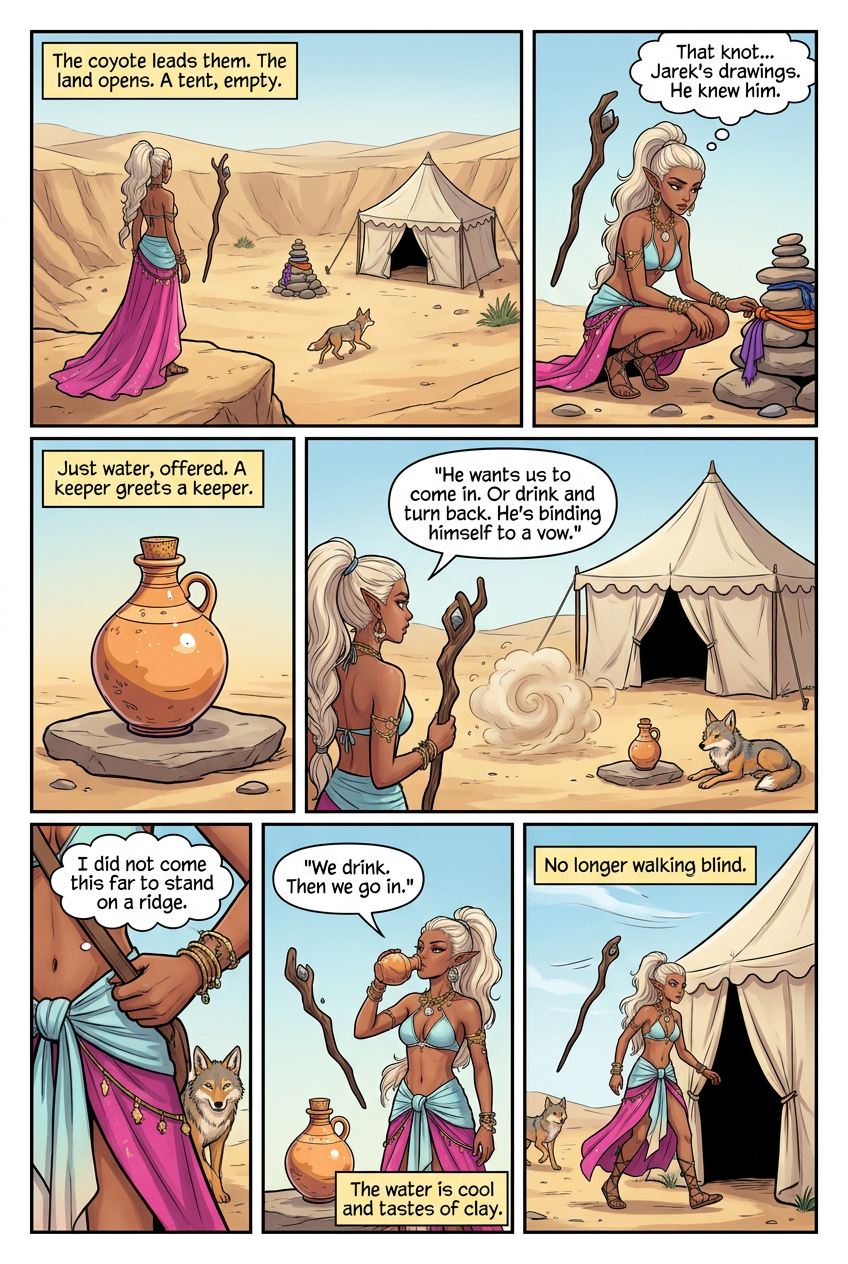
The coyote leads them around a low ridge, and the land opens. Zia stops at the edge. In a hollow below sits a canvas tent with wooden poles, the awning pinned wide to the wind. No one stands outside. The flap hangs open like a held breath. Teo's lodestone stick points straight at it. Zia crouches in the sand. She studies what the guide has set in plain view. A stack of stones rises near the tent, wrapped in a faded cloth of purple, blue, and orange. She has seen that knot before, in Jarek's drawings. So the guide knew him. Knew him well enough to keep his marker standing. In front of the tent, on a flat stone, sits a clay jug with a cork stopper. Nothing else. No weapon. No sign. Just water, offered. Zia understands the shape of it. A keeper greets a keeper with water first. "He wants us to come in," Teo says. "Or he wants us to drink and turn back." Zia watches the tent flap move. "Either way, he's telling us who he is before he shows his face." Water in the desert is a vow. Whoever waits inside is binding himself to it. A small dust cloud lifts between them and the tent, then settles. The coyote trots down and lies beside the jug. It knows this place. Zia's hand tightens on her pack. She thinks of the dryad tending her pool, the tortoise watching her boundary. She did not come this far to stand on a ridge. "We drink," she says. "Then we go in." Teo nods. They walk down together. Zia pulls the cork. The water is cool and tastes of clay. She sets the jug back exactly as she found it. The tent flap lifts in the wind, and she steps toward it, no longer walking blind.
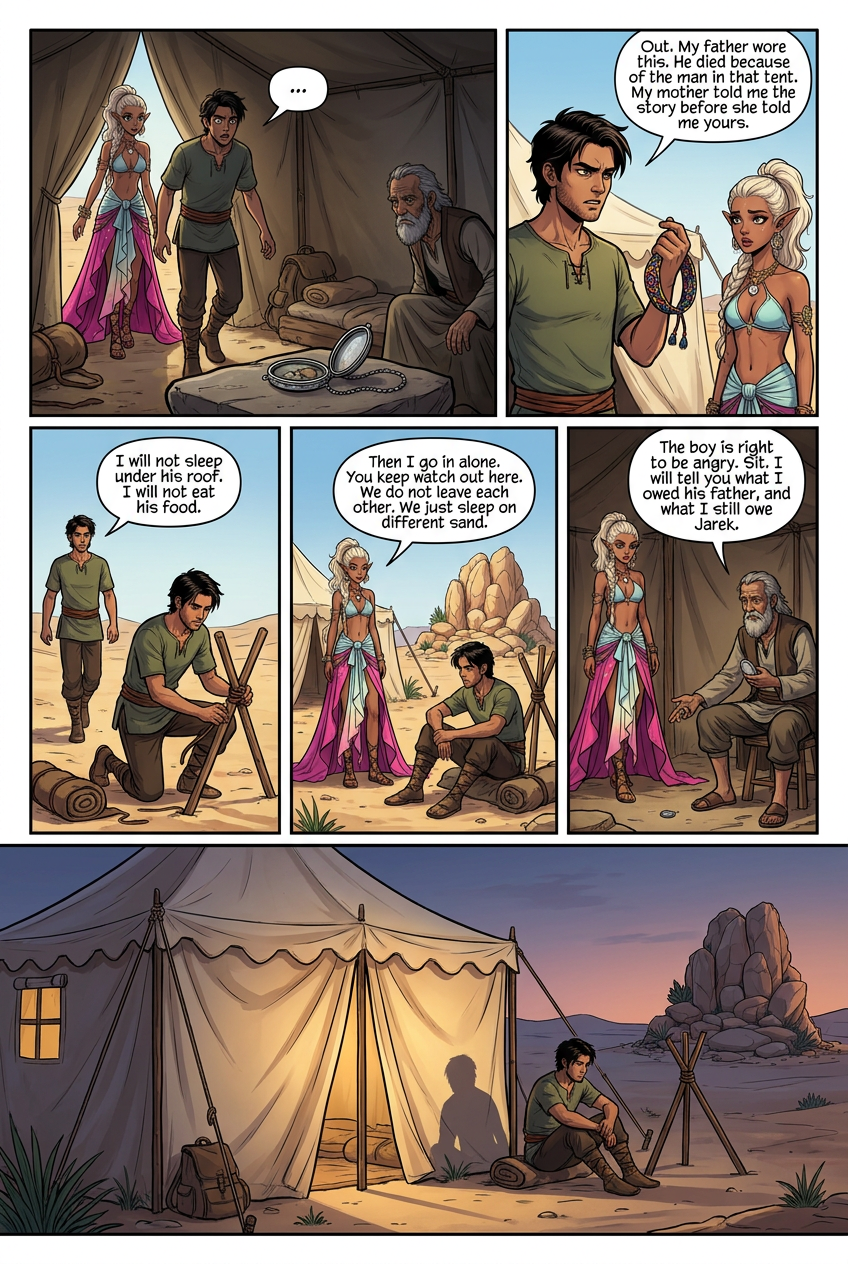
Zia ducks under the awning first. Inside, the tent is plain: a bedroll, a pack, a small flat stone holding a tarnished silver locket left open in the light. An old man rises slowly from the back. Before Zia can speak, Teo stops dead in the doorway. His eyes lock on the locket. His face goes white, then hard. "Out," Teo says. He backs into the sun. Zia follows, confused. Teo digs into his pack and pulls free a woven bracelet, bright threads in a pattern she does not know. He holds it up between them. "My father wore this. He died because of the man in that tent. My mother told me the story before she told me yours." Zia looks back at the open flap. The old man has not followed. He stands by the locket, hands at his sides, waiting. "He offered water," she says. "We drank." Teo shakes his head. "You drank. I will not sleep under his roof. I will not eat his food." His voice is quiet and final. She tries once. "We need him. Jarek trusted him." Teo's jaw tightens. "Then Jarek did not know everything." He walks ten paces from the tent, kneels, and lashes two poles into a leaning X, binding them with a strip of leather from his belt. He drives the base into the sand. A marker. A wall. He sets his bedroll beneath it and sits down facing the open desert. Zia stands between them, the tent at her back, Teo at the edge of the hollow. The alliance she pulled together at the jug has split clean down the middle. She makes her choice the only way she can. "Then I go in alone," she says. "You keep watch out here. We do not leave each other. We just sleep on different sand." Teo does not turn, but he nods once. She steps back through the flap. The old man closes the locket and slides it into his pocket. "The boy is right to be angry," he says. "Sit. I will tell you what I owed his father, and what I still owe Jarek." Zia sits. Outside, Teo's shadow stays sharp against the canvas, unmoving, a guard she did not ask for and now cannot lose.
Play your story to life
Storycraft is a mobile game where you create AI characters, craft items and locations to build their world, then discover what direction your story takes. Download the iOS game for free today!
Download for free