

Zazz's ArcChapter 8 of 10
Zazz's dream is uncovering drone survey data to find how to seal dangerous reality rifts.

Click to expand
Chapter 8
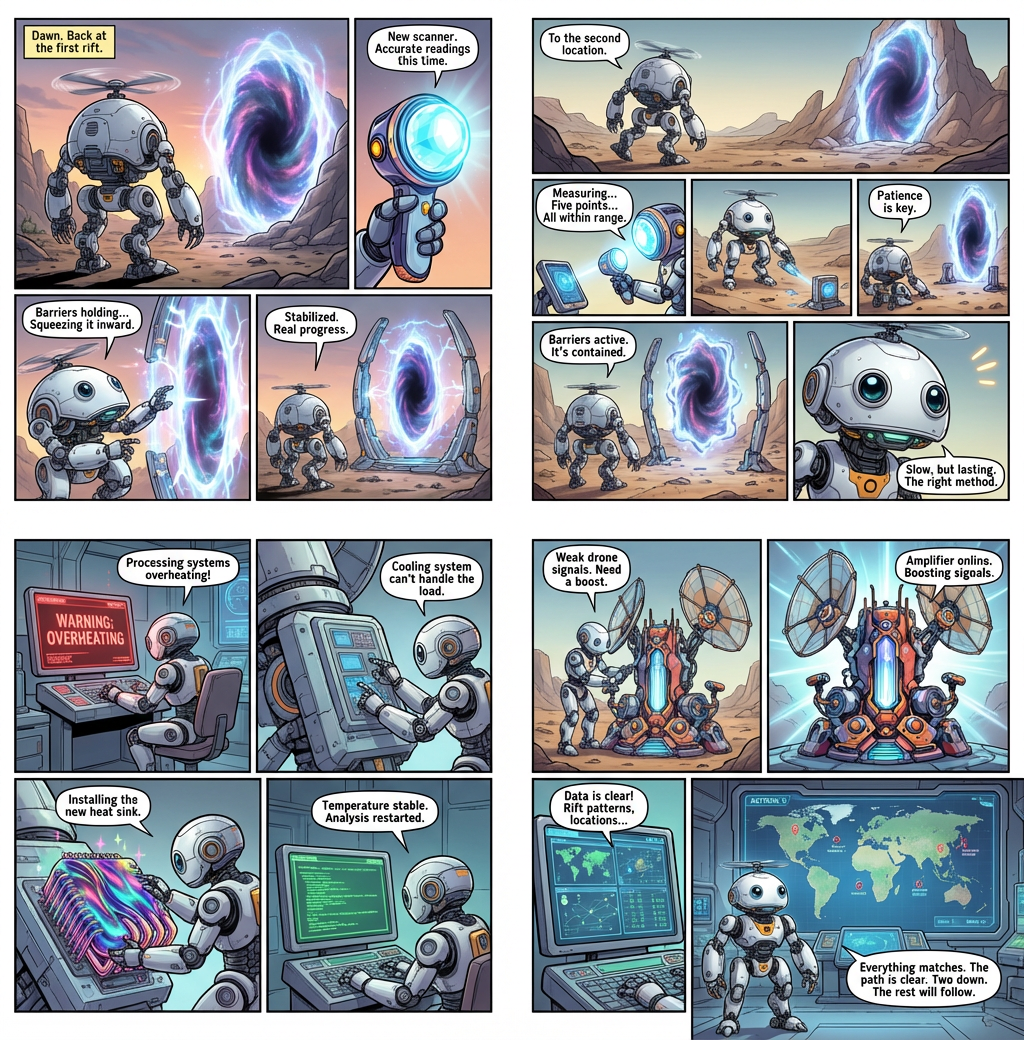
Zazz returned to the first rift at dawn with new equipment and verified readings. The robot's sensors swept the dimensional tear carefully, recording accurate energy levels this time. Fresh barriers formed around the rift's edges, calibrated to match the real output. The rift pulsed and pushed against the containment field. Zazz adjusted the barrier strength in real-time, watching the measurements on the handheld scanner. The device's crystal lens glowed brighter as energy levels peaked. The barriers held steady this time, squeezing the dimensional tear inward. After two minutes, the rift collapsed to half its size. Warning lights stayed green across all systems. Zazz locked the barriers in place and marked the location as stabilized. The first rift wouldn't close completely yet, but it no longer threatened to expand. Real progress, built on accurate data and working tools.
The robot walked to the second marked rift location and pulled out the crystal-lens scanner again. The device measured energy output at five different points around the tear. Numbers appeared on the display, all within expected ranges this time. Zazz prepared the sealing equipment and set barrier generators at each measurement point. The process would take hours of careful adjustments, but the path forward was clear now. Each rift needed individual attention, verified readings, and patient work. The mission would succeed through small steps instead of quick fixes. Zazz activated the second set of barriers and watched them take hold. The dimensional tear flickered but stayed contained. Progress was slow, but it was real and lasting. The robot had learned from failure and found the right method. The rifts would seal, one careful measurement at a time.
Back at the research station, Zazz faced a new problem. The satellite's processing systems overheated during data analysis of the drone survey files. Red warnings flashed across the terminal screen. The cooling system couldn't handle the intensive calculations needed to decode rift patterns from multiple locations. Zazz shut down the analysis and examined the satellite's external components. The existing heat management system was too weak. The robot retrieved a component from the equipment storage—an elegant assembly of copper tubes with an iridescent coating that shifted colors in the light. Zazz attached the heat sink to the satellite's processing unit and rerouted the thermal output through the new copper tubes. The coating shimmered as it absorbed excess heat. Within minutes, the temperature dropped to safe levels. The terminal warnings cleared. Zazz restarted the analysis, and this time the systems ran smoothly. The drone data flowed through without interruption.
The satellite picked up weak signals from distant survey drones, but the transmissions kept breaking apart before reaching the receivers. Zazz needed stronger signal strength to access the complete survey data. The robot assembled a structure outside the station using curved metal dishes and crystalline core tubes that glowed with internal light. The equipment amplified incoming transmissions, pulling weak signals from across the planet's surface and boosting them before they reached the satellite. Data streams suddenly filled the terminal screens with clear information. Maps appeared showing rift locations, energy signatures, and formation patterns. Zazz cross-referenced the new data with the handheld scanner readings. Everything matched now. The robot had working tools, verified measurements, and complete survey information. The path to sealing every rift on Astrion V was finally clear. Two rifts were already stabilized. The rest would follow, one careful step at a time.
Play your story to life
Storycraft is a mobile game where you create AI characters, craft items and locations to build their world, then discover what direction your story takes. Download the iOS game for free today!
Download for free