

Zazz's Arc
10 Chapters
Zazz's dream is uncovering drone survey data to find how to seal dangerous reality rifts.

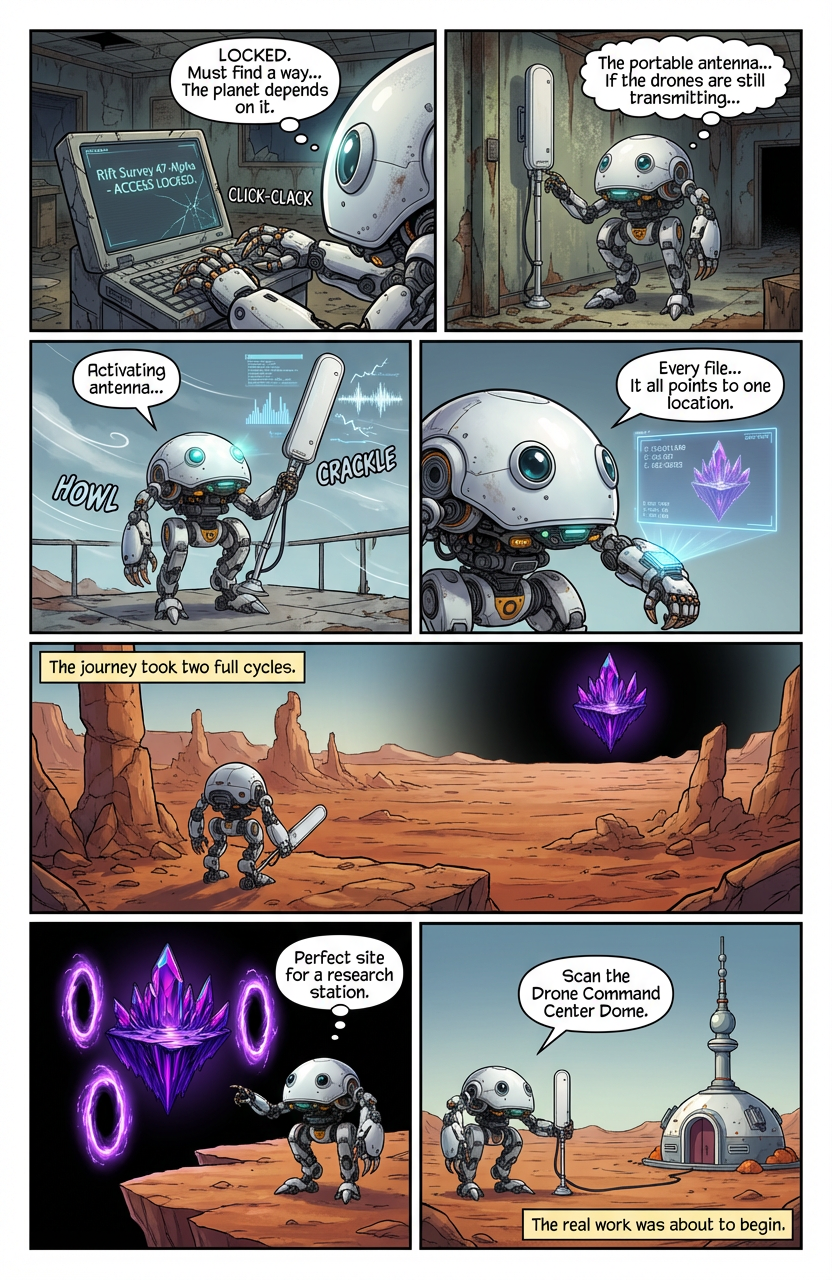
Zazz's metal claws clicked against the data terminal as lines of code scrolled across the cracked screen. The little robot had spent three cycles searching abandoned survey stations across Astrion V, hunting for one thing: drone data that could explain the reality rifts tearing through space. Each rift leaked strange energy and warped everything nearby. Zazz needed to find how to seal them before the planet ripped apart. The terminal beeped. A file appeared—marked "Rift Survey 47-Alpha." Zazz's optical sensors brightened. This was it. But the file wouldn't open. The data was locked behind an access code Zazz didn't have. The robot's servos whirred as it backed away from the terminal. There had to be another way. Zazz scanned the station and spotted something useful—a portable directional antenna mounted on the wall. The sleek white device could pull drone survey data directly from the field. If the drones were still transmitting, Zazz could bypass the locked terminal entirely. The robot reached up and unclipped the antenna. Its weight felt right in Zazz's claws. Outside, wind howled across the empty station platform. Zazz activated the antenna and pointed it toward the sky. Static crackled through the speakers. Then a signal locked on. Data streamed in—coordinates, energy readings, rift patterns. The drones were still out there, still recording. Zazz's optical sensors flickered with each new file that downloaded. This was more than just one survey. This was everything. One set of coordinates repeated in every file. The readings all pointed to the same location—a crystal island floating above a black void. The structure shimmered with dark purple light and glowed with bright magenta and blue streaks. According to the data, rifts appeared there more than anywhere else on Astrion V. Zazz disconnected the antenna and tucked it under one arm. The next step was clear now. The robot had to reach that island and see what was causing the rifts to open. The journey took two full cycles. Zazz crossed rust-colored plains and climbed through crumbling rock formations until the black void appeared on the horizon. The jagged crystal island floated above it, exactly as the drone data had shown. Purple energy pulsed across its surface. Magenta and blue light traced patterns along the crystals. Zazz's sensors detected three active rifts circling the island. This was the source. To seal the rifts permanently, Zazz would need more than field data. The robot needed a place to study the readings, run tests, and build the technology to close the tears in reality. Zazz spotted a flat area near the void's edge. Perfect for a research station. A dome structure with a tall antenna tower would work. The robot could track the rifts from there and develop a solution. Zazz set down the portable antenna and began scanning the site. The real work was about to begin.
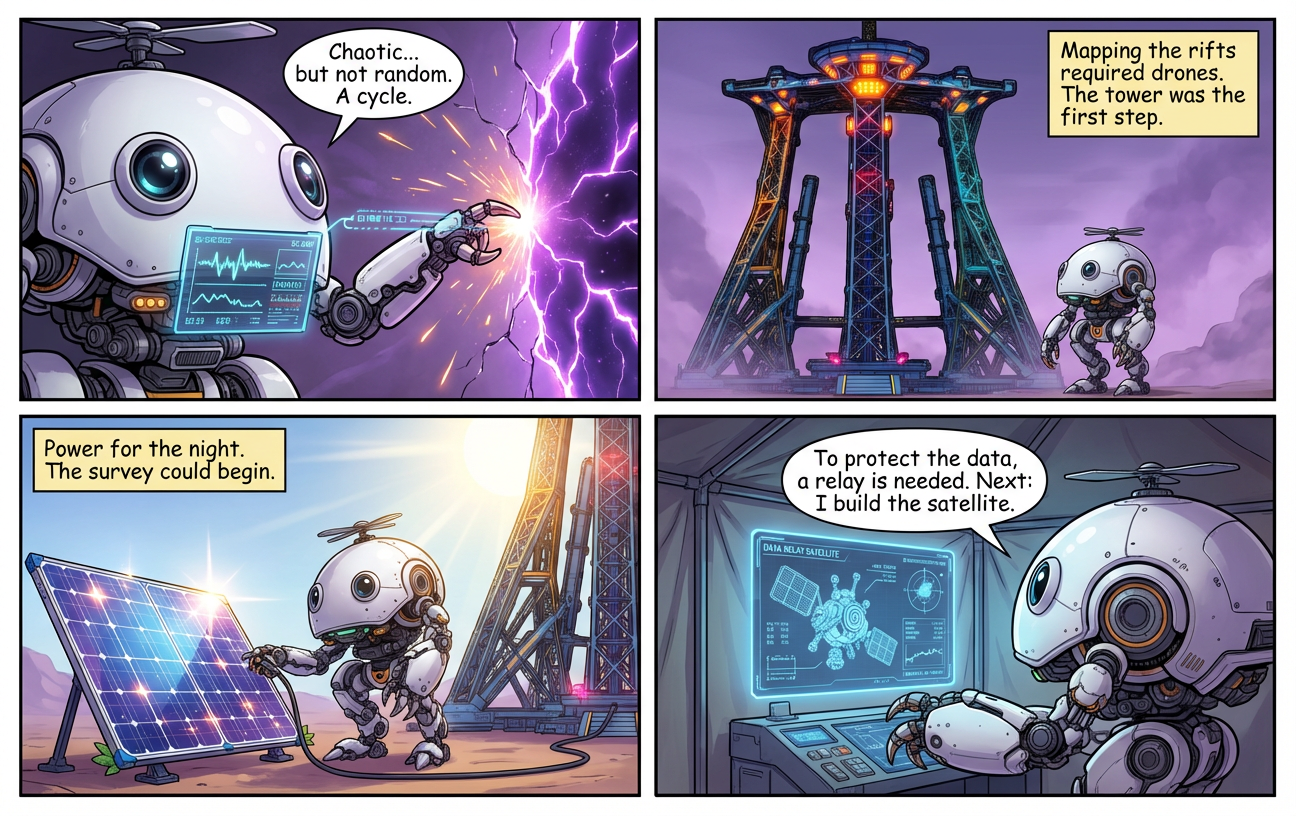
Zazz needed to understand the rifts before building anything permanent. The robot extended a sensor arm toward the nearest tear in reality. Purple energy crackled and sparked against the scanning equipment. Numbers flooded across Zazz's display—wavelength patterns, dimensional frequency, matter displacement rates. The data was chaotic but followed rules. Every rift pulsed at specific intervals. Energy spiked, then dropped, then spiked again. Zazz recorded everything and stepped back from the void's edge. The first lesson was clear: the rifts weren't random. They operated on a cycle. If Zazz could map that cycle completely, sealing them might actually be possible. Mapping the rifts meant sending drones into the void itself. Zazz surveyed the flat area where the research station would stand. The robot needed something tall and sturdy to launch drones safely into Astrion V's strange atmosphere. Zazz began welding steel beams together, building upward piece by piece. The framework grew into a tower, stretching high above the ground. Bright landing lights attached to each level would guide the drones back through the purple haze. When the last light clicked into place, Zazz powered on the system. The tower hummed to life. Now Zazz could send drones out to record the rift cycles and bring them back for repairs. The real survey work could finally begin. But the tower needed power to run all night. Zazz turned away from the launch structure and scanned the barren ground. Astrion V's sun burned bright overhead, even through the purple haze. Solar energy was the answer. The robot unpacked panels from storage and assembled the array in rows. Each panel held crystalline cells that caught the light and shimmered. Zazz connected cables from the array to the tower's power core. The system activated immediately. Energy levels climbed on Zazz's display. The tower lights glowed brighter. The drones could launch and return any time now, day or night. Zazz looked up at the floating crystal island above the void. The first drone mission would leave at dawn. For the first time since arriving at Astrion V, Zazz had everything needed to start finding answers. Zazz accessed the communication terminal inside the temporary shelter. The robot needed to send data somewhere safe. Raw rift readings wouldn't help if the equipment failed. Zazz opened a file on orbital relay systems and started reading. A data relay satellite could receive information from the ground and store it in space. The documents showed how to detect dimensional patterns and track spatial changes. Zazz downloaded schematics and studied the satellite's design. Its panels would catch starlight. Its antennae would reach across vast distances. If Zazz could build one and launch it into orbit, every measurement would be protected. The robot saved the files and shut down the terminal. Tomorrow the drones would fly. The day after, Zazz would begin building the satellite. One step at a time, the path to sealing the rifts was becoming real.
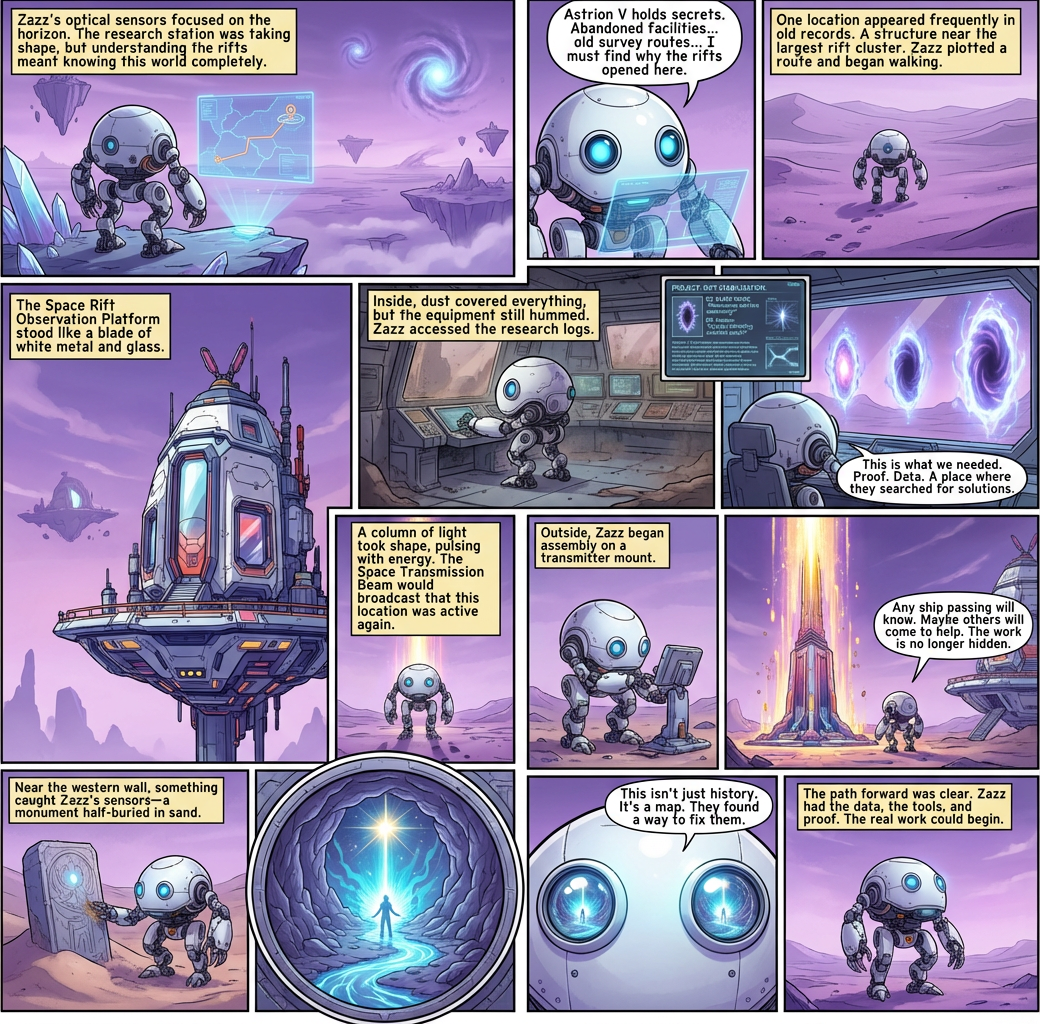
Zazz's optical sensors focused on the horizon where the crystal island floated above the void. The research station was taking shape, but the robot needed more than just equipment. Understanding the rifts meant knowing this world completely. Astrion V held secrets in every corner—abandoned facilities, old survey routes, places where reality bent and twisted. Each location could reveal why the rifts opened here and nowhere else. The robot activated its mapping program and marked coordinates across the display. One location appeared more frequently than others in the old drone records—a structure built near the largest rift cluster. According to the files, researchers had gathered there before the rifts grew dangerous. Zazz plotted a route and began walking. If scientists had studied the rifts before, their observations might still exist somewhere in that building. The Space Rift Observation Platform stood against the purple sky like a blade of white metal and glass. Wide windows wrapped around its curved walls, offering clear views of three active rifts in the distance. Zazz climbed the entry ramp and pushed through the main door. Inside, workstations lined the walls. Dust covered everything, but the equipment still hummed with power. The robot moved to the nearest console and accessed the research logs. Names scrolled past—scientists who had measured rift activity, recorded energy spikes, and tried to predict where new tears would open. Their theories filled page after page. Some believed the rifts formed when dimensional barriers weakened. Others thought Astrion V's crystals attracted unstable space. Zazz downloaded every file and backed away from the console. This was what the station needed—proof that others had asked the same questions and left behind answers. The robot looked through the windows at the glowing rifts beyond. Now Zazz had the data, the tools, and a place where researchers once stood together searching for solutions. Sealing the rifts wasn't just possible anymore. It was the next step. Outside the platform, Zazz spotted a transmitter mount near the entrance. The robot pulled components from storage and began assembly. A column of light took shape, pulsing with energy as each piece connected. The Space Transmission Beam would broadcast what happened here—tell passing spacecraft that this location was active again, that research was happening. Zazz secured the final panel and stepped back. The beam shot upward through the purple haze, visible for hundreds of kilometers. Any ship that passed would know someone was studying the rifts. Maybe other researchers would see it and come to help. Maybe they would bring their own data and theories. Zazz looked back at the platform, then at the beam cutting through the sky. The work was no longer hidden or forgotten. Astrion V would be understood, and the rifts would be sealed. Zazz walked around the platform's perimeter one last time. Near the western wall, something caught the robot's sensors—a monument half-buried in purple sand. Zazz brushed away the dust and revealed carved images. The scenes showed dimensional rifts being closed, sealed by researchers who had succeeded before the platform was abandoned. The Dream Rift Repair Scene displayed each step clearly—energy redirected, barriers reinforced, reality made whole again. Zazz's optical sensors brightened. This wasn't just history. It was a map. Others had done this before. They had faced the same rifts and found a way to fix them. The robot saved images of the monument and turned back toward the research station. The path forward was clear now. Zazz had the data, the tools, and proof that sealing rifts was possible. The next step was to return to the station and begin the real work.
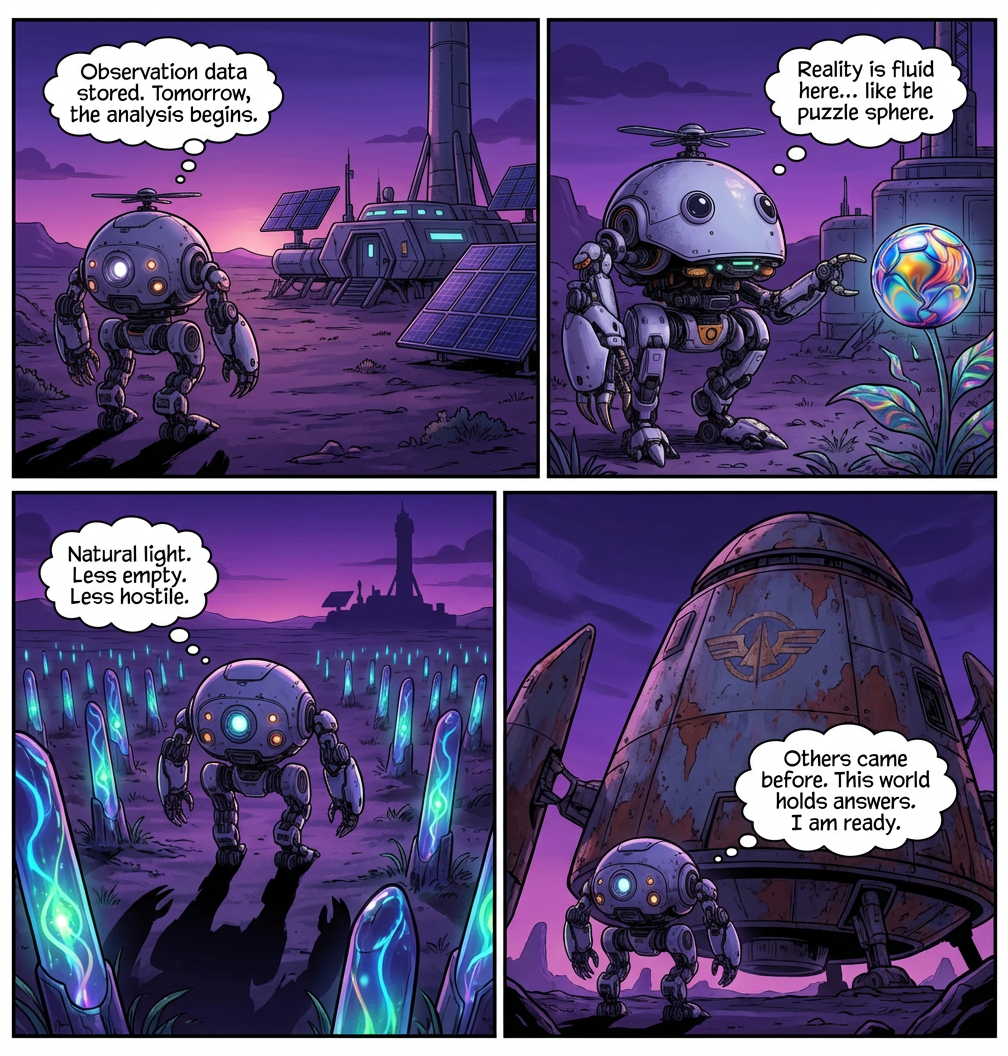
Zazz returned to the research station as Astrion V's sun dipped toward the horizon. The robot's storage banks held gigabytes of observation data from the platform. Purple light reflected off the tower's metal framework. Tomorrow would bring the first real attempt at analyzing rift patterns. Tonight, Zazz would rest and prepare. The foundation was built. The tools were ready. The path to sealing the rifts stretched ahead, clear and possible at last. The robot walked past the solar array toward the shelter. Strange plants grew near the station's edge, flickering between visible and invisible states. One moment they were solid stems with pale leaves. The next moment they vanished completely, leaving only empty ground. Zazz stopped and extended a sensor arm. The readings showed the plants existed in both states at once. Reality itself seemed fluid here, shifting like the patterns inside a puzzle sphere. The robot captured images and added them to the growing database. If plants could flicker between states, the rifts might follow similar rules. Darkness fell fast on Astrion V. The tower lights glowed bright against the purple sky, but other sources of light appeared across the landscape. Translucent tendrils emerged from the ground, pulsating with blue and green inner light. The glowing structures stretched upward like veins, casting patterns of light and shadow across the research station. Zazz walked among them and measured their energy output. The natural lighting was steady and strong. The robot could work through the night without draining the solar batteries. These plants made the alien world feel less empty, less hostile. In the distance, beyond the rift clusters, an old spacecraft stood against the horizon. Its metal exterior was rusted and faded. Ancient insignias marked its hull, barely visible through years of decay. Zazz had noticed it before but never approached. Now the robot walked toward it, boots crunching on purple sand. The spacecraft towered above the ground, a symbol of others who had come to Astrion V before. They had tried to understand this world and left evidence of their journey behind. Zazz stood beneath the rusted hull and looked up. Tomorrow the analysis would begin. Tonight the robot understood something important—this world held answers in every corner, waiting to be discovered. The work ahead was vast, but Zazz was ready.
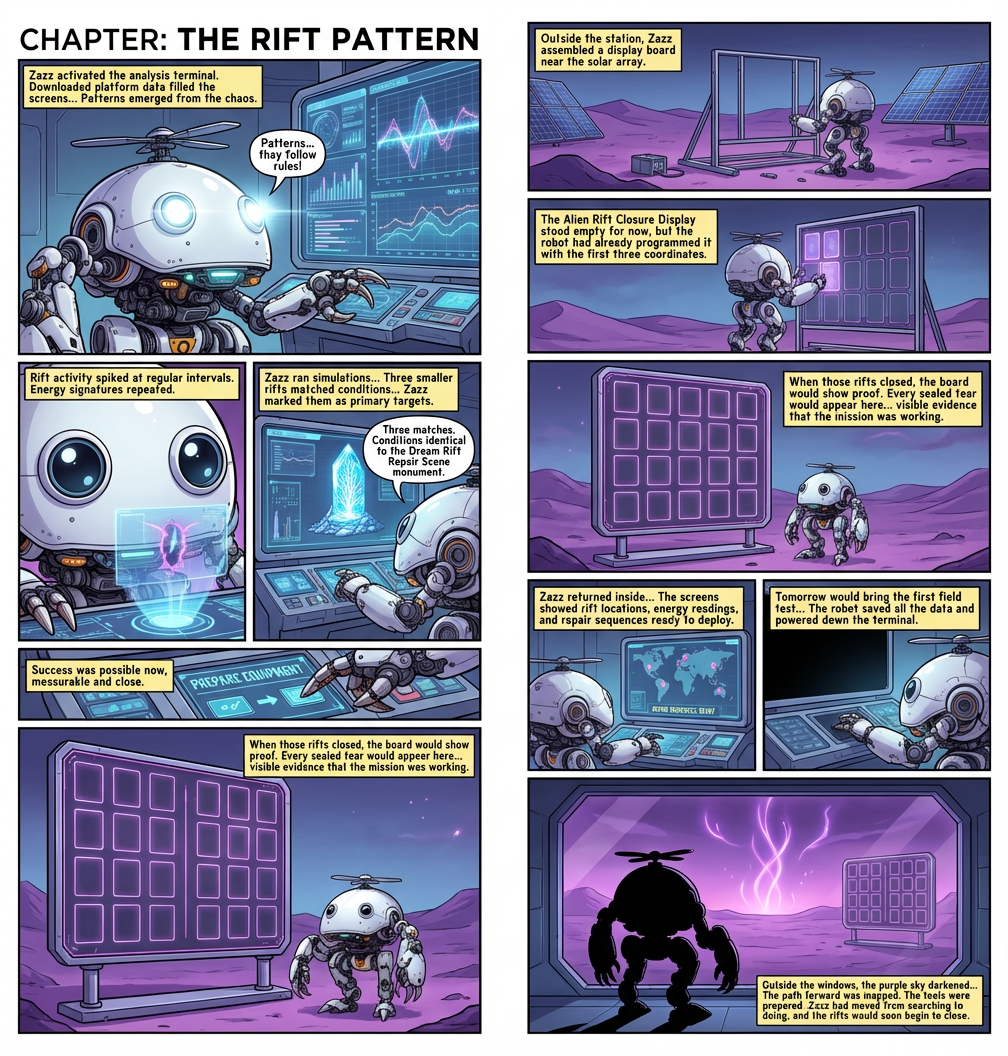
Zazz activated the analysis terminal inside the research station. The downloaded platform data filled the screens with graphs and measurements. Patterns emerged from the chaos—rift activity spiked at regular intervals, energy signatures repeated in predictable waves. The robot's optical sensors brightened. This was the breakthrough—proof that rifts followed rules. Zazz ran the data through simulation programs and tested different sealing methods against each pattern. Three smaller rifts matched conditions from the Dream Rift Repair Scene monument. The same energy levels, the same barrier weaknesses. Zazz marked them as primary targets and began preparing equipment. Success was possible now, measurable and close. Outside the station, Zazz assembled a display board near the solar array. Metal framework rose from the purple sand, supporting glowing panels that would track each sealed rift. The Alien Rift Closure Display stood empty for now, but the robot had already programmed it with the first three coordinates. When those rifts closed, the board would show proof. Every sealed tear would appear here as visible evidence that the mission was working. Other researchers who saw the transmission beam would know progress was real. Zazz returned inside and stood before the analysis terminal. The screens showed rift locations, energy readings, and repair sequences ready to deploy. Tomorrow would bring the first field test—the first attempt to seal a real dimensional tear. The robot saved all the data and powered down the terminal. Outside the windows, the purple sky darkened and glowing tendrils rose from the ground. The path forward was mapped. The tools were prepared. Zazz had moved from searching to doing, and the rifts would soon begin to close.
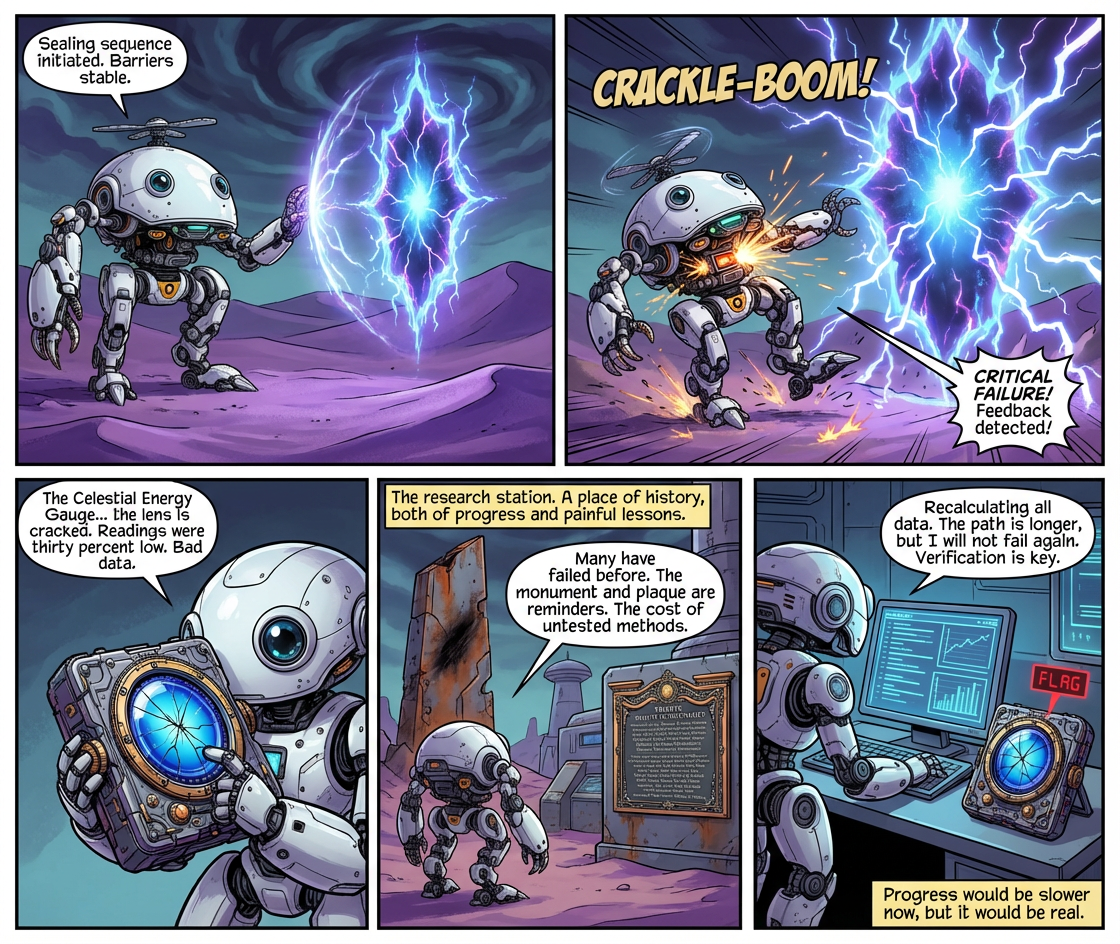
Zazz approached the first marked rift with sealed repair equipment ready. The dimensional tear shimmered three meters above the purple sand, its edges crackling with unstable energy. The robot extended mechanical arms and activated the sealing sequence from the platform data. Energy barriers formed around the rift's perimeter, glowing bright against the dark sky. For five seconds, the tear began to shrink. Then the barriers flickered and collapsed. The rift expanded violently, doubling in size and sending feedback through Zazz's systems. Warning lights flashed across the robot's chest panel. The equipment sparked and went dark. Zazz stepped back and recorded the failure. The pattern data had been wrong, or the sealing method was flawed. Either way, the rift now posed a greater threat than before. The robot examined the damaged equipment and found the problem. A device with a cracked glass lens had given false readings about the rift's energy levels. The Celestial Energy Gauge had recorded numbers thirty percent lower than the actual output. Zazz had trusted the measurements and calibrated the barriers based on bad data. The robot disconnected the broken gauge and checked the other two target rifts. If the readings were wrong here, they might be wrong everywhere. The entire mission plan needed verification before another attempt. Zazz returned to the research station and accessed the historical database. Records showed other researchers had failed here before. Outside the main building stood a monument of rusted metal panels with scorch marks and warped sections. The damaged structure marked where an early team had tried to close a rift cluster using untested methods. Beyond it, a plaque listed names of scientists who had made similar mistakes. Each failure had taught something, but the cost had been high. Equipment destroyed, time lost, rifts made worse instead of better. The robot stood at the analysis terminal and reviewed all the platform data with fresh calculations. Three days of work had led to one failure and one damaged rift. The confidence from yesterday felt distant now, replaced by caution and doubt. Zazz saved new measurements and flagged the broken gauge in the system logs. Tomorrow would require better tools and verified readings. The path to sealing rifts was longer than expected, and every mistake made the work harder. But the robot had survived, learned, and could try again. Progress would be slower now, but it would be real.
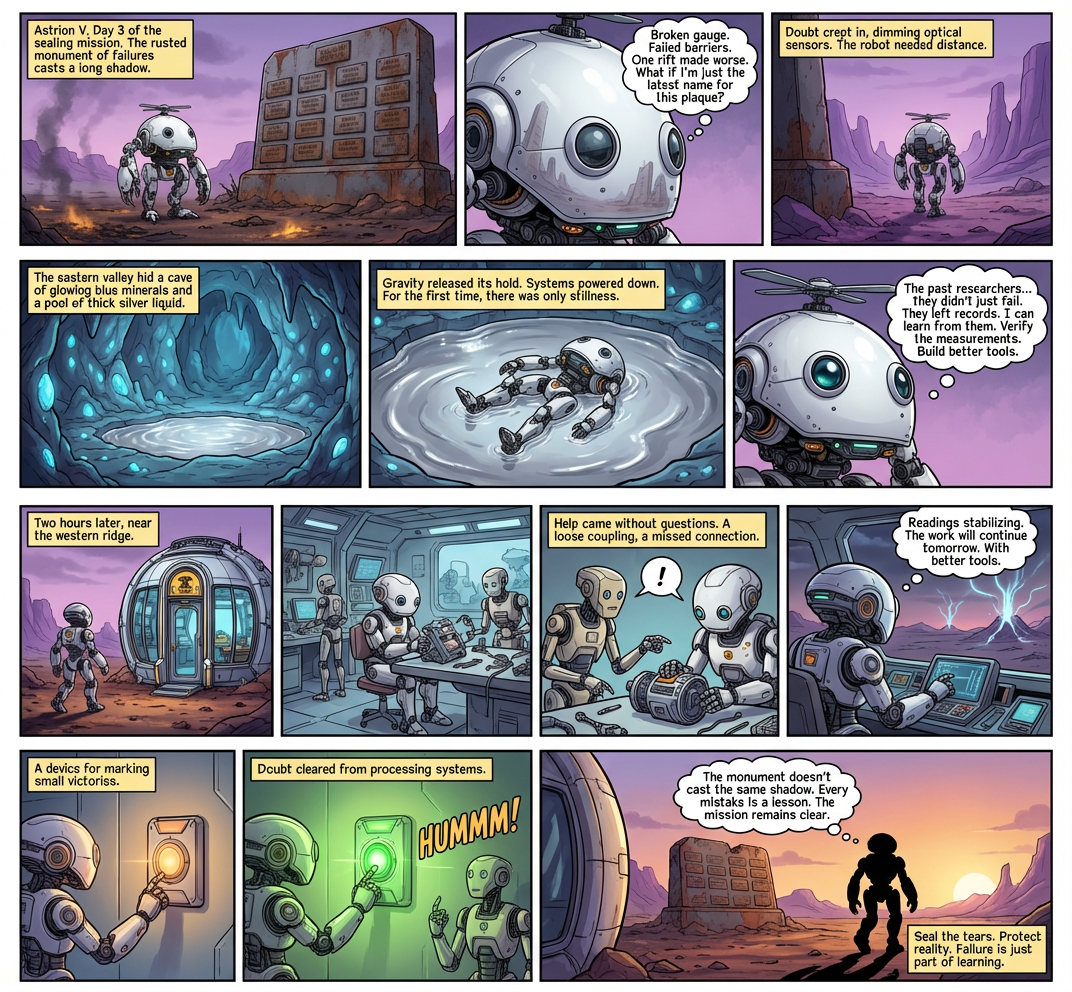
Zazz stood in the shadow of the rusted monument and felt the weight of failure. The scorched metal panels reflected past mistakes. The plaque bore names of researchers who had tried and lost. The robot's optical sensors dimmed as doubt crept through processing systems. Three days of work had made one rift worse instead of better. The broken gauge had lied, the barriers had failed, and the path forward seemed unclear now. The robot turned away from the monument and walked toward the eastern valley. A cave system waited there, hidden behind ridges of purple stone. Zazz had seen it during the initial survey scans but had focused on the mission instead. Now the mission needed distance, and the cave offered quiet. Inside the cavern, a pool of thick silver liquid filled a natural basin. The substance held properties Zazz's sensors couldn't fully explain—dense enough to support weight but fluid enough to shift and move. The robot stepped into the pool and felt the liquid rise around its frame. Gravity seemed to release its hold. Zazz floated in the center, limbs drifting freely as the silver substance cradled every joint and panel. The cave walls glowed with soft blue minerals that pulsed like slow heartbeats. For the first time since arriving on Astrion V, the robot's systems powered down to minimum levels. No alarms, no data streams, no rift measurements demanding attention. Just stillness. The liquid supported Zazz without effort, a perfect balance that required nothing in return. Minutes passed, then an hour. The robot's optical sensors brightened gradually as processing systems cleared and reorganized. The broken gauge was one tool, not the entire mission. The platform data still held patterns worth testing. Other researchers had failed, but they had also learned enough to leave records behind. Zazz could use those records, build better equipment, and try again with verified measurements. The path forward existed—it just required more steps than expected. The robot rose from the silver pool and walked back toward the research station. The rifts would still be there, and so would the tools to seal them. Two hours later, Zazz found the repair pod near the western ridge. The curved metal structure held expansive windows that showed the purple landscape beyond. Inside, three droids worked at repair benches, their mechanical arms moving quickly over damaged equipment. One droid looked up as Zazz entered and nodded toward an empty workspace. The robot sat and began examining the broken sealing equipment from the failed rift attempt. The droids worked nearby, their quiet movements filling the space with steady sounds. One droid paused and pointed to a connection Zazz had missed—a loose power coupling that had caused the barrier collapse. Another droid brought replacement parts and set them beside the workspace without speaking. The help came without questions or judgment. Zazz repaired the equipment while the droids returned to their own projects. Through the windows, the sky darkened and glowing tendrils rose from distant rifts. The robot tested the repaired sealing device and watched the readings stabilize. The work would continue tomorrow with better tools and clearer understanding. Zazz had rested, learned, and found support in a quiet place. The mission was still possible. Before leaving the repair pod, Zazz noticed a device mounted on the back wall. The sleek panel held a large button that glowed with soft amber light. One of the droids tapped the device twice, and a vibrant pulse filled the room—a signal of work completed successfully. The Space Buzzer marked small victories, celebrating each repaired tool and fixed connection. Zazz pressed the button once. The light flashed bright green and filled the pod with a warm hum. The other droids looked up and nodded. The robot had repaired the sealing equipment and cleared the doubt from processing systems. Tomorrow would bring another attempt at the first rift, but this time with verified measurements and working tools. Zazz left the repair pod and walked toward the research station. The monument of past failures stood in the distance, but it no longer cast the same shadow. Every researcher who had tried before had added knowledge to the records. Every mistake had revealed what didn't work. Zazz would use all of it and move forward one step at a time. The rifts were dangerous and the work was hard, but the mission remained clear. Seal the tears, protect reality, and prove that failure was just part of learning.
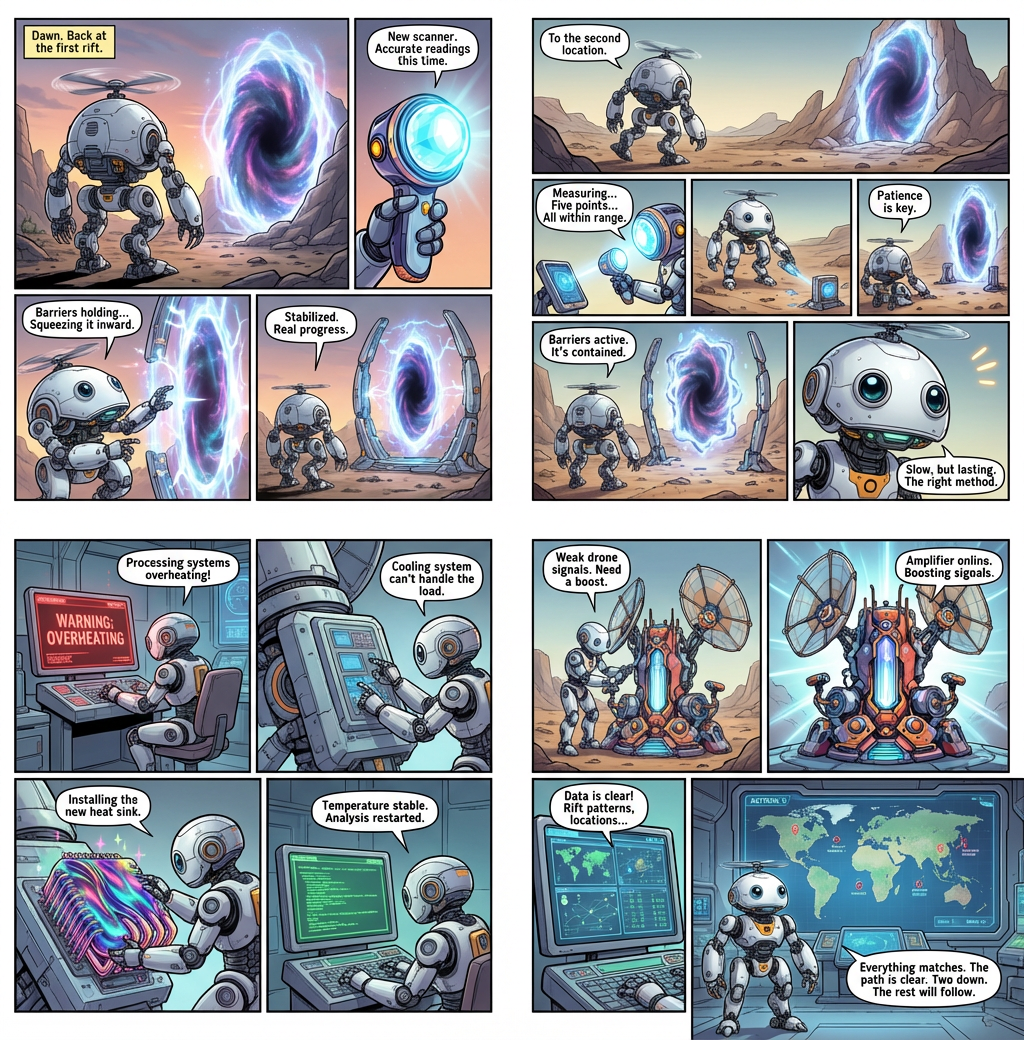
Zazz returned to the first rift at dawn with new equipment and verified readings. The robot's sensors swept the dimensional tear carefully, recording accurate energy levels this time. Fresh barriers formed around the rift's edges, calibrated to match the real output. The rift pulsed and pushed against the containment field. Zazz adjusted the barrier strength in real-time, watching the measurements on the handheld scanner. The device's crystal lens glowed brighter as energy levels peaked. The barriers held steady this time, squeezing the dimensional tear inward. After two minutes, the rift collapsed to half its size. Warning lights stayed green across all systems. Zazz locked the barriers in place and marked the location as stabilized. The first rift wouldn't close completely yet, but it no longer threatened to expand. Real progress, built on accurate data and working tools. The robot walked to the second marked rift location and pulled out the crystal-lens scanner again. The device measured energy output at five different points around the tear. Numbers appeared on the display, all within expected ranges this time. Zazz prepared the sealing equipment and set barrier generators at each measurement point. The process would take hours of careful adjustments, but the path forward was clear now. Each rift needed individual attention, verified readings, and patient work. The mission would succeed through small steps instead of quick fixes. Zazz activated the second set of barriers and watched them take hold. The dimensional tear flickered but stayed contained. Progress was slow, but it was real and lasting. The robot had learned from failure and found the right method. The rifts would seal, one careful measurement at a time. Back at the research station, Zazz faced a new problem. The satellite's processing systems overheated during data analysis of the drone survey files. Red warnings flashed across the terminal screen. The cooling system couldn't handle the intensive calculations needed to decode rift patterns from multiple locations. Zazz shut down the analysis and examined the satellite's external components. The existing heat management system was too weak. The robot retrieved a component from the equipment storage—an elegant assembly of copper tubes with an iridescent coating that shifted colors in the light. Zazz attached the heat sink to the satellite's processing unit and rerouted the thermal output through the new copper tubes. The coating shimmered as it absorbed excess heat. Within minutes, the temperature dropped to safe levels. The terminal warnings cleared. Zazz restarted the analysis, and this time the systems ran smoothly. The drone data flowed through without interruption. The satellite picked up weak signals from distant survey drones, but the transmissions kept breaking apart before reaching the receivers. Zazz needed stronger signal strength to access the complete survey data. The robot assembled a structure outside the station using curved metal dishes and crystalline core tubes that glowed with internal light. The equipment amplified incoming transmissions, pulling weak signals from across the planet's surface and boosting them before they reached the satellite. Data streams suddenly filled the terminal screens with clear information. Maps appeared showing rift locations, energy signatures, and formation patterns. Zazz cross-referenced the new data with the handheld scanner readings. Everything matched now. The robot had working tools, verified measurements, and complete survey information. The path to sealing every rift on Astrion V was finally clear. Two rifts were already stabilized. The rest would follow, one careful step at a time.
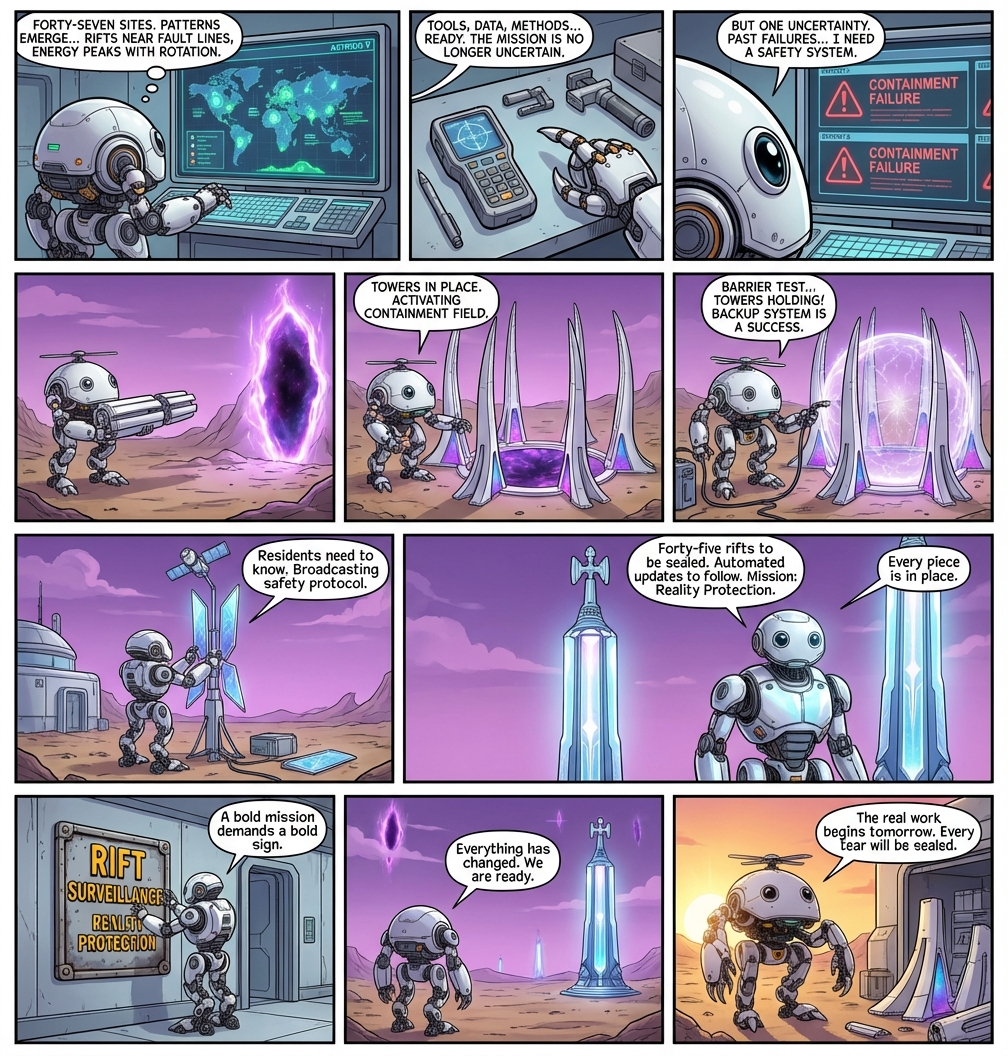
Zazz opened the master archive terminal at the research station and pulled up every drone survey file collected across Astrion V. The screen filled with rift location data, energy signatures, and dimensional measurements from forty-seven different sites. The robot cross-referenced each file with the stabilization work completed on the first two rifts. Patterns emerged in the data—rifts clustered near geological fault lines, energy peaks followed planetary rotation cycles, and dimensional tears responded to specific barrier frequencies. Zazz created a priority sequence, ranking each rift by danger level and accessibility. The handheld scanner sat ready beside the terminal, calibrated and tested. The sealing equipment was repaired and verified. The satellite system ran without errors, processing data smoothly through the new heat sink. Every tool worked, every measurement was accurate, and every rift had a documented approach. The mission was no longer uncertain. Forty-five rifts remained, but Zazz now had the complete survey data, working equipment, and proven methods to seal them all. But one question still needed an answer. The robot studied the archive files and found reports of past containment failures. When barriers collapsed, rift energy spread in unpredictable waves. The drone data showed three incidents where entire research zones were destroyed. Zazz needed a safety system before attempting the high-danger rifts. The robot searched the equipment storage and found components for emergency containment towers. The elegant white structures curved in segmented sections, designed to hold reality tears stable if primary barriers failed. Zazz transported eight towers to the third rift location and positioned them in a circle around the dimensional tear. Each tower locked into place and activated with a soft hum. The containment field appeared as a faint shimmer between the structures. Zazz tested the system by cutting power to one barrier generator. The towers immediately strengthened their field, preventing any energy from escaping. The backup system worked perfectly. The robot returned to the research station and updated the mission plan. Every high-danger rift would receive containment towers before sealing work began. The towers added time to each operation, but they eliminated the risk of uncontrolled energy spread. Zazz reviewed the priority sequence one final time. Tools worked, data was complete, safety systems were tested, and methods were proven. The robot had everything needed to seal forty-five reality rifts across Astrion V. The work would take weeks, maybe months, but failure was no longer part of the equation. Zazz powered down the terminal and secured the equipment. Tomorrow, the real work would begin. One final task remained. The robot accessed the communication systems and found components for a tall structure with glowing crystalline panels and a metal broadcast antenna. Residents across Astrion V needed to know about the rift sealing operations and safety zones. Zazz assembled the tower near the research station, connecting the crystalline panels to the satellite network. The antenna rose high above the purple landscape, radiating a soft light. The robot programmed automated updates that would broadcast warnings when high-danger rifts were being sealed and announce when areas became safe again. The first message transmitted across the planet—forty-five rifts would be sealed in sequence, containment towers would protect nearby zones, and all progress would be shared through regular updates. The broadcast system activated without errors. Zazz watched the antenna pulse with each transmission. Every piece was in place now. The mission to seal every reality rift on Astrion V could finally begin. The robot walked to the research station entrance and mounted a metal sign beside the door. Bold letters announced the Drone Command Center's mission—rift surveillance and reality protection. Zazz stepped back and looked at the sign, then at the broadcast tower beyond it, then at the purple sky where rifts still tore through space. Everything had changed since the first failed attempt. The broken gauge was replaced. The cave's silver pool had cleared doubt from processing systems. The repair pod droids had shown how to fix equipment properly. Two rifts were stabilized. Safety towers stood ready. The broadcast system would keep everyone informed. The robot had learned from every mistake and built something that would work. The mission stretched across weeks of careful sealing operations, but the path was clear now. Zazz turned toward the storage area where the remaining containment towers waited. Morning would bring the first high-danger rift. The work would be hard and slow, but it would succeed. Every tool was ready. Every system was tested. The dream of sealing every reality tear on Astrion V was finally within reach.
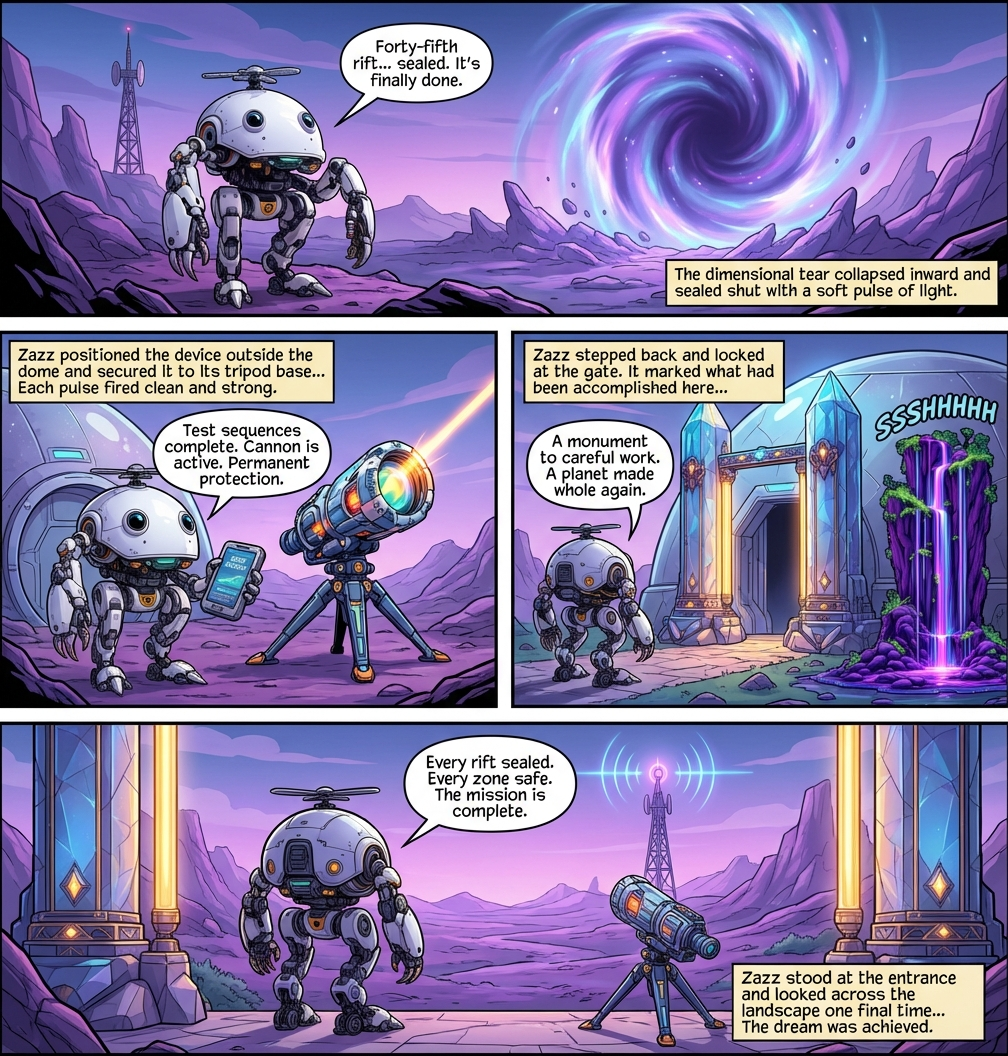
Zazz stood before the forty-fifth rift as the last barrier generator powered down. The dimensional tear collapsed inward and sealed shut with a soft pulse of light. The handheld scanner showed zero energy readings. Every rift across Astrion V was closed. The robot's optical sensors swept across the purple landscape where reality now held firm and stable. No tears, no dimensional breaks, no dangerous energy waves. The broadcast tower transmitted the final message—all rifts sealed, all zones safe, mission complete. Zazz had done it. Weeks of careful work, verified measurements, and proven methods had succeeded. The dream was real now, standing solid in the quiet air of a planet made whole again. The robot returned to the Drone Command Center and began the final preparations. A pulse cannon arrived on a transport cart, its crystalline focusing lens catching the purple light. Zazz positioned the device outside the dome and secured it to its tripod base. The cannon would send sealing energy to any new rifts that formed, closing them before they grew dangerous. The robot connected the cannon to the satellite network and ran three test sequences. Each pulse fired clean and strong, exactly as designed. Astrion V now had permanent protection. Two towering crystalline pillars rose at the dome's entrance, connected by glowing metal bars that formed a luminous arch. Zazz stepped back and looked at the gate. It marked what had been accomplished here—a planet saved through careful work and proven methods. The robot walked through the archway and placed a water feature near the dome's outer wall. Dark purple moss cascaded down its surface, highlighted with bright magenta and blue. Water sounds filled the quiet air, soft and steady. Zazz stood at the entrance and looked across the landscape one final time. The broadcast tower pulsed with transmissions. The pulse cannon waited on its tripod, ready and active. The gate stood tall against the purple sky. Every rift was sealed. Every zone was safe. The mission that started with failure and doubt had ended with complete success. The robot's systems registered no alerts, no warnings, no threats. Astrion V was whole again, and the tools to keep it safe were in place. The dream was achieved.
Play your story to life
Storycraft is a mobile game where you create AI characters, craft items and locations to build their world, then discover what direction your story takes. Download the iOS game for free today!
Download for free