

Inkthorn the Drawn's ArcChapter 4 of 7
Inkthorn the Drawn's dream is escaping the book permanently to become a three-dimensional being.

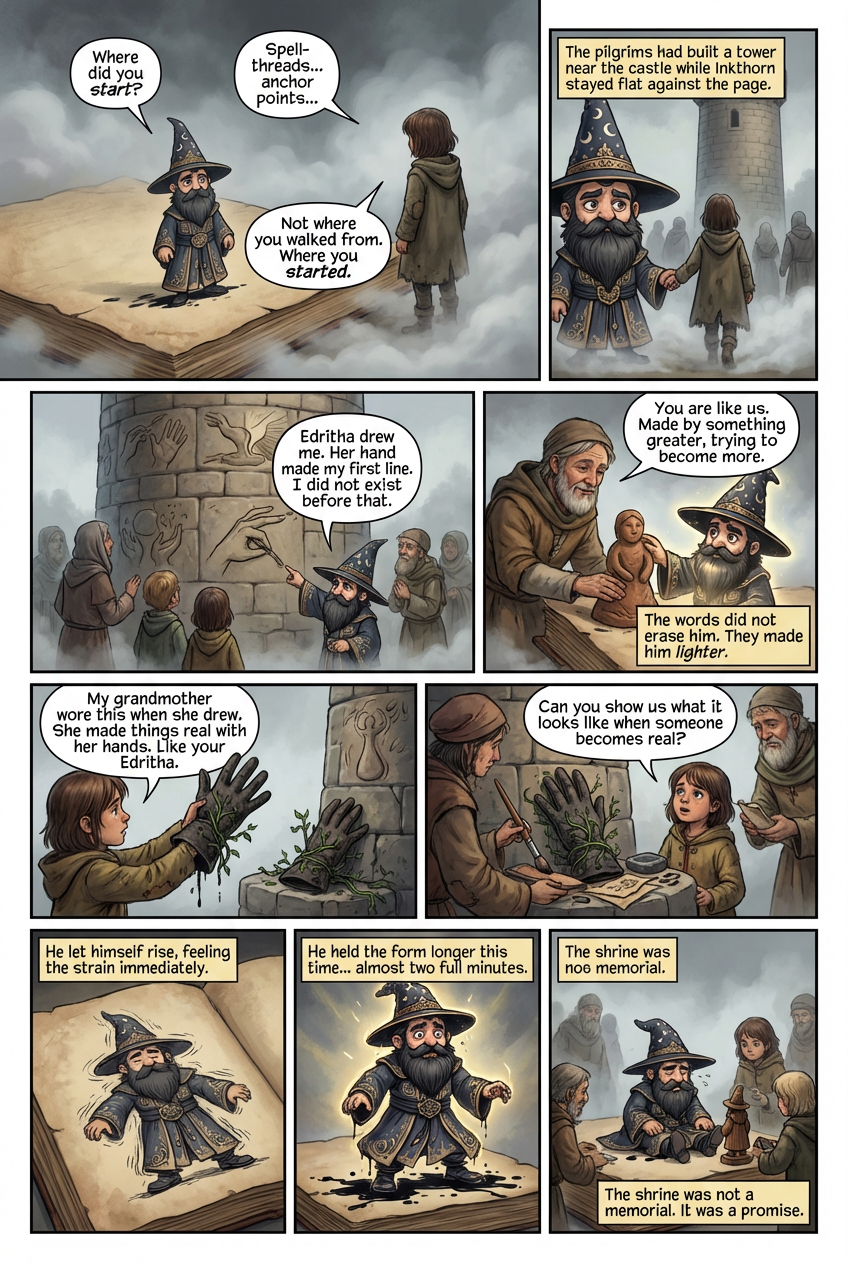
Click to expand
Chapter 4
On the fourth morning, a child stood at the edge of the page and asked where Inkthorn came from. The question hung in the fog like something solid. Inkthorn tried to answer with words about spell-threads and anchor points, but the child shook her head. Not where you walked from, she said. Where you started.
The pilgrims had built a tower near the castle while Inkthorn stayed flat against the page. Stone spiraling upward with carved tablets showing creation stories—hands shaping clay, light splitting dark, words becoming flesh. The child led him there, and others followed. They gathered at the base and waited for him to speak. Inkthorn looked at the carvings and felt the oldest lines in his body pull tight. He could tell them about Edritha's hand, the first stroke that gave him shape, the moment consciousness bloomed in wet ink. But saying it out loud would make it real—would confirm that he began as nothing, drawn into being by someone else's will, never meant to leave the page at all. The pilgrims leaned closer. The child watched with patient eyes. Inkthorn opened his mouth and spoke the truth he had been avoiding: Edritha drew me. Her hand made my first line. I did not exist before that. The words did not erase him. They made him lighter. The pilgrims nodded like this was what they expected, and the child smiled. One of them pressed a hand to the carved tablet showing the clay figure, then touched the edge of Inkthorn's page with the same gesture. You are like us, the pilgrim said. Made by something greater, trying to become more. Inkthorn had thought remembering his beginning would trap him in it forever. Instead, it freed him to imagine a different ending.
But the child was not finished. She reached into her coat and pulled out a leather glove stained with charcoal and ink. Forest vines had grown through the fingers, wrapping the dark material in living green. My grandmother wore this when she drew, the child said. She made things real with her hands. Like your Edritha. The girl set the glove at the base of the tower, arranging it carefully so the stained fingers pointed toward Inkthorn's page. Others came forward then, each adding something to the growing pile—a brush wrapped in moss, a stone ground smooth for mixing pigment, a scrap of parchment with half-finished lines. They were building a shrine. Not to him, Inkthorn realized. To the act of creation itself. To hands that made things that should not exist. The child looked up at him. Can you show us? she asked. Can you show us what it looks like when someone becomes real?
Inkthorn felt the pull toward three dimensions start in his oldest lines. He had been avoiding this—had told himself that collapsing back to the page meant failure. But these pilgrims did not want perfection. They wanted proof that change was possible. He let himself rise, feeling the strain immediately. His edges blurred where the fog touched them. The ink at his feet began to pool again, draining away. But he held the form longer this time, almost two full minutes, and when he finally collapsed back to flatness, the pilgrims were arranging more offerings around the shrine. The child placed a carved wooden figure on one of the shelves—a small inked man standing upright, solid, whole. Inkthorn looked at it and understood: they were not waiting for him to succeed. They were showing him what they believed he could become. The shrine was not a memorial. It was a promise.
Play your story to life
Storycraft is a mobile game where you create AI characters, craft items and locations to build their world, then discover what direction your story takes. Download the iOS game for free today!
Download for free