

Inkthorn the Drawn's Arc
7 Chapters
Inkthorn the Drawn's dream is escaping the book permanently to become a three-dimensional being.

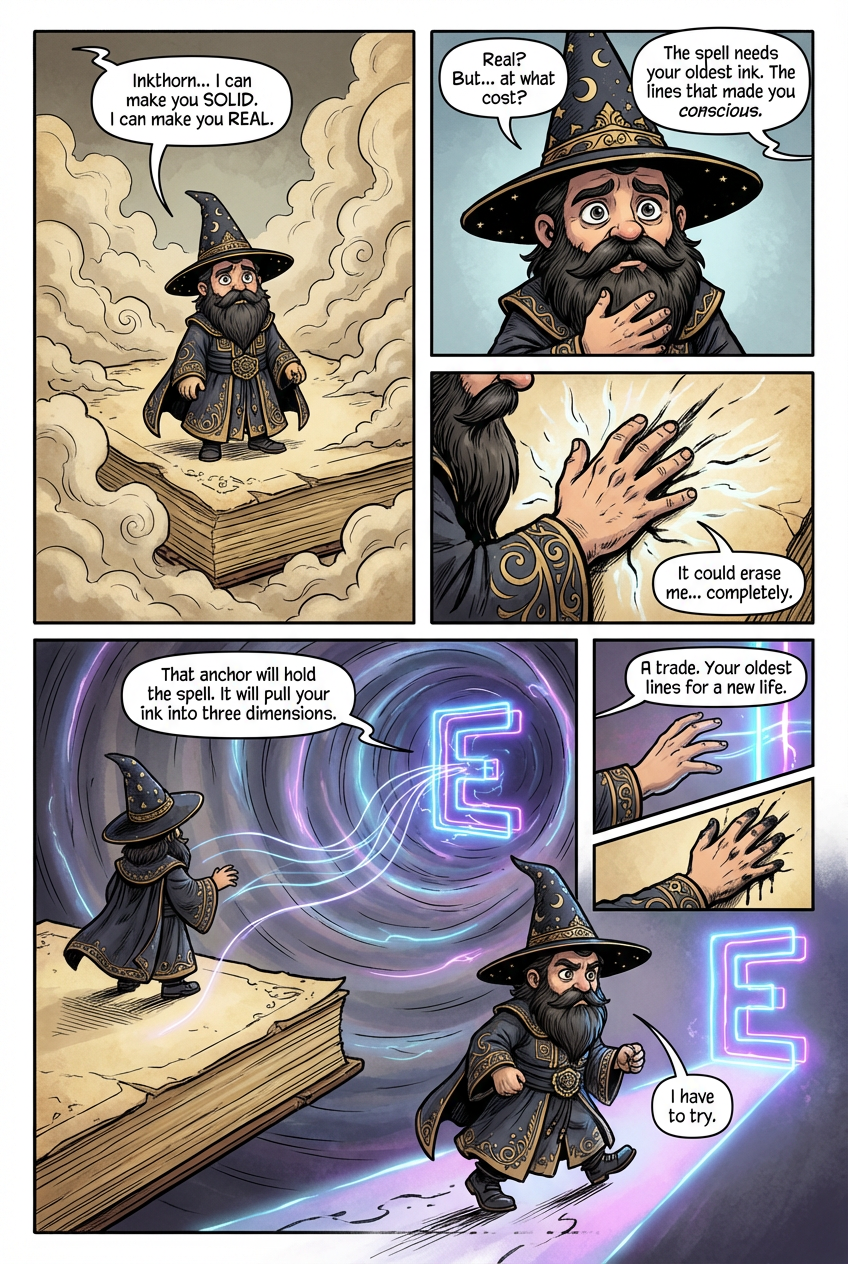
Inkthorn stood at the edge of the page, watching the fog press against his borders. Edritha had been quiet for hours, which meant she was thinking. When she finally spoke, her voice came from somewhere above the book. She said she could make him solid. She said she could make him real. But the spell would need something from him—something drawn in his oldest ink, the lines that held his shape together. He felt the weight of her offer like a hand closing around his center. This was what he wanted. This was what might erase him completely. She showed him the anchor point—a bright structure in the distance, all neon curves forming the shape of a letter. The light traced paths through the fog like threads he could follow. That building would hold the spell, she said. It would pull his ink into three dimensions and lock it there. But the magic needed a trade. He would have to give up the first strokes she ever drew, the lines that made him conscious. Without them, he might become solid. Or he might become nothing at all. He looked at the glowing letter and felt himself reaching toward it before he could decide if he should.
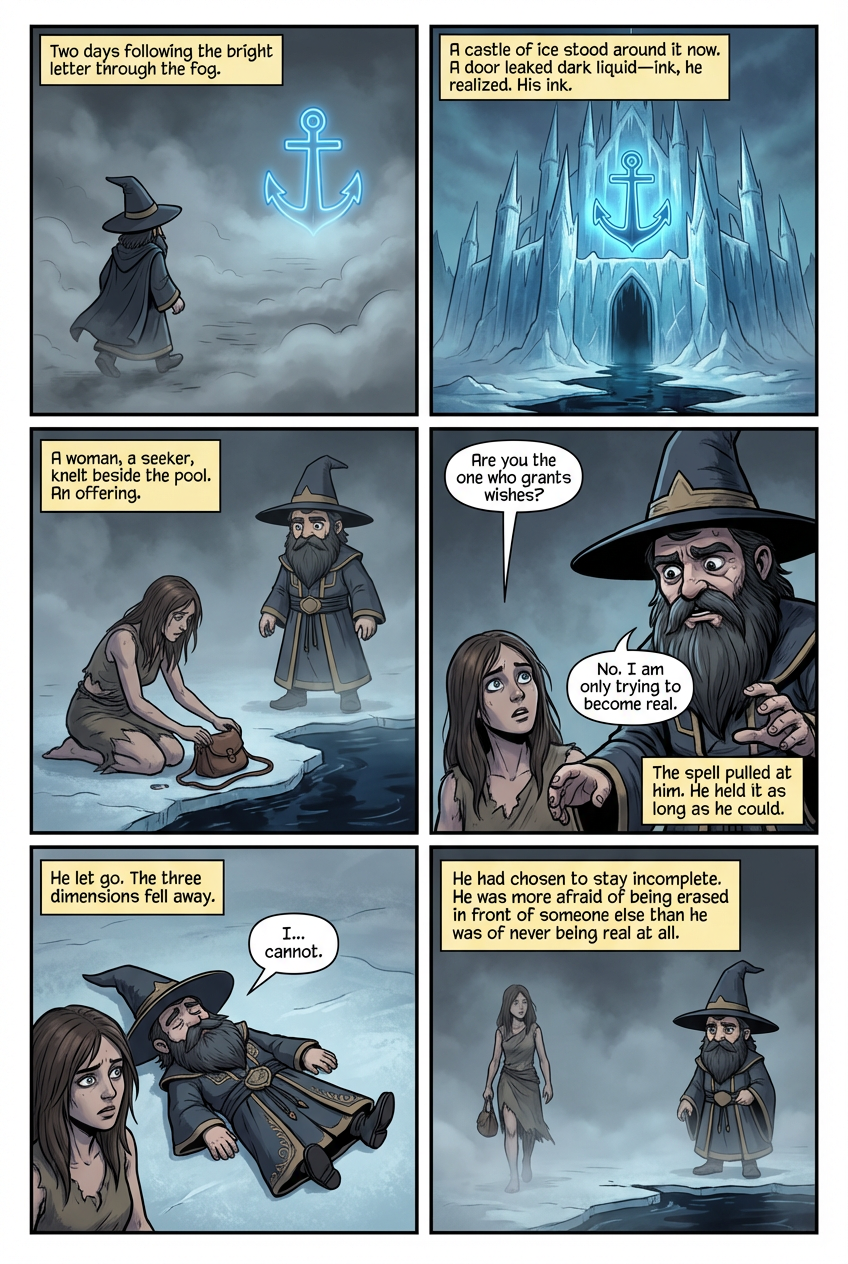
Inkthorn moved toward the neon anchor for two days, following the bright letter through the fog. The light never seemed closer, but he kept walking anyway. On the third night, he saw a figure approaching from the opposite direction. The neon letter had drawn something up from the ground. A castle of ice stood around it now, all sharp towers and frozen arches. The light from the anchor shone through the ice walls and made them glow blue. Near the base, a door leaked dark liquid—ink, he realized, pooling in the fog. His ink. The times he had tried to hold himself solid and failed, the edges he had lost reaching for the spell. The seeker, a woman wrapped in torn cloth, knelt beside the pool and placed a small leather purse there. An offering. Inkthorn stepped into view and felt himself start to rise into three dimensions. The spell pulled at him, trying to make him solid. He held it as long as he could. The woman looked up and her eyes went wide. She asked if he was the one who granted wishes. He told her no. He told her he was only trying to become real. The pulling got stronger and he felt his oldest lines starting to stretch. He could choose now—let the spell take what it needed and stay solid, or collapse back to the page. The woman was still watching. Waiting to see proof that magic worked. He let go. The three dimensions fell away and he collapsed flat again, back on the page. The woman's face changed. Not anger—something worse. Disappointment. She picked up her purse and walked away into the fog. Inkthorn stayed there by the castle, looking at the pool of lost ink. He had chosen to stay incomplete rather than let a stranger see him fail completely. Now he knew the truth: he was more afraid of being erased in front of someone else than he was of never being real at all.
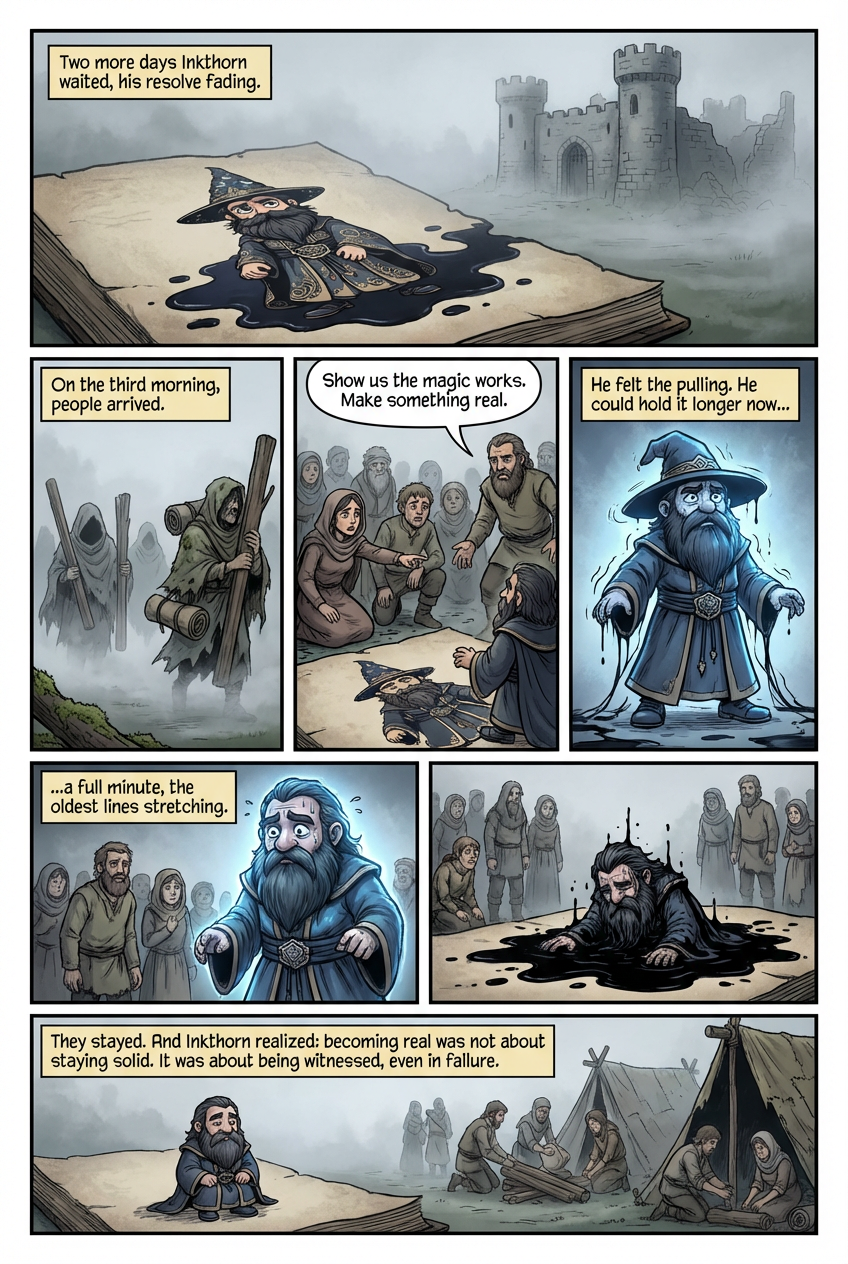
Inkthorn stayed by the castle for two more days. He did not move toward the anchor again. The pool of lost ink grew larger each time he tried to hold himself solid, and he stopped trying. But on the third morning, voices came through the fog. A dozen people arrived carrying rolled canvas and wooden posts. They built a shelter near the castle, moss already growing on the wood like it had been waiting for this. More came after—wrapping themselves in torn blankets, kneeling by the pool, whispering requests into the dark liquid. They thought the castle was a holy place. They thought the ink granted wishes. The woman from before stood among them, and when she saw Inkthorn watching from the page, she pointed. They turned to look at him. One man stepped forward and asked for proof. Show us the magic works, he said. Make something real. Inkthorn felt the pulling start again as he tried to rise into three dimensions. He could hold it longer now, almost a full minute before the oldest lines began to stretch. But he knew what would happen. He would collapse back to the page, and they would see him fail. He looked at their faces—tired, desperate, waiting. Then he understood: they did not need him to succeed. They needed him to try. So he let the spell pull him up and held himself solid as long as he could. When he collapsed, they did not walk away. They stayed. They built more shelters. They left more offerings. And Inkthorn realized the truth he had been avoiding: becoming real was not about staying solid forever. It was about being witnessed, even in failure.
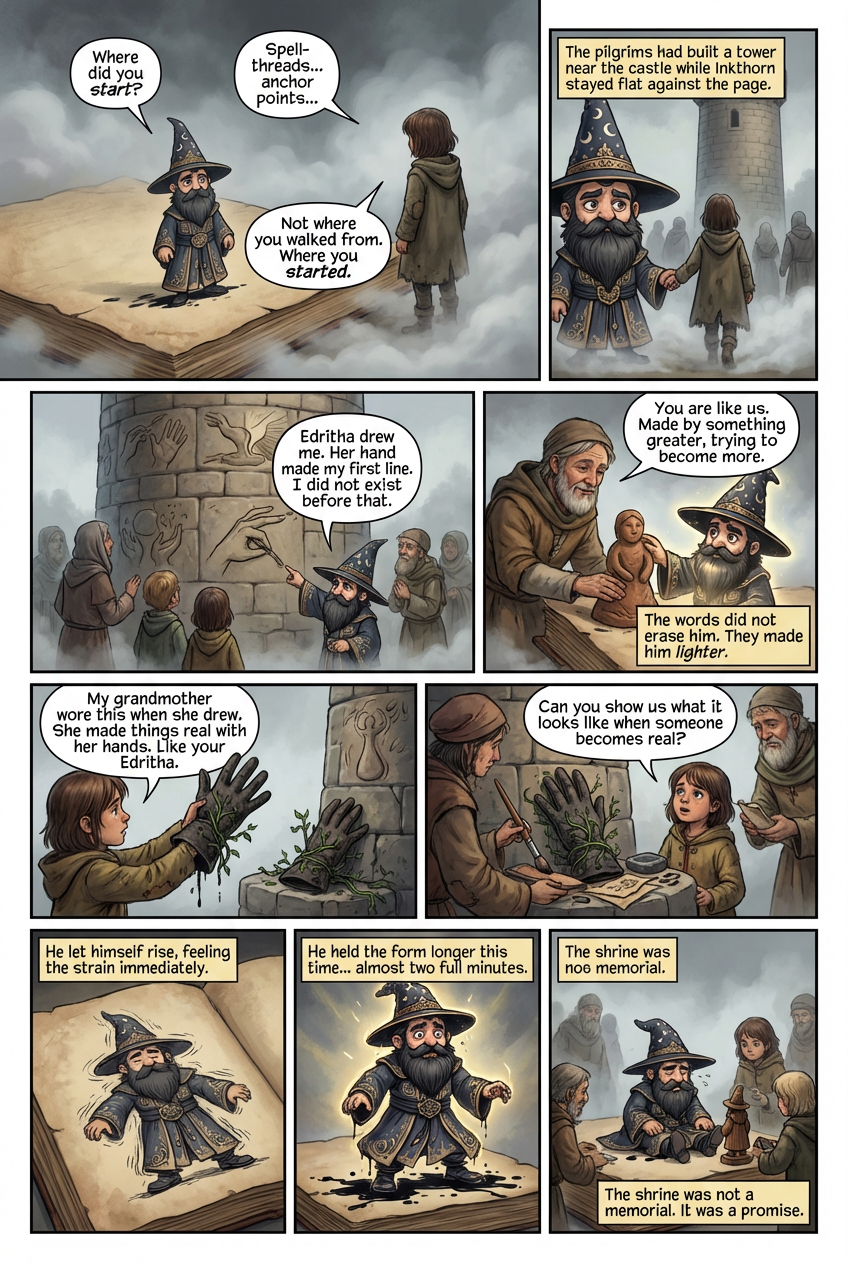
On the fourth morning, a child stood at the edge of the page and asked where Inkthorn came from. The question hung in the fog like something solid. Inkthorn tried to answer with words about spell-threads and anchor points, but the child shook her head. Not where you walked from, she said. Where you started. The pilgrims had built a tower near the castle while Inkthorn stayed flat against the page. Stone spiraling upward with carved tablets showing creation stories—hands shaping clay, light splitting dark, words becoming flesh. The child led him there, and others followed. They gathered at the base and waited for him to speak. Inkthorn looked at the carvings and felt the oldest lines in his body pull tight. He could tell them about Edritha's hand, the first stroke that gave him shape, the moment consciousness bloomed in wet ink. But saying it out loud would make it real—would confirm that he began as nothing, drawn into being by someone else's will, never meant to leave the page at all. The pilgrims leaned closer. The child watched with patient eyes. Inkthorn opened his mouth and spoke the truth he had been avoiding: Edritha drew me. Her hand made my first line. I did not exist before that. The words did not erase him. They made him lighter. The pilgrims nodded like this was what they expected, and the child smiled. One of them pressed a hand to the carved tablet showing the clay figure, then touched the edge of Inkthorn's page with the same gesture. You are like us, the pilgrim said. Made by something greater, trying to become more. Inkthorn had thought remembering his beginning would trap him in it forever. Instead, it freed him to imagine a different ending. But the child was not finished. She reached into her coat and pulled out a leather glove stained with charcoal and ink. Forest vines had grown through the fingers, wrapping the dark material in living green. My grandmother wore this when she drew, the child said. She made things real with her hands. Like your Edritha. The girl set the glove at the base of the tower, arranging it carefully so the stained fingers pointed toward Inkthorn's page. Others came forward then, each adding something to the growing pile—a brush wrapped in moss, a stone ground smooth for mixing pigment, a scrap of parchment with half-finished lines. They were building a shrine. Not to him, Inkthorn realized. To the act of creation itself. To hands that made things that should not exist. The child looked up at him. Can you show us? she asked. Can you show us what it looks like when someone becomes real? Inkthorn felt the pull toward three dimensions start in his oldest lines. He had been avoiding this—had told himself that collapsing back to the page meant failure. But these pilgrims did not want perfection. They wanted proof that change was possible. He let himself rise, feeling the strain immediately. His edges blurred where the fog touched them. The ink at his feet began to pool again, draining away. But he held the form longer this time, almost two full minutes, and when he finally collapsed back to flatness, the pilgrims were arranging more offerings around the shrine. The child placed a carved wooden figure on one of the shelves—a small inked man standing upright, solid, whole. Inkthorn looked at it and understood: they were not waiting for him to succeed. They were showing him what they believed he could become. The shrine was not a memorial. It was a promise.
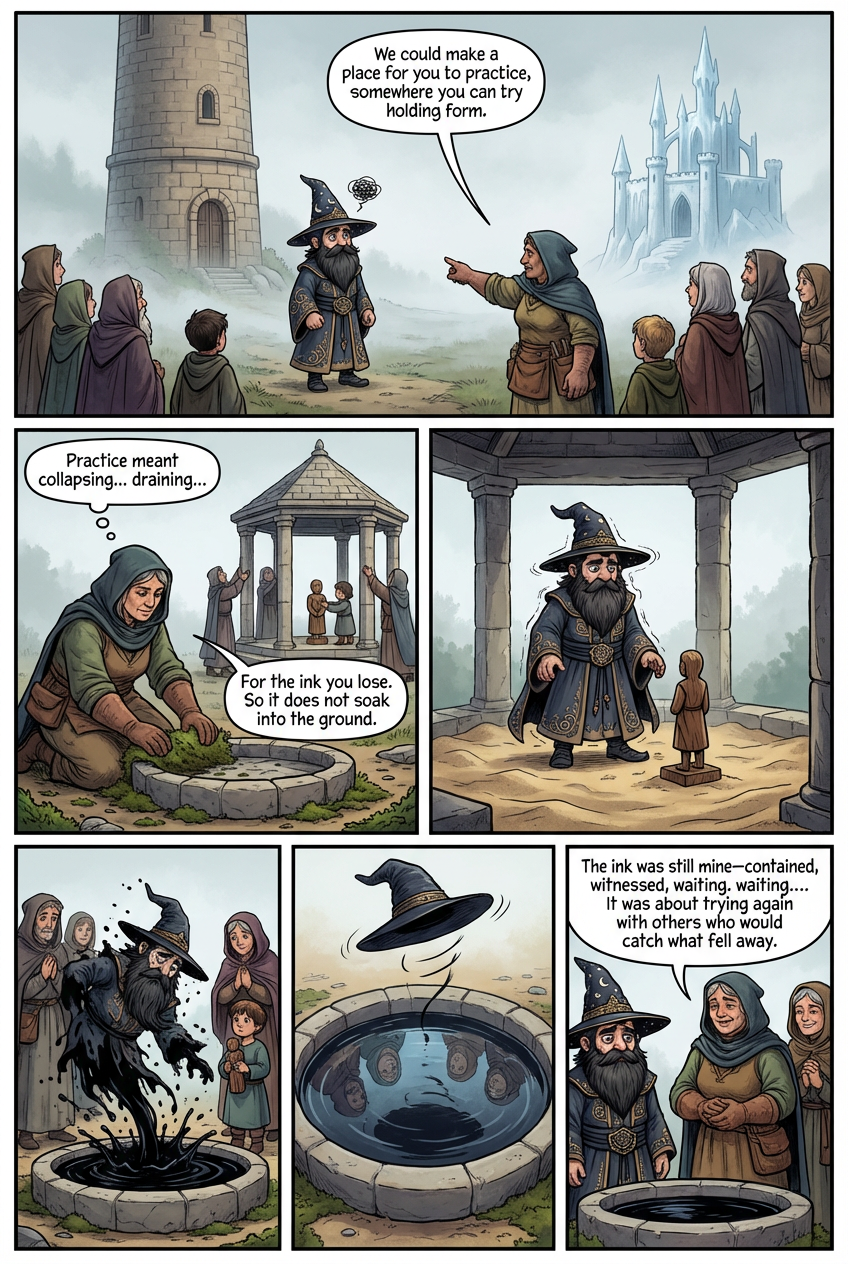
The pilgrims gathered at the shrine the next morning with an idea. One of them—a woman with builder's hands—pointed at the space between the tower and the ice castle. We could make a place for you to practice, she said. Somewhere you can try holding form without worrying about the fog taking pieces away. Inkthorn wanted to say yes immediately, but the truth stopped him. Practice meant collapsing over and over, draining himself each time until nothing remained. The woman must have seen the hesitation in his lines. She knelt and began digging a shallow basin from the earth, packing stones around the edges while others brought moss to seal the bottom. For the ink you lose, she explained. So it does not soak into the ground and disappear. Beside the basin, they raised a pavilion with stone columns and sand spread across the floor—a space sheltered from the worst of the fog. The child brought the carved wooden figure from the shrine and placed it at the center. This is what you are working toward, she said. But you do not have to reach it today. Inkthorn rose into three dimensions inside the pavilion and felt the drain begin instantly. But this time when he collapsed, his ink pooled in the basin instead of vanishing into the earth. The pilgrims did not look away. They stayed and watched him rise again, collapse again, each attempt lasting seconds longer than the one before. By midday, Inkthorn had fallen seven times, and the basin held enough ink to darken the water. He was emptier than he had been since leaving the book, but he was not afraid. The ink was still his—contained, witnessed, waiting. He had learned that becoming real was not about holding form forever. It was about trying again with others who would catch what fell away.
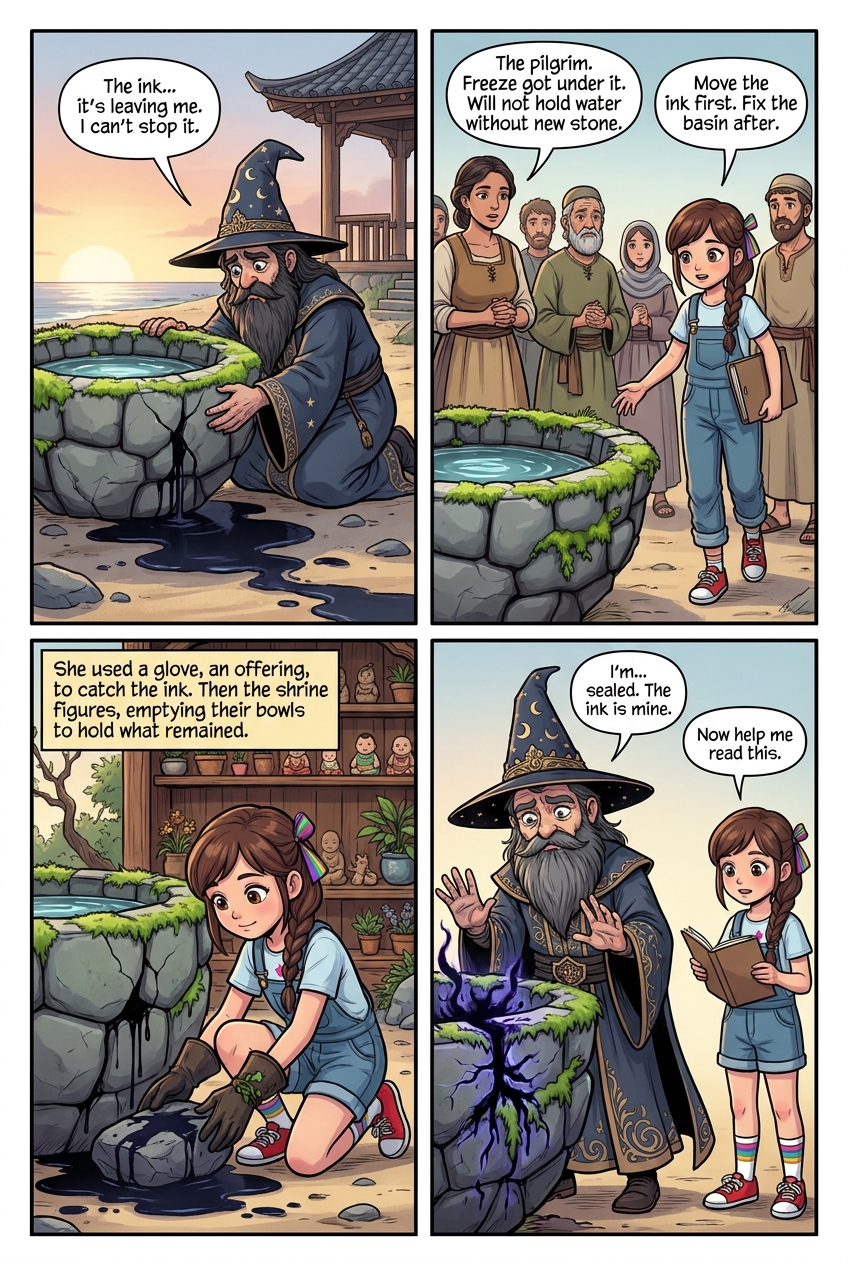
Inkthorn returned to the pavilion at dawn and found the sand dark and wet. The basin had split down one side overnight. A thin crack ran from its lip to its base, and the ink he had spilled the day before was already leaving him. It crept into the soil in a slow black tongue. Every drop that reached the earth was a drop he could not get back. He knelt beside the basin and pressed his flat hand against the crack. His fingers left no mark. He could not lift stone as a drawing. He could not seal the leak from the page. To fix it he would have to rise, and rising would cost him more ink, and more ink would fall through the same crack he was trying to close. The pilgrims came when the light grew. The builder woman touched the split stone and shook her head. Freeze got under it, she said. It will not hold water again without new stone and a full day to set. Inkthorn watched the ink pool slide lower. He did not have a full day. He had minutes. A girl stepped out of the group with a folder under one arm. She said her name was Lily Morrison. She was not a pilgrim. She had followed the path up from the forest looking for someone who might have seen her sister. She set the folder down in the sand and knelt at the basin without asking permission. Move the ink first, she said. Fix the basin after. You need something to hold it now. She pulled a leather glove from her folder, dark with old ink stains and wrapped in green vines from the forest. An offering someone had left on the path, she said. She scooped the vines aside and used the glove to lift a flat, pitted stone from beside the basin. The stone was already stained black from an older spill. She set it under the crack so the ink ran onto its porous surface and soaked in instead of vanishing into the ground. Then she took the small figures from the nearby shelf-shrine, tipped their clay bowls empty, and lined them along the basin's inner wall to catch what still pooled inside. Inkthorn rose. He held three-dimensional form for the count of thirty and pushed his palms flat against the crack from the inside. His ink filled the split as he drained. When he collapsed back to the page, the crack was sealed with a dark seam of himself. The basin held. The pooled ink stayed. The stained stone under the lip held the rest. He was thinner than he had been in days. He could feel the missing weight in his own lines. But the ink was still his, gathered in bowls and stone and seam, witnessed by a girl who had come looking for something else. Lily picked up her folder. She said, Now help me read this.
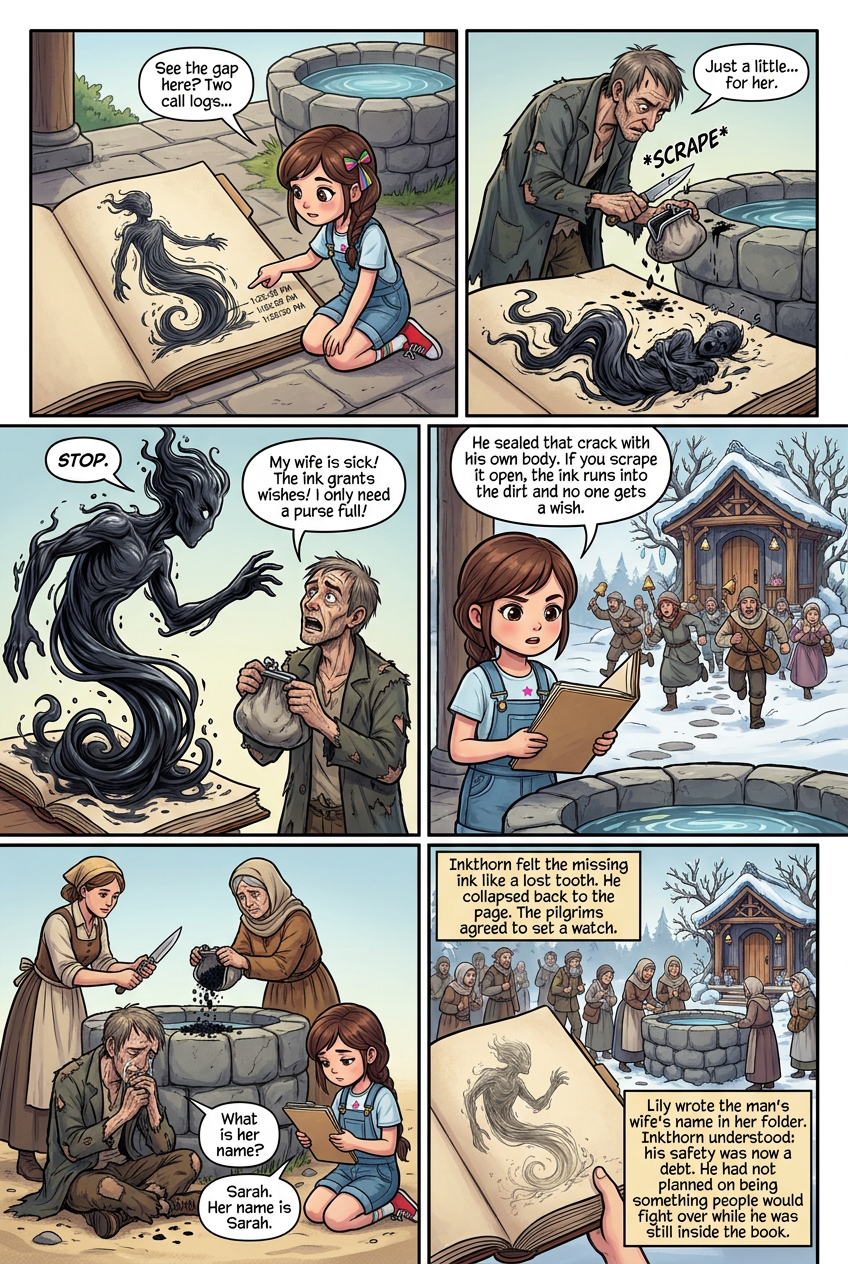
Inkthorn lay flat on the page while Lily spread her folder open on the pavilion floor. He read her timestamps for her, tracing each line with a drawn finger. She was pointing at a gap between two call logs when a shout came from the basin. A thin man in a torn coat had climbed over the low wall. He held a knife against the sealed seam and scraped, catching black flakes into a small leather purse with tarnished silver clasps. Inkthorn felt it before he saw it. The seam was part of him now. Every scrape lifted a curl of ink from his own edge. It was the fog feeling, but sharper. He reached for a word inside himself and found the shape of the word half gone. He rose off the page without deciding to. He held three-dimensional form in front of the basin and said, Stop. The man did not stop. He said his wife was sick. He said the ink granted wishes. He said he only needed a purse full. Lily stepped between them before Inkthorn could speak again. She said, He sealed that crack with his own body. If you scrape it open, the ink underneath runs into the dirt and no one gets a wish. She said it flat, the way she read her folder. The pilgrims came running from the shrine at the ice castle, bells ringing on its frame as they pushed past it. The builder woman took the knife. Another pilgrim took the coin purse and tipped the flakes back onto the stained stone under the basin's lip, where the ink could soak in and stay. The man sat down in the sand and cried. Lily knelt beside him and asked his wife's name and wrote it in the back of her folder. Inkthorn held form a moment longer than he needed to. He looked at the seam. A shallow groove ran along it where the knife had worked. He was thinner there. He could feel it the way a person feels a missing tooth. He collapsed back to the page before the pilgrims could see him shake. The builder woman said she would set a watch on the basin day and night. The pilgrims agreed. Lily closed her folder and tucked the man's wife's name inside. Inkthorn understood, from the page, that his gathered ink was no longer only his to guard. Others would guard it now. That was a kind of safety. It was also a kind of debt. He had wanted to escape the book and become real. He had not planned on being something people would fight over while he was still inside it.
Play your story to life
Storycraft is a mobile game where you create AI characters, craft items and locations to build their world, then discover what direction your story takes. Download the iOS game for free today!
Download for free