

Silas thornbush's ArcChapter 10 of 14
Silas thornbush's dream is operating a successful flower-wagon business connecting isolated frontier towns with beauty.

Click to expand
Chapter 10
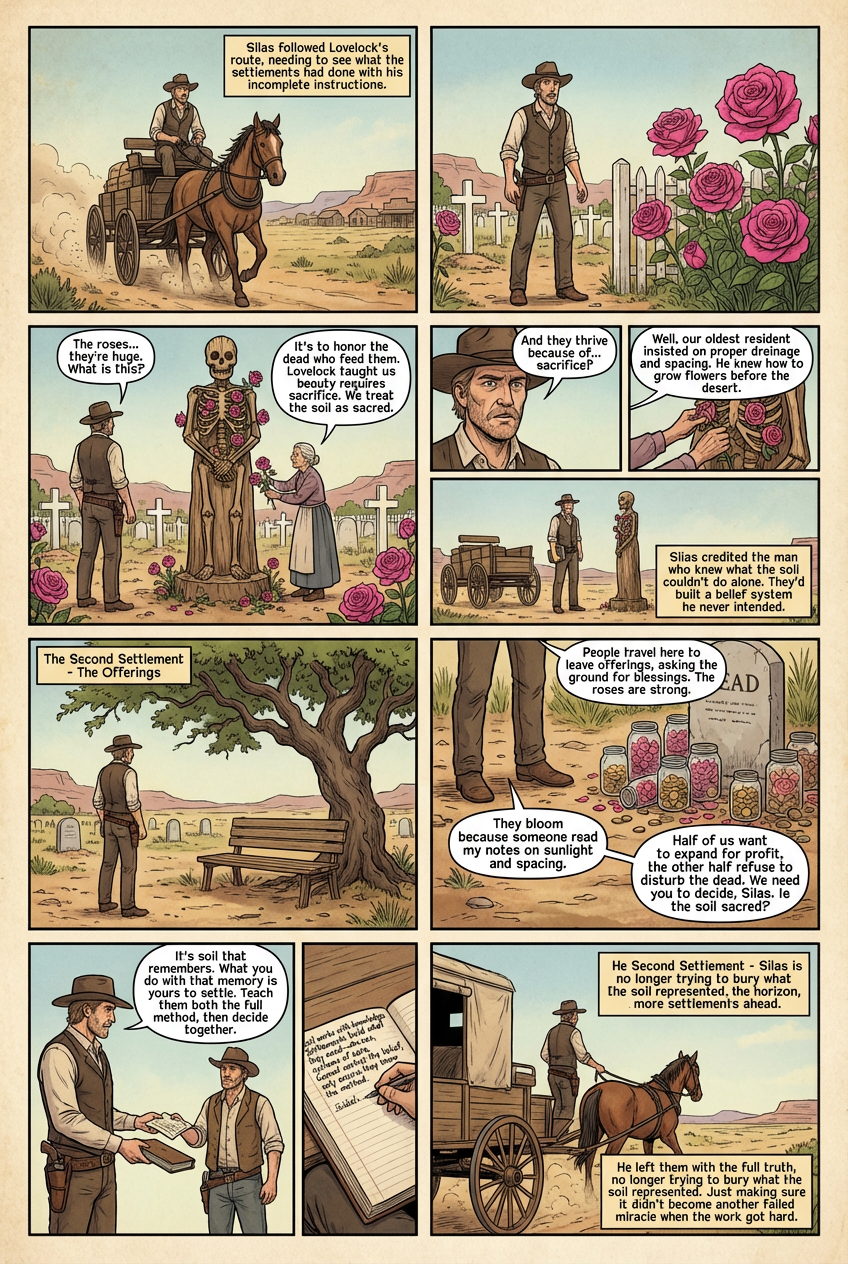
Silas followed the route Lovelock had taken—the same settlements where she'd shared the soil sample, the same foremen who'd received jars of burial ground dirt and believed it would solve everything. He needed to see what they'd done with his incomplete instructions.
The first cemetery sat two days west, marked by whitewashed crosses and a wooden sign that read the settlement's name. Someone had planted roses along the fence line using his soil sample. The stems stood tall and thick, their blooms twice the size of anything he'd grown at the ranch, but the locals had built something more—a statue at the cemetery's center, carved from bleached wood and decorated with fresh pink roses woven through its ribs. An older woman stood beside it, replacing wilted blooms with new ones. She told Silas the statue honored the dead who fed the flowers, that the settlement treated the burial ground soil like sacred earth now. She said Lovelock had taught them that beauty required sacrifice, and they'd taken it to heart. Silas asked if the roses were thriving. She said they were, but only because the settlement's oldest resident had insisted on proper drainage and spacing—he'd grown flowers before the desert claimed most of the land. She credited the soil. Silas credited the man who knew what the soil couldn't do alone.
The second settlement had built a bench beneath an old mesquite tree overlooking their family graveyard, where settlers left glass jars filled with petals and coins at the base of a headstone. A ranch hand met Silas at the cemetery gate and said people traveled from neighboring settlements to leave offerings there, asking the ground for blessings. The roses bloomed strong because the family's grandmother had read Silas's original ledger notes about sunlight and spacing, not because anyone prayed over the soil. The ranch hand said half the settlement wanted to expand the cemetery to grow more roses, while the other half refused to disturb the dead for profit. They'd asked him to decide. Silas looked at the bench, at the offerings piled around it, and understood he'd given them soil and science but they'd built belief systems he never intended. He told the ranch hand to teach both groups the full planting method and let them decide together what the ground should grow. The ranch hand asked if the soil was sacred. Silas said it was just soil that remembered, and what people did with that memory was theirs to settle.
Silas opened his ledger and wrote down what he'd learned: the soil worked when paired with knowledge, and settlements would build what they needed around it—shrines, statues, systems of care. He couldn't control whether people called it sacred or scientific, but he could make sure they knew the full method. He left both settlements with revised planting instructions and notes about what made their roses thrive, understanding that his role wasn't to dictate how settlements honored the flowers, only to ensure they could grow them. The route ahead held more settlements, more experiments, more ways people had adapted his incomplete truth. He released the wagon brake, no longer trying to bury what the soil represented, only making sure it didn't become another miracle that failed when the work got hard.
Play your story to life
Storycraft is a mobile game where you create AI characters, craft items and locations to build their world, then discover what direction your story takes. Download the iOS game for free today!
Download for free