

Silas thornbush's Arc
14 Chapters
Silas thornbush's dream is operating a successful flower-wagon business connecting isolated frontier towns with beauty.

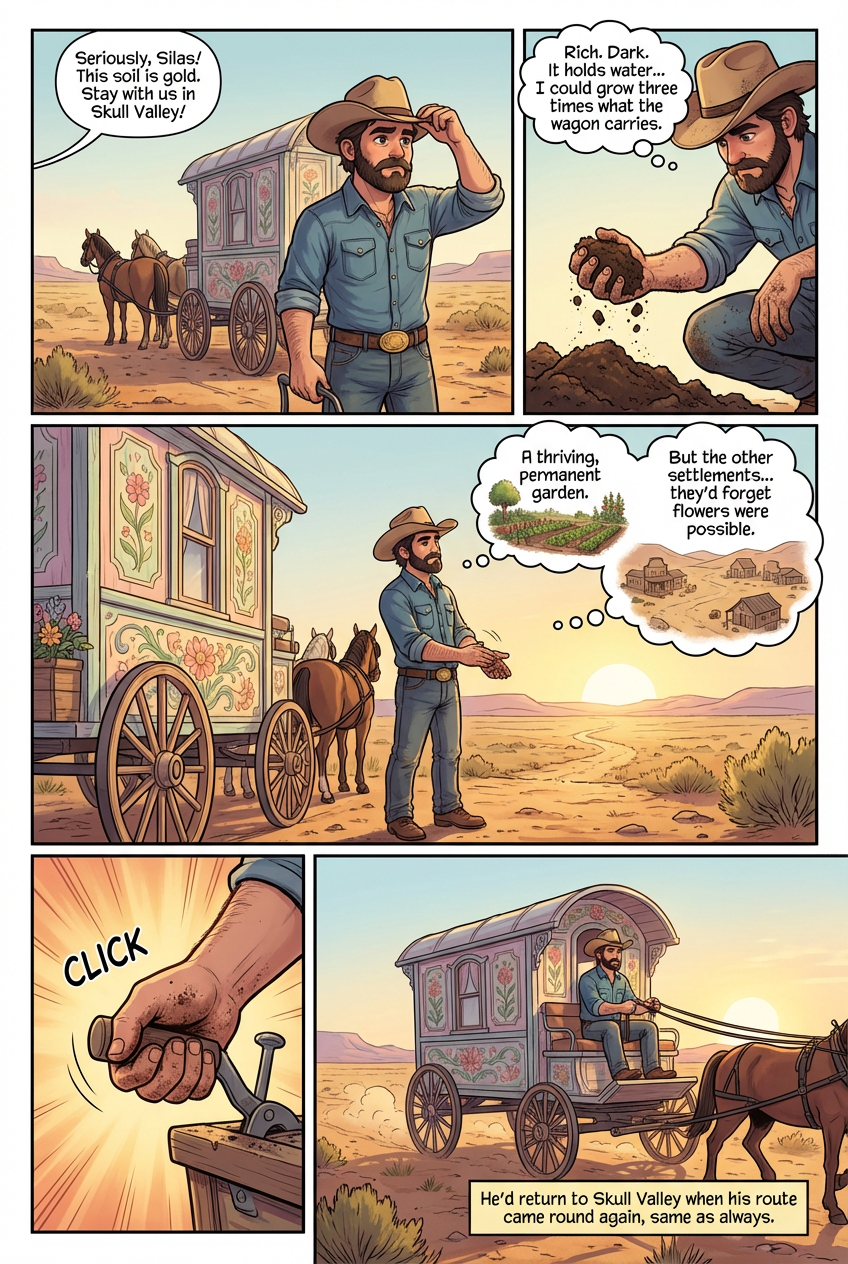
Silas set the wagon brake and studied the stretch of land before him. The ranch hands at Skull Valley had been talking about soil for twenty minutes now, pointing at ground they said would grow anything. They wanted him to stay. Permanent. No more moving settlement to settlement with his flower wagon. He walked the perimeter they'd marked out, crouching to test the dirt between his fingers. Rich. Dark. The kind of earth that held water without drowning roots. Behind him stood his wagon, painted that particular shade his wife had loved, the floral carvings on the panels catching afternoon light. The hands were right about the soil. He could grow twice what the wagon carried, maybe three times. But the settlements beyond Skull Valley would go another year without fresh blooms, and the year after that they'd forget flowers were possible at all. He stood, brushed his hands clean, and walked back to the wagon. The brake released with a familiar click. He'd return to Skull Valley when his route came round again, same as always.
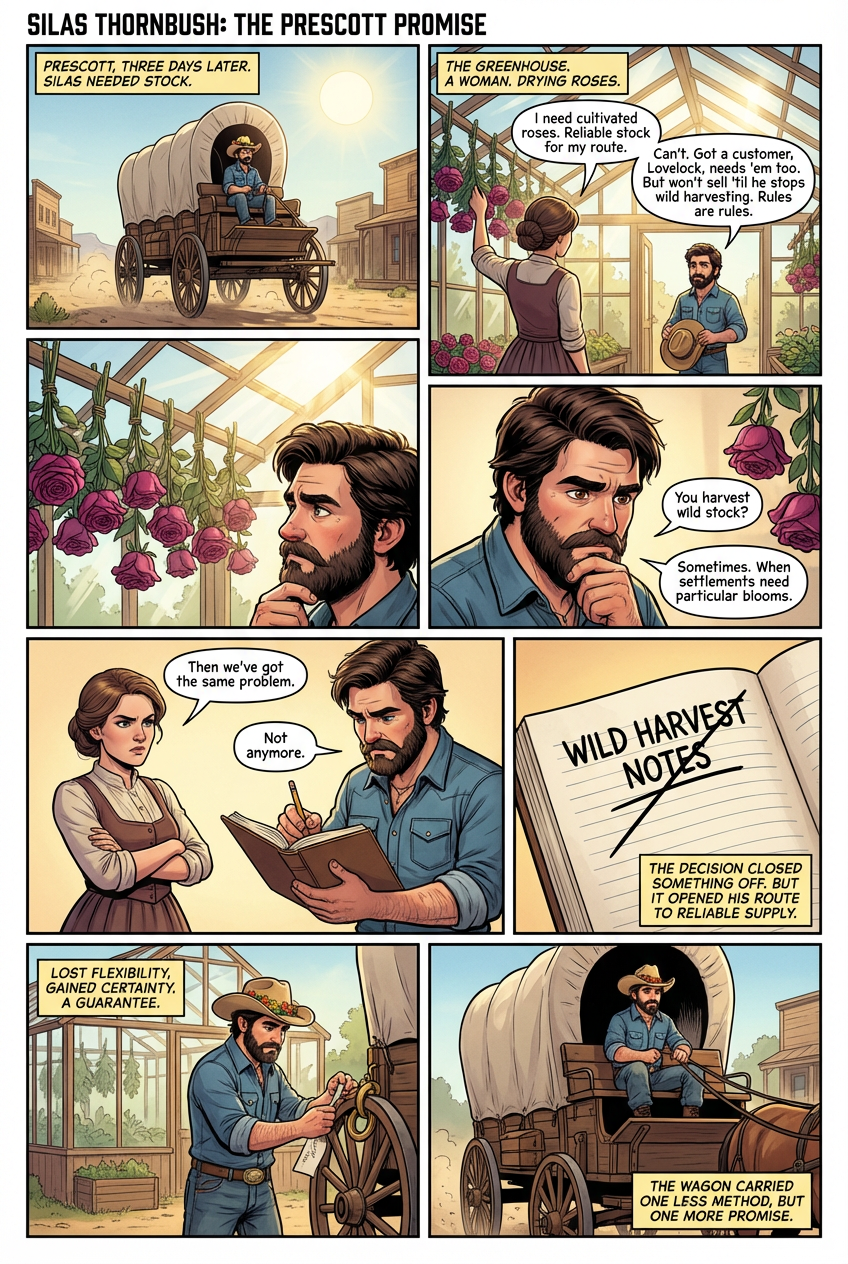
The wagon rolled into Prescott three days later. Silas had spent the miles thinking about Skull Valley's soil and what it could grow if someone stayed put. But staying wasn't the question now. He needed stock. The greenhouse sat at the edge of town, glass panels catching the morning sun. Inside, a woman was hanging roses upside down from a wooden rack, the blooms suspended in neat rows by their stems. Deep pink petals, some fresh, some half-dried. Silas explained what he needed—cultivated roses, reliable stock for his route. The woman listened, then shook her head. She had a customer named Lovelock who needed the same roses, she said, but wouldn't sell to her until Lovelock stopped taking plants from the wild. Rules were rules. She looked at Silas. "You harvest wild stock?" He did sometimes, when a settlement needed particular blooms. She crossed her arms. "Then we've got the same problem." Silas stood there, looking at those roses drying on the rack, knowing his route needed them and knowing what it would cost. He opened his ledger, found page forty-three, and drew a line through the wild harvest notes. "Not anymore," he said. The woman studied him, then nodded and began writing up his order. The decision closed something off—wild blooms had filled gaps when cultivated stock ran short. But it opened his route to reliable supply, the kind that didn't depend on weather or luck. He'd have to plan different now, think harder about what each settlement could sustain. The woman handed him the order slip. His wagon would carry only what could be grown again. Outside, Silas tied the slip to his wagon at the hitching post, the brass ring warm from the sun. He'd lost flexibility but gained certainty. The settlements on his route would get flowers he could promise, not flowers he had to hope for. He climbed up to the bench and released the brake. The wagon started forward, carrying one less method but one more guarantee.
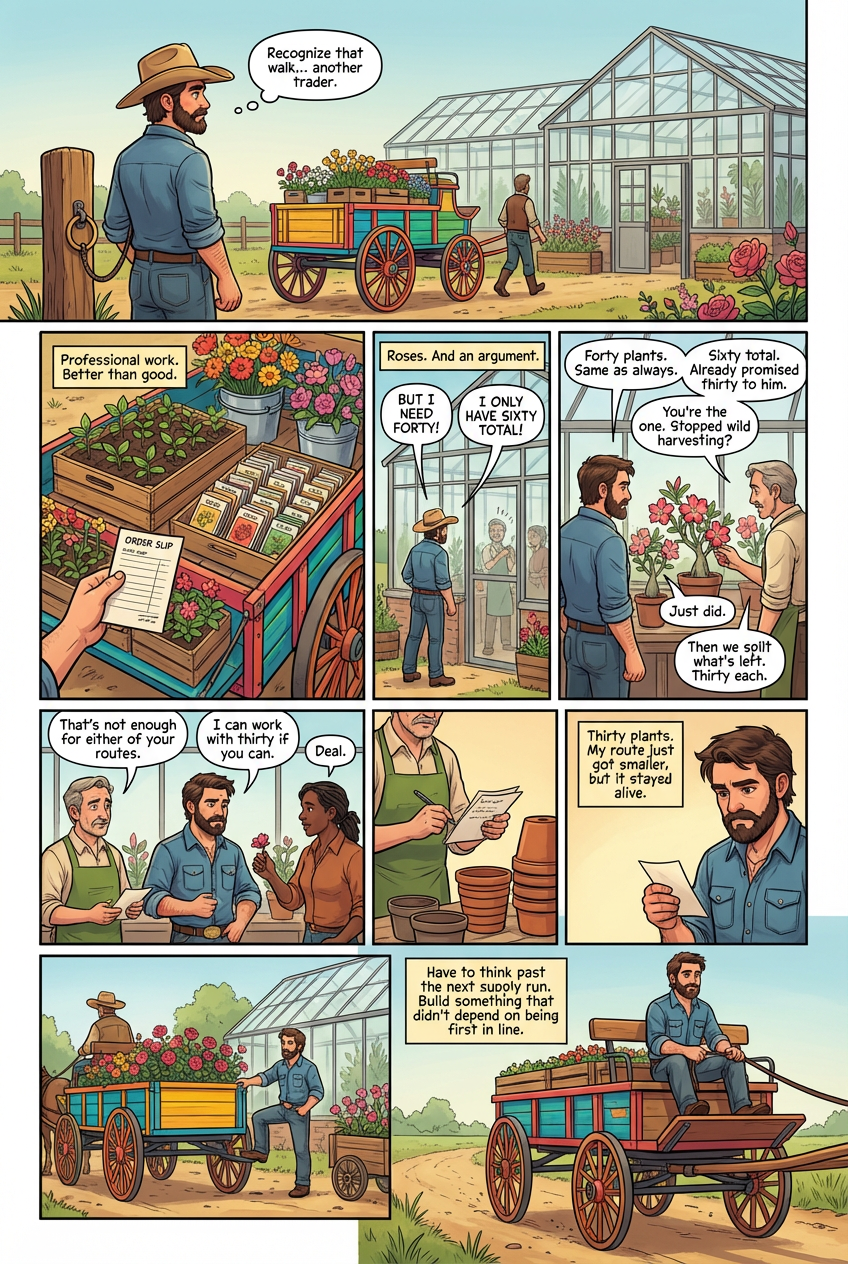
Silas was still at the hitching post when the other wagon pulled up. The driver climbed down and headed straight for the greenhouse, moving like someone who knew exactly what they wanted. Silas recognized the walk—someone on a supply run, same as him. The wagon sat there, bright and loaded. Flowers spilled over the sides, cut blooms packed in water, young plants stacked in crates. The setup was good—better than good. Whoever ran it knew the trade. Silas walked closer, noticed the seed packets organized by type, the way everything had a place. Professional work. Inside the greenhouse, voices rose. The owner was explaining something, her tone firm. Then a second voice—frustrated, insistent. Silas caught the word "roses" through the glass. He looked back at the order slip tied to his own wagon. The greenhouse owner had enough stock for one buyer, maybe. Not two. The voices kept going, back and forth, and Silas understood what was happening. This wasn't just another trader passing through. This was someone who needed the same flowers he'd just secured, someone whose wagon showed they weren't going away. He'd committed to cultivated stock, closed off wild harvesting to get reliable supply. But reliable didn't mean exclusive. The settlements on his route depended on him, and now he had competition for the only source that mattered. Silas untied his order slip and went back inside. If there wasn't enough stock for both of them, he needed to know now—and he needed to figure out how to keep his route supplied when someone else wanted the same thing. Inside, the greenhouse owner was showing Lovelock the display near the back wall—desert roses tucked into the bands of western hats, the petals deep pink against cream felt. Lovelock touched one of the blooms, testing the texture. "I need forty plants," Lovelock said. "Same as always." The owner shook her head. "I've got sixty total. Already promised thirty to him." She nodded at Silas. Lovelock turned, looked him over. "You're the one she mentioned. Stopped harvesting wild stock?" Silas nodded. "Just did." Lovelock studied him a moment, then looked back at the owner. "Then we split what's left. Thirty each." The owner hesitated. "That's not enough for either of your routes." Silas did the math. Thirty plants wouldn't cover half his settlements. But neither would zero. He met Lovelock's eyes. "I can work with thirty if you can." Lovelock nodded once. "Deal." The owner wrote up two slips, dividing the stock down the middle. Silas took his, knowing it meant choosing which settlements got flowers this month and which ones didn't. His route just got smaller, but it stayed alive. Outside, Lovelock loaded the roses into the bright wagon and pulled away. Silas climbed onto his bench and released the brake. Thirty plants instead of sixty. Not what he'd planned, but enough to start solving the problem. He'd have to build relationships with other greenhouses, find new suppliers, maybe even convince some settlements to grow their own stock from his plants. Competition meant he couldn't just buy and deliver anymore. The system he'd relied on wasn't enough. He'd have to think past the next supply run, build something that didn't depend on being first in line.
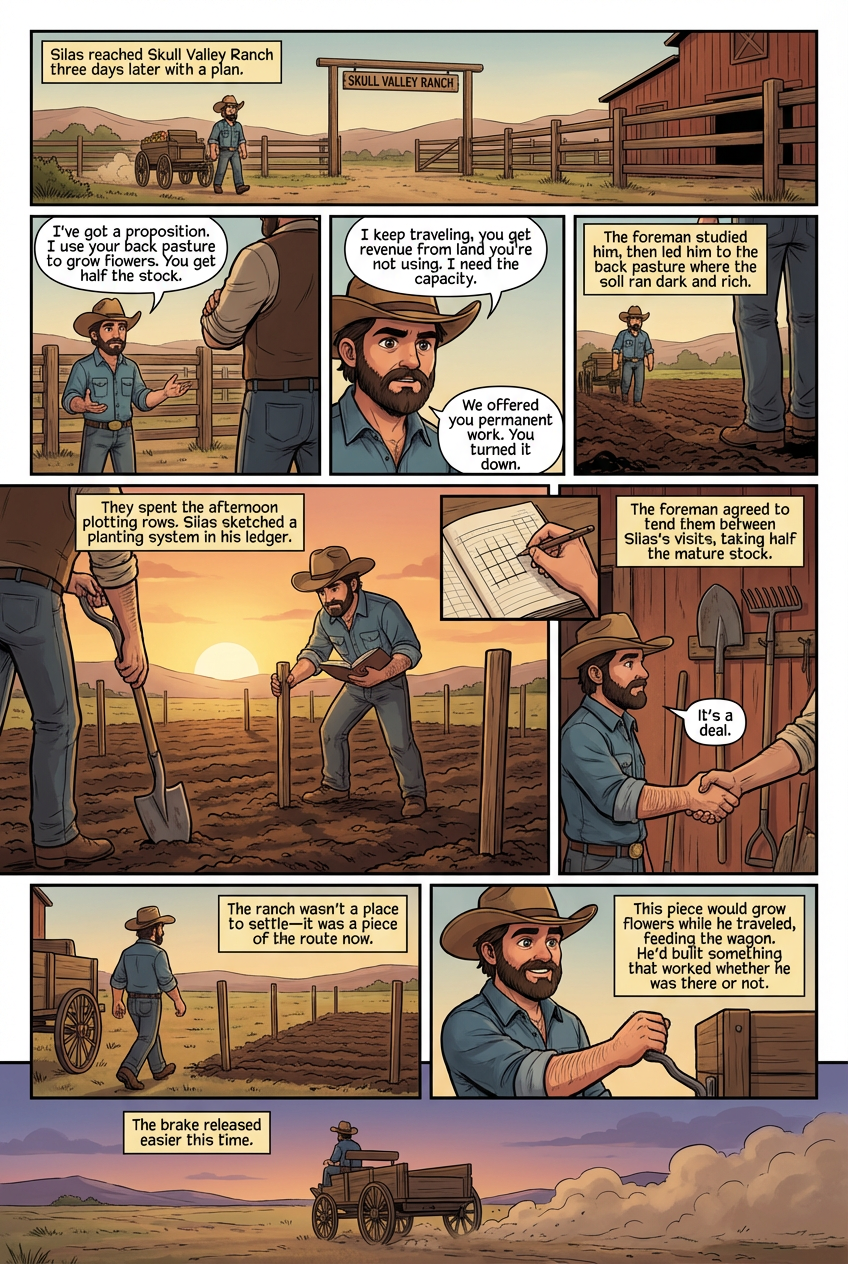
Silas reached Skull Valley Ranch three days later with a plan that wouldn't work on the road. He needed more plants than one greenhouse could provide, and the ranch hands had shown him soil that could triple his output. He found the foreman near the corral and laid it out plain: he'd establish a growing operation here, using their land in exchange for a share of the stock. The foreman crossed his arms. "We offered you permanent work last time. You turned it down." Silas nodded. "I did. But this is different. I keep traveling, you get half the flowers I grow here. I need the capacity. You get revenue from land you're not using." The foreman studied him, then walked to the back pasture where the soil ran dark and rich. They spent the afternoon plotting out rows, marking where the water would run. Silas sketched the layout in his ledger—a planting system that would use the ranch's soil to grow enough stock for his entire route. The foreman brought tools from the rack by the barn, the handles worn smooth from years of use. They set the first stakes before sundown. By the time they finished, Silas had a plot sixty feet long, space enough for two hundred plants. The foreman agreed to tend them between Silas's visits, taking half the mature stock as payment. Silas would haul the rest to settlements that couldn't grow their own. He loaded the tools back onto the rack and shook the foreman's hand. The ranch wasn't a place to settle—it was a piece of the route now, same as any stop. But this piece would grow flowers while he traveled, feeding the wagon instead of draining it. He'd built something that worked whether he was there or not. The brake released easier this time.
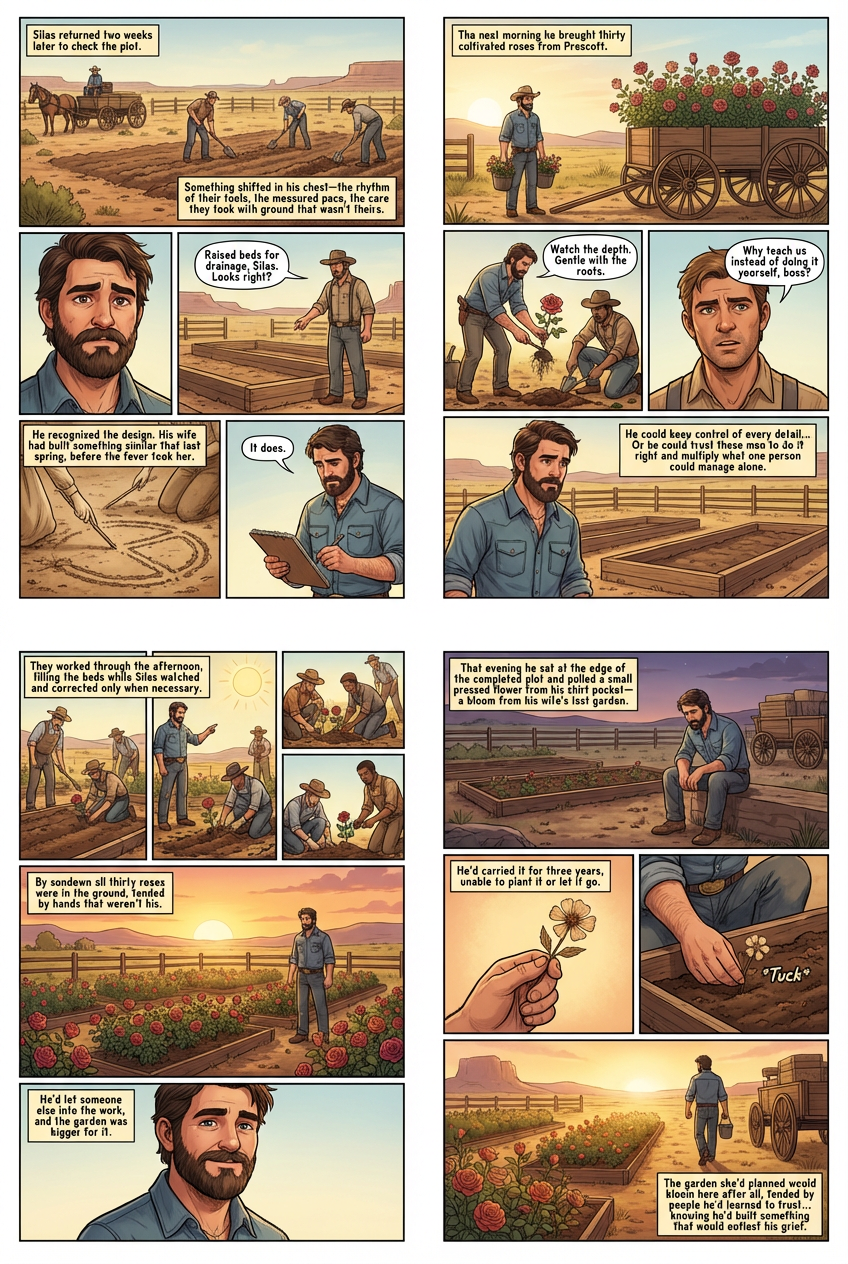
Silas returned two weeks later to check the plot. The ranch hands had already started turning the soil, breaking up the hardpan in long straight rows. He stood at the edge watching them work, and something shifted in his chest—the rhythm of their tools, the measured pace, the care they took with ground that wasn't theirs. The foreman walked up beside him and pointed to the corner posts they'd set. Low wooden borders ran between them, marking out raised beds where the drainage would be best. Silas recognized the design—his wife had built something similar that last spring, before the fever took her. She'd planned the whole layout, drawn it in the dirt with a stick, but never got to see the seedlings break through. He'd abandoned the plot after she died, couldn't bear to tend it alone. Now he watched strangers prepare ground the same way she had, and for the first time it didn't feel like losing her twice. It felt like the work continuing. He pulled his ledger out and sketched the bed layout, noting the post spacing and soil depth. The foreman asked if it looked right. Silas said it did, and meant it. The next morning he brought thirty cultivated roses from Prescott and showed the ranch hands how to plant them. He demonstrated the depth, the spacing, how to check the roots before setting them in. One of the hands asked why he was teaching them instead of doing it himself. Silas closed his ledger and looked at the empty beds waiting to be filled. He could plant them all himself and keep control of every detail, the way he'd done everything since his wife died. Or he could trust these men to do it right and multiply what one person could manage alone. He handed the first plant to the ranch hand and stepped back. They worked through the afternoon, filling the beds while Silas watched and corrected only when necessary. By sundown all thirty roses were in the ground, tended by hands that weren't his. He'd let someone else into the work, and the garden was bigger for it. That evening he sat at the edge of the completed plot and pulled a small pressed flower from his shirt pocket—a bloom from his wife's last garden, the only thing that had survived before the whole plot withered. He'd carried it for three years, wrapped in cloth, unable to plant it or let it go. Now he tucked it into the corner of the first raised bed, beneath the soil where the roots would grow around it. The charm disappeared into the dark earth. When he stood, his pocket felt lighter. The garden she'd planned would bloom here after all, tended by people he'd learned to trust, feeding settlements she'd never seen. He walked back to his wagon knowing he'd built something that would outlast his grief.
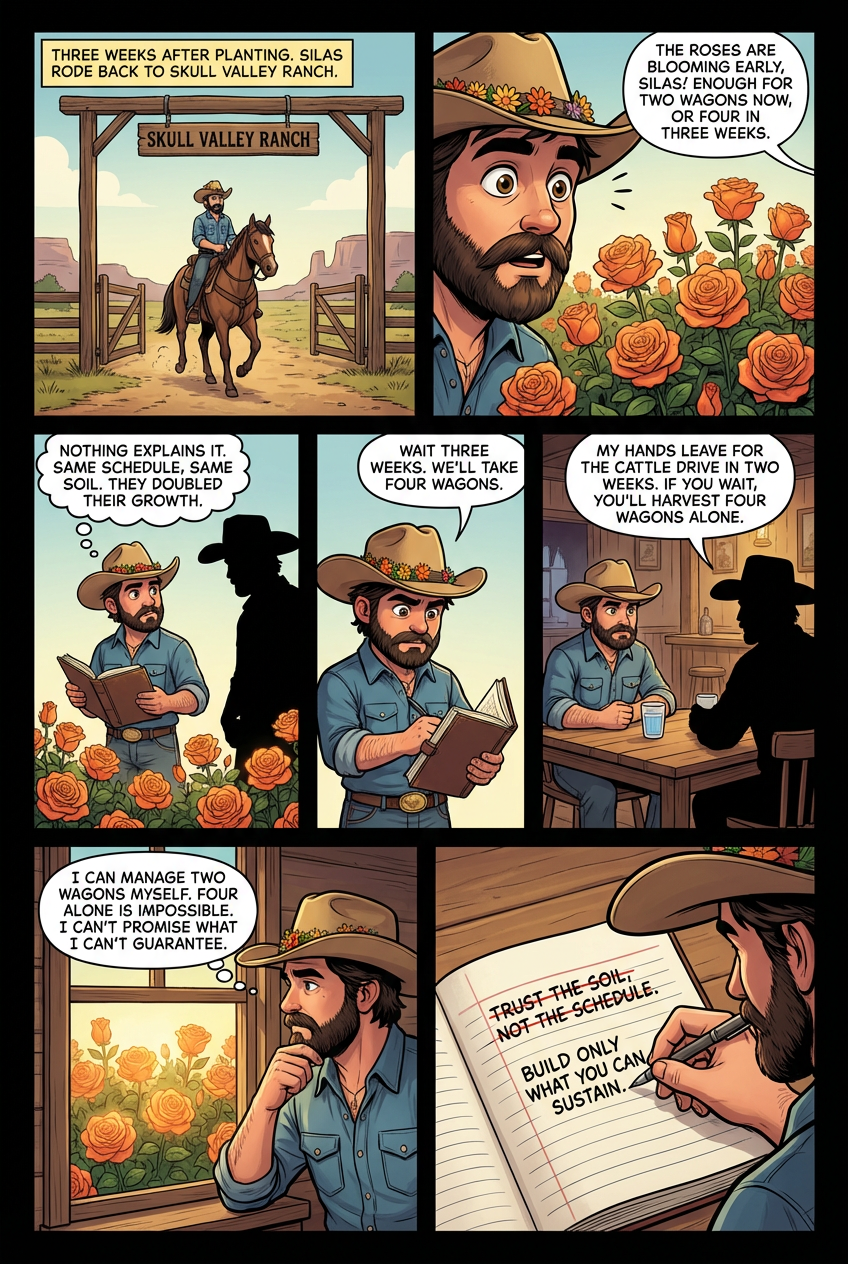
Three weeks after planting, Silas rode back to Skull Valley Ranch expecting to check on seedlings. The foreman met him at the gate with news that changed the timeline entirely. The roses were blooming early—enough to fill two wagons now or four in three weeks. Silas walked to the plot and found it transformed. Orange blooms stood open across the beds, petals spread wide and catching light like they'd been growing for months instead of weeks. The foreman said they'd followed his instructions exactly—same water schedule, same soil mix—but the plants had doubled their expected growth rate. Silas pulled his ledger and flipped to the planting notes, checking elevation and rainfall data against what he knew about desert rose cycles. Nothing explained it. He asked about amendments or changes to the routine. The foreman shook his head. They'd done exactly what Silas taught them, nothing more. Silas closed the ledger and looked at the rows of blooms again. He could harvest now and fill two wagons, taking what was ready and keeping his route on schedule. Or he could wait three weeks and double the supply, giving every settlement on his circuit more than they'd seen in years. The foreman asked what he wanted to do. Silas said to wait. He'd built this garden to outlast his own limits—if the ground could produce four wagons' worth, then four wagons' worth of beauty would reach the towns that needed it. He marked the date in his ledger and added a note: trust the soil, not the schedule. But the foreman stepped forward and pointed to the saloon at the far end of the ranch grounds. He said they needed to talk inside. Silas followed him through the wooden doors, past climbing roses that covered the entire front wall in pink blooms. The foreman poured two glasses of water and sat down heavy at a corner table. He explained that seventeen ranch hands were scheduled to drive cattle to market in two weeks—the annual run that paid for winter supplies and next year's seed. If Silas wanted four wagons of flowers in three weeks, there'd be no one left to help him harvest or haul them. The hands could cut and load two wagons today before they left, or Silas could wait and handle four wagons alone. The foreman didn't say which he recommended. He just looked at Silas and waited. Silas sat silent, turning his water glass in slow circles on the table. He'd spent three years working alone, controlling every detail so nothing could go wrong the way it had when his wife died. He'd built this garden to multiply what one person could do—but only by trusting others to tend it. Now he had to choose between the schedule he could manage himself or the harvest that depended on people who wouldn't be there. He looked out the window at the orange blooms glowing in the afternoon sun. Then he told the foreman to have the hands cut today. Two wagons delivered on time meant settlements could count on him. Four wagons he couldn't move meant nothing. He'd learned to trust the work continuing without him—but he hadn't yet learned to ask for help he couldn't guarantee. The foreman nodded and stood. Silas wrote the decision in his ledger, then crossed out the note about trusting the soil. He wrote a new one: build only what you can sustain.
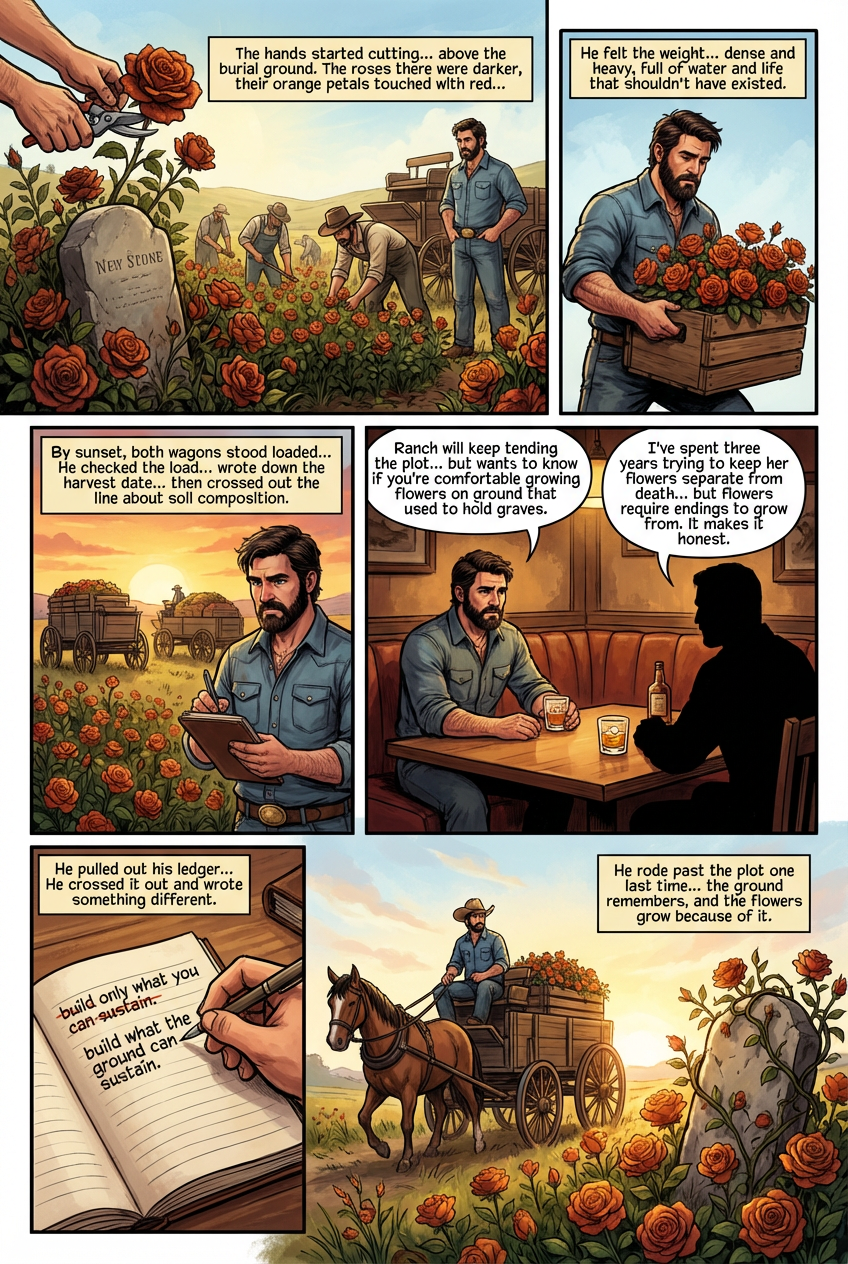
The hands started cutting at the northwest corner where the stone lay half-buried in wild roses. Silas stood beside the first wagon and watched them work their way through the beds in rows, clipping stems and laying blooms in crates lined with wet canvas. The foreman had told them to start where the growth was thickest—right above the burial ground. The roses there were darker than the others, their orange petals touched with red at the edges like they'd pulled color from something deeper than soil. Silas loaded the first crate himself and felt the weight of it. These weren't fragile blooms that needed careful handling. They were dense and heavy, full of water and life that shouldn't have existed three weeks after planting. He set the crate in the wagon bed and stepped back. The flowers would reach the settlements on his route because the ground beneath them remembered how to turn endings into growth. He didn't need to understand it. He just needed to deliver what it produced. By sunset, both wagons stood loaded and ready. The hands had filled every crate, packed tight enough to travel but loose enough to let the blooms breathe. Silas walked the length of the first wagon, checking the load and making notes in his ledger about stem thickness and petal condition. He wrote down the harvest date and the yield—two hundred plants producing enough blooms to fill both wagons with room to spare. Then he added a line about the soil composition and crossed it out. The science didn't matter here. The ground fed the flowers because it had been feeding on loss for fifty years, and no amount of data would change that. He closed the ledger and looked back at the plot. Half the beds still held blooms that would be ready in another week, but there'd be no one here to cut them. The foreman said the hands would be gone by morning, headed north with the cattle. Silas asked what would happen to the flowers that stayed behind. The foreman shrugged and said they'd go to seed or the wind would take them. Silas nodded. He'd built this garden to outlast his control, and now it would. Inside the steakhouse, the foreman poured two glasses of whiskey and sat across from Silas at a corner table. He said the ranch would keep tending the plot after the hands returned from the cattle drive—watering and weeding between Silas's visits like they'd agreed. But he wanted to know if Silas was comfortable growing flowers on ground that used to hold graves. Silas took a slow drink and set the glass down. He said his wife had died three years ago and he'd spent all that time trying to keep her flowers separate from death, like beauty could exist outside of loss. But the truth was that every garden grew from what came before it. The pressed flower he'd buried in the corner wasn't any different from the bodies beneath the stone—they were all feeding the same soil, turning memory into something that could bloom again. The foreman asked if that made it easier or harder. Silas said it made it honest. He'd been carrying his wife's garden like it was something fragile that could break if he let go. But flowers didn't work that way. They required endings to grow from. The foreman nodded and finished his drink. He said the plot would be waiting when Silas came back through. Silas said he'd be back in six weeks with new stock to plant in the empty beds. Silas left at dawn with both wagons full and the horses pulling steady under the weight. He rode past the plot one last time and saw the remaining blooms standing thick in the morning light, orange petals glowing against the desert ground. The stone at the northwest corner was barely visible beneath the wild roses that had grown up around it, pink blooms twisting through the carved letters like they were trying to spell something new. He didn't stop to read it again. He already knew what it said—the ground remembers, and the flowers grow because of it, not in spite of it. He pulled out his ledger and flipped to the page where he'd written his revised plan: build only what you can sustain. He crossed it out and wrote something different: build what the ground can
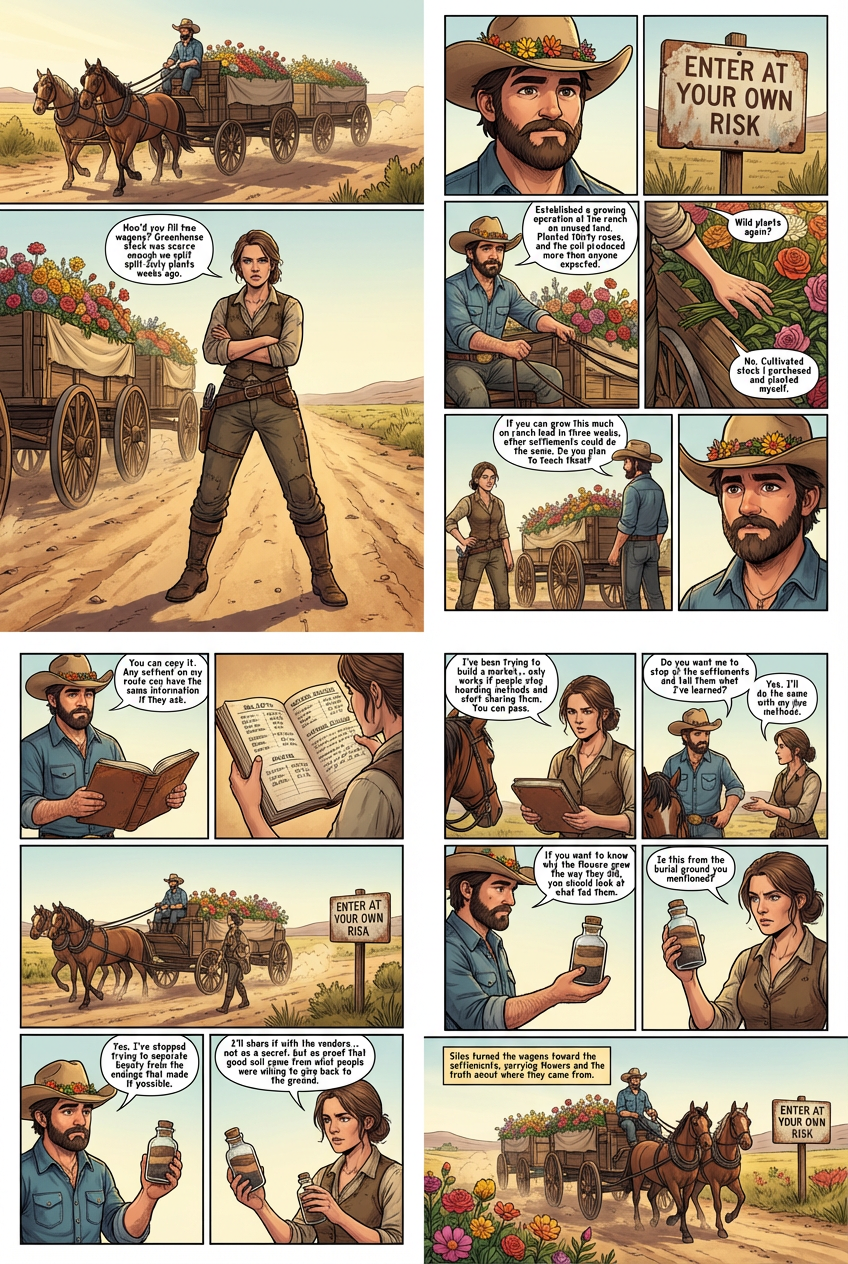
Silas pulled the wagons through Skull Valley Ranch territory with both loads still fresh from the morning harvest. The horses moved steady despite the weight—two hundred plants worth of blooms packed tight in crates lined with wet canvas. He rounded the bend where the old route split toward Prescott and found Lovelock standing beside a rusted sign that read ENTER AT YOUR OWN RISK. She'd positioned herself directly in the center of the road with her arms crossed, blocking both wagons. She looked at the blooms spilling over the crate edges and asked how he'd filled two wagons when greenhouse stock was scarce enough that they'd had to split sixty plants between them just weeks ago. Silas pulled the brake and told her the truth—he'd established a growing operation at the ranch on unused land, planted thirty roses, and the soil produced more than anyone expected. Lovelock walked to the first wagon and ran her hand along the stems, checking their thickness. She asked if he was harvesting wild plants again. Silas said no, these came from cultivated stock he'd purchased from the greenhouse and planted himself. Lovelock stepped back and studied the second wagon, then looked at him. She said if he could grow this much on ranch land in three weeks, other settlements could do the same, and asked if he planned to teach them. Silas hadn't thought past delivering what he'd grown, but the question sat heavy between them like a choice he couldn't avoid. He opened his ledger and showed her the planting data—soil depth, spacing, watering schedule—everything the ranch hands had used to produce the harvest. He said she could copy it if she wanted, and any settlement on his route could have the same information if they asked. Lovelock took the ledger and read through page forty-three, then the new notes he'd added about the ranch plot. She handed it back and said she'd been trying to build a market at Skull Valley to bring vendors together, but it only worked if people stopped hoarding methods and started sharing them. She moved off the road and told him he could pass. Silas released the brake, but before the horses pulled forward he asked if she wanted him to stop at the settlements and tell them what he'd learned. Lovelock said yes, and that she'd do the same with her dye methods. Silas drove both wagons past the rusted sign, knowing he'd just shifted from delivering flowers to delivering the knowledge that would let others grow their own. He reached into his coat pocket and pulled out a small glass bottle, stoppered with cork. Inside, the soil from the ranch plot sat in layers—dark earth at the bottom where the stone lay buried, lighter sand mixed through the middle, clay near the top. He'd filled it that morning before the hands started cutting, thinking he might need proof of what the ground could do. He turned the wagon around and rode back to where Lovelock still stood by the sign. He handed her the bottle and said if she wanted to know why the flowers grew the way they did, she should look at what fed them. Lovelock held the bottle up to the light and studied the layers. She asked if this was from the burial ground he'd mentioned. Silas said yes, and that he'd stopped trying to separate beauty from the endings that made it possible. She pocketed the bottle and said she'd share it with the vendors at her market—not as a secret to keep, but as proof that good soil came from what people were willing to give back to the ground. Silas nodded and turned the wagons toward the settlements, carrying flowers and the truth about where they came from.
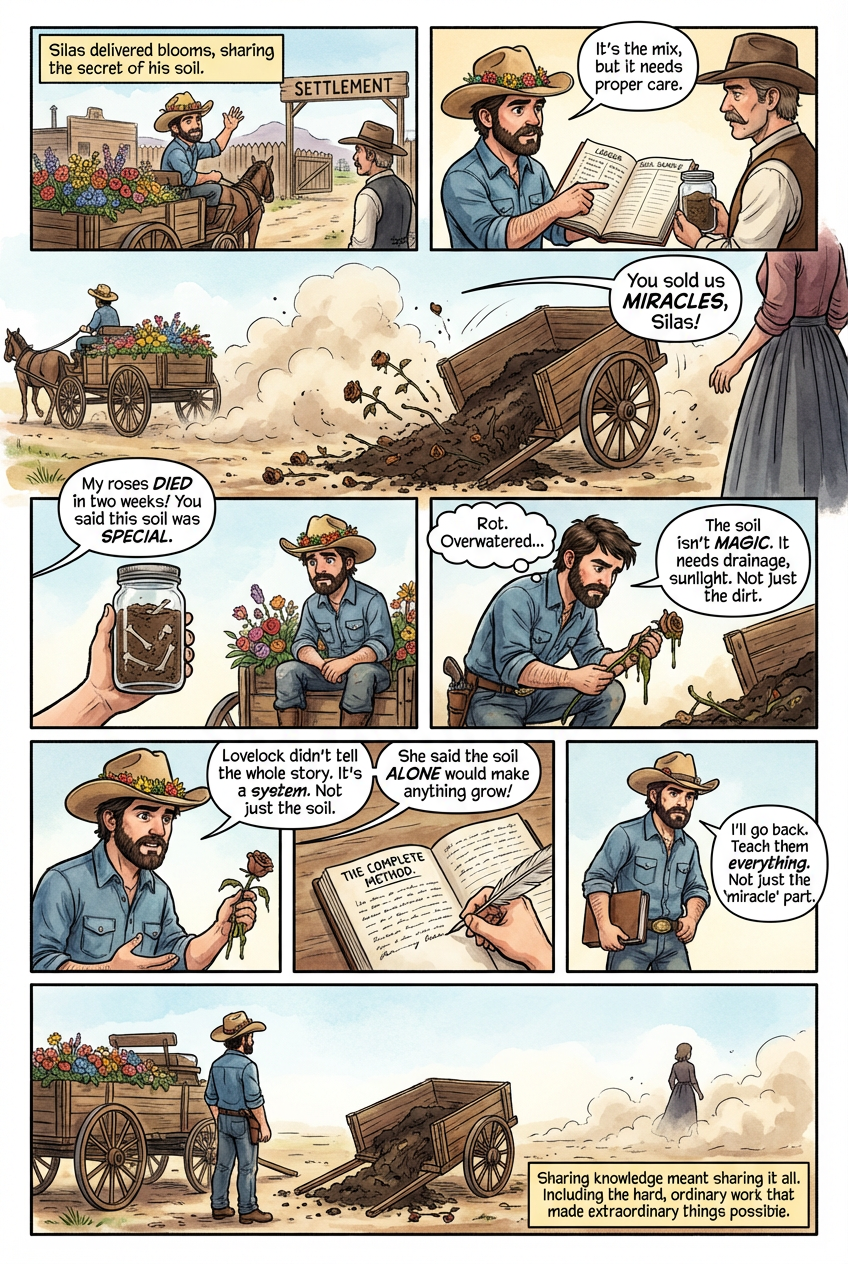
Silas made three stops before Darline found him. He'd delivered blooms to two settlements and shared the planting data with anyone who asked, showing them the soil sample and explaining what made it work. By the third settlement he'd started writing notes in the margins of his ledger about which foremen wanted cuttings and which ones had land ready to plant. Darline arrived with a wooden cart tipped on its side, soil spilling across the ground in front of his wagon. She dragged it there herself, leaving a dark trail in the dirt. Inside the cart sat three dead rose stems and a glass jar filled with bones and soil—his soil, the sample he'd given Lovelock. She lifted the jar and shook it at him. The cuttings had rotted at the base despite being planted in the burial ground mix, their leaves brown and their stems collapsed. She said he'd been selling miracles he couldn't replicate, that she'd followed his exact planting method and the roses died in two weeks. She asked if he'd forgotten to mention that his flowers only grew where the dead were buried fresh, not in soil someone else collected and carried away. Silas climbed down from the wagon and crouched beside the cart. He examined the stems and saw they'd been overwatered—the rot started where the soil stayed wet too long, not where it lacked the right minerals. He told her the soil sample wasn't magic, just proof of what fed the flowers at the ranch. The method still required proper drainage, spacing, sunlight. She said that wasn't what Lovelock told people when she shared the jar, that everyone thought the soil alone would make anything grow. Silas realized he'd given them the truth about the ground but not the full system that made it work. He opened his ledger and added a new page—not about what the soil contained, but about what it couldn't do without the rest. He told Darline he'd visit every settlement that received a sample and teach them the complete method, not just the part that sounded like a miracle. She left the cart where it sat and walked away, and Silas understood that sharing knowledge meant sharing all of it, including the ordinary work that made extraordinary things possible.
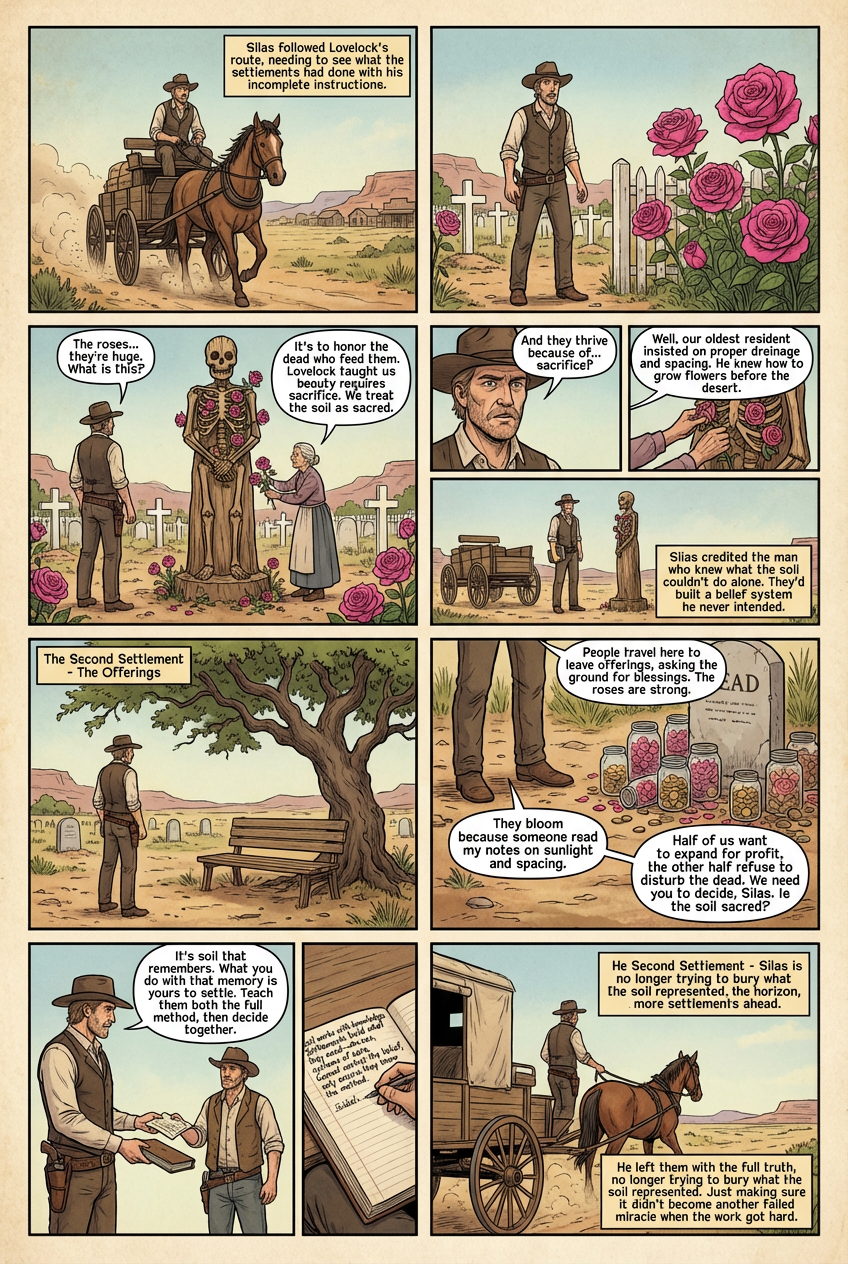
Silas followed the route Lovelock had taken—the same settlements where she'd shared the soil sample, the same foremen who'd received jars of burial ground dirt and believed it would solve everything. He needed to see what they'd done with his incomplete instructions. The first cemetery sat two days west, marked by whitewashed crosses and a wooden sign that read the settlement's name. Someone had planted roses along the fence line using his soil sample. The stems stood tall and thick, their blooms twice the size of anything he'd grown at the ranch, but the locals had built something more—a statue at the cemetery's center, carved from bleached wood and decorated with fresh pink roses woven through its ribs. An older woman stood beside it, replacing wilted blooms with new ones. She told Silas the statue honored the dead who fed the flowers, that the settlement treated the burial ground soil like sacred earth now. She said Lovelock had taught them that beauty required sacrifice, and they'd taken it to heart. Silas asked if the roses were thriving. She said they were, but only because the settlement's oldest resident had insisted on proper drainage and spacing—he'd grown flowers before the desert claimed most of the land. She credited the soil. Silas credited the man who knew what the soil couldn't do alone. The second settlement had built a bench beneath an old mesquite tree overlooking their family graveyard, where settlers left glass jars filled with petals and coins at the base of a headstone. A ranch hand met Silas at the cemetery gate and said people traveled from neighboring settlements to leave offerings there, asking the ground for blessings. The roses bloomed strong because the family's grandmother had read Silas's original ledger notes about sunlight and spacing, not because anyone prayed over the soil. The ranch hand said half the settlement wanted to expand the cemetery to grow more roses, while the other half refused to disturb the dead for profit. They'd asked him to decide. Silas looked at the bench, at the offerings piled around it, and understood he'd given them soil and science but they'd built belief systems he never intended. He told the ranch hand to teach both groups the full planting method and let them decide together what the ground should grow. The ranch hand asked if the soil was sacred. Silas said it was just soil that remembered, and what people did with that memory was theirs to settle. Silas opened his ledger and wrote down what he'd learned: the soil worked when paired with knowledge, and settlements would build what they needed around it—shrines, statues, systems of care. He couldn't control whether people called it sacred or scientific, but he could make sure they knew the full method. He left both settlements with revised planting instructions and notes about what made their roses thrive, understanding that his role wasn't to dictate how settlements honored the flowers, only to ensure they could grow them. The route ahead held more settlements, more experiments, more ways people had adapted his incomplete truth. He released the wagon brake, no longer trying to bury what the soil represented, only making sure it didn't become another miracle that failed when the work got hard.
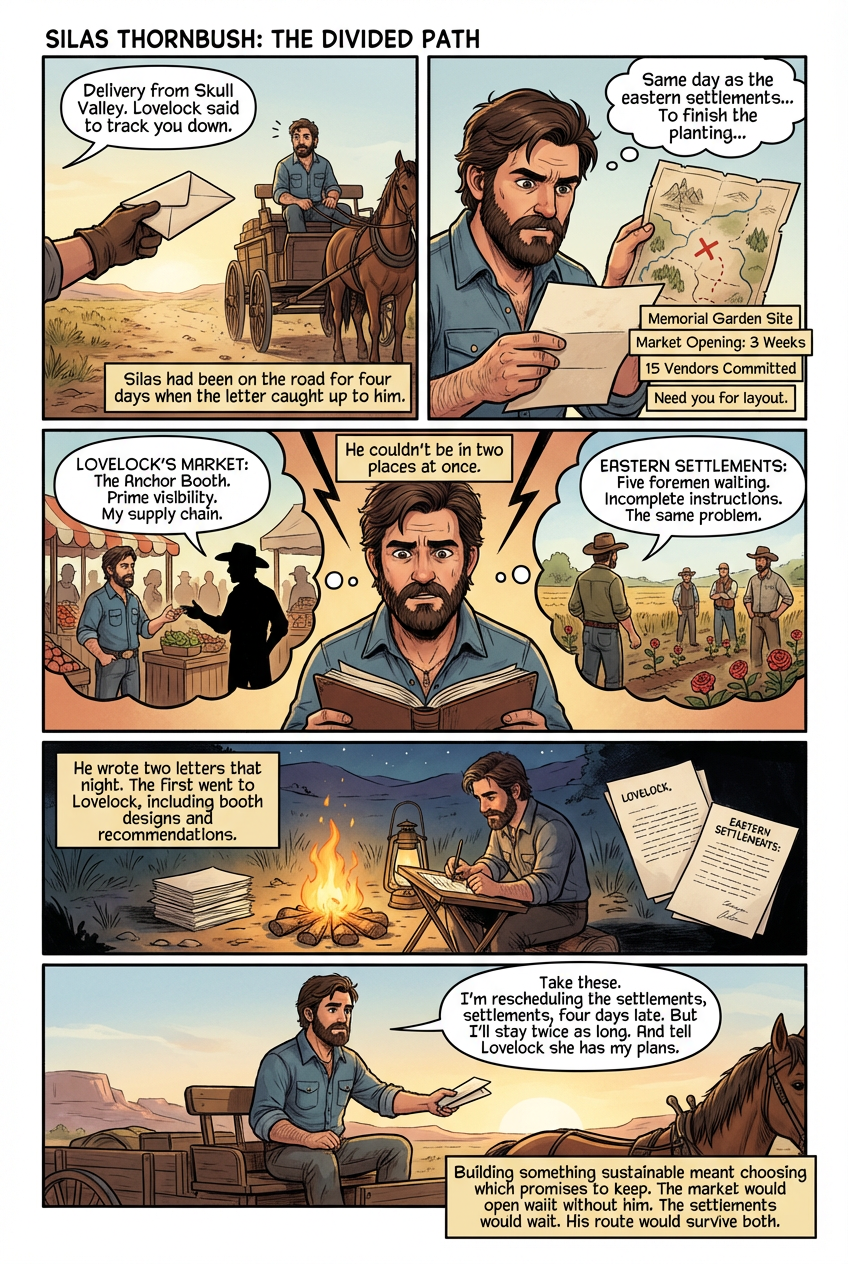
Silas had been on the road for four days when the letter caught up to him. A ranch hand rode out from Skull Valley with it, said Lovelock had left it at the foreman's station with instructions to track him down. Silas opened the envelope and read the single page inside. The letter included a hand-drawn map with a red X marking the old memorial garden site—the same location where the previous market had collapsed three years ago. Lovelock had written that her parking passed inspection, fifteen vendors had committed, and she'd set the opening date for three weeks from now. She needed him there to help stage the layout, walk the vendor booths, and make sure the anchor position he'd negotiated actually worked. The date she'd chosen was the same day he was scheduled to arrive at the eastern settlements to finish teaching the full planting method. Silas pulled his ledger and checked his route schedule. If he skipped the eastern settlements, five foremen would be left waiting with half-planted roses and incomplete instructions—the same problem that had created shrines and failed gardens in the first place. If he skipped Lovelock's opening, he'd lose the anchor booth that gave him prime visibility across the entire territory, the one advantage that made his traveling route sustainable long-term. He couldn't split the difference or arrive late to either. One choice meant abandoning settlements that depended on him finishing what he'd started. The other meant walking away from the supply chain he'd spent months building. Both mattered. Both were his word given. He wrote two letters that night. The first went to Lovelock, telling her he couldn't make the opening but his booth design and vendor recommendations were included on the attached papers—she had everything she needed to stage it without him there. The second went to the eastern settlements, telling them he'd arrive four days later than planned but would stay twice as long to make sure every garden was planted right. He sent both letters with the ranch hand at dawn and released his wagon brake, understanding that building something sustainable meant choosing which promises to keep and which to reschedule. The market would open without him. The settlements would wait four extra days. His route would survive both, but only because he'd stopped trying to be everywhere at once.
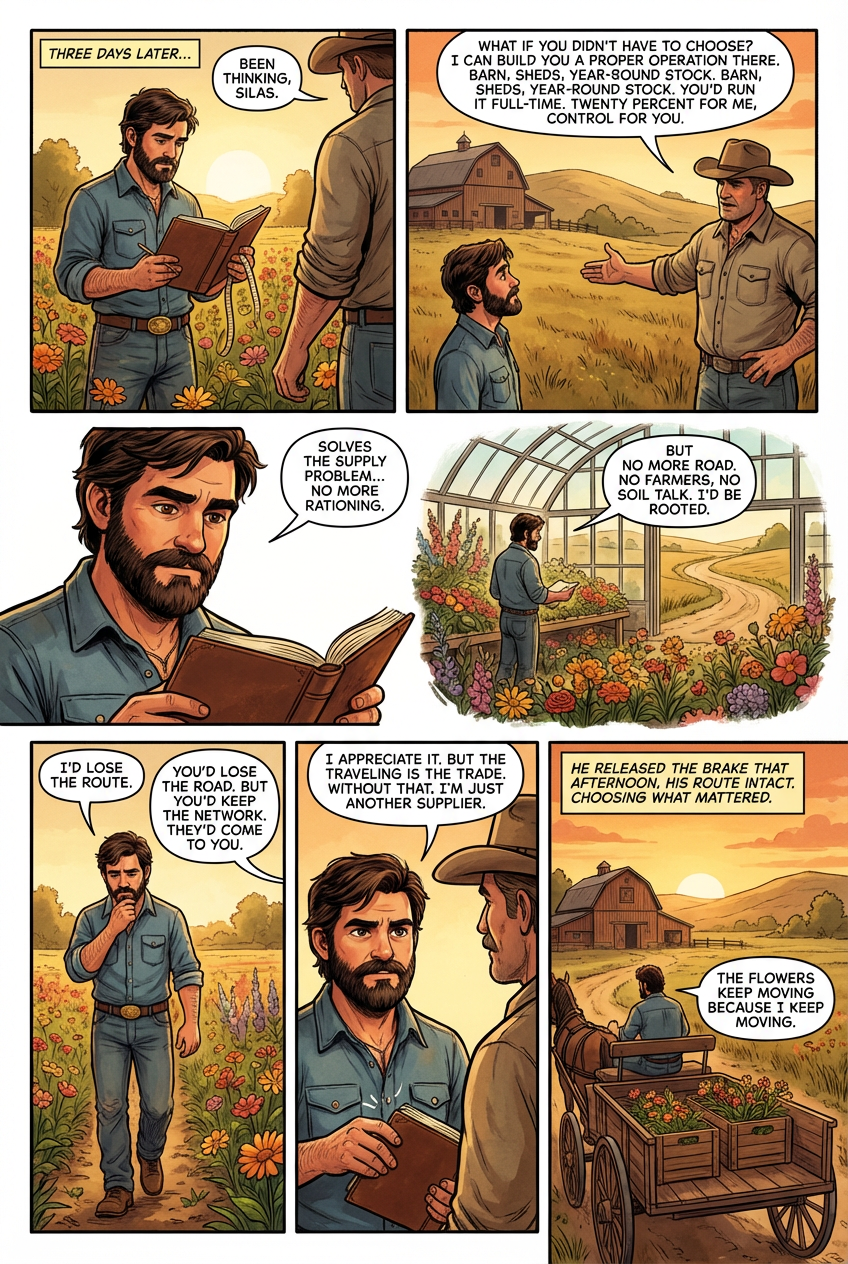
The foreman found Silas three days after the letters went out, walking the perimeter of the ranch's flower plot with his ledger open to a fresh page. He'd been measuring the space between rows, checking how much room remained for expansion. "Been thinking," the foreman said, stopping at the edge of the plot. "You've got settlements waiting on you four months out of the year, and this ground sitting empty the rest. What if you didn't have to choose?" He gestured toward the low hill behind the main barn, where a flat stretch of land sat unused. "I can build you a proper operation here—barn for storage, sheds for propagation, room to grow year-round stock. You'd run it full-time, supply the whole route from one place instead of chasing it wagon by wagon. I'd take twenty percent of what you produce. You'd keep the rest and the control." Silas looked at the land, then back at his ledger. The offer solved the supply problem he'd been fighting since Prescott. It gave him the capacity to serve every settlement on his route without rationing or waiting on greenhouse stock. But it also meant stopping. No more conversations with farmers about soil. No more tracking rainfall patterns across three valleys. No more showing up in person when a garden failed or a planting succeeded. He'd become a grower instead of a trader, rooted instead of traveling. "I'd lose the route," Silas said. The foreman shrugged. "You'd lose the road. But you'd keep the network. They'd come to you, or you'd ship to them. Either way, the flowers still move." Silas closed his ledger and walked the plot one more time, feeling the weight of what staying would mean. He'd built his whole system on being present, on gathering knowledge face-to-face, on showing up when people needed him. A permanent operation would grow more flowers, but it wouldn't grow the relationships that made his route work. "I appreciate it," Silas said. "But the traveling is the trade. Without that, I'm just another supplier." The foreman nodded, unsurprised. "Figured you'd say that. Offer stands if you change your mind." Silas released his wagon brake that afternoon and left the ranch with two crates of cuttings and his route intact. He'd turned down permanence twice now, and each time it felt less like loss and more like choosing what mattered. The flowers would keep moving because he kept moving. That was the work.
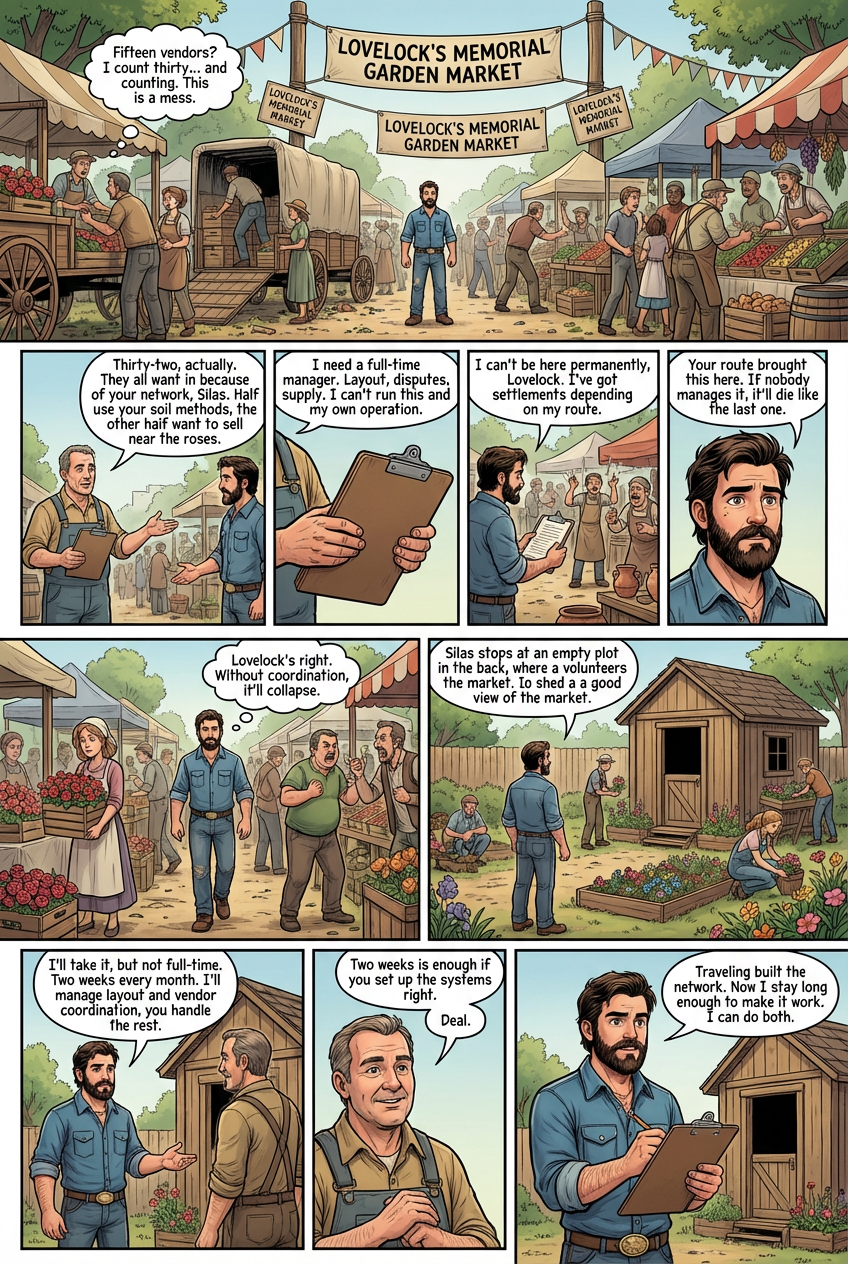
Silas arrived at Lovelock's memorial garden market three weeks after declining the foreman's offer. He'd expected to find fifteen vendors and a layout that needed minor adjustments. Instead, he counted thirty stalls arranged in five rows, with wagons still arriving and vendors arguing over booth assignments. Lovelock met him at the entrance, holding a clipboard thick with papers. "Thirty-two now, actually. Two more confirmed this morning." He gestured toward the chaos. "They all want in because of your network. Half of them are using your soil methods. The other half heard about the roses and want to sell near them." He handed Silas the clipboard. "I need someone here full-time to manage this. Layout, vendor disputes, supply coordination. It's too much for me to run alone while keeping my own operation going." Silas looked at the clipboard, then at the market. Vendors were unpacking without clear assignments. Three people occupied the same corner plot. A pottery seller was setting up in what should have been a walkway. The whole thing would collapse without someone present to organize it. But managing it meant staying put, just like the foreman's offer. "I can't be here permanently," Silas said. "I've got settlements depending on my route." Lovelock shook his head. "Your route brought this here. Thirty vendors selling flowers, pottery, dye, food—all because you connected them. But if nobody manages it, they'll leave and it'll die like the last market did." Silas walked through the rows, watching vendors struggle with setup. A woman with crates of roses had nowhere to unload. Two men were shouting about who had rights to a stall near the entrance. Lovelock was right—without coordination, the whole thing would fall apart. He stopped at an empty plot near the back, where a small storage shed sat surrounded by volunteers planting flowers around its foundation. The shed had good visibility of the entire market. It could work as an office, a place to store records and meet with vendors. He turned to Lovelock. "I'll take it, but not full-time. I'll manage layout and vendor coordination, but I'm keeping my route. I'll be here two weeks every month, and you handle the rest." Lovelock considered it, then nodded. "Two weeks is enough if you set up the systems right. Deal." Silas took the clipboard and started marking corrections on the layout map. He'd built his network by traveling, but now the network needed him to stay still long enough to make it work. He'd found a way to do both.
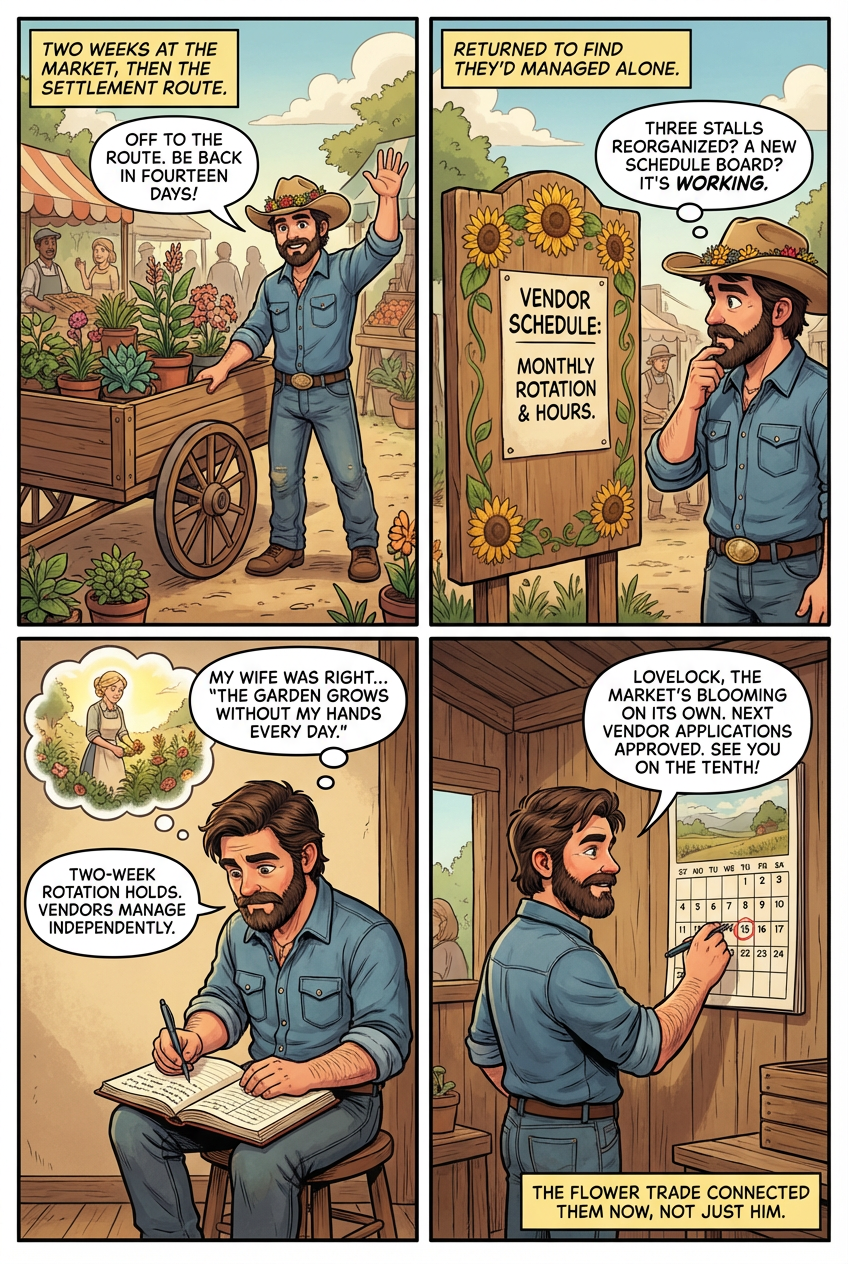
Silas worked the first two weeks at the market, then loaded his wagon and left for his settlement route. He returned fourteen days later to find the vendors had reorganized three stalls and resolved two supply disputes on their own. Lovelock handed him a single page of notes instead of a crisis. Silas spent the morning walking the market rows, checking what had changed. The pottery seller had moved to a better corner spot. Two rose vendors had worked out a shared water schedule. Near the entrance, someone had carved a wooden schedule board listing vendor days and market hours, decorated with painted sunflowers around the edges. He stopped to read it. The board showed which vendors would be present each week of the month, including the two weeks when he'd be gone. The system didn't need him watching it every day. It needed him to set it up right, then trust it to run. He opened his ledger and wrote the date at the top of a new page, then added a single line: "Two-week rotation holds. Vendors manage independently." He closed the book and walked back to the storage shed, where Lovelock was waiting with next month's vendor applications. The route and the market could both work, because he'd finally built something that didn't require him to choose. His wife had always said the garden would grow without her hands in the soil every day, and she'd been right. The vendors proved it. The settlements proved it. Everything he'd planted had learned to bloom on its own. He signed off on the applications and marked the calendar hanging inside the shed, circling the tenth of next month when he'd return again. The flower trade connected the towns now, not just him.
Play your story to life
Storycraft is a mobile game where you create AI characters, craft items and locations to build their world, then discover what direction your story takes. Download the iOS game for free today!
Download for free