

Agnes's Arc
10 Chapters
Agnes's dream is wanting the best for her only daughter.

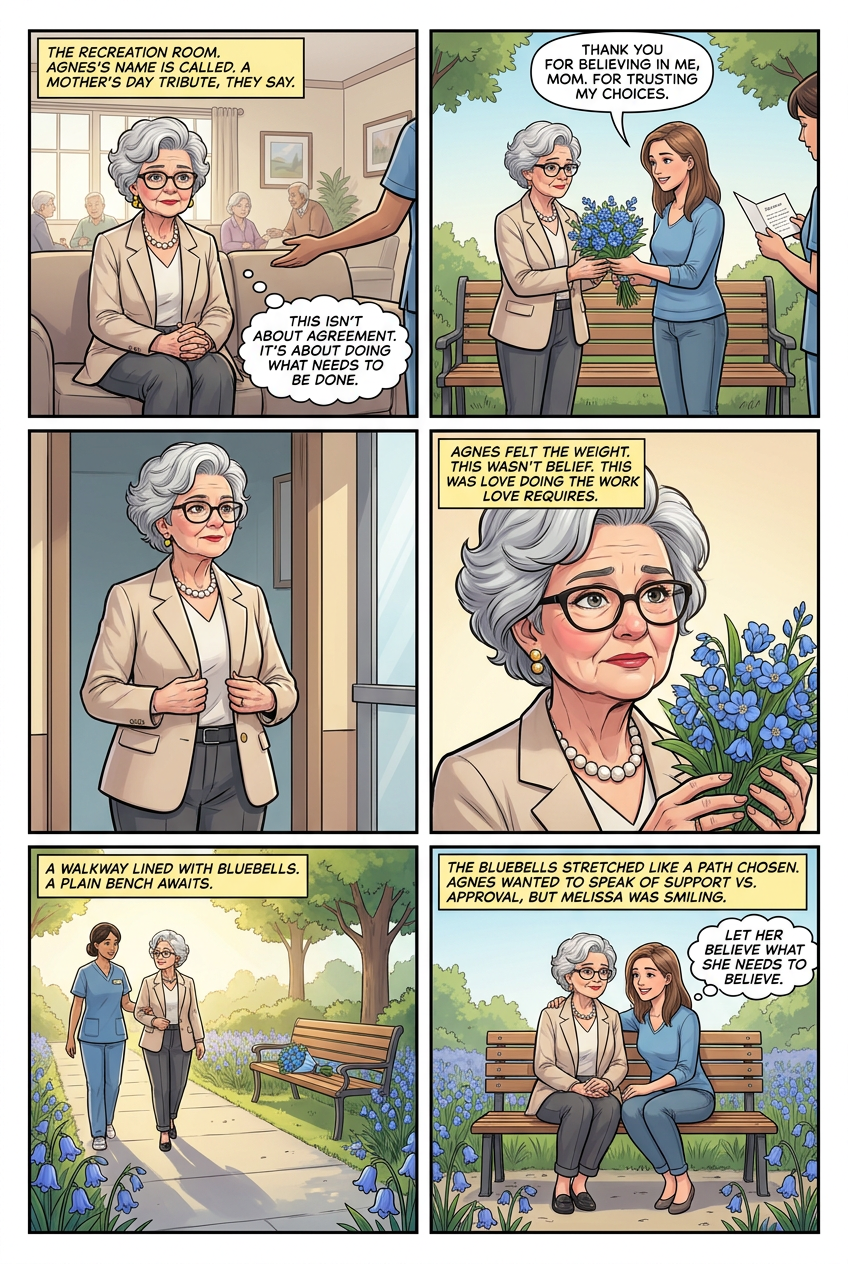
Agnes sits in the recreation room when the director calls her name. A Mother's Day tribute, they say. Recognition for supporting Melissa's choice to marry Allan, even when Agnes had her doubts. She stands and smooths her skirt. This isn't about agreement. This is about doing what needs to be done. They lead her outside to a walkway lined with bluebells. A wooden bench sits at the center, solid and plain. Someone placed a bouquet of blue flowers on the seat. Agnes recognizes Melissa's work in the arrangement. The director reads from a card about dignity and grace. About mothers who put their children's happiness first. Agnes listens without comment. She supported the marriage because Melissa wanted it, not because it was wise. Melissa steps forward and hands Agnes the bouquet. Her daughter's eyes are bright. She thanks Agnes for believing in her. For trusting her choices. Agnes takes the flowers and feels the weight of what Melissa hasn't understood. This wasn't belief. This was love doing the work that love requires, even when it means watching your daughter choose a harder road than she needs to walk. Agnes sits on the bench and sets the bouquet beside her. Melissa sits too, close enough their shoulders touch. The bluebells stretch out ahead of them like a path someone already chose. Agnes wants to tell her daughter that support and approval are not the same thing. That standing by someone doesn't mean you think they're right. But Melissa is smiling, and the words would only build a wall where there's finally a moment of peace. So Agnes stays quiet and lets her daughter believe what she needs to believe.
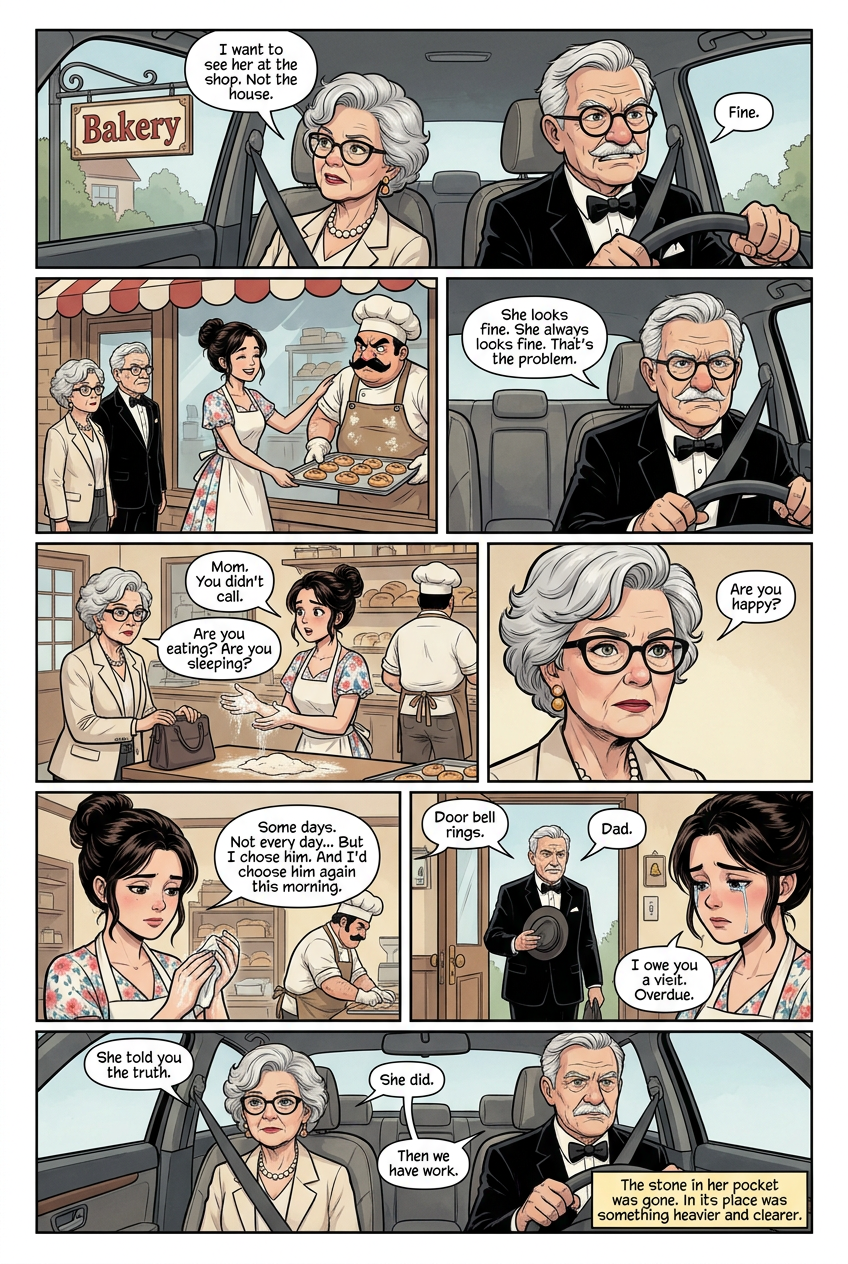
A week after the Mother's Day bench, Agnes still held the question like a stone in her pocket. Melissa had thanked her for trusting the marriage. Agnes had said nothing. Now she needed to know if her silence had protected her daughter or trapped her. She asked Tom to drive her into town. Tom kept both hands on the wheel. He had barely spoken to Melissa since the wedding. He disapproved of Allan and never hid it. Agnes watched his jaw work as they passed the turn to the bakery. "I want to see her at the shop," Agnes said. "Not the house. The shop. You watch a person at work, you learn what they cost themselves." "Fine," Tom said. "But I stay in the car." "No. You come in. I need two sets of eyes." He parked across from the bakery. Red awning, wide windows, bread stacked in the glass. Through the pane Agnes saw Melissa behind the counter, laughing at something Allan said. Allan was scowling at a tray. Melissa reached over and touched his wrist, and his shoulders dropped an inch. "She looks fine," Tom said. His voice was flat. "She always looks fine. That's the problem." Agnes went in alone first. The bell rang. Melissa's face opened when she saw her. "Mom. You didn't call." "I wanted bread," Agnes said. She watched her daughter's hands. Steady. Flour to the knuckle. "Are you eating?" "Every hour. Allan makes sure." "Are you sleeping?" Melissa laughed, then stopped. She glanced toward the back where Allan had disappeared. Her voice dropped. "Mom. Ask me the real one." Agnes set her purse on the counter. Here was the ledge. One wrong word and Melissa would close like a shop at dusk. "Are you happy," Agnes said. Not a question. A place to stand. Melissa looked at her a long time. "Some days. Not every day. He's hard on himself and it spills. I get real good at lying to myself real fast when it does." She wiped her hands on her apron. "But I chose him. And I'd choose him again this morning." It was not the answer Agnes wanted. It was the answer she believed. The bell rang again. Tom stepped inside, hat in his hand. Melissa froze. Her father had not crossed this threshold before. "Dad." "I owe you a visit," Tom said. Short. Load-bearing. "Overdue." Melissa's eyes filled. She did not wipe them. Agnes bought a loaf she did not need. In the car, Tom held the wheel without starting it. "She told you the truth," he said. "She did." "Then we have work." Agnes nodded. The stone in her pocket was gone. In its place was something heavier and clearer. Melissa was not pretending. She was managing. And managing meant there was a man in that kitchen who needed managing, and a daughter who was paying for it in small coins every day.
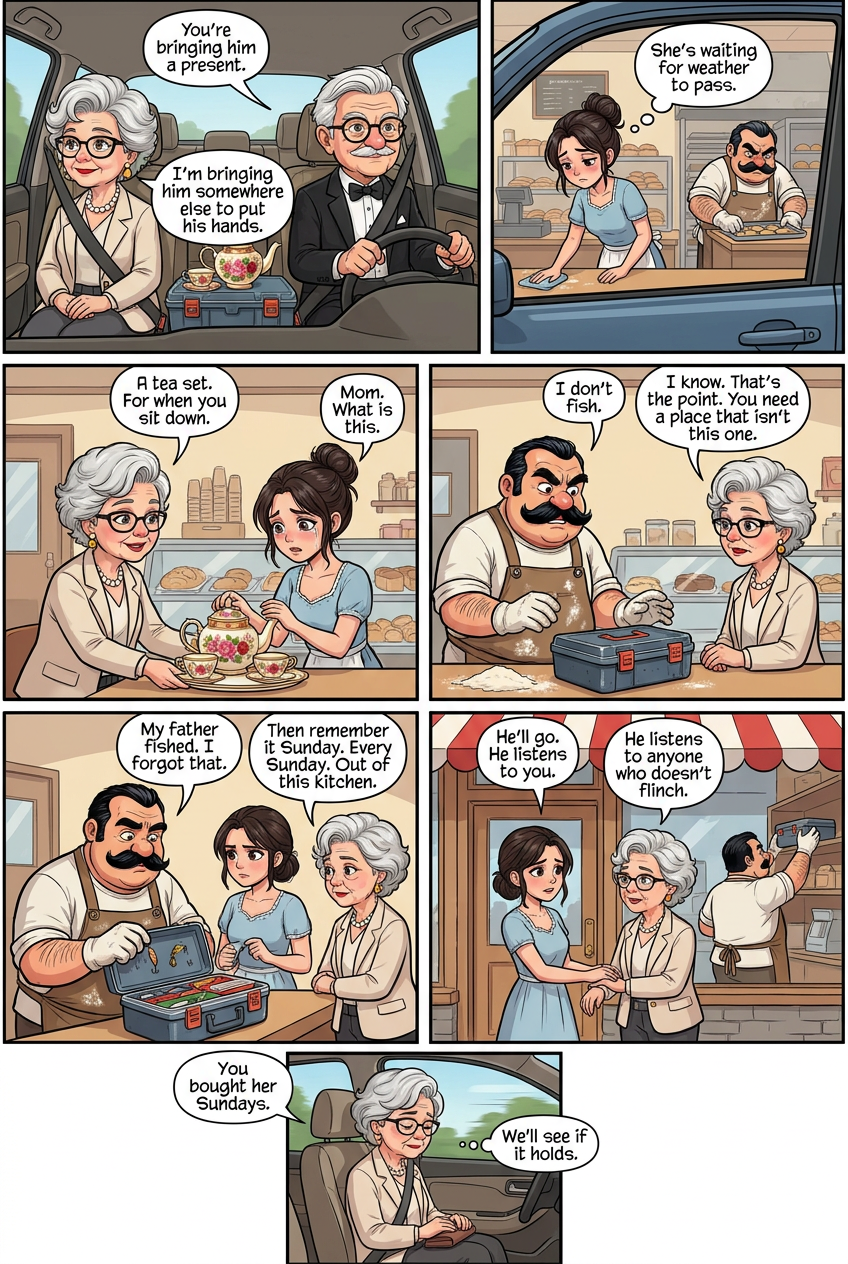
Three days after the bakery visit, Agnes packed two gifts into the back seat of Tom's car. A tea set for Melissa. A tackle box for Allan. Tom looked at the boxes and said nothing for a mile. "You're bringing him a present," Tom said. "I'm bringing him somewhere else to put his hands," Agnes said. "A man who only has one thing will break that thing. And her with it." Tom kept driving. "You think a box of hooks fixes a temper." "I think it gives him a river to go stand in when the bread burns." They parked at the bakery. Through the window Agnes saw Allan at the back counter, shoulders up around his ears, staring down at a tray. Melissa was wiping the same spot on the glass she had already wiped clean. Agnes had seen her own mother do that. It was the motion of a woman waiting for weather to pass. The bell rang. Melissa's face lifted, then tightened when she saw the boxes. "Mom. What is this." "A tea set," Agnes said. She placed it on the counter. Pink roses on white china. "For when you sit down. You do sit down, some days." Melissa touched the lid of the teapot with one finger. Her eyes went wet fast and she blinked it back. Allan came out from the back, hands white with flour. He looked at the second box. Then at Agnes. "I don't fish," he said. "I know," Agnes said. "That's the point. You need a place that isn't this one." He went still. Agnes had watched him go still before, over a ruined loaf. This was the same stillness. She held it. "You think I'm hard on her," he said. "I think you're hard on yourself and she stands closest." Allan looked at Melissa. Melissa did not look away. She did not lie for him. That was the new thing. He opened the tackle box. Lures in neat rows. He touched one. His thumb stayed on it a long moment. "My father fished," he said. Quiet. "I forgot that." "Then remember it Sunday," Agnes said. "Every Sunday. Out of this kitchen. Away from her." "Mom," Melissa said. "Let her," Allan said. He closed the box. He did not thank Agnes. He carried the tackle box to the back and set it on a shelf where he would see it every morning. Melissa walked Agnes to the door. On the step she took Agnes's wrist. Not tight. Just held. "He'll go," Melissa said. "He'll actually go. He listens to you." "He listens to anyone who doesn't flinch," Agnes said. In the car, Tom started the engine. "You bought her Sundays," he said. "I bought her one Sunday," Agnes said. "We'll see if it holds." She looked at her hands in her lap. The stone was gone. Something smaller sat there now. A held breath. A man walking toward a river instead of a tray.
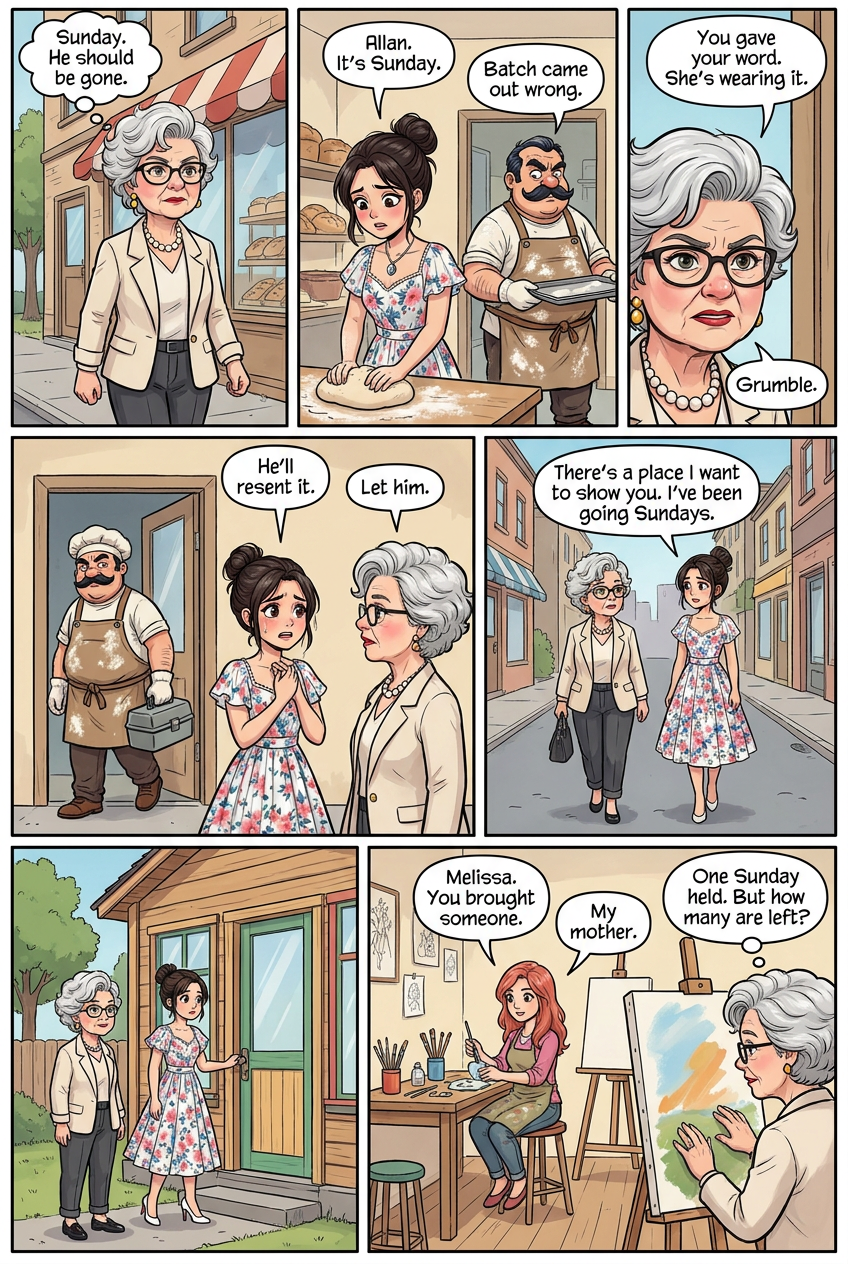
The next Sunday, Agnes drove to the bakery alone. She wanted to see the tackle box gone from the shelf. She wanted to see Melissa breathing without a man in the room. The bell rang. Melissa was behind the counter, kneading. Allan was behind her, pulling a tray from the oven. Agnes stopped in the doorway. Sunday. Ten in the morning. He should have been at a river an hour ago. "Mom," Melissa said. Her voice was careful. She lifted one hand to her collar. A silver locket sat there, small and new. Melissa's thumb pressed the face of it. Agnes had not seen the locket before. Melissa saw her notice and gave a small, tired nod. A signal Agnes did not know she had been waiting for. "Allan," Agnes said. "It's Sunday." He set the tray down. Flour on his forearms. "Batch came out wrong yesterday. I have to redo it." "Redo it Monday." "Customers Monday." "Customers every day," Agnes said. "That's why we picked Sunday." Allan looked at Melissa. Melissa did not look up from the dough. Her thumb was still on the locket. "One Sunday," he said. "One. The world doesn't end." "It ends for her," Agnes said. "You gave your word. She's wearing it around her neck." Allan looked at the locket. He went still the way he went still over a ruined loaf. Agnes held the stillness the way she had held it before. She did not flinch. He wiped his hands on his apron. He walked to the back and came out with the tackle box. "Fine," he said. Not warm. Not sorry. But moving. He went out the back door. The truck started. The truck left. Melissa put both hands flat on the counter. Her shoulders dropped an inch. Agnes had not known they were that high. "He would have stayed," Melissa said. "If you hadn't come." "I know." "He'll resent it." "Let him." Melissa untied her apron. "There's a place I want to show you. I've been going Sundays. While he fishes. I didn't tell him." They walked two streets over. Melissa unlocked a small wooden studio tucked between two shops. Inside: an easel, jars of brushes, paint tubes lined up on a shelf. A half-finished canvas on the stand. Yellows and greens. A field. A woman with long reddish hair sat at the workbench, cleaning brushes. She looked up. She did not smile fast. "Melissa," the woman said. Flat, careful. "You brought someone." "My mother. Agnes. She rents me the corner," Melissa said to Agnes. "Cheap. She doesn't ask questions." "I ask one," the woman said. "Whether she wants tea." "No, thank you," Agnes said. The woman nodded and went back to her brushes. Agnes looked at the canvas. At her daughter's hand on the locket. At the door Allan had walked out of, on time, because Agnes had made him. One Sunday held. Agnes had bought another week. She did not know how many weeks were left to buy.
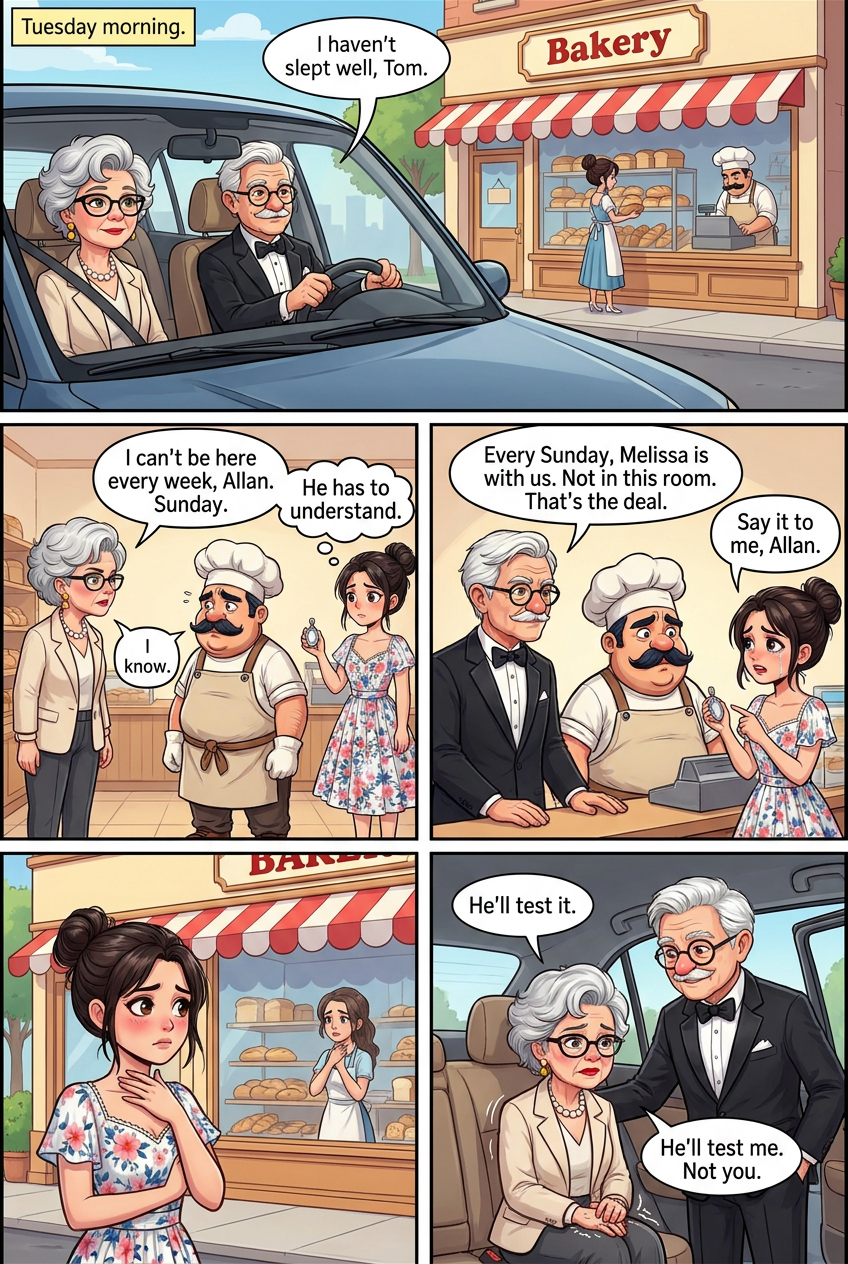
Tuesday, Agnes drove to the bakery with Tom. She had not slept well. She had counted Sundays in the dark. Four, maybe five, before Allan stopped moving when she pointed at the door. Tom parked at the curb. The bakery windows were bright. Inside, Melissa stacked loaves on a shelf. Allan worked the register. He did not look up when the bell rang. "Coffee," Tom said to Allan. Plain. A man ordering, not visiting. Allan poured it. His hands were steady. His jaw was not. Agnes walked to the counter. Melissa met her eyes and gave a small shake of the head. Not here. Not with him listening. "Allan," Agnes said. "A word." He set the cup down. He wiped his hands. He came around the counter and stood in front of her, arms loose, waiting. "Sunday," Agnes said. "I went." "You went because I made you." He went still. The same stillness as the ruined tray. Agnes did not soften. "I can't be here every week," she said. "I'm old. I'll forget. I'll be sick. And the first Sunday I miss, you'll be back at that oven, and she'll be back at that counter, and I'll have bought her nothing." Allan looked at the floor. Then at Melissa. Melissa's hand went to the locket. She did not lower it this time. She held it out where he could see. "I know," Allan said. Quiet. "I know what I do." Tom stepped up beside Agnes. He set his coffee on the counter. "Then we route around you," Tom said. "Every Sunday. Standing arrangement. Melissa spends the day with her mother and me. You do what you want with the shop. But she is not in this room on Sundays. Not one." Allan looked at Tom. Tom did not look away. "That's the deal," Tom said. "You already broke the first one. This one has two of us watching." Allan's mouth opened. Closed. He nodded once. "Fine," he said. "Say it," Melissa said. Her voice was low. "Say it to me." Allan turned to her. He did not touch her. "Sundays are yours," he said. "I won't ask where. I won't call. I won't wait at the door." Melissa's eyes filled. She did not wipe them. She nodded. Outside, Agnes walked to the car. Tom held the door. "You didn't tell me you were coming today," she said. "I heard you pacing at four." Agnes sat down. Her hands were shaking. She had not noticed until now. "He'll test it," she said. "He'll test me," Tom said. "Not you. That's the point." Agnes looked at the bakery window. Melissa was watching them go. Her hand was still at her throat, and her shoulders were down. Agnes had been carrying it alone. She was not carrying it alone anymore.
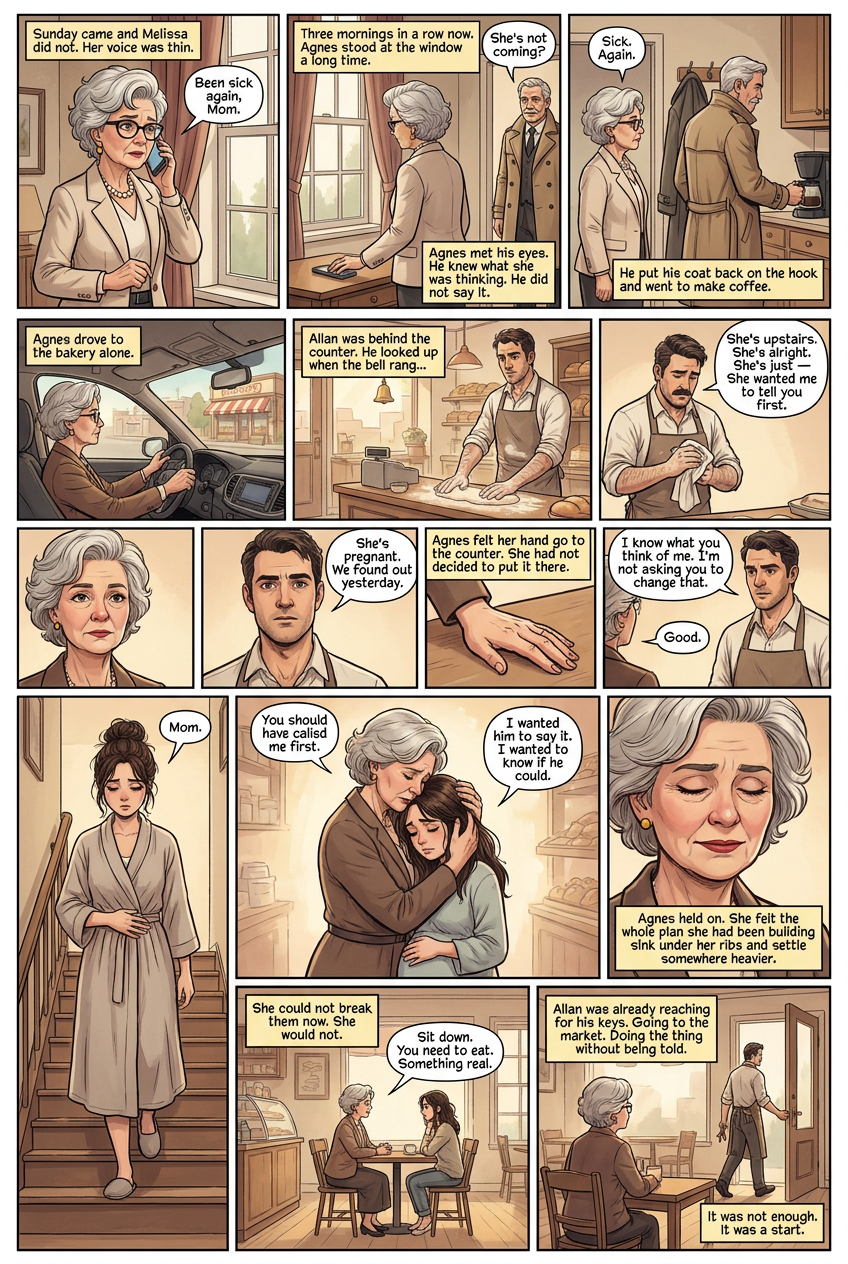
Sunday came and Melissa did not. She called at seven. Her voice was thin. She said she'd been sick again. Three mornings in a row now. Agnes set the phone down and stood at the window a long time. Tom came in with his coat still on. "She's not coming?" "Sick." "Again." Agnes met his eyes. He knew what she was thinking. He did not say it. He put his coat back on the hook and went to make coffee. Agnes drove to the bakery alone. The windows were bright. Allan was behind the counter, sleeves rolled, flour on his forearms. He looked up when the bell rang, and his face did something Agnes had not seen before. It softened. "She's upstairs," he said. "She's alright. She's just —" He stopped. He wiped his hands on the apron. "She wanted me to tell you first." Agnes waited. "She's pregnant," Allan said. Plain. Like he was setting down a hot pan. "We found out yesterday." Agnes felt her hand go to the counter. She had not decided to put it there. Allan watched her. He did not smile. He did not push. "I know what you think of me," he said. "I know what Sundays are. I'm not asking you to change that." "Good," Agnes said. Her voice came out steadier than her hand. "I'm going to be better," Allan said. "I've been saying that. I know. But I mean it different now." "Everyone means it different when they have to." He nodded. He took the hit. He did not go still the way he used to. He stayed with her. Melissa came down the stairs then. She was in a robe. Her hair was up. She looked tired and washed out and her hand was already at her stomach, flat, protective, like she'd been practicing the gesture in the mirror. "Mom." Agnes crossed the shop. She put her arms around her daughter. Melissa was thinner than she should have been. Agnes felt the shape of her shoulder blades and the small warm weight of her breath. "You should have called me first," Agnes said into her hair. "I wanted him to say it," Melissa said. "I wanted to know if he could." Agnes held on. She felt the whole plan she had been building — the Sundays, the routing around, the slow careful pulling of her daughter back — sink under her ribs and settle somewhere heavier. She could not break them now. She would not. "Sit down," Agnes said. "You need to eat. Not bread. Something real." Melissa laughed, wet. "He said the same thing." Agnes looked over her daughter's shoulder at Allan. He was already reaching for his keys. Going to the market. Doing the thing without being told. It was not enough. It was a start. And a start was what she had now, whether she wanted it or not.
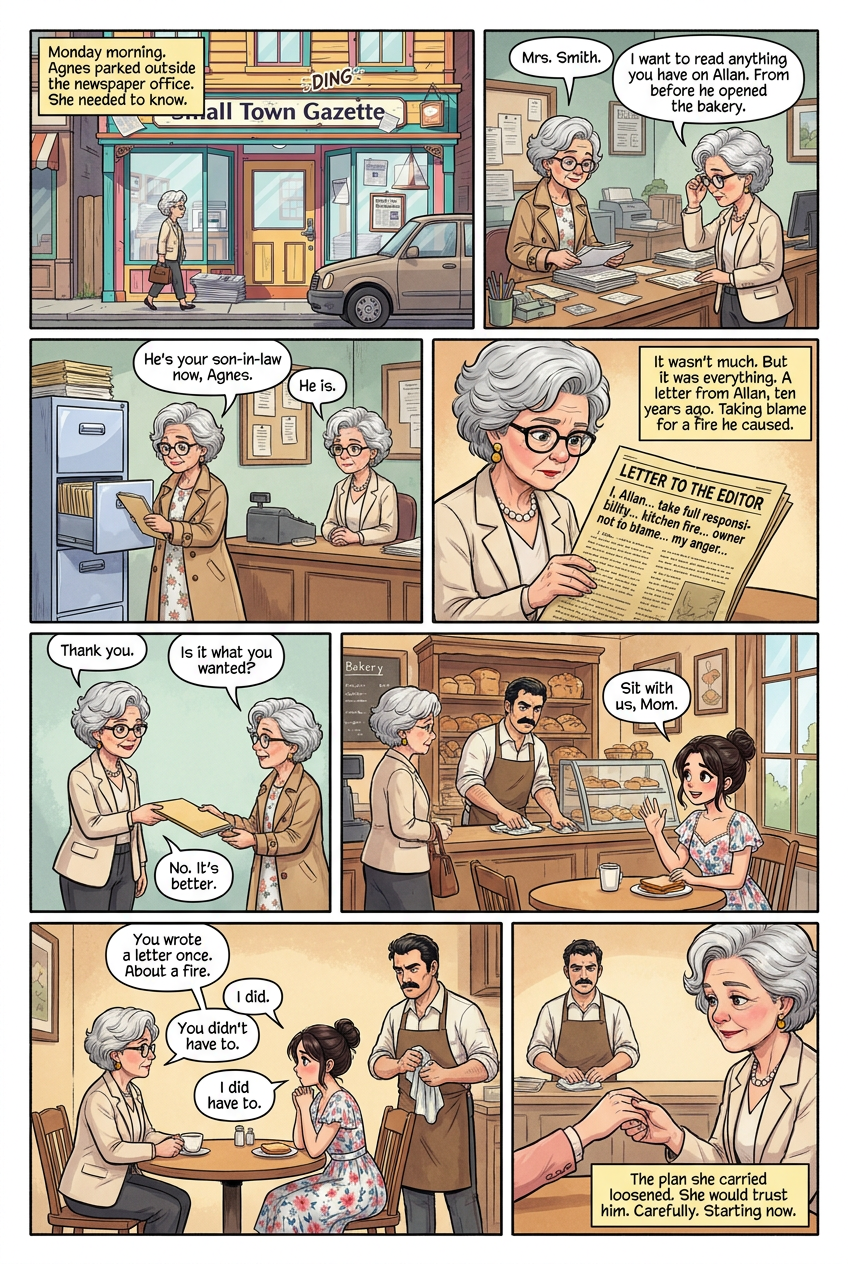
Agnes did not sleep well. Allan going to the market was a good thing. A good thing done once. She had seen men do good things once. She needed to know if this one could do them for a year. Monday morning she drove into town and parked two doors down from the small newspaper office. The bell over the door rang thin. Stacks of back issues leaned against the front counter. A woman in a trench coat was already inside, sorting a bin of old papers with the patience of someone who did it every week. "Mrs. Smith," Agnes said. Mrs. Smith looked up over her glasses. She had known Agnes since the girls were small. She did not ask why Agnes was there. She waited. "I want to read anything you have on Allan," Agnes said. "From before he opened the bakery. Whatever ran in the paper. I don't want him to know I looked." Mrs. Smith set the bin down. "He's your son-in-law now." "He is. And my daughter is carrying his child." Mrs. Smith held her eyes a moment. Then she went to a filing cabinet in the back and came back with a thin folder. She set it on the counter and stepped away to give Agnes the counter to herself. There was not much. A short piece from ten years ago about a kitchen fire at a restaurant two towns over. Allan's name in the staff list. A follow-up saying the fire had started from a pan left on a burner. No charges. A later notice about the restaurant closing. And one letter to the editor. Signed by Allan. Two paragraphs. He wrote that the fire had been his. That he had walked out of the kitchen angry and left the burner on. That the owner had covered for him and he did not want the owner blamed anymore. He asked the paper to print it so the record was straight. Agnes read it twice. She read the date. Ten years ago. Long before Melissa. Long before anyone here knew him. She closed the folder. Her hands were steady now. "Thank you," she said. Mrs. Smith nodded. "Is it what you wanted?" "No," Agnes said. "It's better." She drove to the bakery. Allan was at the counter with a rag in his hand. Melissa was on a stool by the window in a floral dress, eating toast slowly, one small bite at a time. "Sit with us," Melissa said. Agnes sat. She looked at Allan. "You wrote a letter once. About a fire." Allan went still the way he did in front of a ruined loaf. Then he set the rag down. "I did," he said. "You didn't have to." "I did have to." Agnes nodded once. She reached across and took her daughter's hand. The plan she had carried for months loosened in her chest. Not gone. Loosened. She would trust him. Carefully. Starting now.
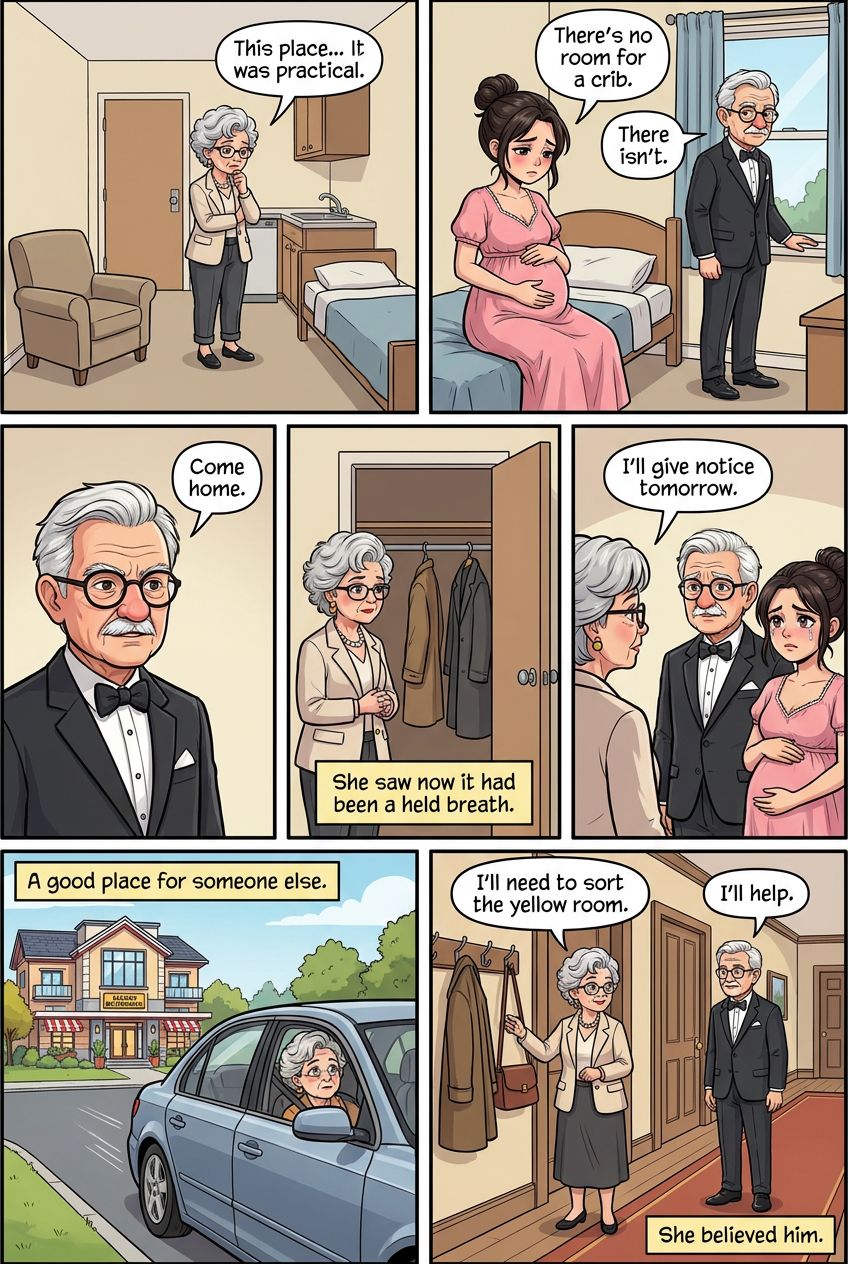
Agnes stood in her retirement suite on Sunday afternoon and measured the floor with her eyes. A single armchair. A narrow bed. A kitchenette the size of a closet. She had chosen the place because it was tidy and cheap and close to nothing that would trouble her. She had not chosen it for a baby. Melissa sat on the edge of the bed with one hand on her stomach. Tom stood by the window because there was nowhere else to stand. "There's no room for a crib," Melissa said. She said it lightly, the way she said things she meant. "There isn't," Agnes said. "I'll bring her by when she's small. After that it gets harder." Agnes heard the shape of it. Visits shrinking. A grandchild she would see in photographs and on holidays. She had spent a lifetime planning around losses. She could plan around this one too. She began to. Tom cleared his throat. "Come home," he said. Agnes turned. "To the house," Tom said. "Your things are still in the closet. I never moved them." "We agreed I would live here." "We agreed when the math looked different. It looks different now." He took his hands out of his pockets. "You're at the house six days a week. You sleep here. That's the only line left. Erase it." Agnes looked at him. The man who had spent forty years across a breakfast table from her without saying much of anything was standing in a rented room asking her to come back. "The baby needs a room," Tom said. "We have four." Melissa's eyes filled. She did not speak. Agnes walked to the small closet and opened it. Two coats. A suitcase she had never fully unpacked. She had told herself the suite was independence. She saw now it had been a held breath. "I'll give notice tomorrow," she said. Tom nodded once. He did not smile. He looked at the floor a moment, then at her. "Thank you." "Don't thank me. It's practical." "It's both," he said. Melissa laughed and wiped her face with the heel of her hand. "The yellow room," she said. "For the crib. It gets the morning sun." "The yellow room," Agnes agreed. They drove back together in Tom's car. Agnes watched the retirement building shrink in the side mirror — the warm facade, the striped awnings, the potted shrubs by the door. A good place for someone else. At the house, Tom unlocked the front gate and held it for her. She stepped through onto the stone path she had walked away from two years ago and had not admitted missing. Inside, the hallway smelled the same. Her coats still hung on the hook by the door. She hung her purse beside them. "I'll need to sort the yellow room by month's end," she said. "Before she starts showing." "I'll help," Tom said. She believed him.
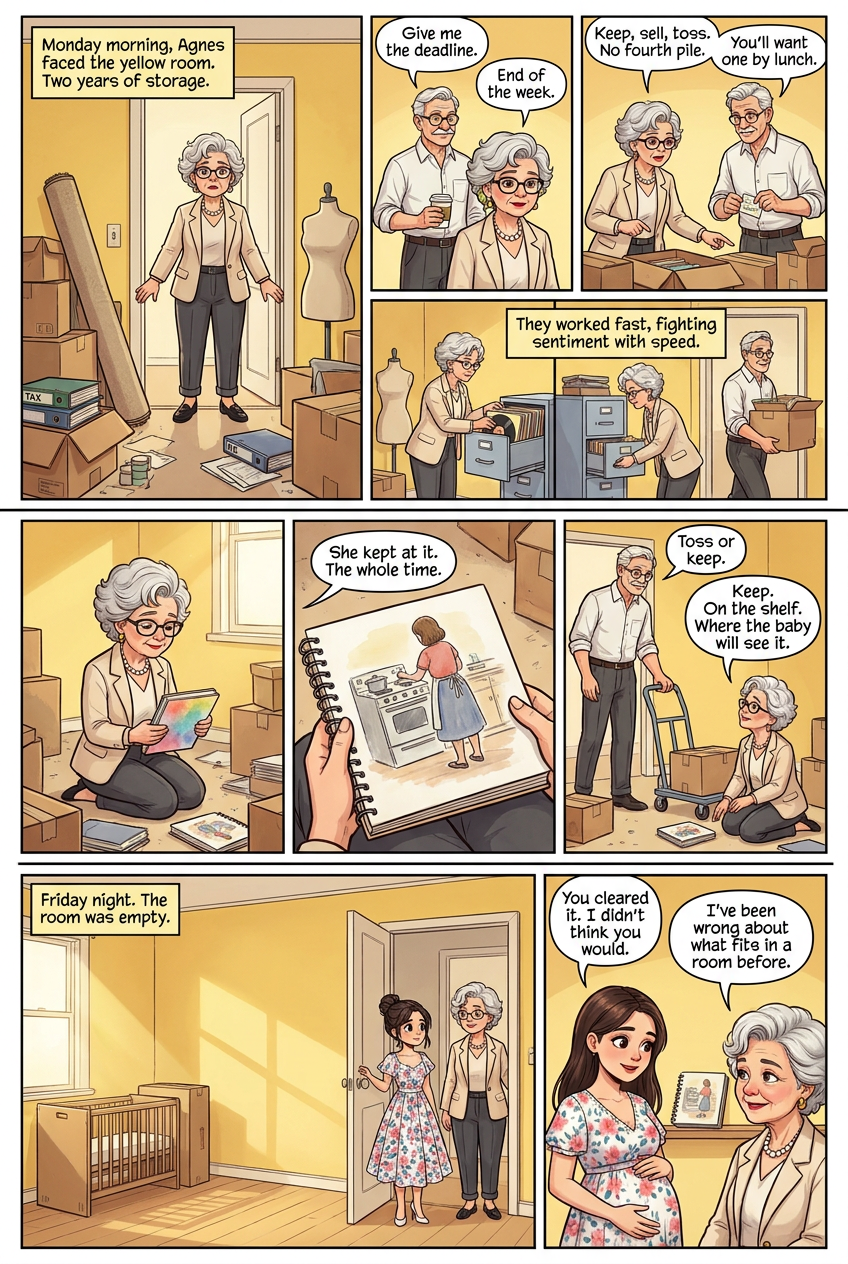
Monday morning Agnes stood in the doorway of the yellow room and made her count. Two years of storage filled it to the ceiling. Boxes on boxes. A rolled rug against one wall. Tom's tax binders stacked on the chair by the window. A dressmaker's dummy she had forgotten owning. The crib would not fit until half of it was gone, and Melissa would start showing inside the month. "Give me the deadline," Tom said from behind her. He had his sleeves rolled and a coffee in one hand. "End of the week." "Then we work in sweeps. Keep, sell, toss. No fourth pile." "You'll want a fourth pile by lunch." "I won't," he said. They started with the boxes nearest the door. Tom read labels aloud. Agnes decided. Tax records to the filing cabinet downstairs. Old curtains to the donation bag. A box of chipped dishes to the curb. She worked fast because slowness was where sentiment lived. By noon they had cleared a path to the window. By three they had cleared the near wall. Tom carried loads down without complaint. Agnes heard him on the stairs and remembered she had forgotten what his footsteps sounded like in this house. The last box in the corner was taped with masking tape gone yellow. Melissa's name was on the side in Agnes's own handwriting. Agnes cut it open. Inside were school papers, a plastic horse, a knot of ribbons. Under the ribbons was a sketchbook with a soft painted cover, colors bleeding into each other like weather. Agnes lifted it out. She was ten, maybe eleven. Every page was full. Trees. The dog they'd had. A woman at a stove who was clearly Agnes, drawn from behind. Agnes sat on the floor with the book on her knees. Tom came in with the empty dolly. He saw her face and set the dolly down. "She kept at it," Agnes said. "The whole time. I thought she'd grow out of it." "She didn't." "No." She turned another page. A field. A fence. A sky she had never bothered to look at. "Toss or keep," Tom said, gentle. "Keep." She closed the cover. "On the shelf. Where the baby will see it." By Friday night the room was empty but for fresh paint and a folded crib in its box. Agnes stood in the doorway again and made her count. Bare floor. Clean walls. Morning sun on the sill. Melissa came by after supper and stood beside her. She did not speak for a long moment. "You cleared it," Melissa said. "I did." "I didn't think you would." Agnes looked at her daughter. "I've been wrong about what fits in a room before." Melissa's hand went to her stomach. Agnes did not look away this time. The sketchbook sat on the shelf behind them, waiting for a child who would open it.
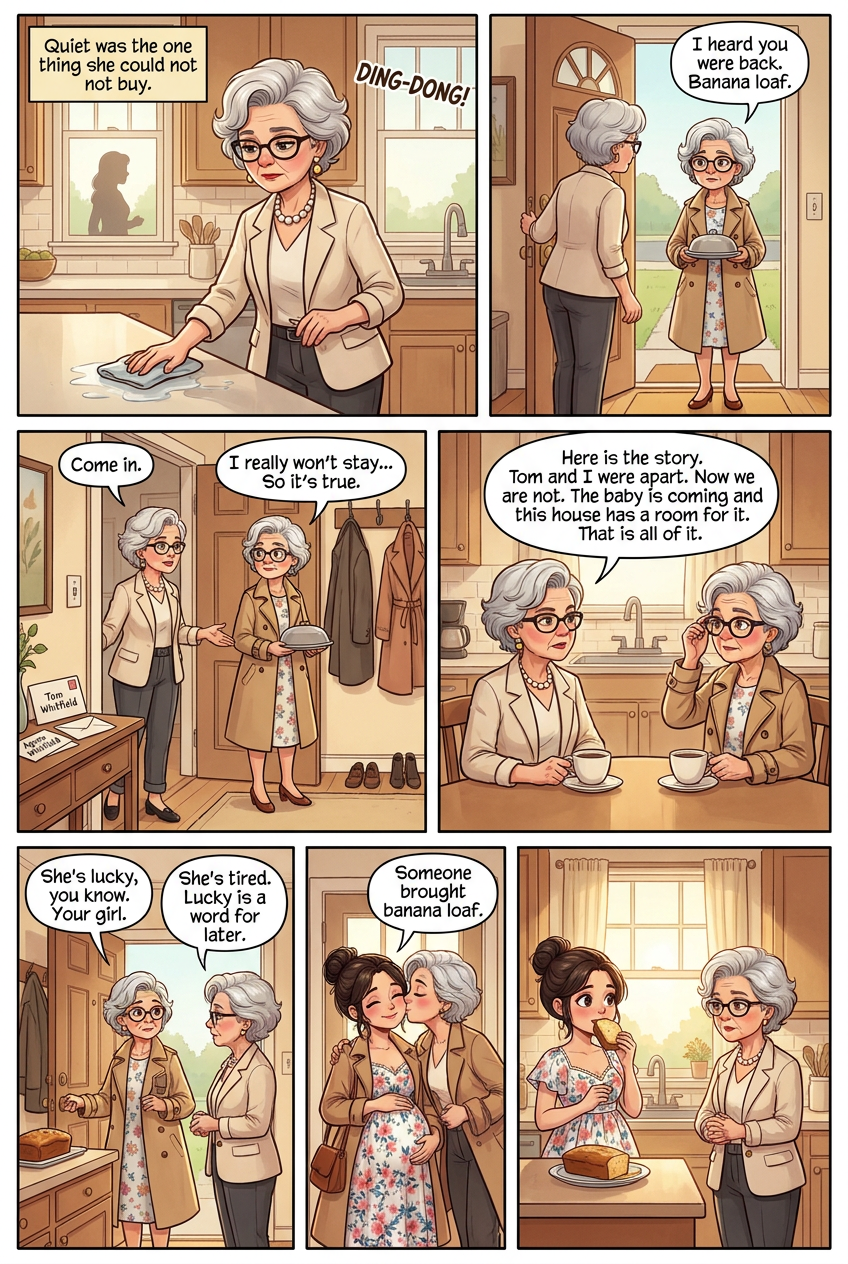
Saturday morning Agnes was wiping down the kitchen counter when the doorbell rang. She was not expecting anyone. Tom was at the hardware store. Melissa was due for lunch at noon. Through the front window she saw a woman in a trench coat standing on the step, holding a covered dish. Mrs. Smith. Agnes had spent hours with her in the newspaper archive months back, asking questions she had not wanted to ask out loud. Mrs. Smith knew where Agnes had been for two years, and why. Agnes opened the door. "I heard you were back," Mrs. Smith said. She lifted the dish an inch. "Banana loaf. I won't stay." "Come in." "I really won't stay." Mrs. Smith stepped into the hall anyway. Her eyes moved over the coat rack, the two sets of shoes, the mail on the table with Tom's name and Agnes's name side by side. "So it's true." "It's true." "Bev at the salon said you were living here again. I told her she was wrong. I said, Agnes wouldn't just walk back after two years without a word to anyone." "I owe no one a word." Mrs. Smith set the dish on the hall table. "People will ask, Agnes. Melissa's expecting. That's the kind of thing folks connect. They'll want a story." "Then they can want." "I only mean —" Mrs. Smith adjusted her glasses. "If I heard by Thursday, Melissa will hear by Monday. From someone at the bakery. From a customer. You know how it goes." Agnes did know. She had counted on quiet. Quiet was the one thing she could not buy. "Sit down," Agnes said. Mrs. Smith sat at the kitchen table. Agnes poured two cups of coffee and set one in front of her. "Here is the story," Agnes said. "Tom and I were apart. Now we are not. The baby is coming and this house has a room for it. That is all of it. You may repeat that in exactly those words." Mrs. Smith blinked. "That's not much of a story." "It's the whole one. If you soften it or stretch it, it becomes gossip. If you say it plain, it becomes fact. Fact travels faster and dies sooner." Mrs. Smith looked at her a long moment. Then she nodded once. "Plain, then." "Plain." Mrs. Smith drank half her coffee and left the banana loaf on the counter. At the door she paused. "She's lucky, you know. Your girl." "She's tired," Agnes said. "Lucky is a word for later." At noon Melissa came through the back door with her coat open over her belly. She kissed Agnes's cheek and sniffed the air. "Someone brought banana loaf." "A neighbor," Agnes said. "She heard I was home. She wanted to be the first to know it herself." Melissa cut a slice and ate it standing. Agnes watched her chew and swallow. Nothing in her daughter's face had changed. The story had been set before it could set itself.
Play your story to life
Storycraft is a mobile game where you create AI characters, craft items and locations to build their world, then discover what direction your story takes. Download the iOS game for free today!
Download for free