

Alice's Arc
20 Chapters
Alice's dream is training her golden retriever into the finest tracking companion the woodland realm has ever known..

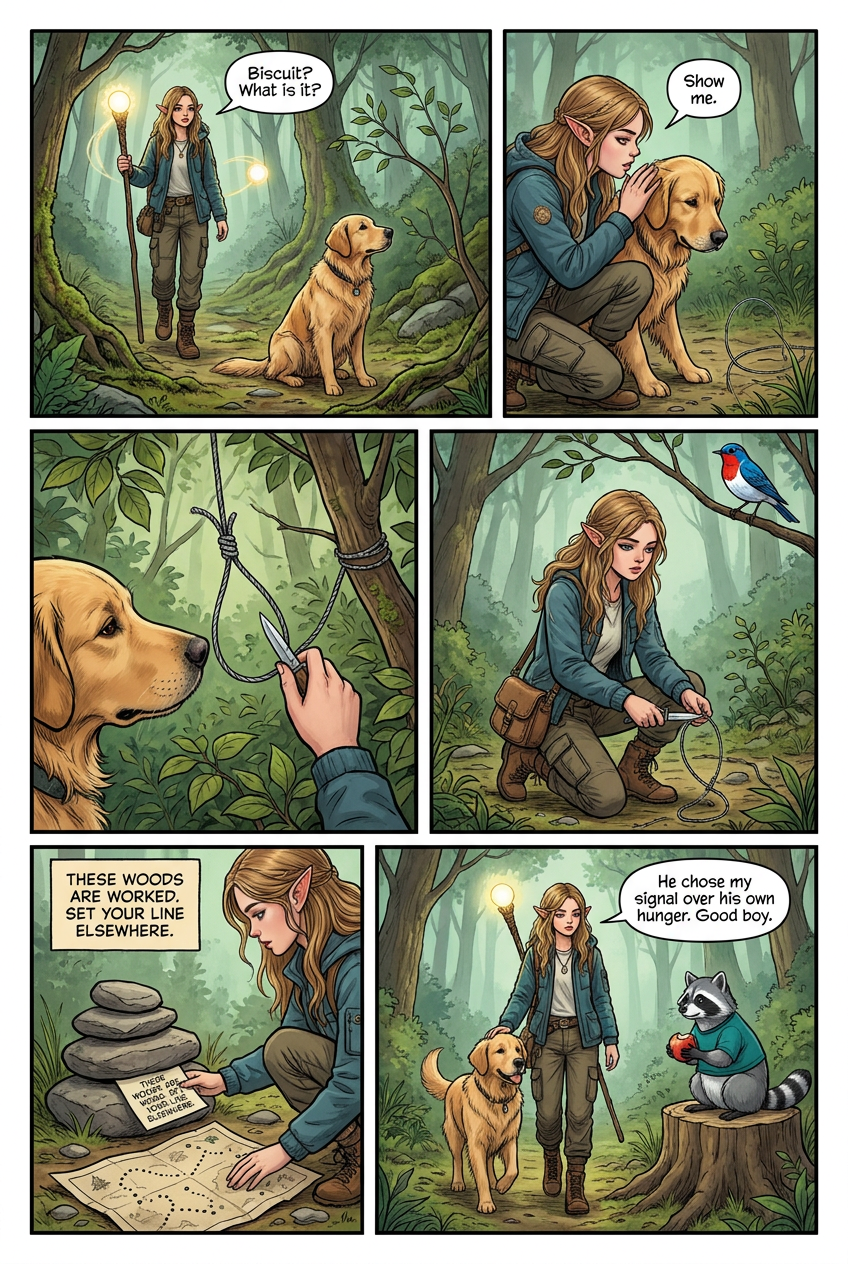
Alice was three weeks into mapping the Hollow Path when Biscuit's ears went flat and he sat down hard on the moss. She stopped mid-step. Her walking stick tipped forward, and the ball of light on its top swung across the ferns. Biscuit was sixteen months old, a golden retriever she was training to be the best tracker the woodland realm had ever seen. He had never been wrong before her. She lowered her pack and crouched beside him. "Show me," she whispered. He pointed his nose at a bent sapling six feet ahead. Alice lifted her light. A wire noose hung open at dog-height, tied off to the sapling with a slipknot. Two feet past it, half-buried under leaves, she found a second snare. Then a third. A trapper had strung a line of them across her practice ground. She sat down beside Biscuit and made herself think. If Biscuit had run ahead the way he used to, the wire would have caught his throat. She pulled a folded map from her satchel and marked each snare with a pencil dot. A bird landed on the sapling above the first noose, red-headed with blue wings and a white breast. It watched her work and did not fly. Alice took that as permission. She cut every snare with the small knife from her belt. She coiled the wire and stuffed it into her pack so no other animal would find it. Then she stacked three flat stones at the trailhead as a marker for the trapper, and tucked a note under the top stone: These woods are worked. Set your line elsewhere. On the walk back, a raccoon in a blue-green shirt watched them from a stump, holding half an apple in both paws. Biscuit did not lunge. He looked at Alice first, waited for her nod, then passed the stump at a steady heel. Alice felt the change in him land in her chest. He had chosen her signal over his own hunger. She knelt and pressed her forehead to his. The practice ground was no longer safe, and she would have to find new country tomorrow. But the dog she was building was already better than the one she had brought in this morning.
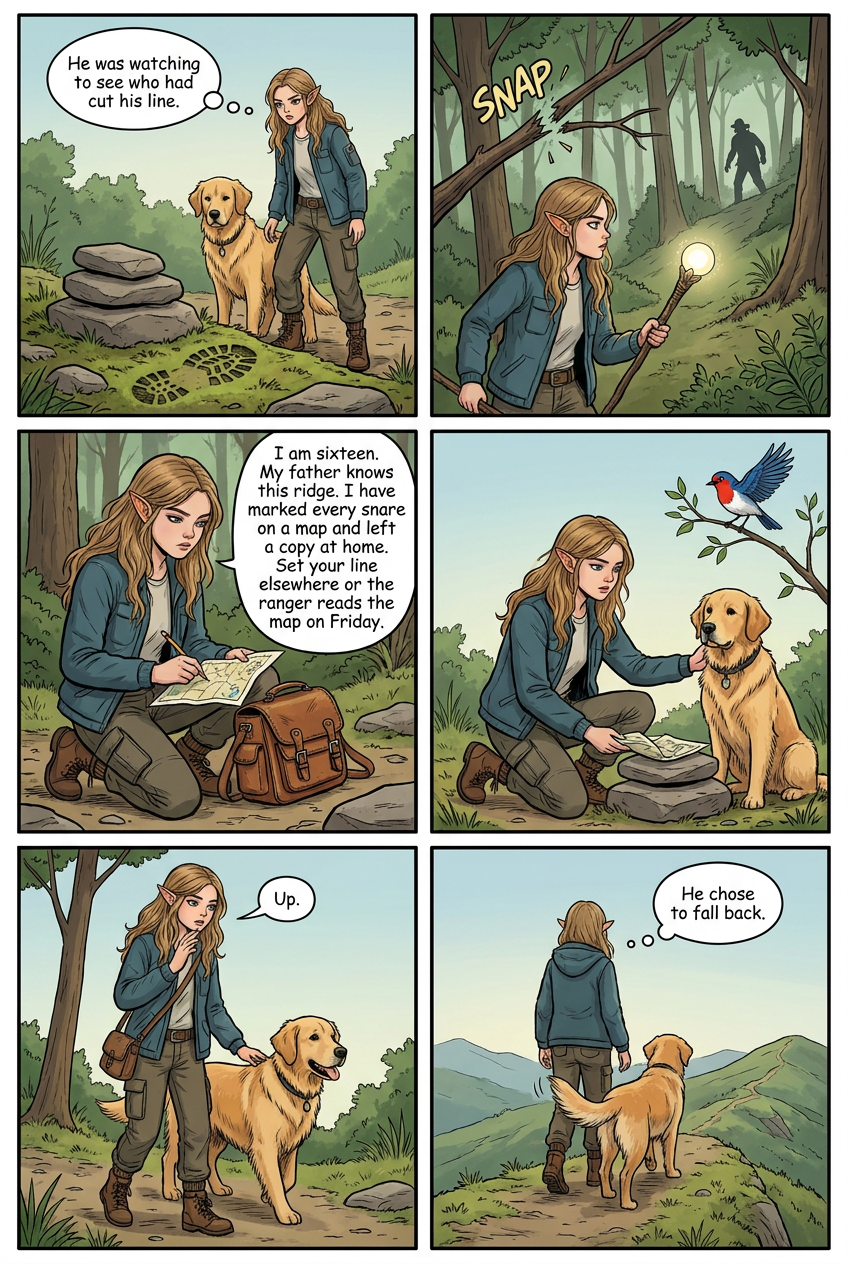
The next morning Alice came back to the trailhead to collect her stone marker and scout new country. The three flat rocks were still stacked, but the note was gone. A boot print pressed the moss beside them, larger than her own and fresh. Biscuit's ears went flat. He sat down hard. Alice froze with her stick raised, the ball of light pale in the daylight. Somewhere uphill, a branch snapped once and stopped. She understood then that the trapper had read her note and stayed. He was watching to see who had cut his line. Alice did not run. Running would teach Biscuit the wrong lesson, and it would show the man her back. She knelt, opened her satchel, and took out her map. On a blank corner she wrote a second note in pencil: I am sixteen. My father knows this ridge. I have marked every snare on a map and left a copy at home. Set your line elsewhere or the ranger reads the map on Friday. She weighted it under the top stone where the first note had been. Then she waited, one hand on Biscuit's collar, until the small red-headed bird with blue wings and a white breast dropped onto the sapling above her. It watched the slope where the branch had snapped. It did not fly. Alice took that as her second permission. "Up," she whispered. Biscuit stood on his own. She stood with him and walked the ridge line away from the snare ground at a steady heel, not looking back. Half a mile on, Biscuit's ears lifted and his tail swung. Whatever had been behind them was no longer following. Alice let out the breath she had been holding since the boot print. She had traded silence for a threat the man could measure, and he had chosen to fall back. But the note named her age and her father, and she had promised a ranger she had not yet spoken to. By Friday she would have to make that promise true.
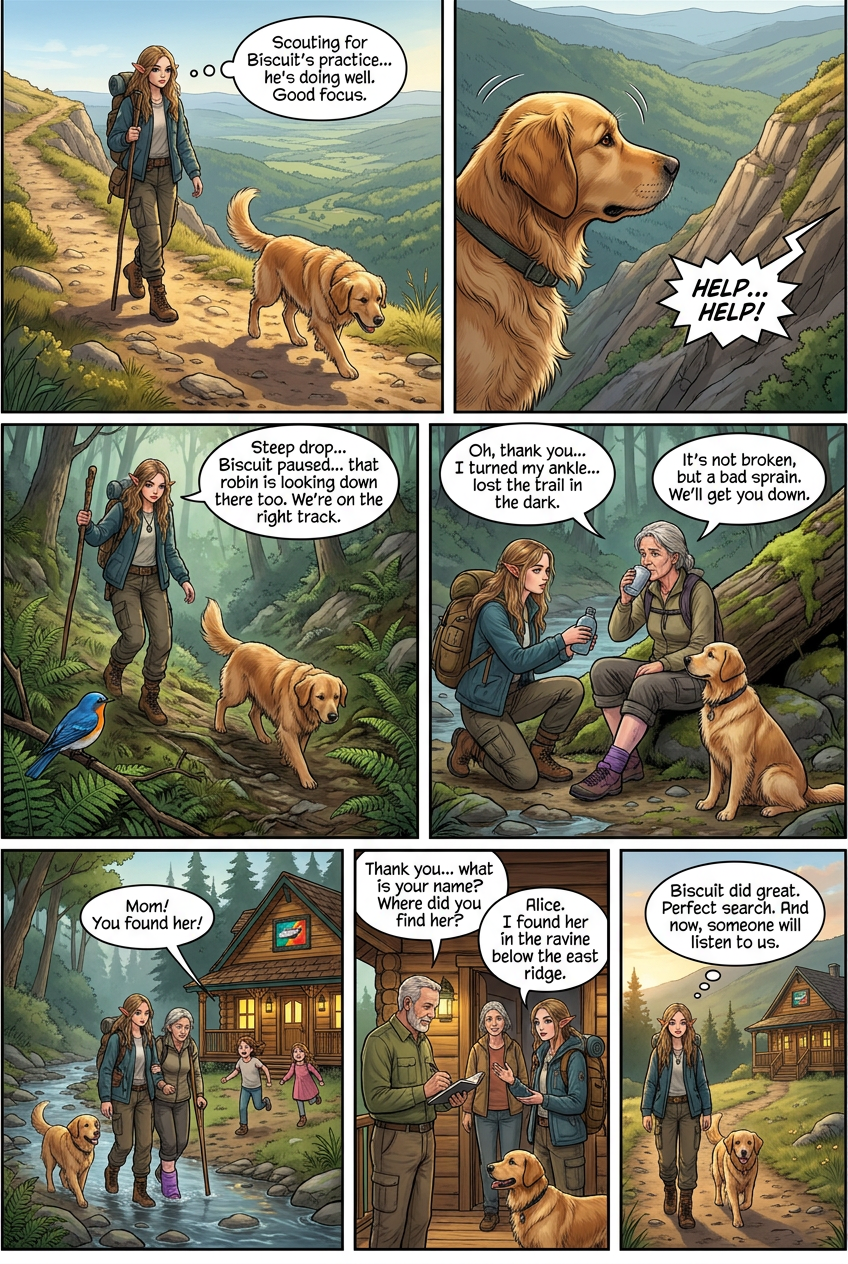
Alice meant to spend the next morning scouting new ground for her practice work with Biscuit. She took the ridge trail east, away from the snare country, and let the dog set the pace. He kept his tail high and his nose working. She was watching him think, pleased, when a voice came up from the draw below the ridge. It was thin and cracked. It called for help, then stopped, then called again. Biscuit's ears swung toward the sound. He did not sit. Alice took that as a green light and stepped off the trail onto the slope. She planted her walking stick with the light on top and used it to brake her descent. The draw was steep and choked with fern. The voice grew clearer as she dropped: an older woman, from the sound of it, calling the same three words in the same order. Alice stopped twice to let Biscuit read the air. The second time, a small bird with a red head and blue wings landed on a low branch and held still. It looked down the draw the way Biscuit did. Alice took the bird's calm as a second opinion and kept moving. She found the hiker at the bottom, sitting against a mossy log with one boot off. The woman's ankle was swollen and purple. Her water bottle was empty. She said she had been calling since first light. She had come up from the lodge trail and lost the switchbacks in the dark. Alice knelt, gave her the full canteen, and checked the ankle with two fingers. Not broken. Badly turned. Alice thought through the climb. The draw was too steep to carry a grown woman up. Downstream was gentler and would meet the lodge road in about a mile. She cut a second walking stick from a straight alder and braced the woman between the stick and her own shoulder. Biscuit went ahead at a slow heel, checking back every few steps. Alice matched his pace. When his ears went flat once at a wet slab of rock, she stopped and waited until he stood on his own, then guided the woman around it. They reached the lodge road by early afternoon. A warm cedar building sat at the bend, lanterns already lit against the shade of the pines. The woman's family was on the porch. Her daughter ran down the steps. Alice handed the hiker off, refused the offered meal, and said only where she had found her and which way the draw ran. The father wrote it down. He asked her name. She gave it, and her father's, and the ridge she worked. Walking back up the road with Biscuit, Alice counted what had changed. Biscuit had held a live search from first call to handoff without one wrong step. She had a name at the lodge now, and adults who owed her a hearing. Friday was three days out, and a ranger would listen to the family she had just helped.
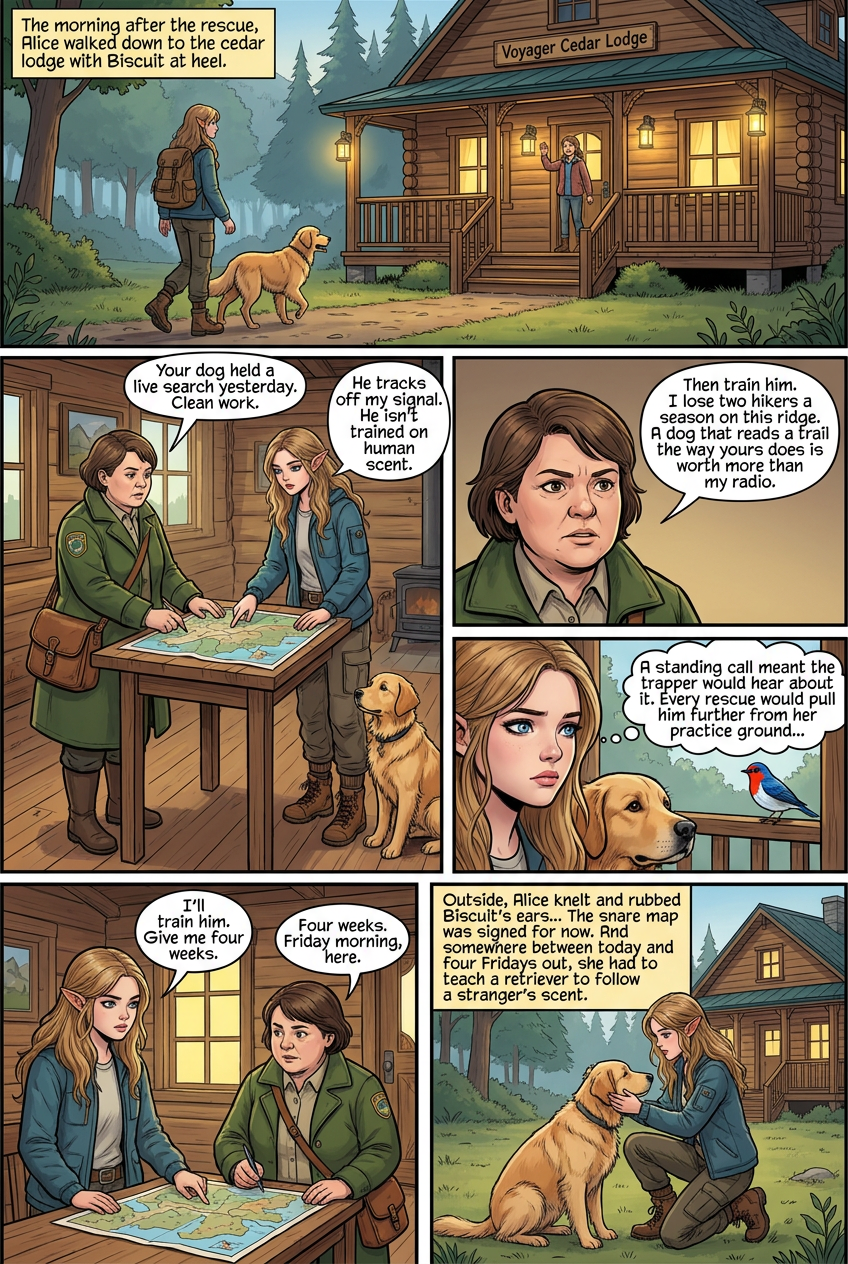
The morning after the rescue, Alice walked down to the cedar lodge with Biscuit at heel. She wanted to be there before the ranger arrived, so the family could speak for her in person. The porch lanterns were still lit against the pine shade. The hiker's daughter met her at the steps and waved her inside. The ranger came just after nine. She was a short woman in a green coat with a leather field bag over one shoulder. She listened to the family for ten minutes, then turned to Alice. Alice laid her map on the table. She showed the snare locations, the stone marker, the two notes, and the date on each. The ranger read every line without speaking. Then she looked at Biscuit, who was sitting square by Alice's boot. "Your dog held a live search yesterday," the ranger said. "The family told me. Clean work." She tapped the map. "I'll walk the snare line today. I want the dog with me." Alice felt her stomach tighten. "He tracks off my signal. He isn't trained on human scent." "Then train him," the ranger said. "I lose two hikers a season on this ridge. A dog that reads a trail the way yours does is worth more than my radio. If he learns scent, I call you first, every time." Alice looked down at Biscuit. His ears were up. He was watching the ranger the way he watched a squirrel he had decided not to chase. She thought about what the ranger was really offering. A standing call meant the trapper would hear about it. It also meant Biscuit would belong to the ridge, not only to her. Every rescue would pull him further from her practice ground and closer to someone else's emergency. She thought of the friend who had stopped coming, and what she had agreed was true. A small bird with a red head and blue wings landed on the porch rail outside the window. It held still and watched the room. Alice took a breath. "I'll train him," she said. "Give me four weeks. I'll bring him back and show you what he can do. If he passes, you can call us." The ranger wrote a number on the back of Alice's map and stood up. "Four weeks. Friday morning, here." Outside, Alice knelt and rubbed Biscuit's ears until he leaned into her hand. She had bought the ranger's ear and traded away part of the dog's future in the same hour. The snare map was signed for now. The trapper would hear a ranger was walking his line. And somewhere between today and four Fridays out, she had to teach a retriever to follow a stranger's scent through country neither of them had mapped.
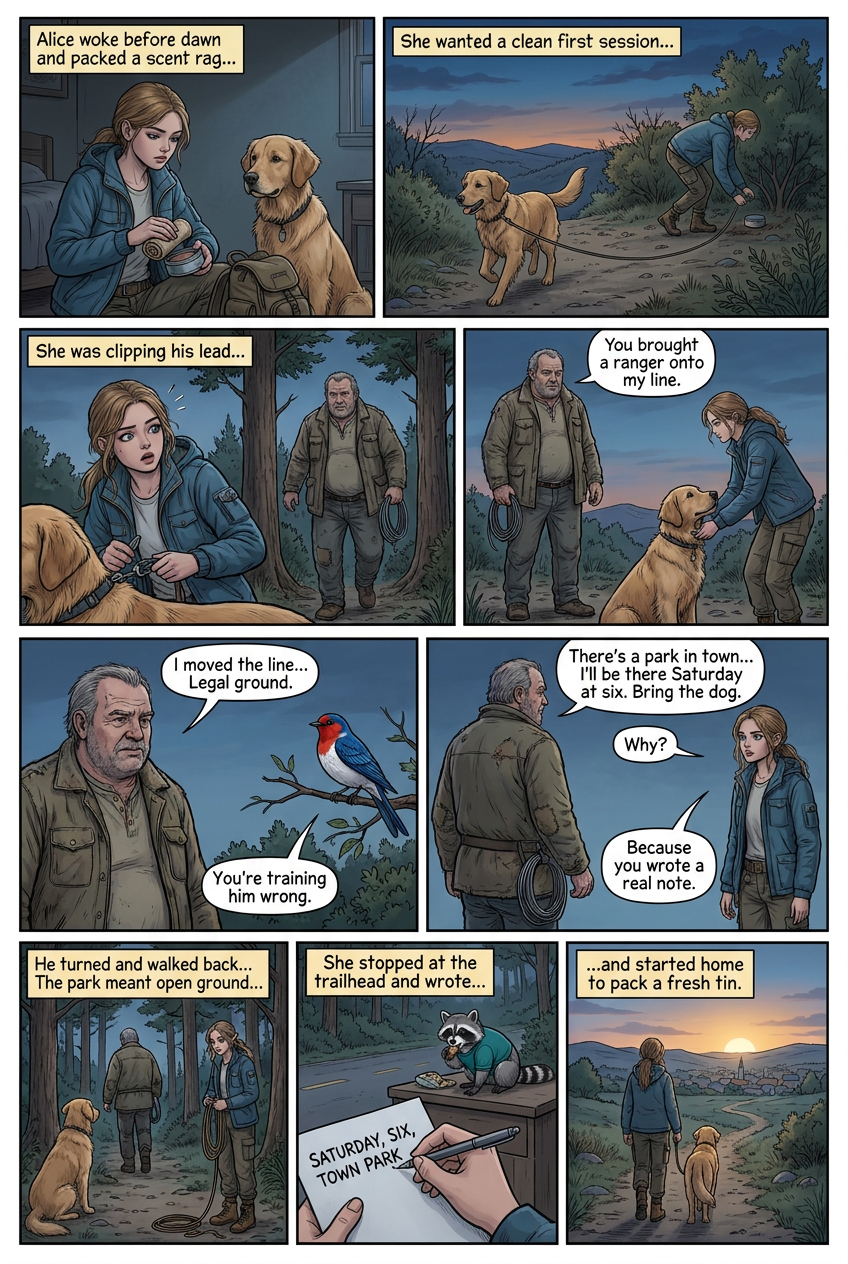
Alice woke before dawn and packed a scent rag from the ranger's map into a sealed tin. She wanted a clean first session on the ridge before the sun cleared the pines. Biscuit trotted ahead on the path, ears loose, tail level. She set three drag lines through the brush above her old practice ground, then hid the tin at the end of the longest one. She was clipping his lead when she heard boots on the scree behind her. The trapper stepped out from between two cedars. He was older than she had guessed, heavy in the shoulders, with a coil of wire on his belt and both hands empty. He stopped ten feet off and looked at Biscuit first, then at her. "You brought a ranger onto my line," he said. Alice kept her hand on Biscuit's collar. The dog's ears stayed up. That steadied her more than the light on her stick. She said she had done what she told him she would do in the note. The trapper nodded once, like he was checking a box. "I moved the line," he said. "Two ridges east. Legal ground." He looked at the drag rope in her hand. "You're training him wrong. Open ridge, wind switches every ten minutes. He'll false-alert all morning and learn to guess." She didn't answer. A small bird with a red head and blue wings dropped onto a branch between them, watched, and lifted off. The trapper watched it go. "There's a park in town," he said. "Flat grass, fence on three sides, steady wind off the lake. I run my nephew's beagle there. I'll be there Saturday at six. Bring the dog. I'll set the drags. You call him." Alice asked why. "Because you wrote a real note," he said. "And because a ranger on my ground costs me less than a bad dog on this ridge costs you." He turned and walked back into the cedars before she answered. Biscuit stood up on his own. Alice let out the breath she had been holding and coiled the drag rope. On the way down she thought it through. The park meant open ground, honest wind, and four weeks that might actually be enough. It also meant standing beside a man who set dog-height nooses and calling that a lesson. She stopped at the trailhead and wrote Saturday, six, town park on the back of her hand. A raccoon in a blue-green shirt watched her from the lodge bins across the road, chewing something it had stolen. Alice clipped Biscuit's lead and started home to pack a fresh tin.
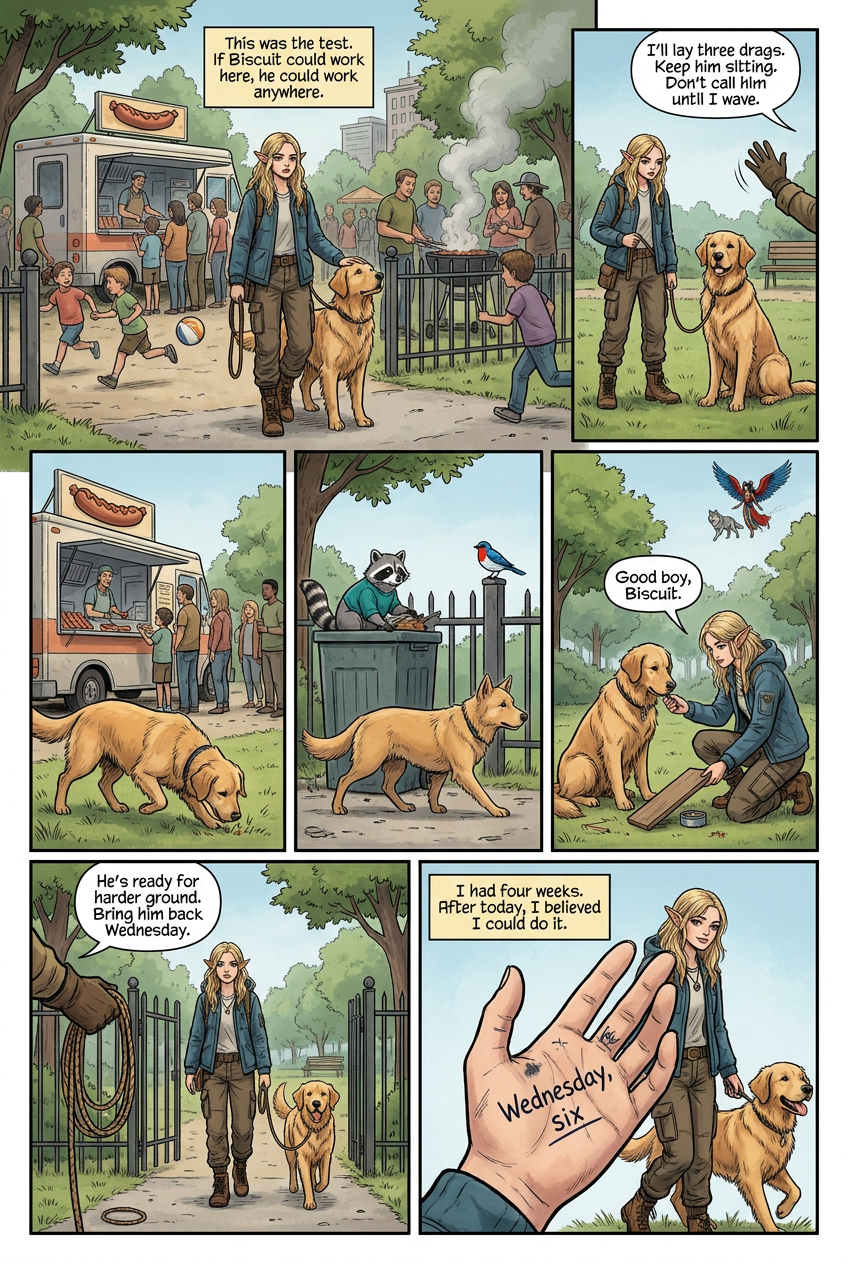
Saturday came heavy and bright. Alice packed a fresh scent tin, a short lead, and a whistle. She walked Biscuit into the town park at five to six. The park was worse than the trapper had promised. A food truck sold sausages near the gate. Children chased a ball across the grass. A group with a grill sent smoke over the fence. Wind came off the lake in gusts, then stopped, then came again. Biscuit's nose lifted at everything. Alice felt her stomach tighten. This was the test. If Biscuit could work here, he could work anywhere the ranger needed him. The trapper waited at the far corner with a canvas bag. He nodded at her and pointed at a stretch of open grass. "I'll lay three drags," he said. "You keep him sitting. Don't call him until I wave." Alice put Biscuit in a sit and held the lead loose. The trapper worked the wind, dragging the rag in a long curve behind a bench, past the grill smoke, and around a trash bin where a raccoon in a blue-green shirt was picking through wrappers. The raccoon watched him pass and went back to chewing. The trapper hid the tin under a loose board and waved. Alice unclipped the lead and gave the word. Biscuit lifted his nose. He took two steps toward the sausage truck. Alice's chest dropped. Then his ears set. He swung wide of the grill, cut around the bench, and put his nose down at the board. He sat hard. He did not move. Above the trees, a winged woman passed high over the park with a wolf watching from the base of a pine at the edge of the grass. Biscuit's ears twitched once at the shadow and stayed on the board. A small bird with a red head and blue wings dropped onto the fence, hopped twice, and flew off. Biscuit did not look up. Alice walked to him and lifted the board. She fed him from her hand. They ran it twice more. He found the tin both times, once through a knot of running children, once with a dog barking ten feet off. The trapper coiled his drag rope and said, "He's ready for harder ground. Bring him back Wednesday. I'll cross the drags and add a false line." Alice said she would. On the walk to the gate she wrote Wednesday, six on the back of her hand under the older ink. Biscuit trotted at her knee, loose and level. She had four weeks to give the ranger a tracking dog. After today she believed she could. She also understood what Wednesday meant. The trapper was not finished teaching, and she was not finished standing next to him to learn.
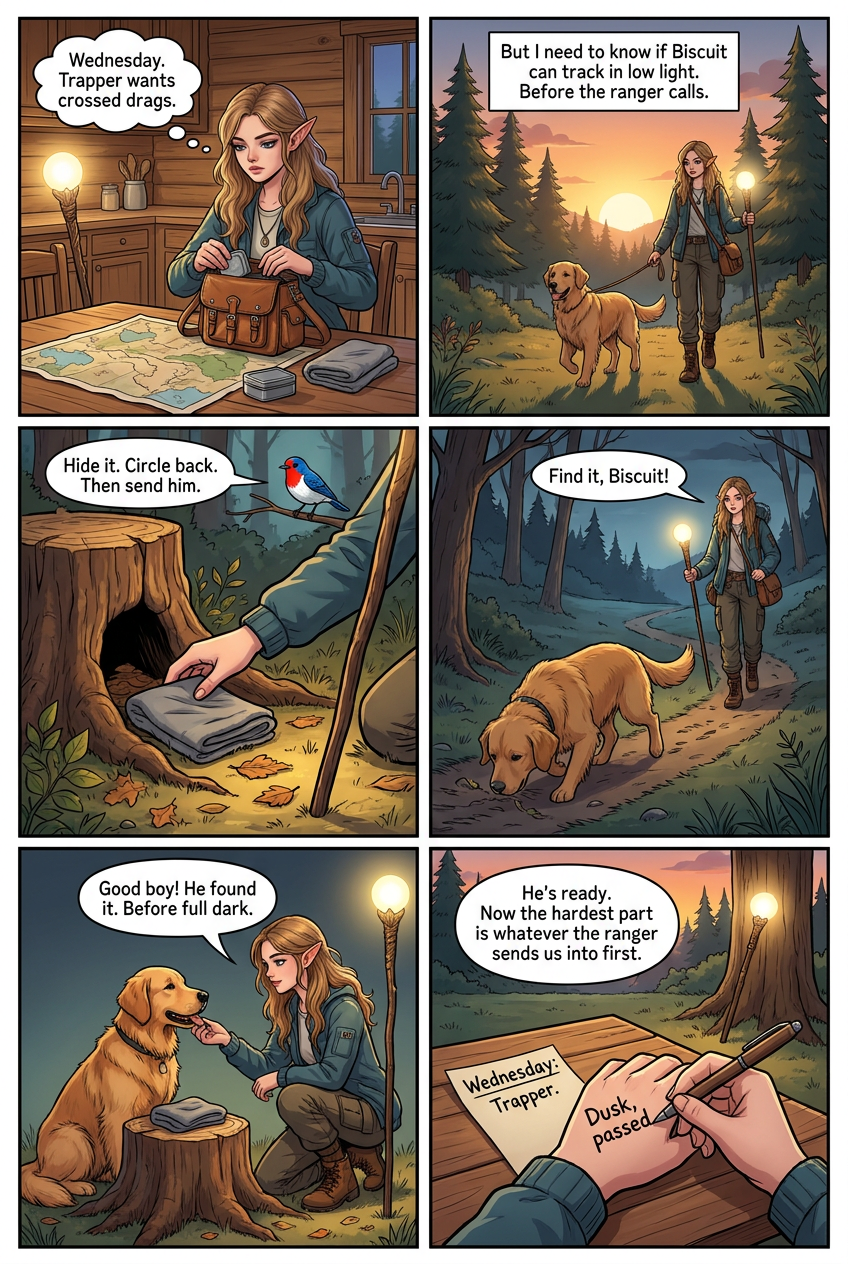
Wednesday came slower than Saturday had. Alice spent the afternoon at the kitchen table with her map, marking a fresh route along the low end of the ridge. The trapper wanted crossed drags and a false line. She wanted one more thing first. The ranger had asked for a working dog in four weeks, and dusk was when hikers went missing. If Biscuit could hold a scent as the light dropped, he could hold it anywhere. She packed her satchel with a scent tin, a whistle, and a folded cloth she had rubbed against her father's coat that morning. She left the house at five. The sun was already low behind the pines. Alice tightened her grip on her walking stick and thumbed the switch at its base. The ball on top brightened to a soft white. She had carried the stick since she was small. The light was for her, not for Biscuit. Tonight she meant to use it for both. At the trailhead she laid the plan out in her head. She would tie Biscuit at the marker stone, walk a curved line into the trees with the cloth, hide it under leaves, and circle back. Then she would send him. If he found the cloth before full dark, she had her answer. She walked the line. The light on her stick threw a clean pool ahead of her boots. She could see the scuffed dirt, the roots, the pale bellies of fallen leaves. She pressed the cloth into a hollow beside a stump and covered it. On the walk back a small bird with a red head and blue wings watched her from a low branch and did not move as the light passed under it. Biscuit was standing when she reached him. She unclipped the lead and gave the word. He put his nose down at once. He worked the curve she had walked, not the straight line between them. His tail stayed level. Twice he lifted his head, checked the air, and dropped it again. The light on her stick moved with him, lit the ground a step ahead of his nose. He did not need it. She did. She kept up. He sat hard at the stump. Alice knelt and lifted the leaves. The cloth was there. She fed him from her hand and let him lean against her knee. Full dark was still ten minutes off. She had her answer before she needed it. On the walk out she wrote it on the back of her hand under the Wednesday note. Dusk, passed. Then she stopped at the trailhead. Biscuit could track her father's scent in low light. That meant the ranger's next call could come at any hour, and she would have to say yes. It also meant Wednesday's session with the trapper was no longer the hardest thing on her week. The hardest thing was whatever the ranger sent her into first.
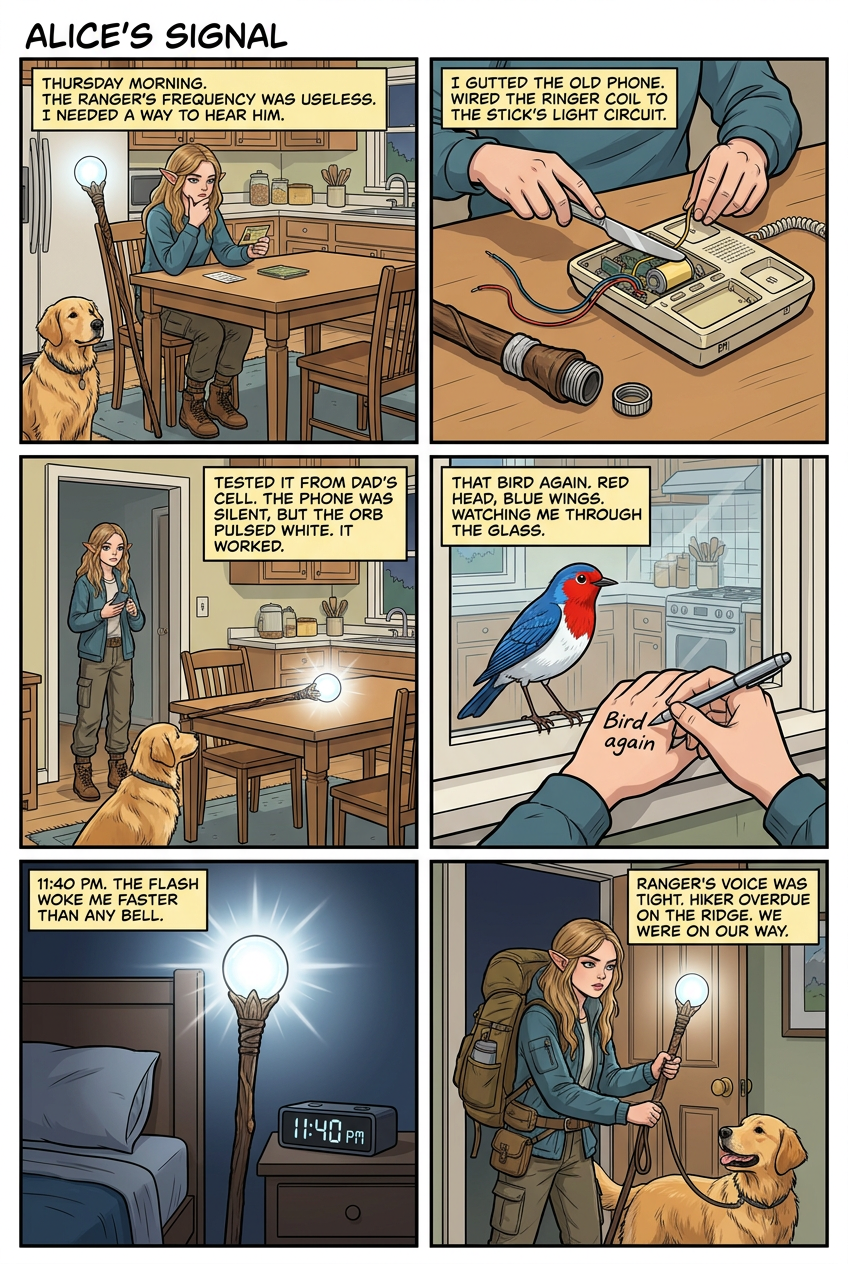
Thursday morning Alice sat at the kitchen table with the ranger's card in front of her. He had given her a radio frequency and a number to call. Neither worked at her house. The radio only reached the ridge. The phone rang in the front hall, and she slept in the back room. If a call came at two in the morning, she would miss it. A missed call meant a hiker waited longer in the dark. She had said yes to the ranger. She needed a way to hear him. She took her walking stick down from its hook by the door and set it on the table. The ball on top was cold glass. She thumbed the switch. The light came up soft and white, the same as always. She had used it as a lamp for years. She had never asked it to do anything else. She unscrewed the base. Inside were two wires, a small battery, and space she had never noticed. Enough space for a receiver. She walked to the hall and unplugged the phone. She carried it back to the table and opened its shell with a butter knife. Biscuit watched from the rug. His ears stayed up. He did not sit down hard. That was permission to keep going. She worked until noon. She pulled the ringer coil from the phone and wired it to the light circuit in the stick. She set the ringer to trip the light instead of a bell. When the phone rang, the ball on the stick would flash. She could sleep with the stick beside her bed. A flash on the wall would wake her faster than a bell down the hall. She tested it. She walked to the hall, lifted the receiver, and dialed her own line from her father's cell. The phone in the hall stayed silent. On the table, the ball on the stick blinked white, three quick pulses, then steady. Biscuit lifted his head and looked at the light. He did not flinch. He did not sit. He put his head back down. A small bird landed on the sill outside the kitchen window. Red head, blue wings, white breast. It watched the light pulse through the glass and did not fly off. Alice had seen the same bird on the trail two nights ago. She did not know what it meant. She wrote it on the back of her hand under the Wednesday note. Bird again. That night the stick flashed at eleven-forty. Alice was awake before the second pulse. She lifted the phone in the hall. The ranger's voice was tight. A hiker was overdue on the ridge, last seen at the lodge road. Alice said she was coming. She hung up, pulled on her boots, and clipped Biscuit's lead. The light on her stick steadied to white. The rescue had started on time.
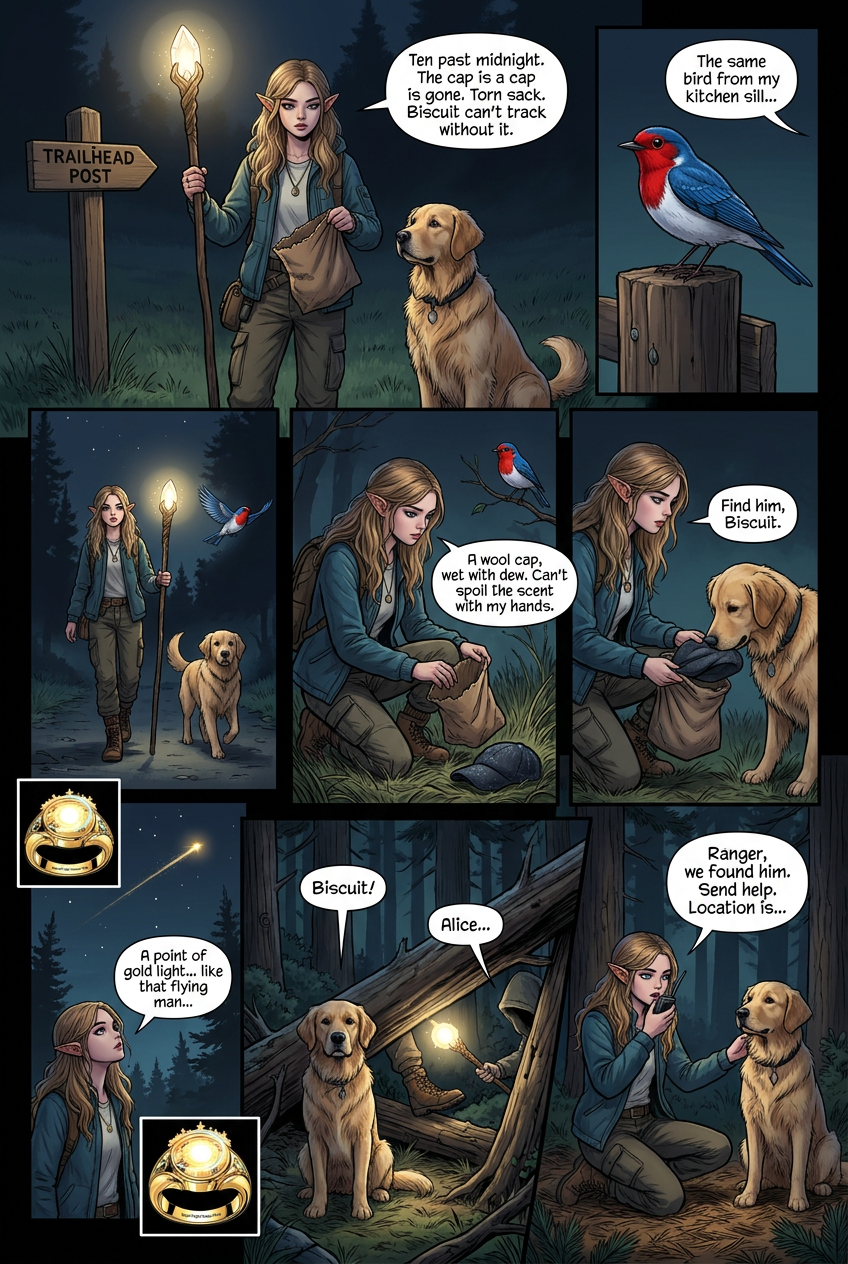
Alice reached the ridge at ten past midnight. The ranger had left a paper sack at the trailhead with the hiker's scent article inside, a wool cap taken from the lodge road. Alice opened the sack under the light of her stick. The cap was gone. The bottom of the sack was torn, and the tear was fresh. She turned the paper over in her hands. She checked the ground around the post. No cap in the grass. No cap on the road. Wind had pulled it out, or an animal had, or the ranger had grabbed the wrong bag. It did not matter which. Biscuit had nothing to smell. Without a scent, he could not track. Without tracking, the hiker stayed lost. Alice stood still and made herself think. She could not call the family at the lodge; they were an hour away and asleep. She could not wait for another article. She looked at Biscuit. His ears were up. He watched the trees. A bird dropped onto the trail post beside her, red head, blue wings, white breast. The same bird from her kitchen sill. It hopped once and looked at the torn sack. Then it flew ten feet up the road and landed again. Alice took a step. The bird flew ten more feet. She followed. Fifty yards up the lodge road, the bird settled on a low branch above a patch of matted grass. A wool cap lay in the grass, wet with dew. The wind had carried it, or the bird had. Alice did not stop to ask. She picked up the cap with the paper sack so her own hands would not spoil the scent. She held it low for Biscuit. He pushed his nose into the wool. His tail went stiff. He pulled toward the pines. Above them, high over the ridge, a small point of gold light crossed the sky and was gone. She had seen a man fly like that once in a news clip, wearing a ring. She did not think about it now. She had a scent. She had a dog. She had a direction. Biscuit worked the trail into the dense pines with his nose low. Alice kept the light on her stick steady and let him lead. Twenty minutes in, he stopped at the base of a deadfall and sat down hard. He did not growl. Alice crouched beside the logs and shone the light between them. A boot stuck out, and above the boot, a leg, and a voice said her name in a thin, tired way. The hiker was alive. Alice keyed the radio and gave the ranger the location. Then she sat down next to Biscuit in the pine needles and waited for him to get up on his own.
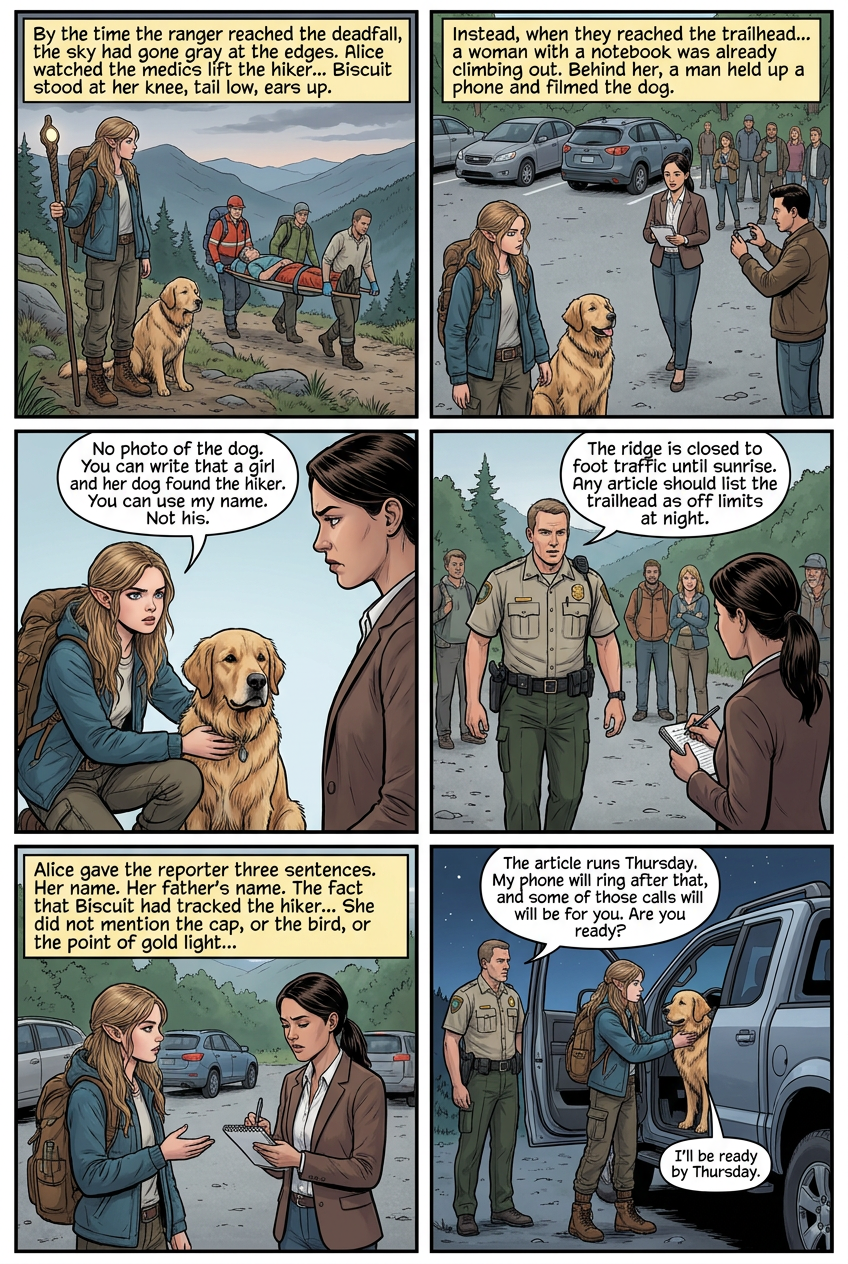
By the time the ranger reached the deadfall, the sky had gone gray at the edges. Alice watched the medics lift the hiker onto a litter and carry him down the ridge. Biscuit stood at her knee, tail low, ears up. She thought they would walk home and sleep. Instead, when they reached the trailhead, three cars were parked on the lodge road, and a woman with a notebook was already climbing out. The woman said she wrote for the neighborhood paper. She had heard the radio call at the ranger station. She wanted a photo of Biscuit and a few words about the rescue. Behind her, a man held up a phone and filmed the dog. Two more people walked up from the lodge road, drawn by the lights. Alice counted them and did not like the number. A story in the paper meant more people on the ridge. More people meant more scent, more noise, more distraction for a dog she still needed to train. Alice knelt and put her hand on Biscuit's shoulder. He was tired. His flanks moved fast. She thought about what the trapper had told her in the park: a working dog is ruined by strangers who want to pet him after a job. She stood up. "No photo of the dog," Alice said. "You can write that a girl and her dog found the hiker. You can use my name. Not his." The reporter frowned. She said a photo would help people care. Alice said she did not want people to care that way. She said Biscuit worked for the ranger now, and the ranger needed him clean. The reporter looked at the ranger, who had come up behind Alice. The ranger nodded once. He told the small crowd that the ridge was closed to foot traffic until sunrise and that any article should list the trailhead as off limits at night. He said it in the voice he used on the radio, flat and final. The man with the phone lowered it. Alice gave the reporter three sentences. Her name. Her father's name. The fact that Biscuit had tracked the hiker through the pines in under an hour. She did not mention the cap, or the bird, or the point of gold light she had seen cross the sky. Those were not for the paper. The reporter wrote it down and closed her notebook. The cars started up and pulled away down the lodge road. The ranger walked with Alice to her father's truck. He said the article would run Thursday. He said his phone would ring after that, and some of those calls would be for her. He asked if she was ready for that. Alice looked down at Biscuit, who had finally sat on his own in the gravel. She said she would be by Thursday. Then she opened the truck door and lifted him in.
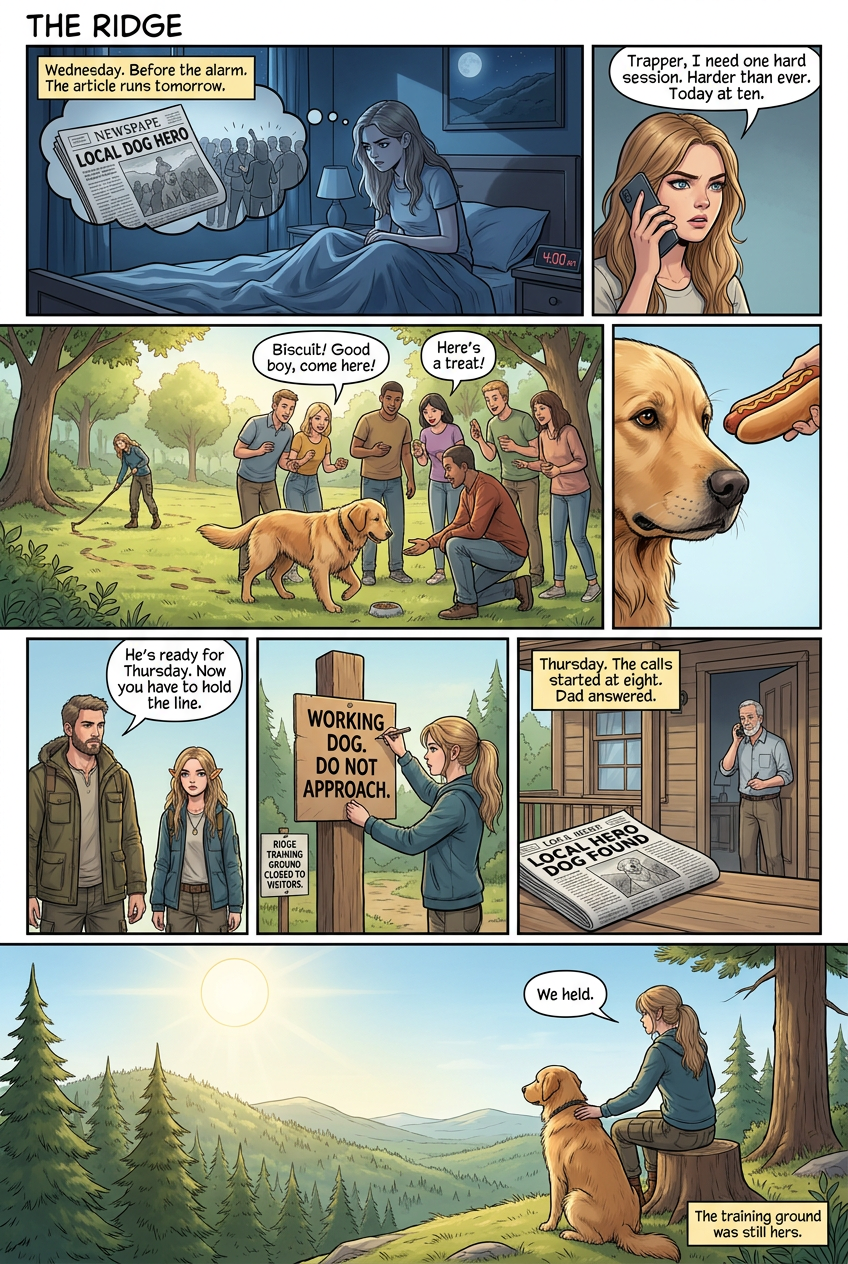
Alice woke Wednesday before the alarm. The article would run the next morning. She thought about what the ranger had said in the gravel lot: the phone would ring, and some of those calls would be for her. If strangers came to the ridge looking for the famous dog, Biscuit's training would break. He would learn to expect hands and voices at the end of every trail. She sat up in bed and made a plan while it was still dark. She called the trapper first. She said she needed one hard session before Thursday, harder than any they had run. She needed proof Biscuit could work through people who wanted him. The trapper said he could bring five friends to the town park at ten. He said he would tell them to crowd the dog, offer food, and call his name. Alice said that was what she wanted. At the park she laid a scent drag through the picnic tables and around the pavilion. The trapper's friends walked in loose groups, eating, laughing, holding out hands. One knelt and called Biscuit by name. Alice watched from thirty feet away. Biscuit's ears went flat once. He sat down hard. Alice waited. He looked at her, then at the ground, then stood on his own and put his nose back to the drag. He found the tin behind the trash barrel in four minutes. They ran it three more times. The trapper made the crowd tighter each round. On the last run, a woman waved a hot dog under Biscuit's nose. He turned his head one inch, then kept working. He found the tin under the bench. The trapper walked over and did not smile. He said the dog was ready for Thursday. He said Alice was the one who had to hold the line now. Strangers would come. She had to keep them off the training ground and away from the dog's face. Alice drove home and wrote two signs on cardboard. One said WORKING DOG. DO NOT APPROACH. The other said RIDGE TRAINING GROUND CLOSED TO VISITORS. She nailed the first to the trailhead post and the second to the fence at the lodge road. She called the ranger and asked him to add her father's number to the article as the contact for anyone wanting to meet the dog. The ranger said he would. He said her father could screen the calls and turn away the ones that were not emergencies. Thursday morning the paper landed on the porch. Alice read it once and set it down. Her father's number was printed at the bottom, not hers. The phone rang at eight. It rang at nine. It rang at ten. Her father answered each time and wrote nothing down. Alice took Biscuit to the ridge at noon and ran a clean drag through the pines. No one came up the trail. Biscuit worked without lifting his head. She sat on a stump after and put her hand on his shoulder. He had held through the crowd. He would hold through the week. The training ground was still hers.
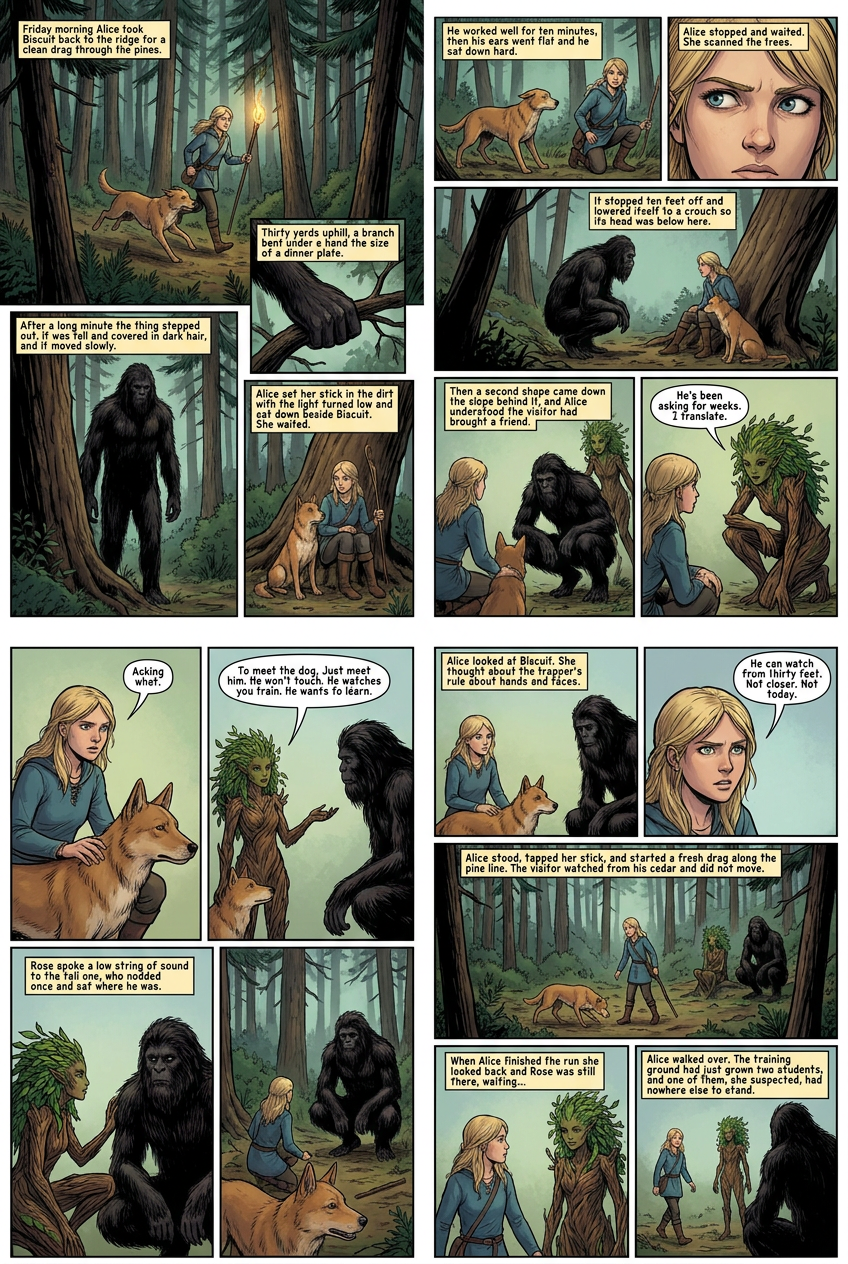
Friday morning Alice took Biscuit back to the ridge for a clean drag through the pines. He worked well for the first ten minutes, then his ears went flat and he sat down hard. Alice stopped and waited. She scanned the trees. Thirty yards uphill, behind a leaning cedar, something tall shifted its weight and a branch bent under a hand the size of a dinner plate. She had seen the sign for three days now: broken huckleberry at shoulder height she did not have, a print in the mud twice the length of her boot, a smell like wet bark and sweat on the wind. Biscuit did not growl. He watched the cedar and pressed his shoulder against her knee. Whatever stood there had been shadowing their runs, and it had come closer each morning. Alice set her stick in the dirt with the light turned low and sat down beside Biscuit. She waited. After a long minute the thing stepped out. It was tall and covered in dark hair, and it moved slowly, the way the trapper had taught her friends to move at the park. It stopped ten feet off and lowered itself to a crouch so its head was below hers. Then a second shape came down the slope behind it, and Alice understood the visitor had brought a friend. This one was not tall or hairy. She was the color of green leaves and yellow boots, with a crown of foliage for hair and bark along her arms. She said, "He's been asking for weeks. I translate." Alice kept her hand on Biscuit's shoulder. "Asking what." "To meet the dog. Just meet him. He won't touch." Rose crouched too, so all four of them were low. "He watches you train. He wants to learn." Alice looked at Biscuit. His ears were still flat, but he was not shaking. She thought about the ranger, and the phone, and the trapper's rule about hands and faces. Then she thought about who else knew this ridge better than any map. She said, "He can watch from thirty feet. Not closer. Not today." Rose spoke a low string of sound to the tall one, who nodded once and sat where he was. Alice stood, tapped her stick, and started a fresh drag along the pine line. Biscuit rose on his own and put his nose to the ground. The visitor watched from his cedar and did not move. When Alice finished the run she looked back and Rose was still there, waiting, as if she had a question of her own to ask. Alice walked over. The training ground had just grown two students, and one of them, she suspected, had nowhere else to stand.
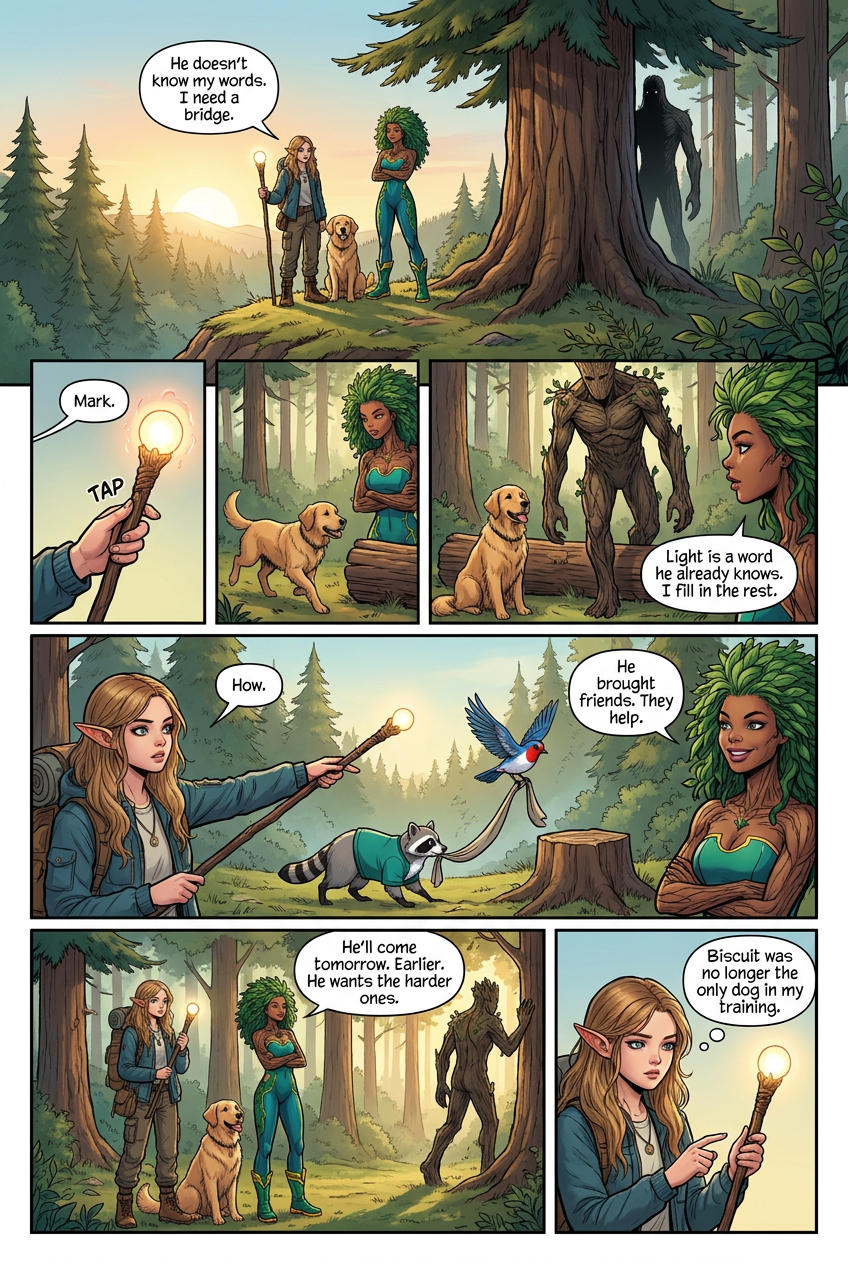
Saturday morning Alice came back to the ridge with a scent tin in her satchel and a plan she was not sure would work. The tall creature was already waiting behind his cedar, thirty feet off, exactly where she had put him. Rose stood beside him in her green and yellow boots, arms folded. Biscuit sat at Alice's knee and watched them both. The problem was simple. Alice could train Biscuit with hand signals and voice. She could not train the creature with anything. He did not speak her words, and she did not speak his. If he was going to learn beside her dog, she needed a bridge. She tapped her stick in the dirt and the ball of light on top flared, then dimmed. She had been thinking about it all night. The light ran off a small circuit she had already rewired once for the phone. She turned the dial down low and pointed the stick at a log ten feet ahead. "Mark," she said to Biscuit. He trotted to the log and sat. She raised the stick. The light pulsed twice, short and short. Rose watched the pulses. Then Rose spoke a low string of sound to the tall one. He rose from his crouch, walked to the log, and sat down beside Biscuit. Alice's throat went tight. She tried it again with a different target, a stump at the edge of the pines. One long pulse. Rose translated. The creature went to the stump. Biscuit followed on Alice's hand signal and sat at his side. "How," Alice said. Rose shrugged. "Light is a word he already knows. I fill in the rest." A small raccoon in a blue-green shirt scuttled out from behind Rose's boot, dragged a strip of cloth across the clearing, and vanished into the huckleberry. A red-headed bird dropped from a branch, picked up the far end of the cloth, and set it neatly at the base of the stump. Alice stared. Rose did not explain. "He brought friends," she said. "They help." By noon Alice had run four drags with three students working the line. The creature learned the sit, the mark, and the wait on light alone. Biscuit read the creature the way he read Alice, and Alice began to read the creature through Rose. When she called the session done, the tall one stood, pressed a palm flat to the cedar bark, and walked back up the slope. Rose stayed. "He'll come tomorrow," she said. "Earlier. He wants the harder ones." Alice looked at her stick. The light was steady now. She had a bridge, and she had a second tracker on the ridge who knew ground no map had ever held. She also had a problem she had not planned for. Biscuit was no longer the only dog in her training.
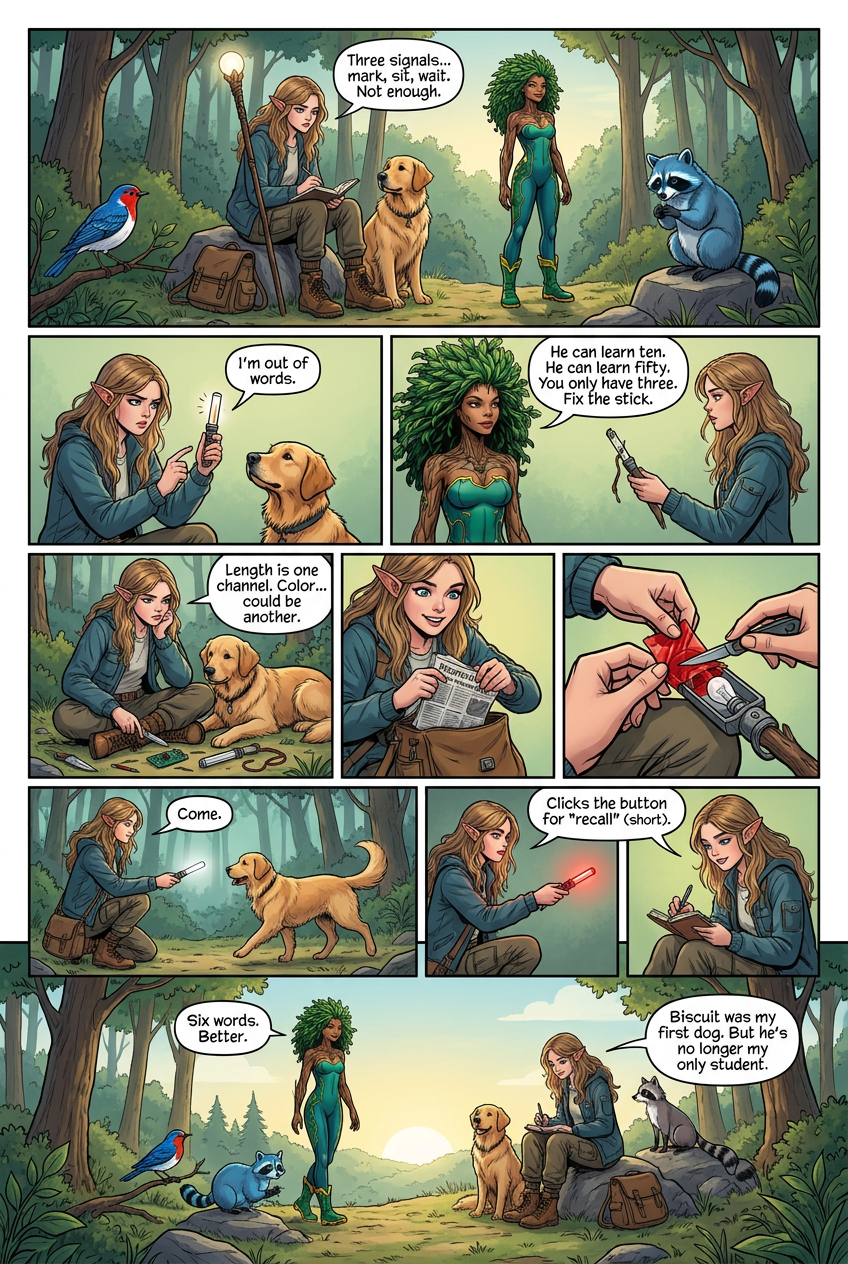
Sunday morning Alice climbed the ridge before the light was full. Rose was already there in her green and yellow boots. The tall creature crouched behind his cedar. The raccoon in the blue-green shirt sat on a stone, cleaning his paws. The red-headed bird watched from a low branch. Alice set her satchel down and pulled out her notebook. She had a problem she had worked half the night, and no solution yet. The light stick had three signals. Short-short meant mark. One long meant sit. Two long meant wait. That was all she could get from the circuit without rewiring it again. Yesterday it had been enough. Today she wanted to teach heel, recall, and quiet, and she had no more pulses to give. She raised the stick and tried a short-long. The ball flickered and went dark. She thumbed it back on. The creature tilted his head. Biscuit looked up at her, waiting. "I'm out of words," Alice said. Rose walked over and looked at the stick. "He can learn ten. He can learn fifty. You only have three." She said it plain, no blame in it. "Fix the stick." Alice sat down in the pine needles and opened the housing with her pocket knife. The circuit was a small board she had soldered herself. She had wired it for on and off, then for pulse. She could not fit a second dial without a second switch, and she had no second switch. She stared at the board. Biscuit pressed his shoulder against her knee. She thought about the phone line at home, how one ring meant a call and two rings meant her father's brother. Length was one channel. Color could be another. She dug in her satchel and found the strip of red cellophane from the newspaper's flash. She cut a piece, wedged it under the glass on one side of the ball, and closed the housing. Now the light burned white on one face and red on the other. She turned the stick and the color changed. Six signals. She wrote them down. White short-short: mark. Red short-short: recall. White long: sit. Red long: quiet. White long-long: wait. Red long-long: heel. She stood and pointed the stick at Biscuit, red face out, one short pulse. "Come," she said. Biscuit came. She turned the stick, red still out, and pulsed short-short toward the creature. Rose spoke a low string of sound. The tall one rose from his crouch and walked to Alice's side. He stopped four feet off, careful of the space. The raccoon scampered up and sat by his foot. The bird dropped down and landed on Rose's shoulder. "Six words," Rose said. "Better." Alice closed the notebook. She had a bridge that carried more than she could yesterday, and a second student who now answered to recall. The ridge felt smaller. Biscuit was still her first dog. He was no longer her only one.
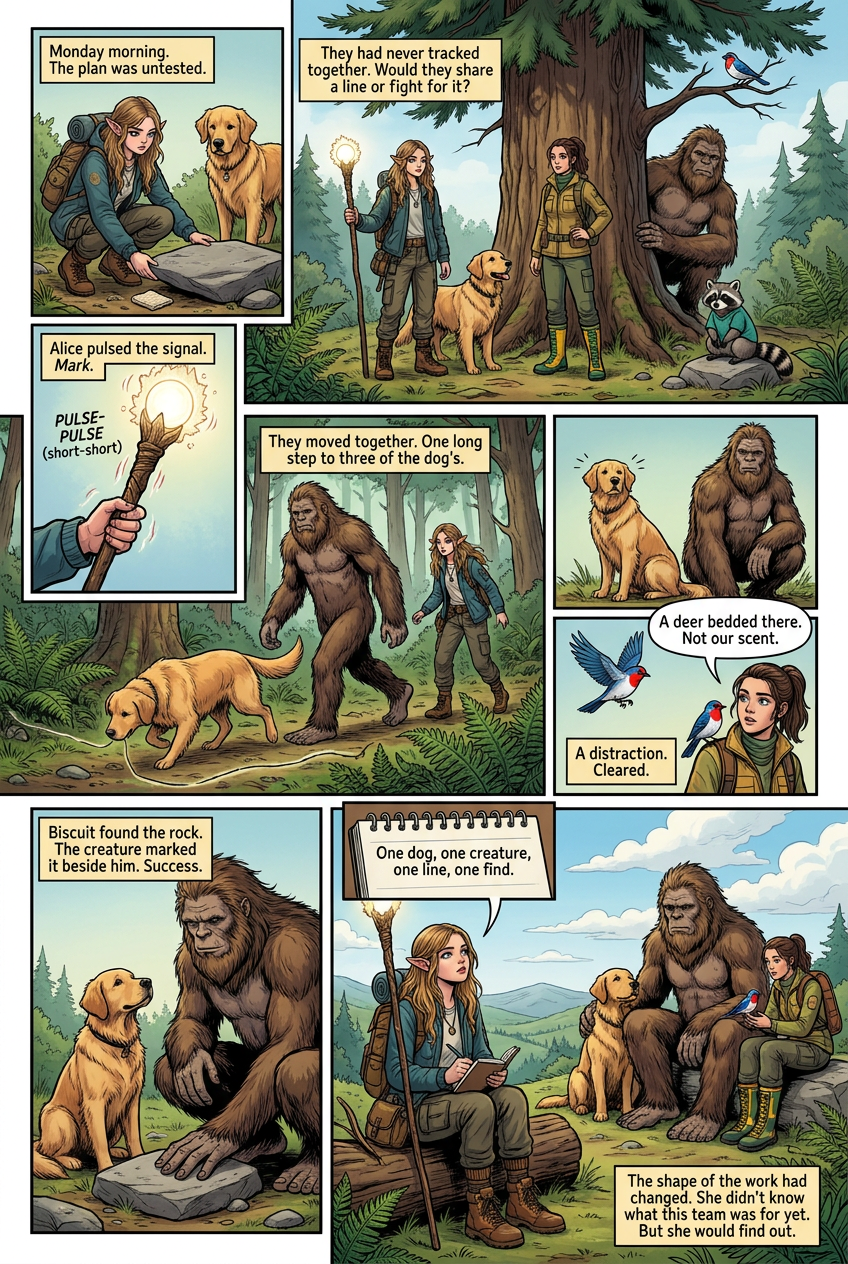
Monday morning Alice climbed the ridge with a scent tin in her satchel and a plan she had not yet tested. Biscuit worked scent well. The tall creature answered her six signals. But she had never asked them to track together. She did not know if they would share a line or fight for it. Rose met her at the cedar in her green and yellow boots. The creature crouched behind the tree. The raccoon in the blue-green shirt sat on a stone. The bird with the red head and blue wings watched from a branch. Alice opened the tin and let them both smell the wool square inside. Then she walked off the trail and hid the square under a flat rock a hundred yards north. She came back and pointed the stick, white face out, and pulsed short-short. Mark. Biscuit's nose dropped. Rose spoke a low string of sound to the creature. He rose and set his hand on the ground beside Biscuit. Alice held her breath. Biscuit pulled north. The creature moved with him, one long step to every three of the dog's. They did not crowd each other. When Biscuit cast left off the line, the creature stopped and waited. When Biscuit locked on again, the creature followed. Halfway to the rock, the dog's ears went flat and he sat down hard. Alice froze. The creature froze with him. The bird dropped from the branch and flew ahead, low over the ferns, then circled back and landed on Rose's shoulder. Rose listened. "A deer bedded there," she said. "Not our scent." Biscuit stood on his own. Alice let out her breath. They moved on. Biscuit found the rock, nosed it, and sat. The creature crouched beside him and set one broad hand flat on the stone. Mark. Alice wrote it down in the notebook. One dog, one creature, one line, one find. They had worked as if someone had raised them for it. She closed the book. The ridge was wider than she had thought a month ago, and she had two students on it now, not one. The arc she had promised the ranger was Biscuit alone, a tracking dog for the woodland. That promise was still open. But the shape of the work had changed under her hands, and she could feel it. She looked at the tall one, and at Biscuit leaning against his knee, and at Rose, and at the bird. She did not know yet what a team like this was for. She would find out.
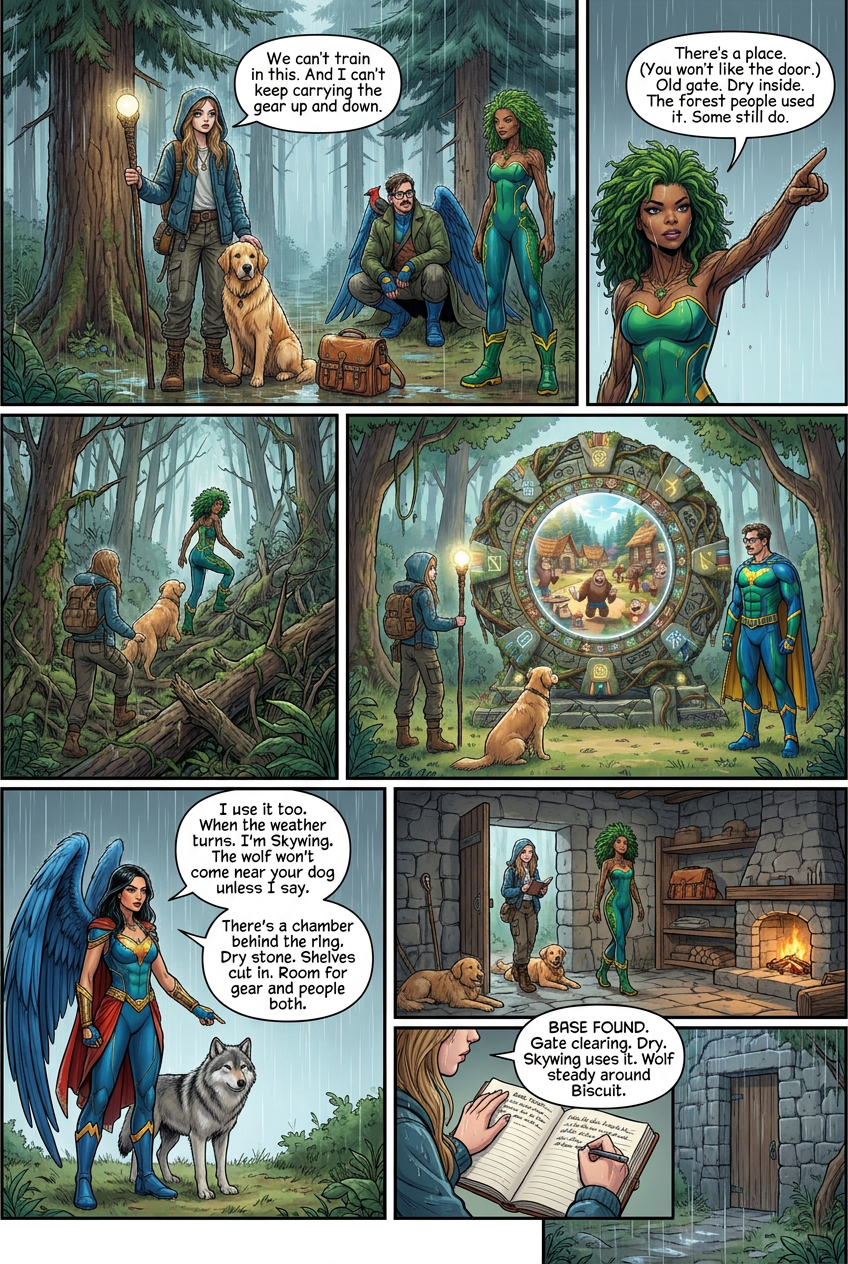
Tuesday the rain came in hard before dawn. Alice stood under the cedar with Biscuit pressed against her leg and water running off her hood. The tall creature crouched under a pine with the raccoon inside his coat and the red-headed bird tucked against his neck. Rose stood in the open in her green and yellow, wet through, unbothered. The scent tins in the leather satchel were beading up. The notebook pages curled at the corners. Alice had no dry place to work from. She had been running the sessions off the ridge itself, packing everything up each night and hauling it home. The team had outgrown that. They needed a base. "We can't train in this," Alice said. "And I can't keep carrying the gear up and down." Rose wiped water off her jaw. "There's a place. (You won't like the door.)" She pointed uphill, past the deadfall, into a stand Alice had never crossed. "Old gate. Dry inside. The forest people used it. Some still do." Alice followed her. Biscuit came at her heel. The creature ducked branches behind them. Twenty minutes up, past a shelf of rock, they stepped into a clearing Alice had walked around a dozen times without seeing. A ring of stone stood in the middle of it, taller than the creature, wound with living vines. The center held an image like a window: small wooden houses, a dirt path, hair-covered figures waving. One of them held up a card. Another laughed. Alice's stick went dim in her hand, then bright again. Biscuit's ears stayed up. He did not sit. A winged woman stood at the edge of the clearing with a gray wolf at her knee. Horns curled from her head. Her wings were folded tight against the wet. "I use it too," she said. "When the weather turns. I'm Skywing. The wolf won't come near your dog unless I say." She looked at the creature and nodded once, as if they had met. "There's a chamber behind the ring. Dry stone. Shelves cut in. Room for gear and people both." Alice walked around the gate. Behind it, set into the hillside, was a low doorway she would have missed from any other angle. Inside: a stone room the size of a small cabin, dry, cold, quiet. Shelves along one wall. A hearth cut into the far corner. Water did not reach the floor. She set the satchel down on a shelf. Biscuit walked the room, sniffed each corner, and lay down by the door. He did not get up. That was her signal. She took out the notebook. The pages had stopped curling. She wrote: base found. Gate clearing. Dry. Skywing uses it. Wolf steady around Biscuit. She closed the book. Outside, the rain kept coming. Inside, the team had walls. She did not know yet who else came through the gate, or what the image in the ring meant, or why Skywing had been up here in weather like this. Tomorrow she would ask.
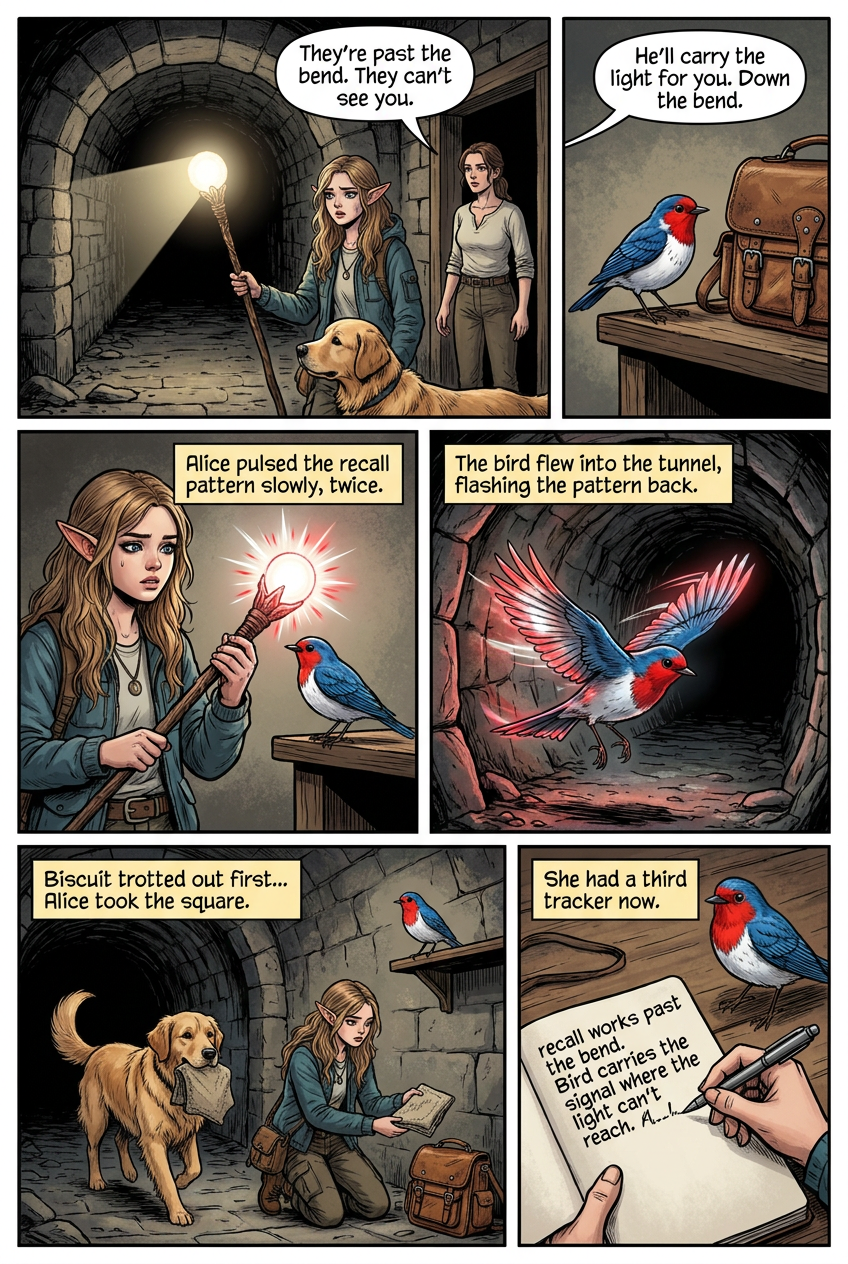
Wednesday inside the chamber, Alice ran a wait-and-recall drill down the side tunnels she had not yet mapped. Biscuit and the tall creature took the scent from a wool square and moved off together into the dark. She counted to twenty and lifted the stick to signal recall. White pulse, red pulse, white. The light hit the tunnel wall thirty feet in and stopped. The passage bent left. Her signal could not turn corners. She waited. Nothing came back. Rose stood at the doorway with her hands loose at her sides. "They're past the bend," she said. "They can't see you." Alice stepped into the tunnel and tried again. The beam died against stone. She could hear Biscuit's nails somewhere ahead, faint, moving further. Her chest went tight. She had built a signal system that worked in open air and failed the first time the ground curved. A small bird dropped from a crack in the ceiling and landed on the shelf beside the satchel. Blue wings, white breast, red head. Alice knew it. It had shown her the wool cap in the grass the night of the rescue. Rose watched it a moment. "He'll carry the light for you," she said. "Down the bend. Around corners. As far as they've gone." Alice looked at the bird. The bird looked at the stick. She lifted the ball close and pulsed the recall pattern slowly, twice, so it could see the sequence. The bird lifted off and flew into the tunnel, quick and low, flashing the pattern back from its own bright feathers as it went, red and white and red, alive in the dark where her beam had died. Alice heard the nails stop. Then turn. Then come. Biscuit trotted out first with the wool square in his mouth. The creature ducked through the low arch behind him, the raccoon riding his shoulder. The bird landed back on the shelf and shook itself. Alice knelt and took the square from Biscuit. He sat, then lay down at her boot. That was her signal. She wrote in the notebook: recall works past the bend. Bird carries the signal where the light can't reach. Then she closed the book and looked at the bird on the shelf. She had a third tracker now, and a way to run the tunnels without losing her team. She still did not know how deep the tunnels went, or where they ended, or what her team would find at the bottom.
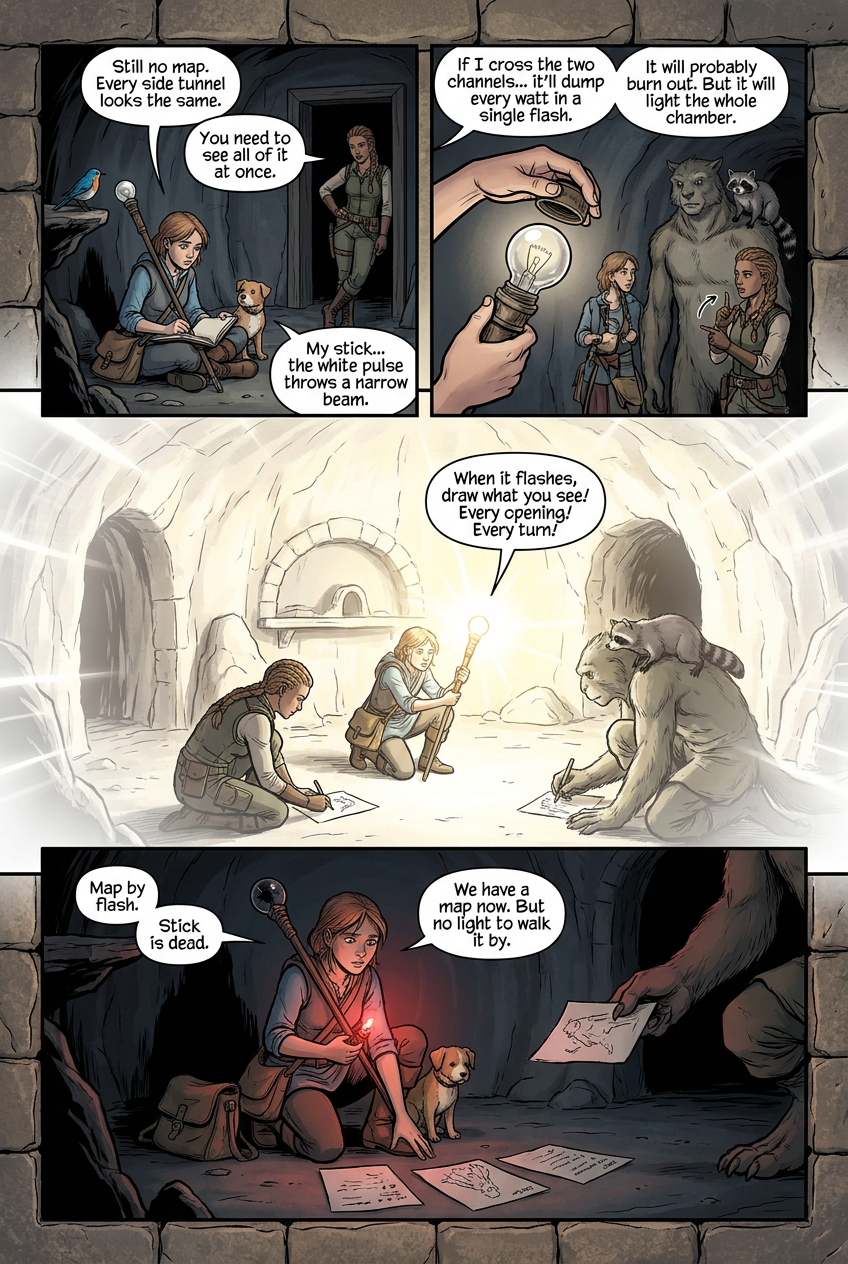
Thursday morning Alice sat on the chamber floor with her notebook open on her knee. The bird could carry her signal past a bend, but she still had no map. Every side tunnel looked the same. Biscuit had come back yesterday with the wool square, but she could not have told anyone the shape of the passage he ran. Rose leaned in the doorway. "You need to see all of it at once," she said. Alice looked at her stick. The white pulse threw a narrow beam. The red pulse threw a narrower one. She had built the light to point, not to fill. She turned the stick over in her hands and thought about the glass ball at the top. She unscrewed the cap. The filament sat in a small cage, wired to a switch she had modified twice already. She had never pushed all the current through it at once. If she crossed the two channels and held the switch, the ball would dump every watt in a single flash. It would probably burn out. It would probably light the whole chamber and every tunnel mouth that opened off it, long enough to see. She brought Biscuit and the tall creature in from the arch. She had the blue-winged bird on the shelf and the raccoon on the creature's shoulder. She told Rose what she meant to do. Rose signed it across to the creature, who nodded once. Alice tore three blank pages from the notebook and set them on the floor with a pencil. "When it flashes," she said, "draw what you see. Every opening. Every turn you can catch." Rose translated. The creature picked up the pencil in two thick fingers. Alice knelt at the center of the chamber, crossed the wires at the base of the stick, and pressed the switch. The ball flared white, so bright the walls went flat and every crack showed. She saw seven tunnel mouths where she had counted four. She saw a low arch behind the shelf she had never noticed. She saw the floor slope down toward the far wall. The flash lasted maybe two seconds. Then the glass cracked and the light died. The chamber went black except for the small red backup she kept in her satchel. Alice fumbled it on. The creature was already drawing. Biscuit sat at her boot. She looked at the three sheets on the floor: her own quick lines, the creature's careful marks, Rose's short notes at the margins. Between the three of them they had the shape of the room and every mouth that led out of it. Alice wrote in her notebook: map by flash. Then she wrote: stick is dead. She closed the book. She had a map now, and no light to walk it by.
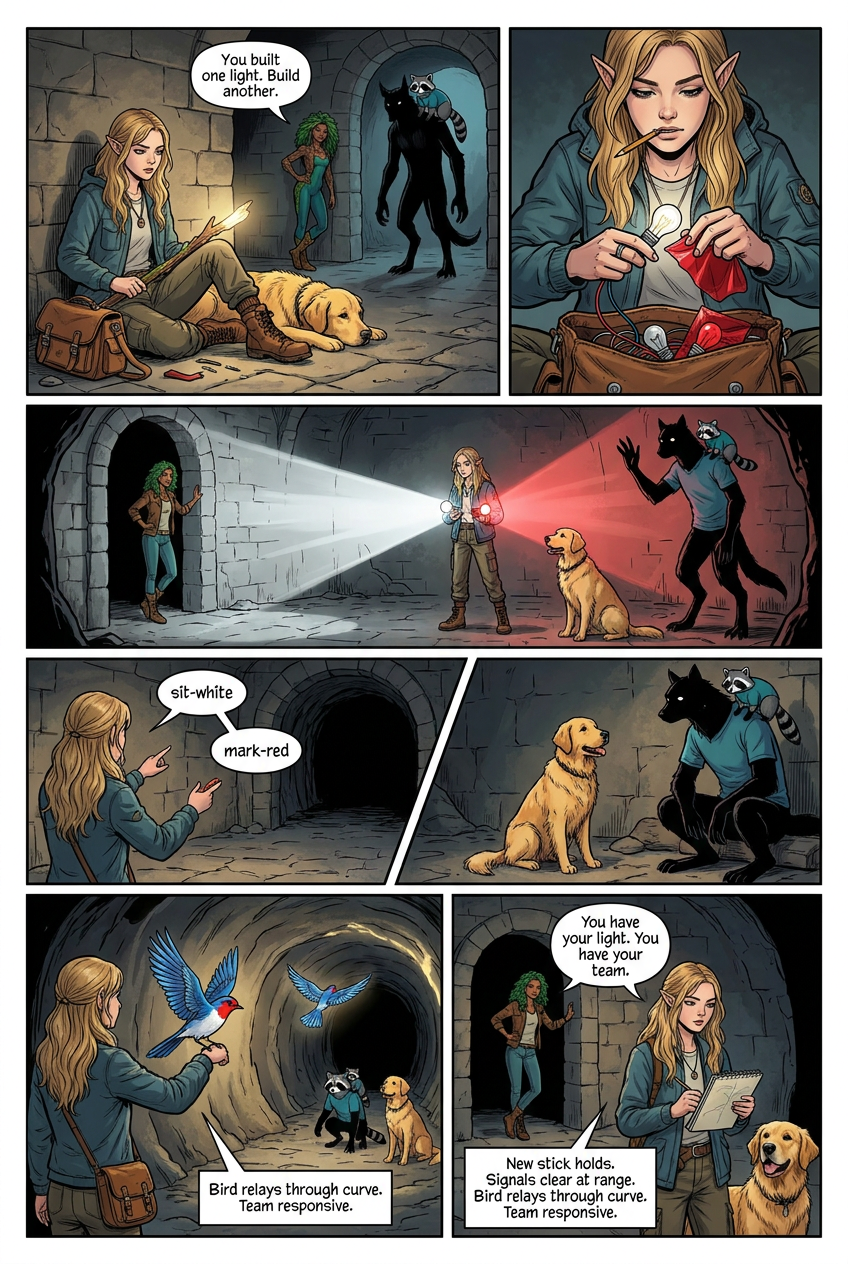
Friday morning Alice sat on the chamber floor with the cracked stick across her knees. The small red backup light in her satchel would not carry across the room, let alone into the tunnels. She had a map now and no way to signal her team through it. Biscuit lay at her boot. The tall creature waited by the arch with the raccoon on his shoulder. Rose leaned in the doorway. "You built one light," Rose said. "Build another." Alice opened her satchel and laid out what she had. Wire from the phone rig. Two spare bulbs from the ranger's kit. The red cellophane. A fresh switch. She had learned the mistake of the first stick: one filament, one channel, too much load. This time she would split the current. Two bulbs, wired parallel, one wrapped red. A heavier switch that could hold the draw. She worked through the morning with the pencil in her teeth. By noon she had a new head fitted to the split end of the stick. She tested the white pulse at the far wall. The beam hit clean and threw a circle wide enough to cover the arch. She tested the red. The circle held. She stepped to the mouth of the third tunnel and flashed both across the chamber. Biscuit's ears came up at forty feet. The tall creature raised his hand at the same distance. Rose nodded once. "Farther," Alice said. She walked the creature and Biscuit to the shelf and sent them to opposite tunnel mouths. She flashed sit-white. Biscuit sat. The creature sat. She flashed mark-red. Both fixed on her. She flashed recall, white then red. They came in together across the chamber floor. She still had the curves to solve. She whistled for the blue-winged bird. The bird dropped from the shelf and took its perch on her wrist. She flashed the recall pattern slow. The bird beat its wings, and the pattern flashed back off its feathers, bright enough to bounce down a bend. Alice sent it into the second tunnel. She sent the creature after it with Biscuit at his heel. She counted to twenty and flashed recall through the bird. Both came back at a steady pace, no confusion, no waiting at the corner. Rose watched from the arch. "You have your light," she said. "You have your team." Alice wrote in the notebook: new stick holds. Signals clear at range. Bird relays through curve. Team responsive. She closed the book. She looked at the seven tunnel mouths on her map. Yesterday she had a chamber and no way to work it. Today she had a light that filled the room and a bird that carried it around corners. The deeper tunnels were open to her now. She stood, and Biscuit stood with her.
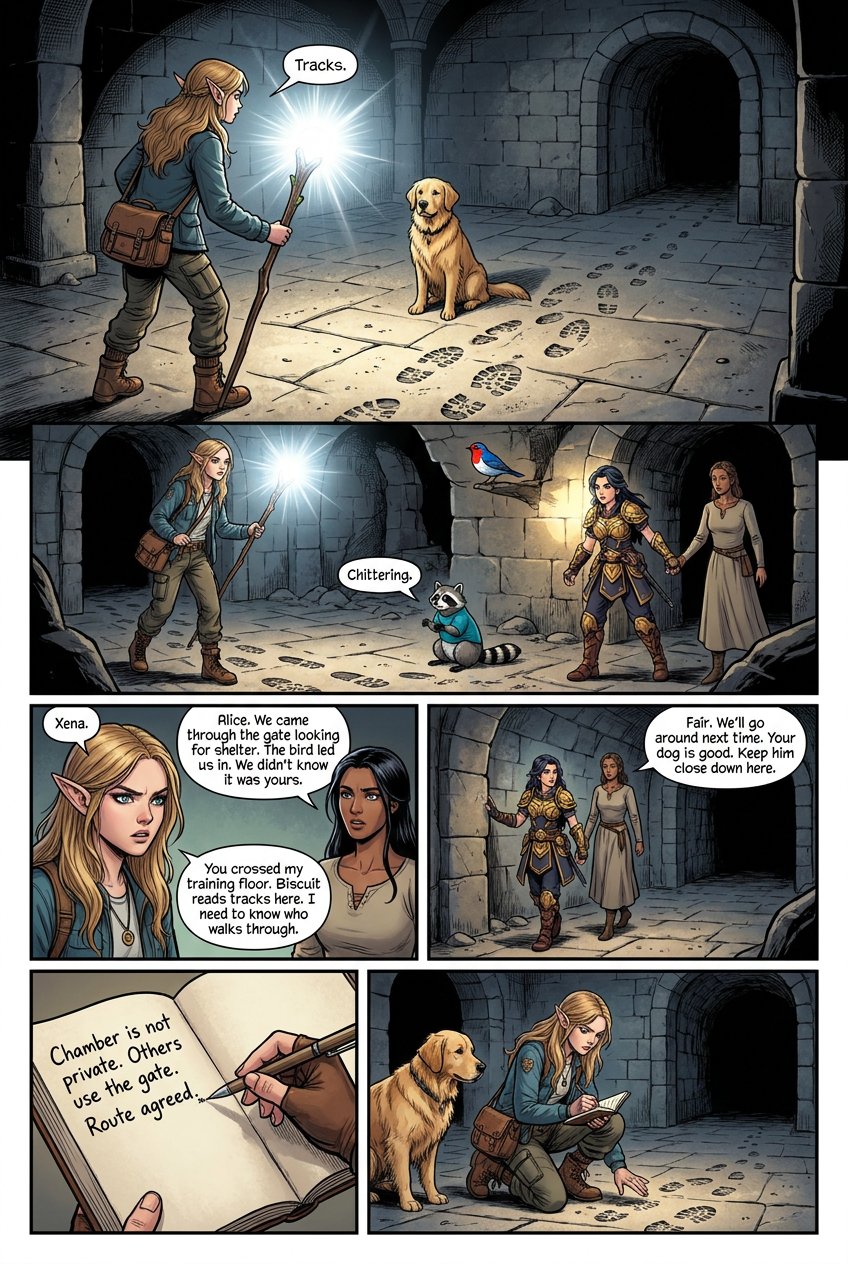
Alice stepped back into the chamber Saturday at dawn with the new stick in her hand and her satchel on her hip. Biscuit padded ahead and stopped short at the center of the floor. His ears went flat. He sat down hard. Alice froze. She lifted the stick and washed white light across the stones. Tracks crossed the floor from the fourth tunnel to the second. Two sets. One boot, one boot. Human. Fresh enough that the dust at the edges had not yet settled. Alice knelt. The prints were side by side, close, one pair heavier than the other. Someone had walked here holding hands with someone else. She unrolled her map on her knee. She had counted seven tunnel mouths. She had told no one about the chamber but Rose and the tall creature. Biscuit had not growled. He only sat. That meant strange, not danger. Alice waited beside him with her hand on his shoulder. She counted to thirty. His ears lifted. He stood. She followed the tracks toward the second tunnel with the stick held low. The raccoon in the blue shirt trotted out of the dark ahead of her, sat on its haunches, and chittered once. Behind it came two figures. A woman in gold armor with a sword at her hip. Beside her, a taller woman whose hand the first one held. The armored woman stopped when the light hit her face. She let the other's hand go. "Xena," Alice said. She had heard the name from Rose, once, in passing about the gate. "Alice." Xena's voice was low and flat. "We came through the gate looking for shelter. The bird led us in." She nodded at the small blue-winged robin on the ledge above. "We didn't know it was yours." Alice looked at the second woman. She was tall, plain-dressed, with a quiet face. Xena did not name her, and Alice did not ask. "You crossed my training floor," Alice said. "Biscuit reads tracks here. I need to know who walks through." Xena nodded once. "Fair. We'll go around next time. Show me the line." Alice showed her the edge of the floor and the wall route past it. Xena walked it once, the other woman behind her, and marked the turns with her eyes. She did not ask twice. When they reached the far arch, Xena looked back. "Your dog is good," she said. "Keep him close down here." Then the two of them were gone into the fourth tunnel. Alice knelt and brushed the boot prints away with her palm until the floor was clean again. Biscuit watched her work. She wrote in the notebook: chamber is not private. Others use the gate. Route agreed. She closed the book and looked at the six tunnels still unwalked. The chamber was hers to train in, but it was not hers alone, and now she knew it.
Play your story to life
Storycraft is a mobile game where you create AI characters, craft items and locations to build their world, then discover what direction your story takes. Download the iOS game for free today!
Download for free