

Alyla Franco's Arc
5 Chapters
Alyla Franco's dream is slaying the shadow beast whose obsidian scales forged the arrows in their quiver..

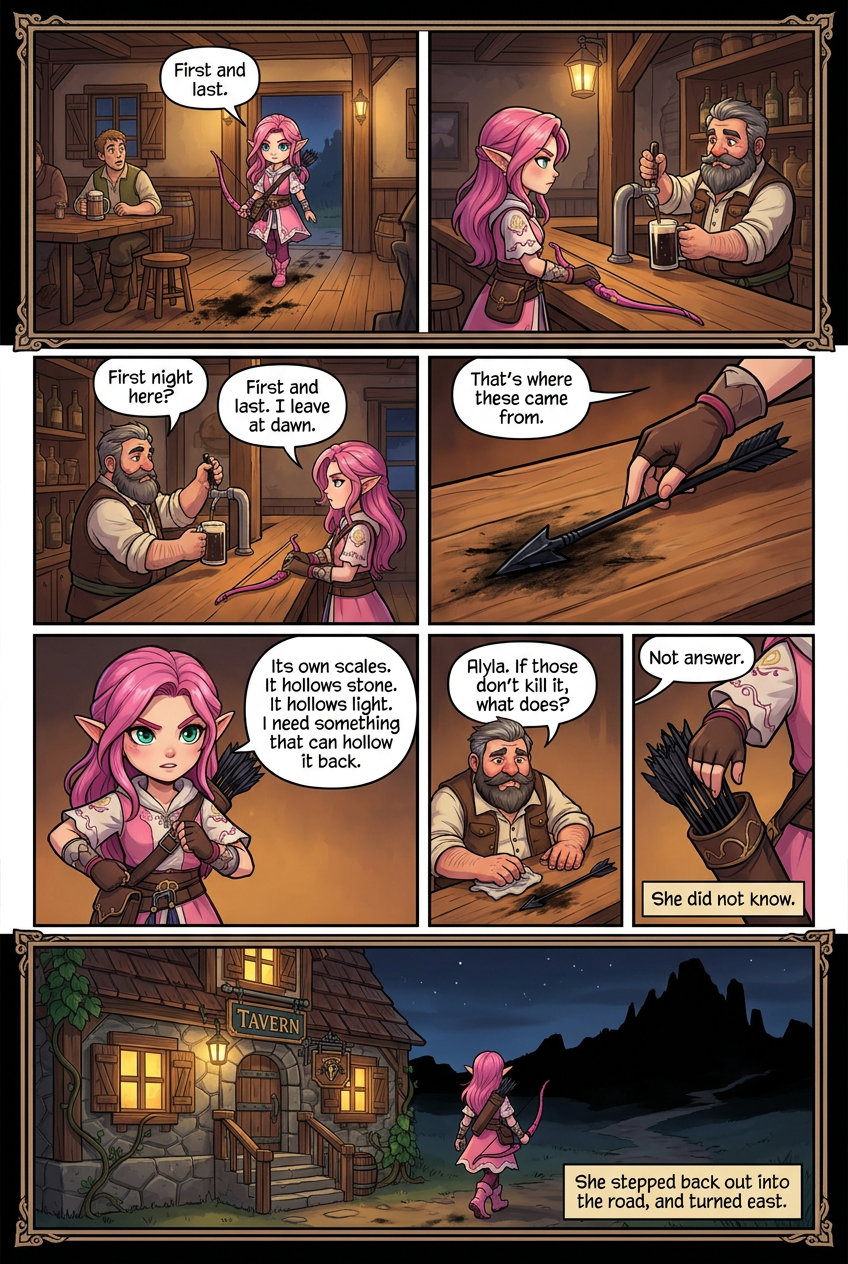
Alyla Franco walked into the tavern with a dead patch of forest still clinging to her boots. The dust she tracked in did not catch the lamplight. It sat on the floorboards like a hole cut into the wood. A farmer at the nearest table saw it and moved his stool away. She set her pink bow on the bar. Her quiver clacked against the wood. Twelve obsidian arrows, cut from scales the shadow beast had shed while grinding through a hillside two valleys east. She had picked them up herself, from ground that no longer held light. Her hair and her coat were still pink. Everything she carried was not. The tavern keeper set down the mug he was drying. He was broad, gray-bearded, sleeves shoved to the elbow. He looked at the dust on her boots, then at her face. "First night here?" he asked. "First and last," Alyla said. "I leave at dawn." He poured a dark stout and pushed it across. "First one's on the house. House rule." "I don't need it, Gareth." "You'll drink it." He did not raise his voice. "Then you'll tell me where you're going." She drank. It was warm and thick and tasted like a fire someone had watched closely. She set the mug down half full. "East ridge," she said. "The dark stretch above the old barn. It's been there three weeks. The horses won't cross it. The farmer lost a foal walking into it." Gareth's hand stopped moving on the rag. "That's the beast." "That's the beast." "People go up there, they don't come back." "I've been up there four times." She tapped the quiver. "That's where these came from." He looked at the arrows a long moment. The obsidian did not shine. It drank the lamp glow and gave nothing back. "Its own scales," he said. "Its own scales." "You think that's enough?" "I think nothing else has worked." She pulled one arrow free and laid it on the bar between them. The wood under the arrowhead darkened where it touched. "It hollows stone. It hollows light. I need something that can hollow it back." Gareth stared at the mark on his bar. He wiped at it once with the rag. The dark stayed. "Finish the stout," he said. "I'll pack you bread." "I don't need bread." "You'll take it." He turned toward the kitchen, then stopped. "Alyla. If those don't kill it, what does?" She put the arrow back in the quiver. She did not answer, because she did not know. She only knew the beast was two valleys away, that the dark was growing, and that no one else was walking toward it. She finished the stout. She shouldered her bow. She stepped back out into the road, and turned east.
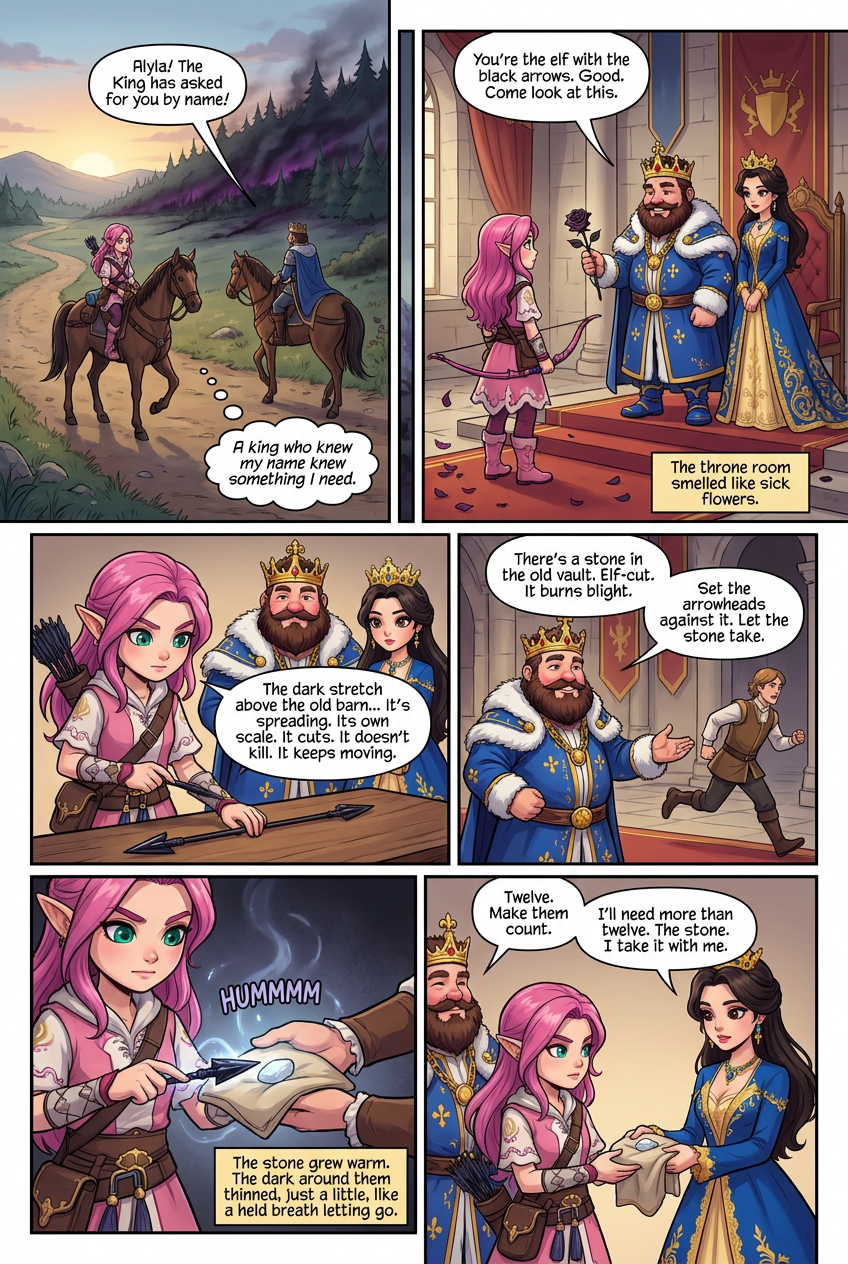
Alyla did not reach the barn at dawn. A rider from the castle caught her on the east road, out of breath, and said the king had asked for her by name. She looked once toward the ridge where the dark stretch waited. Then she turned her horse toward the capital, because a king who knew her name knew something she needed. The castle rose out of the plain in gray stone and colored glass. Guards passed her through without searching the quiver. That told her enough. Inside, the throne room smelled like sick flowers. Petals lay swept into a corner, black at the edges, curled inward like burned paper. King Roderick Rosewood stood by a low table, not on the dais. He was round and rosy-cheeked, dressed in blue, and he was holding a dead rose by the stem. Beside him the queen watched Alyla come in. Ruby Rosewood did not smile. She wore the same blue her mother had worn, and she stood very still. "You're the elf with the black arrows," Roderick said. "Good. Come look at this." He held the rose out. The bloom had collapsed on one side. The soft rot was the same rot Alyla had smelled in the lightless forest. "The dark stretch above the old barn," she said. "It's spreading." "It's here," Ruby said. "The bushes in the south garden went first. Then the east. I lost three men in the wall where the smell started. One was the gardener's boy." Roderick set the rose down. He did not soften it. "Thomas. He volunteered. I let him." Alyla pulled an arrow from her quiver and laid it on the table. The wood darkened under the head. Roderick did not flinch. Ruby leaned closer. "Its own scale," Alyla said. "It cuts. It doesn't kill. I've been up there four times. I've hit it. It keeps moving." "Then you need what we have," Ruby said. She looked at her husband. Roderick nodded. "There's a stone in the old vault. Elf-cut. My grandfather kept it for a season like this. It burns blight out of soil. If it burns blight, it may burn the thing that makes blight." "Set the arrowheads against it," Ruby said. "Let the stone take. Then shoot the beast with what it fears." Alyla picked up her arrow. "Bring it." Roderick sent a steward running. The queen watched Alyla the whole time the man was gone. When he came back, he carried a small pale stone on a cloth. Alyla laid each obsidian head against it, one by one. The stone grew warm. The arrows did not shine, but the dark around them thinned, just a little, like a held breath letting go. "Twelve," Roderick said. "Make them count." "I'll need more than twelve," Alyla said. "The stone. I take it with me." Ruby wrapped the stone in the cloth and put it in her hand.
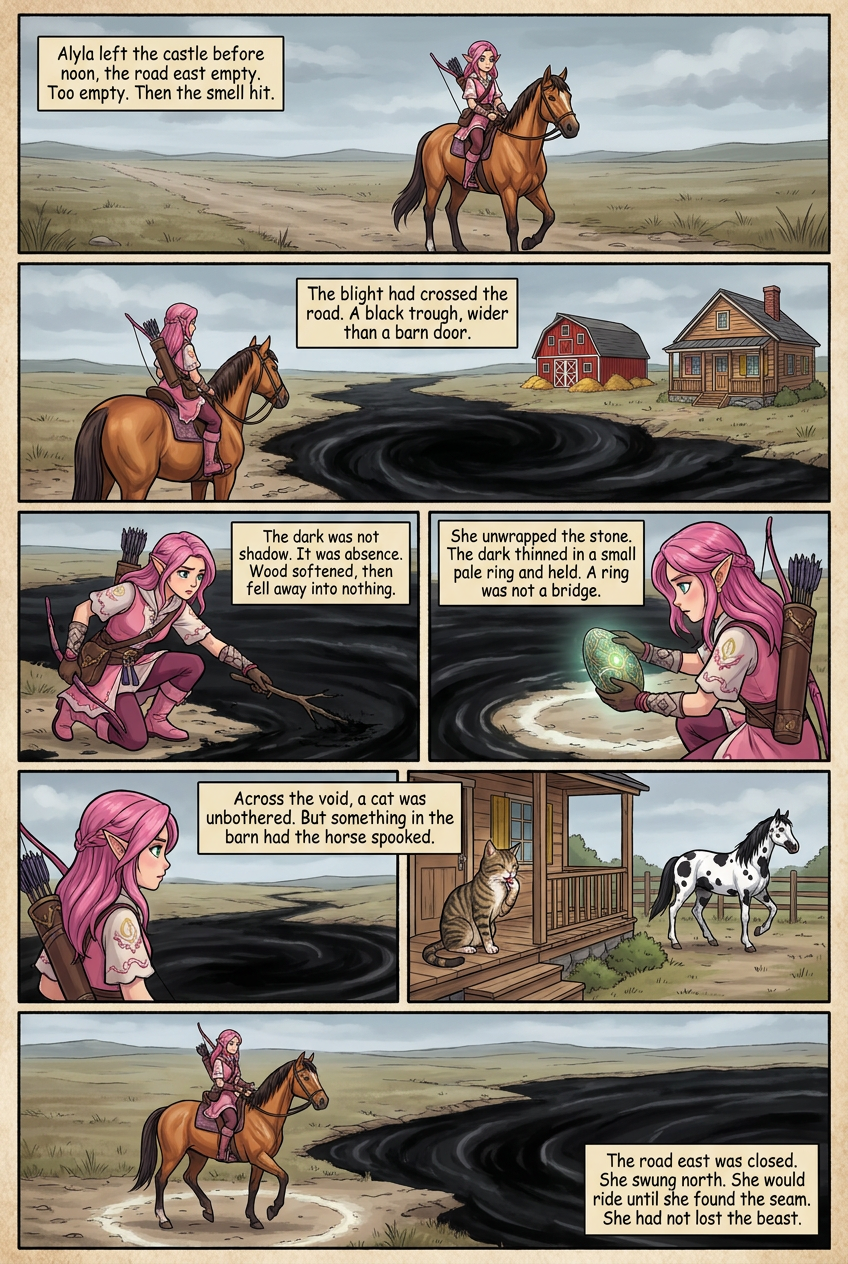
Alyla left the castle before noon with the pale stone knotted in cloth at her belt and twelve treated arrows in her quiver. She rode the two-tone mare the stewards had saddled for her, a warm brown horse with darker legs and a darker mane. The road east was empty. That itself was wrong. By the second hour she smelled the rot before she saw it. The blight had crossed the road. Where the wheel ruts should have been, the ground sagged into a black trough. It ran from the ditch on her left to the field on her right, wider than a barn door. The far side of it held the small farmhouse and, past that, the red barn with hay heaped at its foot. She could see both plain in the afternoon light. She could not reach them. She dismounted and led the mare closer. The horse balked ten paces out and would come no farther. Alyla went on alone. At the edge she crouched. The dark was not shadow. It was absence. A pebble she dropped into it made no sound. She pulled a stick from the ditch and pushed it in. The wood softened, then hollowed, then fell away into nothing. She drew her hand back before the cold could climb her wrist. She unwrapped the stone. It sat warm in her palm, no bigger than a plum. She thought of the twelve arrows and did the count. Twelve to kill the beast. None to spare for the road. She put the stone against the edge of the trough anyway, just at the lip. The blight pulled back from the stone the width of a finger. No more. She pressed harder. The stone grew hot in her hand. The dark thinned in a small pale ring and held there. A ring was not a bridge. She stood and looked across. A tabby cat sat on the farmhouse porch, licking one paw slow, unbothered, on the side of the world she could not reach. Beyond the barn, in the pen, a black-and-white horse paced the fence and would not settle. Something in the barn had it spooked. Something the cat, small and low, did not fear yet. Alyla wrapped the stone. She stepped back from the trough. The road east was closed to her. The beast was on the far side with a house and a barn and animals it had not finished with. She swung up onto the mare and turned north along the ditch. Somewhere the trough had to end, or thin, or bend around a rise. She would ride until she found the seam. She had lost the straight road. She had not lost the beast. Behind her, the ring of clean ground at the lip of the dark stayed pale, and did not spread.
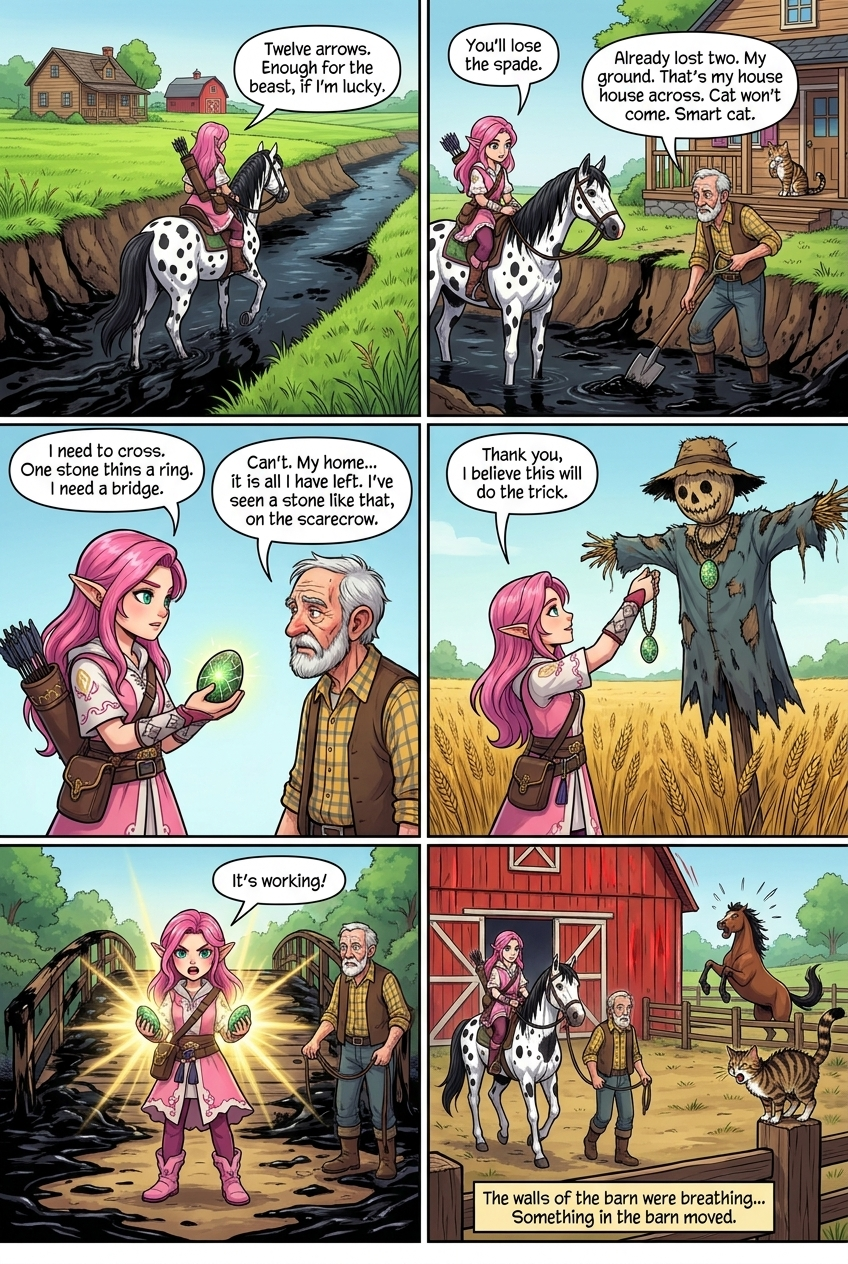
Alyla rode north along the ditch for an hour. The trough did not thin. It ran straight as a plow line, black and cold, the far fields bright and untouched past it. She counted her arrows twice on the ride. Twelve. Enough for the beast, if she was lucky. None to burn a road across the dark. She reined in when she saw the old man. He was on her side of the trough, walking the edge with a spade, prodding the black as if it were a snake he meant to move. His plaid shirt hung loose. His boots were caked. He did not look up until the mare snorted. "You'll lose the spade," Alyla said. "Already lost two." He straightened. His eyes were red-rimmed, dry now. "My ground. That's my house across." He pointed with his chin at the small farmhouse and the red barn beyond. On the porch, a tabby cat washed one paw, slow and unbothered. "Cat won't come. Won't cross. Smart cat." "You're the farmer." "William Thatcher." He looked at her pink cloak, her bow, the wrapped stone at her belt. He did not ask. "You're the one the king sent." "I need to cross." "Can't. I've tried planks. Tried a ladder. Wood goes soft and drops." He wiped his mouth. "My boy volunteered for the king and was lost to the blight. My home, my land, it is all I have left. I need to get across. And I am not a man who waits well." Alyla dismounted. She unwrapped the stone and held it flat on her palm. "One stone thins a ring the size of my hand. I need a bridge." William looked at the stone. "I’ve seen a stone like that, it’s in the field around the scarecrows neck. My father use to say it keeps the field growing and protects it from darkness.” The old man led Alyla to middle of the wheat field. Around the neck of the scarecrow attached to a solid gold chain laid the pale white stone. Alyla reached up and took the necklace off and put it around her own neck. “Thank you, I believe this will do the trick” Alyla said with determination. They both walked back to the dark cold blight that covered the long trough. Approached a bridged covered in darkness. Alyla pressed the two stones together and they glowed giving off a warmth love coals long after a fire has settled. A path cleared around her like a giant ring and held. “It’s working” Alyla yelled. The old man grabbed the reins of the horse and they proceeded together across the bridge just beyond the barn. The walls of the barn were breathing in and out. In the pen behind the barn, the black-and-white horse screamed. The cat stopped licking its paw and stood with all its hair standing up straight. Something in the barn moved.
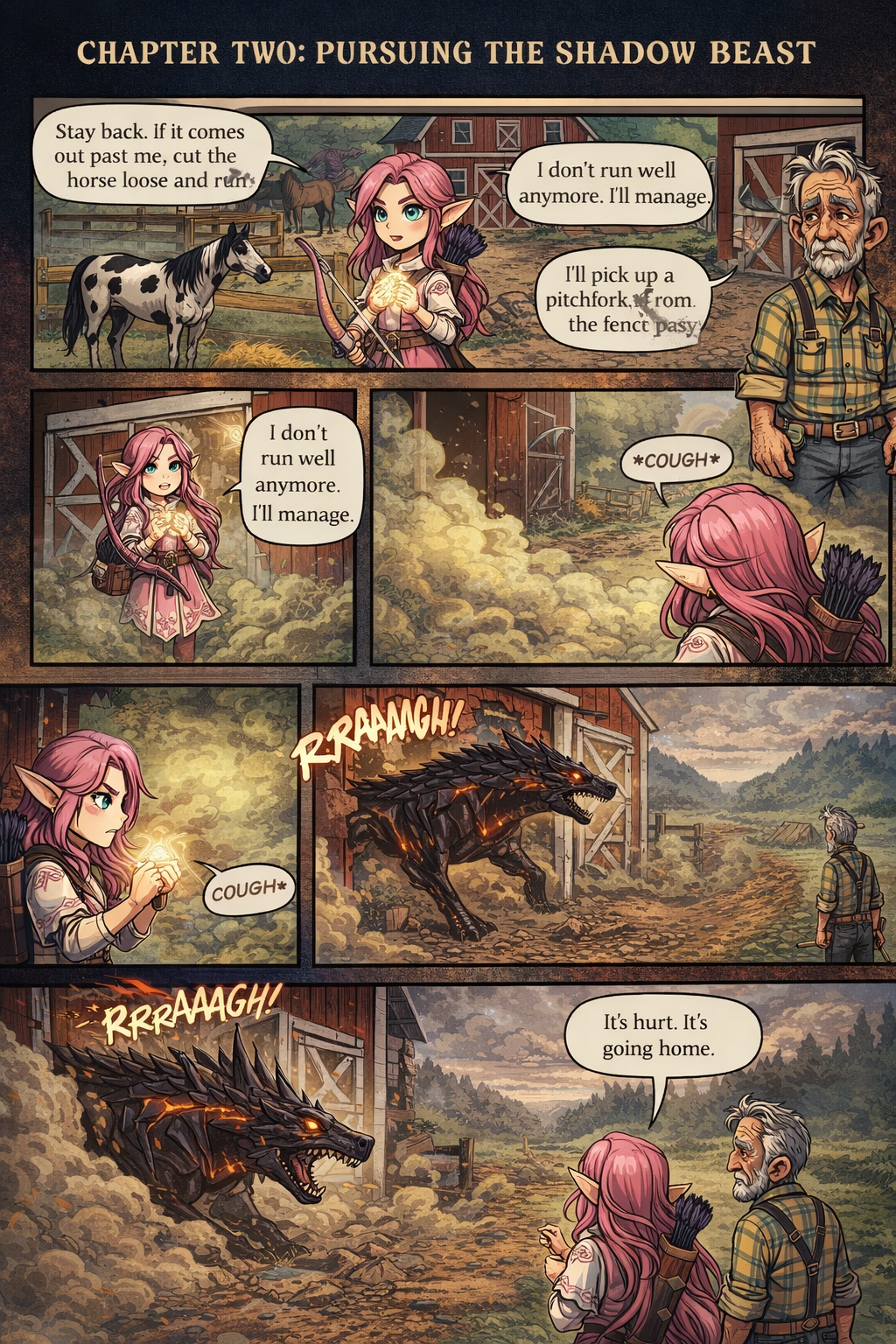
Alyla left the mare with William at the pen fence. The black-and-white horse still screamed inside the rails. The tabby had run under the porch. She pulled an obsidian arrow from her quiver and set it to the string. The barn doors were tall and red, paint peeling in long strips. Hay lay scattered at the base, wet and dark where it should have been dry. "Stay back," she told William. "If it comes out past me, cut the horse loose and run." "I don't run well anymore," William said. He picked up a pitchfork from the fence post. "I'll manage." She pressed the two stones together at her chest. They warmed against her collarbone. She hooked one hand under the iron latch and pulled the door wide. Fog rolled out. It was thick and yellow-green, heavy as water, and it smelled like a wound left too long. It poured over her boots and climbed her legs. Her throat closed. She coughed once, then could not draw the next breath. The paired stones flared white at her chest and pushed a small clear ring around her head. She got one breath. Then another. The fog hissed where the light touched it and drew back a hand's width. Inside the barn, something shifted. She saw the shape of it through the murk. Long body. Low shoulders. Scales like the ones in her quiver, but whole, catching the stone-light in dull sheets. Orange cracks ran along its ribs like a banked fire. Its eyes found her. They were the same orange. She drew and loosed. The arrow struck its shoulder and stuck. The beast screamed, a sound like wood splitting. It did not fall. It turned and drove itself through the back wall of the barn. Boards went soft where it passed and dropped as black dust. A hole opened in the wall the size of a cart. The beast was through it and gone into the field beyond before she could nock again. The fog thinned as the beast pulled it after itself like a cloak. Alyla stepped inside. The foal lay in the first stall. What was left of it. She looked away. William came to the doorway with the pitchfork lowered. "You hit it." "I hit it. It ran." She counted her arrows without meaning to. Eleven. "The scales work. It bleeds." "Where's it gone?" She walked to the broken wall and looked through. A dark trail cut across the wheat, straight north, the stalks gone gray and bent where the beast had passed. At the far end of the trail, past two fields, she could see the edge of a wood where no light moved. "Its den," she said. "It's hurt. It's going home." She pulled the stones apart and wrapped the pale one. The white glow died. William looked at the trail and then at her. "Then we follow," he said.
Play your story to life
Storycraft is a mobile game where you create AI characters, craft items and locations to build their world, then discover what direction your story takes. Download the iOS game for free today!
Download for free