

Amanita Sporewell's Arc
14 Chapters
Amanita Sporewell's dream is growing the greatest mushroom garden the forest has ever seen.

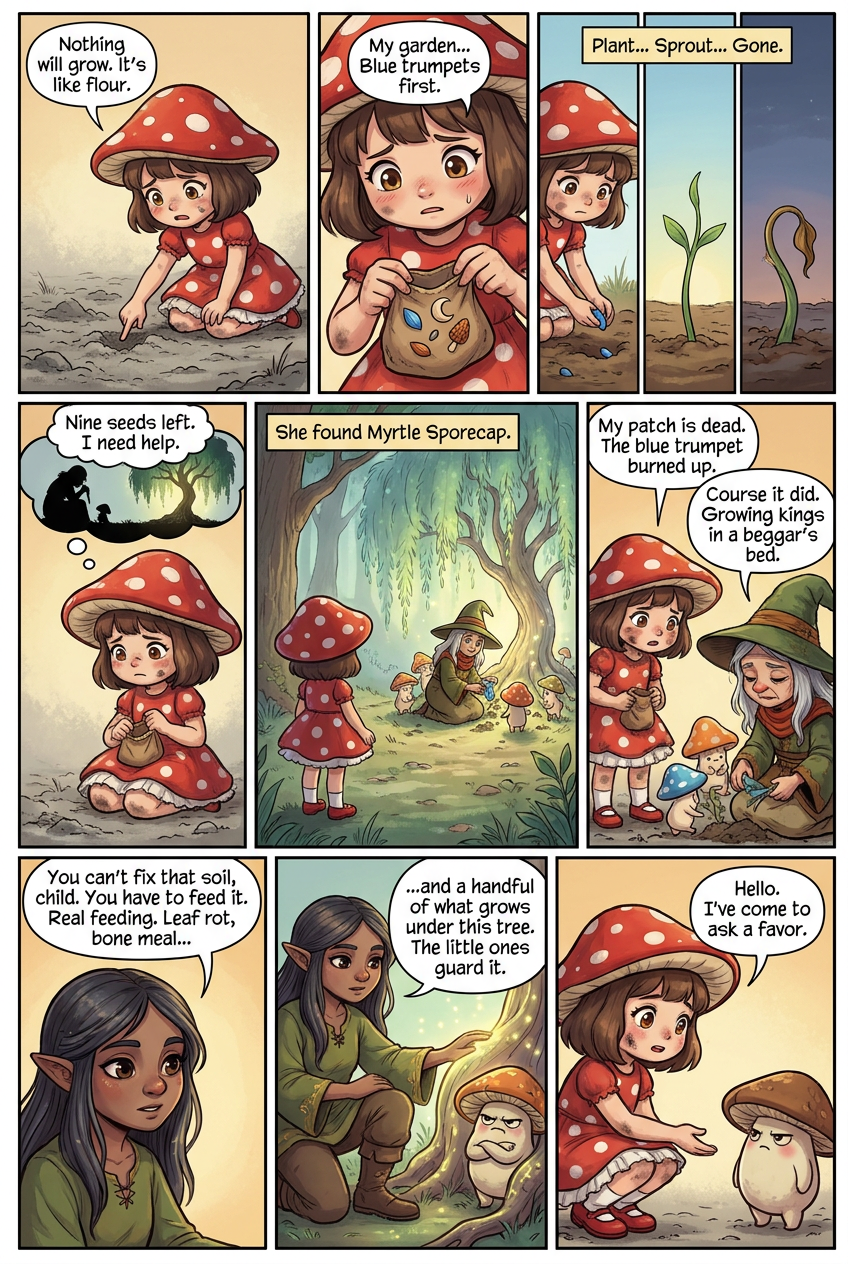
Amanita Sporewell knelt in her patch of dirt and knew, before she even opened the seed pouch, that nothing would grow. The soil was gray and thin as flour. She pushed her finger in up to the knuckle and hit stone. Her red-and-white cap slid over one eye. She shoved it back and tried anyway. She wanted the greatest mushroom garden the forest had ever seen. That was the whole reason she had begged for this square of ground behind the cottage. She had traded three jars of honey for the seeds in her pouch: moonveil caps, blue trumpets, a single ember morel. Rare things. Fussy things. Things that would not survive a week in dust like this. Amanita planted the blue trumpet first, because it was her favorite. She patted the dirt, sang the little song her grandmother taught her, and waited. By noon the sprout came up thin as thread. By afternoon it curled brown at the tip. By supper it was gone. She sat back on her heels and felt her throat go tight. Nine seeds left. If she planted them here, she would lose them all. She went to find the only person in the hollow who might help. Myrtle Sporecap was her great-aunt, and the forest called her a witch because she talked to things that other people ignored. Amanita found her at the edge of the clearing, kneeling under a willow whose branches gave off a soft green shine. Myrtle was tucking scraps of bark into the roots and muttering. Tiny mushroom creatures with painted caps crowded around her ankles, tugging at her hem, offering pebbles. She thanked each one by name. "My patch is dead," Amanita said. "I planted a blue trumpet and it burned up in an afternoon." Myrtle did not look up. "Course it did. You're growing kings in a beggar's bed." "Then tell me how to fix it." Myrtle finally turned. Her eyes were the color of wet bark. She looked at the seed pouch, then at Amanita's smudged face. "You can't fix that soil, child. You have to feed it. Real feeding. Leaf rot, bone meal, spring water, and a handful of what grows under this tree." She patted a root of the glowing willow. "The little ones guard it. You'll have to ask them yourself." One of the mushroom sprites peeked out from behind Myrtle's boot and blinked up at Amanita. It did not look friendly. It looked like something that bit. Amanita tightened her grip on the pouch. Eight seeds and a morel. A dead patch at home. And now a tree full of small guardians who decided who was worthy of the soil beneath their feet. She crouched down to the sprite's level and held out her palm. "Hello," she said. "I've come to ask a favor."
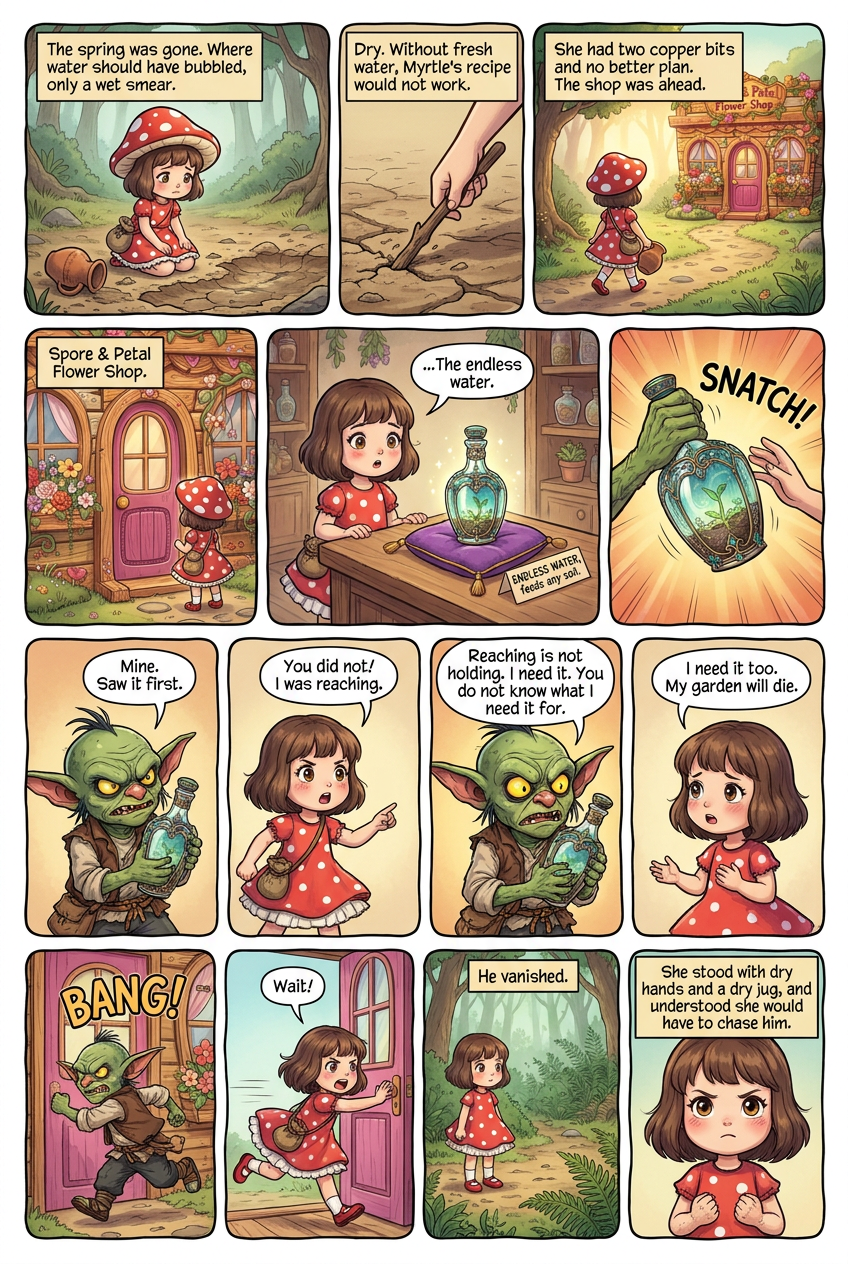
The sprite let Amanita pass. It took most of the morning of soft words and a promise to leave more than she took, but by the time the sun climbed over the willow, she had a small sack of glowing loam tied at her belt. Myrtle had given her the rest of the list too: leaf rot from the north gully, bone meal from the old owl roost, and spring water from the little pool behind the hollow stones. Three of four. Amanita walked to the spring with her clay jug swinging, already picturing her patch turned black and rich. The spring was gone. Where water should have bubbled up between the stones there was only a wet smear and a ring of cracked mud. Amanita knelt and pressed her palm to it. Dry. She scraped at the bottom with a stick. Dry. The dry spell had drunk it down to nothing. Without fresh spring water, Myrtle's recipe would not work. The loam at her belt would sit useless. Her seeds would stay in the pouch until they went to dust. She sat back and tried to think. Myrtle had mentioned a shop at the far side of the hollow that sold garden things. Amanita had never gone alone, but she had two copper bits in her pocket and no better plan. She followed the path until she saw it: a small building crusted in vines and painted blooms, mushrooms clustered along the sill, a pink door standing open. A wooden sign above named it a flower shop. She slipped inside. Shelves ran to the ceiling, packed with jars and seed papers and cut stems. On the counter, alone on a square of velvet, stood a tall glass bottle with gold bracing around its neck. Inside, water glowed faint green around a tiny sprout and a curl of root. A card beside it read: endless water, feeds any soil. Amanita's breath caught. She stepped closer. A hand shot out from behind a barrel and grabbed the bottle first. The goblin was shorter than her. Green skin, torn vest, ears like leaves. He tucked the bottle under his arm and bared small teeth. "Mine," he said. "Saw it first." "You did not," Amanita said. "I was reaching." "Reaching is not holding." Griznak Bitterfinger backed toward the door. His eyes were yellow and tired. One hand shook where it pressed the glass to his ribs. "I need it. You do not know what I need it for." "I need it too," Amanita said. "My garden will die." He was already running. The pink door banged. Amanita bolted after him, but he cut between two stalls and vanished into the ferns. Her copper bits were still in her pocket. The velvet square on the counter was empty. She stood in the doorway with dry hands and a dry jug, and understood she would have to chase him.
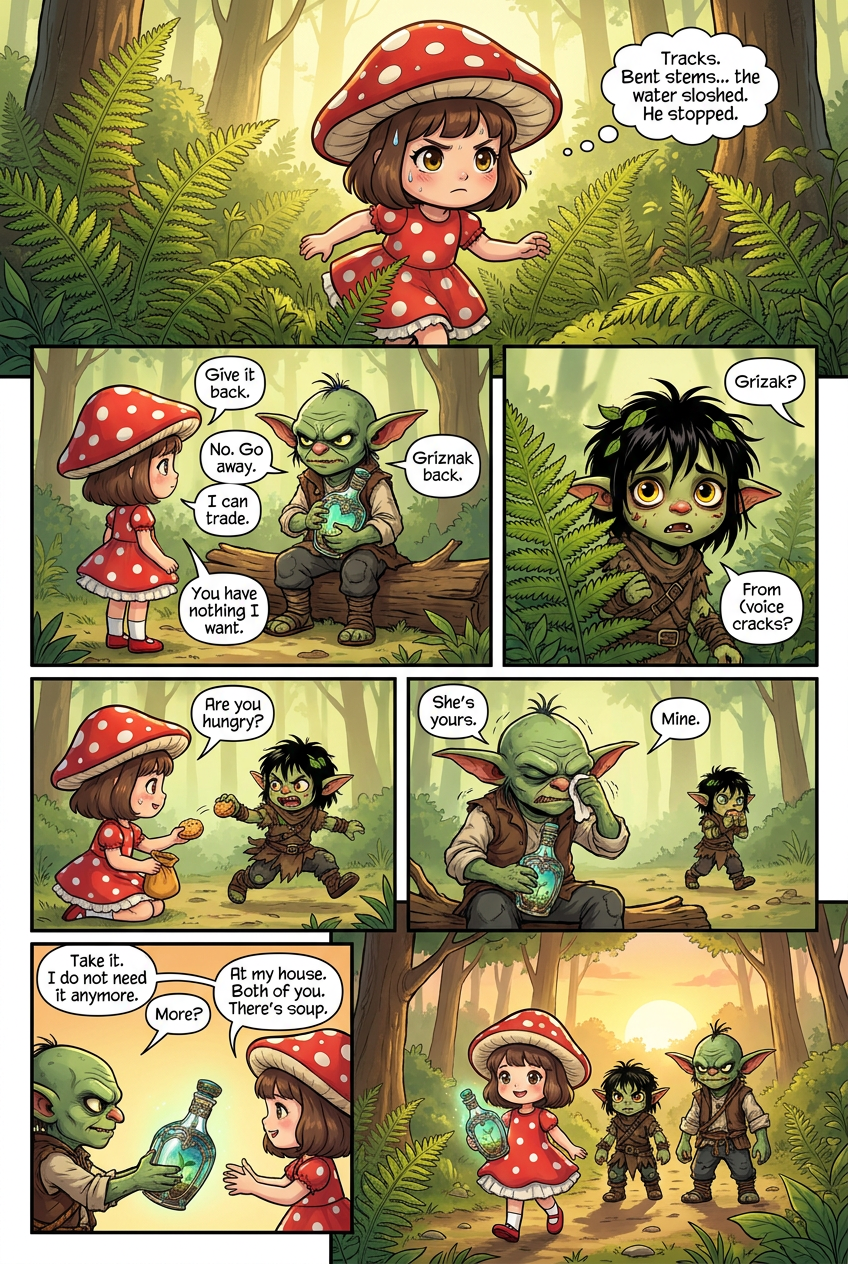
Amanita pushed through the ferns until her legs burned. The goblin's tracks were easy to follow: bent stems, a scrap of torn vest, a smear of green water where the bottle had sloshed. She caught up at a fallen log where he had stopped to catch his breath. He held the bottle to his chest like a baby. "Give it back," Amanita said. "No." Griznak Bitterfinger did not look up. "Go away." "I can trade." "You have nothing I want." Amanita opened her mouth, then closed it. He was right. Two copper bits would not move him. She sat down on the log a careful arm's length away and tried to think of what a tired goblin might want more than water. A branch cracked behind them. Both heads turned. A small figure stood in the ferns, half hidden, watching. She was a goblin too, no taller than Amanita. Her vest hung in strips. Leaves stuck in her black hair. One yellow eye peeked out; the other was covered by a tangle. She saw them looking and bared little teeth, but her hands were shaking. Griznak went very still. The bottle slipped down to his lap. "Grizak?" he said. His voice cracked on the word. The small goblin did not answer. She crouched lower, ready to bolt. Amanita understood before she thought it through. The girl he was chasing. The daughter he would not name to anyone. Standing in the ferns, scared of them both. Amanita kept her voice soft. "Are you hungry?" Grizak Ironhide nodded once, tight. Amanita reached into her pouch, slow, and pulled out the honey biscuit Myrtle had wrapped for her that morning. She set it on the log and slid back. Grizak crept forward, snatched it, and darted three steps away to eat. She watched them the whole time she chewed. Griznak had not moved. His shoulders shook. He wiped his face with the back of his wrist and pretended he had not. "She's yours," Amanita said. "Mine." He did not deny it. He could not, now. He looked at the bottle in his lap and then at his daughter, and the sneer he wore like a coat fell off him. He held the bottle out to Amanita. "Take it. I do not need it anymore." Amanita's fingers closed around the cool glass. The gold bracing was warm from his chest. Inside, the tiny sprout drifted in green light. Grizak swallowed the last of the biscuit and eyed her. "More?" the girl asked. "At my house," Amanita said. "Both of you. There's soup." Griznak stood. He did not thank her. He walked to his daughter and stopped an arm's length short, afraid to spook her. Grizak did not run. She did not step closer either. She fell in behind Amanita instead, keeping the girl between herself and her father. Amanita started for home with the bottle in her arms and two goblins trailing her through the ferns.
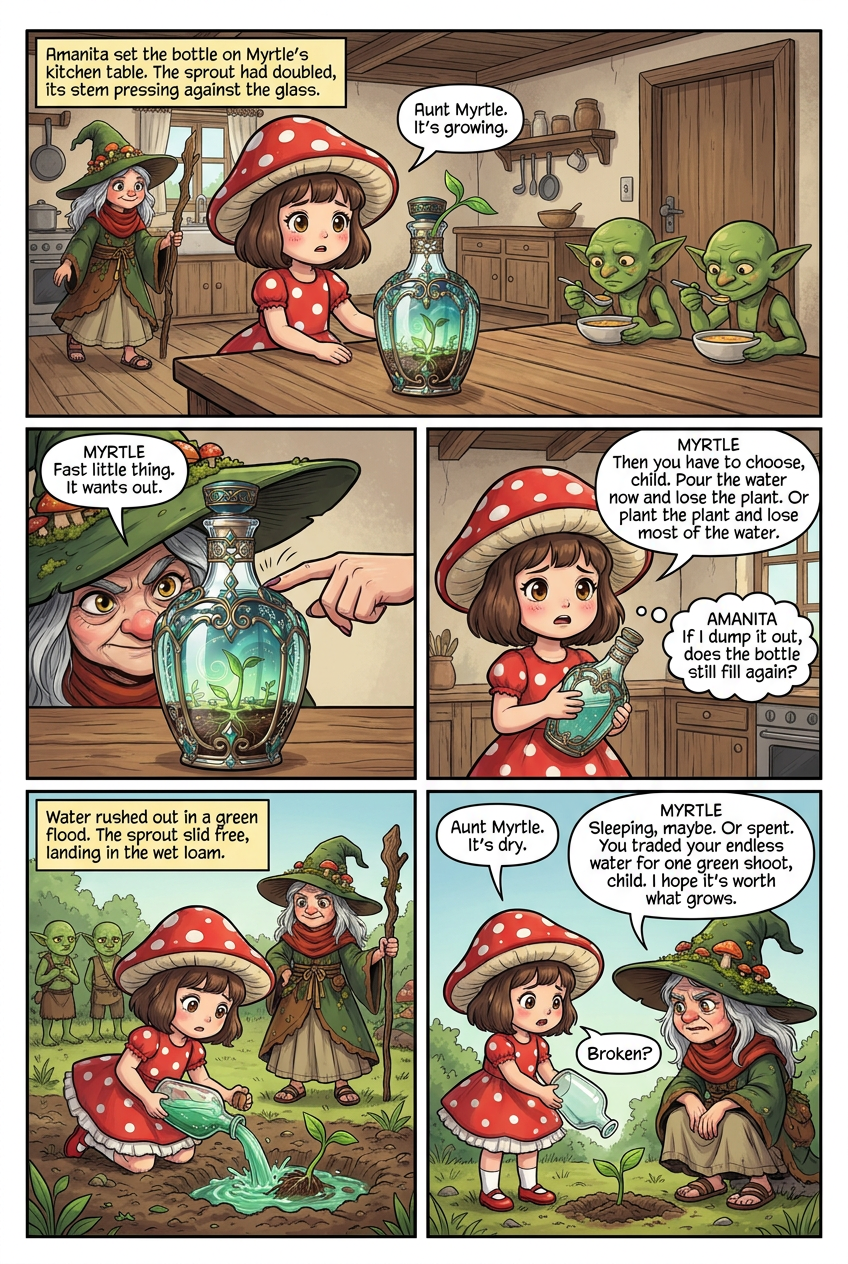
Amanita set the bottle on Myrtle's kitchen table and stepped back. The two goblins waited by the door, spooning soup. The sprout inside the glass had doubled since the walk home. Its stem pressed against the neck. One thin leaf had already curled up into the spout and locked itself there like a green cork. "Aunt Myrtle," Amanita said. "It's growing." Myrtle Sporecap set down her ladle. She crossed the room in three short steps, mushroom cap hat wobbling, and bent to peer at the bottle. Her painted fingernail tapped the glass. The sprout twitched toward the sound. "Fast little thing," Myrtle said. "It wants out." "I need the water. For the garden. If it fills up the spout I'll get nothing." Myrtle straightened. Her brown eyes were sharp under the brim of her hat. "Then you have to choose, child. Pour the water now and lose the plant. Or plant the plant and lose most of the water." Amanita's stomach tightened. She had chased this bottle through ferns. She had traded her honey biscuit and her spare room for it. She was supposed to carry endless water home, not a weed. She looked at the sprout. It was small and pale and reaching. The roots inside had already threaded down through the painted soil at the bottom of the glass. "If I dump it out," Amanita said, "does the bottle still fill again?" "It should. But that sprout dies the moment its roots hit air." Amanita picked up the bottle. The gold bracing was warm. The leaf in the spout wriggled against her thumb. She thought of her garden patch, the seeds she still had to feed, the ingredients she had bled for. Water she could get again. This sprout she could not. She carried the bottle out the back door. Myrtle followed with her staff. The goblins trailed behind, curious now, still chewing. Amanita knelt at the edge of her garden patch. She dug a shallow hole with her fingers in the loam she had earned from the willow sprites. Then she pulled the stopper. Water rushed out in a green flood. It soaked the dirt, ran between her knees, filled the hole and overflowed. The sprout slid free with the last of it and landed in the wet loam, roots first. Amanita packed the soil around its stem. The bottle in her hand was empty. She tipped it. Nothing came. She shook it. Nothing. "Aunt Myrtle. It's dry." Myrtle crouched beside her. She turned the bottle in her hands and frowned at the etched patterns along its side. "Broken?" Amanita whispered. "Sleeping, maybe. Or spent." Myrtle handed it back. "You traded your endless water for one green shoot, child. I hope it's worth what grows." Amanita looked down. The sprout stood in her loam, tiny and stubborn. Behind her, the goblins had gone quiet.
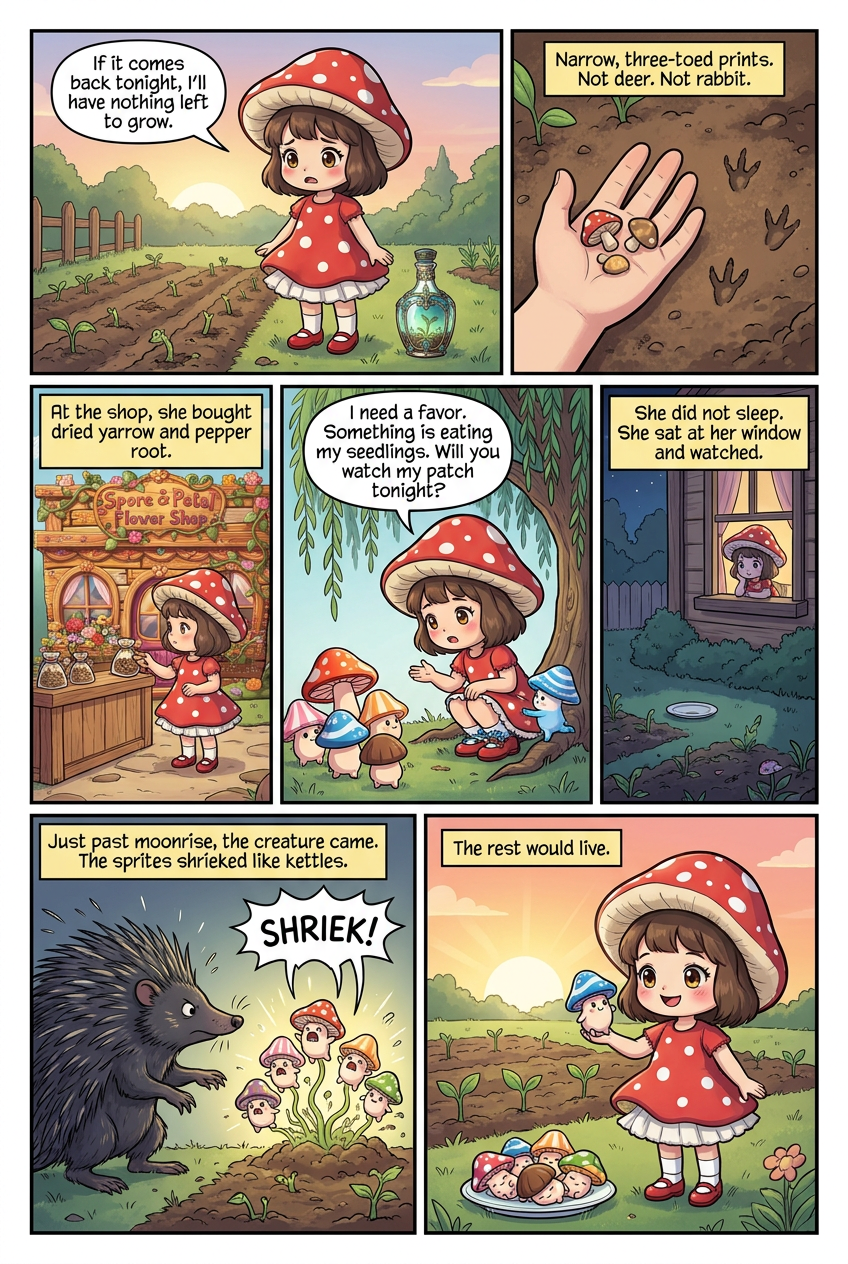
Amanita walked out to her garden at dawn and stopped short. Half the seedlings were gone. Green stems chewed to stubs. The magical sprout she had traded her endless water for stood untouched, but the row beside it was ruined. Something had come in the night. She knelt in the loam. Small tracks pressed the dirt. Not deer. Not rabbit. The prints were narrow, three-toed, the size of her thumb. Whatever it was, it had eaten its way down the row and stopped only when the sky lightened. "If it comes back tonight," Amanita said aloud, "I'll have nothing left to grow." She thought of Aunt Myrtle's warnings about pests, and of the shop where she had first found the bottle. The shopkeeper at the flower shop kept jars of dried petals and powders on a back shelf. Amanita remembered a bitter-smelling bundle labeled for keeping mice off bulbs. She pulled on her boots. The walk took an hour. The shop's painted door was propped open. Vines curled around the sign. Inside, the shopkeeper measured her out a handful of dried yarrow and a twist of pepper root. Amanita paid in dried mushroom caps from her apron pocket. It was not enough, she knew, if the nibbler was hungry enough. On the way home she stopped under the willow. The little fungi sprites who guarded the loam poked their caps up between the roots. One with a blue-striped cap climbed onto her boot. Another peered up from behind a stone, cheeks round. "I need a favor," Amanita said. She crouched low. "Something is eating my seedlings. I fed you honey water when I took your loam. Will you watch my patch tonight?" The blue-capped one tilted its head. The others clustered close, whispering in small squeaks. The one on her boot patted her ankle twice. That was the answer. She carried six of them home in her basket, packed in moss. She scattered the yarrow and pepper root along the garden's edge. Then she set the sprites among the seedlings and left a saucer of honey water for their trouble. She did not sleep. She sat at her window and watched. Just past moonrise, a shape crept from the ferns. Long body, twitching snout, quills along its back. It sniffed the pepper root and sneezed. It kept coming. Then the sprites moved. Six little caps rose from the loam at once, glowing faintly. They shrieked, a sound like kettles. The creature bolted back into the ferns and did not return. At sunrise Amanita walked the row. The seedlings that remained stood safe. The sprites were curled asleep in the moss, honey saucer licked clean. She counted her losses. Half her crop was gone. But the rest would live. She carried the sprites back to the willow that morning. When she set them down, the blue-capped one did not climb off her palm. It looked up at her and would not go.
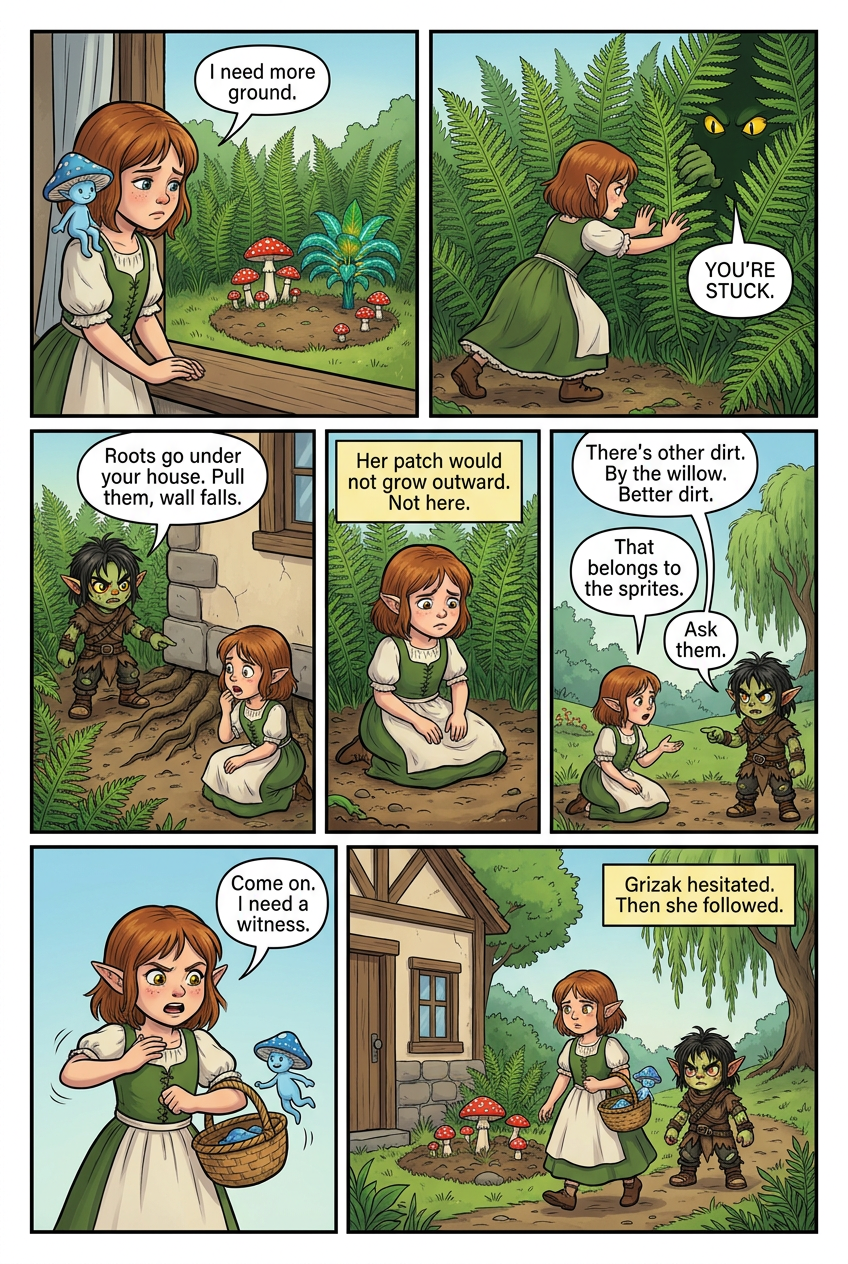
The blue-capped sprite rode home on Amanita's shoulder. She set it on the windowsill and looked out at her patch. The surviving seedlings stood in a tidy row, greener than yesterday. The magical sprout had put out a second leaf overnight. Her garden was alive. It was also small. Too small. A ring of loam no wider than a wagon wheel, hemmed in by the cottage wall on one side and a wall of thick ferns on the other. She had dreamed of the greatest mushroom garden the forest had ever seen. She was growing it in a soup bowl. "I need more ground," she told the sprite. It blinked at her. She walked the edge of the patch and pushed at the ferns. They gave, then sprang back. Beyond them the soil looked dark and rich, but the fronds grew shoulder to shoulder. Clearing them would take a week of digging, and the roots ran deep. She sat down in the dirt and pulled her knees up. Something moved in the ferns. A small green hand parted two fronds. Yellow eyes stared out. The goblin girl stepped through, ragged as ever, a smear of dirt on one cheek. She had been sleeping in the woodshed since her father settled in the shed behind it. She still would not come inside. "You're stuck," Grizak said. It was not a question. "The ferns won't move." Grizak scowled at them. She walked to the nearest frond, gripped it low on the stem, and yanked. Nothing. She braced a boot against the base and yanked again. The plant shuddered. She let go and wiped her hands on her tunic. "Roots go under your house," she said. "Pull them, wall falls." Amanita's stomach dropped. She had not thought of that. She crouched and scraped at the loam near the cottage. Thick fern roots ran under the foundation stones like ropes. If she tore them out, the wall would sag. If she left them, the ferns stayed. She sat back on her heels. Her patch would not grow outward. Not here. "There's other dirt," Grizak said. She jerked her chin toward the woods. "Better dirt. By the willow." "That belongs to the sprites." Grizak shrugged. "Ask them." Amanita looked at the blue-capped sprite on the sill. It looked back. Its cheeks were still sticky with honey water. She stood and brushed off her dress. The cramped patch would stay cramped. That question was answered. But the answer pointed somewhere else — to loam she did not own, guarded by small creatures she had already asked one favor of. She picked up her basket. The blue-capped sprite hopped in. "Come on," she said to Grizak. "I need a witness." Grizak hesitated. Then she followed, three steps behind, close enough to hear.
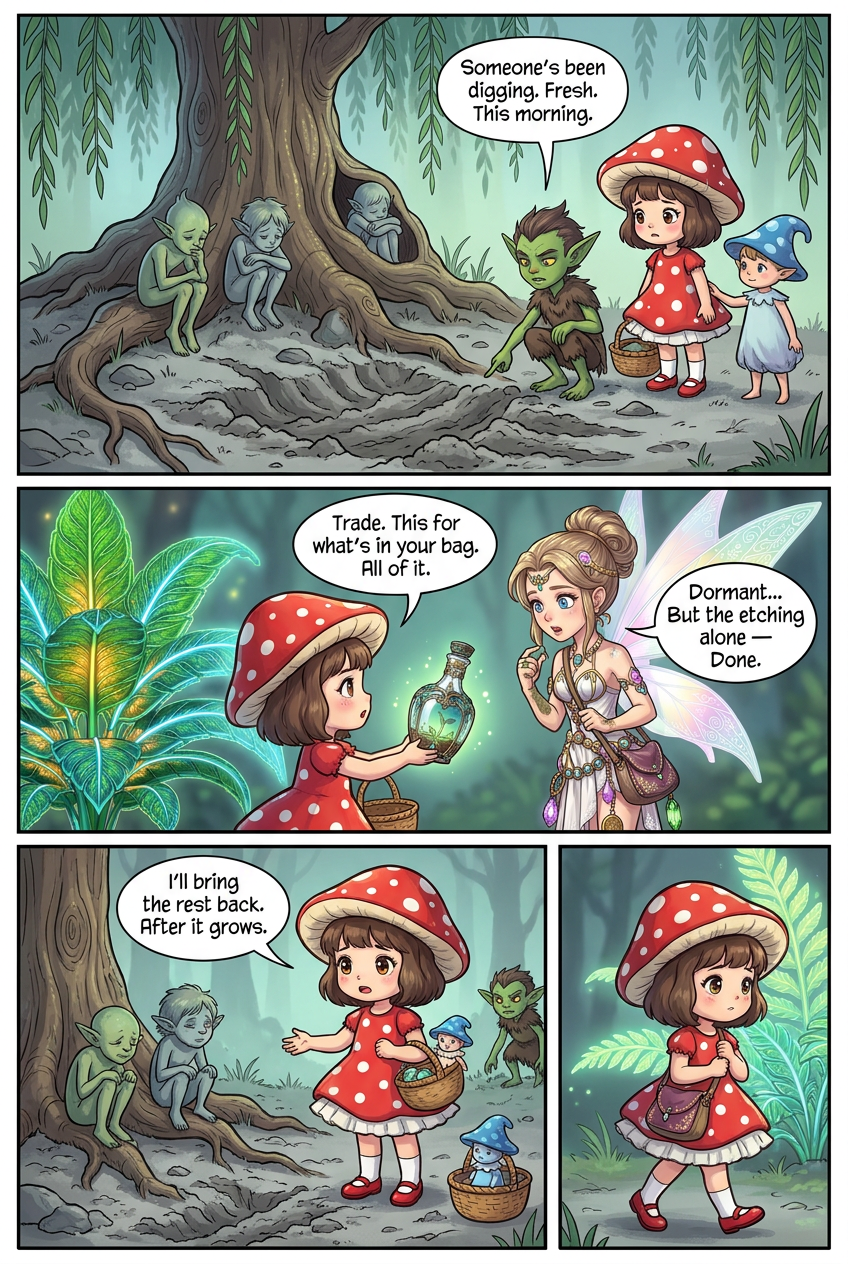
Amanita and Grizak walked to the willow grove with the blue-capped sprite riding in the basket. Amanita had rehearsed her request three times on the path. She would offer more honey water. She would promise to share cuttings. She had a plan. The plan lasted until she stepped past the last luminous fern and saw the grove. The soil under the willow was torn open. Long furrows ran between the roots. Someone had scraped away the glowing loam in wide handfuls and left bare gray dirt behind. Two sprites sat on a root, hunched, their caps dim. A third lay curled in a hollow, asleep or worse. "Someone's been digging," Grizak said. She crouched by a furrow and sniffed. "Fresh. This morning." Amanita's throat went tight. If the loam was gone, she had nothing to bargain for. No richer ground. No garden beyond the wagon-wheel patch. She knelt by the sprites and held out the honey jar. The blue-capped one climbed from her basket and touched a dim sprite's shoulder. The dim sprite blinked once. A soft light moved behind the fronds of a giant fern. Amanita thought it was another sprite. Then the fronds parted and a fairy stepped out, no taller than Amanita's hand. She had folded rainbow wings and a satchel at her hip that clinked. She was tucking something wrapped in leaf-cloth into the satchel. A greenish crumb of loam stuck to her thumb. The fairy saw them and smiled. "Little gardener. You're late to market." "That's mine," Amanita said. Her voice shook. "That belongs to the sprites." "It belongs to whoever carries it out." The fairy patted the satchel. "I trade in rare things. This grove has been generous." Grizak stood up. Her hands were fists. "She's stealing. Look at them." She pointed at the curled sprite. Amanita looked at the empty furrows, then at the fairy's satchel. Arguing would not fill the ground back in. She set her basket down and pulled out the etched bottle. It had not refilled since she planted the sprout. It was still beautiful. The patterns on the glass caught the fern-light and glowed. "Trade," Amanita said. She held it up. "This for what's in your bag. All of it." The fairy's smile changed. She stepped closer. She touched the glass and her eyes went wide. "Dormant," she murmured. "But the etching alone —" She unhooked the satchel and set it in the dirt. "Done." She took the bottle and was gone between the fronds before Amanita could breathe. Amanita opened the satchel. Glowing loam, packed tight in leaf-cloth. Enough for a patch three times her current one. Grizak whistled low. The blue-capped sprite climbed back into the basket. The two hunched sprites watched Amanita, waiting. "I'll bring the rest back," Amanita said to them. "After it grows." She had loam. She had lost the bottle. She walked home with the satchel held tight against her chest.
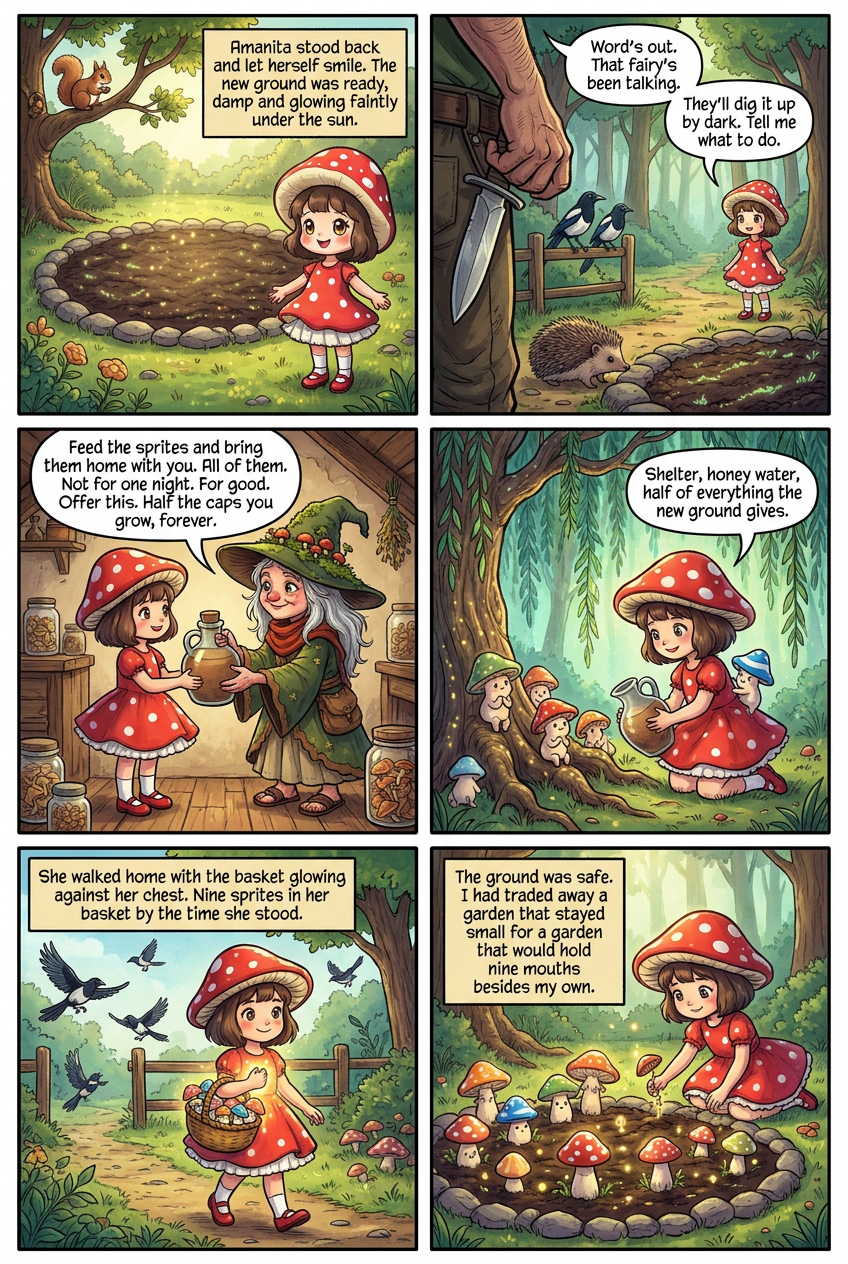
Amanita carried the satchel of loam home and spread it in a wide ring behind her cottage, past the wagon-wheel patch. She worked all morning. Grizak helped her mark the edges with stones. By noon, the new ground was ready, damp and glowing faintly under the sun. Amanita stood back and let herself smile. Then a squirrel dropped out of the elder tree and stared at the loam. It was not the only visitor. A pair of magpies landed on the fence. A hedgehog nosed the stones. Somewhere in the ferns, something larger moved and stopped. Grizak's hand went to the knife at her belt. "Word's out," Grizak said. "That fairy's been talking." Amanita went to the path and listened. She could hear it now — a high, bright voice past the ferns, boasting to anyone who'd stop. The fairy was showing off the etched bottle at the edge of the grove and telling every creature who passed where she'd gotten it. A greedy circle was forming around Amanita's patch by the hour. Amanita ran for her great-aunt's cottage. Myrtle Sporecap was on her step, sorting dried caps into jars. Moss clung to her hat. She looked up before Amanita spoke. "You've got a crowd," Myrtle said. "I can smell the loam from here." "They'll dig it up by dark," Amanita said. "Tell me what to do." Myrtle set down her jar. "You can't hide it. The shine carries. So you stop hiding." She tapped Amanita's chest with a knobbed finger. "Feed the sprites and bring them home with you. All of them. Not for one night. For good." "They belong to the willow." "The willow's loam is in your yard now. Their work is in your yard now." Myrtle handed her a stoppered jug of honey water, larger than the last. "Offer this. Offer the second patch. Half the caps you grow, forever. That's the price." Amanita ran back with the jug against her ribs. At the grove, the sprites were still hunched on the roots. She knelt and made her offer plain — shelter, honey water, half of everything the new ground gave. The blue-capped sprite climbed her sleeve first. One by one, the others followed. Nine sprites in her basket by the time she stood. She walked home with the basket glowing against her chest. The magpies scattered when she stepped into the yard. The hedgehog backed into the ferns. The sprites climbed down and spread across the new ring of loam, caps brightening as they touched it. Grizak let out a breath. Amanita knelt at the edge of her patch. The ground was safe. She had traded away a garden that stayed small for a garden that would hold nine mouths besides her own. She pressed the first spore into the new soil and covered it over.
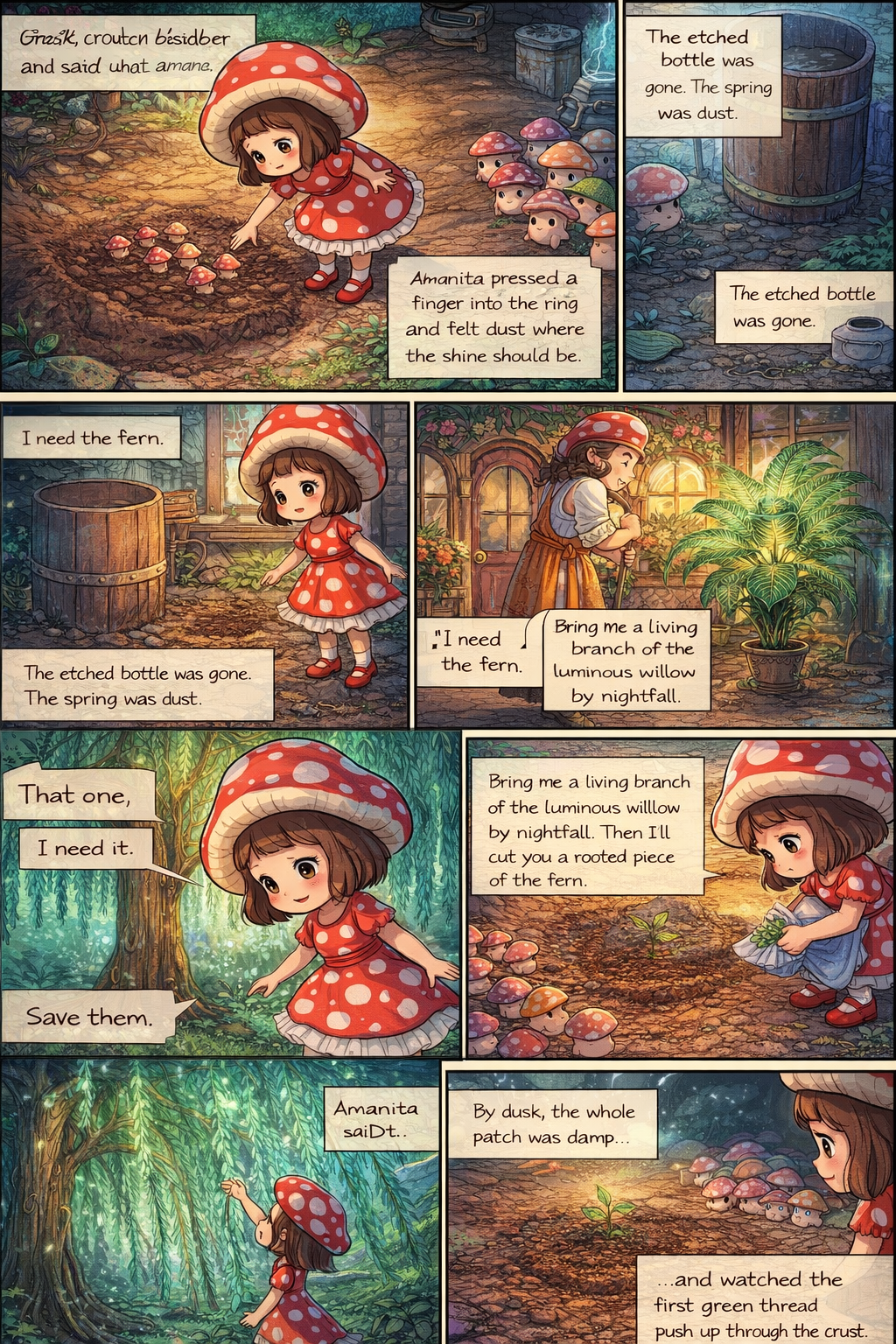
By morning, the new loam had gone pale at the edges. Amanita pressed a finger into the ring and felt dust where the shine should be damp. The sprites huddled in the center, caps dimmer than yesterday. The first spore she had planted lay under a crust of dry soil. Grizak crouched beside her and said what Amanita already knew. "Week's end," Grizak said. "Maybe less. It needs water every day." Amanita ran through what she had. The spring was dust. The etched bottle was gone to the fairy. Her rain barrel held a finger of green scum. She thought of the willow grove, and the tall fern that grew inside the flower shop by the counter — the one that never wilted, even when the shopkeeper forgot it for weeks. Amanita had watched a drop bead on its lowest frond in the dry heat of last summer. Water came out of that plant on its own. She told Grizak to guard the patch and ran for the shop. The shopkeeper was sweeping the step. Amanita pointed past her, to the giant fern in the back corner. Its fronds glowed a soft blue-green, layered outward like open hands. A wet ring darkened the floor around its pot. "That one," Amanita said. "I need it. Or a cutting. Anything." The shopkeeper leaned on her broom. "That fern's been in my family four generations. It draws water out of the air. Feeds itself." She looked at Amanita's dirty hands, the loam under her nails. "It's not for sale." Amanita's throat tightened. "My spore will die by Friday. I have nine sprites depending on me." "Trade, then. Not coin." The shopkeeper's eyes moved to the window, to the willow line beyond the roofs. "Bring me one branch off the luminous willow. A living one, with leaves still on it. I'll cut you a rooted piece of the fern." Amanita went straight to the grove. The willow's branches trailed almost to the ground, glowing faint against the dry sky. She knelt at the roots first and asked, out loud, for one branch. She waited. A low breeze moved through the leaves. One thin branch swung down and brushed her shoulder. She took it as an answer and cut it clean with Grizak's knife. The shopkeeper took the branch without a word. She dug a young shoot from the base of the fern, wrapped its roots in wet cloth, and handed it over. Amanita ran home with the shoot against her chest. She planted it at the center of the loam ring. Within an hour, beads of water rolled from its fronds and darkened the soil around the spore. The sprites climbed onto its leaves and drank. By dusk, the whole patch was damp. Amanita knelt at the edge and watched the first green thread push up through the crust.
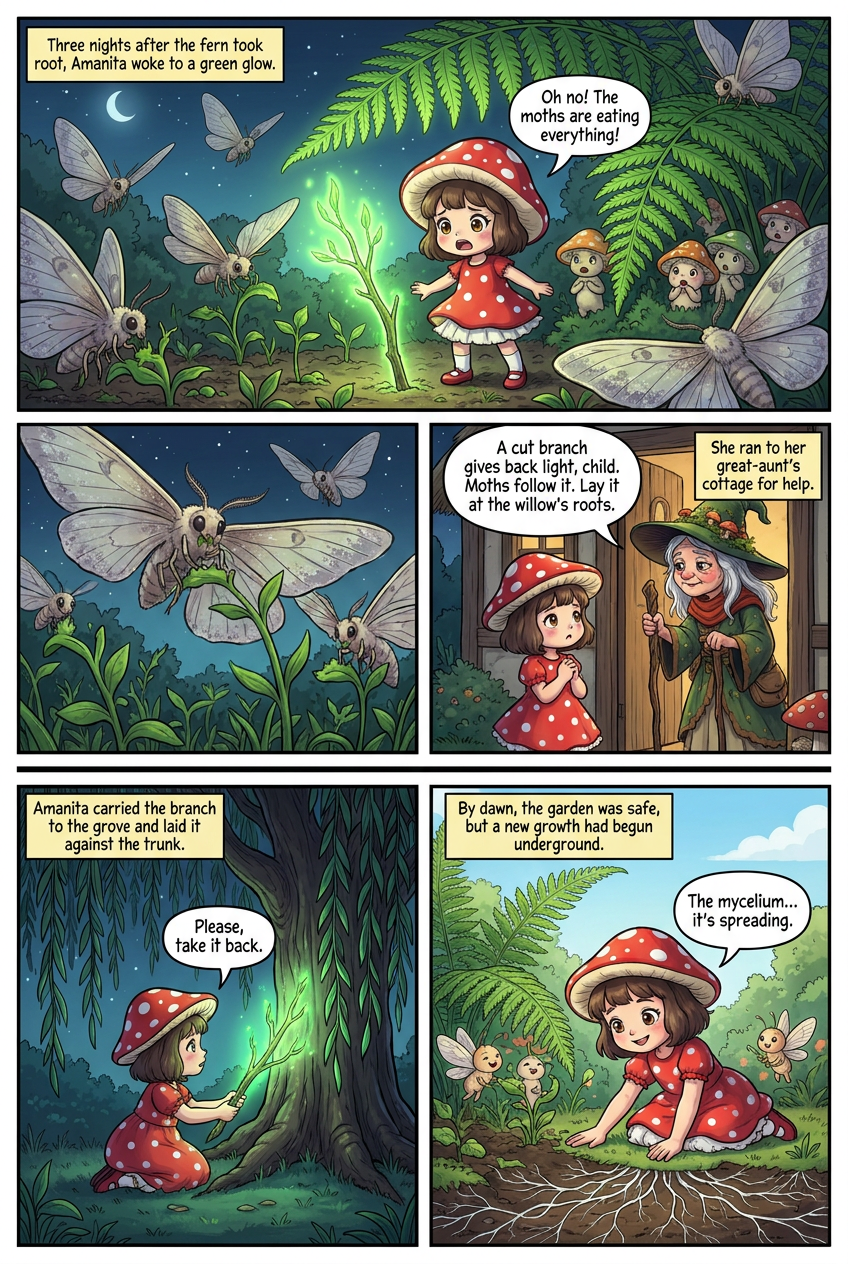
Three nights after the fern took root, Amanita woke to a green glow pouring through her window. She went out barefoot. The willow branch she had cut and stuck at the edge of her patch as a marker was burning bright as a lantern. It had been dim when she planted it. Now it lit the whole garden. She would have been proud, except for the moths. Dozens hung in the air above her spore patch. Their wings were the size of her hands, dusted pale, and their mouths worked like slow scissors. Two had already landed on a new green sprout. When Amanita ran forward, they lifted, circled the branch, and came down again a foot away. By dawn, six sprouts were chewed to the stem. The sprites huddled under the fern, too small to fight wings that wide. Amanita counted what was left. Eleven sprouts. One more night like this and she would have none. She ran to her great-aunt's cottage. Myrtle Sporecap was already at her door, leaning on her staff, mushrooms bobbing on the brim of her hat. She had seen the glow from her window. "You cut a living branch from the willow," Myrtle said. She did not sound angry. She sounded tired. "A cut branch keeps drinking light for a while. Then it gives the light back all at once. Moths follow it. They always have." "Can I put it out?" "Water won't. Dirt won't." Myrtle tapped her staff once. "Take it back. Lay it at the willow's roots before the sun sets. The tree will finish it. If you wait one more night, the moths will strip every sprout you have." Amanita ran home, wrapped the branch in her apron, and carried it to the grove. It was hot through the cloth. She knelt where she had cut it and laid it against the trunk. The willow's long leaves swung down and closed around the branch like fingers around a coal. The glow dulled, then died. The apron came away cool. She walked home slow. The garden was dim again, only the fern giving its soft blue-green light. The sprites climbed out from under the fronds and touched the chewed stems, chirping low. Amanita counted the sprouts once more. Eleven. She knelt and pressed her palm flat to the damp loam. Something crackled under her hand — not a moth, not a root. A thin white thread ran along the soil, then another, spreading out from the fern. Mycelium. The spore had taken hold underground. She smiled, then her smile fell. The threads did not stop at the loam ring. They pushed straight past it, into the pale dead dirt beyond, and stalled there. Her garden was alive. It also wanted more ground than she had.
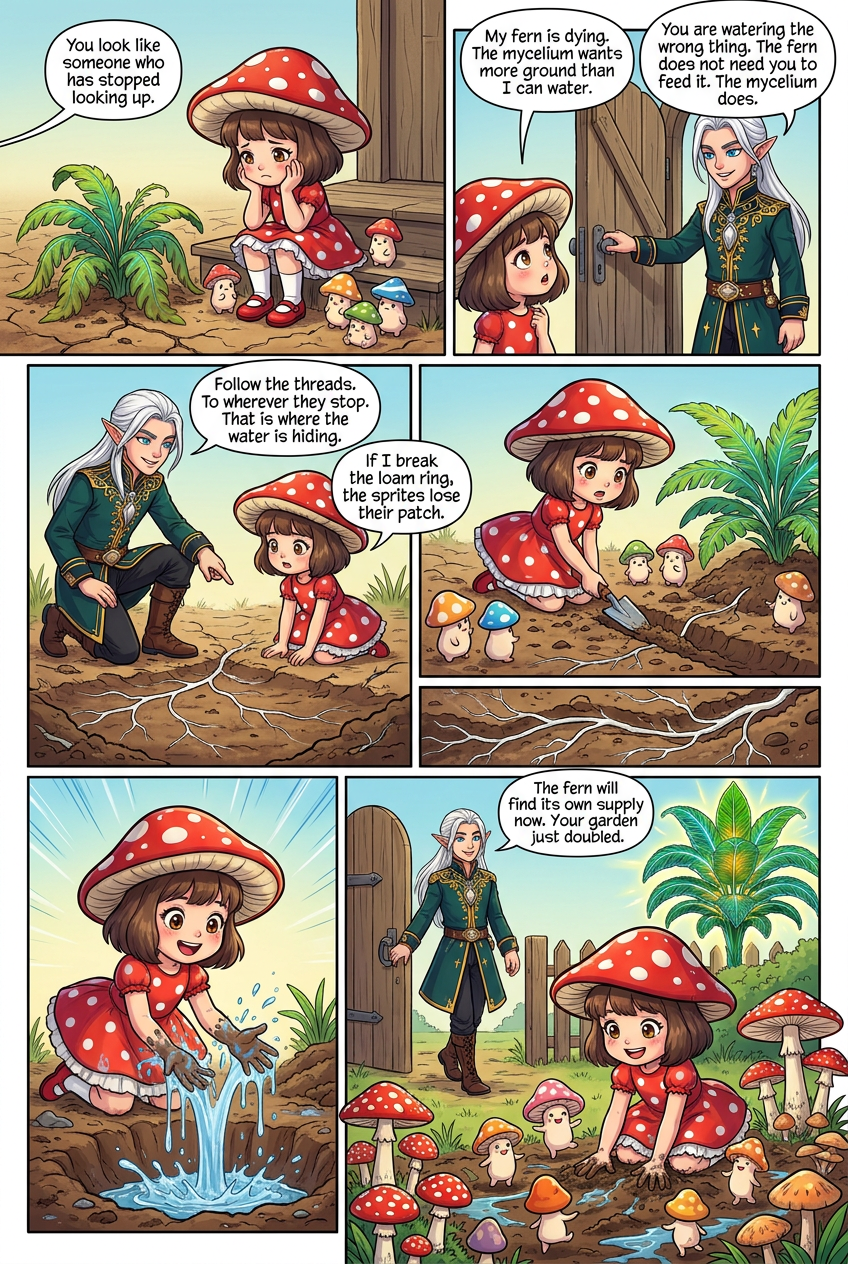
By morning, the mycelium threads had pushed further into the dead dirt beyond her patch. The fern's fronds drooped. The soil around its base looked pale and thirsty. Amanita pressed her fingers into the loam and felt it dry an inch down. One fern could not water a spreading garden. She needed real water, and the spring was still dead. She sat on the step and put her head in her hands. The sprites gathered near her boots and chirped. She had traded away the endless bottle. She had emptied the sprout bottle. She had no plan left. "You look like someone who has stopped looking up." Amanita lifted her head. An elf stood at her gate, silver hair loose over a green coat, a small pendant at his throat. She had met Lysander Moonwhisper twice on the forest paths. Both times he had answered a question before she finished asking it. He unlatched the gate without waiting. "My fern is dying," she said. "The mycelium wants more ground than I can water. I have no spring. I have no bottle." Lysander knelt at the edge of the loam. He touched one white thread where it crossed into the dead soil. He smiled like a person who already knew the answer. "You are watering the wrong thing," he said. "The fern does not need you to feed it. The mycelium does. Follow the threads." "Follow them where?" "To wherever they stop. That is where the water is hiding." He stood and brushed his knees. "Fern mycelium hunts water underground. It reaches until it finds a vein. Yours has stalled because you fenced it in with loam. Break the ring. Let it run." Amanita stared at the pale threads. "If I break the loam ring, the sprites lose their patch." "Then widen it. The loam will follow the mycelium once the mycelium finds what it wants." She fetched her trowel. She cut a narrow channel through the loam ring at the point where the threads pushed hardest. She scraped the dead dirt loose beyond it and laid a thin trail of loam along the cut. The sprites watched from the fern. The threads moved. Not fast, but she could see them creep, white against brown. She followed on her knees for six feet, then ten. At twelve feet the threads bunched and dove. The soil under her hand went cold and damp. She dug two inches down and hit wet clay. Water welled up around her fingers. A hidden vein. Right there, under the dead ground, the whole time. She looked up. Lysander was already at the gate. "The fern will find its own supply now," he said. "Your garden just doubled." He closed the gate behind him. Amanita pressed both palms to the wet soil. The fern's fronds lifted. The sprites ran to the new damp line and began to dance.
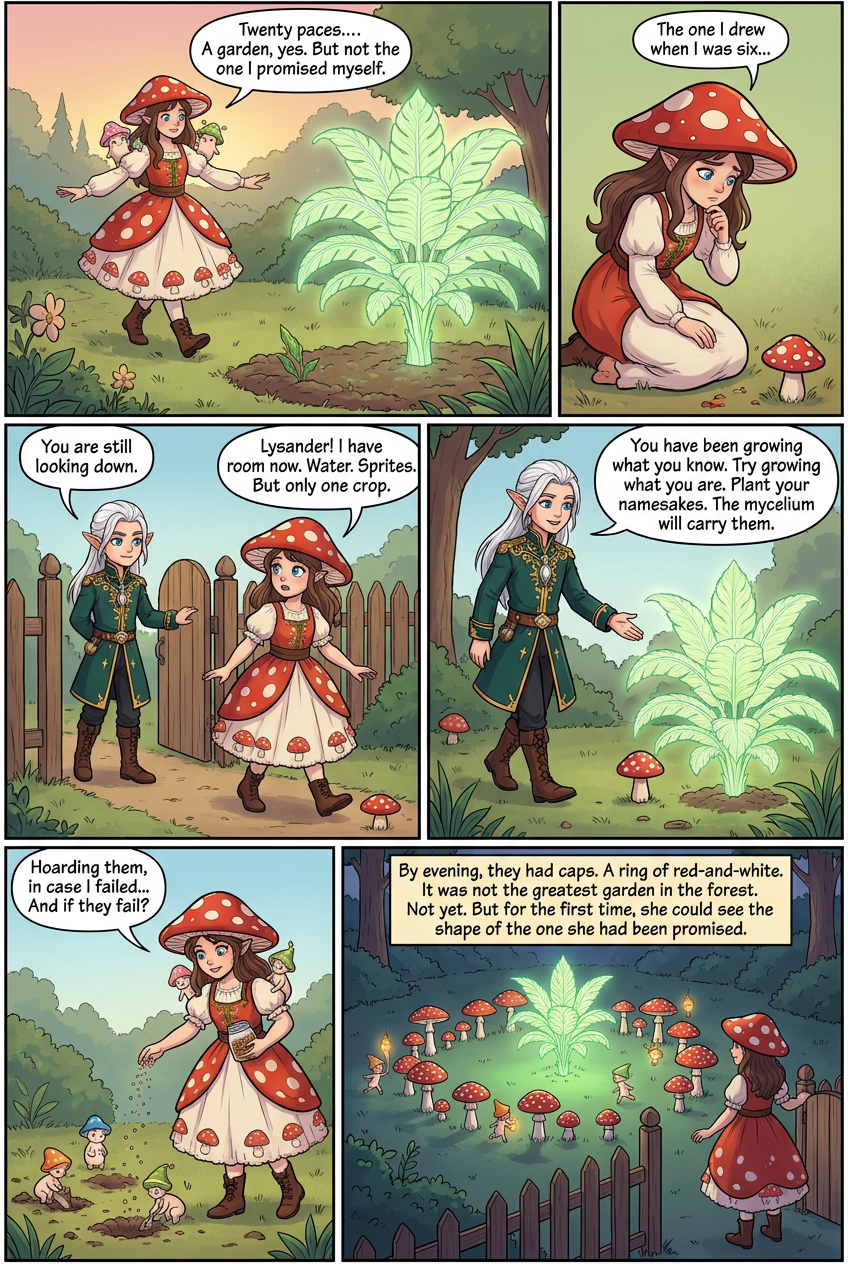
A week passed. The mycelium had drunk deep from the hidden vein, and the loam had followed. Amanita walked the new edge of her patch at dawn and counted twenty paces where there had been ten. The fern stood tall at the center, its layered fronds glowing pale green in the mist. The sprites rode on her boots and shoulders. She had a garden now. She still did not have the garden she had promised herself. She knelt by the first spore mound and lifted a cap the size of her thumb. Red with white spots. The one she had drawn on the inside of her cupboard when she was six. She set it back gently. "You are still looking down." Lysander stood at the gate again. Same green coat, same easy smile, as if he had never left. Amanita stood up and brushed her dress. "I have room now," she said. "I have water. I have nine sprites and a fern that will not quit. But I only have one crop coming up, and it is small." He stepped inside and walked the loam ring. He stopped at the fern and touched one glowing leaf. "You have been growing what you know. Try growing what you are." "Meaning what?" "The red-and-white ones." He nodded at the little cap by her knee. "Your namesakes. Plant them along the whole new ring. The mycelium will carry them. The sprites will guard them. You already have every piece." She stared at the mound. She had been saving those spores. Hoarding them, really, in case she failed. "And if they fail?" "Then you will know something you did not know yesterday." He shrugged. "But they will not fail. Look at the ground." She looked. The mycelium had already threaded pale lines toward the mound, as if the fern itself were asking. Amanita went inside and brought out her spore jar. She walked the new ring slowly, tapping a pinch into each shallow hole the sprites dug for her. Twenty paces. Forty holes. The jar was empty when she finished. She patted the last one closed and sat back on her heels. By afternoon the first white pins pushed through. By evening they had caps. Red caps, white spots, small and perfect. The sprites danced along the ring and would not stop. The fern's glow reached them and made the whole garden look lit from below. Amanita stood at the gate and looked back. Her patch was no longer a patch. It was a ring of red-and-white caps around a glowing fern, with nine sprites moving between them like small lanterns. Lysander was gone. He always was. It was not the greatest garden in the forest. Not yet. But for the first time, she could see the shape of the one she had been promised.
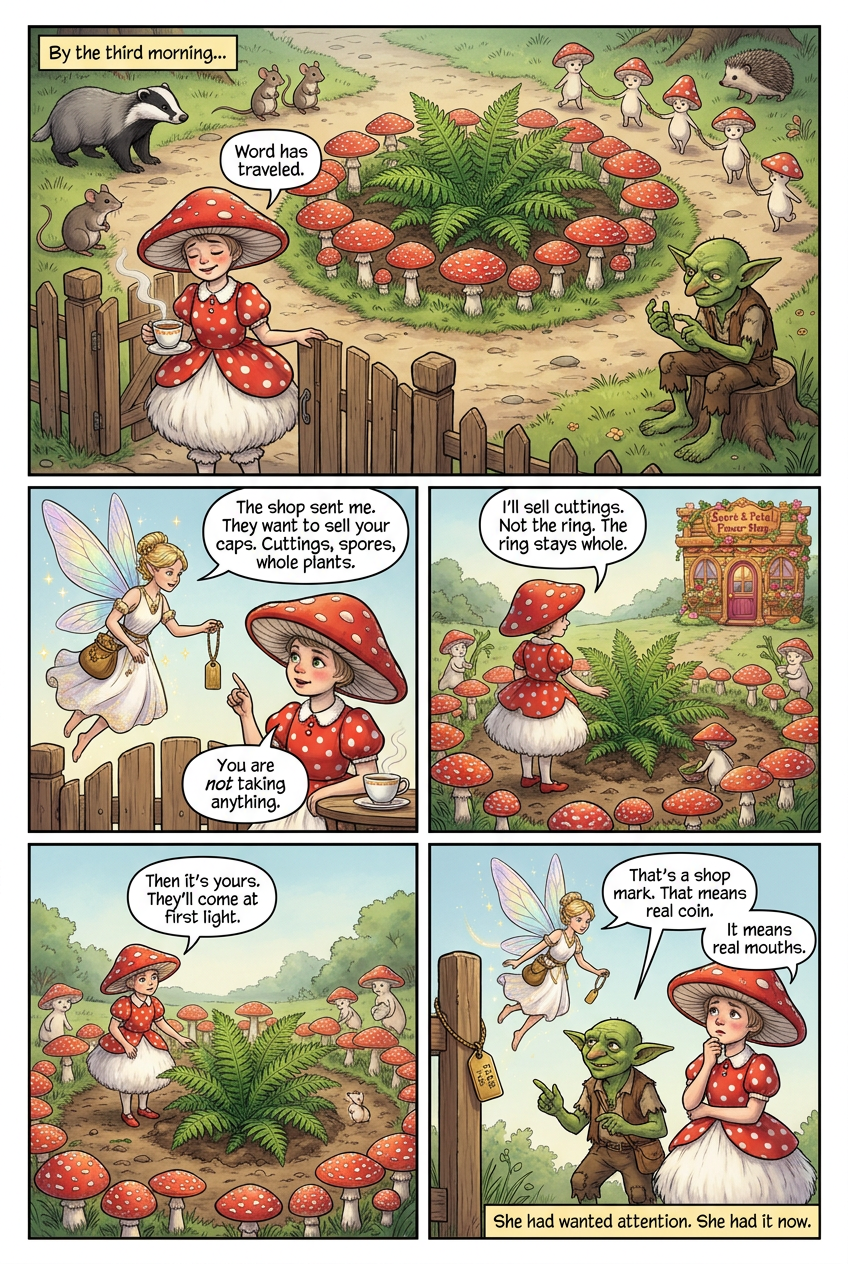
By the third morning, the path to Amanita's gate was worn flat by strangers. A badger came first, then two field mice, then a hedgehog who only wanted to look. Word had traveled. The red-and-white ring around her fern was the talk of the hollow, and every creature within a day's walk wanted to see it for themselves. Amanita stood at the gate with a cup of tea and watched them come. She was tired. She was also, for the first time, happy. The sprites kept order along the ring. They tapped the noses of anyone who leaned too close and led the polite ones in a slow circle around the fern. Grizak had built a low rope fence at the edge of the loam. She sat on a stump beside it and counted visitors on her fingers until she ran out of fingers. A little before noon, a shimmer settled on the gatepost. The fairy from the willow grove. The one who had taken the etched bottle and never given it back. She folded her wings and looked at the garden the way a jeweler looks at a stone. "You did it," the fairy said. "They said you couldn't and you did." Amanita set her cup down. "You are not taking anything." "I'm not here for taking." The fairy touched the pouch at her hip and drew out a small brass tag on a chain. "The shop sent me. They want to sell your caps. Cuttings, spores, whole plants. They'll split the coin with you and send buyers straight to your gate." Amanita looked past her, down the path, toward the flower shop she knew well. Petals on the eaves. Vines around the sign. She had traded there for yarrow, for pepper root, for the fern that saved her. She had never sold anything back. "How many buyers?" "As many as you can feed." The fairy smiled. "Starting tomorrow." Amanita walked the ring once, slowly. Forty caps. Small and perfect. Half of every crop already promised to the sprites. She stopped at the fern and put her hand on the loam. "I'll sell cuttings," she said. "Not the ring. The ring stays whole." The fairy tied the brass tag to the gatepost. "Then it's yours. They'll come at first light." She lifted off and was gone before Amanita could change her mind. Grizak came over and read the tag. "That's a shop mark. That means real coin." "It means real mouths," Amanita said. She looked at the ring and did the math the way her aunt had taught her. Forty caps. Nine sprites. One fern. A shop's worth of buyers by sunrise. She had wanted attention. She had it now. She would have to grow faster than she ever had, or the garden that finally looked like hers would be picked bare by the end of the week.
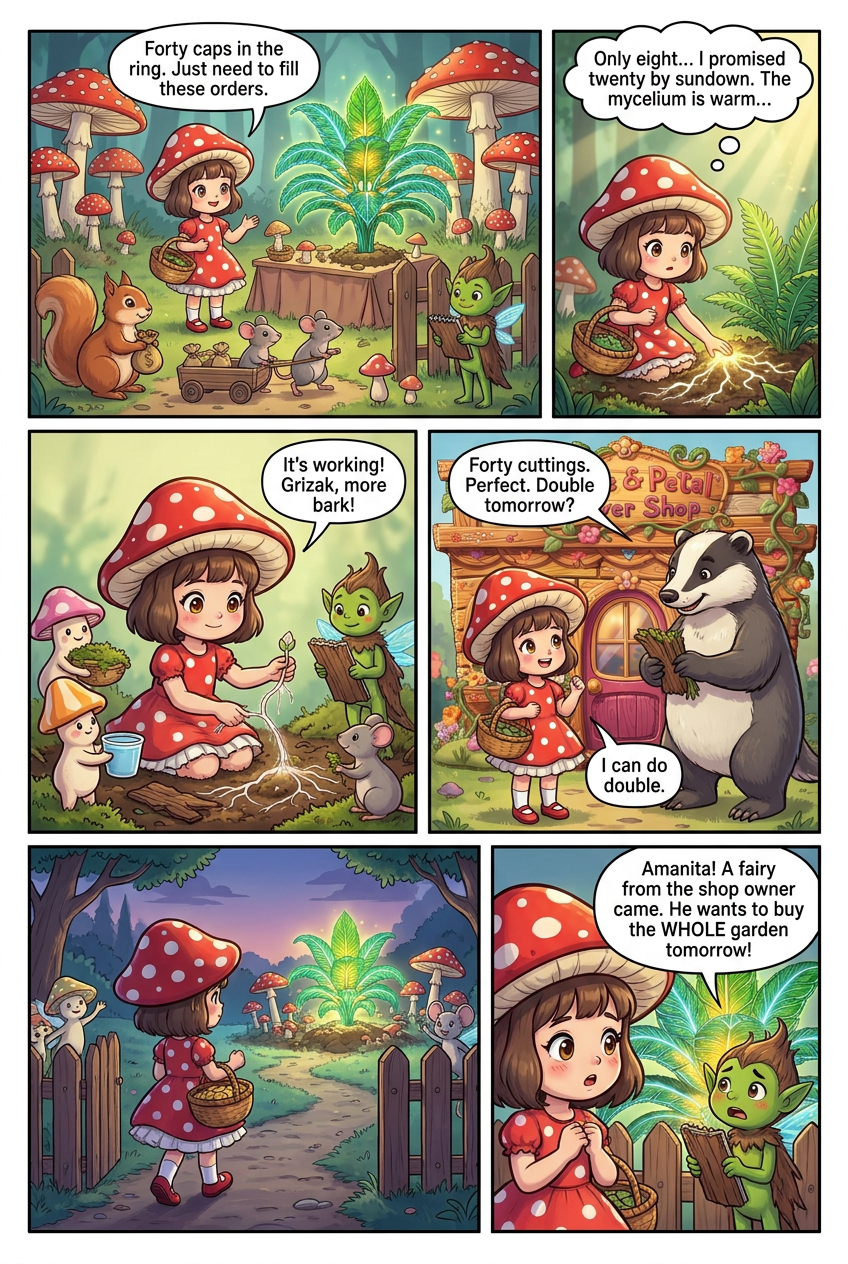
The first buyers came at dawn. A squirrel with a coin pouch. Two mice pulling a cart. A mole who wanted spores by weight. Amanita stood at the gate with her cutting knife and a basket, and she counted her stock the way her aunt had taught her. Forty caps in the ring. Nine sprites watching. One fern at the center, glowing under its layered fronds. She had all morning to fill orders that would take all day. She worked the outer edge first. She sliced cuttings from the smaller caps and left the mature ones whole. The sprites moved with her along the ring, tapping any buyer who stepped past the rope. Grizak took coin at the gate and wrote each order on a scrap of bark. By midmorning the basket was half full and the line still stretched down the path. At noon Amanita ran short. She had promised the shop twenty cuttings before sundown and she had eight. She knelt by the fern and pressed her palm to the loam. The fronds above her curled outward, soft light moving through the leaves. Water beaded on the underside of every frond and fell in slow drops. The mycelium under her hand was warm. It was working faster than she was. She changed her plan. She stopped cutting from the ring and started cutting from the mycelium itself. She lifted a thread from the loam, teased a bud off its tip, and set it in wet moss. Each bud held a small red cap already forming. She worked one thread, then another, then six. The sprites brought her moss and honey water. Grizak brought her more bark to write on. The buds firmed in the basket while she watched. By late afternoon she had forty cuttings and the ring still stood whole. She walked the path herself with the basket on her hip. The shop sat where it always had, petals on the eaves, vines around the sign. The shopkeeper met her at the door and counted every cutting twice. He paid her in coin and asked for double tomorrow. "I can do double," Amanita said. She meant it. She walked home in the last light. The ring glowed ahead of her, forty red-and-white caps and one fern lit from inside. The sprites lined the rope fence and watched her come. Grizak had a fresh scrap of bark in her hand and a worried face. "Another fairy came," Grizak said. "Not the willow one. She said the shop's owner wants to see the ring. Tomorrow. She said he wants to buy the whole garden." Amanita set the basket down. The coin inside was heavier than she expected. She looked at the ring she had promised to keep whole and at the coin that would feed nine mouths through winter. She had met the shop's demand. She had made the deal work. Now the shop wanted more than she had agreed to sell.
Play your story to life
Storycraft is a mobile game where you create AI characters, craft items and locations to build their world, then discover what direction your story takes. Download the iOS game for free today!
Download for free