

Amara Bennett's Arc
13 Chapters
Amara Bennett's dream is winning the underground rebellion's trust and being crowned its leader despite her small stature..

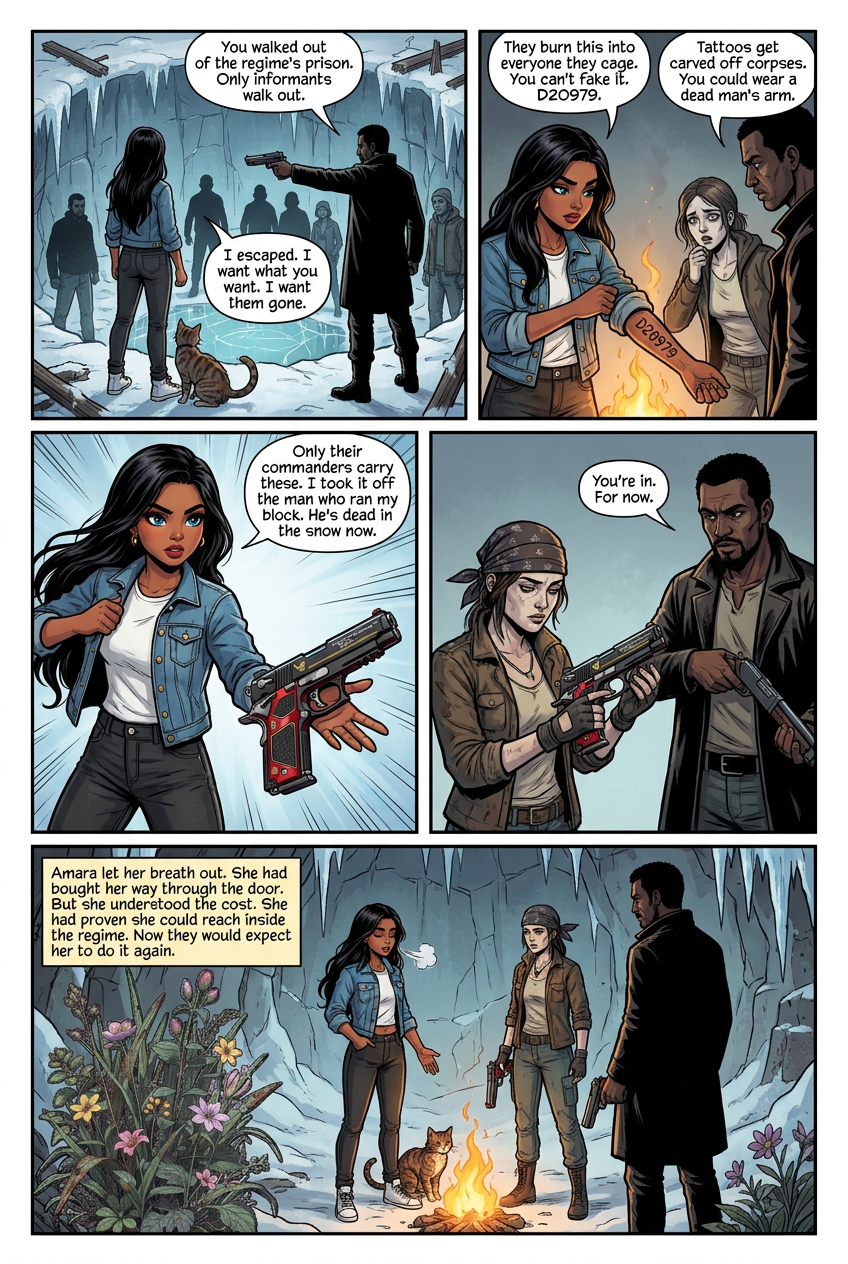
Amara Bennett wanted to lead the rebellion, but tonight the rebels wanted to kill her. She stood at the mouth of their hideout, a frozen pit ringed with ice and broken timber. Six of them watched her from the shadows. Amara was small, barely reaching their shoulders, and she could feel them counting that against her. A scarred cat slipped between the timbers and rubbed her boot. Nobody laughed. The tallest rebel stepped forward and leveled his own weapon at her chest. "You walked out of the regime's prison," he said. "Only informants walk out." "I escaped," Amara said. Her voice did not shake, but her hands were cold. "I want what you want. I want them gone." "Words," he said. "Prove it, or you go in the pit." She had no papers. No dead officer to name. Nothing they would believe. If she gave them nothing, they would shoot her and drop her body into the ice. She had one thing on her body, and one thing in her coat. Amara pulled her sleeve to her elbow. She turned her forearm to the fire's light. The prisoner number stood out in bold, worn ink. D20979. "They burn this into everyone they cage," she said. "You can't fake it. You can't buy it. I earned it in their cells." The rebels leaned in. One woman traced the digits with her eyes and went pale. Amara guessed she had lost someone behind those walls. But the tall man did not lower his weapon. "Tattoos get carved off corpses," he said. "You could wear a dead man's arm." So the number was not enough. Amara reached slowly into her coat. Every gun in the pit followed her hand. She drew out the officer's sidearm and held it flat on her palm, offering it. The weapon was black and red, marked with the regime's eagle and the command crest. The tall man's face changed the moment he saw it. "Only their commanders carry these," Amara said. "I took it off the man who ran my block. He's dead in the snow now. A spy brings you lies. I brought you his gun." The woman took the sidearm and turned it in her hands. She checked the crest, the serial line, the worn grip. Then she looked at the tall man and nodded once. He lowered his weapon at last. "You're in," he said. "For now." Amara let her breath out. She had bought her way through the door. But the woman kept the sidearm, and the tall man kept his eyes on her, and she understood the cost. She had proven she could reach inside the regime. Now they would expect her to do it again. The cat curled by the fire. Amara pulled her sleeve back down and stepped into the pit, one of them at last, and already owing more than she could pay.
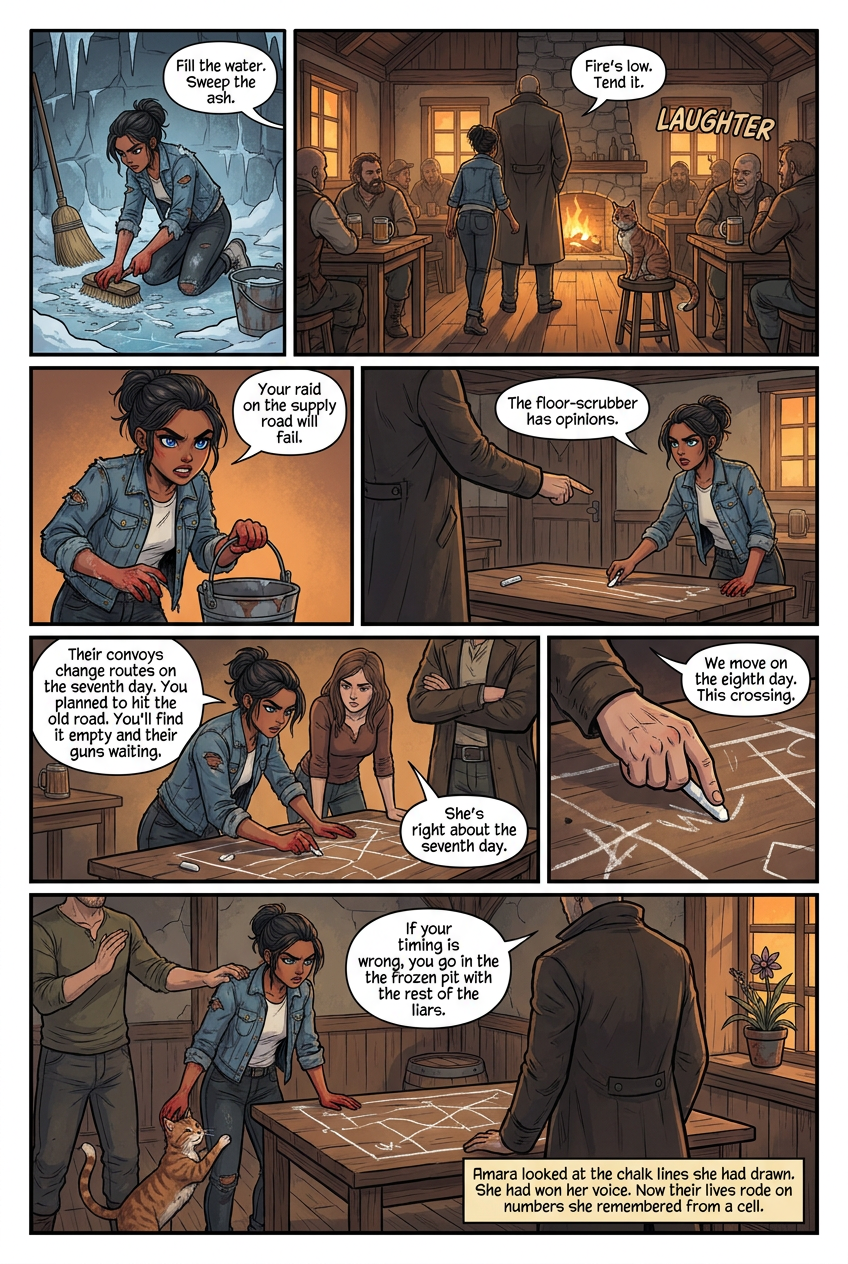
A week in the pit taught Amara one thing. The tall leader would never let her fight. Each morning he handed her a bucket, a broom, or a crate. "Fill the water," he said today. "Sweep the ash." The others sharpened knives and mapped raids. Amara scrubbed floors while they planned. She carried the water bucket to the tavern cottage near the pit. The rebels used it for meetings. Warm light leaked from its cracked windows. Inside, voices rose in a rough song, mugs banging the table. The tall leader stood at the center, tall enough to duck the beams, giving orders. He saw her in the doorway and pointed at the hearth. "Fire's low. Tend it." The room laughed. The scarred cat watched from a stool, tail flicking. Amara set the bucket down. Her hands shook, not from cold now, but anger. She was done fetching water. "Your raid on the supply road will fail," she said. The song died. The tall leader turned. "The floor-scrubber has opinions." "I ran a prison block's supply logs before I escaped," Amara said. "Their convoys change routes on the seventh day. You planned to hit the old road. You'll find it empty and their guns waiting." He crossed his arms. "And how would a spy know that, if not to lead us into a trap?" Amara stepped to the table. She grabbed a piece of chalk and drew on the wood. She marked the crossing, the fallback route, the timing of the patrols. She named the hour the guard shift thinned. The female rebel who had vouched for her leaned close and studied the lines. "She's right about the seventh day," the woman said. "I lost two men on that road last winter. We hit it on the wrong day." The tall leader stared at the chalk marks. The room waited. Amara held his eyes and did not look away. "If I wanted you dead," she said, "I'd have let you march into their guns. Instead I'm telling you where they'll be." He was quiet a long moment. Then he wiped the old route from his memory and tapped Amara's new line. "We move on the eighth day. This crossing." He looked at her. "You come. You'll show us the timing yourself." A few rebels nodded. One clapped her shoulder. The cat jumped down and pressed against her leg. Amara had traded her bucket for a place at the table. But the tall leader's face stayed hard. "If your timing is wrong," he said, "you go in the frozen pit with the rest of the liars." He turned back to the map. The song did not start again. Amara looked at the chalk lines she had drawn. She had won her voice. Now their lives rode on numbers she remembered from a cell, and the leader would be watching every step to see her fail.
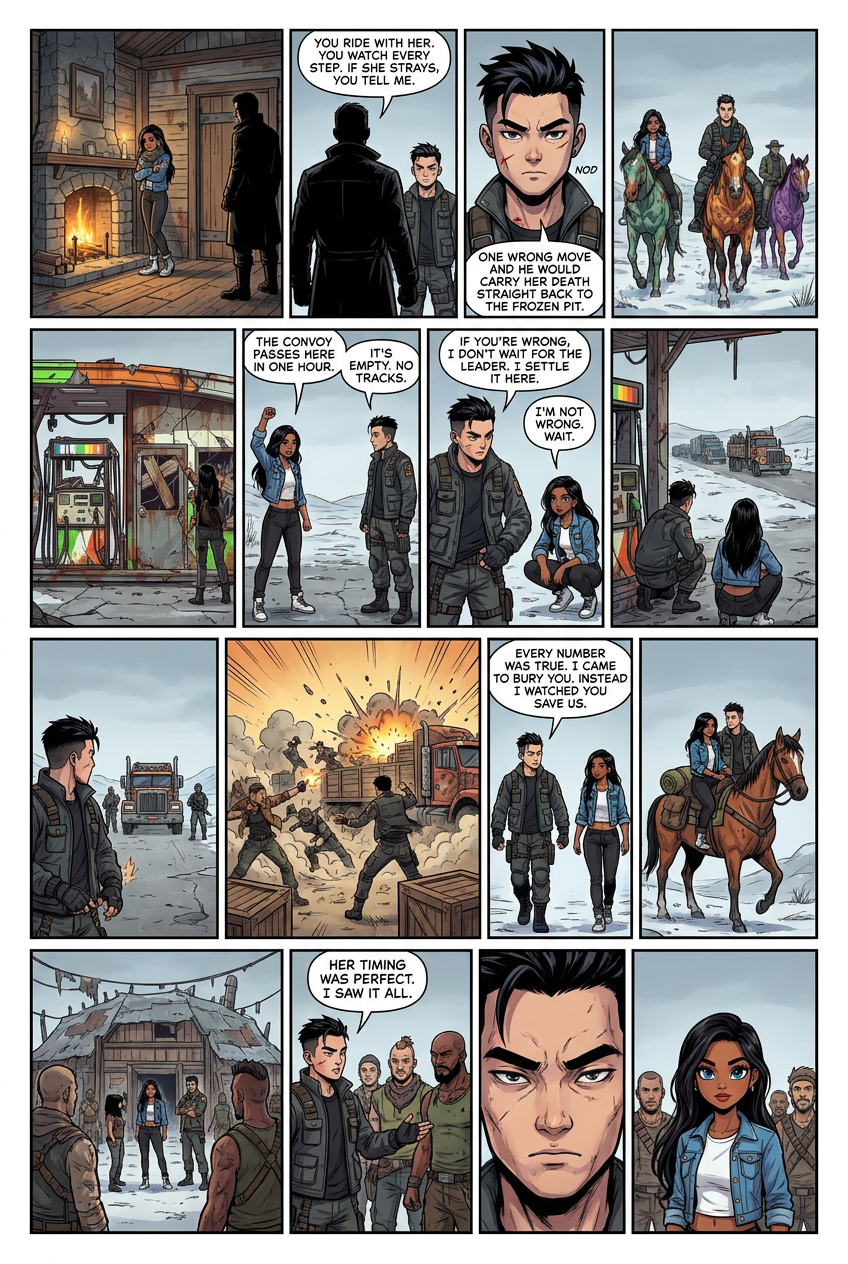
The eighth day came cold and gray. Amara checked her boots by the fire in the small cottage where the raiders gathered. She had won her place at the table. Now she had to keep it alive on the road. The tall leader watched her from the door. Then he raised a hand and called one man forward. "You ride with her," the leader said. "You watch every step. If she strays, you tell me." The man stepped from the shadows. He was tall, with a scar cut over his left eye. He looked at Amara the way a guard looks at a prisoner. This was Jin-Ho Kang, the leader's most loyal blade. Amara knew his name from the barracks talk. He had never lost a target. He gave her a short nod, cold and flat. Her stomach tightened. One wrong move and he would carry her death straight back to the frozen pit. They rode out on three worn horses, a green one, an orange one, and a purple one bred rough for the cold. Amara took the lead. Jin-Ho kept close behind her, saying nothing. His silence pressed harder than any question. They stopped at a broken fuel station. Cracked pumps leaned under a rusted roof. Amara raised her fist. The riders halted. "The convoy passes here in one hour," she said. Jin-Ho swung down and checked the road. "It's empty. No tracks." His voice was quiet. "If you're wrong, I don't wait for the leader. I settle it here." "I'm not wrong," Amara said. "Wait." They crouched behind the pumps. Minutes crawled. Jin-Ho's hand rested near his belt. Amara watched the road and counted in her head, the way she had counted convoys from a prison window. Her mouth was dry. Then she heard it. Wheels on gravel. Engines. A regime convoy rolled into view, right on the road she had marked, at the hour she had named. Guards rode the flanks, few and tired, the shift thinned just as she promised. Jin-Ho stared. His hand fell from his belt. The rebels struck fast. They hit the flank, dropped two guards, and seized the supply crates before the convoy could turn. It was over in minutes. No rebel fell. When the dust settled, Jin-Ho walked to Amara. The cold in his face was gone. "Every number was true," he said. "I came to bury you. Instead I watched you save us." He pulled her up onto the loaded horse himself. On the ride back, he rode beside her now, not behind. The watcher had become a witness. At the hideout, Jin-Ho spoke first, before the leader could. "Her timing was perfect. I saw it all." The other raiders nodded. The leader's hard eyes flicked to Amara, then away. Amara had passed his test. But she saw the leader's jaw tighten. She had won a loyal man from him. Now he had one more reason to fear her.
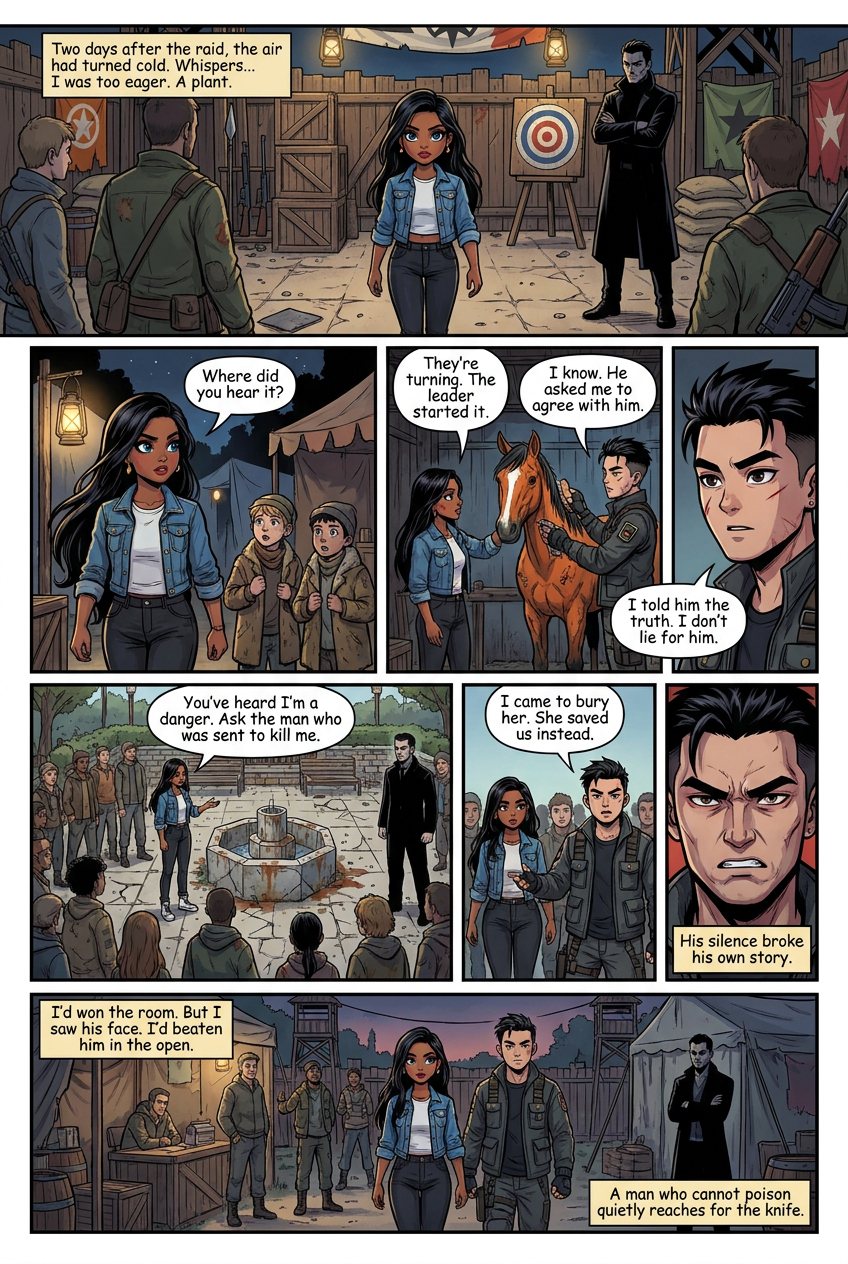
Two days after the raid, Amara noticed the change. Men who had nodded to her now looked away. At the training camp, the sparring stopped when she walked in. Someone had spread a story. She heard the shape of it in whispers: she was too eager, too sharp, maybe a plant after all. The tall leader stood by the target board, arms folded, watching the room turn cold around her. He had built this quietly, and he had built it well. Amara found the source that night. Near the makeshift stalls, two young rebels warmed their hands over a lantern. She heard her name. "The leader says she'll get us killed," one muttered. "Says she's climbing too fast." Amara stepped into the light. The men froze. She did not argue. Arguing would only prove her hungry for power. Instead she asked one question. "Where did you hear it?" They looked at each other and said nothing. That silence told her everything. The leader had gone to each man alone. She needed a witness with more weight than rumor. She went to find Jin-Ho. He was in the horse pen, brushing down the orange mare, his scarred face calm in the dark. He had ridden behind her once as her executioner. Now he brushed the animal like a man at peace. "They're turning," she said. "The leader started it." Jin-Ho kept brushing. "I know," he said. "He asked me to agree with him." Amara's chest tightened. "And?" Jin-Ho set the brush down. "I told him the truth. Every number you gave was true. I don't lie for him." Amara made her choice. "Then say it where they can hear." The next morning she called the rebels to the cracked garden behind the camp, where dead planters lined broken paths. She stood by the dry fountain so all could see her small frame. "You've heard I'm a danger," she said. "Ask the man who was sent to kill me." Jin-Ho stepped forward. He told them plainly: the convoy, the timing, the crates seized without a single death. "I came to bury her," he said. "She saved us instead. The one spreading fear wasn't on that road. I was." The rebels turned then, not to Amara, but to the tall leader. He stood at the edge, jaw hard, caught. He could not call his own enforcer a liar without splitting the camp. He said nothing. His silence broke his own story. The whispers died. By dusk, men nodded to Amara again. She had won the room. But she saw the leader watch Jin-Ho walk at her side, and she understood the cost. She had beaten him in the open. He would not try whispers again. A man who cannot poison quietly reaches for the knife. Amara had made an enemy who now had nothing left to lose.
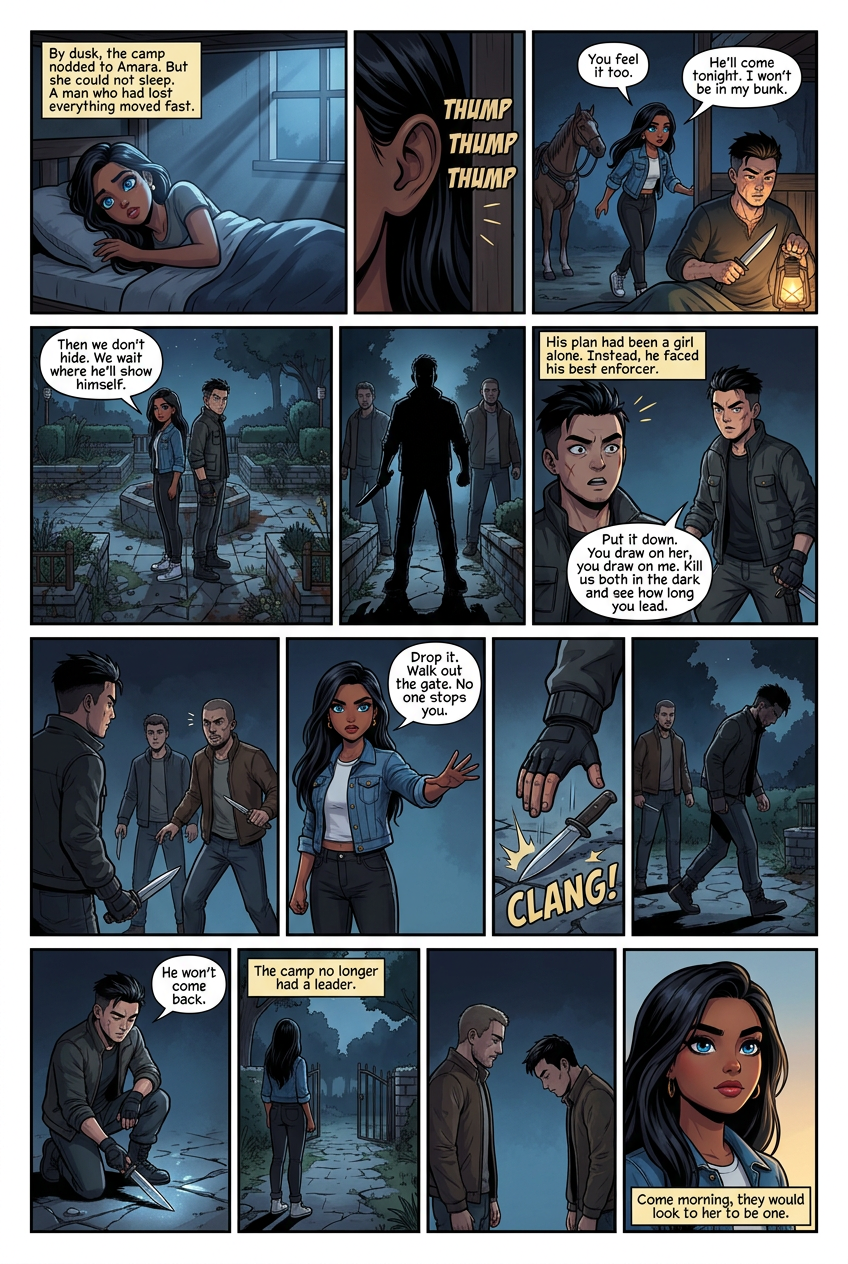
By dusk the camp nodded to Amara again. She had beaten the leader in the open. But that night she could not sleep. A man who had lost everything moved fast. She lay in her bunk and listened to boots pass her door, then stop, then move on. He would not wait for morning. If she stayed here, he would find her alone in the dark. She did not wait to be cornered. She rose and dressed and went to find Jin-Ho. He slept near the horse pen, one hand loose on his knife. He woke the moment her foot scraped stone. His scar caught the lantern light as he sat up. "You feel it too," he said. Not a question. He had ridden behind her once to kill her. Now he reached for his coat to guard her. "He'll come tonight," Amara said. "I won't be in my bunk when he does." Jin-Ho stood. "Then we don't hide. We wait where he'll show himself." He led her past the pen, where three worn horses shifted in the cold. Behind the camp lay the old garden, its planters cracked, its paths broken by weeds. They took the dry fountain at its center and stood in the open, backs to the stone. They did not wait long. The leader came through the dead planters with two men. He carried a knife low against his leg. He stopped when he saw Jin-Ho at her side. His plan had been a girl alone. Instead he faced his best enforcer. "Put it down," Jin-Ho said. "You draw on her, you draw on me. The whole camp knows I stand with her now. Kill us both in the dark and see how long you lead." The leader's eyes moved from Jin-Ho to Amara to his own two men. One of them stepped back. The knife shook in his fist. He had bet everything on catching her weak. Now the bet was lost, and losing it in front of witnesses cost him the last of his name. Amara did not raise her voice. "Drop it. Walk out the gate. No one stops you." She held out one hand, small and steady. "Or stay, and prove every word I said about you." He held for a long breath. Then he let the knife fall. It rang on the broken stone. He turned and pushed past his own men into the dark. His two men looked at each other, then at Amara, and lowered their heads. The threat that had hunted her all night was gone. Jin-Ho picked up the fallen knife. "He won't come back," he said. Amara watched the empty gate. She had survived the leader's last move. But she saw the two men waiting on her word, and she understood. The camp no longer had a leader. Come morning, they would look to her to be one.
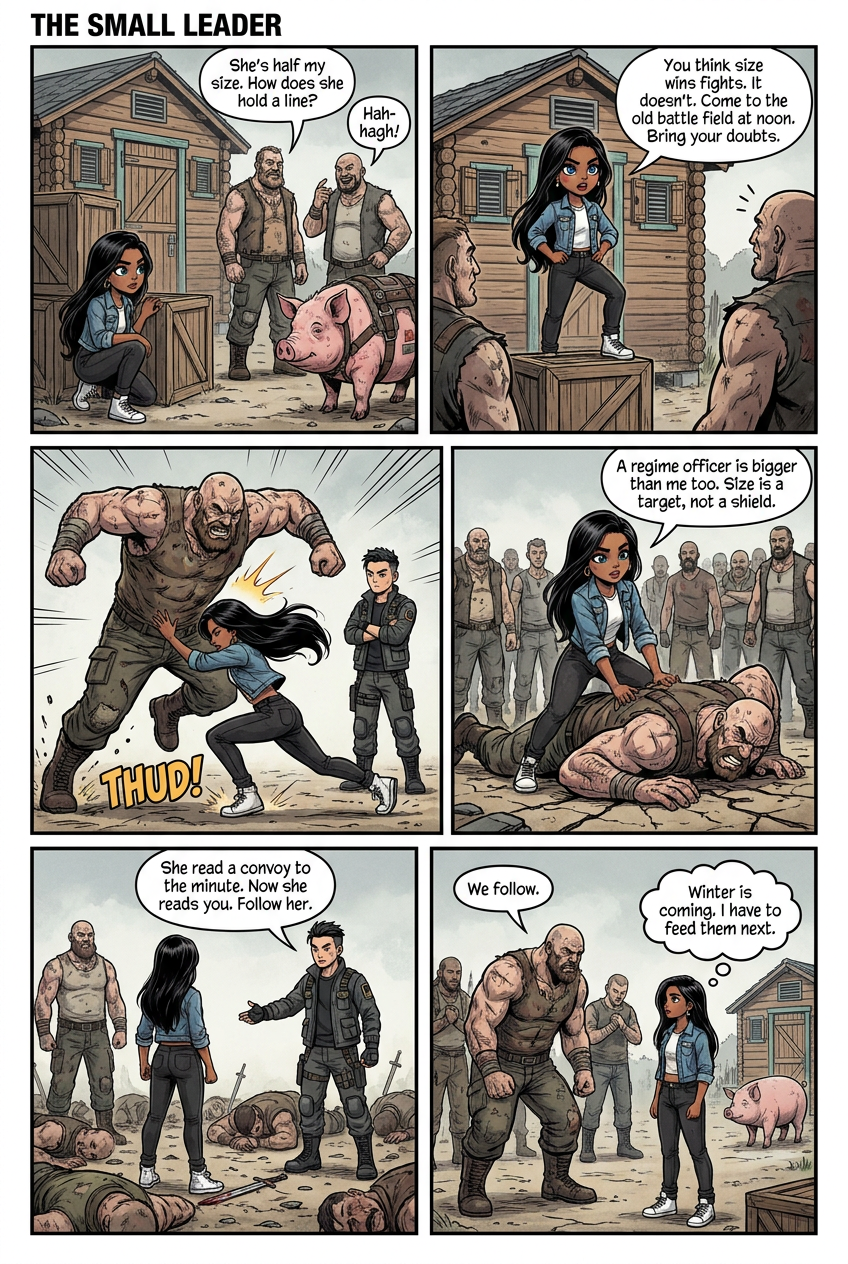
Morning came, and the camp waited on Amara. The leader was gone. But some raiders still did not trust a small woman to lead them into a fight. She heard it near the food store, where men stacked crates of salt pork by a fat, buckle-strapped pig. "She's half my size," one man said. "How does she hold a line?" The others laughed. They would not follow her until she proved she could. Amara did not argue. She walked to the food store and climbed onto a crate so they could see her. "You think size wins fights," she said. "It doesn't. Come to the old battle field at noon. Bring your doubts. I'll answer them there." By noon they gathered at the broken ground where the last clash had left cracked earth and buried blades. Shields lay split among the rocks. Jin-Ho stood at the edge, arms crossed, his scarred face still. He had vouched for her twice before the whole camp. Now he watched to see if she could stand on her own. The loudest doubter stepped out. He was a head taller than Amara and twice as wide. "No knives," she said. "Grip only. Put me down or I put you down." He grinned and lunged. She dropped low, took his wrist, and turned into his weight. His own force threw him past her. He hit the dirt hard and lay stunned among the shields. The camp went quiet. Amara pinned his arm behind his back. "A regime officer is bigger than me too," she said. "I've put down worse than you. Size is a target, not a shield." She let him up. He rubbed his shoulder and did not laugh now. A second man tried her. She used his rush the same way and dropped him beside the first. Then a third. Each fell faster. She did not tire and she did not gloat. "I won't out-muscle the regime," she told them. "Neither will you. We win by seeing what they don't. That's what I bring." Jin-Ho uncrossed his arms. "I rode behind her to kill her once," he said. "She read a convoy to the minute. Now she reads you. Follow her." His word landed on top of hers, and the last mutters died. The tall doubter got to his feet and looked at his own men. Then he faced Amara and lowered his head. "We follow," he said. One by one the others did the same. Amara stood among the fallen shields and knew the camp was hers to command. But she saw the plump pig in its harness and the near-empty crates behind it. Winter was coming, and the raiders looked to her now for food, not just fights. Leading them meant she had to feed them through the cold. That problem waited for her next.
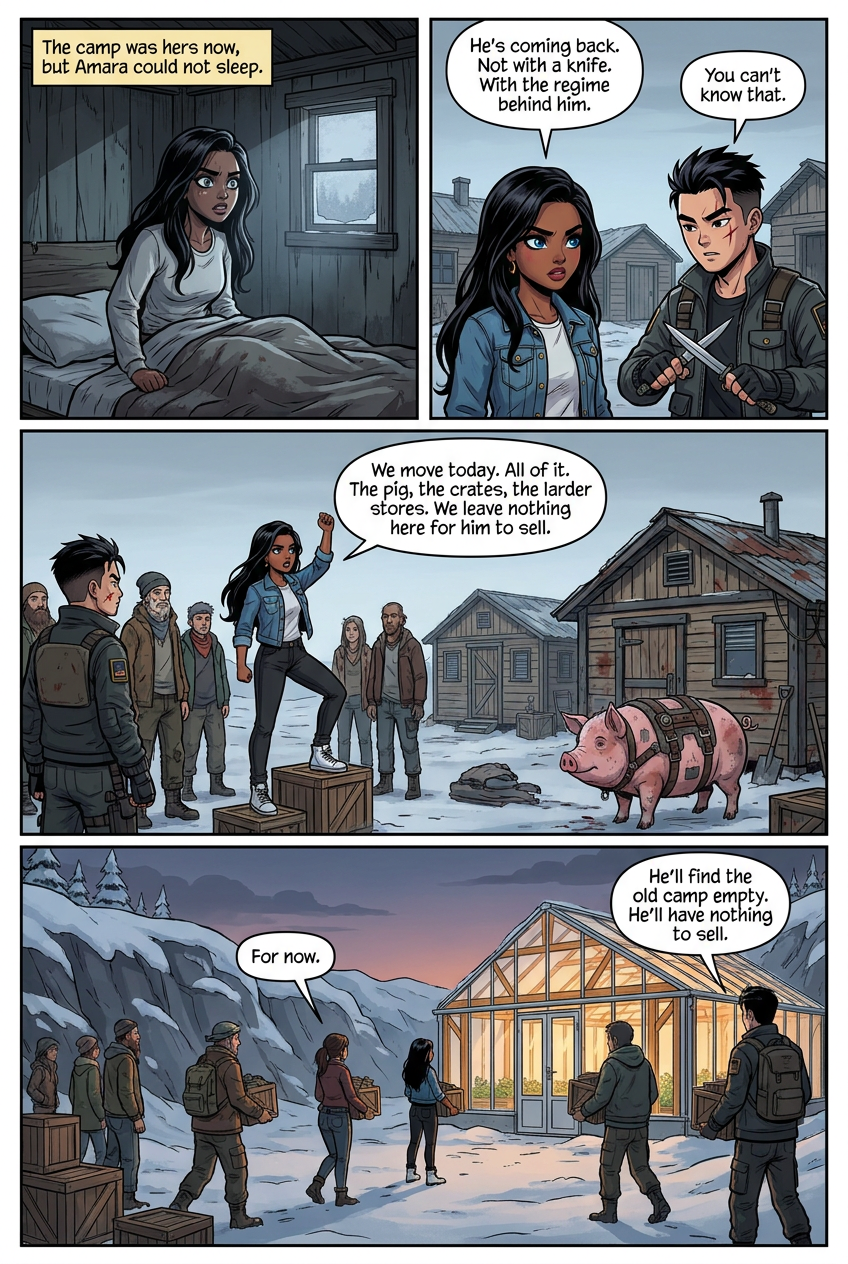
The camp was hers now, but Amara could not sleep. The old leader had fled into the cold, and he knew this ground better than anyone. He knew where they slept, where the walls were thin, where the food house stood. A man with nothing left would sell that to the regime for a warm meal. Amara pictured a raid in the dark, her people cut down in their beds. She rose before dawn and went to find Jin-Ho. He was already awake, sharpening a blade outside one of the weather-beaten hunting cabins. The scar over his left eye caught the gray light. He had ridden behind her once to kill her. Now he was the one man in camp she trusted with a real fear. "He's coming back," she said. "Not with a knife. With the regime behind him." Jin-Ho stopped the blade. "You can't know that." "I know him. He can't beat us alone, so he'll trade us. Our location for his life." She looked at the plump pig in its harness by the food store, at the near-empty crates, at the sturdy larder that held everything they had left. "If they hit us here, we lose the food and the people in one night." Jin-Ho set the blade down. "Then we don't wait here." That was the answer she needed. Amara had already found the place. Two days back, scouting for food, she had seen a glass greenhouse tucked behind a ridge, its wooden beams still sound, its rows still green under frost. It grew food. It had cover. The old leader had never used it, so he could not point to it on any map. She called the camp together at first light. "We move today," she said. "All of it. The pig, the crates, the larder stores. We leave nothing here for him to sell." A few men grumbled. Leaving felt like running. She cut them off. "He knows this spot. He does not know the next one. That's how we stay alive, and that's how we eat through winter." They worked all day. Amara set teams to load the crates and drive the pig. Jin-Ho took the rear guard, watching the tree line for riders. By dusk the camp was empty. They reached the greenhouse as the last light died. The glass held warmth inside. Green rows ran the length of it, enough to stretch their stores for weeks. Jin-Ho stood beside her at the door. "He'll find the old camp empty," he said. "He'll have nothing to sell." "For now," Amara said. She watched her people carry the last crates into the light. She had saved them from the betrayal raid. But moving meant they no longer hid where the regime expected. Sooner or later, a scout would find fresh tracks in the snow, and the whole camp would be exposed in one place. She had traded one danger for another.
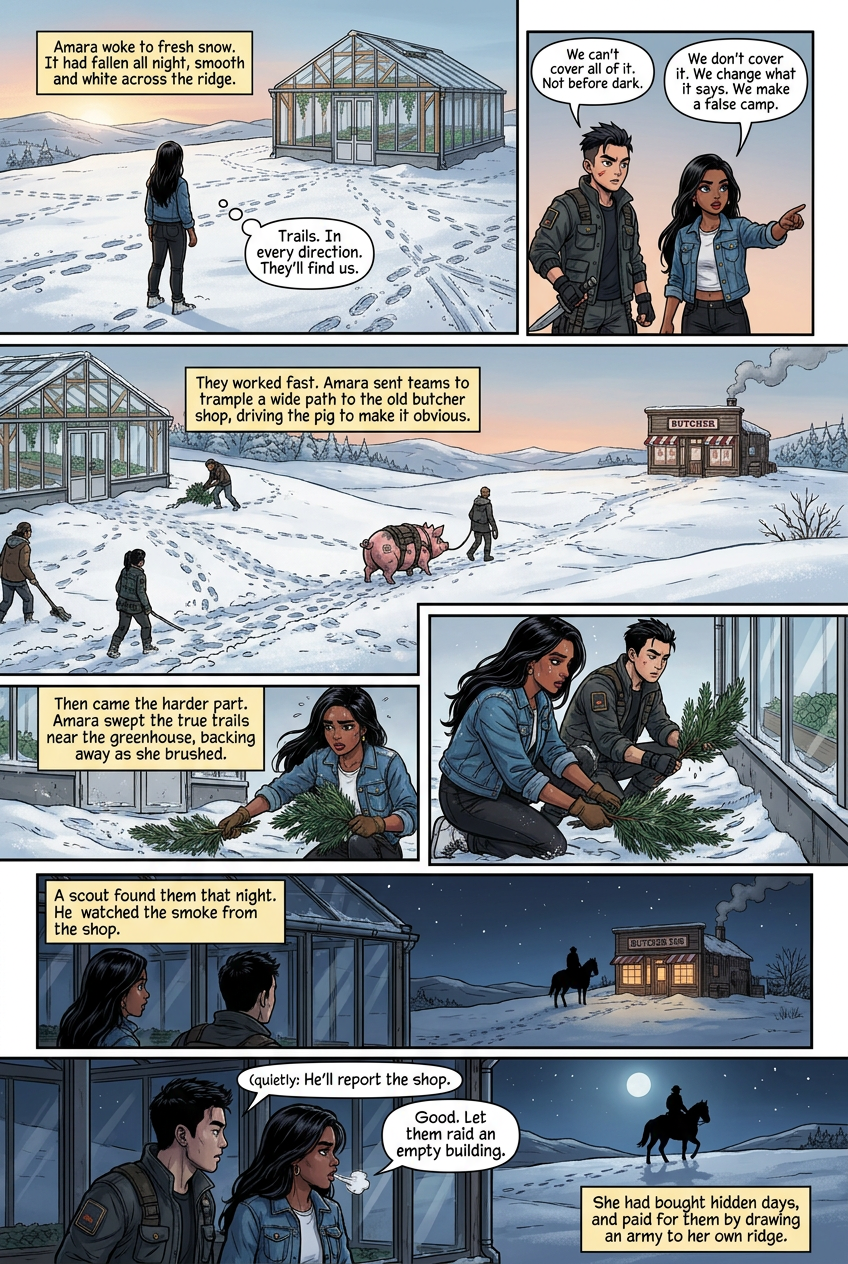
Amara woke to fresh snow. It had fallen all night, smooth and white across the ridge. She stepped outside the greenhouse and saw the problem at once. Trails cut through the powder in every direction. Boot prints from the wood teams. Drag marks from the crates. The deep tracks of the pig in its harness. Any regime scout who crossed the ridge would read the trails like a map and find the whole camp in one glass building. Jin-Ho came out behind her, his blade already at his belt. The scar over his left eye tightened as he studied the snow. He had ridden with her since the convoy raid, and he had stood at her side when the old leader fled. He did not waste words. "We can't cover all of it," he said. "Not before dark." "We don't cover it," Amara said. "We change what it says." He frowned. "Say that plain." "A scout follows tracks to find people. So we make the tracks lead somewhere else." She pointed past the ridge, away from the greenhouse. "There's an old butcher shop down the slope. Empty. Timber walls. If the trails all run there, a scout thinks that's where we are." Jin-Ho understood. "A false camp." They worked fast. Amara sent two teams to trample a wide path from the greenhouse to the butcher shop, deep and obvious. She had them drive the pig down and back three times, so the harness marks pointed to the shop. Inside the shop they lit a small fire and let smoke curl from the chimney. They dropped empty crates by the door. From the ridge it looked lived in. Then came the harder part. Amara took a pine bough and swept the true trails near the greenhouse, backing away as she brushed. The fresh powder was soft and filled the grooves. Jin-Ho worked the other side. By dusk the ground around the glass walls lay smooth again, unbroken, while the churned path to the butcher shop stayed loud and clear. A scout found them that night. Amara saw the lone figure on the ridge at moonrise, watching the smoke from the shop. She held her breath in the dark greenhouse, one hand on Jin-Ho's arm. The scout circled the butcher shop twice. He never turned toward the glass. Before dawn he rode off the way he came. "He'll report the shop," Jin-Ho said quietly. "Good." Amara let out her breath. "Let them raid an empty building." But she watched the smoke thin over the false camp and knew what she had done. She had pointed the regime at a spot down the slope. When they came in force, they would come close. Too close. She had bought hidden days, and paid for them by drawing an army to her own ridge.
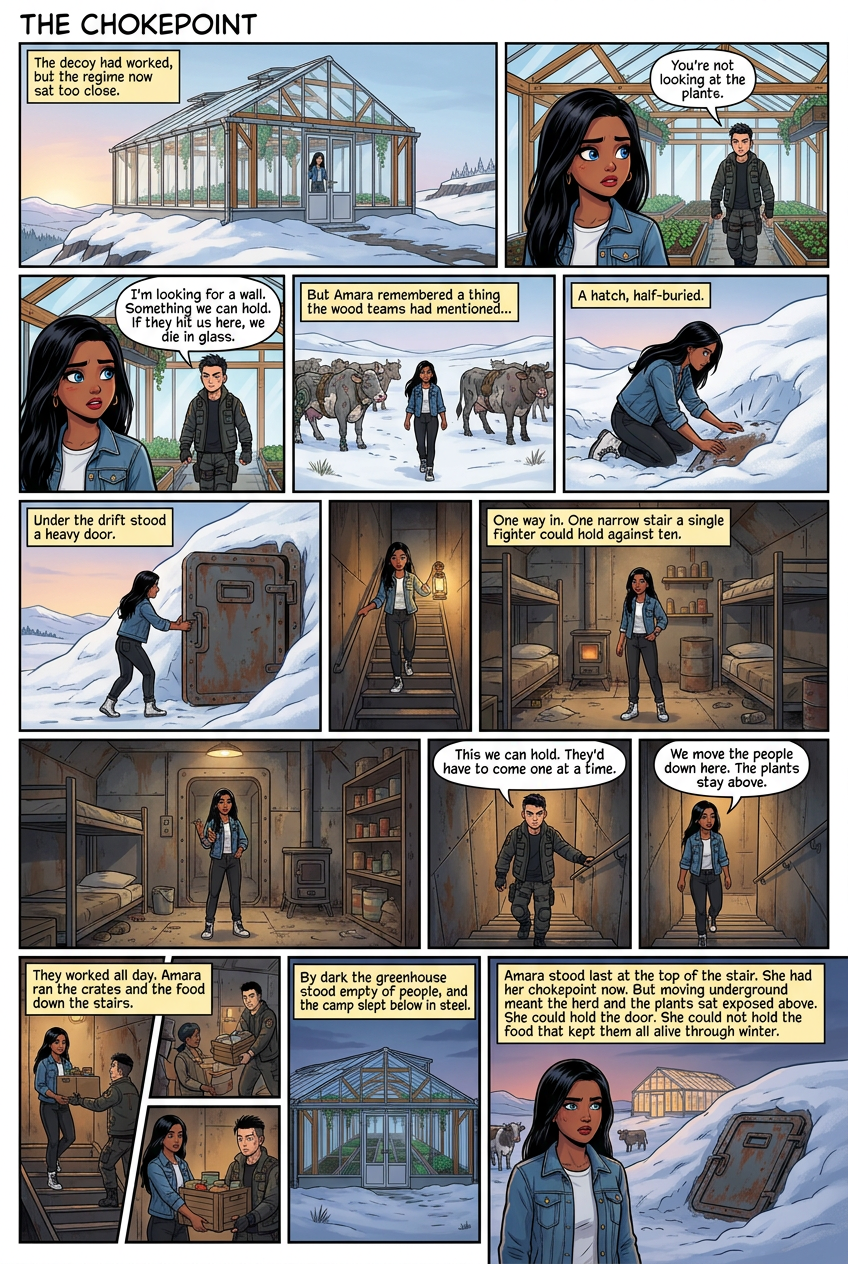
The decoy had worked, but the regime now sat too close. Amara stood in the greenhouse at dawn and studied the ridge through the glass. The false trail had pulled scouts down the slope. When they came in force, they would sweep this ridge. Rows of green plants filled the greenhouse, but glass walls stopped nothing. One volley would shatter every pane. She had a camp full of people and no place to fight from. Jin-Ho found her tracing the ridge line with her finger. The scar over his eye caught the pale light. He had stood at her side against the old leader, and he read her silence now. "You're not looking at the plants," he said. "I'm looking for a wall," Amara said. "Something we can hold. If they hit us here, we die in glass." He crossed his arms. "There's nothing on this ridge but snow and a butcher shop full of lies." But Amara remembered a thing the wood teams had mentioned. A hatch, half-buried, near where the cattle grazed. She pulled on her coat and went out into the cold. The herd stood in the drift, breath steaming, chains and buckles worn on their gray hides. Behind them a wind-packed mound of snow humped against the slope. She dug with her hands until her fingers struck metal. Under the drift stood a heavy door. Two steel panels, streaked with rust, set into the hill. Amara brushed the snow clear. Pipes ran across the surface. A dead red light sat above the frame. She hauled the handle. The door groaned and swung. Stairs dropped into the dark. She lit a lamp and went down. The air was still and warm. Metal panels lined every wall. Bunks, a stove, shelves of dusty cans. One way in. One narrow stair a single fighter could hold against ten. She turned in a slow circle and understood what she had found. Jin-Ho came down behind her. He touched the steel walls, then the tight stairwell. "This we can hold," he said. "They'd have to come one at a time." "And we shoot them one at a time." Amara climbed back up into the light. She looked at the greenhouse, then at the buried door. "We move the people down here. The plants stay above. If scouts see growing rows, they see a farm, not a fort." They worked all day. Amara ran the crates and the food down the stairs. She set watch rotations at the hatch. By dark the greenhouse stood empty of people, and the camp slept below in steel. Amara stood last at the top of the stair. She had her chokepoint now. But moving underground meant the herd and the plants sat exposed above. She could hold the door. She could not hold the food that kept them all alive through winter.
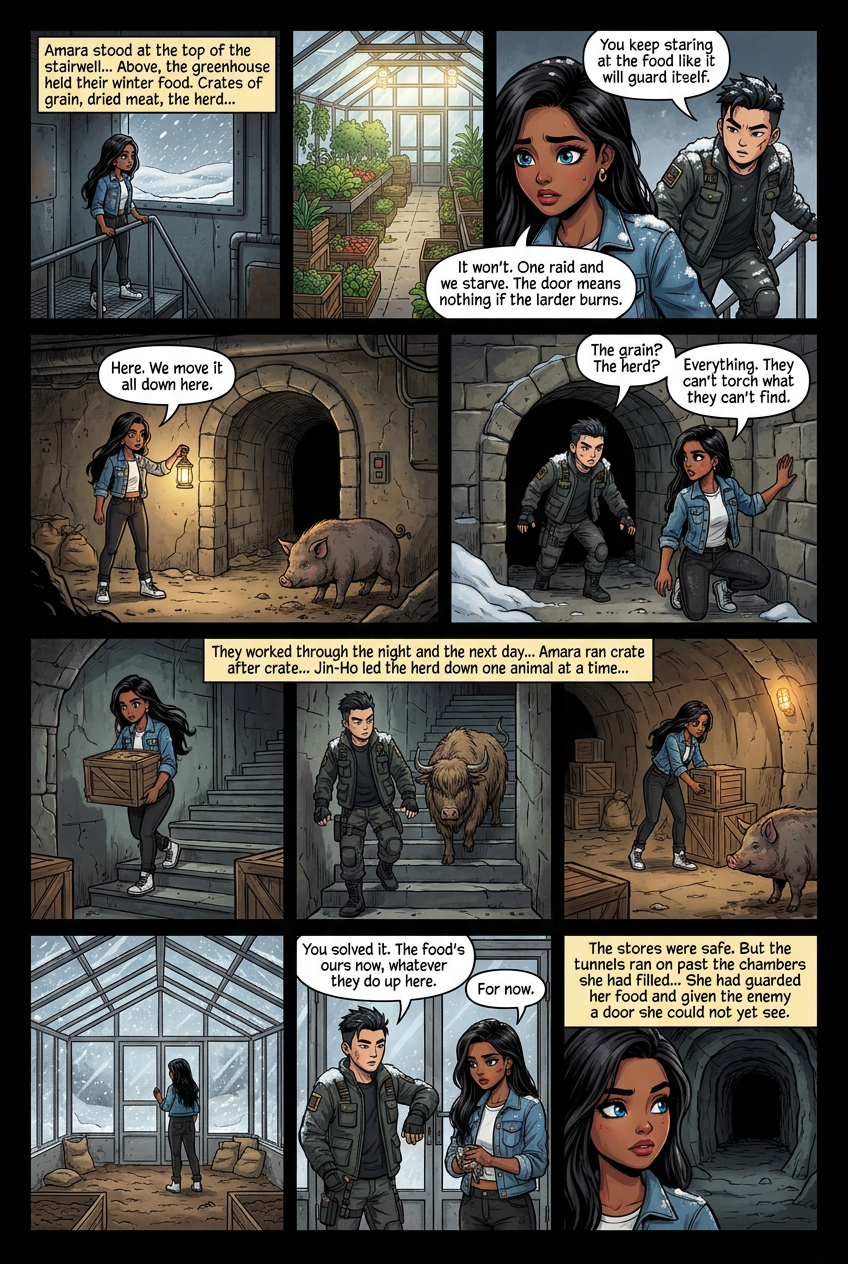
Amara stood at the top of the stairwell as the first storm wind hit the ridge. Below her the camp slept in steel. Above, the greenhouse held their winter food. Crates of grain, dried meat, the herd in the drift. She could hold the door with a single rifle. She could not stop one torch from ending them all. A regime raid would burn the stores while her people watched from below. Jin-Ho climbed up beside her, snow crusting his shoulders. The scar over his eye had gone pale in the cold. He had stood at her side against the old leader, and he read the worry on her face now. "You keep staring at the food like it will guard itself," he said. "It won't," Amara said. "One raid and we starve. The door means nothing if the larder burns." She walked the bunker's lower level with a lamp. Steel gave way to old stone. An arched opening led into a branching run of tunnels, worn and dry. She followed one passage until it forked, then forked again. The air stayed warm. A stout, dusty pig snuffled from a side chamber, rooting at the packed earth. The animal had wandered down and made a home in the dark. Amara stopped. She held the lamp high. "Here," she said. "We move it all down here." Jin-Ho ducked under the arch behind her. "The grain? The herd?" "Everything the regime could burn." She pressed a hand to the stone wall. "They can't torch what they can't find. We leave the greenhouse empty rows and a few thin crates on top. A farm that isn't worth the raid." They worked through the night and the next day. Amara ran crate after crate down the stairwell, past the bunks, into the tunnels. She stacked grain in a dry chamber. She led the herd down one animal at a time, hooves sliding on the steps. The pig watched from its corner. By the second dark, the greenhouse above held only bare soil and a decoy handful of sacks. Amara stood in the empty greenhouse and looked at the glass. Snow hissed against it. If scouts came now, they would find plants and nothing worth the fire. The winter supply sat buried under stone, safe from any torch. Jin-Ho leaned against the door frame. "You solved it," he said. "The food's ours now, whatever they do up here." "For now." Amara wiped the grime from her hands. The stores were safe. But the tunnels ran on past the chambers she had filled, branching into dark she had not walked. She did not know where they ended. If they opened somewhere on the ridge, the regime had a second way in. She had guarded her food and given the enemy a door she could not yet see.
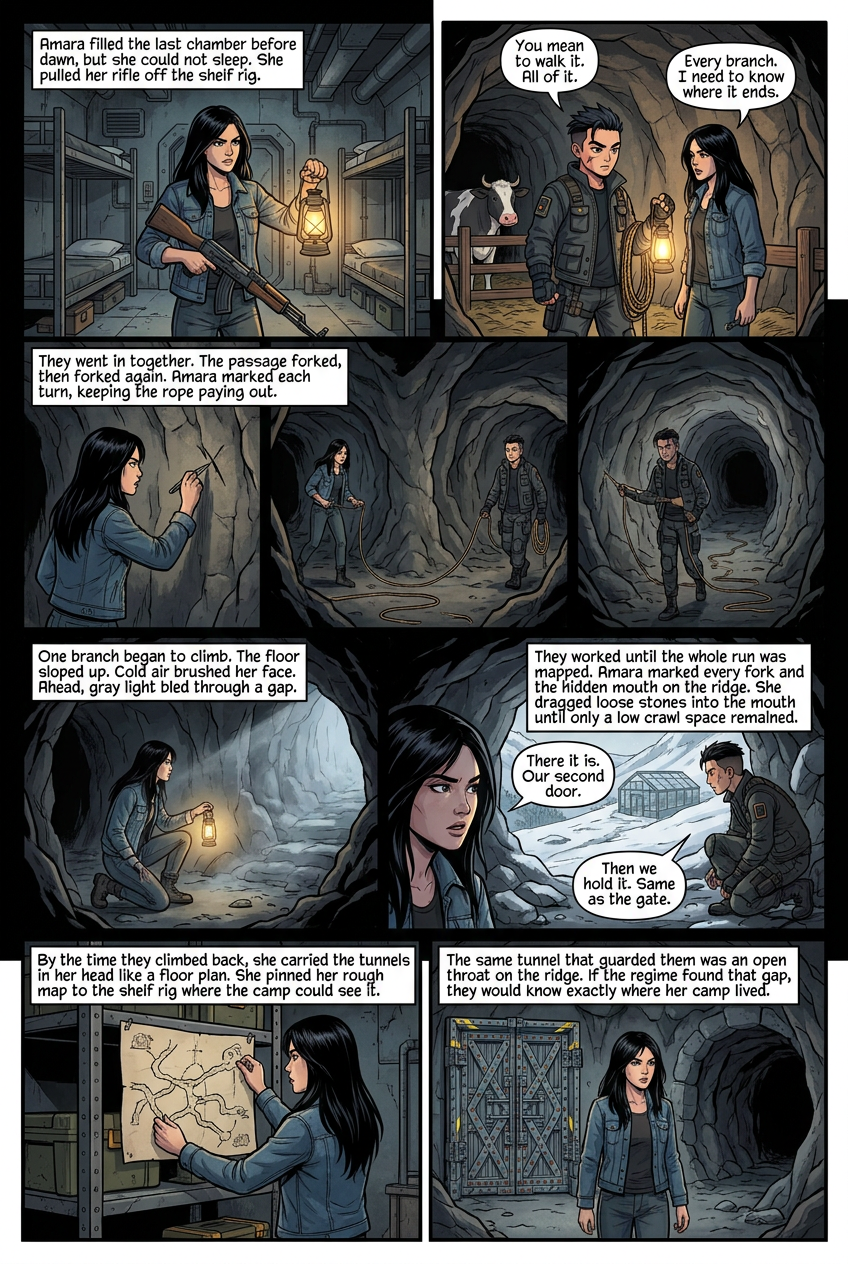
Amara filled the last chamber before dawn, but she could not sleep. The tunnels ran past her stacked grain into dark she had never walked. If they opened somewhere on the ridge, the regime had a door into her camp. She lit a lamp and pulled her rifle off the shelf rig. She would not wait for a patrol to surface among the bunks. Jin-Ho met her at the arch below the animal pens. He carried a coil of rope and a second lamp. The scar over his eye caught the light. He had stood beside her against the old leader, and he did not ask why she was awake. "You mean to walk it," he said. "All of it." "Every branch," Amara said. "I need to know where it ends before someone else finds out first." They went in together. The passage forked, then forked again. Amara marked each turn with a scratch on the stone. The cow lowed once behind them, then the pens fell silent. The air stayed warm and dry. She counted her steps and kept the rope paying out behind her so they could not lose the way back. One branch narrowed and dead-ended in fallen rock. Another circled back to the grain chamber. Amara crossed both off in her head. Then a third passage began to climb. The floor sloped up under her boots. Cold air brushed her face. She stopped and raised the lamp. Ahead, gray light bled through a gap in the stone. Amara killed the flame. She crept up the slope on her hands and knees. The tunnel opened under a snow-heavy bush on the far side of the ridge, well past the greenhouse. Anyone could crawl in. A patrol could reach the bunks without ever touching her defended stairwell. "There it is," she whispered. "Our second door." Jin-Ho crouched beside her and looked out at the empty slope. "Then we hold it," he said. "Same as the gate." Amara studied the narrow gap. A grown man had to crawl through it one at a time. She dragged loose stones into the mouth until only a low crawl space remained. "We don't seal it," she said. "We use it. One rifle here can drop them as they come, single file. And it gives us a way out if the gate ever falls." They worked until the whole run was mapped. Amara marked every fork, every dead end, and the hidden mouth on the ridge. By the time they climbed back to the bunks, she carried the tunnels in her head like a floor plan. She pinned her rough map to the shelf rig where the camp could see it. No patrol could surface among her people now without meeting a gun. But the same tunnel that guarded them was an open throat on the ridge. If the regime found that gap, they would know exactly where her camp lived.
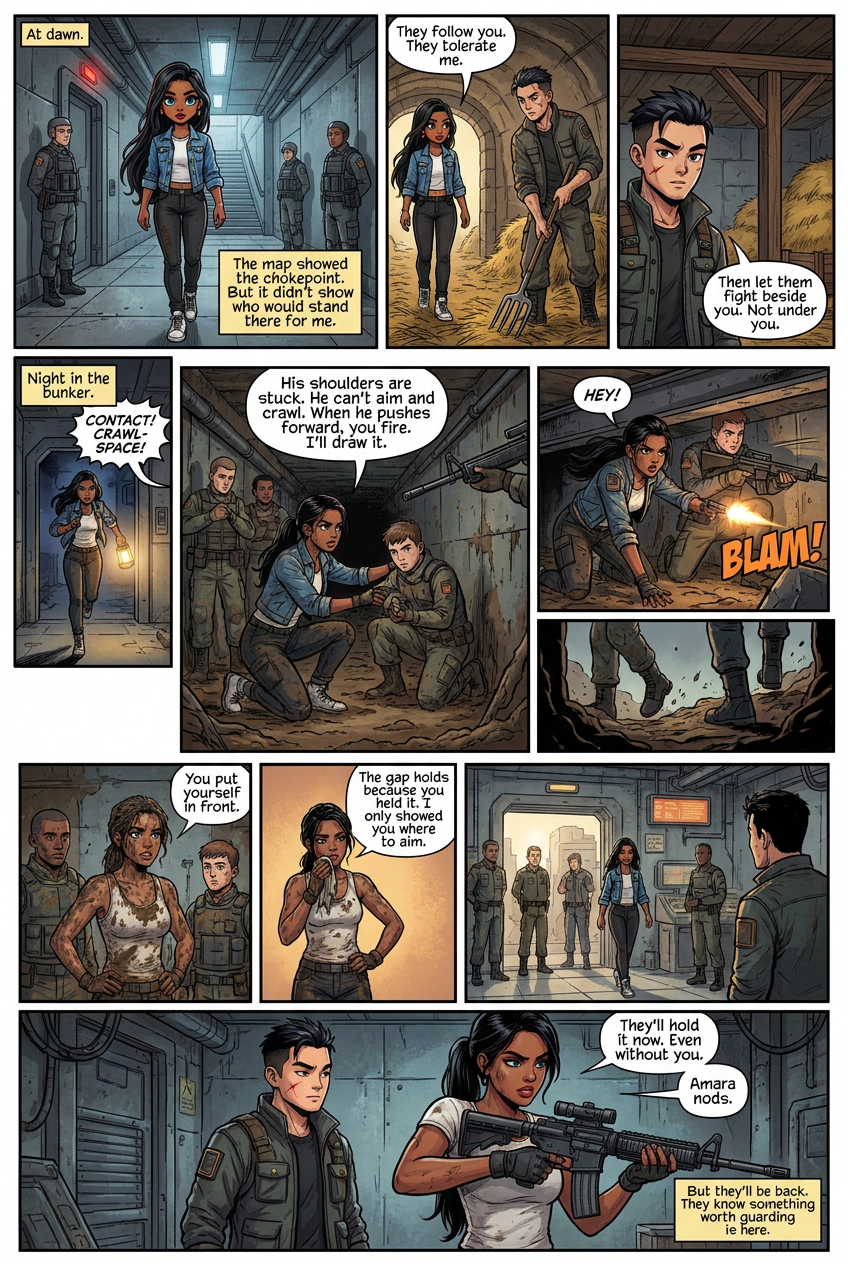
The map on the shelf rig told Amara everything but one thing. It showed the tunnel exit, the chokepoint, the single rifle that could hold it. What it did not show was who would stand there when she was gone. She walked the bunker at dawn and watched the guards at the stairwell. They took her orders. They did not meet her eyes. If a raid came while she slept or fought elsewhere, these men held the throat of her camp. She was not sure they would hold it for her. She found Jin-Ho in the burrow tunnel, forking hay to the herd. The scar over his eye pulled tight as he worked. He had vouched for her three times now. The men trusted him. They still measured her by her height. "They follow you," she said. "They tolerate me." Jin-Ho set the fork down. "Then let them fight beside you. Not under you." That night the alarm came. A guard at the crawl-space exit fired once and shouted. Amara ran the tunnels with her lamp. She found four guards backed against the grain stores. A regime scout had wedged into the crawl space, rifle first. The men had frozen. The chokepoint they were meant to hold was about to break. Amara did not push past them. She knelt in the mud beside the youngest guard and pointed. "His shoulders are stuck," she said. "He can't aim and crawl at once. When he pushes forward, he drops the barrel. You fire then." The guard stared at her. "I'll draw it," she said. "You take the shot." She crawled to the mouth and slapped the stone. The scout swung his rifle toward the sound and heaved forward. His barrel dipped. The young guard fired. The scout slumped in the gap and stopped moving. Behind him, boots scraped and retreated up the ridge. The patrol had turned back. The four guards looked at the dead scout, then at Amara, mud to her elbows, still breathing hard. The young one lowered his rifle. "You put yourself in front," he said. It was not a question. "The gap holds because you held it," Amara said. "I only showed you where to aim." By morning the story had crossed the whole bunker. The guard who fired told it at the food hub, and he told it right. Amara had not stood behind them barking orders. She had crawled into the mud and taken the risk with them. Men who had shrugged at her now nodded when she passed. Two asked her to walk them through the chokepoint again. Jin-Ho found her cleaning her rifle. "They'll hold it now," he said. "Even without you." Amara nodded. But she thought of the boots retreating up the ridge. The scout had died in the gap. His patrol had lived to report it. They knew, now, that something worth guarding sat under this ground.
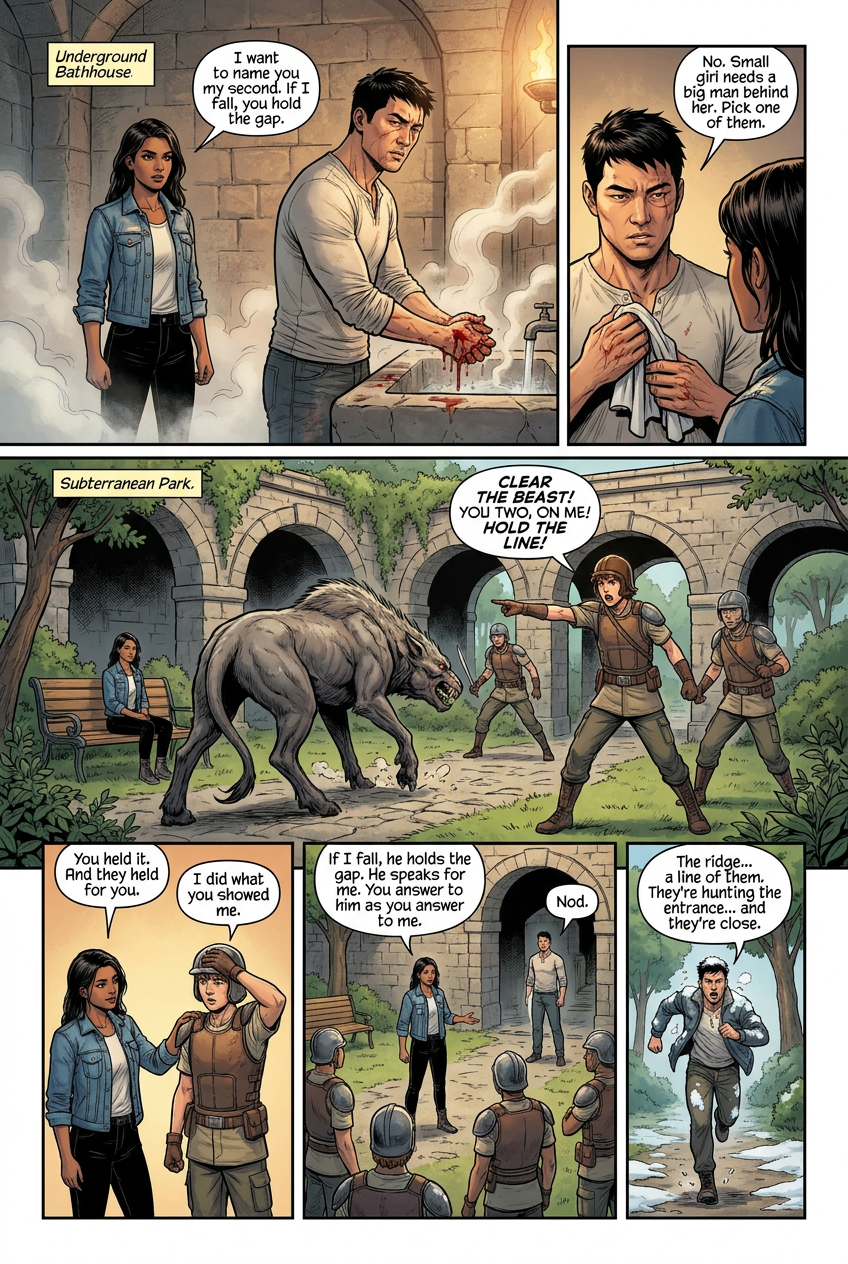
The scout's death sat in Amara's chest all morning. The guards would hold the chokepoint now. But she had learned one thing crawling in that mud: if she fell there, no one would take her place. The men fought beside her. They would not fight for each other without her. She needed a proven second, someone the whole camp would follow if she dropped. She found Jin-Ho in the bathhouse tunnel, washing blood from his knuckles in the stone basin. Steam curled up around him. The scar over his eye caught the lamplight. He was the obvious choice. Everyone already trusted him. "I want to name you my second," she said. "If I fall, you hold the gap." Jin-Ho shook the water from his hands. "No." The answer stopped her. "They follow you." "They follow me because I follow you." He dried his hands on his shirt. "Name me second and you prove their doubt. Small girl needs a big man behind her. Pick one of them." She hated that he was right. She walked the tunnels alone and thought about it. The young guard who took the killing shot was steady but green. The others were older, slower to trust her. She needed proof, not a guess. That afternoon she gathered the guards in the underground park. Green space spread under the carved arches, benches ringed a still pool. She set a test. Not a fight. A drill. She named the young guard to lead a mock defense of the chokepoint while she watched. The old herder brought his sick animal through mid-drill, a stitched creature part goat, part lamb, dragging its hooves. It blocked the passage. The young guard did not freeze. He called two men to clear the beast, held the rest at the mouth, and never left the line uncovered. He gave orders in a clear voice. The men obeyed him without looking to Amara. When the drill ended, she walked to him. "You held it. And they held for you." The guard wiped his brow. "I did what you showed me." "You did more." She raised her voice so all of them heard. "If I fall, he holds the gap. He speaks for me. You answer to him as you answer to me." The men were quiet. Then the oldest one nodded. Then another. No one challenged it. Jin-Ho watched from the arch and gave her a small nod. Amara had her second now. The chokepoint would hold whether she stood there or not. She let herself breathe. A runner came down the stairwell before dusk, still panting from the ridge. He had counted the tracks in the fresh snow above. Not one scout this time. A line of them, spread wide, sweeping the ground in a search pattern. The regime had stopped guessing. They were hunting the entrance now, and they were close.
Play your story to life
Storycraft is a mobile game where you create AI characters, craft items and locations to build their world, then discover what direction your story takes. Download the iOS game for free today!
Download for free